



Abstract
In this essay, I trace how punitive policing in Puerto Rico has deepened existing racial, spatial, and class-based inequalities and further limited life chances for some of Puerto Rico’s most vulnerable citizens. To demonstrate how policing intensified forms of violent exclusion, I focus on mano dura contra el crimen, or iron fist against crime, a law enforcement initiative that sought to eliminate drug-related crime and violence by targeting public housing and other low-income spaces around the island for joint military and police raids during the 1990s. I argue that mano dura promoted an uneven distribution of risk, harm, and death by tacitly allowing the proliferation of violence within economically and racially marginalized communities. Although law enforcement agents engaged in acts of intimidation, harassment, and brutality during mano dura operations, it is perhaps the measures they implemented to concentrate violence in low-income communities that most contributed to the premature death and proximity to harm that barrio and public housing residents experienced. Furthermore, police and other state officials positioned the alarmingly high levels of drug-related violence and death occurring within the confines of these classed and racialized urban spaces as a necessary by-product of the island’s “war on drugs.” Ultimately, police intervention under the auspices of protecting el pueblo puertorriqueño, or the Puerto Rican people, as well as those moments when police deliberately “failed” to prevent violence related to the informal drug economy resulted in greater exposure to harm and death for marginalized communities on the island.
On the morning of January 31, 2012, I met with local activist Giovanni Roberto at La Chiwinha, a small café a few blocks away from the University of Puerto Rico’s main campus in Río Piedras. Over a few cups of tea, he told me about his role in the student mobilizations that shut down the university system for much of the 2010 and 2011 academic years. Giovanni explained the political and economic contexts on the island that drove students to strike for a more equitable and accessible educational system, as well as the incredible violence that students experienced at the hands of police and private security forces determined to “restore order” to the campus. Eventually, our conversation turned to the question of self-defense. Toward the end of the strikes, students were increasingly criticized in the media for fighting back against the police’s use of force as they attempted to subdue the protestors. Images of students in capuchas, or face coverings, aggressively engaging law enforcement officials and committing acts of vandalism circulated widely, souring some Puerto Ricans’ perception of the student movement. When I asked Giovanni about this, without hesitation he said, “I believe in self defense. I believe that students have the right to defend themselves if they feel threatened by cops.”
1
He paused before adding,
And, with what is recently approved [with the police guidelines], a cop can kill you if he or she has the perception that you are dangerous or are going to put their life in danger . . . So, this is turning crazy.
2
Shaping Giovanni’s response that afternoon were the recently announced changes to the guidelines concerning lethal force for the Puerto Rico Police Department (PRPD). On September 5, 2011, the Civil Rights Division of the U.S. Department of Justice (DOJ) issued a damning report that declared the PRPD “broken in a number of fundamental and critical respects.” 3 According to the DOJ report, the PRPD regularly used excessive, and sometimes deadly, force during routine stops and arrests, even when individuals posed no threat or offered minimal resistance. To remedy the PRPD’s unlawful use of force, and what they called a “deliberate indifference to the public’s safety,” the DOJ recommended that the PRPD work toward general standards of accountability by establishing written guidance regarding use of force, making officers aware of effective alternatives to force, offering ongoing professional training, and conducting thorough investigations when force is deployed. 4 Promising to drastically overhaul police procedure regarding the use of force in the wake of the DOJ’s findings and recommendations, the PRPD finally unveiled their response on January 30, 2012, the day before my meeting with Giovanni.
In a perverse twist, the PRPD addressed the DOJ’s concerns over a lack of standardized protocols regarding the use of force by issuing a General Order that allowed for the use of lethal force if an officer has a “reasonable perception” that their life or the life of another is threatened.
5
William Ramírez, director of the local chapter of the American Civil Liberties Union (ACLU), noted that this ambiguously framed order was troubling because an individual officer’s “reasonable perception” of threat is often informed by bias and prejudice. According to Ramírez,
An officer can think that a young, black man coming out of public housing with his hand in his pocket is dangerous. It could be a cell phone or a weapon [in his pocket], but after the officer can say: I shot him because I perceived that I was in danger.
6
Giovanni expressed a similar sentiment during our conversation in La Chiwinha. He noted that police officers, just like many other Puerto Ricans, had been conditioned to associate poverty, blackness, and spatial location with criminality and danger 7 . Indeed, more than two decades of violent police incursions into the island’s low-income and black communities had helped to shape such popular conceptions of danger, while seemingly justifying the need for ever more punitive measures to manage the island’s “dangerous classes.” For Giovanni, the previous day’s announcement that a police officer could justifiably kill you if they believed that you posed some sort of danger merely formalized what had already been long-standing police practice, especially toward the island’s poor and black residents.
Giovanni connected both the recent changes to the PRPD’s lethal force regulations and the deadly racialization of crime to mano dura contra el crimen, or iron fist against crime, an anticrime measure that deployed police and military forces within public housing and other low-income spaces around the island during the 1990s in an effort to eliminate drug trafficking.
8
Giovanni explained,
And that’s what we see, the consequences of wrong politics, of mano dura. It’s not the solution. At the same time, what they’re doing now is increasing [mano dura], because they want to gain more social control. They don’t fucking care if we die or experience violence. They feel secure because they live apart, they don’t hang out in the same spaces that we hang out or live in the same spaces.
9
With this, Giovanni articulated the very central role that policing plays in distributing harm and death according to hierarchies of difference and belonging. Giovanni’s comments also suggested that some Puerto Ricans may tolerate high levels of police violence because that violence is seen as being exercised against dangerous populations that need to be contained and controlled to keep everyone else safe. Still, I wondered, what role exactly did mano dura contra el crimen play in producing and justifying the notion that harm and death were natural, and in some cases desirable, outcomes of police work? In other words, how did policing initiatives like mano dura help bring us to the point where some Puerto Ricans, in Giovanni’s words, “don’t fucking care” if their fellow citizens “die or experience violence”?
In this essay, I trace the emergence of mano dura contra el crimen in Puerto Rico and discuss how it rendered certain populations vulnerable to harm and premature death through logics and practices of dehumanization and criminalization. 10 Rather than providing safety, punitive policing measures such as mano dura have, in many ways, deepened existing societal inequalities and further limited life chances in Puerto Rico’s racially and economically marginalized communities. Punitive logics and measures like mano dura both intentionally and unintentionally perpetuated forms of race- and class-based violence and exclusion, the effects of which continue to be felt in Puerto Rico to this day, as evidenced by Giovanni’s comments. I argue that mano dura promoted an uneven distribution of risk, harm, and death by not only creating situations that fostered an environment of police brutality but also by tacitly allowing the proliferation of violence within economically and racially marginalized communities. While law enforcement agents enacted violence against public housing and barrio residents as part of mano dura contra el crimen, police and other state officials also positioned the alarmingly high levels of drug-related violence and death occurring within the confines of these classed and racialized spaces as a necessary by-product of the island’s “war on drugs.” In this way, police intervention—both police interventions hailed as successful in protecting the Puerto Rican people and those moments when police deliberately failed to prevent violence related to the informal drug economy—resulted in greater exposure to harm and death for racialized and low-income populations.
The case of mano dura contra el crimen in Puerto Rico complicates our understanding of punitive policing and the rise of the carceral state in “American cities” following the Second World War. Puerto Rico, as a colonial territory of the United States, complicates what has become a linear and rather rigid historical narrative that positions the growth of the U.S. carceral state as a direct backlash to the protest movements of the 1960s and 1970s, in particular the civil rights and power movements. 11 How do we grapple with a city like San Juan, an American city, albeit a colonized one, where a hard “punitive turn” took place, but not in response to the same protest movements and forms of social organizing that shaped carceral state on the mainland? How does the history and ongoing reality of American empire complicate well-known and oft-repeated narratives of carceral growth in the United States? 12 This is not to say that policing and correctional supervision did not intensify in many urban areas through the United States in the wake of the civil rights and power movements of the mid-twentieth century. Countless historians and social scientists have shown that such a shift did indeed occur as policy makers sought to “rollback” the gains achieved by progressive and radical social movements. 13 I want to suggest that, rather than locating the emergence of the carceral state and the punitive policing practices that buttress it within a particular historical moment, we must instead emphasize its location within a matrix of historical power relations, such as colonization, capitalist exploitation, and antiblack racism. Rather than positioning Puerto Rico and mano dura contra el crimen as peripheral to our understanding of carceral growth in the United States, centering the island allows for alternative histories of urban policing to emerge.
No Place Is Exempt from Police Presence
The anticrime logics, measures, and rhetoric associated with mano dura contra el crimen arose during a moment of intense insecurity and instability in Puerto Rico. As Cesar Ayala and Rafael Bernabe explain in their history of Puerto Rico during “the American Century,”
Puerto Rico’s economic miracle ended in the mid-1970s. Its economy, plagued by chronic unemployment, has not been able to generate any autonomous dynamic and still depends on the inflow of U.S. capital, while federal welfare funds provide a minimum of relief for the poorer sectors. Sharp social inequalities subsist and the insufficiency of the formal economy fosters the emergence of a significant informal economy, including a thriving illegal drug trade with all its ramifications.
14
Following the collapse of the island’s U.S.-led industrial development program, known as Operation Bootstrap, a volatile informal drug economy took root on the island and contributed to increased rates of violence and crime. By the late 1980s, Puerto Rico was described in the local press as a nation besieged by crime. Fear of carjackings, armed robbery, and stray bullets from drug-related shootouts punctuated everyday conversations and news of bloody “massacres” over puntos [drug points] dominated the headlines. 15 This sense of encroaching crime was, in some ways, exacerbated by the mixed-income layout of Puerto Rico’s built environment, particularly in large urban centers like San Juan and the southern coastal city of Ponce.
Luis Muñoz Marín, who served from 1949 to 1965 as Puerto Rico’s first democratically elected governor, emphasized the need for mixed-income housing and neighborhoods during the height of the island’s industrialization and urbanization efforts. Muñoz Marín believed that if the poor and working classes were placed in close proximity to the middle and upper classes, the latter’s supposedly strong work ethic and morals would help to lift their fellow Puerto Ricans out of poverty. 16 Muñoz Marín’s impact on the built environment not only resulted in drastic socioeconomic difference within close spatial proximity but also reinforced the idea that low-income people were culturally deficient and in need of moral reform. As ethnic studies scholar José I. Fusté notes, through such social and spatial engineering, “The Puerto Rican state has literally cemented the discursive rendering of economically dispossessed Puerto Ricans as incorrigibly ‘disordered.’” 17 This spatial engineering positioned low-income Puerto Ricans, and particularly public housing residents, as social burdens in need of constant surveillance and intervention on the part of the state as well as their fellow citizens. Furthermore, as sociologist Zaire Dinzey-Flores notes, “plans to remove the stigma of public housing by placing it next to neighborhoods of the middle and upper classes backfired by angering those in private housing who feared the stigma would simply spread to them.” 18 While the state sought to increase cross-class spatial proximity in the hopes of turning low-income Puerto Ricans into ideal urban citizens, the middle and upper classes looked toward privatized solutions to maintain social hierarchies of difference and prevent the downward mobility and deterioration they associated with integration. As the informal drug economy expanded over the course of the 1970s and 1980s, leading to rising rates of crime and violence on the island, securitization and crime prevention became sites for the reification of racialized and classed difference articulated through space.
Although the violence associated with the island’s booming informal drug economy was most acutely felt in low-income and predominately black and brown areas of the island, there existed, nonetheless, a prevailing sense that crime was “out of control” and that everyone was at risk. The presumed involvement of low-income Puerto Ricans with the criminalized activities that comprise the island’s informal economy led the upper and middle classes to hold the urban poor largely responsible for rising rates of crime. Furthermore, affluent Puerto Ricans were growing increasingly dissatisfied with the state’s public security efforts, which they felt left them vulnerable to the violence occurring in adjacent low-income communities. With legislative support, middle-class and wealthy Puerto Ricans turned to private security firms to fortify their homes and keep potential threats at bay. On May 20, 1987, the Puerto Rican legislator approved Law 21, known as the Controlled Access Law, which allowed municipalities to grant permits to residential communities that restricted pedestrian and vehicular traffic. These permits allowed for the construction of gates and controlled access points that would monitor entry and exit as a crime control measure. Civilians were encouraged to collude with law enforcement and police their fellow Puerto Ricans as fortified enclaves proliferated in an attempt to identify, screen, and exclude those perceived as dangerous and undesirable. According to anthropologist Ivelisse Rivera-Bonilla, between 1987 and 1997 more than 100 middle- and upper-middle-class San Juan neighborhoods totally or partially restricted street access through the construction of gates and controlled access checkpoints. 19 These changes followed apace in other cities and towns as the fear of crime and violence spread throughout the island. Gates and guards, alongside police interventions in low-income areas, would become central to mano dura’s strategy of containment and isolation of the urban poor as a means of combating crime. 20
Contributing to the general sense of an uncontrollable crime wave was the perception of diminished capacity of the state at the time. As historian Fernando Picó notes, “Nothing better symbolizes the lack of trust in the instruments of the state than the closed urbanizations.” 21 Indeed, the state’s encouragement of controlled access enclosures and other privatized security measures as a way to reduce crime indicated to many Puerto Ricans that they could not and should not depend on the state for protection. According to a poll conducted in 1991 by the local daily newspaper El Nuevo Día, approximately 63 percent of Puerto Ricans had no confidence in the police’s ability to protect them. 22 A series of high-profile attacks on police stations that same year helped to strengthen the public’s perception of a weak state security apparatus. Drug dealers operating out of Las Acacias, a public housing complex across the street from San Juan’s Puerta de Tierra police station, blasted the exterior of the station house with high-powered assault rifles for three consecutive days, leaving the edifice riddled with bullet holes and the police terrified. Police officials responded by putting steel barriers on the windows and minimizing work in open areas to avoid being shot at. The PRPD’s own turn to enclosure in the face of drug-related violence reinforced the general public sentiment that the police were completely ill-equipped to deal with the crime problem. 23
On June 6, 1991, in the wake of escalating skepticism about police performance, 230 officers raided Las Acacias, arresting suspected drug dealers and confiscating drugs and weapons, in an attempt to show the public that, in the words of Police Superintendent Ismael Betancourt Lebrón, “no place in Puerto Rico is exempt from police presence.” 24 After this show of force, however, snipers continued to taunt police by firing upon squad cars and station houses. This targeting of police officers and property by drug dealers gave rise to an epidemic of the “blue flu,” in which scores of demoralized officers called out sick or simply failed to report for work. In November 1991, police once again raided Las Acacias, but this time they did not withdraw. Following the operation, the police established a permanent minicuartel [mini police station] to house officers who would patrol and surveil the complex twenty-four hours a day. Following the blueprint of Las Acacias, on February 26, 1992, police stormed Nemesio Canales in the Hato Rey section of San Juan, which boasted a servi-carro, or drive-through, open-air drug market within yards of police headquarters. Similar to the police in Las Acacias, police followed the operation in Canales by establishing a minicuartel, installing an access checkpoint at the main entrance and building a perimeter gate around the complex. This was the start of a full frontal assault on public housing that would be intensified as a central component of mano dura contra el crimen.
We Wanted to Send a Message
Growing public concern over violence and crime crescendoed at the close of 1991 when Puerto Rico experienced record numbers of robberies, carjackings, assaults, and murders. In the 1992 gubernatorial race, Pedro Rosselló, a former pediatric surgeon, ran on a promise to wield a mano dura against crime. Rosselló pledged to institute a series of legal reforms and new law enforcement policies including increasing the number of police by 50 percent, allocating more funds to the police department, limiting the constitutional right to bail, federalizing crimes involving a firearm (thereby making them eligible for the federal death penalty), and possibly even activating the Puerto Rican National Guard to help combat the crime wave assailing the island.
25
Rosselló seized upon the “talk of crime” that was circulating among citizens and in the popular media to cement his position as a law-and-order candidate.
26
He justified his drastic approach by positioning violent crime as infiltrating all aspects of daily life and touching every family on the island. Rosselló declared,
We live in a Puerto Rico where every day more Puerto Ricans are killed, and where even in our own homes our families are not safe. In essence, we are living in a crisis, an emergency. Faced with this crisis we must act firmly, with extraordinary measures.
27
Rosselló’s rhetoric redefined daily life on the island as one marked by victimization or potential victimization at the hands of violent criminals. Rosselló’s rhetorical reconceptualization of the citizen as a victim of crime not only redefined the legal process and the appropriate conditions for government intervention but created consensus by appealing to existing hierarchies of value regarding who is worthy of state protection. 28 Rosselló’s promises of a swift, mano dura approach to crime provided populist cover for an increasing fortification of the urban landscape driven by racist and classist underpinnings at the same time that it marked criminalized populations as outside of the bounds of appropriate citizenship and, ultimately, as dangers to the nation.
Shortly after Rosselló was elected governor, he and police superintendent Pedro Toledo unveiled Operation Centurion, the most visible component of mano dura contra el crimen in which they deployed the National Guard to assist in civilian policing efforts. On February 25, 1993, Rosselló signed an Executive Order activating the Puerto Rican National Guard to assist police in maintaining public security and quelling drug-related crime. 29 According to Rosselló, the National Guard was being underutilized and could provide police with the essential technological assistance and extra manpower needed to win the war against drugs. The National Guard “is not here,” Rosselló emphasized, “to prevent the Russians from invading us, but to fight the enemies of Puerto Rico . . . and the worst enemy Puerto Rico has is crime.” 30 With this comment, Rosselló not only captured the shift in risk assessment following the end of the Cold War, which cast drug trafficking as one of the most serious threats to global security, but also solidified the notion of criminals as internal enemies of the state.
During the last weekend of May 1993, National Guard soldiers were deployed to patrol public recreational areas, including beaches, movie theaters, and shopping centers. According to the Adjutant General of the Puerto Rico National Guard, Emilio Díaz-Colón, the sight of armed military personnel in fatigues patrolling the ritzy streets of Condado and corridors of Plaza Las Américas, the island’s largest shopping center, was supposed to “send a message to the people that we want to protect the citizens of Puerto Rico.” 31 Similarly, Police Superintendent Toledo remarked, “We wanted to send the message to the people of Puerto Rico that we meant business, that we wanted to protect them, that we would use all the resources that we had to protect the people from criminals.” 32 Although Operation Centurion was first unveiled within the island’s elite spaces of consumption and leisure, it would soon become concentrated in public housing and other racialized, low-income spaces as police raided an occupied supposed drug “hot spots.” And, from the beginning, that had been the plan.
Four days prior to the signing of the Executive Order authorizing the National Guard’s activation, guardsmen and police were already preparing to do battle in the island’s racially and economically marginalized communities. On February 19, 1993, approximately 100 police officers and National Guard soldiers participated in a simulated raid of a public housing complex at the Police Academy in Gurabo. 33 Soon thereafter, Rosselló and Toledo confirmed that the island’s public housing projects were to be the primary target for the joint military–police interventions because they housed many of the island’s drug distribution spots, which were seen as the principal generator of crime and violence. 34 The training exercises carried out at the police academy were put into practice on June 5, 1993, when police and National Guard forces occupied the Villa España public housing complex. The predawn raid at Villa España was the first of approximately eighty-two raids carried out between June 1993 and March 1999. 35 During these raids, police conducted searches, confiscated contraband, and interrogated residents while the National Guard provided logistical and tactical support in the form of soldiers, helicopters, military vehicles, technology, and weapons. The National Guard was also responsible for setting up surveillance, establishing checkpoints, and constructing a perimeter fence around the newly occupied housing complex. The police and National Guard soldiers occupied these public housing complexes for weeks, even months, until a security force of part-time police and private security guards were able to set up a permanent presence.
The perimeter fences built during mano dura incursions into public housing, coupled with the simultaneous rise in private gated communities, further enclosed low-income Puerto Ricans and concentrated the violence of the island’s war on drugs. It also put on full display the explicitly racialized and classed dimensions of state crime control efforts on the island. There were clear differences between the reasons behind installing controlled access gates in middle- and upper-class urbanizaciones and the purpose of the gates installed in public housing complexes in the aftermath of the raids. Criminologist Lina Torres argues,
In public housing, controlled access is so that people from the projects don’t leave and in the urbanizaciones it’s so they [people from public housing] don’t enter. They have different meanings because controlled access results in a state of siege, practically turning public housing into a prison.
36
Unlike the gating of urbanizaciones, the gating of public housing did not come at the request of residents, but rather was dictated by the Puerto Rican government, in effect violating the Controlled Access Law. According to the Controlled Access Law, before a community is gated, the majority of residents must first agree to the gating, the municipality is required to hold hearings, and traffic studies must be conducted. However, the Puerto Rican government was able to side step such legal restrictions by citing immediate public safety concerns. 37
Combined with the booming security industry, the interventions associated with mano dura transformed the island’s physical landscape, turning urban centers into walled cities and eliminating many possibilities for cross-class and cross-racial interaction. According to Zaire Dinzey-Flores, “Gated housing for the poor and the affluent has fostered a formal division of communities and has broken contact across class and race.” 38 Regardless of class status, as a result of mano dura, more and more Puerto Ricans found themselves sequestered behind gates and the logic of spatial separation became further entrenched in the Puerto Rican social imagination. The war on drugs waged by the Rosselló administration was implicitly a war on social contact zones. The overt race and class bias embedded within mano dura policing are perhaps best illustrated by a scandal that erupted shortly after the raids began. While soldiers and police were busting down doors in public housing to search for drugs and weapons, police were sending affluent drug users polite letters telling them that their cars were spotted in “dangerous areas” and that they should stay away for their own safety. 39 Explaining the campaign, Police Superintendent Toledo said that the lawyers and doctors whose luxury cars were seen in the proximity to public housing deserved to be warned because they might have driven by “innocently.” 40 This incident confirmed for public housing residents, as well as social justice activists, civil rights attorneys, and other sympathetic observers, that mano dura contra el crimen had less to do with stamping out the drug trade and more with using targeted policing to managing the threat of violence written onto public housing residents through racist and classist assumptions.
Rosselló dismissed the various concerns about discrimination and civil rights violations that arose over the course the operations . He charged his critics of colluding with the criminal element, calling such allegations
a strategy to get us to stand around with our arms crossed; it’s a strategy to get us to do nothing. It is a strategy that simply may be promoting the criminal element because, for whom is this not convenient? This is not convenient for the criminal.
41
On June 5, 1993, during a meeting between residents of Villa España and representatives from various government agencies following the raid, Joaquina Cruz Pizarro, President of the Villa España Residents’ Council, brought up the harassment experienced by residents during the raid. She said, “Today they broke 42 doors, and there are children here. This isn’t a zoo. They had the right to search but not to hurt people.”
42
Later, during a press conference and in reference to complaints about the police unnecessarily breaking down apartment doors, terrorizing residents, and conducting illegal searches, Rosselló responded,
I don’t understand how anyone in Puerto Rico can make such superficial objections regarding an action that the majority of people have demanded. If we have to break down 37 doors or break down 74 doors to bring peace to the Puerto Rican family we are going to keep doing it.
43
Rosselló attempted to fold critiques of his crime-fighting approach back onto themselves by accusing people of being more invested in critiquing his administration and protecting the rights of criminals than truly improving the lives of public housing residents who were being affected by drug-related crime and gang violence. Rosselló attributed critiques of mano dura to criminals and radicals, who had no attachment to the low-income communities they were ostensibly interested in defending. In doing so, Rosselló dismissed the very real apprehensions and objections coming from public housing residents, as well as concerned members of the public, about the corruption and violence that accompanied these militarized interventions.
I Remember There Was a Lot of Abuse
As the joint police and National Guard interventions spread to public housing complexes around the island, reports from residents and legal observers of excessive force, impropriety, and illegality on the part of soldiers and police began to circulate through the island’s news outlets. Residents spoke about officers quick to hassle tenants and their guests and even quicker to pull their sidearm. León Santiago, a resident of Las Gladiolas in San Juan, said, recalling his military service, “I was a platoon sergeant in Vietnam, and when we entered villages we never pointed our guns at civilians—and that was a war.” 44 Santiago’s comments highlight the ways in which a war waged against drugs transformed into a literal war on economically marginalized populations, particularly young people living in public housing. Juan José Pérez, a resident of the Monte Hatillo public housing complex in Río Piedras, recalled, “I remember there was a lot of abuse. The National Guard didn’t know how to treat people. They would step on 13 and 15-year-old boys with their boots, and if you said anything they would stomp on you harder.” 45 Carmelo Zambrana, a resident of Las Gladiolas, remarked following raids there: “Civil rights violations against residents are especially bad. We get stopped and searched without cause all the time.” 46
Children and teenagers experienced a disproportionate exposure to illegal searches and harassment at the hands of the police, in part because dealers sometimes employed minors as drug mules due to less stringent juvenile sentencing laws. This perception of public housing youth as little more than potential mules made them particularly vulnerable targets of police power during the police occupations of public housing. For instance, residents reported that police officers would stop children on the way home from school without pretense or justification, and force them to open their backpacks to see whether they were transporting drugs. José Luis Rivera, a resident of La Perla, a low-income community in Old San Juan that was raided by police during March 1994, complained, “When kids come out of school at 3, they search them. Why? They’re not selling drugs.” 47 A particularly stark example occurred during the March 2, 1994, takeover of El Trebol, a public housing complex in Carolina, when police detained two young boys and a young girl, forcing the two boys to lie face down on the ground while the young girl sat beside them leaned against a wall. The youth stayed like this for an hour-and-a-half until a reporter on the scene finally asked Superintendent Toledo why the three were on the floor and flanked by heavily armed police. The Superintendent asked one of the attending officers whether the youths had been found with drugs and, when the officer admitted that they had not, released them. 48 One has to wonder how many times scenes like this played out when the press was not around to document and question it.
Residents also reported instances when police unnecessarily drew and discharged their service weapons, intimidating and occasionally injuring residents. In February 1995, following the police occupation of Las Gladiolas, Ada Estel Morales heard a commotion coming from the ground floor of the complex. Morales peered over the railing of her balcony on the eleventh floor to see whether her son “was involved in the bochinche [ruckus].” Instead of her son, she caught sight of a friend engaged in a heated argument with a police officer. As Morales continued to watch the events unfold, she suddenly heard a few shots ring out: “I don’t know where they came from. That’s when the officer took out his gun and shot wildly into the air.” 49 One of the bullets fired from the officer’s gun wounded Morales, striking her in the bladder: “I spent four weeks in intensive care at Centro Medico. And now I have to use this bag to go to the bathroom,” she told reporters following the shooting. 50 Rosselló and Toledo responded to incidents like this by casting them as anomalous and urging public housing residents to see police and guardsmen stationed in public housing as a community resource rather than an occupying force.
The murder by an on-duty police officer of twenty-two-year-old José Rosario Díaz, a resident of the José Celso Barbosa housing project in Bayamón, highlighted the deadly contradictions of “community policing” that mano dura represented. Police and National Guard forces occupied the Barbosa public housing complex in Bayamón on June 8, 1993. Following the raid at Barbosa, like at many other projects, National Guard constructed a perimeter fence around the complex and a police-manned controlled access entrance was established. On September 8, 1993, exactly three months after the initial occupation and barely a week after the withdrawal of the National Guard from the complex, Police Officer Miguel Díaz Martínez was assigned to guard duty at Barbosa’s vehicle-only controlled access entrance. When twenty-two-year-old José Rosario Díaz arrived home from work that evening, he was stopped by Officer Díaz Martínez and asked for his identification to enter the complex. Rosario Díaz explained that he lived in an apartment with his grandmother, Bienvenida Lafontaine, but did not have his identification on him. Rosario Díaz asked the officer to let him enter his apartment to retrieve the necessary identification. Officer Díaz Martínez refused and the two began arguing. Hearing the commotion, Rosario Díaz’s sister, María Rosario Díaz, and aunt, Rosario María del Pilar Ramos, walked over to the guardhouse, which was near their apartment, to try to reason with the officer. Officer Díaz Martínez claimed that Rosario Díaz then physically assaulted him, although eyewitness accounts from Barbosa residents claimed that the officer verbally assaulted Rosario Díaz’s sister María and shoved her to the ground. Residents reported that, when Rosario Díaz approached the officer in an attempt to protect his sister, Díaz Martínez took out his service revolver, pushed it into Rosario Díaz’s chest, and pulled the trigger. Díaz Martínez then shot María Rosario Díaz in her right leg. After shooting both siblings, Díaz Martínez pointed his revolver at their aunt, struck her, and threw her to the ground. Following the tragic incident, residents noted that the officer had acted out violently before but remained on active duty at the housing complex. Indeed, this was only one in a string of brutal acts that punctuated Officer Díaz Martínez’s career.
Over a span of five years, Díaz Martínez engaged in numerous acts of violence toward civilians and fellow law enforcement officers but was returned to duty time and time again despite being designated a danger to himself and others. In 1989, Díaz Martínez suspected that his wife, who was a fellow police officer, was cheating with a colleague. In a fit of jealous rage, he viciously beat her and then took over a police station in Cataño, where he held several police officials hostage, including the acting police superintendent. After that incident, Díaz Martínez was involuntarily committed to a psychiatric hospital and diagnosed as schizophrenic. He was suspended from the force in 1990 and formally expelled in 1991. After appeals to the Police Review Board, Díaz Martínez was found “fit for duty” and reinstated to the force in 1993. It was mere months later that Díaz Martínez fatally shot José Rosario Díaz and seriously wounded his sister, María Rosario Díaz. Despite Díaz Martínez’s clear instability, he remained on the force for several months after he shot the Rosario Díaz siblings. He retained his position until May 1994, when he brutally beat Grancid Camilo-Robles, a security guard working at the courthouse in Bayamón, after being told he could not park in a spot reserved for judges. 51
Díaz Martínez was definitely a “bad apple,” but according to journalist Milvia Y. Archilla Rivera, he was far from the only one:
Distressingly, about 300 police officers have been reinstated to the force with diagnoses and situations similar to Díaz. This is a part of the premise of mano dura contra el crimen’s policy, which mandates the reintegration of officers into the street. However, many of the officers on administrative duty were given that placement due to psychological reasons.
52
The plan to flood the island’s zonas calientes, or hot spots, with police and military personnel as a way of managing crime means that police and government officials took few safeguards to prevent officers with documented histories of violence or mental health issues from being placed in close proximity to citizens during what were highly antagonistic and stressful situations. Mano dura’s strategy of putting more officers in low-income communities exposed residents to exponentially increased verbal, psychological, and physical violence.
Perhaps one of the least examined aspects of the mano dura interventions are the instances of sexual violence and impropriety that reportedly accompanied the early morning raids and subsequent occupation of public housing complexes around the island. While only one accusation of rape associated with the mano dura operations was ever officially reported, in a case which was eventually dismissed in court, public housing residents and individuals who worked with public housing residents say that sexual contact, both consensual and forced, was common during the operations. As there are no “official” accounts, these stories often take the form of hearsay and informal testimonies. Criminologist Dora Nevares-Muñiz notes, “Among the problems that residents themselves mention is that most of what the officers do is chase women and intervening with drug points the least of what they do.”
53
Drawing from conversations with Hector Perez, then copresident of the ACLU chapter in Puerto Rico, Nkechi Taifa, Legislative Counsel for the ACLU, relayed to a congressional subcommittee that “flirtations with females have been a growing problem” among guardsmen and police officers stationed in Puerto Rico’s public housing complexes.
54
Similarly, civil right attorney Judith Berkan remarked that during the raids, it was commonplace for guardsmen and police to “take up with women in the projects” and it was not unusual to see uniforms being hung out to dry on project balconies.
55
She noted,
in the worst of lawlessness it devolves into rape and mass rape . . . but, even in a less virulent occupation, it’s pretty typical to have the military taking up with the local women and that’s what we were seeing.
56
While reports of sexual contact between police and military officials and public housing residents from the mano dura era are scant, in 2010, when Governor Luis Fortuño activated the National Guard in the face of rising crime rates and civil unrest, a number of residents came forward about the abuse they witnessed and suffered during the 1990s, including accounts of sexual impropriety. In interviews conducted by reporters from El Nuevo Día, residents spoke openly about the routine sexual contact between residents and the PRPD and National Guard personnel stationed to public housing. According to Orlando Rosario, a community organizer associated with the Jardines de Country Club public housing complex:
Numerous women ended up pregnant by police and National Guard soldiers . . . That occurred in all the projects that were occupied. I was a national community leader and I had to visit projects throughout the island and I saw hundreds of women pregnant because of those men. Weren’t they there to ensure people’s safety? Why did women end up pregnant?
57
Likewise, public housing resident Tomasa Rodríguez lamented, “In Monte Hatillo there are many children without last names. The women fell in love and ended up pregnant and the fathers never returned. It’s terrible what happened to those women and those children.” 58 Although many of these sexual relationships were, in all likelihood, consensual, these examples, along with accounts of intimidation, abuse, and corruption, demonstrate the impunity that police and guardsmen enjoyed during their occupations of public housing and the growing vulnerability that public housing residents experienced as a result.
Make the Rats Scatter
It is clear that the police actions in public housing and other low-income areas associated with mano dura contra el crimen contributed to greater levels of harm for racially and economically marginalized Puerto Ricans. However, beyond the instances of beatings and shootings, mano dura contributed to increased rates of violence in a much more insidious way by concentrating death and violence within low-income communities through both police action and inaction. This aspect of mano dura reveals the dangerous logic of elimination that continues to haunt policing on the island, which Giovanni Roberto alluded to during our conversation almost two decades later.
One year after the implementation of mano dura contra el crimen, Governor Rosselló and Police Superintendent Toledo could be seen in the press almost daily touting the successes of their tough-on-crime approach. They boasted of decreases in the number of carjackings, assaults, and property crimes (Table 1), and assured the public that the fight against drugs and crime was being won with every public housing project occupied and every punto dismantled. The daily lived experiences of many Puerto Ricans, particularly those living in economically and racially marginalized areas, however, reflected a very different reality. While mano dura may have resulted in an overall decrease in many crimes, it provoked an increase in homicides. Puerto Rico’s murder rate had climbed to 864 recorded murders in 1992, and the implementation of mano dura drove the homicide rate even higher. In 1994, Puerto Rico recorded 995 murders, the most in the country’s history, and the murder rate did not drop significantly below 1992’s alarming number until 1997.
Delitos Tipo 1 Recorded in Puerto Rico, 1990-2000.

Source: Junta de Planificación de Puerto Rico, “Informe Social: Criminalidad en Puerto Rico años seleccionados” (Mayo 2003).
Furthermore, criminologists and demographers have suggested that the number of homicides during the mid-1990s was actually significantly higher, but police manipulated statistics to support the story of mano dura’s success. In their study of homicides in Puerto Rico, Judith Rodríguez and Alma Irizarry demonstrate that in the years immediately following the implementation of mano dura contra el crimen, the number of murders registered with the police was significantly lower than those documented by the Department of Health (Table 2). 59 As Rosselló’s administration and police officials celebrated the safer Puerto Rico achieved by mano dura contra el crimen, images of young men slain in turf wars haunted the nightly news and provided stark reminders of the intense vulnerability and proximity to violence that some Puerto Ricans continued to experience.
Discrepancies in the Reporting of Homicides in Puerto Rico, 1990-2000.
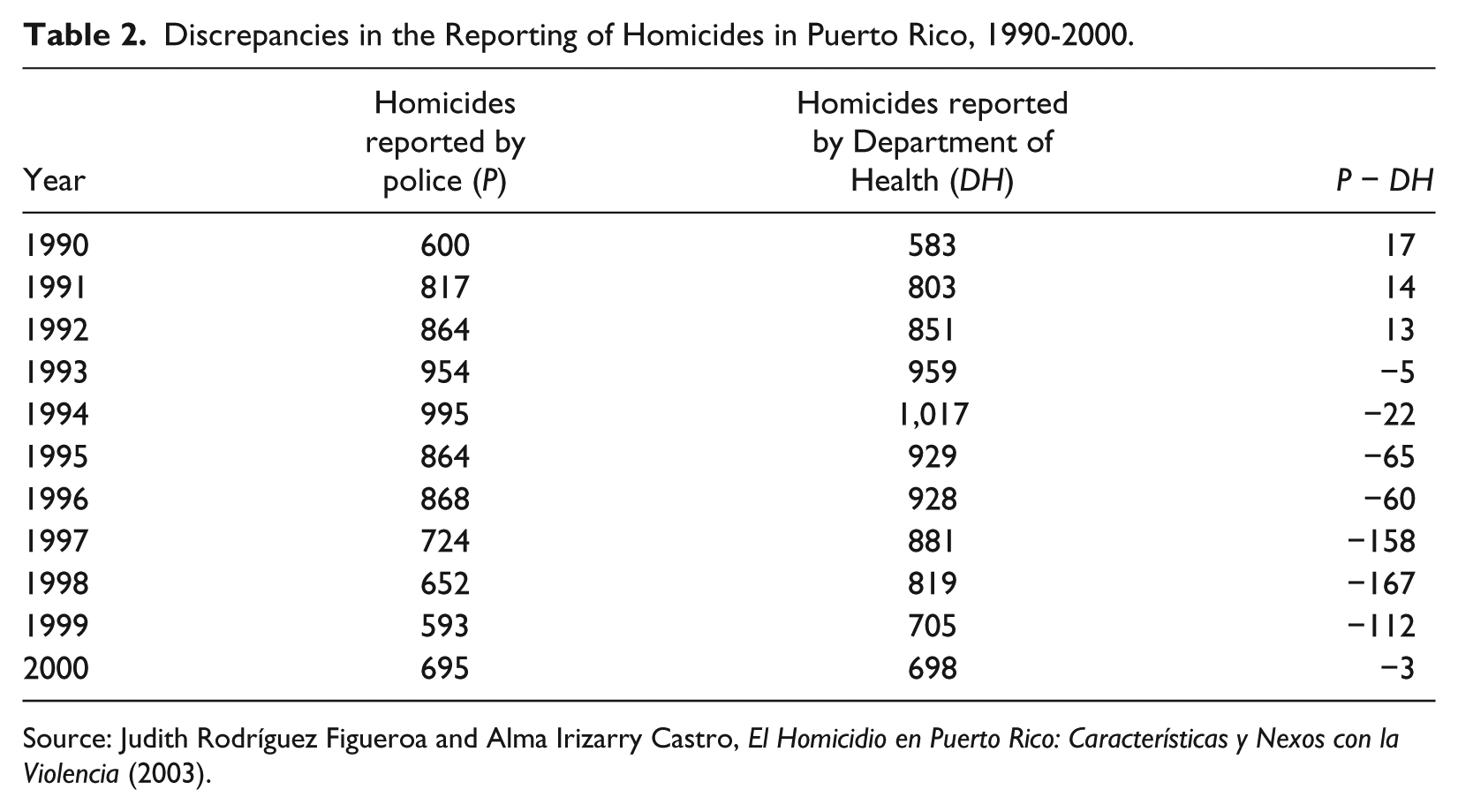
Source: Judith Rodríguez Figueroa and Alma Irizarry Castro, El Homicidio en Puerto Rico: Características y Nexos con la Violencia (2003).
Mano dura contra el crimen did not make the streets any safer in low-income and racialized areas but rather maintained and contributed to high levels of violence during the height of police intervention into the drug trade. Police and military intervention resulted in increased drug-related homicides and violence, especially in 1993 and 1994, as incursions into public housing and low-income barrios disrupted the normal drug trade. Police intervention and arrests resulted in abandoned puntos, which led to violent competition among dealers for these newly available spaces. In 1994, following raids in the working-class community of La Perla and the Llorens Torres and Nemesio Canales public housing complexes, which displaced dealers and led them to compete over control of puntos, murders multiplied in the adjacent areas of Old San Juan, Punto Las Marías, and West Hato Rey 60 . As dealers were locked up or killed, the street price of narcotics increased to cover the new costs of doing business. In 1995, the constant drug raids triggered a scarcity of cocaine, driving the street price up from US$10 to US$30 a gram and provoking desperation on both the part of dealers and users, which, in turn, contributed to more violence and crime. 61
While public feelings and official discourse trafficked in the assumption that drugs and violence were at every turn, the effects of drugs and violence in the wake of the raids remained overwhelmingly concentrated in low-income and racialized urban areas, and the movement of drug points continued to follow well-established patterns of spatial inequality and social abandonment. In other words, while a few enterprising dealers and gangs struck out and expanded into entirely new territory in an effort to stay ahead of the raids, most dealers moved around within already established circuits of the drug market—spaces that were becoming smaller, scarcer, and deadlier with each subsequent police intervention. 62 It is important to note that this phenomenon is not unique to Puerto Rico. “Ghetto sweeps,” which sought to apply increasing pressure on drug dealers and users operating within public housing and low-income, predominately black communities, proliferated during the 1980s and 1990s. With names like Operation Hammer (Los Angeles), Operation Pressure Point (New York City), Operation Sting (Miami), Operation Snow Ball (Orange County, California), and Operation Clean Sweep (Washington, D.C.), these drug raids provoked tremendous violence with no evidence, or negligible evidence, that drug use and dealing decreased in response. 63 Puerto Rico’s mano dura contra el crimen, therefore, exists in relationship to a larger pattern of discriminatory and violent policing that marked the U.S.-led global war on drugs.
Police pointed to the constant movement of drug dealers from punto to punto as evidence of mano dura’s success. According to police officials, one of the goals of these raids was to eliminate drug trafficking not only by disarticulating the puntos but by making puntos increasingly difficult for dealers to operate and maintain, thus forcing them to move around and engage in bloody battles over territory. Police knew that the pressure of constant raids would result in more competition between the gangs and therefore more murders, but they positioned this increased violence as a necessary evil in their efforts to eradicate drug dealing and restore a sense of peace to the “decent” people of Puerto Rico.
64
As police superintendent Pedro Toledo put it,
There could be an increase in gangland killings as puntos are eliminated. However, we’ll continue to hit them wherever they go, keep them on the move, make it tough for them until they have to give up and go out of business.
65
Part of mano dura contra el crimen’s strategy of controlling drug trafficking and drug-related violence on the island, then, included the tacit acceptance of continued and, indeed, elevated levels of harm and death directed at low-income and racialized individuals, particularly the poor, young black and brown men who labored in the informal economy. No only did state officials tolerate their deaths—or, let them die in the Foucauldian sense—but their strategy of promoting and exacerbating the already tense competition over puntos created conditions that positioned violence and death as necessary outcomes of police intervention. That mano dura would drive up the death toll among individuals involved with the drug economy was, for policy makers, in many ways, a foregone conclusion. 66 Said differently, the deaths that mano dura ostensibly prevented, or sought to prevent, were not the deaths of those involved in the informal economy and that was not necessarily the intention. While there is no clear evidence that the state actively planned to harm or kill individuals associated with the informal drug economy through police intervention, it is clear that state officials knew that mano dura would provoke more deaths. While, in a strict sense, the state may not have premeditated their deaths, it did deliberately advance informal and formal policies that “let” these alleged dealers die. Regardless of intent, mano dura provoked and naturalized death as a possible outcome of drug enforcement efforts. 67
Racial, spatial, and economic inequality are among the structural forces that enabled and contributed to the discriminatory and harmful logics that drove mano dura contra el crimen. In mano dura coalesced a history of colonial population management, intense antiblack racism, capitalist exploitation, and urban enclosure. These processes defined the mostly young black and brown men from public housing and barrios who labored in the island’s drug economy as threats to el pueblo puertorriqueño that needed to be contained at costs. As puntos moved either in anticipation of raids or in their wake, violence often followed as dealers attempted to maintain a grip on their slice of the drug trade. Capt. Charles Pérez, commander of the Barrio Obrero police precinct, which had seen a rise in homicides due to displaced dealers moving into the area, said, “It’s like when you move into an old house that’s full of rats. What happens when you move in? The rats go running out all over the place.” 68 While Capt. Pérez’s metaphor attempted to capture the mercurial nature of the puntos and their mobility, he inadvertently elucidated mano dura’s prevailing logic of dehumanization and disposability that allowed and even encouraged drug dealers to eliminate each other. The idea that criminals and drug dealers were outside the bounds of normative Puerto Rican society—rats—guided the logic of mano dura and justified the brutal force utilized during the incursions. This logic also shaped the deliberate action and inaction on the part of law enforcement and politicians in the face of an increasingly volatile drug economy affecting some of island’s most vulnerable communities. As governor Rosselló regularly told the people of Puerto Rico, “habitual criminals” were nothing but “garbage,” killing the island’s youth with drugs. 69 In Puerto Rico, a political and popular rhetoric that dehumanized and vilified drug dealers and users as “monsters,” “animals,” and “garbage” and positioned them as a threat to el pueblo puertorriqueño allowed for the creation of law enforcement policies that cultivated some lives at the expense of others. The devaluation of those lives and deaths naturalized the uneven distribution of opportunity and harm and reinforced the notion that not all lives are livable nor are all deaths grievable. 70
Conclusion
Although mano dura was constructed as an effort to “rescue” Puerto Ricans from violence, crime, and drugs, it functioned in a way that concentrated violence within low-income and racialized communities and exposed residents to greater harm at the hands of both police and their fellow citizens. Residents regularly pointed out the ways that mano dura had not improved their lives and, in particular, had failed to improve the lives of those young men from the barrios and public housing who spent their days and nights working at the puntos. It is this aspect of the drug economy—the labor performed and the income generated—that mano dura disrupted and sought to eliminate in low-income communities without providing an alternative that would address the underlying structural concerns that made working at the puntos an attractive option in a post–“Operation Bootstrap” Puerto Rico. Six months after the National Guard and Police occupied Villa España, Joaquina Cruz Pizarro, President of the Villa España Residents’ Council, pointed out that the government had done nothing to address the rampant unemployment that drove many young people to look for work at the punto, nor had they provided any meaningful alternatives to drug dealing following the raids. According to Cruz,
When they destroyed the drug spot, they should have known there was going to be more unemployment, because like it or not, it provided jobs—seven to three, three to eleven, eleven to seven. In shifts—that’s just how simple it is. And the dealers had to be on time, clean, and drug-free, just like a real job. Now I have 14 to 17 year-olds who aren’t addicts who lost their jobs and want to work. But who is going to give them a job? If the governor had studied that problem then maybe this policy would have worked differently, because now we’re in a crisis.
71
One year after the raids at Villa España, Cruz explicitly tied the government’s failure to address the needs of Puerto Rican youth, particularly those from public housing, to the steady cadence of murders that the island continued to experience. “That’s why the murders haven’t stopped,” Cruz noted. “Those unemployed kids are going to look for a dollar anywhere they can get it . . . they [the government] haven’t fulfilled their economic necessities.” 72 While mano dura might have been touted as the salvation for communities in peril, it actually exacerbated the structural conditions that contributed to the explosive informal economy.
Mano dura contra el crimen demonstrates the ways in which punitive policing intentionally and unintentionally contributes to harm in marginalized communities by advancing discriminatory and dehumanizing policies of criminalization. In addition, the harm enacted through mano dura cannot be contained only to questions of street violence and police brutality. The police occupation of public housing complexes hardened existing race- and class-based prejudices and made it increasingly difficult for low-income people to access economic and social resources. Furthermore, those involved in the island’s drug trade who were arrested during mano dura’s incursions into the puntos might have seemingly escaped death on the streets at the hands of a rival gang or overzealous police officer only to encounter it in the island’s prisons, which swelled during this period. In this way, we must consider the various forms of harm that punitive policing produces or facilitates in marginalized and vulnerable communities.
Mano dura contra el crimen became synonymous with “modern” and “community-oriented” policing, despite abundant evidence that its direct impact on crime rate was minor and that it actually caused serious upheaval in vulnerable communities. Although mano dura did not continue after Rosselló left the governor’s mansion in 2001, it became the blueprint for what policing meant and looked like in contemporary Puerto Rico. The policing and crime reduction measures that followed during the 2000s reinforced a central assumption of mano dura policing, namely, that poor and working-class people were the key generators of violence and crime and that their communities needed constant surveillance and intervention. The administration of Sila María Calderón (2001-2005) promoted what it called la mano amiga (the helping hand) approach to crime prevention, which positioned itself as an antithesis to mano dura contra el crime by emphasizing public health and education as solutions to violence and crime. Although rejecting the overly militaristic and punitive style of mano dura contra el crimen, Calderón’s mano amiga still weighed heavily on the island’s low-income populations, constructing them as a problem population that state must manage. Furthermore, as crime rates surged toward the end of her term, mano amiga began to more closely resemble mano dura as police engaged in targeted hot spot policing with deadly consequences. Just as in the early- and mid-1990s, police were deployed to raid puntos in an attempt to disrupt the drug trade and homicide rates increased. And just like her predecessors, Calderón discussed the increased homicides as a lamentable, but expected, outcome of police intervention. 73 Anibal Acevedo Vila (2005-2009), who succeeded Calderón as governor, took a more hard-line approach instituting Castigo Seguro [Certain Punishment], which relied on hot spot policing in low-income communities, increased surveillance of public housing residents with the installation of security cameras, and the reappointment of Pedro Toledo as police superintendent. While critical of Rosselló’s mano dura contra el crimen, Calderón and Acevedo Vila relied on many of the same logics and practices; Acevedo Vila, for his part, deepened the reach of the state’s security apparatus within public housing and other low-income communities.
Mano dura contra el crimen, while seemingly short-lived, has left an indelible mark on policing in Puerto Rico, hardening associations between blackness, poverty, and criminality, and naturalizing violence as an outcome of police work. Indeed, as Giovanni Roberto’s comments at the beginning of this essay make clear, Puerto Ricans still live with the afterlife of mano dura in their everyday lives as they interact with each other and the state. Like broken windows and zero tolerance policing, the case of Puerto Rico’s mano dura contra el crimen draws our attention to how punitive policing can exacerbate conditions of precarity within communities grappling with crime and violence. As Giovanni’s comments highlight, rather than reducing crime and violence, punitive policing functions to alleviate middle- and upper-class feelings of insecurity at the expense of racially and economically marginalized populations who are made to feel that their lives and deaths do not matter.
Footnotes
Acknowledgements
Many thanks to Chris Agee and Themis Chronopoulos for inviting me to participate in this special section and for their thoughtful engagement with this article. Thank you as well to the anonymous reviewer whose comments greatly strengthened this essay. Jennifer Lynn Kelly talked through this essay with me at various stages and provided an additional set of eyes as this article progressed. The central argument of this article was first articulated in a short chapter written for a volume edited by Jordan T. Camp and Christina Heatherton. Conversations with Jordan and Christina before and after the chapter’s publication helped to clarify and expand my thinking around questions of policing and harm.
Declaration of Conflicting Interests
The author declared no potential conflicts of interest with respect to the research, authorship, and/or publication of this article.
Funding
The author received no financial support for the research, authorship, and/or publication of this article.