



Abstract
With an eye to urban branding campaigns in global cities such as New York, in the 1970s and 1980s, Pittsburgh, Pennsylvania’s public officials worked with local corporations and media outlets to market “dynamic” Pittsburgh to a national audience. This article examines the relationship between the “imagined space” of boosters’ urban branding campaigns and their decades-long efforts to physically and economically reorganize the region’s “material space” around service and finance industries, and medical and educational institutions. Through urban branding, local elites’ efforts created new mental maps of the region that excluded its mill towns and manufacturing workers and emphasized, instead, the relationship between the city and its well-heeled suburbs.
In February 1985, Rand McNally’s Places Rated Almanac declared Pittsburgh, Pennsylvania, “America’s Most Livable City.” To the area’s laid-off manufacturing workers, the designation must have seemed like a cruel joke, coming as it did in the midst of a regional industrial crisis. Between 1979 and 1987, the Pittsburgh metropolitan area lost 150,000 manufacturing jobs, unemployment soared, suicide rates climbed, and droves of young workers fled the region in search of work. Mystified by the supposed “livability” of a gritty steeltown with a devastated manufacturing sector, the national press and late-night talk show hosts made sport of the designation; on the Tonight Show, Johnny Carson cracked, “Pittsburgh is kind of like Newark, but without the cultural advantages.” 1
Journalists, comedians, and the region’s steelworkers may have questioned Rand McNally’s metrics, but the political and corporate elites who controlled Pittsburgh’s growth coalition were thrilled by the long-awaited public relations boost. The Greater Pittsburgh Convention and Visitors Bureau snatched up hundreds of copies of Places Rated, ordered stationary emblazoned with “Most Livable City,” and advertised Pittsburgh’s ranking on billboards across the country. The designation “came at a time when we didn’t have anything else new or dramatic to sell,” recalled Bob Imperata, Executive Vice President of the Bureau at the time. “There was no hook out there for Pittsburgh, and this was the hook we were looking for.” 2
For the city’s boosters, the hook had been a long time in the making. They began to market Pittsburgh as a “headquarters city” rather than a steeltown in the 1960s as part of a campaign to physically and economically reorganize Southwestern Pennsylvania around service-sector industries, research and development (R&D) activities, and medical and educational institutions. City officials commissioned image studies. Civic and business organizations produced brochures and a hefty coffee-table book designed to convince potential investors that Pittsburgh was no longer a dirty, smoke-filled industrial center. 3 In doing so, Pittsburgh’s boosters used methods similar to those employed by businessmen on the East Coast during the nineteenth-century canal and railroad-building boom, and by their counterparts in the nineteenth-century West and early-twentieth-century South to compete for industry, resources, and infrastructure. 4
By the 1970s, industrial restructuring, the reorganization of global labor markets, and increased capital mobility led to accelerated interurban competition, and the nature of place promotion changed. The eclectic and often uncoordinated images and symbols that characterized traditional boosterism gave way to urban branding, a well-coordinated, capital-intensive marketing model for place promotion adapted from corporate strategies. 5 Earlier boosters had advertised cities as spaces for production to potential investors, but entrepreneurial growth coalitions oriented branding campaigns around the consumption of urban space, turning cities into commodities they could sell to tourists and potential residents, too. 6
Scholars have traced the origins of urban branding not to Pittsburgh but rather to the 1975 New York fiscal crises and the efforts of that city’s growth coalition to sanitize New York for investors and tourists. 7 Milton Glaser’s iconic I ♥ NY campaign, originally commissioned to promote New York State, quickly became an international symbol of elite-led efforts to rebrand New York City in the wake of a near-bankruptcy and decades of intense racial and labor conflict. 8 It was a central aspect of a branding campaign designed, as Miriam Greenberg has shown, to market a “cleaned-up” New York “as a safe and exciting city for the ‘average’ white, middle-class consumer.” 9 I ♥ NY marked a shift from the diverse institutional arrangements of traditional boosterism, typically developed and financed in a piecemeal fashion by a range of private sector actors, to elite-controlled urban branding strategies implemented by a public-private partnership. After the runaway success of the I ♥ NY campaign, urban branding and economic restructuring went hand-in-hand in declining North American cities. 10
For scholars, New York is the archetype of the so-called “entrepreneurial” or “neoliberal city” that emerged in the last quarter of the twentieth century. 11 They describe urban branding, like the attack on organized labor, the austerity policies, and the corporate welfare programs that accompanied New York City’s mid-1970s restructuring, as a marker of nascent neoliberal urbanism. 12 For public officials and civic-minded businessmen from the middle of the twentieth century into the twenty-first, however, it was Pittsburgh’s entrepreneurialism that provided a template for their own urban redevelopment activities. Pittsburgh’s postwar urban renewal program made it a popular model for other aging industrial cities in the 1950s and 1960s; in the 1970s and 1980s, its postindustrial transformation provided a blueprint for political and business elites who sought to remake their own declining manufacturing centers. In recent years, civic and political leaders in places such as Detroit, Gary, and Youngstown have looked to Pittsburgh for inspiration as they try to revive declining downtowns and distressed residential neighborhoods. So have their counterparts in Bilbao, Glasgow, the Ruhr Valley, and Lille. 13
Pittsburgh’s growth coalition hired consultants and began to develop a consistent poststeel image for the city in the 1960s, well before New York City’s bankruptcy was on the horizon. In the late 1970s and early 1980s, Pittsburgh’s city and county officials worked with local corporations, media outlets, and national advertising firms to brand and sell Pittsburgh as a postindustrial place ideal for young, well-educated professionals—a difficult prospect after the region’s economy collapsed and unemployment rates soared to 18 percent. 14 Civic leaders and public officials retained advertising executives to “gild the smokestack” with carefully crafted images of a clean, racially harmonious (almost uniformly white), resolutely middle-class metropolis, a place without labor conflict, distressed neighborhoods, or heavy industry. 15 Advertising campaigns promoted new downtown office buildings, knowledge industries, the region’s positive business climate, gentrifying residential neighborhoods, and culture, sports, and leisure in the city, its affluent suburbs, and its tourist-friendly hinterlands.
Urban branding was both material and symbolic, an effort to create new mental maps of cities in the throes of physical redevelopment. 16 Marketing materials embodied the symbolic space of a city in transition—something akin to what Henri Lefebvre called “representational space,” the signs and symbols that attempted to make physical space legible, the mental realm where urban visions were created. 17 In The Production of Space, Lefebvre describes three interrelated forms of space: spatial practice, representations of space, and representational space. Spatial practice refers to how people move through space and how human movement constructs space. Representations of space, the conceptual work that planners, engineers, and scientists perform through map-making, architectural drawings, zoning, and infrastructure projects, render spatial practice visible and attempt to order space. Representational space is where spatial practice and representations of space collide; it is space as lived, and experience through symbols and images. 18
In places trying to emerge from the wreckage of the industrial past, John Rennie Short and Yeong-Hyun Kim write, “the dominant images represent conflict-free cities, where pluralism leads to a variety of ethnic restaurants rather than competition for scarce resources, where the good life is neither marred nor affected by the presence of the poor and marginalized.” 19 The disparities between the devastated mill towns, prosperous suburbs, and declining urban neighborhoods that Southwestern Pennsylvania’s residents moved between in their daily lives did not reflect the imagined space—boosters’ new mental maps—of a postindustrial city. Through branding campaigns, Pittsburgh’s growth coalition brought symbolic order to the unevenly developed material space of a region in transition. 20 The dominant images of Pittsburgh, as it was envisioned and represented by entrepreneurial city officials and corporate leaders, were gleaming headquarter buildings and luxury housing designed to meet the needs of the financial and commercial service sector, residential neighborhoods scrubbed free of industrial detritus, state-of-the-art sports stadiums and conference centers, and culture and leisure activities that would appeal to tourists and suburbanites.
In Pittsburgh, representational authority—the power to control the signs and symbols used to embody the city—was bound up with the power to direct the region’s material transformation. Entrepreneurial mayors worked with local business leaders to promote postindustrial redevelopment as uniformly beneficial for corporations and for existing and future residents. Place promotion and public relations kits became powerful tools through which the growth coalition symbolically erased manufacturing workers and devastated mill towns from mental maps of Pittsburgh. 21 Laid-off manufacturing workers, too, tried to claim the authority to represent region’s present and future. While local elites sought to use urban branding to bolster the postindustrial reconstruction of the city and region, labor activists attacked redevelopment plans that ran contrary to their interests and pursued regional reindustrialization. They ultimately lacked the power to prevail against the growth coalition’s symbolic representations of the city or the material remaking of spaces of production into spaces of consumption.
The so-called “spatial turn” has encouraged historians to think of space as socially produced, and to ask questions about spatial practices. 22 Geographer David Harvey reminds us that urban development is not merely a temporal phenomenon; it is, instead, a “spatially grounded social process in which a wide range of different actors with quite different objectives and agendas interact through a particular configuration of interlocking spatial practices.” 23 At first blush, urban branding may seem like a circuitous route to spatial history. Marketing campaigns, after all, are more likely to reveal how consultants, city officials, and mid-level corporate managers imagined space than they are to demonstrate how urban space is materially produced. When we reconceive urban branding as a form of spatial practice, however, it is apparent that the signs and symbols used to represent material space were not a passive reflection of what already was or an unrealistic projection of what might be. Instead, as the Pittsburgh case demonstrates, urban branding was a geographical process that emerged out of the context of the postindustrial city and helped produce postindustrial space.
Pittsburgh’s Uneven Development
Pittsburgh, located at the confluence of three rivers, historically functioned as the commercial and financial center of a heavily industrialized region, home to several Fortune 500 corporations. The city’s proximity to the coal mines of Western Pennsylvania and West Virginia made it an ideal location for steel production. By the end of the nineteenth century, Jones & Laughlin had large steel-making operations in Pittsburgh’s South Side and Hazelwood neighborhoods, and U.S. Steel operated several integrated mills in the region. Between 1880 and 1920, the region attracted an influx of immigrants from eastern and southern Europe to work in the mills and mines. Steel-making and steel-related industries continued to dominate the regional economy through the end of World War II. 24
But Pittsburgh was more than just a steeltown. The region’s historical economic geography was like that of many other North Atlantic steel centers: a metropolitan core supported by mill towns, rural mining villages, scattered rural development, and the administrative centers of rural hinterlands. Mesta Machine in West Homestead, Dravo Shipyards on Neville Island, Union Switch and Signal in Pittsburgh, and Westinghouse Air Brake Company in Wilmerding all provided inputs to the steel industry as part of their production processes. Westinghouse’s electrical and, after World War II, nuclear facilitates operated in Pittsburgh’s eastern suburbs, and coke production took place in Westmoreland and Fayette counties.
After World War II, the region’s fortunes shifted. Within a few decades, trade liberalization, U.S. subsidies for foreign manufacturers, and successful industrial attraction schemes in the South and the Sunbelt had reduced Pittsburgh manufacturers’ shares of the international market. Increasingly globalized manufacturing and labor flows diminished executives’ commitments to the communities in which their companies were headquartered. Pittsburgh’s banks and major corporations had begun to diversify their holdings away from heavy industry by the 1960s. At the beginning of that decade, many of the region’s coal miners were permanently out of work, and riverside factories stood empty. By the dawn of the next, the specter of abandoned coal mines, shuttered mills, and unemployment lines just outside the city limits exposed patterns of regional uneven development that resulted from nearly a century of investment and disinvestment by the Fortune 500 corporations headquartered downtown. 25
Beginning in 1973 and peaking in the mid-1980s, the basic steel industry experienced a series of crises of global overproduction. 26 The permanent shutdown of Youngstown Sheet and Tube in 1979 tolled a warning bell in the Pittsburgh region. Steelworkers recognized that their jobs were in jeopardy and began to organize against shutdowns. 27 In the United States, integrated steel producers responded to changing competitive conditions by intensifying disinvestment practices already underway and laying off large portions of the workforce. Major producers shuttered mills in traditional steel-making regions, including Pittsburgh, Youngstown, and Chicago. Between 1979 and 1988, the Pittsburgh region lost 44 percent of its manufacturing jobs. 28 U.S. Steel, the region’s largest employer, slashed its labor force by 42.5 percent nationally and by 66 percent locally between 1979 and 1983. By 1984, Democratic presidential candidate Walter Mondale lamented the emergence of a “vast Rust Bowl with tragic unemployment and broken dreams all through the great industrial Midwest.” 29
When Southwest Pennsylvania’s steel industry collapsed, the social and economic consequences of plant closures were indisputably more severe in mill towns like Homestead, Duquesne, and McKeesport than in the city and its residential suburbs. The mill towns existed because of the steel mills at their centers; if another industry was present, it was usually steel dependent. In these places, a plant closing shattered the entire town, and with no remaining tax base to draw on, city governments had little hope of attracting new industry or undertaking extensive economic development. 30 When the mill town economies collapsed, devastating images of regional uneven development threatened to undermine the recovery the growth coalition worked to market. The growth coalition’s ambitious plans for remaking Pittsburgh, thus, required an intensification of their long-term symbolic reimagining of Pittsburgh not as the historical “Pittsburgh district”—the city and its steel-making and coal-mining hinterlands—but as the city and its middle-class suburbs. It was in this context that boosters sought to decisively recast Pittsburgh as a white-collar city, overflowing with corporate headquarters, cultural enterprises, shopping, dining, and nightlife, and firmly situated industrial decline and the social problems of disinvestment in newly distant mill towns. The editor of Pittsburgh Magazine noted this schizophrenic state in 1984, suggesting that the region might adopt Janus as its symbol, with one face turned forward toward Renaissance Pittsburgh and the other facing back toward the mill towns. 31
Urban Renaissance and Regional Decline
The industrial restructuring that tore Southwestern Pennsylvania apart in the 1970s and 1980s, in retrospect, seemed unimaginable. “There were other forces at work, that none of us really did much about, and that was we knew that steel was on its way out,” former city planning director Morton Coleman recalled. “We knew that a long time ago, and nobody really did much about it.” 32 Coleman’s memory of events was flawed: Pittsburgh’s growth coalition had, indeed, tried to do something about the steel collapse its members saw on the horizon. Between the end of World War II and the 1990s, political and business elites carried out two extensive urban redevelopment programs designed to remake the city as a service and finance center. The Allegheny Conference on Community Development (ACCD), a civic organization led by the city’s Republican business elite, coordinated the first, the famed Pittsburgh Renaissance. Formally established in 1944 and initially directed by financier Richard King Mellon, the ACCD was an archetypal public-private partnership that controlled Pittsburgh’s urban development for much of the second half of the twentieth century. The organization’s membership included executives from the city’s most important industrial and commercial enterprises, who wielded considerable influence over the state legislature and local government. 33
Coordinated by the ACCD and Mayor David Lawrence, the Pittsburgh Renaissance reflected the shared concerns of political and corporate elites that Pittsburgh’s reputation as a smoke-filled industrial center would slow its postwar growth and deter new investment in both city and region. Most visibly and most importantly, projects undertaken jointly by political and corporate elites improved the city’s environmental conditions through smoke, pollution, and flood controls. The private sector partners added office space to the downtown business district (the Golden Triangle) through skyscraper construction, while city officials undertook massive slum clearance projects and used public funds to subsidize the expansion of steel production within the city limits. Pittsburgh’s urban renewal program became a model for cities around the country. 34
As the city’s urban renewal projects neared completion in the mid-1960s, the region’s historical economic geography showed clear signs of change. Pittsburgh’s corporate elite worked with the city and state government to pursue “a significant rearrangement of functions” within the urban center through the Renaissance. 35 In a multivolume regional economic study, members of the Pittsburgh Regional Planning Association (PRPA) advised the ACCD and city and county officials in 1963 that corporate investment, job retraining, and various forms of government intervention and planning would be necessary to manage the coming economic transition to services—one that would be more difficult in steel-and-coal-dependent Pittsburgh than in other areas of the country. 36 PRPA predicted that manufacturing, in general, and primary metals, in particular, would decline in importance in the regional economy. They mandated economic diversification and urged the growth coalition to figure out how to make the region more attractive as a place to live and work. Planners recommended that the city and region divest from “nineteenth century industrial development patterns”—the social and spatial integration of the city and its region—to make Pittsburgh more appealing to a postwar populace with greater spending power and more leisure time. 37
Under the direction of the ACCD, boosters’ efforts to promote a new image for the Pittsburgh region intensified in the 1970s. In 1973, the ACCD established a separate promotional agency, Penn’s Southwest, to sell Allegheny, Armstrong, Beaver, Butler, Fayette, Greene, Lawrence, Washington, and Westmoreland counties. Penn’s Southwest was charged with improving Pittsburgh’s image nationally and locally and coordinating promotional activities that would encourage businesses to relocate to Southwestern Pennsylvania. Reflecting its corporate roots, the agency’s first two presidents were Mellon Bank chairmen, and it shared most of its board members with the ACCD. Penn’s Southwest also partnered with the Governor’s office, the Pennsylvania Department of Commerce, the Regional Industrial Development Corporation, Chambers of Commerce throughout the region, corporate leaders, and local, state, and federal elected officials to achieve its mandate.
Penn’s Southwest Executive Director Jay Aldridge carried out an agenda established by the organization’s corporate board members, who sought to provide economic development incentives and induce local governments to cut public services in the name of efficiency. In its first four years, Penn’s Southwest issued press releases on sporting events, cultural amenities, and the region’s “lifestyle” to 3,500 national newspapers and invited members of the national media to town, which resulted in “several fine articles which detailed the physical and economic change of the region.” The agency held seminars for regional firms on stimulating foreign trade, delivered a bimonthly newsletter touting the region’s advantages to twelve thousand executives nationally, and prepared more than 350 customized presentations on the region for corporate leaders. It also sponsored advertisements on relocating to southwestern Pennsylvania in national publications and produced a guidebook on regional leisure and cultural opportunities for corporations to distribute to their employees. 38
Penn’s Southwest wanted to induce a “favorable business climate” and market the region “on the basis of those attributes.” To Aldridge, this meant maintaining infrastructure, establishing “stable taxes and efficient government,” and providing a “quality of life” that would appeal to white-collar workers. 39 Staffers and board members alike lamented increasing interurban competition in which national magazines display advertisements extolling the attractions of one or another state, major news media feature stories about the recent spectacular economic growth of the “Sunbelt,” and various groups of “raiding parties” are reported to be visiting both here and abroad for the purpose of enticing business to settle in their home area. The agency’s first president derided “the siren song of the Sunbelt” and argued that the best way to combat that region’s poorly unionized labor force and low taxes was through a well-coordinated marketing campaign that advertised Pittsburgh’s quality of life and competitive advantages, such as stable tax rates and the availability of utilities and serviced land.
Boosters mounted a national public relations campaign designed to sell Pittsburgh for what it might become rather than what it was. Smokestacks and union members were noticeably absent from promotional materials. They marketed the city’s postindustrial transformation and the public-private partnership that facilitated it alongside the Steelers, the rivers, and the universities. National media, like boosters, presented white-collar workers as “real” Pittsburghers, while the city’s blue-collar workers were symbols of bygone days who added local color to central city neighborhoods increasingly marketed to young professionals. The New York Times reported that the old shot-and-a-beer Pittsburgh had given way to a “new” Pittsburgh, and favorably compared the city’s elite Shadyside neighborhood with Washington, D.C.’s Georgetown. “The young women pouring out of the new office buildings look and dress like their miniskirted counterparts in New York and Chicago and San Francisco,” the Times noted approvingly. “If there is a babushka left in the city, it apparently stays in Polish Hill or one of the other ethnic neighborhoods.” 40 Western Pennsylvania, viewed from Penn’s Southwest boardroom, had over the past two decades weathered a structural change in its economy, and was no longer as reliant on steel and coal as it had been in the past. Even before the steel industry collapsed in the early 1980s, Pittsburgh’s official promotional agency sought to remove heavy industry from Pittsburgh’s regional economic geography, casting it as a remnant of a distant industrial past rather than part of the city’s future.
Marketing the Postindustrial City
Boosters’ coordinated but intermittent promotional efforts coalesced into a branding campaign after city council president Richard Caliguiri became acting mayor in 1977. Caliguiri, the son of a milkman, grew up in the working-class, largely Italian Greenfield neighborhood. He was, like all of the city’s mayors from the New Deal to the present day, a Democrat. He took office when his predecessor, Pete Flaherty, left to join the Carter administration. The local Democratic Party refused to support Caliguiri when he announced he was running for mayor after he finished Flaherty’s term. Undeterred, he threw in as an independent and narrowly beat the Democratic candidate, popular Allegheny County Commissioner Tom Foerster. When he ran for reelection in 1981 and 1985, he did so on the Party ticket, and won by large margins. 41
Caliguiri’s plans to hasten Pittsburgh’s transition from heavy manufacturing to services resembled David Lawrence’s goals for Pittsburgh three decades earlier: an urban Renaissance. Shortly after winning the 1977 election, Caliguiri announced his “Renaissance II” agenda for downtown redevelopment and neighborhood stabilization. Renaissance II reflected the first Renaissance’s focus on downtown construction and improvement projects, but the range of activities expanded to include neighborhood stabilization, economic development, and large-scale projects well outside of the central business district. 42 Caliguiri and his planning department routinely tried to downplay the devastating effects of industrial restructuring on the urban economy and focus instead on cultural development, high technology, and service-sector job creation. 43
Like the first Renaissance, Caliguiri’s efforts to reconfigure urban space were materially grounded in regional economic restructuring. Worried about the lure of Sunbelt states with “good business climates,” Caliguiri set out “to recover lost ground and to determine a new direction” for the city. 44 Boosters in cities such as Phoenix, Houston, and Charlotte enticed a variety of enterprises with tax breaks, public subsidies, and right-to-work laws, which they advertised along with their golf courses and year-round sunshine. 45 From his first days in office, Caliguiri argued that, while Pittsburgh suffered from the same fiscal and physical problems of other manufacturing centers in the emerging Rust Belt, it was also uniquely positioned to share in the prosperity of Sunbelt-style economic diversification. Caliguiri saw his role in economic development as “to provide incentives to private investors.” He optimistically pointed out that, while manufacturing work had disappeared, increased jobs in health, education, and professional and service sectors heralded the emergence of “a more diversified and, therefore, healthier” local economy. 46 The shift also provided an opportunity to remap Pittsburgh’s urban geography.
Between 1976 and 1984, under the guidance of the entrepreneurial mayor and his Renaissance II building program, two billion dollars in public and private investment reshaped Pittsburgh. City officials focused most intensively on leveraging corporate-sponsored projects such as headquarters building. The ACCD’s executives turned their attention to creating a downtown cultural district adjacent to the Golden Triangle. Nonprofit and neighborhood groups remade nearby residential neighborhoods and their commercial districts. The Pittsburgh History and Landmarks Foundation developed a festival marketplace on the South Side at Station Square. Shops and restaurants emerged piecemeal in the city’s wholesale district, with little (positive) intervention from the planning department. A mixture of public and private development, large and small, transformed the city’s North Side. Jack Robin, whose involvement in Pittsburgh’s redevelopment schemes spanned four mayoral administrations and several city agencies, recalled with pride that Renaissance II had made “a different central city than we’ve ever known.”
The mayor’s office, the ACCD, the Allegheny County government, the local media, and the Chamber of Commerce prepared a coordinated marketing campaign to promote their shared vision for postindustrial Pittsburgh. During Caliguiri’s first year in office, utility company Duquesne Light published a brochure, “Living in Pittsburgh,” which it developed with guidance from the Flaherty administration and the ACCD. “Living in Pittsburgh,” like most of the growth coalition’s previous marketing efforts, targeted corporate executives who might relocate their companies to Pittsburgh. Pittsburgh, as the brochure presented it, was “provincial” in a good way—friendly and manageable but not an “outpost.” It depicted the region’s upscale urban and suburban neighborhoods, featured photos of Steelers games, the ballet, and the elite Duquesne Club. Profiles of recent transplants to the city focused on middle-class and wealthy white families, including some who had relocated from European capitals. 47
“Living in Pittsburgh” appeared the same year as Milton Glaser’s I ♥ NY campaign, and boosters’ subsequent promotional materials reflected the influence of New York’s symbolic clean-up. In the early 1980s, Pittsburgh’s boosters launched a series of marketing campaigns that promoted a unified postindustrial brand. Duquesne Light reworked 1977’s “Living in Pittsburgh” into 1980’s “Seven Pittsburghs: Discoveries by Some Younger Settlers.” “Living in Pittsburgh” had marketed the region to executives of multinational corporations and to small business owners who would live in elite neighborhoods such as Pittsburgh’s Shadyside or suburban Fox Chapel and Mount Lebanon. “Seven Pittsburghs” instead promoted the city’s transformation to “new economy” jobs and hip urban living. The brochure promoted the displacement of the city’s residential working class by knowledge workers from outside of the region. It profiled members of what Richard Florida would later dub the “creative class,” and self-consciously positioned Pittsburgh as an alternative to New York, Boston, and San Francisco. 48
The jobs, neighborhoods, and culture and leisure activities that attracted the seven Pittsburghers profiled in the brochure sent a clear message about which groups boosters wanted in the city: educated professionals whose spending habits and tax dollars would support the cultural district, fine dining establishments, and downtown boutiques, and who were likely to gentrify downtrodden blue-collar neighborhoods without requiring substantial public investment. A finance worker and his young family had purchased and restored a house in the North Side’s Mexican War Streets, and he compared Pittsburgh’s real-estate prices favorably to those in New York. “This development on the North Side—the Mexican War streets, Allegheny West and Manchester—is mostly a function of outsiders coming in,” he noted approvingly. “People from the East Coast or just outside the city; not very many native Pittsburghers.” 49
“Seven Pittsburghs” also represented the city as a culturally rich alternative to other, more distressed, Northern cities. Ignoring the region’s often violent labor history, boosters promoted Pittsburgh’s entrepreneurial spirit, top-notch research universities, cultural institutions, and sports teams. A Carnegie Mellon robotics professor, originally from England, liked the “energy” of New York and London but chose to live in Pittsburgh, he said, because it “provides a stimulating working environment for people who are in the middle-class intelligentsia bracket” and offered “world-class” art museums and theater. 50 A young art conservator who relocated from Cleveland to Pittsburgh characterized her former home as “Midwestern” and found Pittsburgh to be more like East Coast cities. Young people in Pittsburgh, she said, were less “staid” than those in Cleveland.
With “Seven Pittsburghs,” boosters seemed to tacitly respond to the racial uprisings that had torn apart Newark and Detroit in 1967 and hundreds of American cities after Martin Luther King’s 1968 assassinations. In his 1973 State of the Union address, Richard Nixon had declared the urban crisis over. 51 Pittsburgh’s boosters seemed to take him at his word. They presented the city as home to a black middle class rather than urban ghettoes. “Seven Pittsburghs,” for instance, profiled a young black Harvard graduate who had grown up in Washington, D.C. He said he left Boston after graduating from college because it lacked a “young, black, married middle-class.” Implying that Pittsburgh, in contrast to other eastern and midwestern cities, was a place without racial conflict, he reported that he and his wife had decided to put down roots in the city because of the friendliness of the people, both white and black. 52 The same civic and political leaders who managed the city’s brand had been heartened that the 1968 uprisings in Pittsburgh’s predominantly African American Hill District and Homewood were, compared with other Northern cities, short-lived and less violent. 53 They glossed over the wide-spread arson and property damage born of years of rage over residential segregation and lack of economic opportunity. Middle-class residents, young and old, and black and white, harmoniously populated the symbolic space of postindustrial Pittsburgh.
The year after “Seven Pittsburghs” appeared, Penn’s Southwest launched “Dynamic Pittsburgh,” a major print-advertising campaign in the Wall Street Journal aimed at national business leaders. 54 Undoubtedly influenced by New York City’s successful rebranding, the campaign represented the culmination of a joint effort by the ACCD, Penn’s Southwest, and the city government to promote physical and cultural redevelopment and business, and residential and recreational opportunities in the nine-county region. Aldridge managed the campaign and hired New York advertising firm Creamer, Inc., to design it. The advertisements promoted the city’s sports teams, cultural institutions, universities, and construction projects, as well as the region’s upscale suburbs, natural beauty, outdoor recreation, rich history, and high-tech enterprises. Local CEOs sponsored or cosponsored the eighteen ads in the series. The twenty-one participating corporations, all headquartered in Pittsburgh, largely reflected Pittsburgh’s traditional industrial base rather than the knowledge economy the ads promoted. The sponsors included Westinghouse, Pittsburgh and Lake Erie Railroad, Heinz, Joy Manufacturing, Pittsburgh National Bank, Dravo, U.S. Steel, Jones & Laughlin, National Steel, Mobay Chemical, ALCOA, Rockwell International, Mine Safety Appliances, USAIR, Mellon Bank, Pittsburgh Plate Glass, Equibank, Gulf Oil, and H. H. Robertson. After their run in the Wall Street Journal, Penn’s Southwest collected the ads into a brochure that it used as a business recruitment tool. 55
“Dynamic Pittsburgh,” more than any other promotional activity undertaken in support of Renaissance II, revealed boosters’ ideas about what constituted Pittsburgh’s postindustrial brand. The early ads focused on the preponderance of Fortune 500 companies headquartered in the region; on its industrial and economic diversity, skilled workforce, prestigious universities, and R&D facilities; on its corporate building campaigns; and on easy transportation to and from the region. The first ad in the series, sponsored by Gulf Oil, promoted the diversity of industry and lifestyle and described Pittsburgh as “a region where big business thrives. And emerging businesses can grow.” The second, sponsored by PPG Industries, hyped the $4.5 billion construction boom under Renaissance II (Figure 1); the third, sponsored by Mellon Bank, highlighted 150 foreign companies that had moved into the “cosmopolitan” Pittsburgh region. While many ads depicted industrial workers on the job, those workers were engaged in light industrial or high-tech production, not the heavy manufacturing that was, by 1981, in sharp decline. Only the ad sponsored by the Consolidated Coal Company and Joy Manufacturing prominently featured smokestacks, and the ad promoted energy, not the steel industry. 56

PPG Industries’ contribution to the “Dynamic Pittsburgh” campaign promoted downtown redevelopment and the growth coalition behind it.
Many of the ads featured striking photos of the Golden Triangle and corporate headquarters, but they also incorporated Pittsburgh’s cultural institutions, the region’s history, its residential neighborhoods, its sports teams, and outdoor recreation such as golf, white water rafting, and skiing. A Dravo-sponsored ad used images of new townhouse, lovingly restored historic homes, and Pittsburgh’s festival marketplace to underscore that Pittsburgh was a “charming place to live and work.” Ironically, U.S. Steel’s ad most clearly articulated the postindustrial transformation Pittsburgh’s boosters wanted to market (Figure 2). The ad characterized Pittsburgh as a “vigorous region” with “hard-working, skilled people as diverse as democracy itself.” The accompanying images depicted traditional markers of Pittsburgh’s immigrant working-class, including a rugby game, Russian dancers, and ethnic food. The ad touted the “charm” imparted by the region’s ethnic roots and the work ethic of its skilled labor force. It also linked the ethnic groups that had “originally settled the region” to a new group of settlers: the international banks and corporations that had more recently moved in. In a departure from earlier promotional materials, members of the hard-working, colorful ethnic groups depicted in the photos were service, high-tech, and cultural workers, not immigrant factory workers. 57
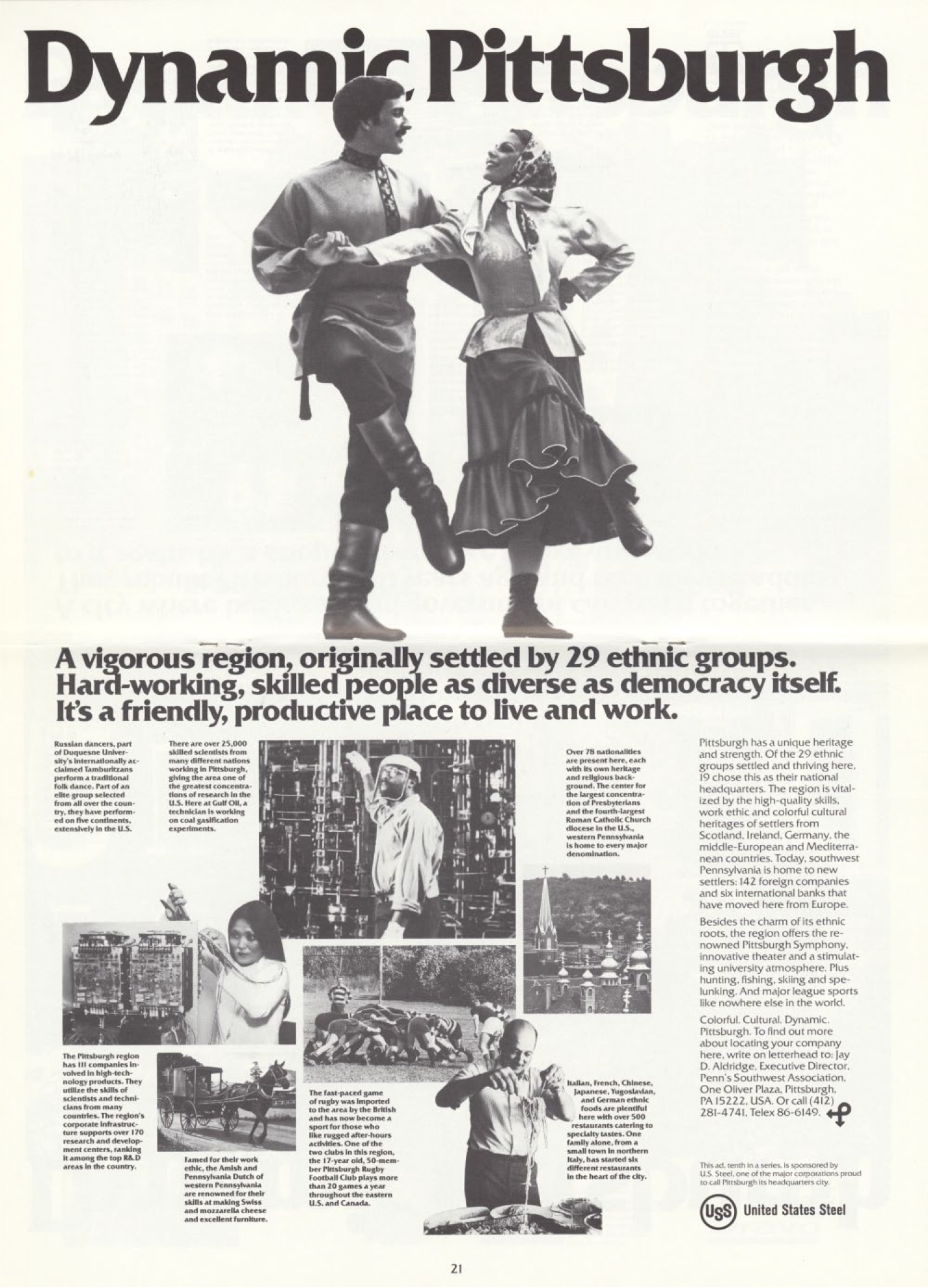
U.S. Steel’s ad emphasized Pittsburgh’s ethnic past, charm, and diversity—with no mention of steel.
The year after the campaign ran in the Wall Street Journal, Penn’s Southwest President (and Mellon Bank CEO) David Barnes reported that the campaign had attracted “a great deal” of national attention and persuaded “worthwhile business organizations” to “take a closer look” at the Pittsburgh region, and that “several” had made a “commitment to join us.” 58 While Dynamic Pittsburgh certainly never gained the cultural currency of the I ♥ NY campaign, Pittsburgh’s boosters coordinated and financed a cohesive branding campaign that successfully sold the physical redevelopment, cultural attractions, and leisure activities that marked the city as a postindustrial space. They cast blue-collar workers and neighborhoods as part of the city’s old-world charm, rather than as a vital part of the contemporary labor force or local economy—a Rust Belt version of Disney’s It’s a Small World, a variation on a theme park. 59
Capitalizing on the favorable press generated by Dynamic Pittsburgh, the Pittsburgh Media Group (PMG), formed in 1980, launched a complementary marketing campaign later that year. Created to sell the Pittsburgh market to national advertisers, PMG included representatives of the Pittsburgh Press, the Pittsburgh Post-Gazette, and local radio and television stations. PMG promoted Pittsburgh’s redevelopment, arts, industry, commerce, universities, and hospitals in a film, “Renaissance Pittsburgh,” a brochure titled “Pittsburgh: A Place Worth Investing In,” and through city tours for advertisers. Like Dynamic Pittsburgh, PMG’s campaign sought to attract new businesses and white-collar professionals to the city by demonstrating that the business interests drove development decisions and that the city and state governments collaborated with corporate leaders to create a positive business climate. PMG praised the ACCD’s “comprehensive blueprint” to “ensure jobs for future generations,” and gathered retail sales data to demonstrate that Pittsburgh’s residents did, in fact, buy what advertisers were trying to sell. The group also sought to dispel what it saw as common myths about Pittsburgh, such as the idea that the city had “a predominance of low-income families.” 60
As a result of the early-1980s public relations blitz, U.S. News & World Report ran a long article on Pittsburgh’s new image. Caliguiri told the magazine, “Pittsburgh is going to counter the conservative mood of other cities. The attitude of business and government is upbeat.” The article called the growth coalition’s plans to redevelop the Golden Triangle “Nothing short of spectacular.” Renaissance II, according to the magazine, would “speed the city’s shift from steel town to cosmopolitan center for business, education, medicine and entertainment.” In US News’ assessment, the local labor market was buoyant: while the metropolitan area lost twenty-three thousand manufacturing jobs between 1970 and 1980, service-sector jobs increased by 111,000, “giving the area a healthy 10 percent gain in employment” overall. Moreover, US News reported that the city’s white ethnic neighborhoods “have retained much of their charm, even though today’s residents are more likely to be engineers or professors than steelworkers.” 61 Three years later, the New York Times offered a similarly rosy assessment of the “new” Pittsburgh, praising Pittsburgh for its declining number of steelworkers, increasing number of high-tech companies, temperate climate, first-rate golf courses, expansive downtown redevelopment projects, excellent nightlife and cultural institutions, and top-ranked universities and hospitals. 62 Both articles reflected reporters’ tacit acceptance of the narrative of modernization and progress presented in press kits and left the impact of lost manufacturing jobs on the region’s residents entirely unexamined.
Disrupting “Dynamic Pittsburgh”
Branding Pittsburgh, like branding New York, was an attempt to market both imagined space and material space. Boosters promoted actually existing physical redevelopment and an actually occurring economic transition, but they did so selectively, using images that depicted a homogeneous urban ideal. In determining which kinds of activities would represent the future Pittsburgh, boosters sought to erase from view the city’s industrial past and the economic violence that deindustrialization visited on the region’s blue-collar workforce. Unemployed manufacturing workers, however, were less enthusiastic about Pittsburgh’s postindustrial transition. Devastated mill towns and the city’s distressed neighborhood commercial districts provided a potent counternarrative to boosters’ postindustrial brand, which labor activists drew on to advance their own spatial imaginary of Pittsburgh.
In the early 1980s, two labor-ecumenical coalitions, the Tri-State Conference on Steel (Tri-State) and the Denominational Ministry Strategy (DMS), formed to protest what they viewed as an unholy alliance between the city government and Pittsburgh’s executives. Tri-State and DMS mounted a rank-and-file response to shutdowns unsanctioned by the international leadership of Pittsburgh’s unions. Both groups organized against layoffs and shutdowns, but Tri-State and DMS had different political agendas, different tactics, and often, an oppositional relationship. Despite their differences, the organizations’ attacks against Renaissance II and the growth partnership behind it were fundamentally similar. Tri-State and DMS activists sought public policies that would regulate when and how employers could close plants, and wanted public funds to flow to social programs that helped laid-off workers rather than to private corporations. Members articulated an alternative vision for Pittsburgh’s future predicated on regional reindustrialization rather than high-technology, service-sector jobs, and the urban forms suited to middle-class professionals. 63
Tri-State and DMS members protested what they perceived to be an inappropriate use of public resources for the benefit of private interests. For activists, the material impact of plant closures on their daily lives, the physical redevelopment of downtown Pittsburgh, and the city’s symbolic rebranding were intimately linked. They saw Renaissance II as part of a strategy to destroy union jobs in traditional manufacturing and replace them with low-paid, nonunion, service-sector positions. Members held that Pittsburgh’s growth partnership commandeered city, state, and federal funds—the tax dollars of citizens like themselves—for a cultural district intended to attract tourists and enhance the region’s new image. 64 Their activities made manifest the unequal material consequences of regional uneven development, and disrupted the rhetoric embedded in marketing campaigns designed to sell Pittsburgh as a postindustrial utopia with a good business climate. Boosters tried to exclude mill towns from Pittsburgh’s new geography, but activists challenged political and civic leaders’ authority to represent the city as postindustrial space.
Tri-State, in particular, condemned public subsidies for high-tech jobs, culture industries, and service-sector employment formed the core of the growth coalition’s postindustrial strategy. “Communities cannot survive without jobs,” Tri-State organizers told laid-off workers. “Young people cannot expect to build a decent life for themselves if they cannot find work.” 65 To garner support for their plan to reindustrialize the region, Tri-State members prepared a slide show of Renaissance II projects subsidized through public funds that its members presented in mill towns throughout the valley. At screenings, Tri-State exposed the lack of concern from Pittsburgh elites over the fate of mill towns and blue-collar workers, telling listeners, “the steel companies have judged the mills, workers, and mill communities to be expendable.” Activists pointed out that workers were told that there were no public funds available to the mill towns for disaster relief, but there was plenty of money available to subsidize new corporate headquarters for the very companies that had laid them off. “Our tax dollars have been used to finance these corporate headquarters. Billions of dollars in our tax dollars have been used to promote the Renaissance,” Tri-State activists exhorted.
Our tax dollars built the Golden Triangle while our own neighborhoods were neglected. Our work in the mills, and our tax dollars have financed our destruction . . . Our tax dollars and the profits made from our labor must be put back in our neighborhoods and our mills.
66
As Tri-State worked to build local support for reindustrialization, DMS activists launched a direct action campaign designed to attract national press attention to the regional disinvestment and the economic violence it wrought on the mill towns. Their goal was to force corporation to behave in a socially responsible manner, but in the process, activists undermined boosters’ marketing campaign. DMS’s earliest protests targeted Mellon bank branches. Activists devised elaborate schemes to disrupt service, such as the “Smellin’ Mellon” campaign, where activists deposited dead fish in safe deposit boxes and sprayed skunk oil in bank lobbies. The “Smellin’ Mellon” campaign forced Mellon Bank to close branches, sometimes for days, while bank staffers and professional cleaners located and eradicated the source of the odor, but it had no discernible impact on the bank’s investment decisions. Skunk oil became the group’s signature: they also released it at a Lutheran convention to protest the Lutheran Synod’s sanctions against ministers involved with DMS and in three downtown department stores in a Christmas demonstration against Pittsburgh’s executives. 67 When their actions failed to provoke much reaction from Mellon or U.S. Steel, whose executives refused to meet with activists, DMS members took their protest from bank lobbies to the church pews and front lawns of U.S. Steel executives. Saying that executives would not be allowed “to sit up in the comfort of their homes and ignore the suffering their decisions have caused,” DMS began to stage actions during Sunday and holiday services at Shadyside Presbyterian church, where many high-ranking executive worshipped. 68
DMS, like Tri-State, saw Pittsburgh’s rebirth and the collapse of the mill towns as opposite sides of the same coin. In 1984, DMS activists penned an open letter to U.S. Steel Chairman David Roderick that explicitly linked the Mon Valley’s economic decline—which activists understood to be the result of corporate decision-making, rather than “neutral” market forces—to Renaissance II’s downtown redevelopment. They charged that CEOs and public officials had produced plans for Pittsburgh’s future,
which call for the elimination of the Mon Valley steel mills, the development of small industrial parks which will hire people at wages significantly below union scale, and the development of river front condominiums and water recreation facilities for the “new residents” of corporate Pittsburgh.
69
Activists’ critique of the Renaissance exposed a deep conflict over how, and for whom, urban space should be used.
DMS incensed boosters who were trying to market Pittsburgh’s good business climate. Roderick accused DMS of “committing murder to our community image” by painting an unfavorable picture in the national media and scaring away new jobs. 70 The Pittsburgh Business Times reported in 1983 that an unidentified New England company had decided not to move into the region because of DMS’s activities, and its editorial board cautioned area workers against radicalism: “Tax laws and labor costs become minor considerations when stacked against the peace of mind and physical safety of the very people who make site location decisions.” 71 While it is impossible to determine how many companies chose to locate elsewhere because of DMS’s persistent attacks on corporate leaders, Roderick’s and the editorial boards’ responses suggest that DMS’s attacks made boosters nervous. By 1985, Business Times editors condemned DMS’s tactics but cautioned local business and government leaders that they needed to take the group more seriously. Under the guise of trying to broker a truce between workers and management, the editors insisted, “Whatever your view of [DMS], they are succeeding in damaging Pittsburgh’s chances of attracting new business. They are even making a lot of the city’s existing corporate lynchpins uneasy.” Furthermore, the “feigned disinterest of the corporations” had prolonged the conflict and created a “double negative for a city trying to improve its image nationwide.” 72
Tri-State and DMS challenged central city redevelopment plans by exposing Pittsburgh corporations’ simultaneous investment in downtown headquarters buildings and disinvestment in regional manufacturing. They sketched out an alternative imagined geography for Pittsburgh’s future, one in which the mill towns remained a vital part of the city’s social and economic landscape. By the mid-1980s, however, increasingly negative popular opinion and purges of DMS’s leadership by the Lutheran synod and the Steelworkers international had neutralized DMS’s members and their message. In 1986, Tri-State finally succeeded in a long battle to establish a public authority through which to pursue regional reindustrialization. Doing so meant that the activists who had fought the city’s growth coalition had to shift gears to work with, instead of against, civic and political leaders. In the end, labor activists ultimately lacked the power and resources to halt the growth coalition’s redevelopment plans. They also lacked the ability to fundamentally disrupt the symbolic imagery of Pittsburgh’s postindustrial rebirth.
America’s Most Livable City
In 1984, as DMS “committed murder” to Pittsburgh’s image, PMG sponsored a luncheon in Manhattan for New York executives and New York–based travel agencies. Caliguiri, Steeler Lynn Swann, Carnegie Mellon President Richard Cyert, Allegheny International CEO Robert Buckley, and representatives from Pittsburgh’s major news outlets promoted Pittsburgh as a good place to live, work, and visit. PMG also induced Carnegie Mellon drama department alums who worked on Broadway to praise Pittsburgh at the luncheon. Actress Barbara Feldon called Pittsburgh the most romantic city she had ever been in. Other speakers described Pittsburgh as a “world-class city,” and suggested that the Sunbelt’s image was “a bit better than is deserved.” 73 A Pittsburgh advertising executive proclaimed that Pittsburgh was “no longer Steel City” but had become “a diversified city of the future.” 74 Reflecting his often-stated desire to replace blue-collar residents with white-collar workers, Caliguiri told the group that he wanted to tear every picture of Pittsburgh’s smokestacks out of the country’s textbooks. For boosters, Blue-collar workers, like the factories that employed them, were an inconvenient reminder of an industrial past that the growth coalition hoped to erase.
Back in Pittsburgh, Aldridge, like Caliguiri, tried to downplay the human cost of hardship and dislocation. Penn’s Southwest instead emphasized that the city was in the throes of being remade for new groups of people who performed different types of work—work associated with service and finance industries rather than manufacturing. In this way, the major regional promotional agency relegated manufacturing industries and workers to a historical footnote, with no place in the new Pittsburgh. “While at one time it was appropriate to direct efforts toward attracting the types of industries based on extractive processes and involving heavy infrastructure needs,” the agency reported in 1984, “today our efforts are channeled increasingly toward attracting businesses and people with new ideas and new technologies who are or will be providing the job-creating industries of the 21st century.” 75 Penn’s Southwest optimistically described the Pittsburgh region as “repeating an historical cycle” of job creation for a “new economic era” rooted in advanced technology rather than industrial production. 76 As it had in the 1970s, Penn’s Southwest acknowledged “that there has been a steady decline of employment by the traditional industries within the region,” but the agency was “heartened by the dramatic opportunities for new employment that the 21st century industries are even now beginning to bring.” 77
Never in their advertising campaigns, in their promotional brochures, or in the luncheons did any of the public or private agencies involved in promoting the region talk about the steel industry or manufacturing workers as anything more than a disappearing remnant of bygone days, no longer relevant to Pittsburgh’s social, physical, or economic geography. It was under these circumstances that the growth coalition received a surprising boost to its branding campaign when Rand McNally named Pittsburgh America’s “Most Livable City.” The Greater Pittsburgh Chamber of Commerce published a brochure titled “Celebrate Pittsburgh” to commemorate the designation. Pittsburgh’s residents had “every reason to celebrate and to pat yourselves on the back for Rand McNally’s ranking of our area as America’s most livable,” the Chamber enthused. “As part of a community of many diverse backgrounds, you have achieved a quality in your lives which is fast becoming the envy of cities, large and small, across the land.” The Chamber claimed, in a moment of extraordinary cognitive dissonance, that
the last forty years have been a time of constant progress and towering achievement. Only decades ago, the city was a symbol of industrial grime, its smoky skies as famous as its steel. But, through years of commitment and cooperation, the people of Pittsburgh reclaimed their town from that image and built it into a model American city, a glittering riverside jewel.
78
For the Chamber, like Caliguiri and the ACCD, the “model city” was decidedly postindustrial. ACCD Executive Director Robert Pease and other boosters saw the designation as evidence that the city’s symbolic space had changed; Pittsburgh was no longer perceived as a smoky steeltown. Pease lamented that, throughout the 1970s, “Pittsburgh could not shake its ‘Smoky City’ image, and the region lagged in attracting significant new investments.” In the 1980s, he wrote, “Pittsburgh’s image—long one of its major handicaps” had been rehabilitated “by effective promotional campaigns,” culminating in the Most Livable designation. After the jokes died down, the national media confirmed boosters’ representations of the city. A month after the designation, the New York Times ran a predictably enthusiastic article: “Anyone who knows the Pittsburgh of the 1980’s knows that this mountainous city of the Three Rivers is not what it once was,” the paper proclaimed. “With its breathtaking skyline, its scenic waterfront, its cozily vibrant downtown, its rich mixture of cultural and intellectual amenities, its warm neighborhoods and its scrubbed-clean skies, it is no longer the smoky, smelly, gritty milltown of yesteryear.” 79
By 1985, the material and symbolic spaces of the city had been largely remade through the growth coalition’s downtown facelift and promotional campaigns meant to signal that Pittsburgh was no longer a manufacturing center. Not all observers were as enthusiastic about the Most Livable designation as the members of the growth coalition. Christopher Marquis, a Pittsburgh-based reporter for the Christian Science Monitor, described the award as “a long-awaited lift by business leaders, who envision a swankier ‘service sector’ Pittsburgh,” an urban vision that required Pittsburgh to disown “parts of itself.” Like many of the region’s manufacturing workers, Marquis understood that the mill towns “shared everything with Pittsburgh except recovery,” and were “left out” of the region’s postindustrial brand. “As the nation’s economy veers from making products to trading services, old cities understandably want a fresh start,” Marquis wrote. “But abandoning people who built our cities because they don’t fit into our plans (unlike the ever-malleable young professional), is nothing but a sellout. Today, that is Pittsburgh’s shame.” Pittsburgh was only “livable,” he contended, because the mill towns were “dying quietly.” Marquis castigated the growth coalition for “catering to a certain ‘kind’ of resident and spurning another” and for suggesting that former residents “who can’t find a place in the ‘New Pittsburgh’ should leave.” 80 Marquis was a voice in the wilderness; by the end of the decade, the national press advanced the growth coalition’s representations of Pittsburgh’s poststeel redevelopment. The New York Times called Pittsburgh “America’s most promising post-industrial experiment.” 81
Conclusion
In the afterglow of the Most Livable designation, the city’s second Renaissance looked to most observers like a resounding success. The power to control material space was bound up with the representational authority over the city’s image, and Pittsburgh’s urban brand became a central site of contestation between boosters and labor activists who held different and fundamentally incompatible visions for the future. Tension over whether to revive shuttered mills or simply write them out of the region’s reconfigured economic geography ended, predictably, in a victory for the executives whose investment patterns produced regional, and global, uneven development. Writing about the Most Livable designation twenty-five years later, however, a Pittsburgh Post-Gazette reporter noted that boosters could not pinpoint any “tangible benefits” from the designation or the hundreds of thousands of dollars they spent to capitalize on it. “The Pittsburgh Press sold more than 11,000 T-shirts that year boasting of the No. 1 ranking,” the reporter noted wryly, “but it might have been better if 11,000 fewer people left the area.” 82
Retrospective assessments aside, from the vantage point of 1985, Pittsburgh’s postindustrial rebranding was a triumph for the growth coalition. They had advanced their material efforts to replace productive spaces with spaces to be consumed by middle-class residents and visitors by erasing struggling mill towns and their unemployed manufacturing workers from the mental maps of southwestern Pennsylvania. They had expanded the boundaries of downtown to include adjacent leisure, cultural, and entertainment districts. And they appeared to have shed Pittsburgh’s reputation as a dirty, gritty steeltown. The postindustrial product advertised in marketing campaigns was rooted in spatial processes that remade spaces of production for a service economy and altered the relationship between the city and its suburbs, mill towns, and hinterlands. In a few short years, Pittsburgh’s growth coalition had turned the city into a commodity, packaged for consumption by tourists, suburbanites, and imagined new residents. Boosters’ branding campaigns constituted a real and symbolic commodification of the city, through which they sold a sanitized version of Pittsburgh as an ideal place for young professionals and service-sector industries.
Footnotes
Acknowledgements
The author would like to thank Matthew Klingle, John McCurdy, Laura Ferguson, and Patrick Vitale for their invaluable comments on earlier drafts of this essay.
Declaration of Conflicting Interests
The author declared no potential conflicts of interest with respect to the research, authorship, and/or publication of this article.
Funding
The author received no financial support for the research, authorship, and/or publication of this article.