



Abstract
Drawing on the literature of public space and military geography, this article explores the martial and civilian places of New York City on the eve of the American Revolution. Whereas martial and civilian places were largely undistinguished in New York before 1750, the arrival of British troops and the repositioning of New York as the center of British military power in North America initiated a process whereby New Yorkers debated if these two should be separated. While military commanders and local officials attempted to protect private spaces like the home through a joint martial-civilian occupation of public spaces with the construction of barracks, the Sons of Liberty contested this use of space and sought to evict the British soldiers. Ultimately, the Battle of Golden Hill and other clashes between soldiers and civilians forced leaders to segregate the city’s places, thereby removing all military geography from the city.
In the summer of 1766, New Yorkers squared off against one another to define their city’s public space. A few months earlier, a group of colonists known as the Sons of Liberty had erected a pine mast topped with a placard proclaiming “liberty.” This Liberty Pole celebrated the recent repeal of the Stamp Act, a tax the group thoroughly despised. The simplicity and classical symbolism of the Liberty Pole appealed broadly to New York’s diverse population, but its location aroused controversy. The Sons of Liberty placed the pole in the Fields, a common located at the northern edge of the city, which also contained a massive barracks. The British soldiers who occupied the barracks stridently disagreed that the defeat of a Parliamentary law should be celebrated on the city common, and so, on the evening of August 10, 1766, a party of soldiers marched a few hundred feet from their barracks and chopped down the Liberty Pole. The next morning, the Fields erupted in violence. Colonists rushed the common and, according to British Captain John Montrésor, began attacking the soldiers with “abusive language” and chunks of brick. In response, the troops drew their bayonets, although the officers quickly ordered them back to quarters. The retreat, however, did not satisfy the crowd, which surrounded the barracks, “saying that the Ground was theirs.” 1 Scuffles continued for the next week as New Yorkers struggled to determine whether the Fields would be a martial place or a civilian one.
Historians have long recognized the Liberty Pole as one of the first confrontations between British soldiers and American colonists, clashes that ultimately culminated in the American Revolution. Typically framed as being about divergent identities, military power, and constitutional rights, such military-civilian conflicts also tell us something about place. 2 In the case of the Liberty Pole riots, the meaning of the Fields was at stake. The Fields had long been an empty pasture where New Yorkers grazed livestock, and it had only recently become the site of civic celebrations and public institutions. As this peripheral expanse became the symbolic heart of the city, New Yorkers transformed the Fields from a space into a place. Yet, what this place would be and who would define it was the subject of considerable disagreement among the city’s inhabitants. The British army wanted a central place in the city, while the Sons of Liberty sought to cleanse the Fields of military power. Both groups recognized that the one who defined the Fields would determine the city’s political discourse, the colony’s future, and, ultimately, whether or not New York would remain in the British Empire.
Accordingly, a closer attention to the process of place-making allows us to rethink the American Revolution in new ways, specifically, the role that military geography played. Military geography—the way that military activities and policies construct place—was being hotly contested in mid-eighteenth-century New York City and reformulated in new and consequential ways. Since its founding in the 1620s, New York had intertwined civilian and martial places. The provincial government operated out of Fort George, while soldiers occupied New York’s green spaces, taverns, and homes. In effect, all of New York was a product of military geography. In the 1750s, however, this arrangement was complicated when Great Britain dispatched thousands of troops to North America and made New York the center of operations. In response, the city thought about its places and their uses in new ways. It barred soldiers from private places like homes and concentrated them in public ones, effectively limiting the army’s reach to Fort George and the Fields. The common council envisioned maintaining these sites as joint military-civilian places, and so it built barracks in the Fields alongside civilian institutions. The Sons of Liberty, however, imagined a city without military geography, one in which soldiers would be confined to quarters or absent altogether. Formerly uncontroversial, Fort George and the Fields acquired new meanings that diverged sharply depending on one’s opinions of British policies (see Figure 1).
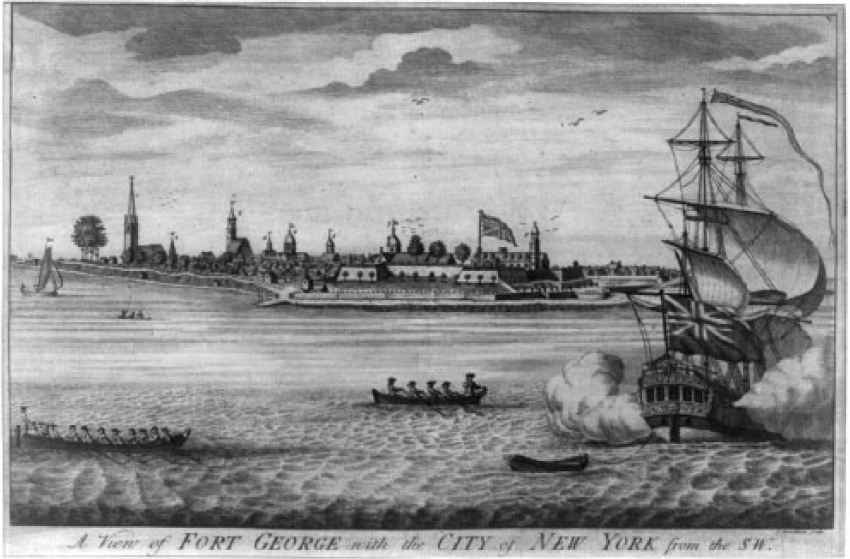
John Carwitham, Engraver, A View of Fort George with the City of New York from the SW / I. Carwitham, sculp. (New York: s.n., 1736).
In this article, I investigate the military geography of Revolutionary New York to understand how its residents perceived, conceived, and lived in the city on the eve of creation of the United States. I detail how changes in British military policy forced New Yorkers to rethink their city’s places, especially its public space. Ultimately, I argue that this process of place-making segregated civilian and military places, radically and permanently altering the character of New York, and by extension, the modern American city.
Public Space and Military Geography
The literature of space offers several avenues for understanding the ways in which Revolutionary New Yorkers struggled to define their city and its places. In his landmark work, The Production of Space, Marxist geographer Henri Lefebvre suggests ways in which to understand how humans create and imagine place, observing that “(social) space is a (social) product.” In particular, Lefebvre argues that place formation is a complex and occasionally contradictory process, as “social spaces interpenetrate one another and/or superimpose themselves upon one another.” Accordingly, we must consider not only how people operate in the places they inhabit, but what they imagine it to be and what it means to them; in other words, Lefebvre’s triad of spatial practice (perceived space), representations of space (conceived space), and representational space (lived space). 3 Written forty years ago, The Production of Space has thoroughly penetrated the academy. Several historians have demonstrated the usefulness of Lefebvre’s ideas to rethinking the past, especially urban places, most notably, Janice L. Reiff in her article on working-class activism in Pullman. 4 It is also worth observing that as a Marxist historian, Lefebvre was primarily interested in the places of modernity as a means of interrogating capitalism. Not surprisingly, then, most of the historians who have employed his ideas have studied the United States or Europe since 1820. 5 As it is possible that Lefebvre’s framework cannot adequately explain the premodern world, it is important to draw on additional analyses of space to understand Revolutionary New York, a place on the precipice of modernity.
Of particular usefulness is the literature on public space, much of which has been informed by the work of Henri Lefebvre. Broadly conceived, public space includes those places to which all citizens have legal access and are places where citizens gather together to form themselves into a public. They are civic places (for instance, parks, streets, and capitols), as well as places controlled by an individual or a group but to which all people are allowed access (for instance, a business or a church), although there are certainly important differences between these types of public space. They are, in many ways, the most social of all social spaces and thus provide some of the best examples for understanding the production of space. 6 In his examination of Berkeley’s “People’s Park,” Don Mitchell demonstrates the contentious debates over public space, arguing that people often hold conflicting notions of what values it should reflect and who should be allowed in it. 7 Accordingly, as Doreen Massey has observed, it is “the very fact that they are necessarily negotiated, sometimes riven with antagonism” that public spaces are “genuinely public” [emphasis in original]. 8 Scholars have also drawn attention to the fact that the negotiators of public space rarely share an even playing field. Often, women, people of color, sexual minorities, and the poor have had limited access to communal places and the power to shape their meaning. 9 In this, the meaning of public space is contingent on what people constitute “the public.”
Whereas Lefebvre and his most ardent disciples are solidly anchored in the nineteenth century and later, scholars of public space have made considerable inroads into the early modern era. In part, this is because it was within such places that representative democracies were formed in Western Europe and North America in the eighteenth century. Jürgen Habermas’s public sphere required places like coffeehouses and taverns free from the supervision of the state and church for the bourgeoisie to plot revolution. 10 At the same time, many historians—especially of gender—have observed that women were excluded from the bourgeois public sphere. Indeed, Nancy Fraser has observed that the freedom and democracy of public space was predicated on the creation of private spaces, specifically the home, and the confinement of women to them. 11 Likewise, slaves, foreigners, and propertyless men were excluded from early modern public space and thus not invited to citizenship in the republics that followed. 12 As a result, understanding the production of public space in the era of the American Revolution can offer unique insights not only into the place itself, but the nation as a whole. However, we must also be cautious to distinguish between types of public space, to observe who was excluded, and to understand how the production of other places—like private ones—shaped public space.
In addition to understanding Fort George and the Fields as public space, we also need to interrogate them as martial ones. Largely independent of the work on public space, a parallel scholarship has emerged on military geography. Military geography picks up on Lefebvre’s notion of social space by exploring how military activities and policies construct place. Like other places, military geography is constantly being negotiated, leading Rachel Woodward to observe that “military control of space . . . is a discursive as well as a material practice.” 13 The military plays an unrivaled role in the places it occupies, bringing the full backing of the state, unparalleled financial resources, and the weapons of war. Although civilians are often in dialogue with the military over space, the military is often unchallenged in its definition of place.
Woodward has also observed “the extension of military influence into economic, social and political life.” 14 Colin Flint and Derek Gregory have expanded on this notion, arguing that in modern geopolitical landscapes, the separation of peace and war is a false dichotomy. For example, Flint argues that after World War II reached its formal conclusion, spatially, the war raged on with soldiers, infrastructure, and the weapons of war defining the postwar era. Gregory goes even farther into the present, arguing that in the post-9/11 world, drone strikes, the drug war, and efforts to control cyberspace have created an “everywhere war.” 15
Unlike investigations of public space, military geography has a decidedly presentist bent. But the sharp distinction between military and civilian places is a relatively recent creation. As Max Weber and Fernand Braudel recognized, in the early modern era, war and peace were firmly delineated. 16 The walled towns of medieval Europe existed because communities were never sure when or from which direction an attack might come. In this setting, everyone was a potential soldier regardless of gender, age, or station. In the seventeenth and eighteenth centuries, a “military revolution” dramatically remade war as gun-wielding infantrymen replaced pikemen. This, in turn, led to a new defensive infrastructure, standing armies, and the dedication of considerably greater resources to war. 17 Scholars are only beginning to appreciate the spatial dimensions of this change. 18 The military revolution promoted the idea that war should be left to professionals while also eradicating traditional defenses like city walls as inadequate to fend off the cannons and other implements of modern warfare. Consequently, people who had once stood ready to fight became full-time civilians, and military geography was reduced to battlefields, barracks, and forts that martial authorities could tightly control without civilian oversight.
Scholars have not appreciated the connection between the simultaneous emergence of the public sphere and the military revolution. Yet, the two changing notions of place worked in tandem with one another in the eighteenth century, influencing and shaping the other. In the case of Revolutionary New York, it is significant that Fort George and the Fields were at once martial and public. When the British army placed itself in New York’s public space, it occupied the very site where New Yorkers came together to determine their city’s identity. In so doing, it subjected military power to a communal debate. As the soldiers threatened to inhibit this discourse, New Yorkers chose to remove the army from their public space, ultimately initiating a process whereby all military geography would be removed from the city.
The City before 1757
In the earliest days of New York, there was no clear division of civilian and martial places. When the Dutch founded the city in the 1620s as New Amsterdam, they surrounded the city with fortifications to prevent invasion by sea and attack by Algonquian Indians. Wrapping the city in a wall was typical for many medieval European cities, and this practice had spread to America, where the English palisaded Jamestown and Plymouth. 19 At the southern end of the settlement stood Fort Amsterdam, which combined civilian and military uses in a single locale. Behind the high walls of the four-sided fort stood barracks and a storehouse, alongside the governor’s residence, a jail, and the preeminent church in New Netherland. Just north of Fort Amsterdam, the Dutch settlers cleared a small space they termed ’t Marckveldt (the Marketplace) or “the Plaine” to serve as the city common. It was here that the city’s residents came together to buy and sell their wares, as well as for open-air meetings, bonfires, and celebrations. Like the fort, the Plaine was a combined civilian and military place. Soldiers employed by the Dutch West India Company regularly paraded on the Plaine, although they were not the only ones to do so. In an outpost on the periphery of a far-flung Dutch empire, all residents of New Amsterdam were expected to take up arms in case of attack, which could come at any moment. 20
Unfortunately for the Dutch, the city’s military infrastructure was ineffective at keeping out the English, who took the city in 1664 and renamed it New York. The English continued the Dutch practice of prioritizing the city’s defensive needs as they repelled Dutch efforts to retake the city. Even the homes of New Yorkers were not sacrosanct. Arriving with three hundred soldiers, Colonel Richard Nicolls discovered a “want of Sufficient Lodginge into the fort” and sought alternative places to quarter his men. As a result, he billeted nearly a hundred English troops in the homes of New Yorkers. 21 Although this was a temporary measure, it indicated that no place in the city was off-limits to the military.
As the English negotiated a peace with the Dutch that confirmed their control of New York, the city made its first effort to separate military and civilian places. First, the inhabitants demanded the permanent removal of troops from their homes. At its inaugural session in 1683, the newly formed New York assembly declared “that noe ffreeman shall be compelled to receive any Marriners or Souldiers into his house and there suffer them to Sojourne, against their willes.” 22 Second, the defense of New York City and its satellite communities like Albany passed to British regulars. A 1689 colonial uprising known as Leisler’s Rebellion in which the Dutch colonists evicted their English governor led London to permanently station four companies in the colony. Hundreds of these troops remained in New York City where they were quartered in reconstructed barracks of Fort Amsterdam—now renamed Fort George. 23
These changes marked the first challenges to the city’s military geography. By demanding and receiving assurances from the provincial government that troops would no longer be billeted in their homes, the inhabitants effectively delineated the home as a private place and removed it from the control of the military. The rest of the city remained more or less open to the army. Indeed, the English provincial governor continued to reside in Fort George and to meet with his councillors only feet away from the fort’s barracks. Likewise, British soldiers roamed the streets, departing Fort George to muster on the Plaine, worship in churches, and frequent taverns. Except for the home, the rest of New York was subject to the army’s influence.
Not long after the home was marked as private, the government of New York City sought to create a public space in the city. Fort George, churches, and taverns had never been entirely public, controlled as they were by the colony, a group of residents, or an entrepreneur. Only the Plaine was open to all inhabitants, but even this small space was soon threatened. In 1732, the common council voted to enclose the Plaine “for the Beauty & Ornamentation of the Said Street as well as the Recreation & delight of the Inhabitants of this City.” 24 Leading inhabitants took over the land and replaced musters with the gentlemanly sport of lawn bowls. As the Plaine became the Bowling Green, the persons allowed onto the city common were severely restricted. The city’s open-air meetings, celebrations, and military exercises did not disappear, but moved a half mile up Broadway to a cow pasture known as the Fields. Removed from the watchful gaze of provincial and military authorities in Fort George, the Fields was New York’s first truly public space. Although soldiers were occasionally present on the common, there was far more room and freedom for new civilian activities to emerge in the Fields.
Building Barracks
While New York delineated its public and private places, England (Great Britain after 1707) quickly forgot about the soldiers stationed in the city. As imperial conflicts subsided or relocated elsewhere in the Americas, Parliament ceased to pay the four independent companies, who came to depend upon the largesse of the New York taxpayers for their food and supplies. With few troops coming from Britain and no money to recruit soldiers in America, the forces declined precipitously from nearly one hundred per company to less than fifty. The British army also declined to send officers to command the forces and so civilian officials, most notably the governor, became responsible for the meager band at Fort George. As a result, New York’s military establishment was largely ineffective for the first half of the eighteenth century. 25
All of this changed in 1756. That year, Great Britain entered the Seven Years’ War against France, initiating the first global war in history. 26 As the world’s two mightiest militaries and their proxies clashed in Europe, Africa, India, the Caribbean, and North America, both sides made unprecedented commitments of men and money to the war effort. New York was particularly affected by the war as military planners rethought its place in the British Empire. In the fall of 1756, the hundred men of the independent companies were outnumbered by the arrival of nearly 1,500 soldiers from the 60th Regiment of Foot. Unlike the aging and inadequately supplied independents, the regulars from the 60th were young and professional soldiers, lavishly supplied and armed by Parliament, and led by a highly trained officer corps. To order the troops in New York and across the continent, the British government created the position of commander-in-chief in North America, which displaced the governor as supreme military commander. When Major General John Campbell, the Earl of Loudoun, arrived to assume command in July 1756, he chose New York City as headquarters for North American operations because of its deep harbor and central location. Although Loudon spent most of his time closer to the front, his successors repeated his preference for New York. In 1756, then, New York City was transformed from a provincial backwater with a peripheral military force to the epicenter of British military power in North America (see Figure 2). 27
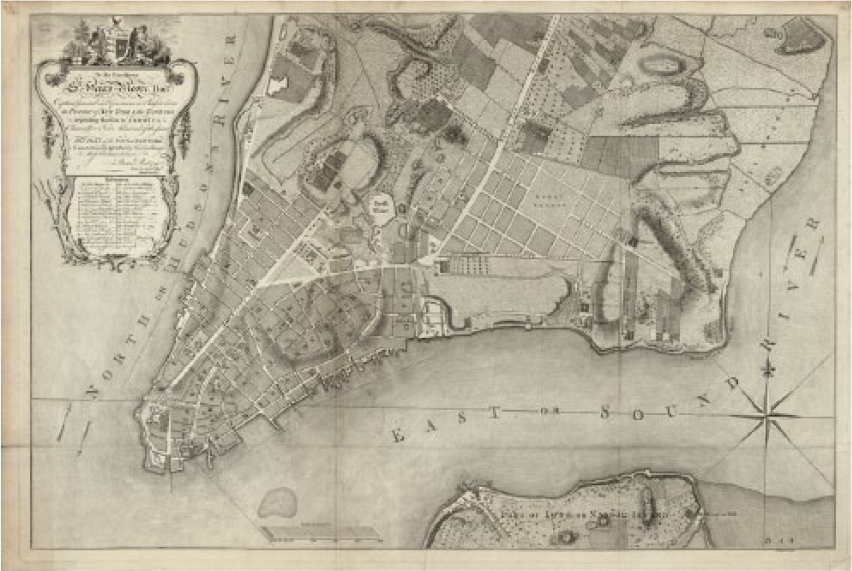
Bernard Ratzer, and Thomas Kitchin To His Excellency Sr. Henry Moore, Bart., Captain General and Governor in Chief in & over the Province of New York & the Territories Depending Thereon in America, Chancellor & Vice Admiral of the Same, This Plan of the City of New York Is Most Humbly Inscribed (London: s.n., 1769).
The city’s military geography changed as well. As had been the case ninety years earlier, the number of British troops exceeded the quarters available in Fort George, and this raised the specter of billeting. When the 60th Regiment first arrived, the common council made Governor’s Island available to them, but with winter approaching, this was not a long-term solution. 28 As the city deliberated, General Loudoun inserted himself into the process. He was unsympathetic to colonial prohibitions against billeting and “told them from the beginning, that if they did not give Quarters, I would take them.” 29 “The demand took air,” remembered Judge William Smith of Loudoun’s position; consequently, “the citizens raved.” 30 Ultimately, it fell to the provincial legislature to find a solution. Reeling from Loudoun’s threat that he might seize quarters, the assembly granted the army permission to lodge troops on the province’s public houses or taverns. However, the law stated that if “there shall not be a sufficient Number of such houses,” then soldiers could be quartered “in such private Houses.” 31
Civic leaders were able to procure sufficient accommodations in the city’s taverns, but the prospect of quartering troops on private homes sent tremors through New York. As the war dragged on, it became apparent that more troops would soon arrive and billeting might become unavoidable. Although New Yorkers had objected to billeting in the seventeenth century, their opposition had only grown more resolute over time as notions of domestic privacy had solidified. As Richard Bushman and Mary Beth Norton have observed, eighteenth-century Americans—especially those in cities—had begun to segregate where they worked from where they lived and to designate certain rooms, often on the second floor, as sacrosanct sleeping areas. This shift was heavily gendered as the emergent notion of privacy included the prescription that women would be protected from the vagaries of public life by being confined to the home. 32 Indeed, simply the use of the terms “public” and “private” in the law suggest that the spatial dichotomy had sharpened since the seventeenth century. The idealization of domestic privacy meant that there was no place for a soldier in the home as such an intruder would only destroy the homeowner’s property and violate his wives and daughters. Accordingly, billeting was increasingly held up as an unconstitutional violation of the colonists’ liberties.
In seeking to protect the home, New York necessarily had to move the troops onto its public space. The 1756 law referred the soldiers to public houses, although this placed the burden on tavern keepers who complained about the low rates of compensation they received for quartering soldiers. Moreover, some taverns were simply rooms in people’s homes, thus making the separation of public and private more linguistic than physical. Tavern keepers, especially, objected to quartering enlisted men who had the reputation of being among the lowest dregs of society: they were noticeably silent on accommodating officers who were older, more genteel, and paid more for their rooms. As a result, pressure mounted on the city to find more appropriate quarters for soldiers than its public houses (see Figure 3). 33
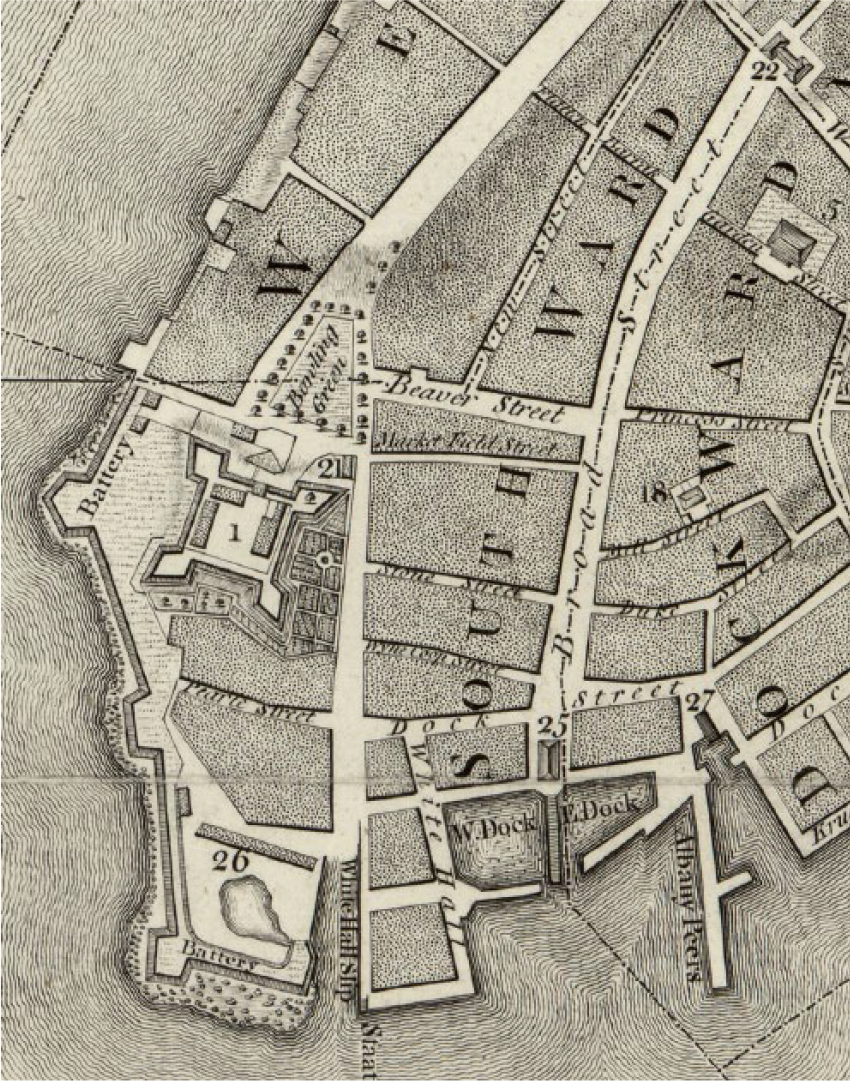
Lower Manhattan—Detail from Ratzer and Kitchin, To His Excellency (1769). 1—Fort George, 21—Secretary’s Office, 22—City Hall, 26—Lower Barracks.
In place of taverns, New York turned its attention to the Fields. In October 1757, the common council voted to build barracks on the city’s common. The plan called for a massive structure, two stories tall, 420 feet in length, and twenty-one feet in width. Inside, the barracks contained forty rooms measuring twenty-one feet by twenty-one feet, each capable of quartering twenty soldiers for a total of eight hundred men. This made the barracks as wide as most of New York’s city blocks and more than twice the size of Trinity Church: only Fort George was larger. To pay for the structure, the provincial assembly granted the city permission to tax the real estate and trade of its residents up to £3,500. At the same time that the city erected barracks in the Fields, the British army built a much smaller set south at the Battery that it used primarily as a hospital. To distinguish them, New Yorkers termed the structures the Upper Barracks and the Lower Barracks, respectively. 34
About two months after the common council voted to erect the Upper Barracks, soldiers from the 60th Regiment took up quarters in the Fields. Quartermaster Major James Robertson was pleased with the results when he surveyed the structure in late December 1757, terming it a “very comfortable Barr[ac]ks.” Robertson’s account also gave a sense of what life inside the barracks was like. Each room contained several beds with “clean Bedding.” In compliance with army regulations, two men were expected to share each bed, blanket, and chamber pot. Each room also contained “a large Table & sufficient Number of wooden forms for the whole Men of the Room to sit on at the same time” as well as a fireplace. 35 Such elements necessary, for although the army provided meat and drink—and the province supplied cooking utensils, platters, and firewood—the men had to cook their own food and eat in their room. Sleeping and eating together, the soldiers lived in tight quarters in the Upper Barracks. To be sure, the army ignored the city’s plan to place twenty men per room, reasoning that fourteen was as many as it could squeeze into one room “without Prejudice to their Healths,” although it also allowed soldiers to bring wives into the Upper Barracks. 36 Army regulations permitted provisions for six women per company, which averaged about two women per room. 37 The army wives provided companionship for the men as well as uncompensated labor, especially, cooking meals.
The construction of barracks also made the joint military-civilian character of the city’s public space concrete. The Upper Barracks was not the only structure the common council built in the Fields; rather, it took its place behind an almshouse where the poor could live and weave cloth, and a jail. The city had raised the almshouse in 1735 and added the jail only a few months before the barracks went up. Both were buzzing with activity in 1757, leading the council to expand both and construct a prison (a “Bridewell”) soon thereafter (see Figure 4). 38
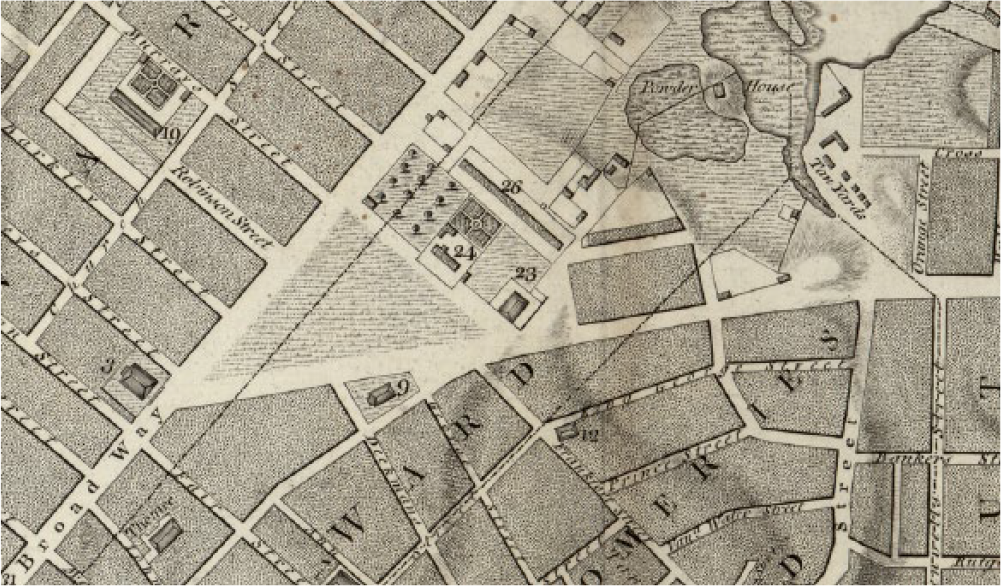
The Fields—Detail from Ratzer and Kitchin, To His Excellency (1769). 3—St. Paul’s Chapel, 9—Brick Presbyterian Church, 19—King’s College, 23—Jail, 24—Almshouse, 26—Upper Barracks.
The barracks, almshouse, and jail were all similar in their publicness, or perhaps more accurately, in the lack of privacy they afforded their inhabitants. All three were versions of disciplinary space where the authorities could closely monitor the actions of soldiers, the poor, and criminals. As Michel Foucault has argued, disciplinary space was new to the eighteenth century as the burgeoning nation-state attempted to rout out the worst traits of society and maximize its citizens’ efficiency. 39 The inhabitants of the barracks, almshouse, and jail also shared the traits of being among the poorest and least respected members of society. Indeed, officers were not confined to the Upper Barracks but continued to billet in the city’s public houses, making barrack life an indignity reserved for enlisted men. It also appears that the size of rooms in the Upper Barracks and the concentration of people in these rooms matched those of the almshouse and jail as well as the dwelling places for African American slaves and “the poorer sort” throughout the colonies. 40 Privacy did not apply to people at the bottom of eighteenth-century society who worked, slept, and ate in close proximity to one another. Nor was life in the public space necessarily gendered. Although the majority of individuals who lived in the barracks, almshouse, and jail were male, women also occupied places in each.
It was also during the Seven Years’ War that New York finally abandoned the wall that had encircled it for more than a century, and the last remnants of the Dutch fortifications tumbled down. To be sure, New Yorkers and the British army still worried about an invasion, but the presence of hundreds of British regulars made such defenses unnecessary, while the increasing prevalence of more powerful weapons made city walls obsolete. The fall of the wall also may have had symbolic meaning to New Yorkers in the 1750s as the century-old military geography of the city was no longer the same. Because of the war, the city had established that homes were private—and thus civilian—places protected from military intrusion. Public space, in contrast, continued to combine both soldiers and civilians, albeit to different degrees. Taverns excluded all but a few wealthy officers, while enlisted men were pushed into places controlled by the city and the province that also served vital civilian functions. However, it would not be until after the war ended that New Yorkers rethought the meaning of their city’s places in earnest.
Joint Military-Civilian Places
As long as the Seven Years’ War raged on, there were few complaints about the military geography of New York. The city remained the center of British military operations in North America as the conflict shifted from Pennsylvania backcountry, to Canada, to the Caribbean. As a testament to the city’s commitment to the forces and its loyalty to the empire, New York maintained its military infrastructure at considerable cost to local taxpayers. In November 1761, the common council calculated that “the Arrears of the City Barracks” approached £1,000 and began to look to the provincial legislature for financial assistance. 41 In spite of the costs, however, the city regularly repaired the barracks and provided supplies like firewood.
When the war came to a close in 1763, New York’s status in the empire was unclear. Britain’s battlefield successes had expanded British North America to include Canada, the Ohio Valley, and Florida. However, these territories contained French colonists and Native Americans whom Britain feared would soon rebel, and so the British government ordered fifteen regiments containing more than 7,500 soldiers to remain in North America. London also decided that New York City should remain the headquarters of the North American military establishment, a point made clear to New Yorkers when Major General Thomas Gage arrived in November 1763 as the new commander-in-chief and began directing troops throughout the continent. 42
Postwar New York was also the site of tremendous growth. No longer constricted by walls or wartime deprivation, the city burst north into communities like the Bowery and Greenwich Village. This increasingly centralized the Fields within the city and increased its popularity. Indeed, in the early 1760s, the excitement of the Fields seeped from the common into the surrounding neighborhood. In part, this was because the public buildings in the Fields seized increasing amounts of land. As Figure 4 indicates, by 1766, gardens, fences, and outbuildings had gone up around the barracks, almshouse, and jail, reducing the open area for markets and celebrations to less than half of the original common. New institutions grew up along the periphery. At the southern edge of the Fields, age-old sectarian disputes played out as Anglicans erected St. Paul’s Chapel in 1764, and Presbyterians followed with a brick meetinghouse four years later. A block west of the common, King’s College opened in 1760 to instruct the sons of the city’s elite. The neighborhood’s rapid growth also attracted tradesmen and laborers who made the area their home, while its location alongside the city’s main thoroughfare attracted a number of taverns whose patrons represented a cross-section of economic and political views. At the northern edge, African Americans gathered to bury their dead in a graveyard that dated from the Dutch era, making the common a central location for the city’s black community as well. 43
The growing civilian interest in the Fields and the surrounding neighborhood in no way inhibited the army’s use of the same place. The Upper Barracks became a locus of military justice where officers tried soldiers for desertion or “disrespectfull & opprobrious Language.” 44 Although courts-martial were conducted inside the barracks, the guilty soldiers were whipped on the common for all to see. In other ways, the army invited the civilians converging on the Fields to observe their work. Troops were constantly being rotated in and out of New York, and this process created a spectacle. When two regiments prepared to return to England in July 1767, the army used the Fields not only to sort out the veterans and the invalids, but to seek civilian volunteers to join a third regiment, which remained in America. Five months later, residents were again invited to the lawn in front of the Upper Barracks for a much less ceremonial occasion. Captain Stevens of the Royal Artillery had recently died, and so the army used the place to auction off his effects. 45 The soldiers also had an effect upon the neighborhood that surrounded the Fields. They frequently departed the barracks to tipple at the nearby taverns and attracted prostitutes to the area who plied their trade in various “infamous houses.” 46
As a result, even as the Fields increasingly became the heart of the city, its spatial practice did not change dramatically, remaining a joint military-civilian place. Moreover, the representations of space that exist suggest that the combination of soldiers and colonists in the public space met with the approval of both military and civilian leaders. It is somewhat difficult to reconstruct the way that New Yorkers conceived of the Fields as few plans or designs remain. However, the construction and the maintenance of the Upper Barracks suggest that both military and civilian authorities envisioned the soldiers’ quarters happily sharing the Fields. To build the Upper Barracks, the common council tapped John de Peyster Jr. De Peyster hailed from an illustrious Dutch family—his ancestors included two former mayors of New York, and two de Peysters sat on the common council in 1757—and these connections allowed him to serve as the city’s chief contractor. In addition to the Upper Barracks, de Peyster was also responsible for building the jail in the Fields. After completing the soldiers’ quarters, de Peyster was hired by the city as barrackmaster, a position he held for more than a decade. As barrackmaster, de Peyster made periodic repairs to the structure, cleaned the chimneys, and provisioned the troops with candles, firewood, and cooking utensils. 47 Although he was paid by the civilian government, de Peyster also had a place within the military infrastructure. According to the “Rules and Directions” issued by General Gage in 1766, the barrackmaster was entitled to his own room in the barracks, a privilege afforded to no officer ranking lower than captain. 48 John de Peyster’s involvement with Upper Barracks suggests that city leaders envisioned the Upper Barracks as another public building not unlike the jail, while the army’s treatment of de Peyster suggests that it did not disagree with this conception.
Political and military authorities also demonstrated their vision for integrating soldiers and civilians in New York’s public space through their organization of patriotic celebrations. Indeed, it appears that both colonial leaders and military commanders saw Fort George and the Fields as important places in which to remind the city’s inhabitants of the importance of loyalty to the British Empire. On June 4, 1766, the whole city came together to celebrate the birthday of King George III. The day began with the peel of bells from every church in the city, and by 7:00 a.m., cooks had begun “to roast two large fat Oxen, on the Common.” At noon, soldiers fired guns at Fort George, after which, Governor Sir Henry Moore, General Gage, and “all the Gentlemen” of the city gathered at the fort to drink to the King’s health. As ships responded with cannon fire, civic and military leaders strode together up Broadway to the Fields. There, they found the oxen roasting, alongside “25 Barrels of strong Beer, a Hogshead of Rum,” and punch. After “the Guns in the Common” blasted twenty-eight times—one for each year of the king’s life—beer and grog were distributed to the large crowd that had gathered to observe the spectacle, and forty-one toasts were drunk. A great feast followed, with everyone invited to dine—even those unfortunate souls confined to “the New-Goal, and Poor-House” in the Fields. 49
The uses of New York’s public space and the leaders’ vision of how places like the Fields should be used pointed to the emergence of a representational space that was distinctly imperial. With an empire that stretched around the world and included an increasingly diverse array of races and religions, Great Britain pursued ways to mark the colonies with the symbols of imperial power, particularly their public space. Local elites who relied on royal patronage for their positions increasingly supported these efforts. 50 In New York, the provincial assembly paid English sculptors to cast a gigantic gilded statue of King George III in ancient garb and seated atop a stead. When the statue arrived in New York City in the summer of 1770, the provincial council, the common council, and “most of the Gentlemen of the city and army” turned out to mark the occasion. 51 As was typical of other royal celebrations, the troops in nearby Fort George joined in the festivities by drinking toasts to his Majesty, firing thirty-two pieces of cannon, and providing “a Band of music playing at the same time from the Ramparts of the Fort.” 52
Challenging Military Geography
While civilian and military officials attempted to place the imprimatur of the king on New York’s public space, they had to contend with a popular and extremely vocal faction that disagreed with them: the Sons of Liberty. Like the city’s leaders, the Sons of Liberty did not initially oppose the presence of British soldiers in the city or their appropriation of part of the Fields. As their opposition to Parliamentary taxes grew, however, they began to question the conceptions of place laid out by colonial and military officials. They directly challenged the city’s imperial representational space by confronting soldiers and assailing the city’s military infrastructure. Ultimately, this led them to reject the city’s military geography and formulate a new vision of New York without any soldiers or barracks—British or otherwise.
The Sons of Liberty is a term used to describe a loose grouping of colonists who opposed British policies, specifically, Parliament’s attempt to tax them. The movement started in Boston in the summer of 1765 when a group of colonists opposed the hated Stamp Act by terrorizing royal officials and destroying the lieutenant governor’s house. Similar opposition to the Stamp Act appeared simultaneously in New York City where the Sons of Liberty did not mount a physical confrontation until November 1, 1765, the day the tax was to go into effect. Acting Governor Cadwallader Colden feared that protestors would destroy the stamped papers, and so he stored them in Fort George with a force of some two hundred British regulars. In response, a riot broke out in front of the fort in which a crowd of thousands burned Colden in effigy and lobbed stones into the citadel. Captain John Montrésor claimed that “300 Carpenters belonging to the mob were collected & prepared to attempt to cut down the Fort Gate on the first Shot fired from thence.” 53 However, the soldiers remained calm and no direct attack on the fort came. Governor Colden remained ensconced in Fort George for nearly a week before turning the stamped papers over to the mayor, who ensured that the tax was never collected in New York. 54
After the Stamp Act riots, the New York Sons of Liberty began to rethink the meaning of British troops quartered in the Fields. The Sons feared that General Gage might deploy the soldiers to force the colonists to pay British taxes, and so as Parliament debated alternative means to derive revenue from America, the Sons became highly suspicious of the troops in the city. They regularly convened at Abraham de la Montayne’s tavern on the west side of Broadway, opposite the Fields, to keep an eye on the soldiers in the Upper Barracks. 55 As such, the Sons of Liberty directly challenged the prevailing symbolism of the city’s public space. By meeting in a tavern, they had changed at least one public house from military quarters to the site for criticizing the army: by selecting a tavern on the edge of the Fields, they forced themselves onto the city common and into competition with the troops. Indeed, by erecting the Liberty Pole in March 1766, the Sons of Liberty openly challenged the Fields as a joint military-civilian place and the imperial symbolism that flowed from this partnership.
When a group of soldiers from the 28th Regiment of Foot chopped down the Liberty Pole in August 1766, the Sons of Liberty seized the moment to further challenge the presence of British troops, not only in the Fields, but in the city. A few days after violence erupted between soldiers and civilians, a handbill appeared “signed by several for turning out the Military, out of the city and not to suffer it any longer a Garrison.” 56 The Sons of Liberty also promoted a boycott of the army by convincing merchants not to sell them any provisions, while two colonists attempted to sue the commanding officer of the 28th Regiment for £10,000 worth of damages. Although General Gage was convinced that “the better sort” was “tired of the Anarchy and Confusion which has so long prevailed” and would ultimately welcome soldiers “to have Order restored,” he did not assume that the Liberty Pole riots would resolve themselves. 57 He ordered reinforcements and artillery into the city including “Two light field six pounders planted at each entrance of the Barrack-yard for the safety of the Troops.” 58 Thereafter, Gage regularly deployed up to twenty-eight officers and enlisted men to guard the Upper Barracks. 59
About a week after the Liberty Pole riots began, tempers cooled and soldiers again departed their quarters to roam the city. However, the riots had permanently altered New Yorkers’ views of their public space as they began to question whether it should be subjected to military geography. For their part, the Sons of Liberty claimed the Liberty Pole riots as a victory and quickly erected a second pole in the Fields. Yet the opposition to British troops was no longer confined to one group; rather, distaste for the soldiers had begun to disseminate broadly among the city’s inhabitants. After August 1766, the movement of troops throughout the city became controversial. One night, an innkeeper rebuked a group of inebriated officers for destroying a street lamp. In response, the officers struck the man with their swords and then marched down Broadway, destroying more lights as they went. When the city’s night watchmen attempted to arrest the officers, a melee ensued. 60 When similar incidents followed, including at the first anniversary of the Stamp Act’s repeal, New York Mayor Whitehead Hicks finally questioned the army’s open access to the city. “The Inhabitants Complain that the Soldiers are out of Their Barracks In Large Numbers at Unseasonable Times of the Night,” Hicks informed General Gage in March 1767, requesting that the commander-in-chief restrict his men’s movements and prohibit them from carrying firearms when off duty. 61
In January 1770, more riots erupted when the provincial assembly voted supplies for the troops. New Yorkers had long complained about the high cost of supplying soldiers at Fort George and the Fields with candles, firewood, and other supplies. Indeed, one letter to a 1770 New York newspaper claimed that the province had spent more than three times as much for soldiers’ supplies as it had for running the provincial government. 62 However, such complaints did not translate into violence until late 1769 when the legislature appropriated £2,000 for quartering expenses. In response, a broadside written by Sons of Liberty leader Alexander McDougall appeared, observing that “what makes the Assembly’s granting this Money the more grievous is, that it goes to the support of Troops kept here, not to protect, but to enslave us.” 63 McDougall’s broadside proved popular with many civilians, but it outraged the soldiers of the 16th Regiment then quartered at the Upper Barracks who decided to once again pull down the Liberty Pole. Now in its fifth incarnation, the Liberty Pole was far more imposing than its predecessors, encased in a foundation of earth and stone, and wrapped in iron. The soldiers thus could not simply chop it down but had to load the base with explosives, although this was such a noisy business that they were soon discovered. As colonists gathered to mock the troops for their efforts, forty soldiers marched across Broadway to de la Montayne’s tavern and sacked it, breaking “Eighty-four Panes of Glass, two Lamps and two Bowls.” 64
Military officials confined three suspected soldiers to the Upper Barracks and placed a sentinel at the Liberty Pole to make sure that the incident would not be repeated. Nevertheless, in the wee small hours of January 17, 1770, a group of determined soldiers finally succeeded in bringing down the Liberty Pole, chopping it up into fifty-eight foot-long segments, and placing it on the doorstep of de la Montayne’s tavern. In response, 3,000 colonists gathered in the Fields demanding that the city confine all British troops to their barracks. While the common council dithered, violence between soldiers and civilians spread beyond the Fields. Two blocks south and east of the common, in an area known as Golden Hill because it had once been the site of rich wheat fields, sixty troops faced off against a growing crowd of colonists, fighting each other with clubs and bayonets. Before anyone was killed, however, civilian and military leaders dispersed the combatants. The next day, violence erupted again on Nassau Street as a group of sailors set upon a dozen soldiers. Once again, civilian leaders interposed before there were any fatalities, but it was clear that the city’s use of its places would have to change. 65
The Battle of Golden Hill of 1770 marked the end to the joint military-civilian places in New York City. On January 22, Mayor Hicks proclaimed that due to the recent “unhappy Differences,” General Gage had ordered, “That no Soldiers are to go out of their Barracks, off Duty, unless under the Command of a Non-commissioned officer.” 66 No longer would soldiers be able to enjoy the city’s taverns or spend their off-duty hours strolling the city streets: unless they were marching in formation, British regulars would not be allowed out of their barracks. While Hicks and the city leaders hailed this as a victory, it is also apparent that Gage’s views on New York were changing as well. He worried that sending soldiers among the civilians would only further inflame the city. To keep the peace, he had to limit the military geography of New York to Fort George and the Upper Barracks. The rest of the Fields, the streets, and the city at large became off limit to British soldiers. The Sons of Liberty had won control over the city’s public space and, thereafter, they would determine the political discourse of New York.
After 1770, the place of British soldiers in New York was remarkably circumscribed. To be sure, they did not disappear. In April 1771, General Gage reported that the 26th Regiment occupied twenty-two rooms in the Upper Barracks, seven in Fort George, and twelve in the Lower Barracks. He also indicated that thirteen officers continued to rent rooms in the city’s taverns. 67 However, the troops were increasingly isolated from the civilian life of the city. Whereas soldiers and colonists had once come together for patriotic celebrations, now they did so separately. At the King’s birthday celebration in June 1773, Governor William Tryon traveled from his residence in Fort George to the Fields to witness military exercises—not of British regulars—but ten companies of the provincial militia. Afterward, “the Independent Companies marched to the Bowling-Green opposite Fort-George” and were warmly received by the members of the council and assembly. While this went on, the British army had its own celebration. While the militia fired a feu de joie at the Battery on one end of Broadway, the Royal Regiment of Artillery “drew out a Proper Number of Field Pieces to Fire a Royal Salute” in the Fields at the other. 68 Only six months later, in December 1773, the joint military-civilian spatial practice of New York was severed entirely when a fire broke out in Fort George: the “Government House” where the governor resided and met with his council “was entirely consumed.” 69 This forced Governor Tryon and his councillors to seek new quarters and, for the first time in 150 years, the civilian business of the colony was not conducted amid soldiers.
The Revolution and After
The same month that the governor’s residence burned in Fort George, a group of the Sons of Liberty in Massachusetts dumped crates of tea into Boston Harbor. Sixteen months later, the soldiers fired shots at Lexington, and the War for American Independence began. The commencement of hostilities further complicated civilian and martial places as the British and American armies sought total control over cities like New York. When the war began, the Continental army attempted to secure the city by erecting new palisades in the Fields. However, in the summer of 1776, General George Washington withdrew his troops from the city, allowing the British army to take control of New York and once again use it as the center of military operations. As the war raged on, all divisions of martial and civilian melted away as did most separations of public and private. The jail in the Fields was used to hold prisoners of war, while the British army confiscated churches, the college, and even private homes to quarter troops and refugees. The British army continued to hold New York longer than any other site on the Atlantic seaboard, not evacuating until November 25, 1783, nearly three months after the two sides signed the Treaty of Paris, officially ending the American Revolution. 70
Once New York City returned to civilian control, New Yorkers fully embraced the vision proffered by the Sons of Liberty less than twenty years earlier: New York would cease to have a military geography. Once the Upper Barracks was vacated of soldiers, the common council leased the rooms as apartments and turned others into a hospital for the almshouse. Shortly, however, Mayor James Duane became concerned that the barracks “were going to ruin for want of Repair & yielded a very trifling Emolument,” and so, in January 1790, the council voted to dispose of the buildings in the Fields “formerly occupied as Barracks.” 71 That same year, Fort George was demolished at the behest of the New York State assembly. In its place, the state erected a “Government House” for the use of President George Washington and the federal government, New York being the nation’s capital at the time. Although the U.S. government relocated to Philadelphia before Washington could live there, George Clinton and John Jay used the Government House as their official residence while they served as governor, thus returning the chief executive to the site that had so long served as the administrative center of New York. Two years later, the common council ordered the demolition of the Lower Barracks, and the last of New York’s military geography vanished. When war came again in 1812, the city had no military structures in its public space, having removed all fortresses to harbor islands. 72
Looking back more than two centuries later, it is remarkable not only how quickly the military geography of New York evaporated but how permanent the transition was. After 1800, the city converted the lands that had once housed Fort George and the Fields into parks and erected new structures to serve the public. New York built the present City Hall near where the Upper Barracks once stood, while at the other end of Broadway, the U.S. government erected a customs house that has since been converted into the National Museum of the American Indian. To be sure, institutions to deal with the poor and the criminal have departed from these places as well, but they have been relocated elsewhere in the city. No effort has been made to permanently remilitarize New York or its public space.
In many ways, the experience of New York was the experience of the American city. Nearly every American city in the eighteenth century had a fort or barracks, but after the Revolution, the U.S. Army relocated its forces to rural environs, leaving the cities with many memorials to soldiers but no actual troops. To some extent, the removal of military buildings was a repudiation of America’s membership in the British Empire, although this alone does not explain why the federal government did not send U.S. troops to occupy the places that once housed British soldiers. Nor does it explain why the American cities that followed in the nineteenth and twentieth centuries made little effort to construct their own defenses or to welcome professional soldiers onto their public space. Instead, a permanent change was effected in the lead-up to the American Revolution that continues to inform the country’s urban spaces.
In sum, the military geography of Revolutionary New York left a lasting impression on the American character. Because of the importance of the public sphere and the military revolution to the eighteenth century, spatial practice changed during and immediately after the Seven Years’ War, creating opportunities for new representations of space to emerge. While theirs was not the only new conception of space, the Sons of Liberty was ultimately the most successful, in part, by challenging the prevailing spatial representations of forts and barracks within the city as innocuous and permanent. As a result, when we contemplate the horrors of the everywhere war—not just far away but on our city streets—we might observe how recent and how innovative the idea is that the city should be a place of peace.
Footnotes
Declaration of Conflicting Interests
The author declared no potential conflicts of interest with respect to the research, authorship, and/or publication of this article.
Funding
The author received no financial support for the research, authorship, and/or publication of this article.