



Abstract
During the twentieth century, Jacob Riis’s once-widely-acknowledged role as father of the urban small-parks movement receded in historical significance in favor of his contributions to journalism, photography, housing reform, and settlement work. This pattern overlooks the central importance that Riis himself placed on parks and playgrounds activism in his broader social agenda, at one point calling it “the logical sequel to ‘How the Other Half Lives.’” This essay examines how Riis, through his efforts to provide New York’s tenement districts with “breathing spaces,” refashioned eminent domain from a rhetorical concept into a potent tool for reformers to assert control over working-class urban spaces. It also considers the impact of these projects on the working-class denizens of Riis’s proposed park sites, who viewed their homes in a markedly different light.
When New York’s Mulberry Bend Park opened on June 15, 1897, attending public dignitaries hailed it as a cleaner, safer alternative to the crime-ridden immigrant ghetto occupying that space previously. “If there was ever a doubt of the need of a park here,” declared one prominent city park official to the large and enthusiastic audience, “you have wiped it out. It has cost a million and a half dollars to get this park here, but I believe that it is cheap at that price.” Mayor Strong concurred, predicting that more parks would soon follow: “it has taken much time and money to establish this little open place, but . . . it will be of a hundred times more value than the cost of it.” 1
Conspicuously absent from the slate of speechmakers was the man who had campaigned tirelessly for years to make the project a reality: Jacob A. Riis. After enduring his scathing public criticism on the park’s slow progress, city leaders—some of whom now stepped forward to claim credit—had omitted him from the ceremonial proceedings. 2 Riis viewed the brass band and speeches from among the throngs of Lower East Side spectators, gazing with satisfaction on the many children “rolling and tumbling about” on the grass that he had helped provide for them. 3 His decision to attend was amply rewarded when one of the speakers, sanitary engineer George E. Waring, led the crowd in saluting Riis’s “citizen effort” with three rousing cheers. 4
Riis recounted this story frequently and fondly in his reform writings from the 1900s, suggesting that his role in creating Mulberry Bend Park ranked among his most personally meaningful achievements. This naturally raises the question of why, after Riis’s death in 1914, his small-parks advocacy faded in historical significance alongside his contributions to journalism, photography, housing reform, and settlement work. 5 This trend becomes even more puzzling in light of Riis’s well-publicized devotion to green spaces throughout the 1890s and early 1900s, when major newspapers regularly referred to him as “leader of the small-parks movement.” 6 Riis also expressed the depth of his commitment to green spaces in private, once confiding to a friend that he saw playgrounds as “the logical sequel to ‘How the Other Half Lives,’ and the thing I have aimed at for years.” 7
Examining Jacob Riis more closely through the lens of his urban-parks activism, it becomes clear that the movement was as much a part of him as he was a part of the movement. As an immigrant, reporter, and reformer, Jacob Riis was uniquely positioned to embrace the cause of green spaces and to propel it forward. Growing up in rural Denmark had imparted to him a deep reverence for nature and the power of environment to mold human beings, in keeping with the romanticism of earlier urban-reform movements. Later, as a reporter and reformer, he harnessed groundbreaking developments in public health, photography, and social science to promote letting sunlight and fresh air into tenement districts by replacing slums with parks. Riis’s methods and objectives, therefore, serve as a bridge between older and newer perspectives on urban parks advocacy, as well as a key intersection linking together reform movements in his own time period. 8 When his efforts culminated in the razing of Mulberry Bend, Riis relished the subsequent park as a victory against “deadly official inertia,” individual property rights, and public apathy; on a personal level, it also represented his final triumph over the degradation and misery he had experienced when he first walked those streets as a homeless tramp. Through his fiery and emotional crusade to transform the urban environment, Riis redeemed himself, and provided the burgeoning small-parks and playgrounds movement with a strong precedent and a template for action.
Jacob Riis: From Ribe to Reform
Jacob Riis was born in 1849 in Ribe, a Danish coastal village located far from railroads, telegraphs, and other technological innovations transforming the face of western Europe and the United States. 9 Once a flourishing medieval trading center, Ribe featured a largely pre-industrial economy, strong traces of a feudal caste system, and a local culture centered around its imposing twelfth-century church “against whose strong walls,” Riis recalled for American audiences, “the town leaned with its time-worn old houses and crooked streets as if seeking strength and comfort.” 10 Against this quaint and rural backdrop, Riis distinguished himself from future reform colleagues through his lack of wealth, social connections, and academic credentials. Growing up with fourteen siblings on his father’s modest schoolteacher salary, Riis grew up feeling the sting of material deprivation; he later became the only son to survive past the age of thirty, having lost one brother to drowning and six more to tuberculosis. 11 Equipped with only carpentry skills on immigrating to New York in 1870, he found his occupational opportunities restricted to exploitative and often-dangerous manual labor in harvest fields, coal mines, and factories. When even these opportunities eluded him, he sought shelter on the same New York streets he would come to immortalize in print. 12
While Riis’s formative years in Denmark did not herald a career in social reform, they did shape the perspective he would bring to American urban problems. 13 His faith in environmental influences gained traction among the “simple, honest, and good” people of Ribe, where “neighbor knew neighbor, and shared his grief and his joys.” 14 Riis attributed their unhurried gentility to the stabilizing influences of family, religion, and tight-knit communities; he saw these cultural traits extending seamlessly from the village’s unspoiled marshes, meadows, and forests surrounding their village. These childhood memories of Ribe grew only more powerful over time, leaving vivid imprints on Riis’s writing and fueling his desire to transplant this bucolic ideal to the frenetic, temporal, and anonymous backdrop of the modern city. 15
Riis eventually found his niche in the freewheeling, sensational atmosphere of late-nineteenth-century newspaper publishing, where success depended not on advanced degrees or social pedigree but on the ability to communicate a good story effectively. 16 By 1877, Riis had landed a reporting job at the New York Tribune, where his office—situated directly across from police headquarters—provided an ideal vantage point for examining the city’s geography, cultural groups, political rivalries, and social problems. Riis never lost his fascination with the deeper, universal “human element” lurking at the heart of the routine calamities he covered: “. . . A petty tenement-house fire might hide a fire-bug, who always makes shuddering appeal to our fears,” he later observed; “the finding of John Jones sick and destitute in the street meant, perhaps, a story full of the deepest pathos.” 17 Over the next ten years, Riis cultivated a colorful style that encouraged readers to see themselves in the unfortunates he wrote about: prisoners who left heartfelt messages on cell walls; a woman awaiting her husband’s return, unaware that he had perished that day in a work-related accident; a two-year-old girl who wandered away from home, leaving her immigrant family in anguish; and people who died alone in the city’s hospitals, prisons, almshouses, and lunatic asylums, their meager personal effects unclaimed. 18 Although Riis’s superiors cautioned him to discard his literary flourishes in favor of the facts, he came to relish the power of his subjective style to influence public opinion. If undertaken in the right spirit, he believed “[a] murder story may easily come to speak more eloquently to the minds of thousands than the sermon preached to a hundred in the church on Sunday.” 19
Throughout the 1880s, Riis’s police-beat coverage expanded to include a broader array of social concerns such as street sanitation, housing conditions, food and water contamination, and infectious-disease outbreaks. 20 He became a fixture at the city health department, where he peered into microscopes alongside sanitary inspectors and acquired proficiency with mortality rates from statisticians. 21 Even as he incorporated these empirical methods into his work, Riis’s perspective on urban issues remained firmly rooted in moral environmentalism: “I searched in vain for the real bacillus of the slum,” he wrote; “it escaped science, to be identified by human sympathy and a conscience-stricken community with that of ordinary human selfishness.” 22 Over time, he broadened his investigation to include the municipal inefficiency and corruption perpetuating slum conditions, and the reform activism organizing in response. 23 Flash-lighting innovations from Germany enabled Riis to capture photographic images of dark tenement rooms and neighborhood alleyways and share them with his audiences in newspapers and public lectures. 24 As his reputation grew, so did demand for his work in national publications. 25
In How the Other Half Lives (1890), Riis harnessed his signature literary style, his firsthand experiences as a police reporter, and his knowledge of emerging social-scientific and technological methods to educate Americans about New York slum conditions. Drawing on his own observations, photographs, and city statistics, Riis highlighted the tightly interwoven relationships between immigration, low wages, high rents, overcrowding, saloons, high death rates, and arrests. 26 Central to his book was the conviction that “we are all creatures of the conditions that surround us, physically and morally.” 27 Riis felt tenement children stood little chance of becoming decent citizens in homes resembling “a pigeon-hole in a coop along with so many other human animals.” By the same token, he believed that nature redeemed “the child of common clay” by awakening “the instinct of beauty, of love for the ideal” that distinguished civilization from savagery. “I have seen an armful of daisies keep the peace of a block better than a policeman and his club,” he argued, “seen instincts awaken under their gentle appeal, whose very existence the soil in which they grew made seem a mockery.” 28
How the Other Half Lives placed Riis and New York’s social problems on a national stage. 29 Reviewers praised the book’s authenticity: “Mr. Riis knows the East Side and its slums and alley and tenements as perhaps no other man in this city knows them,” crowed his employer, the New York Sun; “[n]o writer has so minutely described the exact status of the wretched inhabitants of our tenement houses as Mr. Riis,” agreed the New York Press. 30 During a time when “slumming” constituted a legitimate leisure activity as well as popular travel literature, it was arguably the voyeuristic nature of Riis’s work that fueled sales. “He has written a plain, unvarnished tale, and yet the incidents are thrilling,” the Press noted. 31
The popularity of How the Other Half Lives supplied Riis with the credentials and wider recognition he needed to issue calls for drastic action in the cities. As he continued writing and lecturing about working-class conditions throughout the 1890s, his efforts attracted interest and assistance from “men of sympathy, of learning, and of power”: most notably Theodore Roosevelt, an up-and-coming politician who, on reading How the Other Half Lives, immediately contacted Riis with offers to help. 32 At the same time, Riis’s growing success complicated as well as facilitated his mission of bringing rich and poor closer together. Because Riis understood that appealing to genteel audiences meant keeping them comfortable as well as engaged, his attitude toward the working classes in How the Other Half Lives often bore traces of the same condescension, exasperation, and disgust evident among other social commentators of his day. 33 For example, he confirmed his readers’ image of tenement dwellers as “shiftless, destructive and stupid” before driving home his environmentalist argument that “they are what the tenements have made them.” 34 Likewise, he helped his readers make sense of New York’s diverse working-class population by relying on racial and ethnic stereotypes already familiar to them. 35 Jews, he informed them, believed that “money was their God”; Italians learned “slowly, if at all”; both groups “carr[ied] their slum with them wherever they go.” If both groups rose “only by compulsion,” they still ranked ahead of the “Chinaman,” who “[did] not rise at all.” 36 In downplaying the significant social barriers that Italian, Jewish, and Chinese immigrants faced when seeking advancement in urban America, Riis emulated the detached and critical perspectives of wealthier, “old-stock” Americans. 37 This conflicted approach to the poor—humanity and harshness, civility and condescension, brotherhood and bigotry—would set the tone for his subsequent battle with the slum.
Parks and Playgrounds in New York City: An Overview
New York’s small-parks and playgrounds movement took shape at the nexus of two interrelated ideas driving urban reformers and sanitarians throughout most of the nineteenth century: the redemptive powers of nature, and the power of environment to shape people’s health, characters, and destinies. The movement for green spaces did not begin in earnest until the 1840s, when the city’s increasing population compelled notable New Yorkers to recognize the importance of providing a refuge from the stresses of encroaching urban-industrial development—a “green oasis for the refreshment of the city’s soul and body.” 38 While their objectives reflected European trends in culture and urban planning, advocates argued that public parks also appealed to Americans’ growing sense of nationalism by promoting their own natural resources and republican values. 39 If Old-World empires had begun redistributing aristocratic holdings to benefit ordinary citizens, they argued, how much more should casteless Americans feel entitled to lands reserved for their enjoyment? 40
Central Park, carved out of the center of Manhattan in the late 1850s, boasted a carefully sculpted landscape of wooded pastures, open grasslands, and ponds connected by pedestrian and riding paths. Its designer, Frederick Law Olmsted, intended for the park to serve as not just an aesthetic marvel for its well-to-do neighbors but also a personal sanctuary for “hundreds of thousands of tired workers” who could not afford to leave the city. 41 By carving out common spaces similar to the public parks and gardens of Europe, where citizens from all walks of life could “enjoy together the same music, breathe the same atmosphere of art, [and] enjoy the same scenery,” Olmsted and like-minded contemporaries hoped that the park would stimulate a feeling of fellowship and community fast disappearing in American cities. 42 In keeping with the romanticism of the period, they also believed that mere exposure to the park’s carefully maintained tranquility could refine “the most unfortunate and lawless classes” into adopting the middle-class values of “courtesy, self-control, and temperance.” 43
Central Park became a point of civic pride among genteel New Yorkers, inspiring other large-scale public recreation areas on the municipal, state, and national levels. 44 “[It] bears the stamp of a kindly and poetic genius,” remarked William Dean Howells of Olmsted’s work, “. . . giving to the city-prisoned poor an image of what the free country still is, everywhere.” 45 Yet the project undermined its founders’ visions of class solidarity by placing the park at a substantial distance from working-class neighborhoods, by abruptly displacing more than a thousand immigrants and African Americans who eked a living off the land, and by adopting a segregated layout that promoted what Roy Rosenzweig and Elizabeth Blackmar have described as an “elaborate class choreography of use.” 46 On the carriage-roads and promenades, upper-crust New Yorkers formed a “broad torrent of vehicular gentility” that drew barbs from cynical observers. 47 Parkgoers of more modest means visited the pedestrian areas on Sundays, where they encountered more than a hundred types of signs—and scores of vigilant “keepers”—cautioning them against rock-climbing, flower-picking, athletic games, and other activities that risked marring the pristine appearance of the grounds. 48 Despite its billing as “the people’s park,” New York’s first large-scale public space proved over time to be more accessible and welcoming for people whose lifestyles and tastes reflected those of its designers.
Riis joined the ranks of social reformers at the precise moment when parks agitation acquired a fresh burst of momentum in New York City. 49 By the 1880s, as the effects of unregulated development grew more visible in working-class neighborhoods, urban park advocacy shifted away from aesthetic boosterism toward the sanitary and social concerns driving the public-health and housing-reform movements. Thirty years after Central Park’s founding, bacteriological discoveries confirmed popular miasmatic associations between disease and dark, stuffy, overpopulated spaces; moreover, a new generation of social experts now agreed that sprawling landscape parks offered less-prosperous New Yorkers little protection against the debilitating effects of city life. 50 “After a long day’s work,” protested Bureau of Labor Statistician Elgin Gould, “they do not feel disposed to go, as they usually must, a long distance to reach one, and then find nothing to do but take a short walk before darkness comes. To expect them to do it is absurd.” 51 A series of smaller, streamlined “air holes” scattered throughout the city, Gould and others reasoned, would supply working-class New Yorkers with the fresh air and sunshine denied them in tenements, factories, and schools, enabling them to maintain stronger defenses against disease-carrying germs. 52
Although small-parks supporters valued function and efficiency over aesthetics, they still shared their predecessors’ conviction in the power of environment to mold human beings. If darkness and “bad air” in tenement houses caused physical and moral degeneration, they reasoned, sunlight and fresh air would reverse these effects and prevent them from recurring. Declaring that “foul air prompts to vice and oxygen to virtue,” one Boston physician speculated that “if there was an attractive park convenient [the workman] would seek it as instinctively as the plant stretches towards the light.” Gould agreed that green and sunny urban spaces were valuable for “bring[ing] back hope as well as health to multitudes.” 53 In the wake of growing labor unrest like the 1886 Haymarket bombing in Chicago, the medical and moral benefits of small parks also highlighted the urgency of addressing social inequities: another factor in common with Olmsted’s quest to foster class harmony through uplifting recreational spaces.
All of these late-nineteenth-century urban concerns intersected sharply in the growing child. Contemporary scholars of human development, most notably G. Stanley Hall, viewed the transitions from infancy to adulthood as mirroring the stages of human evolution from savagery to civilization. 54 Play, they believed, offered children a safety valve for channeling these primitive impulses in age-appropriate ways, enabling them to become healthy, productive, and orderly citizens. To that end, the lack of play opportunities for working-class city children worried many socially conscious Americans. “They are driven from their crowded homes in the morning,” explained journalist-reformer Walter Vrooman, “chased from the street by the police when they attempt to play, and beaten . . . [by] the janitor’s wife when found in the hallways or on the stairs.” 55 Lillian Wald of New York’s Henry Street Settlement recalled the pathos of children’s dogged attempts to play checkers in a crowded street market, their board “precariously perched on the top of a hydrant”; she also sympathized with the “fretful small boy” who complained when “the ‘cop’ had snatched his dice . . . nobody wanted him to chalk on the sidewalk, and he had been arrested for throwing a ball.” 56 Hull-House founder Jane Addams witnessed similar frustration among neighborhood children in Chicago: “Although they start over and over again,” she lamented, “even the most vivacious become worn out at last and take to that passive ‘standing round’ varied by rude horse-play, which in time becomes so characteristic of city children.” 57 Denied appropriate outlets for their play instincts, these observers argued, children learned to associate happiness with vice and authority with the enemy, eventually turning “into not healthy men and women, but into monsters.” 58 Based on their conception of childhood as a fleeting window “when character is plastic and can be molded for good or evil as clay in the potter’s hands,” playground advocates—Addams in Chicago, Wald and Charles Stover in New York, Joseph Lee in Boston, Stoyan Vasil Tsanoff in Philadelphia—demanded that cities set aside spaces for future citizens to indulge and master their “animal spirits.” 59
How to introduce the redeeming powers of nature into working-class New Yorkers’ daily lives then became the question. With unimproved land fast disappearing in the industrial development following the Civil War, and weak housing laws that encouraged overbuilding as well as overcrowding, parks shifted from private aesthetic retreats for the wealthy to functional “lungs” that powered and purified the whole city. 60 In New York’s densely populated tenement districts, this required clearing multiple 25-by-100-foot lots, each with an owner demanding compensation. 61 Recent housing agitation addressed this problem through the Small Parks Act of 1887, which allotted the city up to $1 million annually for acquiring land to convert into public parks. The city, led by reform-minded mayor Abram Hewitt, moved quickly to establish parks on vacant lots that it already owned; these first efforts lacked the sweeping views and aesthetic flourishes of Central Park, consisting of asphalt paths, a few trees and shrubs, rows of benches, and a fence. 62 They shared Central Park’s tight restrictions, however, prompting Vrooman to complain that “our park officials [feel] that it is better for grass to grow green over children’s graves than yellow under their feet.” 63 This municipal indifference toward working-class conditions led reform-minded New Yorkers to favor more drastic methods of intervention. 64 “If the houses are crowded,” urged Felix Adler, founder of the Society for Ethical Culture, “the government must interfere”; Gould, using the analogy that “no cure for cancer [existed] except the knife,” argued that the only solution for “irremediably insanitary” tenements was to tear them down. 65
By the 1890s, as changing demographics and disease etiologies intensified public anxiety toward tenement neighborhoods, small parks and playgrounds emerged as a solution that multiple branches of reformers could agree on. Public-health and housing activists hailed them as “safety valves” that relieved crime and high mortality in surrounding areas; settlement workers welcomed them as extensions of their “common ground” approach, where immigrant children could forge hyphenated American identities through play. In a larger sense, small parks and playgrounds also came to represent strategic defenses against the municipal incompetence, unregulated profiteering, and old-world ignorance that many civic-minded New Yorkers traced to the slum districts. During a period when the western frontier was closing and new opportunities for expansion beckoned in the Caribbean and Far East, small-parks supporters’ interest in appropriating and taming these “city wildernesses” paralleled a broader national agenda of empire-building amid the world’s “waste spaces”—as did their breezy paternalism toward those already inhabiting the places they wished to transform. 66 Jacob Riis would provide forward momentum for this burgeoning movement with his crusade against “the foul core of New York’s slums”: Mulberry Bend.
“Letting in the Light”: Riis and Mulberry Bend
By the time Riis arrived in America, Mulberry Bend had long been associated in the popular imagination with immigrants, filthy and dilapidated housing, violence, and frequent epidemics. 67 Pursuing police-beat stories for the Tribune made him intimately familiar with the area’s streets and narrow passageways; inside the houses, the squalor and hardship he witnessed while touring with health inspectors “gripped my heart until I felt that I must tell of them, or burst, or turn anarchist, or something.” 68 Riis’s desires for action found a catalyst in his coverage of Felix Adler, who railed against Mulberry Bend in his public lectures as “one of the greatest plague-spots in New York . . . a sink of corruption and disease.” 69
In How the Other Half Lives, Riis devoted a full chapter to detailing how the dark haphazardness of Mulberry Bend’s built environment manifested itself in the idleness of its tramps and thieves, the ignorance of unregulated street vendors and teen-aged mothers, or the filth and illnesses of large families confined to a single room. In brief, picturesque swirls of local color—a flirtatious and pretty girl, spirited hagglers on the street, fluttering red bandannas—Riis also relayed hints of a diverse and struggling community whose vibrancy shone through “its household work, its bargaining, its love-making . . . or idling when it has nothing better to do.” 70 Based on a combination of personal impressions and statistics, however, Riis concluded that Mulberry Bend represented “a vast human pig-sty . . . swarming with unwholesome crowds” that defied municipal attempts to improve or control. 71
Riis’s solution of “letting in the light” bridged older associations between nature, health, and morality with the recapitulation theory of contemporary play advocates. By replacing Mulberry Bend with a park, Riis hoped to enrich the lives of tenement children who amused themselves by scrawling “Keeb of te Grass” on fences, although “there was not . . . a green sod within a quarter of a mile.” 72 On a broader scale, he also wanted to strike a blow against the public indifference and administrative neglect that enabled similar trouble spots to flourish. 73 “As long as [Mulberry Bend] stood,” he later explained, “[t]he slum had backing, as it were.” 74 On a more personal note, the same dark alleys that fueled his literary rise also contained bitter memories from when he first walked them as a tramp himself, “long enough to taste of its poison.” These painful memories amplified his conviction that “the blow must be struck there, to kill.” 75
Riis had reason to believe that his plan would succeed. Other American cities in the early 1890s, including Boston, Philadelphia, and Kansas City, were developing expansive park systems; moreover, the Small Parks Act now gave New York the legal grounds it needed to condemn private property for that purpose. 76 Even so, Riis’s battle with Mulberry Bend dragged out across multiple city administrations, none of which demonstrated enthusiasm for the project. 77 For years, Riis applied steady pressure through newspapers, national magazines, and the lecture circuit, employing vivid language that characterized the Bend as morally and physically infected. 78 “[The Bend] taints whatever it touches,” Riis declared; “wickedness and vice gravitate toward it and are tenfold aggravated, until crime is born spontaneously of its corruption.” He promoted destruction as the only effective solution: “Recovery is impossible under its blight,” he insisted; “Rescue and repression are alike powerless to reach it.” 79
Meanwhile, Riis expanded his efforts from publicity to participating directly in government. He served on the 1894 state Tenement House Commission, which prioritized the need for small parks alongside its efforts to improve safety and building codes. After determining that one-third of New Yorkers lived below Fourteenth Street—where park acreage comprised barely one-fortieth of the city total—commissioners secured passage of a law requiring the municipal government to provide two parks there within three years, along with open-air playgrounds for all subsequently built public schools. The commission also authorized the Health Department to condemn unsanitary properties for the public good: a development that gave reformers a weapon against “every old ramshackle, disease-breeding tenement house” in New York. 80
After expending $1.5 million in damage awards and assessments, the city finally took possession of Mulberry Bend in 1894, where “for a whole year,” Riis fumed, “it complacently collected the rents and did nothing.” 81 Razing the tenements and building the park involved three more years of public prodding, scandals, and changes in leadership. 82 After he goaded the city into vacating and destroying the houses, the empty lot became a neglected and hazardous dumping ground. Only after two boys playing with a truck were crushed to death in an exposed cellar hole did park construction begin in earnest. 83
When Mulberry Bend Park opened in June of 1897 during William Strong’s reform-friendly administration, Riis described it in the glowing terms he usually reserved for his childhood memories of Ribe: “The sun shone upon flowers and the tender leaves of young shrubs . . . Crowds of little Italian children shouted with delight over the ‘garden,’ while their elders sat upon the benches with a look of contentment such as I had not seen before in that place.” The park, in giving working-class New Yorkers a space of their own, gave reformers a decisive, tangible victory for “decency and good government”; “It is as if the old bad days were gone with it,” Riis remarked, “and a new reckoning begun.” 84 Arguably, this redemption contained personal significance for Riis as well. After being gruffly disciplined by a policeman for walking on the park grass, Riis later recalled “ha[ving] been ‘moved on’” before when I sat and shivered in reeking hallways in that very spot, alone and forlorn in the long ago . . . The children who were dancing there in the sunlight were to have a better time, please God! We had given them their lost chance.” 85
Just like Central Park forty years earlier, Mulberry Bend Park’s significance lay not only in what it contained but also in what it lacked. Despite Riis’s insistence on the importance of playgrounds, the park only offered asphalt paths, benches, and patches of grass bordered with wire to discourage pedestrians from walking on them. “Places of this sort are well called breathing spaces,” Boston playgrounds advocate Joseph S. Lee observed scornfully; “you can go there and breathe, but there is very little else you can do.” 86 Also missing were 2,600 residents—young and old, lodgers and families, street vendors and tramps—who were abruptly displaced to make room for the park. Reflecting on their departure, Riis speculated that the loss of people’s homes now afforded them “a chance for their purely human qualities to expand,” which the Bend had been “choking and smothering every hour.” 87 Enough vacant apartments existed all over Manhattan to shelter them, he reasoned, provided they were willing to move. 88 “It is not where they shall go, but that they shall not go there at any rate [emphasis added],” he concluded, “that is the important thing.” While he did not include any reactions from the displaced residents themselves, Riis maintained that the permanent scattering of their community would work out for the best: “Something is gained in the mere shifting about,” he wrote; “some of the dirt is lost on the way.” 89

A photograph taken of Mulberry Bend, ca. 1890, which Riis included in his 1902 book A Battle with the Slum.

A photograph of Mulberry Bend Park, taken in 1900, which Riis included in his 1902 book A Battle with the Slum.
Mulberry Bend: Template, Precedent, Springboard
Flush with his Mulberry Bend victory, Riis began outlining a broader vision for tenement-district “breathing spaces” through the Committee on Small Parks, a citizens’ advisory group that Mayor Strong appointed in June, 1897. Drawing on police and public-health statistics, the committee compiled the number and density of people in each ward, including children less than fifteen years of age, and the death rates in each ward compared with the city as a whole. They then compared these numbers with a map they compiled of the city’s parks, schools, and neighborhoods that featured the highest statistical incidence of crime, death, disease, and overcrowding. Based on these empirical findings, Riis, the committee’s secretary, concluded that “the children seem to have been forgotten” in the city’s rampant development. 90 Drawing upon the same European examples that Downing and Olmsted had used to justify Central Park’s construction forty years earlier, Riis now downplayed their aesthetic marvels in favor of their recreational opportunities. “Amid all the wealth of shrubbery, flowers, statuary and fountains are spaces . . . devoted exclusively to games,” he reported, “while in the very walks may be found . . . innumerable children digging holes and playing with the dirt heaps thus created.” He then cited the new park at Mulberry Bend as proof that battling the slums “was not a question of moving an unruly population, but changing its environment”: a conclusion that overlooked the thousands of residents who were, in fact, compelled to move in order to enable the park’s construction. 91 The committee issued fourteen recommendations for small parks and playground sites throughout the city, which languished when Strong lost his re-election bid to Robert A. Van Wyck: a “peppery Tammany mayor” who had won on the slogan “To Hell with Reform,” and thereafter accorded Riis’s committee “as much authority as a committee of bootblacks.” 92
Breathing-spaces agitation shifted back into the private sector, where Riis joined Stover, Wald, and other settlement workers in forming the Outdoor Recreation League: a citizens’ pressure group that maintained their own playground equipment at several unimproved municipal sites in hopes of persuading park officials to assume the responsibility themselves. 93 Meanwhile, in his impassioned writings and public lectures, Riis’s pleas for “letting in the light” conveyed not only a literal mandate for green spaces but also a powerful metaphor for civic reawakening. “For every slum block you tear down to make room for a playground,” he told a Chicago audience in 1899, “you let the sunshine into the souls of 10,000 children who, in the next generation, will pull this great city out of the mire.” 94 Pointing to Mulberry Bend’s recent transformation, Riis imbued this light with self-governing, even mystical qualities. Averring that “scarce a knife has been drawn, or a shot fired” since the park opened two years earlier, he explained that “it is not that the murder has moved to another neighborhood . . . It is that the light has come in and made crime hideous.” 95
Riis’s humble beginnings and harsh introduction to America often separated him from wealthier, native-born reformers who based their approaches to urban poverty through abstract principles and statistics, rather than direct experiences and emotions. 96 Nevertheless, his parks advocacy throughout the 1890s, along with that of the Outdoor Recreation League and other organizations, provided a template and a precedent for these reformers to build on. When compiling his report for the New York State Tenement House Commission in 1900, Lawrence Veiller drew heavily on Riis’s research from the Small Parks Committee and the Mulberry Bend campaign. Veiller’s subsequent report concluded that Manhattan’s tenement districts—which housed roughly two-thirds of its 1.6 million people—still contained only forty of the island’s 1,141 acres set aside for parks. 97 Agreeing with Riis that sunlight and fresh air created “a total change in the character of the neighborhood,” Veiller then compiled a list of sixteen “city wildernesses” that he recommended for future park sites. 98
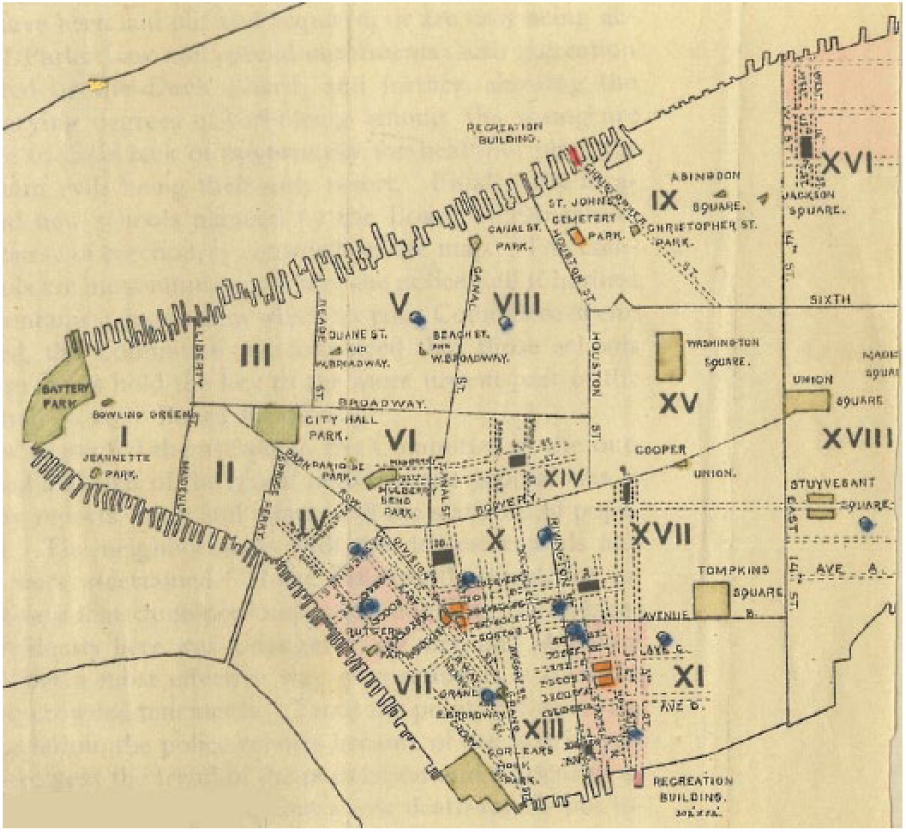
Section of a map of Lower Manhattan from the Committee on Small Parks’ 1897 report, which Riis took a major role in creating. The map shows the locations of proposed and existing parks as well as overcrowded areas in need of parks.
By the same token, Riis’s work also provided younger, more technically oriented activists like Veiller a springboard to push back against. While Veiller valued Riis’s abilities as a writer and publicist, he dismissed Riis’s approach to urban problems as “unscientific,” unsystematic, and often impractical. 99 Replacing slums with parks “does not ‘let in the light’ as you seem to think,” Veiller explained to Riis in 1900; “there are no rooms in any of the surrounding buildings that are any lighter for this park,” other than “the front apartments . . . which already have ample light.” 100 These criticisms, along with Veiller’s reluctance to credit the 1894 tenement commission or Small Parks Committee with meaningful change, fueled Riis’s resentment toward him. 101 While Veiller and Riis maintained an uneasy alliance going forward, their fundamentally incompatible outlooks mirrored a broader conflict between romantic and social-scientific waves of reform.
Fusion candidate Seth Low’s mayoral victory in 1901 facilitated the revival of long-tabled municipal park projects, as well as new ones all over the city. By spring of 1903, Lower East Siders had Corlears Hook Park, located on the eastern tip of Manhattan; Seward Park, at East Broadway and Essex Street; Hamilton Fish Park at East Houston, Stanton, Pitt and Sheriff streets; and several others. 102 As with Mulberry Bend, each of these three-to-four-acre parks replaced blocks of condemned tenements: Corlears Hook Park replaced the “Hook,” an area known for prostitution and gang violence, and Hamilton Fish Park replaced “Bone Alley,” home to generations of rag-pickers. 103 Through the efforts of the Outdoor Recreation League, many of these parks boasted playgrounds as well. 104
At the park’s official opening on a rainy day in October, Riis sat alongside other prominent city leaders in a covered pavilion: a far cry from the official cold shoulder he had received at Mulberry Bend Park’s opening just a few years earlier. 105 In a speech he had prepared for the occasion, Riis intended to ask his Lower-East-Side listeners to “always remember this day and this meeting, for here a new citizenship is born today, a citizenship that shall look to the ideal, not always to the material; that shall carry in loving regard ever the city of its home … [that] shall wipe the word slum forever from its page.” Looking out across a sea of more than fifteen thousand New Yorkers standing without umbrellas in the rain—many of them children—Riis forfeited his hard-earned moment of glory. “As anxious as I was to get the children into this park,” he remarked, “I am more anxious to get them out. I came here to talk to the children, but I will wait until a fair day. I have done all the talking to the administration that I care to, and it is no longer necessary to talk to them, thank God.” 106
Conclusion
Born in the romantic age and propelled to national fame in the Progressive age, Jacob Riis carried an unshakable faith in the restorative powers of nature that fused the aestheticism of Olmsted’s generation with the social-scientific empiricism of his contemporaries. His insistence on fresh air and sunshine over property and profits situated him within a broader, interrelated network of urban activism that included public health, housing reform, and settlements. Beginning with his campaign against Mulberry Bend, Riis refashioned eminent domain from a rhetorical concept into a tool that reformers could use to transform working-class spaces. 107 Once the park was completed, he continued advocating for working-class children’s access to healthy, open-air spaces through the Fresh Air Fund, the Boy Scouts, the city’s Sea Breeze Hospital, and his own settlement. 108 Toward the end of his life, Riis pursued these opportunities for himself by “taking the air” at various sanitariums. 109 While Riis’s determination to “let in the light” met with skepticism among some of his reform-minded colleagues, none of them disputed his talent for breathing life into their causes and instilling public awareness. “Though I’d like to reform almost every other reformer I ever knew,” conceded journalist Lincoln Steffens, “I shouldn’t change Riis, even if I could, in any particular, least of all in his roaring follies.” 110
Riis’s work with Mulberry Bend, and later the Small Parks Committee, supplied “breathing-space” advocates with a precedent and a template for their own projects. In the process, it reinforced their assumptions that planning and executing “breathing spaces” was a job for experts: people who possessed the proper credentials for gathering and evaluating the evidence needed to generate a successful outcome. This evidence typically resided with organizations that monitored as well as served the poor: private charities, settlements, and public agencies. While reformers lauded new municipal parks and playgrounds as “proof what can be done with the waste spaces in the midst of tenement districts,” it is worth remembering that those who lived in these “waste spaces” often viewed the situation differently. 111 “Is Bone Alley healthy?” Nicholas Balzer, unofficial “mayor” of the neighborhood, repeated incredulously to a reporter. “Look at me. I was born there, lived there until I grew up to be a strong, able-bodied man . . . There are dozens of old men around here who were born and brought up in the alley.” 112 Other locals pointed to “Frau Gurnurneger,” a toothless, white-haired, and evidently vigorous woman who had lived in Bone Alley for sixty years. 113 These protestations, while subjective and anecdotal, suggest that the mortality rates and lurid descriptions wielded by Riis and others did not always support tenement-district residents’ lived experiences of health and community. 114 It was not the poor themselves, but expert-driven impressions of the poor that ultimately determined which working-class neighborhoods remained and which became marked for destruction: something that the former denizens of Central Park, Mulberry Bend, and Bone Alley understood all too well. 115
Footnotes
Author’s note
The author wishes to thank Jeffrey Adler, Joseph Spillane, Mitchell Hart, Jack E. Davis, Pamela Gilbert, Judith Leavitt, Alan Kraut, and the two anonymous reviewers for their valuable comments and suggestions.
Declaration of Conflicting Interests
The author declared no potential conflicts of interest with respect to the research, authorship, and/or publication of this article.
Funding
The author received no financial support for the research, authorship, and/or publication of this article.
