




Abstract
This essay proposes a new approach to world’s fairs. Local elites, representing manufacturing, banking, transportation, merchandizing, and commercial interests, organized pre–World War I expositions to create urban settings supporting trade and cultivating innovation on a long-term basis. These stimuli came in the form of systematized infrastructure and environmental improvements, resources for training technical workforce, educating public taste, and reputation building. Most historically important, the result was to constitute the public facet of the second industrial revolution, identified on the business side with new energy sources, integration of industrial production and consumption, transportation, and institutionalization of research allied with industry based on official reports and documents.
Part I: Introduction
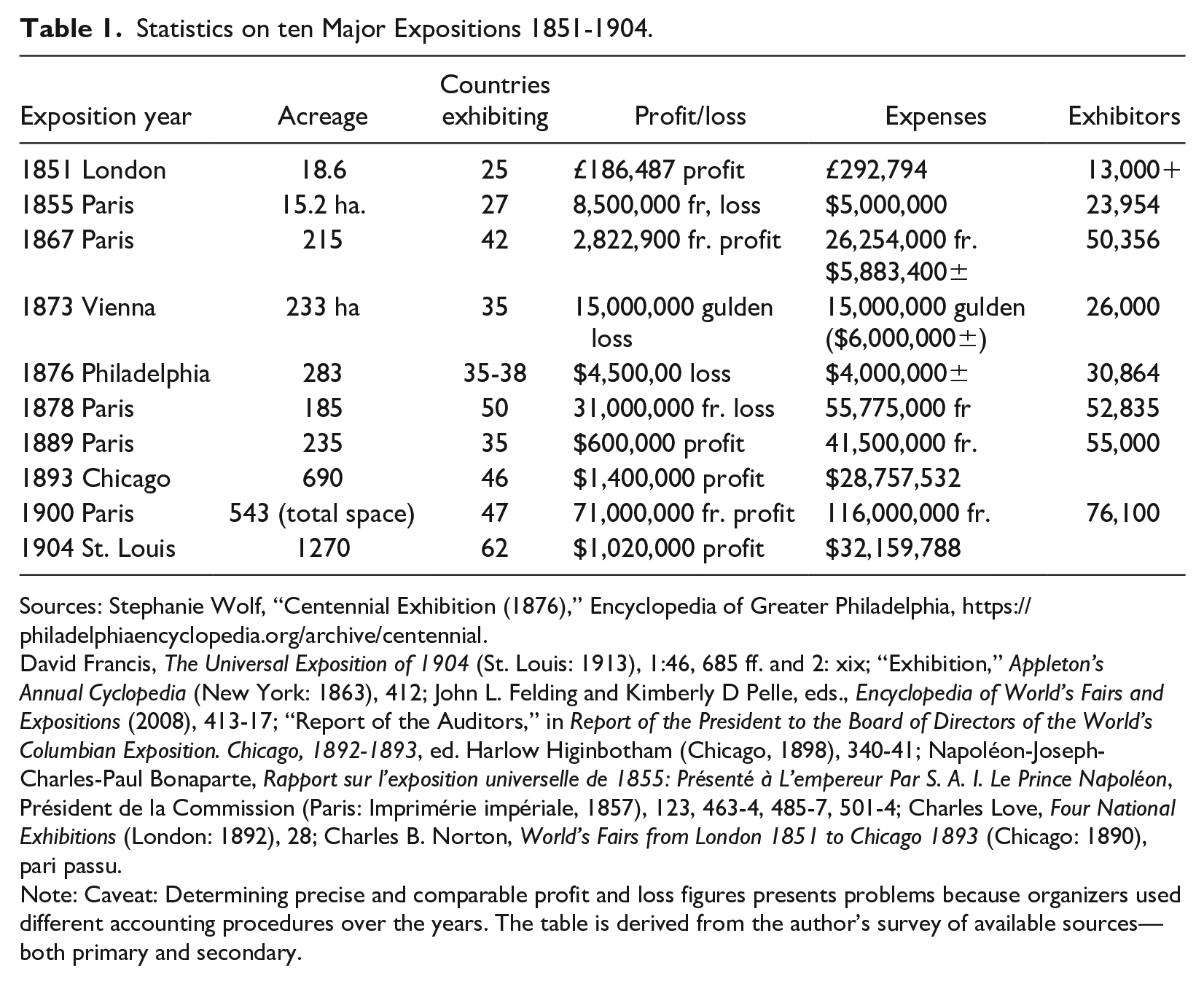
What were world’s fairs for? After numerous publications on the cultural and political significance of these events, a fundamental question remains. 1 Why did governments, businesses, and public and private institutions commit so much treasure, human effort, and space to mount international expositions for such short periods of time? It is particularly important to raise the issue in regard to the first series of great expositions that punctuated the years between 1848 and World War I. For they inaugurated a phenomenon in which in total, billions in today’s dollars, millions of work hours, and thousands of acres were devoted to the ten major urban extravaganzas, from the Great Exhibition of 1851 in London to the Louisiana Purchase Exposition of 1904 in St. Louis 2 (see Table 1). The primary answer to the question lies in the objectives of the prime organizers who had vested interests in developing the national and international trade potential of their respective host cities.
Statistics on ten Major Expositions 1851-1904.
Sources: Stephanie Wolf, “Centennial Exhibition (1876),” Encyclopedia of Greater Philadelphia, https://philadelphiaencyclopedia.org/archive/centennial.
David Francis, The Universal Exposition of 1904 (St. Louis: 1913), 1:46, 685 ff. and 2: xix; “Exhibition,” Appleton’s Annual Cyclopedia (New York: 1863), 412; John L. Felding and Kimberly D Pelle, eds., Encyclopedia of World’s Fairs and Expositions (2008), 413-17; “Report of the Auditors,” in Report of the President to the Board of Directors of the World’s Columbian Exposition. Chicago, 1892-1893, ed. Harlow Higinbotham (Chicago, 1898), 340-41; Napoléon-Joseph-Charles-Paul Bonaparte, Rapport sur l’exposition universelle de 1855: Présenté à L’empereur Par S. A. I. Le Prince Napoléon, Président de la Commission (Paris: Imprimérie impériale, 1857), 123, 463-4, 485-7, 501-4; Charles Love, Four National Exhibitions (London: 1892), 28; Charles B. Norton, World’s Fairs from London 1851 to Chicago 1893 (Chicago: 1890), pari passu.
Note: Caveat: Determining precise and comparable profit and loss figures presents problems because organizers used different accounting procedures over the years. The table is derived from the author’s survey of available sources—both primary and secondary.
This essay proposes that successive groups of self-interested fair organizers came to see that international expositions could help create urban settings supporting the expansion of industrial based trade and commerce on a long-term, international basis by exploiting the necessary relationship between mounting the fairs and accommodating the cities that hosted them to their larger agenda. They helped fit cities directly by focusing on transportation and business network building. As important, they focused on more indirect, but essential fitting through establishing institutions supporting innovation and specialist training, and on developing accessible modern neighborhoods for businessmen, managers, and professional classes who ran these enterprises. Theirs was a process of tailoring the relationship to the specific goals for their city, of emulating and learning from prior fairs, and of establishing networks of local, national, and international business relationships that centered on their cities.
They were motivated by the desire to regain and steer the momentum of domestically oriented industrial development that social unrest, the revolutions of 1848 and the Crimean and American Civil wars had interrupted. As Prince Napoléon, head of the 1855 and 1867 Paris expositions, well expressed these expectations: “These expositions will contribute to the rapid propagation of the truth that well-managed transitions will allow us to move smoothly towards the industrial and commercial organization of the entire world.”
3
Moreover, organizers were in agreement that the relationship between fairs, urban-centered development, and expansion of international trade and commerce were crucially interconnected. They were in positions to capitalize on the protean possibilities fairs held. 4 They not only understood—but also had vested interests in—using the fairs to boost the development of their cities in the interests of trade. Both European and American, they were capitalists: business owners, investors and directors, bankers (including various Rothschilds), manufacturers, political office holders, engineers, and merchants with vested interests in and aspirations for developing their particular urban locales into economically flourishing modern metropoles. Among them were ministers of trade, presidents of chambers of commerce and manufacturing associations, and real estate owners with vested interests in expanding the host city’s reach. Representing the interest in scientific and technological research and training necessary for innovation were members of scientific societies, heads of universities and technical institutes, as well as advocates of industrial and art museums. Many had close ties to railroads with their attendant enterprises of mines, mills, termini, and hotels.
The essay integrates and moves forward two areas of historical research on world’s fairs: that of business history on the fairs’ as stimulants to trade and that of cultural history on fairs as factors in developing modern cities. In the first instance, Merle Curti showed that at bottom these were trade shows fueling serious international competition for markets that grew along with industrial-based national economies in the six and a half decades before the Great War. 5 Later work in this area looked more closely at the fairs as urban-centered spurs to innovation and to reputation building. 6 In the latter instance, work emphasized their role as a modernizing catalysts, with particular benefits to scientific, medical, and technological institutions, or in the twentieth century, as platforms for ideological contests. 7 Missing from both is the rationale that linked fair organizers’ ambitions to grow trade and manufacturing beyond national borders with their commitment to investing in substantial, increasingly coordinated changes to their cities.
This approach to the study of these major pre–World War I expositions makes several contributions to understanding their historical importance. First, it shifts attention onto the efforts and aims of their prime movers: the local organizers who did the heavy lifting. Second, it establishes fairs as factors in long-term urban development that made these cities modern centers in a growing network of international trade and commerce. Third, it suggests possibilities for further research along these lines to examine whether the smaller fairs of the period fit this pattern and whether twentieth century expositions diverted from it as they came to serve ideological agendas that placed trade ambitions in second place. It is based primarily on published primary sources, a majority of which are voluminous official reports compiled under the aegis of exposition commission directors. These contain correspondence, budgets, regulations, speeches, legislation, as well as written descriptions and commentaries on the activities of the various committees.
The essay is organized in two complementary parts. The first discusses the ways in which over time organizers accommodated the siting of individual fairs to the development of urban spaces and extended geographic reach. These discrete analyses show the similarities and differences among the fairs, as well as the expansive trajectory organizers’ urban aspirations took. This section includes the four initial forays (the Great Exhibition of 1851, Paris 1855 and 1867, and Vienna 1873) that established the pattern, introduced innovations, and identified challenges. It then explores the unique trajectory of the Paris expositions of 1878, 1889, and 1900 under the Third Republic that turned the city into a cosmopolitan marketing phenomenon. It ends with the three American fairs (Philadelphia, 1876; Chicago, 1893; St. Louis, 1904) that marked organizers’ aggressive efforts to enter their cities into the international market place.
The second part of the essay looks at the consequences of organizers‘ use of the fairs to further their urban-centered aims on a long-term basis: the lessons learned and innovations adapted from one another that set a trajectory of improvement; the enabling web of supporting administrative, governmental, and financial arrangements constructed; and the growth in trade and population achieved. The conclusion considers the nature of the new international web of industrial commercial relationships the fairs helped host cities enter by World War I.
Part II: Initial Efforts (1851-1873)
The Seminal London Great Exhibition
The Great Exhibition in London set the measure for those to come. It wedded the fair and the city to the aim of increasing markets for British manufacturing and London commerce in several ways. 8 Organizing Commission members identified the fortunes of international trade with urban development as they sought a large, unencumbered site they could make accessible to exhibitors and visitors. Official approval of the union came with the rental and improvement of the Hyde Park royal property at the western end of London where rail lines already existed. In addition, the impressive foreign displays at the fair convinced them they needed permanent institutions that encouraged British manufacturing innovation, while the event itself left them with a profit they could use to this end. Thus, the fair had also helped identify Hyde Park and the west end as an exhibition locale. 9 The result was Prince Albert’s proposal to use profits from the exposition to purchase eighty-seven acres adjacent to Hyde Park to construct a cluster of applied art, science and technology institutions known informally as “Albertopolis.” 10
The prime mover was Exhibition Commissioner Henry Cole, a civil servant and then head of the Board of Trade’s Department of Art and Science. The major fruit of Cole’s efforts was the South Kensington Museum opened in 1857, its collections comprised manufactured and hand-made goods from carpets and flat ware to fire place screens and textiles, many purchased from the Great Exhibition. Aimed at extending “the influence of Science and Art upon Productive Industry,” the museum offered vocational training and research in product design and production techniques, as well as exhibitions and lectures meant to cultivate the public’s taste for innovative manufactured goods, especially of British design. 11
By the 1870s, it was part of a complex of institutions built on the Commission’s estate to “serve the extended wants of industry.” 12 Among them were the Museum of Natural History, the City and Guilds College, and the Geological Museum located near the Royal Geographical Society and the Society of Arts. The Commission also encouraged trade and commerce in the area by selling or renting out part of the estate for residential housing, coach houses, stables, and street construction. An underground station opened in 1867. Thus, in unforeseen, but controlled series of moves, Great Exhibition commissioners invented a cluster of urban cultural features that supported an expanding modern economy. Successors would come to identify these as desirable consequences they incorporated into their own exposition plans.
Paris 1855 and 1867: The Conundrum of Encouraging Industry and the Arts
Napoleon III and his Prefect Haussmann’s plan to rebuild Paris as the hub of rail and steamship networks that stretched across the Atlantic placed constraints on organizers of the two Paris expositions during this period. The Emperor and his Prefect Haussmann’s insistence on both system building and the creation of an imperial image for the capital as a center of art and luxury meant that organizers had to consider the infrastructure and the symbolic ambitions. Beginning with the 1855 exposition, they worked to stimulate trade via infrastructure changes and to design them in a way that signified the superiority of French industrial manufacturing and artisanal and artistic production. 13 Their commitment to the idea that “the improvements of industry are tightly bound to that of the fine arts” found expression not only in the amount of space delegated to innovations in the fine and applied arts at the fairs, but in the way they accommodated art and technology into the larger urban plan. 14
The beginnings of this effort can be seen in the unsuccessful attempt in 1855 to fit the exposition into a city already under reconstruction. 15 Its locale at the foot of the Champs Élysées amid newly constructed streets had the advantage of being near the city center, theaters, and shopping and not far from rail stations. Set within the city, it stamped it as the center of French industry and art. 16 The reality was, however, that inserting the fair into an already developed space truncated any urban improvements directed specifically at sustaining business and trade and made a logistic nightmare. To avoid cramming expositions into difficult to access urban spaces that interfered with economic growth, future Paris exposition organizers looked for a way to advance rather than accommodate Napoleon III and Haussmann’s plan.
The 1867 exposition provided commissioners with an opportunity to move in this direction by setting it in the Champs de Mars neighborhood on the left bank at the city’s western edge. 17 As Prince Napoleon recounted in his official report, the largest single expense, aside from the main building, was for extending the water drainage system to connect the Champs de Mars and École Militaire with the Grand Égout, for bringing in gas lines and lighting, improving streets, and draining the area. More than a bow to aesthetics, the gas lamps were intentionally designed to match those on the new boulevards to emphasize continuity of this peripheral space with the rebuilt central city. 18 Construction of a rail line from the site to the newly opened ceinture rail line circling the city gave access to rail service for trade and passengers in more affluent areas.
There had also been limited efforts to use the 1867 exposition to open the area to commerce on an extended basis. Prince Napoleon enthusiastically touted the steamboat taxis on the Seine that habituated visitors and Parisians to water transport from the Hotel de Ville to the Champs de Mars. A 600-m embankment and dock at the exposition site made for easy transport and pleasant promenades and vistas that improved access to the area from the river. 19 These efforts had had no life beyond the exposition, however, being torn down at its end. Prince Napoleon lamented the destruction of what “would have offered commerce an un-floodable quay and harmonized with the Place du Trocadéro design [opposite].” 20
Most important, the 1867 exposition did elicit an alternative vision for the city that was industrial and strongly opposed to the conservative commitment to the arts. It came from Michel Chevalier, member of the Imperial Commission, of the Emperor’s Conseil d’état, co-author of the Cobden Chevalier free trade agreement with Great Britain, and advocate of Saint Simonian industrial growth ideas. In a scathing passage in the official jury report for 1867, Chevalier shared the lessons he had learned from the fair regarding the needs of the city.
In it he warned that current policy privileging an economy of luxury and pleasure would destroy Paris. If “Paris were not developed into an industrial and commercial city, she would end with grass growing in the cracks of her splendid avenues.” While luxury and entertainment were important to draw visitors to the city, primary focus should be on educational institutions based on science, an economy that opened opportunities for private businesses, and an intracity transportation network that reached into quarters on the east and southwest where manufacturing and commerce were centered. He specifically noted that a quarter of the funds poured into the new Opera and the large access avenues would have “endowed Paris with an ensemble of educational institutions for primary, intermediate and higher education” that would make Paris a true capital of the industrial world. An underground rail system would provide rapid, inexpensive travel. “Time is money.” 21 It was a challenge post-1870 fair organizers would meet in a peculiarly Parisian way.
Vienna 1873: Boosting an Aspiring Metropolis on the Danube
Organizers of the 1873 Vienna exposition had multiple aims for using it to fit Vienna for industrial business and manufacturing. Distinct differences placed their efforts more in concert with Chevalier’s proposals than with those of the Second Empire’s commissioners. Commission aims were defined to a large extent by efforts to recover from Austria’s defeat by Germany in 1866. 22 At the urging of the Vienna Trades Union and under the direction of Baron Schwartz-Sanborn, an advocate of international patent laws and secretary of the Vienna Society of Industry, the commission had a dual agenda to boost the market for Viennese manufactures and business. 23 Building urban infrastructure that connected the Leopoldstadt districts with the main city was pursued with improving land that added residential and manufacturing space. 24 Key projects were “the Great Regulation: completion of the Danube Canal and an enlarged port on the Danube River.” 25 These improvements were projected “to open up the capital, by this close connection with a great navigable stream, all the advantages which can be derived for commerce from so favorable a position.” 26 They included railroad lines and the construction of the Kronprinz-Rudolph-Brücke.
By setting the exposition in a portion of the Prater, a large piece of state land on Leopoldstadt, organizers were in a position to orchestrate changes to the surrounding area where manufacturing, vegetable gardens, small businesses, and working-class residences had drawn Jews and migrants to the growing economy. 27 In tandem with completing the Great Regulation, the exposition was to help turn the land into an useful annex to the port, with the main building to be a corn market and warehouse for the port complex. 28 The exposition was also a spur to planned railroad and bridge construction—initially needed to mount the fair and transport visitors, but remaining to service the entire island and port. Re-invigoration was apparent in the widened boulevards and transport facilities, rail terminals for goods and visitors, and in construction of “acres” of private building projects and hotels. 29
The fair was a limited success, partly because some projects were not completed in time for the fair opening, and partly because the concept of dual usage turned out to be difficult in practice to coordinate. 30 The vast main building was used for periodic trade shows in following years, but never as a commodities exchange center. A member of the Philadelphia delegation to Vienna, seeking lessons to apply to planning the U.S. Centennial exposition in 1876, reported the exposition had made long-term changes that benefited Vienna’s economy, but was itself a failure. 31
Part III: Late Nineteenth Century Fairs: Consolidations and Variations
These initial forays left a number of institutional inventions, inventive strategies, and instructive lessons that succeeding French and U.S. commissioners would consciously weave together to fit their own international trade ambitions. 32
Third Republic Fairs: Wedding Industry, Aesthetics, and Commerce in Paris
In the process of devising their own iteration of these innovations, organizers of the three French fairs resolved the conundrum posed by Chevalier. They found a way to systematically wed the city’s lucrative status as a locale for art and pleasure with the construction of a vibrant urban industrial infrastructure and the expansion of scientific and technical institutions. After the humiliating defeat in 1870 and destruction from the Commune uprising, elected national and municipal authorities of the new Republic came to join forces. Together they ushered in a new era in which expositions, commerce, manufacturing, and the industrial development of Paris went increasingly hand in hand. A new ideological cast marked these intertwined efforts, as republican leaders redefined Paris as the world center of liberal democratic modernity, committed to science-based education and to making scientific and technological progress available to all.
Organizers drawn from republican “moyen bourgeois” social milieu were responsible for this shift. Scientific and technical education were integral to their commitment to make French industries—including luxury goods and decorative arts—competitive. Graduates of the École Polytechnique continued to hold important places in organizing and administering the expositions. New to the mix were representatives from the working and middle-class districts of Paris who had increasing input into plans for the city that would enhance urban manufacturing and trade.
Changes to the city began as organizers of the first of these fairs in 1878 expanded the exposition on the Champs de Mars to the Trocadéro on the opposite side of the Seine. 33 Their focus on the western side of the city drew attention away from the recently volatile center, where the ruins of the Tuilleries Palace and the Palais d’Orsay stood as reminders of the Commune uprising. The west end signified a Paris of order and security in pursuit of uninterrupted commerce and development.
In fact, fair organizers under the direction of the engineer Senator Jean-Baptiste Kranz helped link development of the Trocadéro area to regions beyond the western outskirts. There, where a reservoir had provided water for the 1867 fair, the new Palais du Trocadéro and its gardens would serve as a cultural center with a museum that expanded on the aims of the Victoria and Albert to include ethnography. 34 In addition, in time for the opening of the exposition, government support for extensions to the existing belt railway lines circling the city improved the flow of commerce between Paris, the hinterlands, and foreign customers. As a result, not only was it easier to deliver freight and visitors to and from the exposition from a string of terminals outside the city, but several lines communicating with railroad stations and gates to the city remained to service its ever-growing chemical and metallurgical businesses in Javel and Grenelle. Their locales did nothing, however, to decongest transport within the city’s ill-served manufacturing neighborhoods to the North and East of the Hotel de Ville. 35
The 1878 exposition provided a platform on which Organizers of the 1889 exposition could build a new identity for Paris as the center of a liberal industrial republic. The republican coalition government took a calculated risk in celebrating the centennial of the French Revolution with a solemn festival recognizing the event as the liberation of work, commerce, and industry “for the benefit of France and of humanity.” 36 Making Paris the place for launching this message added a new ideological dimension to the promotion of French trade and manufactures. The city of danger and dissent was now presented as a liberal democratic environment conducive to innovative manufacturing and marketing. In this respect, fair organizers sought to redirect Second Empire urban development into the service of French manufacturers and small businesses. While they made few permanent changes to the urban fabric or additions to the Trocadéro museum, they expanded the fair’s footprint along both sides of the Seine to accommodate small concessionaires.
What mattered most in modernizing Parisian identity were effective symbols. In this regard, Gustave Eiffel’s Tower was key. Rising up on the Champs de Mars, its 300-m iron shaft dominated the Parisian landscape, insisting it be noticed. Its major champion Édouard Lockroy, variously Minister of Education and Fine Arts and of Commerce during the exposition’s planning phase, framed the Tower’s purpose in both symbolic and economic terms.
37
As Lockroy explained, the Eiffel Tower was not merely an innovative iron gateway. It was a commercial manufactured product, constructed by an engineer whose firm was located in Paris, and a testimony to official support for entrepreneurial ventures. In this sense it was a commodity, being intended to draw paying customers to the exposition and to make a profit by selling them a unique experience of climbing it for a fee. The fact that it was to remain in place after the fair extended its life as a Parisian commercial attraction. Moreover, it served as a cachet, advertising the forward-looking character of French manufactured goods. Lockroy drew a clear connection between these two functions, translating this commercial function into a symbolic one: “It summarized the industrial greatness and power of the present age . . . the image of progress as we conceive of it today: an unending spiral in which humanity gravitates in an eternal ascension.”
38
In official terms, the Eiffel Tower was the ultimate republican product. It stood as a counterpoint to Napoleon III’s Opera and circumvented Chevalier’s criticism by offering an innovative manufactured form of pleasure, fully available for the price of admission that set Paris itself at the vanguard.
Commissioners of the 1900 exposition continued many of the aims of 1889, 1878, and even 1867 and 1855, now also reflecting the small business interests of a reinvigorated, more politically radical Paris Municipal Council. 39 New and most important in 1900 was organizers’ decision to focus on encouraging consumption of Parisian goods, wedding the producers of more affordable domestic goods and decorative arts with their growing numbers of middle-class consumers, both native and foreign. This agenda led to unabashedly identifying their aims for the exposition with changing the character of Paris itself through extensive infrastructure development, including transportation, into arrondissements near the Hotel de Ville noted by Chevalier. The fact that the 1900 exposition’s three sites embedded it in a web of urban activity stretching across the city gave them the range and authority to do so. Under the guidance of General Director Alfred Picard with his polytechnitien’s appreciation for integrated system, organizers implemented a series of official agreements and regulations that further improved the city’s connections to commercial and manufacturing (including decorative arts) enterprises, and its character as a distinctive space attractive to consumers. 40 The exposition’s vast spatial extension, its design, accessibility, and appearance—all enhanced through the application of electricity—were co-incident with developing the entire central city for similar ends.
This coincidence is visible in the organization of spaces that were adjacent to almost every commercial and manufacturing sector of central and western Paris. Commissioners focused once again on the Champs Élysées, which had been reconfigured since 1855 in great part spurred by the 1900 exposition. The locale was now the entry point to a large area stretching from the foot of the Champs Élysées where it met the Place de la Concorde, across the river via the new gilded Alexandre III Bridge to include the Esplanade des Invalides, along both sides of the Seine to the Champs de Mars and Trocadéro. The Vincennes site to the far east was the only noncontiguous sector, now accessible via the Métropolitain completed in time for the fair.
It is also apparent in the way in which Alfred Picard, the General Director of the exposition, described visitors’ path as a procession passing under the entry arch with La Parisienne, mentioning the resplendent replacements for the old Palais de l’industrie, and the plethora of exhibits devoted to the decorative and applied arts products. 41 The exposition spectacle sketched by Picard was a point of departure to a longer term goal to develop the city’s economy. The Alexander III Bridge was among a number of projects built in time for the exposition that would become permanent features of Parisian infrastructure. Others associated with access and circulation in the immediate vicinity included on the right bank, the metro station at the Place de la Concorde on the newly opened, electrically powered line from the Etoile to Nation. On the left bank, they included widening the street along one side of the Esplanade and adding two railway stations to handle projected growth in freight and passengers.
Aesthetics also figured in their development plans for the fair and beyond. Maintaining or enhancing Paris’s famed urban vistas was an important consideration dating back to Napoleon III and Haussmann’s agendas. Sensual appeal could be used to draw people into its economy. To this end, it was important to exercise careful control of new structures and technologies. For example, organizers made certain that the new Compagnie de l’Ouest’s Gare des Invalides and hotel be placed perpendicular to the Seine so as not to block the vista stretching across the river from the Champs Élysées to the Invalides dome. For the same reason, the state also required that the tracks be sunk below ground in a trough. The regulation held true too for tracks of the Moulineaux rail line along the quay, requiring they be covered with an iron grill able to support pavilion structures above. 42
With visitor aesthetic experiences in mind, organizers’ efforts at control extended to the city at large. There were agreements stipulating that railroads would not be allowed to lay track in the city center. The new metropolitan trains themselves would be powered by electricity supplied by underground cables. New tramways linking the edges of the city to the center, permitted in increasing in numbers as the fair approached, would run on quieter and cleaner electric motors without overhead wires. 43 Moreover, fewer horses reduced unpleasant smells and street pollution.
Organizers also looked to electrical illumination to make the city more attractive and accessible at night. Lighting the walled promenades along the left and right banks at the main entrance were intended to increase the number of paid visitors and habituate people to using the space. 44 Electrical lighting for the two new palais that replaced the cramped Palais de l’industrie, along with other designated areas in the city, remained in use after the fair. The palais themselves became economic resources for the city, rented out for various international exhibitions such as decorative arts and automobile shows. 45
The result was that by the summer of the fair, Paris had not only recovered physically from the Commune, but the fair had been used to create a vibrant international economic environment, in addition to demand for French goods. To some extent, the result looked back to the 1855 and 1867 agendas, but organizers had struck a balance between the interests of large and small-scale businesses. The railroads connected the city to regions and countries on all points of the compass, and contributed to the economic development of the city, while being kept from disturbing the inner urban space itself. The “enceinte urbaine” (the urban precinct) was the attraction to which the railroads led. Its vistas were free of railway tracks, wires, smoke stacks, if not entirely of horses, as small-scale transport companies connected the rail stations, hotels, innumerable commercial areas, and monuments with one another via the unseen power of electricity. Moreover, the urban view was punctuated with novel decorative metro entrances, electrically illuminated streets, shops, and cafes, attracting consumers to the spectacle of variety and color in an ordered space.
The United States 1876, 1893, 1904: Unabashed Development
Unabashed ambition for international markets motivated organizers of the three great fairs held in Philadelphia, Chicago, and St. Louis between 1976 and 1904. President Ulysses Grant set the tone for them all in his opening remarks at the 1876 Philadelphia Centennial, the first official American international exposition. Noting that the nation had completed most of the “primal works of necessity” so far as settling the land and opening mines and factories, it was now ready to enter the world stage, “rivaling older and more advanced nations.” 46 On the Federal level, congressional support meant little funding, but official invitations to foreign governments and businesses to participate and favorable tariff agreements. 47 Local organizers raised the funds, took care of logistics, and had to convince foreigners the effort was worthwhile. Moreover, these rising industrial cities were in competition with one another for business investments, trade, and population.
The three American fairs show an evolution in organizers’ plans from considering the city as a stage for the exposition benefiting businesses, to the exposition as an opportunity to improve the environment for business through urban planning, and finally as a collaboration of local businessmen, officials, and higher education leaders to simultaneously advance commerce and trade, urban development, and build reputation as a center of scientific research and teaching. Businessmen and elected officials from city councils, senators, and governors served as official boosters, often bridging the gap between the city and the U.S. government.
Philadelphia 1876: Rejuvenation
Growing trade in manufactured goods, especially iron and textiles, was the overriding agenda for the Philadelphia 1876 exposition in this industrial city with large manufacturers, a port with access to the Atlantic trade, and the headquarters of two railroads now stretching as far as St. Louis. With the end of American Civil War contracts, Philadelphia business owners and investors sought to retool their factories, reorient their commission enterprises, and rebuild their markets with a focus on melding domestic with international trade. They viewed “The International and Universal Exhibition of Arts, Manufactures and Products of the Soil and Mine” as an important boost in building the reputation of Philadelphia’s products and services internationally and to develop an efficient support system meriting that reputation. These efforts included the construction of Memorial Hall at the exposition to be turned into a museum as part of a research complex consciously modeled on the South Kensington. 48
Unlike the European commission members, the Board of Finance members were primarily Philadelphians who did the real organizing and fund raising work. Collectively, this cadre was composed of private individuals engaged in a wide range of activities centered on the city. Such activities included owning older, smaller firms in the city’s center and larger ones on the edge employing up to 3,000 workers. A number were members of the Franklin Institute—a private institution founded in 1824, named after Benjamin Franklin and devoted to promoting science and technology. They were cut from cloth similar to that of the previous generations’ city leaders whose “strength lay in the variety of talent, experience and opinion they could harness to public commissions, private boards and elective office,” who conflated the benefits of the fair to the city with their own. 49 President of the Centennial Board of Finance John Welsh was a good example of such multiple commitments centered on improving the business climate of Philadelphia. He was a merchant businessman who supported the University of Pennsylvania, helped found the Episcopal Hospital, and worked for the development of Fairmount Park, where the exposition was held, as both a source of city water and public leisure. Member William Sellers, founder of the Edge Moor Iron Works after the Civil War, reportedly furnished “all the ironwork” at the Philadelphia fair. 50
Planning logistics drew a great deal of their attention, as reports of their representatives (cited above) to the Vienna exposition attest. The bottlenecks of Vienna were to be avoided if Philadelphia were to prove itself a good place to do business. Careful timing and coordination of transportation construction and systems design were key. Completion of two new bridges across the Schuylkill River in time for the exhibition helped move visitors and goods for display more easily, as did improvements in the Delaware River docks. 51 The Pennsylvania Railroad also built a new passenger station in West Philadelphia and the Wilmington and Baltimore reconstructed its station in South Philadelphia. These presented an occasion for organizational innovation to deal with increased usage in that both railroads introduced the separation of passengers from freight handling at this time. 52 In other related ways, organizers integrated major, long-term improvements into the city that coordinated in their plans for the fair. These included additions to Fairmount Park, turning the fair’s Memorial Hall into the Pennsylvania Museum and School of Industrial Art (modeled on South Kensington), the horticultural hall conservatory and expanded waterworks to supply the city’s anticipated growing population. 53
Chicago 1893: The City as Real Estate Investment Opportunity
In Chicago for the 1893 Columbian exposition, local organizers put their own national and international ambitions for their city first. They took charge, only incorporating people from outside Chicago in their efforts where necessary for expert guidance and prestige. Such was the case of New York architect firm McKim, Mead & White, landscape architect Frederick Law Olmsted, and museum expert George Brown Goode, Assistant Secretary of the Smithsonian Institution. 54 Core organizers were men who understood how to parlay industrial profits into urban development they deemed beneficial, and they embodied the audaciousness of a city that had reversed the flow of its major river to spur economic growth. They were in the business of manufacture and finance, supply and distribution, with connections to the east coast and the midwest region. Lyman Gage and Ferdinand Peck were among the most important. As Vice-President of the First National Bank, one of the most solid midwestern financial institutions, Gage used his skills and connections to raise investments needed to bring the fair to Chicago. As Chairman of the Finance Committee, Peck assumed great authority over fair planning. What made these men different from their predecessors in Philadelphia and London was that they planned to benefit from their investments in the business district, including rents gleaned from the “sky scraper” office buildings, the hotel and auditorium they owned. 55
1893 World’s Columbian Exposition in Chicago was the product of these businessmen. It was important that the exposition advertise the magnificence that industrial wealth could produce, as well as boost that wealth. As the board of director’s president reported, “The matter of ‘dignity’ was in those days so jealously guarded as to become at times almost a bugbear.” 56 Behind the broad vista of the White City, lay capitalists’ quest for expanded trade and commerce with the aim of profits. 57 Foreign participation afforded an opportunity for extended business connections, and railroad development stretching hundreds and thousands of miles. The Chicago and Illinois railroad companies seized the moment to integrate with other lines from outside the state while extending their control over access to the city itself. 58
There were also serious efforts for long-term change within Chicago itself. In this regard, organizers’ real estate investments came into play. The North Shore known as the Lake Front east of the Loop caught organizers’ attention early on as the exposition site. Afterward, part of it was to be used as a park for the enjoyment of a wealthier population living north of the business district. 59 Although this plan was scotched in favor of the less expensive Jackson Park venue, it would eventually be realized as part of the Burnham plan for the city (see the “Part IV: Consequences and Conclusions” section). 60
More indirectly beneficial was the boost Hyde Park received from the development of Jackson Park for the exposition. The draining and filling of this swampy expanse not only turned it into a pleasant urban space, but a healthy environment that drew residential and commercial building investments. In a city working to insure pure water from Lake Michigan, organizers also increased the water supply and sewerage capacity by adding pumps, piping water in from Wisconsin, and using the new Pasteur-Chamberland technology to filter drinking water. Transportation needs for the fair provided an intra-city connection to the Loop by the middle of 1893. 61
The exposition also helped give an inaugural boost to organizers’ real estate investments in the emerging Loop commercial district. These included a number of new structures developed around the time the exposition was being planned: the Auditorium theater and hotel, the Rookery, and the Rand McNally building, where the Board of Commissioners rented office space and where the official printers for the exposition and the Illinois Central Railroad offices were located. The Auditorium theater, built with funds raised by Ferdinand Peck, was rented out to celebrate the exposition’s opening. Its attached hotel opened in time to receive affluent visitors. 62
Organizers also provided the city with a natural history museum. 63 At the urging of committee members, exposition plans included purchasing the Art Building and designing it for this purpose and the appointment of a Museum board from among their ranks. 64 When the transition was completed, the Field Columbian Museum of Natural History collections strongly reflected Ayer’s commitment to ethnography, mitigated by that of Goode to advance science through research and public education, rather than the narrow manufacturing focus of the South Kensington and Philadelphia museums. 65 It was to be what Harlow Higinbotham described as an international institution: “large enough to take in everything.” 66
St. Louis 1904: Urban-academic synergy
The motivation behind the Louisiana Purchase exposition can be characterized as “utilitarian prestige.” To leaders of a city emerging from a decade-long struggle to re-coop trade and population lost during the American Civil War, the fair offered an opportunity to move ahead rapidly, and to best Chicago to become “the very first city of the United States . . .” 67 Motivated by this goal, Sylvester Waterhouse, Washington University Classics Professor and organizing committee member, lobbied hard for an exposition among St. Louis’s elites. 68 The result was that infrastructure and higher education came to be entwined in planning for economic expansion especially by rail.
David Francis, former St. Louis Mayor, Missouri Governor and President of the Board of Directors, led the development of plans for the fair along these lines. 69 Board and Company committees included some of the wealthiest businessmen, bankers, and politicians in the city. A number of these businessmen were associated with St. Louis’s technical training schools for the prestige they brought and for the technical and scientific workforce they produced to help the city develop further. Francis was a loyal supporter of Washington University. There were educators among them, including the enthusiastic Prof. Waterhouse. 70 Eight of them sat on Washington University’s board of trustees, then embarked on an ambitious expansion that moved the campus to land the main exposition site would abut. 71 Through the exposition, they sought both to stimulate commerce, manufacturing, and trade, and to foreground the multitude of ways scientific research helped achieve its “evolution.” 72 As Francis approvingly noted in his final report, the St. Louis exposition had moved from commercial development of the city to advancing the new knowledge on which it depended. 73
Organizers used the fair to effect physical changes focused on a cluster of long-term plans for developing residential real estate, establishing Washington University’s new campus, and developing a rail-based economy. Mutually beneficial real estate agreements counted a great deal, as the Company sought the land it required in addition to city owned Forest Park for the huge affair. The rental of three adjacent tracts for their use brought sewers, lighting, and some road construction to areas on the fringe of the city. Such was the case of the land in Clayton, abutting Forest Park where the Philippine exhibits and village were located, and for the strip where they set the Pike. The quid pro quo for owners of these tracts left them with improved property and water supply they soon developed into new housing meant to attract the anticipated middle- and upper-middle-class migrants to St. Louis. 74
The agreement with Washington University was a model of mutually beneficial exchange, for the directors agreed to build or complete six buildings (including a chemical laboratory) and install 6,500 ft of water pipes on the new campus across from the park in exchange for their rental during the fair. This arrangement with the Directors was a great boon to President Chaplin’s campaign to give the university international stature and increase collegiate enrollment with special emphasis on science. Moreover, the Olympic games held in conjunction with the fair left the university with a first rate athletic field. The international Congress of Arts and Sciences, officially part of the exposition, brought coveted attention to the University as an important intellectual center. 75
Forest Park itself came in for development, as its marshy areas were drained, the Des Plaines River flowing into it channeled into a lagoon and fountains. Moreover, the fair’s Fine Arts building was flagged to become a public museum in which Washington University’s Fine Arts Department was allotted space. 76 Other buildings and landscaping left spaces for public enjoyment, while expanded Botanical Gardens nearby offered enhanced opportunities for plant research and teaching. Organizers’ ambitions accelerated urban growth already underway. The Terminal Railroad Association’s mammoth neo-Romanesque Union Station and Terminal Hotel completed in 1903 gave the city a facility large enough to handle traffic of twenty-two roads that converged from east, west, and south in St. Louis. As in Philadelphia, this station served passengers, exiting five miles from Forest Park and just west of the central commercial district. Freight was directed into another terminal closer to the river as the socioeconomic geography of the city changed. 77
Part IV: Consequences and Conclusions
This concert of exposition efforts to extend trade out from individual locales helped engender the “industrial and commercial organization of the entire world” Prince Napoleon had predicted in 1855. The network of relationships and common culture they produced derived from the fact that organizers not only emphasized, but sought to draw lessons from the experiences of their predecessors. As the Franklin Institute journal editor bluntly noted of the 1876 Philadelphia mission to Vienna, “. . . such experience is imperatively demanded to avoid the blunders and mistakes of previous efforts.” 78 Competition and emulation among them focused on four factors.
First, organizers expanded and improved transport facilities directly and indirectly through agreements with host cities, railroads, and national governments. There was special focus on rail and ports—especially in Vienna, and Philadelphia and later for Paris, Chicago, and St. Louis. Intra-city transport was also important. The support and funding fairs drew enabled the construction of the Paris Métropolitain, the completion of the Danube Canal, and a number of bridges. Moreover, the fairs increased capacity with anticipated growth in mind. Thus, by 1900 Chicago had more than 120,000 miles of rail into and out of the city, and by 1914 St. Louis’s new passenger terminal was among the busiest in the nation. Terminals, tracks, street cars along with bridges completed in time for the expositions created systems enabling goods and people to move efficiently to and from ports and terminals and within the city. In addition, separating terminals for handling quantities of goods and passengers helped eliminate transshipment bottlenecks in the system. 79
Another focus was on the long-term uses to which exhibits and exposition buildings could be put. Organizers’ utilitarian outlook and quest for status contributed to the invention of the modern public museum, using the very goods the fairs had brought to their cities, frequently housed in built for purpose structures left by the fairs. Organizers took initial inspiration from the South Kensington museum whose industrial education agenda and collections drawn from the 1851 exhibition cache. The French had their own variation on this trend to foreground their own commitment to selling Paris as a center of art, culture, and science by re-purposing the Trocadéro Palace into a museum of world ethnography and art. The foundation of the Musée des Arts décoratifs in the aftermath of the 1900 exposition provided a center for research, innovation, and promotion of well-designed, affordable practical products aimed at “stimulating the national economy through the mass production of truly modern design.” 80
It was the Americans who embraced the fairs as a means of developing knowledge producing institutions: museums and universities. Thus, Philadelphia organizers expressly designed and identified funds for the arts building as a permanent structure with the South Kensington museum’s mission in mind. 81 Under Chicago organizers, the city gained a museum building and collections that expanded the utilitarian rational into channels more indirectly associated with trade and commerce. The Chicago Field Museum aimed not only to be a resource for designers and manufacturers’ inventions. It was to educate the public into a more cosmopolitan world opening up around them. St. Louis organizers followed this general approach to including plans and budget for a museum in the Louisiana Purchase exposition. Even more inventive was the advance planning for the development of Washington University itself into an internationally important research institution. Its affiliation with the art museum across the road was in spirit, if not in direct imitation, of Imperial College London within the South Kensington complex.
In one case, the 1893 exposition inspired the Professor William Wilson to found the Philadelphia Commercial Museum in 1897. Its collections (initially purchases from the exposition) and library aimed “. . . to aid [business men and manufacturers from all parts of the globe] in overcoming the difficulties arising from lack of knowledge of foreign languages, money, weights, tariffs, prices and customs of trade” in order “to further the increase of foreign trade.”
82
Organizers also focused their attention on the integrated urban environment fairs produced. From 1851 on, they recognized that the improvements fairs brought to their sites had both economic and aesthetic value so far as their urban agendas were concerned. Thus, they copied, enlarged and improved on the vistas their predecessors created as spurs to later development. Paris organizers’ achievement in 1900 made an especially strong impression on Ferdinand Peck and other Chicagoans that led to further post-Columbian exposition changes to the city.
Peck’s final report to the U.S. government enthusiastically described the impact the newly beautified and convenient city had had on Parisian commerce: “. . . there remain as a result of the Exposition two magnificent stone art palaces on the Esplanade des Invalides, just off the Champs Elysées. The imposing Alexander III bridge and the new and improved quays along the river Seine . . .”
These had brought “millions of dollars to Paris and to France by visitors, and spent in various lines of trade and travelling and living necessities.” 83
Five years later, the Commercial Club of Chicago—with Paris in mind—commissioned Daniel Burnham and Edward Bennett to create a plan for Chicago to guide for its becoming a world renowned commercial center. Their genius was to understand how to bring together in one design the large needs of trade and commerce with the population growth needed to sustain them—especially wealthy elites, upper level managers, and professionals. The authors also proposed building an international research center around the rebuilt Field Museum near the Art Museum and Grant Park bordering on the business district—which would become a “meeting center for the scientific societies of the West.” Consciously emulating the convenience and beauty of Paris, their plan promised to “bring large amounts of money as well as aesthetic satisfaction” by keeping Chicagoans in the city and bringing foreigners to live there, encouraging the circulation of money made from trade among the general population. 84
These physical improvements preparing cities for increasing trade and commerce were accompanied by their use of fairs to draw business from near and far to their cities, and to make transactions with them more secure and efficient. The formal support of foreign governments was key to their realization. The Philadelphia representative in Vienna urged Americans to recognize the advantages that could come from such connections. 85
This outreach required establishing a relationship with their own governments so that heads of state could issue official invitations authorized by legislative bodies. In addition, national legislatures passed laws setting import and export duties on varied categories of goods for the period of the fairs, sales and tariffs on goods and materials intended for the fairs, as well as foreign workers. They also government-appointed national commissions that drew city elites formally into their national orbits. 86
Armed with this authority and status, executive committee delegations visited foreign businessmen, chambers of commerce and business associations, and government officials to encourage them to come and enter into legal commitments. The Americans were particularly aggressive in courting foreign businesses beginning in the early 1870s, recognizing the obstacles distance and cost put in their way—especially in the case of Chicago and St. Louis. The French delegation from the 1889 exposition found this direct approach to foreign businessmen particularly useful when European monarchies refused to associate themselves with an event marking the advent of democratic republicanism. And these delegations could help cultivate mutually beneficial international trade relations, as in 1878 when the director of the French section “who had been in attendance at the Centennial Exhibition . . . promoted our [American] interests whenever it was in his power to do so.” 87
Official reporting on and lessons learned from predecessors’ efforts strengthened these commonalities. Emulation and competition fueled them. The 1851 Great Exposition, in fact, originated because of the British desire to best the French biennial exposition promoting national markets for arts and manufactures. The French then strove to outdo the Great Exhibition in 1855 and 1867, taking from it the need for large spaces, access, and a developing industrial base on which to build. Baron Schwartz-Koburn’s experience as head of the Austrian delegation to Paris in 1867 benefited the Vienna exposition. Philadelphia’s commission, in preparation for the 1876 Centennial, sent engineers to report back on Vienna, particularly on the subjects crucial to that exposition’s success: transportation arrangements for goods and visitors and the port project. Ferdinand Peck’s admiring report on the integrated spaces of Paris 1900 had an effect on the future planning of Chicago.
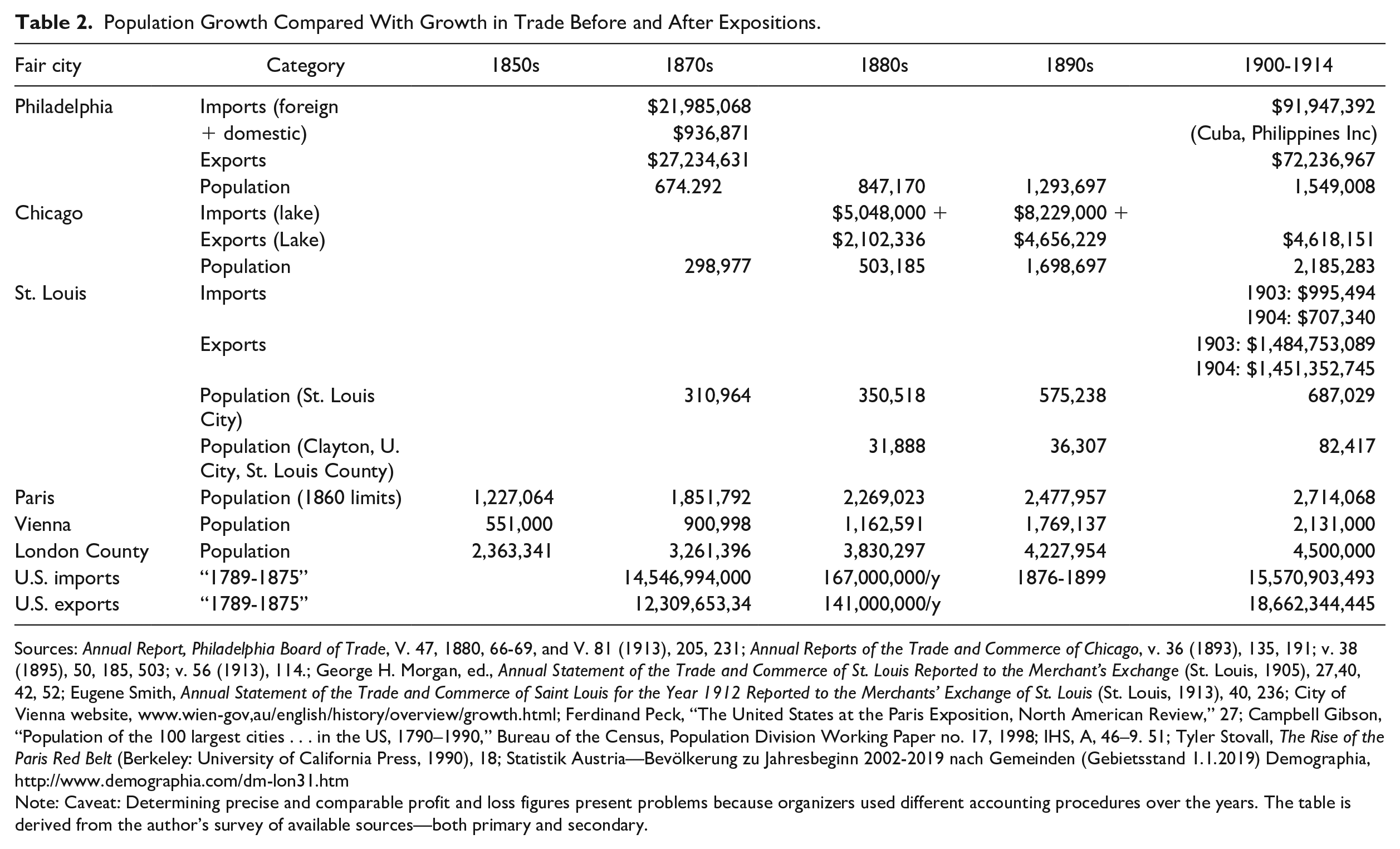
Organizers measured the success of these efforts in terms of growth in trade, and to a general way to population. Table 2 shows increases by decade for each city, so far as statistics are available. 88 It is, however, possible to see that there was growth in the quantity of urban-centered trade and in urban populations in the major exposition cities, even though, for example, the Chicago figures provided by Board of Trade do not include rail transport. There is some basis for direct correlation between trade and individual expositions effects these numbers suggest. The ports, rail lines, and terminals constructed in time for the expositions certainly enlarged capacity and reach. Formal agreements with governments and businesses near and far made new chains of exchange possible and more secure, while the fairs themselves offered opportunities for negotiating large orders with foreign counterparts. At the same time, this new interdependency did not guarantee continuous growth, as witness the decline reported for St. Louis trade during the Mexican war of 1910. 89
Population Growth Compared With Growth in Trade Before and After Expositions.
Sources: Annual Report, Philadelphia Board of Trade, V. 47, 1880, 66-69, and V. 81 (1913), 205, 231; Annual Reports of the Trade and Commerce of Chicago, v. 36 (1893), 135, 191; v. 38 (1895), 50, 185, 503; v. 56 (1913), 114.; George H. Morgan, ed., Annual Statement of the Trade and Commerce of St. Louis Reported to the Merchant’s Exchange (St. Louis, 1905), 27,40, 42, 52; Eugene Smith, Annual Statement of the Trade and Commerce of Saint Louis for the Year 1912 Reported to the Merchants’ Exchange of St. Louis (St. Louis, 1913), 40, 236; City of Vienna website, www.wien-gov,au/english/history/overview/growth.html; Ferdinand Peck, “The United States at the Paris Exposition, North American Review,” 27; Campbell Gibson, “Population of the 100 largest cities . . . in the US, 1790–1990,” Bureau of the Census, Population Division Working Paper no. 17, 1998; IHS, A, 46–9. 51; Tyler Stovall, The Rise of the Paris Red Belt (Berkeley: University of California Press, 1990), 18; Statistik Austria—Bevölkerung zu Jahresbeginn 2002-2019 nach Gemeinden (Gebietsstand 1.1.2019) Demographia, http://www.demographia.com/dm-lon31.htm
Note: Caveat: Determining precise and comparable profit and loss figures present problems because organizers used different accounting procedures over the years. The table is derived from the author’s survey of available sources—both primary and secondary.
The direct effect of expositions on population growth is hard to establish. Expositions did draw vast numbers of people to the cities temporarily and enhanced their cities’ reputations. In the long term, however, they improved spaces where commercial and residential development had already been planned in South Kensington, central Paris, Passy, Leopoldstadt and Brigittenau around the Prater park, around Jackson and Grant parks in Chicago and Clayton and University City in Saint Louis. And they left intra-city transportation networks that joined living and working spaces, connected into regional, national, and international networks.
Despite somewhat tenuous direct correlations, in the minds of organizers, expositions were an important factor in stimulating trade and commerce on a long-term basis. In addition to trade growth in individual cities, they credited the expositions in aggregate with increasing national trade figures. This seemed especially true to the Americans. “After the exposition [of 1876] the tide turned in favor of this country . . .” Peck reported, citing government statistics, “the average annual exportation has been nearly six times the annual exportation prior to that time.” Even when organizers failed to make a profit, the feeling was that the long-term benefits had been well worth it. The Philadelphia Centennial report summed up the rationalization: “Large as was the financial loss to the stockholders of the Exhibition,” the benefits to trade in the long run far exceeded that loss. 90
In conclusion, organizers’ efforts to grow industrial-based trade and commerce in their cities through international expositions had important consequences in terms of creating an urban-centered world-wide organization: In the decades between the revolutions of 1848 and World War I, they helped turn their cities into modern trade centers with new institutions and environments supporting its development. The war would upend this system. To what extent fair organizers in the twentieth and twenty-first centuries have revived or redirected the agendas of world’s fairs will require further investigation.
Footnotes
Acknowledgements
Many thanks to Professor Robert Kargon for his comments and patience in reading early versions of this article and for inviting me to present some of the ideas to colleagues in the Johns Hopkins History of Science and Technology Department. Professors Stuart Leslie, Maria Portuondo, and Sharon Kingsland’s critical insights helped hone the essay’s major theme. The JUH readers’ excellent recommendations for final revisions brought the manuscript to its final form.
Declaration of Conflicting Interests
The author(s) declared no potential conflicts of interest with respect to the research, authorship, and/or publication of this article.
Funding
The author(s) received no financial support for the research, authorship, and/or publication of this article.
