



Abstract
This paper explores the development and legacy of nineteenth-century “animal suburbs,” focusing on Boston and Brighton, Massachusetts. As domesticated animals were pushed from downtowns—and as large-scale animal industries emerged in the 1800s—urban areas grappled with what to do with livestock populations for urban consumers and markets. Animal suburbs like Brighton marked important developmental forms—marking key changes in human-animal relationships, and also in urban development, law, politics, and environmental change. These animal suburbs had distinctive built environments, ecologies, economies, and social landscapes that shaped development in the nineteenth century and in the many decades that followed. This paper explores the life and death of one animal suburb—Brighton—and shows the centrality of these marginal spaces in explaining why parts of American cities look the way they do today, while also providing insight into developments of nineteenth-century law, political development, and capitalism.
Keywords
Hawthorne’s Ride
Nathaniel Hawthorne awoke early on the morning of September 27, 1841. Setting out from his temporary home at Brook Farm, Hawthorne began riding north through the suburbs of Boston. As the sun rose, the morning slowly revealed itself: “clear as crystal, with an invigorating but not disagreeable coolness,” he wrote.
On the road to Brighton, Hawthorne described the picturesque farmlands and emerging suburban landscapes that spread from the edges of the city of Boston. The vegetation was as green as early summer, he wrote, but had started to show the first “brilliant hues of autumn.” The farms they passed had “warm and comfortable farmhouses,” which were intermixed with newer “modern cottages, smart and tasteful; and villas with terraces before them,” landscaped with shade trees and decorated with “wooden urns on pillars, and other such tokens of gentility.” Hawthorne was passing through a new and evolving landscape of early American suburbs—a mix of working and residential landscapes—of farmhouses and villas, of row crops and manicured gardens, of dairy barns and carriage houses, which comprised the transitioning suburbs of Boston and other American cities in the nineteenth century. 1
Though many trips from Brook Farm began as a saunter or stroll, this trip had a single destination and purpose. Two others joined Hawthorne in the horse-drawn wagon. The first was William Allen, “head farmer” at Brook Farm. And the second was Bossie, a calf. 2 September 27, 1841 was a Monday—"market day” in Brighton—when farmers and drovers across New England awoke early and began their mass migration to a small town outside of Boston to buy and sell animals at the Brighton Cattle Fair. 3 Along the way, Hawthorn passed others making a parallel journey, “people with cows, oxen, sheep, or pigs.” 4 Allen and Hawthorne were going to Brighton to sell Bossie to the highest bidder. With the money he received, Allen would buy four new pigs to replace the four he would take to Brighton to slaughter three weeks later. Even the road to Brook Farm, it seemed, passed through Brighton Fair. 5
As the three travelers arrived in Brighton, the pastoral landscapes gave way to a lively and chaotic market. The streets were “thronged with people, horses, and vehicles,” wrote Hawthorne. This was where city and hinterlands met—where farm goods became commodities, and where people from across these diverse landscapes and ways of life met, however briefly. Hawthorne seemed at once aghast and enlivened by the market scene—of the distinctive social and animal space that lay before him that morning. Hundreds of thousands of animals passed through Brighton each year, making it one of the most concentrated animal populations per square mile in all of New England, and among the largest animal markets in all of the United States. The scene at Brighton was “peculiar,” concluded Hawthorne, but “cheerful and lively, too, in the bright, warm sun. I must see it again; for it ought to be studied.” 6
Though Brighton was “peculiar” to Hawthorne, its existence marked an important juncture in the history of urban and suburban development—and in the longer history of human-animal relationships. Places like Brighton marked the beginning of what John Berger has called a “rupture” between modern humans and the animals they consume. 7 But as a feature of the metropolitan landscape, places like Brighton were increasingly common in American cities. Brighton was a prime example of what might be called an “animal suburb” of the nineteenth century. Livestock animals inhabited large parts of the suburban landscape, but nowhere were these animal populations as large and concentrated as they were in animal suburbs like Brighton. Too often, places like Brighton have escaped the suburban taxonomy historians use to understand the processes of urban and suburban development in the late 1800s. But they are important in understanding the social, economic, and political dimensions of urban development that played out across real space. These animal suburbs had distinctive built environments, ecologies, economies, politics, and social landscapes that shaped urban and suburban development in the nineteenth century and in the decades that followed.
Animal Suburbs
Stories of nineteenth-century suburbanization tend to focus on residential forms of suburban development and, occasionally, industrial forms. The study of nineteenth-century suburbs has yielded a sort of taxonomy of iconic suburban forms: from fringe “borderlands,” to “shantytowns,” to wealthy “picturesque enclaves,” to late-nineteenth century “streetcar suburbs,” to suburban industrial factory towns like Pullman, Illinois. Even “industrial suburbs”—when they do appear in accounts of the nineteenth century—are inadequate to fully explain the characteristics of animal suburbs and places like Brighton. 8
Animal suburbs were something quite different. They were suburban areas that centered around the concentration of animals and animal industries. Legally, environmentally, socially, and physically, animal suburbs contained distinctive characteristics that set them apart from these other forms of urban and suburban growth. Animal suburbs looked and smelled different from other areas in this emerging urban-suburban network. They contained distinctive social characteristics, with high concentrations of animal industry workers and others who lived in low-cost housing near the pungent slaughterhouses, stockyards, and rendering operations. As suburbs, these areas also behaved differently over time, and had distinctive developmental paths into the twentieth century and beyond. 9
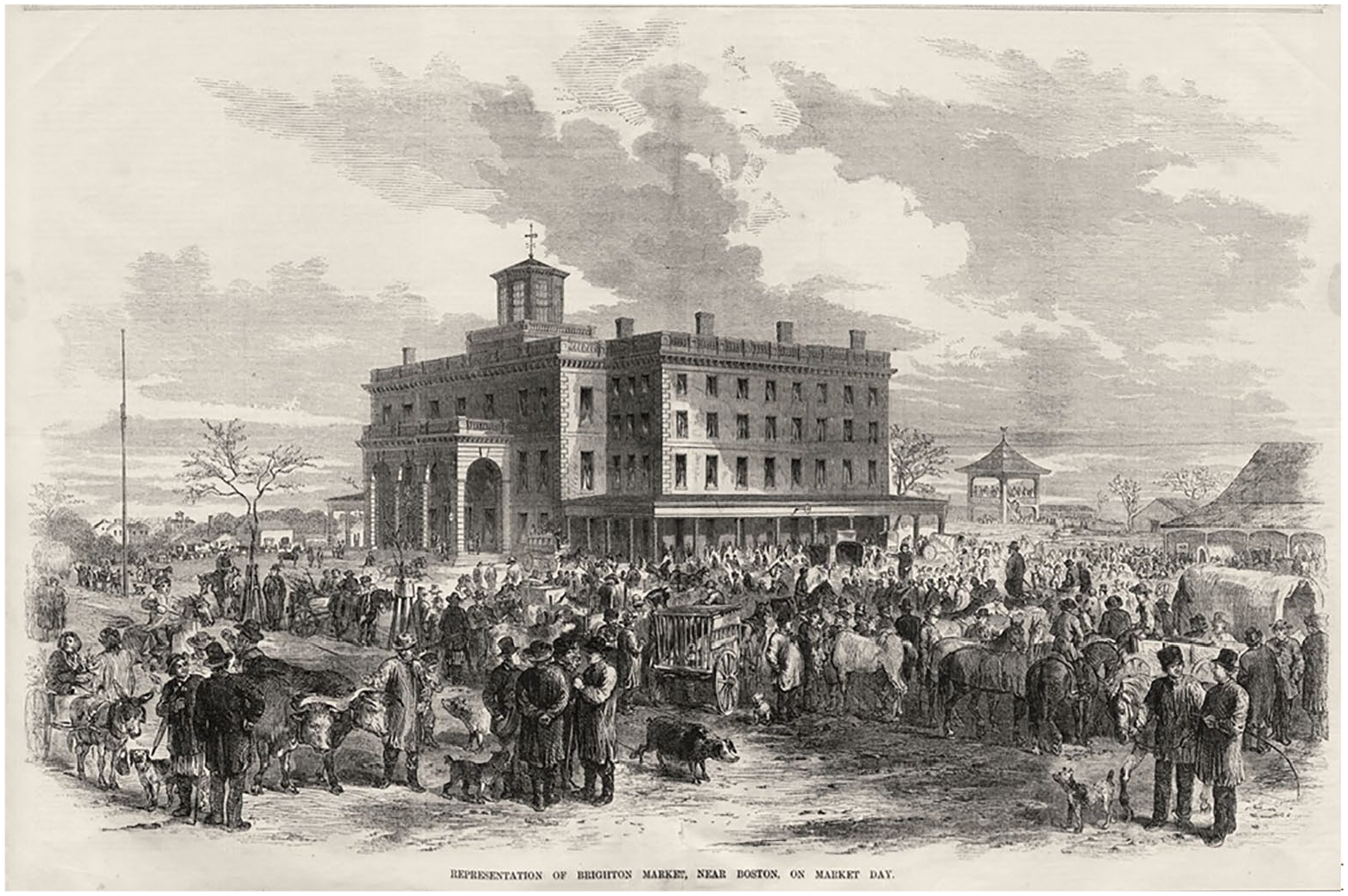
Market day in front of the Cattle Fair Hotel. Ballou’s Pictorial (June 28, 1856). To the right of the hotel were the “extensive cattle pens, and the stand which commands a view of the whole.”
The name “animal suburb” is, of course, misleading. For humans, these livestock centers were suburban because they were peripheral to a city’s downtown, though connected to urban markets and consumers. But for animals themselves—and the people who lived and worked in places like Brighton—these animal suburbs were at the center of their worlds. For animals, Brighton was something like a city—containing immense and concentrated livestock populations the likes of which those animals had probably never before experienced. In the 1860s, about 500,000 livestock passed through Brighton each year—an itinerant population roughly triple the permanent human population of the entire city of Boston at the time. However brief their stay, livestock presence in Brighton was continuous, and at any one moment there would have been thousands of cattle, sheep, and pigs living in the town. Brighton was, as one visitor noted in 1884, “like a big city devoted to buying and selling cattle.” Cows, pigs, and sheep lived shoulder-to-shoulder in stockyard enclosures, before they were prodded through an extensive system of pens and chutes, then onto a planked slaughterhouse floor where their living journey ended. From there, their bodies were disassembled and sent out into a network of urban and suburban sellers and consumers. This concentration of animal industries—and the large and dense populations of animals themselves—made Brighton and places like it distinctive spaces among late-nineteenth-century suburbs.
Animal suburbs like Brighton were made and remade in American cities over the course of the nineteenth century—and nearly every major American city came to have some version of Brighton by the turn of twentieth century. The rise of animal suburbs was not limited to the United States; they also appeared in cities across Europe and around the world. In some ways, they were outgrowths of new transportation and communication technologies, coupled with political and public health movements that sought greater separation between urban and suburban residents, and livestock and animal industries. 10
Most animal suburbs shared several key physical characteristics. For one, they were outgrowths of a railroaded landscape, and were located along railroad lines (or planned railroad lines). 11 These emerging animal districts were near enough to downtown markets to supply fresh foods to urban consumers, but distant enough (at first) to be undetectable to the senses of those same urban residents. Animal suburbs were typically near flowing water (rivers or tides) that offered some promise of cleanliness for the slaughterhouses and animal pens. Many were designed with sustainable, long-term waste management as a stated goal.
But animal suburbs also shared another important underlying characteristic: in the United States, they were the result of policies and laws that structured economies in real space. In this respect, animal suburbs were important sites of nineteenth-century regulation and capitalism. On one side, animal ownership and animal industries faced greater limitations and regulations in urban centers throughout the nineteenth century—effectively pushing certain animal populations and human labor into the suburbs or peripheral areas. Most American cities instituted stricter rules on livestock ownership and usage, causing downtown population declines of cows, pigs, and sheep in particular. 12 By the mid-nineteenth century, many American cities had laws limiting the number and types of animals people could own, where people could own them, and even intricate rules on how people were allowed to treat animals. 13 But the creation of these new animal suburbs was not simply the result of “pushes” on livestock from downtown. As Brighton and other cases show, city and state laws reinforced these divisions and made laws to concentrate the lives and deaths of domesticated animals to particular spaces at the urban periphery.
Despite some similarities in appearances among these animal suburbs, each of these areas was distinct in the nuances of politics, law, environment, and social relationships that shaped their development in and around cities. Sometimes these “animal suburbs” were separate municipalities from the central city they supplied. Other times, they were within the bounds of cities themselves. Most famous in the United States, perhaps, were the Union Stock Yards and slaughterhouses, established in the 1860s in suburban Lake Township (which Chicago would annex in 1889). In San Francisco, city ordinances created the animal suburb of “Butchertown” in 1870. Butchertown was within city limits, but was effectively a suburban landscape and a place apart—with a distinctive set of social and environmental characteristics and rules. Most residents living near downtown San Francisco would not have seen or smelled Butchertown when it was first constructed, its stilted slaughterhouses perched above the San Francisco Bay. In New Orleans, city and state laws created the Crescent City Live-Stock Landing and Slaughter-House Company in 1869, establishing a peripheral concentration of stockyards and slaughterhouses within the city, and ultimately sparking a constitutional battle that reached the U.S. Supreme Court in 1873. Other cities and states used a combination of state laws, city ordinances, corporate structures, and health codes to restrict and confine large-scale stockyards and slaughterhouses to suburban and peripheral districts just beyond the most populated areas of cities. 14
Although animal suburbs were physically distinctive from the wider landscape of suburban forms, these various suburbs shared some important commonalities. The expansion of residential suburbs in the same period offered people access to larger homes and house lots than they could find downtown, along with more desired environmental and social conditions. Although a place apart from the city, these suburbs also allowed human beings to remain within the orbit of urban commerce, labor, and city life. While urban residents increasingly coveted a place in the suburbs to create a good life, animal suburbs were places humans used for confining and concentrating animal life and death. In a sense, the animal suburb enabled these other forms of suburban life by confining unpleasant realities from residential districts. Both humans and animals increasingly commuted to cities from suburbs, but animals increasingly did so as inanimate parts.
Seen in this larger context of suburbanization, new animal suburban forms were arguably the most radical and novel features of suburban development in the mid-to-late nineteenth century. The development of Brighton into a dense suburban landscape containing thousands of cattle, sheep, and pigs offers a compelling example of this process of suburban animal growth, and the underlying economic, political, and environmental dimensions that shaped and emerged from this development. Other animal suburbs developed in different ways, but shared commonalities by the late 1800s of large-scale stockyards and slaughterhouses, and relative social and physical isolation from downtowns.
Taking a longer view, the creation of animal suburbs marked a fragmentation of the metropolitan network in terms of labor, landscape, and social life. Central to that fragmentation were the lives and deaths of animals. The intense smells, sounds, and sights of emerging animal suburbs enabled certain other refined landscapes to flourish in other parts of the urban-suburban landscape. Though largely invisible in the everyday sense, animal suburbs also became hyper visible; concentrated, large-scale animal life and death shocked, awed, and amazed a growing population that no longer had to encounter scenes of animal slaughter.
Animal suburbs were also places that underwent jarring and traumatic economic and environmental changes that continue to shape these urban and suburban spaces today. As suburban livestock and slaughtering declined and gave way to new networks and geographies of stockyards and slaughterhouses in the twentieth century, nineteenth-century animal suburbs were left with gaping holes in their economic foundations. And despite plans that were often well intentioned, nearly all animal suburbs developed into environmental disasters, leaving behind lasting legacies of environmental degradation and neglect. Parts of our cities are still haunted by nineteenth-century animal ghosts. 15
Brighton was one of these animal suburbs. Its development was, in certain ways distinctive and in other ways typical of suburbanization of animals and animal industries. But, like many of these nineteenth-century animal suburbs, even Brighton escapes simple classification. Animal industry was central to the suburban area throughout the nineteenth century, but some parts of town had other suburban characteristics. There were large market farming operations to the west of the slaughterhouses, and other parts of town more characteristic of iconic streetcar or picturesque suburbs. Up the hill from the slaughterhouses and livestock industries in the late 1800s were the fashionable mansions of wealthy butchers, farmers, and professionals. Other parts of town near Brookline resembled the picturesque enclaves that made that town famous.16,17 By the 1860s, Brighton was also a suburb divided against itself—with some nineteenth-century residents seeing the town’s near and distant future as a continuation of the animal suburb, and others wishing to make it into a residential suburb. In the late 1800s, Brighton became the center of a series of reforms that would ultimately remake the animal suburb, shape urban and suburban development, and expose the workings of political and economic power within the greater Boston area. 18 Brighton offers an important and telling example of the life and death of an animal suburb, and the ways in which decisions about animal life and death in the nineteenth century continue to shape our urban landscapes today.
From Little Cambridge to Big Nuisance
The Cattle Market Hawthorne observed in 1841 had been forming and growing over the previous seven decades. The land that would become Brighton was once a village that was part of Cambridge—the only part of Cambridge that lay south of the Charles River. As Little Cambridge grew (to 50 households with 290 residents, in less than 3 square miles in 1749), it increasingly sought various forms of independence from Cambridge, winning ecclesiastical independence in 1779 and becoming a separate township in 1807. 19
The origins of Brighton’s cattle market are steeped in lore. When Brighton does appear in histories of Boston, it usually does so briefly and superficially as a digressive detail in the history of Revolutionary Boston. 20 Brighton’s livestock market supposedly emerged when the Winship family won a contract to supply Washington’s army when they were stationed in Cambridge in 1775. When Washington and the British departed Boston in 1776, they left behind the seeds of the cattle market that would grow into the largest slaughtering and animal industry center in all of New England. 21
In its first several decades, the livestock market and cluster of animal industries appear to have developed largely independent of zoning laws and city and state regulations. There were no state laws confining Boston area butchers to Brighton until the 1870s. But nuisance law nevertheless shaped the emerging geography of animal industries. Under common law, residents could file lawsuits if a neighbor caused a nuisance that detracted from the health and enjoyment of their property. But courts often gave preference to the party that was first present. In a sense, nuisance law structured the landscape, allowing Brighton to develop as a center for cattle trading and slaughtering precisely because those industries predated intensive residential settlement. Brighton began to follow a pathway toward becoming an animal suburb and nuisance zone. 22
Increasingly, Brighton was a sort of spatial bottleneck in a vast network of animal production and consumption. The concentration of livestock and slaughterhouses in Brighton also predated the arrival of the state-chartered railroad line (first completed in 1835), which reached west to Worcester and eventually to Albany, New York, which connected Boston to interior animal producers. The railroad reinforced and strengthened Brighton’s place as an important center of the livestock and slaughtering industries. 23 While many animals still arrived in Brighton on hoof, growing numbers arrived on railroad cars and as “western cattle.” 24
As animal shipping networks fanned out to the west of Brighton, consumer markets grew to the east, in Boston. Through urbanization and immigration, Boston grew rapidly from around 25,000 in 1800, to 61,000 in 1830, to 137,000 in 1850. 25 Those growing urban populations were more reliant on markets for the animal products they consumed. Brighton’s animal industries grew in turn. In Brighton, thousands of livestock would have traversed the town each week—and hundreds of thousands each year—creating a distinctive physical, environmental, and social landscape in the Boston area. 26
But, by the 1860s, the concentration of suburban animal industries—slaughterhouses in particular—were taking heavy environmental tolls in Brighton. Older methods of managing waste could not keep pace with the new scale, speed, and duration of pollution that went into feeding and clothing Boston. Consistent with mid-nineteenth-century slaughterhouse waste management, Brighton butchers had built their slaughterhouses with slatted floors, to allow blood and offal to flow into yards and waterways. Most slaughterhouses kept pigs beneath the slatted floors, or in adjacent yards, where they fed on streams of blood and offal until it was their turn on the kill floor and the cycle repeated. The yards used for pig farms and slaughterhouse waste were occasionally scraped, and the muck sold as fertilizer for nearby farmers. 27 The whole system was intensely commercial but also relatively low-tech. By the late 1860s, Brighton was slaughtering more than 50,000 cattle, 340,000 sheep, and 140,000 hogs per year. 28 If the slaughter of these animals were divided evenly over the course of a year, this amounted to an average of more than 1,500 animals per day who had their blood and offal spilled across the town—mostly in an area of less than one square mile. After decades, the environmental toll mounted.

Location of slaughterhouses (black squares) in Brighton, 1870, showing a relatively disperse pattern.
Although Chicago’s slaughterhouses and stockyards loom large as representations of nineteenth-century capitalism, Brighton was perhaps more representative of nineteenth-century capitalism run amok. The behaviors of Brighton’s butchers showed that pollution and waste were perhaps rational and profitable. Brighton butchers did not seem interested in extracting every last scrap and drop from an animal carcass, but their decisions to spread animal waste across the landscape might well have been economically rational. Nineteenth-century capitalism was as much the intensely polluted landscape of Brighton as it was the large-scale systems that would emerge in Chicago. Capitalism was the polluted streams and the blood-streaked, muck-wallowing hogs of the animal suburb. 29
Brighton’s Evolving Response
Bigger troubles with the animal industries in Brighton began in the 1860s. Although butchers had a strong political presence in town, many residents started complaining about the foul odors and nuisances of the slaughterhouses in particular. Bad smells were so deeply associated with disease that it remains hard to separate overlapping concerns over public health, aesthetic preferences, and property values. 30 In 1865, “owners of real estate” in Brighton petitioned the Brighton Board of Health about the White and Dupee slaughterhouse, asking the Board to shut down the establishment and also to “assign some certain place or places for the exercising of said offensive trade.” 31 The Board of Health obliged the complainants, and in May of 1865 the Board limited new slaughterhouses to the northern part of Brighton, near the Charles River and the railroad tracks, and “not within 40 rods of any public highway.” 32
But butchers were quick to resist the new rules. At a special town meeting soon after the adoption of the new slaughterhouse rules, Brighton butchers and their allies led a vote to replace the town’s Board of Health with three prominent slaughterhouse owners: Albert Hollis, Horace W. Jordan, and Horace W. Baxter. The butchers would now control the very agency tasked with regulating the town’s slaughterhouses. In the days that followed, the new butcher-led Board of Health would withdraw the cease-and-desist order to White and Dupee, and also rescinded the new slaughterhouse rules. 33
With butchers at the helm of the town Board of Health, the town’s political leadership was now divided. Brighton’s board of selectmen remained comprised of a merchant, a farmer, and a horticulturalist, who now sought to regulate the butchers by bypassing the butcher-led Board of Health. As part of their campaign, the town selectmen hired Dr. Henry Clark, a medical doctor from Boston, to investigate and report on the slaughtering conditions in Brighton. Clark’s report was published in April of 1866, and its findings were alarming—particularly to those who dined in Boston.
Clark’s report detailed the health crisis that was emerging in Brighton. He raised grave concerns over the reckless dumping across the land and creeks and the “slaughter-houses hogs” that fed upon offal that was “reeking hot” and “rotten” from “exposure to the sun and air, and to the wallowing of the swine in it.” “The stench about all these places so kept is horrible,” he wrote, and the whole neighborhood had become “infected.” Words could only convey so much, he said, and “fall short of the perfectly disgusting reality, which can only be wholly appreciated by a personal inspection.”34,35 Meanwhile, vital statistics continued to point to an unfolding health crisis in Brighton that threatened to spill over into Boston and other communities. The death rate per thousand in Brighton spiked from 11.2 in 1860 to 19.7 in 1864, caused in part by a diphtheria outbreak that claimed the lives of ten Brighton residents in three months, including the children of a prominent minister, a state senator, and other well-known families in town. Brighton’s mortality rates continued to rise to 22.9 per thousand in 1868, and to 24.9 in 1869. 36
But Clark’s indictment of Brighton was bigger than just the one square mile where most of the slaughterhouses operated. His report documented a wider fear that the deadly conditions in Brighton were overflowing the town limits and threatening the health of Boston-area residents more broadly. The slaughterhouses, he said, “were in a condition and conducted in a manner which I consider both disagreeable and dangerous, directly and remotely, to their immediate vicinage, and to public and individual health.” With a strong breeze, he continued, “the odor from some of them could be observed for more than a half a mile, very strongly.” For many, those odors were thought to be vectors of disease. Clark’s report was reprinted in a prominent Boston medical journal, with an editorial that expressed hope that Clark’s findings would change “the minds of the Brightonians,” whose “sense of smell has probably long since lost all reliability as a guide in such matters.” The revelations, the editorial continued, were “almost enough to convert our whole community to vegetarianism.” 37
But town-level political gridlock and divisions remained. It seemed that if Brighton were to be reformed, laws and regulations would have to come from the state. 38 One of the first steps in state control over Brighton’s slaughterhouses came in the establishment of the Massachusetts State Board of Health in 1869. The new State Board of Health was designed as an arbiter of last resort for public health problems, and would step in only after residents had exhausted local channels of reform. The State Board of Health would also act as a sort of communications link and clearinghouse for city and town Boards of Health, which generally possessed stronger powers to actively remake and mitigate nuisances locally. The seven-member State Board would be appointed by the governor and approved by the Boston City Council, giving immense control to Boston officials and voters. Members of the new board would include a mix of medical doctors, politicians, and prominent (and wealthy) public figures. 39 In many ways, the State Board of Health was designed to tackle problems just like those arising in Brighton—problems that transcended town boundaries, and which were seemingly incurable through local political channels. It was nothing short of a major shift in governing authority.
The State Board of Health immediately set its sights on Brighton. In its First Annual Report, the Massachusetts Board of Health identified “Slaughtering for the Boston Market” as one of its top three priorities. Henry Ingersoll Bowditch—a Harvard physician, abolitionist, and Republican—served as the first head of the State Board of Health and raised the issue of slaughterhouses in his first address. Bowditch made a larger argument for the advancement of “State Medicine,” which had gained prominence in England and was gradually spreading in the United States. Bowditch also articulated human rights to environmental health—arguing that “all citizens have an inherent right to the enjoyment of pure and uncontaminated air, and water, and soil; that this right should be regarded as belonging to the whole community; and that no one should be allowed to trespass upon it by his carelessness, or his avarice, or even by his ignorance.” 40 Bowditch and the State Board were poised to confront the ongoing health crisis in Brighton that exemplified so many elements of failed local health regulation.
The State Board of Health was also quite aware of the national and international movements to regulate livestock and slaughterhouses in other cities. Members of the State Board cited policies and technologies in London, Paris, New York, and St. Louis. “Great cities everywhere are discovering that the slaughtering of animals may become a prolific and dangerous source of filth,” said the 1870 Board of Health Report. 41 One board member visited the new abattoirs in Paris, called La Villette, and testified to the Board that Brighton could be similarly remade for the benefit of public health. Paris, he said, had remade slaughter in a “scientific way,” and “everything valuable is saved, and nothing taints the air . . . A visitor could be in attendance all day without having his nostrils once offended, as they are always at Brighton.” 42 Even the animals benefited from new systems of slaughter, he argued, saying that the French “mode of slaughtering. . . is much less brutal than with us.” 43 The 1860s and 1870s saw widespread reform of urban and suburban livestock and slaughterhouse districts in the U.S. and across Europe. Brighton would soon become part of that movement. 44
Corporate Governance
The state’s solution to the Brighton slaughterhouse crisis was to charter a corporation. This was how nineteenth-century governance often took form—not through bureaucracies and direct taxation, but through corporate charters with strong private interests and incentives, along with clear public responsibilities and obligations. 45 In 1870, the Massachusetts legislature incorporated the Butchers’ Slaughtering and Melting Association (BSMA). The legislature tasked the BSMA with building and operating a new state-of-the-art abattoir in Brighton. In exchange, they received some degree of monopoly on the butchering market in the Boston area. But, like many nineteenth-century corporations, the BSMA would be highly regulated by the state through its corporate charter, which included requirements for ongoing governmental oversight. The BSMA looked like a corporation, but it acted much like an extension—or satellite—of state government. It was created not solely to structure private profit, but as a means of governing. 46
In the 1870 “Act to Incorporate the Butchers’ Slaughtering and Melting Association,” the state outlined the specific rights and limitations of the new corporation. The BSMA would have 2,000 shares of capital stock, to be sold at $100 each to create a capital stock of $200,000. After raising the first $100,000, the Corporation could begin purchasing land and building the new abattoir and animal processing facilities in Brighton. By law the BSMA could own up to 100 acres of land within two miles of the Cattle Fair Hotel—the former livestock center in downtown Brighton. The law gave the BSMA wide-ranging power to purchase and even seize land the corporation deemed necessary for carrying on its operations. 47
The creation of the BSMA also carried with it the promise of new technologies that would create a cleaner and more rational city. One observer said that the BSMA campus would have “all sorts of sanitary appliances—in fact, everything that will go to make up one of the most complete establishments of its kind in the world.” 48 The new slaughterhouses still had slatted floors, but now the blood and offal would be collected in wheeled, stainless steel bins located beneath the kill floors, which would be emptied regularly into rendering and processing vats. There would be “an abundant supply of fresh water” from the adjacent Charles River, delivered to each butcher stall and throughout the facility. The large-scale rendering house was designed so that vapors would pass through a series of condensers and flames to reduce harmful and unpleasant smells. Through state regulation, new technologies could reshape the slaughtering and rendering industries in Brighton.
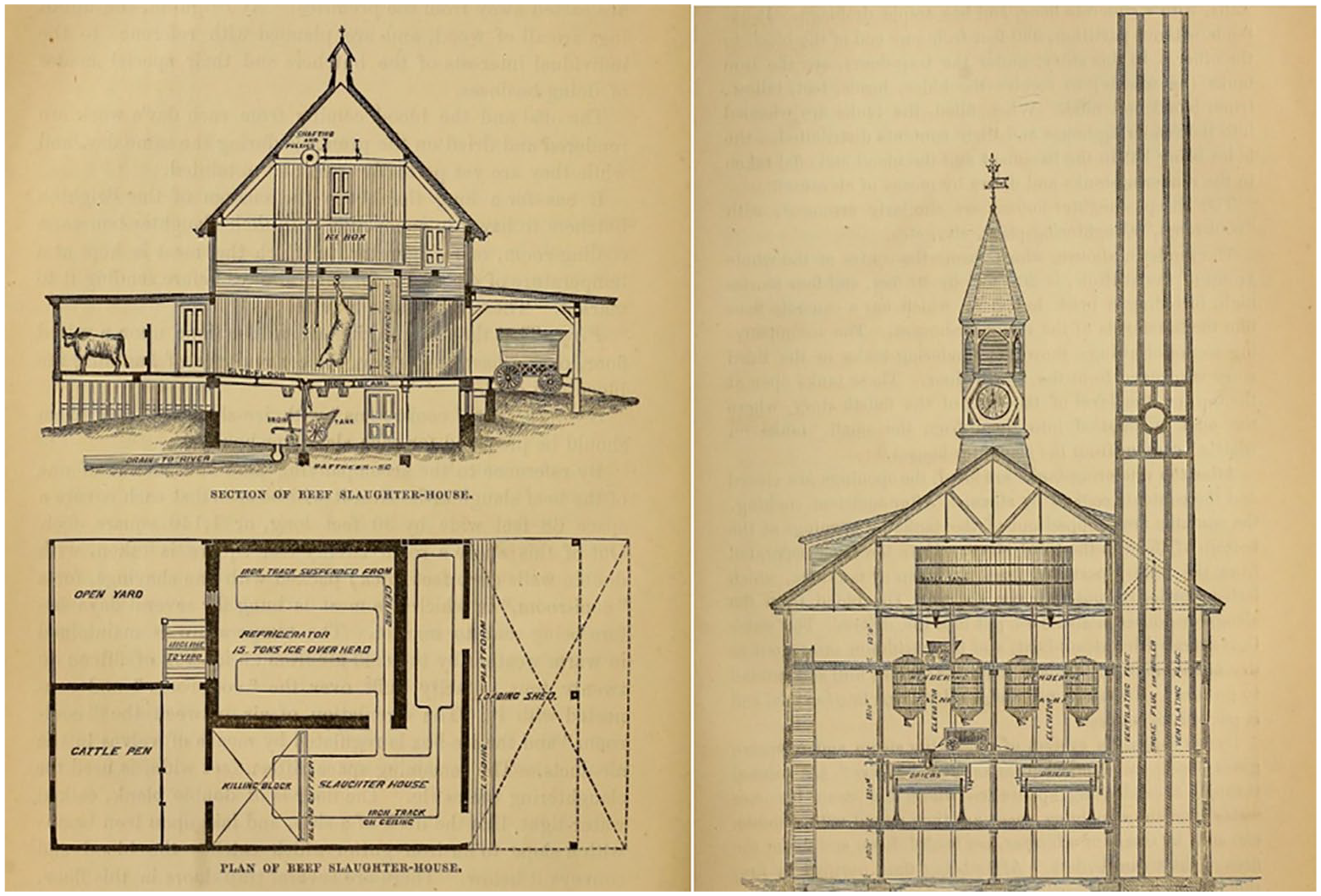
Plans showing the technological and organizational advancements of the Butchers’ Slaughtering and Melting Association.
The BSMA was also structured to have sustained financial support. Not only did butchers pay a usage fee, but the BSMA would keep and render whatever fell into the bins beneath the butcher stalls, including the heads and feet of animals slaughtered. The corporation would render those parts and pay butchers a set price determined by the Board of Directors of the BSMA. According to the corporate charter, the blood and offal collected would become the property of the BSMA, and turned into fertilizer and sold for corporate revenue. 49 The BSMA would be financed from heads, blood and guts of livestock.
Despite resistance on the part of butchers, the state sustained its regulatory push through a series of new laws passed between 1870 and 1873. When subscriptions to the BSMA flagged, the state legislature forced Brighton butchers to subscribe to the Association or else be forced to close. On paper, no slaughtering was allowed within six miles of Boston, except that which was carried out at the BSMA. 50 By 1875, Brighton and the larger Boston area landscape of animal production was drastically remade. In Brighton, all slaughtering and rendering now took place on the 42 acres of the BSMA. The large population of livestock and prevalence of animal industries still defined Brighton in many ways, but now those activities were concentrated to a fraction of their original geography within the “animal suburb.”
What happened next perhaps revealed some of the underlying motivations of many who pushed for reform. Large landowners began subdividing and developing Brighton for residential settlement. Beneath the surface of the public health campaign was perhaps a profit motive. 51 The future of Brighton would be as a residential suburb—connected to Boston by streetcars and trains. The trend would only continue when Brighton joined the city of Boston in 1873.
Annexation
Just as the slaughterhouses were coming under greater regulatory control by the state, Brighton faced the question of joining Boston through annexation. Annexation was the process by which cities expanded into and merged with adjoining suburban towns—a process that accelerated in the late nineteenth century in particular. While many cities in the United States annexed solely with the approval of the state legislature, Massachusetts law required a “dual referendum,” in which both the town in question, and the city of Boston, needed to approve annexation by popular vote. 52
Amid the wave of Boston annexations in the 1860s and 1870s, the motivations for towns to join the city were often quite clear. The traditional historical narrative of annexation is that towns traded their political autonomy for improved municipal services and amenities: public education (schools), fire and police protection, transportation, sewerage, roads, street lights, and water, in particular. With those advancements came promises of development and rising prosperity. Many urban residents and leaders saw expansion as part of a modern process of perpetual urban growth, which would bring in new tax revenue to offset the large sunken costs of municipal services and spur new infrastructure projects that, in some cases, fed urban machine politics with jobs and contracts. 53
These motivations for annexation were largely relevant in Boston, too. Between 1867 and 1873, Boston expanded to include the towns of Roxbury, Dorchester, West Roxbury, Brighton, and Charlestown—nearly tripling the geographic area of the city. 54 Boston leaders had long sought to expand into the wealthy suburb of Brookline, but were rebuffed time and again by the prosperous and independent town. 55
In 1873, Brighton faced the question of joining Boston. But many of the typical political motivations for annexation do not fit in the case of Brighton. In some ways it was clear why Brighton residents would want to become part of Boston. Indeed, the animal suburb had already lost much of its political autonomy to state regulation. Further, by joining the city, Brighton residents would gain access to superior services: roads, water, police, and fire, to name only a few. “Many and great benefits. . . will accrue to our town,” argued pro-annexation Brighton town leaders in 1872. 56 Brighton residents voted 82% in favor of annexation in October of 1873.
What was less clear on its face was why Bostonians would wish to annex Brighton. Brighton contained a dense network of polluting industries—to say nothing of the ostensibly “undesirable” classes of people who worked in (and lived near) the slaughterhouses. Furthermore, by the 1870s, Brighton was in massive financial debt of $713,000—which Boston would assume as part of the merger. 57 Nevertheless, 76% of Boston voters supported annexation 58 Boston leaders and residents understood that annexation of Brighton would allow Boston’s Board of Health and city council to take over regulatory control of the livestock and meat supply for the city. “The question of the meat supply of the community has, of late, attracted much of the attention of the city government, as right it should,” wrote Brighton leaders advocating for annexation. If Boston had control over inspection of Brighton, they continued, it “would remove all suspicion from the minds of consumers, in regard to the quality of the food they eat.” 59 For Boston residents, annexation of Brighton was an expensive proposition, but one that came with knowing that their own city officials would now be in charge of the stockyards, slaughterhouses, and animal industries that put food on their tables, and which discharged pollution upstream and upwind of their homes. Public health—and an attempt to gain control of the animal suburb—lay at the heart of Boston voters’ decision to annex Brighton. Though Brighton appears as just another annexation, the underlying political, social, and economic dimensions of that process were quite distinctive to Brighton’s role as an animal suburb.
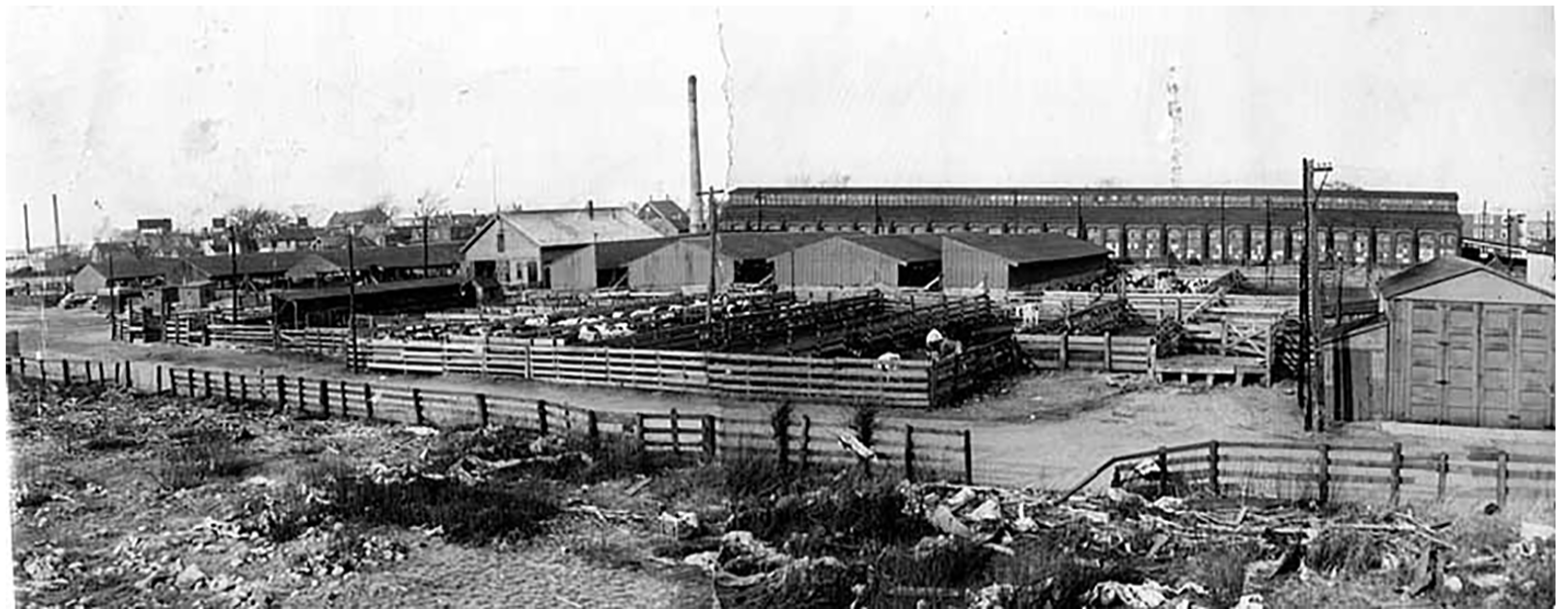
Butchers’ Slaughtering and Melting Association, circa 1950.
Animal Ghosts
The animal suburb of Brighton also had a distinctive developmental trajectory in the twentieth century. Despite the rising influence of Chicago beef and Western cattle on Boston’s meat markets in the late nineteenth century, tens of acres of Brighton would remain an active animal landscape into the mid-twentieth century. There were still more than 100,000 live animals arriving in Brighton each year through the 1940s. In the age of automobiles, highways, and cheap suburban mortgages—the live cattle trade was fading, but Brighton butchers still slaughtered more than a million animals per decade. 60
But the nineteenth-century solution to the public health crisis of Brighton was ultimately short lived. Over time, even the new technologies of the BSMA could not keep pace with the sheer scale and persistence of pollution from modern industrial animal production. The areas around the Brighton slaughterhouses and stockyards were redlined in the 1930s and 1940s. This was true of many suburban and peripheral animal districts across the United States—often, in part, because of the unpleasant smells and environmental conditions that spilled over into nearby residential areas.61,62 Dirty and low-paying jobs in animal industries also attracted workers and residents from marginalized social groups, particularly immigrant and Black Bostonians. In time, those groups also became a determining factor in redlining.
Like many former animal suburbs, Brighton also faced a barrage of redevelopment schemes in the 1950s and 1960s. Stockyards and slaughterhouses were especially vulnerable to being labeled “blighted”—both for their environmental conditions, and also for their economic and social ones. By the 1950s, animal suburbs in most American cities shared the characteristics of economic decline: low property values, environmental decrepitude, and populations of politically and economically marginalized groups. In many cases animal suburbs already had large tracts of land consolidated in the hands of one or a few parties, clearing one of the most significant hurdles to initiating a redevelopment project. 63 Decrepit slaughterhouse and stockyard sites were relatively easy to acquire and redevelop without the clamor of multiple private parties. Consolidation had already happened in the 1870s. In New York, one nineteenth-century slaughterhouse district became the site of the United Nations development project. 64 In San Francisco, Butchertown became part of an urban redevelopment project that promised jobs and tax revenue in a new industrial district, but delivered little. 65
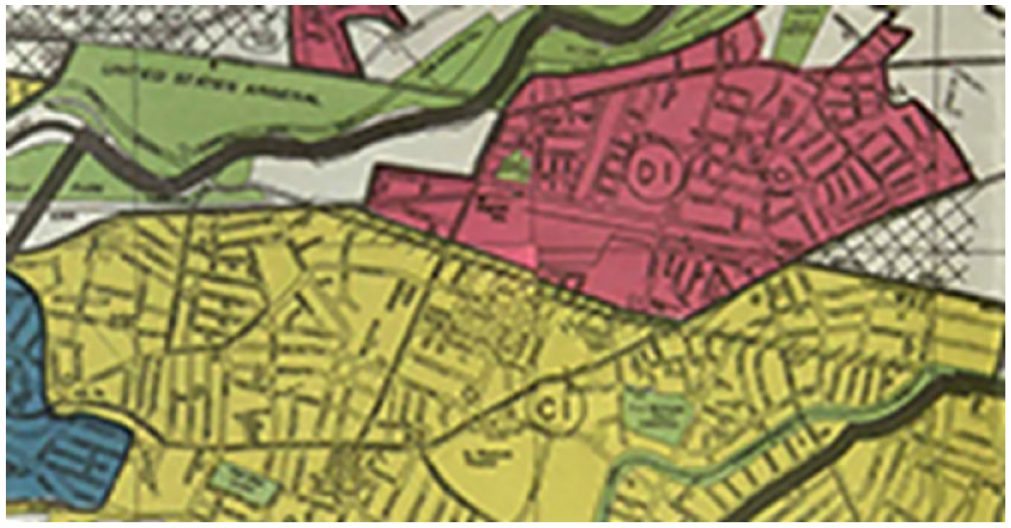
Detail of the 1938 Residential Security Map, prepared by the Home Owners’ Loan Corporation. Redlining traced very closely onto the areas that once held thousands of livestock. The flat bottom line of the red shape shown above corresponds precisely with the southernmost line of the stockyards.
In the 1950s, Boston area real estate developers, city officials, and state agencies set their sights on Brighton’s slaughterhouses as one of the earliest redevelopment projects in the city. Facing declining revenues, the BSMA would ultimately sell their 42-acre property in 1955. The old abattoir would be replaced with the new Charles River-Brighton Business Center—a proposed development supported by Mayor John Hynes, who was defining his tenure as mayor through redevelopment projects that would create a “New Boston.” Hynes called the abattoir “as outmoded as the horse and buggy” and hailed the proposed redevelopment as an important step in the “progress and revitalization of Boston.” 66 Razing the BSMA and building a new business district would, Hynes argued, “produce more taxable property (which is sorely needed) as well as more jobs (which is something we are always seeking) and at the same time eliminate a blight which in past years has often approached a nuisance to persons in the surrounding territory.” 67 What had been the “New Boston” of 1870 now stood in the way of the “New Boston” of the 1950s and 1960s. 68
Like many redevelopment plans, politicians and business developers made big promises and delivered on few. To secure state senate approval for the new construction project, Bradley & Co. drew up plans for the “Charles River-Brighton Industrial Center,” which promised 4,500 jobs. 69 Company executives argued that the new project would give Boston an opportunity to attract business that was migrating to the suburbs 70 “This will rival or even surpass anything along Route 128,” said Mayor Collins in 1960, echoing the talking points of corporate developers: “It definitely means that Boston can now compete with and complement Route 128.” 71
But once the BSMA was dissolved and the abattoir buildings bulldozed, developers changed their tune. The promise of vibrant new industries and jobs never materialized. Instead of a new industrial park, developers built small offices and retail spaces, with only a fraction of the jobs promised by boosters and developers to secure public funding for new roads and government approvals. By 1965, the new buildings on the abattoir site still had numerous vacancies, and the employment gains were nothing close to the 4,500 jobs initially promised. 72
Since the 1960s, the redevelopment of Brighton has continued—often with little regard for those living in and around the former animal suburb. The expansion of the Massachusetts Turnpike (alongside the railroad tracks that brought millions of cattle to Brighton over the years) forced the removal of some eighty families in the vicinity of the abattoir. In another nearby part of town known as Barry’s Corner, adjacent to the stockyards, the Boston Redevelopment Authority (BRA) pursued an aggressive program of eviction and new construction. The last homes were razed in 1969. “We had a beautiful childhood there,” said former resident Irene McCall. “They called it a blighted area and it wasn’t blighted. It was a beautiful area.” 73
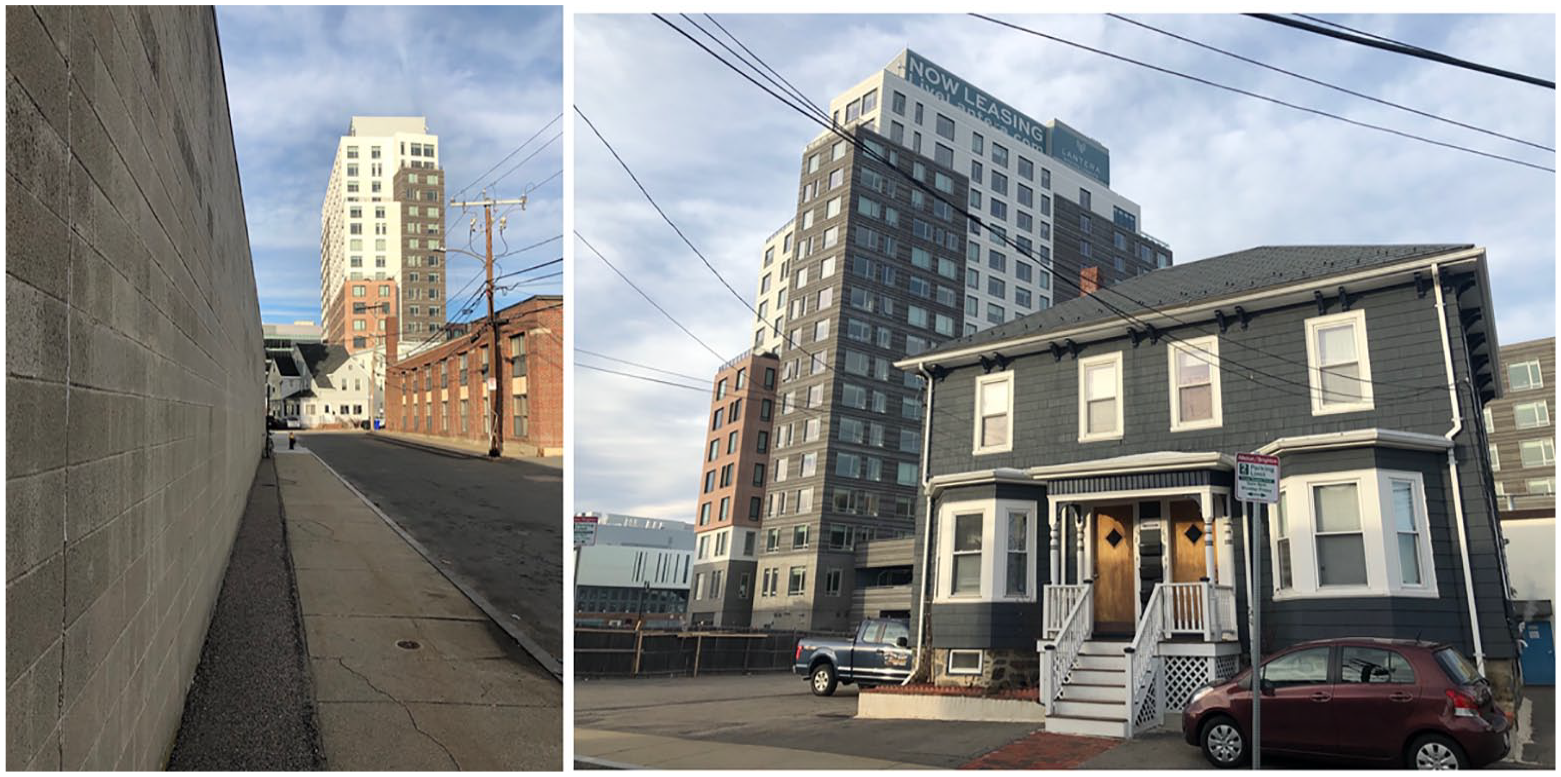
Brighton Landing development project.
Where the old stockyards opened out onto the railroad tracks, is now the sprawling site of “Brighton Landing,” a towering complex that remains under construction. The site of the old stockyards is being remade one steel beam and glass plate at a time. The latest development comes as part of a wave since 2000, when New Balance relocated their corporate headquarters to this corner of Brighton, subsidized by massive tax benefits. Alongside the high-rise offices and condos are the sparkling new practice facilities of the Boston Bruins and Boston Celtics, which stand precisely where millions of cattle and sheep packed the earth for decades. On the same block is a string of chic new stores: an upscale bowling alley that serves organic and gluten-free flatbread pizzas; a vitamin store; and a pour-over coffee shop. Echoing the public health claims of its nineteenth-century iteration, the neighborhood has been privately re-branded as a “Health District.” 74 Changes are all around, but the question remains: for whom?
A short but treacherous walk from the old stockyards—across a bridge that spans the train tracks and the eight lanes of highway—are the vestiges of the redevelopment project on the site of the old BSMA. (Like many former livestock suburbs, the urban landscape does not seem made for pedestrians.) All that remains of the original tenants from the 1950s is the International House of Pancakes—rebranded simply as IHOP, with its bright blue roof and smiling red logo. Where the abattoir stood is now a car dealership and strip mall with several large empty storefronts. The Boston Planning and Development Agency (the rebranded BRA) approved construciton of a Maserati-Alfa Romeo dealership on the site, and the ground has once again been reopened. 75
On the hillside above the proposed luxury car dealership is an overgrown stretch of land. It was this hillside that partially obscured the sights and smells of the abattoir from the wealthier and upstart residential sections of Brighton beginning in the 1870s. The hill is now overgrown with dense thickets of elm, maple, and buckthorn. Piles of old bricks peek out from layers of dead leaves and scattered trash—the bricks perhaps the remnants of the abattoir that represented so much progress and modernity at the time of its construction. On this marginal slice of land—between a strip mall and the whirring 8-lanes of the Massachusetts Turnpike—is a small encampment of homeless residents. If the encampment survives this next phase of development, the tents and tarps will be just a stone’s throw from the $100,000 vehicles and well-to-do shoppers at the bottom of the hill. Capital is remaking the landscape once more.
Like many animal suburbs of the nineteenth century, Brighton experienced a series of economic and environmental traumas in the intervening decades. The development of Brighton as an animal suburb—and the regulations that remade that suburb in the l870s—fundamentally shifted the development of this landscape. Decisions about what to do with livestock within this urban-suburban network continue to haunt this space, as they do in many former animal suburbs in and around cities across the United States. The life and death of Brighton as an animal suburb marked a national and even international moment of parallel development of urban and suburban life, and the development of modern landscapes of human and animal interactions. 76 But animal ghosts remain on the landscape in Brighton. Developers and politicians have tried to exercise them, but they still pace the streets. Traces of their blood and bones still mix with the soil. Seeing those ghosts and reckoning with the human and animal lives that played out in Brighton and places like it—offers a fuller and fairer understanding of urban development, capitalism, and modern life. Hawthorne was right: “it ought to be studied.”
Footnotes
Acknowledgements
The author would like to thank Jennifer Bonnell, Daniel Bluestone, Claire Campbell, Jim O’Connell, Melanie Kiechle, Zach Nowak, Bruce Schulman, Ian Stevenson, and the anonymous reviewers—all of whom offered invaluable comments and suggestions. This paper also benefitted from presentations at the Massachusetts Historical Society’s Environmental History Seminar and the BoCaLo Political History conference. Thank you, also, to the volunteer staff who maintain the Brighton Historical Society.
Declaration of Conflicting Interests
The author declared no potential conflicts of interest with respect to the research, authorship, and/or publication of this article.
Funding
The author received no financial support for the research, authorship, and/or publication of this article.
