




Abstract
Integrated urban planning is based on the necessity of constantly adapting to complex social processes and applying methodology that supports multidisciplinarity, flexibility, and adaptability. In trying to achieve future visions and to meet trends of urbanization, inherited contextual values are often forgotten. Although the impression that everything was better before is based on nostalgia, the urban development history should still be analyzed. This article analyzes principles of integrated urban planning by reviewing twentieth-century development of Banja Luka. The objective is to recognize, to evaluate, and to adapt those principles to the contemporary context and to reconsider them in the future. The analysis shows the positive and negative values of the development, which reveals that the principles of integrated urban planning were present in each period. As their singularity and fragmentation without the systematic integration was not efficient enough, recommendations for improving integrated urban planning in the specific context are given.
Introduction
Nowadays, cities are characterized by complex and dynamic contexts that constantly influence urban transformation. 1 Their quality depends on the ability to manage urban policies and to create an efficient planning 2 model for a sustainable urban development concept. Therefore, an adequate planning model is of great importance for the future of cities. Although contemporary urban planning follows global future visions and trends, it should also be based on lessons learned from the past. That could enable better understanding of cities, achieving continuity of development, and be essential for the quality of urban transformations.
Past experiences are rich, numerous, and closely connected with the tradition of national systems of urban planning and the specifics of their historical development. By observing the history of urban planning, it is possible to see that the planning systems of European countries in the twentieth century passed through a few main urban planning approaches: rational, comprehensive, and strategic. 3 Rational planning, as the physical, public authority-oriented urban planning of the 1950s, has been the basis for the elaboration of modern urban planning. This has resulted in the development of master planning and comprehensive planning, which attempted to perceive social, economic, and environmental, as well as public policy and physical land-use planning. 4 To understand and accept certain approaches to urban planning, it is very important to understand the specific social contexts in which they emerged because the relationship between social processes and planning is one of the basic preconditions for responsible and sustainable planning.
In the middle of this approach is strategic planning, which is as much about process, expert-oriented design, organization, and mobilization as it is about the development of substantive theories. 5 This concept follows on from the widely used idea of “sustainable development expressing the potential for creating a positive-sum-strategy combining social, economic, and environmental objectives in their spatial manifestation” in the 1980s on the way to integration. The New Urban Agenda defines common principles and commitments to sustainable urban development while The Urban Agenda for the European Union (EU) Pact of Amsterdam defines a set of actions for key European actors to achieve sustainable urban development in European cities. Among the priorities is the sustainable urban development of European cities by using strategic urban planning with balanced spatial development and an integrated participatory approach. Integrated urban planning in this sense includes not only physical planning that accepts social and economic processes, natural and built environment, but also institutional and financial support to planning, as well as urban development management processes, through implementation and monitoring of plans, participation, education, creating spatial database management, and so forth.
However, previous research of the planning systems of Sweden, The Netherlands, Portugal, and Turkey over the last few decades shows four different approaches: the comprehensive integrated approach (Sweden, The Netherlands), the land-use management approach (Turkey), the regional economic planning approach (Portugal, Sweden, The Netherlands, Turkey), and traditional urbanism approach (Portugal and The Netherlands). Analysis has shown that approaches had changed, often combined, following changes in social and economic processes in national systems. On behalf of other approaches, traditional urbanism encourages a stronger link between specific urban and landscape design and communities. While the national system of urban planning in democratic European countries quickly took on the principles of strategic urban planning and the integrated urban planning approach, rational urban planning is still in use in some former socialist countries, such as Bosnia and Herzegovina. At the same time, transitional processes in these countries in the domains of economy, society, institutional capacity, professional education, and so on were followed by the strong need to improve the simplified rational planning from the previous period. However, the question arises as to whether certain principles of integrated urban planning are hiding behind socialist rational planning, because it is a common opinion that rational planning is sector-oriented, without the capacity for applying the integrated approach that has characterized the period of sustainable urban development.
In recent decades, according to the documents of UN Habitat and the European Commission (EC), the aim is to establish unique international principles of sustainable urban development based on integrated planning. However, one should keep in mind that those international principles should also be based on national experience and consider national or local contextual specifics. The development and improvement of planning models have stemmed from the need to constantly monitor changes in the sphere of socioeconomic and natural processes and coordinate any changes with them. The multifaceted nature and dynamics of change in all spheres of the city’s life point to the necessity for an integrated approach to urban planning, one of the important strategic mechanisms of urban transformations. It is based on the very integrity of urban phenomena that is variable and processual rather than static and in which a large number of factors realize mutual interactions. In this model of planning, society, economy, and the environment actively interact with each other, which is a necessity if they are to be strategically coordinated. 6
Therefore, integrated planning, the management of socioeconomic relations, and environmental protection are the key factors for sustainable urban development in the late twentieth and early twenty-first centuries. 7 Integrated urban planning consists of several of the following basic principles: (1) comprehensiveness, (2) multidisciplinarity, (3) flexibility and adaptability, (4) participation, (5) a continuous education process, (6) implementing effective procedures, (7) creating an institutional framework, (8) financial models for planning and implementation, and (9) sustainable urban development management defined through (a) implementation, (b) monitoring of spatial planning documentation, (c) planning of strategic priorities, and (d) implementation phases. 8 These general principles of integrated planning are, actually, common urban planning features that have been relevant in the past—and they are still relevant. Planning models need to be developed and tailored on the basis of integrated planning to meet the specifics of each city individually. Furthermore, the integrated approach should be enhanced to the greatest possible extent to achieve the sustainability of urban space.
The basic condition for the quality and sustainability of the integrated urban planning process is a unique methodology that defines the planning process cyclically, from the preparatory phase to its implementation and monitoring, giving guidelines to all participants in the process and realizing an interactive relationship with the management of urban development and socioeconomic processes. It is important to analyze all the relevant aspects of urban space—physical, functional, socioeconomic, and environmental—that can be achieved through the interaction of multidisciplinary planning teams and the implementation of a participatory planning model. This setting represents the basis for defining a custom methodology in accordance with the specific context.
By analyzing rational planning 9 from the mid-twentieth century onward, 10 it is evident that some of the integrated planning principles were present in earlier developmental periods in varying intensities and modes of influence. The implementation of integrated planning had a growing trend due to the dynamics of development and the continuous complication of socioeconomic processes as well as the natural and spatial-functional contexts of urban phenomena, but it was difficult to achieve all at the same time. 11 Despite the difficulties in achieving the integrated approach in planning, this trend has permanently strengthened, especially in the Western European countries, where the development of democratic social processes and a market economy resulted in a more dynamic urban context at the end of the twentieth and the beginning of the twenty-first century.
Given the long-term process that is systematically needed at every level of planning, the problem in implementation of integrated planning is particularly apparent in unstable transition societies like Bosnian and Herzegovinian, where rational planning was implemented until the early twenty-first century. In such conditions, the features of integrated planning were not sufficiently presented due to the limited financial support of the national government for the local level of sustainable urban development. 12 At the same time, local governments did not have sufficient funds to provide adequate spatial planning documentation during the transition period. In addition, it was constrained by the low capacity of local communities to manage this process, lack of strategic planning, and participatory training, and so on.
Based on theory and practice of integrated urban planning in European countries, with a focus on the experience of Banja Luka (Bosnia and Herzegovina), the city of socialist Second World, 13 this analysis points to the need for the improvement of integrated planning in future in a specific context. The objectives of critical reflection on planning characteristics are to recognize and to evaluate, as well as to recommend, their adaptation to the contemporary context in order to be reconsidered in the future. The results may be useful for the integrated urban planning practice to create preconditions for legislative improvement and capacity building of urban development in Bosnia and Herzegovina.
Learning from the Past
For the integrated planning approach to be adequately understood as well as implemented, it is necessary to understand the history of city development. It is necessary to understand both the continuity and contemporary processes because they cannot be isolated. The article focuses on the analysis of the city of Banja Luka from the perspective of the urban planning process, which uses past experience to inform future decisions. The qualitative research methodology is used to explore issues that cannot be easily measured. 14 Given that the topic represents something beyond the visible context and the way the process develops, the analysis deals with qualitative aspects from a qualitative perspective.
Banja Luka is located in the northwest part of Bosnia and Herzegovina, in the geographical region called Krajina. It is placed at the point where the Vrbas River leaves the hilly hinterland flowing to Lijevče and farther to the Posavina field formed around the Sava River. During the centuries, Banja Luka was an integral part of various socio-political and territorial entities during the Ottoman empire (1463-1878), Austro-Hungarian empire (1878-1918), and the former Yugolsavia (1918-1992), to briefly mention only a few. Many and mostly radical shifts of social systems and cultural patterns did not allow spontaneous and natural character of the changes, nor its continuity. This space is for two centuries constantly exposed to many rough, drastic, and extreme structural changes, which have strongly affected its urban morphology, the image of the city, further urban transformations as well as formation of its identity. Contemporary Banja Luka is the second largest city in Bosnia and Herzegovina (after Sarajevo) and the de facto capital city of the Republic of Srpska (one of the two entities of Bosnia and Herzegovina) with approximately 200,000 inhabitants and an area of 1,232 km2 (Census, 2013).
The analysis on urban development frames the second half of the twentieth century, when urban planning became a legally binding obligation for all construction activities in the urban areas of the former Yugoslavia. 15 These are divided into two specific urban morphological periods, marked by the emergence of two urban plans, which were important for the development of Banja Luka, and a few significant social and physical processes that influenced urban development. These are (1) period of socialism 1945-1992, observed through two shorter phases: (1.1.) 1945-1969 (before the earthquake) and (1.2.) 1969-1992 (after the earthquake); and (2) period of transition 1992-2016, observed through three phases: (2.1.) 1992-1995 (war period), (2.2.) 1995-2010 (first phase of transition marked by inadequate planning practice and legislative), and (2.3.) 2010-2016 (Table 1).
Timeline of the Development of Urban Planning in Banja Luka in the Period from the Second Half of the Twentieth Century to Nowadays.
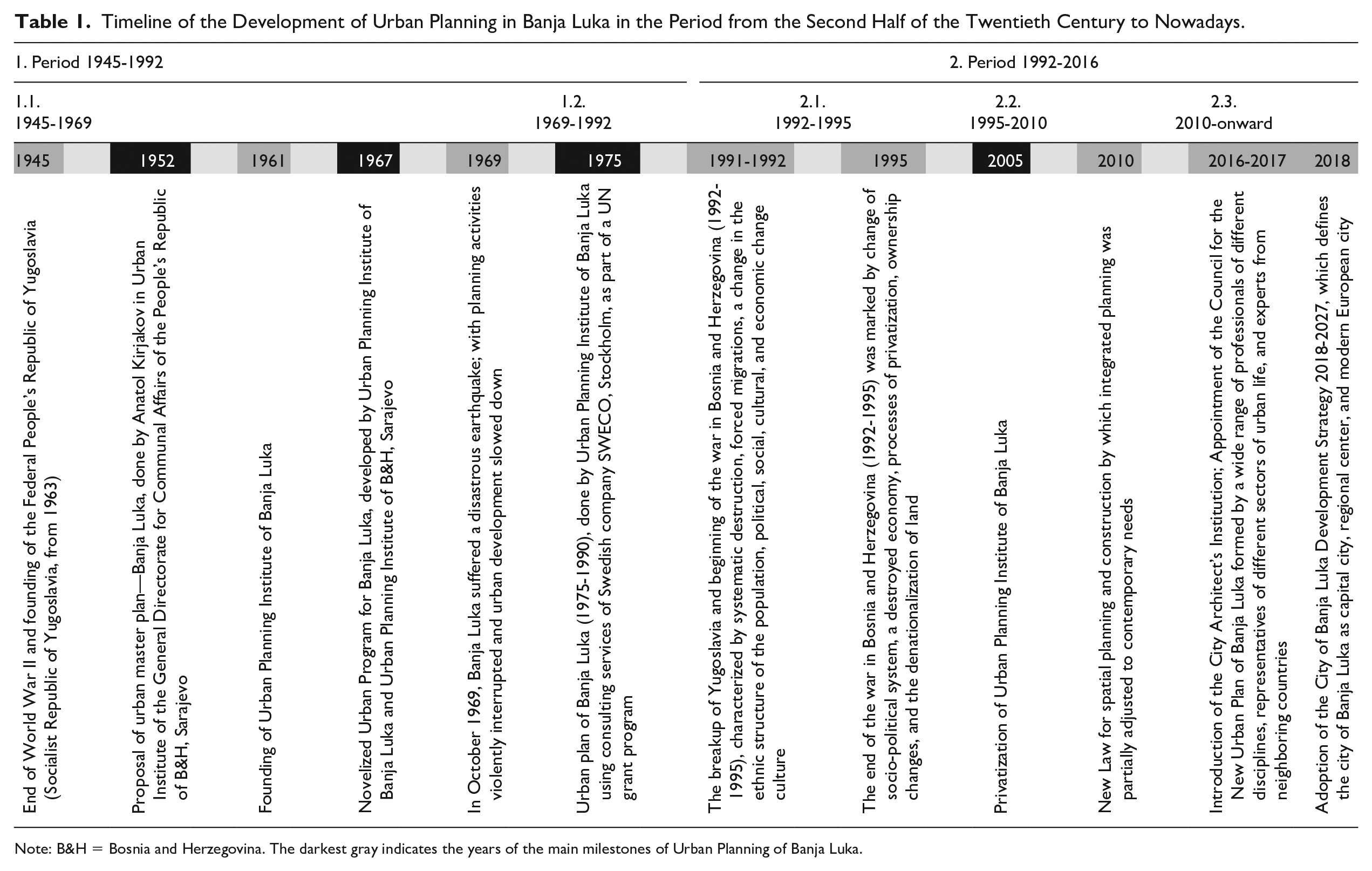
Note: B&H = Bosnia and Herzegovina. The darkest gray indicates the years of the main milestones of Urban Planning of Banja Luka.
The year 2016 marks the beginning of a new contemporary period, which is the subject of the discussion about the urban transformation process in progress. It is the year of local elections in Bosnia and Herzegovina, after which Banja Luka got a new and modern city administration beginning with the drafting of strategic development documents—City Development Strategy and Master Urban Plan with the support of the Urban Planning Council and the Partnership for Development. The introduction of the functions of City Architect and City Landscape Architect has been announced. At the same time, the Master study program Architecture and Urbanism was established at the University of Banja Luka. The Center for Spatial Research began to intensively consider new models of action in the processes of urban planning and promotion of new concepts for the city development and launched the small-scale project of urban interventions in open public space.
Two dominant periods are observed in relation to the process of urban planning documentation: the socialist city and the city in transition. The process of urban planning is analyzed according to the following nine basic principles of integrated urban planning: (1) comprehensiveness, (2) multidisciplinarity, (3) flexibility and adaptability, (4) participation, (5) continuous education process, (6) efficiency of procedures, (7) strengthening the institutional framework, (8) funding, and (9) urban management. We used these principles, in accordance with Yigitcanlar and Teriman, 16 as references for the case study of Banja Luka. Due to the complexity of urban space and the processes within it, a comprehensive approach in planning is necessary in aiming to integrally include the fields of environment, society, economy, built structures, institutional and financial networks, and management of urban development. This implies multidisciplinarity, with the participation of a large number of experts in the planning process, which also must exhibit more flexibility and adaptability for dynamic urban changes, present especially at the last period of urban development. The participation of different groups and actors in the planning process enables connection of socioeconomic processes with the natural and built environment in the aim of improving the quality of life in cities, which is the basic task of integrated urban planning. The educational process has always played an important role in the practice of urban planning. Its permanent improvement is necessary to harmonize with the development needs of society and cities in local and global frameworks. Planning procedures related to the process of preparation, development, adoption, implementation, and monitoring of plans must be effective. They reflect the capacity of local government to manage urban planning and development processes. Institutional support is very important, not only at the local level. It also includes the national government and agencies that create the policies and laws in the field of urban planning and the whole network of institutions that are responsible for the management of infrastructure, natural resources, spatial databases, protection of nature, cultural heritage, and so forth. The institutional framework is, in fact, created at the national level and directly depends on the socio-political system of the state. Financial support for planning depends on the economic power of the state and municipality, which influence directly the quality and quantity of planning, especially in the cities of the socialist Second World where international funds also present resources of financing, which have become actual in the last few decades.
Those principles were basement level for exploring planning practice in Banja Luka from the 1950s to the present. The research started from the assumption that principles of integrated planning were slightly present in the period of rational planning, and that they gained momentum only at the beginning of the twenty-first century. However, the analysis of the plans showed that some forms of integrated planning were even more developed in the past than in the last period when, in accordance with the law, an integrated approach became one of the basic principles of urban planning. The case study shows the specific example of a city that, during only seventy years of planning tradition, has experienced numerous urban transformations with only one valid urban plan. Although exceptional, the example shows a wide range of experiences from which valuable lessons can be learned and shared across different geographies and scales in a way that strategic thinking and analysis would require the understanding and use of lessons learned from past experience.
The Impact of Urban Planning on Banja Luka Development
The First Period 1945-1992
Period 1945-1969
After the Second World War, urban development took place in accordance with the newly formed socialist political system. This meant centralized management and a planning system where construction was financed and regulated by the State. 17 Spatial and urban planning were a matter of special interest directed by institutions—centralized administrative planning commissions, state and city planning institutes—which enabled expert-oriented rational planning tailored to the needs of the socialist society, with a significant influence from urban planners. 18 As in other larger cities (with more than 100,000 citizens) in the former Yugoslavia during the 1960s, an Urban Planning Institute was established in Banja Luka (a network of urban institutes was established in Bosnia and Herzegovina, which had regional or local significance, in accordance with the territory they served. The Urban Institute of Banja Luka was mainly engaged in making urban plans for the city of Banja Luka). In the conditions of industrialization and urbanization, public interest, and the general social standard, not private interests, were the focus of planning. One of the important prerequisites for the efficiency of the planning system was the resolution of property relations, which was regulated through the nationalization of land.
For the first time, urban planning became the basis for planned development thanks to the proposal of a master plan in 1952 19 (Figure 1A) and later the Novelised Urbanistic Program in 1967. These documents were under the strong influence of rational planning 20 containing mostly the physical and functional aspects of spatial regulation, without enough comprehensiveness and multidisciplinarity of a planning process. Therefore, inadequate research about natural conditions created significant environmental problems during the period of intensive urbanization while the socioeconomic aspects were solely within the competence of the state and the planners. At the same time, the lack of public participation in the planning process created problems of place attachment and spatial identity, which later led to many social problems.
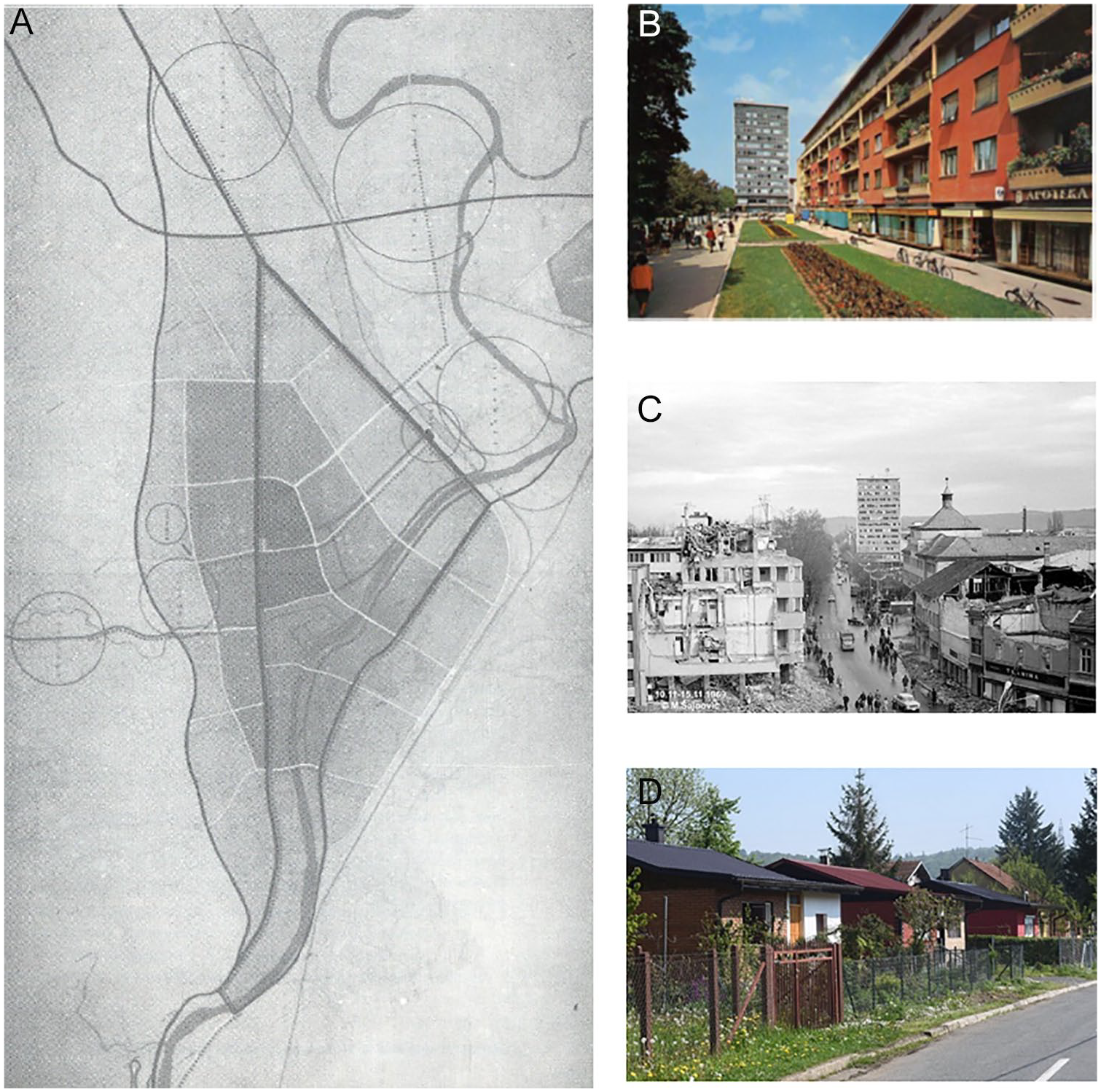
(A) Left: General urban plan of Banja Luka by Anatol Kirjakov, 1952—map of the traffic concept. The darkest gray indicates central urban core, middle gray indicates inner urban zone, light gray indicates wider urban zone, while the rest of the map indicates non-urban zone (Source: Dijana Simonović, Landscape Cities: Comparison of the Development of the Urban Identity of Banja Luka and Graz, p. 121. Banja Luka: Faculty of Architecture and Civil Engineering, University of Banja Luka, 2010); (B) Right (top): The “Titanic” building and business skyscraper on “Kastel’s corner,” 1968. (Source: Verica M. Stošić and Zoran S. Kitten. 2004. Banja Luka koje ima i koje nema u 1000 slika. Mega multimedia, digital edition); (C) Right (middle): The level of devastation of the main street in the 1969. Banja Luka earthquake (Photo by Miroslav Šajnović, 1969); (D) Right (down): The destroyed urban fabric replaced by temporary buildings, still in use—example of housing barracks in Lazarevo neighborhood, 2019. (Source: https://www.nezavisne.com/novosti/banjaluka/Stanari-3600-baraka-postaju-vlasnici/533754).
Due to the robust closed system, insufficiently elaborated planning solutions, lack of experts, and the lack of planner tradition as well as the culture of planning, the period is characterized by incompletion and the failure to realize the concept of a functional modern city. 21 Due to the lack of flexibility and adaptability principles, none of the few attempts to reexamine the concept of a future city have been realized. In the absence of the Plan’s implementation management mechanism and without an integrated approach, the needs and requirements of urban development were met only partially.
After World War II, Banja Luka became the second-largest city in Bosnia and Herzegovina. 22 The new culture of living was reflected in the free-standing residential buildings as the main characteristic of urban landscape, which remained a dominant element of its urban structure until the sixties. The boundary between an “oriental” and a “European” town disappeared during this period 23 so the city was seen as a single entity for the first time in history (Figure 1B).
In October 1969, Banja Luka suffered a disastrous earthquake; with planning activities violently interrupted and urban development slowed down, urban planning took place in a different context (Figure 1C). The destroyed urban fabric was replaced by temporary buildings, which are still used (Figure 1D), hindering its development and contributing to its chaotic composition and fragmentation. 24
Period 1969-1992
The devastating earthquake was an opportunity for urban renewal, opening up a new and more powerful, long-term planned vision. It was a milestone for a construction boom of housing neighborhoods especially, which accelerated migration from the surrounding rural areas (by the 1971 Census, only 48.4 percent of the indigenous population lived in Banja Luka). Due to the large population growth (from 90,831 in 1971 to 143,079 in 1991), industrialization, and urbanization, this was a period of intensive development, pursued according to the principles of international style partially adapted to the local context. Specific sectoral studies of transport, housing, urban economy, and social activities have been conducted for the needs of the new Urban Plan, which have improved multidisciplinarity and comprehensiveness of planning. Finally, the city of Banja Luka adopted the first (and only official) urban plan for the period 1975-1990, 25 which defined an integrated spatial and functional framework of development based on the current situation and needs as well as future projections (Figure 2A). The Urban Plan was done by a new generation of urban planning experts from the Urban Planning Institute of Banja Luka (mostly the scholars from Zagreb, Belgrade, and Sarajevo universities) using consulting services of the SWECO company (Stockholm, Sweden) as part of the UN grant program. Except implementing the knowledge and experience gathered all around Europe, urban planners have the opportunity to use lessons learned from urban plans for New Zagreb, New Belgrade, Skopje, and other Yugoslavian urban planning masterpieces of international urban planning. In the first decade of implementation, it was accompanied by increased financial investments both by the state and by aid from other countries, as well as by strong institutional support and centralized management of development processes focused on public interest.

(A) Left: Urban Plan of Banja Luka 1975-1990; (B) Right (top): Amendment of urban plan for Borik neighborhood in Banja Luka—detailed design, 1969. Red color—central urban functions; orange color—indicates collective housing; yellow color—individual housing; pink color—industry; blue—education; green—urban greenery, sport, and recreation. Borik neighborhood is marked by a black colored dot line in the center of the plan (Source: B. Karabegović (ed.). 1974. Banja Luka. Pet godina nakon zemljotresa. Banja Luka: Glas); (C) Right (middle): Delegation of President Tito passing by during the opening ceremony of the newly constructed Borik neighborhood in Banja Luka, 1973 (Source: http://www.mij.rs/); (D) Right (down): Borik neighborhood nowadays (Source: Photo by authors, 2020).
Unfortunately, this plan did not offer a flexible, adaptable approach, alternative scenarios, or responses to unforeseen situations as those that emerged in the early 1990s. The complex and sluggish planning process failed to respond to many spatial needs as well as the demands of many different actors who were not part of the participatory process. The absence of a mechanism to monitor the implementation of the urban plan diminished the significance of plans and projects as well as the interest in their realization. The system was robust and inflexible to relieve these problems. In addition, the economic crisis and the weakening power of the self-management system, as well as organizational and financial problems in the late 1980s, have led to the inability to realize many planning solutions.
The predominantly longitudinal direction of the city growth and eccentric urban core were retained; thus, the concept of a transverse direction expansion was abandoned 26 (Figure 2A). Numerous residential neighborhoods have been interpolated in the existing urban matrix by liberating city blocks or in close proximity to existing structures (Figure 2). In addition, deviations from the plan became the rule, adopted solutions were inconsistently implemented, and changes have occurred but only partially so a heterogeneity of the physical structure, spatial fragmentation, and discontinuity have emerged. As a result of the inadequate resolution of the lack of housing for an increasing number of residents, construction has taken place on the city’s outskirts, thus forming an informal urban fabric. The urban area was expanding, which in the following period proved to be an unjustified and expensive way of using urban construction land and urban infrastructure. The new modern city remained unfinished, which caused the continuity of the discontinuity in the development and produced many urban voids. These have become important for the perception of Banja Luka as a landscape city and were important spatial capacities for further growth. The general crisis and the decline in living standard were followed by an increase of nationalism, which finally led to armed conflict.
The Second Period 1992-2016
Period 1992-1995
The war in Bosnia and Herzegovina (1992-1995) was marked by a degradation characterized by internal systematic destruction; forced migrations; a change in the ethnic structure of the population; political, social, and economic change; as well as changes in urban culture, which were later reflected in the entire system of planning and construction (Figure 3B-D). Due to the impossibility of creating a vision for future development and achieving the necessary adaptation of the plan, the development of a new urban plan (started in 1990) was stopped in the draft phase.
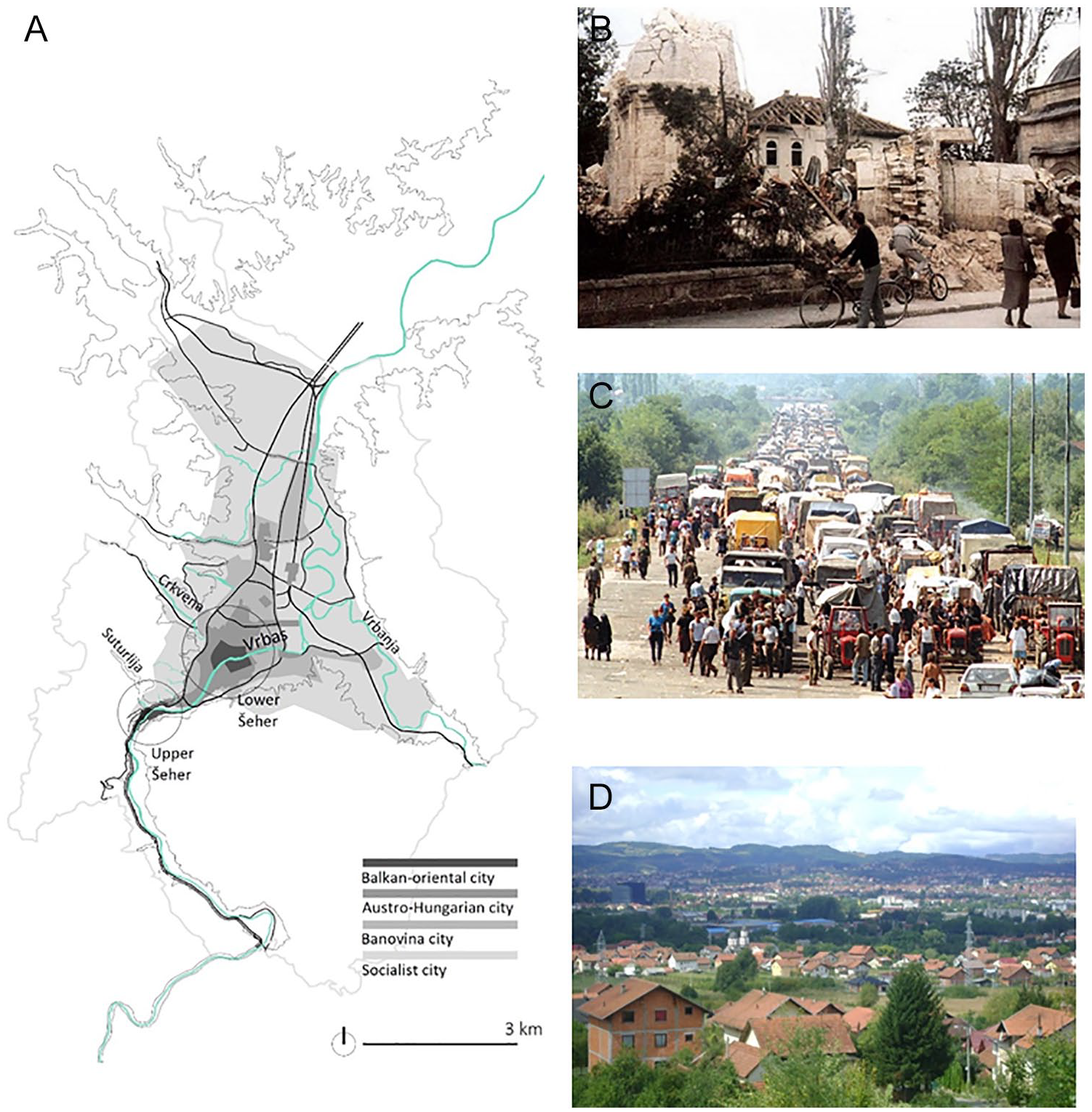
(A) Left: Historical development of Banja Luka city with expansions toward periphery (Map redrawn by authors, 2017); (B) Right (top): Demolition of the Ferhadija mosque in Banja Luka, 1993 (Source: https://radiosarajevo.ba/); (C) Right (middle): The biggest wave of refugees coming to Banja Luka from Croatia, 1995 (Source: http://www.politika.rs/); (D) Right (down): Image of the Česma-Mađir informal neighborhood (Source: Photo by authors, 2015).
Period 1995-2016
By the end of the war (1995), Banja Luka again faced an extreme and sudden change of the socio-political system, a destroyed economy, processes of privatization, ownership changes, and the denationalization of land. In contrast, it became the capital of the Republic of Srpska, a major administrative, political, and cultural center, but with its increased importance came new responsibilities caused by the dynamics of migration and everyday activities. The leading promoters of construction activity and urban development have become the owners of new capital, and investment in housing construction has become the basic aspect of investing money. Others were internally displaced persons under the imperative of an urgent solution for the housing problem and employment. 27
Despite previous experience with sudden and extreme changes, the city has not shown the ability to cope with new situations so the postwar transformation process took place spontaneously. The institutional framework has weakened, and the spatial and urban planning system has retained the socialist model of physical planning, which has not responded to change. This was possible, because in the conditions of socialism, the process of participation had not yet begun, which required new knowledge and skills of urban planners. There are two distinct phases of this period: (1) the first until 2010, when systematically defined planning and law regulation from the previous periods did not support contemporary socioeconomic processes and, thus, were inadequate and inefficient (while at the same time, the country’s institutional and financial capabilities in the postwar reconstruction period were increased by foreign donations); and (2) the second period from 2010 onward, in which integrated planning introduced was partially adjusted to contemporary needs and defined by the new law for spatial planning. 28 The law has improved regulatory conditions in the domain of flexibility of planning, participation, and institutional framework, but some of this is still inadequately implemented. For example, the zoning plan, as a new regulatory planning document that offers more flexibility than plans of detailed regulation, did not have sufficient application or the possibility for improvement. Apart from adapting the planning system to transition changes and the character of contemporary cities, it was also necessary to improve the education of future planners to achieve sustainable urban planning. This process was slow given the rather ineffective nature of the education process.
The period is characterized by the lack of updated spatial planning documentation, especially the strategic, the uncontrolled informal urban fabric (Figure 3D), the unbalanced relationship between private and public interests, the tendency to reduce public areas and greenery, thus endangering urban identity, the incompatibility of infrastructure equipment and public space planning with investment construction dynamics, a lack of public investment, and ineffective participation, which was untenable.
There was corruption at all levels 29 due to insufficient experience and the lack of balance between power and knowledge. 30 Private interests and the so-called investor-oriented planning took precedence over public spaces while promoting transformation of the city (Figure 4). The transition has shown the inability of institutions to protect and improve public spaces as well as the weakness of the whole system. Local government units, tasked with conducting the planning process and public space protection, did not have effective process management mechanisms, which directly affected the public interest. Urban development management was more the result of political decisions and private investor initiatives and less of planning. With the weakening power of the state and the reorganization of institutional responsibilities, it was difficult to finance the planning process, which led to its discontinuity.
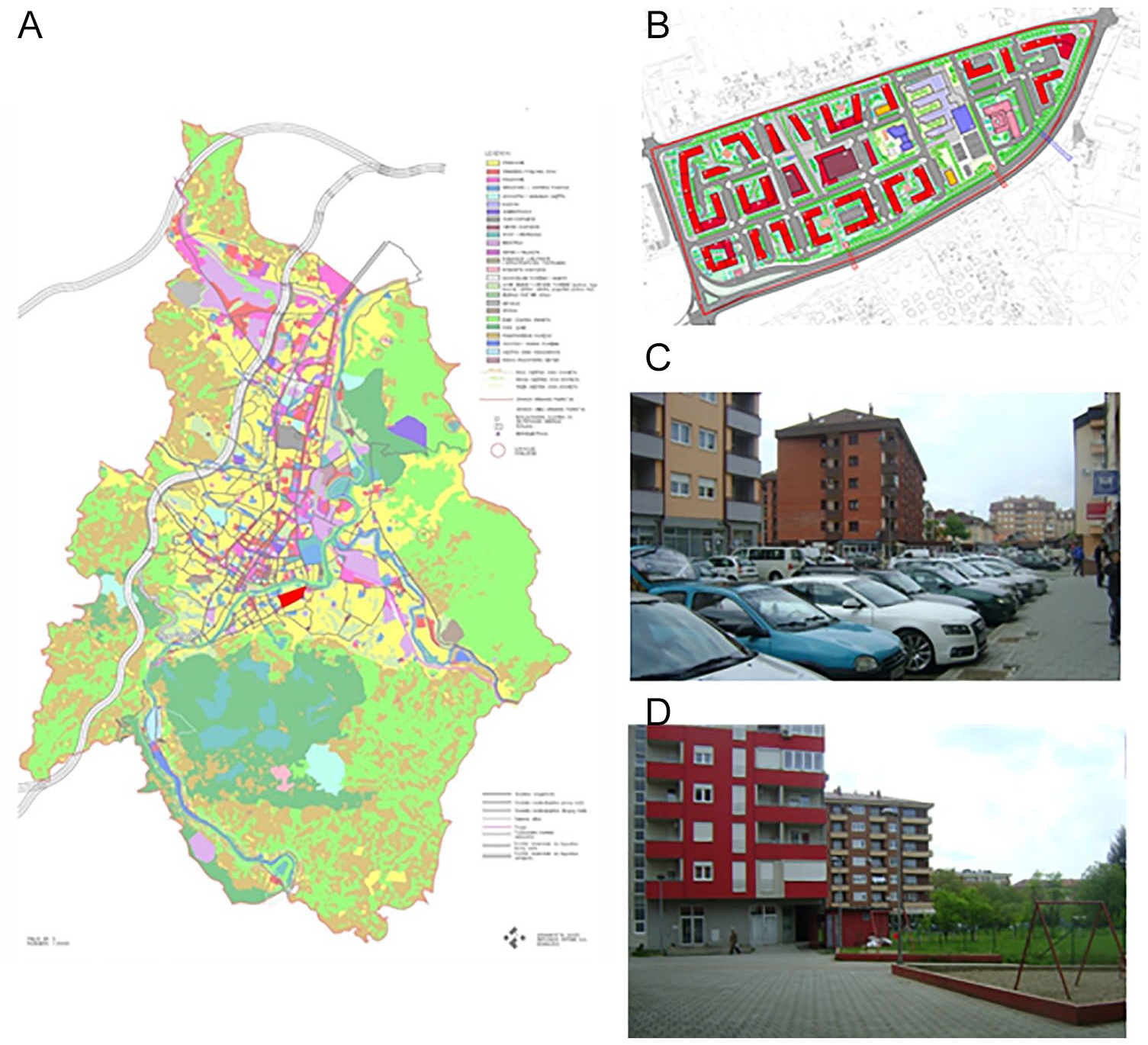
(A) Left: Proposal of Urban Plan of Banja Luka 2008-2020. Red color—central urban functions; orange color—high-density housing; yellow color—low-density housing; pink and violet colors—industry and business; blue—education; green—urban greenery, sport, and recreation. “Jug 3” neighborhood is marked by clear red hatch (Source: The Institute of Urbanism of Republic of Srpska, 2010); (B) Right (top): Detailed regulation plan of the “Jug 3” neighborhood (Source: The Institute of Urbanism of Republic of Srpska, 2005); (C, D) Right (middle) and Right (down): The current state (realized plan) of the “Jug 3” neighborhood (Source: Photos by authors, 2014).
Given the time lag of the 1975 urban plan and the unsuccessful attempts to formulate a new one (1992 draft and 2009 proposal, Figure 4A), spatial changes took place on the basis of drafting, amending, and supplementing plans of detailed regulations in the meantime. They are reflected in the unsystematic approaches to planning, misleading and inappropriate solutions, excessive profit-driven construction, and so on. In such conditions, devastating spatial results are reflected in the degradation of the urban fabric, which is particularly expressed in the devaluation of recognizable urban forms imposed by the market-oriented value system.
Period 2016-2030. The Urban Development Process of Banja Luka
Apart from the changes that the city of Banja Luka has already experienced, contemporary urban transformation has characteristics that have not been considered so far: (1) the problem of the lack of a valid urban plan is gradually transformed into a permanent open planning and construction process; (2) several simultaneous processes that can represent parts of the integrated planning mechanism of urban development are recognized.
In the meantime, the role of the various new planning process actors, which require “rights to the city,” 31 is becoming more important and has become a significant factor of the process. This contributes to the interdisciplinary approach 32 as a mode of joint spatial management, which implies the concept of integration. 33 In this sense, the city gradually becomes what is its essence, so it takes place in the balanced conflict of interest of all interested parties.
In addition to those preparing and formulating the plan, there are many other actors participating in the process: different types of organizations, private companies and public institutions, foundations, scientific research and educational institutions, citizen associations, civic initiatives, citizens as individuals, professional public, and so on. They are recognizing the real problems, needs, and potential of space through activist-design actions. 34 Such a process of shared participation contributes to the informal education of all participants, strengthening of participation, establishing a model of private-public partnership, building a model of public interest protection, and launching public space debates and ways of development.
However, the up-down approach, the established administrative procedures, 35 and the methodology of drafting plans 36 remain unchanged, without recognizing the potential for social community engagement. Although the principal support for underlying bottom-up initiatives exists, it is reduced to individual cases with limited understanding, which also leads to modest results. At the same time, the city administration tries to establish policies and strategies for bottom-up approaches 37 that will determine directions for future actions. Unfortunately, this work remains behind closed institutional doors, still without adequate public participation. The principle of participation is only formally legally respected, and it is more apparent than real.
The process of adopting the Integrated Development Strategy took place according to the Methodology for Integrated Local Development Planning (MiPRO) approach, 38 which is not related to space. Urban planning is viewed as one of a number of its programs, which represents risks and threats for strategy implementation. The process of drafting a new urban plan is designed ambitiously by introducing the function of a city architect and a city landscape architect and by forming an interdisciplinary and multidisciplinary Council of the Urban Plan. However, the influence of both bodies is more apparent than real and is perceived as an amnesty of the program, which was drafted by the plan preparation officer.
The modern post-transition city is in a difficult financial situation, burdened with numerous infrastructure problems. Investments in open public spaces are minimal, the urban structure is demolished, the city’s image is rapidly changing, and the once recognizable symbols of the city pale in comparison. As the city becomes a non-articulated concrete jungle, and while the quality of urban space and quality of life in the city decline, some of the city’s greatest potential remains invisible. 39
Principles of Integrated Urban Planning in Banja Luka Learned from the Past
This analysis shows the positive and negative values of the development of the Banja Luka urban planning process, the valuable lessons that can be learned from, and the solutions that can be improved. Although Banja Luka had several opportunities to make significant advances in its planning process, the city did not succeed in meeting the challenge of integrity. Only one valid urban plan during the observed period was not enough to establish the tradition of planning. Thus, there was no adequate education about the culture of urban planning, institutional strengthening, or improvement of the regulatory, methodological, and organizational framework of planning process. This was directly reflected by the low level of implementation efficiency of plans, which was fertile ground for the informal urban fabric and “investor-oriented urbanism.” The lack of a planning culture led to irresponsibility toward public space, insufficient development of the urban living culture, and a low level of urbanity.
However, the planning inconsistency also had certain positive effects. It led to a relatively spontaneous development of the city and a relaxed urban matrix, which, in combination with formal urban fabric, was for a long time optimal for a pleasant life for Banja Luka residents. It also contributed to the recognizable urban identity of Banja Luka as “an unfinished small town,” 40 “the landscape city,” and “the city of greenery,” 41 as well as the characteristic of the continuity of the discontinuity of the urban structure. However, citizens felt a sense of freedom in creating a city and demanding the “right to the city,” 42 and were allowed more freedom for action in urban planning processes in the coming years. In these conditions, an informal system of flexibility and adaptability spontaneously developed, according to which society managed to overcome numerous obstacles.
The analysis also shows that the urban planning process during the observed period had a very diverse amplitude. The interesting fact is that the process of urban planning did not actually follow an evolutionary path, but the opposite one. Table 2 shows that the war and postwar period followed by the ongoing process of transition had a huge negative impact on the evolution of urban planning processes. It is also clear that the number and intensity of the most integrated urban planning principles significantly decreased after 1992, which even nowadays are not equal to their levels during the period 1969-1992 when the first and only valid urban plan was adopted and implemented. However, this shows that the intensity of all principles of integrated urban planning during the second half of the socialist period was quite pronounced and balanced, except flexibility, adaptability, and participation. With this in mind, it is possible to confirm the importance of observing the history of urban planning, understanding, and using the valuable lessons that can be learned from past experiences. This leads to the conclusion that the system of socialist centralized management and administrative expert-oriented rational planning system was pretty much in line with the basic characteristics of integrated urban planning, which should only be reestablished and improved by introducing and intensifying public participation as well as the flexibility and adaptability that are so much needed.
Intensity of Basic Integrated Urban Planning Characteristics Through Different Periods.
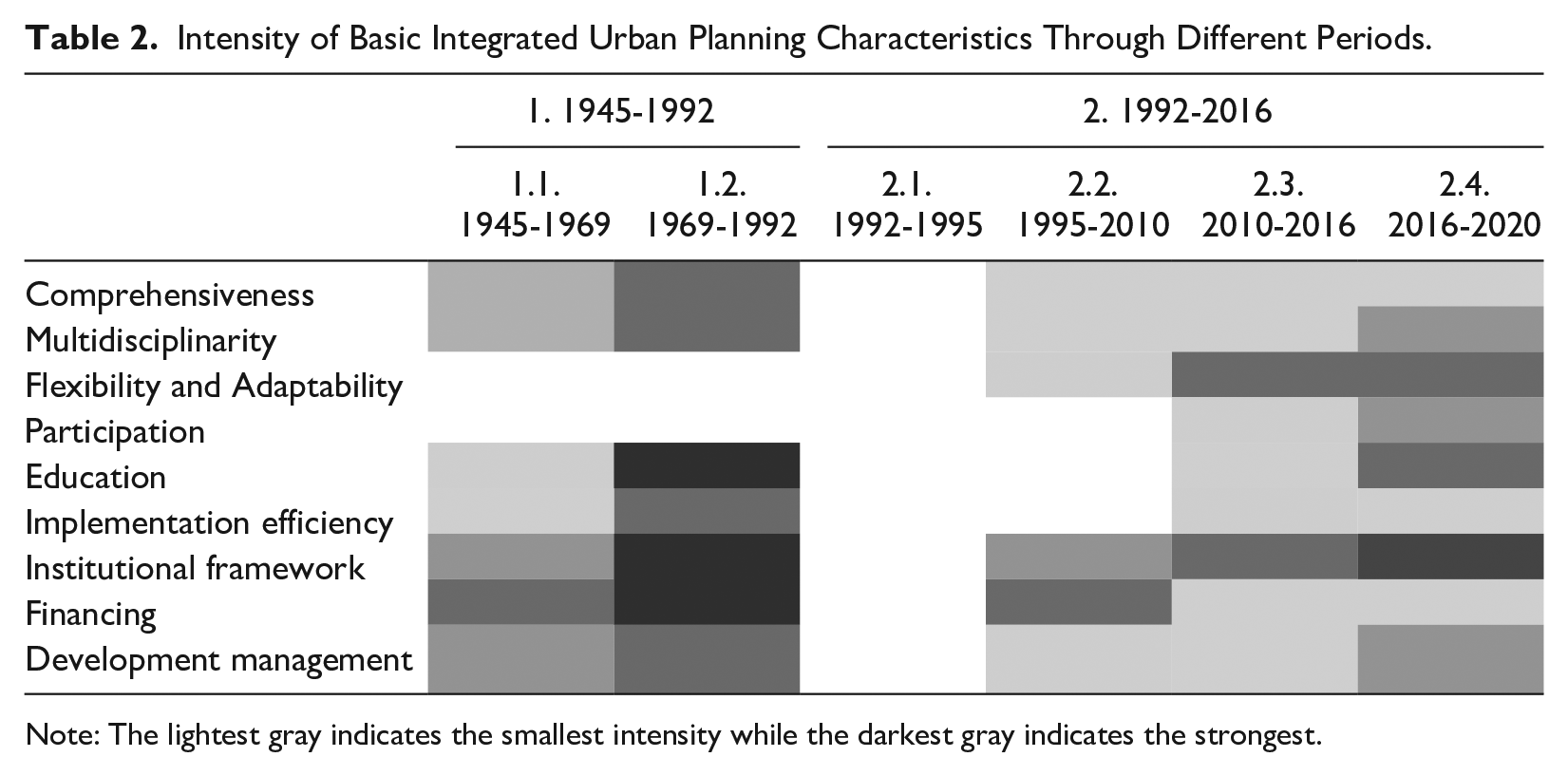
Note: The lightest gray indicates the smallest intensity while the darkest gray indicates the strongest.
From 2016, Banja Luka has been at a specific level of urban development in which dynamic patterns of the socioeconomic context with a local and global background impose the need for an integrated approach for planning urban development. Therefore, continuous and comprehensive work is necessary to improve conditions to allow a good practical application of the principle of integrity at all levels. As there is a large lag behind the developed Northwest European countries, however, it is left to the possibility of establishing a new planning system based on innovation, scientific research, and best-practice examples, 43 which need to be tailored to the specifics of the local context.
In contrast, the lack of efficient management of the implementation of plans and monitoring mechanisms is a big problem and a special challenge. In the meantime, the absence of a system actually becomes a kind of system in itself so the process of informal city development is constantly pursued according to certain unwritten rules and modified traditional patterns. 44 Although it works, the essence of applying the integrated principles is discursive and identified with open flexibility. 45 The open planning process, that is, management of transformations, would imply a coordinated problem-and-project orientation. This would mean continuous monitoring and recognition of spatial potentials, patterns, functioning systems, and other specific spatial development features that are not sufficiently valued and that can be improved in the creation of new models. These new models could improve the existing planning legislation in the analyzed context, just as was done in the EU.
Recommendations
Instead of conclusions, recommendations for improving the integrated planning process were given. The new approach to urban planning should be oriented gradually and based on integrity. This implies the continuity of research and the urban planning process including a multidisciplinary approach, but always having in mind urban history experiences. Therefore, it is necessary to work on educating all participants in the process of urban planning, beginning with the planners who are expected to have an expert and intermediary role among the interested parties. 46 Instead of using only self-experience, research could be extended by lessons learned also from the positive examples in the neighboring post-socialist countries that overcame transition by becoming members of the EU (especially Slovenia and Croatia) and by implementing the principles, laws, and rules harmonized across the countries.
A few actions for establishing an integrated planning approach also derived from the urban history review are as follows: (1) initiating the process of strategic planning of urban development, (2) creating sustainable financing models (private-public partnership), (3) strengthening institutions, (4) improving the local regulatory framework, (5) improving work organization at local and other levels, (6) launching urban regeneration projects, 47 (7) improving the flexibility and adaptability of planning solutions, 48 which opens possibilities for urban interventions 49 —from (8) strategic (significant for the whole city) up to (9) creative strategies 50 that promote contemporary development concepts for small-scale interventions based on the principle of urban acupuncture 51 , and (10) increasing participation and collaboration. 52
Footnotes
Declaration of Conflicting Interests
The author(s) declared no potential conflicts of interest with respect to the research, authorship, and/or publication of this article.
Funding
The author(s) received no financial support for the research, authorship, and/or publication of this article.
