



Abstract
After the Tokugawa shogunate collapsed in 1868, shogunal retainers in the castle town of Edo, now renamed Tokyo, were forced to rebuild their lives under a new regime. A small number of them eventually reemerged as political journalists and, through involvement in progressive political movements, came to lead the city’s newly established local assembly. Focusing on two such assembly leaders, Fukuchi Gen’ichirō and Numa Morikazu, this essay describes how these shogunal-retainer-turned-journalists tried to build political networks around the Tokyo Prefectural Assembly in the late 1870s and the early 1880s. As the new government abolished the feudal status system and gradually introduced representative government, Tokyo’s socio-political structure underwent dramatic change. Fukuchi and Numa’s attempts were therefore exploratory in nature. modernizers though they were, the legacy of Tokugawa Japan and Edo nevertheless deeply influenced them when they approached their local constituencies. Reconstructing their efforts to define representative politics for the new city of Tokyo can help us understand the early-modern to modern transition in Japan’s capital city.
Introduction
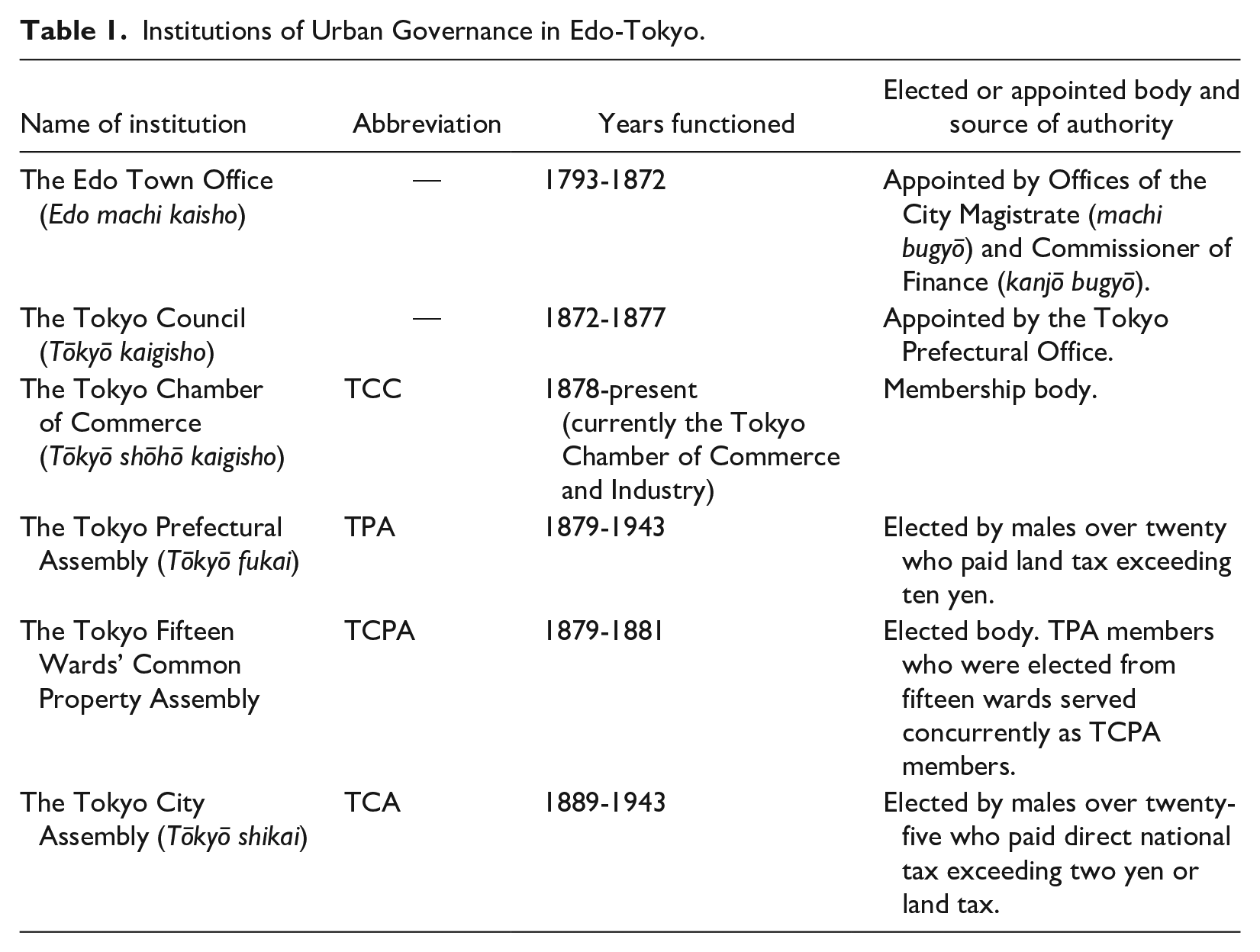
In 1868, the Tokugawa shogunate, the last feudal Japanese military government, collapsed amid political crises triggered by demands of the Western powers for the opening of the country. The shogun left his castle in the city of Edo as the shogunate’s 265-year rule came to an end, and the households of around 34,000 shogunal retainers lost their social status and source of income as the new Meiji government conquered the city. 1 Many struggled to rebuild their lives as petty landlords or low-ranking officials for the new government, but a small number of them reemerged as leading political intellectuals and journalists in the city, which was now renamed Tokyo and became an imperial capital. It was these shogunal-retainer-turned-journalists who led the Tokyo Prefectural Assembly (Tōkyō fukai, hereafter TPA) in its first years. The TPA was established in 1879 by the Meiji government as a step toward a modern nation-state with a representative government. 2 Only a small fraction of the city’s residents were eligible to vote in the early years of the TPA. It remains significant historically, however, as the first popularly elected assembly in Edo-Tokyo’s history. This essay will focus on the politics of the assembly’s first leaders (Table 1). 3
Institutions of Urban Governance in Edo-Tokyo.
I focus here on how Fukuchi Gen’ichiro (1841-1906) and Numa Morikazu (1844-1890), who became the first and second chairman of the TPA, respectively, tried to build networks of political relationships around the assembly (Figures 1 and 2). The two are interesting figures to explore because their thoughts and actions embody what Henry D. Smith II calls “a broad middle ground, where Edo and Tokyo overlap, interact, and produce syntheses that are neither one nor the other.” 4 Experiencing drastic political changes in Edo-Tokyo since their youth, Fukuchi and Numa presented a complex set of values and assumptions when they engaged in politics as the TPA leaders: belief in the need for radical modernization, appreciation for the traditions of samurai and Edo commoners (colloquially known as Edokko, or “children of Edo”), as well as a blend of Western and Confucian political ideas, coexisted in their thoughts and actions.

Fukuchi Gen’ichirō.

Numa Morikazu.
On one hand, Fukuchi and Numa were determined modernists who promoted the rapid westernization of Meiji Japan as well as Tokyo just like the new national leadership, while at the same time they often confronted the repressive government by pushing for expansion of political freedom and “popular rights” (minken) as well as for establishment of a national parliament. They studied Western languages as shogunal retainers, and eventually joined the rare group of Japanese during the period with rich Western knowledge. On the floor of the TPA, in the newspapers they published, and in public speeches—all of which were new public arenas in Japan—Fukuchi and Numa tried to disseminate the idea of representative government to constituencies of citizens many of whom came from the former commoner elite. The two advocated a thorough renewal of Tokyo’s infrastructure, from fire prevention to widening and improving roads, sometimes to the bewilderment of ordinary citizens.
On the other hand, however, their thoughts and actions were also defined by more local and traditional contexts. Fukuchi and Numa were not involved in the heated anti-shogunate sonnō (imperial loyalist) movement in the last decade of the shogunate’s rule. But the patriotic and self-sacrificing mentality of the sonnō shishi (public-spirited samurai) had a lasting impact on political activism in modern Japan, including the Freedom and Popular Rights Movement (jiyū minken undō), to which Fukuchi and Numa, especially the latter, devoted themselves. 5 In addition, as they lived in Edo, they were economically and culturally dependent on the city’s commoners, although their residences were spatially separated from those of the commoners. And with the former commoners’ areas remaining the most populated and stable areas in early Meiji Tokyo, the basic image of the city’s self-government (jichi) tended to be derived from administrative traditions in the commoner neighborhoods (chō/machi).
Political historians have studied Fukuchi and Numa mostly in the context of national politics and political culture. 6 They were indeed never genuinely local figures. In most cases, they wrote and spoke to the emerging national public rather than exclusively to Tokyo citizens. They had far weaker ties with local communities than the traditional local notables in rural areas who came to lead the Popular Rights Movement in their villages and prefectures. However, the political history of Edo-Tokyo cannot be fully described without exploring the “middle ground” that Fukuchi and Numa embody, which at the same time constituted the intersection of the national and the local in the city. How did they interpret the city’s past and envision its future while trying to consolidate the TPA in a rapidly changing urban society? What were their similarities and differences in approaching other actors in the city, and which of their approaches defined the development of political networks in the city? Through answering these questions, we will be able to grasp one important aspect of this “middle ground.” Furthermore, it was during Meiji Tokyo’s passage through this “middle ground” that it joined the global trend of urban industrialization and expansion in the late nineteenth century, 7 which led to structural changes in urban governance. Understanding this transitional period is thus also essential for properly placing the city’s experience in an international context.
This essay is divided into three sections. The first section presents the backgrounds of Fukuchi and Numa and lays out the common conditions behind their leadership in the TPA. The second and third sections take a closer look at how Fukuchi and Numa tried to build political networks around the TPA in often different ways, reflecting their interpretations of the city’s history and visions for its future. Whereas the second section examines their approaches to local organizations in newly established wards (ku) and former commoner neighborhoods (chō), the third section focuses on their relations with a circle of emerging business leaders. In concluding, I contend that a set of modernizing visions, traditional values and historical interpretations defined their organizing efforts, which set the initial conditions for Tokyo’s political history.
From Shogunal Retainers to Local Assembly Leaders
In the last years of the Tokugawa shogunate, young Fukuchi and Numa were similarly selected for their Western language ability by the shogunate and given opportunities to enhance their Western knowledge while working in Edo. Pressured to open the country to trade with the Western powers, the shogunate stepped up its efforts to cultivate talent in Western languages for diplomatic negotiations and military reform in the late 1850s. The son of a Confucian doctor in the port city of Nagasaki in 1841, Fukuchi moved to Edo to master English when he was 18 years old. He learned the language quickly due to his training in Dutch back in Nagasaki and became an official translator for the shogunate in 1859. Between 1861 and 1865, he traveled to Europe with shogunal delegations, becoming one of the rare Japanese who had a chance to observe Western societies first-hand before the ban on overseas travel was lifted in 1866. Numa, born in Edo in 1844 as the son of a shogunal retainer, began to learn English at the age of 15 while staying in Nagasaki. After returning to Edo, he was soon assigned to posts in Western military training and was eventually commissioned as a lieutenant in the shogunate’s elite troops.
Fukuchi and Numa were granted residences in the samurai districts of Edo and thus did not live under the administrative system for commoners, which would be extended to the entire city after the Meiji Restoration and see a thorough restructuring. There were two urban institutions in the commoner areas important to the present discussion: the neighborhood unit (chō/machi) and the Edo Town Office (Edo machi kaisho). Chō, which numbered over 1,300 and each of which consisted of several hundred residents on average, were basic neighborhood units for local governance and community in the commoner areas. 8 Day-to-day administrative activities were put into the hands of the chō, reflecting the highly decentralized urban governance system in Edo. 9 Meanwhile, the Edo Town Office, established in 1793 and run by both the shogunate’s officials and a small number of privileged commoner merchants, was a relatively centralized institution for providing poor relief in order to prevent urban riots. Although Fukuchi and Numa had no direct connections with these local institutions for commoners at that time, their understanding of these institutions would affect the ways they approached the city in later years. 10
The lives of Fukuchi and Numa drastically changed with the collapse of the Tokugawa shogunate. Tokugawa Yoshinobu, the last shogun, left Edo in surrender in April 1868, but some of his retainers fought on or resisted in other ways. Fukuchi and Numa were among them. Disappointed with the shogun’s decision, Fukuchi resigned from the shogunate and published a pro-shogunate newspaper in the city, which resulted in his temporary arrest. Numa left the city to fight on the side of the pro-shogunate domains but was eventually captured in northeast Japan and confined in Tokyo. However, both were soon offered positions in the new government by their former enemies, who urgently needed talented men with Western knowledge for the national modernization project. They entered the Finance Ministry in 1870 and 1872, respectively (although Numa was soon transferred to other ministries), to introduce modern institutions through the translation of Western books and study trips abroad.
Within a few years, however, they left the government to become political activists with their own media outlets as part of the anti-government Popular Rights Movement. Fukuchi resigned his post in the Ministry of Finance in 1874 after he saw his superior Shibusawa Eiichi, whom he trusted and with whom he would later closely cooperate, leave the ministry. He was soon invited to serve as chief editor and president of the newspaper Tōkyō Nichinichi Shinbun and began to write the newspaper’s editorials. His extensive knowledge and elegant writing style quickly established the newspaper’s fame and his own. Numa remained a state bureaucrat until 1879, but earned a reputation as a progressive public intellectual while in the government. In 1873, upon returning from Europe, he established an association with fellow bureaucrats to hold debates on legal and political issues, which Fukuchi also occasionally joined. The association evolved into the Ōmeisha (Singing Birds Society) in 1878, one of the major intellectual associations that led the Popular Rights Movement. When the government prohibited officials from giving public speeches in 1879, Numa finally decided to leave office. He purchased a newspaper, moved its headquarters from Yokohama to Tokyo and renamed it Tōkyō Yokohama Mainichi Shinbun. Fukuchi welcomed Numa’s move, and wrote to him saying, “it appears I now have a great rival in the world of Tokyo-based newspapers.” 11
Fukuchi and Numa soon started to campaign for the expansion of representative government. Fukuchi had already engaged in the issue locally before the establishment of the TPA when he tried with Shibusawa to transform the Tokyo Council (Tōkyō kaigisho), a governor-appointed committee of private citizens that replaced the Edo Town Office in 1872 and was later headed by Shibusawa, into an elective body. 12 Fukuchi drafted the council’s petitions to the state-appointed Tokyo governor while using the editorial page of the Tōkyō Nichinichi Shinbun to repeatedly urge the national government to sanction local assemblies. Their attempts ultimately failed, but his involvement in the issue led Fukuchi to the newly established TPA. When Fukuchi became the first TPA chairman in January 1879, Numa was still a state bureaucrat who was not eligible for election. But he soon left office to seek election and focus on political activism. 13 In December 1879, one month after becoming the Tōkyō Yokohama Mainichi Shinbun’s president, Numa won a by-election and became a TPA member.
After entering the TPA, the two took turns as its chairman for its first decade (Fukuchi from 1879 to 1882 and 1885 to 1887, and Numa from 1882 to 1885 and from 1887 to 1889). Their strategies and leadership styles in the TPA had much in common, although Fukuchi was more moderate and eventually took a decisive turn toward support of the oligarchic national government after the Political Crisis of 1881. They exerted authority among the TPA members and other prefectural assemblymen around the nation. Their political knowledge and control of the media for disseminating it played a huge role in consolidating that authority. Deliberations in the TPA, in which both Fukuchi and Numa refused to represent the “partial” interests of their specific constituents, 14 often led to exchanges of eloquent speeches among the journalist assemblymen. In addition to Fukuchi and Numa, leading orators included Taguchi Ukichi from the Tōkyō Keizai Zasshi and Fujita Mokichi from the Yūbin Hōchi Shinbun. Their speechifying often overwhelmed the old merchant bourgeoisie in the assembly, who were unfamiliar with the practice of the public speech itself. These old merchants generally looked up to the elite journalists, but on a rare occasion, a merchant assemblyman remarked in frustration during a TPA session that the words of these “generals of the lecture circuit . . . could be mistaken for speeches in the Meiji Hall,” a famous venue for the Popular Rights activists’ rabble-rousing lectures in Ginza. 15
Their debates in the TPA were then reported in detail in major newspapers, including their own, and their editorials continued the discussion. 16 With this authority, Fukuchi and Numa steered the TPA’s activities. The TPA often challenged the national and prefectural governments over political rights or tax increases, but at the same time it avoided the outright confrontation with state authorities seen in some other prefectures. Sharing the government’s modernizing stance, the TPA often cooperated in state-led urban modernization projects.
The strong authority Fukuchi and Numa possessed within the TPA and nationwide as leading political ideologues has been widely recognized by previous studies. What requires more attention in the context of Edo-Tokyo’s political history, however, is how they tried to organize or interact with the other local actors who would define the city’s governance together with the TPA. These efforts, some of them unsuccessful, deserve close examination because they tell us how the two former shogunal retainers interpreted the historical experience of the city while trying to renew its political landscape. In the next section, I will focus on their approaches toward local communities.
Old Neighborhoods and New Wards: Approaching Local Communities
As mentioned above, Fukuchi and Numa were elected to the TPA not due to their roots in the local communities. Many of the 100-200 former Edo commoners in their wards who voted for them must have known them primarily as distant intellectual elites with national reputation. Largely welcoming “civilization” but not especially excited about the introduction of local representative government at this point, they entrusted the management of this unfamiliar institution to these former-samurai journalists who had rich knowledge about Western political systems. Therefore, it was after their elections that Fukuchi and Numa started to interact with their local constituents—although the two openly refused to act as agents of their localities, in the belief that they should remain “comprehensive” representatives of all the Tokyo citizens. It was only at this point that they began to speak of local communities in Edo-Tokyo. The city’s local communities were themselves undergoing major institutional change at the same time. The contrasting approaches of Fukuchi and Numa to the issue of local community within the capital reflect the complex state of local organizations during this transitional period.
One of the key elements of the issue was local administrative units: the old chō and new wards (ku), the latter of which were also designated as electoral districts for the TPA. After the Meiji Restoration, the chō-based administrative system in the commoner areas of Edo was extended to the entire city, but then gradually replaced by a more centralized ward-based system. 17 The Tokyo prefectural government removed the administrative functions of the chō because it considered the chō too small a unit for modern urban governance. Wards were then introduced to take over many of the administrative functions of the chō; these wards were much larger in size (after frequent changes in the ward boundaries, fifteen wards were established in 1878) and placed under more direct control of the prefectural government. Fukuchi was elected to the TPA from Shitaya Ward, where he had lived for over a decade but, according to an editorial in his own newspaper, he “had not had time to interact with [his] constituents.” 18 Numa moved from the Shitaya-Asakusa area to the neighboring Kanda Ward by mid-1879 and was elected to office in a few months. In both wards, most residents were former commoners, in contrast to Fukuchi and Numa.
As Ogi Shinzō and Henry Smith emphasize, chō-based communal lives were not immediately affected by this institutional change. 19 At the same time, however, local public life for Edo-Tokyo citizens—especially wealthy male citizens—and accompanying social relations were being profoundly reshaped, as ward governance participation was promoted by the prefectural government and the ward offices. By the end of 1880s, in each ward, voluntary associations of a few hundred citizens were formed to support local projects such as establishing public elementary schools and improving hygiene. 20 Not only old Edokko merchants but also successful businessmen or bureaucrats who had recently moved to the capital city joined these associations, mostly regardless of their status under the old regime. The ward-based associations thus nurtured a new kind of social interaction among old and new upper and upper-middle class Tokyoites.
Under these circumstances, Fukuchi and Numa differed in their approaches. Fukuchi frequently celebrated the traditional “self-government” (jichi) of Edo commoners. His editorial in the Tōkyō Nichinichi Shinbun of 1878 stated that the old city had unconsciously followed the principle of local autonomy because the authorities minimized their intervention, thus enabling citizens to foster “a spirit of exercising their rights.” He contended that this was most clearly embodied in the management of the chō: The authority and prestige of the resident landlords was manifest throughout the chō, and they always declared that the appointed headmen (nanushi) were their employees. The headmen, for their part, acknowledged this themselves and were unable to borrow samurai authority to intervene in chō affairs.
21
While it is true that the shogunate did not intervene in the affairs of the chō as long as they performed their duties, studies on the actual conditions of the chō in Edo suggest that Fukuchi presented an idealized image of the landlords’ authority. 22 Their paternalist role had disappeared in most of the chō in the city by the early nineteenth century as absentee landlords increased and their agents (yanushi or yamori) were commissioned to manage the chō. The point to focus on here is Fukuchi’s insistence on the legacy of Edo commoners rather than the historical accuracy of his description. His idealization of the public life of Edo commoners served the assertion that Tokyo citizens had a history of local self-government.
In contrast to Fukuchi, Numa showed little interest in the legacy of Edo commoners. While both Fukuchi and Numa urged Tokyoites to “recover” their public spirit, Numa reached back to the medieval warriors in the Kantō area surrounding the capital (bandō musha) as a historical precedent instead of the early-modern Edo commoners.
It was once said that the wisdom and courage of [the warriors in] the eight provinces of Kantō were sufficient to fight against all the soldiers in the realm. Are you not the descendants of these wise and courageous bandō musha? No concerns should keep you subservient.
Numa challenged his audience with these words in a public lecture in 1880, while lamenting that Tokyo citizens were slow to organize their political associations. 23 Editorials in the Tōkyō-Yokohama Mainichi Shinbun frequently picked up TPA-related policy discussions, but made no reference to Edo. Numa probably sympathized with Taguchi Ukichi, another prominent former shogunal retainer and Numa’s close ally in the TPA as well as in the Ōmeisha, when Taguchi provocatively described how “Tokyo merchants,” who “had long been oppressed by the [Tokugawa] military government” and relied on the privileges given by the shogunate, were now being overwhelmed by rising “gentlemen businessmen” (shinshō) due to their lack of competence and spirit. 24
Interestingly enough, Fukuchi and Numa’s differing views on the legacy of Edo commoners resulted in hesitance on Fukuchi’s part and willingness on Numa’s to organize residents in their respective wards. Fukuchi did not enter the Shitaya Ward Assembly or other local public associations, although one could hold office in both ward and prefectural assemblies at the same time. 25 Given his popularity in the prefectural assembly elections, it is likely that he declined the offer to be elected to the ward assembly or to join other associations. Fukuchi’s historical interpretation of self-government in Edo appears to have kept him from engaging in administrative and political activities below the metropolitan level. If Fukuchi regarded the wards’ self-government as something close to the chō’s traditional self-government, it was natural for him to think that former-samurai metropolitan assemblymen like himself should not “intervene.” His views echoed the contemporary discourse among many Popular Rights activists and government officials regarding local self-government. 26 The problems caused by the radical social and administrative reforms in the early 1870s prompted them to reevaluate the tradition of local autonomy in the early modern chō and villages. When this image of the self-governing chō and villages was projected onto present-day neighborhoods, they were envisioned as something outside the modern political system. This explains why Fukuchi did not engage in local organizing among his Shitaya constituents and remained a somewhat distant figure in the ward. The more he celebrated the historically self-governing neighborhoods around him, the more reluctant he became to “intervene” in these “traditional” self-governing communities.
Numa, on the other hand, did not hesitate to intervene. He found no reason to keep away from a potential site of political organization. In July 1880, eight months after becoming a TPA member, Numa was elected to the Kanda Ward Assembly and subsequently became assembly chairman. 27 Just as he did in the TPA, Numa “unsparingly criticized and revised bills” in the ward assembly, and “contributed greatly to the ward residents’ conviction that they did not have to fear the government,” according to the newspaper Yomiuri Shinbun (which was independent of Numa). 28 He also initiated the establishment of the resident group Kanda Concordia Association (Kanda Kyōwakai) in 1888 to “contribute to local governance.” 29 With several hundred members, mostly comprising wealthy residents with voting rights, the association soon became the ward’s most powerful voters’ group. Numa himself died in 1890 without witnessing its development but the Kanda Association would go on to send members to both national and local elected bodies.
The Kanda Association was not an isolated case: as the Imperial Diet was established in 1890 and both national and local political structures developed through electoral competitions, ward-based resident groups were established across the city and started to influence the election results in their respective wards. Even in Shitaya ward, without Fukuchi’s leadership, local notables merged four resident groups into the Shitaya Public Association (Shitaya kōdōkai) in 1890. 30 Wards thus started to function as basic units for Tokyo citizens’ public life and the Edo commoners’ chō-based “self-government” praised by Fukuchi was largely dismissed in the process. It was only three decades later that this traditional “self-government” drew renewed attention as part of an idealized image of the city’s feudal past. 31
Urban Elites outside the Assembly: The Break with Business Leaders
While Fukuchi and Numa thus encountered non-elite former commoners by approaching local communities as the TPA leaders, through their interaction with emerging business elites in the city, they also participated in the formation and later dissolution of a samurai-centered circle of modernizing elites in the city. The process started with a series of events that took place prior to the establishment of the TPA and involved Fukuchi: the reorganization of the Edo Town Office into the Tokyo Council and the council’s attempt to transform itself into an elective assembly, as mentioned above. The prefectural government initially made former privileged Edo merchants lead the Tokyo Council, but new business leaders like Shibusawa Eiichi, another former shogunal retainer who became a state bureaucrat but resigned several years later, soon replaced them. Fukuchi vigorously supported their reform movement and eventually became the council’s vice president. The council was dissolved in 1877 without achieving its goal, but a group consisting of both prominent entrepreneurs and political intellectuals was thus formed in the process. The group continuously sought to develop a new public platform in the city and played a primary role in establishing the Tokyo Chamber of Commerce (Tōkyō shōhō kaigisho; hereafter TCC) in 1878, which engaged in advocacy on economic issues. Shibusawa and Fukuchi became the president and vice president of the TCC, as they had been in the Tokyo Council.
When the TPA was established, the TPA and TCC leaders did not entirely overlap but were closely connected to each other. On one hand, Shibusawa and some other prominent business leaders would not enter the TPA. Shibusawa later recalled that he had been asked by the Tokyo governor ahead of the TPA’s first election not to decline if elected, but had not accepted the governor’s request. “I had been determined not to enter the political world since I quit being a government official in 1873. I felt that entering the TPA would lead me to a seat in the national parliament once it was established, so I declined flatly,” he told interviewers. 32 Shibusawa may not have wanted to be caught in the middle of the increasingly bitter confrontation between the government and Popular Rights activists. He may also have wanted to avoid possible conflicts of interest over the public projects in the city that he had started to manage. Whatever the ultimate reason, Shibusawa represented a certain number of Tokyo-based business elites who regarded the TPA as part of the “political world” separate from their economic activities and distanced themselves from it. On the other hand, Fukuchi was determined to maintain the circle linking political and business elites by committing himself to being active as both the TPA chairman and the TCC vice president. Some other business leaders, such as the future founders of two of Japan’s major business conglomerates, Yasuda Zenjirō and Ōkura Kihachirō, also showed strong interest in local representative government at this point and held positions in both the TPA and the TCC.
Under these conditions, Fukuchi labored as a TPA leader to demonstrate the unity of urban elites outside the state bureaucracy. His attempts were initially successful at a symbolic level. In summer 1879, he and Shibusawa co-hosted a non-government reception for former U.S. president General Ulysses S. Grant, who was visiting Japan.
33
Fukuchi strove to present a group of prominent Tokyo citizens including the TCC leaders as legitimate representatives of the city. Upon the news of Grant’s visit, he chaired a meeting among the TPA members, chairmen of ward assemblies, and the TCC members to discuss the reception plan, setting up a “Tokyo Citizens’ Reception Committee” with himself and Shibusawa as co-chairmen. His newspaper praised this attempt by “our elders of Tokyo” and asserted that “it would be a great opportunity for nurturing Tokyo citizens’ liberty” … “letting General Grant realize that ‘citizens’ exist in Tokyo too by publicly welcoming him.”
34
The reception was successful, and when some journalists (including Numa, who was yet to enter the TPA) commented that the TCC members were not entitled to call themselves the representatives of Tokyo’s citizens, the Tōkyō Nichinichi Shinbun responded fiercely: Given that they [the critics] have already lived in Tokyo, they should know that the city is primarily a commercial center, and most of its 800,000 residents, except for the imperial family, bureaucrats, military officers, and peers, engage in commerce and industry. Who else except the TCC could then serve as public representatives of the interests of business? . . . The TPA and ward assemblies represent Tokyo citizens’ public affairs by right, and the TCC represents [the city’s] business affairs in substance.
35
While admitting that the TCC was not an official representative body, the newspaper tried to establish that the TCC members were also an inseparable part of the elite citizenry who should lead urban governance.
Several months later, Fukuchi laid out the same vision when he proposed to build a new city hall. He made the proposal in the TCPA, a subsection of the TPA made up of representatives from the metropolitan area (he interestingly named the city hall machi kaisho, borrowing the name of the old Edo Town Office, seemingly in order to evoke the city’s “tradition” of self-governance). 36 Fukuchi asserted that while the city hall would be primarily for sessions of the TPA and TCPA, it should also be open to other public gatherings, including the TCC sessions. 37 His proposal was passed unanimously, and the Tokyo Nichinichi Shinbun was quick to advocate the proposal, as usual. “The representatives [of the TCPA] properly detected what public opinion demands,” the newspaper claimed, and the city hall would become “a great hall for the preservation of [Tokyo] citizens’ public interests and protection of their rights and liberties.” 38 Although the proposal was eventually put on ice as the fund supervised by the TCPA was transferred to the prefecture, Fukuchi used it as a chance to publicize his vision of a united front of prominent citizens once again.
However, when Fukuchi’s vision was tested over a more substantive policy issue in early 1880, he failed to mobilize others to rally around him. On December 26, 1879, a major fire broke out in Tokyo. The city had suffered numerous fires throughout its history. The leading newspapers cried for thorough fire prevention measures, and Matsuda Michiyuki, the newly appointed Tokyo governor, began planning a large-scale urban improvement project. 39 As major public expenses were expected, Fukuchi tried to support Matsuda by inviting the TPA and the TCC’s core members into the planning process before the TPA’s official deliberations. A week after the fire, Fukuchi sent a letter to the governor and recommended five “distinguished” TPA members (including Numa) and four “Tokyo gentlemen (shinshi)” outside the TPA (including Shibusawa), for a provisional committee that would discuss how to issue prefectural bonds to pay for the reconstruction and fire prevention. 40
His choice of committee members showed his intention to make the TPA and TCC leaders cooperate for what would become the most challenging urban improvement project since the Ginza Brick Town project in 1872; while three out of the five (four out of six, if Fukuchi is included) TPA members held positions in the TCC, all of the four “Tokyo gentlemen,” the term generally used for prominent modern businessmen in the city, were founders of the TCC. The governor accepted most of Fukuchi’s recommendations and set up a committee. 41 If this attempt had been successful, it would have become an important precedent for cooperation among different urban elites on the city’s public projects, through flexible use of semiofficial committees. For better or worse, the city might have been governed through cooperation between the TPA and TCC leaders, with Fukuchi bridging the two groups and blurring the line between the city’s political and business spheres.
His attempt turned out to be unsuccessful, however. Once the TPA’s extraordinary session began, Numa and Yasuda, who had joined the provisional committee on Fukuchi’s recommendation, publicly decried the financial risk of issuing prefectural bonds. 42 In the process of deliberation, Yasuda also submitted a detailed alternative plan without a bond issue. The two thus went against Fukuchi’s scheme to secure agreement among the elites before the actual TPA session began. Fukuchi repeatedly tried to persuade them and others to accept the original plan, but after prolonged deliberation, the TPA passed both the original plan and Yasuda’s plan in February, which was seemingly contradictory but indicated that the majority for practical purposes opposed the bond issue but wished to avoid outright confrontation with Fukuchi. The governor stuck to the original plan, but when the bond issue was sanctioned by the central government and a detailed plan was submitted to the TPA in August, the body rejected the governor’s plan by a wide margin. Worse still for Fukuchi, the businessmen representatives he had relied on, including Yasuda and Ōkura, began to leave the TPA. Fukuchi thus became an isolated figure trying to straddle positions in the TPA and TCC, which made it increasingly difficult to call for a broad coalition of urban elites. As Fukuchi became increasingly pessimistic about the TPA’s ability to represent conflicting interests and values among Tokyo citizens, Numa began to outperform Fukuchi as a TPA leader. 43 And after Fukuchi came under heavy criticism from Popular Rights activists as he sided with the government following the Political Crisis of 1881, Numa came to replace Fukuchi in the leading position in the TPA.
While Numa followed Fukuchi’s leadership style in various ways, he did not share Fukuchi’s enthusiasm for forming a collaborative group of urban elites in the city. 44 More devoted to the Popular Rights Movement than Fukuchi, Numa put his energy into creating a national organizational network to push for the establishment of the national parliament rather than into mobilizing Tokyo-based business leaders, who were not necessarily supportive of the movement. 45 He especially strove to form a coalition of prefectural assemblies with the TPA as a model and mentor for other assemblies. He co-hosted gatherings of prefectural assemblymen from around the country in 1880 and 1883, 46 and in the early 1880s repeatedly advocated concerted action by prefectural assemblies using their right to make proposals to the government. 47
At the same time, he showed greater caution about the political reliability of urban industrialists. In December 1881, when Numa was laboring to establish a political party following the Political Crisis of 1881, his newspaper ran an editorial titled “The Distinction Between Politicians and Businessmen,” arguing, Politicians pursue honor while businessmen pursue interest . . . In the past, in uncivilized countries where political affairs were not yet among the human sciences, there were certainly cases in which politicians were also merchants, or merchants were also industrialists. However, in the current world, political affairs are independent legal processes. . . . A man who overlooks this fact and puts his energy and time into both politics and business affairs must not know the distinction between the two . . . Gentlemen, please do not confuse the two affairs.
48
This moralistic and professional definition of politics seems to reflect the Confucian thought widely shared by the late-Tokugawa and early-Meiji activists that promoted the image of the shishi (public-spirited person) as someone prepared to sacrifice his life or wealth in fighting for what was morally right. 49 There may have been more strategic concern among Numa and his associates about some of the industrialists’ moves toward cooperation with the oligarchy under the slogan of “harmony between the government and people (kanmin chōwa/kyōwa).” 50 In any case, such an anti-bourgeois position inevitably discouraged the political journalists and lawyers from including business leaders in their activities, not only in national politics but also in urban governance. This separation between the TPA-based political leaders and the TCC-based business leaders became more evident in the mid- and late 1880s, when an increasing number of progressive journalists and lawyers entered the TPA and followed Numa’s approach.
The separation between political and business leaders in Tokyo was thus consolidated by the mid-1880s. In stark contrast to other major Japanese cities such as Kyoto and Osaka, where the coalition of old and new business elites dominated both prefectural or city assemblies and chambers of commerce, promoting their economic interests through the two institutions, 51 the TPA (and later the Tokyo City Assembly—Tōkyō shikai, hereafter TCA—which was established in 1899) distanced itself from representing or coordinating economic interests in the city, while the TCC actively played that role in its stead. This separation, together with the dominant political perception that categorically denied the politics of local or particular constituent interests, was preserved until the turn of the century, when accelerating industrialization and developing party politics made change unavoidable.
Conclusion
Fukuchi and Numa became the first elected leaders in late nineteenth-century Tokyo as a result of both the drastic political transformation following the regime change and the remnants of social stratification of the old regime. They would not have participated in governing Edo-Tokyo without the Meiji Restoration, which brought representative government to the city while prompting them to turn to political activism. At the same time, their status as distinguished bureaucrats with Western knowledge was acquired well before the Meiji Restoration, as they had served the Tokugawa shogunate. Due to a social reputation built upon this status, wealthy former commoners voted to let them enter and lead the new governing body modeled on Western institutions.
They shared a modernizing and progressive stance as the TPA leaders but approached the Tokyo citizens in sometimes contrasting ways. While Fukuchi celebrated the Edo commoners’ tradition of self-government in the chō and would not intervene in local affairs, Numa embraced the enlarged new administrative units created after the Meiji Restoration and engaged in organizing his constituents within the ward he represented. Fukuchi struggled to form a coalition among the new urban elites, but Numa tried to keep businesspeople apart from the world of metropolitan political activists. The ways they differed on the issues show that, especially amid a transitional period like this, a politician’s organizing efforts involved defining the limits and core of the city’s political sphere itself. A mixture of traditional and newly acquired values, together with renewed interpretations of the city’s past, accompanied these efforts. One important aspect of “the middle ground” between Edo and Tokyo can be observed in this process.
It is not surprising that “modernizing” and progressive metropolitan elites were quickest to utilize newly introduced representative institutions modeled on Western countries. But what is often overlooked is the complex set of visions and underlying values crystalized in the behavior of these elites. In a manner contrasting with study of the confrontation between the authoritarian government and progressive activists or that between elite modernists and ordinary people, how cities experienced the early stages of political “modernization” can be effectively explored in this light.
Fukuchi resigned from the TPA in 1889 due to a bribery scandal. Numa died in 1890 from brain disease and pneumonia. A decade later, the political landscape of Tokyo underwent another big change. As accelerating industrialization and urban expansion necessitated the intensive economic management of the municipality, the TCA, which had taken over major urban projects from the TPA, suffered from the lack of communication with Tokyo-based major businesses and faced mounting criticism over its handling of the city’s governance. This eventually led to a new attempt by the Liberal Party (Jiyūtō) to take over the TCA and use it for organizing business interests in the city, which led to an enraged response from the ward-based resident groups over the party’s “intrusion” into the city. 52 Building on the foundations formed by the first generation of TPA leaders, a new set of discourses, interactions and clashes would emerge to characterize the capital city’s mass urban politics in the twentieth century.
Footnotes
Declaration of Conflicting Interests
The author declared no potential conflicts of interest with respect to the research, authorship, and/or publication of this article.
Funding
The author(s) disclosed receipt of the following financial support for the research, authorship, and/or publication of this article: This work was supported by JSPS KAKENHI Grant Number 20K13179.