




Abstract
The period between 1900 and 1936 was decisive in the evolution of the city of Madrid, certifying its conversion to a modern European capital. However, the urban transformations in these decades were not uniform and led to noticeable contrasts in the investments made in its different socio-spatial areas. This article will focus on understanding the management and administration of these problems by studying the municipal political action by a socialist movement that gradually stepped up its social support until it took over the reins of the local authority before the Civil War. Starting from the analysis of its actions on three fronts (those implemented on the installations in the areas with the greatest deficits in terms of urbanization, in the field of enhancing subsistence, and in educational facilities), this article will seek to show how socialist policy in the Spanish capital took on an urban profile, in line with European ideas, beyond those that traditionally invoked socio-economic goals.
Introduction
The first third of the twentieth century was a decisive period in the historical evolution of European cities. Their demographic models, the structure and functioning of their job markets, their residential patterns, their material provisions, and their hygiene-sanitation status took a step forward at that time, creating social, economic, and cultural transformations that accompanied in these processes the right conditions to update governance mechanisms that emanated from local institutions that were forced to take on a range of increasingly broader services justified on the basis of their contributions to improve the wellbeing of urban communities. 1
The political forces that competed for the reins of local power did not lose sight of the growing complexity of cities. In a situation where the gaps between the old and the new grew exponentially, they forged their own conception with regard to urban transformation, whereby socialism, against this backdrop, designed a sounder movement at a European level. 2 As from the 1880s, socialism appreciated participation in the local administration as an inseparable element of the action plans and the municipal authorities as the means of social reconstruction through which it could improve the living conditions of the working classes. 3 The debates that raged at that time regarding the potential of local authorities merged with the drawing up of the first municipal programs for the French case, defined by fundamentally social and economic claims (abolition of taxes on the working classes, eight-hour working day, promotion of care institutions for small children and the elderly, free pharmaceutical services, maternity homes for children of working mothers, and job banks for the unemployed). 4
These were the broad strokes that structured the actions of the municipal socialist movement in its origins, implemented in some of the main French cities (Paris, Limoges, Roubaix, and Marseille) 5 and in suburbs of the capital and towns and cities undergoing industrialization processes, like Lyon. 6 Between the end of the nineteenth century and the start of the twentieth century, the objectives affecting the control of representative offices on local authorities took on a transnational tenor. Belgian socialism created a municipal action platform geared to economic and social claims under the leadership of such figures as Émile Vinck, Émile Vandervelde, and Louis Bertrand. 7 These policies were similarly deployed in the British case, with the warmth of actions by the Fabian Society, 8 which would connect with the aims of German social democracy and Italian socialism. 9
The schooling in the local institutional rules by European socialists, consolidated in the first third of the twentieth century with a sustained and growing presence on local councils, paved the way for claims that were not exclusively socio-economic, but interconnected with the changing realities of the cities where they were involved. What Chamouard defined as a social conception of urbanism gradually took hold, which stressed the necessary modernization of the infrastructure and services offered in cities; policies related to the construction of cheap housing and the idea of the garden city and initiatives related to the problems that cities caused as they expanded, associated with improving the living conditions in suburbs and the introduction of community services in outlying areas of large urban agglomerations by advocating frameworks for intercommunal cooperation and solidarity. 10
As regards Spain, the socialists agreed with their European counterparts in terms of most of these evolving scenarios. The first local councilors were invested in Bilbao in 1891, initially developing local policies adapted to schooling in the practices of Roubaix, a city that turned into a benchmark to follow thanks to a growing population that was similar to the capital of Biscay in terms of industrial speed and motivations. 11 However, the urban framework where socialism would have the greatest clout would be Madrid. Like in France, Italy, and Germany, incursions into local politics created internal debates sustained by the consideration of local authorities as inseparable parts of the wheels of State. This is why candidacies were not presented in the Spanish capital until 1901, motivated by the guidelines conveyed to workers’ political organizations at the International Socialist Congress of Paris in 1900 to vie for local representation.
In November 1905, the socialists won their first three council seats in Madrid, thanks to votes from the working-class residents of a district included within the city under the Ensanche Plan 1860 (Chamberí). 12 Until the dictatorship of Miguel Primo de Rivera (1923-1930), they had a continuous presence on the city council of the capital. They grew electorally following an understanding reached with the republicans at the end of 1909, whereby they abandoned their exclusively working-class standpoint and adopted channels for social reform, following the French and German influences. 13 In this alliance, the socialists came out on top of their political partners, reporting and trying to resolve the city’s deficiencies. In the municipal elections in 1920, which they stood at alone and with candidacies in all the districts, they won eight council seats. And at the general elections in 1923, the last elections of the Restoration Parliament, they won a resounding victory, with five of the eight members of parliament (MPs) seats contested. The socialists would return to the city council in the Second Republic and become the main minority party represented, with the support of fifteen councilors and heading up the council’s main administrative committees.
The years of this continuous and growing socialist presence in Madrid coincided with significant economic, social, political, and cultural transformations in the city. During the first third of the twentieth century, the Spanish capital doubled its population to exceed 1 million inhabitants; it specialized as a modern services sector; it developed a transport network that was continuously expanding and took on new forms of conduct associated with an emerging mass society. Historiography shows that the city developed into a modern European metropolis. 14 However, this transformation also led to a number of problems related to the socio-economic gap that opened up between districts and neighborhoods, visible in the thematic fronts that would traverse this work.
This article will explore the way in which the socialists combined this continuous and growing electoral presence in the city with increasingly more in-depth knowledge of its realities. Regardless of committing to economic and social claims related to improving the living conditions of the working classes, the actions by this political force in terms of management and administration became more specialized and took on an urban perspective. In this way, the dynamics of the socialist municipal movement in the city of Madrid would end up being guided by the materiality of a community space understood in terms of the whole, which acted at the same time as a physical and cultural environment.
By monitoring the minutes of the city council and the administrative documentation processed in its different services, this article will specifically explore the most significant milestones of socialist urban policy in Madrid, focusing on three scenarios. Firstly, relating to the treatment of the spatial extension of the city and the needs for installations and material provisions in its outlying areas. Secondly, relating to the definition of a market policy that, in the first third of the twentieth century, differed from catering for the socio-spatial needs of the city. And thirdly, relating to public education and filling the vacuums that the urban spaces presented in the availability of educational infrastructure.
Facilities for Outlying Areas, Thinking of the Future City
In light of their growing municipal representation, European socialists combined social and economic policies with others geared toward a technical urban approach. Against a backdrop of rent increases and significant real estate deficiencies, such as those of the first two decades of the twentieth century, they undertook sanitation projects in working-class neighborhoods and the construction of cheap housing. Vienna was the symbolic paradigm of this scenario, 15 but other cities existed where the footprint of socialism would be clearly seen, in that its management was accompanied by the promotion of different types of habitat. In France, the first struggles headed up by Albert Thomas and Henri Sellier in this scenario, followed by the Bonnevay law (1912) and the Loucher law (1928), enshrined the local commitment to social housing. 16 The socialist reflections on this matter later tied in with aims structured around a coherent whole in relation to town planning. Following Chamouard, raising awareness as to the great evils of cities led to apprehension of the reformist goals that oversaw the rational organization of their predecessors. 17 This would all be accompanied by efforts geared toward equipping the suburbs 18 and to the implementation of intercommunal cooperation programs to improve the services in outlying areas exposed to increasingly more significant demographic pressures. 19
A good many of these goals formed part of the Belgian socialism plans (where research into the social geography of the tentacular city of Émile Vandervelde paved the way for projects by Louis Bertrand and Émile Vinck to inaugurate local societies geared to the construction of collective housing, the creation of garden suburbs, and legislative proposals on inter-municipal planning) 20 and Italian socialism (which sought rational town planning criteria and proposals emerged related to annexing outlying municipalities in large cities like Milan). 21 In the case of Madrid, the socialists also theorized on the magnitude of the residential problem and its potential solutions based on the claims for an urban model of the garden city, cheap housing cooperatives and the socialization of housing through the municipalization of building land. 22 However, various pieces of research have underlined the scant understanding of this political force regarding technical urban proposals. Starting from the analysis of the 1931 plan to extend Madrid (which contained the broad strokes of regional planning), it was conceived that their initiatives did not question the city they inherited 23 but were developed to resolve immediate social problems and mitigate unemployment in the republican period. 24
The study of socialist municipal action in Madrid from a long-term perspective would qualify these statements. On one hand, this action was related to the tripartite and segregated urban planning scheme consolidated in the first third of the twentieth century. The Spanish capital ended up comprising the historical center (Casco Antiguo) which combined affluent areas geared to service in the center and enclaves with a social mix to the north and a more working-class nature to the south, 25 the expansion area (Ensanche), divided into three areas—north, east, and south—which were built up at different speeds 26 and the outlying areas (Extrarradio), which grew haphazardly beyond the limits of the previous area; Figures 1 and 2). 27 The socialist interventions in the first of these areas combined head-on opposition to projects that sought interventions in the most affluent areas with the resolution of city planning deficiencies in the working-class districts of the north and south. The city councilors, in their struggles in these scenarios, strove to improve the water supplies and applications for public water hydrants, increased street lighting, the reform of street paving, and stricter inspections of their overcrowded apartment buildings. 28 They strove to bring hygiene to the most deficient inner-city districts in terms of a lack of material provisions, particularly in the south, due to the very high mortality rates. 29

Distribution of urban areas and municipal districts in Madrid.
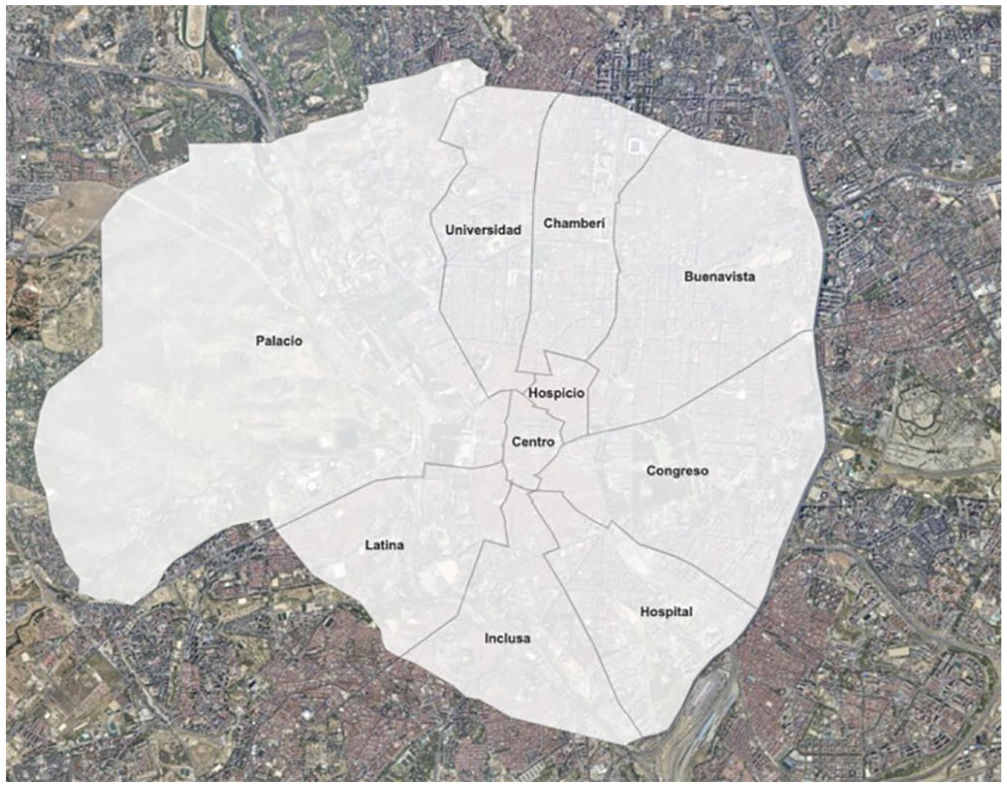
Distribution of urban areas and municipal districts in Madrid.
Although the inner-city districts played a more important role in the socialist approach under the Second Republic, the weight of the actions in these areas does not compare with those in the expansion area and in outlying areas. As regards the expansion area, the comprehension of the characteristics of its spaces led to an understanding of a crucial problem for the rational expansion of the city, related to the policy followed by the city council in this area after the approval of the 1860 plan. History has shown how expansion policies in Spain were the particular expression of European reflections on the principles of order, rationality, and the sanitation of cities. 30 For Madrid, a conservative ideology and the shaping of a social division of space stood out in the original design, which gave rise to the segregated evolution of its northern, eastern, and southern areas. 31 In their first interventions on the city council, the socialists criticized the repercussions of this urban approach, which was combined with dynamics of spatial occupation differentiated according to the distance to the center, the situation with regard to the main roads coming into the capital, and the level of building development in the districts. 32 However, they also stressed the errors by local authorities in not reclaiming the largest possible proportion of the land that would be affected by the expansion project from the start, through the direct expropriation of what was originally arable land to later address the creation of public roads and open spaces. Instead of this, they expropriated by sector as streets were opened up and built on. This was a policy that made the land that the city council needed to acquire more expensive. The socialists calculated that in 1860, the mass expropriation of the expansion area could have been acquired for some 20 million pesetas, one sixth of the price paid by 1916. 33 Consequently, by that year, 1 million of the 4 million square meters of the surface area of the roads in the expansion area were still not built on, a situation that would not prosper under the dictatorship (Figure 3). By the end of 1926, only 136 of the 347 streets in the expansion area had water hydrants and 65 completely lacked any sewage service. 34

Conditions of urbanization of the expansion area of Madrid (Ensanche de Madrid) in 1926.
In order to pave the way for the complete urbanization of the expansion area, the city council that preceded the Second Republic approved an extraordinary budget of 150 million pesetas. 35 This would be applied from April 1931, through the initiatives of the Delegation for Roads and Works of the City Council of Madrid, headed up by the socialist councilor Manuel Muiño. The figures he offered in his report published at the end of 1933 to refer to the activity of the republican city council reflect the importance given to these works, which could also be deduced from the municipal dossiers on public works. In terms of paving, 146 works were executed for the sum of 6,388,933.73 pesetas, in addition to the installation of 233 electric street lamps (426,312 pesetas) and 2,760 gas street lamps (476,695 pesetas). The reports by the socialist councilor also detailed progress on the earthworks and paving, along with the budgets allocated for the expansion areas (10,740,144.54 pesetas for the north, 8,724,713.39 pesetas for the east, and 6,893,498.40 pesetas for the south). 36
Over and above the expansion areas, the outlying areas concentrated the main urban planning concerns of the socialists. The emergence of slums in these enclaves as from the end of the nineteenth century, through private subdivisions created by informal town planning, fell within an extensive European framework of growth in outlying areas resulting in the proliferation of makeshift settlements (Figure 4). The policies to regularize the situation in these areas, or demolish them due to public stigmatization, 37 took place firstly in cities like Stockholm, Vienna, Berlin, London, and Rome, although the problem regarding their development for local authorities was widespread. 38 Madrid, like Barcelona with the phenomenon of shanty towns, did not escape this dynamic. The engineer Pedro Núñez Granés traced out a plan between 1908 and 1910 to plan out the outlying areas that socialism converted into the flagship of their municipal claims. 39 Their first proposals to mitigate the chaotic occupation of these areas underwent a revision of the city council’s budgets, with a view to allocating annual sums of 1 million pesetas to carry out work in unplanned slums. 40 Their defense of the project by Núñez Granés continued unabated despite the deficiencies that began to be revealed to a number of city planners due to their technical complexity and coupling this with the economic and social transformations of the city. The socialists always vied to activate the plan, considering that it would resolve residential and labor problems in the city. 41 They advocated reducing the price of land plots through the acquisition of the land that made up these areas by the city council to hold it in perpetuity, while structuring proposals to communicate them with those of the rest of the city and establish therein all the useful services for the Future Madrid. 42
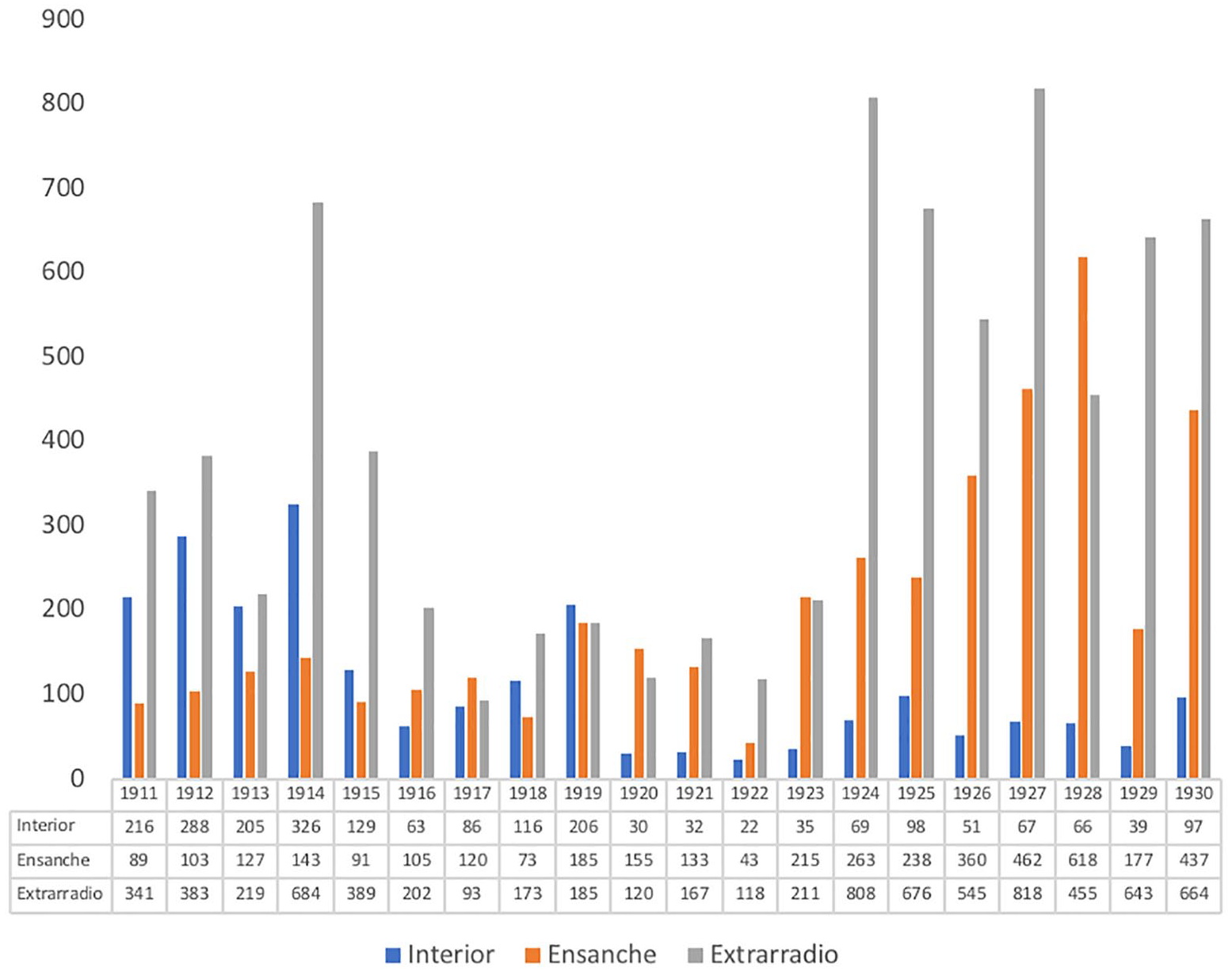
Building licenses granted by the City Council of Madrid according to the urban area (1911-1930).
Against the backdrop of talks on the 1931 Extension Plan, the socialist-run city council assigned a vital role to providing facilities to the outlying areas. As from the start of the new political regime until the end of 1933, they voted in favor of loans amounting to 8.5 million pesetas for works in this area. 43 These included the connection of 112 streets to the sewage network, based on the construction of 33,017.33 meters of new pipes (a good number of them installed in the south of the city, which had worse facilities), the paving of another seventy-two public roads, the creation of a large number of public fountains and water hydrants, and the introduction of electricity and gas street lighting, which rose by 50 percent. Specifically, they installed 1,131 electric street lights (103,125 pesetas) and 821 gas street lights (172,219 pesetas). This coincided with improvements in communications, with the opening of tramlines and extensions to existing tramlines.
As Vörms pointed out, these works improved the living conditions of the inhabitants of the suburbs. 44 However, the consultation of the dossiers drawn up as the works were carried out shows that they were not simply justified by the boost they would give against a backdrop of high unemployment, backed by the number of preliminary proceedings that residents brought before the city council. These dossiers alluded to the abandoned nature of the upkeep of the streets and the visits by inspectors that the authorities tended to request, almost always in vain. They also stressed the impassable nature of living spaces, the dangers due to a lack of public lighting and the absence of alignments and leveling of public roads and the difficulties in accessing built-up areas which were fundamental to communicate with tramway lines or so that children could get to school safely. There was no lack of calls to the authorities to install water sources, which were key to the course of the daily lives of inhabitants who, to get access to water, had to travel long distances. 45 All these questions allow us to suggest the hypothesis that the socialists developed a social concept of city planning in the outlying areas through actions that fell under the materialization of a community space that they closely adhered to as from the start of the twentieth century.
Finally, it should not be forgotten that the outlook of socialism spread beyond the bounds of the municipal limits. Between 1910 and 1912, they advocated intercommunal cooperation between Madrid and the surrounding villages, which translated into the creation of an association of services in this period. Despite the fact that this ultimately failed, it represented a federative solution comparable with those of London, Berlin, and Paris. 46 By doing this, the city council sought the progress of nearby municipalities as regards community services through joint action. 47 This was an idea that dated back to the origins of the debate on the political construction of Greater Madrid, in connection with that of Greater Paris, 48 with the aim of forging dialogue with the intercommunal trade unions established between the French capital and its outlying areas to manage basic services. 49
Following the association experience, the socialists headed up the proposed annexing of the outlying municipalities of Madrid. They started by viewing this as necessary for certain slums in adjoining municipalities (Puente de Vallecas in Vallecas, to the southeast), echoing the requests from a neighborhood that had its moral and material interests in the capital and that saw its deficiencies in terms of hygiene infrastructure, public education, supplies, and medical care enhanced. 50 Within the framework prior to the Second Republic, the socialists extended this proposal to other municipalities that seemed to unite with Madrid without a solution as to continuity and which had undergone tremendous growth (Figure 5), accompanied by haphazard building on land that had not been subdivided and in streets with a lack of hygiene facilities, water, and a sewage system. 51

Demographic evolution of Madrid’s main neighboring municipalities.
For socialism, the Second Republic marked the ideal context for the possibility of annexing the adjacent villages to Madrid, with a view to finding solutions to these problems. 52 Consultation of municipal files on this matter shows that the annexing was invoked as the recognition of shared interests by adjacent municipalities affected by their possible absorption. Both the socialists of Madrid and the major and councilors of Vallecas, Carabanchel Alto, Carabanchel Bajo, Chamartín de la Rosa, Vicálvaro, and Canillejas considered that coordinated relations would allow these municipalities to have access to schools, water supplies, sewage and fire services in good conditions, markets and good cleaning systems, healthcare, public lighting, and transportation. It is important to mention that the outlying villages more clearly felt the need for the annexing rather than an association, for reasons of use and need. Of use, because it was evident that Madrid exceeded the narrow limits of the context and thus needed an expansion area, which could be achieved by absorbing the villages on its edges. And of need, through the appreciation that this annexation fell under a form of social justice; that is, what the City Council of Madrid should offer to help people in these terms without establishing artificial divisions of municipal citizenship over those people who, while working in the big city, were pushed into the suburbs due to the ebb and flow of the city. 53
Ultimately, the socialists committed to the total, swift, and sustained annexing—due to a policy of the devaluing of the land closest to Madrid, which rose in value in parallel, as a result of the urbanization and the provision of means of communication—over other more distant ones that would help bear the burdens of the necessary expropriations. The socialists thus outlined a line of conceptual design that would finally not take place under the instigating parameters of modernity that they intended to achieve, transmitted from the big city to its adjacent municipalities, and which would end up in a victorious and colonizing concept through the Franco regime. 54
Supplying an Expanding City: The Urban Characterization of the Socialist Policy on Subsistence in Madrid
One of the scenarios where European socialism deployed its most incisive municipal actions was in relation to subsistence. Their first initiatives were defined by social and economic trends, through the creation of dining halls for workers, municipal bakeries and tables regulating meat prices, and the demand for the municipalization of milk and particular markets. 55 These sought to guarantee greater control over food costs (which led to the demand for the creation of local authorities that overrode private interests that led to rising prices), 56 but also to combat fraud and adulteration (as problems stemming from the productive changes that followed the Industrial Revolution). 57
These concerns were also present in the socialist actions of urban Spain as from the end of the nineteenth century. While Bilbao opted for the defense of municipal bakeries and tables regulating meat prices, 58 Madrid sought, first and foremost, better food hygiene, promoting the activities of the Municipal Hygiene Laboratory. Although this center was inaugurated in 1877 to guarantee control over food quality, its influence became more demanding when the socialists were elected to the city council. This was corroborated with increasingly bad practices in the sale and production of bread, milk, and meat. As regards bread, the main problems stemmed from their shipping, lack of weight and adulterations, due to using poor-quality flour and well-water. 59 As regards milk, its “refinement” went beyond making it more watery 60 and showed similarities to the milk seen in Paris and London (with the addition of flour and starch to increase its weight and of antiseptic substances). 61 Finally, the shipment of meat caused problems due to the defective state of hygiene of the offal. 62
For the socialists, the problems in Madrid regarding the control of food quality lay in the absence of something that was already working in other cities (London and Brussels) 63 and had been called for by their political counterparts in Paris 64 : the synergy between the local authorities that should guarantee compliance with provisions on overseeing subsistence and the Municipal Hygiene Laboratory, as the fundamental expert body in complying with these objectives. 65 Through the local councilors, the socialists pressurized to ensure this connection, an action that led to significant progress in the oversight of establishments of basic necessities (Figure 6).

Analyses performed by the Municipal Laboratory at the request of local authorities in Madrid (1901-1908).
The search for food hygiene was combined with the fight for stricter municipal control over the cost of basic products, a policy that became a priority with rising living costs in World War I. Asides from heading up collective action related to price increases of basic necessities, 66 socialism designed municipalization projects applied to previous projects. This thus connected with the inherent purposes of European socialism, particularly visible in the center and north of Italy following the 1903 law that made municipalization effective 67 and explained by the need to offer collective services under good conditions at lower prices. 68 However, municipalization required a legislative framework that did not exist in Spain, where a centralized State model predominated. 69 The attempts made in such products as bread and meat 70 did not prosper after World War I, and nor would they in the Second Republic.
Beyond the interests of these actions and their effectiveness, we should look at the policies which, in terms of subsistence, valued factors strictly related to the urban development of Madrid. To do that, it is useful to look at the initiatives that the socialists proposed regarding the geographic distribution of basic products, both in the city as a whole and in its socio-spatial areas, analyzing its policy on markets.
Recent works have raised the importance of markets in the structuring of European urban areas since the mid-nineteenth century. Guàrdia and Oyón refer to a golden era for covered markets, rolled out at different speeds in Great Britain and France. 71 Initially, Madrid observed suggestions made in this scenario. In 1870, it inaugurated two modern iron structure supply centers: the Mercado de la Cebada to the south of the historic center (the main place for the sale of fruit and vegetables) and the Mercado de los Mostenses (located in the center, specializing in the sale of fish). 72 However, the city was far from having a coherent network of markets at the start of the twentieth century. In the midst of staggering population growth and significant physical expansion, these two centers exhausted its possibilities for development, and were only complemented by another seven sites constructed in Madrid by 1920. Against this backdrop, the city offered a model of centralized markets, inherited from a spatial logic of nineteenthth-century demographic concentration revolving around the historic center and which forgot both the demographic growth of the different neighborhoods located in the expansion area (north, east, and south) and in the northern, eastern, and southern outlying areas and the more densely populated working-class areas of the north and the south of the city. Consequently, Madrid was far from a polycentric and balanced geographic model of markets promoted by administrative competence in other cities, based on proximity and better adapted to urban growth. 73
The socialists were aware of this situation as from the start of their membership of the city council, which can be seen in their complaints about the chaotic organization of the markets. 74 However, as from 1920, they took heed of the socio-spatial disjunction of the city in terms of supplies. They then took over the Delegation for Markets of the city council, from where they pushed through repairs to the Mercados de la Cebada and Mostenses, 75 although it was not only their ambition to reform pre-existing structures. As the years went by, an action plan was designed that committed to new distribution centers in each neighborhood and district, appraising the constraints of urban areas in these provisions and their bulging populations.
In this context, the City Council of Madrid achieved a quorum in relation to the creation of a new and larger central fruit and vegetable market. The 1920 works plan designed by city hall for the transformation of the city did not come about in the end, 76 but understood this need, also justified at the start of the dictatorship. 77 The socialist councilors backed the initiative, advocating its location in the south (which connected with the railway lines where the fruit and vegetables entered the city) taking as a reference the models of internal organization of the central markets of Berlin, Vienna, and Budapest. 78 However, they understood that a true supply policy demanded extending investment correlated with supply and the development toward the construction of markets in working-class slums in such outlying areas as Cuatro Caminos, to the north, and Puente de Segovia, to the south. 79 These socialist proposals were justified by the sudden and steep growth in the population of these enclaves as from the start of the twentieth century (including significant percentages of immigration to the city) 80 and by the way in which claims from residents rose in relation to improving the possibilities of access to basic products. 81
The knowledge that the socialists acquired on the needs of these areas consolidated with the exercise of the office of mayor in some districts. Before the dictatorship, the taking over of this office in Inclusa and Hospital (to the south of the historic center and defined by a strong concentration of the working class) caused an overlap between the interests of a neighborhood that created a civic ethos structured by representation in terms of receiving greater public protection. 82 The exercise of the mayor’s office in another district with a strong working-class undertone to the south (Latina) in the city council that preceded the Second Republic raised awareness of the long journeys that people had to make from their outlying neighborhoods to access basic products. Andrés Saborit, who took on this office, contributed to advocating one of the markets that ended up being built in the Second Republic (Tirso de Molina), in the slum area of Puente de Segovia, and was conceived as the proponent of the urban improvement of an area located at the bottom of the pile in material facilities at an urban level. 83
In this context, and unlike what happened in Berlin, Budapest, and Vienna, 84 Madrid did not have a genuine markets program in terms of more compact urban distribution. This plan became imperative before the Second Republic and, in this regard, it should not be forgotten that the last local authorities of the dictatorship committed to the opening of new central fruit and vegetable, and fish, markets, and the appropriation of extraordinary loans to build five at a district level. 85 All of this was done from the standpoint that Madrid had to get close to the figure of a market for every 25,000 inhabitants, taking the coherent system of Barcelona as a model. 86 However, it would be the city council of the Second Republic and the Delegation for Supplies, held by the socialists in that period, which finally turned these intentions into a reality.
For the district and particular markets, the bases set for socialist municipal action during the Second Republic were distributed along two lines. In those of the districts, the raising or conclusion of those planned during the dictatorship was completed, establishing shipping models and uniform mechanisms of health inspections, administrative intervention, and public weighing. Any installation had to be accompanied by previous studies on the number of stalls allocated to each industry and the collection of street vending, also indicating the most appropriate locations for the installations based on the needs of the people. As regards particular markets, the city council would be guaranteed to intervene, adapting to a model comparable with the district markets and to a location that also fitted in with the requirements of local residents. 87
However, the socialists’ projects on markets in the republican era went beyond those inherited from the dictatorship, under the consideration that the standpoint of local authorities was limited with regard to the supply of different population areas. Despite the construction of markets in Vallehermoso and Torrijos-Pardiñas (areas in the north and northeast designed as from 1928) and Tirso de Molina (southwest area demanded by the socialists on a number of occasions in 1930), a significant deficit of markets continued to exist in increasingly built-up and overcrowded inner-city areas in the southeast and outlying areas. To respond to these deficits, it was conceived that a capital city subsidy granted by the State to the City Council of Madrid would play a decisive role at the end of 1932, which had been argued for in preceding years due to the increased attention of an extraordinary nature by the city council and its intention to emulate the experiences that had been proposed in Great Britain, Italy, Germany, and, above all, France. 88
By employing the capital city subsidy, the socialists drew up proposals regarding the supply centers that Madrid needed. They designed them in inner-city areas (Plaza de Antón Martín, Plaza de Lavapiés, and the district of Hospicio), areas to the west of the middle-class areas that still lacked supply centers (the neighborhood of Argüelles), outlying working-class areas in the southeast (district of Pacífico), and working-class areas to the north and northeast of the outlying areas (streets of López de Hoyos, Bravo Murillo, and the neighborhood of Puente de Ventas). 89 The project combined the pressing need to supply areas with the greatest demographic expansion to the north, east, and southeast of the city with the need to extend the limited attention that areas in the historic center had received in the same scenario, close to particular markets opened as from the second-half of the nineteenth century, but lacking a size and functionality connected to the new times (Figure 7).
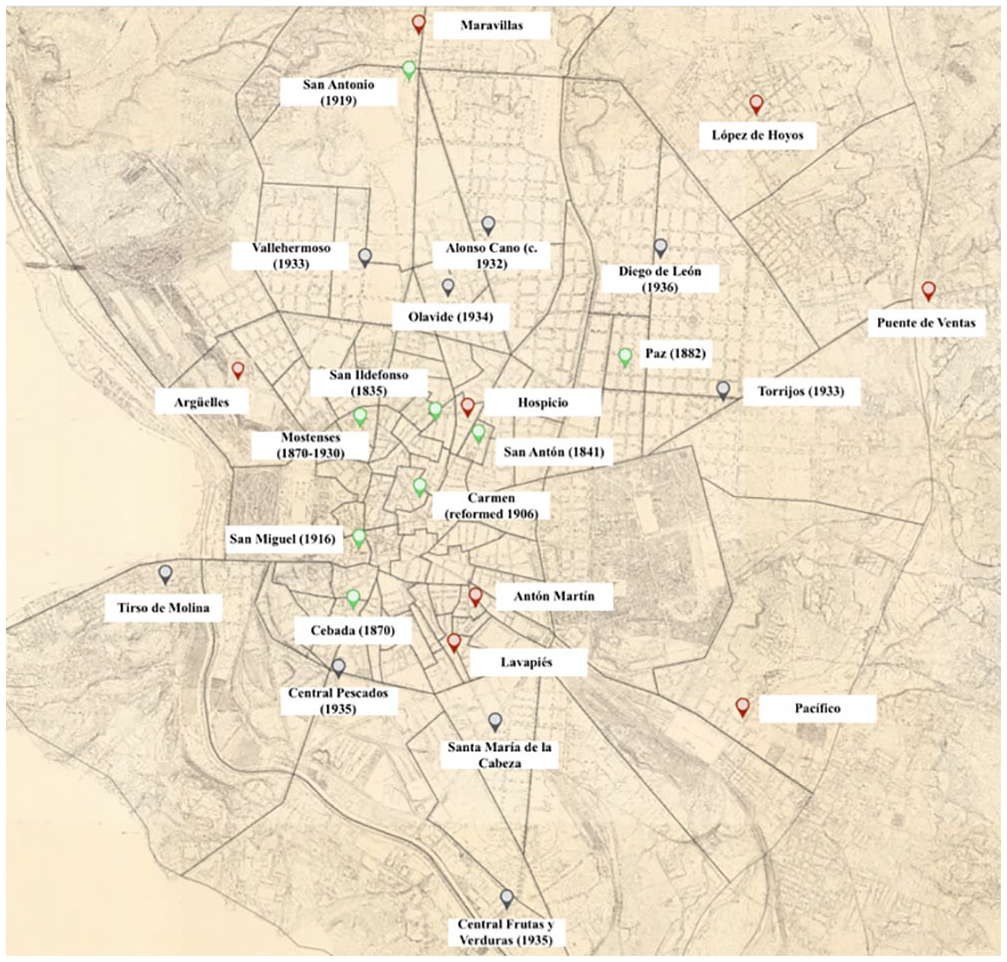
Madrid’s market network during the Second Republic.
Some of the markets proposed by the socialists were planned before the Civil War, such as Maravillas (neighborhood of Cuatro Caminos) and those in the squares of Antón Martín and Lavapiés (southern part of the historic center). Others promoted in this period (López de Hoyos, Puente de Ventas and Pacífico) 90 would be built during the Franco era. The revision of socialist municipal action in this scenario would show how the main aim was to resolve the problems in the distribution system in the different urban areas of Madrid that were not resolved with grocery shops. This is not only reflected by the socialist councilors but also by the technicians that designed the markets inaugurated in the republican era 91 along with the applications sent regarding the opening of markets to the Delegation for Supplies chaired by the socialists by individuals and neighborhood associations. 92 In the case of licenses granted to individuals to build markets, the suitability of the urban area proposed for its location was always assessed. Accordingly, those opened in this period in the northern expansion zone and in the outlying areas to the northeast (Alonso Cano, in the district of Chamberí, and Diego de León, in the neighborhood of Prosperidad) sought to complement the attention these areas received through municipal markets. The markets designed in the southern expansion zone (Santa María de la Cabeza) were specifically planned for the neighborhood which, within this enclave, had recorded greater residential development than in previous years.
However, it should not be forgotten that this socialist policy on markets had the complementary aim of enhancing the facilities in the city; limiting the weight of street vending that was growing each year, which was conceived as distorting the aims of a modern city under the Second Republic. 93 The fact that some of the new markets gave over half of their stalls to street vendors, raised in previous studies regarding the weight of this activity in the neighborhoods where this took place, was no trivial matter. 94 What this reflected was the role assigned to these supply centers in creating the rules for the legitimacy of urban uses 95 and the official intention to create clear boundaries between the act of buying and selling and street culture, following the interpretations of Schmiechen and Carls. 96 The socialists thus connected with the projects that the municipal authorities unsuccessfully presented under the dictatorship to be completed with the haphazard feature of working-class neighborhoods where street vending had a more noteworthy presence and encouraged more fluid pedestrian traffic. 97
The Search for Urban Equality in the Education Policy of the Socialists in Madrid under the Second Republic
Education policy was a priority in the action plans that European socialists developed through the local authorities. While it is true that their first interventions in this scenario focused on works with a significant social content (creation of nurseries, clothing banks, and school canteens), following the ideas of Lefebvre, to the extent that strengthening food and nutrition for children was understood as necessary to prepare the generations that would form the future rank and file of the social revolution. 98 Toward the end of the twentieth century, these initiatives converged with those that the city councils in Marseille and Roubaix oversaw regarding the increase in budgets for public education and to move physiologically weak children to seaside sanatoriums. 99 All without forgetting the programs advocated as applicable in British cities by the Fabian Society with a view to generating progress, coupling the rates of demographic growth with the availability of schools at a socio-spatial level. 100
In the first few decades of the twentieth century, initiatives like school camps took on importance in a framework that correlated an urban approach, public health, and primary education. Their importance was justified by their virtues in promoting the fight against tuberculosis and ensuring that children reduced the stress caused by their constant submission to the collective disciplines of city life. 101 Subsequently, European municipal socialism would create a link between demographic growth in the cities they managed and investment in creating open-air schools, the opening of a large number of classrooms and the creation of schools. These centers were presented as paragons of urban modernity, not just because they appreciated that hygiene-health rules that had not been followed until then were essential inside these centers. In addition, the facilities deployed inside them, aside from the classrooms (canteens, baths-showers, swimming pools, patios, and gardens) sought to convert them into spaces with a language that tied modern architecture in with the wellbeing of pupils. 102
In Madrid, education policy was not a priority for the socialists in their first contact with local authorities. It was not until they joined up with the republicans that they became aware of urban problems regarding public education related to the deficient provision of public schools, their unhygienic nature and their overcrowded installations, the disproportion between the number of pupils and teachers and their deficits in medical exam services, 103 without forgetting teaching methods described as “antediluvian.” 104 Nor could they ignore the fact that the education offer left large urban areas uncovered. Pozo highlights how twenty-nine of the 100 neighborhoods in Madrid lacked a public-school presence in 1912, 105 asserting, like Tiana, that the inhabitants of the city center, who were older, had more schools than the expansion and outlying areas, with younger inhabitants and with a growing demographic trend. 106
When the republicans and socialists were elected to the City Council of Madrid at the same time in 1910, there was no school census, no school colonies that mitigated the hygiene problems of children in working-class neighborhoods and no reorganization plan of primary education that tied in the growing needs in terms of public education with changing urban dynamics. The initiatives in these areas were initially headed up by the republic councilor Joaquín Dicenta, who would propose in 1911 the opening of thirty-seven schools. 107 According to Pozo, this was the first project that tied in urban and educational needs, based on an exhaustive analysis of the realities of the city and of the selection of sites that prioritized more distant parts of the expansion and outlying areas. 108
The city council’s liquidity problems and its dependence on State subsidies for education action limited the effectiveness of this initiative. Of the thirty-seven schools planned in 1911, only two had been built four years later. 109 Madrid increased its provision for schools, but without assessing socio-spatial factors. In 1929, twenty-seven neighborhoods still had no public education and seventeen only had one school classroom. The districts that posed the fewest problems in this regard were the most affluent and those that had seen the smallest growth in population (Centro and Hospicio), finding themselves in the opposite position to the more working-class neighborhoods, increasingly more affected by residential overcrowding (Hospital, Inclusa, and, to a lesser degree, Latina, to the south of the city). Other city boundaries displayed extreme infrastructure realities in terms of education, coinciding with the socio-economic contrasts of the neighborhoods in the districts of Chamberí, Congreso, Universidad, and Buenavista, with quantitative differences in their public-school presence. 110
Accordingly, Madrid suffered a deficit compared with cities where education policy was understood from a rationalized urban perspective. In Lyon, schools were conceived, as from the last quarter of the nineteenth century, as institutions that unified the urban landscape, whereby the choice of the location of schools was an aspect guided by demographic, economic, and social changes in the neighborhoods. 111 In Paris, the first steps of the Third Republic were structured by the will to analyze the school population of each neighborhood in relation to its total population, calculating the maximum distances traveled by pupils to attend school. 112 And in the suburbs of the French capital, the socialist municipal authorities assigned great importance to the installation of schools provided with renewed architectural elements in areas that had a total absence of these provisions, a policy subsequently extended by communist-run local authorities. 113
During the Second Republic, the socialist representation on the City Council of Madrid took control of education actions. Until then, their initiatives in this regard had developed from a secondary position initially compared with the republicans. The election of the councilor Julián Besteiro on the Municipal Board of Primary Education of the city council in World War 1 initiated an approach which combined criticism of the policy of setting up schools in private homes lacking good hygiene conditions with proposals to take culture to working-class children. 114 Their petitions to encourage open-air schools, related to the pedagogic ideals advocated by the Free Education Institution (Institución Libre de Enseñanza) in the last quarter of the nineteenth century and implemented at a European level, 115 included the interest in combining improvements in education with medical intervention at a school level. 116 As from 1920, socialism would fight to boost the regenerating work of children represented through school colonies. 117 The primary aims were to improve organizational practices, ensuring that the criteria to select the colonies depended on the rigorous examination of the socio-economic circumstances of their families. 118 Then, in the Second Republic, these selection patterns would be strengthened and the budgetary items allocated to a form of social existence rolled out in the areas hardest hit by child mortality and tuberculosis expanded. 119
But beyond this, we should look at whether the socialists pushed through, during the context of the relaunch that the Second Republic amounted to for education, 120 a policy which, against this backdrop, connected with socio-geographic factors and the physical transformation of the city. Andrés Saborit, who headed up the Municipal Board of Primary Education between April 1931 and October 1934, participated decisively in drawing up the first school construction plan designed by the city council in 1930. Aside from appreciating the creation of strict statistics on the number of existing schools in Madrid and of a school census organized by neighborhood as imperative, he set up a special commission tasked with studying the distribution of 10 million pesetas proposed as necessary under the concept of attention for primary education. Within the framework of discussions on this plan, the socio-geographic factor was evaluated in regard to the future education policy. Of the twenty education centers proposed in December 1930, ten were defined as “urgent.” These were proposed for outlying areas inhabited by working-class families with a few qualifications that had grown significantly in the preceding decade (slums of Puente de Segovia and Pacífico in the south and Prosperidad and Guindalera in the northeast); in areas characterized by a working-class social landscape (in areas that were not affluent and with few urban facilities in the southern expansion area and enclaves to the south of the historical center) and on land lacking in the most basic signs of urbanization to the north (neighborhood of Bellas Vistas) and to the west and southwest (slums of Casa de Campo and San Isidro). 121
After the proclamation of the Second Republic, Saborit would propose the need to open 200 schools in Madrid, 122 a target that required the combined action of the State and the city council, but also in close collaboration between the latter and numerous social, economic, and administrative stakeholders. Firstly, the refurbishment of premises for the installation of new classrooms required a detailed study of all the municipal school buildings where the number of classrooms could be increased, the management of the rent of premises with owners of urban estates that met the conditions for the interests of teaching or obliging them to improve areas they had rented out in the period prior to the Second Republic to open schools. 123 Secondly, it was necessary to establish initial contact with the urban policy agents of the districts of Madrid (with a view to elaborating statistics that not only included the number of schools per district and nationally, but also religious schools and those maintained by political, cultural, and private centers, determining their characteristics, the number of pupils, candidates registered on the enrolment lists at each school, etc.). 124 Thirdly, it was necessary to forge ongoing dialogue with the mayors of the individual districts, encouraged to gather criteria in their respective jurisdictions on areas that had the right conditions to build schools or with premises that could be rented out. 125 And finally, the Municipal Board for Primary Education gathered the considerations of the headmasters and teachers at schools in Madrid, asking them for initiatives that fostered progress in both construction and in the creation of school centers, and those of the neighborhoods, which forwarded numerous claims calling for schools to be opened.
Firstly, the letters from headmasters and teachers at schools in Madrid were particularly interesting, as they showed the need to adopt an urban vision regarding the geographic distribution of these centers. Pilar Huguet, headmistress of a school in the district of Inclusa, pointed out in a letter addressed to the city council in 1931 that her district displayed the greatest educational deficit in the city. She warned of the alarming lack of schools in the Peñuelas slum in the southern expansion area, with a wholly working-class social composition and frequently categorized as forgotten by the municipal authorities. This enclave only had one school at that time, despite a population increase of 100 percent in some of its main streets and that the schools located in the adjacent neighborhood (Gasómetro) had lists of more than three hundred candidates for school enrolment. Other headmasters and teachers at schools in Madrid quoted the lack of education cover in the districts of Hospital and Latina, with similar socio-economic characteristics to Inclusa, although they were the most mentioned of the above zones of the southern expansion and outlying areas. In parallel, opinions were given that school buildings were “very necessary” in the slums of Cuatro Caminos and Bellas Vistas, within the northern outlying area; in Prosperidad and Guindalera, in the suburbs that were growing the most in the eastern expansion area; and in Gutemberg, to the southeast of the city center. 126
The importance that the Municipal Board for Primary Education gave to the search for premises, plots of land, and buildings for the installation of schools that residents pointed to needing a greater focus on education was also striking. This was something that could primarily be seen in the slums in the outlying suburbs to the south (San Isidro, Marqués de Comillas), northeast (Guindalera and Prosperidad), and north (Cuatro Caminos and Bellas Vistas). The claims made by residents of these areas not only stressed the fact that their residential areas lacked education centers where their children could acquire primary education, but also in the long distances, they had to travel to go to the nearest school and in the processes that could be undertaken in their surrounding areas to arrange rentals for education purposes. 127
The comparative study of the location of school centers at a neighborhood level between 1929 and 1935 offers striking clues as to the effectiveness of the urban leveling up in terms of the availability of education infrastructures that the socialist administration of public education sought to achieve (Figures 8 and 9). The installations were very limited in neighborhoods in the more affluent districts in the first third of the twentieth century (Centro and Hospicio) and very significant in the areas with the worst facilities by the end of this period. Hospital, Inclusa, and Latina saw notable increases in the number of classrooms, albeit at different speeds. The third of these districts was, in 1935, the one that had the highest number of classrooms in the city, thanks to the construction of schools provided with complementary modern installations in the outlying areas (canteens, libraries, showers, workshops, wardrobes, and medical inspection services; Figure 10). This leading position may be associated with greater availability of plots of land for building, a claim that becomes more valid when observing the way in which the districts of Inclusa and Hospital more often opted to extend the number of classrooms in existing schools. However, this representative superiority of Latina could also be understood as the result of the political action developed by Andrés Saborit, who took on the office of mayor in the city council following the dictatorship, developing significant oversight of the education needs of residents and presenting a great many claims regarding the large number of applications for school enrolment that went unattended. 128

Public school facilities in Madrid (1929).

Public schools opened (red) and expanded (green) in Madrid during the Second Republic (1931-1935).

Evolution of public-school classrooms by district in Madrid (1929-1935).
As regards the rest of the city, the socialist policy relating to the city’s educational requirements took on great importance in the neighborhoods of outlying areas in the north and northeast areas (Bellas Vistas, Prosperidad, Guindalera, and Plaza de Toros) and in those areas located bordering the north and east expansion area with the greatest deficits in the number of classrooms (Cuatro Caminos, Hipódromo, and Gutemberg). In these cases, a correlation can be seen between the following three variables: the number of inhabitants in each neighborhood, the population of school age, and the number of classrooms opened during the Second Republic. Based on these figures, a certain coherence existed between the characteristics of the demographic evolution recorded in the neighborhoods of Madrid and the education facilities they obtained (Figure 11 and Table 1).
Neighborhoods with the Largest Increases in the Number of Classrooms (1929-1935).

Source: Boletín Oficial del Ayuntamiento de Madrid, June 10, 1931, 559-60; AM, Relación; JPE, Relación; Del Pozo, Urbanismo (population data for 1929). AM = Ayuntamiento de Madrid; JPE = Junta Municipal de Primera Enseñanza de Madrid.

Neighborhoods with the largest increases in the number of classrooms (1929-1935).
The socialist administration would also stand out for the subsidies granted to private institutions that performed educational functions in the neighborhoods with the fewest schools, although not all the actions were successful. The districts of Hospicio and Centro did not lack schools in quantitative terms, but in qualitative terms. As regards the second district, the visits made to its classrooms by the school doctor inspector Dr Jiménez Quesada in the first few months of the republican period defined them as “genuine incubators of childhood diseases,” due to a lack of ventilation, heating, and auxiliary facilities that complied with the right rules on airspace, hygiene, and cleanliness among pupils (hallways, corridors, cloakrooms, playgrounds, toilets and urinals, showers and wash basins, fountains and even drains). 129 These characteristics also needed to be met in other neighborhoods in the historical center, including those located in the districts of Inclusa, Universidad, and Hospital. 130 This state of things could not be changed suddenly. Despite socialism looking to clean up these centers or close them as new schools were built, the installation of school centers was very complex for topographic reasons or because of the already mentioned lack of available plots of land.
Conclusion
The urban disparities that existed in Europe in the last few decades of the nineteenth century further accelerated in the first third of the twentieth century, visible in the population growth, socio-spatial overcrowding, the diversification of job markets, and the rise in problems associated with hygiene, health conditions, housing, services, infrastructure, and mobility in cities, created the right framework to rethink activity developed by local authorities. The new qualitative realities of cities required responses that would be designed by ideological forces which, as regards the local public sector, created management and administration programs that responded to claims, initiatives, and actions correlated to a social concept of city planning.
At a European level, socialism articulated a municipal movement that would be extended and enriched in its schools of thought and interventions in cities. The struggles focused on the regulation of job markets and attention to the most pressing social and economic claims of the working classes initially justified the same idea of the management of local authorities, pejoratively understood as mere segments of the State apparatus based on access to mayors and councilors. Although these ambitions were not lost with the passing of time, they would become overlapped with other more lasting investments which, within the scope of municipal policy, represented a rapprochement with emerging urban theories understood through the assumption of technical and modern principles.
In the case of Madrid, socialism could not count on politicians truly specialized in the principles that guided modern city planning in the inter-war period, like Henri Sellier and André Morizet. Their role was not as important as that of their European political counterparts as regards the design of urban renewal projects understood through the assimilation of scientific principles, patterns of social zoning and proposals geared to the implementation of extension plans. Nevertheless, the existence of a socialist rapprochement with urban matters and local action tied in to the changing and different realities of cities and their new problems should not be forgotten because of this, which required more proactive interventions from the public authorities. During the learning and assimilation process of the local institutional rulebook, the socialists progressively developed greater awareness as to certain urban dilemmas and evolved toward organic actions regarding cities, resulting from a dynamic comprising observation, claims, practice, and the administration of the community heritage. This was all reflected in such matters as facilities for slums in outlying areas, where socialism had its main support, but also in scenarios in which the capital had suffered from significant difficulties since the start of the nineteenth century (the slow urbanization of neighborhoods in the expansion areas) and on new fronts that tied in with the transformation of Madrid into a large urban agglomeration (with the annexing of adjacent municipalities). As regards policies on subsistence and education, the socialist reflections and actions evolved and were improved, as with the rest of Europe, seeking, in both cases, to achieve a level urban playing field in the provision of infrastructure and facilities that had only been raised in passing before the Second Republic and which, above all, in regard to the case of public education, would be successful in covering certain spatial vacuums. The expansion of the city and its transformations thus gave rise to an urban drive among socialist politicians, committed to an incisive action plan which, despite everything, was frustrated in practice by the limited scope of local finances.
Footnotes
Declaration of Conflicting Interests
The author(s) declared no potential conflicts of interest with respect to the research, authorship, and/or publication of this article.
Funding
The author(s) disclosed receipt of the following financial support for the research, authorship, and/or publication of this article: .This article is framed within the activities of the project entitled “Gobernar la ciudad. La transición urbana como objeto político de los poderes locales en la España Contemporánea (1900-1936)”, of the 2019 call for grants to carry out R&D projects for young PhDs (reference PR65/19-22409). This is an action funded by the Community of Madrid through the multi-year agreement with the Complutense University of Madrid in its line “Programa de estímulo a la investigación de jóvenes doctores” and within the framework of the V PRICIT (V Regional Plan for Scientific Research and Technological Innovation).
