




Abstract
Pakistan’s nuclear assets may be tempting targets for terrorists. Experts are split, however, on the actual threat posed. Some assert that Pakistan’s nuclear assets are on the verge of seizure by terrorists, while others contend that the risk is minimal at best. Because neither side develops robust or holistic threat assessments, however, American decision makers, who wisely include open sources when evaluating possible threats emanating from Pakistan’s nuclear infrastructure, are not adequately informed. Thus, the author maintains that the real threat assessment is yet to be made—one that goes beyond merely considering assumed terrorist capability and putative vulnerabilities.
Pakistan has long been considered a potential source of nuclear weapons for terrorists, even before it had a full-fledged nuclear program and decades before it demonstrated a yield-bearing nuclear explosive capability. In 1976, distressed by the dissemination of nuclear technologies and expertise to “politically unstable countries,” military intelligence historian Roberta Wohlstetter warned that a nuclear-armed Pakistan increased “the probability of terrorist use of nuclear weapons considerably” (Wohlstetter, 1976: 100). Thirty-six years later, an international chorus still warns that Pakistan—presently armed with 90 to 110 nuclear weapons (Kristensen and Norris, 2011)—is the epicenter of violent Islamism where terrorist groups actively seek nuclear weapons. But how real is the risk? Two groups of experts stand on opposite ends of the risk spectrum—these “optimists” and “pessimists” consider valid variables but fail to evaluate all the critical factors necessary for a methodologically robust and defensible threat assessment of Pakistan’s nuclear assets.
The pessimists contend the risk has grown and “the safety and security of nuclear weapons materials in Pakistan may very well be compromised at some point in the future” (Gregory, 2011: 4). Indeed, for almost a decade there have been calls for US contingency plans to destroy, temporarily secure in place, or “exfiltrate” Pakistani nuclear assets—its nuclear weapons and fissile materials—in the event of widespread civil unrest or a governmental coup empowering Islamist forces (Ali, 2007: 9–10; Blair, 2001; Grossman, 2011; Hersh, 2001; Staff, 2009; Wolfsthal, 2001). In contrast, optimists maintain Pakistan’s nuclear weapons infrastructure is secure and the threat posed by terrorists is overblown. Optimists say perceptions of vulnerability do not adequately consider the implementation of various technical precautions and advances in Pakistan’s personnel reliability program (e.g., Luongo and Salik, 2007). For example, optimists emphasize that Pakistan likely maintains its nuclear arsenal in a disassembled state: a bifurcated manner where the weapons’ fissile cores are separated from the non-nuclear components (e.g., firing circuitry and conventional explosives) and delivery platforms (Blair, 2009). Pakistani officials maintain that even during times of crisis, the 2001–2 standoff with India for example, these components are not mated (Lavoy, 2006). When handling components or an intact weapon, Pakistan claims to abide by “two-man” or “three-man” rules “and very tight selection [processes] for vetting personnel involved with nuclear weapons—mirroring in many ways, some believe, the US Personnel Reliability Program” (Blair, 2009: 208). Additionally, they downplay the threat posed by violent Islamists and the risks associated with domestic political instability (e.g., an Islamist coup) (e.g., Ali, 2007). In short, Pakistan’s nuclear assets are either on the brink of successful seizure by terrorists or they are secure. Based on unclassified information, neither the optimists’ nor the pessimists’ positions are defensible—in fact, both positions only review assumed terrorist capabilities and putative vulnerabilities of Pakistan’s nuclear assets.
Today, few assessments consider whether or not relevant Pakistani groups are motivated to attack these assets and what their operational goals might be. 1 Because of these gaps in current threat assessments, no definitive determinations can be made with regard to the security of Pakistan’s nuclear infrastructure (e.g., facilities housing nuclear weapon components, fissile materials, and critical transportation nodes). 2
A holistic threat assessment
Risk assessments typically are comprised of two broad components: chance and consequence.
3
The latter is not relevant here, apart from how the attacker’s perception of consequence management affects his or her motivation and method of attack. Chance is addressed by means of a threat assessment, a process that considers three elements. The first and second are assessments of the value and vulnerability of the asset in question. Likelihood of attack, the third broad element of threat assessment, is dependent on who the attackers might be, their motivations for an attack, and their perceived capabilities. In assessing likelihood of attack, one cannot overemphasize the importance of the attacker’s perception of the target’s value and vulnerability (Ackerman et al., 2007). Figure 1 illustrates these interconnected threat assessment relationships, with the attacker’s perception represented by a dotted line.
Basic threat assessment. Source: Adapted from Ackerman (2007).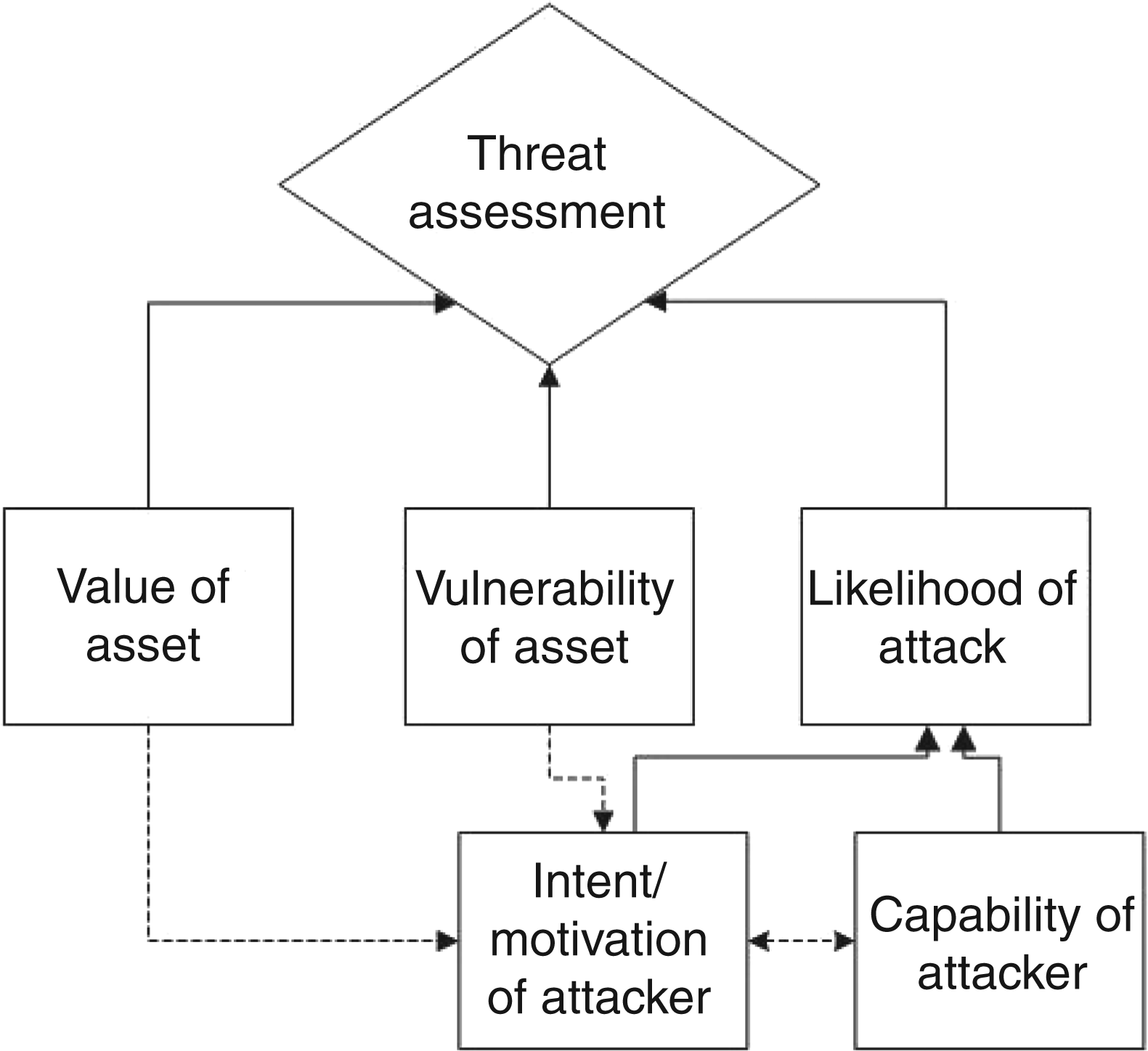
Perceived value and vulnerability of asset
When Wohlstetter cautioned about the dangers of a nuclear Pakistan, she acknowledged “that there has yet been no public indication that terrorist groups are interested” in acquiring nuclear weapons (1976: 100). 4 Little has changed. Today, terrorists’ intentions still go unexplored by experts assessing nuclear security. Intent is largely—and erroneously—treated as solely a derivative of a group’s capability and a given target’s vulnerability.
But if we assume Pakistan’s nuclear assets are at risk, what groups might credibly threaten them? Al Qaeda and the Pakistani Neo-Taliban (PNT) typically generate the most concern (e.g., Gregory, 2009). The former, however, has not yet conducted operationally sophisticated attacks within Pakistan entirely on its own. All of Al Qaeda’s relevant attacks in Pakistan have been closely linked to, if not entirely carried out by, former Kashmiri fighters, foreign jihadists, and tribal militants—all three groups being part of the PNT. 5 Moreover, many analysts believe Al Qaeda is unlikely to credibly threaten Pakistan’s nuclear assets any time soon. In short, if Al Qaeda were to conduct operations aimed at Pakistani nuclear assets, it would have to rely on significant numbers of PNT personnel. Therefore, we shall consider the PNT, specifically its largest and most capable constituent, Tehrik-e-Taliban Pakistan (TTP), “Movement of the Pakistani Taliban,” the most credible threat. The TTP is largely an umbrella organization for dozens of other groups and factions that disagree, often violently, about tactical and, at times, strategic objectives (Blair, 2011).
Although we don’t know the TTP’s perceived value of Pakistan’s nuclear assets, the TTP and its allies likely recognize that both the regional and international security communities view the nation’s nuclear weapons and fissile materials as major elements affecting the region’s geopolitical milieu. In addition to a nuclear asset’s largely tangible value—for example, its role in deterrence, war fighting, etc.—it also has a symbolic value. In the case of Pakistan’s nuclear assets, the former value is determined by the outcome of a successful terrorist attack—one that seizes and removes, or uses in situ, nuclear weapons or materials. 6 In contrast, the latter value allows for suboptimal attack outcomes—for example, thwarted attempts. In this case, the asset’s value is not wholly endogenous; rather, it also has a symbolic meaning. Sometimes even credibly threatening to attack symbolic targets carries perceived benefits to an attacker (Renfroe and Smith, 2010). Thus, when determining the value of a given Pakistani nuclear asset, one must consider how the attacker is likely to define success. Similarly, an asset’s vulnerability relates to both measurable objective qualities and the attacker’s perception of asset security. Generally, attack decisions are not influenced by the defender’s perception of the target’s vulnerability (although insiders may be able to provide this information to the attacker); rather, they reflect the attacker’s perception.
Likelihood of attack: The role of intent and perceived capability
The likelihood of attack is a “subjective equation” (Ackerman et al., 2007: 2) calculated in part through understanding a target’s perceived value—instrumental and symbolic—as well as its perceived vulnerability. Likelihood of attack is also critically shaped by the attacker’s intentions—or motivations—and perceived capabilities. Intention is partially regulated by the attacker’s perception of the target’s value and vulnerability. Additionally, the attacker’s motivations are influenced by three other factors: (1) an ideological agenda, (2) operational objectives, and (3) perceived operational capabilities.
Ideological agenda
Studies in nuclear terrorism reveal a disturbing disregard for the cardinal role of ideology in dictating a group’s likelihood to seek nuclear weapons. At most, widely referenced studies on nuclear terrorism devote a small chapter to general motivation; far more common are a few pages or sentences offering a cursory examination of intent. 7 This is unfortunate, because ideology is likely the strongest factor in determining why a group might choose to pursue a nuclear weapons capability. 8 As terrorist-targeting expert C. J. M. Drake notes, “[T]errorists’ ideology is central … not only because it provides the initial dynamic for the terrorists’ actions, but because it sets out the moral framework within which they operate” (Drake, 1998: 53). A group’s ideology, Drake continues, “is extremely important because [it] identifies the ‘enemies’ of the group by providing a measure against which to assess the ‘innocence’ or ‘guilt’ of people and institutions. This gives rise to the idea that certain people or things are somehow ‘legitimate targets’” (Drake, 1998: 56). Jeffrey Bale, a leading scholar of terrorist ideology, elaborates: “[I]deology is a key—if not the key—behavioral driver of extremist groups. For example, the ideology of certain organizations may explicitly inhibit them, whether for moral or arcane doctrinal reasons, from carrying out attacks that are likely to cause mass, indiscriminate casualties [e.g., nuclear weapon use]” (Bale, 2009: 32). On the other hand, groups that possess an apocalyptic eschatology, seek to serve an otherworldly constituency, or both, may well be drawn to nuclear weapons. As Bale notes, “to the extent that violent extremist groups are absolutely convinced that they are doing God’s bidding, virtually any action that they decide to undertake can be justified, no matter how heinous, since the ‘divine’ ends are thought to justify the means” (Bale and Ackerman, 2005: 29).
Operational objectives
In addition to ideology, a group’s operational objectives are a central element in determining its intent to attack a given asset. These objectives reflect what the group hopes to achieve from an attack. Although other goals may exist, successfully seizing and spiriting away—or using in position—nuclear weapons or fissile materials is arguably the most likely objective of an attack on Pakistan’s nuclear assets. Often left unasked, however, is why a group would seek a nuclear capability. In evaluating terrorists’ adoption of new disruptive technologies, terrorism expert Brian Jackson observes: “Organizations … do not innovate for the sake of innovating. Rather a company or terrorist group will choose to pursue a new piece of technology because of the belief that there is something to be gained by doing so” (Jackson, 2001: 189). “The choice to integrate a new technology into a group’s repertoire and use it in operations instead of currently ‘proven’ methods,” Jackson continues, “entails both the risk inherent in learning a new military technology and the operational risks of failure associated with deploying it” (Jackson, 2001: 193). Unclassified sources lack studies exploring why the TTP would possess operational objectives aimed at acquiring a nuclear capability.
When assuming that groups are predisposed to an assault on Pakistan’s nuclear infrastructure, specifically facilities and platforms perceived to have nuclear weapons, fissile materials, or both, commentators unanimously portray such an attack as having only one objective: the successful seizure or use of nuclear weapons or materials—a largely instrumental attack. However, some experts emphasize that operational objectives can reflect myriad goals—some that may be perceived by observers as less-than-optimal outcomes or even outright failures. These objectives include eliciting a sought-after response from domestic or international authorities, demonstrating the group’s resolve to enemies, rivals, and constituents (especially during times of group factionalization), and, among other possible factors, probing and learning from responses to the attack. 9 It is possible that terrorist groups may attack relevant elements of Pakistan’s nuclear infrastructure believing their attack will fail to acquire nuclear weapons or materials. In such cases, their perception of the target’s vulnerability and instrumental value may not be a decisive component in determining the likelihood of attack.
Perceived operational capabilities
A group’s motivation and likelihood of attack are both influenced by its perceived operational capabilities. If the group’s intention is entirely symbolic rather than instrumental, then belief in moderate operational capabilities may be enough to meet the requirements for an attack. Unless the group’s leadership displays unusually high levels of distorted cognitive and affect-based biases (e.g., the leadership assumes that their “competence is challenged when others criticize their ideas, thus triggering emotional or affective conflict” [Parayitam and Dooley, 2007: 45]), intentions to attain nuclear weapons or fissile materials likely require a perception that the group has high operational capabilities.
An accurate threat assessment of Pakistan’s nuclear materials should measure relevant terrorists’ perceptions of the value and vulnerability of these assets. Critically, terrorists’ motivations—informed by ideology, operational goals, and capabilities—must also be accounted for. Only through such a holistic assessment can the likelihood of an attack aimed at securing or using Pakistan’s nuclear assets be gauged. Unfortunately, extant assessments are fatally uniform regarding the factors they consider and are generally indefensible and incomplete.
Extant threat assessments
Both pessimists and optimists claim an accurate understanding of the threats facing Pakistan’s nuclear infrastructure. However, pessimists typically employ threat assessment methodologies that infer terrorist motivation and capability while assuming that Pakistan’s nuclear-related safeguards mirror that of its other important military assets. Optimists demonstrate flawed methodologies as well. By arguing that Pakistan’s nuclear command and control is assertive and, hence, its arsenal is immune from unauthorized use, and by asserting that Pakistan’s military is largely free from Islamist threat, optimists offer largely artificial and static assessments and may well ignore recent changes.
Pessimists
Threat assessments concluding Pakistan’s nuclear infrastructure is alarmingly insecure typically emphasize three supporting factors. First, observers generally agree that a variety of violent Islamists operating in Pakistan—most notably the TTP—are motivated to acquire a nuclear capability. Groups like the TTP, however, have said little about acquiring nuclear weapons. 10 Consequently, without statements of nuclear intent from indigenous Pakistani violent Islamists, observers often point to declarations linked to Al Qaeda. 11 In addition to well-publicized comments by Osama bin Laden and other top Al Qaeda leaders (e.g., McNerney, 2009), these pronouncements include the May 2003 fatwa (a legally authoritative opinion issued by Islamic religious scholars) delivered by Saudi shaykh Nasir ibn Hamid al-Fahd allowing the use of chemical, biological, radiological, and nuclear (CBRN) weapons (al-Fahd, 2003). 12 The writings of Al Qaeda strategist Abu-Mus’ab al-Suri, moreover, indicate “a clear strategic rationale for the use of weapons of mass destruction by the jihadi movement” (Lia, 2008: 312). In short, since at least 1994, certain jihadist groups, conflated with the TTP, have expressed motivation to acquire CBRN weapons, and, since 2003, such desires have been backed by some religious authorities. 13
Second, pessimists argue the TTP is not only motivated but also increasingly capable of acquiring a nuclear weapon. Such conclusions are drawn from the dramatic increase in terrorist attacks in Pakistan since 2004 (from 150 reported attacks that year to more than 1,300 in 2009) (Blair, 2011). According to observers, the operational sophistication of some attacks—specifically the October 2009 TTP assault on the Pakistan Army General Headquarters in Rawalpindi (“Pakistan’s Pentagon”)—reflect “modalities [that] add up to a virtual blueprint for a successful attack on a nuclear weapons facility” (Gregory, 2011: 6).
Third, commentators warn that critical elements of Pakistan’s nuclear infrastructure are vulnerable to certain types of terrorist attacks. However, unclassified assessments of such vulnerabilities are largely based on conjecture. Perceived insecurities are usually inferred from the following factors:
In short, pessimists assert that groups like the TTP have the motivation, capability, and, because of vulnerabilities, the opportunity to successfully seize or use in situ Pakistani nuclear assets. However, pessimists infer the status of all three factors. Erroneously focusing on Al Qaeda’s intent, these experts leave the TTP’s nuclear aspirations unexplored. In addition, if their goal is to acquire a nuclear capability, no terrorist attack has demonstrated the operational sophistication likely necessary for successful ingress, hold, and egress of nuclear facilities. Finally, pessimists misrepresent alleged Pakistani nuclear infrastructure vulnerabilities by highlighting insecurities of sensitive facilities unrelated to Pakistan’s nuclear assets. Vulnerabilities at some military facilities does not necessarily mean that all nuclear facilities are similarly susceptible to attack. These incomplete and erroneous assessments, however, do little to strengthen those made by optimists, whose conclusions rely equally on inference and otherwise incomplete threat assessments.
Optimists
Interestingly, commentators purporting Pakistan’s nuclear asset security agree with pessimists in two key regards. First, they accept that violent Islamists are motivated to acquire Pakistani nuclear assets. Second, optimists tend to agree that groups such as the TTP display a growing capability to conduct sophisticated operations. It is with perceived asset vulnerabilities that opinions differ:
Optimists argue that, in addition to Pakistan’s command and control arrangements, terrorists’ threats to nuclear assets are minimal because of the professionalism of the Pakistani military and the relatively non-revisionist nature of Pakistan’s Islamist political actors (with regard to foreign relations). However, Pakistan’s nuclear posture is changing into a configuration that embraces war-fighting and predelegation. Centralized control of nuclear weapons is likely to be partial at best, especially in times of crisis. After a half-decade of civil war, Pakistan’s military is beginning to show signs of renewed terrorist collusion, this time with groups that actively oppose the United States and other Western powers. 21
Revisiting value, vulnerability, motivation, and capability
Optimists and pessimists attempt to influence perceptions of Pakistan’s nuclear arsenal. The former endeavor to placate apprehensions about alleged nuclear insecurities; the latter try to alert decision makers to extant and emerging nuclear threats from non-state actors. With no signs of a decline in Pakistan’s civil war, and with the country’s nuclear arsenal rapidly expanding, American decision makers have to consider the security of Pakistan’s nuclear assets. Because neither pessimists nor optimists anchor their assertions to holistic, methodologically robust threat assessments, decision makers who wisely consider unclassified studies are ill-prepared to assess or respond to a Pakistani nuclear terrorism crisis. Relevant US agencies need to allocate greater resources to researchers, analysts, and academics to complete threat assessments of Pakistan’s nuclear infrastructure. The following interrelated areas need exploration:
Pakistan’s domestic stability is likely to continue its downward trajectory. Consequently, American decision makers will increasingly need to assess the threat to Pakistan’s nuclear assets. During a crisis, US reliance on the extant assessments—and their related flawed methodologies—could lead to unnecessary and calamitous overreaction or tragic inaction. The former could result from utilization of the pessimists’ assessments; a conclusion that a “tipping point” of domestic instability requires seizure and possibly exfiltration of Pakistan’s nuclear assets. The latter, a torpid response to dynamic changes in Pakistan’s domestic milieu, could facilitate military collusion with terrorists and a disastrously slow Western reaction to an Islamist seizure of power in Pakistan. Only by means of thorough and robust threat assessments—going beyond the limits of current threat assessments—can American decision makers pursue policies that cogently address the threat posed by Pakistan’s growing nuclear infrastructure.
Footnotes
Acknowledgements
Rebecca A. Remy, an intern at the Federation of American Scientists, provided valuable research.
Funding
This research received no specific grant from any funding agency in the public, commercial, or not-for-profit sectors.
1
Most analysts shy away from looking at motivation because of their perception that it is too complicated a factor to assess. For example, Michael Levy has written, “[p]otential nuclear terrorists are notoriously hard to understand” (Levi, 2007: 11). Levi’s study, On Nuclear Terrorism, devotes only two pages to motivation. Bonnie Jenkins similarly abandons any serious attempt to assess motivation when she notes that, “nonstate armed groups defy easy classification as their characteristics vary along almost every possible dimension: size, structure, ideology, objectives, strategies, and tactics” (Jenkins, 2006: 35). In short, the reluctance of scholars and analysts to assess motivation is the result of their judgment that the “supply side” of the equation—e.g., the number of weapons and stockpiles of fissile materials—is simply far easier to measure than intent (the “demand side”). The author is indebted to Jeffrey Bale for consistently drawing attention to this unfortunate state of affairs.
2
The risks of terrorists sabotaging nuclear power plants and other facilities to release radiation or acquiring radiological materials to create radiological emission or dispersion devices (e.g., so-called “dirty bombs”) will not be discussed.
3
There is no commonly accepted definition of “risk assessment” or “threat assessment.” Useful methodologies, applicable to terrorist threat assessments, include: Eisenhower et al. (2003); Koller (2000); Martz and Johnson (1987); Masse et al. (2007); Monohan et al. (2001); Moteff (2005);  .
.
4
When Wohlstetter composed her essay (May 25, 1975), annual terrorism incidents in Pakistan were roughly 0.5 percent what they were in the United States. For example, from January 1, 1970 through May 24, 1975, the United States had 944 incidents of reported terrorism. During the same time period, Pakistan had four. See the National Consortium for the Study and Response to Terrorism’s (START) Global Terrorism Database. Available at: .
5
Of the 18 attacks in Pakistan reportedly linked to Al Qaeda, six demonstrate somewhat sophisticated operational capabilities. However, Al Qaeda did not claim responsibility for any of the 18 apocryphal attacks (a pattern that would be uncharacteristic of Al Qaeda if, indeed, they were responsible).
6
Using fissile materials in situ accepts the supposition that attackers can create some degree of yield-bearing fission by simply dropping a mass of highly enriched uranium (HEU) on top of another mass of HEU (e.g., the “step-ladder method”). Manhattan Project veteran Luis Alvarez advanced this debatable premise (1987). See also Wald (2002). Compare with .
7
For single cursory chapters dealing with motivation see, for example, Ferguson et al., 2005; Leventhal and Alexander, 1987. As noted, devotes only two pages to motivation (pp. 11–12).
9
The TTP has conducted four attacks near Pakistani facilities that likely house nuclear assets (it has formally claimed responsibility for two of the attacks). Although none of the attacks were likely undertaken with the goal of seizing nuclear weapons or materials, some may have been undertaken to gauge the responsive measures of security personnel. See .
10
One of the few statements indicating motive came in 2008 from Maulana Faqir Mohammed—generally acknowledged to be the TTP’s third in command. Faqir Mohammed reportedly told an interviewer that if “we get hold of nuclear weapons, which we hope to get very soon, then we will safeguard them until Allah Almighty guides us when and against whom to use them.” See .
11
Some journalists and scholars contend the TTP, either in part or in whole, is an army or satellite of Al Qaeda. See, for example, Rashid (2009); Shahzad (2011); Siddique (2008). Compare with .
12
Later in 2003, Shaykh al-Fahd disavowed his earlier statement, noting, “We do not approve of such acts [e.g., nuclear weapon use], which are prohibited.” Al-Fahd’s reversal was widely understood to reflect his coercion by the Saudi Government (McNerney, 2009: 461).
14
15
Experts note: “Pakistan wants to supplement (and perhaps eventually replace) its heavier HEU weapons with smaller, lighter plutonium-based designs that more easily fit on ballistic and cruise missiles” (Kristensen and Norris, 2011: 94).
16
A catalytic nuclear posture is largely political in nature; it is aimed at “catalyzing” a third party into a crisis, either through diplomatic or military intervention. In such a scenario, a more powerful third-party state, concerned by the potential use of nuclear weapons in a regional crisis, intervenes to de-escalate the situation. Prior to dismantling its small nuclear arsenal, South Africa likely embraced a catalytic posture. See Muller (1996); Pabian (1995); Purkitt and Burgess (2005); .
17
Author’s interview, Hans Kristensen, August 24, 2011.
18
Predelegation is a system in which leadership has empowered subordinates to make key decisions if necessary in certain situations. In the nuclear context, this would refer mainly to the weapon’s transport, targeting, and detonation. Seminal works exploring predelegation include Blair (1985), Bracken (1983, 1987), Feaver (1992), and .
19
Predelegation is likely because of Pakistan’s lack of strategic depth; proximity to India is so immediate that nuclear decapitation may be a pervasive threat (although India has a countervalue, as opposed to counterforce, capability). During the Cold War, a Soviet bolt-out-of-the-blue attack on the United States featured attack warnings of 30 minutes or less. In the case of South Asia, a shared border between India and Pakistan leads to attack warnings of around four minutes, even if one assumes the existence of an effective early warning system. For US attack warning times, see Blair (1985: 147–148, especially figure 5-2). For Pakistani warning times see Bowen and Wolvén (: 35, footnote 28).
20
India has a countervalue, as opposed to counterforce, nuclear capability. In short, India’s delivery platforms do not have a narrow enough circle error probability to ensure destruction of Pakistan’s nuclear weapons and its nuclear command and control facilities. Still, it can be argued that Pakistan perceives India has such a capability, one perhaps solely conventional in nature. Author’s interview, Hans Kristensen, August 24, 2011.
21
Pakistan has long relied on violent non-state actors to pursue its foreign policy goals. Traditionally, most of these groups had an anti-India agenda—for example, Lashkar-e-Tayyiba (LeT: Army of the Pure) and Jaysh-e-Muhammed (JeM: Army of Muhammed). Since 2003, Pakistan’s Inter-Services Intelligence Agency has decreased its support for Kashmiri-based jihadists; however, it has likely expanded its cooperation and support of groups opposing US and ISAF forces operating in Afghanistan (Blair, 2011). These latter groups include the Haqqani Network, and those elements of the TTP led by Hafiz Gul Bahadar and Maulavi Nazir (Blair, 2011).
22
For more on the generally conservative nature of terrorists’ adoption of new technologies, see Jenkins (1986) and .
23
There is precedence for such plans. For example, Aum Shinrikyo sought to “trick” the United States into using nuclear weapons against Japan, initiating “World War III” and a “cleansing apocalypse” (Lifton, 1999: 6).