




Abstract
This article proposes two explanations for why public confidence in China’s central authorities has appeared high and stable since the early 1990s. Drawing on interviews with petitioners in Beijing, it argues that trust in the Center is resilient in the sense that individuals who might be expected to lose trust often manage to retain it by redefining what constitutes the Center and what is trustworthy about it. On one hand, they remain confident by excluding authorities they find untrustworthy from the Center. On the other hand, they remain confident in the Center’s commitment even when they no longer trust its capabilities. Drawing on a local survey conducted in 2011, this article suggests that global and generic measures used in national surveys may overstate the amount of public confidence in central authorities by missing two subtle variations. First, people may sound confident about central leaders in general while they only trust one or some leaders. Second, people may sound fully confident about central leaders while they only have partial trust.
National surveys have indicated that popular trust in China’s central authorities has remained high and stable in the past two decades. Tianjian Shi’s (2001: 406) 1993 survey found that 74 percent of respondents strongly agreed or agreed with the statement that “you can generally trust decisions made by the central government.” A few years later, the World Values Survey (2000: V153) and the Asian Barometer Survey (2002: Q008) showed that over 85 percent of Chinese respondents had a great deal or quite a lot of confidence in the central government. More recently, the AsiaBarometer Survey (Inoguchi, 2006: Q29a) found that 85 percent of Chinese respondents trusted “a lot” or trusted “to a degree” that the central government operated in the best interests of society, and the China Survey (2008: b9i) showed that 86 percent of respondents “very much” or “somewhat” trusted central government officials. Similar findings have emerged from local surveys in urban and rural settings (e.g., Chen, 2004; Li, 2004, 2010; Wenfang Tang, 2005; Yang and Tang, 2010).
The observation that popular trust in China’s central authorities remains high and stable poses a potential challenge to theories of political trust. Admittedly, China’s leaders deserve credit for the country’s impressive economic growth, which would be expected to enhance public confidence (e.g., Finkel et al., 1989; Mishler and Rose, 1997; Chanley et al., 2000). But they are also (and probably more) responsible for a wide range of worsening social and political problems which are thought to diminish trust. Above all, corruption has become more widespread and systematic (e.g., Gong, 2002; Manion, 2004; Wedeman, 2005; Guo, 2008), which should weaken trust in the government (e.g., Anderson and Tverdova, 2003; Morris and Klesner, 2010). Meanwhile, income inequality has grown at an alarming rate (e.g., Gustafsson et al., 2008), which would also be expected to erode trust (e.g., Uslaner and Brown, 2005; Anderson and Singer, 2008). Finally, judicial irregularities have become more widespread and egregious (e.g., Lu and Gunnison, 2003; Diamant et al., 2005; Yuen Yuen Tang, 2005), which is likely to undercut confidence in a ruling party that tightly controls the legal system. Why has popular trust in central authorities remained high and stable in spite of all this?
Some analysts might wave away the question on grounds that self-reported trust in central authorities is merely a “response to social pressures and political control” in authoritarian China (e.g., Newton, 2001: 208). Researchers, however, have found little evidence that political caution seriously compromises the validity and reliability of survey data about politically sensitive issues (Shi, 2001: 406–7; Chen, 2004: 34–36; Tsai, 2007: 357). This leaves a number of other possible explanations. Tianjian Shi (2001) argues that traditional cultural values help cultivate trust in the central government by instilling deference to the powerful. Jie Chen (2004) notes that observed confidence in the central government constitutes diffuse system support, which is more stable than performance-based specific trust in the government. Lianjiang Li (2004) suggests that the ruling party’s propaganda shields central leaders from popular discontent by scapegoating local officials for things that go wrong. Zhengxu Wang (2005) contends that strong economic performance delays the emergence of “critical citizens.” John Kennedy (2009) finds that government-controlled education and media can instill belief in the ruling party. Most recently, Qing Yang and Wenfang Tang (2010) observe that trust in the government derives from a positive evaluation of government performance and government-controlled politicization.
In this article, I propose two alternative explanations for high and stable trust. Drawing on interviews with petitioners in Beijing, I argue that trust in the Center is resilient in the sense that individuals who are expected to lose it often manage to retain it. Drawing on a local survey conducted in 2011, I suggest that the amount of trust ordinary people have in the Center may look larger than it is when it is assessed by global and generic survey measures. The article concludes with a discussion of why it is important to refine the measurement of popular trust in China’s central authorities.
The Resilience of Trust
One of the most effective methods for studying the resilience of a physical object is to subject it to increasing pressure until it reaches a breaking point. By scrutinizing when and how something cracks and collapses, we see what makes it robust or fragile. Following this logic, automobile manufacturers conduct crash tests and airplane designers use wind tunnels to examine the sturdiness of their products. Social scientists have also conducted similar experiments. Psychologists, for instance, administer anger tests to explore how to enhance stress management skills (e.g., Kassinove and Tafratreb, 2010). Since they are unable to simulate laboratory conditions for many questions that interest them, political scientists tend to turn to “natural experiments” (e.g., Robinson et al., 2009). They, for instance, analyze a wide range of state failures to explore mechanisms that affect the viability of political systems (e.g., Rotberg, 2002; McFaul and Stoner-Weiss, 2004).
Petitioning in Beijing is a good approximation of a wind tunnel test for resilience of complainants’ trust in the Center. Petitioners typically arrive in the capital with a fair amount of confidence in central authorities. An earlier study showed that among individuals who had visited only sub-national governments, those who had more confidence in the central leadership were more inclined to bring their cases to the capital (Li, 2008: 218–19). Interviews also suggested that first-time petitioners in Beijing tended to believe that central authorities were willing and able to impartially adjudicate their disputes with local officials (e.g. Yu, 2004, 2007; Zhao, 2009). As it unfolds, however, petitioning Beijing is usually full of frustrations. The prescribed method for lodging a complaint, which amounts to simply registering at a petition office, is generally ineffective and can easily become counterproductive. Attempting to petition “more forcefully” by engaging in disruptive activities is subject to punishment ranging from detention to imprisonment (e.g., Minzner, 2006; Yu, 2009; Li et al., forthcoming). Disappointment and agonizing defeats, like a powerful blast in a wind tunnel, often induce petitioners to reflect on their initial confidence in the Center. While some petitioners lose their trust quickly, others manage to hold on to it longer. The process through which petitioners sustain their confidence in central authorities is a telling indicator of what contributes to its resilience.
In order to trace how petitioners manage to retain trust in the Center despite repeated setbacks, over one hundred individuals who had lodged complaints in Beijing were interviewed. 1 Since this research draws primarily on interviews with petitioners who had kept some of their confidence, the analysis below has selected extreme cases on the dependent variable (Collier and Mahoney, 1996) and aims solely to uncover mechanisms of resilience.
Initial Trust in the Center
Petitioners’ initial trust in the Center has two defining features. Most notably, petitioners tend to regard all central authorities as the Center. Unlike citizens of liberal democracies, who have varying degrees of trust in the legislature, the executive, and the judiciary (e.g., Citrin and Muste, 1999), many petitioners regard the Center as a unified, encompassing body, which includes petition offices, ministries, and top leaders. Although they are generally aware that some central authorities are more powerful than others, petitioners regard even the lowest-ranking office as a full and genuine representative of the Center. For example, a Jilin petitioner was thrilled to have “at last found the Center (zhongyang)” when he first saw the gate of the State Bureau of Letters and Visits (Guojia xinfangju, hereafter the SBLV), which is one of the least powerful central agencies (Int. 1; similar remarks were made by Ints. 2, 3, 5, 7, 11, 16, 24, 36, and 44).
The second characteristic of initial trust is that petitioners tend to have confidence in all dimensions of the Center, including its commitment, capacity, fairness, responsiveness, and effectiveness. When a Hebei petitioner made her first visit to Beijing in 1992, she went to the petition offices of the All-China Women’s Federation, the Public Security Ministry, and the National People’s Congress. “At that time,” she recalled in 2007, “I was particularly trusting of the party and the government. After I received letters in reply (huihan) from petition offices of the ministries I visited, I felt as though I had received an imperial edict (shengzhi)” (Int. 2). Similarly, another Hebei petitioner thought he had finally obtained “an imperial sword” (shangfang baojian) when he received a letter in reply from the SBLV in 2000 (Int. 43; similar remarks were made by Ints. 3, 5, 9, 10, 16, 17, and 18).
Having full confidence in all central authorities, many petitioners expect that once they arrive in Beijing they will promptly receive a fair hearing and their grievances will be redressed. As a Jilin petitioner recalled: “Before I came to Beijing, I thought my problem would be resolved as soon as I got here” (Int. 1). A Heilongjiang petitioner also had high expectations. She believed that all central authorities were upright and would impartially adjudicate her dairy farm contract dispute with the Beidahuang Group, formerly Heilongjiang Production and Construction Corps, immediately after she took her petition to Beijing (Int. 3; similar remarks were made by Ints. 5, 16, 18, 21, and 44).
From Full Confidence to Partial Trust
It usually does not take long before petitioners’ trust in the Center starts to fade. Typically this begins with the SBLV, which since its establishment in 2000 has been a common location for initial encounters with the Center. For petitioners, the first sight of the reception hall of the SBLV can be quite discouraging. “My heart sank,” the Jilin petitioner who was excited to make it to the SBLV recalled, “when I saw the huge crowd in the reception hall” (Int. 1). Evidently, he explained, if the SBLV was as helpful and powerful as he had imagined, there should not have been so many people waiting to register their complaints. A Ningxia petitioner was also quick to feel doubt about the SBLV: “The first time I went to the SBLV I saw several policemen beating up a petitioner outside the gate. At that moment I realized that it was hopeless to seek a solution there” (Int. 6).
Despite sobering first encounters, most petitioners do not abandon their confidence in the SBLV immediately. They usually go through three stages in deciding whether it merits their trust. First, they do not question the SBLV until they are certain that it has learned about their cases. Many petitioners spend considerable time and effort trying to inform the SBLV about what has happened to them and what they are demanding. At this stage, the distinction between a general problem and an individual case often helps sustain confidence. Petitioners realize that the SBLV must know about widespread problems such as illegal land appropriation, unlawful demolition of houses, and local corruption. Many of them, however, insist that the SBLV must not truly comprehend their particular grievance because there are so many petitioners and the SBLV is clearly understaffed. A Jilin petitioner, for instance, agreed that the SBLV must know that local officials often colluded with profiteering property developers and that the police were often ordered to drag residents out of their homes so that waiting bulldozers could move in to destroy a house. He insisted, however, that the SBLV had yet to fully understand his case, which he argued should be classified as a “big and important one” (da an yao an). In his telling, the party secretary of his home city took millions of yuan in bribes from a real estate developer. In return, he said, the secretary sold a government compound to the developer at a below-market price. The secretary also allowed the developer to use a plot of 300 mu (about 49 acres) of land reserved for low-income public housing to build luxury apartments. In addition, the secretary turned a blind eye to the businessman’s evasion of tens of million yuan in taxes and his hiring of gangsters to bully local residents (Int. 1). Like this individual, many petitioners insist that the injustice they have suffered is particularly outrageous and deserves special attention. That is why they keep trying to inform the SBLV of the gravity of their case, a process which can go on for days, weeks, or even longer.
Petitioners start to lose confidence in the SBLV’s abilities when they have received the attention they expected, but their problems remain unresolved. Evidence that the SBLV has paid due attention to a case is the issuance of a “letter in reply.” Usually written up by staff members of the SBLV after reviewing petition materials and interviewing petitioners, letters in reply can easily lead petitioners to believe that the SBLV is on their side. But this is by no means always true. For one, lacking power and resources to conduct an independent investigation, SBLV staff typically take no position on the “facts” presented by petitioners. Many petitioners, however, mistake the SBLV’s receipt of a petition as acknowledgment of the validity of their claims. For another, letters in reply typically include a recommendation that local authorities handle a case seriously according to existing law and policies. Feeling absolutely certain that they have been wronged, petitioners often mistake such formalistic suggestions for authoritative “instructions” (pishi) in their favor. For these reasons, petitioners often expect that “imperial edicts” they have received will drive local authorities to right wrongs. Not surprisingly, they are often distressed to see local officials dismiss letters from the SBLV as “waste paper.” A Hunan petitioner, for example, came to Beijing in 2004 and hoped that local officials would “listen to the Center.” When he presented the SBLV’s letter to local officials, however, he was told that it was “less useful than toilet tissue.” At this stage, many petitioners lose their confidence in the SBLV’s capacity. The Hunan petitioner, for example, realized that “the SBLV is only an information agency of the Center and has neither power nor money to solve petitioners’ problems” (Int. 4). Another Hunan petitioner reached a similar conclusion: “Officials at the SBLV are supposed to put out fires, but they have received no fire extinguishers from the Center” (Int. 20; similar observations were made by Ints. 2, 3, 5, 18, 21, 22, and 33).
For some petitioners, losing confidence in the SBLV’s ability spells total disillusionment. For others, however, the distinction between commitment and capacity (e.g., Levi and Stoker, 2000) helps them retain a modicum of trust. They remain confident that the SBLV is willing to help them even when they no longer trust its capacity to do so. Their belief in the commitment of the SBLV is not shaken until they procure evidence that officials there collude with local authorities. In recent years, one of the most devastating discoveries made by petitioners is that some SBLV officials accept bribes from local authorities and then refuse to register petitions or even delete completed petitions from the computerized registration system (see Yu and Li, 2007; also Li et al., forthcoming). Such evidence convinces petitioners that the SBLV is entirely untrustworthy. A Jilin petitioner, for instance, concluded that “the whole petition system is nothing but a protective umbrella for corrupt officials” (Int. 23). A Hubei petitioner called the SBLV “a human meat market,” meaning that officials there practically “sell” petitioners to local authorities for a profit when they take bribes and delete registered petitions (Int. 5). Another Hubei petitioner even called the SBLV “a mafia lair” (heiwo) (Int. 8; similar comments were made by Ints. 9, 24, 25, and 26). For these petitioners, trust in the SBLV has transitioned from nearly complete to nonexistent.
From an Integrated Center to a Handful of Top Leaders
Disillusionment with the SBLV can sometimes destroy petitioners’ trust in the Center. A Hebei petitioner, for instance, concluded that “the Communist Party is corrupt and it is useless to lodge complaints” after being coldly received by an unfriendly staff member of the SBLV (Li, 2004: 245). Most petitioners, however, do not go so far so fast. After all, the SBLV is only a bureau-level agency, which is one rank lower than a ministry. Instead of losing their trust in Beijing completely, petitioners sustain it by excluding the SBLV from the Center (e.g., Ints. 2, 3, 4, 10, 16, and 24).
The process of preserving trust by redefining what constitutes the Center can involve as many as three rounds of elimination. After losing faith in the SBLV, petitioners typically turn to what they call “big ministries” (da bu) as representatives of the Center. Frequently mentioned “big ministries” include the Ministry of Public Security, the Central Organization Department, the Central Disciplinary Inspection Committee, the Central Political-Legal Committee, the Ministry of Construction, the Supreme People’s Court, the Supreme People’s Procuratorate, the National People’s Congress, and the National People’s Political Consultative Conference (Ints. 2, 5, 6, 7, 11, 12, 13, 14, and 15). Like their experiences with the SBLV, petitioners usually proceed through three stages in assessing the trustworthiness of a “big ministry.” They do not question a “big ministry” until they are certain that it has learned of their sufferings and demands; they reflect on their confidence in its capacity after they have drawn its attention; finally, they start to wonder about its commitment to redressing grievances after they have lost confidence in its capability. Since a “big ministry” is far less accessible than the SBLV and facts about it are much harder to come by, it usually takes petitioners longer to descend the ladder from full confidence to total distrust.
Like what occurs with the SBLV, petitioners draw different conclusions when “a big ministry” proves untrustworthy. Some become disillusioned with the Center entirely. A Xinjiang petitioner, for instance, experienced his moment of truth after six years of frustration and defeats:
In 2004 I returned to Beijing again to check the outcome of my petition. The reply I got from the Supreme People’s Procuratorate was that my case was not under its jurisdiction. I despaired. It was then that I started to think about writing [an essay titled] “The Extreme Corruption of the Chinese Communist Party.” I realized that protecting corrupt officials is an organized endeavor rather than an individual activity. Nobody but the Politburo can be the organizer. The anti-corruption effort led by the central leadership is not credible. . . . This regime no longer represents the mass of the people. (Int. 18)
More persistent petitioners, however, do not abandon their trust in the Center even after they have lost confidence in the “big ministries.” As it happens with the SBLV, such petitioners retain their trust by excluding organizations that have disappointed them from the Center. At this point, they typically look to the Politburo Standing Committee as the true Center. A Liaoning petitioner, for instance, went to the National People’s Congress and the National People’s Political Consultative Conference to lodge complaints in 2006. Two years later he decided that both institutions were just “flower vases” (huaping), though the former was a bigger vase because it registered his petition on its computer system, while the latter did not even register his complaint. He then concluded that the Center was just “those nine men” (jiuge ren), that is, the nine members of the Standing Committee of the Politburo (Int. 11; similar comments were made by Ints. 5, 21, 27, and 43).
Petitioners’ confidence becomes largely unfounded when they define the Center as nothing but the “nine men.” Only a handful of daring petitioners still attempt to appeal directly to the Center so defined by trying to intercept cars transporting top leaders. A Henan petitioner, for instance, managed to stop the car of Premier Wen Jiabao on November 27, 2004, to hand over her petition materials (Int. 44). Most petitioners avoid such risky actions. They instead keep mailing their petition materials to top leaders, and they take every opportunity to seek attention from high-profile public intellectuals, who they believe may have access to Zhongnanhai. They meet with foreign journalists, hoping that publicity in the international media may attract attention from top leaders. Petitioners also post their petition cases online, now that Hu Jintao and Wen Jiabao reportedly consult the internet for information about public opinion. In general, though, petitioners rely largely on hearsay to determine whether the most powerful politicians in the country are worthy of their trust.
The third and last round of elimination occurs when petitioners develop doubts about certain members of the Politburo Standing Committee. Yet again petitioners have different reactions at this moment. Some regard the Standing Committee to be united and conclude that if some members are bad then others cannot possibly be good. A Heilongjiang petitioner, for instance, concluded that “all central leaders, including Hu Jintao and Wen Jiabao, care only about themselves and their power. None of them truly cares about the interests of ordinary people” (Int. 3). Other petitioners, however, argue that members of the Standing Committee belong to different factions. A Hunan petitioner, for instance, insisted that Hu Jintao and Wen Jiabao belonged to the same faction and truly wanted to “serve the people.” According to him, the other seven members belonged to the “Shanghai Gang” (Shanghai bang) and were “interested only in gaining power” (Int. 20; similar observations were made by Ints. 27, 28, 29, and 30). For these petitioners, the Center is nothing other than the two most prominent national leaders: the state chairman and the premier. In the words of a Hunan petitioner: “No official can be trusted. Our case can never be solved unless Hu Jintao and Wen Jiabao learn about it and issue an order” (Int. 31).
Petitioners’ step-by-step testing of the trustworthiness of central authorities and their level-by-level elimination of untrustworthy authorities help to account for the resilience of their trust in the Center. Each cycle of testing takes time and effort. Moreover, each round of elimination of untrustworthy authorities prevents petitioners’ trust from falling precipitously at once. It is as if lower-ranking central authorities serve as protective buffers for the top leadership. In addition, after each round of elimination it becomes harder for petitioners to go through the ensuing cycle of testing due to a lack of reliable information. This is particularly true of the critical move from having doubts about the Center’s competence to having doubts about its commitment to help the aggrieved. In the understanding of many petitioners, every time a lower level of central authority proves untrustworthy, it means a loss of capacity for the remaining, more narrowly defined Center they still trust. The suspicion that the Center is losing ground to corrupt officials helps sustain petitioners’ belief that its failure to deliver on its promises is due to a shortage of capability rather than a lack of commitment.
If disaggregating the Center into a hierarchy of authorities allows petitioners to retain confidence despite repeated setbacks, then equating the Center with the top two national leaders can sometimes make trust nearly impregnable. As will be discussed below, once they no longer regard the Center as an institution and conclude that it is nothing but the top two leaders, some petitioners stop examining whether these leaders are trustworthy. Instead, they rationalize their trust.
The State Chairman and the Premier as “Owners of the Country”
For some petitioners, trust in the top two national leaders, the state chairman and the premier, is hardly shakable. They can virtually never be certain that the two leaders have learned about their cases. As long as they hold on to the assumption that the two leaders are kept in the dark by their rivals on the Standing Committee of the Politburo and corrupt underlings, petitioners are unwilling to harbor doubts about the premier and the state chairman. After petitioning Beijing for nine years in vain, for instance, a Jilin petitioner insisted that the state chairman must not know about his case:
Hu Jintao does not really know what is going on down below. His underlings only tell him good news and dare not report the dark side of reality. As regards petitions, they often lie through and through. . . . My case, for example, has long been reported as terminated. (Int. 13)
Yet he remained confident about Hu’s good intentions: “Hu Jintao’s policies are heart-warming. He wants to govern the country by law and demands that everything be done according to the law” (Int. 13). Similarly, a Henan petitioner came to conclude that only Hu Jintao and Wen Jiabao were the Center after twelve years of petitioning Beijing in vain, and insisted that they would certainly want to help him if they learned about his case (Int. 32).
Other than the commonly held belief that the top two leaders are kept in the dark, the distinction between a general problem and an individual case also helps sustain confidence in a highly personalized Center. Some petitioners rightly recognize that Hu and Wen are unable to reign in all corrupt local authorities, but they have no doubt that the two leaders could remove “local emperors” who have mistreated them. A favorite example of this was the dismissal of Chen Liangyu, who was the party secretary of Shanghai and a member of the Politburo before being jailed for corruption (Ints. 11, 13, and 32).
The distinction between commitment and capacity is also at work in sustaining petitioners’ confidence in the top two leaders. When they suspect that Hu and Wen should have learned about their cases but see no sign of intervention, petitioners tend to attribute the leaders’ absence to a lack of capability rather than a lack of commitment. Several petitioners insisted that Hu and Wen must truly want to combat corruption even though they had not done much in that regard. In these petitioners’ eyes, Hu and Wen had yet to take any decisive action because they were outnumbered by the corrupt “Shanghai Gang” on the Standing Committee. A Liaoning petitioner, for example, argued that Hu and Wen had to be very cautious about handling petitions because many cases involve cronies or family members of the powerful Shanghai Gang (Int. 11; similar observations were made by Ints. 2, 3, and 13). A Guangzhou petitioner, who had heard reports about factional struggles in Zhongnanhai from TV stations based in Hong Kong, insisted that Hu Jintao and Wen Jiabao truly wanted to handle petitions according to law but did not have enough power to do so (Int. 34). A Sichuan petitioner made a similar argument, saying that Hu and Wen’s failure to take action against corruption arose because the powerful “political-legal committee system” and the “disciplinary inspection committee system” were in the hands of the Shanghai Gang (Int. 27).
Such speculative and wishful trust derives primarily from three sources. Most clearly, persistent trust in top leaders seems to have its roots in the traditional belief that it is in the emperor’s own interest to take care of his “realm” (tianxia) and “subjects (chenmin). Some petitioners argued that for the top two leaders, whom they saw to be “the owners of the country” (guojia de zhuren), self-interest implied protecting the people’s interests (see Shi, 2001). They were well aware that China was no longer an empire and top leaders were no longer selected by birth. Nevertheless, they contended that once a leader managed to make it to the top he would inevitably undergo a metamorphosis and become an “emperor” (huangdi). A Shandong petitioner, for example, suspected that the top two leaders might have engaged in corruption and office buying in order to climb the official hierarchy. Yet he insisted that they must truly want to clean up corruption because it was in their own interest to prevent predatory local officials from driving people toward rebellion. In his words: “Emperors of all dynasties wanted the country to be prosperous and strong. Only then could they live in peace and enjoy themselves. If there were crises below, they had no peace.” In this sense, he argued, top leaders were like “lotus flowers that grow out of the mud without being tainted” (Int. 16). Similarly, a Liaoning petitioner compared China to a large family and regarded top leaders as patriarchs: “In my opinion, as paramount central leaders, Wen Jiabao and Hu Jintao must want to clean up corruption because they are the heads of a large family” (Int. 11). Several other petitioners used the same metaphor. A Jilin petitioner, for instance, said: “Hu and Wen are good. How could a family head ever want to see his household in chaos?” (Int. 35; similar comments were made by Ints. 29 and 36).
If traditional political culture substantiates a belief in top leaders as “owners of the country,” party indoctrination nourishes this line of thinking (see Kennedy, 2009). Government-controlled media runs a non-stop campaign to glorify top leaders, while tight censorship forbids negative publicity about them and their families. Lacking much information, petitioners construct a view of top leaders based on what they hear about central policies in the media. As a result, many people attribute good intentions to top leaders since they like many central policies. A Shandong petitioner, for instance, argued that “central leaders are the finest men in China because the policies they make are very good indeed” (Int. 16). Similarly, a Hebei petitioner argued that Hu Jintao and Wen Jiabao must want to help petitioners because “the Center has issued many documents in the last few years which show that it is determined to solve our problems” (Int. 29). In the meantime, the party propaganda apparatus attempts to cultivate trust in the Center by blaming local authorities for everything that goes wrong (see Li, 2004). The media’s selective exposure of low-ranking officials may reinforce the myth that beneficent top rulers are undermined by disloyal local agents. The regime’s scapegoating tactics work particularly well on petitioners, many of whom are inclined to have confidence in top leaders, not only in spite of, but also because of their distrust of local authorities. In order to discourage petitioners from going to Beijing, local officials often warn (rather bluntly) petitioners not to believe in what central leaders say because they do not mean it. Petitioners, however, contend that central leaders must be trustworthy exactly because local officials say the opposite. For instance, when a county official advised a Hebei petitioner to stop petitioning Beijing because “Hu and Wen are also corrupt,” the petitioner retorted in disbelief: “I will stop petitioning if I see Chairman Hu and Premier Wen in person and hear them saying that they don’t want to help me” (Int. 29).
Lastly, the authoritarian system in China provides fertile soil for the seed of faith in top leaders to take root and grow (see Cai, 2008). By monopolizing important powers and denying the importance of institutional accountability to the people, top leaders leave the powerless with two choices: believe or despair. For petitioners who feel deeply wronged, losing trust in top leaders means in effect abandoning hope for redress. As a Shandong petitioner admitted, ordinary villagers have no choice but to trust the Center because “if we don’t, we have nothing left” (Int. 16). A Jiangxi petitioner made a similar point: “I trust General Secretary Hu. We common people have neither money nor power. Who can we trust if not him?” (Int. 25). Indeed, for some petitioners trust in top leaders approximates religious faith. A Hainan petitioner, who had petitioned for thirteen years about the alleged murder of her younger brother by township officials, came close to regarding top leaders as her saviors: “I often agonize in the night, but I calm down when I think of Premier Wen” (Int. 28). Similarly, a Henan petitioner was confident that “Chairman Hu is able to solve all problems down below. It’s only that the time is not ripe.” Then she quoted a popular Buddhist saying: “It is not that retribution does not come. It is only that the time has yet to come” (Int. 37). The psychology of these petitioners is reminiscent of individuals who justify systems they feel unable to change (e.g., Jost et al., 2004). For these petitioners, the term “trust” may not apply well in that it implicitly presumes that the trusting and the trusted are fundamentally equal. It is probably more precise to call what these petitioners feel about top leaders political faith (see Field, 1976), which can withstand (and even thrive on) a huge shortfall between what the believers pray for and receive in return. 2
The Magnitude of Trust
The fact that petitioners in Beijing keep adjusting their understandings about what constitutes the Center and what is trustworthy about it helps account for the resilience of their trust. But the same fact also makes it very difficult to assess how much confidence they have. At any given moment, petitioners with varying experiences have significantly different understandings of the Center and its trustworthiness. Moreover, from time to time the same petitioner may considerably change his or her understandings.
As scholars have long noted, measuring political trust involves two major challenges. The first is accurately identifying the object or target of trust, which can be incumbent politicians, government institutions, or political systems (e.g., Easton, 1965: 171–219; Abramson and Finifter, 1981: 298; Craig et al., 1990). 3 Even more challenging is tapping the substance of trust or trustworthiness, which is particularly complicated when it comes to politicians. On one hand, trust in political leaders has multiple dimensions. Citizens may have varying degrees of confidence in a leader’s commitment, capacity, moral integrity, and so on (e.g., Abramson, 1972: 1245; Citrin and Muste, 1999; Levi and Stoker, 2000: 497–98). On the other hand, confidence in a political leader may vary from one domain of an issue to another (Levi and Stoker, 2000: 499). Citizens, for instance, may trust a leader with respect to foreign policy but not regarding domestic issues. Measurement problems crop up when survey items fall short of adequately tapping either the object or the substance of political trust. Global measures of objects and generic indicators of trust, for instance, are thought to have inflated public distrust of the government of the United States, as survey respondents might “express distrust of leaders generally when only certain specific leaders are actually seen as culpable” (Hill, 1981: 258).
Measuring Chinese petitioners’ trust in the Center is difficult because object and substance vary significantly from individual to individual and from time to time. Precise assessment requires specific measures of the Center and its trustworthiness. Measures of trust used in all national surveys are inadequate, as they neither distinguish different levels of central authorities nor identify specific dimensions of trustworthiness. 4 If such measures are applied, both the magnitude and resilience of petitioners’ trust in the Center will be overestimated. A one-time observation will miss the fact that petitioners who appear to have the same level of confidence in the Center have different understandings about what constitutes the Center and what is trustworthy about it. If panel data are collected, such measures miss the fact that some individuals who seem to maintain the same level of confidence in the Center have lost much of their initial trust over time. The problem of “attitude generalization” (Hill, 1981) occurs, but its effect is to magnify measured trust rather than distrust.
The same measurement problem may occur with ordinary people if they share petitioners’ understandings about the Center and its trustworthiness. To test this hypothesis, a pilot survey of 400 villagers was conducted in 2011. 5 To set up a baseline, the pilot survey adopted the measure of trust in central leaders used in the 2008 China Survey. Two sets of new measures were employed to tap the notion of central leaders and the trustworthiness of the state chairman. Bivariate analyses were then conducted to examine whether the general measure of trust in central leaders missed important subtleties. The results are as follows.
High Trust in Central Leaders
The following question was adopted from the China Survey: How much do you trust the following people? Do you (1) trust them very much, (2) trust them somewhat, (3) don’t trust them very much, (4) don’t trust them at all? 6 Three groups of government officials were listed, one of which was “central government officials” (zhongyang lingdao). 7 The measure is global in that it targets broadly defined central leaders. It is generic in that it does not identify dimensions of trustworthiness.
The result of the pilot survey was highly consistent with that of the national survey (see Table 1). In the national survey, 22 percent of respondents declined to answer. 8 Among the 3,112 respondents who offered valid responses, 46 percent trusted central leaders very much, 40 percent trusted somewhat, 10.5 percent did not trust very much, and 3.4 percent did not trust at all. Similarly, 11 percent of respondents in the pilot survey declined to answer. Of the 357 respondents who offered valid responses, 38 percent trusted central leaders very much, 52 percent trusted somewhat, nearly 9 percent did not trust very much, and 1.4 percent did not trust at all. The high degree of consistency offers some assurance that findings of the pilot survey may be generalizable. 9
Frequency Distribution of Trust in Central Leaders
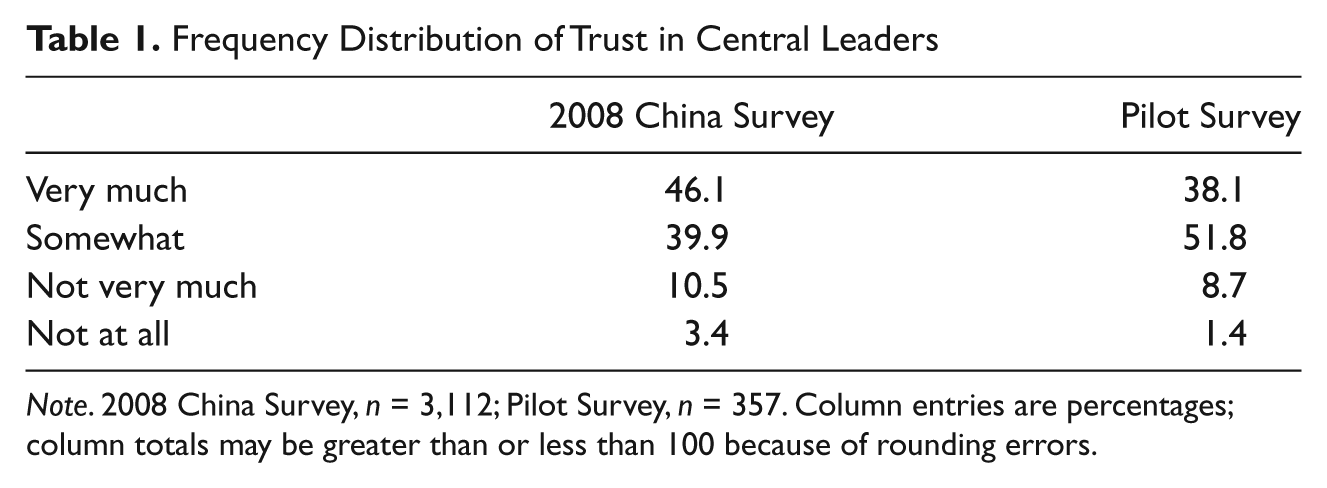
Note. 2008 China Survey, n = 3,112; Pilot Survey, n = 357. Column entries are percentages; column totals may be greater than or less than 100 because of rounding errors.
Varying Notions of Central Leaders
The following question tapped respondents’ notion of who a central leader was: “On a 0 to 10 point scale, to what degree do you think the following cadre counts as a central leader?” 10 Nine central authorities were named one by one: (1) the state chairman, (2) the vice state chairman, (3) the premier of the State Council, (4) the chairman of the National People’s Congress (NPC), (5) the president of the Supreme People’s Court, (6) the minister of Public Security, (7) a secretary (mishu) of the state chairman, (8) the director of the State Bureau of Letters and Visits, and (9) the minister of Civil Affairs.
Who counts as a central leader does vary significantly. About 50 percent of respondents regarded all listed central authorities as “central leaders.” Other respondents, however, regarded higher ranking authorities, for example, the state chairman, as more “central” than lower ranking ones, for example, the minister of Public Security. Respondents’ rankings of the nine listed authorities were summed up as an index, which shows the inclusiveness of their category of central leaders. As Figure 1 shows, the notion of central leaders fell along a wide-ranging continuum. Although most respondents regarded most listed authorities as central leaders to a high degree, it is remarkable that half of the respondents did not regard all listed authorities as fully central leaders. 11
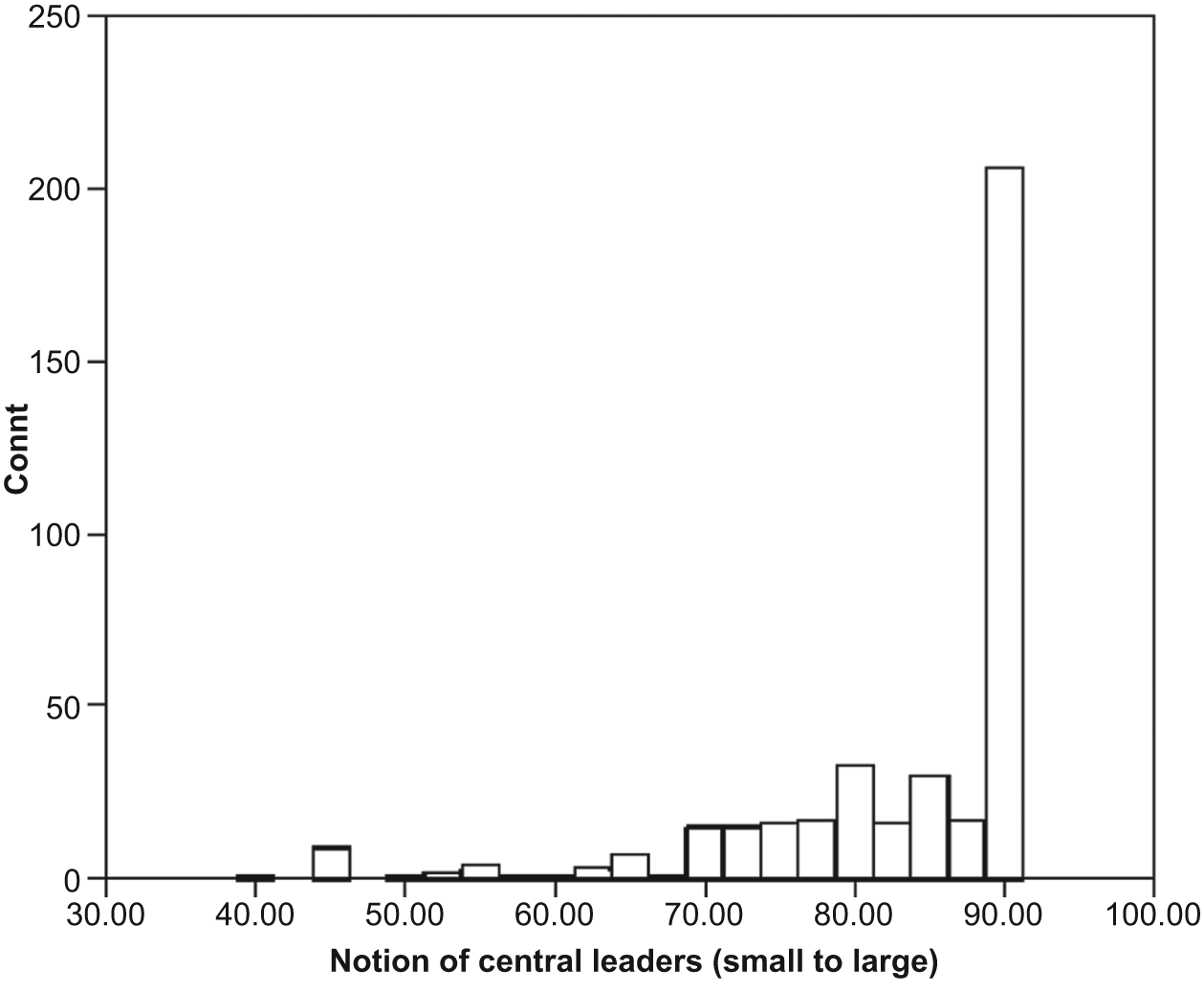
Notion of central leaders
Knowing how people understand “central leaders” helps assess more precisely the amount of confidence they have in central leaders. Bivariate analyses showed that underneath the same answer to the general question about trust in central leaders there was a varying amount of trust. Among the 136 respondents who trusted central leaders very much, 60 percent regarded all listed central authorities as fully central leaders. The other 40 percent, however, had a smaller category of central leaders in mind and had a smaller amount of trust (see Figure 2). The least trusting person in this group regarded the state chairman, the deputy chairman, the premier, and the NPC chairman as fully central leaders, but he thought that other authorities were not central leaders at all. The notion of central leaders also fell along a broad spectrum among respondents who said they somewhat trusted central leaders (Figure 3). These results showed that many ordinary people, just like petitioners in Beijing, appear confident about central leaders in general although they only trusted some leaders. For these people, the general measure magnifies the amount of confidence they have in central leaders.
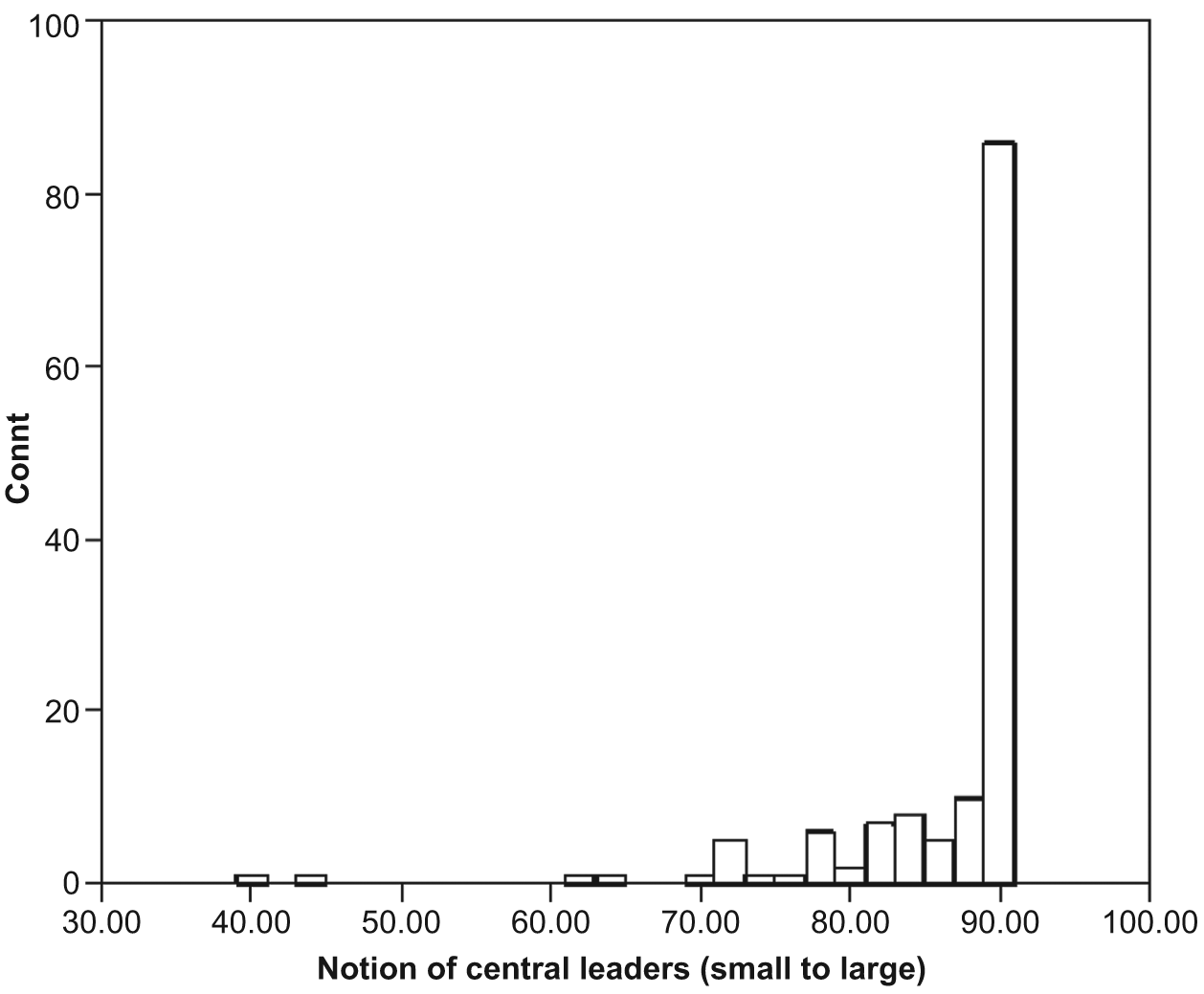
Notion of central leaders among respondents who trusted very much
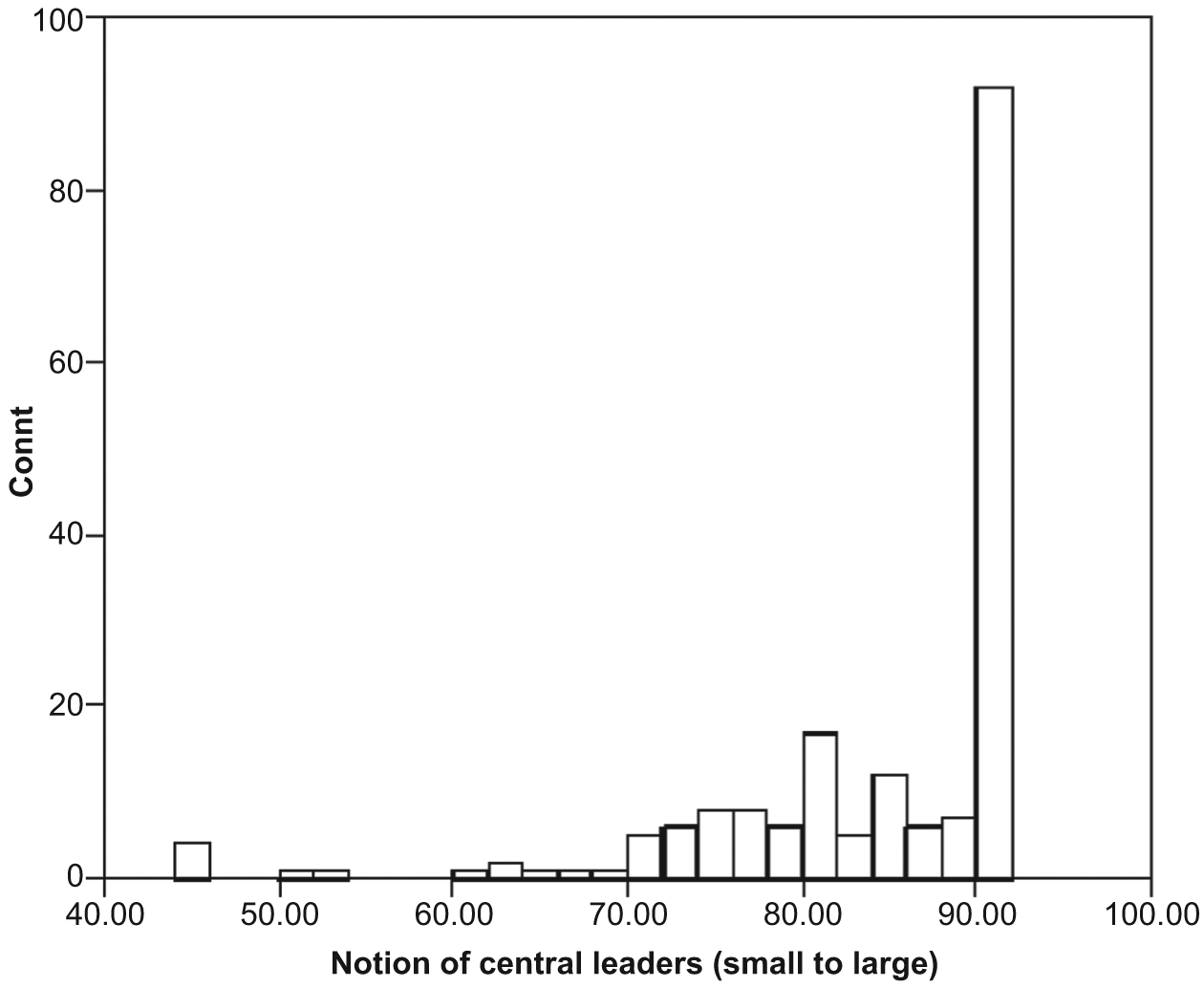
Notion of central leaders among respondents who trusted somewhat
In addition to magnifying the amount of confidence, the global measure of central leaders also overestimates the stability of trust when it is used to collect longitudinal data. Imagine that another wave of the pilot survey is conducted in the same county ten years from now, and imagine further that the general question about trust in central leaders generates the same result. One would be tempted to conclude that public trust in central leaders in this county remains unchanged. In fact, however, significant changes may have taken place. For instance, if by then 30 percent rather than 60 percent of respondents who trust central leaders very much regard all listed authorities as fully central leaders, it would indicate a significant loss of popular trust. Conversely, if by then 90 percent rather than 60 percent of those respondents regard all listed authorities as fully central leaders, it would signify a considerable increase in trust.
Dimensions and Domains of the State Chairman’s Trustworthiness
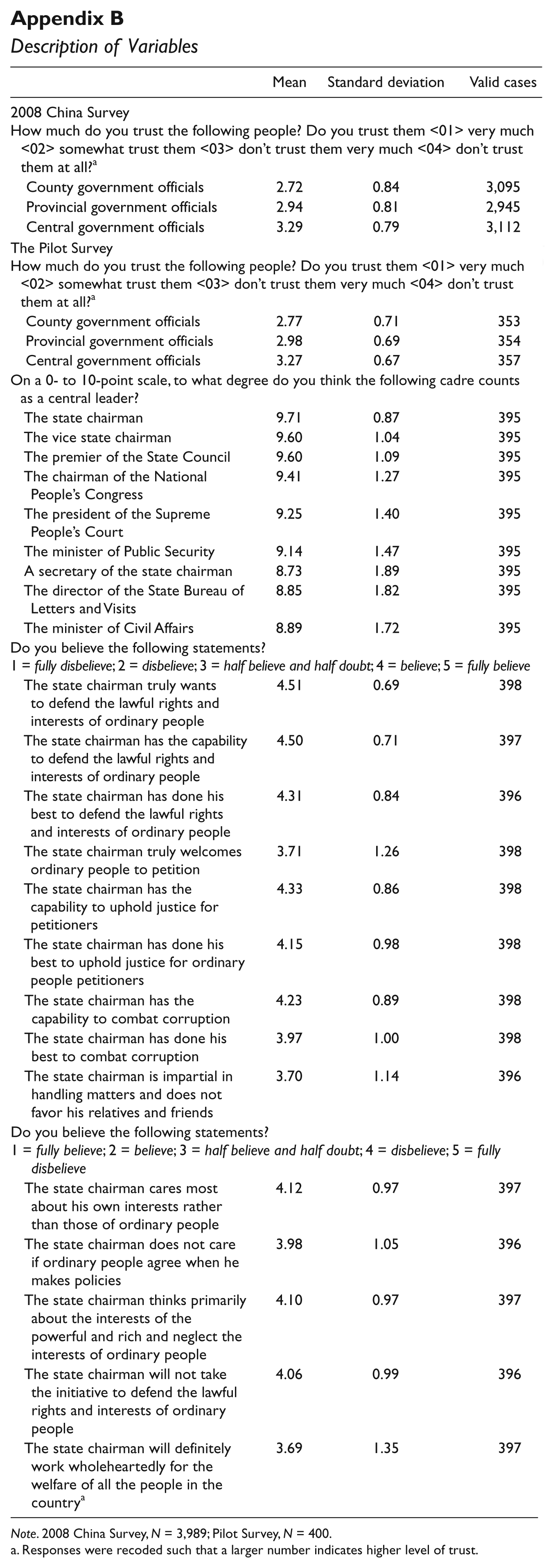
Petitioners, as we have seen, not only have varying levels of trust in different central authorities, they also have different levels of trust concerning different aspects of the same central authority. To see if ordinary people share this pattern of trust, respondents were asked to what extent they believed 14 statements about the state chairman. 12 These statements tap confidence about four major dimensions of trustworthiness: commitment, ability, performance, and integrity. Domains include defending the lawful rights and interests of ordinary people, upholding justice for petitioners, and combating corruption. Means and standard deviations of responses are reported in Appendix B.
Three findings emerged. First, overall trust in the state chairman is high. The chairman received high scores on all 14 indicators, averaging 3.7 out of 5 or higher. Measured by the simple summation index (Cronbach’s α = .85), 13 the state chairman’s average score was 56 on a scale that ranges from 14 to 70, which is equivalent to 75 on a 100-point scale.
Second, respondents had varying degrees of confidence in differing aspects of the state chairman. The dimensionality of trustworthiness was most obvious in regard to handling petitions. The state chairman scored highest (4.33) on having the ability to uphold justice for petitioners, lower (4.16) on having made utmost effort, and lowest (3.71) on sincerely welcoming ordinary people to petition. 14 Furthermore, confidence regarding a given aspect of the state chairman varied considerably across domains. In general, the state chairman received higher scores on issues that involve less conflict between self-interest and the public interest. He scored high (4.51) on truly wanting to defend the lawful rights and interests of ordinary people but significantly lower (3.70) on handling affairs impartially without favoring relatives and friends.
Lastly, and most important, relying on generic measures would have missed important variations in the substance of trust. Among 355 respondents who offered valid responses, 38 percent trusted the state chairman very much, 52 percent trusted him somewhat, 8 percent did not trust him much, and less than 2 percent did not trust him at all. As Figure 4 shows, respondents who trusted the state chairman very much had significantly different understandings about what was trustworthy about him. The total amount of trust varied more widely among those who somewhat trusted the state chairman (Figure 5). 15 Like global measures of central leaders, generic measures of trustworthiness magnify both the amount and stability of popular confidence about the state chairman.
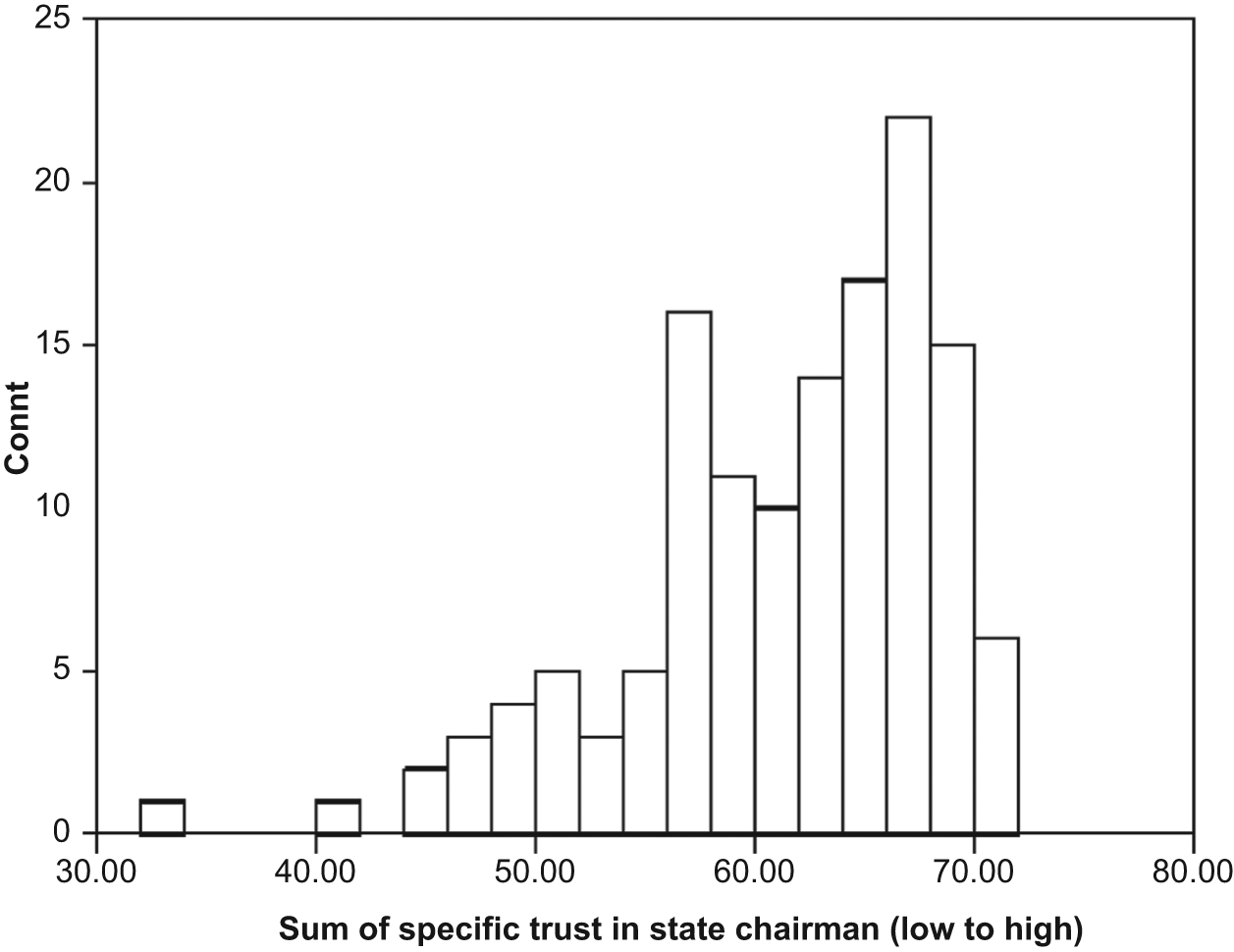
Total amount of trust held by respondents who trusted the state chairman very much
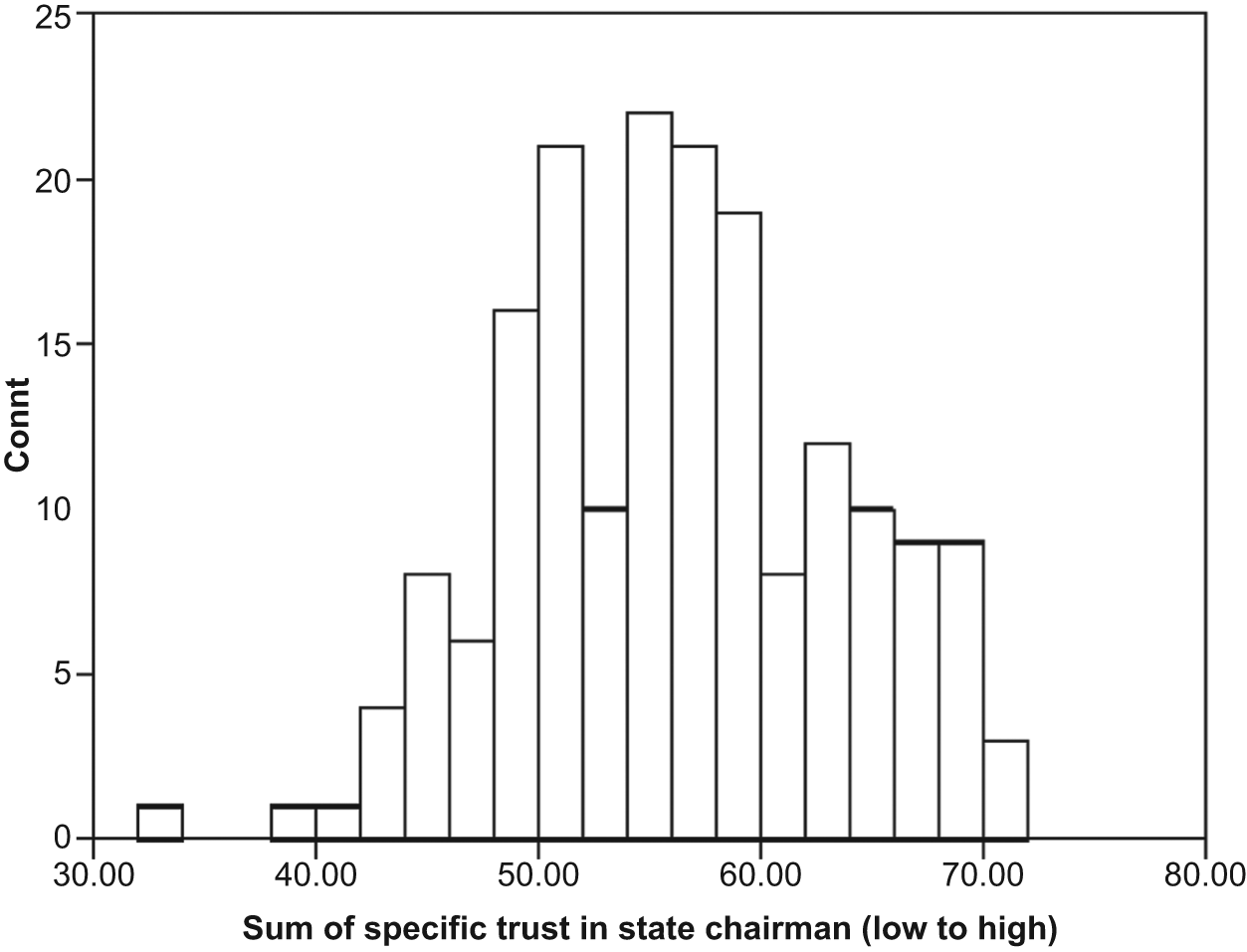
Total amount of trust held by respondents who trusted the state chairman somewhat
The Significance of Trust
It is important to measure trust in the Center more accurately because the magnitude and stability of trust have far-reaching implications. For petitioners, high confidence in central authorities is commonly associated with following prescribed procedures (see Li et al., forthcoming). For the general public, high confidence in central authorities may induce voluntary compliance with laws and regulations (e.g., Scholz and Pinney, 1995; Scholz and Lubell, 1998). Even if they engage in protest, people who trust central authorities may defy local authorities without challenging the central leadership. As a recent study suggests, higher level of trust in the central leadership’s commitment to serve the public interest is associated with stronger rules consciousness, which presupposes an acceptance of the prevailing political order (Li, 2010; also see Perry, 2007, 2008).
Another indicator of its importance is that even partial loss of trust in the Center can have an effect on attitudes and behaviors. Petitioners who have lost confidence in the SBLV, for instance, are more likely to engage in disruptive activities in Beijing. In recent years, disappointed petitioners wearing shirts emblazoned with the oversized character “wronged” (冤), spread leaflets in front of Mao’s portrait at the north end of Tiananmen Square, climbed lamp posts in the square to make a scene, wrote graffiti on walls surrounding government compounds, and even attempted suicide by drinking pesticide or setting themselves on fire (Ints. 2, 3, 5, 19, 20, and 29). 16 Partial loss of confidence in the Center has also resulted in tactical escalation in rural contention (O’Brien and Li, 2006: chap. 4). In 2004, for instance, four disappointed petitioners from Hanyuan county, Sichuan, returned home and organized a large-scale, and ultimately violent, protest that shook the province for several weeks (see Li et al., forthcoming).
Since trust in the top two leaders is most resilient, its collapse would also have the most far-reaching effect. Disillusioned petitioners loathe being cheated. A Shaanxi petitioner and a Jilin petitioner both condemned Hu Jintao and Wen Jiabao for hypocritically deceiving ordinary workers and farmers (Ints. 38 and 39). Three petitioners from Hubei, Henan, and Jilin cursed Hu and Wen for using them to collect information about local authorities and to consolidate power without trying to address their grievances (Ints. 5, 21, 23, and 41). Instead of regarding top leaders as “untainted lotus flowers,” a Hubei petitioner said, “All politicians are fearless and shameless. Hu is one of them and must be especially so, otherwise how can he become the head of dragons?” (Int. 5). One petitioner went beyond grumbling behind closed doors. In a move to embarrass Premier Wen Jiabao, a Heilongjiang woman filed a lawsuit against the State Council in 2003 for taking no action on her petition to the Supreme People’s Court (Int. 3).
When it happens, total disillusionment with the Center often results in despair. Among petitioners, this often leads to turning up the rhetoric of violence, which corroborates the belief that distrust in government is associated with approval of street protest and confrontation (e.g., Gamson, 1968: 48; Aberbach, 1969; Abravanel and Busch, 1975). Some petitioners praised Yang Jia, a young man who killed six police officers in Shanghai in 2008 (see Barboza, 2008), as a hero. During interviews, some petitioners vowed to “take extreme measures” (Int. 20), to “break the law” (Int. 39), “to struggle with my life” (Int. 40), to firebomb county government buildings (Ints. 21 and 5) and county courts (Int. 20), “to kill people if I had a gun” (Int. 26), or even to “learn from Bin Laden” (Int. 24). Some petitioners did indeed take dramatic action. In 2007, a Gansu petitioner firebombed a county government building after failing to gain redress in Beijing. In 2011, a long-time petitioner from Jiangxi set off explosives in several government buildings in his home city, killing himself and wounding a number of other people (Wong, 2011).
It is noteworthy that losing confidence in the Center can also lead to a change in fundamental political beliefs. Some disillusioned petitioners in Beijing condemned “one-party rule” and “the dictatorship of the Communist Party” and demonstrated a fair amount of understanding of how alternative political systems work. A Hebei petitioner, for example, said he liked liberal democracy because the “multiparty system allows competing political parties to supervise each other” (Int. 43; also 41). Some petitioners argued that democracy was more important than economic development. In the words of a Liaoning petitioner: “Without democracy the economy is meaningless no matter how developed it is. It does no good for the government to have missiles and spaceships if it always commits murder and arson” (Int. 11). 17 Disillusionment with the Center, should it spread, may have far-reaching effects. One study, for instance, showed that distrust of the central leadership was associated with stronger demand for leadership change, which in turn was associated with a stronger preference for popular election of the state chairman (Li, 2011).
Conclusion
This article proposes two explanations for why public confidence in China’s central authorities has appeared high and stable since the early 1990s. First, popular trust in the Center is resilient in the sense that individuals who might be expected to lose confidence often manage to retain it by redefining what constitutes the Center and what is trustworthy about it. On one hand, they remain confident by excluding authorities they find untrustworthy from the Center. On the other hand, they retain confidence about the Center’s commitment even when they no longer trust its capabilities. Second, public confidence in central authorities may look higher than it truly is if it is assessed using only global and generic measures. For one, people may sound confident about central leaders in general while they only trust a small number of leaders. For another, people may sound fully confident about central authorities while they only have partial trust. Repeated use of overly general survey questions magnifies the stability of public confidence by missing two kinds of change. One is that people who sound like they have the same level of confidence in the Center may have significantly changed their understandings about what constitutes the Center; the other is that such people may have changed their understandings about what is trustworthy about the Center.
This study highlights the importance of survey measurement by explaining how global and generic measures miss subtle yet significant variations in trust in the Center. For many people, the Center is not a unitary entity but a hierarchy of authorities. Losing confidence in a lower ranking authority does not necessarily bring down confidence in higher ranking ones. At the same time, the substance of trust in the Center has multiple dimensions and varies across domains. Losing confidence on one dimension does not necessarily erode confidence on other dimensions. Furthermore, losing confidence on one dimension regarding one issue does not necessarily reduce confidence on the same dimension regarding another issue.
Public confidence in China’s central authorities is an important source of legitimacy for the regime, and even partial loss of confidence can have far-reaching consequences. This is why survey researchers need to refine existing measurements. Only when sufficiently specific information is collected can researchers assess who tends to trust which authority, on what dimension, and regarding what issue. With more nuanced information, researchers will be better able to examine what affects a specific configuration of trust in the Center and how it may affect political behavior and preferences. Without specific enough information about objects, dimensions, and domains, researchers will continue to base their interpretations of trust on perhaps faulty assumptions of what people have in mind. Any serious mismatch between assumption and reality will inevitably result in imprecise assessment of the amount and stability of popular trust, which in turn may invalidate arguments about its sources and implications.
Footnotes
Appendix A
Appendix
Description of Variables
| Mean | Standard deviation | Valid cases | |
|---|---|---|---|
| 2008 China Survey | |||
| How much do you trust the following people? Do you trust them <01> very much <02> somewhat trust them <03> don’t trust them very much <04> don’t trust them at all? a | |||
| County government officials | 2.72 | 0.84 | 3,095 |
| Provincial government officials | 2.94 | 0.81 | 2,945 |
| Central government officials | 3.29 | 0.79 | 3,112 |
| The Pilot Survey | |||
| How much do you trust the following people? Do you trust them <01> very much <02> somewhat trust them <03> don’t trust them very much <04> don’t trust them at all? a | |||
| County government officials | 2.77 | 0.71 | 353 |
| Provincial government officials | 2.98 | 0.69 | 354 |
| Central government officials | 3.27 | 0.67 | 357 |
| On a 0- to 10-point scale, to what degree do you think the following cadre counts as a central leader? | |||
| The state chairman | 9.71 | 0.87 | 395 |
| The vice state chairman | 9.60 | 1.04 | 395 |
| The premier of the State Council | 9.60 | 1.09 | 395 |
| The chairman of the National People’s Congress | 9.41 | 1.27 | 395 |
| The president of the Supreme People’s Court | 9.25 | 1.40 | 395 |
| The minister of Public Security | 9.14 | 1.47 | 395 |
| A secretary of the state chairman | 8.73 | 1.89 | 395 |
| The director of the State Bureau of Letters and Visits | 8.85 | 1.82 | 395 |
| The minister of Civil Affairs | 8.89 | 1.72 | 395 |
| Do you believe the following statements? | |||
| 1 = fully disbelieve; 2 = disbelieve; 3 = half believe and half doubt; 4 = believe; 5 = fully believe | |||
| The state chairman truly wants to defend the lawful rights and interests of ordinary people | 4.51 | 0.69 | 398 |
| The state chairman has the capability to defend the lawful rights and interests of ordinary people | 4.50 | 0.71 | 397 |
| The state chairman has done his best to defend the lawful rights and interests of ordinary people | 4.31 | 0.84 | 396 |
| The state chairman truly welcomes ordinary people to petition | 3.71 | 1.26 | 398 |
| The state chairman has the capability to uphold justice for petitioners | 4.33 | 0.86 | 398 |
| The state chairman has done his best to uphold justice for ordinary people petitioners | 4.15 | 0.98 | 398 |
| The state chairman has the capability to combat corruption | 4.23 | 0.89 | 398 |
| The state chairman has done his best to combat corruption | 3.97 | 1.00 | 398 |
| The state chairman is impartial in handling matters and does not favor his relatives and friends | 3.70 | 1.14 | 396 |
| Do you believe the following statements? | |||
| 1 = fully believe; 2 = believe; 3 = half believe and half doubt; 4 = disbelieve; 5 = fully disbelieve | |||
| The state chairman cares most about his own interests rather than those of ordinary people | 4.12 | 0.97 | 397 |
| The state chairman does not care if ordinary people agree when he makes policies | 3.98 | 1.05 | 396 |
| The state chairman thinks primarily about the interests of the powerful and rich and neglect the interests of ordinary people | 4.10 | 0.97 | 397 |
| The state chairman will not take the initiative to defend the lawful rights and interests of ordinary people | 4.06 | 0.99 | 396 |
| The state chairman will definitely work wholeheartedly for the welfare of all the people in the country a | 3.69 | 1.35 | 397 |
Note. 2008 China Survey, N = 3,989; Pilot Survey, N = 400.
Responses were recoded such that a larger number indicates higher level of trust.
Acknowledgements
For helpful comments on earlier drafts I would like to thank Kathryn Bernhardt, Richard Gunde, Kent Jennings, Christoph Steinhardt, Ralph Thaxton, Ning Zhang, two anonymous referees, and, especially, Kevin O’Brien. I would like to thank Liang Jun, Liu Mingxing, Mei Donghai, Tao Yu, Wang Jingyao, Yu Jianrong, Zhang Dong, and Zhao Shukai for their assistance with fieldwork.
Declaration of Conflicting Interests
The author(s) declared no potential conflicts of interest with respect to the research, authorship, and/or publication of this article.
Funding
The author(s) disclosed receipt of the following financial support for the research, authorship, and/or publication of this article:
Financial support for this study was provided by the Research Council of Hong Kong Government (CUHK2440/06H and CUHK450111) and the South China Program at the Chinese University of Hong Kong.