



Abstract
This article examines anti-missionary rumors that prevailed in nineteenth-century China and led to the Tianjin Missionary Case of 1870. Relying on archival sources, it shows that many rumors were fueled by Protestant missionaries’ medical practices in addition to political conflicts. Furthermore, the rumors were framed in spatial concepts. The rumors arose and persisted not because the missionaries deliberately hid information, but rather because the visibility of their daily activities, the accessibility of the space they inhabited and practiced in, and the spatial placement of their living quarters contradicted cultural norms in nineteenth-century China and therefore prevented the Chinese from acquiring correct information about the missionaries. The ambiguity of information that caused the rumors was the result of the confrontation between two ways of understanding space.
Wild rumors about Christian missionaries—for example, that they gouged out the eyes of the dying, opened hospitals in order to eat the children admitted as patients, and cut open pregnant women to make medicine from their fetuses—were pervasive in nineteenth-century China and widely believed (Su, 2001; ter Haar, 2006; Li, 2009). 1 Contrary to the opinion that rumor is a temporary phenomenon thriving only in periods of social distress (Knapp, 1944), these rumors were extraordinarily long-lived. In many cases, they directly provoked, preceded, or were otherwise related to “anti-missionary cases.” These anti-missionary cases, which usually involved attacks on missionary stations or churches and the subsequent beating or killing of missionaries, played a significant role in Sino-foreign relations in the latter part of the 1800s (Fairbank, 1957; Cohen, 1963; Lu, 2011).
Scholars have noted that the provision of medical services constituted an important part of Protestant missionaries’ activities in nineteenth-century China (Croizier, 1968; Walls, 1996; Grundmann, 2005; He, 2006; Yang, 2006). Anti-missionary rumors coincided with popular suspicion of medical missionaries, but studies of these rumors have yet to explore how they were related to missionaries’ medical practices. I focus here on the Tianjin Missionary Case of 1870. I choose to focus on this case, from among the huge number of anti-missionary incidents, because it is considered to be one of the most important anti-missionary cases of the late Qing dynasty (Cohen, 1963) and because rumors played a significant role. Besides its prominence, another major reason I concentrate on this case is the basic one of availability of source materials. The investigation of the Tianjin Missionary Case after the incident produced valuable historical documents that allow us to study the historical processes related to rumor production. Although more than eight hundred anti-missionary cases were recorded in nineteenth-century China, this is the only one, among those that were thoroughly investigated, in which the nature of rumors was discussed. 2
While exploring the historical archives, especially those on the Tianjin Missionary Case, I noticed the importance of space and secrecy in the formation of those rumors. To the Chinese, the missionaries’ activities were “evil” because they were “secret,” and they were “secret” because they were conducted in a space that looked secret to the Chinese but not necessarily to the missionaries themselves. This finding from the data pushed me to look more closely at the role of space in rumor production and circulation. I then looked at the missionaries’ side. There is no evidence that the missionaries wanted to appear secretive. But they ended up seeming that way because their understanding of what constituted a secret space was different from that of the Chinese. I also found that the missionaries’ medical practices increased the sense of secrecy of the space they occupied in the community. How different customs involving space generate specific rumors will be the focus of this article. Here, in order to enrich the understanding of the difficulties in communication between China and the West, I apply an analytical approach that derives from the social science literature on rumors and is different from approaches used in existing narratives of this well-known event in late imperial China.
To do this, I draw mainly on English- and Chinese-language archival documents as well as building on existing scholarship. In the discussion that follows, I first provide historical accounts of surgeries performed by Protestant medical missionaries and how they were perceived by local patients, the rise of suspicion of Western medicine, the origination and dissemination of rumors, the Tianjin Missionary Case and the subsequent investigation of it, and the political and cultural conflicts between Westerners and Chinese. After reviewing studies of rumors in other contexts, I then identify and examine the problematic of rumor itself by scrutinizing the spatial aspects of Christian missionaries’ activities.
Historical Context: Medical Missions and the Spread of Eye-Gouging Rumors
Since the beginning of the nineteenth century, Protestant missionaries came to China to evangelize and convert the Chinese to Christianity. 3 However, the Protestant missionaries soon found that the Chinese were extremely resistant to their preaching, so they instead began providing medical services to reduce hostility and to foster friendly contact between themselves and the local people. The Protestant missionaries’ priority was the “saving of souls,” but hospitals and clinics produced more converts than did preaching (Lowe, 1895; Lambuth, 1920; Balme, 1921). Soon Protestant missionaries accepted medical work as the most effective evangelical tool in China (Whyte, 1988: 134). 4 As a result, the number and activities of medical missionaries in China increased significantly. For example, in 1860, there were about 81 Protestant missionaries in China (Cohen, 1963), 36 of whom were medical missionaries. 5 By 1850 there were at least 10 missionary hospitals; by 1889 the number had grown to 61 (Balme, 1921: 85).
The Protestant missionaries’ medical services quickly attracted many patients. For example, in a Shanghai hospital started by William Lockhart, a medical missionary sent to China by the London Missionary Society, there were only two or three patients a day in 1844, the year the hospital opened. But in two years’ time, the total number of patients treated annually at the hospital grew to over ten thousand (Lockhart, 1861: 264). In the early 1860s, medical services became the most visible, most enduring, and most appreciated means of reducing prejudice and disseminating the Gospel at the majority of the Protestant missions (Hood, 1986: 74–84; Kessler, 1996; Brown, 1997: 69–70).
The early Protestant medical missionaries were especially successful in ophthalmic surgery and removing huge external tumors and bladder stones (Wong and Wu, 1936; Choa, 1990). Consequently, the Chinese showed much gratitude for the missionaries’ medical services: The feeling of confidence on the part of the patients is worthy of notice. One of these was reminded shortly before the operation that with all the care that could be taken the result was sometimes fatal—he interrupted the remark by saying, “I have been too long acquainted with you, doctor, have seen too much in this hospital with my own eyes, to require [you] now to inspire my confidence.” The operation was successful, and the man, soon restored to health, returned to his family. His father, who was a learned man, wrote a letter of thanks for the kind treatment of his son, expressing his abundant thanks for favours which he could not recompense. (Lockhart, 1861: 311)
This was typical of stories told by many medical missionaries in different places to show their achievements. Peter Parker, the first full-time American medical missionary to China, constantly mentioned the gratitude shown by the Chinese. According to Parker’s reports, patients presented numerous tablets and poems containing expressions of their gratitude (Parker Hospital Report 11). A merchant who had been operated upon for cataracts stated that he would have Parker’s picture engraved on wood, with writing explaining what Parker had done for him. Many patients wanted to bow before him, touching their foreheads to the floor to show how grateful they were (Parker, 1836). Other medical missionaries reported that their Chinese patients showed their appreciation by sending them little gifts of eggs, tea, cakes, and so on (Schofield and Schofield, 1898: 183).
Despite their initial success in attracting attention and earning the gratitude of the Chinese, the missionaries soon found that their medical practices fed wild rumors against them, no matter how much they denied the accusations (Zinsser, 1940). Their medical practices were often misunderstood by the Chinese, and this only became worse after 1860. The details can be found in numerous anti-missionary pamphlets, which accused Christian missionaries of taking the eyes and the hearts of their Chinese patients for use in medical or alchemical experiments, drugging and raping Chinese women, and giving Chinese women and children anesthetics to poison them (Wang, 1984: 5, 7–10, 21, 158). 6
Eye Surgeries and Eye-Gouging Rumors
One of the most widely circulated rumors was that the Christian missionaries snatched the eyes from their Chinese patients, stored the eyeballs in jars, and hid the jars in church basements. This rumor was broadly believed by the Chinese, who also believed that Westerners found Chinese eyes desirable for various imagined purposes—for example, for their medical power, because they were useful in photography, or because they contained lead, which could be refined to make silver (Wang, 1984: 9). Ter Haar indicates that kidnapping scares—in which fetuses and children were supposedly stolen so that their organs could be used to prepare medicine—were a regular phenomenon in the history of China (2006: 106–8). However, eye gouging was a novel rumor that appeared only in the nineteenth century.
The rumors about eye gouging by Christian missionaries emerged as early as the 1840s. In Haiguo tuzhi (An Illustrated Gazetteer of the Maritime Countries), a popular book written by a well-known Qing dynasty geographer and thinker, an article introducing Christianity claimed that when Chinese converts were sick and dying, Christian missionaries came to take their eyes. Then, when they died, their bodies would be covered with a white cloth to hide the fact that their eyes had been removed (Wei, 1852). In the 1850s, the rumors of Christians gouging out eyes and taking hearts were circulated in southern China, especially in Guangdong and Fujian provinces. The rumors usually went like this: “Christian missionaries eat the dead body. When people are dead, the missionaries take their eyes to extract silver. One hundred taels (liang) of Chinese lead can make eight taels of silver. Only Chinese eyes are usable; Westerners’ eyes are not effective” (Wang, 1984: 154–65). For unknown reasons, it was believed Chinese eyeballs contained lead. In the late 1860s, the circulation of anti-Christian rumors reached a high point. It was not clear whether the distribution of those rumors was organized or random. Paul Cohen (1963) believed that “it was organized in certain instances, spontaneous in others” (224).
It is important to note that although only Protestant missionaries were actively using medicine as an evangelical tool, the medicine practiced provided material for the rumors against all Christian missionaries. That is because the common people of China had not yet learned to distinguish between Protestantism and Catholicism, grouping both under the latter designation (Cohen, 1963: 70). 7
These widely believed rumors about eye gouging coincided with the historical fact that the early hospitals established by Protestant missionaries in China were ophthalmic hospitals (Wong and Wu, 1936: 302–32). For example, Thomas Colledge, a Scottish surgeon who founded the Medical Missionary Society in China, opened a hospital in Macao in 1828 that chiefly treated eye diseases (Wong and Wu, 1936: 308–15). In addition, Peter Parker’s Canton Hospital, opened in 1835, was called the “Ophthalmic Hospital in Canton” and cured many patients with eye diseases (Parker Hospital Reports 1–15). Following the approach of Parker, most Protestant medical missionaries favored the practice of ophthalmic surgery. For example, Benjamin Hobson, a medical missionary sent by the London Missionary Society, reported that patients with eye problems constituted the majority at the Macao Hospital operated by the Medical Missionary Society in China (Hobson, 1844).
Given this preference, it is not surprising that the Protestant medical missionaries treated more cases of eye disease than any other kind of medical problem. During the first three months of his practice at the Ophthalmic Hospital in Canton, Parker treated 1,020 eye cases among the 1,061 patients who visited the hospital; thus, eye cases accounted for about 96 percent of the total cases (Parker Hospital Report 1). In the following years, the Ophthalmic Hospital at Canton continued to specialize in the treatment of eye diseases, especially the removal of cataracts. From July 1, 1845, to December 31, 1847, the hospital treated 7,571 patients. Of these, 5,669 (nearly 75 percent of the total) presented with eye diseases (Parker Hospital Report 14). Eye operations were also a daily practice in other Protestant missionary hospitals. William Lockhart reported that from September 23, 1840, to February 20, 1841, the Chusan hospital, run by the Medical Missionary Society in China, treated 1,554 patients for eye disease, or about 44 percent of the total 3,502 patients (Choa, 1990: 37). This preference for treating eye diseases was true even in hospitals opened by the Chinese with Western doctors. According to an 1886 report by John Kenneth Mackenzie, a British medical missionary sent by the London Missionary Society, 589 surgeries were performed at the Viceroy’s Hospital that year; of those, 212 were eye surgeries. In addition, eye diseases had been the most common type of affliction treated at the institution (Bryson, 1891: 390–95). 8
From the reports of Parker, Lockhart, and others, it was evident that the incidence of eye diseases in China was high: The number of blind people was particularly very great. Some time during the 1830s, it was ascertained that there were about four thousand seven hundred fifty blind people among Canton’s million or million and a half people and this number probably did not include half of those who had diseased eyes. (Parker Hospital Report 4)
Eye problems constituted such a great portion of their cases that medical missionaries often asked why the Chinese suffered so much from diseases of the eye. They blamed it on Chinese medical practitioners’ ignorance of the treatment of eyes: It may be replied that probably the ordinary amount of ophthalmia is not much greater among them than among the people from other countries. . . . However . . . the native surgeons being unable to arrest disease . . . the results of inflammation have seriously affected the state of the organ. (Lockhart, 1861: 250)
Faced with this situation, medical missionaries found an advantage in their ability to operate on the eyes and treat surgical diseases that Chinese medical practitioners were unable to treat. Another reason medical missionaries favored the practice of ophthalmic surgery is because it could dramatically restore sight, hence facilitating the patient’s conversion to Christianity. The Medical Missionary Society in China justified this focus by declaring that to many hundreds of human beings, suffering from blindness, perhaps the severest affliction with which it has pleased Providence to visit our imperfect nature, the blessed light of heaven had been restored, the darkness of a long gloomy night dispelled, and the road to happiness and useful industry once more before re-opened eyes. (Ljungstedt, 1839: 58)
That the eye-gouging rumors appeared only after Protestant missionaries began to practice eye surgery on Chinese subjects suggests that the rumors were closely related to the missionaries’ medical practices. Although Protestant missionaries were successful in their efforts, the ophthalmic surgeries were understood as something else by the Chinese. For example, Parker recorded a case of a patient suffering from cataracts. The patient said to him, “If you like, you may take them both out and put them in again” (Parker Hospital Report 14). Parker told the story in his report as evidence of the trust he had gained from the Chinese patients. However, we can see from this story that eye surgery was misunderstood by the patient: she thought the doctor was going to take out her eyes. This misunderstood process could have easily been interpreted as eye gouging by observers.
The rumors persisted well into the twentieth century and were also recorded by many Protestant medical missionaries. For instance, Dugald Christie, a Protestant medical missionary who had worked in northeast China, recorded his observation of this popular belief: [It was believed that] the Catholics and we were alike anxious to obtain children’s hearts and eyes, and were willing to give large sums for them. When the priest called, he brought under his robe a little child. We retired into a dark room, weighed it, removed the eyes and heart, and agreed upon the price. (Christie and Christie, 1914: 6)
Christie’s account suggests that the eye-gouging rumor was widespread in the nineteenth century. The Chinese believed that the missionaries had opened hospitals to collect Chinese eyes and use the eyeballs to make a powder needed for photography. “How can a box see to make pictures,” it was reasoned, “if it has not eyes inside?” (Christie and Christie, 1914: 5)
John MacGowan, a member of the London Missionary Society, also reported that he and his fellow missionaries were accused of removing the eyes of Christians after death, a rumor believed by many: “The scholars accepted it as true; the commonest coolies repeated it; the middle classes everywhere talked about it as a fact, and even the mandarins were prejudiced against the Christians, because they believed the common report” (1909: 52). Even when missionaries came to China in the 1930s, they still found that Christian missionaries were believed to be foreign devils who had come to scoop out the eyes of children so as to grind them up for medicine to send abroad (Adolph, 1945: 39).
Medical Space and Rumors
To further understand the content of the rumors, I analyzed 207 anti-missionary pamphlets. 9 Based on this analysis, I found that the majority of the rumors were related to either medicine or secret spaces, or both.
Many rumors were related to Protestant missionaries’ medical practices or the medicines they distributed. For example, the accusations that Christian missionaries extracted eyes, hearts, kidneys, or other human body parts or fluids to make magical medicine, particularly from children, pregnant women, or the dying, were the most widely circulated and deeply believed. Table 1 shows that rumors of organ snatching were the most frequent: 66 percent of the pamphlets contained this accusation. The charges of giving anesthetics and poisoning Chinese patients appeared in 36 percent and 29 percent of the pamphlets, respectively. In addition, charges of kidnapping children were also related to medicine because people believed Christian missionaries seized Chinese children and women to make medicine from their body parts.
A Content Analysis of Anti-Missionary Rumors in 207 Pamphlets.

Source. Wang, 1984; and Qing mo jiao’an, 1996–2006.
The percentage was calculated by dividing the number of times the rumor appeared by the total number of pamphlets (207).
Many rumors were expressed in spatial terms. These were rumors regarding, for example, the closed doors of church buildings; the exclusion of the public from churches and missionary residences; the private hearing of women’s confessions; men and women living together in the same room; the hiding of weapons and ammunition in the basements of the churches; and the hiding of Chinese patients’ vital organs, including eyeballs, in the church basements. The sexual seduction of women was the second most frequently attributed crime, mentioned in 55 percent of the pamphlets. Closed doors were mentioned in around 23 percent of the pamphlets. It needs to be emphasized that rumors about the seduction or rape of women were also derived from Chinese spatial conceptions. The suspicion of seduction or rape was related to women participating in religious activities in the same room with men. My content analysis of the rumors suggests that people were concerned with what they saw during everyday encounters, especially those that were unfamiliar, such as church basements and the closed doors of churches.
Two illustrations from an anti-missionary pamphlet further illustrate the way rumors were formed. 10 In Figure 1, while two Christian missionaries gouge out the eyes of a Chinese subject in a room, another watches the door carefully, and two others guard the entrance to the building, indicating that the missionaries do not want their activities to be seen by others. The two kneeling figures in the foreground are converts who are spies and obey the foreigners.
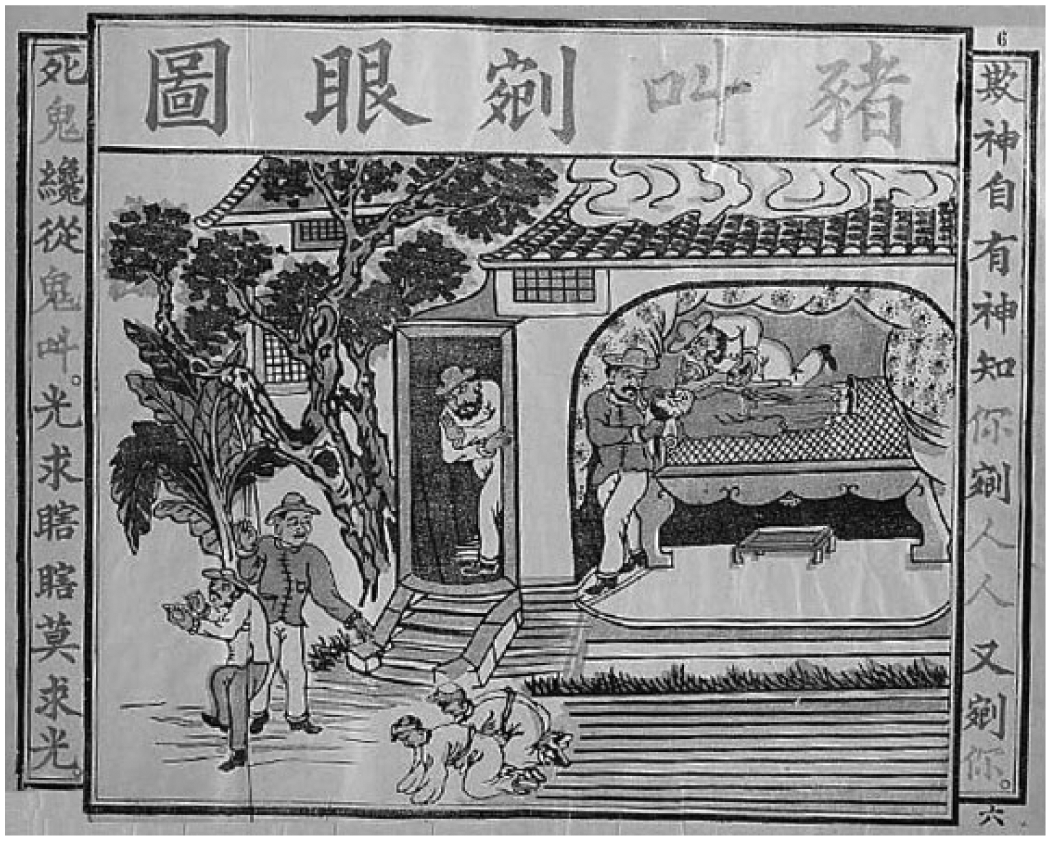
“The Hog Sect Gouging out Eyes”: Illustration from an anti-missionary pamphlet.
Figure 2, “A Little Boy Loses a Kidney,” turns on the notion that traditional Chinese medicine considered the kidneys an organ essential for reproduction (Cheng, 1999). Figure 2 is a warning to parents of the possibility that the evil missionaries will cut out their children’s kidneys, so they cannot have descendants. While the whole family surrounds the child, a man outside is listening furtively. The warning is that if the family and parents are not careful enough to prevent the devil of the evil religion (xie jiao, “foreign religion”) from coming to their household door, the whole family will regret it.

“A Little Boy Loses a Kidney”: Illustration from an anti-missionary pamphlet.
From both the pamphlets and the pictures, we can see that space was an important element in the construction of rumors. The two repeated themes in the rumors, medicine and space, actually both pertain to the theme of secrecy. Indeed, the word “secrecy” (mimi) is mentioned explicitly in many pamphlets. As I will discuss later, the medicine practiced by Protestant missionaries looked secretive to the Chinese. Secrecy was viewed as structured into the space where medicine was practiced.
Indeed, when Christian missionaries came to China, they also occupied space in local communities. The most obvious way missionaries made themselves felt on the local scene was through the mission compounds they occupied and the buildings they built, sometimes in a Western architectural style (Renshaw, 2005). These new spatial establishments changed the local landscape. For example, both Protestant and Catholic missionaries were blamed for bringing bad luck to the local community because their churches were built in a manner that disturbed geomantic forces (fengshui) (Feuchtwang, 1974: 172–75, 236–54; Wyman, 1997). Therefore, it is necessary to focus on how Chinese responded to the appearance of unfamiliar spaces in their local environment and on the conflict between these unfamiliar spaces and the relationship to space in their tradition. In the next section, I will use the Tianjin Missionary Case to explore how the spatial arrangements of daily activities contributed to the misunderstandings between the Chinese and Christian missionaries.
The Tianjin Missionary Case
In the mid to late 1860s, rumors about kidnapping and eye gouging by Christian missionaries began to circulate from southern to central and northern China, including Jiangxi, Hunan, Hubei, and Zhili (Zeng, 1987: 6979–80). 11 These rumors, which frequently blamed Catholic missions, spread to Tianjin as well. At that time, the French Sisters of Charity had been giving small cash rewards to people who brought homeless or abandoned children to their orphanage in the city of Tianjin, strengthening the rumor that the sisters removed children’s hearts and eyes to make medicine. 12
Epidemics during the very hot late spring of 1870 killed 40 children in the Tianjin orphanage in twenty days in May, increasing the already high number of child deaths there. Under pressure from so many deaths, the sisters hastily placed the dead bodies in trunks that served as coffins and carelessly buried them in a public cemetery at night. On June 4, it was discovered that stray dogs had dug up one of these coffins and eaten the bodies of two children. When people saw the children’s remains, wild tales began to spread. Suspicious of the deaths, hundreds went to the cemetery and dug up more of the coffins, trying to find out what had happened to the children. To their horror, they found each coffin contained the bodies of multiple children. These discoveries outraged both local officials and commoners and fortified the rumor that missionaries were taking children’s eyes and hearts to make medicine.
Two days later, on June 6, local residents apprehended two men, Zhang Shuan and Guo Guai, and sent them to the Tianjin yamen. They were accused of kidnapping children in Jinghai and selling them to the French orphanage in Tianjin. They confessed that they had used anesthetics to kidnap young children, but they denied the charge that they had used the children’s organs to make medicine. No evidence was found for this accusation either (Liang, 2002).
On June 18, several local residents accused Wu Lanzhen, a nineteen-year-old Tianjin resident, of kidnapping, and he was arrested and brought to the Tianjin yamen for questioning. Wu confessed that he had gotten the anesthetic he used for kidnapping from the missionaries and claimed that his crimes had been instigated by a converted Chinese Christian named Wang San. He also confessed that he had previously kidnapped one child and had received five yin yuan from the French Sisters of Charity in exchange for the child. Most importantly, he claimed to have also sold children to the janitor of the orphanage, which confirmed the rumor that the kidnapping was related to the missionaries. Wu Lanzhen’s confession inflamed tensions between the townspeople and the orphanage staff.
Tianjin’s residents demanded that the local yamen arrest Wang San. With turmoil starting to grow, hundreds of people gathered outside the French Sisters of Charity’s church on June 19 and demanded to be admitted so they could investigate. French consul Henri Fontanier, trying to play his role as protector of Catholics, refused. 13 Realizing the seriousness of the situation, missionaries and foreign officials blamed local officials and the gentry for stoking the tensions and asked local authorities to take action to restore order (Liang, 2002: 18–20).
Together with other local officials, the Beiyang commercial official Chong Hou, the highest-ranking Chinese official in the Tianjin district at that time, met with Fontanier on June 20. A decision was made that they would take Wu Lanzhen to the church on June 21. On June 21, they searched the whole church but found nothing suspicious. Nor could Wu Lanzhen identify the Chinese convert Wang San mentioned in his affidavit. But by this time thousands of people had congregated outside the church, and turmoil began to grow.
Amid the growing unrest, Fontanier asked local officials to drive the crowd away from the church. In response, Chong Hou, who had already left the scene, sent a few officials to try to persuade people to disperse. Unsatisfied with the local officials’ attempts, Fontanier left the church and, with his assistant, headed to Chong Hou’s yamen. The angry Chinese crowd followed him to the yamen, where he forced his way inside. Once inside, Fontanier aimed a gun at Chong Hou and fired, but missed. Then a local official, Liu Jie, came to the yamen with a large crowd following him. The moment Fontanier saw him, he rushed into the crowd and fired at Liu Jie, but ended up killing Liu Jie’s servant instead. This was the last straw for the crowd, which became furious and rioted, killing Fontanier and his assistant. The enraged crowd went on to attack Christian institutions, including 4 Protestant mission stations, and to kill 30 to 40 Chinese converts and 21 foreigners. The rampage lasted three hours.
Political and Social Conflicts behind the Rumors
A number of historical and political factors contributed to the Tianjin Missionary Case (Fairbank, 1957; Cohen, 1963). Most current literature looks at the incident as an outbreak of hatred of imperialism against the background of religious, political, and economic contacts between China and foreign powers (Fairbank, 1957; Mo and Guo, 2003). To be sure, it was not an accident that the incident happened in Tianjin, where the humiliating treaties of 1858 had been signed and which was one of the earliest treaty ports. The actions of foreigners also played a part. Particularly, “the French authorities occupied a former imperial villa as their consulate” (Cohen, 1963: 229). To make matters even worse, in 1869 the Catholics built a massive new cathedral, Notre Dame des Victoires, together with an orphanage, on the site of an old Buddhist temple (Whyte, 1988). These actions increased tensions between foreigners and the locals and set the stage for the violence in 1870 (Liang, 2002: 18–20).
Another possible source of resentment was that the foreign missionaries challenged the status and interests of the local gentry, 14 who felt threatened by the Christian missionaries and thus mobilized anti-Christian sentiment (Latourette, 1929: 348–50, 467–68; Cohen, 1963: 86–87, 141; Cohen, 1978: 556–60, 564–70). However, in a quantitative study of all anti-missionary cases, Chen Yinkun (1991) showed that the majority of the anti-missionary cases were initiated and led by commoners, rather than by local gentry. Cohen (1963: 174) noted that “there were more than a few instances in the 1860’s in which popular hostility to the foreign religion was aroused not by the gentry, but by the people’s direct contact with the missionaries and converts.” Sweeten’s study of Catholics in Jiangxi also showed that, over four decades, conflicts between Catholics and the local community in Jiangxi were not gentry-led movements (2001: 2). More recent work has also emphasized the role played by ordinary people in various kinds of anti-imperialist movements in modern China (e.g., Li, 2004; Xi, 2008). Indeed, people had various reasons for their attitudes toward Christianity. These came from personal or community experiences rather than from prejudices passed on by the gentry.
In contrast to the political approach, ter Haar emphasizes a cultural tradition that had existed in China for centuries. To ter Haar, the anti-missionary rumors were built on stereotyped fears of kidnapping and organ snatching (2006: 191). For the average Chinese, the missionaries were yet another example of the outsider groups that were traditionally held responsible for such kidnappings. Wyman (1997) also argues that missionaries were targeted not because they had the characteristics of foreigners but because they fell into a categorizing scheme that differentiated all outsiders from the locals. Suspicion of outsiders is also the theme in Kuhn’s seminal study of the queue-cutting and soul-stealing panic in the Qianlong period (Kuhn, 1990).
Ter Haar, Wyman, and Kuhn all identify an important characteristic of traditional Chinese society: outsiders were regarded with suspicion. To be sure, missionaries were like other outsiders to some extent. However, Christian missionaries were also different because they were usually not as mobile as other outsiders who were traditionally blamed for kidnapping or organ snatching. For instance, Christian missionaries built churches and lived in the local communities for a much longer time than traveling monks or strangers from another town. Therefore, if missionaries were discriminated against because they were outsiders, we would expect that this would weaken after they had spent some time in the local communities. On the contrary, missionaries were still regarded skeptically even after many years of residence in China. 15
Although they cannot fully explain the rumors, proponents of the cultural approach urge us to look at the local encounters between the Chinese and the missionaries. Indeed, ordinary Chinese people were more sensitive to elements that were close to their everyday lives than to ideologies such as anti-imperialism. For example, although it was not deliberate, the imprudence of the Catholic sisters inadvertently encouraged kidnappings by local bandits. To the sisters, the cash reward of five yin yuan for a child was a small amount, but to many Chinese, it was enough to motivate a kidnapping. That was actually a lot of money in late nineteenth-century China. In the market, one yin yuan was equivalent to one tael, 16 and for ordinary people, one tael was enough for a few months’ living expenses (Peng, 1994). It is probable that these rewards encouraged kidnapping; certainly many Chinese believed so.
However, while these factors may partly explain the outbreak of the Tianjin Missionary Case, none of them explains the substance of the rumors or why they were so widely believed. No matter what their attitudes were toward foreigners, it seems that the vast majority of the Chinese were firmly convinced that the crimes attributed to the missionaries were true. To better understand this, next I will review some studies of rumors in other contexts, hoping the analytic and theoretical tools they offer can help explain why people believe rumors.
Social Studies of Rumors
Rumor has been regarded as a way to either deal with individual or collective emotions, derived from fears and anxieties, or to express the underlying hopes, fears, and hostilities of the group (Knapp, 1944; Allport and Postman, 1947; Shibutani, 1966). Both early and recent studies of rumors share the consensus that the message of rumors is, by nature, an unconfirmed explanation of events at the time of transmission (Knapp, 1944; Allport and Postman, 1947; Peterson and Gist, 1951; Donovan, 2007; Fine and Ellis, 2010). Although many elements have been identified as necessary for rumor transmission (Klapper, 1960; Shibutani, 1966; McGuire, 1969; Rosnow, 1980), the ambiguity of information has been deemed the most essential (Allport and Postman, 1947; Rosnow and Fine, 1976; Rosnow, 1980). However, little research has been done on what causes ambiguity. The ambiguity of information is either taken for granted or treated as a conspiracy—a deliberate hiding and manipulation of information (Renard, 2007)—or else clearer information is simply not available, such as when routine channels of communication break down, do not exist, or cannot be trusted (Shibutani, 1966).
A potential reason for the unavailability of information is that it is kept hidden, as a secret. Indeed, secrecy is an extreme form of inhibition of the flow of all types of knowledge or information across boundaries (Simmel, 1906; Shils, 1956), which results in unclear information. It is thus understandable that secrecy might give rise to rumors. Most definitions of secrecy suggest a conscious and deliberate attempt by individuals to conceal information. For example, Shils (1966) argues that secrecy is the calculated concealment of information. But sometimes information is restricted without intention by individuals or groups. For example, individuals simply cannot successfully communicate many private thoughts. In some cases, “secrets” are maintained only because outsiders do not have the intellectual capabilities to discover them (O’Connell, 1980; Tefft, 1980). Concealing information can be voluntary or mandatory, but it can also be involuntary and nondeliberate. Therefore, we need to know the conditions under which the involuntary and nondeliberate hiding of information might happen and what influence this can have on rumor production and transmission.
To be sure, rumor arises from the failure of communication of information. However, this failure or unavailability of information is not always caused by conspiracy. As Donovan (2007) points out, the ambiguity of information is often better explained by people’s relationship to the information or a lack of critical capacity (Chorus 1953) rather than gullibility. That is to say, what people believe and why they believe or doubt a piece of information is contingent on the knowledge context. Reflecting these premises, therefore, I propose to resituate rumors in relation to the cultural differences in ideas about space and secrecy, in order to understand better why rumors arise and why they take a particular form.
Scattered mentions of the impact of space on rumors have appeared in the literature on rumor studies. It has been noted that the collective-living habits of the Chinese have played an essential role in the rumor that Chinese workers in some African countries are prisoners (Dobler, 2008; Yan and Sautman, 2012). Studies of organ-theft rumors in Africa and Latin America also show that those rumors exploded during a period of increased international adoptions, in which local residents could see that babies were being shipped from their poor communities to foreign countries, alien spaces to which they did not have access (Scheper-Hughes, 2000; Campion-Vincent, 2011). Fine and Ellis’s (2010) study of the rumors that unsuspecting tourists’ kidneys were being stolen while they were abroad also shows how people feel less in control of their bodies when they are in a foreign space.
Echoing these recent studies, the starting point of this article is a given conception of space and of routinized spatial arrangements. I argue that customs of space can influence the way people respond to newcomers, who usually organize their daily activities in different spatial configurations. For example, missionaries in nineteenth-century China stored coal in the church basement, a structure unknown to the Chinese, who usually used their backyards for coal storage. An examination of anti-missionary rumors can help us understand the ways rumor can be seen as an instance of how different concepts of space shape micro-politics. I want to interrogate and contextualize these rumors in the daily experience of the people who were involved: both the Chinese and the missionaries. To do this, we need to look at local practices. Thus, I return to the historical case at hand, where Zeng Guofan’s investigation and reports about the Tianjin Missionary Case give us an account of what nineteenth-century Chinese officials thought had happened.
Space in the Tianjin Missionary Case
After the Tianjin Missionary Case, the court ordered Zeng Guofan, the governor-general of Zhili province at that time, to investigate it. 17 Zeng went to Tianjin and took on the last mission of his political career.
Zeng Guofan’s Investigation
Zeng’s first memorial, which he presented on June 27, 1870, outlined the policies that the court should pursue. He pointed out that the official investigation needed to determine two things: whether the rumored connection actually existed between the Catholic church in Tianjin and kidnappings that had taken place in the city in the spring of 1870, and whether there was any truth to the widespread rumors that the Christian missionaries extracted eyes and hearts from Chinese patients (Zeng, 1987: 6967–68). 18
On July 21, Zeng’s report on his investigation of the case was presented to the throne. It stated that Chinese people’s misunderstandings were the main reason for the incident, and he claimed that the eye-snatching rumors were false. In a July 27 memorial, Zeng again firmly discounted the rumors about Catholic involvement in kidnappings (YWSM, 1930: 73.44–45). He noted that the charges against the missionaries in Tianjin were similar to rumors that had been circulated earlier in Hunan and Jiangxi provinces and more recently in Yangzhou (in Jiangsu province), in Daming and Guanping (both in Zhili province), and in Tianmen (in Hubei province). However, the truth or falsity of these rumors was never determined.
During his investigation, Zeng examined the space occupied by the Catholic priests and sisters. He investigated the basement of the Catholic church and found out that it was just a place to store coal. He and many others also went to other parts of the church and found no eyes or hearts, contrary to the claims in the pamphlets and rumors. Furthermore, he examined the corpses of children that had been buried and dug up, and found that, contrary to claims, their eyes and hearts had not been taken (Zeng, 1987: 6980).
In his reports, Zeng took advantage of his firsthand experience to make it clear that he had found absolutely no evidence supporting any of the charges of kidnapping or organ snatching (Zeng, 1987: 6980, 6992). Based on his investigations, Zeng reported that the popular suspicion came from the following five sources (as summarized from Zeng, 1987: 6981):
The church kept its doors closed all year long, so it was hard for people to know what was going on inside. Both the church and the orphanage had basements, but Chinese never entered the basements. It was believed that children were hidden in them. Moreover, these buildings had not been built by local workers, so nobody knew the truth about the basements.
People who went to the mission station for medical treatment occasionally refused to return home, including one teenage girl, the child of a member of the local gentry.
The sisters took in dying children and adults, and some Chinese may have seen the sisters washing the eyes of the newly deceased. Also, boats from other countries delivered hundreds of people to the church, but nobody ever saw them leave.
There was a popular belief that mothers and children received by the Catholics lived in separate parts of the church building and sometimes did not see one another for a whole year.
There had been kidnappings in Tianjin in the spring of 1870, and the church had been implicated in them. The Chinese were suspicious because the church buried corpses at night, with two to three corpses sharing one coffin.
These five sources of suspicion suggest that people’s understanding of space, more so than their understanding of medicine itself, was essential to their suspicion of the Christian missionaries. The first source, the church’s closed doors, meant that the space was not accessible or visible to others. The second concerned the medical treatments received by the Chinese, but what mattered was that the treated people chose to stay in the hospital instead of going home. The third also concerned a suspicion about the one-way interchange between the inside and outside spaces. The fourth contradicted norms about the spatial placement of people: mothers and children should live together, but they were put in different rooms in the church. The fifth, the kidnapping scare, was indirectly related to medicine, but the fact that corpses were buried at night implied it was done secretly. Burying two or three corpses in one coffin was problematic because it contradicted ideas of how space should be shared.
Zeng realized that there was a connection between notions of secret space and the popular suspicion of and anxieties about the church. In fact, he explicitly mentioned the “sense of secrecy” caused by the architectural structure of the church (Zeng, 1987: 6980). 19 The general aura of secrecy that enveloped the management of the orphanage, dispensary, church, and hospital was the most important source of popular suspicion.
In addition to showing the falsity of the rumors, Zeng also tried to control their effects. His intention to dispel the rumors about missionary work was well documented in his diaries and letters to family members (see Liang, 2002: 30, 32, 75–93). He requested that the imperial court reveal the truth to the country, both to pacify the foreigners and to dispel the suspicions of the gentry and the commoners. This report is remarkable not only because Zeng based it on facts and investigation, but also because it represented the only effort of Chinese authorities to clear up the rumors so widely believed by the people. As a result of Zeng’s investigation of the Tianjin case, the throne issued an edict: “Since the rumors about the Catholics have been proven false, in the future people of the empire need have no suspicions in this regard” (YWSM, 1930: 73.23).
Zeng’s Failure
One might expect that Zeng’s report and the edict issued by the emperor would help dispel the rumors, because if rumors were caused by ambiguity of information (Allport and Postman, 1947; Rosnow and Fine, 1976; Rosnow, 1980), one potential way to dismiss them would be to provide clear information certified by official authorities. That was exactly what Zeng did. The information he provided was based on investigation, issued by officials, and endorsed by the emperor. However, even after the official announcement was made, people still did not discard the belief that Christian churches were involved in the activities decried in the rumors. Instead, they criticized Zeng’s memorial clearing the missionaries of the charge that they extracted eyes and hearts from Chinese patients (Zhu, 2001: 314–15).
Instead of changing popular opinion, Zeng was accused of being a traitor. A July 24 report to the throne by Song Jin, a Qing government official, said, “There are jars of young children’s eyes in the orphanage of the church” (reproduced in Liang, 2002: 114). As a result, even Empress Dowager Cixi, the de facto ruler, believed that there were stolen eyes in the orphanages. In her edict to Zeng, she said that “when people entered and destroyed the orphanage, they found eyes and hearts of children. People handed them in to Chong Hou, but Chong Hou destroyed the evidence instead of reporting it to the court” (reproduced in Liang, 2002: 116).
Under great pressure, the court was forced to issue an imperial order relieving Zeng of his command (Zhu, 2001: 316). 20 Zeng retired to his viceroyalty at Nanjing and was even expunged from the list of officials from Hunan province. In the end, he was under such great pressure that he had to admit in a later memorial that the accusations of eye snatching might be true (Zeng, 1987: 7096).
The tragic end of Zeng Guofan’s political career suggests that the rumors about missionaries were related to something deeply embedded in the culture of the era. In the following section, I search for these elements by looking at the way missionaries organized their practices and the social context in which they conducted their daily activities.
Secrecy and Spatial Arrangements
The analysis above suggests that rumors and popular suspicion were related to the “secret space” involved in the missionaries’ activities. To understand this, we need to look at the local sense of space. A sense of space is the attribution of meaning to a place, natural or built (Rotenberg and McDonogh, 1993). I find that the visibility of activities, accessibility, and the spatial placement of people were important to the local people’s understanding of space. In this section, I discuss missionaries’ activities with regard to these three aspects of space.
The Visibility of Activities
First of all, although medical missions played an important role in Protestant missionaries’ evangelical activities, the visibility of activities in Western medicine was mystifying from the perspective of the traditional Chinese way of curing. In traditional Chinese medicine, treatment took place in the house of the patient’s family. Usually when someone was sick, the family would invite a physician to come to the patient’s bedside. Doctors conducted all the diagnoses and treatment under the surveillance of the patient and the relatives (Hume, 1940: 120). Care of the patient was provided exclusively by family members, in the patient’s own house. If patients were old or very seriously sick, it was very important that they go back to their own house no matter how far they were from home at the time (Yang, 2006: chap. 2).
But in the medicine practiced by Protestant missionaries, all diagnoses and treatment were conducted in a place not visible to the patient’s family. 21 Moreover, operations were also done in a special room to which no one had access except the doctors, nurses, and patients, making the operating room a “secret space.” Furthermore, care was provided by nurses. Patients stayed overnight in the hospital, a very unfamiliar space, and died in the hospital instead of in their own homes.
Thus, when Chinese entered missionary hospitals, they entered a sequence of unfamiliar spatial settings. The activities in missionary hospitals were much less visible than those in what they understood to be a “healing” space. As the missionaries conducted their activities in what the Chinese regarded as “secret space,” the patients did not know what to expect. In the Chinese view, it looked as though the missionaries were hiding something from them.
Later, some Protestant medical missionaries realized these differences were problematic and tried to reduce the level of “secret space” involved in their medical practices. For example, to reduce suspicion of the hospitals, most allowed the relatives of patients to accompany them overnight (Balme, 1921). Doctors also tried to make their operations visible to the public. In early May 1883, rumors circulated that Scottish missionaries, including Dugald Christie, were working with local Catholic priests and nuns who were believed to be “anxious to obtain children’s hearts and eyes, and were willing to give large sums for them.” To dispel the suspicions, Christie decided to allow the Chinese to watch while he performed surgical operations. According to Christie’s record, dozens, and on some days even hundreds, of people visited the missionary hospital, not to seek treatment, but to watch him perform operations. After a couple of years, Christie was accepted by the local community because his open-air surgeries succeeded in dispelling many doubts (Christie and Christie, 1914: 40–43). Dr. Worth at the Jiangyin mission station also tried to overcome the rumors that foreign doctors were engaging in immoral medical practices by performing all operations in public to show that no stealing of body parts had occurred (Kessler, 1996: 31).
In addition to performing surgeries in public, some Protestant missions also changed their infrastructure to accommodate the local sense of space. For example, beginning in the late nineteenth century, many missionary architects and their clients were consciously trying to make their buildings superficially appear more “indigenous” and less Western (Renshaw, 2005: 63–64). Another accommodation the Protestant missionaries initiated was to make the healing process more visible to patients and their friends or relatives by changing the architecture of the missionary hospitals. For example, in many missionary hospitals, when their turn came, a patient would enter a separate examination area sometimes partitioned off but often remaining in full view. This arrangement was commonly adopted so that Chinese who were waiting, and any friends or relatives who had accompanied the patient, could see what the doctor was doing. They hoped that this would inspire confidence, allay fears, and prevent rumors from arising. (146)
Some Protestant missionary hospitals built in the late nineteenth century also incorporated segregation of the sexes in the waiting rooms (142).
Accessibility of Space
Accessibility is another important aspect of space. Compared to other religious buildings and spaces in nineteenth-century China, Christian churches were less accessible and therefore looked more secretive to the Chinese.
In nineteenth-century China, temples were public spaces where many secular community activities took place (Yang, 1961). A Chinese village temple usually held a wide range of ritual services and public activities, such as folk operas for the entertainment of the temple deity, and the buying and selling that accompanied temple fairs (Brim, 1974; Litzinger, 1996: 51–52). Additionally, people slept overnight in Buddhist and Daoist temples. Temples that were a short distance from a village were convenient resting places for beggars (Smith, [1899] 1970: 139). Thus these buildings and spaces were familiar to people.
However, the doors of the Christian churches were always closed, and people could not enter them without permission, a practice shared by both Catholic and Protestant missionaries in nineteenth-century China. Even in rural areas where non-Catholics could sometimes observe church ceremonies, Catholic priests often restricted access. Because of this, “to some non-Catholics, churches seemed dark places and took on an aura of mystery” (Sweeten, 2001: 48). As Sweeten noted, “religious services held in Catholics’ homes might have led to suspicions about sectarian activities, but closed church doors caused other misunderstandings” (50). Sweeten further points out that “allowing ready access to the church would have showed the general public that there was nothing strange or mysterious inside” (50).
The closed doors became such an important issue because they highlighted an underlying difference in the understanding of privacy in the West and in China. As Philip Huang (2000) points out, the word “private” has different connotations in English and in Chinese. In nineteenth-century China, Western travelers, adventurers, and missionaries found Chinese customs inexplicable. MacGowan noted that “such a thing as a private house, in the sense that it is sedulously guarded from the outside world, is unknown to the Chinese” (1909: 241) and that “the doors [of the Chinese home] are open the livelong day; every sound from the street, as well as the voices of the neighbors in the adjoining compartments, penetrates it” (243). MacGowan used a story to illustrate this point. While he was traveling in China, crowds followed him everywhere. Once, to escape the persistent following, he dived into the house of a respectable-looking man who had politely invited him to come in and sit down. However, the crowd entered with him, as though the place belonged to them all. The owner of the house did not seem to think there was anything out of the ordinary in this intrusion on the privacy of his home (241). In a situation like this, it is easy to see why the inaccessibility of churches would lead to suspicion of evil dealings.
Christian churches not only had closed doors, but were also often located in walled, gated, and guarded mission compounds. Indeed, the physical locus of missionaries’ work was the mission station, a compound enclosed by a wall or fence (e.g., see Kessler, 1996: 9). From the time they arrived in China until the time they left, most of the missionaries lived and worked in the highly organized structure of the mission compound. 22 All the facilities used by missionaries were in a closed space. This was especially true of Protestant missionaries and Catholic missionaries who worked in big cities.
The majority of Protestant missionaries tended to be confined in the mission compounds in the treaty ports (Austin, 2007: 118). Although Protestant and Catholic missionaries alike evangelized in both cities and villages, Protestants were more urban than were Catholics (Bays, 2012: 60). Even after the 1860 treaty allowed missionaries to travel into “the interior,” Protestants tended to stay in the treaty ports and penetrated slowly beyond them—at least until the founding of the China Inland Mission in 1866. 23
Compared with Protestants, Catholics penetrated more in rural areas, especially before 1860. Before then, Catholic missionaries tended to work mainly in small villages to avoid harassment from officials (Wiest, 2000). But after 1860, because the treaties allowed missionaries to enter China’s inland and to recover Catholic Church property confiscated a century earlier, Catholic missionaries established themselves in or near large cities (Sweeten, 2001: 41–42; Bays, 2012). In those cities, Catholic priests built mission headquarters that gradually developed into large mission compounds, just as Protestant missionaries had done (Sweeten, 2001: 42).
Therefore, despite the different evangelical approaches, both Protestant and Catholic missionaries built compounds in the cities. For many practical reasons, they retreated inside their compounds and asked the Chinese to enter their space, a space that was usually separated from the rest of the community (Austin, 2007: 119).
Such an establishment was owned or leased by the missionary society, and was under the protection of the extraterritoriality clauses, being in effect an enclave of “foreign territory” in its community. Inside the enclosure were the installations for the work of the station and for the housing of its personnel: missionary residence, a church, classroom buildings, a dispensary and/or hospital, and auxiliary buildings. The compound was entered by way of a gate, usually guarded by a Chinese keeper. (Forsythe, 1971: 13)
Thus, missionary compounds were closed units, segregated from the local surroundings. They were independent and distinctive. Even in rural areas where large mission compounds were less common, Catholics in some provinces tended to see their missions as enclaves of Christianity in an alien society and used their churches to regroup the Chinese converts into Catholic villages (Wiest, 2000: 252–53) in order to protect them from the pressures and hostility of non-Catholics (Lindenfeld, 2005). By doing so, Catholics also formed a closed unit and became largely “a community apart, isolated and often estranged from their fellow Chinese” (Cohen, 1978: 557).
What made things more complicated was that Protestant missionaries used their medical practices to evangelize China. Because medical missionaries were both doctors and ministers, they usually built their hospitals inside or adjacent to churches. Hospital and church were usually in one building, gated and guarded. For the local people, it was very hard to tell the difference between the church, inside which foreigners practiced a strange religion, and the hospital. The miraculous atmosphere of the church reinforced the mystery of the hospitals maintained by the medical missionaries. As Zeng recognized, the general aura of secrecy that enveloped the management of the orphanage, dispensary, church, and hospital was the most important source of popular suspicion.
To be sure, many of the earliest missionary hospitals established in treaty ports were not located in mission compounds. Rather, they used existing (Chinese) buildings (Renshaw, 2005: 51). But many of them were still secluded for the practical reason that it was hard for missionaries to secure a good location as a rental, and buying was not allowed until the 1860s (Cadbury and Jones, 1935: 37–38; Parks, 1948). For example, Peter Parker’s Canton Hospital was confined in the Thirteen Factories, the area where the foreign traders lived in Guangzhou (see Figure 3).
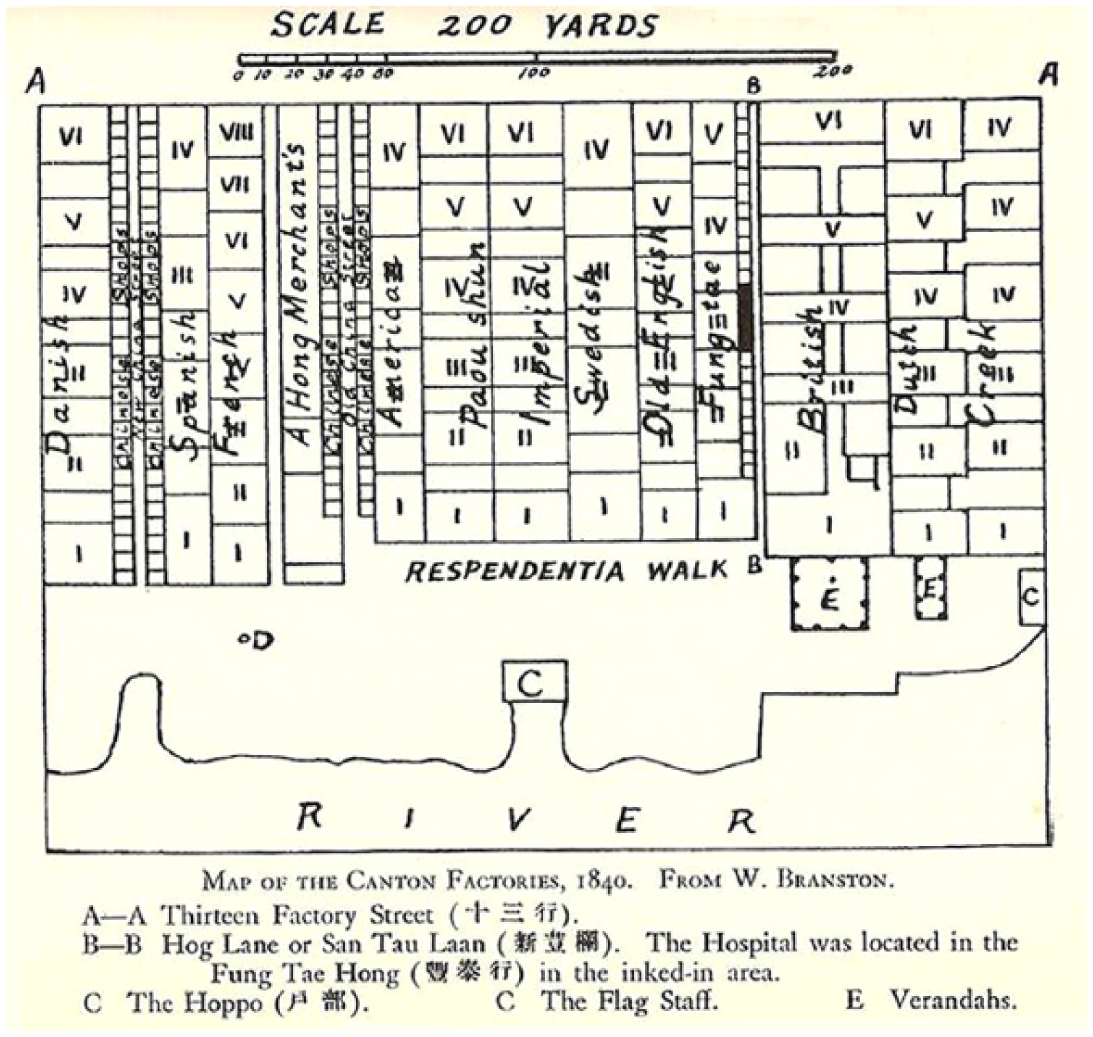
Location of Peter Parker’s ophthalmic hospital.
The physical style and size of church buildings also played a part. In the early years and in rural areas, most churches and their affiliated facilities were small and modest, inconspicuously located in existing Chinese buildings. Those buildings were not different from those around them (Renshaw, 2005: 51–52). For example, Dr. Worth’s clinic at the Jiangyin mission station was a rough and small clinic in a rented building in the city. “Its construction was so flimsy that an opium addict once kicked down the wall of his room and escaped” (Kessler, 1996: 31). The hospitals missionaries later built in the port cities, however, “tended to be in either a ‘colonial,’ or modest foreign style” (Renshaw, 2005: 52). Also after 1860, when Catholics began to build their mission headquarters in cities, more and more church buildings were large and built of brick and stone (Sweeten, 2001: 43), making them highly visible because of their sheer size and European architectural style. These architectural styles, combined with the hospitals’ location inside the missionary compounds, made the problem of space more salient.
The interiors of churches were also different from those of Chinese buildings. Many rooms were not visible, and Chinese did not know what their functions were. Furthermore, as Zeng noted in his reports on the Tianjin Missionary Case, the churches were often built by workers from other towns instead of by local workers, which therefore made the interiors mysterious to the local residents and fueled suspicion (Zeng, 1987: 6981). All these factors increased the secrecy of churches.
In summary, churches and their affiliated hospitals inserted a very unfamiliar space into a community with established customs regarding space. The strange and closed internal spatial arrangements of the church, all the mysterious rituals happening inside it, and the fact that missionaries were also doctors with the spatial practices described above increased the perceived secrecy of the missionaries.
Accessibility is such an important aspect of the customs of space that one might speculate that if the churches had been more open, there would have been fewer suspicions. In fact, in earlier years, even though missionaries were not aware of the problem of secret space, some of them evangelized in a way that accidentally lowered the level of secrecy involved in their practices, and consequently reduced suspicions. For example, in some rural areas, the Catholics made their space more open and accessible by sending adopted infants to local wet nurses instead of keeping them at the church orphanages. Consequently, in those areas the Catholics were able to become an integrated part of the local community (Sweeten, 2001).
On the Protestant side, the China Inland Mission (CIM) was more mobile than other Protestant missionary organizations, so much so that it gained the nickname “Constantly in Motion” (Austin, 2007: 128). Hudson Taylor, the group’s founder, assumed the strategy of extensive itinerations, rather than intensive church-building. Taylor and the CIM usually started from a central city and made evangelistic tours of the neighborhoods in surrounding cities and villages, stopping at public spaces wherever people gathered, such as tea shops and religious shrines. They also conducted intensive house-to-house visiting (Austin, 2007: 4). By November 1867, the end of CIM’s first year, it had 25 missionaries at 11 stations in Zhejiang and Jiangsu provinces (Austin, 2007: 119). The CIM became the largest of all the missionary organizations in China (Whyte, 1988), probably because its approach seemed less secretive to the Chinese.
The Spatial Placement of People
Another aspect of spatial arrangements is the placement of people. People live and conduct their activities in specific spaces, and there are spaces in which certain people are or are not allowed. This spatial arrangement also determines the visibility of particular groups of people.
A repeated theme in the rumors in nineteenth-century China was seduction or rape by Christian missionaries. To be sure, there are many historical and cultural reasons for this theme. For example, anxieties about women being seduced and raped by foreigners might have been rooted in the patriarchal society, in which women were regarded as the property of men (Su, 2001). However, one phenomenon is noteworthy: the rumor was always stated in spatial terms—for instance, that in the missionary compounds “men and women live in one room” 男女共处一室. This statement usually referred to the practice of men and women preaching in the same room in churches (Sweeten, 2001: 49). This implied that the Chinese thought that it was improper for men and women not of the same family to be in the same room, especially when the room was not a publicly accessible space. The implication was that women should not be in the same room together with men, for fear that they would be raped or seduced.
Indeed, in nineteenth-century China, women were not allowed to be present in public together with men, especially with men who were not their husbands or close relatives. Women had their own space. It was very important that women not be seen by people other than their intimate relatives. Many Westerners in China at that time noticed the sexual segregation that existed in Chinese society. For example, Christie and Christie (1914: 23) observed that even in northern China, where women were not as restricted as in other parts of the country, sexual segregation still existed and women were not allowed in most public spaces. Smith observed that as soon as a Chinese girl is betrothed, she is placed in a different relation to the universe generally. She cannot go anywhere, because it would be “inconvenient.” She might be seen by others. To the native, it is hardly possible to think of anything more horrible. (Smith, [1899] 1970: 265)
It is not surprising, then, that the Christian rituals of women and men worshipping together would lead to suspicion of sexual misconduct. In fact, Husdon Taylor and his CIM used missionary women to conduct house-to-house visits in order to reach Chinese women precisely because Chinese women did not appear in public (Austin, 2007: 4).
In conclusion, Christian missionaries seemed mysterious to the Chinese because of the way they organized their daily activities, both medical and religious. People in nineteenth-century China had their own relationship to space. They understood secrecy as that which was invisible or inaccessible, and attributed it to activities whose spatial arrangements differed from the existing social order. The secrecy perceived in the missionaries’ activities and the unavailability of information were caused by the differences in spatial arrangements. Thus, rumors were partly the result of the spatial settings of missionaries’ daily practice.
Conclusion
The spatial arrangements of missionaries’ everyday activities, which contradicted the existing spatial settings in local Chinese communities, encouraged the nineteenth-century Chinese to believe wild accusations about missionaries’ conduct and led to riots and killings. The confrontation between these two ways of understanding space made mutual understandings between missionaries and the Chinese difficult to achieve, and this incomprehension consequently led to rumors.
The common feature of secrecy is that knowledge is not reciprocal. But in nineteenth-century China, missionaries had no intention to hide information from the locals. Instead, they wanted to be understood and to show what they were doing. However, the spatial arrangements of their activities made this intention incomprehensible to the locals. The nonreciprocity of information was caused by the two groups’ different settings for their activities and, specifically, their different understandings of space.
Missionaries were oblivious to local conceptions of space, and this caused major barriers to communication. To be clear, I am not saying that if certain spatial relationships had been altered, the Tianjin “massacre” might not have happened. I am not trying to distance my explanation of rumors centered on the role of secret spaces from the political explanations that focus on anti-imperialism. The two explanations are not irreconcilable. The spatial practices of medical missionaries were rooted in their own conception of space, which cannot be separated from the new culture they were trying to introduce into China. Therefore, my argument enriches the current understanding of what constitutes imperialism and which elements lead to anti-imperialist sentiments.
Moving beyond this specific historical event, it is clear that the ambiguity of information that causes rumors is deeply rooted in the conceptual patterns of a particular cultural group. Not only are rumors a function of importance and ambiguity, but hidden spaces can lead to assumptions about what is happening behind closed doors. When people hold different views of space, misunderstanding of information is likely and can lead to rumors.
In addition to providing a cultural explanation of conflicts between the Chinese and the missionaries in nineteenth-century China, the above discussion about space and information also sheds light on the sociological study of rumor and, more generally, the study of information transmission. This helps us understand why even when the alleged facts were repeatedly refuted, many still believed them. Indeed, what is considered as evidence is culturally defined. Sometimes, contradictory evidence is simply ignored or is considered to have resulted from a conspiracy, a view that fortifies rather than dispels rumors.
The spatial organization of everyday activity informs how people respond to new information. People use their prior knowledge and experience to understand what happens to them. Therefore, rumors are most likely to arise when the parties to the rumor have a low critical ability to judge the information transmitted. And this is most likely to happen when two cultures come into contact but do not understand each other. More specifically, I emphasize the location of information, that is, the power of different customs of space in providing the grounding for unsecured beliefs. Spatial access contributes to a recognition of “social transparency,” which in turn contributes to how we understand the possibility (or even the likelihood) of conspiracy. For that reason, looking at the presence of Western knowledge through its interaction with local cognitive patterns such as spatial conceptions is a promising method for future studies of China-West interactions in modern China.
Footnotes
Acknowledgements
I would like to thank Andrew Abbott, Guy Alitto, Stefan Bargheer, Louise Edwards, Robert Freeland, Karen A. Joe Laidler, Sida Liu, Daniel Menchik, Pamela Oliver, and Dingxin Zhao for their advice on this article. I especially appreciate the helpful comments from the referees for Modern China.
Declaration of Conflicting Interests
The author(s) declared no potential conflicts of interest with respect to the research, authorship, and/or publication of this article.
Funding
The author(s) disclosed receipt of the following financial support for the research, authorship, and/or publication of this article: This study was supported by the Nicholson Dissertation Research Fellowship (2007-2008) at the British Isles, Nicholson Centre for British Studies, University of Chicago; the Henderson Dissertation Research Fellowship (2008-2009) at the Department of Sociology, University of Chicago; and the Dissertation Writing Fellowship, Center for East Asia Studies, University of Chicago (2009-10).