




Abstract
Over the past three decades, a distinctly post-socialist form of marriage with high rates of divorce as well as rising rates of marriage and remarriage has emerged as the result of a “triple turn” by the party-state in regard to the institution of marriage: a “turn toward” marriage as a voluntary contract, a “turn away” from close surveillance of sexual relationships, and a “turn away” from protection of communal property. The one-child policy runs against these three prevailing “turns” toward privatization, but to date this contradiction has been muted by a de facto distinction between (strong) control over reproduction and (weak) control over sexual relationships. Moreover, as illustrated here through close analysis of three recent interpretations 解释 of the Supreme People’s Court and interviews with ordinary citizens in Guangzhou and Shanghai, by continuing to extend the logic of voluntary contract to intimate relationships, the party-state’s own actions (and inaction) serve to accelerate privatization of marriage in post-socialist China.
In explaining the changes in the experience of marriage after 1949, many scholars (including myself) have emphasized how provisions of the Marriage Law of 1950 expanded the rights of women as brides, wives, and daughters-in-law and more generally increased the autonomy of the conjugal pair. However, while the 1950 law supported a new form of companionate marriage and construed marriage to be the “personal property” (Ocko, 1991: 319) of the husband and wife, in other ways, the 1950 Marriage Law repositioned and strengthened the state’s oversight of the institution of marriage (Davis and Harrell, 1993; Palmer, 1995). First, in contrast to the marriage regulations that the Chinese Communist Party (CCP) had drafted earlier for its base areas, the 1950 Marriage Law recognized a marriage only after state registration and refused to treat long-term cohabitation as de facto marriage (Palmer, 1995). Second, by requiring that all divorces be registered with the local government and all petitions for divorce be subject to mediation first by leaders of the local community and later by court officers, the 1950 law inserted the state into disputes that previously had involved only family members (Alford and Shen, 2004; Diamant, 2000; Huang, 2005). Moreover, in the case of divorce, the law stated that the collective “needs of production” (Article 23) explicitly trumped the individual interests of either spouse, thereby making marriage as much a “social” as personal form of property (Ocko, 1991: 320). Finally, even though the 1950 law (Article 15) granted children born outside marriage the same rights as those born to a married couple, by mandating monogamy and ignoring unregistered unions, the law more effectively limited childbearing to married couples than had either pre-1949 law or custom. In sum, multiple provisions of the 1950 Marriage Law empowered state agents as social engineers to mobilize the institution of marriage to advance the larger project of national development.
The Marriage Law of 1950 also directly redefined the norms and opportunities for sexual intimacy. When Article 2 prohibited concubinage 纳妾, the law conflated sexual intimacy and monogamous marriage for men as well as women. By criminalizing prostitution and closing brothels, the CCP further restricted sexual relationships to married couples. Before 1949, wealthy men often took secondary wives and many men visited prostitutes before and after marriage. Women, by contrast, were expected to be virgins before marriage and were severely punished for adultery (Hershatter, 1997; Mann, 2011). After 1950, both male and female sexual relationships became subject to legal and public censure. And in the context of political campaigns to identify saboteurs of socialism, sexual infidelity or even premarital sexual intimacy could be grounds for punishing individuals as class enemies (Chan, Madsen, and Unger, 1984; Hong, 1997; Kang, 2005).
Legal reforms initiated the “socialization” of marriage, but CCP economic policies that eliminated private ownership of land and capital created the enduring, institutional foundations for “socialist” marriages. After full collectivization and criminalization of private entrepreneurship, families could no longer accumulate substantial wealth. Henceforth, collective property rights routinely trumped those of households and when young adults became members of work teams or employees of state enterprises, parental control over mate selection or even the timing of marriage also atrophied. A child’s marriage remained a turning point in the life cycle, routinely triggering decisions as to whether or not to divide the household budget. But the marriage of a son or daughter no longer fulfilled the core, economic functions as it had when the economy was dominated by family farms and private commerce (Ocko, 1991; Watson and Ebrey, 1991).
The socialist command economy was most fully realized in towns and cities and therefore urban family life was more fully “de-commodified” and “de-capitalized” than in villages. In the countryside, even during the high tides of the Great Leap Forward and the Cultural Revolution, families continued to own their homes and village youth worked alongside their kin. By contrast, urban daughters as well as sons stayed in school until their mid-teens and then went directly to work in a state or collectively owned enterprise. Apprenticeships in family stores and domestic service disappeared, and young adults spent little time under the close scrutiny of parents or networks of extended kin. Moreover, not only did the structure of the urban economy weaken parental control over a child’s future, it also tied the future well-being of married couples closely to their workplace (Whyte, 1992). One of the clearest examples of this comprehensive reach of the socialist economy was the urban real estate system that transformed urban couples into “supplicants to a socialist state” (Davis, 1993). In 1949, most families lived in privately owned accommodations which they owned or rented. But within a decade the majority of urban residents lived in publicly owned apartments. Couples waited in a housing queue at their workplace and the seniority and status of the head of household, usually the husband, determined when and where they moved to a new home. Once they had acquired their new residence, rents took a tiny fraction of monthly income and lifetime tenancy was guaranteed (Whyte and Parish, 1984). Urban families effectively held use rights in perpetuity while for employers provision of housing was a social welfare benefit.
Evolution of Post-Socialist Marriage
The reintroduction of private ownership and re-legitimation of the profit motive after 1980 destroyed the core logic of the socialist economy. The impact on manufacturing and commerce has been well studied; the impact on marriage less so. Yet just as the ideological shifts away from the command economy curbed state surveillance in the workplace, in a parallel fashion the CCP’s endorsement of market transactions, privatization of assets, and reliance on voluntary contracts transformed familial and marital relationships. Under these conditions marriages became less like “social property” and closer to “personal property” (Ocko, 1991: 319). Thus I would argue that the changes in the experience of marriage and in the state’s policy of marriage since 1980 go beyond a retreat from the earlier role as social engineer and toward a more general “privatization” of the institution of marriage.
In making this argument I am not adopting the vocabulary of legal scholars such as Cass Sunstein and Richard Thaler (2008) who advocate privatization of marriage as a correction to the distortions created when government licensing subsidizes one form of intimacy over another. Rather, I understand privatization of marriage as a process that follows from the state’s redefinition of marriage as a voluntary contractual relationship grounded in individual emotional satisfaction. One immediately observes this redefinition in provisions of the new Marriage Law promulgated soon after Deng’s proclamation of the Four Modernizations. Henceforth, whenever both spouses agreed that affection had completely broken down 如感情确已破裂, the court had to grant a divorce (Marriage Law of the PRC, 1980: Article 25). 1 If only one spouse declared a complete breakdown of affection, the court was required to grant a divorce after mediation failed (Article 25) and no state agents could deny or delay a divorce on the grounds that the larger needs of the society trumped those of the individual happiness of an alienated spouse. The new law also abandoned the earlier provisions that had prioritized the needs of production over the claims of the married couple (Article 13), thereby signaling to the court and the community that personal preferences could trump the needs of the public economy.
At first glance, it would seem that the one-child policy, first announced in 1979, contradicted the promise of the new Marriage Law to prioritize personal satisfaction and subjected a couple’s most intimate life to increased state control. Yet if one distinguishes between marital fertility and sexuality, the contradiction becomes less stark. In 1978, the national leaders were convinced that only by mandating a dramatic drop in birth rates could they achieve “core regime objectives” (Greenhalgh, 2008: xvii). However, if sexual intimacy did not lead to a birth, the state could (and did) treat it as a matter of personal choice protected by the right to privacy. In short, by delinking regulation of sex from regulation of procreation, the contradiction in the state’s position toward post-socialist marriages become less salient. In fact, one could hypothesize that by making such a distinction, state agents were able to monitor procreation while reducing surveillance of sexual intimacies. In the Conclusion section, I will return to this contradiction. But first let me now turn to a discussion of how economic, social, and legal changes in the second and third decades of reform further privatized the institution of marriage.
Marriage in the Second and Third Decades of Economic Reform
Rapid growth and institutional restructuring after 1990 intensified the initial privatization and commodification of the economy. They also complicated the financial dimensions of marriage and increased the number of family disputes over property. Growth of family firms required courts confronting divorce or inheritance disputes to weigh the claims not only from the two spouses but also from in-laws and other shareholders whose property interests had not been salient during the first decade of market reform. Rapid privatization of urban housing stock and skyrocketing prices after 2000 ended urban housing as a welfare benefit (Davis, 2010). They also promoted multigenerational investments into marital residences whereby in-laws could hold claims to a conjugal home equal to (or even stronger than) than those of a spouse. Rural families were not immune from these new pressures. But because rural families had built and owned their homes throughout the socialist era, the creation of a more privatized housing market did not create as dramatic a disjuncture as it did for urban families (Parish and Whyte, 1978).
A second and distinct source of disjuncture was a surge in geographic mobility. For most of the socialist era the hukou registration system tied adults to the county or city of their birth. and a first employer was often the last (Davis, 1992). Over the first decade of reform, geographic mobility had increased, but migration did not routinely involve permanent relocation. Over the second and third decades of reform, however, migration accelerated and became less short-term. More than 200 million villagers left home and millions traveled to towns or factory zones thousands of miles from their parents and their ancestral villages. At the same time hundreds of thousands of Hong Kong, Southeast Asian, and Taiwan investors extended their sojourning in the People’s Republic of China (PRC) and many became long-term residents. In the context of high levels of geographic mobility, the market for romantic and marital partners rapidly expanded and social norms that had constrained premarital and extramarital sexual relationships weakened (Shen, 2008). Prostitution returned, premarital sex became normative, and divorce rates surged (Farrer, 2002; Farrer and Sun, 2003; Farrer et al., 2012; Huang et al., 2011; Osburg 2013; Parish, Laumann, and Mojola, 2007; Pei, 2011; Yan, 2003; Zhang, 2011). Privatization of property transformed the economics of marriage. Mass migration and openness to global cultural shifts unleashed a sexual revolution that redefined the character of intimate relationships inside and outside of marriage.
Revised Marriage Law of 2001
There was no single reaction to the lower barriers to divorce and the freer sexual climate. But regardless of whether individuals embraced the shifts as a positive break from a repressive past or whether they saw social breakdown and moral decay, local courts found it increasingly difficult to rely on the 1980 Marriage Law to adjudicate the financial, property, and custody disputes of contemporary family life. In response to both public dissatisfaction and confusion in lower courts, the National People’s Congress (NPC) decided to solicit proposals for a new Marriage Law. Two opposing views soon crystallized. On one side were those who felt that the 1980 law had been too liberal and they proposed more legal oversight of marriages and harsher penalties for adultery. On the other side, were those who advocated further liberalization, such as recognition of same-sex marriage. 2 Debate continued over five years with no clear resolution. But faced with the need to adjudicate the ever more complex family disputes, in 2001 the NPC promulgated a revised rather than new Marriage Law (Alford and Shen, 2004).
In terms of substantive changes, the most noteworthy new provisions were those strengthening individual property rights (Marriage Law of the PRC Revised, 2001). 3 Articles 18 and 19 defined individual 一方 property within marriages and elaborated how prenuptials or other notarized agreements between spouses could designate legally enforceable claims. Henceforth, all property acquired before marriage would be presumed to be individual unless otherwise agreed, as would all items which one spouse deemed for his or her personal use. Article 19 introduced new vocabulary such as gezisuoyou 各自所有 that stressed individual ownership as well as explicit wording to emphasize how agreements to designate separate ownership were binding on both parties. By contrast Article 13 in the original 1980 law had merely commented that both spouses had equal rights to manage a couple’s jointly owned property 夫妻对共同所有的财产 有平等的处理权.
In addition to detailed specification of individual 一方 property rights, the revised law reinforced the ideal of marriage as a voluntary contract where courts would take action only when one or more parties requested court adjudication. Or, as summarized by legal scholar Margaret Woo (2003), the 2001 revisions went beyond specifying individual rights to enhancing “litigant’s choice” 当事人主意 so that henceforth courts would intervene in marital disputes only if at least one party explicitly requested court adjudication. In statute and practice therefore, the Revised Law of 2001 echoed and strengthened the underlying trend toward ever greater privatization and individualization throughout contemporary Chinese society (Kong, 2011; Yan, 2009, 2011).
Without access to inner-party debates, I cannot explain the shifting positions among the national elite toward marriage reform. However, by tracking the frequency with which People’s Daily, the official paper of the CCP Central Committee, published stories with “marriage” or “divorce” in the title between 1946 and 2009, I can roughly trace the rise and fall in the relative importance of marriage as a central concern among those at the apex of national politics. As we see in Figure 1, coverage peaks in the three years after 1949, drops drastically after 1953, and virtually disappears between 1960 and 1979. It then picks up again after the passage of the 1980 Marriage Law, and continues at levels comparable to the mid-1950s. Based on these trends, it appears that official discourse on marriage and/or divorce maintained a salience for the post-Mao leadership that had been absent in the high-socialist years of the Great Leap Forward and the Cultural Revolution.
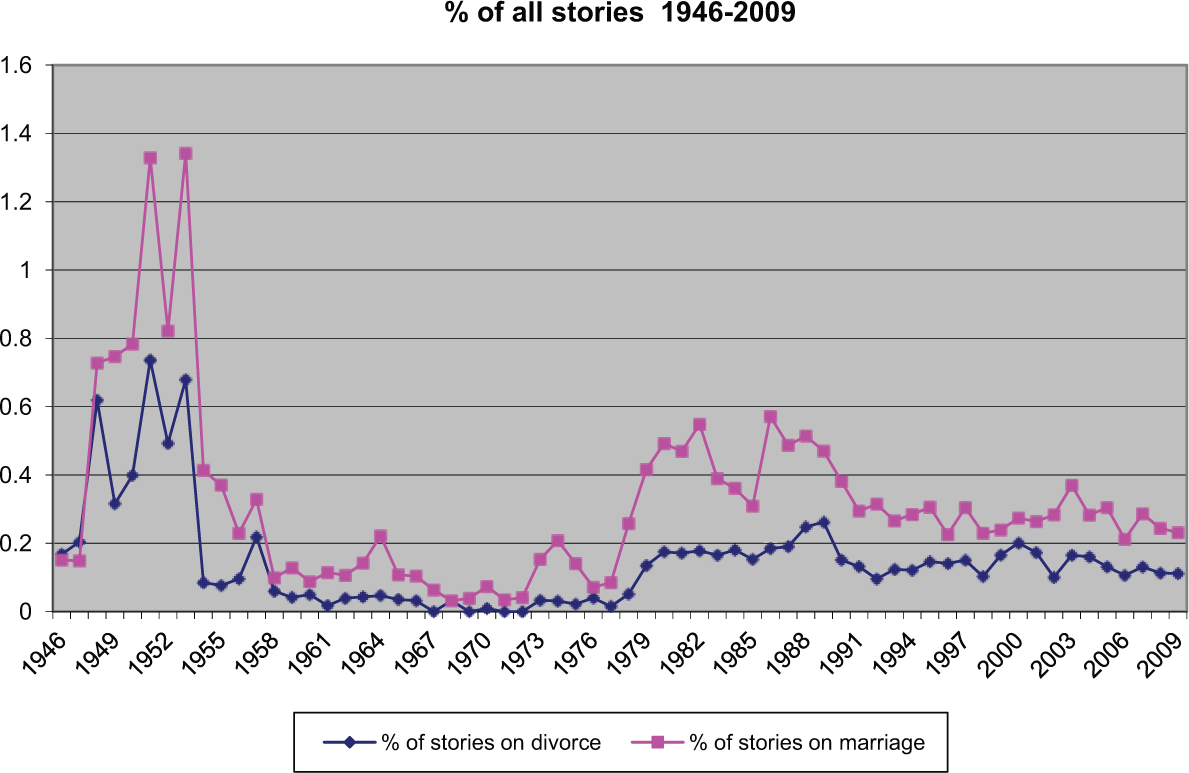
Discussion of marriage and divorce in People’s Daily, 1946–2009.
I turn now to three Supreme People’s Court (SPC) interpretations of the Revised Marriage Law. Through examination of these interpretations one observes a “triple turn” by the party-state as it advances the further privatization of the institution of marriage. First, the court has “turned toward” expanding protection of individual claims to property, a turn clearly in accord with an economy where an ever higher percentage of wealth is privately held. Second, it has “turned away” from surveillance of private life, a turn equally in accord with the state’s new endorsement of voluntary contract and the right to privacy. And, finally, by privileging individual claims to private property, the court has also “turned away” from the CCP’s long-time advocacy and support for a communal, conjugal property regime. The result is an ever more privatized institution of marriage.
Interpreting the Revised Marriage Law of 2001
Chinese statutes are often vague. And because lower courts cannot rely on case precedents as in the Anglo-U.S. system, judges who find a statute ambiguous or incomplete first consult their party committee, which may subsequently seek guidance from higher courts or party supervising bodies. When a problem is pervasive or challenges persist, the Supreme People’s Court will be asked to issue interpretations to guide the lower courts in subsequent adjudication (Finder, 1993). 4 Since passage of the Revised Marriage Law in 2001, the SPC has issued three such interpretations. In addition, because drafts of what later became the third interpretation were circulated on the internet, comparison among drafts identifies issues where CCP elites were uncertain or disagreed as how to instruct lower courts in cases of marital discord.
The First and Second Interpretations of the 2001 Revised Marriage Law
The SPC issued its first interpretation of the revised law in December 2001 (SPC, 2001). In that interpretation, the court focused on defining terms that had been absent in the earlier version of the Marriage Law such as “family violence” 家庭暴力, “adulterous cohabitation” 配偶者与他人同居, and “abuse” 虐待 and that according to the revised statute established grounds for financial compensation in cases of divorce. Also significant was a provision that courts could not withhold divorce from the party at fault if affection had broken down. By instructing lower courts to differentiate criteria for granting a divorce from those for awarding financial compensation such as bigamy, cohabitating with lovers, abusing children, or abandoning the family, the court simultaneously upheld the principle of monetizing fault and advanced an individual’s personal right 人身权 to leave a marriage that was no longer emotionally satisfying. In 1989, the SPC (1989) had issued an opinion 意见 that opened the door for a person guilty of adultery to apply for divorce and if denied on first petition, the court could not refuse to hear a second petition. Provision 22 of the 2001 interpretation went beyond that earlier opinion by deleting the several conditions for a second petition and guaranteeing that the court must grant, not merely hear, a petition for the divorce from the adulterous spouse. Henceforth, it became even clearer that a court could not withhold a divorce simply because a judge found one party guilty of abuse (SPC, 2001: Provision 22).
The second SPC interpretation of the Revised Marriage Law, issued on December 24, 2003 (SPC, 2003), further strengthened the salience of personal rights within the marital relationship. For example, the first provision of this 2003 interpretation explicitly explained that cohabitation only comes into the court’s purview when justifying a contested divorce or assigning compensation. Another significant provision in the 2003 interpretation clarified the property rights of parents-in-law in regard to their expenditures for wedding gifts or a new conjugal home (SPC, 2003: Provision 22). During the socialist era, parents in rural areas exhausted their savings to build homes for their sons. However, because divorce was rare and geographic mobility restricted, parents rarely needed to go to court to recoup their investment in a child’s marriage. In cities, where direct costs of marriages were far lower and housing was rented, concern with recouping parental investment was even less pressing (Davis-Friedmann, 1983; Whyte and Parish, 1984). However as noted, rising real estate prices and accelerating migration have created a situation where both rural and urban parents heavily invest in establishing their children’s new households even as geographic mobility may undermine family and marital solidarity (Davis, 2002, 2010; Yan, 2011). Thus, by 2000 the issue of how to protect parental investments in the purchase of a married child’s new residence could not be ignored. In response to this specific issue, the Revised Marriage Law was inadequate and thus Provision 22 of the 2003 interpretation specified that absent other arrangements, parental investments before a marriage should be seen as a gift 赠与 to their child alone and investments after the marriage would be considered as a gift to the couple.
The Third Interpretation of the 2001 Revised Marriage Law
In August 2011, the SPC issued its third interpretation of the Revised Marriage Law (SPC, 2011). In contrast to the first and second interpretations, this third interpretation directly undermined the latent protections of communal property. Thus, Provision 7 in the third interpretation states that when parents give their child money to purchase “immovable property” 不动产 after the child’s marriage and the property is registered in their child’s name, then according to Article 18 of the Marriage Law, the property is a gift to their child alone and considered one spouse’s individual property 夫妻一方的个人财产. The interpretation then goes on to say that in cases where parents of both husband and wife have invested in the purchase of the home, absent other arrangements, ownership will be apportioned on basis of parental investment. Were lower courts to follow this logic strictly, they could in the event of divorce grant to the parents who had paid the largest percentage of the down payment or mortgage a larger share of a marital home than to the coresident spouse.
Marking an even more dramatic break with past practice, Provision 11 instructed lower courts to refuse to hear cases where one spouse had sold a jointly owned marital home 夫妻共同共有的房屋 without the permission of the other spouse. Only in cases of divorce could the spouse who had not been consulted sue for compensation; however, even then ownership of the home remained with the third party who had legally purchased the property. For decades, PRC law and judicial rulings had upheld the right of each spouse to equal claims to the home in which they lived regardless of formal legal documentation specifying rights of ownership. Specifically, regulations of the socialist era emphasized that even when one spouse (most often the wife) did not have his or her name on a deed or had not made the largest financial investments, that spouse was entitled to half the conjugal home on the grounds that many years of uncompensated labor to maintain the family, raise the children, and care for the elderly had created the conjugal assets to which each spouse held equal claims. 5 By prioritizing the legitimacy of officially documented financial transactions, voluntary contracts, and notarized agreements the 2011 SPC interpretation not only “turned away” from established norms of the socialist property regime but also argued in favor of formal over substantive equality.
A third noteworthy element in the 2011 interpretation was the “judicial silence” on matters of sexual infidelity. I flag this silence not because lower courts ignored issues of sexual infidelity in adjudicating divorce cases but because in 2009 and 2010 the SPC released draft interpretations that explicitly dealt with how best to deal with sexual infidelities irrespective of questions of divorce (SPC, 2009; SPC, 2010). Moreover, because these drafts circulated widely on the internet, we can interpret what the SPC’s silence on these matters in the final version in 2011 signals about the party-state’s evolving position on the limits of state intrusion into marriage as a private institution. Particularly noteworthy was a provision in the 2009 draft that instructed lower courts to adjudicate disputes over loyalty agreements 忠诚协议 between married spouses and a provision in the 2010 draft that denied legal standing to plaintiffs challenging compensation payments on termination of cohabitation. 6 One presumes that the drafts circulating on the internet addressed these issues because lower courts had been asked to rule on such agreements and judges in lower courts had ruled inconsistently. However, by remaining “silent” on all matters related to sexual intimacy, the final version of the third interpretation signaled that lower courts would not regulate sexual intimacy among consenting adults. Or, the silence could simply indicate that the SPC judges could not agree on how or when the court should act on issues of sexual fidelity. Regardless of the judges’ motivations, the consequence of the silence was that lower courts remained free to interpret the law according to their own guidelines and that couples could continue to make and break agreements about sexual fidelity according to personal preferences and beyond the purview of the courts.
Interpretations of the SPC reveal the priorities of the party-state elite. They establish the formal legal context in which marriages are officially recognized or dissolved; they cannot, however, capture changes in popular opinion or behavior. Moreover, because most people avoid taking family disputes to court, court documents cannot reveal changes in popular attitudes or shifts in typical behavior across the decades. To address these concerns one needs to go beyond discussion of legislation and judicial interpretations. In the next two sections, I introduce material from two alternative sources: census data and interviews with a cross-section of urban residents in Guangzhou and Shanghai. I first review census materials to summarize demographic change at the level of the population. I then turn to interviews where we explicitly asked respondents to compare the efficacy of loyalty agreements and prenuptial contracts as well as to contrast the conditions of marriages today to those of their parents. 7 Neither set of data is definitive, but taken together, they bring us closer to understanding the lived experience of post-socialist marriages.
Demographic Trajectory of Change
In terms of behavioral shifts, longitudinal demographic measures reveal two seemingly contradictory trends. First, as one would expect, divorce rates have risen since passage of the 1980 Marriage Law. In 1980 divorce was a rare occurrence in the country as a whole and even in a city like Shanghai. By 2010, the national crude divorce rate (CDR) approached that of Taiwan and in Shanghai nearly converged with that of the United States (see Figure 2). 8 Yet at the same time as more marriages dissolved, overall marriage rates in China rose. Moreover, when one compares China’s crude marriage rate (CMR) to those in other countries in East Asia, Europe, and North America, China is the only one where CMR has recently risen (see Figure 3). 9 In addition, the upward swing has been absolute not relative. For example, in 2011, twenty-six million people married, a total that was eleven million greater than in each of the three years between 2000 and 2002, and a surge that cannot be attributed solely to a sudden increase in the number of men and women of marriageable age. 10 Rather it is more likely that CMR rose as a confluence of factors that included not only a slightly larger cohort size but also catch-up among those who had postponed marriage and marked increase in remarriage after divorce (more on this last factor below). 11
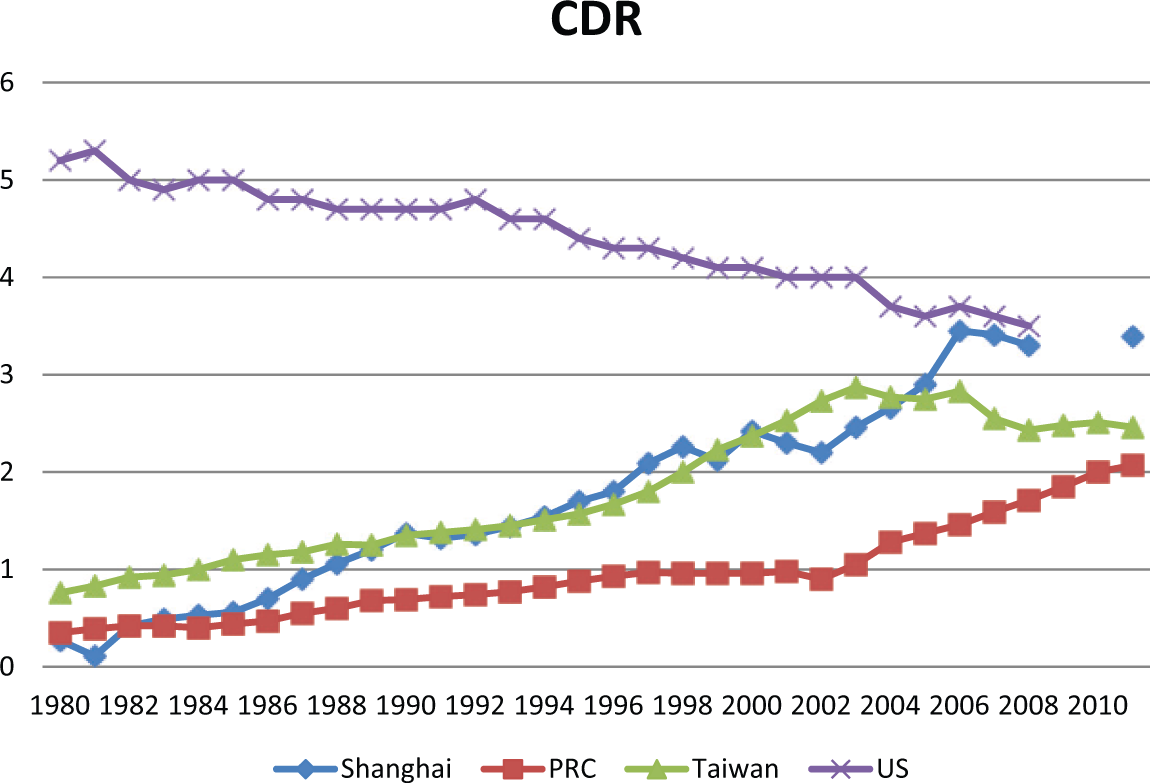
Crude divorce rates (CDRs), 1980–2011.
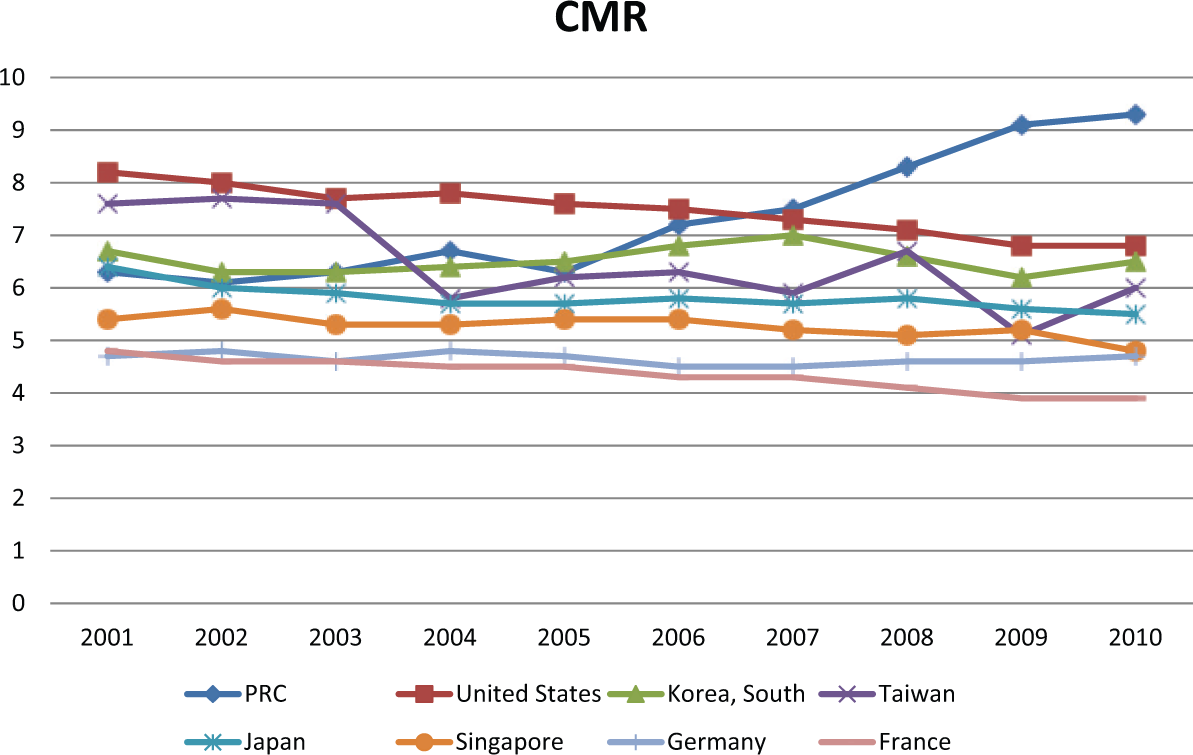
Crude marriage rates (CMRs), 2001–2010.
Population metrics like CDR and CMR offer crude proxies of behavioral change because increases are sensitive to such underlying population dynamics as rising fertility rates or longer life expectancies. Thus we turn next to trends that directly capture changes in marriage behavior irrespective of changes in population dynamics: rates of remarriage and percentage of those who have never married. In both cases, the more targeted metric confirms the continuing desirability of marriage. Between 1985 and 2010, the percentage of all persons marrying in any one year who had been previously married rose from approximately 3 percent to 11 percent (see Figure 4). Given the steady rise in divorce rates over these same years, it is not unexpected that remarriage rates would also increase. But on the other hand, it is theoretically possible that in years when many marriages fail, those who divorce will prefer to never risk another failure. In China, however, the story is on the side of willingness to try again. In sum, while individuals are ever more likely to divorce, high rates of marriage and remarriage indicate that marriage as an institution remains normatively robust.
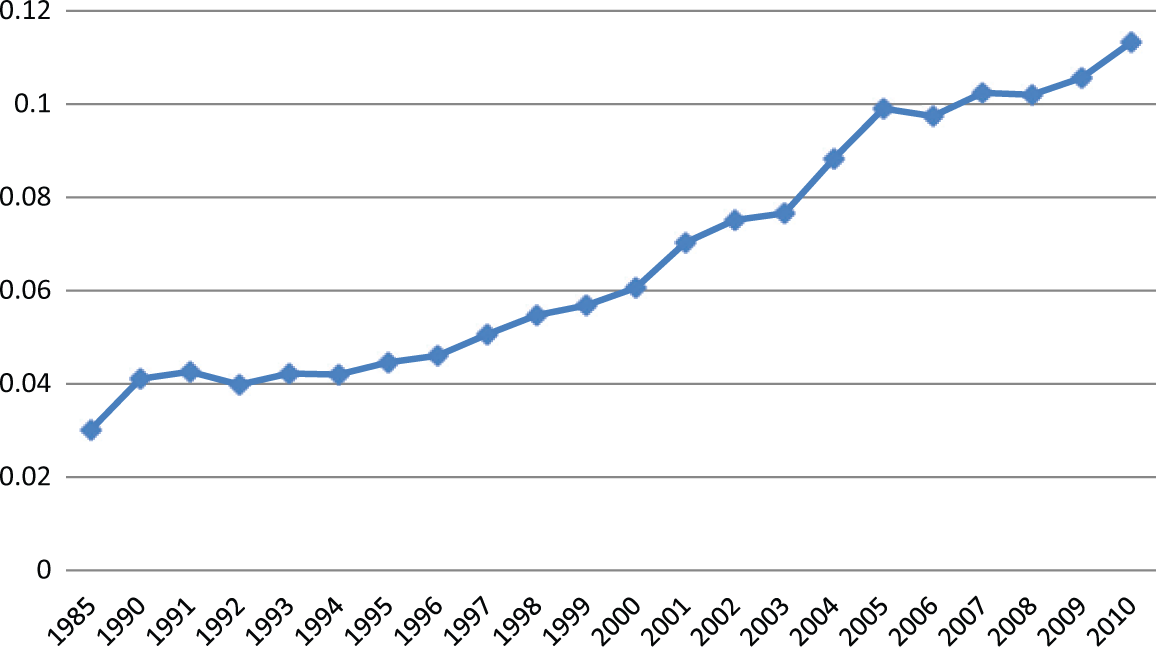
Percentage of persons marrying who had previously married.
Another demographic indicator documenting the continued desirability of marriage is the very low percentage of men and women who have never married by their late thirties. For example, looking at data from 2009, we observe that between the ages of 35 and 39 years, less than 5 percent of the population have never married; only among those born after 1980 is marriage not yet nearly universal (see Figure 5). It is of course too soon to know whether the high cost of establishing new households and the more liberal sexual norms will depress marriage rates among those younger than 30 years, but the recent upturn in CMR captured in Figure 3, the surge in the absolute number of marriages, and the rising rate of remarriage suggest that a large majority of both men and women born after 1980 will marry at least once. The one demographic group where rates of marriage are likely to decline will be among rural men born after 1980, where the proximate cause of decline will be the gender imbalance created by the one-child policy.
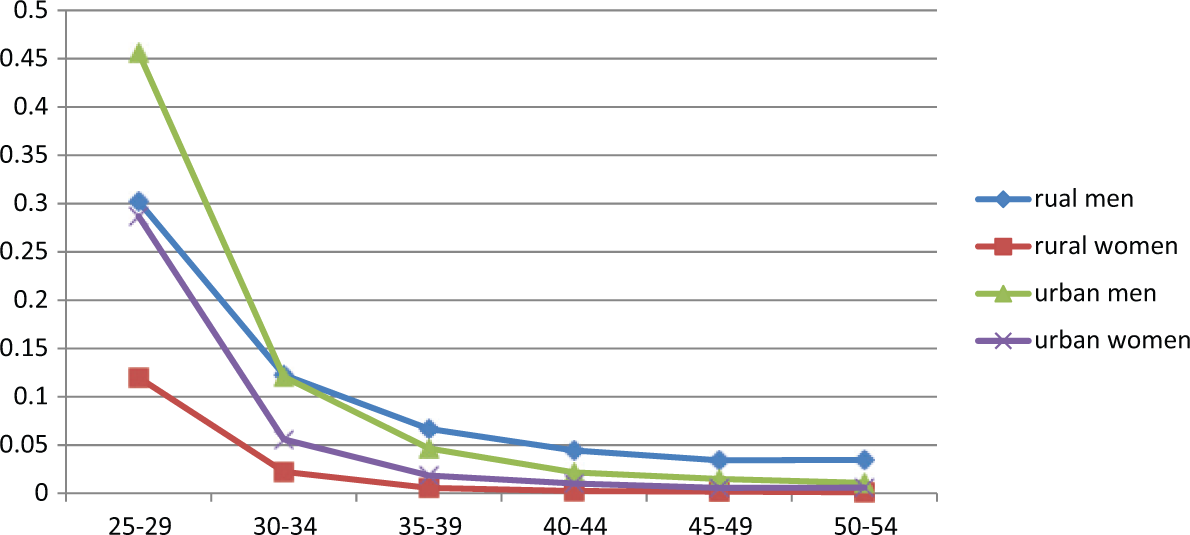
Percentage never married in 2009 by age, gender, and residence.
Marriages as Enforceable Voluntary Contracts
Nowhere in the 1950 Marriage Law do we find the terms “contract” (hetong 合同) or “formal agreement” (yueding 约定). However, in the four articles regarding guardianship, division of property, and financial support in divorce settlements (Articles 20, 21, 23, and 25) the 1950 law did use xieyi 协议, another term often used to refer to legally binding agreements between spouses. Similarly, the new Marriage Law of 1980 never explicitly referred to “contract,” or hetong, but it did use yueding twice. Article 8 guaranteed that either a man or a woman could use a yueding to become a member of the other spouse’s family and Article 13 stated that absent a yueding, all property acquired after marriage would be considered jointly owned 归夫妻共同所有. The 1980 law, however, was silent on treatment of property acquired before marriage 婚前, a distinction Article 23 in the earlier 1950 law had considered when explaining that property women had owned before marriage would not be divided with husbands in the event of a divorce.
As already noted, the 2001 revision of the 1980 Marriage Law added multiple provisions to protect individual property whether acquired before or after marriage, and the 2011 SPC interpretation strengthened the property rights of third parties as well as those of individual spouses in ways that directly undermined equal claims to communal conjugal property 夫妻共同所有. In Article 3, the Revised Marriage Law also for the first time introduced the term “contract,” or hetong. In addition the 2001 statute speaks directly about establishing individual claims to premarital personal assets (Articles 18 and 19), and greatly expands the use of yueding to specify the property claims of an individual spouse (Article 19).
The attention to issues of side agreements before and during marriage, the introduction of contract as well as the new emphasis on personal choice distinguish the Revised Law of 2001 from earlier legislation. However, whether such statutory shifts have any broad impact in a country where law is often aspirational and the state has repeatedly issued new statutes to dictate change remains an open question. On the other hand, because we know that the SPC issues interpretations only when local courts have been overwhelmed by cases initiated by local residents, one assumes that the public opinion on use and misuse of contract in cases of marital disputes had in fact shifted. I turn now to one of the most striking examples of the new centrality of enforceable contracts between engaged or married couples: loyalty agreements.
Loyalty Agreements
I do not know when the first loyalty agreement was created or contested, but in legal handbooks and publications the most frequently cited case involves a couple in Shanghai, both of whom had been previously married and divorced. In May 2002, the wife discovered her second husband was having an affair and the husband sued for divorce. The wife then countersued for the 300,000 RMB compensation as specified in their loyalty agreement. The Minhang District Court ordered mediation, and the wife settled for 250,000 RMB (Jia, 2008: 80–81). However, in 2004, on the husband’s appeal, the Shanghai City Court voided the award on grounds that infidelity was an emotional not legal issue, that loyalty was only aspirational, that such agreements violated personal freedom and the right to privacy, and that parties in a contract cannot specify damages prior to a breach (Li, 2009).
By reviewing materials from law firm websites, legal journals, and court cases that addressed the legality of loyalty agreements, I discovered one line of argument in support of the agreements and another opposed. In support of enforcing loyalty agreements, advocates make four points: (1) loyalty agreements concretize 个体化 the principle of fidelity identified in Article 4 of the Marriage Law (夫妻应当互相忠实); (2) individuals sign these agreements voluntarily and no provisions violate the law nor harm other persons or society; (3) the marriage law guarantees the right to make agreements about division of conjugal property at any time in a marriage; and (4) Article 46 of the Marriage Law guarantees compensation to the innocent party (Fan, 2010; Jia, 2008; Li, 2009; Zhao, 2010).
Opposing the legitimacy of loyalty agreements was an argument similar to that of the Shanghai City Court: (1) infidelity is an emotional or moral issue not a legal issue; (2) inclusion of fidelity in Article 4 of the Marriage Law represents a declaration and therefore as specified in the 2001 SPC interpretation cannot establish grounds for review; (3) loyalty agreements violate constitutional protection of personal freedom 人身自由的权利; (4) civil law cannot allow damages to be specified via a contract in advance of an offence; and (5) because Article 46 of the Marriage Law already provides grounds for the innocent party in cases of adultery, abuse, or extramarital cohabitation to sue for compensation, there is no need for additional agreements (Fan, 2010; Guo, 2010; Jia, 2008; Xu, 2010).
To explore how ordinary citizens rather than legal experts assessed the validity of loyalty agreements as well as other forms of contractual arrangements between engaged and married couples, I now draw on interviews with 48 men and women in Guangzhou and Shanghai. 12 In these interviews, however, we did not limit our questions to attitudes and experience with loyalty contracts but also asked respondents to compare prenuptial agreements and loyalty agreements and also to compare their own experience as spouses to those of their parents. In this way we extended questions about loyalty agreements to a broader discussion of the changing character of marriage. 13
Shanghai and Guangzhou Interviews
When asked if they had heard of a prenuptial agreement 婚前协议, most interviewees (40/48) answered they had. When asked if they thought prenuptials were a good innovation, half thought they were and another third thought they might be useful. By contrast, barely a quarter (13/48) had heard of a loyalty agreement. However, after everyone understood what loyalty agreements entailed, more than half (32/48) thought they were either useless or no good.
Given men’s higher rates of admitted infidelity (Kong, 2011; Zhang et al., 2012) as well as the widespread expectation that men (and their families) are responsible to provide a marital home, I initially had hypothesized that men and women would differ in their assessment of the utility and necessity of prenuptials and loyalty agreements. In addition, given the dramatic economic and legal changes between 1966, the year of the first marriage among our oldest respondents, and 2010, the year of the most recent marriage among our youngest respondents, I also hypothesized that older respondents would be more critical of these innovations than the younger. I was wrong on both counts. Although men more often spoke about the importance of being responsible in marriage and women more often prioritized security, beneath the juxtaposition of responsibility versus security there was gender-neutral agreement that the key threat to marital stability was a general lack of trust and the need for both men and women to protect themselves 保护自己 from being cheated. Women were described (by men and women) as being fearful that husbands would be seduced by young unmarried women at their workplace or during frequent business trips. Men were described (again by both men and women) as being taken advantage of by gold-digging girls, and in particular by poor women who came from another city or province. Given these fears, it was not surprising that most respondents deemed formal prenuptial agreements to be a good innovation. However, far fewer (N = 19) were willing to say they would suggest that a friend or a relative draft a prenup, primarily because they feared that such a recommendation signaled doubt about their friend or relative’s choice of spouse or they felt that decisions about marriage were a private matter between the two individuals. Typical was the exchange on January 29, 2011, between my colleague Peidong Sun and a woman born in 1943 who approved of prenuptial agreements but would not recommend them to others, including her own daughter.
So, even though you would do it yourself, you wouldn’t recommend it to your daughter?
Right, I wouldn’t recommend young people do it this way.
And this is because you hope that they’ll be married for life 白头偕老?
Right. I hope that they will forever have a good situation, right? Marriage isn’t easy, right? It’s not something you just do one day and then divorce the next.
But you said that if their relationship is good, then if they signed a prenup it would not necessarily mean they would divorce, right? What is it that you fear? Why won’t you recommend a prenup?
Because if there were some stuff 东西and I said to the younger generation, when you marry you should first put this stuff in order, this would imply a certain viewpoint, right? But this is not how I think adults like us should behave. Also others would start to look askance at me, right? The young couple now has a good relationship, but I’m asking them to look into the distant future and consider what if their relationship became bad, and suggesting that they now divide their property. Then others will say you’re being too shrewd/calculating 奸细. Also if they followed your view, then it would be harder for them to develop harmony 融洽 and it would be hard to manage. Right? So suggesting it for yourself and for others is not the same.
A second overarching rationale for not recommending others sign a prenup or loyalty agreement was a general reluctance to intervene in the private lives of others. Thus not only has the party-state granted marriages more autonomy and personal space, so too have individual citizens. Here I excerpt from an October 22, 2010, interview by Jun Zhang with a married Guangzhou man who was born in 1982. In this case, the man would not condemn the agreements for others because he equated the existence of such agreements with the more general freedom to choose how to conduct one’s personal affairs.
Yes. I personally don’t feel it will have a very negative impact, and I also don’t feel it’s absolutely necessary. That’s what I feel 觉得.
So you feel it’s nothing so special.
Right, it’s just one free choice 选自自由. It has its reason to exist, but it’s not that every couple will choose it. This is how I feel.
Respondents also repeatedly noted that if people did not trust their partners before marriage, they should not marry, and that if later they were betrayed, they should simply divorce. Thus even in cases where respondents considered the prenuptial to be a good innovation for minimizing disputes, they did not enthusiastically endorse it because they believed a request for a prenuptial agreement undermined a more fundamental value of trust. Moreover, most interviewees embedded their discussion within comments on the fragility of marriage in the competitive and permissive market society in which they lived.
Guangzhou and Shanghai are huge metropolitan cities and marriages there confront economic, social, and cultural conditions unlike those in rural villages or small towns. But I am not using these interviews to generalize to all of China, but rather to identify the concerns that individuals highlight when they discuss contemporary marriages under conditions of pervasive competition and insecurity. These men and women often spoke approvingly of the new freedom for unhappy couples to divorce, but like the 2011 SPC interpretation they did not endorse the use of loyalty agreements to create trust and many (especially among the youngest cohort) were confident that in their own marriages they enjoyed such trust. Yet even as they felt that their spouse was trustworthy, they were aware that in contrast to earlier decades it had become more difficult to sustain a satisfying marriage given the greater freedoms, mobility, and temptations 诱惑 of the current era.
Conclusion
Over the past 50 years, European and North American societies have witnessed dramatic changes in the institution of marriage. Marriage rates have fallen and non-marital cohabitation has increased among all socioeconomic groups. Most striking is the increase in births to unmarried women or women not in a legal relationship with the father. In countries as economically and culturally diverse as Mexico, France, Sweden, and Slovenia, fewer than half of children are born to married mothers (Social Policy Division, 2012). This pattern of non-marital childbearing has also coincided with dramatic declines in overall fertility (Lesthaeghe, 2010). In many parts of the world, therefore, the new millennium has simultaneously witnessed very low rates of childbearing and the delinking of procreation from marriage, outcomes that are variably attributed to uncertain job prospects for men, rising levels of education and employment of women, easier access to effective contraception as well as cultural shifts that destigmatize both childlessness and out-of-wedlock births (Cherlin, 2004; Cohen, 2002; Coontz, 2004).
At the most general level, these recent changes can be viewed as a continuation of earlier shifts away from patriarchal marriages anchored in community obligations and male dominance (Burgess, Locke, and Thomas, 1963). But for some scholars, the changes since 1970 indicate a more radical “deinstitutionalization” of marriage without any clear “reinstitutionalization” around generally accepted new norms for household and family formation (Cherlin, 2004). In the United States, where marriage rates are still noticeably higher than in Europe (see Figure 3), sociologist Andrew Cherlin has hypothesized that marriage now functions as a prestigious form of symbolic capital to which a majority of both men and women aspire but which only an advantaged minority (usually college educated whites) achieve, an interpretation recently confirmed by demographer Averil Clarke’s analysis of differential marriage rates among American women (Cherlin, 2004; Clarke, 2011). Few would go as far as Anthony Giddens (1992) and predict that marriage will become “just one life-style among others” (1992: 154). But many agree that the economic, legal, and cultural shifts that have privileged private preferences and individualized property rights since 1970 have changed the expectations and experience of marriage (Cherlin, 2004; Cohen, 2002; Coontz, 2004; Lesthaeghe, 2010; Stacey, 2011).
But should we expect that the recently more privatized Chinese marriages will be similarly deinstitutionalized? Certainly, party-state policies on divorce and property as well as citizens’ expectations of marriage and sexual intimacy have substantially shifted. Barriers to divorce are minimal, prenuptial property agreements have gained legitimacy, communal property claims have been weakened, and premarital and extramarital sexuality are rarely punished (Farrer, 2002, 2006; Farrer and Sun, 2003; Shen, 2008; Pei, 2011; Yan, 2011). Yet, in other essential dimensions, changes in marital experience in China do not resemble the recent shifts in capitalist democracies of Europe or the Americas but rather resemble behaviors prevalent in China’s past.
For example, in terms of the most recent SPC interpretation that privileged claims of a husband’s parents over the wife, we observe both a break with the socialist past and a possible return to earlier traditions that privileged familial over conjugal claims to property. On the other hand, the trend to delink sexual intimacy and marriage suggests only a partial return to the norms of the 1920s and 1930s. In those pre-socialist decades, men but never women could legitimately experience premarital and extramarital sexual relationships, and men of wealth often took secondary wives (Mann, 2011; Hershatter, 1997). Thus the new freedom of women as well as men to de-link sex and marriage marks a sharp break from the high-socialist years but only a partial return to or reinstitutionalization around pre-1949 behaviors.
Turning to issues of childbearing, we immediately confront the most fundamental distinctions between marriages in China and those in Europe and the Americas. In China, as in other Asian societies, marriage and parenthood are tightly linked and sequenced and there are few births outside marriage (Jones and Gubhaju, 2009). Thus even as women match or exceed male enrollment in tertiary education and most mothers work outside the home, the rate of non-marital births remains very low. Explanations for the low rates of non-marital childbearing in Asia often stress traditions that prioritize fatherhood for men, emphasize the filial duty to continue the family line, and make motherhood virtually mandatory for women to be treated as adults (Jones and Gubhaju, 2009). In China, in addition to these shared Asian norms, the government prohibitions against non-marital childbearing explicitly confine parenthood to marriage regardless of ethnicity, religion, or educational background (Immigration and Refugee Board of Canada, 2009, 2012). 14 For this reason the one-child policy, which represents a powerful illustration of the CCP’s continued commitment to a developmental state, makes the Chinese experience distinctive. At the same time, however, the one-child policy stands in contradiction with the CCP’s own increased recognition and support for more individualized property claims and enlarged privacy rights that intensify privatization of marriage. 15
To date, these contradictions have been muted by the CCP’s support for expanded personal autonomy, greater economic freedoms, and minimal constraints on sexual intimacy. Moreover, as the party-state continues to disengage from close surveillance of private lives and to extend the logic of voluntary contract to intimate relationships, its own actions (and inaction) serve to further privatize the institution of marriage.
Footnotes
Acknowledgements
This article could not have been completed without the expert interviews carried out by Professors Peidong Sun and Jun Zhang. I also benefitted greatly from comments by Juan Chen, Jane Duckett, Andrew Junker, Minhua Ling, Xuefei Ren, Helen Siu, Anthony Spires, Hania Wu, and anonymous Modern China referees.
Declaration of Conflicting Interests
The author(s) declared no potential conflicts of interest with respect to the research, authorship, and/or publication of this article.
Funding
The author disclosed receipt of the following financial support for the research, authorship, and/or publication of this article: Field work for this research was supported by a faculty research grant from the Cheng-Lee Endowment of the Council of East Asian Studies at Yale University.