



Abstract
This article examines the career backgrounds of municipal Chinese Communist Party secretaries between 1990 and 2011. Based on an analysis of 898 cadre biographies and 32 interviews with local government officials during 2011 and 2013, this article shows that the majority of municipal party secretaries had spent their careers working at the provincial and municipal levels, while only few advanced up from the county. Our analysis finds that obstacles hindering leading county cadres from rising to the upper ranks of the municipal apparatus include age and education restrictions; limited positions at the municipal level; the lack of networks linking to provincial leaders; and provincial leaders’ appointment preferences. Limited career advancement opportunities for county cadres have important implications for understanding the incentive foundations of China’s bureaucracy. With only slim prospects for leading county cadres to rise to top municipal positions, the political incentives outlined in the cadre evaluation system might not be as effective in steering cadre behavior as currently claimed in the literature.
The combination of China’s strong growth with the survival of a one-party system has given rise to a sizeable literature examining China’s approach to state-led development overseen by the Chinese Communist Party’s bureaucracy. Institutions internal to the Chinese Communist Party (CCP) have been studied systematically to explain how an authoritarian political system like China’s can be so resilient and effective in facilitating reform and development. Among different institutions embedded in the CCP, the party’s cadre management system is seen as particularly important in contributing to the survival of China’s one-party system (Edin, 2003; Huang, 2002; Landry, 2008).
A growing number of studies have analyzed the basis of cadre appointment and promotion decisions in China (Burns, 1987, 1994; Choi, 2012; Li and Zhou, 2005; Manion, 1985, 1993; Shih et al., 2010, 2012; Walder, 1995). Contrary to the conventional view that delivering economic growth is the most important criterion in promotion decisions, recent findings suggest that China’s cadre management system, in fact, neither rewards leaders with good economic performance in their municipality and nor does it penalize laggards (Landry, 2008). Instead, factional ties with various top leaders, educational qualifications, and provincial revenue collection have been identified as key factors in explaining promotion outcomes (Shih et al., 2012). While this recent work has significantly advanced our understanding of the determinants of cadre advancement in China, as yet very little attention has been paid to how leading cadres’ career pathways shape their prospects within the party-government hierarchy. Using a new biographical database of 898 municipal party secretaries 书记, this article addresses this gap by examining the career trajectories of these leading cadres 领导干部. 1
An analysis of leading cadres’ career backgrounds before being appointed a municipal party secretary helps to achieve numerous research objectives. First, municipal cadres are the first group of leaders selected by provincial organization departments, and not by the center, under the “one-level down” appointment system. Since most previous work has focused on the appointment of provincial leaders (Choi, 2012; Li and Zhou, 2005), shifting attention to municipal leadership allows us to assess how appointment decisions are made at lower levels of China’s decentralized leadership selection system. 2 Our data set also allows us to track leading cadre movements across vertical, horizontal, and regional levels, thereby shedding light on the career background of municipal party secretaries. In our study, vertical mobility refers to the extent to which cadres move up or down between different administrative levels. Horizontal mobility captures cadre movements across different party and government structures. Our regional mobility index looks at the number of provinces in which cadres have lived, studied, or worked.
The findings show that, before their appointment, municipal party secretaries typically move horizontally across different party and government bureaucracies and organizations, yet vertical and regional mobility are much less common. A close analysis of vertical mobility reveals that leading party-government officials mainly move from positions in the provincial government to the leadership of municipalities, but upward mobility, wherein county-level cadres are promoted to a municipality, occurs only in exceptional cases. The main obstacles hindering leading county cadres from rising to top municipal positions include age and education restrictions; the limited number of available spots at the municipal level; the absence of factional ties to provincial leaders as well as the appointment preferences of provincial leaders. These findings have important implications for understanding the incentive structure of China’s bureaucracy. With only slim prospects of rising to the upper ranks of the municipal apparatus, capable and eager mid-career county cadres might not be as responsive to political incentives outlined in the cadre evaluation system as the literature has tended to assume. For such leading cadres, the provision of economic incentives such as wages, subsidies, and other material or social benefits are likely to elicit a higher degree of compliance.
Data Sources and Measurement
Our analysis draws on a database summarizing biographical information about municipal party secretaries as well as semi-structured interviews. We collected biographical data for 898 municipal party secretaries from 234 municipalities in 23 provinces, covering the period from 1990 to 2011. The database includes information about municipal party secretaries’ demographic characteristics such as gender, age, ethnicity, birthplace, and formal education. It also tracks party secretaries’ previous career positions prior to their appointment, including the location, length, and type of their first position as well as the five preceding work placements. Table A1 in the appendix summarizes cadres’ demographic details. We differentiate between two groups of municipal leaders: party secretaries (PS) who were appointed during the period 1993–2001 (PS 93-01) and those who were appointed between 2002 and 2011 (PS 02-11). The distinction between the two groups helps to grasp commonalities and differences between collective traits of different generations of municipal party secretaries. The year 2002 was selected as a turning point to mirror leadership changes at the national level in 2002–2003 with the new Hu-Wen administration after the Sixteenth Party Congress. 3
To compile the database, we used two major sources: municipal government websites and the Renmin Wang website (www.people.com.cn). The provincial-level municipalities—Beijing, Tianjin, Shanghai, and Chongqing—are excluded from the database as they have a unique status thanks to their placement under the direct supervision of the State Council and because they do not represent typical provinces with several municipalities (the unit of our analysis). Municipal party secretaries in Tibet, Qinghai, Xinjiang, and Hainan were also excluded since little or no public information on municipal leaders in these localities was available.
In order to categorize the career background of municipal party secretaries, we first analyzed the administrative level and the particular function of cadres’ first entry-level position as well as their last five positions prior to appointment. Table A2 in the appendix summarizes the different categories we used for coding (i.e., government-related, party-related, or functional departments—系统). As a next step, we categorized party secretaries’ career background according to the administrative level in which they spent the largest portion of their career. The categorization is based on the highest number of years that a cadre spent at a particular administrative level over his or her last five positions. On average, a party secretary spent ten to twenty years in such a career track. For example, if a party secretary worked for three years as a deputy party secretary at the municipal level, four years as a vice-mayor at the municipal level, six years in a functional department at the municipal level, three years as an assistant to the governor at the provincial level, and one year in a functional department at the provincial level, then this would add up to thirteen years of municipal and four years of provincial-level work experience, and thus the cadre would be counted as having a municipal career background. This is, of course, only a snapshot but is, nonetheless, helpful to understanding where a cadre served the majority of his or her time during the last ten to twenty years before his/her appointment as a municipal party secretary. In addition to examining cadres’ first entry-level position and their last five work placements, we also screened each cadre biography and noted whether a cadre worked previously at the town or county level in the course of his or her career. Since the group of cadres who worked at the county level during the last five work positions accounts for 90% of all party secretaries with county-level experience (29% of the sample), our analysis does not lose much by focusing only on the last five work placements.
The coding of party secretaries’ career paths is challenging due to missing or incomplete biographical data and the common practice of cross-posting. Among the 23 provinces considered, the profiles of some party secretaries are incomplete. It was, for example, confirmed during interviews that Ji Youwei was the party secretary in Datong municipality before 2000, a fact that is also recorded in local gazettes. Yet, despite various research efforts, no public record of Ji Youwei exists. Many publicly available cadre biographies are also incomplete. For instance, only 815 of the 898 party secretaries have made public details of their previous work experience. Of these 815 party secretaries, 12 profiles do not record the corresponding time periods for the work position. These observations were accordingly dropped from the study.
Another challenge in coding arises from the common practice of cross-posting, whereby a cadre gets appointed to two or three government or party positions simultaneously, either in the same locality or between different administrative levels (Huang, 2002). In cases where cadres listed cross-postings on their curriculum vitae, we studied each profile and identified the position with the main responsibilities and higher rank. For example, if a cadre held a post as a county head or municipal mayor while simultaneously acting as the deputy party secretary of the same locality, we picked the role as the county head/mayor as the main work position as this post ranks higher than the local deputy party secretary position and comes with real daily responsibilities. In instances where a cadre worked as a municipal party secretary while also being a member of the standing committee of the province, we picked the work as a municipal party secretary as the main position because the cross-posting to the provincial level is often only a transitional role or an opportunity for a cadre to lobby for his locality’s or his own interest, but the main responsibility remains the daily work as a municipal party secretary.
The analysis also draws on 32 interviews with party-government officials at the county, municipal, and provincial levels during 2011 and 2013. We interviewed cadres in Beijing and in four provinces (Hunan, Jiangsu, Jiangxi, Shanxi) to avoid biases based on regional appointment particularities. The interviews provided general information on local cadres’ career trajectories and promotion opportunities and revealed additional information on barriers to leading county cadres rising to the top of the municipal party-government apparatus. We also distributed a structured questionnaire to our interviewees, asking specific questions on promotion barriers and how they affect cadre behavior.
Our analysis begins by outlining the main characteristics of party secretaries’ vertical, horizontal, and regional mobility. We then analyze the direction of vertical mobility and show that it tends to point downward, from the provincial to municipal level. The discussion then turns to the limited upward promotion opportunities available to county-level cadres and offers some explanations for the existence of this glass ceiling. The subsequent section draws on interview data and summarizes the main obstacles that tend to prevent county cadres from rising to leadership positions at the municipal level.
Cadre Mobility: Vertical, Horizontal, and Regional
This section examines cadres’ vertical, horizontal, and regional mobility prior to their appointment to the party secretary post. The “vertical mobility” index measures the extent to which cadres moved between different administrative levels (i.e., central, provincial, municipal, county, or township level) over the course of their past five work positions. For example, a party secretary received 1 point if she or he worked at the same administrative level and 5 points if she or he worked at five different levels during the last five work appointments. The “horizontal mobility” index measures cadres’ experience in different departments or functions across different party and government structures over their last five work positions. A party secretary received 1 point if she or he always worked within the same function (e.g., same bureau) and 5 points if she or he worked in five different functions (e.g., four years as a deputy party secretary, five years in the organization department, four years in the propaganda department, three years in the economic commission, and six years as a county head). Finally, the “regional mobility” index captures the number of provinces in which a party secretary has lived, studied, or worked. A cadre who was born, studied, and worked during the last five previous positions in the same province in which he or she was ultimately appointed to party secretary would receive a score of 0. By contrast, a cadre who is currently a party secretary in one province but whose birthplace, undergraduate and graduate university degrees, and place of work over the five previous positions were in a different province would receive a score of 8. The findings are summarized in Table 1. Party secretaries are more likely to move horizontally between different functions in the party-government apparatus instead of vertically across different administrative levels. Regional mobility is low; on average, most municipal party secretaries have lived, studied, or worked in just two different provinces. The three indices do not change much over time, though party secretaries appointed since 2002 have slightly higher vertical, horizontal, and regional mobility than their predecessors. 4
Cadre Mobility Indices.

Source. Party Secretary Database, 2013.
Vertical Mobility
A more detailed analysis of vertical mobility shows that, before their appointment, party secretaries mainly worked at provincial and municipal levels, while relatively few leading cadres had recent county-level work experience. Three quarters of all party secretaries (78%) had previously worked at the municipal level in at least one of their five last work placements. Yet, it is also significant that roughly a quarter of all party secretaries (22%) had not worked at the municipal level during their last five positions before their appointment, but were sent down to the municipality directly from the provincial level. More than half of all party secretaries (56%) had worked at the provincial level in at least one of their five last previous positions, suggesting that possessing close links to decision makers at the provincial level may be very helpful in gaining appointment as a municipal party secretary. Finally, party secretaries who had worked at the county level in at least one of their five previous positions were rare, accounting for just 26% of the total. Given that overseeing counties is an important task for municipal party secretaries, their limited work experience at the county level is surprising.
Horizontal Mobility
Among the different mobility indices, horizontal mobility is highest as promotion-hopeful cadres commonly go through different functional departments and bureaus within the party and government structures. Previous work experience in units with far-reaching influence, such as economics- and commerce-related bureaus, propaganda departments, and organization departments, is particularly common for municipal party secretaries. Among other benefits, establishing a footing in the personnel management bureaucracies, economic bureaus, or the propaganda bureaus might be an aid to building useful personal relationships needed to rise to the top of the municipal apparatus. Cadres also switched between party- and government-related positions, although more cadres switched from governmental units (e.g., Development and Reform Commission, Finance Bureau) to party-related units (e.g., Organization Department, Party Committee) than vice versa. 5
Regional Mobility
The low regional mobility suggests that cross-provincial mobility is not a prerequisite for being selected as a municipal party secretary. Figure 1 decomposes the regional mobility index into its eight sub-categories: birth place, location of undergraduate and graduate university, and place of first, second, third, fourth, and fifth previous work positions. Thirty percent of leading cadres are party secretaries appointed in a different province than the one in which they were born. Most commonly, cadres studied in a province other than the one where they worked as a party secretary: 36% of cadres obtained their undergraduate degrees in a province other than the one in which they held the party secretary position while 62% held graduate degrees from universities in another province. Regional mobility declines drastically once a person joins the civil service. While 11% of municipal party secretaries had their first of the five positions under consideration in another province, this share declines for the previous fourth, third, second, and last positions to 9%, 7%, 4%, and 1%, respectively. 6 Low cross-provincial mobility among leading cadres indicates the provincial focus in appointment decisions and suggests that one of the much-vaunted hallmarks of China’s approach to reform—the sharing of local best practice examples and policy experiments at the county and municipal level across provinces—does not appear to be a priority in appointment decisions on municipal party secretaries.
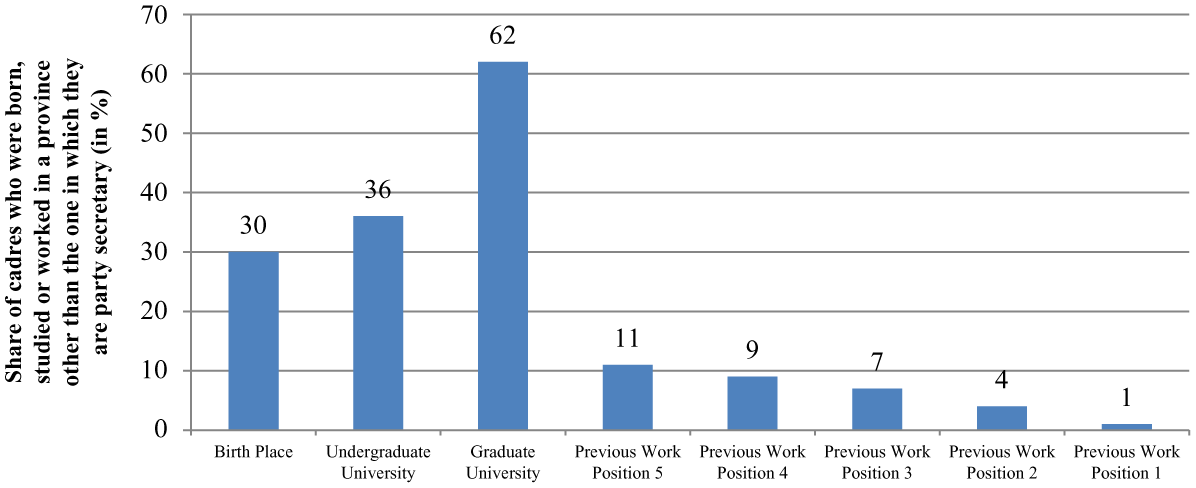
Regional mobility for municipal party secretaries (1993–2011).
To summarize this section of our analysis, we can say that many party secretaries in their last five working posts had moved horizontally between different functions in the party-government apparatus, but vertical and regional mobility was much lower. The results for vertical mobility are particularly interesting. We observe that cadres mainly moved between the provincial and municipal levels, and very few movements to and from the county level are recorded. The next section zeroes in on the features of downward mobility (e.g., moving from the provincial to the municipal level) and upward mobility (e.g., moving from the county to the municipal level).
Vertical Mobility: Downward and Upward Mobility
In order to unpack the issue of vertical mobility and to distinguish more clearly between downwardly and upwardly mobile cadres, this section first explores municipal party secretaries’ first entry-level position after college or university and their five previous work experiences before their appointment. We then classify cadres’ career backgrounds based on the administrative level in which they spent the bulk of their time in their last five positions.
The analysis of party secretaries’ first entry-level position after college or university shows that the most common entry point into the bureaucracy was the provincial level. Among the cadres who directly entered a political position in the civil service system (321 cadres, or 43%), 7% started at the central level, 28% at the provincial level, 16% at the municipal level, 27% at the county level, and 22% at the town or village level. The remaining party secretaries (433 cadres, or 57%) started their careers in non-political positions, such as working at a factory (37%), a school (39%), or in other non-political jobs (24%). Party secretaries who entered a political position at the county or town level (49% of 321 cadres) left their county position on average at the young age of 24.8 years. This suggests that cadres need to move early on out of a county in order to make it to a top municipal leadership position, allowing them sufficient time to cycle through different stations at the municipal and provincial level.
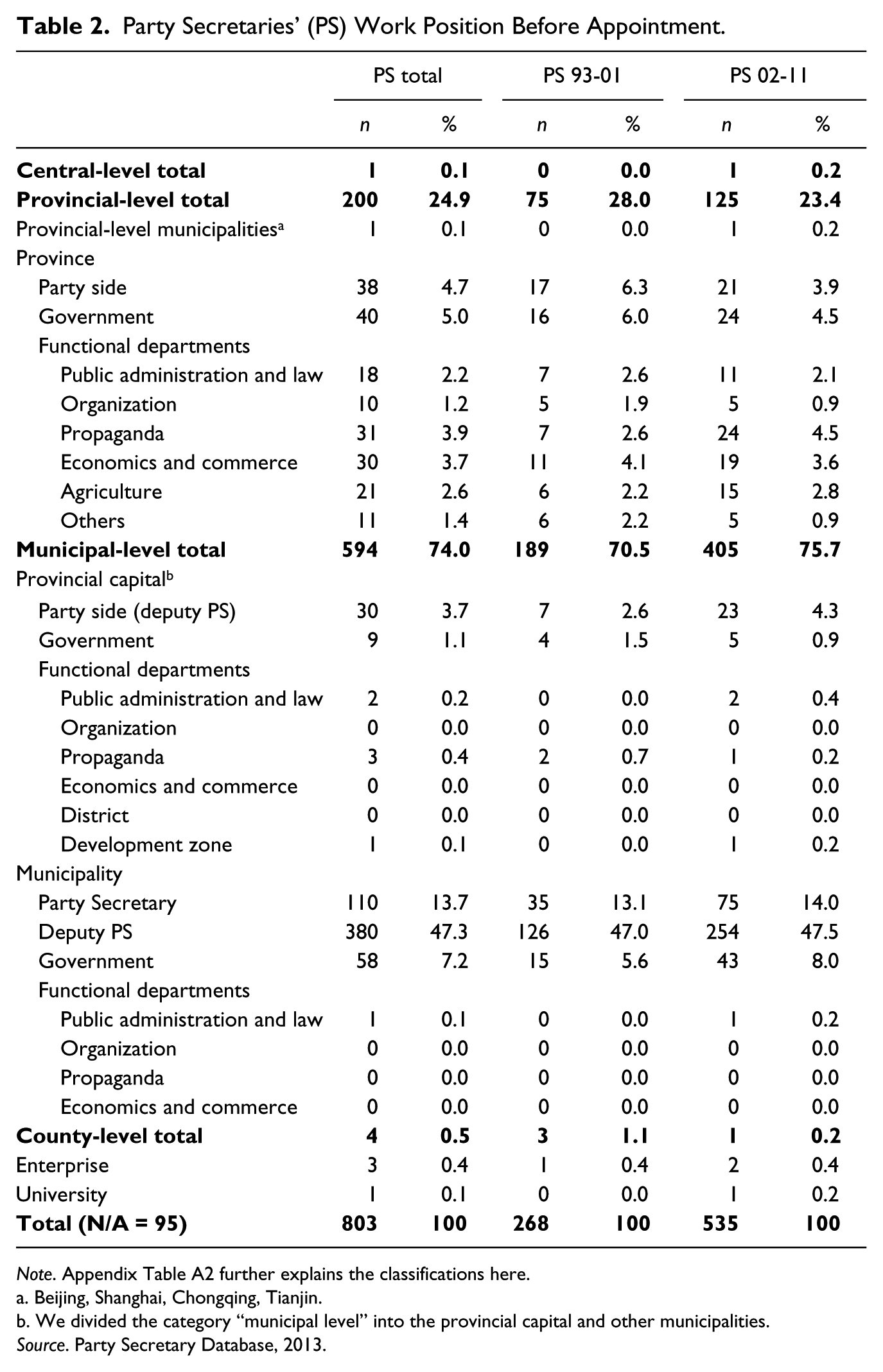
When examining party secretaries’ last five work positions, it becomes clear that most cadres had spent the last ten to twenty years at the provincial or municipal level. Table 2 lists the positions party secretaries held immediately before their appointment. Seventy-four percent of all party secretaries came from different positions at the municipal level, while 25% were appointed directly from positions at the provincial level and less than 1% came from the county level. Almost half of all party secretaries acted as deputy municipal party secretaries prior to their appointment (47%). This shows that leading cadres could first learn about their future tasks and prove themselves before their skills were put to the test as the “number one hand” 一把手 in a municipality. Some party secretaries (15%) were also promoted directly from a functional department at the provincial level, indicating that work experience in the provincial capital is important for cadre advancement. Fourteen percent of cadres were already acting as a municipal party secretary in their previous position but in a different locality. This illustrates that party secretaries are frequently rotated to another municipality to serve again as a party secretary. 7
Party Secretaries’ (PS) Work Position Before Appointment.
Beijing, Shanghai, Chongqing, Tianjin.
We divided the category “municipal level” into the provincial capital and other municipalities.
Source. Party Secretary Database, 2013.
As a next step, we investigated the career background of selected party secretaries. The categorization of party secretaries’ career background is based on the administrative level in which they spent the largest number of years during their last five work positions prior to appointment as municipal party secretary. Among party secretaries, 2.7% spent most of their career at the central level, 32.3% at the provincial level, 56.1% at the municipal level (including 7% in the provincial capital), 5.4% at the county level, and 3.6% with a state-owned enterprise or a university. 8 Figure 2 illustrates that the career backgrounds are largely similar between the two different generations of party secretaries. One difference is that, in the group appointed since 2002, the share of party secretaries with a county background dropped significantly from 9.8% to 3.2%. In other words, there are fewer and fewer municipal party secretaries who spent significant time at the county level.

Career background of municipal party secretaries.
We now consider how many party secretaries have held at least one position at either the provincial or county level. More than half of all cadres (56%, or 475 cadres) had spent time at the provincial level during one of their five previous work positions, suggesting that developing personal networks to provincial leaders can be important to climbing up the career ladder. Table 3 shows that the most common provincial-level positions held by future party secretaries were in the economics or commerce bureaus. The next most common trajectory was coming up through the government side, including the following positions: secretary general/deputy secretary general 省政府秘书长/副秘书长 of the provincial government, deputy governor 副省长 of the province, and assistant to the provincial governor 省长助理. The third most common type of experience gathered by party secretaries at the provincial level was in party-related positions, such as provincial party secretary/deputy secretary of the Communist Youth League, secretary general/deputy secretary general of the provincial committee, and head/deputy head of the general office of the provincial committee. 9 In addition, 54% of all party secretaries (457 cadres) had worked in the municipal government in the provincial capital during at least one of their last five positions before becoming a party secretary. 10
Party Secretaries’ (PS) Work Experience at the Provincial Level.

Note. The analysis looks at the past five work experiences. Only the function where a party secretary spent most time at the province level is taken into account here.
Source. Party Secretary Database, 2013.
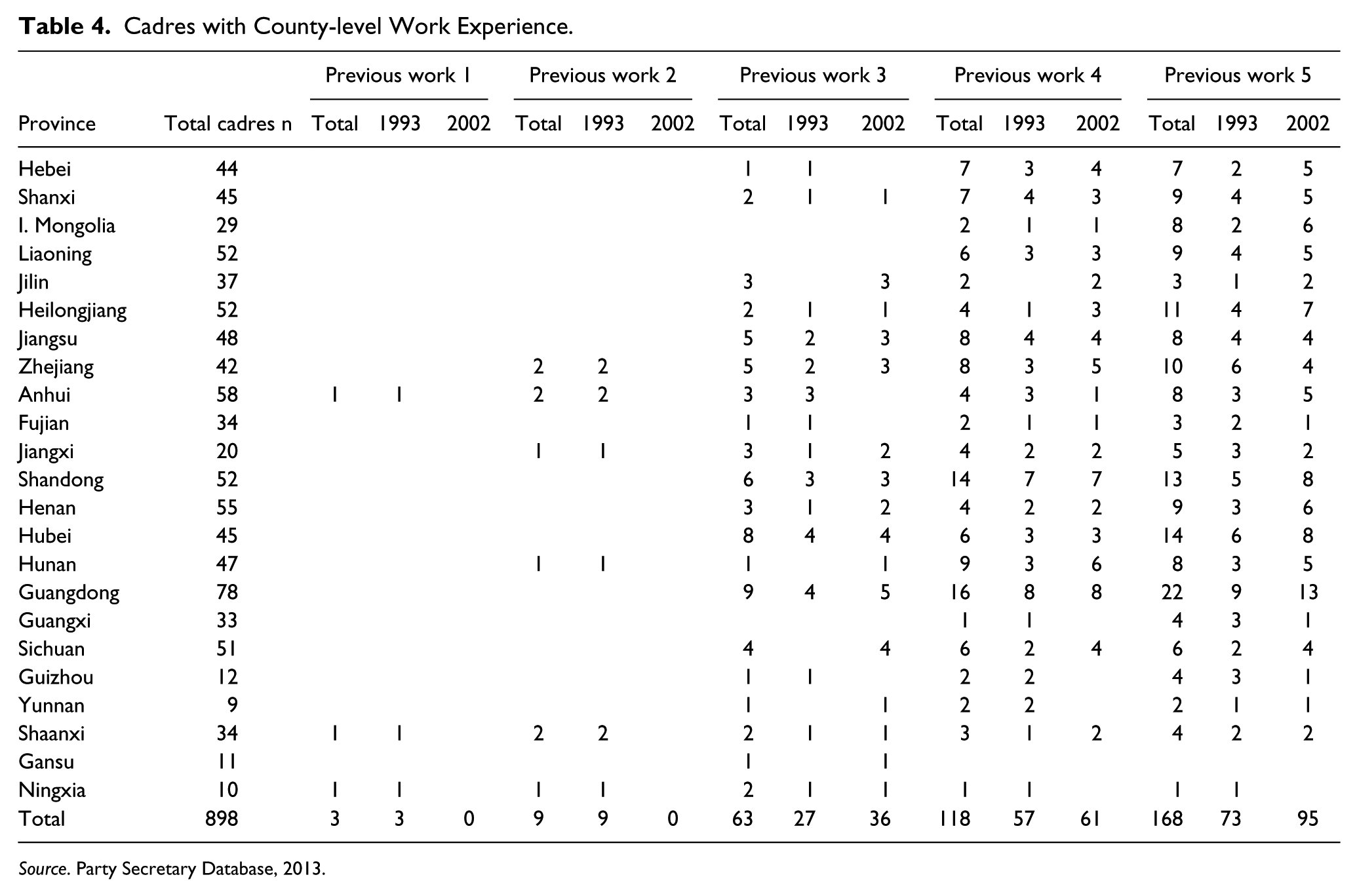
Compared with the number of party secretaries with provincial work experience, there are significantly fewer municipal party secretaries with previous county-level work experience. In total, only 259 cadres (29%) had, at some point in their career, worked at the county level, while 639 cadres (71%) lacked any form of county work experience. Among the 29% (or 259 cadres) with county-level experience, 202 cadres had regular grass-root experience 基层经验 while the remaining 57 cadres were sent to the county temporarily in order to gain additional leadership experience. When looking at their last five work positions, 26% (or 235 cadres) of all party secretaries worked at some point in a county. As shown in Table 4, among party secretaries appointed since 2002, none had county-level work experience during their last or next to the last position before becoming a party secretary and a small minority had worked at the county level at some point in their prime career time (i.e., the last five work positions averaging approximately thirteen years prior to their appointment as party secretary at age 49 years).
Cadres with County-level Work Experience.
Source. Party Secretary Database, 2013.
In summary, vertical mobility mainly concentrates on cadre exchanges between the provincial and municipal levels. More than half of all the municipal party secretaries appointed by the provincial party committees and organization departments had previously worked at the provincial level and one quarter were provincial careerists, holding no recent municipal work experience. Notably, upward mobility from the county to the municipal level was much lower. Party secretaries who initially entered the civil service at the county level or below tended to move to the municipal or provincial level at a very young age. Of all party secretaries in the leadership database, just 5.4% were categorized as cadres with a county-level background and only 26% had worked at least once at the county level in one of their last five work positions. This is surprising since county governance is one of the core tasks of municipal leaders and one assumes that leaders with firsthand knowledge of the challenges faced by county leaders would be better positioned to perform this task. The predominance of previous experience at the provincial and municipal levels in the curriculum vitae of current municipal party secretaries indicates the limited opportunities for career advancement for leading county officials. Overall, there seems to be a glass ceiling for county cadres, for all except a precious few high-fliers who spend a brief period in sub-municipal positions before helicoptering into higher levels.
Glass Ceiling for Leading County Cadres
Secondary sources and anecdotal evidence from fieldwork provide further evidence of the limited career advancement opportunities for leading county cadres. According to a survey by Renmin Forum, 64% of the respondents stated that there is a large glass ceiling for leading cadres who work at the county level. Only about 10% of approximately 400,000 to 500,000 leading county cadres have the possibility of getting promoted (Renmin Forum, 2009). Interviews conducted with leading county cadres during 2011 and 2013 further confirmed the difficulties that capable cadres at the county level face in trying to get promoted above the county. Each of the leading cadres interviewed agreed that there is a glass ceiling for county cadres. Informants estimated that only 10% to 40% of the most excellent county cadres deserving a promotion to a municipality actually received such a promotion. Interviews further revealed that among cadres selected for promotion to the municipal level, a few of them made it eventually to the post of municipal vice-mayor or municipal departmental head, but these leading cadres were almost never promoted to the top positions in a municipality (INT20).
Exceptional Cases
This section considers outliers in the party secretary database, that is, cadres from the county level who did climb up the ladder and made it into the exclusive provincial-municipal club. One such figure is Zheng Xiaoming, who served as a party secretary of Shizuishan municipality in Ningxia from 1994 until 2002 and worked at the county level directly before his promotion. His case illustrates the importance of being promoted at a young age. After graduating from college with a major in farmland conservation in 1982, Zheng Xiaoming began work at the Bureau of Water Conservancy and Hydroelectric Power in Pingluo county in Ningxia. After only two years, at the age of 29, he was promoted to head of the bureau. In 1986, he was appointed deputy head of the county and in 1989 he became the vice party secretary of Pingluo county. In 1991, at the age of 37, he was promoted to county party secretary, in which post he served until 1993. Next, he became a member of the municipal standing committee while, at the same time, continuing in his post as party secretary of Pingluo county. From 1993 to 1994 he studied at a Central Party School and on completion of his studies in 1994, he was selected as the new party secretary of Shizuishan municipality, where he served two terms, until 2002. From Zheng’s career path it is very apparent that he did not stay anywhere for longer than two years, ensuring that he could advance to the municipal level quickly enough to make party secretary before the retirement age of 60. Within four years of starting his career as a civil servant, he was promoted to the county’s leadership group 领导班子, all of which suggests that he must have had very strong supporters among municipal leaders with a say in county-level appointments.
Other exceptional cases where a cadre with a county career background rose to a municipal party secretary position can be found in Anhui (Anqing municipality) and Shaanxi (Yulin municipality). In both cases, administrative reforms helped county cadres to climb the ladder. In Anhui, Anqing municipality’s party secretary Zhu Duwen (2008–to today) spent the majority of his early career in the county of his birth, Liu’an. After numerous career stops, Zhu was ultimately promoted to party secretary in Liu’an county in 1997. In 2000 Liu’an was upgraded from county to municipal administrative status 县改市. During the administrative reforms, Zhu was promoted from county-level party secretary to vice party secretary of Liu’an municipality. In 2001, he was appointed the vice party secretary of Anqing municipality and since 2008 he has been the party secretary of Anqing. It is likely that the upgrade of Liu’an county helped Zhu to step into the municipal-provincial circle. 11 The third exception, party secretary Liu Hanxing from Yulin municipality in Shaanxi, benefited from the same exceptional circumstances—he was once the party secretary of Yulin county, which was also upgraded to municipal status in the year 2000. As noted, these are the exceptional cases in our sample and, as a rule, county leaders are not in the running for municipal party secretary posts.
Barriers to Upward Mobility for County Cadres
The preceding analysis highlights the thickness of the glass ceiling above county-level leaders’ heads and prompts the question: Why do so few municipal party secretaries rise from the county level? Based on the biographical analyses, interviews with cadres, as well as a short structured questionnaire filled in by our interviewees, we identified four main obstacles hindering county cadres’ promotion to the upper ranks of the municipal apparatus: age and education restrictions; limited availability of spots at the municipal level; lack of network connections; and the appointment preferences of provincial leaders. 12
Age and Education Restrictions
Two thirds of all interviewees pointed to age and education restrictions as a key factor explaining why so few leading county cadres manage to rise to leading positions in municipalities. Cadres are often too old when they reach the deputy department rank 副厅级 and the full department rank 正厅级, which are the minimum ranks 级 necessary to be considered for a municipal party secretary post (INT21, INT23, INT29, INT31). 13 According to numerous official documents published by the State Council and the Central Organization Department, the average age of county and municipal leading cadres at the time of promotion should be kept at around 45 years. 14 Many provincial and municipal organization departments closely follow these guidelines and the stated maximum age requirement is usually around 45 years. Sometimes leading cadres keep applying for municipal posts until the age restriction prevents them from further trying to apply (INT23). This suggests that age restrictions might eventually constitute an important barrier, but other factors hinder county cadres much earlier on from joining the provincial-municipal club.
Official documents also state that municipal party secretaries and mayors should hold at least a bachelor’s degree. This further excludes some leading county cadres from the potential pool of candidates for a party secretary post. A municipal deputy party secretary in Jiangxi noted that the current selection process for many municipal positions requires formal written exams, which poses another challenge for some leading county cadres:
Nowadays, there are more channels for leading county cadres to look for upward promotion opportunities as more municipalities use open selection and examination to search for candidates. However, the candidate must be good at taking written examinations and some county cadres fail during this round of selection. Especially for candidates who received less formal education it is difficult to advance to the next stage of the selection process even though they have lots of practical work experience at the county level. (INT31)
Formal written exams prevent county officials from being promoted rapidly to higher positions, which in turn prevents them from getting into the candidate pool for the post of municipal party secretary.
In summary, formal age and education requirements make it harder for county cadres to rise to top-level positions in the municipal party-government hierarchy because they must first be promoted through numerous grade levels and hold formal educational degrees.
Limited Available Spots at the Municipal Level
The limited availability of positions at the municipal level is the second most commonly identified barrier among informants. While there are many leading cadres at the county level, work opportunities at the municipal level are comparatively few. In 1998, of 5.3 million civil servants, the largest share worked at the county level (41%), followed by cadres working at the municipal level (22%) and townships (17%) (Burns, 2007: 9). Within this group, there were 508,000 leading cadres in China, of which 2,562 worked at the provincial level or above, 39,108 at the bureau or departmental level, and the remainder—the vast majority—at the division/county level (Wang, 2012: 98). In other words, a disproportionate share of leading cadres works at the division or county level in China, creating high competition for a very few slots at the municipal level (Ang, 2012; INT22, INT29). The competition is intense and “if one just does the numbers, one knows that the chances are very limited” (INT25) and “sometimes there are more than a thousand leading county cadres eligible for twenty municipal cadre posts” (INT27). This pyramidal structure means that there are very few opportunities for promotion to the municipal level. Moreover, even if county cadres get promoted to a position at the municipal level, their chances for further advancement at the municipal level can be limited. A county party secretary in Jiangxi pointed out that “some of these municipal positions are so-called empty places as there are no further development opportunities connected with these posts” (INT32). For example, a very capable county cadre did not accept a promotion to the municipal level because “there would be no further chances for career advancement for him after this transfer” (INT27).
Lack of Networks
Weak personal ties to top municipal and provincial leaders constitute another important barrier. Our analysis of party secretaries’ first entry-level position after college showed that unless county officials get promoted from the county to the municipal level at a very young age, they do not stand a good chance of ever climbing up the career ladder to a municipal party secretary post. To enter the municipal level very early on in their career helps build relationships both at the provincial and municipal levels and provides opportunities to gain work experience at more influential bureaus.
Most leading county cadres, however, never have an opportunity to work at the upper levels of government, and, as a result, they are usually not sufficiently close to decision makers at municipal or provincial levels who hold power over appointments. With limited opportunities to build relationships with top municipal or provincial cadres, leading cadres at the county level have very limited chances “to be discovered” (INT24) and lack access to information on how best to qualify for a municipal party secretary position (INT26, INT28). A deputy party secretary in a county in Jiangxi also stressed that
the chances for county cadres to get promoted depend on contacts and networks to the municipal level. Over the last decade, communication and exchange between county and municipal cadres in my locality has worsened, which makes it harder for current leading county cadres to get promoted upward. (INT27)
Appointment Preferences of Provincial Leaders
Finally, candidates for the position of municipal party secretary are identified and chosen by provincial organization departments and party committees. Provincial leaders who are in charge of selecting a municipal party secretary also have incentives to pick someone with close ties to the province who can strengthen its linkage to municipalities and ensure that provincial interests are not sacrificed. Our analysis of cadres’ career backgrounds shows that in many provinces there was a clear preference for candidates with a provincial career background: 32.3% of all the party secretaries worked for the majority of their careers at the provincial level and 7% in the provincial capital. In provinces such as Inner Mongolia, Ningxia, Gansu, and Yunnan, provincial leaders maintained a particularly tight provincial-municipal network as more than 60% of all the selected municipal party secretaries had spent the majority of their careers at the provincial level. According to a leading cadre in Inner Mongolia, a possible reason for keeping municipal party secretaries on a tight leash is that provincial leaders had poor experiences with cadres with county backgrounds who used their privileged positions to favor their old county colleagues in various ways (INT14). As such, provincial leaders preferred to keep county-trained cadres in the “second row” and instead appoint their own candidates as the number one who they expected would serve as a bridge between the province and the municipality.
Implications of Limited Career Advancement Opportunities
For county cadres, career advancement opportunities are highly significant. When asked to rank the importance of salary, bonus payments, promotion opportunities, high status, pension and health care, and other benefits (e.g., cars, banquets paid for with government funds), most cadres confirmed that promotion opportunities matter the most for the motivation of leading county cadres. Three quarters of all interviewees stated that promotion opportunities at the county and municipal level were important motivators, while approximately half of informants stated that salary, status, pension, and health care mattered. About a third of our respondents named bonus payments and other benefits, such as cars and dinners, as significant for their motivation. Given the stated importance of political promotion among respondents, the finding that there are, in fact, very limited career advancement opportunities for county-level leaders suggests that dissatisfaction and low motivation are common among county cadres in their mid-career stages. The following statement by an ambitious county official summarizes this attitude:
After graduation with a graduate degree from Taiyuan University, I started to work in my home county in Shanxi. After having worked here for eight years, I’m pretty disappointed. I work extremely hard and have fulfilled all the tasks in my annual cadre evaluation sheet, but I don’t think I’ll ever get promoted to the municipality. From my entire peer group, some of whom have been working for ten years in the same system 系统, none of us stands a realistic chance of getting promoted to the municipality. But we don’t complain, because, as government officials, our living standard in the county is very comfortable. We not only get a wage but also receive lots of additional allowances, subsidies, and even a car. (INT3)
Dissatisfaction can be even higher for county cadres who have no further chances of getting promoted, which one respondent reported as adversely affecting their behavior and motivation (INT21). Such cadres often have “no incentive to do anything at the current position since they can no longer be promoted and just kill time” (INT24) and “some might even engage in illegal activities” (INT30). Interviewees suggested that more higher-ranked positions should be created at the county level to motivate cadres closer to retirement (INT24, INT29). In addition, organization departments should abolish the age discrimination since the age of 45 is seen as “perfect timing for leading cadres to work and contribute their rich experience” (INT26).
These results suggest that awareness of the limited opportunities for career advancement is critical for understanding county cadre behavior and incentives. While it is apparent that not all leading county cadres can be promoted upward, it seems that, even for many capable and ambitious officials, upward promotion to the top of the municipal apparatus is effectively out of reach. China scholars have studied the cadre evaluation system in depth, assuming that cadres both want and are able to get promoted. The assumption in the literature is that cadres with outstanding performance evaluations will advance faster in China’s Leninist system than officials with mediocre performance evaluations. Our finding of the limited career promotion prospects for county leaders strongly calls the validity of this assumption into question. Instead, the slim possibilities of upward mobility might result in non-responsiveness to the political incentives written into the cadre evaluation system.
While political incentives might be less effective than previously thought, economic incentives, on the other hand, may, in fact, have a bigger role to play in incentivizing leading county cadres. Economic incentives refer to wage and bonus payments, administrative benefits (e.g., free transportation, entertainment, training, and travel), and other allowances for cadres (e.g., subsidies for housing, health care, retirement, and further education). 15 County officials also have many opportunities to engage in rent-seeking activities and in embezzling public funds (Wedeman, 2004). Since leading county cadres face a political glass ceiling, at the peak of their powers they might have greater incentives to maximize the income and financial rewards that come with being a leading cadre in a county (INT31). This is especially the case after passing the age of 45, beyond which they have starkly limited promotion chances (INT30). If so, the importance of political incentives in the cadre evaluation system might have been overestimated. With the exception of the research by Whiting (2004) and Ang (2009), very few studies have analyzed the effect of economic incentives on local cadres’ behavior. More research is needed to understand the weight and conditions needed to make certain political and economic incentives work.
Policy Responses
The glass ceiling for cadres at the grassroots level 基层 has been a focal point of public debate in recent years, especially since 2009. 16 In response to cadres’ grievances, by the end of 2009 the central government promulgated an “Outline of 2010–2020 Further Reform for Cadre Personnel System” 2010–2020年深化干部人事制度改革规划纲要. The promulgation aims at (1) making selection and appointment of cadres more democratic; (2) ensuring fair and open competition for the appointment of cadres; (3) promoting a more scientific performance evaluation system for cadres; (4) providing more rotation; (5) increasing supervision and management of cadres; and (6) forming a cadre personnel system for government and public service.
In addition to national efforts, several provinces, such as Hunan, Guangdong, Hubei, Shanxi, and Jiangsu, have started experiments to ease the tension and implement some measures and policies to motivate leading county cadres. Many provinces such as Zhejiang and Guangxi use cross-posting as a means of offering leading county cadres some form of political promotion. By cross-posting leading county cadres to the municipal level, cadres often double as county party secretaries and members of the municipal party standing committee. Through such methods, organization departments can raise the rank of these cadres and bring them into the provincial political system without having to make new resources available for the secondary positions (Chien, 2013). In 2009, other provinces, such as Hunan, promoted nineteen county heads to deputy department rank 副厅级, which is similar to the rank of a deputy head of a municipality. Among those nineteen county heads, sixteen stayed at the county level to continue a career as a county party secretary with a higher rank, and three moved up to the municipal government. Moreover, under current reforms to place county fiscal management under direct provincial control, various documents issued by the Central Organization Department have proposed that county party secretaries receive a higher political rank (Xinhua, 2009).
Provincial leaders in Guangdong are also making an effort to address the problems of the glass ceiling. Guangdong’s reforms started with the implementation of the province-wide pilot program Democracy/Political Negotiation Measures for Guangdong Province in 2009. 17 This pilot originated and was tested in Guangzhou but quickly spread all over the province. It allows the Guangdong Provincial Committee to first select the top five leading cadres working at every county or district level in Guangzhou and then to examine and vote on whether these leading cadres are qualified to be promoted directly to the full department rank 正厅级, the administrative level equal to that of a typical municipal party secretary. The first five county cadres selected in 2010 were promoted directly to the municipal level. This example illustrates that the glass ceiling is already perceived as a real problem in China and that some provincial pilot programs have been started to address the problem.
Conclusion
Using a new biographical database of 898 Chinese party secretaries appointed between 1990 and 2011, this article has analyzed their career backgrounds and mobility patterns. Before their appointment, municipal party secretaries frequently moved horizontally across different functional bureaucracies and organizations, but regional and vertical mobility was much lower. The findings show that very few of the cadres appointed to the top of the municipal apparatus had originally climbed up the ladder from the county level, which suggests that there is a thick glass ceiling above county-level leaders’ heads. Based on 32 interviews with leading local cadres, the article has illuminated the reasons for the existence of this glass ceiling. Obstacles that stand in the way of leading county-level cadres rising to the upper ranks of the municipal apparatus include age and education restrictions, limited available spots at the municipality, weak network ties to provincial leaders, and provincial leaders’ appointment preferences.
Awareness of the limited career advancement chances for leading county cadres is critical to gaining a more accurate picture of the true basis of cadre behavior and incentives. The current literature on cadre management in China has emphasized the importance of political incentives in steering the behavior of local party and government officials (e.g., Edin, 2003; Li and Zhou, 2005; Whiting, 2004). The general assumption is that cadres angle for promotion in one of two ways (or some combination of the two): either they receive excellent performance evaluations or otherwise set themselves apart from their peer group; or they foster close guanxi ties with their superiors and climb the ladder with the aid of these relationships. As a result, local cadres are generally understood as agents who try to qualify themselves for the next promotion by scoring highly in annual performance evaluations and by building good networks with their superiors.
Our key findings challenge this widely accepted image of the promotion-maximizing local cadre. Since only a tiny minority of leading cadres at the county level have a realistic chance of promotion to the municipality or beyond, the political incentives outlined in the cadre evaluation system might not be as effective in steering local cadre behavior as the literature has tended to assume. Of course, even leading cadres who have little hope of being recruited into the provincial-municipal team do, nevertheless, have some incentive to fulfill upper-level mandates since this is a game of both carrot and stick and most want to avoid being fired or demoted. But, at the same time, our analysis shows that limited opportunities for career advancement can lead to non-responsiveness to political incentives, as well as high levels of frustration and resentment among capable and ambitious mid-career county officials. In such circumstances, cadres who perceive themselves as having been unfairly excluded from promotion opportunities may be more likely to use their positions of power to engage in self-maximizing behavior such as increasing their personal wealth, perhaps even by illegal means. For such cadres—who, as shown here, constitute the majority of leading cadres at the county level—political incentives are perhaps not upper-level leaders’ best means of guiding the behavior of lower-downs. Our findings suggest that economic incentives might play a more prominent role in incentivizing leading county cadres than previously thought. Future research in this area could profitably focus on analysis of the conditions under which political and economic incentives work as intended as well as the appropriate balance of these two incentive mechanisms in the cadre management system.
Footnotes
Appendix
Third-Previous Position of Municipal Party Secretaries, 1993–2011.

| PS total |
PS 93-01 |
PS 02-11 |
||||
|---|---|---|---|---|---|---|
| n | % | n | % | n | % | |
|
|
|
|
|
|
|
|
|
|
|
|
|
|
|
|
| Provincial-level citiesa | 2 | 0.3 | 0 | 0.0 | 2 | 0.4 |
| Province | ||||||
| Party side | 50 | 6.4 | 26 | 10.0 | 24 | 4.6 |
| Government | 30 | 3.8 | 8 | 3.1 | 22 | 4.2 |
| Functional departments | ||||||
| Public administration and law | 12 | 1.5 | 1 | 0.4 | 11 | 2.1 |
| Organization | 13 | 1.7 | 4 | 1.5 | 9 | 1.7 |
| Propaganda | 36 | 4.6 | 9 | 3.5 | 27 | 5.1 |
| Economics and commerce | 59 | 7.5 | 19 | 7.3 | 40 | 7.6 |
| Agriculture | 24 | 3.1 | 4 | 1.5 | 20 | 3.8 |
| Others | 25 | 3.2 | 6 | 2.3 | 19 | 3.6 |
|
|
|
|
|
|
|
|
| Provincial capital | ||||||
| Party side (Deputy Party Secretary) | 13 | 1.7 | 5 | 1.9 | 8 | 1.5 |
| Government | 12 | 1.5 | 3 | 1.2 | 9 | 1.7 |
| Functional departments | ||||||
| Public administration and law | 3 | 0.4 | 0 | 0.0 | 3 | 0.6 |
| Organization | 4 | 0.5 | 2 | 0.8 | 2 | 0.4 |
| Propaganda | 6 | 0.8 | 1 | 0.4 | 5 | 1.0 |
| Economics and commerce | 8 | 1.0 | 2 | 0.8 | 6 | 1.1 |
| District | 13 | 1.7 | 4 | 1.5 | 9 | 1.7 |
| Development zone | 0 | 0.0 | 0 | 0.0 | 0 | 0.0 |
| Municipality | ||||||
| Party Secretary | 37 | 4.7 | 15 | 5.8 | 22 | 4.2 |
| Deputy Party Secretary | 217 | 27.6 | 71 | 27.3 | 146 | 27.8 |
| Government | 65 | 8.3 | 22 | 8.5 | 43 | 8.2 |
| Functional departments | ||||||
| Public administration and law | 6 | 0.8 | 3 | 1.2 | 3 | 0.6 |
| Organization | 18 | 2.3 | 6 | 2.3 | 12 | 2.3 |
| Propaganda | 7 | 0.9 | 3 | 1.2 | 4 | 0.8 |
| Economics and commerce | 5 | 0.6 | 1 | 0.4 | 4 | 0.8 |
|
|
|
|
|
|
|
|
|
|
|
|
|
|
|
|
|
|
|
|
|
|
|
|
|
|
|
|
|
|
|
|
| Information N/A | 112 | |||||
Source. Party Secretary Database, 2013.
Acknowledgements
Earlier versions of this article benefited greatly from advice provided by Yuen Yuen Ang, Sarah Eaton, Mei Ciqi, Elena Meyer-Clement, and Gunter Schubert. We also thank Peiyuan Gan for her excellent research assistance.
Declaration of Conflicting Interests
The author(s) declared no potential conflicts of interest with respect to the research, authorship, and/or publication of this article.
Funding
The author(s) disclosed receipt of the following financial support for the research, authorship, and/or publication of this article: The authors gratefully acknowledge funding from the Dr. Werner Jackstädt Stiftung and KOMPOST.