




Abstract
The article explores recent restoration of ancient temples and the creation of new, modern monuments dedicated to the legendary sage ruler Shun, considered one of the “founding fathers” of the Chinese people and state. The article shows how local elites have tried to build a sense of their community’s historical and moral identity while at the same time pursuing economic and political advantage through the promotion of cultural sites. Drawing on time-honored symbols and narratives that celebrate the unity of the Chinese state, these local constructions of Chinese identity promote the local and regional while integrating with higher levels of social and political organization, ultimately re-creating and reinforcing the Chinese nation and, through an appeal to Sinophone sentiment, extrapolating a global Chinese identity. The powerful hold that historical memory still has on people’s imaginations is revealed through an examination of prominent temple sites in two locales, in southwestern Hunan and northern Zhejiang.
We don’t have those skyscrapers and crowds that the big cities have. We don’t have all that much money. What we have is this natural beauty, and the beautiful virtues of the Culture of Shun. We should effectively strengthen our research on the Culture of Shun, its publicity, and development, using the power of the Culture of Shun to promote the rapid economic advancement of the Ningyuan county region.
If one travels anywhere in China today, or one follows the Chinese media, including television dramas, movies, and news outlets, or even if one merely tracks academic publishing in China in any number of fields in the humanities and social sciences, one cannot avoid concluding that the Reform era, particularly since the 1990s, has been characterized by an embrace of China’s long historical heritage. The period began, at the close of the 1970s and in the early 1980s, with a critical look at China’s past, but by the late 1980s this critical mood had already begun to give way to a new national and cultural pride, which only grew as the Little Dragons of Asia emerged as global economic contenders. This new enthusiasm for the past has far overshadowed and outlasted the more critical mood of the early 1980s (both positions tend toward essentializing), and manifests in innumerable ways, but is most visible in its monumental forms: public monuments and sculptures, restored temples and monasteries, historically based shopping districts or theme parks, and wildly expensive new museums. This explosion of interest in restoring old temples and erecting cultural sites of all sorts has in fact changed the human geography of China, often through the construction of new monuments celebrating legendary figures or events, and, at the local level, the promotion of distinctive regional customs and traditions that can be integrated into the larger national narrative of “five thousand years of Chinese history.”
There are many ways to understand these complex and widespread phenomena. On the one hand, it can be argued that the intellectual freedoms afforded by the shift in social, political, and economic policies during the Reform era have allowed Chinese citizens and state officials to turn their creative attention to the historical past, once pathologized by the Communist Party during the Cultural Revolution. Celebrations of China’s heritage in the Reform era, then, might be seen as attempts to heal China’s own “memory crisis” at the end of China’s own “long century” (which we might argue lasted from the self-strengthening movement of the 1880s to the Olympic ceremonies of 2008). Another, somewhat more cynical perspective would be to argue that the majority of attempts to resuscitate China’s historical consciousness are driven by the urge to attract global capital, through the creation of tourist attractions, theme parks, media events, and the like. A third possibility is that the attention now being paid to China’s past is neither a move to heal old wounds nor a marketing strategy, but rather a political tactic, centrally supported or even directed by the state and its agents as part of a massive promotion of nationalist sentiment. 1 On their own, each of these explanations is far too simplistic, and none comes close to providing a convincing, comprehensive explanation of these broad socio-cultural trends in contemporary China. Considered critically, and in concert, however, they do help to illuminate some of the motivations and desires of many of the social actors involved in the recent celebration of China’s past. Furthermore, these three modes of analysis—the economic, the political, and the historical rehabilitative—can all be tied to the articulation of identity. To the extent that the Cultural Revolution produced a memory crisis in China, its cessation and the collapse of the communist ideology behind it created a serious identity crisis: many Chinese throughout the ensuing Reform era have struggled to articulate a new set of values and a new national narrative on which to build a stable sense of Chinese identity.
This article will focus on a special set of representations of historical memory rooted in high antiquity and examine how regional identities are being negotiated through the broader cultural revival that has become ubiquitous at temples and other cultural sites across China. Moreover, we will pay special attention to the way that such negotiations can be used to integrate multiple scales of cultural identity, whereby promotion of local Chinese identity reinforces cultural unity at the national level and beyond. At such sites, the individual aspirations and collective memories of contemporary Chinese citizens are being elicited and manipulated, usually for a complex mix of political, social, and economic reasons. The focus here will be enduring local and national cults to one mythic figure from China’s romanticized past, the sage emperor Shun, with special attention to the fate of these cults over the last two decades. In several regions of China, Shun has been celebrated as both a local and national hero, and the cult dedicated to Shun has sometimes filled the role seen taken in other Chinese communities by cults dedicated to tutelary gods. In the Reform era, financial and cultural capital has been reinvested in and in some cases produced once more from the figure of Shun, whose story can shed light on how historical memory can be used to forge meaning, identity, and power, today as in the distant past.
Myths of the Founding of the Chinese State
In the classical Chinese historiographical tradition, there are widely conflicting accounts of the origins of the state and the chronology of the earliest rulers. In spite of this, a handful of figures are generally fixed within a grand chronological narrative, and treated with more or less uniformity in the majority of our early sources. In the Book of Documents, or Shang Shu 尚书, one of the earliest and long one of the most authoritative works that attempts to present a comprehensive historical account of the origins of Chinese civilization and the state, a trinity of sage rulers and their deeds are presented (the sections we are concerned with may date roughly to the fifth–fourth century
Shun has long been celebrated as one of the great founders of the Chinese race, state, and culture. Numerous sources trace the establishment of many surnames to his various sons, so that it is possible to imagine his teeming progeny populating the realm. Moreover, the core values celebrated from classical times are often portrayed as being articulated definitively by Shun. Chief among these is the value of filial piety, which can be and often was understood as the fountainhead of all other classical Chinese values. Shun can rightly be thought of as the patron saint of filiality. The story of his undying respect and concern for his father, who after remarriage turns against Shun and conspires with his new son (Xiang) from the second marriage to murder him, now stands as the centerpiece of the Shun narrative and is the locus classicus for the celebration of filiality above all other values. Mencius, one of the two or three most influential thinkers in the Confucian tradition during the first millennium of its history after the master himself, embraced Shun as the sage ruler par excellence, recording long and complex passages of the Shun narrative for us along the way. 2
While these aspects of Shun’s story are well known and clearly prominent in what we might call the contemporary Chinese historical imaginary, this article will begin by looking to a set of traditions about the end of Shun’s career and finally his death on what was imagined as the southern frontier of the Chinese empire. The focus will be a mountainous region at the far southern edge of modern-day Hunan province, where temples and other monuments to Shun have existed for millennia and where his body was purportedly buried. This examination will lead me to consider other regions in China where similar claims about Shun’s local role are made to this very day (see Figure 1; for more maps and color photographs related to this article, visit /www.flickr.com/photos/robin_mcneal/sets/ to find a folder dedicated to this article). The histories of the cult dedicated to Shun in each of these regions are quite distinct, and Shun’s modern fate in each locale varies widely. Nevertheless, in many places across China today, individuals and communities have embraced the figure of Shun and once again have created meaning and forged a sense of place and identity through their engagement with traditions about his role in local and national history. Social agents occupying different places in the contemporary social hierarchy tend to invoke different aspects of those traditions, but as has been true across millennia, the rich, mythic nature of these traditions continues to provide inspiration to people who, like Shun, aspire to rise beyond the limitations of their particular social and geographic contexts.
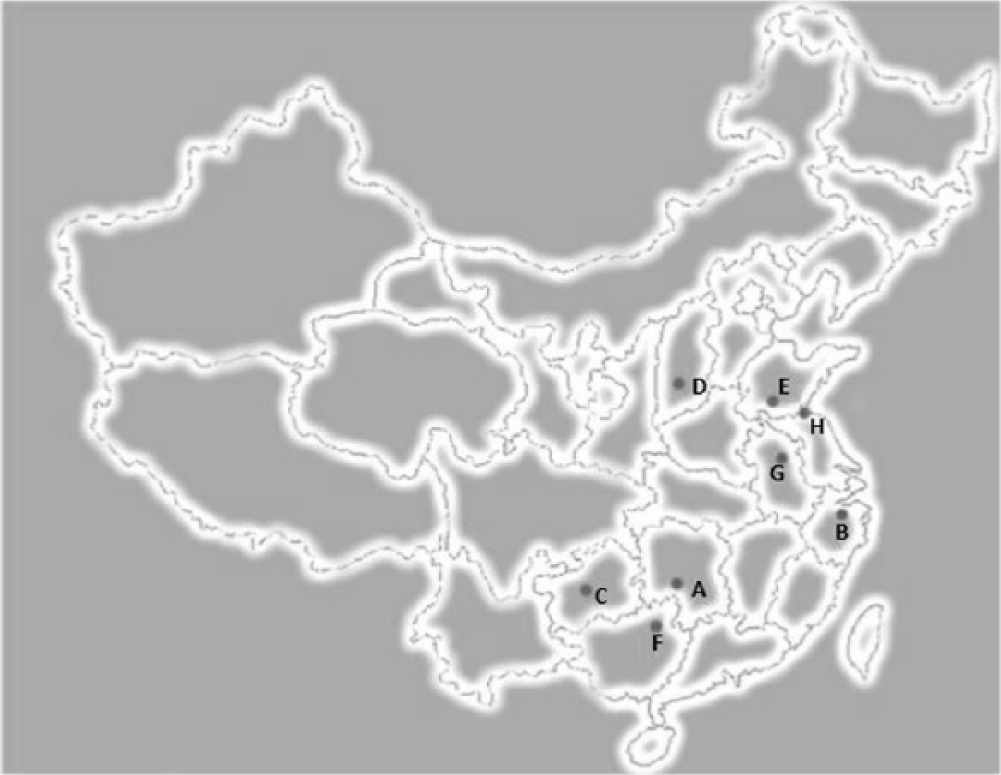
Sites related to Shun discussed in this article. (A) Shun Temple and Mausoleum in Jiuyi Mountains, Hunan. (B) Temple to Shun in Wangtan, near Shaoxing, Zhejiang, and new park and temple to Shun in Shangyu, Zhejiang. (C) Site of old shrine to Xiang in Qianxi, Guizhou. (D) Site of multiple cults to Shun in southern Shanxi. (E) Temple to Shun at Heze, Shandong. (F) Temple to Shun in Guilin. (G) Site of national park named for Shun tilling Mount Li, Huainan, Anhui. (H) Site of proposed monument to Shun in Lianyungang, Jiangsu.
The Story of Shun’s Death
In turning to mythic materials to tell the origins of the Chinese state, classical authors were likely drawn to the same qualities in these myths that over millennia have attracted so many others: their powerful symbolism, their air of authority and antiquity, their tendency to embody core values of a society. Perhaps most important to this study is the ability of myth to help articulate and even bring into existence a communal identity. While much scholarship on Chinese myth in the twentieth century insisted that early Chinese myths were heavily historicized (Bodde, 1981), the prominence of cults across China dedicated to early mythic figures such as Shun, Yan Di, and Yu the Great over the last millennia suggests that these figures retain much of their mythic aura. Stripped of all their mythical qualities, these figures would hardly have made such powerful, evocative exemplars. As we will see in our case study below, mythic elements in the broad narrative of Shun continued to be productive over many centuries and are still very much alive even today.
The great Han historian (and mythographer, as it turns out) Sima Qian, whose magnum opus, the Shiji, tells the story of Chinese civilization from further back even than Yao down to his own day (ca. 100
Today, there is a massive temple complex and mausoleum in the Jiuyi range dedicated to Shun. It was completed during the opening decades of the Ming dynasty, in the fourteenth century, and was frequented in the late imperial era by Ming and Qing emperors and court officials on inspection tours of the southern frontier. It formed part of a network of sacred sites centering in this region on the holy southern peak, Hengshan, located just over 200 kilometers to the north of the Jiuyi range. The structure now in place actually dates no earlier than 1942, when the temple was reconstituted after the original complex had been burned to the ground. 4 By the end of the Cultural Revolution, however, this smaller scale temple had fallen into disrepair. During the last three decades of the Reform era, the temple complex has been repeatedly repaired and expanded as local and provincial interest in the site has risen. The story of this renewed interest in the burial place of Shun (or, one of the burial places of Shun, since similar claims are made in at least three other parts of China) begins with an archaeological discovery in the early 1970s.
Southern Hunan and the Culture of Shun
Somehow, in the midst of all the cultural iconoclasm and social turmoil of the Cultural Revolution, a few spectacular archaeological discoveries were made and publicized during the early 1970s. None was more astonishing than the tomb complex unearthed near Changsha, in Hunan province, at a tiny rural site called Mawangdui. The tombs belonged to a prominent family posted to this peripheral region early in the second century
There is no legend or other key to reading the map, and no explication of the symbol anywhere, but there is little question that the map records, already early in the second century
The mood among intellectuals in China in the early 1980s is hard to fully appreciate now. There was a palpable excitement, an eagerness to explore areas of thought and social activity that had been politically dangerous for two decades. Over the coming years, this intellectual climate dovetailed with other social changes, particularly the prospect of a new economy not based on collective agriculture and state-run heavy industry. Along the coast and in major cities, entrepreneurially minded private citizens and local government officials experimented with ways to respond to the new economic freedoms, which were by no means clearly defined in law or centrally organized. Officials and newly emerging entrepreneurs in rural regions and even large cities in China’s vast interior struggled with ways to capitalize on the changes. Documents and statistics from the mid-1980s to mid-1990s in Hunan province show remarkable ingenuity and resourcefulness in this regard. In tourism and geography programs at colleges in the area and among local officials, a discourse concerning how to help southern Hunan enter the Reform era slowly began to unfold. A formula was proposed for promoting the local region and expanding the economy: southern Hunan was remote and undeveloped, but it might turn these features to its advantage by attracting tourists who longed for the natural beauty of the Jiuyi Mountains and were drawn to the “Culture of Shun” 舜文化. 6
It is clear from even the earliest of these documents that the Culture of Shun was somehow imagined to reside in and reverberate through the features of the human and natural landscape here. Such phrases abound in contemporary China and seem to reflect a very old set of notions about place, meaning, and identity.
7
Just how the relationship between a charismatic figure such as Shun and his local environment took shape over time is not always made clear, but we can begin by noting that very early sources describe Shun’s transformative moral influence on each community in which he lived. To the extent that locals in southern Hunan province were willing to imagine themselves as peripheral, which was in any event an undeniable fact of geopolitical life here, they could then at least take pride in their status as a privileged periphery, a place where the rustic landscape has been preserved but morality had long ago been transformed. There is a very old textual tradition on which this later discourse draws, summarized in this passage from Sima Qian’s first century
Thus, discussions of the Culture of Shun center specifically on this notion of the Virtue of Shun 舜德. The Culture and Virtue of Shun are understood to permeate the landscape of Ningyuan county, where the Jiuyi Mountains and the temple to Shun are found. In fact, there is a centuries-old tradition of inscribing these abstractions concretely onto the landscape in the form of monuments, the temple in the Jiuyi Mountains being but one obvious example. Older than the modern-day temple located at the foot of Shun Peak is the tradition of carving inscriptions on a strange rocky outcropping deeper in the valley formed by the three small rivers that flow north out of the range. There is a cave at the foot of the small rock mountain, and local lore maintains that Shun recognized the talents of a medicine man here in antiquity. In the Han, an official who visited the site claimed to have found a set of jade pitch pipes used in the time of Shun, and he presented them to the Han throne. Pitch pipes were understood to be magical tools for bringing human society into harmony with the patterns of nature, and from sometime in the Han on, this small mountain was called Yuguan Yan 玉琯岩, or Jade Pipe Cliff. 9 On the face of the rocks surrounding the cave are numerous inscriptions, the largest and one of the oldest dating from the Song dynasty. The inscriptions all celebrate various motifs or passages from the broader cycle of Shun myths and stories (Figure 2). Such relics are understood to impart a certain power to the local landscape, standing as concrete relics of the virtues and accomplishments of the sage ruler. This rich heritage makes the local and peripheral a central part of the national narrative of the ancient origins of the Chinese nation and state. Local communal memory intersects with the history of the Chinese empire, and through such memorialization, the Culture of Shun has been imagined and reproduced here for centuries.
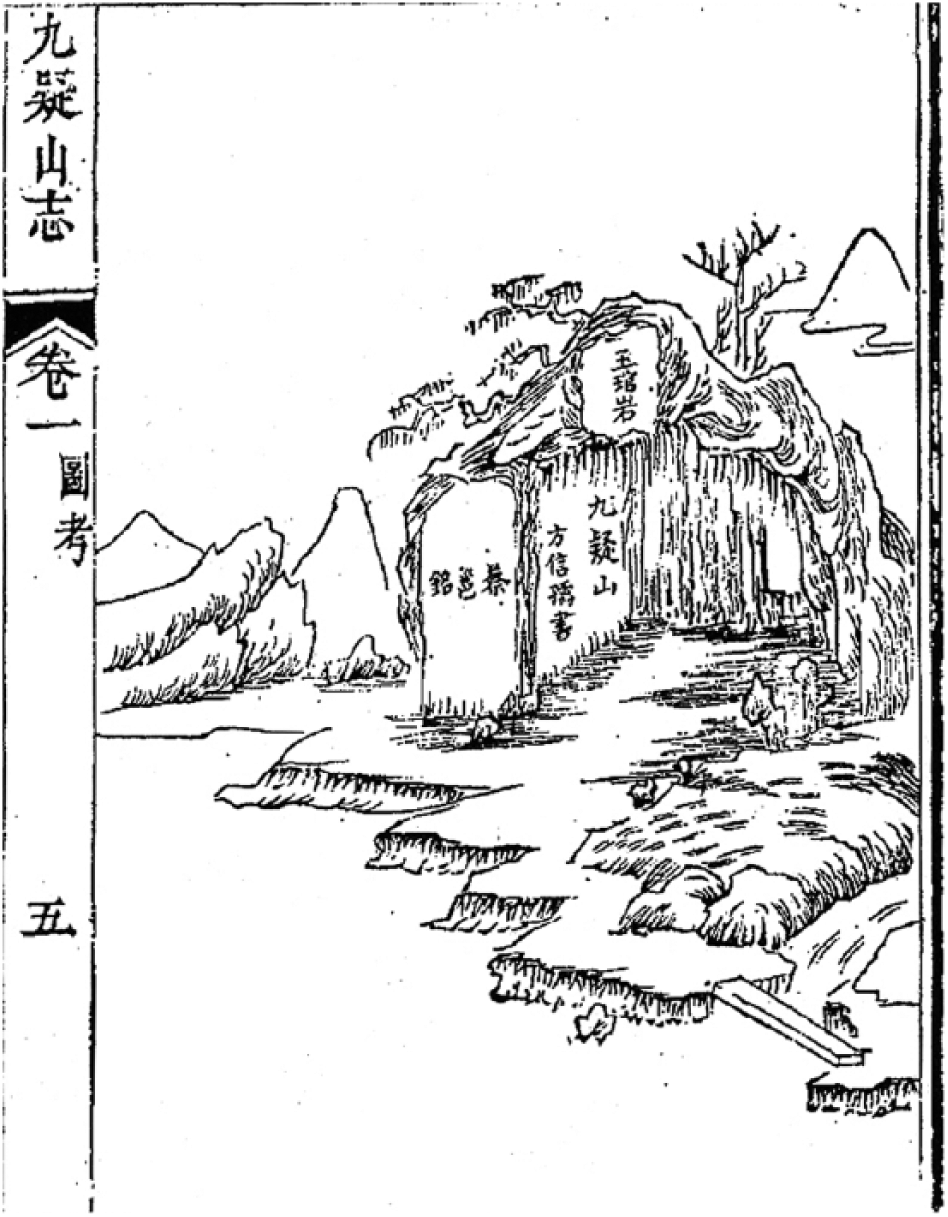
Illustration of Yuguan Yan from Wu, 1796: 1.5, noting some of the most prominent inscriptions.
Another striking example of local promotion of the Virtue of Shun, coming in quite different form, can be found in a primary school reader distributed in Ningyuan county in the early years of this century. The book is titled All People Can Become a Yao or Shun: An Educational Reader on the Virtues of Shun. It comprises twelve chapters, with such titles as “The Strength to Persevere,” “Humanity, Care, Filiality and Brotherly Love,” and “The Realm Belongs to All the People.” It is interspersed with traditional morality tales, historical vignettes, local folklore about Shun’s time in the area, and of course short writing assignments and homework questions (Figure 3). Thus was the Culture of Shun celebrated and reproduced in Ningyuan county at the start of the twenty-first century, inculcated into local schoolchildren’s very sense of their identity and origins (Zhou, 2004). 10
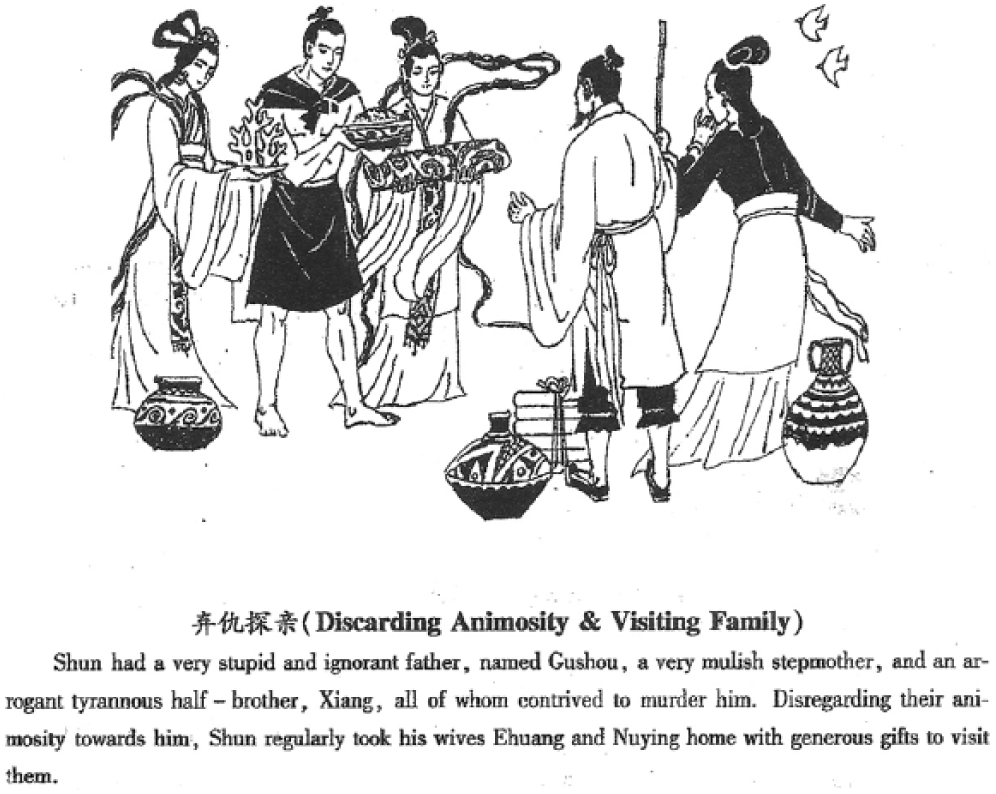
Illustration from Shun Reader, distributed in Ningyuan, Hunan, depicting Shun and the two daughters of Yao visiting Shun’s father (the illustrations all have English captions). After Zhou, 2004.
The compilation and distribution of a children’s reader about Shun coincided with a flurry of other local activity in celebration of the local Culture of Shun at the start of this century. Ningyuan county had spent the majority of the 1990s trying to transform itself into a tourist destination. As early as 1985, the Hunan provincial government restored the walls of the temple complex in the Jiuyi Mountains and established an office of tourism for the Jiuyi Mountains region. Between 1985 and 1988, this office registered over 300,000 visitors. By 1995, the total number of registered tourists had exceeded one million, and much of the basic infrastructure needed to support continued growth of tourism had been built: a paved road from the county seat in Ningyuan, hotels, souvenir shops, restaurants, and KTV parlors (figures and descriptions of the tourist industry are from Liu and Cheng, 1995).
Trying to demonstrate the bottom line in such cases is difficult, since the Jiuyi tourist industry is a complex, diffuse work in progress, but the impression one gets from written sources and conversations with local officials is that to date, tourists have been bringing in just enough to sustain the investments: official documents from this period complain that many visitors did not stay overnight in the region, but merely passed through (Liu and Cheng 1995: 58; similar arguments are made in dozens of articles beginning in the mid-1990s). The investments continued, however. Experts—including a British geologist who examined the numerous caves in the area—were invited in to make proclamations about the various features of the region. Between 1995 and 2000, attention increasingly focused on the site around Yuguan Yan, where in the late 1990s archaeologists from the local Cultural Relics Bureau were ordered to conduct surveys. In a large field opposite the entrance to the cave there, they found ceramics dating from the Song dynasty, some with inscriptions that suggested they might have been used in imperially sponsored rites. Formal excavations were carried out between 2003 and 2004, during which the remains of a massive temple were uncovered (Guojia wenwuju, 2005).
It had been known that the original temple structure and mausoleum dedicated to Shun once resided deeper in the Jiuyi range than the location of the present temple. Archaeologists concluded that they had discovered the original site of the Shun temple. Foundations from a massive structure dating from the Song were unearthed, and below them was evidence of an earlier temple complex dating from the Tang dynasty. In a distant corner of the excavation site, a very limited amount of pottery and other debris described as belonging to sacrificial pits datable to the Han dynasty were also found, but these discoveries butted into a local home, and archaeologists were unable to excavate this portion of the site any further. Nevertheless, they excitedly announced the discovery of an ancient mausoleum where, they assumed, the sage ruler Shun was in fact actually buried. The excavations were then celebrated in a barrage of orchestrated media coverage, including a local conference attended by such scholarly luminaries as Li Xueqin 李学勤, from the Chinese Academy of Social Sciences in Beijing. In 2004, the Hunan Provincial Cultural Relics and Archaeology Institute in Changsha put the site up for competition to be named one of the top ten archaeological sites of the year. Ningyuan county’s expensive and elaborate bid for this prestigious recognition was not successful. Nevertheless, in 2005, major sacrificial rites to Shun were held in the Jiuyi region, and dignitaries from abroad joined provincial and central government representatives to honor one of the founding fathers of the Chinese nation.
The years immediately leading up to the 2004 bid for national recognition as a top-ten archaeological discovery and the 2005 performance of rites to Shun marked the biggest push to invest in what we might call “cultural infrastructure.” The most prominent landmark in this flurry of spending is a modest public square on the dusty outskirts of the county seat, Ningyuan, called Emperor Shun Square 舜帝广场. Here, looking out toward the Jiuyi range, which lies southeast of the city, a massive statue of Shun was commissioned and erected. Shun gazes sternly toward the mountain peaks, which on clear days are just visible from his lonely vantage point amidst half-finished apartment complexes and aging brick buildings. One is immediately struck by the stiff, lifeless pose of the figure, and its unusual gesture: Shun’s arms are held closely to his sides, elbows bent and palms facing upward at the edge of his shoulders, almost as if he were a busboy in a restaurant carrying trays of dirty dishes (Figure 4). Curious about the intended symbolism, I asked local officials, who were surprised that I was not able to tell them what the gesture meant. It was, they had been told by the sculptor when the piece was first commissioned, an internationally recognized symbol of care for the people that would appeal to the aesthetic sensibilities of overseas Chinese, who, it was imagined, would soon be flocking to the region, bringing with them global capital and prosperity. Once I explained that the gesture made no sense to me, they confided that the statue seemed alien and confusing to them also, if not downright ugly. 11
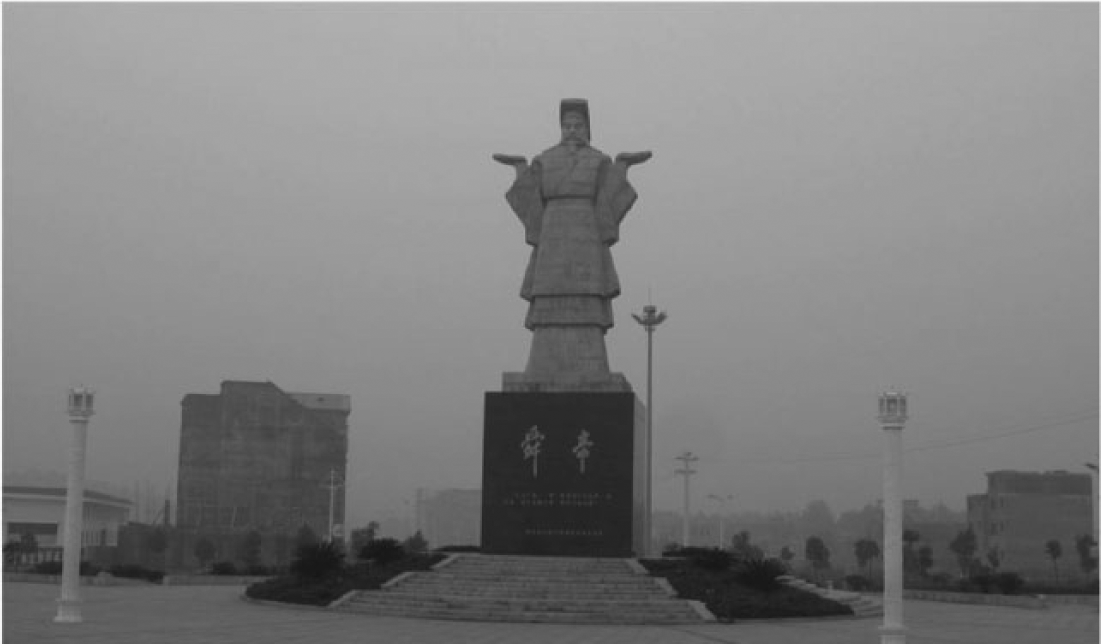
Emperor Shun Square, Ningyuan, Hunan. Photo by the author.
By the time of my visit, in late 2007, it had become clear that their statue of Shun had failed to bring Ningyuan prosperity, and local interpretations of the gesture had begun to crop up. One local Cultural Relics officer imitated the gesture with a shrug and said, “The statue means ‘I am Shun; I came to Ningyuan and now I am broke and have nothing to my name.’” I commented on the irony: indeed, tradition held that Shun had come here just after abdicating the throne, and therefore after ceding the riches of the entire empire, to Yu; he really came to Ningyuan and died with nothing to his name. To my surprise, the officer was unable to place the local stories about Shun into the broader narrative about abdication, and did not grasp the full implications of his own explanation. Later, a second official offered what he said was a much more common interpretation of the statue among local residents. Because of the orientation of the public square and statue, Shun’s hands, held out at either side of his body, are pointing more or less north and south. This gesture, the official explained, carried a message for everyone living in Ningyuan county: if you want to get rich, go to the north to become an official, in the provincial capital Changsha or, beyond it, Beijing; otherwise, go to the south to become a businessman, in the booming coastal cities of Guangzhou or Shenzhen. But whatever you do, get out of Ningyuan.
The ambiguity felt by many local residents of Ningyuan toward all the recent attention to the Culture of Shun is surely complex, stemming in part from the disappointment over the failure of years of investments and promotion to transform the local economy. And here we must confront the possibility that, in Reform-era China, it has become exceedingly difficult for anyone, individuals and communities alike, to construct a sense of modern identity that is not rooted in economic prosperity. It is as if Deng Xiaoping’s slogan “it is glorious to become rich” has become a sort of threat, somehow shutting off other avenues to success. The residents of Ningyuan seem to have made the best choices they could about how to position their remote community in the broader Chinese imaginary, linking themselves to one of the most glorious founders of Chinese culture and the Chinese state. The historical and archaeological record has been good to them, providing rich resources for the creation and sustenance of a long historical memory. Yet in spite of all this, prosperity has eluded them, and all the attention to Shun and the stiff, foreign, and expensive likeness of him that stands on the edge of their city has yet to provide an easy map for locals to follow as they try to forge a modern, prosperous identity rooted in their traditional role as bearers of the Culture of Shun.
The monumentalization and commodification of local historical memory has, in spite of its spotty record of success so far, become the model for many communities across China to stake their claim to a portion of the emerging national imaginary and whatever economic and social benefits are expected to accompany this move. This model may yet be vindicated. The future of tourism in Ningyuan is far from settled. There are plans for networks of national high-speed railways, and one line (the Kun-Tai line) is planned to run east to west, from Xiamen on the coast zigzagging west and passing very close to the Jiuyi Mountains before moving on through Guilin and Guiyang to Kunming. Another main line opened in the closing days of 2012, moving down from Beijing through Wuhan and Changsha, passing to the east of Ningyuan where it will eventually intersect the Kun-Tai line at Chenzhou, on its way south to Guangzhou, Shenzhen, and Hong Kong. The municipality of Yongzhou, which administers Ningyuan county and the Jiuyi Mountains, has continued investment in monumental cultural sites, and the high-speed railway may yet bring the prosperity dreamed of so long in this region. 12 The arrival of high-speed train networks has already had transformative effects on the way people live, work, and enjoy leisure time in other regions of China (e.g., the Jiangnan region, particularly the network of high-speed railways now linking Shanghai to Suzhou, Wuxi, Nanjing, etc., to the west, and to Hangzhou in the south). Future geographic studies of scale, economy, and society in China will need to pay particular attention to this unprecedented change in China’s transportation infrastructure.
This transportation infrastructure promises to link in real, navigable terms a Chinese nation that, for the vast majority of Chinese citizens, could heretofore only be traversed imaginatively, through the great geographic treatises and historical records of the imperial era, through elite poetry about place and travel literature, and most recently through many popular cultural tourism television series. Viewed in this light, the many cultural sites now transforming the Chinese landscape, while by no means centrally organized, take on a series of integrative roles at different levels of society that ultimately help link collective memory at the local and national level. Imagining the modern Chinese state as a natural outgrowth of an enduring Chinese nation with deep historical and cultural roots becomes, for the citizen who can now visit a seemingly endless series of celebrations of Chinese heritage, not only possible but virtually inevitable. To understand this process as entirely manipulative and inherently modern, the “invention of tradition” out of whole cloth, is to miss the broader and historically deeper set of processes whereby the Chinese empire was conjured, integrated, and held together or re-created over millennia, sometimes by sheer force of imagination and will power.
Numerous inscribed stelae from the late imperial era show that the current site of the Shun temple and mausoleum, built in the Yuan era, was a landmark of the imperial imagination. Throughout the Ming and Qing periods, as Han Chinese (and of course eventually Manchu) colonization of the far southwest accelerated and the region was consolidated as an integral part of the late imperial state, relations between Han and indigenous people remained a major source of local tension and court concern. Southwestern Hunan to this day remains a frontier region of Chinese civilization, and stelae still on display at the site from the Ming and Qing dynasties make the tension between Chinese and so-called barbarian occupation of the region readily apparent. These stelae tell the tale of pacification of the natives and the spread here of the values and practices of Chinese culture exemplified by Shun. The temple to Shun in Ningyuan is undeniably very old, and the rich finds from the Tang and Song period near Yuguan Yan suggest that the temple was a thriving center of local activity then. Throughout its entire existence, however, it is likely that the temple was something of an outpost of Chinese civilization in a sea of cultural and ethnic diversity. The precedent of Shun’s visit to the Jiuyi Mountains to bring civilization and virtue to the southern tribes was a powerful symbol, and the temple is likely to have filled the same role in earlier times as well, probably starting as early as the Han, when Chinese were already pushing the frontiers of the imperial state to the South China Sea. Throughout the imperial period, Shun stands not as just a founding father of the Chinese race and nation, but as a representative of core Chinese virtues and the power of these virtues to transform the less civilized. He stands as a focal point around which Chinese identity can be forged and articulated.
The temple to Shun in southern Hunan, then, may always have been as much fantasy as reality, an imagined model of submission and moral transformation set in high antiquity but somehow hard to realize in the here and now. The tension inherent in the project of “transformation” (化, the term is original to Chinese texts) of local customs and beliefs was hinted at in the link between Shun’s journey to the south and his relationship with his half-brother, Xiang. Shun’s decision to make a tour of the south is linked to two motifs. Broadly, he is portrayed as bringing his civilizing influence to barbarian tribes at the ends of the earth. More specifically, however, there are narrative features of the larger Shun story that suggest he has unfinished (if perhaps symbolic) business in the south. It will be remembered that earlier in his life, Shun became renowned for his undying devotion to family, even though his father, after remarrying, turned against him. In those stories, his father, named surely symbolically the Old Blind Man, is led on in his plotting by Shun’s half-brother, Xiang. Xiang, 象, literally “elephant,” is an unusual choice for a name in Chinese. Moreover, even a casual summary of the full story of Shun must account for the fact that, alone among early Chinese figures from myth, legend, or history, Shun is already prominently linked to elephants in the story of his cultivating the land with the help of birds that drop seeds for him and elephants (or an elephant) that tills the fields. As testimony to his ability to rule by moral example, Shun is portrayed as gently transforming his half-brother over time, so that when Yao finally makes him ruler, Shun is able to enfeoff Xiang in a small territory in the far south. The name of this statelet is, remarkably, You Bi 有鼻, or “Possessors of Trunk” (the Kingdom of Those with Nose?), and it is said to be located in southwestern Hunan province.
The stories of Shun tilling the fields with the help of elephants, of his half-brother, “Elephant,” who tries repeatedly to kill him, the stories of this “Elephant” being sent off to the deep south to a kingdom named for his trunk, and finally the stories of Shun perishing in the wilds of the same region, suggest a broader mythic narrative, now all but lost. 13 Whatever earlier versions of the myth there might have been, we are now left with a story that portrays Shun’s journey to the south as a feature of the broader abdication cycle and little more. Nevertheless, Shun’s conflict with Xiang and his disappearance in the southern wilderness carry overtones that were still very suggestive to later ages, as the tension between Shun as symbol of Chinese culture and Xiang as symbol of the barbarian tribe awaiting China’s transformative civilizing influence remained a productive force for centuries to come. The history of temples dedicated to Xiang in the far south during the imperial era demonstrates this. The Shui jing zhu, it will be recalled, noted the existence of temples to Xiang in southern Hunan in the Period of Disunion after the fall of the Han, but no comment is added concerning their possible relation to the cult of Shun. In the Tang dynasty the famous literary figure Liu Zongyuan 柳宗元 (773–819) penned a celebration of a Tang official, Xue Bogao 薛伯高, who encountered one of these shrines while posted to southern Hunan. Xue was apparently deeply offended by the existence of a cult devoted to the evil half-brother of Shun, and he ordered that the shrine be razed. 14 We are left to wonder about the exact nature of this cult, and what role Xiang might have been assigned by devotees of the shrine. Mention of the cult of Xiang disappears from the records for centuries, but surprisingly the cult seems to have survived. In the Ming, another famous Confucian scholar-official, Wang Yangming 王阳明 (1472–1528), was posted to an even more remote and culturally diverse region than Liu Zongyuan and Xue Bogao, this time in Guizhou province. While there, he was asked by locals (described as ethnic Miao) to compose a piece in commemoration of the restoration of a shrine deep in the mountains northwest of metropolitan Guiyang, a shrine dedicated to Xiang. Wang Yangming’s reaction is remarkably different from that recorded by Liu Zongyuan centuries earlier, and in a famous piece he composed called “Xiangci ji” 象祠记, “Record of the Shrine to Xiang,” he argues that the worship of Xiang must be a local attempt to memorialize Xiang’s moral transformation late in life under the sway of his patient and loving brother, Shun. Xiang, then, stands as a symbol to all non-Chinese peoples within the Chinese sphere, proving that anyone (no matter how crude) can be civilized by the moral power of Chinese culture (Wu and Wu, 1959 [1695]: chap. 12). 15
Whatever the status of the cult to Xiang might have once been, it is now remembered, if at all, in Wang Yangming’s terms, as testament to the great transformative power of Shun and the virtues he embodies. The motif of Shun’s ability to reshape morality is in fact a central feature of numerous sites across China. A temple complex dedicated to Shun in Guilin celebrates the same story of Shun’s journey south as the temple and mausoleum in the Jiuyi Mountains does, and numerous mountains in many provinces are named in honor of Shun, who is said to have tilled at Mount Li during his days as a commoner. In Huainan, Anhui, local scholars explained the importance of a low-lying mountain range just south of the Huai River, named Shun Geng Shan, or “the mountains that Shun tilled.” Here, I was told, Shun stopped to observe the lay of the land and to bring the arts of agriculture to the Eastern Barbarian tribes, the Huai Yi, who were civilized by his influence. At one of the peaks, a pavilion records his merits here in paintings and colophons. Near Heze, in Shandong, the same claims are made about Shun’s time tilling the mountains, and a massive temple–tourist attraction has been constructed here. What is likely the most extensive cult to Shun is found in southern Shanxi province, where temples to him and his two wives, the daughters of Yao, are numerous and are mentioned in historical gazetteers and other sources from as early as the Han dynasty. There is a large temple and mausoleum complex dedicated to Shun here, outside of metropolitan Yuncheng. Far less well known is a region in northern Zhejiang province, reaching from the Kuaiji Mountains south of Shaoxing east to Shangyu and Yuyao, where locals claim Shun was born, raised, and finally buried. Temples and other sites associated with Shun in this region have not gained the national prominence of sites in Shanxi or Shandong, nor have they previously been promoted with anything like the fanfare surrounding the Jiuyi temple complex, but there is ample evidence of a thriving, long-lived local cult to Shun here.
Shun as Symbol of Moral Transformation and Chinese Identity
In modern-day Shangyu, a city just east of metropolitan Shaoxing, a massive monument to Shun now occupies a new city park, named the Shun Tilling Park. At the northern entrance to the park, a long plaza stretches south, past a bronze statue of an elephant, a pond with rock sculptures, and a series of stairs that open on a large bricked terrace. At the far western end is a stone wall with depictions of Shun and his story. At the center is a huge sculpture of Shun standing on the back of the largest in a herd of elephants, memorializing the early tradition that Shun tilled the fields with the help of elephants. The original story as we know it from canonical stories makes Shun’s efforts tilling at Mount Li a part of his rise from obscurity to local prominence, before Yao chose him as successor to the throne, but today most sites that memorialize this story collapse the chronology of the narrative so that Shun is already a ruler and a civilizing force. The statue of Shun in Shangyu is visually unambiguous—Shun stands erect on the back of the largest elephant, his posture stern, one hand raised high and supporting a cluster of stars and the crescent moon above his head. Shun is here celebrated as emperor above all else (Figure 5).
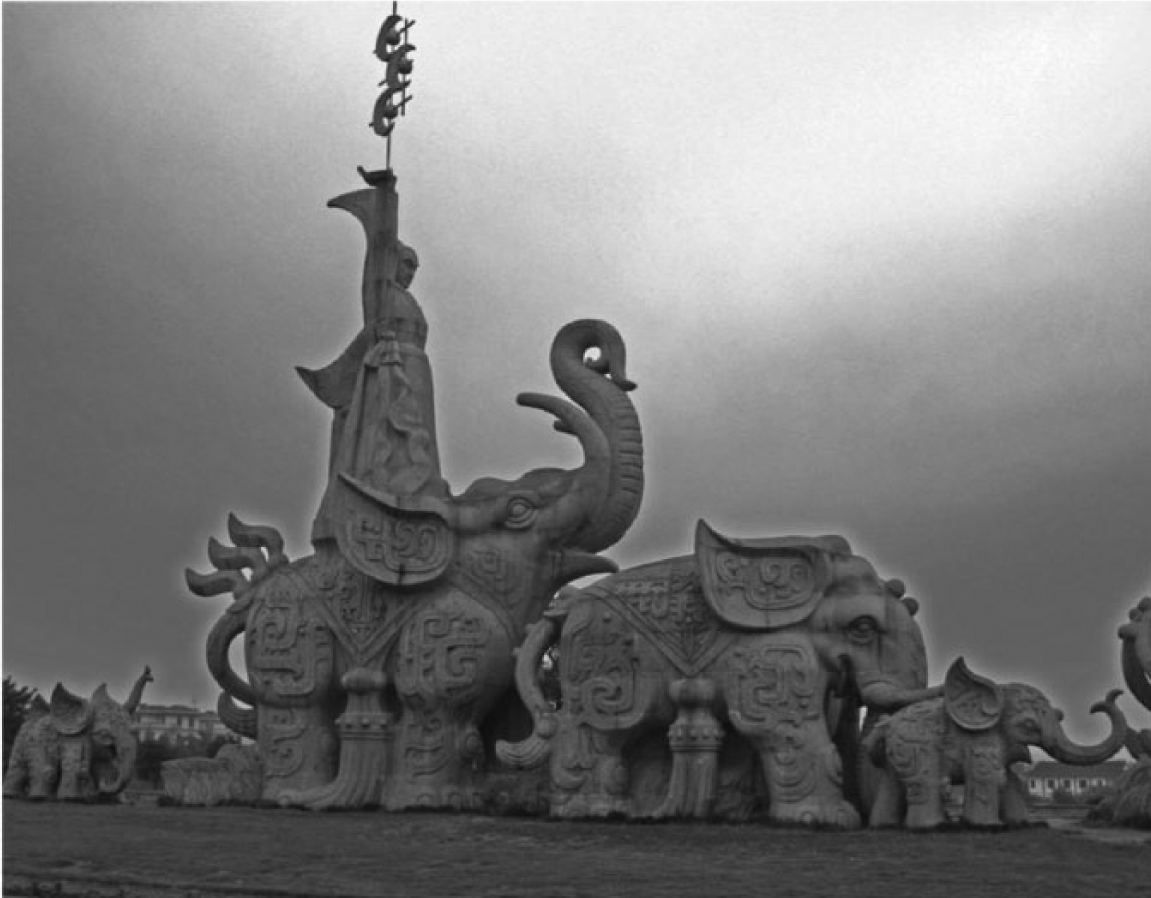
Statue of Shun riding a herd of elephants at the new park in Shangyu, Zhejiang. Photo by the author.
The park memorializing Shun in Shangyu was opened in 2008, but the massive statue was not to be its final centerpiece. Once, Shangyu had been home to a temple to Shun as well as several local landmarks commemorating his role in the region. Today one can still visit “Shun’s well,” but the site is not the original well that local lore maintains was used by Shun when he lived here. Like so many other features of the cultural landscape, “Shun’s well” is a re-creation of a site long since destroyed. Most such sites in Shangyu met their demise not during the Cultural Revolution, but during the rush to modernize in the early 1980s. That is when the original temple to Shun was razed and replaced by an apartment complex with ground-floor storefronts. Over the last five years, a new temple to Shun has been constructed, along with a massive ancestral hall dedicated to him, this time positioned behind the new Shun statue and park, carved into the side of a mountain at the southern end of the new park. The new temple is in every way monumental, built from concrete and stone in a mixed style imitating Han architecture but incorporating nods to Late Neolithic building styles, a reference to the prominent local Hemudu culture of the region, and with another massive statue of Shun seated in its main hall. 16
To call the new monument in Shangyu a temple is in fact clearly inaccurate. Nothing at the site is intended to encourage the burning of incense or other offerings. The new park in Shangyu is a cultural monument celebrating Chinese national unity, local historical memory, and the values of filiality and virtue associated with Shun. At the same time, it is a tourist attraction, intended to draw visitors and their money, and to awe and amaze them with the richness of local resources, both historical and economic. Understanding how a park dedicated to Shun might become the source both of revenue and of local pride requires a more careful look at another temple in the region dedicated to Shun, one whose Reform-era success played an important role in convincing bureaucrats and entrepreneurs in Shangyu of the viability of their revival project.
Whereas the temple to Shun in Hunan earned imperial recognition and sponsorship over the centuries, a large and important temple to Shun not far from Shangyu, in Wangtan village in the mountains outside of Shaoxing, appears to have existed for centuries with little sponsorship or recognition beyond the regional community. It was once part of a large network of temples and other sites dedicated to Shun in this area, covering the modern city of Shangyu, northeast of Wangtan, south into the Kuaiji Mountain range. The local cult to Shun is at least as old as the Han dynasty, since there are stories dating from the Han about an official who changed the name of the Shunjiang, or Shun River, to commemorate another local hero, Cao E (the Little Shun Jiang retains its name to this day). The great Han skeptic Wang Chong mentions local lore about Shun in his Lun heng, and local gazetteers over the ensuing centuries occasionally make note of local temples or other sites associated with Shun in this region. In recent years, a local scholar has compiled folklore and visited the sites of over a dozen temples to Shun in the mountains south of Shaoxing (Yu, 2006). 17 Many of these temples quietly resumed activities in the years following the Cultural Revolution, and in Wangtan, the traditional temple festival 庙会 was revived in 1985 and has been held every autumn since then.
Of the numerous temples dedicated to Shun in the Shaoxing region, the Wangtan temple is the biggest and best preserved. The temple festival continues to grow steadily year by year, and the temple’s reputation now regularly attracts visitors from all over the Jiang-Zhe region and beyond. Unofficial accounts at the Shaoxing County Cultural Development Center estimate provincial government investments in the temple and its surrounding infrastructure over the last twenty years totaling more than ten million yuan. Roads and parking lots, public toilets, and a small exhibition hall have been built in just the last four years, and the temple itself has been repaired and maintained in excellent condition. The temple festival now runs over a three or four day period, and inexpensive tickets are sold to the event, allowing the Cultural Development Center to track attendance. 18 In 2009, 7,200 tickets for the temple festival were sold; in 2010, the number was 7,500; and in 2011, the number rose to 8,100. These tallies exclude roughly 2,000 tickets that are distributed free each year to various officials in cultural and other offices. With these and other uncounted visitors, attendance is estimated at well over 10,000 for each of the last two years. For a small, rural community like Wangtan, this number of visitors is an enormous boost to the local economy, and of course as the reputation of the temple grows, visitors in all seasons increase.
In many respects, the economic activity that has accompanied the reemergence of the Wangtan Shun temple demonstrates the potential for such cultural tourism to transform a community while maintaining or reasserting some sense of historical identity. Restoration work at the temple has been tastefully accomplished without the sort of wholesale destruction so often seen in other areas, where “restoration” ends in demolition. 19 The original architectural style of the temple has been preserved, and the wood and stone carvings on columns and eaves have been well maintained or restored. The temple stage, where during festivals traditional dramas are performed, is in excellent condition and has been in use again since the resumption of the annual festival. During the temple festival, the entire village of Wangtan is crowded with throngs of visitors who pour in from surrounding villages, from the metropolitan centers of Shaoxing and Hangzhou, and from neighboring cities and towns across Zhejiang and Jiangsu. The narrow roads leading to the temple are choked with makeshift stalls where local merchants sell candles, incense, paper money, toys, snacks, shoes, and the like; some stalls include games or fortune-telling, others sell goldfish or red-eared sliders, ubiquitous throw-away pets found all over China. In a cleared lot behind the road leading to the temple, one can find rented bumper cars and small merry-go-rounds playing circus music.
The resumption of temple festivals and the revival and restoration of local cults and temples is a widespread Reform-era phenomenon with complex religious, political, cultural, and economic facets, all worthy of more detailed study. Some of these sites have been able to resume a central role in local communities, while others have struggled to find the right balance among these different social forces. The designers of the new monumental park to Shun in Shangyu opted for a much grander scale than the old temple in nearby Wangtan, but this has not meant abandoning the hope that it might revitalize traditional culture and become a part of the regular rhythm of local life. As one moves from the park to the new temple and then beyond it toward the newly constructed ancestral hall of Shun, there are roads rising up the side of the mountain, lined with tourist shops and signs announcing a new annual temple festival that will be staged here. Over the past two years, a massive Buddhist shrine-cum-tourist center has been erected directly adjacent to the park, clearly conceived as part of the total cultural tourism experience. Buddhism has undergone its own striking revival in northern Zhejiang during the Reform era, and Buddhist sites dominate regional cultural tourism, attracting huge devout followings both regionally and at the national level.
The scale of the new monuments to Shun in Shangyu is testament to the economic successes of this part of northern Zhejiang, reaching from Hangzhou to the west through Shaoxing, Keqiao, and Shangyu and then all the way east to Ningbo and the Zhoushan archipelago on the coast. It is also part of a broader move to restructure the province’s economy, including developing the service sector through investments in areas such as tourism and cultural attractions. Hong Kong is the biggest outside investor in Zhejiang, and sites like the new Shun monument are clearly intended to appeal to the sentiments of Chinese in Hong Kong and overseas. When the new park opened in the fall of 2008, a large billboard at the entrance celebrated donations to the new temple project, then just underway. The Shangyu Hometown Association in Hong Kong, which boasts over eight thousand members, contributed 50,000 yuan to the new temple in that year alone. Even more striking, however, is that local businesses and entrepreneurs have outstripped overseas Chinese donations to the temple. The park and temple were built in the administrative section of Shangyu called Cao E Township, and in 2008 donations from Cao E alone matched those from Hong Kong. While some of these donations were modest, from as little as 500 or 1,000 yuan, the majority of the money came from a few wealthy individuals, and it would surely be a mistake to imagine that the new temple has simply mobilized local sentiment and unleashed an outpouring of philanthropy. More likely, local businessmen have found it in their best interests to become economically involved in a project that promises to dominate the cultural landscape and has the backing of local officials.
Just as in Ningyuan, the restoration of Shun to the physical landscape in Shangyu has provided a platform from which government offices and organizations can launch educational and cultural activities. Competitions have been held locally to encourage the writing of duilian, couplets to be posted on the sides of gates and doors throughout the temple and ancestral hall at the Shun park. Throughout the city, schoolchildren and adults were urged to compose these terse couplets in celebration of Shun’s role in transforming the peripheral region of northern Zhejiang through his filial behavior and selfless acts. Local scholars and journalists now regularly write articles and editorials or give public speeches celebrating the rich filial heritage of the region, and in 2010 the Chinese Folk Literature and Arts Society named Shangyu the “hometown of filial virtue.” 20 Local archaeologists, cultural officers, and educators have embraced the stories of Shun and set about constructing a local landscape and articulating a regional identity rooted in these stories.
Conclusion
In all of these communities, in one way or another the myth of Shun has provided a powerful set of narratives, values, and symbols around which local stories can emerge and identities, local and national, can be negotiated. Shun’s role as filial son and local moral exemplar, and his rise to imperial (now understood as national) power as a dedicated minister and finally virtuous ruler, provide an ideal model for the integration of the local with the national and the present with the past: once local lore has been articulated through the retelling of regional traditions about Shun, prominent local social agents can then invoke the more universal motifs in the cycle of Shun narratives. This is as much true today, in the Reform era, in places like Ningyuan, Wangtan, and Shangyu, as it was centuries ago. Shun has proven to be an enduring character. As noted above, there are communities in Shandong and Shanxi that also lay claim to fame based on purported historical associations with Shun, and there is a massive temple to Shun in Guilin that also celebrates the civilizing influence of Shun’s legendary trip to the south. 21 Shun has been celebrated in poetry and literature for millennia, and remains a popular figure around whom intellectuals and public figures alike can construct elaborate theories, fantasies, and plans. The power of the mythic to serve as a focal point for a variety of narratives—about empire or nation, about morality and identity, about locale and prosperity—is exemplified by Shun, who continues to inspire people to reimagine their place in history. 22 Among what is now a vast literature on the Culture of Shun in the Ningyuan area, one brief article by Song Juxiang, of the Chinese Communist Party Hunan Provincial Committee Party School, makes this extraordinarily clear. The article partakes of the current infatuation with the word “culture,” arguing that local culture is crucial to economic development and competitive spirit, and provides the “background operation” of the local economy. She urges local governments to “dig deeply into their historical heritage” and “promote the merging of traditional culture and modern culture” (Song, 2006: 44). She celebrates the Culture of Shun in Ningyuan, Hunan, as a prime example of this, while having to admit that economic development in Ningyuan has been slower than hoped.
Ningyuan’s failure to capitalize on the Culture of Shun does not deter Song from her vision, probably because she finds in the story of Shun an enormously attractive model for integrating the values and ambitions of a new generation of party cadres, entrepreneurs, and local officials who have come to power in the age of globalization. She begins by positing the pan-Asian influence of Shun, arguing that “Shun’s thinking and political behavior allowed East Asian society to make the jump from savagery to civilization” (2006: 44). She goes on to offer a fascinating formula for the rise of Chinese culture rooted in the sage rulers of early myth and legend. First, the Culture of Yandi 炎帝文化, the Flame Emperor (here equated with the legendary Shen Nong, or Divine Farmer of high antiquity), provided China with settled agriculture. Next, the Culture of the Yellow Emperor 黄帝文化 contributed political culture to China’s ancient heritage. Finally, Shun, source of all bright virtues, provided China with its moral culture. This symbolic triad of cultural heroes builds on the popular cliché describing all Chinese as the descendants of Yandi and Huangdi, the Flame Emperor and the Yellow Emperor (and is itself a form of local boosterism, since many traditions also link Yandi to Hunan). The addition of Shun as the exemplar of Chinese morality is particularly appealing to Song, who extols him for his incorruptible, public courage to always do the right thing. If the Culture of Yandi represents the vast majority of China’s rural residents, and the Culture of Huangdi, foremost among all emperors, represents China’s top political leaders, then the Culture of Shun is an avatar of China’s new moral elite, modernizers and entrepreneurs who bring globalization and capital to China while preserving Chinese heritage.
Song’s article manages to bring into play virtually every theme and slogan dominating contemporary ideological discourse in China, equating culture with soft power and arguing for its efficacy in helping to usher in a “fabulous renaissance of the Chinese race,” ultimately allowing all of East Asia to “organically merge with the global exchange of civilization” (2006: 45). Culture will help China to modernize and globalize, she argues, while ensuring a “harmonious society,” and the culture of Yao and Shun specifically is singled out for motivating “the coming together of the people and the unity of the nation” (45). In the stories of Shun, Song finds a reflection of the aspirations of her own generation—the return to glory of the Chinese nation—and through identifying with and promoting the Culture of Shun she posits the crucial role played by her own class, local party officials, as the moral conscience of the Chinese state. 23 Myths of China’s most ancient origins are in this way reimagined, reinvested with meaning, and reinscribed on the contemporary landscape in new and monumental ways. And in these new visages of old myths, Chinese are encouraged to find both their ancient ancestry and their modern identity.
Footnotes
Acknowledgements
I am indebted to many people across many provinces who facilitated the fieldwork that made this study possible, especially Xiang Taochu at Yuelu Academy, Hunan University; Wei Chongwen, at Changzhi College, Shanxi; Zhang Honglin in Shaoxing; Song Youhong, formerly with the Shaoxing County Cultural Development Center; and the Ningyuan Cultural Relics Bureau, Hunan.
Declaration of Conflicting Interests
The author(s) declared no potential conflicts of interest with respect to the research, authorship, and/or publication of this article.
Funding
The author(s) disclosed receipt of the following financial support for the research, authorship, and/or publication of this article: Fieldwork for various portions of this project has been generously supported by the Jeffery Sean Lehman Fund for Scholarly Exchange with China, the Department of Asian Studies, and the East Asia Program’s LT Lam Fund for East Asian Studies at Cornell.