




Abstract
The early PRC discourse of the petty bourgeoisie was the intellectual foundation upon which embodied petty-bourgeois subjects appeared at every level of society. The discourse features three interwoven accounts, each founded on a synthesis of Marxian ideas and conventional and contemporary thinking. The national-developmental account reframes existing notions of class, nation-state, and utopia within a Marxist narrative of class struggle and presents the petty bourgeoisie as vital to nation-building. The political-revolutionary account combines conventional views of the political order and the self with a Marxian analysis of political behavior, and highlights the petty bourgeoisie as an obstacle to the Communist revolution. Based on a traditional understanding of the connection between personal conduct and good governance and the Maoist myth of working-class virtues, the habitual-corrective account portrays the petty bourgeoisie as individuals who are afflicted with habits and dispositions harmful to socialist development. The petty bourgeoisie turns out to be a virtually elastic population. Analyzing how Mao’s regime exploited existing ways of thinking to construct the petty bourgeoisie and, more broadly, “Marxist” classes, furthers understanding of symbolic power under Chinese Communism.
The most basic feature of Chinese society is that members of the petty bourgeoisie make up the majority of the general population. One has to dispense with the constituent subject, to get rid of the subject itself, that’s to say, to arrive at an analysis which can account for the constitution of the subject within a historical framework.
Born in Shanghai in 1926, Hu Dacheng came of age during the tumultuous Republican decades (1912–1949). Shortly after his birth, the failure of the family business in Shangyu county, his native place, roughly a hundred miles from Shanghai, cost the family its fortune. When the Japanese military invaded Shanghai in the early 1930s, Hu and his mother took refuge in the city’s International Settlement, where they lived in a makeshift hut while the father supported them from working inland. They lost touch with him during the Sino-Japanese War (1937–1945). Hu’s mother washed and mended clothes for a living; Hu helped with collecting and delivering the clothes and continued to go to school. When the Japanese seized the International Settlement, the mother and son returned to Shangyu and supported themselves through household farming among other things. Then sixteen, Hu also became a principal-cum-laborer in a makeshift school. A year later, he joined a local guerilla band as a newspaper translator and copy editor. He left the band after the war and taught in a nearby city. When the family was reunited later in Shangyu, he resumed his secondary education and became what the Chinese Communist Party (CCP) referred to as a “progressive” student. Hu returned to Shanghai and joined the party before its mid-1949 takeover of the city. His work for the People’s Republic of China (PRC) quickly earned him a training opportunity in Beijing at the party school of the Chinese Communist Youth League. When the Korean War broke out in mid-1950, he became a political officer in the Chinese People’s Volunteer Army, which fought against US forces. His subsequent and rather successful military career ended abruptly during the Anti-Rightist Campaign of the late 1950s (Hu, 2010).
Displacement as much as opportunity marked Hu’s early life, an experience not unusual for his generation of Chinese men and all those who lived through the tumultuous 1930s and 1940s. Shortly after the CCP takeover, however, he became a “petty bourgeois” 小资产阶级 in his colleagues’ and his own eyes, remarkable for his purportedly dubious character typical of persons of such a class background. How did Hu acquire the class identity and identification in terms of self-understanding and recognition by others respectively? After all, the compound xiao zichan jieji 小资产阶级, which can be used to refer to a single person or can be a collective noun or adjective, entered the Chinese language relatively late through Europe and Japan (Liu, 1995: 368). More broadly, how did hundreds of thousands of merchants and shopkeepers, experts and professionals, officials and office workers, teachers and students, and even some peasants, laborers, and housewives become highly visible petty-bourgeois subjects after the 1949 revolution? And what made otherwise privileged and generally respected people (such as scholars, lawyers, and college students) describable together with others who led unenviable lives?
This article extends a growing body of constructivist research that has furthered understanding of Chinese Communism through unraveling the normalization of class and other categories sanctioned by the CCP (e.g., DeMare, 2012; Mullaney, 2011; Song, 2007; U, 2007, 2013; Zhang, 2004). The primary objective of this scholarship is arguably to elucidate the “symbolic power” (Bourdieu, 1991: 166) of the party, or how it imagined, promoted, and enforced its version of the sociopolitical order. In this respect, the postrevolutionary spectacle of the petty bourgeoisie is especially interesting not only because many of those who were stigmatized as petty bourgeois shared little in common in everyday life, but also because it followed decades of war and revolution that had forced families and individuals into unsettled lives and coincided with a rapid decline in private property and economic inequality due to state actions. That is to say, the class category of petty bourgeoisie was reified, ironically enough, when personal economic situations had been unstable and existing economic institutions weakened.
The following illustrates the critical role that official discourse played in turning large numbers of men and women into highly visible petty-bourgeois subjects. When the Mao regime took power, China had “none of the ingredients of classical Marxism” that predicts a socialist revolution (Apter and Saich, 1994: xv). Swiftly recognized nationwide, the “Marxist classes” (Fitzpatrick, 2005: 71) of petty bourgeoisie, rich peasants, capitalists, and so on were discursive-cum-organizational achievements of the socialist state. The above-mentioned scholarship as well as earlier research (e.g., Chang, 1997; Kraus, 1981; Watson 1984; Whyte, 1974) has drawn attention to the impact of propaganda, thought reform, property redistribution, and other tactics of domination in producing and reproducing Marxist classes and categories. These studies, however, rarely separate the role of representation and illustration from that of organization and mobilization. Meanwhile, research on the CCP’s discourse has stressed its success in integrating history with ideology, narrative with emotion, and the socialist ideal with traditional views, but not how such intellectual ingenuity served to reify Marxist classes (Apter and Saich, 1994; Ip, 2005; Knight, 2007; Liu, 2010). The early PRC discourse of class was a “heretical subversion” (Bourdieu, 1991: 128) of deeply rooted knowledge of social hierarchy as underprivileged, if not also disparaged, populations were regarded as the most valuable sections of society. The discourse formed the intellectual foundation upon which petty-bourgeois and other class subjects appeared in everyday life, notwithstanding that ambiguity of class identities and identifications persisted.
In her recent book, Elizabeth Perry (2012) indicates that cultural positioning—“the strategic deployment of a range of symbolic resources (religion, ritual, rhetoric, dress, drama, art, and so on) for purposes of political persuasion”—had been integral to the revolutionary process of the CCP since its founding in the early 1920s (4). Creative appropriation of traditional values, mores, and practices by party leaders has been at the heart of the party’s success and longevity. Perry uses the 1920s mobilization campaign in the Anyuan coal mine in south-central China as her example. Impassioned young cadres, including Mao Zedong, skillfully deployed conventional beliefs and idioms, religious and quasi-religious rituals, secret-society traditions, and other elite and popular practices to organize workers while establishing themselves as leaders of a revolutionary movement. Building on her analysis, this article illustrates cultural positioning within the early PRC discourse of the petty bourgeoisie, or how the Mao regime combined in narrative form select historical and cultural resources with a Marxian perspective on society and history to promote a particular conception of the category. I focus on the synthesis of intellectual assumptions, organizing motifs, and empirical analyses that grounds the portrayal of persons who occupied distant social spaces as comparable petty-bourgeois subjects.
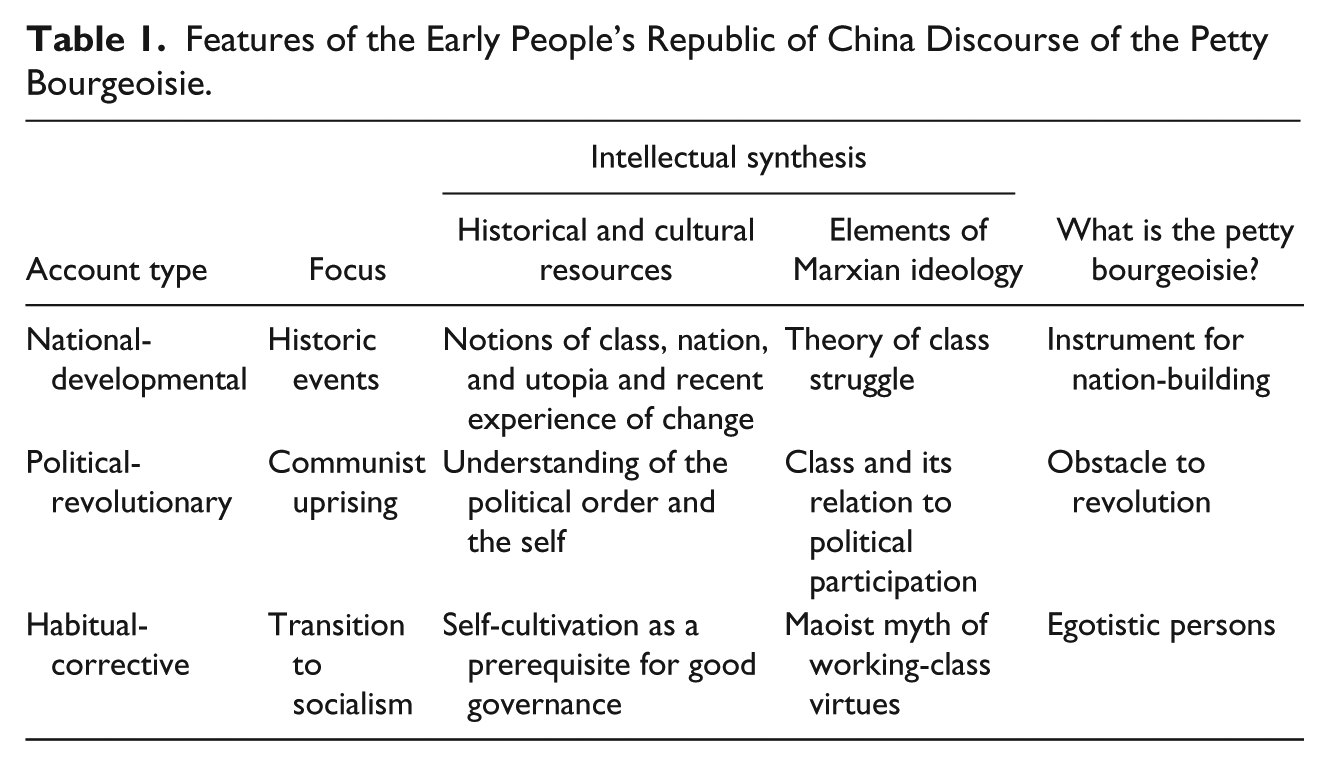
In a nutshell, the official discourse of the petty bourgeoisie contains three accounts that represent the category at the historical, the collective, and the individual level, the substance of which the Mao regime had started to elaborate during its Yan’an years (1937–1948). The national-developmental account deploys extant notions of class, nation-state, and utopia to support a Marxian narrative of class struggle. The account delineates the role and experience of the petty bourgeoisie in the recent history of the Chinese political economy and highlights the category as vital to nation-building. The political-revolutionary account combines a Marxian interpretation of class and political participation with dominant thinking on the relationship between the political order and the self. The account describes a wide range of political behavior and depicts the petty bourgeoisie as an obstacle to the Communist revolution. Conventional presuppositions of the political importance of self-cultivation and the Maoist myth of working-class virtues underpin the habitual-corrective account. Here the petty bourgeoisie become individuals plagued by undesirable conduct and beliefs that must be eradicated to ensure Chinese socialism a radiant future. Table 1 summarizes the features of the discourse. Though thematically distinct, the accounts are interwoven, as elements of each are brought to bear on the others. In the regime’s eyes, socialist development requires the participation of the petty bourgeoisie as well as the exposure of their objectionable political behavior stemming from specific yet rectifiable habits and dispositions.
Features of the Early People’s Republic of China Discourse of the Petty Bourgeoisie.
The early PRC discourse of the petty bourgeoisie bridged grave contemporary concerns about China and its people, that is, development and inequality, revolution and political change, and the responsibility of the individual to the nation. The accounts inscribe upon the category a social role and impact, worldviews and interests, and habits and dispositions. The petty bourgeoisie emerges as an essential instrument of nation-building, a fetter on revolutionary change, and a population of morally inferior persons. That is to say, the Mao regime attached to the petty bourgeoisie, as with other major categories in the official division of classes, a more or less distinct set of functions, beliefs, and behavior—and declared that these modes of engagement with society distinguish the petty bourgeoisie ontologically. The epistemological foundation of these “magisterial forms of objectifying discourse” (Smith, 1990: 4), which dismiss and discount lived experiences, includes not simply penetrating Marxian concepts and analyses borrowed from abroad, but also historical and cultural patterns of thinking and experience. The petty bourgeoisie was not an outcome of China’s “colonial, semi-colonial, and semi-feudal” development before 1949 as Mao or others claimed. The highly visible subjects, instead, were reflections of CCP pre- and postrevolutionary work of construction, of which representation and illustration were foundational.
A Note on the CCP Definition of Petty Bourgeoisie and Sources
It is necessary to begin with the CCP’s definition of the petty bourgeoisie to underline the daunting intellectual task that the Mao regime faced during the early 1950s when it represented a diversity of people as similar class subjects. The notion of petty bourgeoisie is unsurprisingly based on Marxist-Leninist thought, and reproduces its emphasis on production, exploitation, and domination. The regime considered the petty bourgeoisie an intermediate population between exploiting and exploited classes, with its members living mainly on their own physical and/or mental labor rather than off those of others. With physical labor identified as the locus of exploitation, white-collar workers were depicted as the backbone of the petty bourgeoisie. Mao, Chen Duxiu, and other early CCP leaders proclaimed that petty-bourgeois subjects were locatable everywhere—cities, towns, and villages. Mentioned specifically were office clerks, government functionaries, schoolteachers, petty merchants, small lawyers, intellectuals, senators and politicians, and artisans and craftsmen (Chen, 2013 [1923]; Mao, 1967 [1926]: 15). The early PRC discourse also placed into the petty bourgeoisie impoverished urbanites, peddlers, small factory or shop owners, and college and secondary school students, including those of privileged backgrounds and those who had joined the party (Qin, 1953: 1–2; Kraus, 1981: 185).
Although the early PRC discourse of the petty bourgeoisie concentrated on the nonagricultural population due to the high numbers of then overlapping official campaigns in urban areas, the Mao regime, as one of the epigraphs suggests, regarded the majority of peasants as members of the petty bourgeoisie, a position consistent with Lenin’s teaching. In other instances, however, the regime used the phrase “the peasant class” 农民阶级 (Mao, 1991 [1940]: 671; “Zhonghua renmin gongheguo wansui!” 1949: 2) and thus implied that they formed a distinct social class. There were other occasions where the leadership placed “workers, peasants, and soldiers” 工农兵 together to suggest that they constituted the revolutionary classes, a view traceable to the experience of two decades of rural insurgency waged by the party. 1 Suffice to say that the regime considered the peasantry not a single class, but a combination of exploiters at one end and exploited at the other end, with large numbers of petty-bourgeois households, or those whose survival depended on tilling their own land, in between.
The early PRC definition of the petty bourgeoisie was complicated further by the official dual assignment of class status to individuals. Recorded were family background 家庭出身, or how one’s paternal family had acquired its wealth or livelihood, as well as occupational status 个人成分, or how one fits into the existing division of labor (Watson, 1984: 5). A schoolteacher, for instance, would be a petty bourgeois from a bourgeois family if his father had owned an industrial plant, but would have had working-class origins had his father been a factory worker. Furthermore, as Hu Dacheng’s experience demonstrates, family background and occupational status were not necessarily fixed attributes. As we shall see, the early PRC discourse of the petty bourgeoisie was potent to the extent that not only a wide range of social types and people with unsteady lives were affected by the classification; virtually anyone could be considered a petty bourgeois under some circumstances.
The following analysis draws on the writings of Mao and other leaders that articulated the CCP’s conception of the petty bourgeoisie, newspapers and other postrevolutionary publications that disseminated the discourse, and Shanghai government reports that reproduced it at the local level. A synthesis of Marxian themes with traditional and contemporary thought within the discourse is demonstrated through a reading of the rich scholarship on Chinese culture and politics in the late imperial and Republican periods. One primary source is especially worth mentioning. It is a 103-page book from 1953 that resembles a state-sanctioned treatise on the petty bourgeoisie. Titled The Thought Reform of the Petty Bourgeoisie 小资产阶级的思想改造, it was published by Practice Publishing House, a small Shanghai enterprise that promoted official views. It is one of three original books from 1949 to 1953 with “petty bourgeoisie” in the title that is available for sale online, and one of only two listed in the global catalog of the Online Computer Library Center (OCLC) attainable via interlibrary loan. Although the background of its author, Qin Yi, remains unknown, it is apparent that he drew extensively on information promoted by the Mao regime. When the manuscript was completed in October 1952, the official Three-Anti and Five-Anti campaigns, which targeted malfeasance in the public and private sectors, and the Thought Reform of Intellectuals Campaign, which spread across art, education, and other arenas, were still underway. These national exercises aimed at reshaping political consciousness led to countless state reports and documents as well as newspaper and magazine items on the so-called petty bourgeoisie.
A Tool of Nation-Building
The national-developmental account of the petty bourgeoisie of the early 1950s is part of the official discourse of New Democracy 新民主主义, a concept that Mao had begun to expound more than a decade earlier. The discourse suffused the September 1949 inaugural meeting of the CCP-sponsored Chinese People’s Political Consultative Conference (CPPCC), which formally ratified the structure of the PRC government (Zhonghua renmin gongheguo kaiguo wenxian, 1949), and became the Trojan horse that carried the official vision of class to the general public. The discourse declares that the working class would lead three other primary classes—the peasantry, the petty bourgeoisie, and the national bourgeoisie—in a system of cross-class governance during the transition to socialism. Apter and Saich have observed that the CCP discourse of revolution is “logocentric” (based on preselected intellectual doctrines) and “inversionary” (ruptures conventional thinking) (1994: xi, xiii). It is well known that Mao and other CCP leaders “sinified” Marxism for their revolutionary purposes (Dirlik, 2005; Wylie, 1979). A recap is needed to show that the Mao regime also appropriated themes and terminology of existing thought, so much so that they permeated and reinforced the revolutionary message, including the top-down representations of the petty bourgeoisie.
The New Democracy discourse presents Marxist classes as agents of history and a blueprint of China’s future as a nation-state. Although the concepts of class (jieji 阶级) and nation-state (guojia 国家) were each based on “an alien mode of thought” (Watson, 1984: 6), they had not been foreign in social or political discourse. Jieji is an age-old phrase that denotes the gradients separating social groups (Kuhn, 1984: 17–18). When early CCP leaders reused the phrase to construct class categories in the early 1920s, they followed then established practice in political and intellectual circles influenced by anarchist and socialist thought of European origins (Dirlik, 1989, 2005). Four primary axes of social differentiation in premodern society, that is, occupational status, rulers and ruled, rich and poor, and free and unfree (Kuhn, 1984: 20–25), reappear in the CCP conception of class. Occupation becomes a primary signal of personal class belonging; the other axes serve to support a three-pronged critique of class in Chinese society before 1949, or political domination, economic exploitation, and practical subjugation. 2 Likewise, the leadership’s understanding of China as a “selfsame community progressing from ancient time to a modern future” (Duara, 1995: 5) took after established thinking. By the early 1920s, the “linear, teleological model of Enlightenment History” (4) from Europe that puts the nation-state at the center had become paradigmatic among China’s elites due to the impact of foreign occupation and other events. CCP leaders embraced the growing nationalist sentiment as much as they did the internationalism of Marxism and Leninism.
Reduced to its bare bones, the New Democracy discourse reframes the Taiping Rebellion (1850–1864), the first Sino-Japanese War (1894–1895), the decline of Qing rule, and other recent historic episodes as events in an expanding national struggle against exploiting classes and their system of “imperialism, bureaucratic capitalism, and feudalism.” The May Fourth movement (late 1910s to early 1920s) thus becomes a watershed in this Marxian narrative of class and development. Previous efforts of reform and revolution had stemmed from a project of “bourgeois-democratic” revolution led by the petty bourgeoisie and the national bourgeoisie to replace imperialist and feudal powers. The movement launched the political career of the CCP, which would prepare the working class to assume revolutionary leadership as “a conscious, independent political force” (Chow, 1960: 347, 351) with the above sections of the bourgeoisie as allies. The 1949 takeover becomes part of “the world revolution” toward the formation of “a new world culture” of socialism and democracy (Mao, 1967 [1940]: 344, 380), during which China would emerge as “a nation with an advanced culture” (Mao, 1977 [1949]: 16–18).
This national-to-global account of class struggle reflects further characteristics of conventional and contemporary thinking. Epistemologically, the “explanatory completeness” that the Mao leadership conferred on the notion of class, at once natural and social, moral and historical, and analytical and practical, mirrors the long-standing Confucian usage of “comprehensive social and metaphysical categories as a means to understand the world and act upon it” (Grieder, 1981: 286). Analytically, the account was then only one of many that indicates what had gone wrong in China and what needed to be done, often in terms of class relations (Dirlik, 2005; Fung, 2010; Schwarcz, 1986). Politically, the account’s utopian vision echoes imaginations of universal peace, egalitarianism, and community from Confucius to recent revolutionaries and reformers such as Hong Xiuquan, Kang Youwei, Liang Qichao, Yan Fu, Tan Sitong, Sun Yat-sen, and the anarchists, all of whom stressed “the moral teleology of the historical process” and some even “a progressively realized world community” (Furth, 2002: 16, 19; Knight, 2007; Spence, 1981: 32–33).
Upon such a synthesis of Marxian and Chinese ideas, the Mao regime described a full range of conduct and experience of the petty bourgeoisie in relation to nation-building since the late nineteenth century. As the next two sections demonstrate, much of the analysis focuses on what the regime denounced as treacherous class-based beliefs and behavior of the members of the category, or obstacles to the socialist project. Important to mention here is that the theme of nation-building was the substrate upon which the regime constructed class categories and elaborated all of the traits and tendencies attributed to them. More specifically, the recasting of familiarly poignant issues of development such as political reform, revolutionary activism, war resistance, and economic crises within a Marxian narrative of class struggle placed a diversity of personnel, including members of the cultural, political, and even economic elites in the class of petty bourgeoisie.
On one level, the Mao regime declared that the petty bourgeoisie had been indispensable to national development. Petty-bourgeois intellectuals, or teachers, artists, officials, students, and other literate persons, had pioneered the overthrow of corrupt Qing rule. They had protested against warlord domination afterward and built bridges across patriotic movements during the May Fourth period, the second Sino-Japanese War, and the Civil War (1946–1949). Many of these individuals had stood up for underprivileged populations in the political realm; some had even joined the Communist movement and, like Mao, helped spread Marxist-Leninist teachings among peasants and laborers as well as mobilize them to join the socialist revolution (Chen, 1952: 4–5). More broadly, members of the petty bourgeoisie had initiated projects such as “saving China through strengthening education” 教育救国 and “saving China through building up the industrial sector” 实业救国. Their efforts to avert national crises outside of the movement, however, had been futile because of their marginalization from governance by the ruling powers (Qin, 1953: 3, 5, 10–11).
On another level, the regime stated that the petty bourgeoisie had had different economic experiences, especially in the Republican years. The “upper section” of the category (e.g., elite lawyers, renowned writers, famous performers) lived comfortably, unaffected by or having benefited from the upheavals of the preceding decades. The rest had encountered difficulties due to lack of power or social connections, seeing themselves “displaced” from their work, their businesses “gobbled up,” and their families pushed to the brink of “decline and bankruptcy.” In particular, the “middle section” of the category (e.g., most schoolteachers and journalists) had led marginally satisfying lives, teetering sometimes on the edge of poverty (Qin, 1953: 1). Intellectuals and students had lived “in fear of unemployment and of having to discontinue their studies” (Mao, 1967 [1939]: 322). The “lower section” of the category (e.g., peddlers, shop clerks, poor peasants) had had “too many [financial] problems to tackle” on a daily basis. These individuals and families had endured unremitting poverty (Qin, 1953: 1).
The official conception of the petty bourgeoisie as a relatively educated, primarily urban and non-exploiting, and heterogeneous population, “one of the motive forces” (Mao, 1967 [1939]: 321) behind the socialist revolution, allowed the Mao regime to imagine the category broadly in the early 1950s as an “important constitutive component” for developing Chinese socialism, including “democratic reform in various sectors” and “industrialization step by step” (Qin, 1953: preface). What Vice Premier Chen Yun 陈云 said shortly after the PRC’s establishment about financial and economic personnel 财经工作人员 exemplifies how such a set of beliefs strengthened the regime’s alchemy of Marxist theory of class struggle and existing conceptions of class, nation-state, and utopia, and hence the reification of the petty bourgeoisie nationwide. Describing a heterogeneous and scattered population, the members of which were doubtful of having “a common identity, status, or consciousness” (Fitzpatrick, 2005: 33), Chen stated that their work in any area was not merely about fulfilling the job description. Instead, they needed to embrace the idea that their tasks had an “important influence” on class struggle in the “geographical vast and resource-rich” nation of China as well as “the project of liberation of the world population” (Chen, 1995 [1950]: 61). Following central directives, focusing on essential tasks, renouncing self-interest, avoiding waste and corruption, and acknowledging and correcting mistakes quickly would be the immediate steps for all personnel. From the official perspective, the petty bourgeoisie, of which financial and economic personnel constituted a fraction, had been and would continue to be a vital instrument of nation-building.
The Mao regime seemed to have been quite successful before its takeover in promoting at least within elite circles its schema of China’s class structure in general and the national-developmental account of the petty bourgeoisie in particular. When the CPPCC met in Beijing to establish the PRC government, nonparty delegates declared the importance of the category to the new republic according to what is laid out in the New Democracy discourse (Zhonghua renmin gongheguo kaiguo wenxian, 1949). Being invited to be part of the ruling elite, or so it seemed then, undoubtedly increased compliance. Restating the official schema of classes, of course, cannot be equated to comprehending their definitions, still less their meanings intended by the Mao leadership and their embedded ambiguity. Yet, it suggests that the delegates from around the country became important partners in the dissemination of the account.
The national-developmental account of the petty bourgeoisie of the early PRC makes use of consistently powerful ideas, concerns, and sentiments in the broader society. In terms of reifying impact, however, the account pales in comparison to the intensity or, more precisely, ferocity of the following two accounts, which portray each and every member of the category as a potentially grave threat to the socialist project. Two factors account for such a discursive imbalance, as it were, a trend that would deepen as radical politics replaced moderate policies during the Mao era. 3 For Mao, especially, the adoption of New Democracy was “a tactical matter” aimed at consolidating CCP rule by including a variety of elites in a predefined political process (Meliksetov, 1996: 76). This transitional project did not involve any genuine official appreciation of the value of the so-called petty bourgeoisie, except as a tool of development; nor did the project include a rejection of the prejudices—and even murder—previously directed against writers, teachers, and others within the Communist movement. More importantly, after the Thought Reform of Intellectuals and the Three-Anti and Five-Anti campaigns were launched in the early 1950s, the idea that the petty bourgeoisie was vital to nation-building became the backdrop to a national revelation of the alleged treacherous traits of the members of the category.
An Obstacle to Revolution
The political-revolutionary account of the petty bourgeoisie of the early PRC serves to reify the category by promoting justifications of why the class, though crucial for nation-building, is not qualified for a leading role in socialist development. The account focuses on the political behavior of the members leading up to the 1949 revolution. What Dorothy Smith (1990: 14) calls “relations of ruling” underpins the narrative. The Mao regime illustrated conduct that it deemed to have harmed the Communist movement, and why the conduct was inevitable given the class-based politics of the petty bourgeoisie. The lived experiences of war and revolution of the groups and individuals in question were erased or discounted on the one hand, and reframed and aggregated into “class” attributes on the other hand. Underlying the resulting negative image of the petty bourgeoisie is not merely a Marxian political analysis; the account is founded upon enduring concerns about the relations between self and society.
The Marxian doctrine that suggests social being determines social consciousness formed a primary basis upon which the Mao regime represented the petty bourgeoisie’s politics. In particular, Lenin’s perspective looms large in the account, with conditions of labor taking center stage. Whether performing mental or manual labor, the petty bourgeois purportedly encounters work in a distinct manner: their “basis of production” of scholarship, goods, paintings, produce, and so on is “fragmented, isolated, and of small-scale” compared to that which dominates modern industrial settings. This bounded character and experience of work, the regime claimed, fosters a specific approach to life: extreme individualism 极端个人主义. Members of the petty bourgeoisie “have developed a habit of focusing on their own narrow lives and possessions, and naturally deal with every issue by placing their personal interests ahead of everything else.” Though not identical to the exploitative calculus of capitalists or landlords, such selfishness belongs to “the bourgeois ideological realm of private ownership,” and makes the petty bourgeois easily corruptible by their ideas and ideologies. Shopkeepers, schoolteachers, farmers, and others not only defend wage labor, land rent, and other existing economic institutions; they lack the knowledge, sympathy, and experience to grasp broader views of fairness, justice, and community (Qin, 1953: 2).
Underlying this criticism of the petty bourgeoisie in general and its politics in particular one can find durable assumptions of the Confucian tradition. For one thing, the complaint reflects the “perennial ideal of ‘public-mindedness’” expected of individuals, or the emphasis on their duties and obligations to society. This ethical view is quite different from the Western liberal concept of individualism, which highlights personal privacy, liberty, and autonomy, or one’s latitude to hold beliefs and to make choices, as an important moral foundation of society (Furth, 2002: 32; Munro, 1977: 2–5). Furthermore, the complaint is based on “the deep-laid notion that the political order was the moral and ideological center” of society and hence its fountainhead of change (Schwartz, 1985: 30). The regime reproached the petty bourgeois not only for lacking public-mindedness, but also for failing to challenge the dominant political order. The petty bourgeoisie was thus responsible for the reproduction of poverty, corruption, lawlessness, and other deplorable societal conditions. More broadly, the CCP’s criticism of the petty bourgeoisie and prerevolutionary society reproduces the aspect of “Confucianism’s ‘interior’ personality” that aspires to critiquing “rationalizations of political and moral authority” (Grieder, 1981: 286). In short, the complaint is founded on primary elements of Chinese political thinking and therefore is legitimized by it.
By the early 1950s, the CCP’s criticism of the petty bourgeoisie also carried a somewhat natural appeal after decades of soul-searching within political, intellectual, and other circles amid war and chaos. Since the political and cultural elites had begun to grapple with China’s decline in the international order in the nineteenth century, issues of public spirit and civic responsibility dominated national debate. Prominent figures from all sides, such as reformer Liang Qichao, Marxist Li Dazhao, and neo-Confucianist Liang Shuming, had warned against indifference to the nation’s welfare as well as its underprivileged populations. A primary strain in Republican political thinking was that Chinese society had been “rendered atomistic and unhealthy by a lack of public morality and by laissez-faire economics, selfishness and greed” (Fung, 2010: 14). Criticism of relations between self and society had permeated urban areas, thanks to organized action. The New Life Movement launched by the ruling Nationalist regime during the 1930s, for example, promoted moral regeneration and public spirit in the individual, among other things (Dirlik, 1975). Throughout Republican China, the elites used education heavily as a tool to inculcate public-mindedness, not so much in terms of advancing “individual rights and freedoms” as calling for “selfless contributions to an assumed common good” (Culp, 2007: 286).
With these cultural and critical expectations and sentiments as foundations, the Mao regime’s Marxian attack on the petty bourgeoisie as a distinct population looking out for their own self was remarkably comprehensible, if not also convincing to many, through “evocation of the sense of déjà vu” (Gouldner, 1985: 293). The attack falls into six areas related to politics, economics and, more generally, social life: desire for private property 私有性, lack of discipline 散漫性, narrow-mindedness 狭隘性, lack of courage 软弱性, conservatism 保守性, and vacillation 动摇性 (Qin, 1953). The next section illustrates what the regime alleged were expressions of these traits in everyday life that make the petty bourgeois an inferior moral subject and a threat to socialist development. Here I indicate how the regime linked the stated tendencies to a myriad of political conduct to be understood solely in relation to the Communist revolution, or the moral object of the political-revolutionary account. The behavior depicted was as diverse as petty-bourgeois subjects were purportedly scattered across society.
In their pursuit of profit and power, the regime stated, the rural and urban petty bourgeoisie had cooperated with exploiting classes and their official representatives “in tens of thousands of ways.” These members of the petty bourgeoisie, for instance, had supported “reactionary political groups and parties” and considered their approach to government “mainstream and legitimate.” They had promoted “putting the nation first” 国家至上, “putting the Chinese race first” 民族至上, and other anti-revolutionary ideas, and fought against the Communist insurgency with proposals such as “defeating internal enemies before fighting foreign aggression” 攘外必先安内 and “uniting the military command under the Nationalist Party” 军权统一论 (Qin, 1953: 4). On another level, the regime observed, the political naiveté, apathy, and traditionalism of other members of the petty bourgeoisie had similarly helped sustain class exploitation. Some of these people had blindly promoted Western capitalist culture and political systems; some had adopted an indefensible and passive “I-am-above-class-politics” 超阶级 attitude; some had never gone beyond grumbling about economic hardship and political oppression; some had continued to support patriarchy and even suggested “returning [China] to antiquity and revering Confucius” 复古尊孔 as a solution to political and moral problems (Qin, 1953: 4, 6, 10–11).
A very different population, noncommunist political activists, was attacked as self-interested petty-bourgeois subjects, too. The regime contended that teachers, journalists, and others who had set up political parties and national salvation groups or organized demonstrations and other such activities had been swayed by “reformist ideologies” that favor “bit-by-bit” institutional improvement of “the economic foundation of the old society” (Qin, 1953: 10). What they actually wanted was political influence and improvement of their own livelihood. As activists, they had adopted an elitist attitude of “championing the cause of justice for the common people” 打抱不平 and “protecting the underprivileged through punishing the powerful” 扶弱逞强 (9). They had thus dismissed the revolutionary efforts of workers. Some of these activists had been truly devoted to “saving the people and the nation,” but their goal of strengthening existing political, educational, and other institutions only helped perpetuate feudal, capitalist, and imperialist domination (10).
Even within the Communist movement, the regime indicated, petty-bourgeois subjects had been exercising undue influence. Liu Shaoqi, vice chairman of the PRC in the early 1950s, described how this had happened in his notable essay “How to Be a Good Communist.” In a nutshell, many party members of “non-proletarian origins” had failed to cast off “stubborn habits, prejudices and selfish desires” that were the result of cultural, family, and other kinds of influence. These individuals had used Marxist-Leninist teachings as “a weapon to further their own private ends” (Liu, 1965 [1939]: 25). They had engaged in “unprincipled quarrelling, factional struggle, sectarianism and departmentalism” (58) in violation of party discipline. Some had “held back” on their commitment to the revolution and had even “broken away” and betrayed it. Others had failed to cope with its taxing demands and developed a “left-wing infantile disorder with Chinese characteristics” 中国式的左派幼稚病 (Qin, 1953: 4–5). Borrowed from Lenin’s famous polemic against ideological competitors, the label means that these party members had developed irrational expectations of the revolution and its goals.
Archival material from the early PRC years reveals how such political criticism was deployed officially in urban areas, to the extent that the complaints against the petty bourgeoisie reappear in the government records of a large number of people. One of the first things the takeover authorities did was to order surveys of different kinds of workplace (e.g., factories, newspapers, colleges) to ascertain probable cooperation and challenges. The survey included an investigation of officeholders, a time-consuming, open-ended process conducted often with help from the police. The investigation revolved around four axes—political attitudes and behavior, occupation and work performance, family background and experience, and personality and habits. In other words, a class of petty-bourgeois subjects emerged at the local level not only because of the labeling effect of official discourse; trained cadres ascribed to person after person some or all of the traits that the Mao regime used to condemn the category and, in particular, its political character.
The CCP authorities took over the well-known Wuben Girls Secondary School in Shanghai shortly after they seized the city. A report furnished by a teacher (probably an underground CCP member) who had been there for two years discusses more than forty faculty and staff members and labels each of them as an undesirable political subject. The school principal, Yang Minghui, was considered a close ally of the ruling class. This “parasitical” woman had been rumored to be the mistress of a local high official and had had a “close and subtle” relationship with his wife. Yang had been a “dirty party politician” 党棍 of the Nationalist regime and had been elected to its approved National Congress and Shanghai Council. The head of instructional affairs, Guo Lian’gang, had allegedly supported the Nationalist regime, too, as a means to further his own career. He had catered to Yang’s demands, including preventing students from campaigning against the Nationalist government. Teacher Yu Jianhua was considered quite “contented with his own comfortable life” and showed “no interest in the masses or politics” (Shanghai Municipal Archives, 1949: 11–12). “Timid,” “hypocritical,” “stubborn,” “excessively tactful,” “lacking ability to think critically,” and other complaints against the faculty and staff appear repeatedly in the report, indicating in one way or another their active or passive resistance against the Communist revolution.
Likewise, an investigation of 25 CCP members to be assigned to Shanghai schools, all of whom had had substantial professional and administrative experience, and hence were classifiable as petty bourgeois, portrays them as politically wanting. One woman, for example, reportedly had joined the party in 1939, but formally requested to withdraw three years later, an action commonly construed by party authorities then as a sign of political vacillation. At least three other veteran party members were found to have committed graft during the Three-Anti Campaign (Shanghai Municipal Archives, 1952). Frequent complaints against the individuals include lack of organizational discipline, conceit, and passivity. From the leadership’s perspective, even though these individuals did not cooperate with the Nationalist regime, they had harmed the socialist revolution and the transition to socialism from within because of their questionable character.
The political-revolutionary account of the petty bourgeoisie, like the national-developmental account, both differentiates and amalgamates. It separates the category into different sections based on political conduct. Yet it also combines the variety of conduct into what the Mao regime regarded as the dubious, class-based politics of the petty bourgeoisie. The leadership did not consider distinguishing among the kinds of conduct unimportant, as state violence and other forms of punishment in the early PRC notably revealed. For the leadership, however, members of the petty bourgeoisie were identical at the core, that is, each one was a threat to the transition to socialism. This takes us to a third and foundational dimension of the early PRC discourse of the petty bourgeoisie, an account that individualizes besides differentiating and amalgamating.
A Population of Egotists
The habitual-corrective account of the petty bourgeoisie of the early PRC condemns what the Mao regime deemed to be the moral failings of the category and how they could be overcome through thought reform. The resulting “objectified knowledge” (Smith 1991: 7) supports both the denunciation of the politics of the petty bourgeoisie as well as the declaration of its importance to socialist development. Some of the alleged character defects were framed in such general terms that they could be identified deliberately or otherwise across spatial and social boundaries with little difficulty. The account hence complicates further the boundaries of an already heterogeneous class of petty bourgeoisie defined by the regime.
The habitual-corrective account, too, involves a synthesis of Marxian thought and existing patterns of thinking. The attack against the petty bourgeoisie was based on an unusual moral understanding or, more precisely, adulation of the working class within the Marxian tradition. Although Marx believed that industrial workers have to acquire progressively the level of political consciousness and organization critical to overthrowing capitalism, he did not provide any in-depth analysis of their character as a population or individuals (Karabel, n.d.). Lenin famously opined that such workers left on their own would develop at best “trade-union consciousness,” always ready to make compromises with exploiters for temporary economic gains or protection (Karabel, 1997: 270). By contrast, the Mao regime, following later Bolshevik examples, used a materialist argument to depict the Chinese working class as a virtuous population, despite acknowledging variations of beliefs and behavior among its members.
If the cultivation of the socialist New Man, “a higher human type” (Fritzsche and Hellbeck, 2009: 302) that combines strength, courage, intellect, and vision, was always a Soviet aspiration under Lenin and Stalin, “embodied only by preciously few outstanding individuals” (324), the Mao regime, after taking power, anointed the working class as the New Man. Thanks to their collaboration in daily production, workers reportedly develop “the highest capacity of organization and discipline.” Their interdependence under brutal conditions of labor fosters among them “intra-class friendship,” staunch determination to combat exploitation, “unlimited creativity” in devising revolutionary tactics, and “a mighty spirit of self-sacrifice.” They are able to grasp the “correct theory of Marxism and Leninism” and develop an internationalist-cum-patriotic outlook. The Chinese working class possesses the “heroic standpoint of a collective revolutionary” 革命英雄主义—it is “most farsighted and selfless” and has “the most number of thoroughly revolutionary members” (Qin, 1953: 91–95).
By contrast, the Mao regime charged the petty bourgeoisie with habits and dispositions completely opposite those it associated with the working class. The leadership maintained that the defects were fully rectifiable through thought reform, that is, any petty bourgeois could become an upright socialist citizen. A brief description of thought reform, an institution that first gained a foothold in the Chinese Communist movement during its Yan’an phase, is necessary. The goal of thought reform was to remold thinking and conduct to the extent that the targeted persons would enthusiastically support socialist development. These individuals underwent political study and participated in officially sponsored campaigns under supervision. During what was called criticism and self-criticism, they recalled, examined, and criticized moral and political shortcomings of the self and colleagues in a small-group setting based on official teachings. These repeated exercises reflected the Marxist and Soviet views that one’s political consciousness changes with historical circumstances and is transformable through education (Munro, 1977: 8–14). Research has stressed the coercive dimension of thought reform, and noted that it bears only a superficial resemblance to the Confucian practice of self-cultivation (Chen, 1960; Hu, 2012: 23–25). A primary argument here is that the Mao regime exploited traditional and contemporary values to justify thought reform, which in turn created individualized petty-bourgeois subjects.
Thought reform was built upon the Confucian assumption that good governance begins with the “humane insight” and moral qualities of the ruler, and that he must establish “ritual conduct” to widely promote ethical values and behavior. Kang Youwei, Liang Qichao, Tan Sitong, Sun Yat-sen, and other late imperial and Republican reformers and revolutionaries largely accepted this view and promoted it, though they conceived the modern state in general and the political elite in particular as the ruler. Their political ideas emphasize “commonly recognized [moral] principles” as the prerequisite of a harmonious social order and education as the means to achieve a “common consensus” in governance (Furth 2002: 35). The Mao regime followed this tradition of political thinking, but claimed that the working class and its most revolutionary section, the CCP, are the repositories of universal truths and values. Furthermore, what thought reform sought to achieve nationally, or the broadening of socialist consciousness, resonates with another Confucian assumption on governance—that is, “there is no distinction between public and private personality.” Good governance comes from “consonance of moral instincts” across state and society, so much so that conflicts between “private interests” and “public concerns of state and culture” are minimized (Grieder 1981: 8–12). In this respect, thought reform seeks to reduce, if not eliminate altogether, private interests and beliefs.
At the individual level, thought reform reflects yet another conventional view of politics, that is, one is responsible for improving one’s character through self-cultivation, again “as the means by which humane government will be perpetuated,” and consistent effort, to the extent that being “dull and determined” is key (Grieder 1981: 10). As an institution, thought reform also extended in its own way reformist thinking that had emerged since the late nineteenth century in which “psychological renewal” of the individual had been considered an imperative for strengthening China (Furth, 2002: 37). Nowhere is the invocation of tradition to support thought reform as transparent as in the aforementioned essay of Liu Shaoqi, notwithstanding that his audience was CCP members. He repeatedly quoted well-known ideas of “feudal philosophers” Confucius and Mencius related to self-cultivation and its importance to government to exhort party members to devote themselves to a life of study of Marxism-Leninism, applying the teachings correctly, and becoming true proletarian revolutionaries.
On the premises of proletarian virtues and thought reform, the Mao regime indicated that members of the petty bourgeoisie, because of their “basic attribute” of self-centeredness, share many mental and other habits detrimental to nation-building. As far as their work is concerned, petty-bourgeois subjects are preoccupied with location, working conditions, prospects for advancement, and compensation, or how the work they are assigned may affect themselves and their families. In their jobs, they like “to follow trends” 赶浪头 and “seek the limelight in a measured way” 出小风头, always trying to safeguard or advance their careers; they act in a “perfunctory” and even “unconscionable” manner in relation to public causes and interests. Their selfishness leads to predictable reactions when they encounter change. If the latter is agreeable, they feel excited and energized and even volunteer to work overtime; otherwise, they become guarded, dispirited, or disgruntled and sometimes threaten to quit. “Sudden change in affections” 忽冷忽热, 忽高忽低 in response to perceived opportunities and difficulties is common (Qin, 1953: 8–9, 12–13).
Self-centeredness produces in many the “syndrome of a self-styled hero” 个人英雄主义. This is a wide-ranging charge that the regime had skillfully deployed in the 1940s to consolidate Mao’s leadership of the Communist movement, as its rural bases saw the arrival of large numbers of schoolteachers, students, and other literate persons, some of whom challenged existing practices. The regime alleged that members of the petty bourgeoisie commonly have an inflated sense of self because of their educational, occupational, and familial experiences. They pursue personal success in all of the roles that they assume (e.g., student, parent, and revolutionary). They emphasize their own skills, abilities, and achievements. Intellectuals, in particular, put on “airs of the learned” 知识架子. The rest may sympathize with the poor, but still fail to appreciate their knowledge, experience, or accomplishments. Any improvement in the conditions of the underprivileged is thus seen as an example of “kindness and favor” delivered with help from the petty bourgeoisie. Condescension toward “the laboring people” is a characteristic trait (Qin, 1953: 9, 12).
From the official perspective, thought reform, which penetrated education and other sectors in the early 1950s, produced intense displays of conduct that confirmed the lack of character of petty-bourgeois subjects. The authorities reported encountering many who continued to promote, protect, or think merely about themselves at the nation’s expense. These observations became an integral part of the habitual-corrective account. Among other things, it was observed that members of the petty bourgeoisie approached thought reform as well as other officially sponsored programs with “a mentality of passing a test,” “catching up with the excitement,” or “keeping up with the show.” They had little interest in official teachings, still less learning from the working class; but they also did not want to appear defiant or indifferent to the authorities.
Many acquiesced to thought reform because of family or peer pressure. Some “pretended to have an open mind” and accepted untrue accusations against themselves. A minority drew attention to themselves through giving eloquent speeches and circulating their own essays that cited Marx, Engels, Lenin, and Stalin. They offered advice to peers and even volunteered to help the authorities with training (Qin, 1953: 32–33, 46).
Self-criticism was reportedly used by many to improve their own position or reputation. For example, a well-educated man from a wealthy family criticized his selfishness with an introduction of his learning and achievements: “When I started school, and from my primary and secondary education to my college years, I was always among the best in end-of-term exams because I am endowed with natural talent. All faculty and student thought highly of me” (Chu, 1950: 1–2). Some participants talked about their hardships, honesty, and charitable deeds to suggest that they had not supported class exploitation. Some admitted to having supported Nationalist policies but argued that this had been reasonable at the time. Some resorted to drama: they “banged on the table and kicked the bench” when criticizing colleagues, or “cried their heart out” and apologized for their actions against the laboring masses. Concealment of information, the authorities stated, was commonplace. For example, someone who had been raised in a landlord family claimed “middle-peasant” origins to avoid attacks and harm to his career (Qin, 1953: 28–29, 45–46).
Thought reform did more than corroborate, elaborate, and propagate the traits of egotism, materialism, lack of discipline, deceitfulness, and other dubious dispositions that the Mao regime attributed to the petty bourgeoisie. The recurring instructions, confessions, observations, and assessments engendered “a whole mass of documents” that enabled “the pinning down of each individual in his [or her] own particularity.” As details accumulated, each petty-bourgeois subject became “a describable, analyzable [and evolving] object” (Foucault, 1979: 189–92). This critically affected how state and society understood the petty bourgeoisie. For one thing, the association of specific cognitive and behavioral tendencies with the category practically decoupled its definition from the original structural basis—small-scale production—provided by the Mao regime. So long as some character flaws were observed repeatedly in someone, the authorities or others could label him or her a petty bourgeois, even though official records said otherwise. A publicly lauded “revolutionary soldier,” Hu Dacheng, the officer noted in the introduction, became a petty bourgeois in the eyes of his superiors partly because of his beliefs and behavior, partly because of his rocky relations with them, and only partly because of his social background. 4 Put differently, because the regime proclaimed certain habits and dispositions to be marks of the petty bourgeois, they became clues that the subject belonged to the petty-bourgeois class as much as being stamped as petty bourgeois signaled their presence in the subject.
Second, some of the tendencies and conduct that the Mao regime announced as traits of the petty bourgeoisie, such as lack of discipline, indifference to public affairs, and undue focus on reward structures, were not only open to interpretation by the authorities; they were relatively common across spatial and social boundaries. Industrial workers who complained about income and work hours or production campaigns or other official policies risked accusations of harboring petty-bourgeois sympathies or even turning their back on the proletariat. In fact, the regime declared that no one, not even CCP members of working-class origins, is immune to petty-bourgeois influence unless they resist it through effort and determination:
In general, our Party consists of the finest sons and daughters of our country, the vanguard of the Chinese proletariat, but they come from all strata of the old society, and in China today there still exists exploiting classes and the influence of these classes—selfishness, intrigue, bureaucracy and various types of filth. . . . It would be strange, and indeed incredible, if the ranks of the Communist Party were absolutely free from such filth. (Liu, 1965 [1939]: 73–74)
That is to say, one could be of proletarian origins on paper, but a petty bourgeois or worse in thoughts and deeds. The petty bourgeoisie was virtually a boundless population.
Class-Making, Cultural Positioning, and the Petty-Bourgeois Category in the Early PRC
The most impressive feat of the Mao regime during the mid-century was arguably not the 1949 seizure of power, but the swift and public conversion of virtually everyone in an increasingly complex society into a member of a category specified in the official schema of classes. The classes imagined by the regime became locally recognizable populations; individuals were understood to possess specific class attributes or could claim to share them. Sheila Fitzpatrick (2005) observes that in postrevolutionary Russia the recently disappeared system of social estates (sosloviia), which had been officially used to ascribe to individuals usually hereditary membership in a social category (noble, clergy, merchant, townsman, peasant), furnished ideological support and even approaches to social identification for the class schema of the Bolsheviks. The lack of a hereditary system of estates in imperial China made the class-reifying feat of the Mao regime especially remarkable. Existing research contains many clues for explaining the achievement. Intellectually, the “Sinification of Marxism” by the Mao regime made a foreign political philosophy of revolution relevant to China (Knight, 2007), while tested models of class status assignment were available from the Soviet Union. Organizationally, almost three decades of revolutionary mobilization of the CCP meant that the regime had established contact with different sections of society. On the eve of revolutionary success, the regime had tens of thousands of cadres ready to put into practice its view of class and to train other people for the same purpose.
Building on Perry’s concept of cultural positioning, I have indicated that an essential but overlooked element of the class-reifying feat was the Mao regime’s use of conventional and contemporary thought to promote the official division of classes. Because learning of texts assigned by the regime was one of its primary techniques of governance, my analysis of the reification of the petty bourgeoisie has focused on written sources. I have not studied the official and quasi-official texts as disembodied objects but rather as political tactics, or how Chinese experience and values were incorporated by the regime into its discourse of the petty bourgeoisie. This is not to say that the local authorities subscribed fully to the intellectual perspective of the Mao leadership, still less that the discourse was sufficient for reifying the category. Rather, the discourse formed a powerful foundation on which the authorities promoted and practiced the official division of classes. As Perry explains, “Success in generating new commitments and identities hinges as much upon the skills of the messenger as on the substance and syntax of the message itself” (Perry, 2012: 5). In the latter respect, the effectiveness of the official discourse of the petty bourgeoisie to influence the popular consciousness was based on the recycling of existing intellectual presuppositions and political imaginations. There is no need to assume that Mao and other CCP leaders planned carefully whenever they deployed cultural patterns of thinking in their discussion of the petty bourgeoisie and, more broadly, classes in Chinese society. The discursive tactics reflected decades of participation in intellectual and political circles, or the habitus that the leaders had developed in their careers as revolutionaries.
During the early 1950s, the class of petty bourgeoisie constructed by the Mao regime served as what Bowker and Star (2000: 296–97) call a “boundary object,” an item of knowledge that bridges otherwise different perspectives that inevitably exist across diverse populations. Life and therefore schemes of social classification vary across China because of economic, regional, cultural, linguistic, and other factors. The CCP’s conversion or, more precisely, reduction of this diversity into a schema of economic classes at the national level and a corresponding distribution of predefined moral subjects at the local level required concepts comprehendible across spatial and social boundaries, for example, between urban and rural areas where local structures and beliefs differed significantly, and between the highly educated and the nonliterate population in which linguistic and other habits diverged. The notion of “petty bourgeoisie” was central to this intellectual project, along with “class exploitation,” “class struggle,” and other concepts. The structural, political, and dispositional features that purportedly define the petty bourgeois (i.e., living on one’s own labor, unsupportive of the Communist uprising, and imbued with self-serving habits) were “plastic enough to adapt to local needs and constraints” of class labeling and yet “robust enough to maintain a common identity across sites” (Bowker and Star, 2000: 297)—that is, ordinary people who were unable to uphold consistently socialist principles and ethics—or, as Mao asserted, the majority of the population.
Professors, office clerks, peddlers, and others who otherwise experienced everyday life in quite different ways became comparable as petty-bourgeois subjects, first to the Mao regime and then the broader society, and so were farm laborers who complained about their earnings, housewives who failed to demonstrate enthusiasm for state initiatives, and industrial workers who refused to follow orders. The top-down deployment of the concept of petty bourgeoisie, in turn, engendered a host of organizational and individual responses within state and society. Workplaces such as schools, government bureaus, and factories considered this class status of individuals when doling out positions and benefits as well as implementing political control mechanisms. Writers, teachers, artists, and students invoked the petty bourgeoisie constantly in their criticism of Chinese politics and society and themselves. The deployment of the concept was central to the translation of the official division of classes into local, permissible knowledge of the class structure.
Footnotes
Acknowledgements
I am grateful for advice from Robert J. Culp, Thomas Mullaney, Wen-hsin Yeh, and other participants of Organized Knowledge under State Socialism (University of California, Berkeley, October 2012) and from the referees. Richard Gunde provided excellent editorial suggestions.
Declaration of Conflicting Interests
The author(s) declared no potential conflicts of interest with respect to the research, authorship, and/or publication of this article.
Funding
The author(s) received no financial support for the research, authorship, and/or publication of this article.