



Abstract
This article examines recent changes in the functioning of the state and in state-society relations in Chinese cities as market reforms have deepened. The pursuit of “Olympic urbanism” as a developmental strategy by the municipal government of Beijing—that is, hosting the mega-event as a means of capital mobilization for public investment conducive to the pursuit of economic and political ambitions—has involved a concentration of resources in certain sectors of the local government with a concomitant and significant weakening of the governing capacity in other sectors. The result has been an uneven capacity to govern. This in turn has opened up an important space for certain disadvantaged societal actors to maneuver for survival. It has sparked protest by the weakened sectors of the local government through, for example, the promotion of the work of a leading photographer campaigning for urban modernity. Based on field work in Beijing, this article demonstrates how the municipal leadership’s long-standing neglect of waste management has created leeway for a strategy of self-protection at the grassroots level of the society, and how the sectors of the municipal government in charge of urban sanitation have reasserted their position by publicizing the chaos of debris dumping through the work of an influential photographer. This case study shows the active role that rural villages have played in the transformation of the urban environment and their interaction with a reformed state that has become not just inconsistent and segmented but also self-conflictual and self-contradictory.
China’s extraordinary economic growth over the past three decades has gone hand in hand with urbanization. When market reforms were launched in the late 1970s, China was an under-urbanized economy, with less than a fifth of its population living in cities. 1 Since then, millions of rural residents have left the villages and entered cities and towns, many seeking jobs in the export-oriented factories and construction sites that the reform policies promoted. In 2011, it was officially estimated that 52% the population was in cities and towns. 2 For the first time in history, a majority of the Chinese lived in urban settlements. Less noted but equally striking has been the physical transformation of China’s cities. According to official statistics, between 1996 and 2014 the total urban built-up area in China expanded by 146.22%, from 20.2 to 49.8 thousand square kilometers. 3 Moreover, between 2005 and 2014, a total of 2.79 billion square meters of new floor area was constructed. In the process a great number of villages and inner-city neighborhoods were wiped out each year to make room for urban construction and redevelopment (Cody, 2004; Economy, 2012; Meyer, 2009).
The literature on post-Mao urbanization has stressed the leading role played by the local state (Cartier, 2002; Huang, Wei, and He, 2015; Lin, 2007; Logan, 2002; McGee et al., 2007; Wu, Xu, and Yeh, 2006). Crucially, out of their own personal financial and political interests, local officials have zealously pursued city-building projects (Hsing, 2006; Hsing, 2010; Lin, 2014; Lin et al., 2015). Thus, urbanization can no longer be understood simply as a result of economic agglomeration, but instead must be seen as more of a state-led project. In recent years, scholars have interrogated the implications of state-led urbanization for China’s ever-changing state-society relations. For instance, there has been much research on the issue of land conflicts (Chuang, 2014; Hess, 2010; Lin, 2009; Hsing 2010; Kuang and Gobel, 2013; Liu, Wong, and Liu, 2012; O’Brien and Deng, 2015). This research has revealed how aggrieved societal actors, particularly households subject to inner-city relocation and farmers whose land has been taken from them, have mobilized themselves, what strategies they have adopted, and how they and others have sought justice. There have also been investigations into the production of new social-spatial forms, such as chengzhongcun (“villages in the city”) and lower-class enclaves in cities (Ma and Xiang, 1998; Tian, 2008; Huang and Yi, 2015; Lin, 2015). These investigations have brought to light the connections between urbanization, social marginalization, and injustice.
Despite the increasing theoretical sophistication and empirical rigor of the recent literature, so far there has been little discussion of the influence of urbanization on the continuing transformation of the Chinese state. As many have pointed out, the era of market reform has been a period of state transformation rather than of state retreat (Oi, 1992; Remick, 2004). The transformation of the Chinese state has shaped not only the post-Mao economy but also the landscape of social activism (Lee, 2007). In this respect, You-tien Hsing (2010) has proposed the concept of “the urbanization of the local state” to capture the importance of urbanization to local state capacity building. But what does an “urbanized” local state look like? And what are the implications that this particular urbanization process has had for China’s ever-changing state-society relations?
During the early 2000s, in order to improve the quality of Beijing’s air before the 2008 Olympics, municipal officials decided to close down all the quarries within the municipality. This unexpectedly sparked a process of informalization in which the municipality’s original quarries were turned one after another by their village operators into underground debris dumps. In this article, we use this unusual process of quarry-to-dump conversion as a point of entry into an intriguing process of urbanization whereby the state’s practice of hosting mega-events such the Olympic Games as a strategy to mobilize capital—or what we term “Olympic urbanism”—has led to a concentration of resources in certain parts of the local government while significantly weakening the governing capacity of the others. We find that the municipal leadership’s long-term neglect of waste management has created an environment for the development of quarry-to-dump conversion as an effective strategy of self-protection. In other words, the uneven capacity to govern brought about by the state’s pursuit of urbanism has opened up an important space where disadvantaged societal actors can maneuver for survival. Furthermore, the municipal leadership’s neglect of waste disposal has been contested by the weakened segments of the local government that purposely publicized and promoted the work of an influential environmental photographer as a means to reassert their position in the municipal hierarchy. This research thus highlights the active role of society in urbanization and its interaction with a local state that has become not just inconsistent and segmented but also self-conflictual and self-contradictory.
In the recent literature on post-Mao urbanization, dispossession and resistance are two enduring themes when it comes to the issue of changing state-society relations. Some have provided us with empathetic, if also grueling and graphic, depictions of urban and rural residents losing their homes to local governments’ land grabbing, while others have discussed the extent to which the soaring number of land-associated protests and lawsuits may indicate the emergence of a civil society. The process of quarry-to-dump conversion in rapidly expanding and urbanizing Beijing has, however, made it clear that Chinese society is less wretched and less heroic than is portrayed in the recent literature. For villages that used to operate quarries, fighting the municipal government for the right to mine sand and gravel was an option that was too costly to pursue. Their reaction to the municipality’s mining ban—that is, turning quarries into debris dumps—therefore was to search for an alternative model of development that could lead to a sustainable stream of revenue. We use the term “maneuver” here to highlight the practicality revealed by this particular strategy of self-protection. In short, this article depicts and analyzes a more complicated and nuanced reality regarding changing state-society relations unveiled in a rapidly urbanizing economy and society.
By seeing urbanization as a process that has led to a horizontal reshuffling of state power, this article also presents a different depiction of the local state. Although in China studies there has been a call to pay more attention to the issue of fragmented authoritarianism (Qian and Mok, 2016; Mertha, 2009; Tai, 2014), the recent literature on post-Mao urbanization largely continues to conceive of the local state as a consistent and self-contained entity that speaks with one voice in pursuit of similar or common interests. When examining the Chinese local state from Beijing’s urban fringe, we found it to be an institutional ensemble much less consistent and less coherent. While much attention and local resources are directed toward city-building projects, agencies whose lines of work do not directly contribute to urbanization have become less capable of holding on to their power and fulfilling their responsibilities. The imperative to secure a larger portion of municipal resources and to assert the value of their work has shaped the way these agencies interact with certain segments of society.
China’s impressive new urban places have been built on the destruction of a vast quantity of the country’s original building stock. By some conservative estimates, construction activities in China now produce no less than 800 million tons of waste each year, contributing to roughly 40% of the country’s total waste stream (Zhang, Zhang, and Sha, 2013). 4 Studies of China’s demolition waste—mostly carried out at the city scale—have focused on its composition and possible strategies for its reduction, recycling, and reuse (Hu, van der Voet, and Huppes, 2010; Zhao, Leeftink, and Rotter, 2010; Lu, Yuan, and Li, 2011; Yang et al., 2011; Li, Yin, and Zhou, 2011; Xiao, Ma, and Ding, 2016). These studies, however, shed little light on the actual actors involved in the production, removal, reuse, recycling, and disposal of waste materials.
Our research on the political economy of debris dumping in Beijing was conducted between 2011 and 2013. It began with interviews with officials in the municipality’s Office of Debris—an agency under the Beijing Commission of Urban Administration and the Environment (hereafter CUAE)—and local Chinese researchers who had studied debris management. In the summer of 2011, we had two night tours to debris dumps, guided by debris truckers, in the city’s Shunyi and Tongzhou districts. During the following months, we conducted semi-structured interviews with other truckers, demolition workers, and scavengers who worked in debris dumps. In the summer of 2012, we carried out two additional self-guided tours to debris dumps in Fengtai district. Debris dumps in Beijing are operated by villages as enterprises, and the ideal situation would have been to obtain formal interviews with people on village committees or with dump managers. However, it was not easy to obtain such interviews. Information about these village operations mainly came from interviews with village residents, truckers who were familiar with the villages, and local gazetteers. Finally, we examined governmental documents and news reports.
The remainder of this article is organized into three parts. The first is an examination of how Beijing’s municipal government managed demolition waste in the era of fast-paced urban growth. We point out in this section that as more and more resources were diverted to growth projects, the municipality become less and less capable of managing its waste. The two sections that follow examine how an uneven capacity to govern has brought about new state-society dynamics. The second section looks at how the municipality’s preparations for the 2008 Olympic Games led to the conversion of a large number of quarries into dumps. This section shows that the uneven capacity of the state to govern opened up new and unintended space for certain disadvantaged segments of the society to maneuver for survival. The third section examines how the weakened sectors of the local government secured and improved their position in the municipal hierarchy by promoting the work of an environmental photographer publicizing the chaos of debris dumping. The problem of illegal debris dumping was captured in the works of the freelance photographer and documentary filmmaker Wang Jiuliang, who, beginning in 2008, embarked on a social documentary project that aimed to locate the garbage dumps for the urban waste produced in Beijing. The CUAE, which is in charge of urban sanitation, had assisted Wang by publicizing his work in order to reassert its importance. The section then illustrates that the ways the weakened sectors of the local government interact with the society are increasingly bound up with the concern for attaining a better position in the municipal hierarchy. Implications of the case study for China’s changing state-society relations are discussed in the conclusion.
Urbanism and Debris Governance
Since China formally established a land leasehold market in 1988, Beijing’s municipal leadership has shown an increasing interest in urbanization and urban redevelopment projects (Lin, 2014; Lin and Zhang, 2017). According to official statistics, between 1996 and 2014 the total urban built-up area in the municipality expanded by 190.69%, from 476.8 to 1,386 square kilometers (National Bureau of Statistics, various years). Moreover, between 1995 and 2014, a total of 917 million square meters of new floor area was constructed. This is 3.69 times greater than the total floor space the city had in 1994. 5 Not surprisingly, one consequence of the municipal government’s obsession with rapid urbanization has been a soaring amount of demolition waste. According to estimates by Hu Dan and his collaborators, the demolition waste generated in Beijing has grown steadily, from a total of 5 million tons between 1989 and 1993, to 7.5 million tons between 1994 and 1998, 18 million tons between 1999 and 2003, and 23 million tons between 2003 and 2008 (Hu et al. 2010: 1181–82).
The presence of a large quantity of demolition waste in and around the city was hardly anything new to longtime residents of Beijing. The city had undergone a substantial makeover during the 1950s and the early 1960s, when socialist officials carried out a number of large-scale urban redevelopment projects to modernize and industrialize the city. 6 Many of the city’s courtyard houses (siheyuan) and its imposing defensive walls were reduced to rubble. What would appear to be new, instead, was the way officials managed the waste. The socialist period witnessed government agencies in Beijing actively engaging in the collection and the recovery of materials from the demolition of buildings. Their purpose was to prevent the emergence of a market for these materials and to maintain a boundary between the urban and rural populations. In contrast, in the reform period the municipal government has come to rely on a market-based regulatory framework—called “designated debris disposal sites” (zhiding zhatu xiaona chang, DDDS hereafter)—for the management of demolition waste. 7 The DDDS are, now by law, the only places in the municipality where debris can be legally dumped. They are operated by villages on the urban fringe that have signed “debris disposal contracts” (zhatu xiaona heyue) with the municipal government. By offering their land to the municipality for debris disposal, these suburban villages in turn receive from the government the exclusive right of charging users a government-set dumping fee. In other words, in the reform period, the government has turned to the market as a solution for demolition waste management.
The creation of the framework of the DDDS, as well as its role as the predominant method for demolition waste management in the municipality, reveals a municipal leadership that has become increasingly reluctant to invest in projects or activities that do not have much potential for expanding land revenue. Since market reforms were introduced, officials in Beijing have become less interested in waste collection and recovery simply because these activities do not look profitable. In 1983, for example, the municipal government dissolved the Beijing Waste Material Recycling Company, which used to recycle the city’s household waste during the socialist period (Goldstein, 2006). With respect to demolition waste, government agencies and state-owned enterprises that were in charge of land redevelopment in Beijing increasingly subcontracted the work of building demolition to private contractors—or demolition companies—and became unconcerned about how these contractors handled the waste. The state’s retreat resulted in a huge accumulation of waste in the early 1990s, when urbanization started to pick up. Many of Beijing’s residents recalled that, during that time, the city’s fringe areas, where the Third Ring Road now stands, constituted a gigantic de facto garbage dump. As a part of the effort to deal with this crisis, in 1994, the CUAE—the municipal agency responsible for urban sanitation—introduced the DDDS framework. 8 Thereafter, as the volume of demolition waste continued to soar, the CUAE proposed several projects, including the introduction of municipality-run demolition waste recycling facilities, that would require the state to manage demolition waste more directly. All such projects nevertheless were rejected by the municipal leadership due to their concern over costs or profitability. 9 Over the years, however, the municipal government did enact several new laws and regulations to improve the DDDS framework. It has mandated, for example, that all truckers must have a debris disposal permit to use a dump, and that debris trucks should be on the road only between 9 pm and 6 am.
One result of the creation of the DDDS framework has been the informalization of debris dumping. The regulatory framework surrounding the DDDS was introduced in the 1990s alongside the formation of a thriving network of demolition waste businesses. As mentioned earlier, since market reforms, the work of building demolition has been increasingly subcontracted to demolition companies. These companies were de facto waste collectors, making a profit by selling recyclables—including old bricks, scrap lumber, plastics, rebar, and other scrap metals—to recyclers. After the recyclables were collected, demolition companies would hire debris truckers to remove what was left—that is, the debris—from demolition sites. 10 Most of these truckers were rural migrants who had just a little capital, enough to either buy a truck or lease one from a debris removal company. For them, making trips to the DDDS was simply not profitable. Within the CUAE, the agency in charge of debris administration was the Office of Debris, which was one of the most understaffed and poorly funded agencies in the municipality. 11 Although the amount of the debris the city produced had skyrocketed over the preceding two decades, the Office of Debris staff consisted of only five people, and the office often did not have enough funds to offer debris disposal contracts to villages with desirable locations (Interview 5). The result was that most of the DDDS, which by law were the only places truckers could dump debris, were far from Beijing’s city center. Yet, for debris truckers, the distance they had to travel was the key that determined their income (Interview 1). As mentioned above, debris trucks are now allowed to be on the road only between 9 pm and 6 am. To make a reasonable living, truckers would need to make at least three trips a night. However, since DDDS were all far from downtown, it was difficult for the truckers to make enough trips. Most truckers, therefore, would not consider using the DDDS. 12
Looking at urbanism in terms of debris management, we found it was a double-edged sword insofar as local state building was concerned. While a great deal of attention and many resources were drawn toward city-building projects, the governing capacity of agencies whose line of work was not directly involved in urbanization had been compromised. Throughout much of the 1990s, the weakness of law enforcement and the municipality’s neglect of waste management were reflected in ongoing dumping chaos (Interview 4). After the Third Ring Road was completed in 1994 and adjacent areas were developed, debris began to pile up along what is today the Fourth Ring Road. However, in 1997, Beijing established the country’s first Urban Law Enforcement and Administration Bureau (also known as chengguan), which was responsible for, among other things, regulating debris disposal. The state-owned-enterprise reforms in the late 1990s led to widespread unemployment in major cities throughout the country, and municipalities began to establish chengguan bureaus to provide jobs for laid-off workers (Swider, 2015). Unlike the regular police forces, however, chengguan bureaus were more municipal enterprises than agencies. They received very little funding from municipalities, and they relied heavily on collecting fines from local lawbreakers to finance their operations. In Beijing, debris truckers were one of chengguan officers’ primary targets. As the municipal government issued detailed regulations about where debris should be disposed of and how debris should be transported, it was easy to find truckers who were in violation of the law. For instance, Zhang Xishu, the owner of a small trash removal company called Prosperity Homeland, had been working in the city as a debris trucker for eight years before he set up his company in 2006. During our interview, he vividly described how the appearance of chengguan in Beijing came to shape the work of debris disposal:
When normal people drive, they focus on the one or two cars immediately in front of them so as to avoid an accident. But we debris truckers are different. Chengguan officers can be hiding anywhere, and they chase debris truckers like lions chasing sheep. When they are bored or short of money, they come out from the caves looking for us. They would say we have violated this law or that, and then half of our hard-earned income would be gone. So we debris truckers have all learned to look far and wide when we drive. Chengguan could be anywhere, and you better spot them before they spot you. (Interview 6)
After the chengguan became a player in the political economy of debris dumping in Beijing in the late 1990s, truckers found it increasingly difficult to make a living. While the DDDS were as costly to get to as before, disposing of debris at other locations became much riskier. Although the predatory practices of chengguan contributed to the increasingly difficult situation that truckers now have to live with, the municipal leadership’s neglect of waste management has been at the root of the problem. Had the Office of Debris been given the resources it needed to establish a functioning DDDS service network, truckers would not have to face the dilemma of risking getting caught by chengguan or paying more to dispose of debris legally.
Olympic Urbanism and the Conversion of Quarries into Debris Dumps
News reports about the issue of demolition waste dumping in Beijing always describe the countryside as a victim of urbanization. An April 13, 2014, report in China Youth Daily, for example, identified the countryside around Beijing as “the major bearer of the environmental cost of rapid urban expansion.” Such an understanding of the countryside—as a passive actor in the geography of debris disposal—is oversimplistic and misleading. During our fieldwork in Beijing between 2011 and 2013, with the help of debris truckers, we were able to identify six debris dumps (Figure 1). These dumps were all located outside the city’s Fourth Ring Road, in the countryside on Beijing’s urban fringe. Through visiting three of these dumps, and also through our interviews with truckers, we found that debris dumping was in fact a business being actively pursued by villagers and the migrant population in the nearby rural area. All the six identified debris dumps were run by villages as enterprises. They charged truckers a dumping fee and collected an entrance fee from migrant scavengers who came to collect recyclables. Two additional findings about these villages complicate the picture even more. First, none of these village enterprises had a license from the municipal government. In other words, even with rent-seeking chengguan trying to nab truckers, debris was still disposed of illegally. And second, all these six villages had quarries which had been turned into debris dumps. Why and how did former sand and gravel mining villages turn themselves into illegal debris dumps?

Location of debris dumps identified for this research. ECF, 2001: 134–37; Tian, Yin, and Lu, 2014.
In July 2001, Beijing won its bid to host the 2008 Olympic Games. Hosting this mega-event triggered a new wave of construction in Beijing, and the city’s demand for sand and gravel surged to an all-time high.
13
However, not all parties involved in Beijing’s urban construction at that time became beneficiaries of the construction boom. Municipal officials believed that, in order to significantly improve the city’s air quality before the start of the 2008 Olympic Games, sand and gravel mining needed to be stopped and relocated elsewhere.
14
The early 2000s witnessed the municipal government using its administrative authority to remove quarry operations from the municipality. The closing down of the sand and gravel mining industry started with an outright ban on all quarry operations. On December 14, 2001, the Bureau of Land Resources (BLR) and the Bureau of Water Resources together issued a notice titled “Plan for Closing Down Quarries within the Municipality” (Beijing Bureau of Land Resources and Beijing Bureau of Water Resources, 2001), which announced that, in order to retire all quarry operations by the end of 2003, the BLR would no longer issue new quarry licenses or renew existing ones. However, soon after the municipal government realized that a quarry ban was not enough: there was a large number of underground quarries and the government simply did not have the manpower to track them all down. The municipal government then began to work its way through sand and gravel consumers—construction companies and manufacturers of building components. It banned these firms from purchasing sand and gravel from unlicensed sellers,
15
and at the same time it worked with the neighboring province of Hebei to help these companies find sand and gravel from the outside.
16
On top of cutting off customers from quarries, the government intensified its campaign against quarries in the name of the Beijing Olympics. On April 24, 2005, the BLR circulated another notice, “Notice on Measures to Stop Illegal Sand and Gravel Mining in Beijing” (Beijing Bureau of Land and Resources, 2005), to other municipal bureaus and district governments. In this notice, the BLR instructed district governments to “fully utilize media platforms such as Beijing Daily, Beijing TV, local cable news networks in districts and counties, and propaganda boards to inform people of the reasons and the goals of the remediation action.” It continued,
Citizens should be educated to follow the law and administrative orders. Everyone should be aware that the ultimate goal is to hold a high-quality and green Olympics, and that it is everyone’s responsibility to struggle against (jinxing douzheng) the illegal mining of sand and gravel. (Beijing Bureau of Land and Resources, 2005).
At that time, most of the quarries that served Beijing’s construction companies were located along the municipality’s three major waterways, the Yongding, Wenyu, and Chaobai rivers, where there were rich deposits of sand and gravel (Figure 1). The majority of these quarries were operated as village enterprises, which not only provided villagers with jobs but also provided local revenue to benefit the community, such as through welfare and pensions. For these villages, the city’s successful Olympic bid marked the beginning of a painful process of transformation. Since the quarry ban cut them off from an important source of revenue, they needed to find an alternative source of income. For many of them, a sensible—if not the sole—option was to turn their quarries into debris dumps. Truckers needed a place where they could easily dispose of debris, and these villages had the kind of the place that truckers needed: quarries. The recent transformation of Yushuzhuang, a village in Beijing’s Fengtai district, provides a vivid example for how former village quarry operators managed to survive the onslaught of Olympic urbanism by turning their quarries into debris dumps.
Yushuzhuang is about 17 kilometers southwest of Tiananmen Square (Figure 2). It sits on the east bank of the Yongding River, 2 kilometers southeast of the infamous historic landmark Lugou Bridge (also known as the Marco Polo Bridge). Today, the village is known as the home of the only suburban park in Beijing—Yushuzhuang Park—with a traditional-style Chinese garden. The park features a 2.66-hectare artificial lake surrounded by pavilions, a five-story pagoda, and artificial rock hills (Figure 3). Less known to the public, however, is the important role that it played in the city’s urbanization in the first three decades of the reform period: first as a provider of sand and gravel for the city’s construction companies, and later as a debris dump.

Location of Yushuzhuang Village.

Yushuzhuang Park. Photo by Shih-yang Kao, July 3, 2012.
In October 1979, the municipal government of Beijing opened up a segment of the Yongding River around the Lugou Bridge for sand and gravel mining. 17 During the decade that followed, as urbanization began to pick up in Beijing and created an increasing demand for construction materials, more and more mining operations sprang up in the area. 18 For villages in the area, urbanization in Beijing turned what lay beneath their farmland—sand and gravel—into a valuable resource. Many of them, Yushuzhuang included, began to open up their farmland for sand and gravel mining. The site now occupied by Yushuzhuang Park was in fact a quarry back in the 1980s and 1990s. In addition to opening up its farmland for mining, Yushuzhuang capitalized on the opportunity presented by urbanization by establishing, in 1980, a factory to make building components. The purpose was to create non-farm jobs for the village. 19 By the mid-1990s, this factory, the Yushuzhuang Building Component Plant, had grown into an enterprise with more than a thousand employees. It was the village’s biggest employer and also its most profitable enterprise.
As far as the villagers of Yushuzhuang were concerned, Beijing’s crackdown on quarries in the early 2000s revealed the erratic nature of state-led urbanization. While for two decades the village had devoted its resources and labor to support urbanization, officials now turned their back on the villagers and declared the village’s quarry operation a threat to city building. This attack on quarries not only cost the village an important source of revenue but also caused serious trouble for the village’s building component plant. Because it could no longer use the sand or gravel from the village’s own land, the plant had to source these materials from elsewhere. This increased the plant’s costs and by 2005 drove it into debt (Interview 7). To handle the crisis, in the spring of 2006, the enterprise had to let go 23 of its 32 managers (who were all residents of the village) along with several hundred of its workers.
If Beijing’s crackdown on quarries revealed the erratic nature of post-Mao urbanization, Yushuzhuang’s way of handling the crisis has demonstrated the resilience of Chinese society. In the spring of 2005, Yushuzhuang established a new village enterprise dubbed Sand and Gravel Management Center. The village claimed this was a recycling business: it retrieved sand and gravel from the “foundation trench soils” disposed of by construction companies and then used the materials to manufacture new building products. In reality, however, the enterprise was nothing more than a dump. The village’s claim that the enterprise was a recycling business was a necessary excuse: since the law required that debris be disposed of only in designated locations, the village could not tell people that the dump was a dump. By turning its quarry into a debris dump, Yushuzhuang managed to continue taking advantage of urbanization in Beijing. In 2006, the Sand and Gravel Management Center reportedly earned 11 million RMB. Li Shufu, the village’s party secretary at that time, commented that establishing the dump was a “clever move” (miaoji). “The result was just wonderful,” he added (Zhonggong, 2008: 176).
Through our site visits, interviews with debris truckers, and archival research, we found that what happened in Yushuzhuang was replicated in five other villages: Naizi, Shaziying, Laiguangying, Sunhe, and Dongheyan (Figure 1). We do not have the information we would need to claim that all the underground debris dumps in Beijing today had been quarries (as there is no complete documentation of all the underground debris dumps). Nor can we claim that all the city’s former quarries were turned into debris dumps (again, there is no complete documentation of all the underground quarries). The six cases we investigated, however, do demonstrate vividly the nature of post-Mao urbanization as a double-edged sword with regard to local state building. The municipal leadership’s lack of interest in investing in facilities for debris handling stands in sharp contrast to its painstaking effort to bring about the desired urban milieu for the Olympics (i.e., the effort it put into controlling the construction industry’s material supply chain in order to ensure blue skies and fresh air for the sixteen-day games). The resulting failure of the city to provide the services needed by debris truckers (that is, a functioning DDDS network) was then exploited by village quarry operators desperate to find a new way to generate income. These underground dump operators worried less about the chengguan officers. The chengguan’s primary target was the migrant population, who, unlike Beijing locals, did not have the resources or the personal connections to protect themselves. Moreover, many chengguan officers were hired from the local people, and so it was in their interest to facilitate the operation of the underground dumps. During our visits to the dumps we learned about an informal rule called “full-in, empty-out” (quanchejin, kongchechu). According to this rule, a truck should never leave a dump unless the materials that it carried had been completely discharged. Dump operators began to enact the rule in the mid-2000s in order to deal with a problem that was driving down village revenues: that is, truckers shopping around an area between dumps for a lower dump fee. Truckers said that those who violated the rule would always find themselves being stopped by chengguan officers immediately after they left the dumps. “Dump operators and chengguan,” one truckers told us, “work together. They’re more like a team.”
The recent literature on society and post-Mao urbanization centers on two issues: dispossession and resistance. Neither of these two is directly relevant to the experiences of underground dump operators and the actions they have taken. The opportunity to commodify sand and gravel was created by urbanization. Since these villages had never “owned” the opportunity to commodify, they were not “dispossessed” of anything when quarries were banned. Furthermore, these former quarry operators did not, as far as we know, take any action against the quarry ban, and the quarry-to-dump conversion that they undertook indicated their interest in urbanization was unchanged. Moreover, as their action posed no obstacle to the state or its desire to urbanize, it can hardly be seen as a form of resistance. We believe the term “maneuver” better captures the essence of quarry-to-dump conversions. “Maneuver” conveys a sense of recognition of one’s own resources and how to put them to good use. What made the quarry-to-dump conversions a unique tactic of self-protection was village quarry operators’ ability to see potential value in the empty quarries: that is, recognizing that they could be turned into moneymaking dumps. Villagers’ understanding of the village’s assets can be further demonstrated through a rent-seeking practice that we observed during our research. Within a pile of debris, one can always find a small amount of recyclable materials: scrap iron and steel, plastic, wood, glass, rubber, and so on. All the dump operations that we have come to know about have found ways to exploit this situation. Some opened up their dumps at night to scavengers and charged them entrance fees (Figure 4). Others leased out the dumps to scavengers and let them run the dump (as in the case of the village of Dongheyan, discussed in the next section).
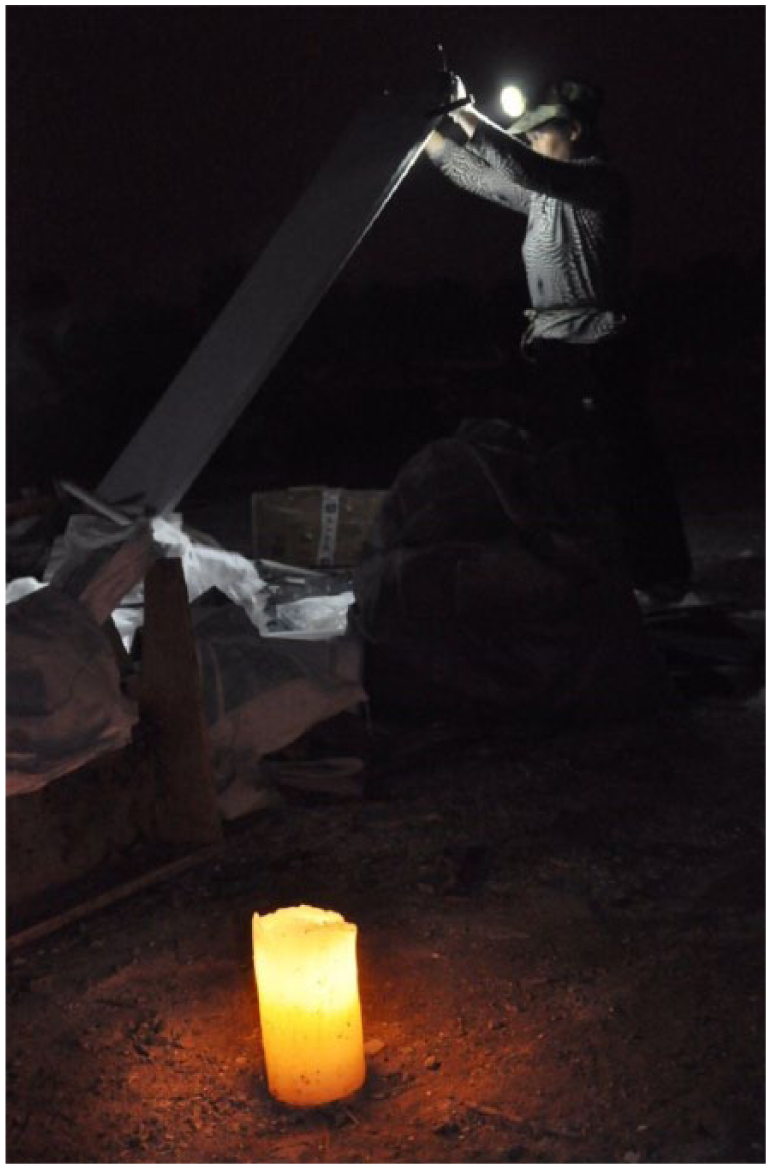
A scavenger working at the debris dump of Naizi village. Photo by Shih-yang Kao, July 18, 2011.
Debris: A Documentary
The Beijing municipal government’s neglect of waste management not only opened up important space for certain disadvantaged segments of society at the grassroots level to make a living but also gave rise to a dynamic of state-society relations in which the weakened sectors of the local government managed to reassert their political position through the promotion of the work of a leading photographer and filmmaker concerned with the chaos of urban waste disposal. Since the municipal leadership came to embrace urbanization as a growth strategy, agencies that were not directly involved in city-building projects have found it more and more difficult to have their voices heard. Even though the amount of the debris produced in the city skyrocketed over the past three decades, the CUAE, which was in charge of urban sanitation, had never been able to convince the municipal leadership to build a government-run debris handling facility. At the same time, the Office of Debris had never had the resources it needed to make the DDDS system work. In much of the recent discussion of changing state-society relations in the post-Mao period, state actions toward society are often interpreted as forms of social control. It has been assumed that maintaining power amid social resistance or unrest is the main concern behind the state’s actions. In this section, we show that Beijing’s pursuit of Olympic urbanism and the subsequent re-prioritization of the municipal developmental agenda (and hence the reshuffling of internal state power) have given rise to a heretofore little-recognized form of state-society dynamics. For disadvantaged agencies of the local state, the question of how to acquire more resources has become an important concern. Consequently, how the weakened sectors of the government interact with the society is increasingly bound up with the concern to improve their position in the municipal hierarchy.
In the summer of 2010, an unusual public photo and installation art exhibition, titled Beijing Besieged by Waste: The Observations from Wang Jiuliang, was held at the Beijing Songzhuang Art Museum. The exhibit showcased the work of the Beijing-based photographer and documentary filmmaker Wang Jiuliang, who had been documenting Beijing’s garbage dumpsites, as well as the lives of those who lived on the dumps, since 2007. The exhibit included two enormous outdoor installation art pieces—respectively made of cast-off instant coffee packages and disposable slippers—and over 130 photographs of Beijing’s dumpsites (Wang, 2016: 233–34). Never before in Beijing’s art scene had garbage dumps been the main subject of an art exhibit.
Debris was one of the main subjects in Wang’s works. A section of his exhibit called “At the Urban Fringe” (chengbian) drew viewers’ attention to Dongheyan, a gigantic debris dump on the western bank of the Yongding River in the district of Fengtai. Just like Yushuzhuang, Dongheyan used to operate a quarry before the ban. The quarry ban led the village to turn the quarry into a debris dump. After the dump opened, scavengers showed up and asked for permission to collect materials from the dump. The village eventually leased out the dump area to the scavengers and allowed them to build houses on the dump. In the years that followed, more and more scavengers came to work and live on the dump, and eventually they grew into a community of about 2,000 people. Wang Jiuliang found the dump of Dongheyan in April of 2009 during one of his normal dump-hunting trips. 20 He was immediately attracted to the village’s history intertwined with urbanization and the close relationship between Beijing’s debris and the city’s migrant population. In addition to continuing to look for new dumps, Wang began to visit Dongheyan frequently and made friends with the scavengers living there. On June 24, 2010, Wang published a photo journal titled “The Labyrinthian City of Waste” in Southern Weekend, a liberal and widely circulated magazine based in Guangzhou. In this photo journal, Wang showed some the images he took in Dongheyan: scavengers using scrap to build houses, children playing in the dump, and so on. Three months later, on April 2, a troop of demolition workers and police, organized by the Fengtai district government, which was embarrassed by Wang’s photo journal, entered Dongheyan, drove out the migrant scavengers, and tore down all the homes they had built. Wang was shocked by the brutality and decided that the images he took in Dongheyan should be a major theme of his solo exhibition in Beijing.
This was certainly not the first time in China that debris appeared as a subject for art. 21 Many Chinese artists have produced works around the theme of urban demolition to capture and to reflect on the state of flux brought about by rapid urbanization. 22 However, the debris shown in Wang’s images was situated in a geographical context that had thus far been largely invisible to even Beijing’s proud longtime residents: the dumps. While works of previous artists depicted urbanization as a force destructive to neighborhoods and some old ways of life, Wang asked his viewers to pay attention to the destruction and disturbances that urbanization had brought to the countryside as well as the changing situation of urban modernity.
Wang Jiuliang never expected he would be able to show his works in Beijing. The images he took showed the damage urbanization had done to the countryside, implicating the municipal government for turning a blind eye to environmental problems. Officials, he thought, would be too embarrassed to allow a public showing of these images. That, however, was not the case. In November 2009, Wang brought some of his works to Guangzhou to show at the Lianzhou International Photo Festival, and he won the first prize. He began to gain some fame in art circles, and more and more media began to approach him for interviews. In March 2010, officials from the CUAE got in touch with Wang to learn about his social documentary project. These officials not only gave Wang the green light to show his work in Beijing but went so far as to help him find media sponsors, including Xinhua News Agency, CCTV, Global Times, and Beijing News (Xinjing bao).
Wang recalls vividly what happened on June 29, 2010. In the morning of that day, two tourist buses arrived at the Songzhuang Art Museum carrying about 80 officials from the municipal government, led by Yang Anjiang, the chair of the Beijing Political Consultative Conference, who had come to see Wang’s exhibit. At the end of their visit, Yang commented that Wang’s documentary on Beijing’s dumps was important and valuable. He asked Wang to compile all his images (there were more than 5,000 of them) into a photo album, so that the government could give a hard copy of his work to all of the municipality’s bureaus, offices, and district and township governments. Wang was surprised with the positive feedback and recalled that he felt his hard work was finally paying off. Chen Xiaoliang from the Office of Debris was among the officials who visited the exhibit that day. When asked to comment on Wang’s exhibit, Chen said that it was rare to see such an honest documentary (Interview 8). “People really should see those images. And actually that was why the government organized the visit. When governmental officials visit an exhibit, reporters and journalists will come. That’s how you help him send his important message to the public,” she said.
In order to assert the importance of its work—including urban sanitation—to the municipality’s overall development, the CUAE actively helped Wang publicize his exhibition, even though his images showed the commission’s incompetence when it came to managing urban waste, including construction debris. In other words, the ways the weakened sectors of the local government interacted with society were increasingly bound up with the concern to improve their position in the municipal hierarchy. But did such a strategy of social control work? On March 30, 2010, in a document entitled “Implementation of the Planning and the Construction of Waste-Treatment Facilities” the municipal government declared that, by 2015, it would invest a total 10 billion RMB in the construction of 40 waste-treatment facilities, including four building waste recycling plants (Beijing Municipal Government, 2010). On April 17, 2013, it issued another notice, “Plan for Implementing the Construction of Waste-Treatment Facilities (2013–2015),” in which it announced that, by 2015, it would construct no less than five building waste recycling facilities (Beijing Municipal Government, 2013). Many newspaper and magazine reports credited these new developments to Wang Jiuliang’s social documentary project (see, e.g., Zhao, 2011; and Zhao, 2017). However, at the time of this writing, Beijing still does not have a single building waste treatment facility. It remains unclear whether the municipality has become more attentive to the problem of urban waste and how serious Beijing’s reaction will be to the problems of urban waste management exposed by the Wang’s influential art works.
Conclusion
The explosion in urbanization taking place in China has affected not only population mobility and spatial restructuring but also the way the state and society function and interact. Until recently, studies of China’s state-society relations have been based on the assumption, either explicit or inexplicit, that the state is either virtually an all-powerful unified entity or, alternatively, a bi-polarized central/local composite, and that, in either case, society is relatively weak, passive, and victimized. Our research into the ongoing process of urbanization in the metropolis of Beijing has uncovered a dynamic in which the state’s pursuit of urbanism has led not only to a redistribution of resources but also to an uneven capacity to govern and thereby has opened up new and unintended space for certain segments of society to maneuver for survival. The state encompasses a sophisticated ensemble of power relations extending both vertically and horizontally. Likewise, society should be seen as a complex system of adaptable, proactive, and strategizing actors and forces that are far from passive, powerless, and victimized. It is possibly because of this sophisticated and ever-changing nature of state and society that state-society relations in China are played out in a way that cannot be characterized as a zero-sum game.
Beijing’s winning of the Olympics bid in 2001 induced two major developments in the city’s ecological frontier: the expansion of the city’s quest for sand and gravel into the province of Hebei and the conversion of the city’s quarries into dumps. The former was led by the municipal government as a part of its effort to terminate all quarry operations in the municipality. This development shows a Chinese local state caught up in what could be called urban aspirations. In the quest for blue skies for the 16-day games, it destroyed a material supply chain whose role in the city’s air pollution problem was not certain.
The second development, led by the villages that were operating the quarries, shows a Chinese local state whose capacity to govern is compromised by its own urban aspirations. Just like many other municipal agencies that were not directly involved in city-building projects, the Office of Debris was invested with few resources. Hence it is not surprising that it failed to implement the regulatory framework that it invented. The villages that were operating quarries exploited the situation by entered the dumping business. The local state’s role in urbanizing China may appear invincible when we look at how it takes away people’s land or implements clean air policies. But it appears much weaker when we consider it in relation to debris disposal.
Looking at urbanism in terms of debris management, we thus find that state building has been a double-edged sword. While much attention and many resources were drawn toward city-building projects, the governing capacity of agencies whose work did not directly involve urbanization had been compromised. In this article, we have explored how this uneven capacity to govern brought about new state-society dynamics. On one hand, the uneven capacity to govern opened up an important space where disadvantaged societal actors maneuvered for survival. The villages examined in this case study cannot be described as merely victims of debris dumping or urbanization. Villages that used to operate quarries reinvented themselves as dump managers and created a new geography of dumping. They also enacted rules that truckers had to follow. Any analysis of debris dumping that does not take into consideration the active role played by these villages would be incomplete and one-sided. On the other hand, the ways the disadvantaged sectors of the local government interact with society are increasingly bound up with the concern for attaining a better position in the municipal hierarchy. In order to assert the importance of its work for the municipality’s overall development, the CUAE actively helped the photographer and filmmaker Wang Jiuliang to publicize his exhibition, even though Wang’s images showed the commission’s incompetence at managing urban waste, including debris.
The village landscape along the Yongding, Wenyu, and Chaobai rivers has gone through a series of transformations during the past twenty years, first from farmland to quarries and then from quarries to dumps. More than ten years have passed since the quarries were converted into debris dumps. Thus, in some of these villages the dumps have been filled up. Meanwhile, the urban area of Beijing has also expanded, bringing the city closer to them. Quite a number of them have been turned into suburban recreational or green areas. As the natural historian William Cronon once said, it would be a mistake to think of the countryside as a place of calm and stillness. The transformation of China’s restless countryside continues to take place in tandem with the expansion and development of the city in an era of rapid urbanization.
Footnotes
Acknowledgements
The authors are grateful to the interviewees in Beijing for sharing information and to the anonymous referees for helpful comments. They would also like to thank Chen Liwen from Green Beagle for assisting with the interviews and site visits.
Declaration of Conflicting Interests
The author(s) declared no potential conflicts of interest with respect to the research, authorship, and/or publication of this article.
Funding
The author(s) disclosed receipt of the following financial support for the research, authorship, and/or publication of this article: The work described in this article has been sponsored by grants from the Research Grants Council of the Hong Kong Special Administrative Region, China (GRF 17662116 and CRF C7028-16G).