




Abstract
This article looks at the role of Guangzhou’s Public Security Bureau in constructing Africans in the city as “triple illegal,” or sanfei 三非. The term refers to those who enter, stay, and work in China illegally. While many scholars have written about the racial profiling of Africans by the Chinese police, little is known about how police officers on the ground enforce the law and why they act the way they do. Failure to tackle these questions, combined with a more or less exclusive focus on Africans’ strategies of survival, not only undermines the effectiveness of criticizing the emerging institutional racism in China but also risks reinforcing the negative image of Africans as lawbreakers. This article attempts to fill this gap by approaching the topic from the perspective of police officers. It argues that the way the police system is set up makes Africans vulnerable targets of police officers, who are under great pressure to improve performance statistics and are motivated by monetary incentives.
It was a summer morning in 2015 when I met Henry, a 29-year-old from Niger who smiled a lot. I met him at the Community Office of Foreigner Assistance (see Figure 1) in the Xiaobei 小北 area of Guangzhou, where he was applying for the Registration Certificate of Temporary Residence 临时住宿登记 (referred to hereafter as RCTR). This is a document that foreigners are required to obtain from the police within 24 hours of their arrival. But to alleviate the burden on local police stations, since 2007 the Guangzhou government has established community offices in all major foreign communities to save foreigners the trouble of visiting police stations (Zhou, 2014: 5). Although these offices are staffed by civilian personnel, the document is issued by police officers stationed there.
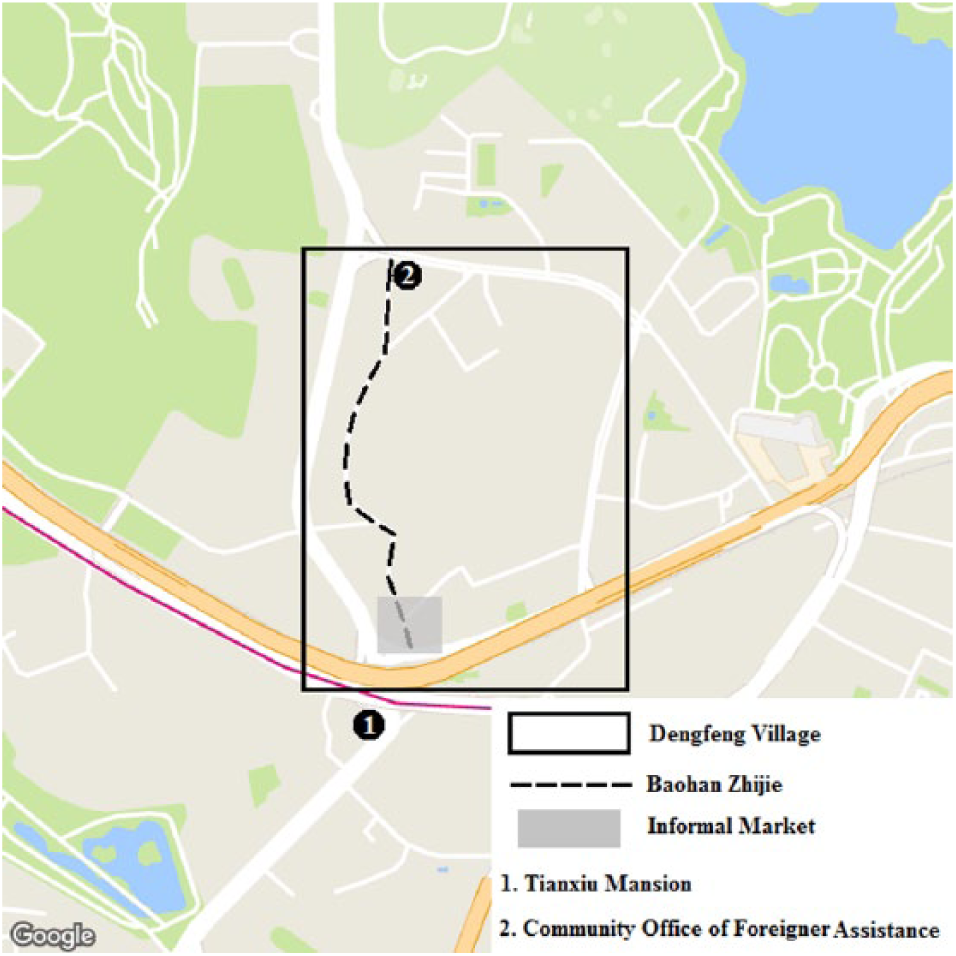
Xiaobei, with key locations mentioned in the article. Map created by the author using Google Maps.
When I arrived at 7:30 that morning, there were already ten to fifteen Africans waiting outside the office because earlier in the year the office implemented a daily quota on the number of RCTRs issued (see Figure 2). Many Africans like Henry thus came early to make sure they had a spot. As we were waiting, I tried to talk to Henry. He was reluctant at first, but after I told him about my research and showed him my American student ID, he became more relaxed.
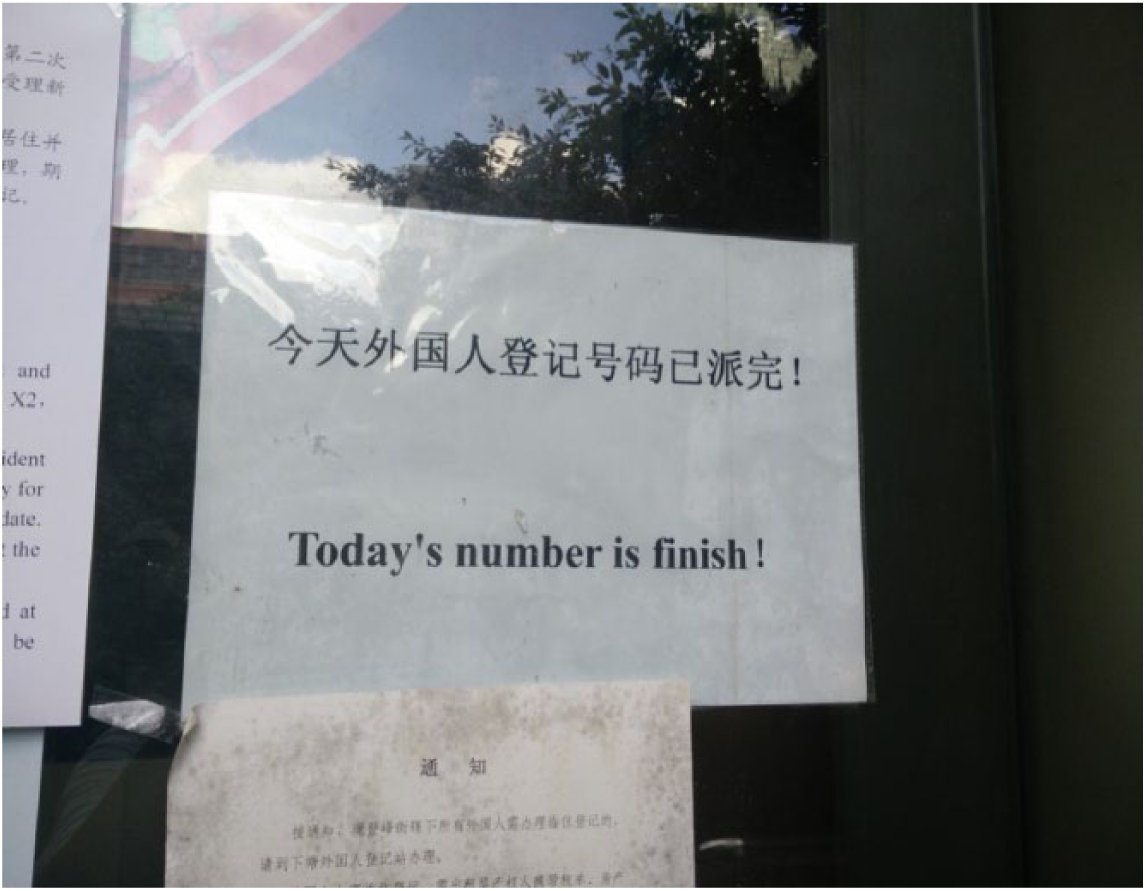
Sign on the door of the Xiaobei Community Office of Foreigner Assistance. The Chinese on the sign reads “The numbers for today’s registration of foreigners have all been given out.” When the quota system was implemented, the office gave out numbers to the applicants in an attempt to organize them. Photo by the author, 2015.
He complained to me that the laws and regulations in China changed frequently, and usually for the worse. The RCTR, for example, used to be valid for the duration of one’s visa, but he said a few months back, the office reduced it to seven days, meaning that foreigners had to go through the trouble of applying multiple times. This, in addition to the daily quota, had made the procedure so unnecessarily competitive that some had to come as early as three in the morning to secure a spot.
At around 8:30, the staffers of the office gradually started to arrive. Fifteen minutes later, one of them came out with a stack of forms in her hands. All of a sudden, the quiet of the morning turned into chaos with people pushing, yelling, and scrambling. It turned out that this was all unnecessary as the regulations once again had changed. The quota was no longer in effect and the duration of the RCTR, to Henry’s surprise, was lengthened, but people who had never registered with the office earlier that year were no longer eligible to apply. Because a foreigner’s RCTR must correspond to their address, this meant foreigners could no longer move into this neighborhood. Needless to say, mostly Africans were affected because they were the main residents there. But what made it worse was that the government never communicated this change to the residents. A woman, whom Henry told me came at 5:00 am, just found out about the change that day. On hearing the bad news, she stormed out of the office. Volatile regulations, however, are just one of the ways that Public Security targets Guangzhou’s African residents.
That day, after he received the document, Henry took a walk with me in Baohan zhijie 宝汉直街, a narrow street surrounded by old and cramped tenement buildings. The apartments inside are home to many Africans. As we walked, I noticed that the street was heavily policed. Surveillance cameras were installed in many places, and during the thirty minutes I was there, three police patrol teams walked by. The police presence is usually heightened at night. A Chinese informant told me recently that even the Armed Police Force could be seen patrolling the neighborhood in the evenings (Figure 3). 1 Obviously the local government has turned the area into a panoptic space where policing is omnipresent. For the African residents there, door-to-door inspections and raids have become part of their lives. A young Kenyan who used to live in the area told me that the police knocked at his door every morning at eight. On the street, stop-and-frisk spot inspections targeting only blacks are very common. Henry gave me an example. He was once walking in the Xiaobei area behind a white man and a policeman approached them. The officer left the white man alone, but stopped Henry and asked to check his documents. Henry was very upset and refused to show his documents. “I was furious,” he recalled. “I told him if you want to see my documents, you have to check that white man’s first.” But instead of checking the white man’s documents, the policeman let Henry go to defuse the situation. This kind of blatant racial profiling explains why Africans resent the police, something that has led to two street protests, in 2009 and 2012. 2 Given this volatile situation, it is important to discuss what the police might be trying to accomplish by targeting Africans.
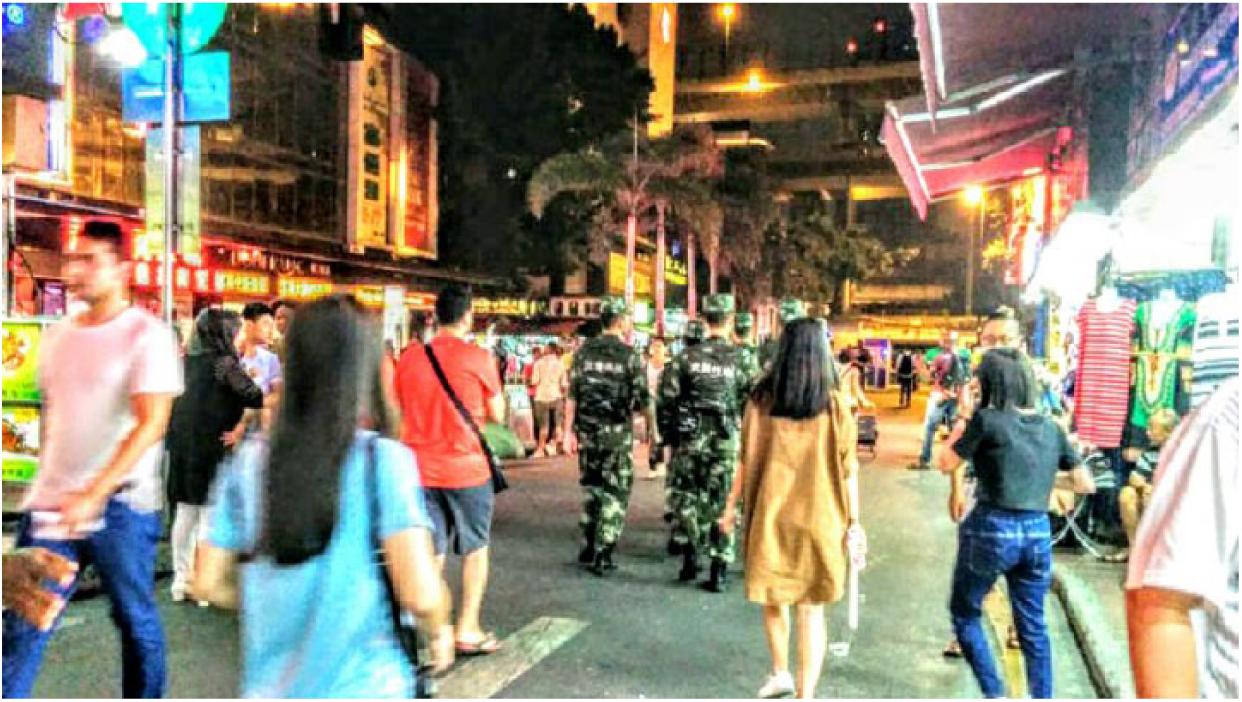
A team from the Armed Police Force patrolling the Baohan zhijie neighborhood at night. Photo by an informant, 2016.
This article looks at Public Security’s role in constructing Africans as “triple illegal,” or sanfei 三非. The term refers to those who enter, stay, and work in China illegally. Although the term does not single out any racial group, news media in China have constantly linked it to Africans, so much so that in many online forums, Chinese simply label Africans “sanfei blacks.” 3 As the police in China and one of the main government organs responsible for managing foreigners, Public Security has been fighting the sanfei problem for the past fifteen years. Since around 2008, Africans have become the main target of many anti-sanfei campaigns. These campaigns usually include mobilization of public support via the media, shortening of the RCTR, constant stop-and-frisk style inspections, visa raids, drug busts, and so on.
Arguing that sanfei as a black problem is a social construct should not be taken to mean that no African violates Chinese immigration regulations. Many Africans, as demonstrated by other scholars (Haugen, 2012; Castillo, 2016; Lan 2016), in fact overstay their visas or use fake passports. I have during my own research also come across Africans who are sanfei. 4 However, Africans are not the only group that violates immigration regulations, and the fact that the public associates sanfei mainly with Africans has much to do with how Public Security operates and enforces the laws. In other words, we should have a more nuanced understanding of illegality and look at what Shanshan Lan refers to as the “legal production of ‘African illegality’” (Lan, 2015: 290). The police targeting of Africans, as we shall see, directly contributes to the production of a higher number of illegal Africans.
This article is based on my research in 2014, 2015, and 2017. I spent three summers in Guangzhou, each time about two months, talking with Africans and observing how they lived their lives. I also talked to a few Chinese whose work required close contact with Africans, such as government officials, businesspeople, Chinese employees of Africans, and immigration agents. 5 Their candid opinions and insider’s perspective proved to be a great help. Although my field research was brief, fortunately several key informants trusted me enough to continue to provide me with materials after I returned to the United States. For this particular article, I rely heavily on the insights provided by a police officer, Dai, 6 who works in a precinct right next to Xiaobei. His input greatly complicates the simple dichotomy of racist police and oppressed Africans indirectly portrayed by other scholars. Such a heavy reliance on one single informant necessarily entails an obvious caveat: the idiosyncrasies of small sample size. But considering Dai’s closeness to the situation and the difficulty of finding another police officer so forthcoming about their work, his insights are still worth reporting. Also, I extensively reference scholarship on policing in China so as to minimize the potential for errors.
My research focuses on the Xiaobei area, one of the two largest African communities in the city. One particular building complex, Tianxiu Mansion 天秀大厦, is so exoticized in the news media that some compare it to the Chungking Mansion in Hong Kong (Ma, 2015), which, as detailed by anthropologist Gordon Mathews, is occupied by mostly non-Chinese, especially those from other Third World countries such as India and Nigeria (Mathews, 2011). Because of this, Xiaobei is one of the most heavily policed, as well as best-studied, areas.
The Literature
In the past eight years or so, the Africans in Guangzhou have received increasing attention both from the news media and academia. Most writers (Bertoncello and Bredeloup, 2009; Lyons, Brown, and Li, 2008; Osnos, 2009; Bodomo, 2010; Haugen, 2012; Li, Lyons, and Brown, 2012; Pieke, 2012; Yang, 2012; Lan, 2015 and 2016; Castillo, 2016) have mentioned how the police have structured Africans’ daily lives in Guangzhou. Some of these scholars, using a globalization framework, highlight the Africans’ agency by focusing on the resiliency of their communities despite all the challenges they face, but few have discussed the role of Chinese law and none focuses on the perspectives of the police. Yang Yang (2012), for example, mainly looks at how Africans live in an underground economy by taking advantage of modern networks, transportation, and the infrastructure of the age of globalization. She refers to this phenomenon as “globalization from below,” a form of grassroots movement different from the proliferation of giant multinational corporations with which we usually associate globalization. Although Roberto Castillo’s work has a more detailed discussion of the police, he mainly treats them as a threat that brings Africans together and prompts them to organize. However, we still know relatively little about how state institutions such as Public Security work. What’s worse, emphasizing Africans’ defiance of immigration regulations as a strategy runs the risk of reinforcing the stereotypical image held by Chinese that Africans residents have no respect for the law.
This is not to suggest that no researchers realize the importance of the role of the state. Zhigang Li, Michal Lyons, and Alison Brown, for example, discuss how the state has authored the slow decline of the Xiaobei community (Li, Lyons, and Brown, 2012). Shanshan Lan, on the other hand, attributes the government’s heavy-handed approach to a 2011 law that affects many major aspects of Africans’ lives (Lan, 2016). However, we do not know how institutional changes affect Africans on the ground and how the legislation is enforced by the police, which is usually a far cry from what the text of laws specifies.
Moreover, while several scholars (Sautman, 1994; Sullivan, 1994; Cheng, 2011) have written in detail about the racial conflicts between African and Chinese college students in the 1980s, most work on Africans in Guangzhou today eschews any argument about race. Even though some scholars point out that race seems to be a criterion in police operations, they do not elaborate on the mutually constitutive relationship between race and institutions. Perhaps this is because the black community in Guangzhou is still a relatively recent and local phenomenon. Lan acknowledges that “racialization of ‘blackness’ has played an important role in the social and legal construction of African ‘illegality’ in Guangdong,” but the issue does not seem to be a nationwide one (Lan, 2015: 300). At this stage, Africans’ experience in Guangzhou might be a local phenomenon, but it is important to note that news articles connecting sanfei with Africans abound on many news websites with a national reach and such sites inform Chinese throughout the country. Moreover, as Frank Pieke notes, when the labor shortage created by the One Child Policy kicks in around 2025, China will likely depend more on international migration (Pieke, 2012: 41–42). So, what happens in Guangzhou could give us some indication of what might happen throughout China in the future.
This article thus represents an effort to add depth to the documentation of institutional racism. It contends that the discourse of sanfei represents a form of racial formation. Michael Omi and Howard Winant in their research on race relations in the United States define racial formation as “the sociohistorical process by which racial categories are created, inhabited, transformed, and destroyed” (Omi and Winant, 1994: 55). In this vein, we will look in this article at one of the social processes through which the police construct the racial code word “sanfei.” Castillo argues that the behavior of the police should be understood not as a form of racial profiling, but rather as an analogue of the way that the authorities have long treated China’s internal migrants (Castillo, 2016: 292). While he is certainly correct in identifying the similarities in the treatment of the two groups, the fact remains that the police are indeed racially profiling Africans while enforcing immigration regulations. As Omi and Winant explain, racial formation consists of “historically situated projects in which human bodies and social structures are represented and organized” (Omi and Winant, 1994: 55). Consequently, such a formation is contingent on the time and location of its occurrence. In China, the government’s policies on internal migrants have not only provided a framework for dealing with Africans residents but have also enabled the police to target Africans.
However, unlike Omi and Winant, who assign an a priori role to racial ideology, my understanding of the Chinese state is influenced by studies of institutional racism in the United States. Institutional racism in the United States has been well studied by many scholars. As long ago as the early 1900s, W. E. B. Du Bois insightfully pointed out that institutions could in fact reinstate serfdom (Du Bois, 1903). Later scholars (Blauner, 1972; Wellman, 1993; Harris, 1995; Brown et al., 2003; Lipsitz, 2006; Alexander, 2012) have revealed how institutions and the legal system continued to privilege whites, especially white males, after the abolition of Jim Crow laws. Some of them focus specifically on how police racial profiling and the criminal justice system can create a larger number of black criminals. Michael Brown et al., for example, expose the fallacy that blacks commit a disproportionate number of crimes by showing that police are more likely to stop and arrest blacks (Brown et al., 2003: 149–50). Michelle Alexander similarly argues that targeting black communities for drug busts and unequal sentencing result in a disproportionate number of blacks being incarcerated, despite the similar drug crime rates across the racial spectrum (Alexander, 2012: 98–99). This scholarship aims to tackle a more hidden form of racism under the rise of the neo-conservatives in the post–Jim Crow era where race is believed to no longer play a significant role in public life. In the context of China, where racism is generally assumed not to exist, this scholarship is particularly informative and has inspired me to look at the constructive role of the police. 7
To understand the constructive power of the state also requires us to recognize its complexity. State action often cannot be simply interpreted as racially motivated, although the outcome may feed into an existing racial discourse. As Brown et al. point out, “discriminatory outcomes can be produced by actions that appear bureaucratically neutral or colorblind—sometimes even well-intentioned, undertaken in response to concerns raised by minority communities” (Brown et al., 2003: 138). Institutional racism, in other words, thrives not on the racial prejudice of individuals, but on how state and/or business institutions are structured. And usually prejudice and structural incentives are so intertwined that one is inseparable from the other. That makes it more dangerous and harder to critique. The police in Guangzhou are no exception. The motivation behind all the anti-sanfei campaigns and racial profiling cannot be simply explained away as racial prejudice. These actions, as we shall see, are also driven by pressure from police officers’ superiors and monetary incentives.
Policing in China
Policing in China is the responsibility of the Public Security organs, which, from the central to the local level, include the Ministry of Public Security, Provincial Public Security Departments, Municipal Public Security Bureaus (PSBs), and local Dispatch Stations 派出所. Various scholars (Bracey, 1989; Bakken, 2005; Tanner, 2005; Tanner and Green, 2007; Wong, 2009; Trevaskes, 2010; Wang, 2015) have discussed in detail how these institutions came about, how they organize themselves, and how they function. Kam C. Wong traces the origin of policing in communist China to the Disciplinary Patrol 纠察 during the Canton–Hong Kong Strike in the 1920s. The strike was directed by the Communist Party and its disciplinary team 纠察队 was charged with directing the strike, supervising its members, and enforcing strike laws and union orders (Wong, 2009: 69). Whatever the case, from its inception, the defining character of policing in China derived from the mindset of self-defense. According to Wong, the party established its first security-defense organ 保卫组织 in 1927. This institution, “the earliest known state-sponsored public security organization in Communist China” (Wong, 2009: 104), was designed to defend the party from constant persecution by the Guomindang, the ruling Nationalist Party. Guarding against subversion and protecting party secrets were thus its top priorities. This history set the course for the police in China: rather than being an independent professional law enforcement institution, the police have always served as “an instrumentality of the state and in defense of the Party” (Wong, 2009: 92).
But according to Murray Scot Tanner and Eric Green, there is another twist to the story. In the early years of the Chinese Communist Party, some internal struggles also left an indelible mark on police work in China. In the 1930s, in an attempt to copy the Soviet’s centralized and independent police system, the Chinese Soviet Government in Jiangxi set up a State Political Security Bureau, which, many historians now argue, led to widespread intra-party purges (Tanner and Green, 2007: 650). Learning from this mistake, the Chinese government now guides the security system with the principle of “combining vertical and local leadership, with local leadership as the main part” (tiaokuai jiehe, yikuai wei zhu, 条块结合, 以块为主, hereafter referred to as the tiaokuai principle) (Tanner and Green, 2007: 648). This means that although local Public Security bureaus are controlled by their provincial and central superiors, the local party plays an active role in directing them and organizing their work.
During the Mao era, policing depended on the community and the masses, and the relationship between the police and urban residents was relatively intimate. Many police officers spent their entire career working in one neighborhood and got to know the locals very well. The residential committees, which provided the model for the Community Office of Foreigner Assistance, were established to help with social control at the ground level. The success of policing during this period, of course, must be attributed to the household registration 户口 (hukou) system, which prevented the population from freely moving, and the Maoist mass line, which dictated that the people’s police should serve the people (Bracey, 1989: 132). The police and residents collaborated to maintain social order. Crime rates during this period were relatively low and party officials boasted that, unlike in capitalist societies, in China people did not need to lock their doors (Dutton, 2005: 195).
Things changed drastically following the reforms of the late 1970s. The reform and opening up policy in 1978 reintroduced a market economy into China and the central government began shedding some of its responsibilities, including policing. Michael Dutton, a specialist in Chinese policing and social control, has discussed the introduction of the responsibility system 责任制 in policing in the late 1970s following its huge success in agriculture. While the economic reforms gradually eroded the hukou system, the rural population began moving into cities and crime rates skyrocketed. The implementation of the reforms thus called for improved performance of the police and the professionalization of officers. Besides enacting criminal laws and regulations regarding public security, the central government also introduced monetary incentives for local police stations and remuneration was tied to numbers of crimes solved. The relationship between the government and the police thus operated like a contract. It is not difficult to see all the problems that the reliance on statistics can create, and it eventually came to play a significant role in the discriminatory targeting of Africans in Guangzhou through spot inspections and raids.
One odd by-product of the responsibility system has been the resurrection of Maoist-style political campaigns. According to Dutton, the party, alarmed by the increased crime rates, demanded that the police bring them back down to the level of pre-reform days—an unachievable order, but one that had to be followed nonetheless. To demonstrate their determination, the police brought back the type of campaigns that were characteristic of Mao’s rule (Dutton, 2005: 201). These policing campaigns, as Susan Trevaskes points out, also serve as a tool for the state to construct a sense of coherence by bridging the past and the present in a period of drastic economic change (Trevaskes, 2010: 8). Although today these campaigns no longer center on political struggle, they are very much driven by a political agenda. Instead of serving the “people” as in Mao’s day, the goal of policing in post-reform China is to maintain social stability and create a secure environment for economic development (Trevaskes, 2010: 58; Wong, 2009: 165).
Unlike campaigns during the Mao years where the masses were mobilized and played a major role, these policing campaigns usually just involve a heavy-handed approach to raiding, arresting, sentencing, and curtailing due process. Because the new campaigns have been a response to the influx of the rural population into urban areas, it is not surprising that they have always targeted communities of rural migrants, although migrants are in fact more likely to be the victims of crimes than the perpetrators (Bakken, 2005: 78). The state launched its first Strike Hard 严打 campaign in 1983; its driving principle was to combine leniency for first-time offenders and those who confess with harsh punishment for recidivists and people who resist interrogation. However, Trevaskes argues that in reality, the harsh-punishment side of the equation was the sole focus (Trevaskes, 2010: 56). Since then, the police have launched countless campaigns modeled after this one, targeting either serious crimes or specific types of crime such as drugs or prostitution. Public Security authorities launch campaigns so often that they are no longer special operations but rather a normal practice.
Among the long list of police campaigns are those directed against sanfei, which are characterized by ceaseless raids, heavy fines, and prolonged detention (Haugen, 2012: 73). Because these anti-sanfei measures derive from both the state’s response to the movement of rural populations into cities and the fact that the government has, since 2008, considered both groups as a “floating population” in the city (Lan, 2016: 11), the police treat Africans very similarly to rural migrants. However, the situation for Africans is considerably more difficult because unlike rural migrants, they are a small group not perceived to be essential to Guangzhou’s economic development; thus, the municipal government has little incentive to accommodate them. For example, while the government has been slowly phasing out the temporary residence permits 暂住证, a document that rural migrants must obtain in order to remain in cities, since 2010, giving rural migrants rights similar to those of residents with an urban hukou (“Guangzhou and ten other cities,” 2010), it has been stepping up enforcement of the RCTR in neighborhoods with a large African presence. The Xiaobei area in particular has been subject to particularly harsh policing because of its location at the center of the city and the consequent higher pressure on the police stations.
Xiaobei
Xiaobei derives its name from Xiaobei men 小北门, or Little North Gate, a portal in the wall that surrounded ancient Guangzhou. The area was thus once farmland on the periphery of the city, and Baohan zhijie was in fact located outside of the original city. As the city expanded and as distances were shortened by modern transportation, the area became part of the heart of the city. It is close to many major wholesale markets and connected by all major public transportation networks, making it appealing to Chinese and African traders alike. While all farmland has disappeared, the original villagers rebuilt their residences into tenement housing, catering to incoming domestic migrant workers. Such village-turned-rental-houses are numerous in Guangzhou and are nicknamed urban villages 城中村. 8 Dengfeng village 登峰村, where Baohan zhijie is today, is one such neighborhood. Because of migrant workers’ low socioeconomic status, urban villages tend to attract many informal businesses. Unlicensed hawkers and venders occupy the streets and public sanitation is usually not good. These conditions already existed before Africans settled in Guangzhou. Official media tend to portray these urban villages as chaotic and crime-ridden and the government has been trying to redevelop them since the 1990s. Police raids and ID inspections were very common in these neighborhoods. While it is beyond the scope of this article to discuss the history of urban villages, suffice it to say that before the arrival of the Africans, the police had been targeting the Baohan zhijie neighborhood. In the eyes of the police, the Africans have simply replaced the rural migrants as new troublemakers.
But Xiaobei is also unique. It is very heavily policed because it is close to the city’s administrative center. Xiaobei is within the jurisdiction of Yuexiu district 越秀区. Within a three-kilometer radius of Tianxiu Mansion are provincial and municipal government buildings, the municipal Public Security Bureau, and the municipal Foreign Affairs Bureau. The provincial Public Security Department and the air force Logistics Department are both within five minutes’ walking distance. Dai told me that because of its proximity to all these state institutions, many government and party officials lived in this area. When they saw the chaos in Dengfeng village right under their nose, they applied extra pressure on the local police stations to clean up the area. Shanshan Lan also notes the sensitive nature of this area and argues that the government does not want the African community to expand toward the government buildings (Lan, 2015: 296).
But perhaps above all, the nearby state agency that exerts the most pressure on the local police to clean up Xiaobei is the municipal committee of the Chinese Communist Party, located about a kilometer and a half from the Baohan zhijie neighborhood. According to a video produced by the Yuexiu district government in July 2015, a series of clean-up actions followed the appointment of Ren Xuefeng 任学锋 as the secretary of the Guangzhou Municipal Committee of the CCP (Chinese Communist Party) in August 2014. Ren, who is also a member of the standing committee of the provincial committee of the CCP, chose Baohan zhijie as the first stop of his “clandestine visits” anfang, 暗访. The video, titled The Past and Present of the African Village 非洲村的今昔, was meant to be circulated internally among government agencies. The video reports on the “improvements” to the neighborhood that were put in place after the clean-up and how well the district government had achieved the goals set by Ren. As discussed earlier, because of the tiaokuai principle, local party committees have significant control over local PSBs. Trevaskes points out that while party officials do not interfere in individual cases, they nevertheless retain decision-making power over anti-crime policies (Trevaskes, 2010: 59). This is because social order “is a major item in the political evaluation of local Party officials” and their influence is particularly strong during anti-crime campaigns (Tanner and Green, 2007: 666). So, Ren has had a substantial personal stake in cleaning up such a key area of a city indelibly associated with the sanfei. 9
That Xiaobei is located in such a key area with the party secretary living within walking distance must have resulted in more pressure on local police stations to produce results. The video accentuates this point with a map of Xiaobei marked with the locations of several key state agencies (Figure 4). The map shows the Baohan zhijie neighborhood ringed by key institutions. To inject a sense of urgency, the map exploits sharply contrasting colors to highlight the neighborhood’s incongruity with its surroundings. While the exaggerated green and blue colors that depict the nearby natural environment seem to portray the area almost like a theme park, the redness covering the neighborhood conjures up a sense of danger. Interestingly, at first glance, the neatly defined border of the red zone seems to indicate that the sanfei problem needs to be contained. But a closer look suggests otherwise because it does not exactly correspond to where Africans gather most frequently. The Tianxiu Mansion, which many Cantonese associate with Africans, is not even in the zone. The area covered seems to correspond more to Dengfeng village, which has yet to be completely redeveloped. The narrator of the video corroborates this point by attributing the chaos and crime to the fact that the area is undergoing a rural-to-urban transition. This suggests that the real goal for this clean-up was to gentrify this urban village. Besides, the map also includes the Huanshidong CBD (central business district) 环市东 CBD, reminding officials that the party considers the city’s very economic heart to be at risk if public security is compromised.
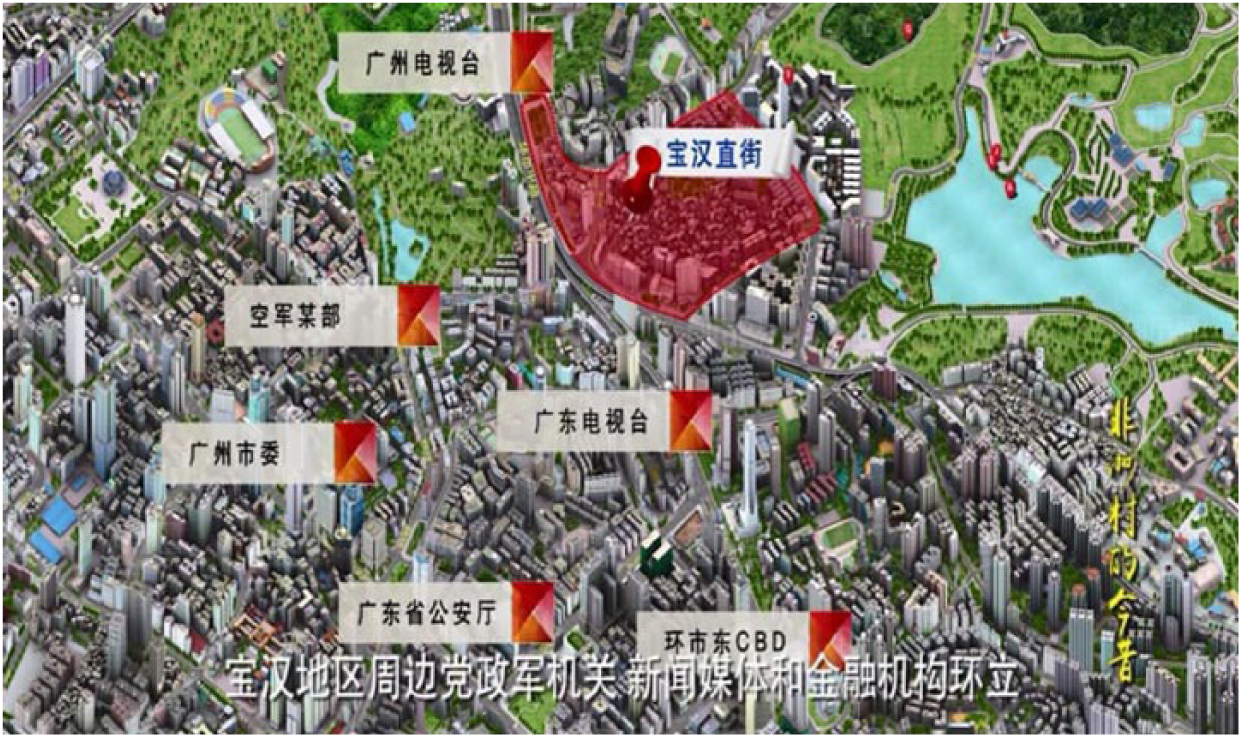
Screenshot from the video The Past and Present of the African Village. The map shows various institutions near the Baohan zhijie neighborhood (highlighted in red with the name of the neighborhood against a white background). From top to bottom, these institutions are Guangzhou Television, “a certain department” of the air force, Guangdong Television, the Guangzhou Municipal Committee of the CCP, the Guangdong Provincial Public Security Department, and the Huanshidong CBD (central business district). The subtitle reads: “The Baohan area is ringed by party, political, and military offices, as well as media and financial institutions.”
Another point worth mentioning is that among all the places highlighted on the map are two major television stations, Guangzhou Television and Guangdong Television. Although all media in China are in fact state agencies, they do not necessarily avoid topics of public interest that can make law enforcement look bad, albeit within acceptable limits, because they too depend on viewership for their financial survival. In addition, news media in Guangzhou are relatively bold in their social critiques, and so may generate pressure on the police. Dai, however, told me they were not really worried about the TV stations because the police had liaisons inside the news media and there were regulations on what not to talk about. Consequently, it is difficult to gauge how much influence the two TV stations have on policing, but the fact that they are shown on the map at least tells us that officials watching the video should be aware of their presence.
Apart from the presence of all these institutions in the area, surveillance of the police themselves is pervasive. It is thus not surprising that policing in Xiaobei is tough. Some of my African informants also sensed the uniqueness of Xiaobei. Sultane Barry, the Guineans’ community leader, suspected that the city was dissolving the African community because of its strategic location. On the map shown in the video, the air force Logistics Department is not even named, only referred to as a “certain department of the air force,” indicating its sensitive nature.
Pressured to “Produce Results” and the Manufacturing of the Black Sanfei Stereotype
As mentioned earlier, under the responsibility system, the performance of each local (street-level) police station concerns not only the leaders of the station but also the municipal, provincial, and central government as well as party officials. Thus, the pressure on local police stations and the police on the ground is high. They must provide positive statistics to pass performance evaluations. Things are perhaps worse among “foreigner management police stations” 外管所 (waiguansuo) because their job concerns China’s national security and potentially could affect foreign relations. 10
Because Dai’s precinct borders Xiaobei, his station is a waiguansuo and he has to handle foreigners, including Africans, on a daily basis. He gave me some idea what it was like to work under such pressure. Every year, his station has to submit a comprehensive foreigner management proposal and every month the Yuexiu district branch of the municipal PSB evaluates all the waiguansuo. One of the items in the evaluation is a spot inspection. Evaluators choose a section of a road within a station’s jurisdiction and stop foreigners passing by to check if they have a passport and a RCTR. The more foreigners there are, the more likely it is for the evaluator to catch someone without these documents, which means that the police become more punitive and restrictive in order to drive foreigners away. The seven-day RCTR, for example, was imposed by the police specifically to drive foreigners out of their precinct and thus lessen the heat from the evaluators.
Apart from this, the evaluation also focuses on the police station’s records of the past month—the number of arrests and penalties in particular are carefully scrutinized. Stations can score points by apprehending sanfei and other foreigners without a RCTR. At the end of the month, the evaluations are assembled and all the waiguansuo in the city are ranked according to their performance. Dai told me that between 2007 and 2010, when Guangzhou was preparing for and then hosting the Asian Games, the heads of the police stations took the ranking especially seriously, since it was tied to their “political achievements” 政绩.
A low ranking during those critical years could result in the precinct being categorized as a “key clean-up street” 重点整治街 by the municipal PSB, which would be bad news for the local police. Once a station was so labeled, it would be closely watched by the municipal PSB, which would launch more inspections and more clean-ups in the area. This created more pressure on the chiefs of the police stations, which translated into more work for the already overworked officers. Dai’s precinct was a “key clean-up street” in 2014. He recalled he often had to work overtime to produce results 出成绩. In his survey of 19,000 police officers in Shenzhen, a nearby large city in the same province, Wang Xiaohai discovered that many police stations were undermanned and had to depend on paid security guards and volunteers (Wang, 2015: 121). It seems that the situation was the same in Guangzhou because Dai’s experience echoed these findings: he told me his station hired many “assistant police” 辅警, who were assigned many duties that they were not trained and authorized to carry out. The threat of the “key clean-up street” label must have pushed waiguansuo to assiduously hunt for foreigners with violations and launch more campaigns.
Dai is no stranger to such campaigns. He recalled a drug bust in 2013 launched by the municipal PSB in which more than 1,300 police officers were mobilized. In one particular hotel, he said, more than a hundred people were arrested. Most of them were from Nigeria, Niger, and Congo, and many jumped out of the window to avoid being arrested. The operation was the subject of intense media scrutiny. Most reports blamed the Africans for making, using, and dealing drugs (“Guangzhou police,” 2013).
Xiaobei has had its fair share of campaigns and arrests as well. According to Li, Lyons, and Brown (2012), the police set up special patrol zones in the area in 2007. In 2009 the municipal PSB, teaming up with several other agencies, launched a major clean-up (Wang et al., 2009). How many people were arrested is unknown, but news reports claimed that “a bunch” of foreigners holding fake passports or without RCTR were identified and “handled according to the law.” As a result of the police’s heavy-handed approach, many traders left the area and many shops in Tianxiu Mansion were closed (Li, Lyons, and Brown, 2012: 67–68). However, despite all the policing, the informal marketplace in Dengfeng continued and the neighborhood remained rowdy. That was until 2014, when the city almost completely gentrified the neighborhood following Ren’s appointment. Thanks to the internal video, we see a more detailed report of this clean-up. According to the video, thousands of illegal businesses were closed, hundreds of illegally operated vehicles were confiscated, and some 230 people were arrested. 11
As we can see, reports of clean-ups heavily emphasize statistics (see Figure 5). This is because, despite their inaccuracy and oversimplification, statistics make the intangible goal of social control measurable, and the municipal PSB judges local police stations based on statistical records. Dai commented that his superiors cared less about public security than statistics. As Børge Bakken has explained, the purpose of launching anti-crime campaigns in general is to achieve three statistical goals: “lowering numbers of criminal cases, increasing arrests, and increasing the percentage of officially opened case files that are solved—the ‘case cracking rate’ (po’an lü)” (Bakken, 2005: 75). In waiguansuo, this would also include the number of sanfei arrested or the number of foreigners caught without a RCTR. During the Olympics and the Asian Games, the drive to produce such statistics was particularly strong. Campaigns are an effective way to achieve these goals because they allow the police as well as the whole criminal justice system to be especially heavy-handed. Mass arrests and long sentences in turn generate favorable statistics.
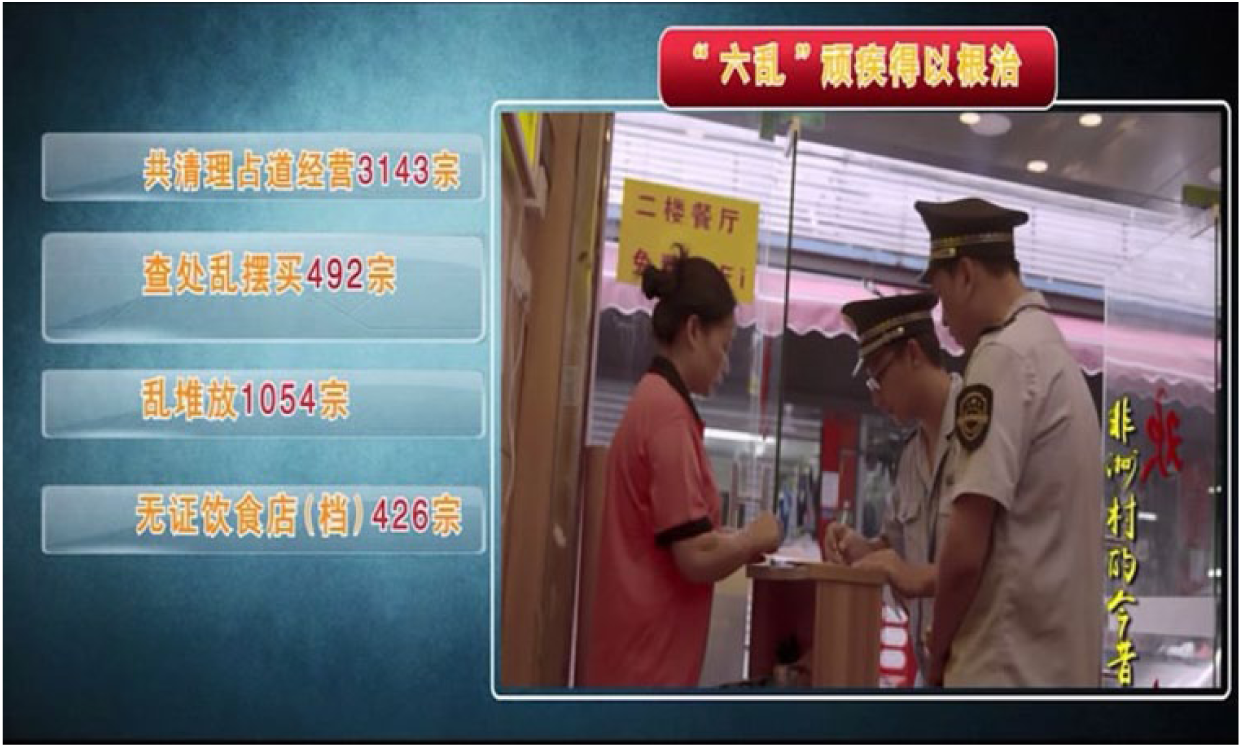
Screenshot from the video The Past and Present of the African Village. The text on the top right: “‘Six Chaotic’ chronic diseases were eliminated.” On the left, from top to bottom: “Cleared away 3,143 cases of road-blocking businesses; Handled 492 cases of illegal peddling; 1,054 cases of street occupation; 426 cases of unlicensed restaurants (food stands).”
Because crime statistics are created under pressure from above, we must treat the narratives they support with caution. Bakken points out that the police can even “improve” their statistical performance (Bakken, 2005: 74–75). For example, the rate of crimes solved, obviously a very important index for the performance of a police station, can be easily raised by not reporting certain cases that are not easily solved or simply not opening investigations into such cases. Statistics important to waiguansuo such as the number of sanfei arrested or foreigners caught without a RCTR can also easily be boosted by targeting Africans.
Africans make easy targets for several reasons. First, unlike white foreigners, who are scattered around the city, Africans are concentrated in a few areas, with Xiaobei being the most prominent. Also, the police know that Africans are more likely to rent from private landlords and not have the RCTR since the RCTR is issued by the police themselves. Because white foreigners are usually formally employed or stay in hotels, the RCTR is less of an issue for them. 12 Finally, African sanfei are much easier to catch. The term “sanfei” includes those without valid immigration documents and those working in China without authorization. However, the way the law is enforced is heavily biased against the former group. Since many Africans violate the sanfei law by overstaying their visas, instead of working without authorization, they are very easy to catch and convict as all the police need to do is check their passports. Illegal workers, on the other hand, are much harder to convict, despite their large numbers.
Because the process for foreigners to get permission for formal employment is complicated and involves a great deal of paperwork, many employers tend to avoid hiring foreigners. Many foreigners, however, are still able to find jobs in the informal sectors where employers hire them illegally (although Africans are seldom able to find either legal or illegal employment because of their negative image in the eyes of Chinese employers and customers). Sometimes employers believe having a white foreigner as an employee may make their business look classy 高档, but there are also cases where a foreigner has some unique skills required by a business. For example, Dai saw many Westerners working as DJs or performers in discos and nightclubs and many Indians working in restaurants. During my research I also met a Pole and a Russian working in a gym as trainers, although neither of them was in good shape and neither had the skills to train anyone (the gym employed a Chinese trainer for the actual work). Neither of them was legally hired because even the gym itself was not legitimate. The owner took all the customers’ money and disappeared soon after I left China. China’s cash-based marketplace makes it very easy for employers to hire illegally and get away with it.
Dai told me of his frustration over how difficult it was to catch foreigners working illegally. Even if the police caught them in the act, in most cases they could do nothing. Foreigners could claim they were simply helping their friends. A foreign chef caught cooking in chef’s uniform, Dai complained, could still say he put on the uniform to pose for pictures and have fun. Again, paying people cash leaves no bookkeeping trail and makes it hard for the police to find evidence that would stand up in court. Mindful of their statistics and the goals set by the leaders, the police are as a result inclined to pick the easier target, which inevitably further inflates the number of African sanfei.
Monetary Incentives
Pressure from above is not enough to motivate local police stations to work as hard as they do. The stick of negative evaluations would not work without the carrot of monetary incentives. Not only are the police in many big cities overworked, but they are also underpaid. Several scholars have offered valuable insight into the parlous state of municipal police finances. According to Bakken, the central government nowadays only provides a budget for the Ministry of Public Security (Bakken, 2005: 84). The provincial, municipal, and local Public Security organs are all dependent on their respective governments for funding. Municipal governments have underfunded their police so badly that in some cases police offices report being unable to afford electricity, phone bills, or uniforms. Low salaries have led to corruption and involvement in gambling and drug trafficking. According to Tanner and Green, central government leaders refer to this structurally induced reliance on extra-budgetary and illegal income as “eating impure grain (chi zaliang)” as opposed to eating “the emperor’s grain (chi huangliang)” (Tanner and Green, 2007: 667). Among the impure grains is the excessive use of fines. Catching foreigners, especially Africans, without the proper documents is an excellent source of extra income of this sort.
The heavy fines imposed on Africans have been widely discussed (Haugen, 2012; Lan, 2015; Castillo, 2016). Lan attributes the fines to the 2011 Interim Provisions of Guangdong Province on Administration of and Services to Aliens (Lan, 2015: 297). However, the act of singling out Africans for fines began much earlier. In 2006, the municipal PSB began imposing a 50 yuan (about US$8) on foreigners who failed to carry a passport with them (“Tens of thousands,” 2007). Dai told me that, between 2006 and 2012, in order to motivate the police, the municipal PSB generously used surcharges from this fine as a bonus to reward local police officers. At one point, collecting this fine had enriched local police officers to such an extent that Dai fondly remembered it as a “lucrative business” 好生意. This phrase, he said, actually came from a sarcastic comment made by a foreigner who was fined, but Dai and his colleagues embraced it. Castillo’s informant also shared this foreigner’s opinion and complained to Castillo that the police had “built an economy” out of it (Castillo, 2016: 296). He was absolutely correct. For this particular fine, Dai said the municipal PSB would offer local officers double the amount they picked up in street collections as an incentive to go after lawbreakers. In other words, for every 50 yuan in fines, 100 yuan would be returned to the local police station. In a single night during those years, Dai revealed, they could collect 1,000 yuan to 2,000 yuan. During the 2010 Asian Games, the police would set up as many as three checkpoints on a single block. “Sometimes,” he said sympathetically, “the foreigners were just trying to buy something in the 7-11 close to the hotel and didn’t bring their passport. Then they got fined.” For most foreigners, carrying a passport around in a foreign country risks theft, so many simply ignored the regulation and decided they would rather risk being fined than losing their passport.
However, as life slowly returned to normal after the sporting event, the good days for the police on the ground came to an end. In 2012, according to Dai, another deputy chief took over the Division of Exit and Entry Administration of the municipal PSB, replacing one who was disciplined for corruption. 13 Many changes resulted and the application paperwork for bonuses and rewards became stricter and much more complicated. On the other hand, although the monthly ranking Dai mentioned that was so important to waiguansuo continues to this day, it became moot as it was no longer associated with their leaders’ “political achievements.” Thus, the imposition of the 50 yuan fine gradually became more relaxed. With the new exit and entry laws that came into effect in July 2013, it was finally repealed. Instead, foreigners who do not carry their passport with them are now simply given a warning, a decision that Dai hailed as more “people friendly” 亲民. That, however, was not actually the case. It seems that taking away monetary incentives only caused officers to take measures to drive away the Africans from their precinct since passing the evaluation became the sole motivation. Worse still, the new laws did not herald the ending of the heavy fining of foreigners.
Although the fine for not carrying one’s passport was abandoned, the fines for overstaying and not having the RCTR are still in effect and they are getting heavier. On the very first day of my second field research trip in 2015, a Congolese informant complained to me about the shortened RCTR and the expensive consequence of not having it. He told me that the new fine for not having the document was 2,000 yuan (about US$330), a jump from 500. Dai confirmed this and said foreigners should get the document within 24 to 48 hours of their arrival. If they waited for four days or more and got caught, they would be fined 2,000 yuan. As for the overstayers, based on how many days one had exceeded the visa limit, the police are now fining them at a rate of 500 yuan per day overstayed with a cap of 10,000 yuan to 20,000 yuan depending on the number of offenses. (The cap, the Nigerian community leader Ojukwu Emma told me, was 5,000 yuan before the year 2013.) This is a very steep price to pay and can counterproductively force many to continue overstaying because they cannot afford to pay the fine. But it makes a very good source of revenue for the PSB, even though the share of officers on the ground is smaller than in the days when failing to carry a passport was fined.
These monetary incentives make the already easy target of the African communities more vulnerable to police harassment and as a result they have also borne the brunt of the fines. Dai said buildings with many African residents were particularly heavily patrolled as they were usually popular spot-inspection locations during the evaluation. He recalled that his station once caught nineteen Africans without the RCTR in a single building in a month, fining each of them 2,000 yuan. The police, meanwhile, sometimes intentionally avoided confronting Americans because they were more likely to protest and “overreact” 没事找事. Africans, on the other hand, were, as Dai put it, more “obedient” 乖. Thus, Africans’ compliance with the law can ironically cause them to become easier targets.
But that statement exaggerates Africans’ “obedience.” Dai reported that many Africans claimed that they lacked the money to pay the fine. Also they sometimes chose to flee, fake illness, or even cry to win sympathy. The police thus sometimes avoided them as well. Dai did not see those reactions as forms of protest, but as symptoms of “low quality” 低素质, a popular term that Chinese like to use to describe a wide range of behaviors deemed uncivil by the speaker. However, considering the completely different images presented by the media, one wonders how much overreacting would help these Africans. Even if it did, such overreactions on the part of Africans is likely to be taken as further evidence of their “low quality.” Worse still, Dai said that a hostile attitude could warrant shortening the duration of their stay or even the term of their visa. Thus, faking illness is in fact quite a smart strategy. It is interesting that although Dai had demonstrated sympathy for Africans, he almost subconsciously refused to see that they were often making the most sensible decisions under the circumstances. As a response, to make sure that they pay the fines, police officers are now confiscating foreigners’ passports once they are found without the RCTR, something that Dai admitted the police were in fact not authorized to do. Foreigners then have to redeem their passports with fine payment receipts. This is likely to cause even more Africans to flee when the police approach them.
As we can see, the ways the Chinese police system functions place Africans in double jeopardy. The pressure to produce statistical results and the need for funds induce many local police stations to hunt for easy targets. While these targets used to be domestic migrants from rural China, it is now Africans who are sharing their neighborhoods that are targeted, because they are easier to demonize. The consequence is that Africans are disproportionately represented in the sanfei discourse, which now has a strong racial undertone. The conversation with Dai gave me a glimpse into officers’ stressful life and made me empathize with them at times. I also realize that the system works to give an institutional logic to the decision to racially profile Africans. However, I could not help but feel that this logic is always mixed in with racial prejudice. When I mustered up my courage and confronted Dai with the question of racism, he honestly admitted there was racism within the police and that he sometimes acted in a racist way too.
Racial Prejudice
Although Dai never hinted at it, based on our conversations, it was clear that racial prejudice among police stems from the top. He frequently used the word “leader”—lingdao, 领导— but it was not always clear to whom he was referring. It could be the head of his station, the municipal PSB, the government, the Communist Party, or all of them. But it is clear that the officers at the forefront of dealing with foreigners are constantly fed racist ideas by their leaders.
As in other parts of the world, it seems that for the lingdao in the Chinese police system, words like “Africa” or “blacks” 黑人 are signifiers of negative things such as chaos, crime, drugs, backwardness, disease, and poverty, all of which are seen as the antitheses of modernity. Dai reported that in Guangzhou, policing of blacks had always been very strict because the lingdao demanded that the police pay more attention to them. Also, the lingdao of the municipal PSB specifically cautioned the police against letting Yuexiu district become “little Africa” 小非洲. It is as if the word “Africa(n),” which was also used in the title of the internal video discussed earlier, in and of itself warranted heavy policing. Other scholars (Cheng, 2011; Hood, 2013) have also observed that the media tend to portray Africa and Africans as backward and impoverished.
Meanwhile, the lingdao hold completely different views of white foreigners. The initiative to recruit foreign volunteers to work in several Community Offices of Foreigner Assistance began in 2008, but eventually fizzled out partly because the lingdao in the street-level government wanted to find white foreigners, but only blacks applied. I asked Dai why the leaders preferred whites. He said they thought having white people in the office would make it “classier.” This contrast in attitudes is shocking, but unfortunately not surprising. It stems from the common belief that one can enhance one’s social status by appropriating whiteness, which, as a proxy for Westernness, represents wealth, advancement, global reach, and hence “class.” White people are thus also believed to be in a position to authoritatively approve other countries’ modernization efforts. Consequently, being able to attract white people to volunteer in the community offices could indicate the modern nature of the offices—hence the desire to recruit white foreigners.
Besides, when bad things happen to white foreigners, the police are more likely to protect them and show them how efficient China’s police force can be. Consider an incident in 2012 that was widely reported in the news media. A German woman lost her handbag containing goods worth more than 300,000 euros in a train terminal with 500 to 600 people in Shandong province. The railway station police mobilized their entire staff and retrieved the bag in a few hours by checking each individual passenger and examining surveillance camera footage (“German lost bag in terminal,” 2012). Based on my conversations with Dai and my African informants, it is hard for me to imagine that a police station would devote the same amount of effort and resources to help any African. Even though in Guangzhou Africans do not expect such solicitous treatment from the police, the blatant racial profiling they experience simply cannot be justified.
Dai confessed that the police relied on their “hunches” 直觉 when on the beat and were more likely to stop and question Africans. Ojukwu Emma, the Nigerian leader, told me that even African government officials visiting China were stopped and checked by the police. What’s more, their attitude is usually worse toward blacks. Dem, a Senegalese informant, told me his nephew once tried to apply for the RCTR. He went into the police station with his Chinese girlfriend. Not only was his application denied, but the officer also scolded the girl for going out with a man who could potentially be diseased. Dai also said that whenever a foreigner is arrested and taken back to the station, the first question the officer handling the case usually asks is “Is he white or black?” Whites were routinely treated more politely.
Dai was not immune to such racist behavior himself, which he attributed to his overexposure to “darkness” 黑暗, meaning cases of Africans breaking the law. I did not question what he said, but at the same time since Africans are often targeted in clean-ups and spot inspections, the police inevitably encounter more illegal activities committed by Africans. In other words, it could be that targeting Africans has taken a mental toll on officers, reinforcing their negative image of Africans and therefore making the officers even more aggressive and biased.
Dai recalled he was once in a raid in an apartment building. In one particular unit, he knocked at the door and a black woman answered, but held the door only slightly open. Dai nonetheless clearly saw another person through the gap who disappeared into another room. Dai and his colleagues rushed in, but the person was already gone, perhaps escaping through a window. The woman denied that there was another person in the room. Dai agreed that the person might have taken flight because he forgot to bring his immigration documents, but his first instinct was that they were doing drugs in the apartment. He did not tell me what happened to the woman. They probably could not do much if she had all the documents, but this incident definitely made the police even more suspicious of Africans, in their minds justifying more targeting of the community.
Conclusion
Before I left Guangzhou in the summer of 2015, I met up with Dem, my Senegalese informant, in Tianxiu Mansion to say goodbye. During our discussion, he received an email from a friend and he showed me a document sent as an attachment. It was the minutes of the “Meeting Between Consul General’s [sic] and the Deputy Director General of Guangdong Foreign Affairs Office.” His friend, perhaps a staffer in one of the consulates, asked Dem to help translate the minutes into French and Dem gave me a copy.
Although it was a low-profile meeting (no news media reported on it), all participants held important positions. The African attendees included the consuls general of Uganda, Ethiopia, Mali, Nigeria, and the Ivory Coast. On the Chinese side were the deputy director of the Exit and Entry Administration of the Guangdong Public Security Department, the deputy head and section chief of the Exit and Entry Administration of the Guangzhou PSB, the deputy section chief of the Guangzhou PSB, and the deputy director general of the Provincial Foreign Affairs Office. Public security had a heavy presence in the meeting because the police’s treatment of Africans was the main item on the agenda.
The representatives for the Africans brought up many of the issues discussed in this article. For example, they pointed out the inefficiency of the police and the Africans’ consequent plight. The diplomats were told, perhaps by their own people, that the police in Xiaobei could only issue 60 RCTRs a day, but if the Africans were not able to get registered within 24 hours, they could be fined and their visas cancelled. Prolonged detention, increasing fines for overstayers, and racial profiling were also brought up by the consuls general, who were hoping the Chinese government and the police would be less rigid in dealing with their people. On all these issues, the Chinese officials simply reiterated official policy. In other words, no plan was made to change.
It is interesting that in his concluding remarks, the deputy director general of the provincial Foreign Affairs Office hoped that “future meetings would discuss other issues like promotion of investment and trade.” This statement clearly shows the divergence between the two sides. While the African officials were worried about the well-being of their people in this unfriendly foreign country, the Chinese officials were only concerned with economic construction, a priority of the entire Chinese state.
As we can see, African officials are well aware of the problems and did try to address them through formal and legal means. While Chinese on the internet raged about the supposed lawlessness of African residents and the impotence of the government in controlling them, they have little idea how their own government has been treating these visitors. At the end of the day, the whole public security system is to blame. The police officers on the ground, as Dem saw it, are just as victimized by this system, which works like a self-fulfilling prophecy. The police targeting of Africans necessarily generates more African lawbreakers and reinforces a negative image among the police and, thanks to the media, the Chinese public. This image is used to justify even more targeting of the community in an endless cycle. To this day, there is still no telling when the sanfei clean-ups will end.
Footnotes
Acknowledgements
I would like first of all to thank all my informants for their candid input and trust, which made this article possible. Second, I want to thank Carl Nightingale, David Schmid, and Kristin Stapleton for their invaluable advice. Third, my second research trip to Guangzhou, which resulted in the majority of the content in this article, would not have been possible without the support of the Mark Diamond Research Foundation. Finally, I would like to thank Kathryn Bernhardt for patiently guiding me through the peer review process and the two anonymous reviewers who provided invaluable suggestions for revision.
Declaration of Conflicting Interests
The author declared no potential conflicts of interest with respect to the research, authorship, and/or publication of this article.
Funding
The author disclosed receipt of the following financial support for the research, authorship, and/or publication of this article: My second research trip was made possible by the support of the Mark Diamond Research Foundation.