



Abstract
Native-place associations have played an indispensable role in the global migration of ethnic Chinese. Although there has been growing attention to their political role in advancing the Chinese state’s interests, few studies have looked into how they are organized and how they operate vis-à-vis the state. This article focuses on post-handover Hong Kong, where native-place associations, despite their long presence, are still growing in number and sophistication after the 1997 handover. It posits that native-place associations there are forming a “cultural nexus” through which the Chinese state fosters political mobilization in support of its interests and policies. Based on an original set of event and biographical data, it shows that native-place associations are consolidating into a massive network connected by power-seeking elites. It also demonstrates how these associations seek to renew the significance of native-place and national identities. The findings point to how native-place associations may serve as a powerful cultural space for the Chinese state to project its influence offshore.
Native-place associations have played an indispensable role in the global migration of ethnic Chinese. By bringing together on foreign soil Chinese people from the same place of origin, these associations have served various functions: providing mutual assistance to the needy, promoting trade and investment on a global scale, and maintaining native-place ties and identities. In recent years, however, with the rise of China as a world power, observers are paying increasing attention to the political role of native-place associations as a vehicle to advance the state interests of the People’s Republic of China. Observers have argued that in many countries with a large Chinese diaspora, native-place associations, given their extensive linkages with the central and local governments in the mainland, are organizing and mobilizing overseas Chinese communities as part of China’s public diplomacy, providing political support to the government in times of need (Li, 2012). Some observers even contend that native-place associations, along with other overseas Chinese voluntary associations, operate as the long arm of Beijing’s united front work (see Bowe, 2018; Turbanisch, 2018). Despite the growing attention, empirical research on the contemporary significance of native-place associations has been limited. Understanding of their political involvement remains thin and relies largely on anecdotal evidence.
Post-handover Hong Kong—a former British colony restored to China as a Special Administrative Region in 1997—provides a salient case to investigate the political role of native-place associations in the context of China’s projection of power offshore. Hong Kong has long been a magnet for Chinese emigrants leaving the mainland or returning from overseas sojourns, and many native-place associations have been established in the city since the early colonial era. These associations played important social, economic, and cultural roles in the lives of fellow natives throughout the colonial years, although their significance gradually declined toward the end of the British rule as Hong Kong grew wealthier and people became less reliant on them as service providers. Interestingly, however, the post-handover years have seen a notable resurgence of native-place associations. Not only have these associations become more numerous and more sophisticated, they have also become increasingly involved in political activities, such as rallying support for government policies, campaigning for pro-Beijing parties during elections, and counter-mobilizing against pro-democracy protests. Their political participation is best exemplified by the signature campaign initiated against the pro-democracy Umbrella Movement in 2014: out of the 1,600 organizational signatories, 26 percent were native-place associations (Pang, 2016). This revival raises several questions: What has driven their resurgence after the 1997 handover? In what ways has this resurgence taken place? Why are they relatively successful in mobilizing politically?
This article addresses these questions and posits that native-place associations form a “cultural nexus” in a semi-autonomous polity through which the Chinese state can assert power and foster political mobilization in support of its interests and policies. Based on an extensive set of event and biographical data, complemented by memoirs and official publications, it shows that native-place associations are increasingly consolidating into a massive network of various communities, vertically and horizontally connected through power-seeking elites who create, sponsor, and bridge them. It further demonstrates how these associations seek to renew the significance of native-place and national identities through a wide array of social and cultural activities, and how such identities are invoked at specific moments to mobilize support for the Chinese state. The findings contribute to a better understanding of the changing role of native-place associations in Hong Kong and China’s offshore projection of power through cultural organs.
Native-Place Associations as a Cultural Nexus
Native-place associations and the migration of Chinese people have long been intricately intertwined. Established first in major Chinese cities during the Ming dynasty by migrants from other regions (Belsky, 2005), native-place associations subsequently proliferated and flourished around the world as Chinese people migrated overseas in search of a better life (see Kuah-Pearce and Hu-Dehart, 2006; Pieke, 2004; Benton, Liu, and Zhang, 2018). Bringing together sojourners from the same places of origin, these associations have assumed different names in different places and times—huiguan 會館, gongsuo 公所, gongsi 公司, tongxianghui 同鄉會, and lianyihui 聯誼會. The native places represented can also correspond to different jurisdictions—province, prefecture, county, village, and at times a combination of them. With geography as their major marker, native-place associations are distinguished from other types of Chinese voluntary associations, such as surname associations, chambers of commerce, professional guilds, brotherhood associations or secret societies, even though these latter groups can sometimes be associated with specific native places.
There has been much research on native-place associations in various historical and geographic contexts. Scholars have pinpointed three roles that these associations have performed. First, and most crucial, is their social and cultural role. For Chinese living away from home, native-place associations serve as mutual help groups, providing food, lodging, information, and other forms of assistance (Goodman, 1995a). More resourceful associations also operate schools (Ng, 1999; Teoh, 2017), manage the burial of deceased compatriots (Sinn, 1997), and donate to charity and disaster relief work in their hometowns (Kuah-Pearce and Wong, 2001). Oftentimes native-place associations are simultaneously the locus of the recreational and cultural life of fellow natives. They have, for example, established shrines and temples for hometown deities, and they occasionally organize religious festivals and produce performances in the local style and dialect (Belsky, 2005). By catering to the social needs of fellow natives, these associations aim to sustain communal life and support their members in an unfamiliar environment. Their wide array of activities also helps to maintain and foster native-place—and sometimes national—identities, while at the same time connecting traditional and native identities with a modern, cosmopolitan, and transnational world (Goodman, 1995a).
Another common focus is economic. In a classic work, Ho Ping-ti (1966) pointed out the significance of native-place associations in facilitating interregional integration and creating a common market within mainland China. Studies by Skinner (1977), Rowe (1989), and Goodman (1995a) show how these groups organized trade and occupations as well as cultivated talent that was exported across China. Even as Chinese people migrated overseas, these associations continued to perform a crucial economic role, not only by providing them with job opportunities, but also by organizing trades (Freedman, 1960; van Dongen, 2018) and serving as a financial channel for remitting money to their hometowns (Benton and Liu, 2018). After China embarked on reform and opening up in the late 1970s, native-place associations acquired a new economic role by serving as a magnet to attract and direct investment, linking up local governments in the mainland with the capital and expertise of overseas Chinese (Sinn, 1997). To further facilitate transnational business ties under globalization, many native-place associations have grouped themselves into regional and international bodies, creating global business networks through which Chinese sojourners can build guanxi with business leaders, accumulate cultural capital, and advance their economic interests (Liu, 1998; Kuah-Pearce and Wong, 2001).
Less conspicuous but no less important is their political role: engaging with the state and interacting with state institutions. Bryna Goodman, for example, has shown how native-place associations in the Nanjing decade performed critical quasi-governmental functions, such as crime investigation, dispute resolution, and social mobilization against foreign authorities (1996: 165–66), and how they fostered urban nationalism by expressing native-place identity as a subset of a larger Chineseness (1995a: 258–304; 1995b). Elizabeth Sinn (1997) has discussed how native-place associations in colonial Hong Kong attempted to influence local politics in their hometowns. These works and others are focused on the historical role of native-place associations in imperial and modern China. Few studies have explored their contemporary political significance and their relation to China’s offshore projection of power today. Nor are there any in-depth analyses of their organizational structure and how they operate vis-à-vis the Chinese state.
China’s expanding offshore influence highlights the need for in-depth studies on contemporary native-place associations. In light of China’s rise as a global power, there has been an impressive array of scholarly works on the Chinese state’s cultivation of offshore influence. Scholars have discussed China’s evolving qiaowu 僑務 policies to engage with the overseas diaspora (Thunø, 2001; Liu, 2005; To, 2014; Liu and van Dongen, 2016), 1 its trade ties and investments around the world (Zhu, 2016; Lee, 2018), its foreign aid policies (Kitano and Harada, 2016; Dreher et al., 2018), and its “soft power” diplomacy (Hartig, 2015; Custer et al., 2018). But although these works—particularly those on qiaowu—have touched on the role of native-place associations in China’s “going global” strategy, they mostly take a top-down approach by focusing on the state’s policies. What has been lacking is a bottom-up view of how native-place associations dovetail with the state’s projection of influence offshore. Given that native-place associations are one of the most common forms of organization among overseas Chinese to maintain ties with mainland China, it is important to understand the role they play in China’s offshore influence campaign.
Some scholars have begun to address this question from a bottom-up perspective. In her study of the heritagization of the Hungry Ghost Festival by Chaozhouese native-place associations in Hong Kong, Selina Chan argues that even though the Chinese state has sought to promote nationalism through the festival, various social groups have attributed different cultural meanings to the event (Chan, 2018). It is these cultural meanings that have empowered the native-place community and enabled its political mobilization in line with the new directives from the Chinese state. In their study of native-places associations in Macau, Lo and Chong argue that Fujian associations, which are deeply entwined with casino interests, have developed strong clientelist ties with voters, which puts them in a good position to win in Macau’s elections and garner public support for the central government (Lo and Chong, 2016). Both studies have blazed a new path for research on native-place associations. However, as these works are case studies of particular native-places, more in-depth work that looks at the wider ecology of native-place associations—their structure, dynamics, and context—is needed. Moreover, new studies should adopt a broader understanding of the nature of native-place associations. Native-place associations should not be considered as merely ethnically based interest groups pursuing parochial goals, but they should be more broadly conceptualized as cultural spaces where different actors interact and make meanings, as Chan (2018) argues. Indeed, as I seek to show, it is not just their economic imperatives, but also their cultural significance for the overseas Chinese communities, that has catalyzed their political transformation.
Post-handover Hong Kong provides an ideal setting to investigate how native-place associations function politically as a part of China’s state-building effort to project power beyond the mainland’s borders. Although Hong Kong officially reverted to China’s sovereignty in 1997, which renders it essentially different from sovereign states, it has constitutionally maintained a different political and economic system from that of the mainland under the principle of “one country two systems.” With a thriving capitalist economy and a mature rule of law system, the semi-autonomous city has developed a vibrant civil society and a sizeable democratic opposition that mobilizes occasionally to promote democratization or fend off authoritarian encroachments (Ma, 2007: 199–220), as seen in the massive demonstration against the national security bill in 2003 and the Umbrella Movement in 2014 (Cheng, 2016). In response, the Chinese government has constantly sought to strengthen its control over the territory through co-opting elites into national institutions (Fong, 2014) and using legal measures to persecute opponents or exclude them from political office (Kaeding, 2017). But in order to subdue pro-democracy forces, it must also win the hearts and minds of ordinary citizens and build the capacity to mobilize its supporters (Lam and Lam, 2013). However, even though China has carried out united front work in Hong Kong for a long time (Loh, 2010) and has had some successes in building a pro-government citizen base in the electoral arena (Ma, 2017), the cosmopolitan and pluralistic nature of Hong Kong society, coupled with the constitutional guarantee of “high autonomy,” has made it difficult for the Chinese state to exercise control as tightly as in the mainland. At least until the early 2010s, political mobilization remained mostly associated with the democratic opposition; supporters of the Chinese state were scarce.
Hong Kong’s native-place associations appear well positioned for state-directed political mobilization. As discussed, they have proliferated in the city since the early colonial era, performing important social, cultural, and economic roles (Sinn, 1997; Kuah-Pearce and Wong, 2001). By 1990, there were more than 220 native-place associations (Sinn, 1997), mostly for natives of Guangdong and Fujian, serving a large population, from wealthy merchants to working-class people (Choi, 2006). Some also began to interact frequently with local governments in the mainland after China embraced reform. But their political role was not apparent from the beginning. Although a few had already played a salient role in China’s united front work in the 1980s by publicly supporting the state during in the handover period (Yang, 2019), others largely stayed out of politics. Susanne Y. P. Choi (2006) observes that in the 1990s there was declining enthusiasm in native-place associations as elites shifted their interests to emerging political parties and other community-wide organizations. Fellow natives also relied less on these associations as service providers as they became wealthier while welfare provision in the colony improved. Focusing on the Chaozhouese community, Choi argues that the participation of “lower-level associations” in China’s united front was minimal. This was also true of the Fujianese community, which was divided not by class but by locality and dialect. As these cases suggest, shortly before the handover, native-place associations remained fragmented despite their sizeable numbers and extensive reach.
The revival of native-place associations after 1997 and their increasing involvement in China’s united front thus warrant explanation. Why and how did this take place? And what are the consequences? I begin by conceptualizing the nature of native-place associations in Hong Kong’s post-handover context. First, native-place associations can be broadly defined as voluntary associations formed by and for people from the same places of origin. Given their recent association with China’s united front work, it may be tempting to further think of them as social groups that are being incorporated into the state as surrogate organizations directed under a top-down command-and-control structure, as research on united front work tends to argue (Loh, 2010). However, while it is true that these associations work closely with the state, this conceptualization may downplay the fact that they are actors that pursue their own interests or even actors that help others to achieve private goals. But this is not to say that we should conceptualize them purely as interest groups seeking material gain. Although one of the key missions of native-place associations is to advance the material interests of fellow natives, one should note that the promotion and celebration of native-place identities remain their defining feature.
The challenge, therefore, is to conceptually integrate their multiple roles as agents of the state while pursuing their economic and cultural interests. In this regard, it may be helpful to conceptualize native-place associations and their resulting networks in terms of what Prasenjit Duara (1988) calls the “cultural nexus of power.” In his discussion of rural North China in the first half of the twentieth century, Duara contends that this nexus was composed of hierarchical organizations and networks of informal relations that constantly intersected and interacted with one another. Hierarchical institutions, such as those of the market, kinship, religion, and water control, and networks, such as those between patrons and clients or among affines, provided a framework within which power and authority were exercised. The term “culture” in “cultural nexus” refers to the symbols and norms embedded in organizations that were meaningful to their members. These norms encoded religious beliefs, sentiments of reciprocity, kinship bonds, and the like, which were transmitted and sustained by the institutions and networks of the nexus. (Duara, 1988: 5)
Duara argues that these symbols and norms embedded in the cultural nexus lend it authority, thus allowing it to “serve as an arena for the expression of legitimate leadership aspirations in local society” (1988: 5). The Qing state’s reliance on this cultural nexus, comprising a thick network of irrigation associations, lineage groups, and religious organizations, enabled it to govern the rural communities of North China at least until the late nineteenth century, despite its inability to penetrate the grassroots.
In Hong Kong, the expanding network of native-place associations shares some characteristics with the cultural nexus described by Duara, even though it lacks the latter’s all-encompassing scale. First, these associations are closely interconnected through overlapping directorships of elites. Not only are they connected with other territorially proximate units in the same region, they are also interlinked with one another on a higher geographical order—that is, the provincial level. Second, this native-place network embodies a plethora of symbols and norms, such as kinship bonds, dialect, habits, myths, historical experiences, and religious practices, all of which express, maintain, and sometimes reconstruct the cultural distinctiveness of native-place identities in a modern environment. These symbols and norms are constantly transmitted and circulated across the nexus through gatherings and activities, renewing the relevance of the identities and strengthening cohesion among those who share them. At the same time, such symbols and norms can be leveraged and manipulated by aspiring elites to gain prestige and status within the nexus, which are often intermingled with their economic and political interests. The result, then, is a culturally mediated space that forms a web of relations between state and society. On one hand, by dispensing political rewards to leaders who hold key positions in the nexus, the state can tap into its sprawling membership networks and leverage them for political mobilization. On the other hand, by cultivating native-place identities through symbols and norms, leaders can foster horizontal ties among members and build a more tightly knit network, which gives them greater authority within the nexus and greater bargaining power vis-à-vis the state.
Method and Data
This article draws on an original dataset of native-place associations in Hong Kong which records information on their background, leaders, and activities. To compile a comprehensive list of native-place associations, I conducted a thorough search through online search engines, Wisenews, and the list of organizations registered under Hong Kong’s Societies Ordinance, using relevant keywords, such as tongxianghui 同鄉會, shetuan lianhui 社團聯會, and lianyihui 聯誼會. I also looked up newspaper advertisements posted by major native-place federations, which sometimes list their member associations. The same set of tools made it possible to collect background information on the sampled organizations, including the year they were established, the administrative level of their native places, and the number of members or affiliated organizations. Focusing on provincial-level umbrella associations and a selection of the Fujian associations, 2 I collected data on the boards of directors (the names and positions of those who were appointed as either honorary or executive board members) in two different periods, 2011–2014 and 2015–2018 (using the Umbrella Movement as the dividing line), through their annual reports, newsletters, and advertisements in state-controlled newspapers, including Wenweipo, Takungpao, and Hong Kong Commercial Daily.
Second, I collected all the news reports in Wenweipo’s “social organization news” 社團新聞 section from 2008 to 2017. 3 Wenweipo is a state-controlled newspaper with an explicit pro-China slant. While its reporting may be skewed, the paper allows us to see the news from the state’s perspective and provides the most comprehensive database of activities of officially sanctioned pro-China groups in Hong Kong. Since more than ten thousand raw reports were collected, I used computational text analysis to identify all the events related to native-place associations, and then categorized them by event type with the help of research assistants. This extensive event database not only provides rich descriptive details about their activities, but also allows one to see their variety. Finally, I also rely on memoirs, articles, and books by leaders of native-place associations to understand more about their organizational work from an insider’s perspective.
Expansion and Networkization of Native-Place Associations
After a steady growth in the number of native-place associations in Hong Kong between 1984 and 1997, the post-handover years saw a dramatic and sustained surge. Within twenty years, more than two hundred associations were established, compared with only 230 throughout the 156 years of colonial rule. Figure 1 shows the number of native-place associations established by year. Two points are of particular interest. The first is the upsurge in the number of native-place associations in 1997, the year of the handover, when fifteen associations were established. This includes the Hong Kong Federation of Fujian Associations (HKFFA) and the Federation of Hong Kong Guangdong Community Organizations (FHKGCO), both of which are provincial-level umbrella groups established specifically for the handover to better coordinate lower-level associations and foster their participation in local affairs. The FHKGCO, for instance, took shape in 1996 as a committee, comprising more than twenty smaller Guangdong associations, for the planning of the handover celebration, before being formalized after the handover. The HKFFA was formed for a similar purpose by five Fujian associations shortly before the handover.
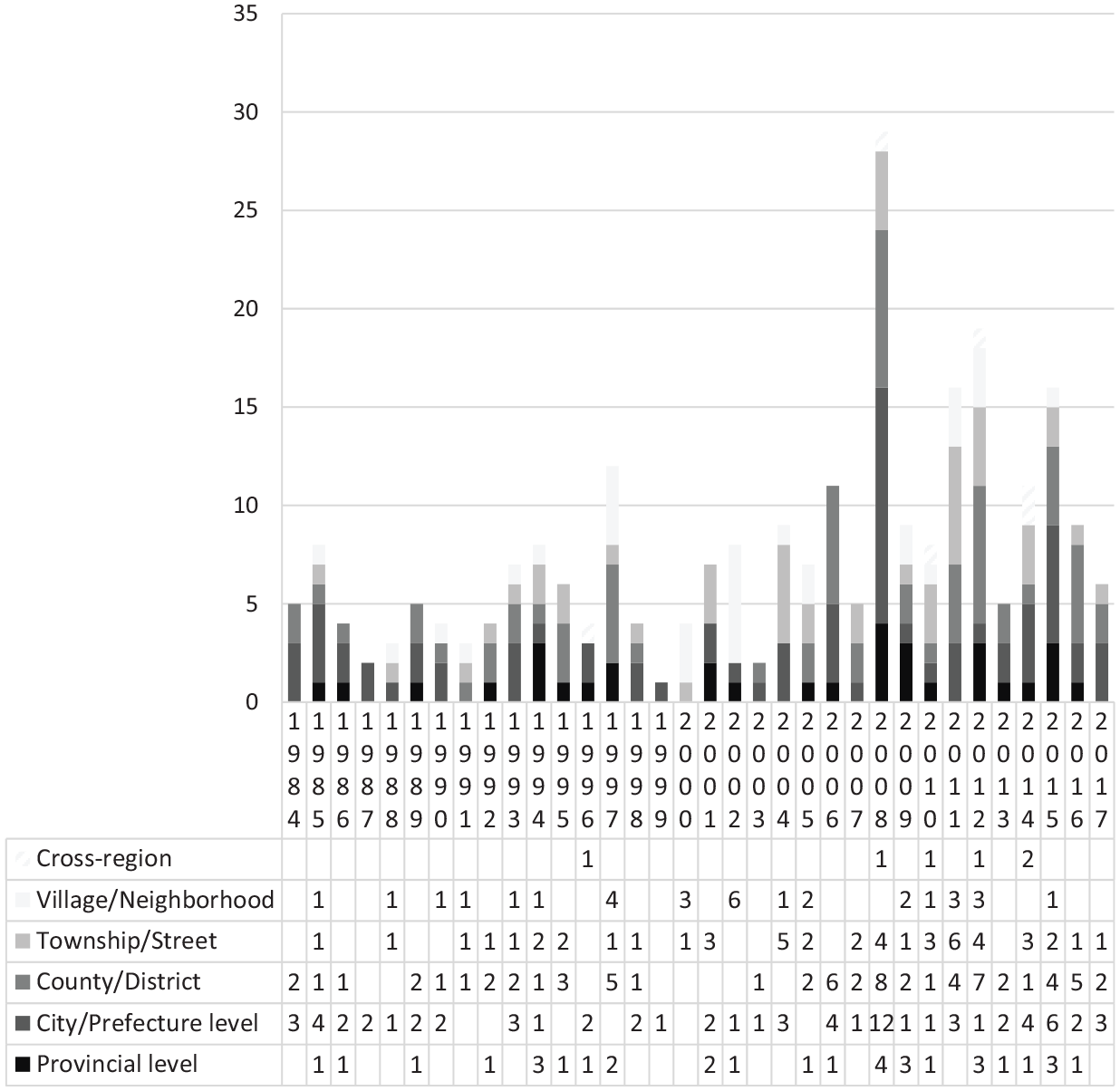
Native-place associations established in Hong Kong by year, 1984–2017.
The second point of interest is that while the growth waned shortly after 1997, it regained momentum in 2008 and remained steadily until 2015. During this period, an average of fourteen associations were established each year. Multiple contextual factors are likely to account for this temporal spike. It may have been due to the rising nationalistic sentiment triggered by the 2008 Beijing Olympic Games, which galvanized overseas Chinese communities and underlined the importance of projecting China’s soft power abroad (Nyíri, Zhang, and Varrall, 2010). A more institutional explanation is the appointment of Xi Jinping, then a member of the Politburo Standing Committee, to lead the Central Coordination Group for Hong Kong and Macau Affairs in 2008, shortly before he became the general secretary in 2012. During his tenure as the top policy-maker on Hong Kong, Xi reportedly called on pro-Beijing social organizations to participate more actively in local affairs, and for native-place associations specifically to take a leading role (Li, 2019: 10).
A closer look clarifies two features that characterize the new ecology of native-place associations. First, a sizeable number of provincial-level associations like the HKFFA and FHKGCO have been established, many of which function as umbrella organizations to consolidate lower-level organizations. 4 Prominent examples include the Federation of Hong Kong Chaozhou Community Organizations (FHKCCO, established in 2001), the Federation of Hong Kong Shenzhen Associations (FHKSA, 2003), the Federation of Hong Kong Guangxi Community Organizations (FHKGXCO, 2006), and the Federation of Hong Kong Jiangsu Community Organizations (FHKJCO, 2015). Some prefectural-level associations, organized on the basis of prefectures with a large number of emigrants, have also been transformed into smaller umbrella organizations. A good number of them were renamed from “associations” to “federations” to denote their new role. 5
Institutionally, provincial-level umbrella organizations often constitute the top-layer of each native-place community, encompassing all lower-level associations within the region as members. To foster coordination, umbrella organizations typically appoint leaders of associations one administrative level below (usually the prefectural level) as senior board directors, and leaders of associations two or three levels below (usually the county and village level) as rank-and-file directors. In turn, lower-level associations serve as smaller umbrella organizations by including leaders of associations below their level in the board of directors. The aim is to create a pyramid-like, multilayered structure to bridge class, dialect, and geographical divisions in each native-place community (Choi, 2006). In the case of the Fujian community, the HKFFA was instrumental in bringing together the Minnan and Minzhong groups, seeking to horizontally integrate them despite their linguistic differences. To foster the integration of the Guangdong community, the FHKGCO appointed leaders from all twenty-one prefecture-level native-place associations as the deputy chairman/chairwoman. The chairmanship, meanwhile, rotates among leaders from the three dialect groups: Cantonese, Hakka, and Chaozhouese. As one serves as the chairman/chairwoman, the other two are the executive chairpersons.
Second, the post-handover era also saw the establishment of myriad lower-level native-place associations, ranging from the city/prefecture level to the village/neighborhood level. As will be explained, such initiatives often came from the local governments of the respective localities, as officials are incentivized to develop ties with fellow natives in Hong Kong out of both economic and political considerations to promote business and united front work. These top-down initiatives are usually more successful if there is already a sizeable and resourceful native-place community. But when this is not the case, the role of the umbrella organizations becomes crucial. They can facilitate the formation of lower-level associations by locating members of the native-place community and finding the necessary funding. The Guangxi community provides a good example. Before the establishment of the FHKGXCO in 2006, there were no local-level associations; but after the FHKGXCO was in place, as many as twenty prefecture- and county-level associations emerged and joined it.
These native-place associations tend to have many members. The FHKGCO and the FHKGXCO, for example, claim to have 560,000 and 100,000 members respectively. The same is true even for lower-level associations. The Shenzhen association, for instance, claims a membership of a hundred thousand. The Quanzhou association, meanwhile, claims a more modest number of eight thousand. Given their large variance, these numbers on the high end are likely to be inflated. Furthermore, memberships—like the directorships—are also likely to be overlapping across different associations. But the numbers, even if discounted, still remain substantial. Participants in mega events (e.g., celebratory banquets) organized by native-place associations can well be in the thousands. 6 While it is difficult to accurately assess the actual membership of each association, the crowds at their events, as well as sheer variety of such organizations, suggests that the native-place networks have encompassed a sizeable portion of the population.
Top-Down Directives and Elites as Brokers
What has driven this expansion? The conventional wisdom has been that the central government started to play a more active role in Hong Kong’s affairs after the massive protest against the national security legislation in 2003 (Cheng, 2016; Fong, 2017), partly through the empowerment of the Central Liaison Office (CLO), which represents the central government in the semi-autonomous city. Since then, the gradually expanding CLO has played a key role in local elections as well as the formation of myriad pro-Beijing community organizations (Ma, 2017). In 2005, the CLO established a Community Liaison Department, a unit dedicated to establishing and liaising with these organizations. But such efforts alone cannot explain the emergence of such a wide variety of native-place associations. While the CLO often provided the coordinating work, it is the United Front branches of local governments that initiated the policy impetuses. Directed from the center by the United Front Work Department to expand the party’s influence outside the mainland, these local branches are delegated with the responsibility to cultivate their own ties with groups and individuals in offshore locations, one of which is Hong Kong. With support from other local agencies, such as the Hong Kong and Macau Affairs Office and the Overseas Friendship Association, their main task is to locate people from their region and establish corresponding native-place associations as liaison organizations. 7 This is why local united front officials and party leaders are always invited to attend the inauguration ceremonies of native-place associations in Hong Kong. Indeed, the central role of the United Front Work Department branches has been further entrenched when it was announced in 2018 that the Overseas Chinese Affairs Office would be integrated into the United Front Work Department (Wenweipo, 2018a).
Although top-down directives play a significant role in the formation of native-place associations, it is the local elites, mostly wealthy merchants and politicians, who lay the groundwork. They are the brokers who create associations from scratch—by recruiting members, drafting the constitution, donating money, taking care of registration, and providing office space. In the case of the FHKGCO, the idea of forming a federation was first proposed by Yu Kwok-chun 余國春, a veteran pro-China figure, who secured the support of the leaders of several Guangdong associations to start the organization (CPPCC Subcommittee, 2017: 425–30). A more recent example is Henry Tang 唐英年, a Jiangsu native and a former government official, who ran for the office of chief executive in 2012. After losing, Tang led the effort to establish the FHKJCO in 2015, reportedly under the advice of Chinese officials (Yu, 2015). Apart from enlisting the support of other business elites of Jiangsu origin, Tang donated eight million HKD to sponsor the purchase of an office for FHKJCO. Like Tang, who was appointed as the federation’s chairman, many of those who donate generously are often given leadership or honorary roles. 8 These donations usually qualify as tax deductions because many of the larger associations have established charity arms, which are exempt from tax under local laws. 9
Elites do not always have to be natives to become leaders. 10 A case in point is the FHKGXCO, the Guangxi Federation. The current chairman, Karson Choi 蔡加讚, is in fact a Chaozhou native from the prefecture of Jieyang. Before becoming the chairman in 2016, Choi was appointed to the Chinese People’s Political Consultative Conference (CPPCC) as a representative from Guangxi, likely because of his family’s business connections there. The previous two chairs, Connie Wong 王惠貞 and Tang Ching-ho 鄧清河, were also not natives of Guangxi; they were from Chaoyang and Bao’an respectively. Another noteworthy example is Liang Liang-sheng 梁亮胜. A prominent businessman, Liang, who is of Hakka origin, hails from Meizhou but was appointed as the chairman of the Hubei Fraternal Association in 2010, given that his company is headquartered in Wuhan. This flexible criteria of nativeness sometimes applies also to rank-and-file members. The Guangxi Federation, for example, allows non-natives to join as members, so long as they are “young” and “identify with its principles.”
The flexibility, malleability and, to an extent, fictitiousness of native-place ties, as noted by Emily Honig (1996), can be further illustrated by how leaders seek to reconstruct native-place boundaries. After serving as the leader of the Hubei association, Liang Liang-sheng led the establishment of the Hong Kong Federation of Guangdong Hakka Associations in 2011. The Hakka, which literally means the “guest people,” are a group of ethnic Chinese residing in Hakka-speaking regions in the southern provinces, with a large diaspora all across the world (Constable, 2005). Unlike most other ethnic Chinese groups, the Hakkas are not named after a geographical region. Because of this lack of geographical boundaries, the Hakkas are often thought of as a fluid, disperse, and marginal group. To capture more of the Hakka subgroups, Liang renamed the organization simply the Hong Kong Hakka Associations. As he said in an interview with a state newspaper, “The Hakkas in Hong Kong are not necessarily from Guangdong; some are from other provinces or have grown up locally in the New Territories. We can only achieve ‘big unity’ if everyone is gathered on this platform” (People’s Consultative Conference Daily, 2018). Interestingly, Liang eventually returned to his geographical roots. In 2015, he established the Federation of Meizhou Community Organizations to group together all Meizhou associations and took up the chairmanship.
These brokerage works are encouraged because they often come with lucrative political rewards. To begin with, leadership roles in native-place associations, especially provincial-level umbrella organizations, are prestigious and powerful positions. As they give elites the power to speak for a large number of fellow natives and mobilize them to action, they serve as bridges for the Chinese state to develop local influence. Thus, acquiring these positions almost certainly guarantees that elites will be nominated and appointed to the local or national CPPCC—the political advisory bodies that often serve as mechanisms for cooptation (Interview with chairman of a prefectural-level association in Guangdong, Nov. 7, 2018). These positions in turn connect elites to mainland guanxi networks and open up regular access to local and central government officials, which is particularly important for those who have businesses and investments in China. Thus, in some major associations, competition for the top leadership positions can be intense (Oriental Daily, 2014). For some associations, it has even been said that their rules require that their directors be CPPCC members (Apple Daily, 2014a).
The dual role of elites—as both leaders of native-place associations and members of mainland institutions—has been officially endorsed by the party. In 2011, the CPPCC’s Committee for Liaison with Hong Kong, Macao, Taiwan, and Overseas Chinese released a research report that concluded that the two hundred national CPPCC members and five thousand local CPPCC members from Hong Kong should play a role in both Hong Kong’s local affairs and the development of the mainland (CPPCC, 2012). Since then, this has been repeatedly mentioned by party leaders and local CLO officials (Wenweipo, 2018c). Using directorship data (see Table 1), I find that, in 2013, 47 percent of the national CPPCC delegates were directors of provincial-level native-place associations in the preceding year; in 2018, the number rose to 52 percent. The more native-place ties a director has, the greater the odds that person will be a CPPCC member. On average, individuals who sat on the board of directors of seven to ten native-place associations simultaneously had a probability of 28 percent to have been a national CPPCC member after the handover. The probability declines to 18 percent for those who sat on four to six boards, and less than 3 percent for those sat on fewer than three boards.
Relationship between Number of Directorships Held and Likelihood of Being a National CPPCC Delegate, 1997–2018.
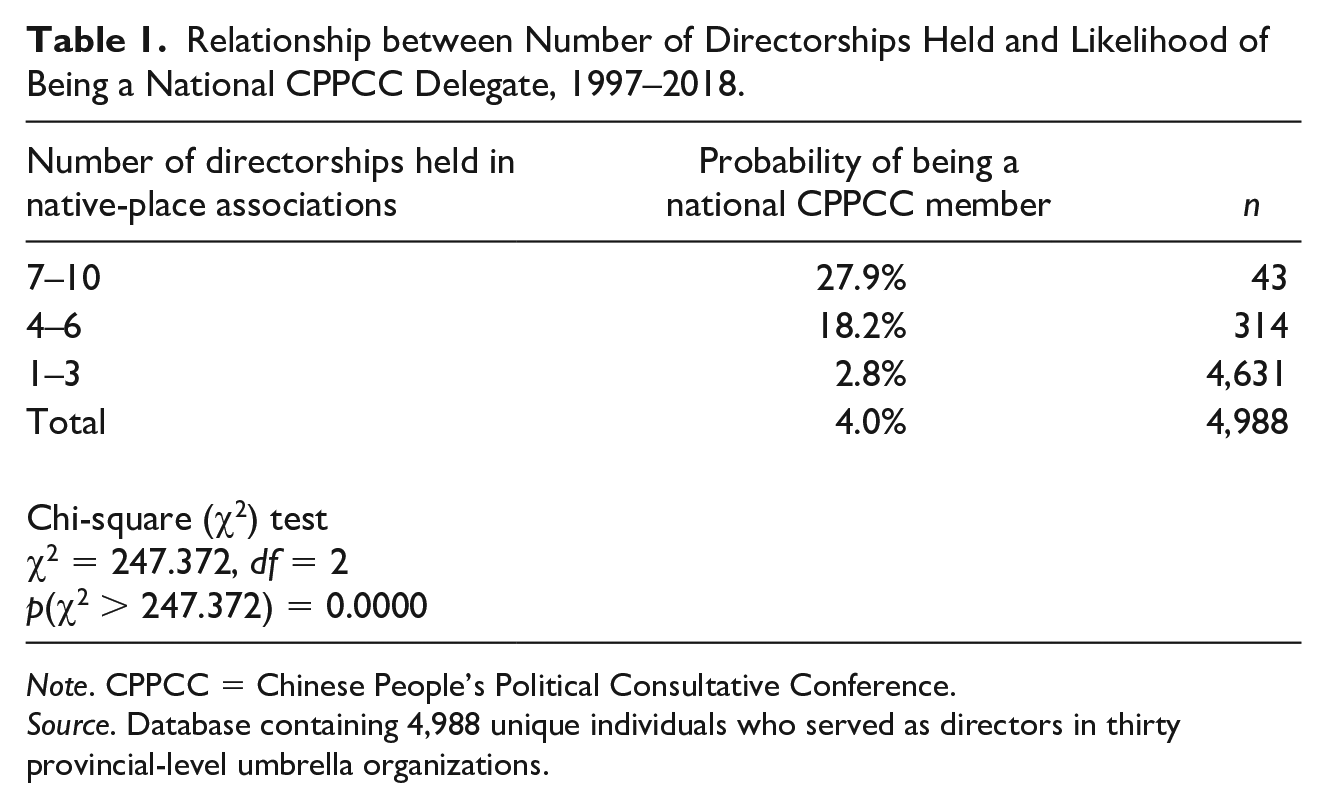
Note. CPPCC = Chinese People’s Political Consultative Conference.
Source. Database containing 4,988 unique individuals who served as directors in thirty provincial-level umbrella organizations.
The fact that politically upward-looking elites tend to sit on the boards of directors of several native-place associations simultaneously has resulted in an expansive, highly interconnected network of organizations and people. But of course, interlocking memberships and directorships are not a surprise, as scholars have already pointed out (Choi, 2006). What is remarkable is that these shared ties have increased over time. In the Fujian community, for example, shared directorships among a subset of fifteen major associations increased from the year 2011 to 2018, before and after the Umbrella Movement, as shown in the increase of the density and weighted transitivity measures in Table 2. But more remarkable is that even provincial-level umbrella organizations became increasingly interconnected through overlapping directorships in the same period. This finding indicates that not only were regional ties increasingly consolidated at the provincial level, but also that cross-regional ties were increasingly forged by elites to create a larger, more tightly knit native-place network.
Connectedness of Native-Place Associations.

Source. Board directorship data collected by the author.
Density is the total number of shared ties divided by the total possible ties within a social network.
Weighted transitivity is a measure of the degree to which nodes in a graph tend to cluster together. Specifically, it is the mean of local clustering coefficient of each node within a network.
From Mutual Help Groups to Social and Cultural Organizations
Parallel to the expansion and networkization of native-place associations is the transformation of their functions. In the past, a core function of native-place associations was to serve as mutual help groups for fellow natives by fulfilling their material needs. But this function has declined in importance given Hong Kong’s sustained economic development and the drastic improvement in public welfare provision. Although the welfare function is still alive in the realm of education (such as operating schools) and in assisting new immigrants coming to Hong Kong who may have difficulty adjusting to their new lives, another distinct function, namely the transfer of bodies for burial in native places, has declined, since more people are willing to be buried locally when they die. The declining functional value of native-place associations is also coupled with the public perception that they are old-fashioned and are associated with the older generation. As a result, if native-place associations are to remain relevant, they need to come up with new activities that can attract members and the public as well as maintain their role in members’ civic lives.
Figure 2 shows the types of activities native-place associations are involved in, as reported in the state mouthpiece Wenweipo, from 2008 to 2017. These are of course only the activities being reported, which are likely only a fraction of a larger universe. However, the data are, nonetheless, helpful in revealing the variety of major activities. The majority (54 percent) consist of what I call “formal conventions,” which includes inauguration ceremonies of new directors, annual meetings to discuss native-place affairs, and celebratory banquets or cocktail get-togethers for specific occasions. These events are often scheduled around major political holidays, such as National Day and the handover anniversary, to simultaneously serve as political celebrations. Some coincide with traditional Chinese holidays, such as the Lunar New Year, the Ching Ming festival, and the Mid-Autumn Festival, in part to evoke a sense of cultural pride among fellow natives in the larger Chinese nation, as opposed to just their native places. During these events, which are mostly held in opulent venues, fellow natives are not the only participants; local government delegates, CLO officials, and Hong Kong government ministers are often invited as officiating guests. These are perfect occasions for elites to mingle and network, and for native-place associations to solicit donations. For rank-and-file members, they provide an opportunity to gather over free drinks and food.
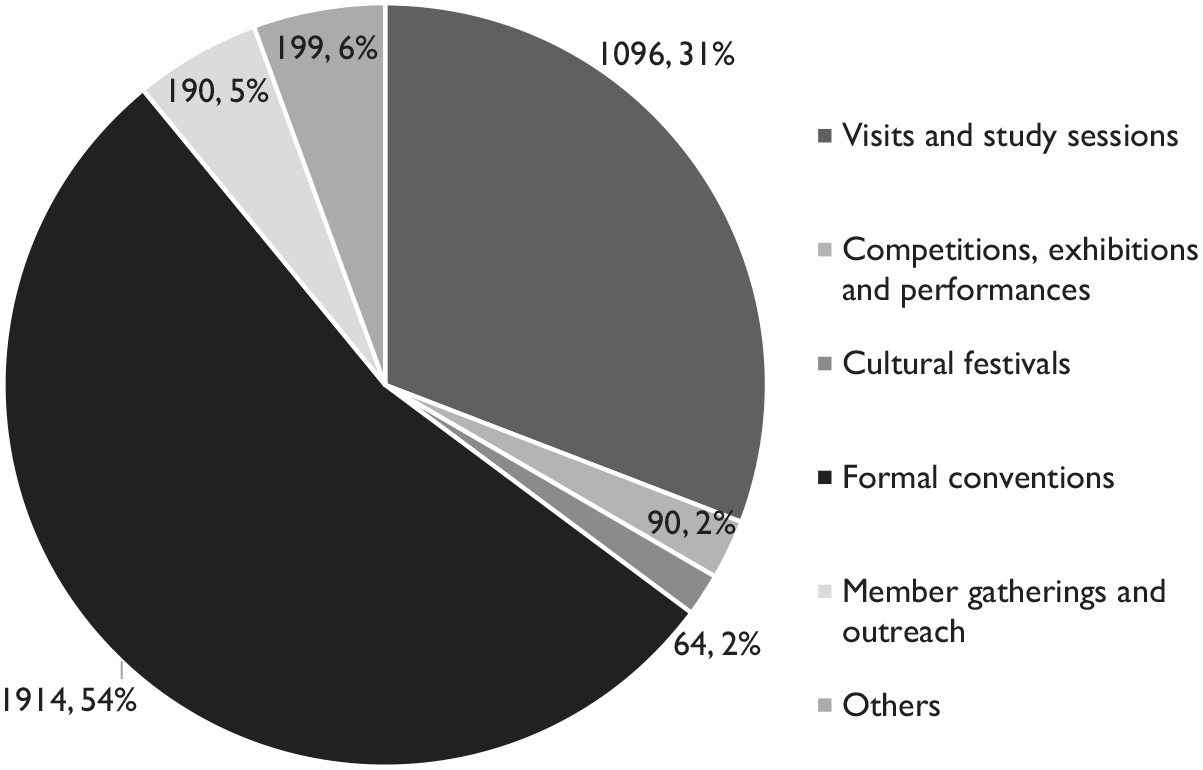
Social and cultural activities of native-place associations in Hong Kong, 2008–2017.
The next most frequent type (31 percent) is what I call “visits and study sessions,” which includes visits to Hong Kong by mainland government officials, tours of mainland China, and study sessions that feature talks by mainland officials or guests. The substantial number of these activities shows that there have been frequent exchanges and interactions between native-place associations and local governments in the mainland. Other types of activities include cultural festivals (2 percent); competitions, exhibitions, and performances (2 percent); and members’ gatherings and outreach activities (5 percent). These are often catered for the rank-and-file members and their families, among which new immigrants—mainland students, mainland professionals, and people visiting for family reunions—are often a major target.
Festivals, which have been significantly more numerous since 2016, are particularly noteworthy. These events aim to promote the local culture of native places through a series of performances, exhibitions, and food festivals. First started by the Fujianese in 2002 (Yuan, 2012: 79), festivals of this type spread to other communities in the early 2010s. A prominent example is the Chaozhou Festival, which began in 2015. In 2017, for instance, the festival was held in Central’s Chater Garden for a week, and featured numerous performances of traditional Chaozhou music and dance and a carefully curated exhibition that introduced the long history of the Chaozhouese in Hong Kong (Author’s observation, Dec. 7, 2017). The organizer, FHKCCO, even invited famous restaurants from Chaozhou to serve local delicacies at the event. Another important event that the Chaozhouese organize annually is the Hungry Ghost Festival. A traditional commemoration of the dead, the event has been celebrated by the local Chaozhou community, among others, for a long time. Since 2011, thanks to the efforts of two Chaozhou associations, the FHKCCO and the East Kowloon Chaoren Association (EKCA), it has been listed as part of China’s intangible cultural heritage (Chan, 2018). The heritagization has had profound consequences for the Chaozhou community: not only does it make more sponsorship available for lower-level associations to organize the festival, it also helps to integrate them vertically with upper-level associations and enhance Chaozhou identity among the Chaozhouese community, which has paved the way for their political mobilization (Chan, 2018: 154–62).
Because of the deep-rootedness of the Chaozhouese culture in Hong Kong, these festivals appeal to the public. However, smaller native-place communities needed more creative themes. A good example is the Lotus Root Festival, which has been co-organized annually by the Hubei Association and the United Front Work Department of Hubei Province since 2013. Hubei is famous for producing lotus roots. Since the crop is often harvested shortly before winter, past festivals were always held in December to coincide with the harvest. The event, like others in Hong Kong, featured a rich program of cultural performances, after which free samples of vacuum-packed lotus root were distributed to the participants. This suggests that cultural festivals are not only events to gather people but also occasions to objectify cultural symbols, such as Hubei’s lotus root, Chaozhou’s tea, or Foshan’s kung fu. These symbols help to promote the distinctiveness of native-place identities, but they are also simultaneously framed as expressions of Chinese culture and even nationalism. As a pundit wrote in a state-controlled newspaper in praise of the Chaozhou Festival, “the event was not simply about the gathering of fellow natives, it was also important for promoting the spirit of loving the country and the native place” 愛國愛鄉 (Kwan, 2017). These symbols are especially effective because they are markedly different from the images in official state ideology. The fact that they are much closer to everyday life and are easily identified with makes it possible to shorten the cultural distance between Hong Kong and the mainland, thus fostering a culturally oriented national identity. As Selina Chan (2018) observes in the Hungry Ghost Festival, it is the attribution of different meanings—religious, charitable, communal, and ethnic—by multiple local actors, rather than by the state, that makes these festivals culturally significant.
Festivals are costly and thus can be held only occasionally. To gather fellow natives on a regular basis, native-place associations also rely on ordinary social and cultural activities, including volunteering, sports competitions, performances, art exhibitions, and tours to mainland China offered at discounted prices. By positioning themselves as the locus of members’ cultural life, native-place associations function to maintain the cohesion of fellow natives despite their declining role in providing basic material support. Another equally important dimension is the recruitment of new members, which is a crucial performance indicator for higher-level associations to “evaluate” lower-level ones for possible sponsorship. The case of the Guangxi federation is again revealing. The federation states that at least 30 percent of the participants in activities organized by its member associations but sponsored by the federation must be new members, who can be non-natives. After the events, to be reimbursed member associations must submit the information on the new members (Apple Daily, 2014a).
Political Mobilization
Although these activities are mostly social and cultural, the fact that they help to promote native-place ties and identities among members and participants is crucial to understanding why native-place associations have become increasingly active in political mobilization. In fact, the connection between fostering native-place ties and mobilizing support for the Chinese state has been overtly acknowledged by a prominent native-place leader. In an article recounting his experience of organizing native-place associations (Li, 2019: 242–52), Chau On Ta Yuen 周安達源, a businessman of Fujianese origin, stated that while it is crucial to enhance the “cultural substance” of these associational activities, the most important task is to transform and sublimate “plain native-place sentiments” into “conscious patriotism” 自覺的愛國主義. To do so, native-place associations must put politics first and actively project their voice in society. As Chau remarked, “we are confident in saying that associations which prioritize politics and emphasize ideology construction [. . .] will certainly be the ones with the strongest fighting power and influence.”
The political involvement of native-place associations has been widely observed in electoral politics, in which they actively campaign for pro-Beijing candidates. For instance, in the 2016 Legislative Council (LegCo) election, several Fujian prefecture-level associations, including those of Jinjiang, Nan’an, and Shishi, were reported to have been involved in campaigning and voter mobilization (Tang and Yung, 2016). In addition to organizing activities for pro-Beijing candidates to meet fellow natives, they also produced a list of endorsed candidates for their members. A leaked document shows that the Jinjiang association even formed a “command center” to coordinate efforts, including street canvassing, leaflet distribution, door-to-door visits, telephone calls, and taking elderly voters to polling stations (Apple Daily, 2016). Similar activities again took place in the 2018 LegCo by-election (Wenweipo, 2018b). Involvement of native-place associations has not been limited to the Fujianese community. Several non-Fujian associations have also boasted of their participation in election campaigns as key activities in their websites or annual reports, possibly to gain recognition from the Chinese state. 11
Building contact with potential voters is also an important goal of native-place associations. By holding regular activities for fellow natives, they encourage or assist members to register to vote, sometimes using gifts as an incentive. But such close involvement in voter registration has sometimes resulted in scandals such as “vote planting,” which happens when a voter is included in the register of a constituency when in fact that person does not live or has never lived there. One such scandal involved the HKFFA in the Western District during the 2011 District Council election. One of its directors was accused of leasing his property to a native-place association, which then registered six of its members who resided in the mainland as voters (Chow, 2018). Another scandal in that same election involved the Maoming association in a middle-class housing estate, where it openly backed a pro-Beijing candidate. It was reported that a flat there had thirteen registered voters with seven different surnames. The flat owner was found to be a native-place association director and also a local CPPCC member in Maoming (Ming Pao, 2011).
These political involvements are of course responses to directives from top-down—the CLO, the United Front Work Department, or local governments. But they would not be as effective without the horizontal networks created by native-place associations and thickened through myriad social and cultural activities, which help to make sense of these directives and transform them into actions. Indeed, the contribution of the native-place cultural nexus is further revealed by their participation in protests. Starting in the early 2010s, native-place associations began to frequently mobilize mass rallies and protests, at times in support of major government policies and at times to counter those organized by the pro-democracy camp, such as the annual July 1 rally (see Table 3). But it was ultimately the Occupy Central movement in 2014—a pro-democracy civil disobedience campaign that later evolved into the Umbrella Movement—that brought their protest mobilization to a climax. During that time, almost the entire network of native-place associations became politically mobilized. They formed a substantial part of an anti-Occupy group known as the Alliance of Peace and Democracy, and more than three hundred of them signed in the signature campaign against the pro-democracy movement. They also mobilized members to participate in a large protest in mid-August 2014, which claimed a turnout of 130,000, to voice opposition to the movement. The Fujianese played a particularly prominent role. The honorary president of HKFFA, Hung Chao Hong 洪祖杭, served as the “commander in chief” of the protest while its president, Thomas Wu 吳良好, was his deputy. 12 After the Umbrella Movement erupted, these native-place associations continued to counter-mobilize against the pro-democracy protesters from time to time. For instance, a deputy chairman of the Shanwei association was said to have orchestrated a protest to block the entrance of the Apple Daily, a newspaper that supported the Umbrella Movement (Apple Daily, 2014c).
Major Rallies and Countermobilizations Involving Native-Place Associations in Hong Kong.
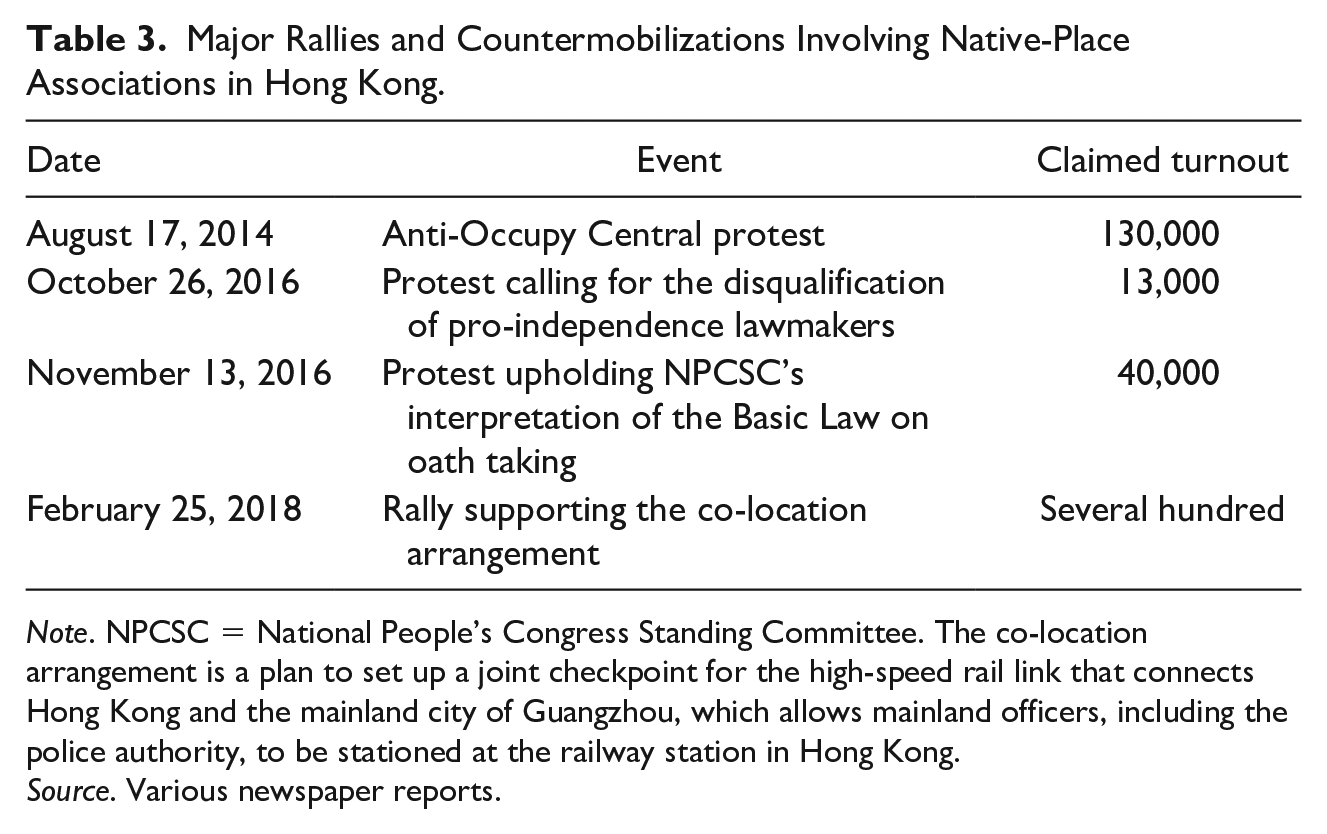
Note. NPCSC = National People’s Congress Standing Committee. The co-location arrangement is a plan to set up a joint checkpoint for the high-speed rail link that connects Hong Kong and the mainland city of Guangzhou, which allows mainland officers, including the police authority, to be stationed at the railway station in Hong Kong.
Source. Various newspaper reports.
Native-place and national identities at times constitute a crucial part of the mobilization process (Polletta and Jasper, 2001). The most salient use of such identities can be observed in the recent counter-protests against the nascent localist movement (Veg, 2017). Like the Occupy protests, the localist movement has offered a clear target against which the pro-Beijing camp could counter-mobilize. And because the movement has called for self-determination and independence, it has fueled a reaction to protect China’s national sovereignty and territorial integrity, in which native-place and national identities become relevant. In late 2016, in response to protests voiced by two pro-independence lawmakers in the legislature’s oath-taking ceremony, the pro-Beijing camp formed a coalition known as the Alliance against Insulting China and Hong Kong Independence. Among the twenty-five founding organizations, seven are umbrella native-place federations. The honorary president of the HKFFA, Hung, served as its convener. In October, the alliance staged a large protest in front of the LegCo, calling for the disqualification of the two pro-independence lawmakers. In November, it held another mass rally to support the National People’s Congress’ interpretation of the Basic Law regarding oath taking, claiming a turnout of forty thousand. In both protests, many native-place associations, from the provincial-level to the village/neighborhood level, mobilized their members to participate (Initium, 2016). During these events, participants displayed banners denoting which native-place associations they came from, while holding standardized protest sign boards—often with red fonts, and many of which branded the pro-independence lawmakers as “running dogs” and “traitors” to the Chinese nation. National symbols were also ubiquitous. Many groups waved the Chinese flag to express their patriotism. Even the protest site had a nationalistic bent: it was spatially divided by different regions of the mainland, where protesters could “stand with” with their fellow natives (Author’s observation, Nov. 13, 2016).
Conclusion
Native-place associations have played an important political role on behalf of the Chinese state in the contemporary era—a role inseparable from their social, economic, and cultural functions. This article has attempted to demonstrate how native-place associations in a non-mainland offshore territory create a cultural nexus through which a rising Chinese state can indirectly project its power and foster political mobilization in support of its interests and policies. By focusing on the case of post-handover Hong Kong, a Chinese-ruled semi-autonomous polity with a robust civil society, it has shown how native-place associations have undergone a remarkable revival and expansion after the handover, and how both top-down directives from the Chinese state and the brokerage role of elites are important in concatenating them into an expansive network. The evidence also points to the contributing role of a rich array of social and cultural activities in renewing the significance of native-place identities in a pluralistic and cosmopolitan city where many factors can dilute regional sentiment (Sinn, 1997: 396). These renewed native-place identities, in turn, can sublimate into a sense of cultural pride in the Chinese nation and proffer the necessary motivation that can be invoked at specific moments to mobilize support for the Chinese state, be that elections or rallies.
The findings thus provide new evidential support for the long-held view in the literature on native-place associations that traditional groups can find renewed relevance in modern and cosmopolitan societies. While in the past native-place associations remained relevant largely due to their social function of providing mutual help and their economic function of facilitating businesses, they now enjoy a renewed significance in large part because of China’s rise as a global power and ambition to project its influence. By reshaping their social and cultural functions to cater to present needs, they act as a bridge to connect a more outward-looking Chinese state with overseas Chinese communities, fostering native-place as well as national identities, and mobilizing them when needed. In this regard, like traditional groups, native-place associations today do not challenge the power of the modern nation-state; on the contrary, they have enhanced it (Ong and Nonini, 1997).
The findings also demonstrate the complex ways the Chinese state leverages overseas Chinese communities to advance its interests. The Chinese state does not totally control native-place associations, nor does their mobilization in support of state interests solely depend on top-down state directives. The notion of a cultural nexus enables us to think of state-society relations as a culturally mediated space that generates symbolic meanings and accommodates the pursuit of both material and nonmaterial interests, rather than simply as a vertical command-and-control structure in which agents are directed to act. Successful political mobilization is thus not only the product of state directives but also the result of the fact that native-place associations are interconnected in a vast and thick network that allow elites to pursue prestige and interests and fellow natives to pursue their social and cultural objectives. Without the resulting horizontal web of relations among elites and fellow natives as well as the cultural resources being accumulated, top-down state commands can hardly be effectively translated into political actions.
A final question to consider is the extent to which the case of Hong Kong’s native-place associations is generalizable to other overseas Chinese communities. Since Hong Kong is after all a territory under China’s sovereignty, one concern is that the capacity of the Chinese state in cultivating native-place associations is likely much greater than in foreign countries with a large Chinese diaspora, thus making Hong Kong a rather special case. This is, in part, true, given the ability of state institutions to play an open and direct role in Hong Kong. But as this research has emphasized, one must also consider the mediating role of elites and the ability of native-place associations to create a cultural space that brings together the state and overseas Chinese. In this regard, whether this is Hong Kong or other overseas Chinese communities does not matter as much. In the latter context, native-place associations, even without the overt exercise of state power, can also respond to incentives at a distance and participate in the national “going global” policy. But whether this is indeed the case is beyond the scope of this article and deserves further research.
Footnotes
Acknowledgements
The author is grateful to Sebastian Veg, Karita Kan, Siuyau Lee, Ray Yep, and two anonymous referees for their generous feedback on earlier drafts of this article.
Declaration of Conflicting Interests
The author declared no potential conflicts of interest with respect to the research, authorship, and/or publication of this article.
Funding
The author received no financial support for the research, authorship, and/or publication of this article.