



Abstract
In legal practice in contemporary China, courts usually distinguish between government-led enterprise restructuring 政府主导的企业改制 and independent enterprise restructuring 企业自主改制. Following contract logic, the courts believe that labor disputes related to government-led enterprise restructuring are not contract disputes—that is, they are not disputes between equal parties, which is required for civil litigation—and are therefore generally not accepted. Moreover, in actual legal practice, the scope of application of the principle of government-led restructuring has been expanded, with the courts adopting a very broad standard. In addition, a considerable number of cases are excluded on the grounds that the time limit imposed on arbitration has been exceeded. This in effect has replaced the older principles surrounding labor relations in enterprise restructuring led by local governments. The actual practice of the principle of government-led restructuring should be understood in the larger framework of multidimensional and complex relationships between local governments and the market. The use of local government power in conjunction with the logic of contract in effect enlarges the scope for setting aside the older principles of labor relations for the purpose of enhancing the market competitiveness of enterprises and promoting economic development. The result has been a marked degree of social injustice. The construction of labor laws should be rooted in actual conditions, and not overemphasize the formalism of contract logic and ignore the substantive logic of labor relations.
Keywords
In the practice of civil law in contemporary China, cases of labor disputes arising from enterprise restructuring are the most common type. In 2003 the Supreme People’s Court issued the Provision on Several Issues Regarding the Trial of Civil Dispute Cases Related to Enterprise Restructuring 关于审理与企业改制相关的民事纠纷案件若干问题的规定 to regulate the trial of such cases. The provision stresses that the courts shall only accept cases involving civil disputes arising from the reform of the enterprise property right system when the parties to the dispute are equal civil subjects 平等民事主体. Moreover, the courts shall not accept cases involving “disputes that occur in the process of administrative adjustment and transfer of state-owned assets of the enterprise by the competent authorities of the government, [and] the parties bring a civil suit to the people’s court” (Zuigao renmin fayuan, 2003). Since the practical problems involved in legal practice are complex and diverse, some basic-level courts usually include a statement of their general understanding of enterprise restructuring in the judgment: “Enterprise restructuring” is the shortened form of “reform of the enterprise system.” It refers to changing the original capital structure, organizational form, operation and management mode or system of the enterprise in accordance with the law, in such a way as to adapt to the new needs of enterprise development. Generally speaking, state-owned enterprises [SOEs] and collective-owned enterprises are changed into corporate entities with multiple investors and joint stockholders, or enterprises are transferred between domestic and foreign firms. (Case 2)
1
In fact, enterprise restructuring has had a profound impact not only on China’s economy, but also on the legal rights of workers.
This article focuses on labor dispute cases arising from enterprise restructuring and analyzes how the law specifically affects the legal rights of workers. It is based on all such labor dispute cases that were dealt with by basic-level courts in 2018. Using the keywords “civil cases” 民事案件, “labor disputes” 劳动争议, “enterprise restructuring” 企业改制, “basic-level courts” 基层法院, and “2018,” a search was made (the final search date was May 8, 2019) of the cases—all openly available and a matter of public record—at the wenshu.court.gov.cn website. The search turned up 1,021 cases. It should be pointed out that these litigation cases make up only a small proportion of labor disputes brought before the courts because most labor disputes are diverted to mediation and arbitration tribunals. This is mainly because the law requires that labor disputes be arbitrated before they can be litigated in court. Furthermore, most of the 2018 litigation cases had been rejected by arbitration tribunals on the grounds that they were “not within the scope of arbitration” or had “exceeded the statute of limitations for arbitration.” A few cases, however, were the result of one party being dissatisfied with the result of arbitration and bringing the case to court.
In addition, these cases were mostly considered by the courts to be labor disputes related to “government-led enterprise restructuring” 政府主导的企业改制. However, due to the large number of cases in the sample selected for this article, it is difficult to come up with an accurate count of how many of the 1,021 cases actually concerned government-led restructuring. Thus another method was used to analyze this feature. A close reading of these cases reveals that although the content of the cases is complex, the wording of the written judgments is relatively fixed. The judgments emphasize that labor dispute cases arising from government-led enterprise restructuring are not within the scope of the courts’ purview, and thus the courts reject such suits. Therefore, the specific method adopted here was to carry out a fuzzy search of these 1,021 cases for the keyword “government” 政府 (not directly searching for “government-led” 政府主导, mainly because some courts use terms such as “government-coordinated settlement” 政府统筹解决 or “government-related” 与政府相关). This search yielded 951 cases. Next, a search of these 951 cases for the keyword “rejection” 驳回 resulted in 911 cases, which indicates that the two are closely related. Examining these cases makes it clear that almost all of them belong to the above-mentioned type of cases.
It bears repeating that all the cases in our sample of litigation in basic-level courts occurred in the year 2018. Therefore, the situation surrounding this litigation is different from that in Philip Huang’s analysis of dispatch-work 劳务派遣 cases before the year 2016 (Huang, 2017b, 2017c: 127). As we will see, the scope of application of labor disputes related to local government-led enterprise restructuring has gradually expanded in legal practice. In dispatch cases involved in enterprise restructuring, the courts have gradually moved from rejecting workers’ suits on the basis of the labor dispatch law to using the legal principle of government-led enterprise restructuring to reject suits. That means that the courts therefore simply do not accept suits from workers involved in government-led restructuring. This potentially includes a huge number of workers since the principle of government-led restructuring is increasingly used in collectives, “semi-enterprise work units” in various public sectors, 2 and subordinate work units of primary-level governments, and also extends to some private enterprises.
It should be emphasized that this article focuses on the actual operation of the law, rather than the interpretation of legal provisions or social issues outside the law. The reason is that if we limit our analysis to the provisions on labor dispatch in the current law, it is difficult to explain why the practice of looking at cases through the lens of government-led enterprise restructuring has rapidly expanded and how court judgments have affected the rights of workers. Moreover, it is not conducive to a deep understanding of the logic of legal judgments. As Philip Huang has pointed out, the current labor law text itself “is in fact murky, confusing, and even self-contradictory; mere textual analyses will not be able to clarify either the practical or theoretical implications of the new law.” Therefore, we need to “examine closely how the law has actually been applied, and [. . .] on that basis how labor laws and relations have changed in practice” (Huang, 2017b: 248). Such an exploration should not be limited simply to the interpretation of existing laws. Nor should it view labor disputes arising from enterprise restructuring as the result of unsound social security in the process of “de-identification” 去身份化 as SOE or collective employees, thus ignoring the logic of legal judgments. Law obviously is very important in enterprise restructuring, and consequently we should analyze the logic of legal practice. In short, social problems outside the law are not within the main scope of the article.
What follows is an exploration, via court cases, of the meaning of government-led restructuring and the legal principles associated with it. The basic thread running throughout this article is the relentless expansion of the scope of the application of the principle of government-led restructuring in legal practice. The section that immediately follows first analyzes the types of enterprises for which government-led restructuring is applicable and how the standard for determining what qualifies as “government-led” has expanded. This is followed by an explanation of how the principle of government-led restructuring has become the key consideration in rendering judgments in legal practice. Next, the article compares government-led restructuring with dispatch- work cases, and traces the expansion of the scope of dispatch-work relationships 劳务关系 in practice. Then the article turns to a comparison of the types of cases accepted by courts, seeking to account for the expansion of the scope of the application of government-led restructuring, which also means the narrowing of the scope of labor dispute cases that the courts will accept. Lastly, the practical legal principle of government-led restructuring is placed within the context of China’s development experience.
Enterprises Subject to Government-Led Restructuring
The restructuring of small and medium-sized SOEs and collective enterprises in China has been mostly led by local governments. This is because the enterprise restructuring process largely involves government actions. Furthermore, whether enterprises are profitable or not affects local government tax revenue. Local governments therefore often attach importance to the restructuring of local enterprises. Enterprise restructuring is also of great importance to workers, because it inevitably affects their livelihood, which in turn affects the stability of the local social order. Local small and medium-sized SOEs have close relations with local governments in terms of operation and management. As for actual numbers, before the introduction at the turn of the century of the state policy of “grasp the big and let go of the small” 抓大放小 (meaning that the central government should concentrate on strengthening control of the largest SOEs and relinquish control over smaller SOEs to local governments, which in turn had the authority to restructure, privatize, or close these enterprises), most of the enterprises in China were state-owned or collective entities. In this article, most of these enterprises were restructured after the turn of the century without being dealt with under the state policy of “grasp the big and let go of the small,” which shows that this policy is actually still operative. Generally speaking, it is believed that after the introduction of the “grasp the big and let go of the small” policy, the enterprises that survived consist mainly of large central SOEs, numbering about a hundred and twenty in total. Each has around a hundred subsidiaries on average; hence the total number of large central SOEs is about twelve thousand. In addition, there are about a hundred thousand local SOEs. Altogether, SOEs account for about 40 percent of China’s nonagricultural GDP (Huang, 2015: 254). As can be seen from court cases, after the “grasp the big and let go of the small” policy was adopted, the number of local SOEs has not been static, this because local governments continue to restructure and reform local small and medium-sized SOEs and collective enterprises in response to changing business conditions and state policies.The restructured enterprises involved in this article were mainly small and medium-sized SOEs or collective enterprises, but a few private enterprises were also involved.
The principle of government-led restructuring has been applied in legal practice to several different types of enterprises. Above all, it is about the labor disputes arising from the restructuring of SOEs under various public entities of local governments. For example, in the case of a labor dispute related to the restructuring of a municipal government hotel, where the local government guesthouse had been turned into a hotel serving the public, the plaintiff asked for confirmation of the existence of a “labor relationship” 劳动关系 with the defendant. The hotel had been restructured in 2005 via the transfer of assets managed by a government department. This meant that the dispute was not a general labor dispute and hence was beyond the scope of civil litigation. The court therefore rejected the suit (Case 13). In addition, the hotel itself was a subordinate work unit of the local government. In another example, in a case involving a labor dispute over the restructuring of a state-owned county farm, the plaintiff asked for a determination of whether she had a “labor relationship” with the defendant and whether she, the plaintiff, was an “employee.” In 2011, the court held that the restructured farm followed the general idea of “transforming farms into towns, and farmhands into farmers” 农场变乡镇、农工变农民, in line with the “integrated towns and farms” 镇场合一 management system, and therefore the dispute between the plaintiff and the defendant arose from the process of enterprise restructuring under the guidance of the government. The dispute, in other words, did not spring from the process of independent enterprise restructuring (i.e., where restructuring is not government-led but is conducted by the enterprise itself), and so it was not within the scope of civil disputes that the court would accept for adjudication (Case 11).
In addition, the scope of application of government-led restructuring, as noted earlier, also encompasses some local private enterprises. For example, in a labor dispute involving a private transport company, the enterprise transferred part of its route and terminated its labor relationship with the plaintiff. The plaintiff asked the court to confirm that there was a labor relationship between the plaintiff and the defendant (the enterprise) and to award him compensation. The court, however, held that in the takeover, the arrangements for the employment of drivers and for passengers were government-led and therefore were not legal relations between equal civil subjects. On that basis the court rejected the suit (Case 3).
In practice, the types of enterprises involved in government-led restructuring have been gradually expanding, and their specific forms have also become more complicated. Local governments pay attention to business conditions and overall policy on enterprises, and as these change, governments may modify the capital structure of enterprises or change their organizational form, operations, and mode of management, which may either strengthen the management of local SOEs or lead to privatization. In short, the fate of local SOEs is determined by the local governments’ reading of specific policies and economic conditions.
In the face of this reality, the courts’ factual criterion for determining whether a case involves government-led restructuring has gradually expanded. In legal practice, the meaning of “government-led” has been extended to “government-related department-led.” Here “led” refers not only to the government or its departments giving the seal of approval to restructuring plans, but also to the government or its departments as the subject of signed agreements. The courts consider most such cases as instances of government-led enterprise restructuring, and thus reject them. This is an outgrowth of the courts’ adoption of a very broad understanding of this category of enterprise restructuring. If a case involves restructuring approved by the government or its departments (usually the most critical element), or if the subject of a restructuring agreement involves the government or related government departments, it may be recognized as a type of government-led enterprise restructuring. This naturally has expanded the scope of application of the principle of government-led restructuring. For example, plaintiff Long Weiyi and the defendant, a Municipal State-Owned Assets Supervision and Administration Commission (SASAC), had signed an employee settlement agreement, which ended Long’s status as an employee of an SOE. However, because the agreement did not mention how the labor relationship between Long and the defendant’s company was to be handled, Long asked the defendant to go through the procedures of dissolving a labor contract and to pay compensation. The court held that the defendant (the municipal SASAC) had signed an employee settlement agreement with Long, which changed Long’s status as an employee of an SOE. Therefore, the court concluded that Long’s claim was the result of a dispute caused by a government-led restructuring and reform of a state-owned and collective enterprise, and therefore the court rejected his suit (Case 9). In sum, as can be seen from the legal cases, the majority of the labor disputes have been recognized by the court as involving government-led enterprise restructuring, which has as much to do with the expanded meaning of government-led restructuring in legal practice.
“Government-Led” as a Key Consideration in Labor Disputes
My research shows that “government-led” has gradually become a key consideration in labor disputes concerning enterprise restructuring. If the courts determine that a suit by an employee for monetary compensation and social insurance is the result of government-led restructuring, then the courts will reject the suit on the basis that such restructuring does not fall within the purview of the courts. With the gradual expansion of the scope of the application of “government guidance,” the actual effect on the judgments of the courts is a result of a combination of local government power and formalistic contract logic, further promoting and deepening the transformation of labor relations. In legal practice, the contract logic of “equal civil subjects” has gradually evolved into a reason for the courts to exclude the legal claims of enterprise employees. The key is the legal principle of “government leadership,” with the courts limited to accepting labor dispute cases involving independent enterprise restructuring, which actually undercuts the logic of labor relationships. As Philip Huang (2017b: 257) has pointed out, The older Reform period Labor Law of 1994 had been organized mainly around the concept of protecting industrial workers from abusive treatment by their employers-managers: reasonable work hours and rest days and holidays, overtime pay, decent and safe conditions of work, protection against arbitrary dismissal, health and retirement benefits, requirements against use of child labor, and of female labor for heavy work, and so on.
However, according to contract logic, the only labor disputes the courts will accept for adjudication are those in which the parties are equal subjects. Although the reality of labor dispute cases can be complex, the scope of acceptance is narrow, making it is easy to ignore in practice the weak position of workers.
Monetary Compensation
Generally speaking, there are three ways of settling the status of employees who are laid off as a result of enterprise restructuring: retirement without changing their status as employees, often in the form of early retirement, without any arrangements for new jobs; requiring former employees to look for a new job themselves after the termination of labor relations between the employees and the enterprise; and signing of new contracts with the restructured enterprise after the termination of labor relations. The subjects of disputes also generally fall into one or another of three categories: labor disputes between enterprise employees and the original enterprise before it was restructured; labor disputes between enterprise employees and the restructured enterprise; and disputes between enterprise employees and the local government that led the restructuring. According to the legally required restructuring scheme, laid-off employees should receive a modest monetary compensation. In practice, the situation is more complex. Some enterprises have not followed through on the procedures to terminate formal labor relations with their employees, leaving these workers with no compensation. This, of course, is likely to result in labor disputes.
In one case, the plaintiff, Jiao Zhamei, stated that she was hired by the Wuwei Transportation Group in August 1982. In 2004, this SOE was restructured into the private Wuwei Transportation Company. On December 31, 2004, Jiao and Wuwei signed an agreement terminating the labor relationship between both parties and Jiao signed a new labor contract with Wuwei. This changed Jiao’s status from employee of a state-owned enterprise to employee of a private enterprise. According to the state’s SOE restructuring policy, Jiao was entitled to 17,866.67 yuan in compensation. Wuwei issued the compensation to Jiao in the form of a bank account passbook deposit, and Jiao had always had possession of the account passbook. Jiao worked at Wuwei until she reached retirement age. When she went through the retirement procedures, she was required to return the passbook. She did so, and the retirement procedures were completed. However, Jiao felt she was entitled to the funds in the account, and she consequently brought suit.
The judgment of the court of first instance was significantly different from that of the court of second instance. The content of the judgment of the court of first instance can be summarized in two points: first, the plaintiff was changed from an SOE employee to a private enterprise employee, and signed a labor contract with a new enterprise, which is no different from post-layoff reemployment and thus the plaintiff was entitled to monetary compensation; and second, the fact that the current enterprise made no attempt to recover the compensation in a timely fashion showed that the default compensation was legal.
The court of second instance, in contrast, ruled that the case involved litigation arising from government-led enterprise restructuring and thus should not have been accepted at all, overruled the judgment of the court of first instance, and rejected Jiao’s suit. According to the court, the company’s restructuring was led by the government; was carried out in accordance with the policies, laws, and regulations in force at that time; and was guided by a restructuring plan—which was not an independent enterprise restructuring—which was required by law. Since the dispute arose in the process of restructuring, the court reasoned, according to law it should not have been accepted in the first place. In the end, the court ruled that the court of first instance had improperly accepted the case, and therefore it rejected Jiao’s lawsuit (Case 4).
It should be emphasized that enterprise restructuring is not aimed at any particular employee, but involves all the enterprise’s employees. Therefore, generally speaking, labor dispute litigation in such instances is not limited to a single suit brought by one individual, but can involve lawsuits by other employees as well. For example, Wang Aiping, another Wuwei employee, also sued, but the verdict was the same: suits arising from government-led enterprise restructuring fall outside the purview of the court (Case 10).
The fundamental difference between the judgment of the court of first instance and the judgment of the court of second instance was not in the determination of the nature of the legal relationship between employees (i.e., workers who were transformed into employees of private enterprises and signed labor contracts with new enterprises) and SOEs. Instead, it revolved around contract logic: the court of second instance held that labor disputes involved in government-led enterprise restructuring could not be litigated in court because the court did not consider the legal relationship between the workers and the enterprise to be one between equal civil subjects. Thus the question of the performance of the labor contract simply did not arise.
Social Insurance
Article 70 of the 1995 Labor Law states, “The state shall develop social insurance undertakings, establish a social insurance system, and set up social insurance funds so that workers may receive assistance and compensations under such circumstances as old age, illness, work-related injury, unemployment and child-birth.” At the same time, Article 73 stipulates that according to the law, workers shall receive social insurance benefits for retirement, unemployment, or work-related injuries or death. However, the application of the law in practice has been complicated. For example, in a labor dispute case arising from an enterprise restructuring, the defendant announced that the plaintiff, Su Lianhua, would be included in the layoffs. Su asked the defendant to pay her living expenses during the period of unemployment (from 2002 to 2008), and provide improved endowment insurance (i.e., old-age insurance), medical insurance, and unemployment insurance from 2002 to 2008. The court decided that the Su’s suit fell in the category of disputes arising from government-led restructuring of SOEs and collective enterprises and thus it was outside the scope of permissible civil actions (Case 1).
Aside from providing social insurance, enterprises are also required to provide “work-related injury” insurance. Even though the Regulation on Work-Related Injury Insurance 工伤保险条例 spells out various grades and compensation standards for “work-related injury” or death and has relatively clear and specific provisions, it pays particular attention to separating injuries into different types. At the same time, Article 43 stipulates that, “If an enterprise goes bankrupt, at the time of bankruptcy liquidation, payments for work-injury insurance should be paid out by the work unit according to law.” However, in practice, if a case involves government-led enterprise restructuring, the courts consider suits for work-related injury compensation to be outside the scope of the courts. For example, in a case involving a coal miner, the plaintiff entered the defendant’s Douling work area in January 1994 to carry out excavation work. In April he was injured and returned home because of it. In October 1999, the plaintiff returned to the defendant’s work unit where he worked underground until 2012, at which time the Douling work area stopped production when the defendant underwent enterprise restructuring. In 2017, the plaintiff, suffering physical discomfort, went to the hospital for a checkup and found that he had an occupational disease dating back several years to when he was working. The plaintiff raised the matter with the defendant, but failed to get anywhere. The worker then brought the matter to the Changning Municipal Labor Dispute Arbitration Committee for arbitration. On December 15, 2017, the committee announced that it was rejecting the case on the grounds that it was not within the scope of its authority. Therefore, the plaintiff filed a lawsuit to protect his legal rights and interests. The court held that the plaintiff’s claims involved issues arising from the restructuring of the work-unit enterprise. The restructuring had been approved by the Municipal State-Owned Enterprise Property Rights Reform Leading Group, making it a government-led restructuring. Again, the court ruled that this labor dispute did not fall within the court’s jurisdiction (Case 5).
In China, the current trend in legal practice regarding labor relations can be described as a gradual shift from the logic of labor protection to the logic of contract. The latter restricts the scope of labor disputes to contests between equals. However, in the courts’ view, in government-led enterprise restructuring the employee and the employer are not equal subjects, and thus labor disputes between the two inevitably fall outside the scope of labor law. Here “government-led” is the key consideration. All else is ignored, leaving the courts insensitive to the complex situation surrounding cases. The close integration and deepening of ties between local government authority and contract logic may promote the economic development of enterprises, but it also brings with it some very clear problems.
The Application of the “Government-Led” Principle and the Expansion of the Scope of Dispatch-Work Relationships
The logic behind dispatch-work relationships is essentially consistent with the logic of government-led enterprise restructuring: the old-style “labor relations” have been replaced by a new form wherein the enterprise is “only the user of the work, not the employer of the person” 只用工, 不用人. That is, in dispatch work, the enterprise hires workers through an intermediary dispatch agency. A worker’s contract is thus with the dispatch agency and not the enterprise. Since the enterprise does not actually enter into a contract with the worker directly, it thereby evades the responsibilities of an employer as spelled out in China’s labor laws. The actual result for workers is the same as the application of the “government-led” principle in that they are usually not effectively protected by labor laws in legal practice.
Dispatch work involves a very complicated legal relationship. Philip Huang has pointed out a “black hole in labor law theory and practice, related to its construction of a severing of contracting from management and of the laborer’s ‘person’ from the laborer’s ‘work’” (Huang, 2017b: 247). Based on lawsuits, Huang analyzed how enterprises use dispatch work and dispatch agencies to transform themselves from a “contracting and managing entity” into simply a “managing entity” (with the dispatch agency being the contracting entity), or, in other words, from being an “employer of the person” into simply a “user of the work.” These enterprises have thereby successfully exempted themselves from legal obligations toward their workers. Thus we see that the courts reject suits from dispatch workers seeking protection on the basis of the labor law (Huang, 2017b). Huang focused on dispatch-work cases prior to 2016, whereas the present article draws on basic-level court handling of enterprise restructuring labor dispute cases in 2018. In the cases in the former category, the courts had mainly rejected workers’ suits on the basis of laws related to the dispatch-work relationships. At present it is more likely that a case will involve government-led enterprise restructuring, and regardless of whether the worker has a dispatch-work relationship or a labor relationship with the enterprise, the courts will rely on the “government-led” legal principle to reject workers’ lawsuits. The outcome, in other words, remains the same.
In a case from September 2017, for example, the plaintiff Liu Jun claimed that he was an employee of the defendant’s SOE. On January 3, 2017, Liu learned from a document of the municipal SASAC that at the end of 2003, when he was transferred to the Shaanxi Lueyang Iron and Steel Co., the transfer was part of a collective transfer of employees to the Lueyang Iron and Steel Co. during its first restructuring. By the end of 2003, the status of workers as SOE employees had not been changed: they were still in a labor relationship with Lueyang. In late September 2016, Lueyang was restructured again, and this time was transformed into a “user of the work” 用工单位 (rather than an “employer of the person” 用人单位, as in its earlier incarnation). This transformation meant that the defendant had cut labor and employment ties with its workers. In Liu’s view, the work unit and the defendant had shirked their responsibilities and failed to arrange a new job for him. He thus brought suit against Lueyang. The court ruled that this dispute arose from enterprise restructuring, that the defendant, Lueyang Iron and Steel Works, was an SOE, and that the 2003 restructuring was not an independent restructuring. The dispute, the court held, did not arise because of a problem with carrying out a contract. Thus, the dispute was not a labor dispute case. The court ruled that the case should not be filed for trial as a civil case and the plaintiff should not be subject to suit (Case 7). Here it can be clearly seen that the key basis for the judgment turned on whether the restructuring of Lueyang was “government-led.”
In another case, enterprise restructuring also involved dispatch work. The plaintiff, Huang Fujiu, was recruited in 1997 to work in the Lüdu Dongfanghong Grain Depot in Sichuan loading and unloading grain. Soon he was offered a long-term position because of his excellent work. However, for two decades his employer denied him the benefits and protections to which the law entitled him. It did not apply for social insurance for him and it did not give him time off on holidays. He asked the court to confirm that he and the Lüdu Dongfanghong Branch Co. were in a labor relationship, and he asked the company to apply for social insurance for him. The court held that the restructuring of the Dongfanghong Grain Depot had been government-led and therefore, according to law, Huang’s case was not within the purview of the court. On September 28, 2007, under the leadership of the Hulin municipal government, the Dongfanghong Grain Depot had been handed over to the Xinliang Grain and Oil Group Co. The court determined that this was a government-led restructuring and not an independent enterprise restructuring and therefore Huang’s suit should not be accepted by the court. Moreover, the court held that Huang had already been dispatched by a third party and that he had no labor relationship with the defendant. After the establishment of Lüdu, the loading and unloading business of this company was entrusted to a dispatch agency, and thereafter Huang’s wages were paid by the agency. All these facts do not confirm that there was a labor relationship between Huang Fujiu and the Lüdu Dongfanghong Branch. Huang’s request that the court rule that he had a labor relationship with Lüdu was rejected (Case 6). What these cases all have in common is that in legal practice the law has created a situation where the enterprise is “only the user of the work, not the employer of the person.” Hence they do not have to bear the obligations involved in a labor relationship.
The Expanding Use of “Government-Led” and the Shrinking Acceptance of Labor Dispute Cases
As the use of the principle of “government-led” in law has expanded, the courts’ acceptance of cases involving enterprise restructuring and labor disputes has concomitantly shrunk. In this regard, it is instructive to look at the various types of cases that were accepted by the courts. First, some cases involve enterprise restructuring plans that have been approved by the local government and are binding on both parties, or the dispute between the two parties in any particular case is not related to any objection to the restructuring plan. Instead, what is involved is a civil dispute between equal parties. In civil disputes, the courts have taken the position that the coordination plan involving both parties should be preserved and that at the same time the restructuring is binding on both parties. 3 Fixed coordination plans are more often than not considered to be a specific part of the implementation process of restructuring plans and neither party may violate such plans. Putting a restructuring plan into practice helps confirm its effectiveness. Second, there are also cases involving the restructuring of enterprises where the phrase “government-led” is not used and where workers have signed a new labor contract. In these cases, the enterprises must adhere to the old labor relations protection requirements. In short, the courts only accepts civil relationship disputes between equal subjects which are not contrary to or are unrelated to the restructuring plan approved by the local government. Hence the scope of labor dispute settlements is further limited according to formalistic contract logic. In practice, the courts only accept suits that arise from the implementation of the restructuring plans. Thus, as mentioned above, the scope of what the courts will accept is narrow.
Coordination Plans
In Case 12 (see the Appendix), the plaintiff Yang Junyou worked for the defendant, Tianjin Gushang Petrochemical Co., from June 2006 to November 2015, when the company closed and the labor contracts were cancelled. Yang repeatedly asked for severance pay, but Tianjin Gushang refused to pay and therefore Yang sued in court. Tianjin Gushang claimed that it did not pay compensation because it was forced to close by the government after the August 12, 2015, Tianjin port explosion. From the defendant’s perspective, the case belonged in the category of disputes with laid-off workers caused by enterprise restructuring led by government departments, and thus was not within the scope of the courts.
The court’s view was that Yang had submitted a receipt to Tianjin Gushang’s finance office on February 2, 2016, that confirmed that Tianjin Gushang had already paid Yang social security compensation in the sum of 17,600 yuan and indicated an additional, “temporary payment of 50 percent” (“暂付50%”). The court held that both parties had reached an oral agreement on the amount of compensation. The defendant, it further held, had refused to carry out the terms of the agreement. The court held that this dispute over the termination of workers did not arise because of government department-led enterprise restructuring, and therefore the case was within the court’s purview. The court also held that Yang’s request that Tianjin Gushang pay the remaining 50 percent compensation had a factual and legal basis (Case 12). In this case, the defendant tried to use the Tianjin port explosion to argue that the case should be considered a government-led enterprise restructuring so as to overturn the established and agreed-to plan for payment of compensation. In fact, the court accepted the case mainly to see that the coordination plan was enforced.
The court held that compensation methods involved in the enterprise restructuring plan was binding on both the enterprise and the employees as equal civil subjects. The enterprise and the employees reached an agreement on the amount of compensation, and thus compensation had to be provided as spelled out in the agreement. The key point in this case is that the employee did not object to the enterprise restructuring plan itself, but to the implementation of the plan. The latter, the court held, is a civil dispute between equal subjects, and the established coordination plan is binding on equal civil subjects. What the courts will accept for trial is therefore limited to civil relationship disputes between equal civil subjects. Thus we see that the scope of acceptance of labor dispute cases has been narrowed based on contract logic.
New Contracts and the Principle of Government-Led Restructuring
In still another case, the courts held that if an enterprise went through a government-led restructuring, and the enterprise was completely restructured, but had not released its employees from their contracts, then a labor relationship still existed and the enterprise must honor its obligations to its workers. The defendant in this case, Liu Bingqiang, started working at the Anyang Equipment Factory, a branch of the Anyang Chemical Fiber Textile Factory, in 1986. In 2000 Anyang Equipment was completely restructured as the Anyang Shenda Railway Equipment Co. Liu’s position did not change and he continued to work. In November 2016, Anyang Shenda proposed terminating the labor contract and reached an agreement with Liu to end the labor relationship that had existed for thirty years and ten months. According to law, Anyang Shenda was required to pay Liu compensation for the termination of the labor relationship. However, the company refused to do so and did not admit that it was in a labor relationship with Liu. The company appealed to the court because it disagreed with the local arbitration tribunal’s decision in favor of Liu. In the court’s view, the Anyang Equipment Factory was entirely restructured into the Shenda Company. In the restructuring, Anyang had not been relieved of its labor contract with the defendant. Moreover, both sides continued to perform according to the original contract, and therefore the court confirmed that both parties had begun a labor relationship in March 1986. The final verdict ordered the plaintiff pay the sum of 14,400 yuan in compensation to the defendant in order to terminate the labor contract (Case 8). It may be reasonable to speculate here that the court’s verdict was in favor of the worker. This outcome can be mainly attributed to the fact that the enterprise did not use the “government-led” legal principle, and without signing a new contract, the company and the employee maintained their preexisting labor relationship. Therefore the enterprise had to honor its labor protection obligations.
The Practical Jurisprudence of Government-Led Enterprise Restructuring and China’s Development Experience
To conclude, government-led enterprise restructuring should be understood in the context of China’s development experience. Here it is important first to emphasize that at the center of Chinese economic practices is the all-important role played by government-led enterprise restructuring in economic development. Before the restructuring of enterprises there were a multitude of factors that influenced economic effectiveness. The internal logic turned on the fact that bureaucratic coordination entails what János Kornai (1992) called “soft budget constraints.” Under the policy of “grasp the big and let go of the small,” many small and medium-sized SOEs were introduced to the market through a variety of processes such as reorganization, alliance building, merging, and others. At the same time, in order to reduce the burden on enterprises, huge numbers of workers were laid off. “Grasp the big and let go of the small” had a remarkable effect on the economy. Based on solid empirical evidence, Philip Huang has demonstrated that the transformation of SOEs into profit-making state-owned companies has played a positive role in the rapid growth of China’s GDP (Huang, 2012: 591). The restructuring of small and medium-sized SOEs has often been linked to the competition for economic growth between local governments. Zhou Li’an believes that this local government competition has played an important role in China’s economic development and, “since the 1980s, the ‘promotion tournament’ model that revolves around GDP growth is key to understanding government incentives and growth” (Zhou, 2007: 38). The small and medium-sized SOEs that have been “released” to participate in market competition have eased the financial burden on local governments, and their contribution to local economic development is unquestionable.
However, this has also brought problems with it. For example, Philip Huang has argued that the main reason local governments, whether intentionally or not, evade labor laws and regulations in the “informal economy” is because the law often only protects employees in the formal economy (Huang, 2012: 592). Workers in the informal economy include 277 million migrant workers and also about 45 million workers in small and medium-sized SOEs who were laid off by the turn of the century, as well as those who are still working and about 60 million “dispatch workers” (Huang, 2017a: 3). Huang has pointed out that these workers in the informal economy—the majority of the employed population—are urgently in need of the protection of labor laws and regulations (Huang Zongzhi, 2013: 56). At the same time, Zhou Li’an has pointed out that the competition among local governments around economic growth presents another problem. For example, “local governments only focus on measurable economic results, while ignoring many long-term effects” (Zhou, 2007: 48). Wang Shaoguang has argued that the relationship between “ethical economy” and “market society” needs to be properly dealt with and “by pursuing the maximum efficiency or overall economic growth rate, everything else is compromised, including fairness, employment, workers’ rights and interests, public health, environment, and so on” (Wang, 2008: 131). Among the issues this raises is formal contract logic, which is inherently logically consistent with the competition between local governments for economic growth because it causes local enterprises to make profit their overriding goal, often at the expense of substantive labor protection. The intertwining of formal contract logic and local government power amplifies the complexity of the problem.
We should at the same time look at the economic competition between local governments and all the obvious problems that accompany it. This article has explored the two types of restructuring—government-led and independent (or self-restructuring)—and shown that government-led restructuring is rife with labor disputes. In labor disputes involving government-led restructuring, the courts follow formalist contract logic and hold that these are not contract disputes between two equal subjects and thus the question of contract performance does not enter the picture. Such suits, then, do not meet the requirements of a civil dispute and are excluded from trial. However, the reality is that most enterprise restructurings are government-led. In fact, enterprise restructuring procedures mostly involve local government actions. Thus, the courts often interpret “government-led” in a very broad sense. In addition, the courts also exclude cases that have extended beyond the statute of limitations for arbitration. This, in practice, can mean that if an enterprise restructuring entails any connection at all with the local government, then the court can reject the case based on contract logic. It is true that this helps local governments to promote enterprise restructuring in order to adapt to market competition or strengthen the overall management of enterprises by local governments. While this may advance local economic development and reduce the financial burden on local governments, it also creates problems of procedural, social, and legal justice.
From this we can also see that the fundamental problem with the “theory of market transition” proposed by Victor Nee is that it is based on the Western notion of a linear market transition, thus ignoring the complexity of the changes that China has undergone. Nee’s main argument is that “in reforming socialist economies, the transition from redistributive to market coordination shifts sources of power and privilege to favor direct producers relative to redistributors” (Nee, 1989: 663). This makes it easy to ignore the complex role of local government and its impact on ordinary people in the process of enterprise restructuring. Chinese labor relations are more complex than those in the West, which is closely related to the basic realities of China’s government–enterprise relations, operation of trade unions, and economic transformation. In analyzing labor relations in the West, Western scholars tend to highlight the significance of labor unions and collective bargaining. For example, Thomas Kochan, the senior American scholar in the field of labor relations, and his coauthors have argued that “labor and management relations in the post–World War II American economy were shaped by the rise, maturation, and eventual weakening of a system that regulated collective bargaining between the nation’s major unions and employers. Even in firms without unions, employment conditions and management actions were influenced heavily by events within the organized sector of the economy. Thus it is important to understand the nature of the union or, as we call it, the ‘New Deal industrial relations system’” (Kochan, Katz, and McKersie, 1994: 21) However, in China, the close relationship between local governments and firms, as well as the transformation of the economic system, are obviously different from the basic situation presupposed by formalist contract logic.
Therefore, if one takes a perspective that is forward-looking and strategic, it is important that labor law should be rooted in Chinese practice and not ignore the logic of substantive labor protection by emphasizing formalistic contract logic above all else. In fact, as scholars have noted, the logic of labor relations protection is an important legacy of the revolutionary legal tradition (Huang Zongzhi, 2013: 57). That legal tradition can also be used as an important resource for the construction of labor law today. At present, an effective strategy to deal with the legal principle of government-led enterprise restructuring should at least clearly take into consideration the fact that most workers are in a disadvantaged position vis-à-vis local enterprises. Legal practice should focus on the protection of workers’ rights, rather than further expanding the scope of the principle of government-led enterprise restructuring. Attention should be paid to identifying the specifics of labor disputes based on the logic of labor protection. In fact, we can sum up our experience from legal practice: for labor dispute cases, the courts, based on the actual situation of the case, should analyze the relationship between the reasonable demands of enterprise employees and the enterprise restructuring plan so as to decide whether to include it within the scope of a court trial. Furthermore, the specific meaning of “relevant” and the standards for factual judgments should be clarified. In addition, the courts should consider whether there are justifiable legal reasons why labor disputes in which the statute of limitations for arbitration has been exceeded should heard. When such legal reasons exist, the courts should try such cases, rather than simply exclude them from the courts’ jurisdiction based on the principle of government-led enterprise restructuring. In short, the trial of labor relations cases should be carried out on the basis of an analysis of the specifics of each case. At present, the scope of application of “government-led” should be limited rather than further expanded. In a word, we should focus on the proper integration of rights protection, substantive moral concerns, and practical considerations based on the specific facts of the case at hand. Only in this way can we truly and effectively protect the legitimate rights and interests of workers and enhance the credibility of judicial authority, thus safeguarding social fairness and justice.
Footnotes
Appendix
Legal Cases.
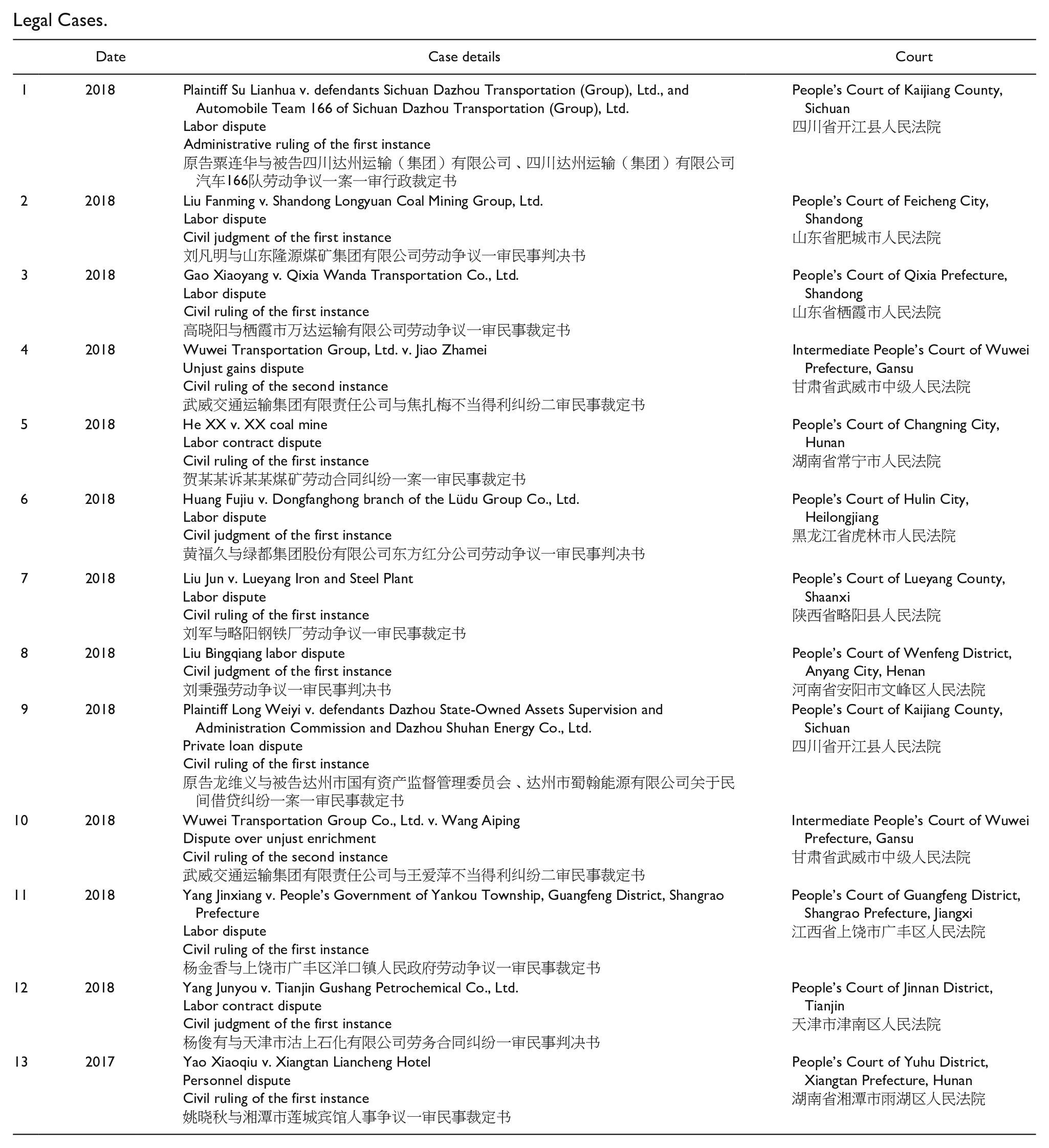
| Date | Case details | Court | |
|---|---|---|---|
| 1 | 2018 | Plaintiff Su Lianhua v. defendants Sichuan Dazhou Transportation (Group), Ltd., and Automobile Team 166 of Sichuan Dazhou Transportation (Group), Ltd. Labor dispute Administrative ruling of the first instance 原告粟连华与被告四川达州运输(集团)有限公司、四川达州运输(集团)有限公司汽车166队劳动争议一案一审行政裁定书 |
People’s Court of Kaijiang County, Sichuan 四川省开江县人民法院 |
| 2 | 2018 | Liu Fanming v. Shandong Longyuan Coal Mining Group, Ltd. Labor dispute Civil judgment of the first instance 刘凡明与山东隆源煤矿集团有限公司劳动争议一审民事判决书 |
People’s Court of Feicheng City, Shandong 山东省肥城市人民法院 |
| 3 | 2018 | Gao Xiaoyang v. Qixia Wanda Transportation Co., Ltd. Labor dispute Civil ruling of the first instance 高晓阳与栖霞市万达运输有限公司劳动争议一审民事裁定书 |
People’s Court of Qixia Prefecture, Shandong 山东省栖霞市人民法院 |
| 4 | 2018 | Wuwei Transportation Group, Ltd. v. Jiao Zhamei Unjust gains dispute Civil ruling of the second instance 武威交通运输集团有限责任公司与焦扎梅不当得利纠纷二审民事裁定书 |
Intermediate People’s Court of Wuwei Prefecture, Gansu 甘肃省武威市中级人民法院 |
| 5 | 2018 | He XX v. XX coal mine Labor contract dispute Civil ruling of the first instance 贺某某诉某某煤矿劳动合同纠纷一案一审民事裁定书 |
People’s Court of Changning City, Hunan 湖南省常宁市人民法院 |
| 6 | 2018 | Huang Fujiu v. Dongfanghong branch of the Lüdu Group Co., Ltd. Labor dispute Civil judgment of the first instance 黄福久与绿都集团股份有限公司东方红分公司劳动争议一审民事判决书 |
People’s Court of Hulin City, Heilongjiang 黑龙江省虎林市人民法院 |
| 7 | 2018 | Liu Jun v. Lueyang Iron and Steel Plant Labor dispute Civil ruling of the first instance 刘军与略阳钢铁厂劳动争议一审民事裁定书 |
People’s Court of Lueyang County, Shaanxi 陕西省略阳县人民法院 |
| 8 | 2018 | Liu Bingqiang labor dispute Civil judgment of the first instance 刘秉强劳动争议一审民事判决书 |
People’s Court of Wenfeng District, Anyang City, Henan 河南省安阳市文峰区人民法院 |
| 9 | 2018 | Plaintiff Long Weiyi v. defendants Dazhou State-Owned Assets Supervision and Administration Commission and Dazhou Shuhan Energy Co., Ltd. Private loan dispute Civil ruling of the first instance 原告龙维义与被告达州市国有资产监督管理委员会、达州市蜀翰能源有限公司关于民间借贷纠纷一案一审民事裁定书 |
People’s Court of Kaijiang County, Sichuan 四川省开江县人民法院 |
| 10 | 2018 | Wuwei Transportation Group Co., Ltd. v. Wang Aiping Dispute over unjust enrichment Civil ruling of the second instance 武威交通运输集团有限责任公司与王爱萍不当得利纠纷二审民事裁定书 |
Intermediate People’s Court of Wuwei Prefecture, Gansu 甘肃省武威市中级人民法院 |
| 11 | 2018 | Yang Jinxiang v. People’s Government of Yankou Township, Guangfeng District, Shangrao Prefecture Labor dispute Civil ruling of the first instance 杨金香与上饶市广丰区洋口镇人民政府劳动争议一审民事裁定书 |
People’s Court of Guangfeng District, Shangrao Prefecture, Jiangxi 江西省上饶市广丰区人民法院 |
| 12 | 2018 | Yang Junyou v. Tianjin Gushang Petrochemical Co., Ltd. Labor contract dispute Civil judgment of the first instance 杨俊有与天津市沽上石化有限公司劳务合同纠纷一审民事判决书 |
People’s Court of Jinnan District, Tianjin 天津市津南区人民法院 |
| 13 | 2017 | Yao Xiaoqiu v. Xiangtan Liancheng Hotel Personnel dispute Civil ruling of the first instance 姚晓秋与湘潭市莲城宾馆人事争议一审民事裁定书 |
People’s Court of Yuhu District, Xiangtan Prefecture, Hunan 湖南省湘潭市雨湖区人民法院 |
Acknowledgements
I appreciate Philip Huang’s insightful comments and Matthew Hale’s and Kristopher Pickett’s help in translating the article. I also thank Kathryn Bernhardt and Richard Gunde for help with revising this article. All errors that remain are mine.
Declaration of Conflicting Interests
The author declared no potential conflicts of interest with respect to the research, authorship, and/or publication of this article.
Funding
The author received no financial support for the research, authorship, and/or publication of this article.