




Abstract
Veterans have become one of China’s largest and most vocal protest groups. Studies on the country’s veterans have focused on their grievances and have identified these individuals as “unlucky” victims of economic reforms who suffer because of the state’s inadequate attention and local governments’ poor policy implementation. However, this article argues that the difficulties veterans face are the product of piecemeal policies adopted by central authorities. These policies have been inherited from the Maoist era’s principle of local resettlement of demobilized soldiers. Local governments have tried to reduce the heavy burden this resettlement policy imposes on them. Drawing on a review of a large number of policy documents, as well as interviews with dozens of veterans, this article presents a comprehensive picture of the resettlement system and the way piecemeal reforms have spurred various forms of unrest among veterans. It also shows that the differential treatment of various veteran groups in similar situations, as a result of the fragmented system and accumulated policy changes, has exacerbated veterans’ grievances. Finally, the article explores the conundrum of reforming the resettlement system. While the local resettlement of veterans is guaranteed and remains a cornerstone of civil/party-military relations, it has become impossible for the government to locally resettle all veterans. The resettlement system’s internal fragmentation also allows different authorities to shirk responsibility and eventually puts the burden on the veterans themselves. The elusive reforms proposed by the current leadership are unlikely to resolve these tensions.
At the Nineteenth National Congress of the Chinese Communist Party in November 2017, Xi Jinping (2017) announced the creation of a Ministry of Veterans Affairs to protect veterans’ rights and “make the military a respected career in Chinese society.” The ministry was formally established in April 2018, and by July newly appointed vice-minister Qian Feng announced that it would draft a new law to “protect veterans’ rights” (Xiao and Lun, 2018). These initiatives would allegedly address the grievances of millions of veterans who have demanded better living conditions and social and political recognition of their contribution to the nation. Their mobilization has received increasing media coverage, and the largest demonstrations have caught the authorities’ attention. For instance, in October 2016, thousands of veterans gathered in front of the Central Military Commission to voice their dissatisfaction, and in February 2017, more veterans gathered simultaneously at the Central Discipline and Inspection Commission and at the Ministry of Civil Affairs to denounce the corruption in and the flawed implementation of the resettlement system (Xiong and Shu, 2016). In 2018, having received no meaningful response, several veteran groups mobilized across the country to call out the state for suppressing their petitions. 1
These actions illustrate how veterans have become one of the most vocal and best-organized protest groups in China today. Some governmental authorities have even gone as far as calling them a major threat to social stability. 2 However, the scope and nature of veterans’ mobilization have only recently caught scholars’ attention. Early research mostly approached the issue of veterans’ resettlement as a by-product of the downsizing and modernization efforts of the People’s Liberation Army (PLA). The need to resettle very large numbers of veterans in state and state-related enterprises was created by the decision to drastically reduce the vast number of troops and put an end to the problematic and corruption-prone business activities of the PLA (e.g., Schichor, 1996; Shambaugh, 1996; Joffe, 1996; Cheung, 1994; Mulvenon, 2001: 50–52). The Chinese authorities have used the term “transfer” 转业 to designate the procedure by which PLA officers, including cadres ranked platoon leader 排长 or above, war veterans, and non-commissioned officers (NCOs) who served for at least ten years, receive a permanent job and associated social benefits and pensions in local government offices and state-owned enterprises (SOEs) when they leave the military. By contrast, “resettlement” 安置 designates the general process by which all PLA members are decommissioned. It includes transfers, but also other statuses, such as the status of “demobilized” 退伍 given to military cadres who give up the right to claim a permanent job in return for compensation, “retirement” 退休 for those who served until the legal retirement age, and also the lump sum given to demobilized conscripts and NCOs who served for less than ten years.
Some authors have connected the fate of veterans to the structural effects of China’s marketization reforms, especially the government’s efforts to downsize and privatize SOEs, which sharply reduced the number of available positions and caused large numbers of veterans to lose the jobs given to them as the major part of their resettlement in the late 1990s (Shambaugh, 1996; Yang, 1999; Zhou, Luo, and Zhang, 2006; Luo, 2005, 2014; Dong, 2009: 111–13). These veterans were later identified as active participants in the social and villagers’ protests of the early 2000s (Yu, 2003; Bernstein and Lü, 2000). Research in this vein has shed light on the structural factors that have contributed to the problems confronting veterans, but it has treated veterans as a single group and has failed to consider the differences between different generations and categories of veterans, as well as the variety of claims they make.
Neil Diamant and Kevin O’Brien went much further in analyzing the grievances, demands, and mobilization of veterans. They looked closely at the stories told and arguments put forward by veterans protesting online and showed that, in reality and contrary to official discourses proclaiming veterans to be the nation’s pride, many never obtained the benefits promised to them and felt degraded, humiliated, and neglected by society (Diamant, 2008; Diamant and O’Brien, 2015; O’Brien and Diamant, 2015). Diamant and O’Brien have pointed to both the structural reforms and the poor implementation of veterans’ policies by negligent or corrupt officials as the primary causes of the hardship veterans face. However, they did not examine the mechanisms behind these implementation problems. And yet, there is evidence that both the central and local governments have been aware of these problems and have earmarked substantial public funds to build houses and pay veterans’ pensions and subsidies. 3 It is crucial, therefore, to examine why these measures have failed to effectively address veterans’ grievances. Moreover, Diamant and O’Brien identified some vocal groups of protesting veterans, including veterans of the Sino-Vietnamese War of 1979 and high-ranking military officers, but did not systematically address the diversity of these protestors and did not link these cases with the resettlement system or its evolution over time. Jieren Hu, Tong Wu, and Jingyan Fei (2018) and Xingmiu Liao and Wen-Hsuan Tsai (2019) have analyzed the government’s strategies in responding to the veterans’ protests, but not the institutional reasons behind these protests. Maryanne Kivlehan-Wise (2007) provided a preliminary overview of these different veteran statuses, but did not analyze the relationship between them and the protests.
This article focuses on the relationship between the military resettlement system and the grievances of veteran protest groups. It traces the successive resettlement policies of the Chinese state and explains why they failed and, instead, caused increasing levels of discontent among veterans. It argues that the central government’s inability to do away with the resettlement system alongside marketization reforms created an unsolvable problem at the local level. In order to alleviate this problem, various ad hoc policies have been adopted over the years that have either directly pushed groups of veterans into the market or given local governments the discretion to do. Moreover, the piecemeal policy process created a multitude of actions that veterans perceived as unfair.
In order to examine this argument, the article traces the evolution of the military resettlement institutions and policies of the People’s Republic of China (PRC) since the end of the Cultural Revolution and highlights the causal relationships with the grievances of various protest groups. The analysis draws primarily on a corpus of central documents that have organized and reorganized the military resettlement system over time (Lieberthal, 1978: 6–20; Oksenberg, 1974; Wu, 1995: 24–38; Diamant, 2010). This corpus comprises the four official compilations of Selected Documents on Military Transfer Resettlement 退役安置工作文件汇编 (1950–2006) and documents gathered from online legal databases such as Beida fabao 北大法宝 and Falü faguiwang 法律法规网. In addition, we also obtained statistical data from the China Civil Affairs’ Statistical Yearbook 中国民政统计年鉴 (1980–2017) and from the official Transferred Military Cadres 转业军官 magazine run by the Resettlement Working Group for Transferred Military Cadres of the State Council. Finally, in addition to these official sources, we also gathered information from veterans themselves. This information was collected both from veterans’ blogs posted on platforms such as Tianya 天涯, Xinlang 新浪, and Boxun 博讯, and from interviews with fourteen veterans contacted via personal relationships. Although few, their accounts illustrate the difficulties typically experienced by the different categories of veterans discussed in this article. 4
The rest of the article is divided into four sections. The first presents the resettlement system, which has evolved into two institutionally separate tracks for military cadres (PLA officers with the rank of platoon leader and above) and other veterans. The second section examines the policies on military cadres and the grievances they have generated. The third turns to the policies targeting veterans who were not cadres (NCOs and war veterans) and these groups’ grievances. Based on the analysis in these sections, the conclusion synthesizes the fundamental mechanisms feeding into veterans’ discontent and analyzes whether the CCP’s recent reforms can resolve them once and for all.
Structural Tensions within the Military Resettlement System
Chinese veterans’ demands concern the malfunctioning of the resettlement system that was first put in place to draw down the PLA after the PRC was established in 1949. This section analyzes three structural tensions underlying the malfunctioning of this complex institutional apparatus.
The Origin and Evolution of the Military Resettlement System
A resettlement system was set up in 1949 to address the issues surrounding the demobilization of millions of PLA soldiers and to establish loyal local administrations and production units across the country (Mao, 1991 [1949]). Only veterans who had been cadres in the PLA were given a permanent job in local work units, such as local government offices or local SOEs (Liu and Xue, 2013). Ordinary soldiers were sent back to their places of origin 原籍 when they were discharged. 5 Under the planned economy, a person with the status of a “national cadre” 国家干部 was entitled to a permanent position 编制 (Brødsgaard, 2002) in government and enjoy a high social status and an opportunity to pursue a public career in the party-state, but also priority access to social benefits, such as free national health care and other services in scarce supply as well as housing. Even after retirement, the pension of veterans with national cadre status was the highest in all of society.
Before the Cultural Revolution, demobilization had been the responsibility of the Ministry of Internal Affairs. In 1968, the ministry was dismantled by the Central Military Commission under the Cultural Revolution leadership, and the resettlement system was frozen (Ministry of Civil Affairs, 2014). In 1975, Deng Xiaoping, then Chief of the General Staff of the PLA, reestablished the resettlement system and created a Resettlement Working Group for Transferred Military Cadres under the State Council 国务院军转安置工作小组 to arrange for the transfer of military cadres from the PLA to civilian positions in local government (State Council and Central Military Commission, 1983 [1975]). In 1980, this office was integrated into the Ministry of Personnel, which was in charge of civil servants, under the auspices of the CCP Central Organization Department. 6 However, the ministry only took care of military cadres. The demobilization of ordinary soldiers was entrusted to the Ministry of Civil Affairs (MCA), established in 1978, giving rise to a dichotomous resettlement system.
At the same time, the route to becoming a military cadre was changed. The possibility of ordinary soldiers being promoted to the status of cadre 提干, which had once been a strong motivation for youth to join the PLA (Zhang, 2015), quickly slipped away beginning in the late 1970s as military academies supplied most of the military cadres (You, 2006; Shambaugh, 1996). As WMS, a veteran from a village in Liaocheng, Shandong, said, I was an ordinary farmer in a peoples’ commune at the time. I was lucky to be recruited as a member of the ground staff by the Air Force in 1968. Five years later, I was promoted and granted cadre status. Another five years later, I was demobilized and given a permanent position in the commune in my hometown and worked there until my retirement. Now I still have a good pension. This cadre status changed my destiny. (Interview 2)
However, WQY from a village in Heze, Shandong, was not so lucky. He joined the army in 1978, hoping to move up the status ladder in a similar way. But instead, when he found out that the pathway to cadre status had already been cut off, he decided to leave the army after his three-year compulsory service (Interview 3). In order to attract and retain the most promising and skilled soldiers after they had completed their compulsory service, the Military Service Regulation adopted in 1978 (State Council and Central Military Commission, 1978) created the new status of “volunteer soldiers” 志愿兵 (VSs) for those who decided to stay but had little chance of being promoted to military cadres. In 1999, this status was further institutionalized and given the title of “non-commissioned officer” 士官 (NCO) (State Council and Central Military Commission, 1999).
Like military cadres, VSs/NCOs were entitled to resettlement upon demobilization, but unlike military cadres, they only had a “state ownership identity” 全民所有制身份 rather than a national cadre identity and were most likely to be given a job in a local SOE. 7 Although the social value of this status is not comparable to that of national cadre, a permanent placement in an SOE, which included housing and a pension, nonetheless meant that VSs/NCOs enjoyed an enviable social status and income, especially compared with those of workers in collectively owned enterprises and small private businesses (Interview 4). However, this resettlement was carried out by the MCA and its offices in local governments rather than by those of the Ministry of Human Resources and Social Security (MHRSS) (see Figure 1). The resettlement rights and benefits of military cadres and VSs/NCOs were enshrined in a series of central regulations and laws, an important point in understanding subsequent developments. The status of military cadres was detailed in the 1978 and 1989 PLA Cadre Service Regulations and enacted into law in 2000; the status of NCOs was secured in the 1978 National Congress Decision on the Military Service Issue, the 1984 Military Service Law, and the 1999 Guidelines for the Demobilization of NCOs.

The dichotomous process of resettling Chinese veterans.
The Dichotomous Resettlement System: Three Structural Tensions
Three structural tensions underpin the problems with the resettlement system. The first revolves around civil‒military relations. The rationale for the resettlement policy was based on the notion that the state—not the PLA itself—must bear the responsibility for providing for demobilized officers. The relationship between decommissioned soldiers, regardless of their status, and the PLA is completely severed as soon as they are discharged and given a lump sum severance payment. Their resettlement, social welfare, and other benefits are entirely borne by the government, relieving the PLA of all responsibility. Government departments have complained about and protested this situation since the 1970s. Yet, Hu Yaobang, who was then head of the CCP Central Organization Department, contended that “it is not about whether or not we should do it like this; we must do it like this, because it guarantees the continuous development of the PLA and ensures war preparedness” (Hu, 1983 [1978]). In the civil–military relationship, the military takes precedence. In 2006, Hu Jintao also said that disarmament and military reforms would not be considered complete until all military cadres had been resettled (Cao and Zhang, 2009).
The second tension concerns central–local relations and who has responsibility for shouldering the resettlement burden. In the 1950s, the CCP adopted the principle of “local resettlement,” which tasked local governments with organizing and financing the resettlement of demobilized military officers. This principle has been reemphasized by successive leaders. According to Cao Zhi and Zhang Miyang’s 2009 report, Deng Xiaoping in 1975 stressed that the responsibility for resettlement fell on local governments. In 1993, despite pressure on local governments to reform and downsize, Jiang Zemin pointed out that “military resettlement is an important political task,” and the party Central Committee insisted that local governments “prioritize the resettlement of military cadres” (Cao and Zhang, 2009). From the local governments’ perspective, this demand implies that “the center plays the host, but the local government pays the bill” 中央请客 地方买单. For example, in 1980, the provincial and municipal governments disagreed with the central government’s decision requiring them to build new houses for retired military cadres (CCP Central Committee, 1980).
The third tension is between different ministries, in particular the MHRSS and the MCA. A core mechanism of the dichotomous resettlement system involves decommissioned soldiers being handed over to one or the other of these two, depending on their status. Military cadres are the responsibility of the MHRSS, while the MCA is responsible for the rest, regardless of the length of their service.
The three relations at the heart of the dichotomous resettlement system determine the operational logic of resettlement and underlie the various problems it faces.
Resettlement Pressure on Local Government and the Drive to Reform
As a result of civil–military and central–local dynamics, the ultimate responsibility for implementing the resettlement policy has fallen on county and township governments, which have usually found positions for transferred military cadres either in their own local administration or in SOEs. For the veterans during the planned economy era, this was nothing more than a transfer within the party-state, but in the 1970s, after decades of implementing this policy, local governments were faced with severe overstaffing. For instance, in 1986 a municipality in Hunan had 1,294 employees on its staff spread across forty bureau-level units. Within two years, following a downsizing of the PLA, employees had doubled in number to 2,425 across sixty-six bureau-level units—exceeding by more than 90 percent the quota for the number of personnel 编制 in the municipality. In order to create positions for all the decommissioned cadres, the director of each local unit was assigned dozens of “deputy directors” (Zhang, 1988). This phenomenon continued into the 1990s and 2000s, despite calls from the center to reduce the size of local government. According to data collected by Xu Peng, a member of the Shandong Social Security Office in charge of resettlement, some counties and districts were asked to resettle a dozen or more transferred military cadres every year (Xu, 2008). Commenting on this phenomenon, LZ, a staff member of the Shandong Changyi City personnel office, stated that the continuous transfer of military cadres was a critical factor in the seemingly unresolvable overstaffing of county and township governments (Interview 5).
While it was very difficult for the local MHRSS offices to find resettlement jobs for military cadres, it was even a greater challenge for the MCA offices to find positions for NCOs, who did not benefit from national cadre status. According to former MCA vice-minister Luo Pingfei, locally owned enterprises were the main source of jobs for demobilized NCOs. However, during China’s economic reform, most of these enterprises went bankrupt in the 1990s, leading to a “decline in the number of SOE jobs controlled by the government and a consequent weakening of the capacity to resettle” veterans (Luo, 2005). As a result, responsibility for ex-NCOs was shirked from county-level governments to township- and village-level governments. This resulted in lower salaries, reduced benefits, and even, in some cases, no resettlement at all. For instance, a township in ZQ district in Ji’nan, Shandong’s capital, received twenty-five NCOs in 2015–2016, far more than it could cope with. Resettlement work at the local level has been dubbed “the hardest work on earth” 天下第一难工作 (Interview 6).
All this illustrates that the pressure to resettle veterans has become a real dilemma since (and because of) the country’s economic reforms. Local governments have repeatedly asked central authorities to take steps to reduce the pressure. In a speech at the 1980 annual conference on military transfers, Hu Yaobang reported that some localities argued that, since the PLA was the national government’s army, the central government ought to provide housing for veterans. And, Hu noted, some even refused to provide the veterans with housing at their own expense, as required by the central government (CCP Central Committee, 1980). Such resistance at the local level eventually prompted the center to acknowledge the difficulty local authorities were facing and recognize the urgency of reforming the resettlement system. From the 1990s onward, the government began to adopt a series of reform measures, but this was done within the framework of the dichotomous resettlement system without breaking free of any of the system’s three core dynamics described above. As a result, the difference in treatment between military cadres and NCOs has widened, and the binary resettlement discrepancy has been reinforced. Both Jiang Zemin and Hu Jintao declared that the problems with resettlement were the result of a system that had been designed under the planned economy and such a system was fundamentally incompatible with a market economy. Both prescribed gradual modifications of the “socialist market economy” system (Cao, Wu, and Di, 2000). As a result, virtually all the veterans’ policies adopted since the 1990s have involved pushing veterans into the market. At the same time, however, laws (e.g., the Military Service Law) in which the fundamental right to resettlement was enshrined have never been changed. Instead, in recent years, Xi Jinping has continued to insist that, as spelled out in law, local governments must ensure that military cadres are resettled (Ni, 2016). This has resulted in a fundamental mismatch between the piecemeal resettlement policy process and the law protecting the rights of veterans. This in turn has perpetuated the poor implementation of policies at the local level and done nothing to quell veterans’ grievances.
Military Cadres and the Struggle for Statutory Rights
Since the very beginning, military cadres have been the primary beneficiaries of the resettlement scheme. However, the growing number of transferred military cadres (TMCs)—2.4 million since 1980, according to the MHRSS 8 —has rapidly exceeded the capacity of local governments to provide such positions (see Figure 2). This section explores the relationship between three important policies aimed at alleviating the resettlement burden on local governments and TMC protests in the reform period.
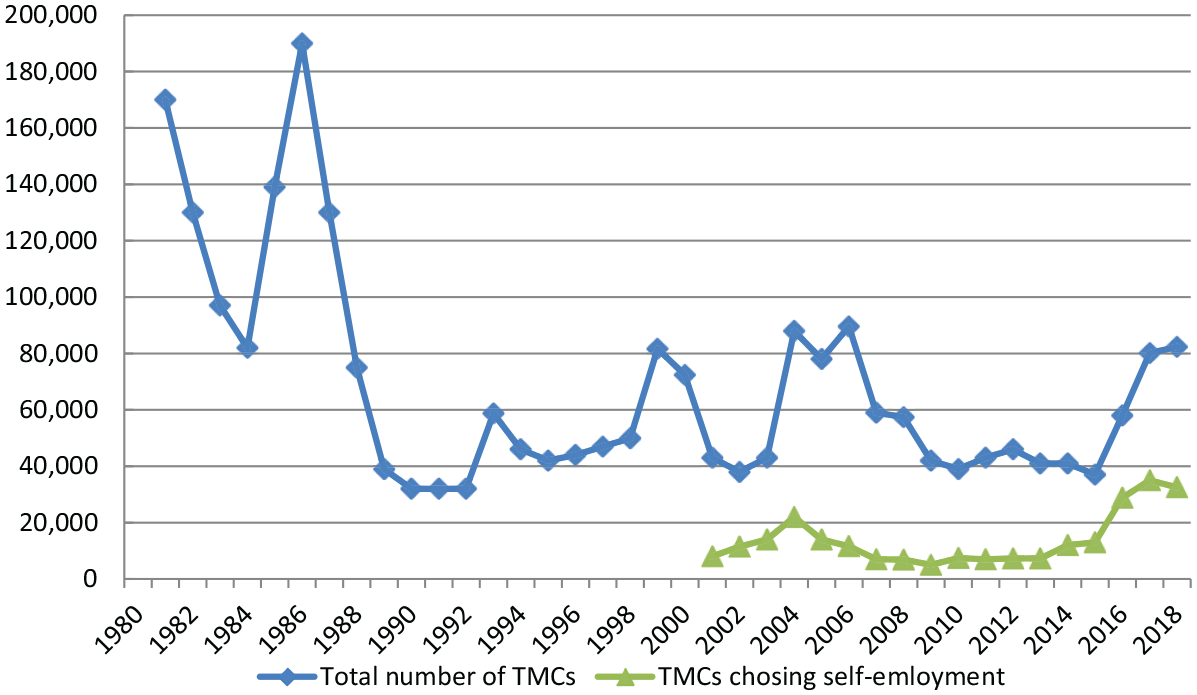
Number of transferred military cadres (TMCs) and TMCs choosing the self-employed option, 1980–2018.
The Cancellation of TMCs’ Cadre Status Following Resettlement
The massive downsizing of the PLA in the 1980s coincided with similar downsizing of the state bureaucracy. The huge pressure of personnel placement prompted local governments to adopt some new measures. One immediate solution was to expand the resettlement scheme to SOEs. In the following decade, hundreds of thousands of military cadres were resettled in SOEs while retaining their status as national cadres. In the pre-privatization environment, the status and welfare benefits of these resettled cadres were very similar to what they would have enjoyed in local governments, and thus this change did not trigger opposition.
However, a 1993 document issued by the Ministry of Labor and Social Security in view of the upcoming SOE reforms abolished the differences between SOE cadres and other workers and severed the link between SOE cadres and the state administration (Ministry of Labor and Social Security, 1993). This implied the withdrawal of national cadre status from some 940,000 resettled military cadres. However, the effects were not immediately perceptible as long as these TMCs remained in the SOEs. It is only when they were laid off that the consequences of the loss of their status were felt, as they discovered that they could no longer claim the right to be provided with another job nor receive the benefits associated with a job in an SOE. This triggered a major mobilization and large numbers of petitions. This mobilization was considered a major threat to social stability, as attested by the inclusion of the “laid-off TMCs problem” among the five issues addressed at an extraordinary inter-ministerial conference on “petitions and mass protests” 群体性事件和信访突出问题联席会议 convened in 2003. This conference set up five corresponding working groups, 9 and the one in charge of laid-off TMCs followed up by issuing three key classified policy documents in 2004, 2005, and 2006. 10 According to veterans’ accounts, these documents instructed local governments to reject laid-off TMCs’ demands that their national cadre status be restored. Although it is impossible to verify these accounts conclusively, they fit with similar instructions formulated in a leaked Central Organization Department classified document from 2002 that justified this refusal on the grounds that it would run counter to the process of marketization (Central Organization Department, 2002).
Eventually, TMCs began considering legal action against these policies in order to get their status back. A mock lawsuit against the MHRSS published on a veterans blog in 2011 laid out in great detail their argument that the 1993 policy, by withdrawing their national cadre status, violated several laws such as the 1984 Conscription Law and the 1988 Law on Officers in Active Service, and that the three documents of the working group from 2004, 2005, and 2006 were also violations of these legal rights (Voice of the Veterans, 2011a). As one of those TMCs explained, At the time, the government told us they had difficulties resettling us in the government, so they hoped we could take the interests of the state into account and accept a position in an SOE. They also assured us we would keep our national cadre status. However, the Ministry of Labor abolished SOE employees’ cadre status in 1993 and forced us to sign labor contracts with the enterprises we worked for. At that time, the negative impact was not obvious because the enterprises were still in operation. But when our companies went bankrupt, we lost everything. [. . .] The local government didn’t care about us. When we asked for help and for our cadre status, they said the central government had already issued a document to sever the relation between us and the state. There are a lot of people like me, jobless, who are having a hard time making ends meet. Finally, we decided to join forces to sue the Ministry of Human Resources, which had illegitimately canceled our statuses. We don’t want to make trouble; we just want our status back. We want to survive. (Interview 7)
In 2010, a group of 6,823 TMCs from Hubei brought a lawsuit against the MHRSS in Hubei’s Higher Court, but the court dismissed their case on the grounds that it did not have jurisdiction over the legality of state policies (Voice of the Veterans, 2011b). According to a leaked document of the Henan Provincial Party Committee, TMCs from across the country were organizing to bring a collective lawsuit to the Supreme People’s Court in Beijing (Henan Province, 2011). Facing this movement, the Supreme Court issued instructions to all provincial higher courts to dismiss these cases on the basis of arguments from Hubei’s Higher Court, namely that the situation of laid-off TMCs resulted from state policies adopted in specific historical circumstances and that courts did not have the right to review their legality. But in the eyes of the TMCs, their situation was not merely the unfortunate result of historical circumstances: it was the result of deliberate decisions made by the state, which took advantage of the reforms to get rid of them.
The “Voluntarily Demobilized” Option
At the same time the government adopted the policy to resettle veterans in SOEs, it created another new policy to relieve some of the resettlement burden on local governments. This policy created the possibility for military cadres to “voluntarily demobilize” 自愿复员, which implied abandoning their national cadre status and resettlement in exchange for significant monetary compensation, reportedly ranging between 35,000 and 120,000 yuan (State Council Working Group, 1993; Interview 8). 11 By the time this policy was abandoned in 2001, an estimated twenty-three thousand military cadres had chosen this option (Song Ge, 2011).
According to a report by the Qinghai Provincial Department of Civil Affairs, many of these military cadres were intent on finding a job in the market, while most counted on the lump sum compensation to support themselves (Qinghai Department of Civil Affairs, 2007). However, their plans were jeopardized by the economic developments of the subsequent decade. High inflation and a significant increase in the cost of living quickly reduced the value of this money. At the same time, many of these veterans lacked skills in demand in civilian society and had difficulty finding a job. Thus they felt cheated. This led many to petition local governments as well as the MHRSS and the Central Military Commission, asking that their national cadre status be restored, but they were unsuccessful. For instance, in 2011, a group of twenty-eight voluntary TMCs petitioned the Lanzhou Military Region command, and in November 2015 another group, numbering over three hundred, from across China petitioned the Department of Political Work of the PLA in Beijing (Gansu Demobilized Officer, 2010; Luo, 2015). The petitioners explained why they believed that the government had cheated them: Our problems all come from Document No. 93.1. When the army tricked us into voluntary demobilization, we were told we would receive a large sum in compensation, but none of us had seen the full text of this document. We never understood that we would lose our national cadre status. [. . .] Anyway, this policy document is illegal. According to both the Law on Officers in Active Service and the Military Service Law, we are entitled to the status of national cadre (Luo, 2015).
Even though these veterans were received by the leaders responsible for military transfer affairs and petitions, their action did not lead to any substantive results.
The “Self-Employed” Option
Although the central government did not give in to veterans’ demands, it eventually abandoned the “voluntarily demobilized” option and reaffirmed the importance of ensuring the national cadre status as well as resettlement rights of decommissioned military cadres. In 2001, it also created a new, more flexible resettlement option, which it called “self-employed” 自主择业 (CCP Central Committee, 2001), according to which TMCs would give up their right to claim a job but retain their national cadre status and receive a monthly living allowance 退役金 of between 7,000 and 16,000 yuan from the central government based on their rank in the PLA, length of service, and place of residence. As shown in Figure 2, from 2001 to 2017, around 219,000 military cadres chose to be demobilized as “self-employed.” This reform, which placed more responsibility on the central government, was naturally welcomed by local governments, which hoped that an increasing proportion of transferred military cadres would select the “self-employed” option. However, the central authorities, focused on limiting the central government’s financial burden, imposed very strict limits on access to this status: it was available only to military cadres with over twenty years of service, and even amid very substantial downsizing of the PLA, the minimum length of service required to be eligible for this option remained eighteen years (CCP Central Committee, 2016).
However, although the central government decided to assume the responsibility for paying the pension funds for TMCs, their health care benefits and housing subsidies were to be provided by local governments, even though they were no longer on their payroll. However, the policy did not clarify which level of government was responsible, and unsurprisingly, different levels of government pushed the burden onto each other, which meant that a considerable number of self-employed TMCs never obtained the promised social benefits. For instance, in November 2016, a group of self-employed military cadres wrote to the governor of Sichuan complaining that local governments had refused to provide them with the promised housing subsidies and a priority position to purchase welfare housing: We chose self-employment in good faith in order to respond to the CCP’s call to reduce the state’s resettlement burden. We should be considered pioneers in the state’s efforts to reform [the resettlement system]. Each self-employed cadre saves the local government around a hundred thousand yuan. So local governments should not withhold the social benefits we deserve. [. . .] We will no longer sit around indifferent to some departments shirking their responsibilities and thereby damaging the image of the party and government. (All Self-Employed Military Cadres, 2018)
However, even though these self-employed TMCs complained about the non-delivery of social benefits, the new status indirectly vindicated the claims of the TMCs who were “voluntarily demobilized” in 1993 and demanded that the state grant them similar conditions, especially national cadre status. 12
In sum, the problem facing military cadres was that the state wanted to withdraw some of their privileges in order to resolve the increasingly unsustainable resettlement burden on local governments during the reform era. In the early 1990s, the central government attempted to push military cadres into the market by severing ties with those resettled in SOEs and offering to trade their cadre status for some monetary compensation. However, these policies provoked strong resentment once the practical consequences of the loss of status became apparent, and by the early 2000s, the central government reversed course and reaffirmed the importance of the cadre status, indirectly validating the protestors’ claims but without surrendering to their demands. Even so, the central government remained reluctant to assume the responsibility for resettling them. It has continuously pushed its welfare responsibilities onto local governments, which has become an important impetus behind new protests.
The following section examines the situation of NCOs and war veterans, who, although not military cadres, were nonetheless promised favorable resettlement jobs, which has played a role in exacerbating the resettlement problem.
Non-commissioned Officers’ and War Veterans’ Futile Struggle against Marketization
As mentioned in the first section, the status of “volunteer soldier” (VS) was created in 1978 to keep experienced soldiers in the army. In 1999, this status was further institutionalized in the form of a non-commissioned officer 士官 (NCO) ranking system in parallel with that of military cadres. However, whereas VSs benefited from job resettlement from the first year they stayed in the army after their compulsory service, after 1999 only those who had served eight years beyond their compulsory service earned the right to job resettlement. Because this new rule is very clear, those leaving earlier were demobilized in return for a lump sum payment. Even though some may have encountered some hardships upon their return, there are no records of them staging protests (Interview 9). NCOs entitled to a job assignment could theoretically choose to leave with a lump sum payment instead. However, the majority chose to stay in the system and asked to be given a local job. In 2018, these so-called “transferred NCOs” 转业士官 numbered around fifty thousand (see Figure 3). This group has undoubtedly put a great deal of pressure on local government resettlement.
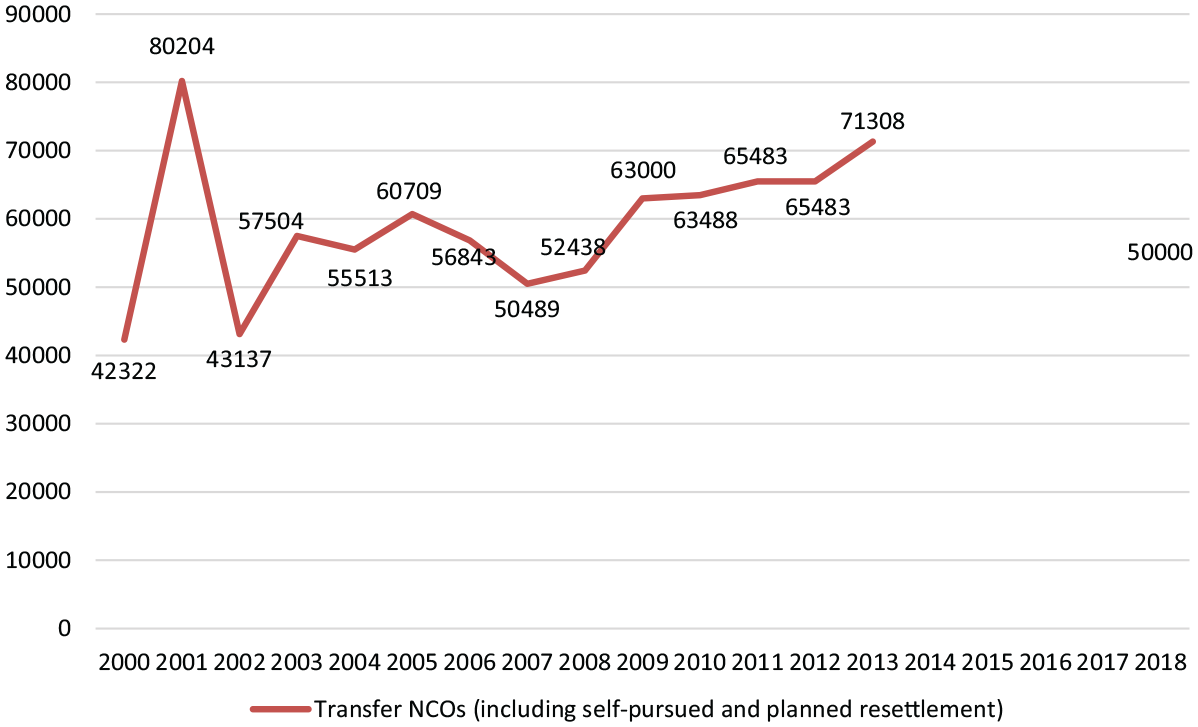
Number of transferred non-commissioned officers (NCOs), 2000–2018.
Laid-off Transferred NCOs
Since local SOEs are the main (if not the only) destination for resettling NCOs, the impact of the SOE reforms in the 1990s affected transferred NCOs even more than the TMCs. Gao Xiaobing, the current vice-minister of the MCA, has acknowledged this as a major challenge (Guo, 2018). For instance, in 2001, Hubei had to resettle around twenty thousand NCOs, or several hundred in each county. Many NCOs were assigned to local companies, even if they were already on the verge of bankruptcy. In fact, the proportion of NCOs who got a position officially granted to them under the resettlement scheme decreased from just 31.84 percent in 1999 to only 18.42 percent by 2000 (Hubei Provincial Resettlement Office, 2001). This situation was very common throughout the country. According to Luo Pingfei’s statistics, even in larger cities this proportion did not exceed 50 percent, and in some smaller towns it was more often between 15 and 20 percent (Luo, 2014: 137). As a result, large numbers of transferred NCOs got neither the job nor the pay they expected. Many became unable to support themselves. ZXY, a transferred NCO in Tai’an, Shandong, explained this situation: When I left the army, I was assigned the job of security officer in a textile mill. But actually this company had already stopped production for a long time. No one was working, and I received no pay. However, when I reported this situation to the local government and asked for another position, they said I could take it or leave it—there was nothing else available. They didn’t even mention my “state ownership status” that I’m entitled to according to the law. I can’t live like this any longer. (Interview 10)
In the 2000s, as a supplementary measure to make up for its reduced resettlement capacity, the government began to set up a large number of “public welfare posts” 公益性岗位 to absorb laid-off NCOs as well as NCOs who had never obtained a state-allocated position. These new posts included such jobs as street cleaners, security guards, urban law enforcement officers, neighborhood stability maintenance workers, and so on. These workers would have their salary paid from the government budget, but, in Shandong for instance, their monthly salary would amount to only 1,600 yuan and would not include the welfare and social benefits associated with an SOE or a local government job. Moreover, these positions were nothing like an “iron rice bowl”: they were contractual positions limited to three years. This shows that, although the government created welfare jobs, it had no intention of restoring the kind of “state ownership status” 全民所有制身份 that had previously existed, which would have imposed a very heavy financial burden on local governments. The aim of these cheap measures was merely to assuage the anger of the NCOs in the short term, but the basic objective of mitigating the resettlement pressure through marketization was unchanged. As the Shandong provincial government admitted to an NCO network, public welfare jobs are bottom-level jobs created by the government to guarantee the survival of NCOs; they do not constitute a new resettlement position. 13
Transferred NCOs and the “Self-Search” Option
In the late 1990s, mirroring the handling of TMCs, local governments began to experiment with new practices aimed at alleviating the resettlement burden. They began to offer NCOs the option of “finding a job on your own” 自谋职业 (or “self-search”), according to which NCOs would forgo their claim to a job in exchange for monetary compensation. This practice spread quickly and, legalized by the State Council in a central document, became national policy in 2001 (Ministry of Civil Affairs, 2003). Although “finding a job on your own” was optional in theory, many local governments devised informal strategies, such as lengthening the settlement process, to force transferred NCOs to choose this option. These strategies were implicitly approved by the central authorities, since the director of the Resettlement Department at the MCA, Sun Shaocheng 孙绍骋, 14 declared that the “finding a job on your own” option should become the main resettlement approach for transferred NCOs (Sun, 2002). As a result, the number of NCOs who chose this option saw a sharp increase. For instance, in Zhijiang, Hubei, it grew from 24 percent in 1997 to 67.1 percent in 2001 (Hubei Provincial Resettlement Office, 2001). In the early 2000s, the average rate for the whole country stood at around 60 percent (Ministry of Civil Affairs, 2007b).
However, the compensation had to be paid by local (mostly county) governments and was comparatively low. For instance, in 2001, in Shandong it amounted to between 10,000 and 40,000 yuan, and in Hubei to 30,000 yuan (Hubei Provincial Resettlement Office, 2001). The difference in treatment compared with the TMCs is striking, and this also pushed NCOs into the streets. By the year 2002, the number of petitions to the MCA had increased by 178 percent (Petition Office, 2004). Yet, the government persisted, as HX, a transferred NCO from Guang’an, Sichuan, who served in the army for fifteen years and was demobilized in 2010, explains: The Guang’an Bureau of Civil Affairs told me there weren’t enough jobs. If I chose resettlement, I’d have to wait a very long time. They recommended that I choose the “self-search” option. In the end, I had no choice but to accept it. However, they gave me only 43,000 yuan in compensation; this is far from enough to raise my family. [. . .] We served in the army for decades. We’ve been isolated from society for a long time. Now we’re too old and out of touch to find a good job. [. . .] When we were playing with guns, the whole country was thinking about developing the economy and making money. But we’re veterans; we’ve been totally forgotten. We’ve become a disadvantaged group and need to restart from scratch. (Hanxin, 2013)
NCOs have staged many demonstrations, including two large ones around the central institutions in Beijing. On October 10, 2016, tens of thousands of NCOs holding red flags emblazoned with “Transferred NCO” or “Volunteer Soldier” and singing military songs such as “Unity Is Strength” gathered from all over the country in front of the Central Military Commission to express their outrage. They demanded jobs in SOEs, as well as health care and social welfare benefits (Xiong and Shu, 2016). Four months later, on February 22, 2017, thousands more gathered at the Central Commission for Discipline and Inspection and the Ministry of Civil Affairs to denounce the corruption in the resettlement system and urge the MCA to accelerate their resettlement (Qiao, 2017). In response, the MCA in 2018 launched a campaign to “clear up all the resettlement problems” (Guo, 2018). However, without concrete policy measures, this declaration remained little more than empty words, and after the new Ministry of Veterans Affairs was established in April 2018, the campaign was no longer mentioned.
The promise of a job was a very important element in solving the PLA’s recruitment problems while allowing only graduates from the military academies to become military cadres. However, this promise was founded on the premise that the state could provide unlimited jobs, which has become increasingly problematic since the 1990s. Pressured by the market, NCOs have been compelled to accept the “self-search” option, which means that, unlike “self-employed” TMCs protected by their national cadre status, they can only receive compensation from local governments, which the latter hand out grudgingly.
War Veterans’ Struggle for Status
The various conflicts that the PRC has engaged in involved a large number of ordinary soldiers. According to the first “military service law” issued in 1954, most of these veterans were sent back to their place of origin, like all other conscripts. In 1984, however, this law was amended and officially entitled war veterans to be resettled and receive preferential treatment 职位安置, the same as what local civil affairs bureaus provided to transferred NCOs and VSs, albeit without creating a specific status for them.
15
Accordingly, the implementation of this law was highly uneven. On the one hand, there are accounts of some local governments, such as Yanzhou, in Shandong, and Beijing, that had job quotas in city-owned and township-run factories for veterans of the Sino-Vietnamese War (Beijing Bureau of Civil Affairs, 1986; Liu Yuan, 2012). On the other hand, there are numerous testimonies, documented by Diamant (2008), showing that many war veterans, especially the disabled and ill, never obtained the promised positions or health care. Yan Geling’s novel Fanghua 芳华 (Youth), which was turned into a very popular movie of the same name in 2017, describes this dramatic situation. Moreover, many of those who did obtain a job were later laid off, together with contingents of SOE workers. That was the case with Zhang Hejing, a veteran from the Sino-Vietnamese War, who was resettled in a local state-owned diesel engine factory in his place of origin, Suzhou 宿州, but lost everything when the factory went bankrupt in 2002. “When the diesel engine factory went bankrupt,” Zhang wrote, I lost all of my income, and my life suddenly became very difficult. At that time, I hadn’t reached retirement age yet and still wanted to work. Together with other war comrades, we petitioned the county’s Bureau of Civil Affairs to get a new resettlement. We petitioned for many years but never received any response. (Zhang, 2017)
In the 2000s, faced with unresponsive local civil administrations and a job market in which they had little prospect of surviving, these war veterans began to claim job resettlement—at least, living stipends as war veterans. For instance, in 2000, dozens of Sino-Vietnamese War veterans petitioned the Guangxi Military Region complaining about their bad health and their miserable living conditions and sought to push the latter to pressure local governments into providing the living allowances and medical care they claimed they deserved, but their attempt was unsuccessful (Wang and Bi, 2001). Similar demands in different places were equally ineffective. However, repeated protests caught the attention of some government officials, who began to advocate that the state recognize their status as claimants for compensation and provide them with adequate support (Hong, 2008).
Eventually, in July 2007, the MCA announced a policy that acknowledged the very existence of “war veterans” 参战退役人员 for the first time ever and demanded that local governments provide a monthly living allowance of 100 yuan to “those who had been laid off and those in great difficulty” 失业下岗且生活困难人员 (Ministry of Civil Affairs and Ministry of Finance, 2007). Two months later, the MCA clarified that these “war veterans” included not only veterans of the Sino-Vietnamese War but also troops who had fought against Taiwan’s Guomindang army (1954–1985), those who had participated in repressing the uprisings in Tibet and Xinjiang (1955–1990), and those who had taken part in border conflicts with India (1962) and the Soviet Union (1969) (Ministry of Civil Affairs, 2007a). 16 As a result, thousands of veterans flooded the local Civil Affairs Offices, which resulted in the official count of war veterans rising from 1,364,271 to 1,539,584 by 2011 (see Figure 4). However, it soon became clear that the 100 yuan allowance would be insufficient to resolve the difficulties these war veterans were facing. According to official reports, several provincial and local governments greatly increased this allowance. For instance, in 2007, Jiangxi increased the monthly allowance to 230 yuan and Shenzhen to 360 yuan. Other sources report that in 2009 Ningbo prefecture in Zhejiang provided 400 yuan and Anhui 170 yuan (Hualü Net, 2018).
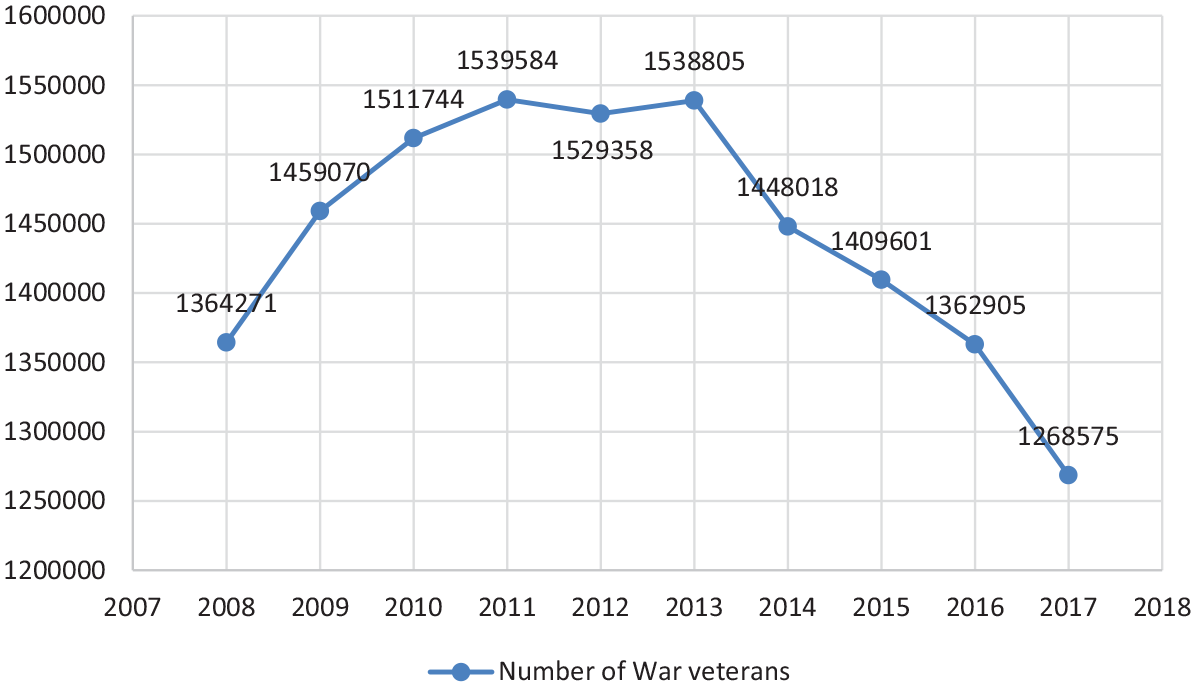
Evolution of the number of war veterans, 2008–2017.
However, this living allowance was far less than what was needed to maintain a decent standard of living. A survey conducted by Chen Chengwen and Chen Jiangping on veterans from Hunan in 2013 found that 39.9 percent of the respondents judged their living conditions to be “very bad” 非常差. Nearly all the respondents (92.6 percent) said the most urgent need was to increase their allowance in order for them “to live a normal life” 过一个正常生活 (Chen and Chen, 2013). Moreover, these policies failed to effectively address the demands of war veterans regarding postwar medical care and pensions. A document released by the Ministry of Labor and Social Security in 2006 first tackled the issue of providing pensions to veterans who had been laid off, but, once again, vague definitions and complicated conditions left much room for interpretation about who could claim benefits (Ministry of Labor and Social Security, 2006). On July 21, 2016, when close to a hundred veterans of the 1965–1975 Vietnam War against the United States petitioned the Municipal Bureau of Human Resources in Wuhan demanding pensions as stipulated in the policy, they were sent away because they allegedly lacked standing (Xu, 2016).
Like transferred NCOs, war veterans’ right to resettlement was guaranteed by law, but they were not protected by national cadre status as is the case with military cadres; thus, they were the first victims of local governments pushing back against “unreasonable” resettlement demands. Local governments have not addressed transferred NCOs’ and war veterans’ claims to job resettlement and state ownership status. Instead, they have merely used some ad hoc social assistance and emergency measures to provide them with minimal (but insufficient) living allowances and to resolve some of their grievances.
Conclusion
The relationship between China’s resettlement policies and the numerous veterans’ protests that have repeatedly occurred since the beginning of the reform era makes it clear that, instead of stemming from the bad luck of veterans caught in economic reforms, these protests have been rooted in the policies adopted by the central government. These policies established a dichotomous resettlement regime for different categories of veterans. The central government subsequently tried to resolve the mismatch between the resettlement promises made to the most privileged veterans and local governments’ dwindling ability to fulfill these promises with ad hoc buyout-oriented self-employment measures designed to push veterans into the market. However, each of these measures aimed at relieving resettlement stress has paradoxically created a new protest group (see Table 1 and Figure 5). These measures have not been drawn up according to a long-term macro-plan designed in coordination with a downsizing of the armed forces and the government’s capacity to resettle veterans, relieve the burden on local government, and improve veterans’ employability. Instead, they have been piecemeal attempts to address emergencies and the special grievances of particularly vocal groups at different points in time. These successive policies adopted in isolation in different tiers of the institutionally divided dichotomous system have ended up creating numerous contentious statuses for different groups and generations of veterans. These statuses entail varying levels of welfare provision to different groups. It is unclear how or whether the differences are related to merit, time served, and the objective conditions of veterans. Thus, they are widely perceived as unfair and fuel unrest.
Veterans’ Policies and Status and Protest Groups in China’s Reform Era.
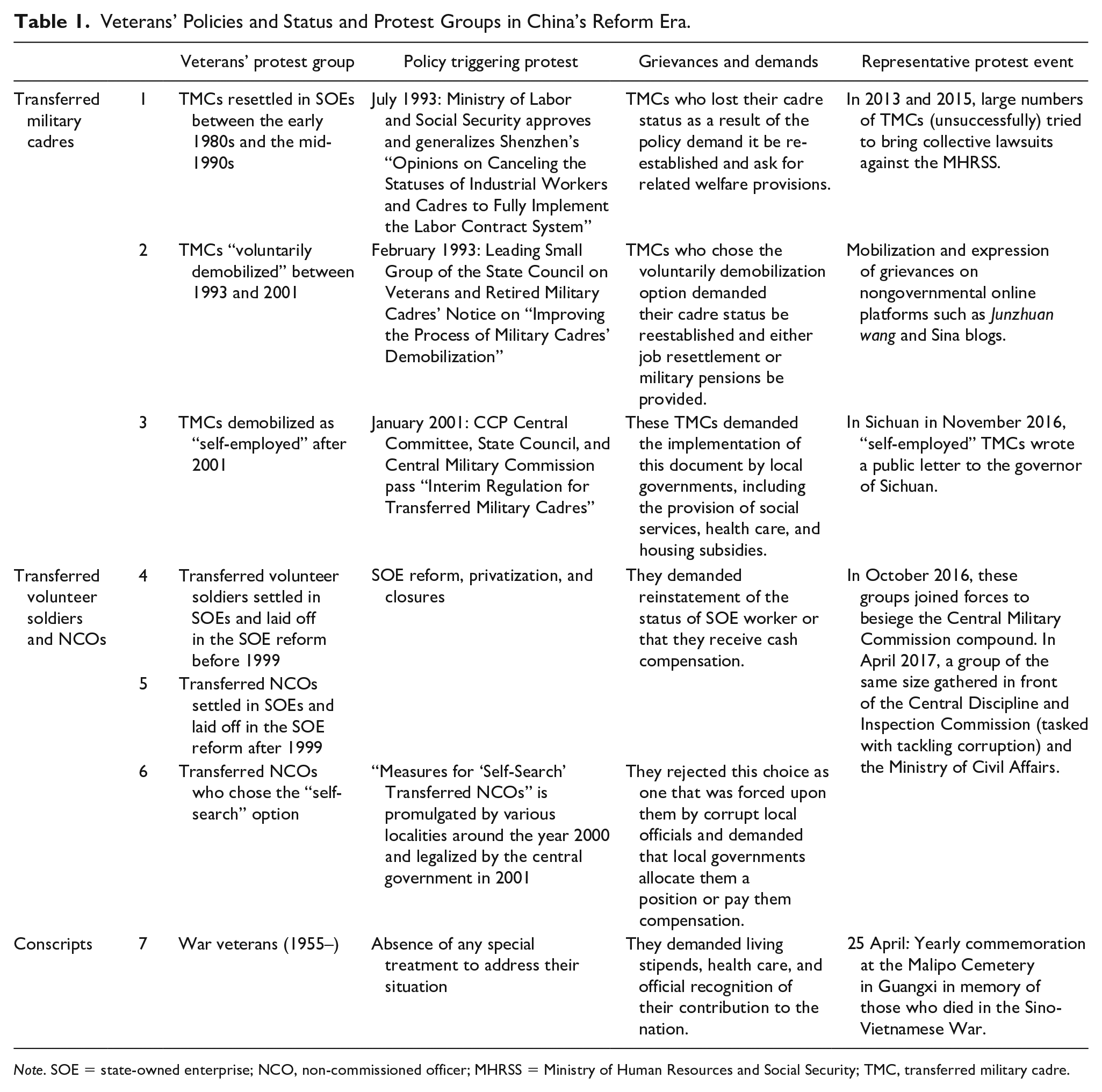
Note. SOE = state-owned enterprise; NCO, non-commissioned officer; MHRSS = Ministry of Human Resources and Social Security; TMC, transferred military cadre.
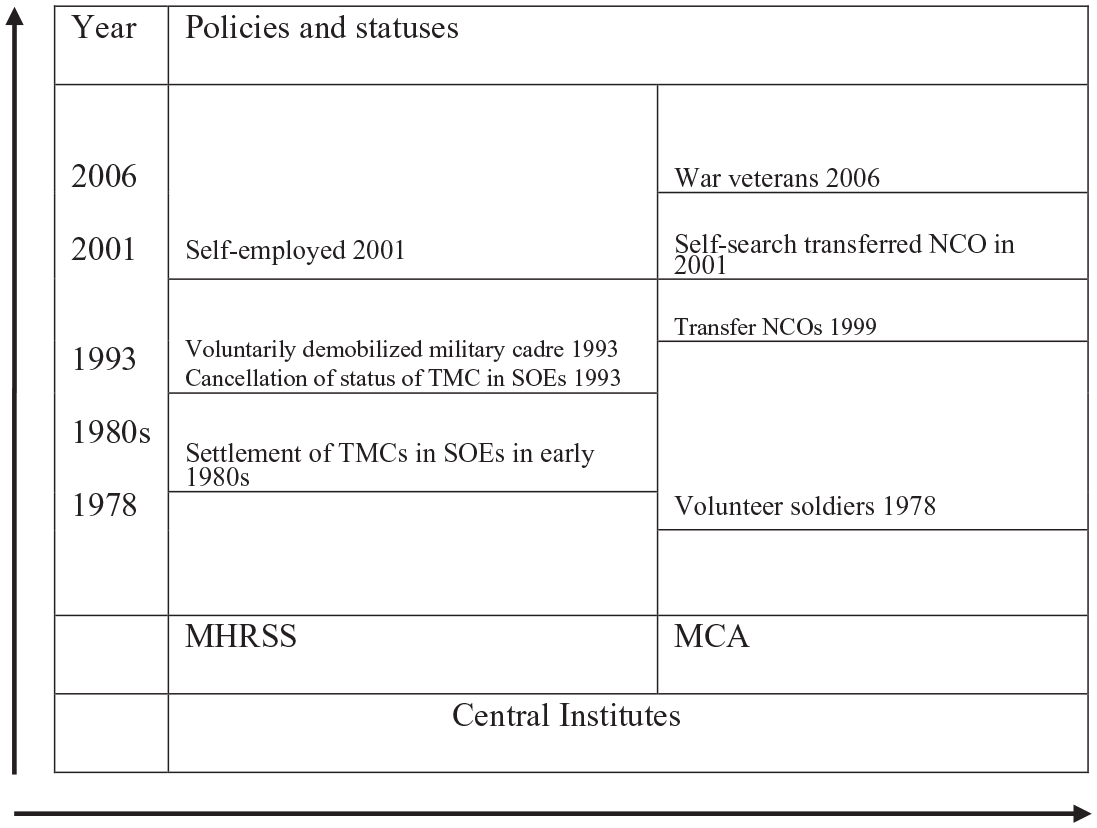
Policy-created veteran statuses over time.
The reforms aimed at mitigating local resettlement pressures have created a large group of protesting veterans, essentially because none of these policies has tackled the fundamental contradiction between the resettlement system inherited from the planned and the post-socialist economies. The resolution of these fundamental contradictions has to take into consideration and alter the three core institutional dynamics that have underpinned the operation of the dichotomous resettlement system.
The first of these dynamics concerns civil–military relations and the resettlement system’s fundamental role in this respect. In China under the CCP since the founding of the PRC, the needs of the military have superseded other considerations, and the government as a whole has played the role of providing logistics in service of the military. While the resettlement system is entirely organized and run by the government, its existence has constituted a guarantee of PLA recruitment and control, especially for military cadres. PLA military cadres in service can still expect a permanent position in their hometown governments after separation, and have therefore become an interest group at the highest level with a vested interest in keeping the resettlement policy unchanged, especially when they compare their lot with that of NCOs and ordinary soldiers who are without cadre status. The status and interests of this group have led to opposition to any fundamental reform of the system. During the two sessions of the National People’ Congress and Political Consultative Conference in March 2018, Professor Hao Wanlu, a member of the National Political Consultative Conference and a colonel in the Defense University, declared that the government should “no longer take over the duties and working arrangements of veterans but replace them with more generous social benefits and necessary social pensions, and strengthen reemployment training and intermediary services for demobilized military personnel.” However, although this kind of approach would arguably be more “adapted to the needs of the reformed nation’s social security system and the need for the reform of the military’s human resources policy system” (Jiefangjun bao, 2018), the speech elicited very strong reactions from military personnel, who came out against such reforms in mainstream military magazines such as PLA News 解放军报 and The Defense 国防报 until the Ministry of National Defense refuted “online rumors about changes in the resettlement of demobilized cadres” (Ministry of National Defense, 2018). This illustrates the very strong resistance from within the military to any comprehensive overhaul of the resettlement system.
The second of these dynamics concerns the well-known issue of central–local relations. Most of the responsibility to resettle, care for, and compensate veterans has been passed onto local governments. In some localities, the pressure to resettle transferred military cadres has resulted in 90 percent of the staff being made up of veterans. This pressure has persisted, even though the local governments’ capacity to resettle has been increasingly limited by central-level policies requiring them to downsize and professionalize, and their financial capacity has increasingly been restricted by fiscal reforms, especially at the county and township levels. Naturally, local governments have strongly resisted the resettlement policy and bargained with the central government to develop alternative solutions, such as the self-employment and self-search schemes. The frequent changes in resettlement policies in the reform era have undoubtedly been a product of this bargaining. Local governments have been able to make use of vague terminology in the regulations and policy documents, such as “equivalent” 相应, “in general” 一般, and “refer to” 参照, to downgrade transferred officers’ status and treatment, place them in non-leadership positions, and so on (Junyang Wang, 2019). These practices have become another source of dissatisfaction among veterans.
The third and final issue concerns the fragmentation of responsibility among different branches of the government, the MCA, and the MHRSS, which has led to disjointed policies being adopted and implemented by different local administrations. What is hidden behind this organizational confusion is the insurmountable gap between military cadres and non-commissioned officers caused by the status of national cadre that benefits the former. For instance, TMCs’ self-employed status can guarantee their national cadre status and basic interests, which alleviates the resettlement burden imposed on local governments. However, the absence of national cadre status has denied NCOs similar treatment, and despite their often very long service in the PLA, the center has consistently refused to meet their demands. Former MCA deputy minister Luo Pingfei once declared that “the de facto inequality brought about by the difference in the types of resettlement has become an important factor fueling the discontent of ordinary veterans” (Luo, 2014: 99–100).
The newly established Ministry of Veterans Affairs is intended to solve the problem of veterans’ unrest by merging all the responsibilities and veterans’ statuses for resettlement into one single system. In October 2017, Xi Jinping announced at the Nineteenth National Party Congress that he would “protect the legitimate rights and interests of military personnel and their families, and [. . .] make military service a professional that enjoys public respect.” In April 2018, he established the Ministry of Veterans Affairs, tasked with settling and providing social security to veterans. But for this ministerial reform to succeed, the new ministry needs to seize the power to manage veterans’ affairs from the MHRSS and the MCA. The main resistance is likely to come from the MHRSS, the government façade of the party’s Organization Department, which is unlikely to relinquish control over military cadres. One may also wonder how a ministry that has no power to appoint personnel within the party-state can provide the large number of positions required each year to satisfy demobilized military officers. In other words, the reform as currently presented is unlikely to bring about any major breakthroughs. Unless the resettlement system is transformed in a more fundamental way and much more central-level finance is committed to veterans’ affairs, it is also unlikely to adequately address veterans’ grievances.
Footnotes
Appendix
Acknowledgements
For helpful comments, I would like to thank Chen Feng, Jing Vivian Zhan, Kang Yi, Kathryn Bernhardt, Kevin J. O’Brien, Richard Gunde, Yongshun Cai, and the journal’s anonymous referee. I am also grateful to Zhengqiang Liu for his sharing of interview materials.
Declaration of Conflicting Interests
The author declared no potential conflicts of interest with respect to the research, authorship, and/or publication of this article.
Funding
The author disclosed receipt of the following financial support for the research, authorship, and/or publication of this article: This research was financially supported by the National Social Science Fund of China (Grant No. 17CZZ018).