



Abstract
“Informality” and “semiformality” are the primary characteristics of minimalist governance. The operation of minimalist governance assumes a boundary between state and society and some amount of autonomous space between them at the ground level. Whether in a traditional or modern form, minimalist governance stands in contrast to the formal, hierarchical bureaucracy of the state. Minimalism is a pragmatic approach to governance tailored to local conditions, a form of semiformal or informal government that emphasizes operational effectiveness over elaborate bureaucratic procedures. Since minimalist governance does not rely entirely on the hierarchical power of the state apparatus, this semiformal approach is simple and effective, hence its “minimalist” appearance. The key to solving the problem of formalism at the basic level of government lies in managing the relationship between “a thousand threads above” and “a single needle below.” Autonomy and self-governance must be granted to the basic level of the government so that party committees may fulfill their integrative political functions and their role in minimalist governance. Ultimately, this will allow the “needle” of grassroots organizations to connect with “a thousand threads above” while also penetrating deeply into local society. There is significant practical and theoretical importance in understanding the uniqueness of Chinese-style modernization, and the modernization of rural governance, from the perspective of “social foundations,” but to achieve this Chinese-style modernization we must learn from the West and from China’s own traditional and contemporary experiences.
Anyone with even a modicum of experience with or understanding of basic-level governance or administrative affairs is more aware of the complexity, intricacy, and rigidity of government at the local level than its “minimalism.” Is the call for “minimalist governance” unrealistic in the face of these traditions? Is it just an expression of wishful thinking and idealism?
Philip C. C. Huang first introduced the idea of “minimalist governance” in his article “Centralized Minimalism: Semiformal Governance by Quasi Officials and Dispute Resolution in China.” The subtitle of the article succinctly captures the essence of minimalist governance—“semiformal governance by quasi officials and dispute resolution.” “Semiformal governance” lies at the core of minimalist governance. As Huang argued:
That basic approach to governance—of acting only after complaints and of relying as much as possible on informal and semiformal processes—was applied, it turns out, not only in the civil justice system but also widely throughout Qing local administration. Unlike modern bureaucratic government and its emphasis on routinized supervision and paperwork, the Qing method of local governance by quasi officials and by dispute resolution may be termed “minimalist,” even though governmental power was highly “centralized” at the top. (Huang, 2008: 10-11)
Huang’s concept of minimalist governance clearly stands in contrast to the “modern bureaucratic government and its emphasis on routinized supervision and paperwork.” His purpose was to describe an administrative approach at the local level characterized by “societal (i.e., community and kin group) mechanisms for dispute resolution rather than by the courts” and showed that informal governance was manifested in “quasi officials” and “semiformal processes” that effectively resolved disputes. This kind of semiformal governance appears “minimalist” precisely because it does not rely on the formal power of the “modern bureaucratic government” (formal employees, organizations, operational costs, and so on). Specific manifestations of “informal governance,” of course, change over time.
After Huang introduced the concept of minimalist governance, some scholars interpreted it only as a tradition of the past and discussed its value and functions, but rarely has anyone provided a comprehensive explanation of the distinctive characteristics, practical mechanisms, and operational foundations of minimalist governance (Lü, 2017; Zhao, 2014). But, whether in the context of analyzing micro-level government practice or macro-level government structure, scholars unanimously consider “social autonomy,” “flexible space,” and “independence” as the most important values of minimalist governance (Liu and Huang, 2020; Han, 2021). For example, Ren Jiantao, studying the intersections of state, society, and the market, argues that the complex structures of modern states require some form of minimalist governance mechanisms, but those mechanisms should not replicate or expand state power. If they do, the state will become an all-encompassing entity that engulfs society and the market (Ren, 2010). Although Ren Jiantao’s concept of state minimalism is only a theoretical construct, he did point out the fundamental value proposition of minimalist governance—to prevent state power from eroding social autonomy. In fact, whether at the local level of semiformal governance or at the national level of “using simplicity to manage complexity” 以简驭繁, minimalist governance is premised on the boundary between state and society. Even where the state and society intersect, there remains a third sphere of shared space, a space that prevents the state from entirely supplanting society.
In “Minimalist Governance: The Modernization of Rural Governance Beyond Bureaucratization,” 1 I discussed the practice of minimalist governance at the intersection of state and society to show how the encroachment of state administrative power on local autonomy hinders the functioning of minimalist governance and leads to the proliferation of formalism at the local level (Ouyang, 2022). “Minimalist Governance” discusses specific practical mechanisms and their social foundations to demonstrate that minimalist governance is not just an ideological assertion or an unrealistic, idealistic notion about the past, but an inherent characteristic of local governance in China over a long period of time. The ideas in “Minimalist Governance” are not a figment of my imagination but a reflection on and expansion of existing research. In this article, I will first outline the origins of “minimalist governance” within my own research trajectory, then clarify the meaning of minimalist governance and its modern characteristics in the context of Huang’s historical research, and end with a discussion of its theoretical significance in the context of the modernization of Chinese-style local governance.
The Research Context: From “Strategism” to “Minimalist Governance”
In Strategism: The Logic of Operations in Orange Township 策略主义: 桔镇运作的逻辑 (Ouyang, 2011), I described an approach to basic-level government in which officials embraced a philosophy of “whatever works, just sort it out and get it done” 不管用什么方法,摆平就行,搞定就行. 2 This principle of action, regardless of the rationality or legality of the means or methods employed, neither aligns with the rationalism of hierarchical systems nor falls within the scope of traditional minimalist governance. I employed the term “strategism” to characterize and summarize this behavior, presenting it as the operational logic of governance in local townships as they were observed and understood thirteen years ago.
Around 2014, in order to gain a deeper understanding of grassroots governance, my research scope expanded from townships to counties, thereby revealing a different facet of local governance. During the research for Strategism: The Logic of Operations in Orange Township, I had thought that township governance was a form of weak governance, with township governments functioning as “maintenance regimes” 维控型政权 designed simply to maintain local order (Ouyang, 2011). This understanding also aligned with descriptions of local government by other scholars, such as Zhou Feizhou, who described it as a “levitating” type 悬浮型 of government (Zhou, 2006). When I shifted my focus to county-level governments, however, I found that there was “weak” and “strong governance” at the basic level. Whether in urban areas or industrial parks at the county level, significant changes could be seen. County governments displayed strong governance capabilities in activities such as attracting business and capital or acquiring land and demolishing old buildings. These observations led me to differentiate between those areas in which county governments demonstrated strong or weak governance, which led me to the concept of “core tasks” 中心工作 in governance (Ouyang, 2017; Ouyang, 2018). County governments were determining their “core tasks” based on performance indicators issued by higher-level authorities and their own strategies for the development of the county. Different departments in the county government were also differentiating their work into “key” core tasks and “general” core tasks according to the placement of those tasks in the performance indicators. As I observed how county governments addressed their core tasks, I discovered a series of governance mechanisms such as “mobilizational governance” 运动型治理, the “administrative contracting system” 行政包干制, and an “integrated system of politics and administration” 政治统合制 (Ouyang, 2014, 2019, 2020).
While tracing the types and execution of core tasks, I became more aware of a crucial governance structure—the party committee organization. What I discovered was that the organization of the party committee played a central role in the establishment of core tasks and the various mechanisms chosen for their execution. Prior research in political science and sociology, however, has rarely taken the party organization into account in constructing analytical frameworks for understanding governance. Studies of party organization have largely focused on party building and party history. Since the 19th National Congress of the Communist Party of China in 2017, under the concept of “leading through party building” 党建引领, scholars have begun to integrate party organization into their analytical frameworks and research on governance, an approach that has now become mainstream. Since the inception of the Communist Party of China in 1921, it has understood its mission to be to transform society; its efforts to change governance and introduce reforms have therefore usually started at the grassroots level. With the establishment of the People’s Republic of China in 1949, the ruling Communist Party has been the leader in “governing the country and managing the administration” 治国理政 and plays the crucial role in the governance of the state. Therefore, to understand China and its institutional mechanisms and how they function, it is imperative that we observe and understand the governance structure of the “Party.”
Once party organization is included in the framework of analysis, we can not only better understand why there is “strong governance” at the basic level, but also better observe the two pathways—party politics and government administration—in local governance. However, if we use Frank Goodnow’s either-or binary framework of “politics/administration” to examine the relationship between the party and government in China’s local administration, we cannot fully understand the practice of local government in China. In Strategism: The Logic of Operations in Orange Township, I used the metaphor of “in-laws” 公婆 to describe the relationship between the party and government at the township level. That metaphor, however, merely described a division of labor and method of cooperation between the party and government, one that featured both authoritative orders and equal consultations. It did not deal with the differences in and interrelationships between their different governance mechanisms, methods, and techniques. In comparison to townships, the county level provides a favorable vantage point for observing the relationship between the party and government. My description of an “integrated system of politics and administration” was an attempt to describe this relationship, but it was only a starting point. All of this previous research shows how challenging, yet meaningful, it is to observe and understand the practice of governance in China, particularly at the grassroots level, through the intersecting pathways of politics and administration.
The “integrated system of politics and administration” also laid the foundation for my later understanding of “minimalist governance.” This is because the integrated system of politics and administration can break through the rigidity and solidity of the hierarchical bureaucracy of the state and enable effective implementation of minimalist governance at the local level. In recent years, during my research on local governments, I discovered that cadres at the basic level of government no longer adhered to the mentality of “whatever works, just sort it out and get it done,” but rather adopted an approach of “no matter what we do, we need to fill out forms and provide photographic evidence.” In the past, local cadres often said, “a thousand threads above, a single needle below” 上面千条线、下面一根针 (referring to a local government acting as a “needle” that stitches together and implements the tasks assigned to it by the “thousand” functional departments of upper governmental levels—on which more will be said below), but now they say “a thousand blades above, a single head below” 上面千把刀、下面一颗头 or “a thousand hammers above, a single nail below” 上面千把锤、下面一根钉. Why such a change in their mentality? Whatever the case, it forced me to reevaluate my previous research. Upon reconsidering the concept of “strategism,” I find its most significant characteristics are “adaptation” and “informal operations,” but it cannot distinguish between different kinds of “adaptation” and “informal operations.” There are adaptations that are well-done, cost-effective, and efficient, but there are also those that disregard costs and legality. Those low-cost, efficient adaptations and informal operations are the heart of “minimalist governance.” The primary reason for the proliferation of formalism at the local level is pressure from the “benchmarking and form-filling” imposed by the bureaucratic hierarchy, which stifles inclinations toward minimalist governance and makes it difficult for local officials to adapt to circumstances.
The Essence and Characteristics of Minimalist Governance: Tradition and Modernity
“Minimalist Governance” in the Third Sphere
Minimalist governance is a way to understand China’s system of state governance in the third sphere where the state and society interact and a method for capturing the nature and practices of government organizations at the basic level. Although the reach of the state has steadily expanded since the late Qing, the third sphere as a space where the state and society interact has never disappeared. On the contrary, “third-sphere entities are still expanding rapidly” (Huang, 2019: 385). Whether in urban or rural areas, local governance is located precisely at this intersection between state and society, an intersection that allows us to observe a substantial amount of informal or semiformal governance that differs from bureaucratic systems. Understanding this intersection also allows us to avoid either-or binary linear thinking and overly simplistic generalizations dissociated from practice, such as “from minimalist governance to bureaucratic governance,” “from minimalist governance to thick governance” (Zhang and Du, 2022), or “from minimalist governance to complex governance.”
Philip Huang’s concept of minimalist governance stems from his observations of practice in the third sphere. Given that he observed a substantial amount of “informal or semiformal” governance in practice, he argued that Weber’s theory of bureaucracy could not explain these practices. In his article, “Rethinking ‘the Third Sphere,’” he argued that “centralized minimalism” is made up “of highly concentrated central power combined with a vast small peasant economy, which resulted in strong tendencies toward minimalist governance both to guard against parcelization of centralized imperial power and to maintain governance at minimal cost to the state” (Huang, 2019: 357). He described it as “‘centralized’ because of the imperial claims to absolute (patrimonial) power in the person of the emperor.” “[T]he logic of patrimonialism,” he wrote, “demanded that governmental machinery be kept to a minimum number of layers, lest the personal loyalties of individual officials to the emperor that bonded the system together break down and local patrimonial satrapies take over” (Huang, 2008: 24-25). This logic formed the essence of the “centralized” element in Huang’s concept while the insistence on the use of quasi officials and informal operations is the essence of “minimalist governance.” As Huang argued,
The imperial bureaucracy could have opted for complete bureaucratization, a “maximalist” approach, specifying the functions of all offices and insisting that paper records be maintained for all activities of government. The imperial state instead chose something closer to a minimalist approach, insisting on quasi officials rather than salaried bureaucrats. (Huang, 2008: 24)
For these reasons, Huang argued that Weber’s characterization of the “patrimonial (centralized) bureaucracy” of the Chinese empire and Philip Kuhn’s description of the opposition between the “monarchy” and the “bureaucracy” are inaccurate. Weber’s work
belies [his] own rather unilinear scheme by which the premodern, prebureaucratic state changed to its modern, bureaucratic, and rational successor. But Weber’s schema can have little place for the semiformal province of governance that has been the focus of this article. His characterization of the ideal types and of the historical (as opposed to ideal typical) Chinese state as a “patrimonial bureaucracy” was in the end limited to government’s formal institutions and functions. It was predicated on a conception of state and society as an either-or dichotomous binary. Governance is by definition limited to the actions only of the formal state apparatus, in contradistinction to those of informal society. (Huang, 2008: 22)
Huang also argued,
Western analyses of governance generally confine themselves to formal bureaucratic institutions, putting the state and civil society in an either/or binary framework, but China’s long-standing practices of local governance do not lie in the binary opposition between the public and private. Instead, they involve a semiformal, semi-official realm and methods of governance in-between. (Huang Zongzhi, 2007: 7)
Weber’s focus on the formal governance of state institutions, and his failure to take into account China’s distinctive “semiformal” philosophy of governance, led him to conclude that China’s government was a “patrimonial (centralized) bureaucracy” or a centralized, hierarchical government. Philip Huang, on the other hand, by studying examples of “semiformal governance” at the local level in the late Qing and Republican period, demonstrated that the traditional Chinese empire was not the “centralized bureaucratic government” described by Weber and Kuhn but one distinguished by its “centralized minimalism,” which was “a highly centralized system under the emperor and the official bureaucracy at the top, with a very minimalist basic-level governance at the bottom” (Huang, 2019: 360).
The historian Li Huaiyin uses the term “substantive government” to describe the essence of minimalist government as distinct from the formal governance of the bureaucratic state system. He argued, “Unlike formalistic administration, which ideally precludes informal elements and nonstandardized practices, substantive government was a realm in which both the government and society participated and where governmental functions intermeshed with local arrangements” (Li, 2005: 10). Li’s description of “substantive government” is essentially a form of minimalist governance vis-à-vis the formal bureaucratic system. Its fundamental characteristic is “semiformal and informal governance in the interaction between state and society.”
The Essence and Characteristics of Minimalist Governance
Although both Philip Huang and Li Huaiyin argue that minimalist governance originated in the traditional period, possessed “particularly persistent characteristics,” has existed in different periods of modern China, and plays an important role in shaping modernity with “Chinese characteristics,” neither of them has addressed the form of minimalist governance in contemporary China and the forces that shape it.
With the passage of time, the authoritative foundation and social basis of minimalist governance (a society based on small peasant producers) has undergone a variety of changes. First, there has been a transformation in the basis of authority and organizational foundations of society. The Communist Party, as the new governing entity, has become the crucial leader and leading participant in modernizing rural governance. The integrated system of politics and administration of the party committees, because of their ability to “coordinate various aspects and oversee the overall situation,” can break the “iron rules of the bureaucracy,” adapt to new goals and undertake new tasks stemming from social changes, and make progress according to local conditions. Second, there has been a shift in the foundations of society. The traditional structures of rural gentry autonomy and processes of ritualized governance have disintegrated, yet rural China has not become a homogenous, standardized industrial society aligned with bureaucratic governance, but remains a dynamic, heterogeneous, and diverse society. While many of the characteristics of traditional rural life have diminished, contemporary rural society still values the “principles of human relations” 情理.
Although the essence of minimalist governance changed along with its operational foundation, it is important to continue using Huang’s notion of “minimalist governance” because its fundamental characteristic as a form of “semiformal” or “informal” governance, which Huang described as its “particularly persistent characteristics,” has not fundamentally changed. In brief, whether in a traditional or modern context, the essential characteristic of minimalist governance, relative to the formal, hierarchical bureaucracy, is its semiformal or informal nature and its relative independence from the formal power structures of the state. What has changed are the specific methods, mechanisms, and makeup of minimalist governance. Traditional minimalist governance manifested itself as “semiformal administration centered on quasi officials and dispute resolution.” Modern minimalist governance is manifested in informal or semiformal governance that “combines centralized and decentralized approaches” in forms such as extraorganizational personnel, the mass line approach, stationed cadres, the village contracting system, and work groups. In my article “Minimalist Governance,” I delved deeply into the governing subjects, methods, mechanisms, and operational foundations of minimalist governance in contemporary grassroots practices at the local level, all based on inspiration from Philip Huang’s work.
As shown in Table 1, the essence of “simplicity and efficiency” in minimalist governance is in comparison to formal bureaucratic governance. Bureaucratic governance not only relies on the support of enormous organizational structures, human resources, sophisticated technology, and careful budgeting, but it also involves high operational costs. In contrast, minimalist governance does not depend entirely on state labor, finances, or organizations. It can mobilize society and organize the masses, utilizing a significant amount of social resources to carry out grassroots governance. For example, the village contracting system and township-level work groups resulted from township party committees rearranging and recombining existing organizational structures and personnel through the integrated system of politics and administration. Coupled with ideological persuasion and personnel incentives from the party organization, this approach can stimulate initiative and vitality in basic-level governance. As Zhao Xiuling puts it, minimalist governance is “simple and efficient” because it makes full use of “limited resources” to shoulder “unlimited responsibilities” and accomplish the tasks of “a thousand threads above” despite the governance dilemma of “inequities in power, responsibilities, and benefits” faced by local governance organizations (Zhao, 2022). Consequently, whether during the “poor and blank” phase of construction in early New China, or in the context of “inequities in power, responsibilities, and benefits” in the post-reform period, grassroots governance organizations have always been able to effectively achieve various top-down tasks and goals.
The Essence and Characteristics of Minimalist Governance.
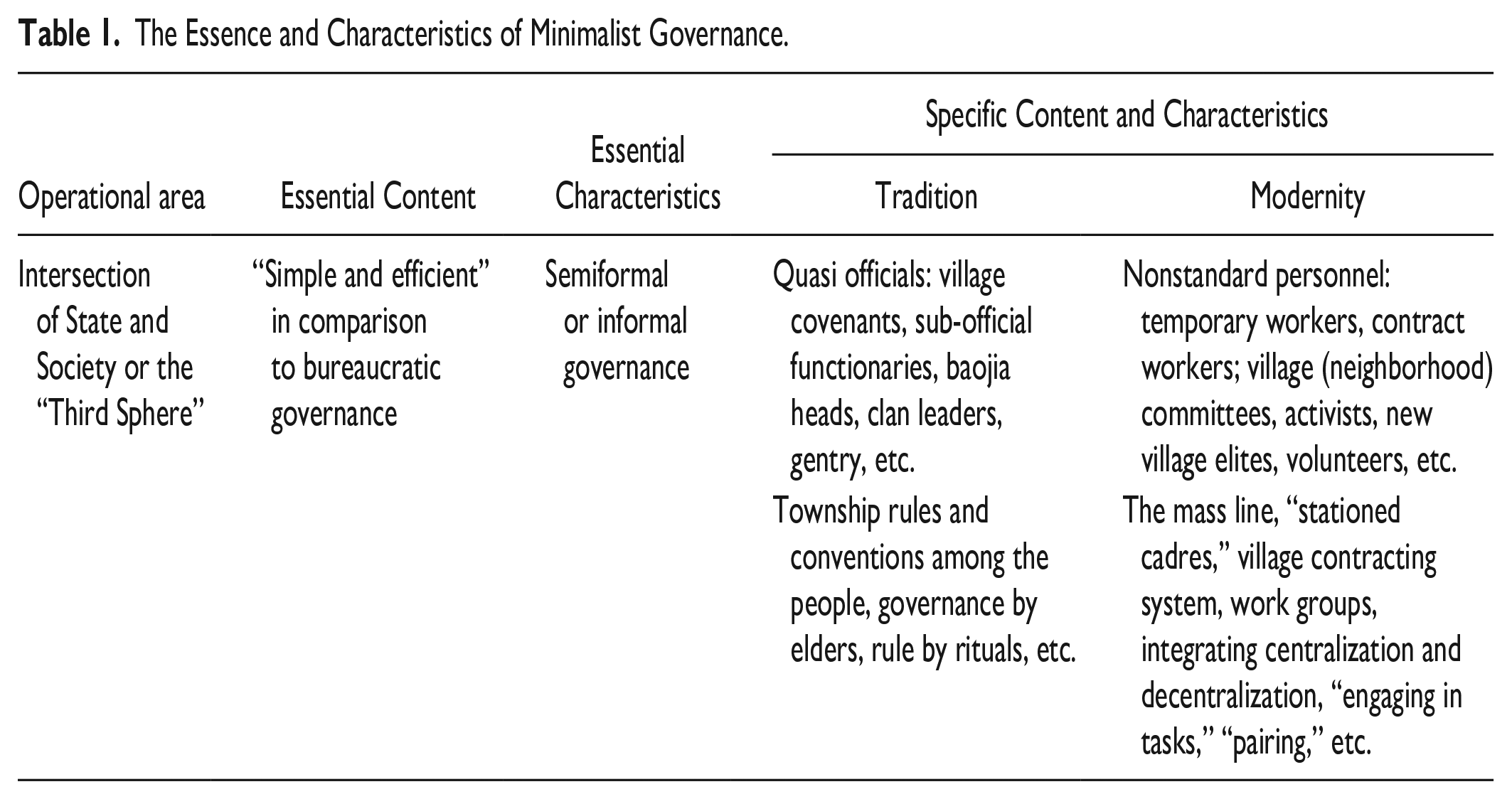
Working on the “modernization of governance,” Shi Yungui and Xue Zhe have redefined the essence of minimalist governance as “from complex to simple, simple but not deficient, and simple yet efficient” 化繁为简、 简而不少、 简而高效. They have divided minimalist governance into two types based on the objects of governance: internal and social. Internal minimalist governance is manifested as holism 整体性 while social minimalist governance is marked by collaboration with society (Shi and Xue, 2022: 153). This expansion of “minimalist governance” extends its essence beyond its “semiformal” or “informal” characteristics to encompass the simplicity of the “governance system” itself and the high efficiency of “governance capacity,” which enriches the content of minimalist governance. Fundamentally, however, we must always remember that minimalist governance stands in contrast to complex, bureaucratic governance. If minimalist governance is only understood as “simplicity” or “from complex to simple, simple but not deficient, and simple yet efficient,” and dissociated from its specific operational contexts and practical mechanisms, we render the concept of minimalist governance as boundless and all-encompassing (Han, 2021).
Philip Huang’s arguments about “minimalist governance” have two elements—the juxtaposition of minimalist to bureaucratic governance and its existence within the “third sphere” between state and society. He believes that it is the existence of this “third sphere” at the intersection of state and society that gave rise to semiformal and informal forms of governance (Huang, 2019). Basic-level governance takes place in this “intersection” between state and society, an “intersection” also central to Fei Xiaotong’s understanding of the “dual track in politics” in traditional China between the power of the monarch and the power of the gentry. When discussing the “dual track,” Fei argued that only by understanding the “point of convergence” between the state and society “can we truly understand the operation of the traditional Chinese system” (Fei, 2006: 49). This “intersection” or “point of convergence” between the state and society not only helps us understand the practical aspects of traditional minimalist governance but also sheds light on contemporary minimalist governance practices. In my article “Minimalist Governance,” I built upon this understanding of the “point of convergence” between the state and society to describe contemporary rural governance practices and presented the specific operational mechanisms of contemporary minimalist governance at the local level.
Bureaucracy Goes to the Countryside: Squeezing Minimalist Governance
The central problematic I addressed in “Minimalist Governance” concerned formalism in the lowest levels of government. In recent years, formalism has rapidly spread throughout local government and has attracted widespread attention. As the bureaucracy has become more embedded at the basic level, the practices of “benchmarking and form-filling” endemic in bureaucracies have become more severe and formalism has become more entrenched. Conversely, in areas where the bureaucracy is less developed, minimalist governance is more effective and formalism less prevalent. In some economically underdeveloped regions in central and western China, for example, the lack of substantial resources to support the operation of the bureaucracy has allowed minimalist governance to survive. According to the law of autonomous growth of bureaucratic organizations, they will also spread to economically underdeveloped areas once local financial resources are sufficient to sustain them.
In a rapidly changing society, when the “benchmarking and form-filling” bureaucracy becomes the dominant mode of grassroots governance, especially in rural areas, it will inevitably lead to the proliferation of formalism. This is because the pursuit of quantification and certainty in bureaucratic government cannot cope with an ever-changing and variegated local society. Existing analyses of basic-level formalism usually start from the internal perspective of the bureaucracy. This perspective usually leads to arguments that the spread of formalism is the result, on the one hand, of the subjective initiative of local officials, their orientation to performance indicators, and their bureaucratic style (Huang, Ding, and Lin, 2019; Lü, 2019) and, on the other hand, of “information asymmetry” and “unscientific assessment systems” within the bureaucracy and the “simplistic” logic that everything can be “tracked” (Peng and Zhao, 2019; Yan and Yang, 2019; Wen and Li, 2019). These arguments, however, would be applicable to any bureaucracy because they do not take into account the operational basis of the organization they are studying. As research on the theory of bureaucracy has shown, formalism is an inherent “negative function” of all bureaucracies (Merton, 1968; Crozier, 1964). Scholars of public administration in the West have attempted to alleviate this chronic and stubborn organizational disease through “process re-engineering” and “organizational restructuring” (Osborne, 1998; Peters, 2001; Linden, 1994). However, as I pointed out in “Minimalist Governance,” the emergence of formalism at the local level in China is not simply a problem of administration or service within the bureaucracy, but is tied up with the relationships between the bureaucracy and rural society and between bureaucratic and minimalist governance. These issues are encapsulated in the relationship between “a thousand threads above” and “a single needle below” (Ouyang, 2011).
The phrase “a thousand threads above” refers to the division of government organizations above the grassroots level into various functional departments based on the principles of hierarchical specialization within the bureaucracy. Different policy tasks are then allocated downward through these functional departments. The “single needle below” signifies that grassroots organizations, which serve as the terminals of policy implementation, are not divided in a functional or departmental manner. Instead, they take on the role of a “needle” to connect the “thousand threads” above (He, 2010: 52). The essence of the relationship between the “single needle” and the “thousand threads” lies in how grassroots organizations exercise their role in coordination and synthesis to address the functional division of labor and compartmentalization of the government offices above, the “thousand threads” of the bureaucracy. In the process of the recent tax and fee reforms, and the comprehensive reform of township institutions, the hierarchical institutions of the bureaucracy aggressively extended their reach into the countryside and villages. In this process, the functions, personnel, and funding of the “seven stands and eight offices” 七站八所 at the township level were taken away from the horizontal “block-by-block” 块块 leadership of township authorities and incorporated into the vertical “line-by-line” 条条 management structure of the county-level administration, which has resulted in “a thousand threads above, a thousand threads below.” In economically developed areas, as illustrated in Table 2, the bureaucracy has become the dominant governance structure in villages and local communities.
“Vertical Line of Work” in Village A in Eastern China in 2017.
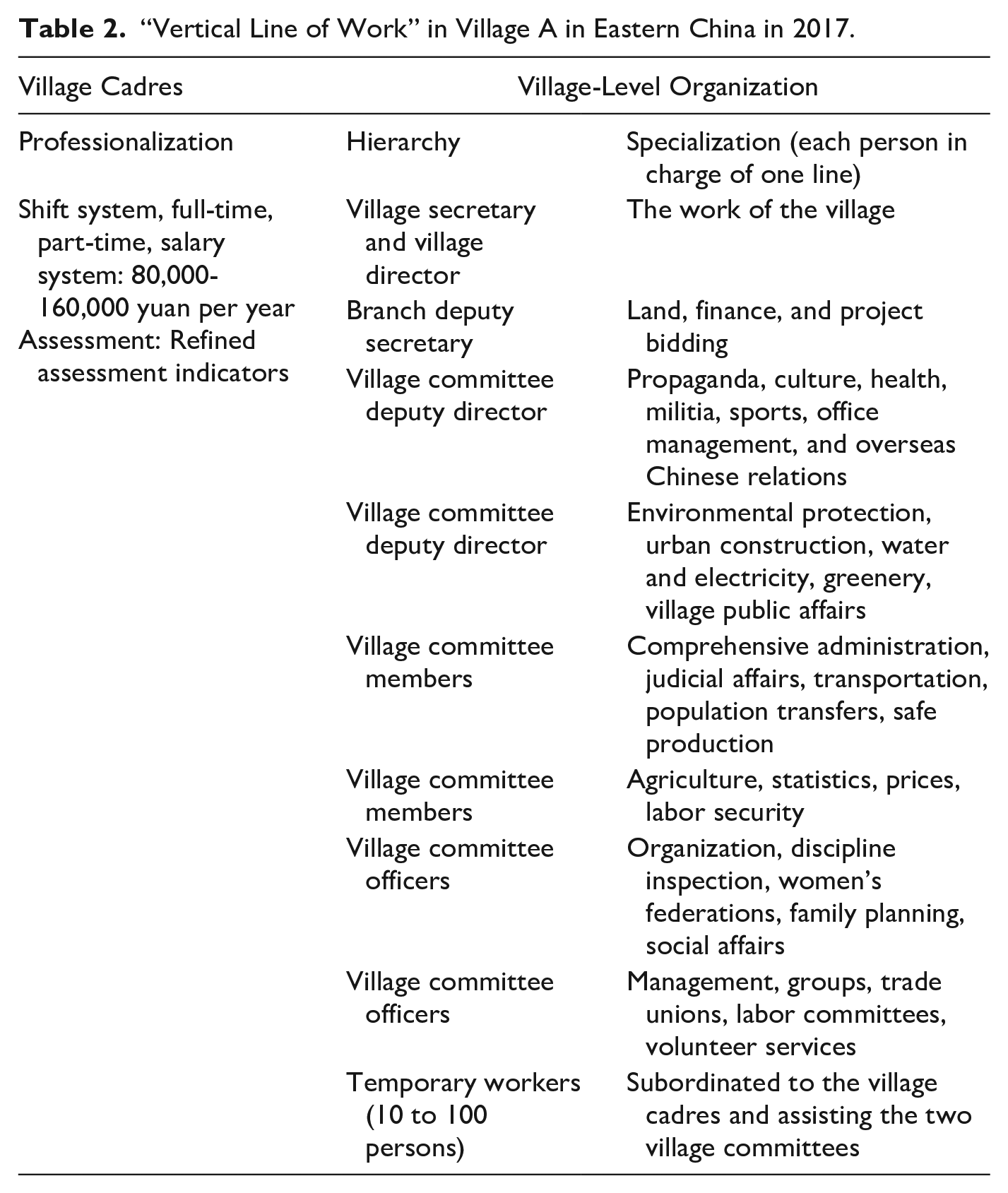
In economically developed areas, village and community cadres have essentially been “professionalized” through practices such as fixed working hours, salaried employment, performance assessment, and potential promotion. Village-level organizations have also displayed the characteristics of hierarchy and specialization. Village cadres each manage specific professional functions that correspond to higher-level functional departments, which is referred to as “vertical line of work” 条线工作. Each line of work has its own internally hired personnel who are assigned tasks by village cadres. These internally hired personnel are recruited by township or village-level organizations and can range from a dozen to over a hundred individuals. Additionally, “technological governance” 技术治理, the use of digital technologies to aid in governance, has also been extended into villages and local communities alongside the bureaucracy.
Constrained by local public finances, some regions, although unable to “completely bureaucratize” village and community cadres, are increasingly operating the village and community organizations according to the logic of modern bureaucratic systems. For instance, in the central and western regions, townships allocate the annual assessment criteria and indicators set by higher-level authorities to village and community organizations at the beginning of each year. The village and community organizations then operate based on these assessment criteria and detailed indicators (see Table 3).
The Major Tasks from “A Thousand Threads” in Village Y, Central Region, 2019.
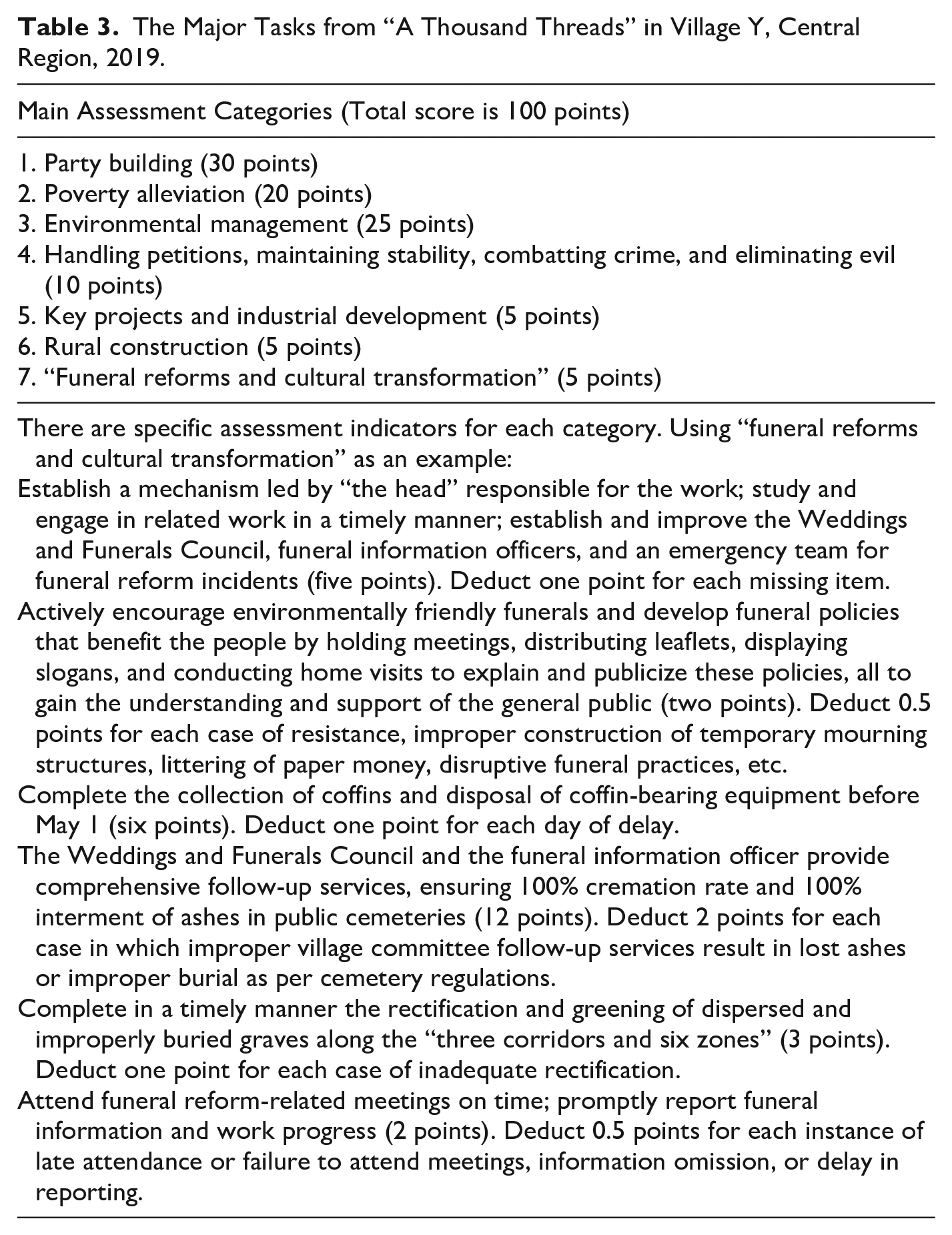
These quantitative assessment indicators only represent the main tasks of the “thousand threads,” not the day-to-day work of basic-level government. These main tasks, however, have exhausted the time and energy of many village and community cadres, leaving them with little capacity to promote “village self-governance.” For example, Village Y, located in the country’s central region, hosted and cooperated with 185 different evaluations and inspections from the county, city, and township levels between January and August 2019, an average of 23 a month. During this period, villagers approached cadres with approximately 60 matters requiring their attention, an average of less than 10 per month. Most of these matters were seasonal, concentrated mainly at the beginning and end of the year, when migrant workers return to their hometowns. These matters primarily involved handling identification documents and other certificates; they rarely involved village governance issues. Cadres working in “shifts” mainly engage in office work, responding to the requirements of bureaucratic, archival, and procedural aspects of the government hierarchy by producing relevant materials and recording information. As one interviewed village cadre explained, their usual tasks involve handling administrative affairs from the “vertical lines,” such as various registrations, issuing certificates, stamping documents, and managing medical insurance and social security, and their superiors assess them based on these tasks. Their engagement with the community is largely limited to organizing cultural and athletic activities such as dancing; they do not know the village (residents) very well. Because of their familiarity with producing documents on computers, village officials who have graduated from college have essentially become specialized “typists” and “form fillers” for village-level administration. They use the phrase “the end of the universe is a spreadsheet” 宇宙的尽头是表格 to describe their work.
The proliferation of formalism in some grassroots areas primarily stems from pressure on minimalist governance by the “benchmarking and form-filling” approach of bureaucratic management, which compresses the “thousand threads above” into a “single needle below.” First, because the tasks and standards of the “thousand threads” (manifested in practice as “benchmarking”) have been put on the villages and townships, though human and financial resources remain within county- or higher-level bureaucratic organizations through “specialized staffing” and “project-based” approaches, basic-level party committees lack the ability to integrate politics and administration. Consequently, they are unable to achieve effective informal governance through work groups and the village contracting system, which has changed “a thousand threads above, a single needle below” into “a thousand blades above, a single head below” or “a thousand hammers above, a single nail below.” In this context, township-level “needles” lack the ability to connect the “thousand threads above” effectively and are forced to resort to formalistic practices.
Second, the “benchmarking and form-filling” approach of bureaucratic government is not only divorced from grassroots society, but also deprives it of the autonomy and flexibility it should possess. The rigid demands of “benchmarking and form-filling” prevent local officials from improvising, making it difficult to address a dynamic, ever-changing society that stresses the principle of human relations. In the end, many tasks at the grassroots level end up being confined to forms, documents, and numbers, rather than dealing with the actual issues at hand.
It is for these reasons that the key to addressing the issue of grassroots formalism lies in effectively managing the relationship between the “thousand threads above” and the “single needle below.” It is essential to provide localities with the autonomy and space for self-governance, enabling them to harness the integrated system of politics and administration of the party committees and the corresponding capabilities of minimalist governance. This way, the grassroots organizations, symbolized as the “needle,” can effectively connect the “thousand threads above” while also establishing deep roots in the local community (Xu and Wang, 2021).
Conclusion: Minimalist Governance and Chinese-Style Modernization
Building on the foundation established by Philip Huang, my article “Minimalist Governance” presented the specific practices, mechanisms, characteristics, and operational bases of minimalist governance at the local level in contemporary China. As I showed, minimalist governance operates not only in rural areas but also in urban settings. In many urban areas, for example, “community aunties” 社区大妈 and volunteers, as well as auxiliary police officers and traffic personnel, serve as the frontline of urban law enforcement. Despite serving in a nonofficial capacity, these groups are all involved in the most important types of grassroots community engagement. As Shi and Xue argue, “They often engage public challenges at the local level through an approach that couples empathy with the law. Local governments often favor the flexibility, effectiveness, and cost efficiency of this type of governance” (Shi and Xue, 2022: 156).
If formalism and autonomy in grassroots governance are the practical concerns of minimalist governance, then the modernization of grassroots governance is its theoretical concern. The phrase “the modernization of rural governance beyond bureaucratization” is an expression of this theoretical concern. Do we have to accept the “fatalistic” idea that grassroots governance will inevitably become bureaucratized? Can we break out of this “iron cage”? Can we return to the “tradition” of minimalist governance? The answer to these questions lies in the modernization of governance. “Advanced” Western theories about bureaucratization and modernization have long influenced the theory and practice of basic-level governance in China, but scholars have largely failed to adequately analyze or summarize China’s own valuable historical traditions or experiences gained from practice. As Zhang Kangzhi has astutely observed, accepting Western theories on public administration as absolute truth has led to “Western public administration theory largely dominating the thinking of Chinese scholars of public administration.” This has had an “enormous impact on the practice of China’s administrative reforms” because “the administrative knowledge of Chinese government officials largely comes from Western theories on public administration” (Zhang, 2012: 3).
Achieving Chinese-style modernization requires us to learn from the West and from China’s own traditions and practical experiences. First and foremost, we need to break free from linear or binary oppositional thinking such as “advanced/backward,” “traditional/modern,” and “West/China” and grasp that the modernization of rural governance requires the fusion of tradition and modernity, China and the West. As the foundation of Chinese civilization, rural society has shaped the cultural genes that define Chinese identity. Concepts such as family responsibility, “the principle of human relations,” and “connections” 关系 are not only ethical rules and behavioral norms in rural society but also in Chinese society at large. Since its approach to governance is built upon the foundations of Chinese society, the government cannot ignore the ethical rules and behavioral norms that underlie it. Therefore, understanding Chinese-style modernization from the perspective of “social foundations” has vital practical and theoretical significance, a significance we must explore as we move forward.
Footnotes
Declaration of Conflicting Interests
The author declared no potential conflicts of interest with respect to the research, authorship, and/or publication of this article.
Funding
The author disclosed receipt of the following financial support for the research, authorship, and/or publication of this article: Funding for this research was received from the National Social Science General Project “Organizing and Constructing a Sociology of Finance” 财政社会学的梳理与构建 (19BSH104).