



Abstract
This article employs the ecological theory of “boundary work and exchange” to elucidate the latest reforms in China’s procuratorial system, delineating the expanding remits of the procuratorates both within and beyond their traditional domain of criminal justice. Following the national supervision system pilot reform in 2016, which stripped the procuratorial bodies of their authority to investigate official crimes, China’s procuratorates have endeavored to expand their jurisdictions in areas such as criminal, civil, administrative, and public interest litigation. By examining how China’s procuratorates leverage their respective institutional advantages to broaden their functions, we find that they have not only strengthened their role in criminal proceedings but have also continuously expanded their functions beyond criminal litigation. These reforms follow a well-defined trajectory shaped by boundary work and exchange. However, in contrast to boundary work and exchange as usually theorized, which usually starts in ambiguous and elastic areas, China’s procuratorial reforms are notably confined to a fixed sphere. This can be attributed to the procuratorate’s pursuit of state support, which has, in turn, led to its constrained expansion. This enhanced theoretical framework sheds light on the evolving role of China’s procuratorates and underscores the potential significance of ecological theory for understanding broader institutional reforms in China.
In recent years, scholars have identified a marked trend toward “prosecution centeredness” in China’s criminal proceedings, a result of the implementation of the plea leniency system (Lin, 2020; He, 2023). However, in addition to their conventional role in prosecuting criminals, China’s procuratorates have also been actively expanding their purview beyond criminal justice. Since 2017, for example, China’s procuratorates have been exploring prosecutor-led public interest litigation in civil and administrative domains, and have been issuing an exponentially increasing number of “procuratorial recommendations” 检察建议 for civil and administrative verdicts and mediations. 1 The expanded involvement of China’s procuratorates in the areas of criminal, civil, administrative, and public interest litigation prompts a query as to why they are inclined to take on responsibilities across such a broad spectrum, rather than focusing primarily on criminal proceedings as has historically been the case.
Numerous discussions about this expansion in the power of China’s procuratorial services have referred to a recent momentous legal reform to the national supervision system (Li and Peng, 2019; Ding and Xiao, 2021; Lin and Wu, 2022). The national supervision system reform was launched on a pilot basis in 2016 and then enshrined in the constitution and the Supervision Law in late 2018. The newly established National Supervision Commission (NSC) and its subordinate local-level supervision commissions share equal constitutional status with the government, courts, and procuratorate. 2 The most significant aspect of the national supervision system reform was the transfer of strong investigative power over official crimes from the procuratorate to the supervision commissions (Lin and Wu, 2022: 81). This power allocation aimed to improve the efficiency of investigations into official misconduct, which had previously been plagued by bureaucratic hurdles and dispersed resources (Ma, 2016).
Subsequent to this development, China’s Supreme People’s Procuratorate (SPP) proposed the Four Major Procuratorial Functions 四大检察 reform in early 2019. This proposal signaled a transition from the procuratorate’s original sole focus on criminal matters to a more balanced distribution of procuratorial work across criminal, civil, administrative, and public interest litigation. 3 While retaining a primacy on criminal cases, the SPP’s reform underscores a broader effort to enhance procuratorial powers over all major facets of litigation.
While these changes are highly significant, there has been a dearth of scholarship that examines or theoretically explains the interactive relationship between the national supervision system reform and the procuratorate’s efforts to expand its powers. In terms of criminal justice, while Yu Mou (2020) acknowledges the challenges the procuratorate faces due to the national supervision system reform, she does not explore their interaction in depth. Wei Xiaona’s (2018) research, conversely, underscores the necessity for sweeping reform of China’s procuratorates following the establishment of the supervision commissions, but confines itself to specific criminal reform measures rather than addressing the overall reform process. Similarly, Yuhao Wu (2020) and Enshen Li (2022) focus narrowly on particular elements of criminal justice reform, such as the determination of sentences and the role of mandatory defense counsel. At a broader level, Xin He (2023) offers a dynamic account of how procuratorates extend their criminal authority vis-à-vis other criminal justice actors (He, 2023), while in a previous article we ourselves illuminate the catalytic role of the national supervision system reform in spurring procuratorial changes at the level of criminal prosecution (Lin and Wu, 2022). Our analysis there examines the expansive reforms of China’s procuratorates in criminal litigation, yet it does not explore procuratorates’ expansion efforts in civil, administrative, and public interest litigation, thus not conveying fully the comprehensive expansion trajectory of China’s procuratorates. In areas beyond criminal prosecution, Weijia Lv (2018) employs normative analysis to examine the procuratorate’s assumption of public interest litigation power, whereas Chunyan Ding and Huina Xiao (2021) empirically investigate its role in environmental public interest litigation from 2003 to 2018. Neither of these studies, however, integrates a theoretical framework that connects the national supervision system reform to China’s multidimensional procuratorial changes.
This study aims to explicate the complex interplay between China’s national supervision system reform and the procuratorate’s multifaceted efforts in criminal, civil, administrative, and public interest litigation. Utilizing ecological theory as the theoretical framework, we explore how China’s procuratorates have expanded their power through the processes of “boundary work and exchange.” The article initially provides a concise overview of the historical evolution of China’s procuratorial power and national supervision system, while also introducing the ecological theory of boundary work and exchange. Subsequently, the focus turns to the recent Four Major Procuratorial Functions reform, highlighting the expansion of the procuratorate’s role both within and beyond the sphere of criminal litigation. 4 Employing ecological theory, we analyze the factors contributing to the successful augmentation of procuratorial power. We acknowledge, however, that such expansion is not unfettered, as it operates within the boundaries set by contemporary state policies on national and social governance. As such, the article adapts ecological theory to better contextualize ongoing judicial reforms in China.
The ensuing section discusses some tentative indications that China’s procuratorial reforms could potentially lead to a distinctive pattern of institutional power expansion. Specifically, procuratorial power is henceforth likely to be premised on the criminal prosecution function and buttressed by an array of functions that transcend the conventional boundaries of criminal justice. It will continue to expand its functional boundaries in adapting to the exigencies of social development, institutional reform, and judicial reform (Wang, 2022: 9). On the other hand, despite the opportunities for jurisdictional expansion enabled by broad institutional frameworks and enduring pragmatism, the pursuit of state backing suggests that China’s institutional reforms are likely to follow a more constrained evolution rather than unrestricted growth. The final section concludes with a summary of the key findings and their implications.
A Brief History of China’s Procuratorial Power and the National Supervision System Reform
China’s Procuratorial Power
The scope and content of China’s procuratorial power have been evolving in tandem with broader institutional reforms. Following the ratification of China’s inaugural constitution in 1954, the SPP gained independence from the Central People’s Government and began to exercise procuratorial power, functioning in parallel to both the executive and judicial branches of government. In 1960, the Ministry of Public Security, the Supreme People’s Court (SPC), and the SPP underwent a joint office arrangement, and the dominance of the public security sector led to the marginalization of procuratorial functions to an auxiliary role. The situation was further exacerbated by the enactment of China’s second constitution in 1975, which subordinated the functions of the procuratorial agencies to the public security organs at all hierarchical levels, meaning that procuratorial power was effectively abolished.
The contemporary procuratorate was rebuilt in 1978 and was officially positioned as the national legal system supervision organ in the 1982 constitution. Its reestablished role primarily involved public prosecution and supervising the police and courts in criminal proceedings. Although both the Civil Procedure Law and the Administrative Procedure Law provided the procuratorate with the power to supervise civil and administrative litigation in 1982, it never fully exercised this supervisory function because of the lack of specific provisions for implementation (Zhou, 2020: 68). With China’s rapid economic development and the abolition of the Commission for Discipline Inspection’s (CDI’s) Office for Combating Economic Crime in the 1990s, 5 the procuratorate was empowered to investigate official crimes (i.e., dereliction of duty by state functionaries) so as to respond to mounting corruption among public servants. In this century, China’s procuratorial system remained relatively unchanged. Until the implementation of a two-year pilot program in 2015 and, subsequently, the permanent authorization for prosecutor-led public interest litigation in 2017, procuratorial power remained largely confined to criminal cases.
In 2018, the national supervision system reform took away the procuratorates’ power to investigate official crimes, thereby profoundly altering the landscape of procuratorial power within China’s criminal justice system. Consequently, the procuratorates started to seek authority in new areas to fill this power vacuum. 6 Leveraging the nebulous definition of “legal supervision,” the SPP introduced new supervision guidelines in the Four Major Procuratorial Functions, which encompass “optimizing criminal prosecution, strengthening civil litigation supervision, improving administrative litigation supervision, and effectively executing public interest litigation.” This proposal gradually expanded procuratorial power into legal arenas both within and beyond criminal proceedings. Presently, together with other state authorities, China’s procuratorates are actively deliberating and exploring the dispute resolution mechanisms of “governing at the source” 诉源治理, through which they may acquire additional functions that could exceed the originally intended scope of the Four Major Procuratorial Functions. 7 Overall, the ambit of China’s procuratorial power has been in a process of gradual and dynamic adjustment, with the most recent pivot being triggered by the national supervision system reform.
The National Supervision System Reform
The national supervision system reform was enacted to concentrate anti-corruption efforts and strengthen the efficacy of such endeavors. Prior to this reform, there were mainly two separate forces carrying out anti-corruption work in China: the CDI and the procuratorate. The CDI was responsible for intra-party oversight, focusing on the conduct of Chinese Communist Party (CCP) members, and the procuratorate was tasked with investigating official crimes committed by state employees during their official duties. Given the substantial overlap between CCP membership and state employment, the jurisdictions of these two institutions often intersected. Although the procuratorate had greater legitimacy as a state organ, the discipline-oriented CDI played the essential role in investigating corruption, leading to a number of jurisdictional clashes and inefficient outcomes in the management of corruption cases (Lin and Wu, 2022).
To streamline anti-corruption activities by unifying most (if not all) anti-corruption resources, the newly established NSC absorbed the procuratorate’s investigatory powers over official crimes, as well as the relevant personnel. Consequently, the NSC acquired comprehensive authority to oversee and investigate all public officials exercising public power, including professionals like hospital and school administrators, involved in corruption.
Since then, the procuratorate has faced challenges not only in losing investigative power over official crimes and the associated prosecutorial status but also in confronting the sudden emergence of another strong supervisory entity in the area of criminal justice. Among these two supervisory powers, as the national supervision reform is directly driven by the CCP Center, the supervision commission’s supervisory authority takes precedence over the procuratorate’s legal supervision. For example, in instances of jurisdictional conflict between the two supervisory organs over investigating official crimes, the guiding principle of “prompt communication but prioritizing the NSC” is expected to be upheld (Lin and Wu, 2022).
Ecological Theory in the Legal Sector
Ecological theory was originally employed to examine the “competitive cooperation” paradigm among flora and fauna as a survival mechanism in animate nature (Thompson, 1911; Stauffer, 1957). Inspired by Georg Simmel’s (1950: 307–308) theory that relations among people are based on reciprocal knowledge, Robert Park and Ernest Burgess (1921: 507) identified a parallel construct of “cooperative competition” in human society that bears ecological analogs, and the term “human ecology” made a formal entrance into sociology in 1921. Their student Roderick McKenzie conceptualized human ecology within a larger system of relations that encompassed physical and material aspects, and particularly emphasized the physical basis of social relations (MacDonald, 2011). Derived from plant and animal ecology, human ecology provided an interdisciplinary and micro-sociological mode of analysis characteristic of empirical ecological studies, and allowed for a more holistic and detailed understanding of social dynamics. However, the prominence of human ecology waned following its early twentieth-century peak because of several factors, including an excessive focus on urban issues and a dearth of quantifiable empirical methodologies.
After experiencing a revival in the 1970s, ecological theory underwent a major theoretical shift in focus. Initially centered on the analysis of spatial competition among humans, evident in urban settings with concentric zones and interdependent communities, ecological theory evolved to address more abstract contexts such as organizational, political, and professional arenas. Andrew Abbott (1988), for example, employed ecological theory to scrutinize the sociology of professions, eventually developing the concept of jurisdictional conflict theory. This theory positions professions within an ecological framework that systemically delineates how professions form, and how they compete with one another.
Building on Simmel’s interactionist tradition, Park and Burgess’s human ecology, and Abbott’s sociology of professions, Sida Liu (2017) developed a processual theory of boundary work and exchange to account for the emergence and transformation of fragmented social structures in China’s legal services market. Through this ecological theory of the legal profession, Liu offers a meticulous and compelling elucidation of the factors that contribute to the precarious status of Chinese lawyers, namely, the ambiguous jurisdictional boundaries separating lawyers from other legal professionals and the relatively weak position of the authority overseeing lawyers.
Specifically, maintaining “survival as objective” and “interaction as foundation,” Liu’s research adopts a processual analytical framework and argues that social boundaries are not always explicit between social actors but are often ambiguous and elastic. Their social construction involves multiple forms of boundary work, such as boundary making, boundary blurring, and boundary maintenance, as well as the crucial process of social exchange that integrates actors (Liu, 2015). He posits that these mechanisms collectively reflect a competitive struggle for territory or jurisdiction.
The first form of boundary work, boundary making, originates from jurisdictional conflict and is intended to distinguish individuals from others operating in similar work jurisdictions or service arenas. This is typically achieved by highlighting the unique competencies of a particular professional or social group, thereby creating recognizable jurisdictional boundaries. Conversely, boundary blurring manifests when existing demarcations become indistinct, a phenomenon that can coexist with boundary making. Both forms aim to vie for jurisdictional control over professional tasks. Boundary maintenance represents a third form, typically enacted by an intermediary actor who benefits from ongoing boundary disputes and wants to maintain a dynamic equilibrium between conflicting actors. Such maintenance may manifest as either active adjustment or passive balancing and is frequently conducted by the state in the legal professional services market. Beyond competition and conflict, social actors also engage in symbiotic exchange, involving the reciprocal transfer of power, resources, and personnel. Empirical observations indicate that such exchanges are rare among equally powerful actors but prevalent between professionals and the state (Liu, 2017: 10). The dual processual constructs of boundary work and exchange jointly sculpt the societal architecture of the legal profession and state governance (Liu, 2017: 7).
While Liu focused on the fragmented nature of China’s legal market, he also acknowledged the potential for broader applications of the boundary work and exchange theory within judicial systems (Liu, 2017: 229). Considering the robust explanatory capacity that ecological theory has demonstrated across various domains, such as biological evolution, urban governance, organizational behavior, and occupational competition, we believe this theoretical framework can also be employed to analyze China’s latest procuratorial reforms. However, as noted above, despite the comprehensive and nuanced insights offered by ecological theory into the interactions among social actors and their evolving jurisdictions, a consistent critique has been its dearth of empirical support. To address this limitation, we intend to augment our theoretical framework with as much empirical material as possible. Furthermore, we argue that Liu’s ecological theory of the legal profession warrants modification and development under China’s contemporary trend toward increased centralization.
China’s Procuratorial Reforms within Criminal Justice
As previously stated, the national supervision system has curtailed the investigative powers of the procuratorial authorities and teams dedicated to official crimes, thereby compromising their influence over criminal justice. In response to this development, the SPP has initiated a series of reforms aimed at broadening the criminal functions and responsibilities of procuratorates. These reforms encompass a multitude of complex measures, such as the internal reorganization of departments responsible for criminal matters, early intervention in investigations, the empowerment of single prosecutors with the authorities to arrest and prosecute, 8 the reform of the “admission of guilt and acceptance of punishment” 认罪认罚从宽 (plea leniency) system, and detailed sentencing recommendations. The overarching trajectory and rationale of these criminal reforms aim unequivocally at enhancing the engagement of prosecutorial authorities in relation to other judicial stakeholders, including police, defendants, defense lawyers, and judges. Primarily, this expansion process is advanced through the plea leniency system, with other measures being ancillary. The focus of this section will therefore be largely on the plea leniency system.
Implementing the Plea Leniency System
The plea leniency system stands as a pivotal shift in China’s criminal justice system, fundamentally altering the interactive dynamics among the nation’s judiciary authorities (He, 2023: 1). Enacted in 2018, the reform was precipitated by multiple imperatives: enhancing judicial efficiency, mitigating the prevalence of petty crime cases, aligning with global trends in negotiated justice, and preserving the indigenous Chinese tradition of “xi song” 息讼 (amicable dispute resolution). As stipulated by the revised Criminal Procedure Law 刑事诉讼法, defendants wishing to avail themselves of the plea leniency system must plead guilty and sign a confession affidavit with prosecutors that explicitly states, “I voluntarily plead guilty and agree to the sentencing recommendation and the application of plea leniency procedure.” Notably, the plea leniency mechanism is applicable to all criminal offenses and criminal proceedings, allowing defendants to plead guilty at any stage of the investigation, prosecution, or trial. In practice, the plea leniency procedure is applied in up to 90 percent of criminal cases in China. 9 Similar to the plea bargain system in the United States, China’s plea leniency system is also prosecutor-led, and the procuratorates have strategically capitalized on their comparative advantages to maximize their involvement and influence in the criminal justice process as much as possible.
First, the plea leniency system strengthens prosecutors’ guidance and supervision over police investigations. Chinese criminal justice has long remained “investigation centered” (McConville, 2011), wherein the police collect all incriminating evidence at the investigation stage alone. This framework often marginalized prosecutors, particularly after they lost the power to investigate official crimes. Under the plea leniency regime, however, defendants are restricted to negotiating exclusively with prosecutors, even if they opt to plead guilty during the investigation phase. Once the defendants have pleaded guilty and signed a confession affidavit, the prosecutors gain amplified control over police evidence collection (Bian and Tao, 2021), particularly in complex and challenging cases. Because the prosecutors possess the suspect’s confession and details of the crime, the police have to rely on their intervention and guidance to effectively and lawfully conclude the evidence collection process. Additionally, support measures like establishing dedicated procuratorial departments within police stations and integrating the powers to approve arrests and prosecutions have been implemented. These measures back prosecutors in their interaction with the police and objectively strengthen procuratorial power vis-à-vis investigative power.
Second, under the plea leniency system, prosecutors completely dominate the plea negotiations with the defense. The original intention of the plea leniency system was to foster equitable negotiations between both parties on matters such as guilty pleas, sentencing recommendations, and procedural applications. Over time, however, the system has gradually evolved into a unilateral prosecutor-led negotiation pattern, which is reflected in three aspects. In the first aspect, the prosecution–defense relationship in China remains essentially unchanged under the plea leniency system, with prosecutors, as “repeat players,” enjoying greater experience and professional advantages relative to defendants, who are “one shotters” (Galanter, 1974). Moreover, defense lawyers still maintain a “symbiotic” relationship with the prosecutors and their lack of independence remains unaddressed (Liu, 2011). In the second aspect, normative frameworks such as the Criminal Procedure Law and pertinent “Guiding Opinions” 指导意见 confer upon prosecutors the exclusive authority to initiate, conduct, and conclude plea leniency proceedings (Li, 2020: 36). In the third aspect, numerous empirical studies have indicated that the practical negotiation process conforms to a “hearing paradigm,” whereby the prosecutors conduct a hearing of the defense and subsequently render their decisions (Yan, 2019). This operational mode relegates the defense to a largely passive role in prosecutor-led negotiation. On these bases, it is arguable that the plea leniency system further exacerbates the existing asymmetry between prosecution and defense, thereby amplifying the prosecutors’ authority.
Third, and perhaps most critically, the outcomes of plea leniency negotiations between prosecutors and defendants have significantly restricted judicial discretion, particularly in the realm of sentencing. To incentivize guilty pleas, the Criminal Procedure Law confers significant legitimacy upon negotiated agreements, as manifested in the sentencing recommendations issued by prosecutors. 10 Specifically, the law stipulates that judges “should generally adhere to prosecutors’ sentencing recommendations.” 11 As a result of this provision, Chinese prosecutors, who have traditionally lacked influence over sentencing decisions (Lin and Wu, 2022: 100), are now vested with substantial authority to shape those outcomes (Zhang and Qian, 2020). To maximize the benefits of this provision, the SPP has begun requiring prosecutors to issue highly precise sentencing recommendations, 12 detailing imprisonment durations down to the month or even day, exact fine amounts, and probation eligibility. These detailed sentencing recommendations significantly limit judicial discretion (Lin and Wu, 2022: 100). While this development initially led to judicial resistance and even inter-institutional disputes (Wei, 2020: 1212), the advantages of precise sentencing recommendations, such as reduced appeal rates and decreased judicial workload, led judges to become more accepting of such recommendations (He, 2023: 15). As of now, over 95 percent of prosecutors issue precise sentencing recommendations, and a similar proportion of judges accept them. 13 Considering the widespread application of plea leniency procedures, prosecutors possess considerable de facto authority in determining sentencing in a significant proportion of criminal cases.
The aforementioned elucidation details how procuratorates make full use of their comparative advantages to maximize their influence over other criminal justice players, such as police, defendants, defense lawyers, and judges. Specifically, within the context of the plea leniency system, prosecutors have expanded their remit through a range of supportive measures. These include exerting greater control over investigations, establishing a prosecutor-led negotiation paradigm in the prosecution–defense relationship, and practically taking over the reins of substantive sentencing decisions for the majority of criminal cases. Overall, there has been a marked expansion of prosecutorial powers in criminal justice, and even a trend toward “prosecution centeredness.”
However, it is also noteworthy that, while procuratorates have attempted on multiple fronts to win more influence from other players in the criminal justice system, they have not challenged the loss of their jurisdiction over the investigation of official crimes. In fact, when the Criminal Procedure Law removed procuratorates’ power to investigate official crimes, it did reserve a minor jurisdictional space for procuratorates. For practical reasons, Article 19 of the Criminal Procedure Law permits procuratorates to file and investigate cases involving judicial misconduct during their oversight of judicial activities. However, in contrast to their enthusiasm for “sentencing power,” procuratorates have shown minimal eagerness to compete with the supervision commissions in this domain. At present, the number of people investigated for official crimes by procuratorates is even less than half of the number of procuratorates. (In 2022, for example, a total of 3,604 procuratorates conducted investigations on just over 1,400 individuals suspected of official crimes [Supreme People’s Procuratorate, 2022; Law Yearbook of China, 2022]). This observation suggests that China’s procuratorates have a discerning grasp of the limits of their expanding power in criminal justice. They clearly know which areas they can realistically compete for, and which they cannot.
China’s Procuratorial Reforms Outside of Criminal Justice
The expansion of the power of the Chinese procuratorates beyond criminal justice has been carried out mainly through the framework of the Four Major Procuratorial Functions. These initiatives were conceptualized by Zhang Jun 张军, the SPP’s former chief prosecutor, in early 2019, after the establishment of the national supervision system. The framework categorizes procuratorial functions into four types of litigation: criminal, civil, administrative, and public interest. It requires, at least nominally, a balanced development among the four functions.
In a bid to institutionalize this determination, both the SPP and local procuratorates have proceeded to reorganize their internal departments to establish specialized departments for non-criminal responsibilities. For the first time, non-criminal functions have been allocated their own dedicated procuratorial departments and personnel. For instance, the Eighth Procuratorial Department is now tasked with public interest litigation, while the Seventh Procuratorial Department and Sixth Procuratorial Department are responsible for supervising administrative and civil litigation, respectively.
To expedite the procuratorates’ forays into and influence in these newly demarcated domains, the SPP formulated distinct development policies tailored to each function. These will be illustrated in greater detail in the following subsections.
Functions in Supervising Civil Litigation
Procuratorial supervision of civil litigation includes the scrutiny of judgments, rulings, mediation agreements, judicial conduct, and civil enforcement activities. Before the national supervision system reform, China’s procuratorates upheld the longstanding practice of “affording precedence to criminal cases over civil cases,” and prosecutors generally lacked relevant knowledge and expertise in civil litigation. As a consequence, the supervisory oversight of civil litigation was scant in both quantity and quality.
After the national supervision system reform, the SPP required procuratorates to strengthen their supervision of civil litigation. First, at the normative level, the SPP promulgated the Rules of the Procuratorates for the Supervision of Civil Ligation 人民检察院民事诉讼监督规则 (hereinafter the Civil Supervision Rules) in 2021 to promote sweeping and penetrating supervision of civil litigation. As per Article 18 of the Civil Supervision Rules, supervisory procedures may be initiated either through petitions from parties to a lawsuit, from third parties, or at the procuratorate’s own discretion. Civil supervision embraces nearly the entire process of civil litigation, and there are three general methods the procuratorate can use to respond to improprieties in civil cases: filing a protest, offering procuratorial recommendations, and issuing correcting opinions (Articles 3 and 71). To ensure that procuratorates possess the requisite capability to carry out their supervisory duties, they are granted considerable powers of investigation and verification (Article 62), which will be expounded upon later. These powers enable prosecutors to investigate and verify evidence related to legal infringements by engaging parties, experts, or other relevant individuals involved in the litigation.
Second, recognizing the voluminous civil caseload and their limited workforce, procuratorates have implemented more focused methods of supervision that will still be further adjusted as judicial practice develops. The recent focus of civil supervision is fraudulent litigation, that is, litigation that is a fraud on the court because material misrepresentations are made in order for a party to obtain a favorable verdict. This focus was chosen not only in response to a sharp increase in fraudulent cases but also because this area of supervision is likely to garner the strongest support from the courts. Under the party-based litigation structure, courts face considerable challenges in unilaterally dismissing litigation suspected of fraudulence. The procuratorate, however, functions as a relatively neutral entity that is not directly implicated in the civil cases, thus equipping it to assist the judges in eliminating fraudulent litigation through its investigatory and verification powers. In 2022, approximately 70 percent of the procuratorates’ supervisory opinions concerning civil litigation were focused on fraudulent litigation, 14 which greatly benefitted courts in maintaining judicial order.
Third, China’s procuratorates have demonstrated both quantitative and qualitative advancements in civil litigation supervision. For example, the procuratorates have almost doubled the number of civil cases for which they have initiated supervision since 2018, alongside a substantial uptick in courts’ adoption of procuratorial protests and recommendations. As evidenced by the data in Table 1, China’s procuratorates are intensifying their involvement in civil litigation, and their expertise has been increasingly acknowledged by the courts. Consequently, the procuratorial role in overseeing civil litigation has significantly grown since the national supervision system reform.
Data on Procuratorial Supervision of Civil Litigation from 2018 to 2022.
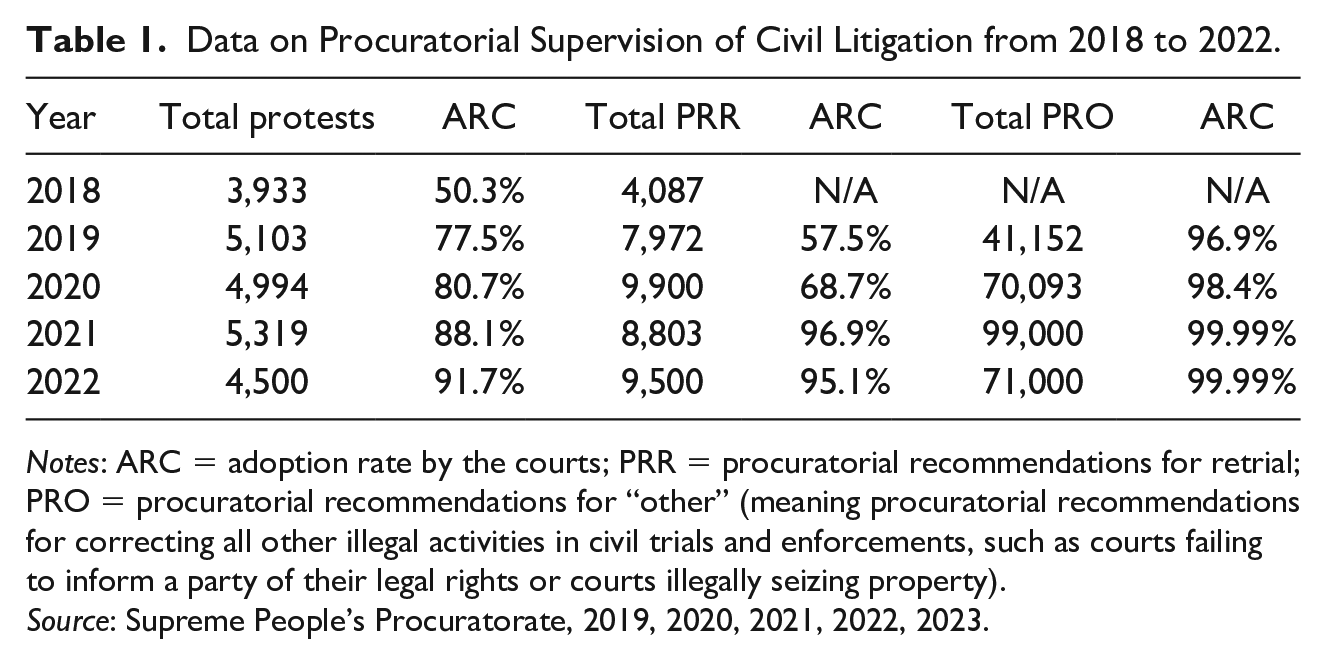
Notes: ARC = adoption rate by the courts; PRR = procuratorial recommendations for retrial; PRO = procuratorial recommendations for “other” (meaning procuratorial recommendations for correcting all other illegal activities in civil trials and enforcements, such as courts failing to inform a party of their legal rights or courts illegally seizing property).
Source: Supreme People’s Procuratorate, 2019, 2020, 2021, 2022, 2023.
Functions in Supervising Administrative Litigation
China’s procuratorates have exercised limited supervisory functions in administrative litigation over the past thirty years (Zhang, 2019: 57). Hence, in 2019, the SPP enunciated a new policy aimed at “fully implementing functions in supervising administrative litigation.” In 2021, strikingly similar to the measures undertaken in terms of civil supervision, the SPP also established a separate procuratorial department for administrative supervision and issued the Rules of the Procuratorates for the Supervision of Administrative Litigation 人民检察院行政诉讼监督规 (hereinafter the Administrative Supervision Rules). The Administrative Supervision Rules provide that procuratorial administrative supervision can be initiated by the parties to the proceedings, third parties, or by procuratorates themselves (Article 18). The oversight scope includes appropriateness of verdicts, mediation agreements, illegal behavior of judges in administrative trials, and illegalities in administrative enforcement activities (Articles 16 and 19). The three general supervisory methods and support powers are consistent with those granted by the Civil Supervision Rules.
Nonetheless, there are three salient distinctions between administrative and civil supervision. First, the primary objective of supervising administrative litigation is the successful resolution of administrative disputes (Article 2), rather than holding governments to account. Second, in order to maximize the possibility of resolving disputes, procuratorates employ a more flexible and comprehensive array of methods in supervising administrative litigation, such as providing judicial relief and interpretation of the legal reasoning for the involved parties. Third, the supervision of administrative litigation has gradually extended to encompass “administrative non-litigation enforcement,” which refers to actions taken by administrative organs independent of court enforcement.
As Table 2 shows, in actualizing these supervisory functions over administrative litigation, the available data reveal a notable increase in procuratorates’ administrative supervisory activities, albeit less so and with worse outcomes in terms of court adoption rates compared to civil case supervision.
Data on Procuratorial Supervision of Administrative Litigation from 2018 to 2022.
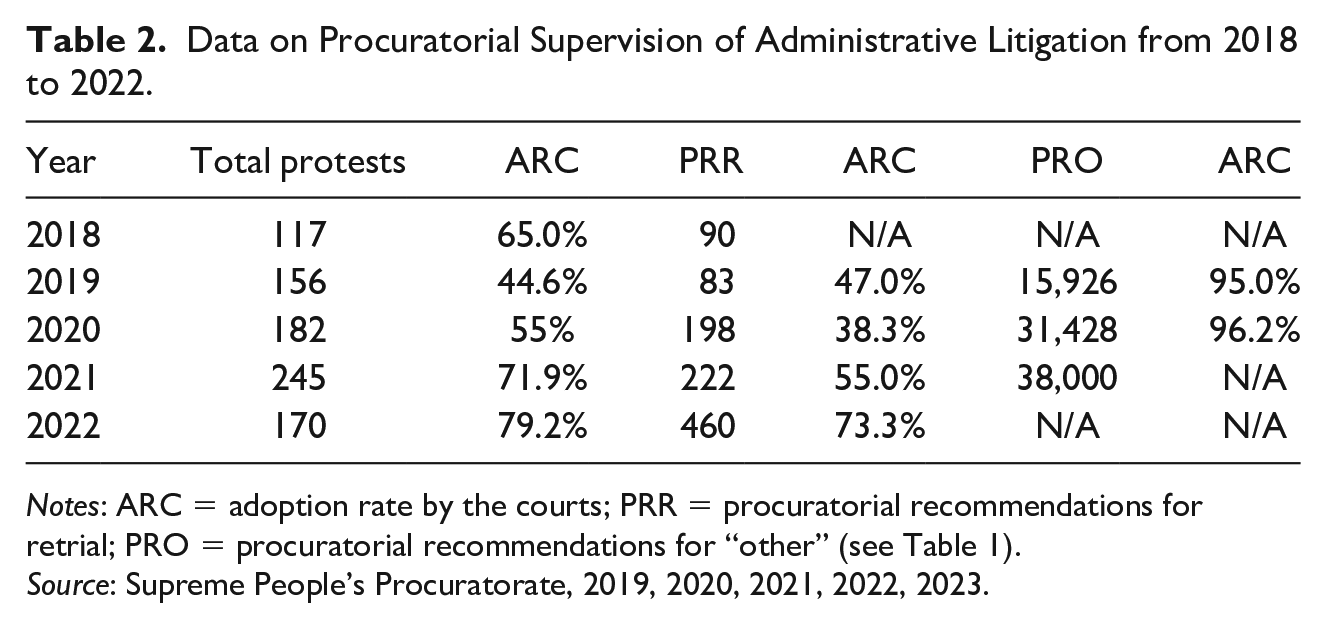
Notes: ARC = adoption rate by the courts; PRR = procuratorial recommendations for retrial; PRO = procuratorial recommendations for “other” (see Table 1).
Source: Supreme People’s Procuratorate, 2019, 2020, 2021, 2022, 2023.
Functions in Public Interest Litigation
The growth of procuratorial functions in the field of public interest litigation represents a substantial expansion of procuratorial power beyond criminal justice. Prior to 2014, Chinese procuratorates were precluded from initiating civil litigation as equal litigants because of their supervisory position. 15 However, a paradigmatic shift occurred in 2014 when the CCP Center advocated for “exploring a system of public interest litigation initiated by procuratorates,” 16 leading to a modest increase in such caseloads. The watershed moment came in 2017, when the Standing Committee of the National People’s Congress (NPC) formally established the prosecutor-led public interest litigation system through amendments to the Civil Procedure Law and the Administrative Procedure Law. Capitalizing on endorsements from both the CCP Center and the NPC, the SPP announced a policy aimed at “improving functions in public interest litigation.” Subsequently, the SPP assigned the Eighth Procuratorial Department to spearhead nationwide work in this domain and issued the Work Rules of the Procuratorates for Public Interest Ligation 人民检察院公益诉讼办案规则 (hereinafter the Public Interest Litigation Rules) in 2021.
After a rigorous five-year endeavor, the SPP has filed more than 670,000 public interest litigation cases since 2017, 17 and has formally lobbied the NPC to start the enactment of a specialized Public Interest Litigation Law in March 2023, 18 further solidifying its emerging role in this area.
In addition to robust support from central authorities, the SPP’s emphasis on public interest litigation can be attributed to the domain’s novelty and extensive scope, which provides fewer obstacles to the expansion of procuratorial authority. However, even within this ambiguous domain there still remain definable limitations to its expansion.
Regarding civil matters, prosecutor-led civil public interest litigation predominantly oversees civil activities that infringe on social or national interests. Presently, there are eleven supervision areas: ecological environment and natural resource protection, food and drug safety, juvenile protection, protection of heroes and martyrs, protection of the statuses and rights of military personnel, occupational safety and production, personal information protection, monopolistic practices, telecommunications network fraud, quality and safety of agricultural products, and women’s rights and interests protection. In order to encourage public participation, procuratorates are obligated to issue a public announcement thirty days before initiating such litigation. Should no other organizations or persons commence proceedings within this window, the procuratorate assumes the role of “litigator of last resort.” Even with a circumscribed legal role, procuratorates are still the mainstay of civil public interest litigation and have brought over 90 percent of such cases since 2018. 19
In the context of administrative matters, prosecutor-led administrative public interest litigation mainly supervises the administrative activities (including failure to act) of responsible administrative authorities alleged to have violated state and social interests. The twelve supervision areas are the same as those in the previous paragraph, excluding monopolistic practices and adding two new areas: state-owned property protection and the transfer of state-owned land use rights. In these cases, the procuratorate serves as the exclusive legal plaintiff and is mandated to issue pre-litigation procuratorial recommendations to the executive branch. These preliminary suggestions have resolved over 90 percent of administrative public interest disputes since 2018. 20
Beyond the thirteen statutory supervision areas in total, procuratorates are actively exploring additional types of cases to supervise, such as in biosecurity, public health, cultural protection, national tax revenue, financial regulation, and railway transportation. 21 The percentage of cases filed in these new areas exceeded 25 percent of the total public interest litigation caseload in 2021, thereby expanding the procuratorate’s influence to a multitude of previously untouched domains (see the final column in Table 3). 22
Data on Prosecutor-Led Public Interest Litigation from July 2015 to 2022.
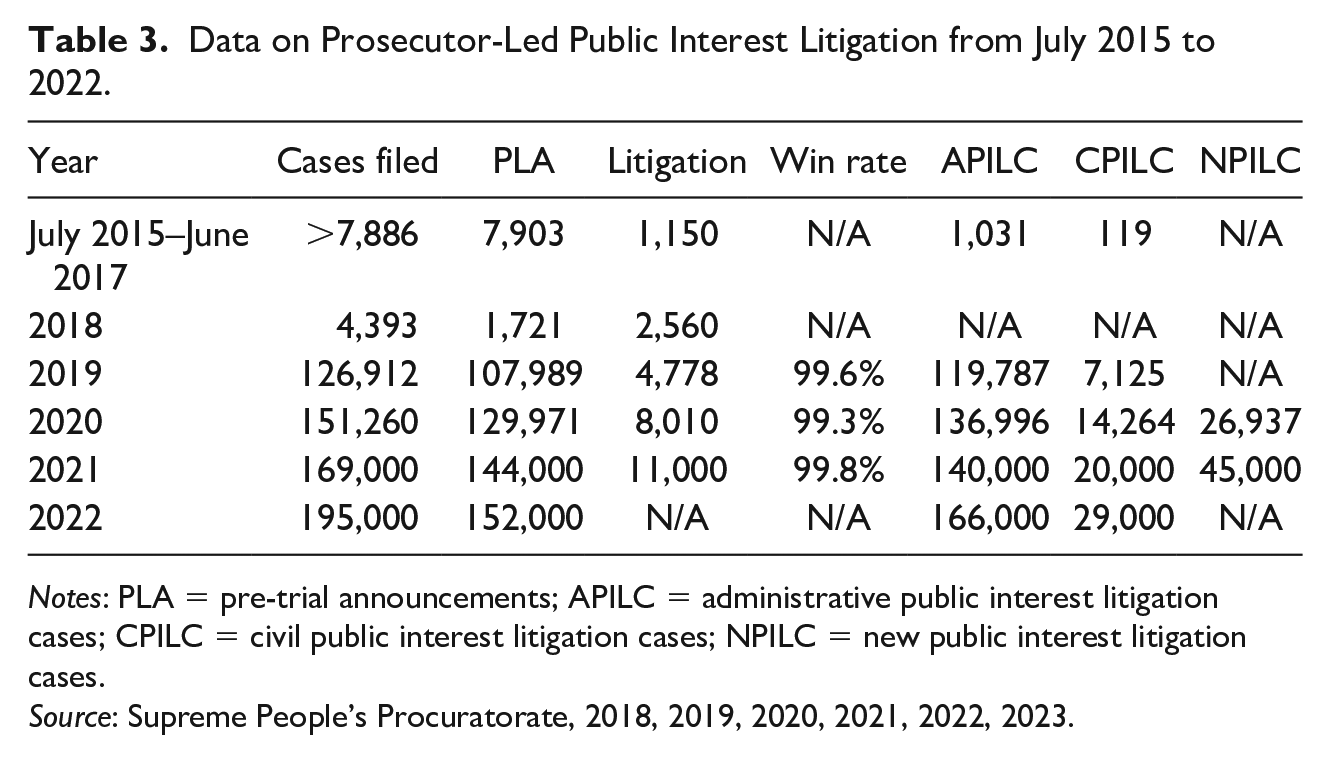
Notes: PLA = pre-trial announcements; APILC = administrative public interest litigation cases; CPILC = civil public interest litigation cases; NPILC = new public interest litigation cases.
As it stands, prosecutor-led public interest litigation has the largest case-load and highest adoption rate by the courts among the “three major procuratorial functions” outside of the criminal arena. The flexible and diverse approaches to handling public interest cases and the ever-broadening case scope have made prosecutor-led public interest litigation the most promising procuratorial function for the expansion of procuratorial power.
Even so, it is important to acknowledge that there exist certain boundaries to the expansion of the procuratorate’s power in the context of public interest litigation, namely, the need not to excessively discredit the government, as this may pose a risk to social stability. Thus, for administrative public interest litigation, the system is designed and practiced so as to limit litigation. Apart from compulsory pre-trial proceedings, initiating litigation against a government agency requires approval from the leadership of a higher procuratorate. 23 In practice, prosecutors are often instructed that the purpose of administrative public interest litigation is not to prosecute but to close cases before trial (Ding and Xiao, 2021: 372).
Boundary Work and Exchange: The Expansion of Procuratorial Power
In contrast to the Western paradigm of separated powers, China’s state power system is characterized by a monolithic structure, with all forms of state power emanating from the NPC, which is guided by the leadership of the CCP Center. Holding the supreme legislative power, the NPC established the four legally coequal but independent state organs, namely, the government, supervision commissions, courts, and procuratorate, to exercise executive, supervisory, judicial, and legal supervisory powers, respectively. Under this power structure, the procuratorate has sought to expand its power by entering into the jurisdictions of other state organs, such as the trial and administrative areas, with approval and endorsement from the NPC and the CCP.
The theory of boundary work and exchange provides a compelling framework for understanding how the procuratorate managed to expand its domain in criminal, civil, administrative, and public interest litigation without triggering fierce resistance from other actors. Furthermore, it explains why the procuratorate, rather than the courts or the police, has succeeded in transcending its initial jurisdictional boundaries to assume a prominent role in new legal arenas.
However, it is important to note that this theory may overemphasize the role of institutions in shaping the current power structure. It assumes that institutions compete with one another across blurred operational boundaries, underemphasizing the fact that all state agencies in China’s monolithic power structure can only operate within the boundaries defined by the party-state, that is, a model of “constrained power expansion.”
Boundary Making: The Beginning of Power Expansion
Boundary making refers to the process of settling jurisdictional conflicts in order to enable actors to distinguish themselves from others (Liu, 2015: 3). Since the implementation of the national supervision system reform, a jurisdictional conflict has arisen because there are two entities simultaneously exercising supervisory powers in the criminal field: the supervision commissions’ supervisory power over official crimes and the legal supervision power of the procuratorate. Therefore, the procuratorate’s top priority became the reconfiguration of its functional scope to distinguish itself from the supervision commissions.
In the criminal sphere, the strategy of procuratorates is to move from “playing the anti-corruption card” to “playing the legal supervision card” (Ding and Xiao, 2021: 372). Relying on the broad definition of legal supervision and the opportunities presented by the plea leniency system, the procuratorate has strengthened its authority in almost every stage of criminal proceedings. These include but are not limited to investigation, examination and prosecution, negotiation with the defense, trial proceedings, pacifying victims, 24 and criminal enforcement activities. Moreover, the procuratorate has pushed for new jurisdiction in criminal cases involving corporate compliance, which expands its legal supervisory remit into the governance of private enterprises. Nevertheless, these efforts have not solved the inherent dilemma of dual supervisory powers in criminal justice. As such, the procuratorate has to seek a more distinct role beyond the criminal sphere.
Drawing on Xi Jinping’s 2017 pronouncement that “prosecutors are the representatives of the public interest,” the SPP has sought to reposition procuratorates as representatives of the public interest outside of criminal justice. It urged all procuratorates to assume a more public-interest-oriented function, transcending their traditional focuses on fighting corruption and prosecuting criminal cases (Zhang, 2018). This orientation is further reflected in the SPP’s proposal for the nominally balanced development of the Four Major Procuratorial Functions, three of which fall outside the criminal field. In effect, this framework and accompanying slogan, coupled with the rapidly growing procuratorial caseloads in civil, administrative, and public interest areas, have greatly facilitated the procuratorate’s differentiation from the supervision commissions. Thus the concept of the Four Major Procuratorial Functions helps procuratorates gradually free themselves from their former anti-corruption focus and forge for themselves a newfound role as representatives of public interest.
In the SPP’s long-term plan, there is a concerted effort to exploit, given their scalability, both the “legal supervision” and “public interest representative” roles in order to actively participate in jurisdictional competition with other state agencies for the paramount position in social governance. If this boundary-making process succeeds, China’s procuratorates will assume a completely new role that is free from the role challenges of the supervision commissions.
Boundary Blurring: The Process of Power Expansion
Boundary blurring is about expanding jurisdictional domains; as such, it may seem to be the opposite of boundary making, which defines boundaries (Liu, 2015: 3). In our opinion, however, the two tactics serve a congruent purpose, but are tailored to different external actors. Boundary making is often deployed against actors that may potentially infringe upon one’s jurisdiction, aimed at asserting jurisdictional dominance to preclude potential encroachment. Conversely, boundary blurring is applied to entities whose likelihood of infringing upon one’s jurisdiction is minimal, thereby enabling unilateral jurisdictional encroachment by the implementing party. This strategy is typically utilized to enhance success rates in jurisdictional competition and avoid possible serious consequences. Despite their apparent differences, both strategies share the same goal of advancing the position of the implementing party in jurisdictional competition (Liu, 2015: 4).
In our research, for example, when faced with the supervision commissions’ heightened propensity for jurisdictional encroachment in the criminal justice domain, procuratorates have strategically chosen boundary-making measures that reposition themselves and redefine their jurisdictional boundaries, effectively distinguishing their supervisory authority from that of the supervision commissions. Such measures also serve to prevent the possible expansion of supervision commissions into other arenas of criminal justice. On the other hand, in a legal landscape in which the government finds it practically impossible to compete for legal supervision power, the courts rarely refuse prosecutorial power, and NGOs are not resourceful enough to fight for litigation opportunities, the procuratorates choose to blur their work jurisdictions and attempt to gain de facto jurisdictional authority by proliferating their caseloads and involvement in these blurred areas. Our fieldwork, involving secondary empirical material and consistent interaction with grassroots-level procuratorates in S Province, revealed the use of nuanced tactics to facilitate this boundary-blurring process. Specifically, procuratorates strategically cultivated symbiotic relationships with government, court, and NGO actors, thereby preemptively mitigating potential resistance or conflict. This is particularly noteworthy as it contradicts Liu’s theoretical expectation that such symbiotic exchanges are predominantly observed between the state and professional entities, rather than occurring intra-professionally.
Boundary blurring in the judicial sector
China’s procuratorates have successfully expanded their power in criminal and civil trials through boundary blurring and exchange. In terms of criminal sentencing, while the relationship between judicial power and prosecutorial power is generally summarized as one of mutual cooperation and mutual restraint in China, the precise degree to which the opinions of the procuratorates should be accepted by judges has been an ambiguous issue in practice. This nebulous zone provides fertile ground for the expansion of procuratorial influence in sentencing procedures. Capitalizing on this ambiguity, the SPP advocates the idea that “sentencing recommendations inherently lie within the prosecutorial purview” (Zheng, 2020). In doing so, the SPP actively encourages procuratorates at all levels to issue a greater number of detailed sentencing recommendations, which may secure them a more advantageous position in terms of the still ambiguous binding force of prosecutorial sentencing recommendations.
However, the longstanding practice in the field has been that the procuratorates focus on convictions while sentencing is the exclusive preserve of judges (Lin and Wu, 2021: 100). In such circumstances, it is difficult for the procuratorates to secure sentencing power by relying solely on boundary blurring, even if they are backed by the legal provision and the signed affidavit of the defense. Therefore, besides promoting the notion that sentencing recommendations can better supervise judicial power, the SPP also underscores the potential of sentencing recommendations in expediting trial proceedings, attempting to foster a symbiotic exchange relationship with the courts.
Specifically, there are three prominent benefits to judges from accepting sentencing recommendations. First, it contributes to reducing appeal rates from either the defendants or the prosecutors, which is a critical factor in the performance evaluation of judges. Second, it alleviates judges’ workload by precluding the need for extensive research and analysis. Third, it mitigates judges’ lifelong accountability for wrongful convictions by shifting the onus of sentencing decisions onto accepted procuratorial recommendations (He, 2023: 21). This exchange-driven symbiosis contributes greatly to an adoption rate for sentencing recommendations that currently stands at over 95 percent.
In terms of civil trial activities, the extent to which prosecutors’ powers of legal supervision can allow them to intervene in civil proceedings also remains an ambiguous issue in practice. Previously, civil litigation fell by and large within the jurisdiction of courts, with procuratorates playing a marginal role in the process. Moreover, the procuratorate’s traditional administrative-style supervision of civil litigation led to relatively tense relations with civil judges (Zhong and Yu, 2004: 423). To avert confrontation with judges during their boundary blurring, procuratorates strategically chose to prioritize the supervision of fraudulent litigation in their civil supervision work.
Fraudulent litigation can occur in all civil litigation cases but is most prevalent in private lending cases (Feng and Teng, 2021: 46). Given that these disputes often center on straightforward asset dispositions, judges find it exceedingly difficult to dismiss them outright. This complexity arises because parties may produce transfer records and acknowledge lending, even when the transactions could involve illegal loans, estate transfers, or changes in ownership. Instead of resisting procuratorial involvement, the courts welcome it in these cases. Procuratorates bring to bear not only necessary resources but also specialized personnel and investigatory expertise needed to investigate potential fraudulent litigation, thereby reducing the risk of wrongful judgments or enforcement.
With a shared objective of preserving the integrity of civil litigation, courts and procuratorates have established a collaborative relationship to combat fraudulent litigation. For instance, in 2021, the SPP and the SPC jointly issued the “Opinions on the Further Punishment of Fraudulent Litigation” 关于进一步加强虚假诉讼犯罪惩治工作的意见. Recent initiatives by some procuratorates to leverage big data approaches to automatically analyze court documents have further expanded their supervisory scope in civil litigation (Zeng and Jin, 2018). This computational approach grants procuratorates unprecedented access to a vast amount of internal judicial information, thereby broadening their supervisory remit beyond fraudulent litigation to a more extensive array of civil litigations.
In sum, the extent to which the procuratorate can intervene in court trials has long been an ambiguous issue, but by capitalizing on this ambiguity the procuratorate has solidified its position in both criminal and civil trial proceedings. It has also gained more opportunities to supervise through exchanging resources and abilities with the courts, thereby expanding procuratorial power in the judicial sector.
Boundary blurring in the administrative sector
The procuratorate aspires to intervene in the resolution of administrative disputes that are not originally within its jurisdiction by invoking blurred policy concepts, thereby augmenting its influence within the administrative sector.
Strictly speaking, from a jurisprudence perspective, the procuratorial supervision of administrative litigation pertains to the oversight of activities in administrative litigation and correlated administrative actions, which is primarily supposed to restrain executive power. Although this function has the potential to amplify the influence of prosecutorial power over administrative entities, it has been minimally realized in practice. In the past, local procuratorates were fiscally beholden to local governments, inhibiting their jurisdictional efficacy in administrative matters. Although the reform denoted as “unified management of human and financial resources procuratorates below the provincial level” 省以下地方检察院人财物统一管理 has greatly mitigated this dependency, it has not completely eradicated the issue. Given this, the procuratorate’s efforts to enhance its power by constraining administrative authority are likely to yield minimal results or incur substantial costs. 25
Contrary to the limitation of executive power, procuratorates have strategically opted to prioritize their supervision efforts in resolving administrative conflicts rather than holding the government liable. The procuratorates are encouraged to explain the law to the concerned parties as a means of facilitating the resolution of administrative disputes. For example, the Administrative Supervision Rules explicitly stipulate that the objective of administrative litigation supervision is not constraining administrative power, but “successfully resolving administrative disputes.”
Technically, the settlement of administrative disputes falls within the jurisdictions of the judicial and administrative authorities, and prosecutorial power, being a judicial procedure-requesting power 程序请求权, 26 cannot yield substantive results. However, in practice, the protectorates are increasingly employing blurred policy concepts like substantive rule of law 实质法治, national governance 国家治理, and proactive prosecution 能动检察 to assert a major role in the settlement of administrative disputes (Jiang and Wang, 2022). 27
Such a process of boundary blurring serves to augment procuratorial powers in at least two ways. First, by targeting administrative disputes rather than administrative bodies, the procuratorates can cultivate a more symbiotic relationship with local authorities, thereby enhancing such authorities’ goodwill toward and recognition of them. This in turn increases the likelihood that procuratorial recommendations will be accepted and implemented by government authorities. As demonstrated by Table 2, government authorities accepted more than 90 percent of all procuratorial recommendations. Second, such a strategy enables the procuratorates to extend their purview into the realm of administrative dispute resolution. While not legally designated as an adjudicative entity in administrative disputes, this limitation does not preclude the procuratorates from effectively functioning as the de facto mediator in such matters, affording them a valuable opportunity to participate in administrative governance.
Finally, when confronted with the intervention of procuratorial power in administrative activities, the decision of Chinese administrative agencies to support the involvement of the procuratorate may simply be attributed to the generally overwhelming administrative workload they face. The intervention of the procuratorate can help alleviate some of their work pressure. In any case, the boundary-blurring process has resulted in the expansion of procuratorial power in the administrative realm.
Boundary blurring in the public interest sector
The process of boundary blurring is most evident in prosecutor-led public interest litigation. This is attributable not merely to the practice’s novelty but also to the procuratorate’s expanded interpretation of the concept of “public interest” to incorporate an increasingly diverse range of jurisdictional areas.
Historically, China’s procuratorates had not been involved in public interest litigation. However, to optimize the utility of this recently acquired authority and to subsume as many jurisdictional functions of other entities as possible, the procuratorates have employed distinct strategies to enlarge their scope of influence in civil and administrative public interest litigation, while evidence of exchange processes in both directions is apparent.
First, in the realm of civil public interest litigation, the procuratorate’s expansion has been notably direct. Specifically, it has leveraged its institutional strength and exceptional litigation resources to directly seize and enlarge jurisdictional domains traditionally occupied by social public interest organizations. Registered social organizations like environmental NGOs and consumer protection associations initially took the lead in civil public interest litigation; however, once empowered to initiate civil public interest litigation, procuratorates shortly assumed a dominant role and brought the majority of such cases. For instance, in the critical domain of environmental litigation, procuratorates have been responsible for initiating more than 90 percent of cases since 2018 (Hu, 2020: 16), vastly outnumbering those brought by environmental NGOs.
From a jurisprudential standpoint, the procuratorate ought to serve an auxiliary function in civil public interest litigation, focusing primarily on facilitating the initiation of lawsuits by social organizations. However, as seen in the annual reports of the SPP, the procuratorates prioritize their own initiation and expansion of public interest litigation as a key performance indicator, rather than focusing on facilitating the efforts of social organizations. This tendency may imply that the procuratorate’s objective is not to empower social organizations to serve as public interest representatives, but rather to take this role for itself.
Second, in administrative public interest litigation, procuratorates choose to collaborate with governments to access extensive data and case leads, thereby broadening their jurisdiction into areas that have traditionally been beyond their purview, yet which are related to the public interest. Similar to the procuratorial function in supervising administrative litigation, procuratorial administrative public interest litigation is not fixated on filing lawsuits against unlawful government actions; rather, it takes “advancing the construction of a rule-of-law government” as its institutional objective.
Under the CCP Center’s new round of requirements for building a “rule-of-law government,” governmental bodies have to correct illegal activities, improper decisions, and inadequate regulations. Nevertheless, inherent bureaucratic constraints and limited capacities in managing public interest matters often impede the realization of this task through the internal efforts of governments alone. Against this backdrop, procuratorates collaborate with local agencies, leveraging their specialized expertise and oversight functions to contribute to the construction of a rule-of-law government.
The results are a large number of documents jointly issued by local governmental entities and local procuratorates that require governmental departments to support the procuratorate’s work in administrative public interest litigation. 28 Two crucial mechanisms involved are information sharing and the transfer of case leads. 29 With access to the government’s extensive database, the procuratorates can more efficiently discover case leads and explore novel categories of public interest cases. For example, the audit supervision that the Chuzhou Municipal Procuratorate is currently conducting relies heavily on the support of information sharing and case lead transfers from the local government’s auditing department. 30
In summary, the boundary blurring of China’s procuratorates in public interest litigation is intended to secure greater control over relevant legal work as soon as is practicable, and to continually explore and incorporate potentially accessible legal arenas, ultimately seeking to augment institutional power through an increased presence in these legal arenas. 31 This enables the procuratorate to consolidate and enhance its structural position within state apparatuses.
In this process, exchange is widely employed. Even facing weak social organizations, the procuratorates still commit to providing them with support in the form of legal advice, evidence gathering, and courtroom assistance. As for governments, official cooperation documents show that a solid symbiosis between governments and procuratorates has been formalized. Consequently, these symbiotic relationships may contribute to the future expansion of procuratorial power.
Boundary Maintenance: Stable Exchange with the State
Within the framework of Liu’s theory on boundary work and exchange, boundary maintenance refers to the intervention of a third, typically more authoritative, actor who stands to benefit from the ongoing blurring of boundaries (Liu, 2015: 4). In the Chinese context, this maintenance process holds crucial significance in determining whether the actor’s reform will garner support from the CCP Center and, ultimately, whether the reform will succeed or fail. As a general rule, there are two types of boundary maintenance, active and passive boundary adjustment, both of which are observed in the context of procuratorial reforms. In addition, the core of boundary maintenance is the exchange process, especially stable exchange. Liu contends that the “reason for the failure of the Chinese lawyer profession lies precisely in the fact that the exchange between them and the state is not as strong or as stable as that between their competitors [and the state]” (Liu, 2017: 16). This different stability of exchange with the state also explains why procuratorates are better positioned for successful power expansion compared to the courts or police.
Passive boundary maintenance: State enforcement and institutionalization
Passive boundary maintenance is embodied in the acceptance and adoption of procuratorial reforms by both the CCP Center and the NPC. As explained earlier, all-encompassing powers in China are unified in the NPC, which is led by the CCP Center, thereby necessitating their agreement for state actors to undergo power expansion. The CCP Center and the NPC have concurred with the procuratorial reforms, particularly regarding the investigation and verification and procuratorial recommendation systems. Both of them have strongly supported the boundary work of the procuratorate and exemplified passive boundary maintenance by the state.
The first example of passive boundary maintenance is the state’s approach to the procuratorate’s powers of investigation and verification. In 2018, the Standing Committee of the NPC passed the amended Organic Law of the People’s Procuratorates (hereinafter the Organic Law), granting prosecutors the power to investigate and verify. This newfound power was further specified in detail in the four “rules” of the Four Major Procuratorial Functions, making it an essential element of all procuratorial work. The 2018 legislation formalized the previous tacit acceptance of the procuratorates’ boundary making and boundary blurring.
The conferred authority to investigate and verify is pivotal for ensuring effective oversight in each of the Four Major Procuratorial Functions. Given the limited deterrence prosecutors possess in criminal cases, and their inability to use coercive measures in non-criminal proceedings, this power becomes indispensable for achieving successful supervisory outcomes. By passing the Organic Law, the CCP and the NPC demonstrated their supportive stance in maintaining the status quo achieved by the procuratorates’ prior boundary blurring.
The second instance is the formalization of the procuratorial recommendation system. Although procuratorial recommendations had been employed informally for some time, they were not codified as a statutory form of legal supervision until the adoption of the Organic Law. Following this legislative move, the SPP promulgated a comprehensive regulation, the Provisions on the Procuratorial Recommendations Work of People’s Procuratorates 人民检察院检察建议工作规定 (hereinafter the Procuratorial Recommendations Provisions), which outlines five types of prosecutorial recommendation: for retrial, for correcting violations, for public interest litigation, for social governance, and for “others.” Like the power to investigate and verify, the prosecutorial recommendation system has been assimilated into the broader framework of the Four Major Procuratorial Functions. Coupled with the high acceptance rate, this system has emerged as an essential and powerful instrument for maintaining the expansion of procuratorial power.
In conclusion, the endorsement and institutionalization of key procuratorial reforms, specifically the systems of investigation and verification and procuratorial recommendation, demonstrate how the state subtly supports the procuratorate’s boundary work and power expansion. We argue that this exemplifies a form of the state’s passive boundary maintenance that facilitates the procuratorate’s growth; otherwise these legislations or regulations will not have been passed or implemented.
Active boundary maintenance through pre-emptive adjustment
Different from the passive adoption of procuratorial reforms after the boundaries had already been blurred, active boundary maintenance in the procuratorial context occurred before the boundaries blurred and was characterized by a direct repositioning by the state, which was accompanied by the issuance of high-level policy documents that encouraged subsequent blurring.
The first example is the rearticulation of the prosecutor’s role by Xi Jinping, which directly added the important responsibility of serving as a representative of public interest to the prosecutor’s remit. At the Twenty-Second Annual Conference of the International Association of Prosecutors in 2017, Xi explicitly stated that prosecutors serve as “representatives of the public interest, shouldering significant responsibilities.” 32 Since then, the procuratorates have taken this expression as a robust policy foundation from which to move beyond criminal cases and dynamically expand their functions into the civil, administrative, and public interest arenas (Miao, 2017). Xi’s statement can therefore be interpreted as state support for the expansion of procuratorial power, serving as a catalyst for the subsequent process of boundary blurring.
The second and even more straightforward example is the promulgation of the “Opinions of the Central Committee of the Chinese Communist Party on Strengthening the Legal Supervision of Procuratorates in the New Era” 中共中央关于加强新时代检察机关法律监督工作的意见 (hereinafter the Opinions) in 2021. This document not only affirms the Four Major Procuratorial Functions, but also formally endorses the dual roles of the procuratorate as both a legal supervisor and a representative of public interest. In doing so, it solidifies the procuratorate’s repositioning as a multi-functional institution with a broad scope of authority.
Moreover, the Opinions require the procuratorate to further strengthen its work in various areas such as national security, social stability, economic development, public welfare, and social morale. This in effect confirms the procuratorate’s jurisdiction in these areas. The Opinions conclude by urging local party and government agencies to support the work of the procuratorates by improving their training, financial resources, operational equipment, and information technology.
Significantly, the Opinions are the first high-level and formal document issued by the CCP specifically pertaining to the procuratorial system. They represent a proactive approach by the state to support the continued expansion of the procuratorate’s jurisdiction, as well as exemplifying the concept of active boundary adjustment. The prima facie reason behind this is that the state believes it can profit from assigning to the procuratorate a greater role in social and national governance. The deeper reason, however, lies in the more stable exchange between the procuratorate and the state, which is discussed in the next section.
Stable exchange with the state
A stable exchange between actor and state is often the key to successful boundary work in the legal professions. This rule holds true for both the procuratorates and for lawyers, as studied by Liu. At present, the CCP Center is endeavoring to promote the “modernization of the capacity to govern” 国家治理能力现代化, 33 and all reforms of state organs should serve this general objective if they are to be supported by the state. In the field of dispute resolution, the police, procuratorates, and courts have all responded to this objective by introducing the working concept of “governing at the source,” which aims to extinguish disputes at their origin and prevent them from escalating into litigation. This aligns with the larger objective of fostering a harmonious society and maintaining social stability.
In this respect, the procuratorate is better positioned for seamless integration into this new governance paradigm compared to the police and courts. For example, publicity materials on this issue indicate that the police and courts primarily rely on education and mediation for early dispute resolution. 34 Although these methods have proven to be effective in practice, they may be insufficient given the increasing complexity of social conflicts. The procuratorate, in contrast, offers a more comprehensive approach to governance at the source, as illustrated in the following two cases.
The first case involves a Beijing procuratorate promoting corporate compliance through procuratorial recommendations (Jian and Ma, 2022). In March 2020, a couple in Beijing was apprehended by the police for repeated instances of intentionally not paying for merchandise at a local supermarket, amounting to over 800 yuan. Upon referral for examination and prosecution, the designated prosecutor conducted a comprehensive review and opted not to prosecute. However, during the verification of the couple’s compensation payment to the supermarket, a discrepancy emerged: the absence of receipts for the 1,500 yuan that the couple purportedly paid in compensation. The prosecutor attributed this issue to deficiencies in the supermarket’s compensation process, prompting the issuance of procuratorial recommendations. The recommendations were aimed at addressing two specific issues: the weakness in the store’s anti-theft measures and the irregularities in its reconciliation process. The supermarket accepted the recommendations and rectified the situation accordingly.
In the second case, a Chongqing procuratorate organized multiple government departments to repair the local sewerage system. 35 In January 2021, a Chongqing procuratorate was informed that residents were discharging domestic sewage directly into a river, leading to severe pollution. After investigation and verification, a Chongqing prosecutor found that the root cause was an aged and damaged sewerage pipeline. Therefore, the Chongqing prosecutor issued pre-litigation recommendations to three local government departments—the relevant street office, urban management bureau, and urban construction commission—urging them to immediately repair the pipeline. However, subsequent progress was minimal, as each department dispatched its own personnel to repair the pipeline, without coordinating with one another. Realizing this, the Chongqing prosecutor convened joint meetings involving the three departments and multiple experts, with the goal of collaboratively devising a pipeline modification plan. After a year of supervision, all of the outdated sewerage pipes were ultimately repaired.
The above two cases underscore the unique advantages procuratorates can offer in both dispute resolution and social governance. The broad extension of procuratorial functions, including legal supervision, investigation and verification, and procuratorial recommendations, naturally fits the need for comprehensive governance at the source. In turn, the opportunity to effectively govern at the source has extended its scope from merely ex post legal supervision to ex ante preventative measures, encompassing crime prevention, corporate governance, administrative management, and other activities prone to legal contention. Thus far, the procuratorate has emerged as the most appropriate organ of the three legal authorities to ensure stable governance at the source, and an important driving force in enhancing the capacity of social and national governance. Consequently, the procuratorate has gained the most support from the state for its boundary blurring and power expansion.
To sum up, compared with the courts and police, a critical factor contributing to the procuratorate’s sustained expansion of jurisdictional boundaries lies in the stronger and more stable exchange it maintains with the state.
Discussion: The Procuratorate’s Constrained Evolution
The current procuratorial reforms are still ongoing and far from being concluded. When we closely inspect the boundary work and exchange processes within the reforms that have driven the expansion of the power of the Chinese procuratorates, a persistent question emerges regarding the connotation of the procuratorates as the “legal supervisory organ” in China. Rooted in the 1979 Criminal Procedure Law, the legal supervisory organ was initially mainly understood to be the public prosecutors and criminal justice supervisors. However, the procuratorates’ role expanded significantly with the second revision of the Criminal Procedure Law in 1996, which enabled them to investigate official crimes and thereby bolstered procuratorial authority. Following the 2012 amendment, the procuratorates’ jurisdiction extended to cover criminal, civil, and administrative matters. While the 2018 Criminal Procedure Law rolled back the procuratorates’ capacity to investigate official crimes, they were given the role of public interest representation by the CCP Center.
As it stands, and pending any substantial forthcoming reforms, the operational paradigm of China’s procuratorial power can be succinctly delineated within the framework of the Four Major Procuratorial Functions. That is, according to the policy direction set forth by the CCP Center, procuratorial power will operate on the basis of the criminal prosecution function, be augmented by an extensive range of ancillary functions beyond the bounds of criminal justice, and continue to broaden and diversify in tandem with China’s evolving societal needs.
It is evident that the Chinese procuratorates have undergone continuous evolution, and we propose at least three conclusions that can be drawn from this ongoing process. First, the jurisdictional boundaries of China’s state organs have always been blurred or elastic. Although China’s institutional boundaries are nominally defined, a certain degree of ambiguity and uncertainty persists. This situation may partially stem from an inadequate and unscientific legal system, but a more compelling explanation may be the CCP Center’s development policy that advocates reforms and boundary blurring. As a result, jurisdictional conflicts and competition among state organs are not merely tolerated but institutionalized, allowing the procuratorate to continually evolve its role and expand its powers without overtly breaking the law. We can expect to observe similar processes of boundary work and exchange in the reforms of other state organs.
Second, the background to this situation is the longstanding pragmatism of the Chinese philosophy of governance. This pragmatism is deeply ingrained in China’s governance, institutional, and reform philosophies, and is reflected in Deng Xiaoping’s famous quote, “It doesn’t matter whether a cat is black or white, as long as it catches mice.” In the judicial sphere, this pragmatism manifests as a prioritization of substantive justice over procedural justice, while in ecological theory, it can be explained by the phenomenon that the institution offering the most stable exchange with the state will receive the greatest support.
For example, the boundary work of the procuratorate should be rooted in its constitutional position as the legal supervisory organ of China, which means that its work is primarily concerned with ensuring the uniform implementation of the law and supervising violations after they happen. However, when the procuratorate surpasses its role as legal supervisor and enters the realm of social governance, such as issuing procuratorial recommendations regarding company operations and educational policy for primary schools, the CCP Center does not hold it back but justifies its actions. One reason for this phenomenon is that the procuratorate’s involvement in social governance is conducive to the larger goal of resolving disputes at the source and improving governance capability.
Third, a salient feature of the procuratorate’s evolutionary trajectory is its adherence to national policy. This reflects the fundamental principle that in China’s political system all powers are centralized within the party-state, and only those entities supported by the party-state can achieve success in their evolution and expansion. However, state support is never unconditional and often operates as a double-edged sword. For instance, on the one hand, seeking state support is indispensable for the procuratorate’s jurisdictional expansion, as it furnishes the political backing required to overcome jurisdictional boundaries and negotiate power expansion with other players. On the other hand, seeking state support means sticking to its current policy direction, which establishes distinct limits for the expansion of the procuratorate. Therefore, the procuratorate cannot continue to expand its role in anti-corruption efforts when the state seeks to centralize all anti-corruption powers. This also explains why the procuratorate has utilized all available means to compete with other state agencies for jurisdiction: it did not resist when its core power was curtailed and has barely expanded in this area since. In addition, in a governance atmosphere aimed at ensuring stability, the procuratorate must exercise extreme caution in government-related cases, making the prospect of public victories in clashes with the government no longer a viable option.
In light of the above three findings, this model of controlled and constrained power expansion with well-defined boundaries may represent the new norm for competing jurisdictions under China’s current consolidated governance system, with all future reforms of China’s state organs likely to follow this model, led by central policy. This marks a departure from the disordered jurisdictional competition of traditional boundary work and exchange theory.
Conclusion
This article presents a nuanced analysis of the latest reforms in China’s procuratorial system. After the national supervision system reform, the procuratorate has been exploring ways to broaden its jurisdiction to enhance its overall power. As reflected in the Four Major Procuratorial Functions, the procuratorate has proposed different development strategies in the areas of criminal, civil, administrative, and public interest litigation. Through these strategic efforts, the procuratorate has enhanced its power in relation to other players in criminal justice, while also elevating both the quantity and quality of civil and administrative supervision and prosecutor-led public interest litigation.
Our analysis of the reform processes surrounding the Four Major Procuratorial Functions reveals the procuratorate’s active engagement in boundary work and exchange processes. The entire Four Major Procuratorial Functions reform can be understood as a form of boundary making by the procuratorate, as the national supervision system reform forced the procuratorate to distinguish itself from the supervision commissions. As the procuratorates further enter the criminal, civil, administrative, and public interest arenas, they inevitably encounter jurisdictional conflicts with other governmental organs and the courts. In order to expedite their reform agenda and expand their power, procuratorates act strategically by extensively engaging in exchanges with courts and other government departments in the process of boundary blurring. For example, the procuratorates assist the courts in cleaning up fraudulent litigation and support governmental efforts to construct a “rule of law” framework.
This strategic boundary making and boundary blurring has allowed the procuratorates to quickly expand their functions to incorporate supervision work in the criminal, civil, administrative, and public interest litigation arenas. However, for these shifting boundaries to be formally accepted, the procuratorates must be supported by the state. Fortunately, the expansive interpretation of the concept of legal supervision has rendered the procuratorate exceptionally well positioned to achieve the state’s overarching aim of dispute resolution at the source. Within the context of ecological theory, the procuratorate enjoys a more stable and robust exchange of resources with the state, compared to other legal authorities. This stable exchange mechanism not only garners state support for the continual expansion of procuratorial powers but also shapes the current controlled expansion of China’s procuratorates.
The article’s insights extend beyond the legal sector, suggesting that the theories of boundary work and exchange can be applied more broadly to a myriad of institutional reforms in China. In conclusion, the role of the procuratorate is in a state of ongoing evolution, influenced both by the ambiguities in legal statutes and jurisdictional boundaries, as well as by China’s deeply pragmatic governance philosophy. Because of these elastic boundaries and prevailing pragmatism, any policy changes initiated by the CCP Center would trigger another round of jurisdictional competition among state organs, leading to a fresh round of boundary work and exchange. Moreover, China’s centralized political system means that only the actor who receives the strongest support from the CCP Center can succeed in the jurisdictional competition. However, this centralized system also creates clear and often insurmountable boundaries to the expansion of different players within the system. Therefore, not only the procuratorate but all current and prospective state organs in China are likely to experience a constrained expansion in their boundary work and exchange activities.
Footnotes
Acknowledgements
Many thanks to the anonymous Modern China peer reviewers for their insightful feedback and suggestions. Special thanks to Prof. Chen Tianhao, Prof. Yu Xiaohong, Dr. Lu Shenghua, Dr. Lin Haozhou, and Chen Yueou for giving detailed comments on an earlier version of this article.
Declaration of Conflicting Interests
The author(s) declared no potential conflicts of interest with respect to the research, authorship, and/or publication of this article.
Funding
The author(s) disclosed receipt of the following financial support for the research, authorship, and/or publication of this article: This work was supported by the National Office for Philosophy and Social Sciences of China, under the project title “The Predictors of Prosecutors’ Sentencing Recommendation Decisions in China: An Empirical Research” 检察机关量刑决策影响因素的量化评估研究 (22BFX057).