



Abstract

introductory note
What follows is the creation of a script for an imaginary radiophonic piece on the Brazilian sound artist Janete El Haouli (1955–), a key radio art reference in Latin America. Author of various radiophonic pieces, she also created and directed the radio programme Música Nova: Rádio para Ouvidos Pensantes (New Music: Radio for Thinking Ears), which was transmitted between 1991 and 2005 by Rádio UEL (Londrina State University’s radio station). Both her pieces as well as her programme move away from the traditional radio model in which the listener is understood as a passive receiver. What El Haouli proposes is not a radio as mere medium of transmission, but rather an experimental radio that invites the listener to perform a reflexive and imaginative listening. While inspired by this latter model, we, Valéria Bonafé and Lílian Campesato, have here developed a script for an imaginary radiophonic programme seeking not only to present Janete El Haouli, the artist, to the reader/listener—her biography, her works and poetics—but also to invite this reader/listener to participate in a network of intersubjective listening combining different agents and narrative lines. The script presents five sound works by El Haouli and a selection of fragments of an audio testimony where she reflects autobiographically on her life. The script also collects three affective reports from listening carried out by women artists who were impacted, in different ways, by the ethical and poetic dimensions involved in the work of El Haouli: Valéria Bonafé, Lílian Campesato and Thaís D’Abronzo. Both El Haouli’s testimony and the three affective reports 1 from listening were made originally in Portuguese and were translated by the authors for this imaginary radiophonic piece. All these elements appear interwoven and contextualised in a script organised along five different blocs, with a radio presenter guiding the reader/listener throughout. The way this piece is composed reflects the desire to experiment with the construction of a narrative fostering openings to the other and otherness in general while establishing an intersubjective network between El Haouli, the authors themselves and the readers/listeners. The construction of the narrative resists, therefore, the heroism of traditional biographical discursivity that finds in the white male its reference and norm (Rago, 2011, p. 252). This imaginary radiophonic piece is also part of a larger project centred on recorded conversations with women artists who work with sound, and which has been ongoing since 2017. In this project, the focus is on how women listen to themselves, understand themselves, express themselves. At stake, therefore, is a project committed to exercising a feminist politics of listening, which values random aspects, apparently insignificant, yet intimate, singular, in the desire to build an alternative history, counter-discourses to the dominant ones in the field of artistic creation.
opening
Many voices, resonating from different times and spaces. A radiophonic piece on Janete El Haouli created by Valéria Bonafé and Lílian Campesato.
Memories, autobiography, woman, intensity, desire, listening, radioart, experimental radio, voice-music, Cambé, surrounding sounds, Lebanon, magic box, travels through noise, immigrant, baba ganoush, red lipstick, silver hair, intuition, creation, mother lion, three children, life and art: one thing only.
‘Voices, voices, voices, sound-voices. […] When I speak of radio, when I speak of the voice, when I speak of my work with soundscape. […] Many voices, resonating from different times and spaces.’
Janete El Haouli. An artist of listening who strolls through life scenes, through images and affects (see Figure 1). Who knows things, people and places through her listening, and who shares with the listener sound dramas touched by her presence. Flowing across disciplines, her work has made a very particular imprint on Brazilian sound studies. Her PhD, dating back to 2000, already included largely unexplored ideas in Brazil: acoustic art, radio-art, radio-landscape, acoustic ecology, experimental voice, poetics of listening. A thought-provoking professor, with far-reaching ideas. A listener-thinker, moved by passion and curiosity. A sound-music encyclopedia, a collector of musics from around the world, a phonotheque. A woman who captures and transmits, who travels through noise. Janete El Haouli, an antenna.
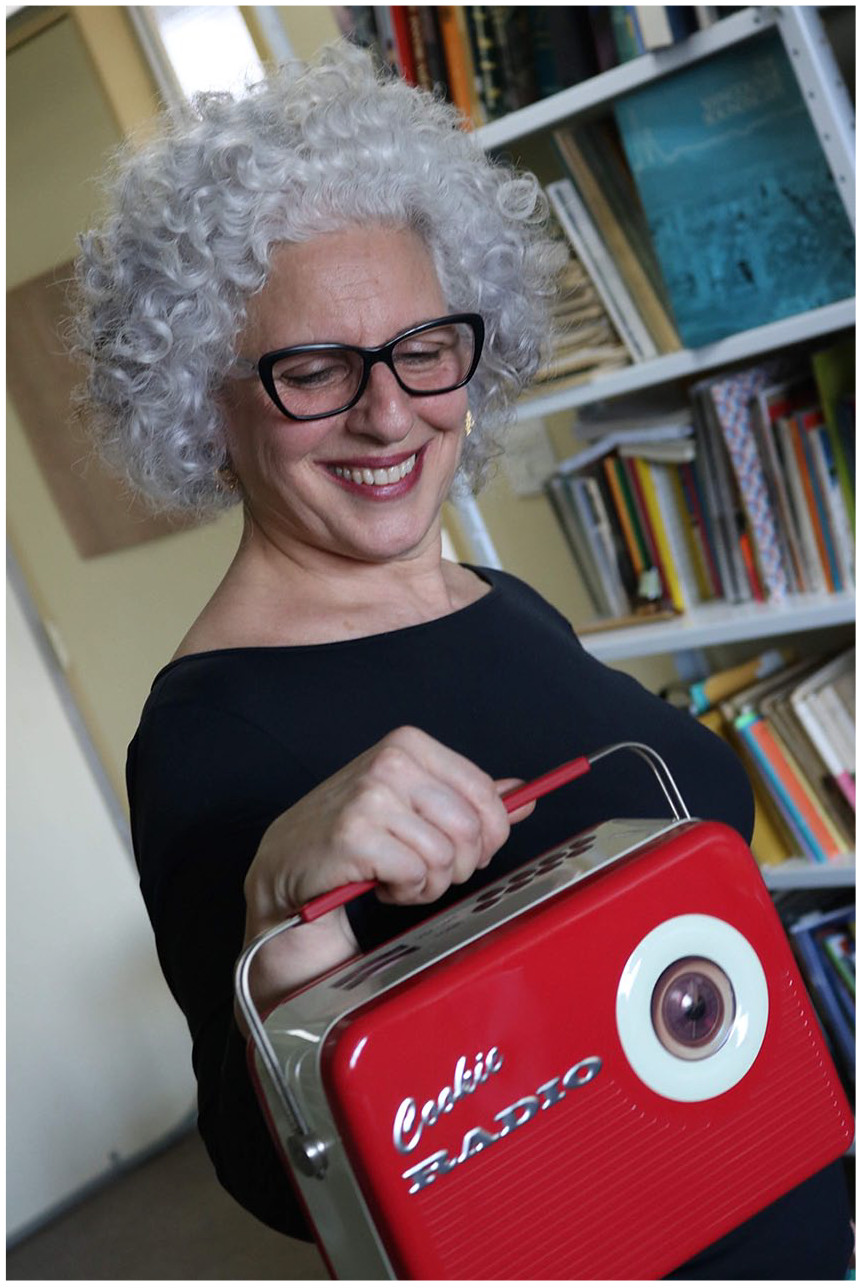
Janete El Haouli
soundscape
‘I was born in a house in Cambé [a small city in the interior of the state of Paraná] […]. It was a house my father had built and had wooden floors. It was hollow underneath, there was a great basement, and we went down there to play. I loved bouncing around in that house. You can say I was born in a house-instrument, a house-drum. And our home was a house in the country, where I lived hanging off trees, listening to birds, hearing the carriage pass in front to drop off the milk and the bread. […] And I remember vividly: the cobblestone, the hour the horse arrived, that sound of the cart, the wooden wheels. My relation with sounds around me was always something very present.’
We have just listened to Ciranda das Mulheres [Ciranda of Women] (El Haouli and de Paula, 2017), by Janete El Haouli and Julio de Paula.
Ciranda das Mulheres is a radiophonic piece created from recordings collected in Caruaru, a city in the interior of the north-eastern state of Pernambuco. ‘Ciranda’ is a type of circular music and dance nurtured traditionally by women. According to Janete, the piece works very much like a sound-portrait or a movie for the ears, with a sequence of scenes flowing in dreamlike fashion. From a set of utterances, songs, recitations, testimonies and other references, Janete sketches the contours of a soundscape taking the listener close to Caruaru’s cultural riches.
‘I’ve never been in Caruaru. A “pife” [a Brazilian bamboo fife] reverberates the rhythms and the multiphonics of a fauna-city I’ve never met. The voice of a woman bursts through in a flux of words that accelerate and decelerate: all singing, the sound, in the back alley, with lightness, on a drying rack, kids, on the slope, screech, of a girl, people in the flesh, I forget to remember, I wonder. I’m entranced by the intense and open sonority of the Pernambucan way of speaking. A “rabeca” [a Brazilian fiddle] sustains the prayer chanted by another woman: Don’t allow God that I die without touching all that exists. A metallic beat warns that time passes. I shiver. Finitude also afflicts me. The disjunctive choir reaffirms the minor seventh with the augmented fourth and the faith in a Northeast I don’t belong to. A mixture of estrangement and desire. The street market is alive: voices, voices, sound-voices. The heat is audible. The vendors announce: here ice-cold mineral water. There are women, men, children. In the chaos of overlapping sounds, Cazuza’s [Brazilian singer and songwriter] voice springs into my ears, the ears of a girl born in the [19]80s and brought up in a middle-class family based in São Paulo. Me accompanying my sister in her songs with my blue guitar. The sound of a trembling accordion plucks a smile out of me, the same sound that brings with it an inexplicable nostalgia. Better snatch the offer! My listening adrift. Expectation. Another voice arises. That one I recognise: it’s Janete. The Janetes, a ‘ciranda’ of Janetes. In the voice, in the body, in the shouting, their feelings, their truth, every day. I hear Janete’s Caruaru. A Janete-Caruaru. Janete’s Caruaru in me. I self-listen.’
That was an affective listening report conducted by Valéria Bonafé on the basis of Ciranda das Mulheres.
radio
‘And my father having a Philco radio, which I later inherited, is something that really marked my childhood. He would sit on the veranda listening to news from Lebanon. […] I remember that we would listen together, that I didn’t understand very well. For me, it was a magical thing for him to listen to Lebanon from that box. After he’d go listen to France, touring all the radios in the world. […] It was a moment I’d stay with him, who worked all week, travelling through all those sonorities, all that noise.’
We have just listened to Cantos e Pássaros Não Morrem [Songs and Birds Don't Die] (El Haouli, 2000), an episode of the programme Música Nova: Rádio para Ouvidos Pensantes [New Music: Radio for Thinking Ears], presented and directed by Janete El Haouli.
A weekly radio show broadcast by a university radio station. Every Monday night, for fourteen years (1991–2005), voices were invoked that, one after the other, invited listening. The vignette of the programme is the initial part of Luciano Berio’s Laborintus II, which ends with the narrator saying ‘In quella parte, in quella parte della mia memoria’. This was the password opening listening to the unknown, a sort of portal through which one stepped into a ‘radio for thinking ears’. Cantos e Pássaros Não Morrem is a radio show dedicated to all murdered Brazilian indigenous people.
‘I met the radio programme Música Nova: Rádio para Ouvidos Pensantes in 1998 […]. It was a shock for me when I heard it. First due to the type of sonority: Meredith Monk, Fátima Miranda, Diamanda Galás, John Cage, Luciano Berio, Murray Schafer. I was 18 and I hadn’t heard anything like that before. […] I needed to listen in the dark, because it was an immensity which was coming out of the radio. Also Janete’s voice, both calm and strong. […] I met there worlds that decided many things in my life, in the way I think. […] It was the entire world there on Monday nights. Each week was something mad, really different. […] Sound began and we no longer knew who it was, what it was, where we were, what was going on. I remember right before the programmes not having any information of what we were going to be listening to. And I loved that. […] In one of these programmes, we listened to the funeral rite of the Bororo indigenous people. […] The mourning of the Bororo is something that has never left me. […] It was a state of rapture. […] I could hear a different sonority of the tear, of sorrow. […] The programme had a pretty strong emotional bent. I was moved quite a few times listening to it […]. I think that radio programme was also made to batter the ear, not only for “thinking ears”.’
That was a flashback of the actress, director and professor Thais D’Abronzo when remembering the radio programme Música Nova: Rádio para Ouvidos Pensantes, presented and directed by Janete El Haouli.
voices
‘I loved to listen to my mother’s voice. […] I remember that when she scolded me, in Arab, or in Portuguese, I wasn’t very interested in the meaning of the words but in their sound. […] We would also listen to a lot of Lebanese music at home, Fairuz, Sabah and so many other singers, that melismatic music. And then I come across Demetrio Stratos. Before him, I had encountered other voice artists, Meredith Monk, Theophil Maier, Diamanda Galás. But it was Demetrio who took over me as you know. […] Well, all this to synthesise what was my transition from traditional Lebanese music, from when I was in my mother’s womb, through my childhood, all the way to Demetrio Stratos, with all that highly experimental approach to the voice.’
We have just listened to Stratosound (1998b), by Janete El Haouli.
‘On 30 July 1998, I had the intuition of coming here to this apartment where my mother lived. I asked her if I could record what she had already told me about her entire life, her own life. It lasted thirty-four to thirty-five minutes. She chose to begin from when she was a child, moving to her arrival in Brazil and other episodes. She died exactly a month later, 30 August 1998. It’s impossible to describe what the loss of a mother means. […] I kept the recording for eighteen years and every time I listened to it I wept. In 2016, I had the idea of working on the recording creatively. […] I proposed to Mannis that we do a piece […]. We invited my daughter, Maya, who translated the text. And we used a sort of shadow, a second voice, something which could even be thought of psychoanalytically. Maya had a very strong relation with my mother, of great proximity. It was really stirring work. My daughter, my mother and me, when I was a composer, creator […]. You have there a voice which doesn’t understand exactly the meaning of what my mother was saying. It’s in Portuguese and she speaks with great difficulty, barely being able to breathe, with lung cancer. So this piece represents a lot to me, really a lot. It’s the story of my mother’s life, of a submissive woman to her husband, to her father, to the family as a whole, but who was also taurine, a lioness. My mother was a woman of incredible strength, impressive, and I have something very strong of hers in me. Zahrah Jahjah Maluf El Haouli (see Figure 2), my mother, would have been 101 on 15 May.’
We have just listened to Memórias de Zahrah [Memories of Zahrah] (2016), by Janete El Haouli and José Augusto Mannis.
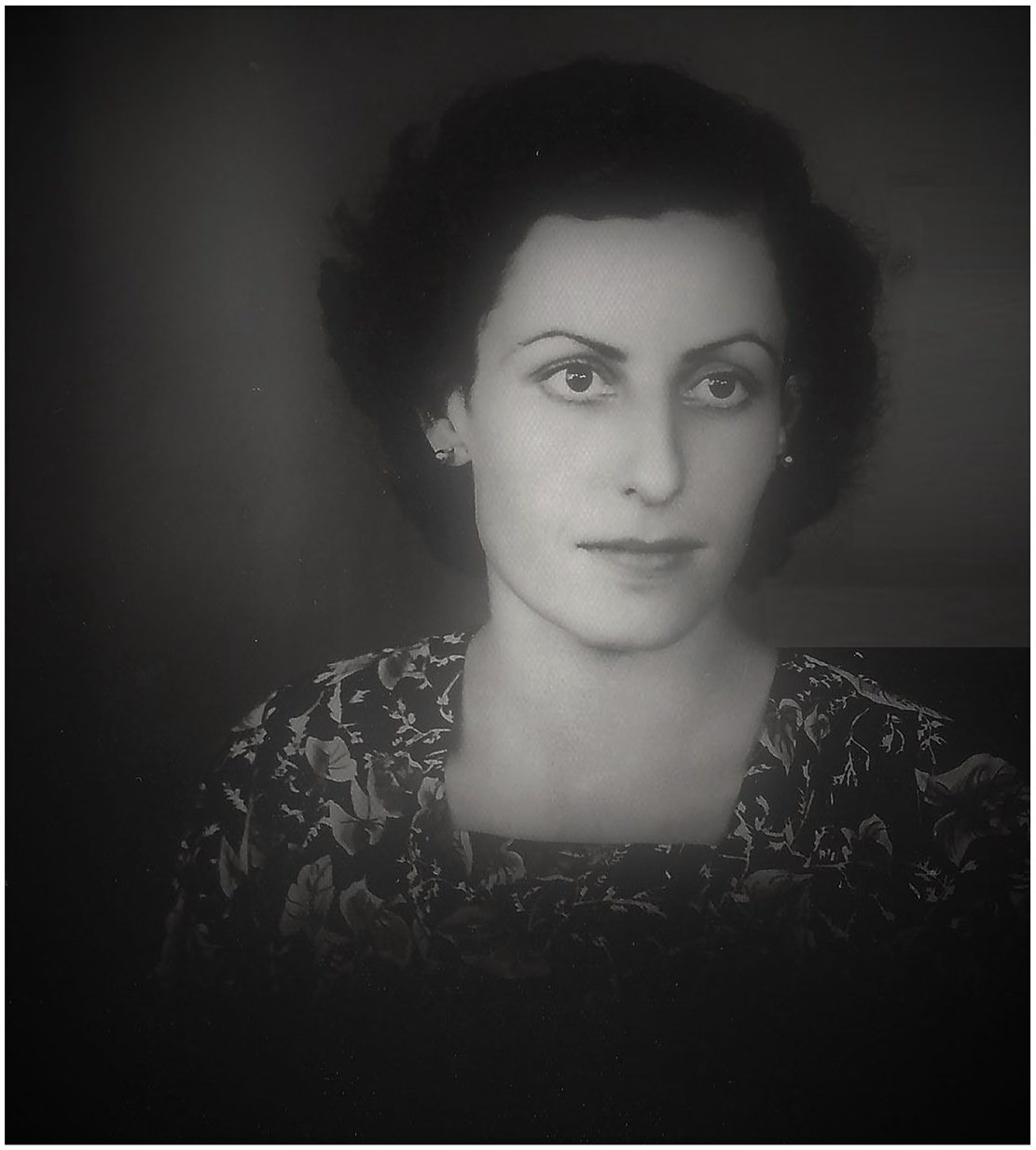
Zahrah Jahjah Maluf El Haouli
‘I hear two voices. Demetrio’s voice, on the one hand, Zahrah’s on the other. A voice which has the world of voices and another voice, childish, fragile. An androgynous voice, virtuosic, fascinating, a girlish, hesitant voice, even if extremely noisy. These voices are a reference for two radiophonic pieces by Janete. One meant for WDR, which deals with her main research interest throughout her life, Demetrio Stratos: En Busca de la Voz-música (El Haouli, 2006 [1999]); the other, a documentary piece on her mother. One voice-music, the other, a voice-womb. These two voices are references for Janete, who, in turn, is a reference for me: a heated voice, a voice spacing out silences, the voice of a woman. I hear Janete in Demetrio’s voice just as I hear her in her mother’s voice. The voice of her mother, now girlish, childish, is strange to me; it’s a weakened voice, unrecognisable, distant from the voice she once had. But then I also hear my own voice as a mother and think of the listening my daughter has of my voice. Zahrah’s narrative of her own life is a biography inside Janete’s own autobiography. She tells herself through her mother’s memories. There’s a double sense of estrangement and familiarity of the voices which are told in Janete’s radiophonic work. A voice of memories. Through which I too tell myself through Janete’s voice. Listening to two voices, I hear many voices, I hear my own voice and, then, fall into silence.’
That was an affective listening report conducted by Lílian Campesato on the basis of Stratosound and Memórias de Zahrah.
self-listening and autobiography
Janete El Haouli composes with what she hears. Her listening—indissociable from her body, from her references and biography—is necessarily engraved in her works. Whoever listens to Janete’s works not only accesses Caruaru’s soundscape, the funeral chanting of the Bororo, Demetrio Stratos’ voice or the life testimony of a Lebanese immigrant: they also access how Janete expresses her own listening. It’s this encounter with the works, with the other, with the uncanny, that allows the listener to both scout and listen to the self. Such an experience of alterity allows for self-listening (Campesato and Bonafé, 2019). Both Janete when she listens to the Bororo and the listener of the Bororo as Janete hears them are able to experience other ways of inscribing their subjectivity. Be it in processes of musical creation, be it in the construction of narratives forged using them, the idea of self-listening allows for a displacement, a denaturalisation of a habitual regime of listening, which moves away from the sort of regime wherein listening, as well as analysis and discourse, is directed exclusively at the object. In his book Listening (2007 [2002]), Jean-Luc Nancy says that: To be listening will always, then, be to be straining toward or in an approach to the self […]. When one is listening, one is on the lookout for a subject, something (itself) that identifies itself by resonating from self to self, in itself and for itself, hence outside of itself, at once the same as and other than itself, one in the echo of the other, and this echo is like the very sound of its sense. (Nancy, 2007 [2002], p. 9)
‘More than talk about myself, [this process of telling myself] allowed me the hearing of myself, and this in a very profound way, was critical for me. As if life and art had always been together. I was always on the move, made my life and my work, my art, my creation, one thing only. […] It moves me, you know? How my choices were so good to me. How they’ve done me good. […] And one very strong thing in this journey was the birth of my three children. Maya in 1982, Marcos Ibrahim in 1985 and Matheus in 1987. They were born during all these processes. They were a part, made me stronger, gave me other senses, made me feel other emotions. So it’s a mix, an edited mixture, life montage, a great composition, all of it.’
Understanding the fluidity between life and art as a to and fro between two parallel trajectories, with points of contact here and there but which are one thing only, bonded. ‘Many voices, resonating in different times and spaces’ is an (auto)biographical narrative where the frontiers between public and private, fiction and reality, intimacy and politics, self and world are blurred (Rago, 2011, p. 252). The recorded testimony, the voicing of memories, the listening of the other. This encounter of oralities isn’t merely about unveiling individual stories of women, or about the contours of what a feminist history of sound-art would look like in Brazil: it’s about showing how these self narratives allow us to develop a cartography of subjectivity itself. A living shrine of memories, a desiring radio programme.
Many voices, resonating from different times and spaces. A radiophonic piece on Janete El Haouli created by Valéria Bonafé and Lílian Campesato.
Footnotes
Acknowledgements
With thanks to Janete El Haouli for her generosity in sharing her intimacy so frankly, for her availability and the affection of always; to Thaís D’Abronzo for sharing her memories; to Sonora: Músicas e Feminismos for the conviviality and exercising of a feminist politics of listening; to Fernando Iazzetta and Rogério Costa for their close reading; and to Filipe Ferreira for the English translation.
1
We use quotation marks in the script in two situations: 1) for excerpts taken from El Haouli's testimony and 2) for excerpts from the three affective reports from listening by Lílian Campesato, Valéria Bonafé and Thaís D'Abronzo. We believe that the use of quotation marks in these passages can help the reader to realise that in these moments they are ‘listening’ to other voices besides that of the ‘Voice-over’ and the ‘Radio presenter’.
author biographies
 .
.
.