




Abstract

The body and face of the colonized are not a pretty sight. It is not without damage that one carries the weight of such historical misfortune.
In 2020, as a queer Chicana documenting the lives of transgender Latina immigrants in the US, I see how Albert Memmi’s work applies to my life and the work that I do. 1 Colonial conditions have disfigured our faces and bodies. Memmi is right and we have been made ‘ugly’. From colonial regimes, we have inherited borders, binary gender systems, white supremacy, institutionalised greed and patriarchy. Those of us who are colonial subjects endure daily doses of systemic and psychic fragmentation of our individual and collective identities. Coloniality breaks us and destroys our sense of self. Yet, we are unable to break away from colonial relations because these relations are perpetuated through every institution of every dominant nation. And, while coloniality is all-encompassing and institutional, the call to decolonise ourselves seems to be made individually, like another neoliberal attempt to make us responsible for our own suffering. When called up to join decolonising modalities, many of us are tired before we even begin. Our tired bodies and psyches represent the damage of carrying the historical misfortune of colonisation that Memmi describes in his text. From this perspective, the colonised is disfigured; too tired to fight against over 500 years of colonisation. But what if, for a moment, we focused on decolonisation practices as small, quotidian moments of beautiful self-authorship, community-building and a sense of spiritual fulfilment? What if we were given the opportunity to see how some women of colour in the US use makeup rituals to reconstruct themselves and others? What creative possibilities would open up for those of us who want to read decoloniality in the small yet profound activities that make us whole in a world designed to break us?
In this Open Space piece, I address these questions using excerpts from interviews with two powerful and influential transgender Latina immigrant (TransLatina) activists and makeup artists, Brenda Del Rio Gonzalez and Renata García. Brenda has been a dedicated health educator and social justice activist for and with the TransLatina community since the 1980s. She currently works at a non-profit organisation where she coordinates social services for TransLatinas living in California. She is well known in her community, and her presence in this group is constant and supportive. Renata is an emerging TransLatina activist who has been working with the TransLatin@ Coalition—a non-profit organisation focusing on the needs of trans migrants in the US—and working to improve the lives of TransLatinas. My friend and co-investigator, Bamby Salcedo, President of the TransLatin@ Coalition, introduced me to Brenda and Renata and facilitated these interviews.
fragmented and distorted: violence against TransLatinas
In 2007, US immigration enforcement captured, incarcerated and denied HIV medication to Victoria Arellano, a transgender Latina immigrant in the US. Arellano died shackled to a hospital bed a few months later (Hernandez, 2008). Since this tragic event, many other TransLatinas have been incarcerated in detention centres in the US. Some make it out of there alive and others do not. TransLatina activists fight daily to demand structural change in the form of immigration reform and access to life chances. They hold demonstrations against unjust policies that seek to eradicate them. While this important decolonial work focuses on larger structural change, many TransLatina activists are simultaneously attentive to the smaller and less recognisable ways to create decolonial socialities, such as their work in transgender-led beauty pageants and makeup artistry. By the time Brenda and Renata spoke with me about their decolonising practices, we had known each other for many years. As a team, we had investigated, analysed and exposed all aspects of structural violence against TransLatinas (Padrón and Salcedo, 2013). If asylum policy worked for TransLatinas, they would be considered refugees to be protected against persecution on the basis of gender identity. But this is rarely the case. TransLatinas remain largely undocumented and marginalised. They might not be breaking the law, but the law is certainly breaking them. Nonetheless, there came a point when Brenda and Renata wanted to talk about mending and reconstructing their individual and collective identities as TransLatinas. They wanted to talk about something other than marginality and oppression, and my previous work within the community provided the trusting space to conduct the following interviews.
Brenda talks about TransLatinas beauty pageants, makeup and self-authorship
In order to begin a conversation about something other than the outcome of oppressive colonial systems, I asked Brenda: ‘What kinds of actions connect you to yourself and others? In what ways do you resist the distortion of your identity? Are these feminist acts? How so?’. Brenda began to talk about the beauty pageants as sites of self-authorship and empowerment. She stated: In the beauty pageants, when we are backstage, we feel like we are jumping on a trampoline, bouncing with strength. These pageants are for us to realise our own beauty, our physical beauty and our inner beauty. And, by realising our beauty, we become empowered. We are empowered to see how we have evolved and come into our own being.
2
Throughout her career as an activist, Brenda has witnessed numerous social and economic hardships imposed on the members of her community. So, when beauty pageants take place, they are received with great enthusiasm because they offer a unique opportunity to defy the shattering logic of colonisation and, instead, present a way for the community to put themselves together with the power of their own creative hands. Gloria Anzaldúa, a queer Chicana author, theorised self-authorship as a site of agency and the beginning of a decolonial practice of autonomy. In the introduction to Making Face, Making Soul, Anzaldúa (1990, p. xvi) writes: ‘we begin to acquire the agency of making our own caras … Making faces is my metaphor for constructing one’s identity’. For Brenda, agency means having the ability to create a way to find balance in a life that has been violently disturbed. She finds wholeness in beauty practices that reconstruct the mental, physical and spiritual aspects of TransLatinas’ lives. In regenerating their identity, TransLatinas recover the energy to help themselves and other members of their community. In this sense, beauty pageants create spaces for wholeness, collaboration and mentorship. Brenda stated: Throughout our lives and beauty rituals, we realise that we have found a balance between the spiritual, mental and corporal parts of our identities. With this realisation we become whole, and when this happens then we can focus on helping the younger girls so they can have a more dignified, healthy and respectable life. What we want is for them to have a balance that is spiritual, mental and physical. This balance was costly and lengthy for many of us, but it doesn’t have to be that way for the new generation of girls.
In all of the years that I have known Brenda, Renata and many other TransLatina activists, I have realised that their work is a struggle for self-definition, autonomy and collectivity that moves beyond surviving. They are not interested in only surviving; they want to thrive, and they want to do it collectively. When I spoke with Renata, she illuminated me about the ways in which makeup artistry and application are not just about making other people feel beautiful but also about making important and authentic connections. These connections enrich their lives and momentarily defy systemic oppression and disconnection.
makeup practices that are communal
Makeup artistry, like other forms of artwork created by and within marginalised groups, can be read as a way of knowing and as a practice to reclaim one’s full humanity (see Collins, 1990, pp. 221–238). For some TransLatinas who participate in beauty pageants, makeup artistry is an individual, collective and disciplinary way of knowing that fosters a sense of humanity. Part of fostering one’s humanity is creating and maintaining social ties that produce mutual benefits such as caring, respect, admiration and an overall feeling of being useful and talented.
When I asked Renata if she likes doing makeup, she said: ‘I love doing makeup; I don’t know what I love more, making love or doing makeup’. I inquire about why doing makeup is so pleasurable for her and how she interacts with her makeup clientele. She replied: I love doing makeup because I can see the transformation of the face. When I am done with her face, I can see what it is that I did to get her to that beautiful stage, I feel this way even when some of the women request very light or natural makeup. I do makeup for weddings and quinceañeras and many of the women request light makeup. Even with them, I can see the transformation and the beautification of their faces. I love to see them react to their image in the mirror and the comments they give me. When I first meet the person whose makeup I will do, I talk to her as if I have known her all my life. The reason why I do this is because the face is the most personal and sensitive part of a person’s body. They are allowing me to apply their makeup and help them with their presentation. So, I want to know as much as I can about them to see what features I want to bring out in her and what colours she will like. I also ask her about the attire she is going to wear, and we go from there. I love doing makeup because of the connection that I make with the women. And it is an honest connection, let me tell you. For example, sometimes a girl comes up with a picture of a celebrity in her hand and she tells me, ‘I want to look like this picture of J-Lo, or Angelina Jolie’, and sometimes I have to say, ‘look these celebrities often times have put a lot of money into products that make their faces extremely moisturised and refreshed. They also have special lighting for these pictures that they take and the picture may be altered. Also, your features are very different from hers, and to contour your face it will take very heavy-duty makeup that only looks good on camera but not in person. Instead, why don’t we accentuate your most beautiful feature?’. And, when I say this, the women usually respond in a very positive manner. I help them see themselves for who they are and what they bring to the table. This is what I love to do and they love the results. They tell me they love their faces and what I have done with the contours and the colours that I have used to accentuate their natural beauty.
3
Renata’s experience as a makeup artist demonstrates the satisfaction she gets not from doing makeup as a job per se, but for doing it as an act that requires skill, tact and honesty, and one that merits connection, recognition, fulfilment and satisfaction. The sociality that she experiences through her role as a makeup artist is one that allows her to bond with others on the basis of her talent and expertise on feminine ways of knowing. It is interesting and perhaps very fitting that she associates doing makeup with making love. After all, there is vulnerability, intimacy, physical contact and often a great deal of satisfaction in the relationship between the makeup artist and her client (see Figure 1).
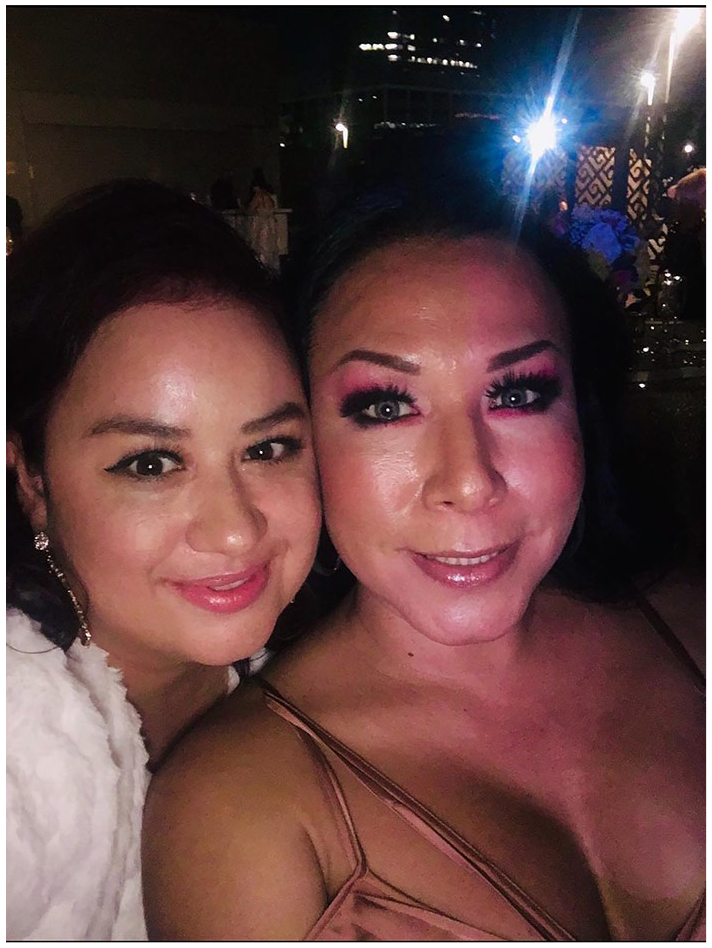
The author (left) and Renata García (right) at a wedding (Los Angeles, USA, 2019)
TransLatina makeup artistry as a decolonial and sacred mandate
In my earlier conversation with Brenda, she communicated that this type of decolonial sociality between the makeup artists and their transgender mentees constitutes a feminist way of knowing that is sacred and fulfilling. Brenda stated: I love doing makeup on the girls. It is part of my job as a mentor and activist. The girls say, ‘I want Brenda to do my makeup’. And, in the gay parade of 2012, Maria Conchita Alonso was there to represent the Latino community, and when she saw me, she immediately said: ‘I want her to do my makeup’.
When I asked Brenda why this is important, that they choose her to do their makeup, she replied: It makes me feel wonderful, that they want my teachings with the makeup. I not only do their makeup, but I teach them how to do it. By teaching them to do their makeup, I give them the weapons [armas] they need in order to go out and show their faces [dar la cara] out in the street. And, one day they will look more beautiful than me, because the student always surpasses her teacher. On the day that the girls tell me, ‘look Brenda, now I can do my makeup by myself’, that day is amazing. It’s an amazing day because I was able to turn tears into a smile and that is the most wonderful gift. At that moment, I feel very grateful to the universe because that is the precise reason I was put on earth.
Brenda’s knowledge of her community strongly resonates with the ways in which Gloria Anzaldúa thought about the sacred ways of making face. Anzaldúa wrote: You are the sharper of your flesh as well as your soul. According to the ancient nahuas, one was put on earth to create one’s face (body) and ‘heart’ (soul). To them, the soul was a speaker of words and the body the doer of deeds. Soul and body, words and actions are embodied in Moyocoyani, one of the names of the Creator in the Aztec framework, ‘the one who invents himself/herself … the builder Kachina himself/herself.’ (Anzaldúa, 1990, p. xvi)
Brenda further theorised making face as a healing practice and as a portal towards social belonging. She argued: When we apply makeup, we are healing our shredded souls. They have been shred to pieces by life circumstances. We have lived a path of roses and thorns, and during that path there are many roadblocks: HIV, substance abuse, immigration inequality, discrimination. All of those things destroy our integrity and our spirits. We are left abandoned and empty inside. But, like the clowns that are sad, and they paint their faces, the same way we paint ourselves to cover our sadness. And, then, we begin to feel beautiful and many more doors open up around us, we are now accepted back into society.
Societal acceptance is not generously distributed to TransLatinas. What is more, the constant battle for humane treatment wears them out and distorts their integrity. However, through makeup practices, they defy the disfiguration of neocolonial dominance. Brenda conveyed this defiance beautifully when she stated: When you apply makeup on pain, when you apply makeup on the imperfections, and you cover up the tears and paint them with beautiful colours, what are you demonstrating? You are demonstrating that you are alive!
I am in awe of the beauty and depth of Brenda’s words. As she pauses her speech, I take a few seconds to enjoy her message. I then think of the many second-wave feminists who essentially dictated that makeup was oppressive. And I ask Brenda one more question. I say, ‘Brenda, tú, eres feminist?’ (‘Brenda, are you a feminist?’). And she responds: ‘Si, feminsta y bastante liberada!’ (‘Yes, feminist and very liberated!’) (see Figure 2).
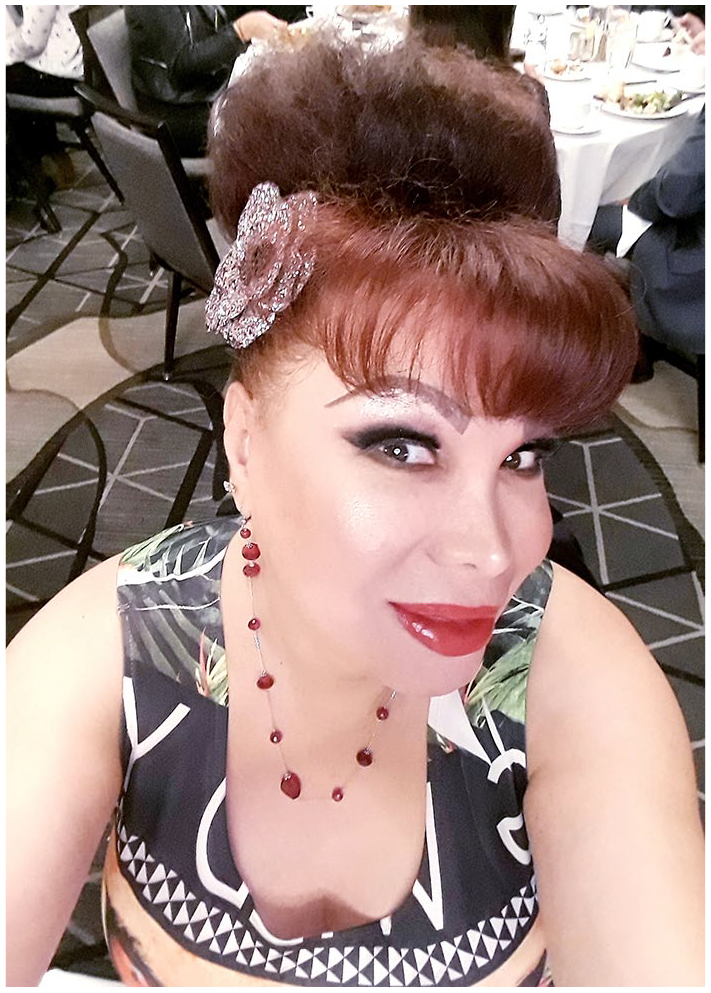
Brenda Del Rio Gonzalez poses for a picture at the start of a TransLatina beauty pageant (Los Angeles, USA, 2017)
conclusion
Speaking of the oppressed class, Memmi (1957, p. 119) said, ‘In all the colonized there is a fundamental need for change’. Decolonial change, he argued, will inevitably come with the revolt of the colonised. Indeed, TransLatina activists constitute a group of people who fight fearlessly against institutional oppression. Yet, they also create sites of bonding and fulfilment through their connections with others in beauty pageants and makeup sessions. By focusing on the intimate practices of makeup rituals, TransLatina activists and makeup artists show us that self-authorship, community-building and deep interpersonal connections are possible through small and profound steps. These are the steps to recover the beauty that colonisation has stolen, and this is why, for Brenda and Renata, to decolonise is to beautify.
Footnotes
Acknowledgements
I would like to express my deep gratitude to Bamby Salcedo, Brenda Gonzalez Del Rio, Renata Garcia and Ryan Lee Cartwright for their support during the writing of this piece.
1
In 1957, Memmi wrote the Colonizer and the Colonized (1957). In it, he drew from personal experience to powerfully theorise the ways in which colonisation shapes the uneven power dynamics between the coloniser and the colonised. As a writer of Tunisian-Jewish origins, Memmi refers to himself as a ‘half-breed of colonization’ (ibid., p. xvi). He wrote this book mainly to understand himself: ‘I simply wanted to understand the colonial relationship to which I was bound’ (ibid.). Nonetheless, he later recognised that his work applied to other people and places also marked by colonialism: ‘It was my readers—not all of them Tunisian—who later convinced me that this portrait was equally theirs’ (ibid., p. viii).
2
Brenda Del Rio Gonzalez, personal communication, 5 March 2015; all of Brenda’s statements included in this text are quoted from this personal communication.
3
Renata García, personal communication, 7 March 2015; all of Renata’s statements included in this text are quoted from this personal communication.