




Abstract
This article proposes to narrow the range of possible meanings for the phrase δɩκαɩοσύνη θɛου̑. Because δɩκαɩοσύνη is the nominalization of an attribute, we have to rule out of bounds any notion of δɩκαɩοσύνη θɛου̑ as a subjective or objective genitive. Once these two options are eliminated, the remaining possibilities for understanding the genitive are significantly narrowed. The article also suggests that Käsemann’s interpretation is still possible even when rendering the phrase as a simple possessive genitive—God’s own righteousness (though the genitive of source is still within the range of possible meanings as well). When interpreted as a possessive genitive, righteousness at its root is an attribute of the divine nature that can stand metonymically for God’s redemptive work through Christ. The article closes with a brief sketch of how this understanding would inform the exegesis of Rom. 1.17 and 3.21-26.
Introduction
Sometimes scholars interpret the New Testament in ways that are too clever by half. There is a tendency to read subtleties into texts that would never have occurred to the original hearers of those texts, much less to the original author. Such is the case with the apostle Paul’s various references to δɩκαɩοσύνη θɛου̑. The history of interpretation of this phrase faces us with a bewildering array of explanations—all of which claim some connection to the historical setting of the author Paul and of his original readers. Whether construed as God’s covenant faithfulness, as God’s saving activity or as a status given to a sinner, scholars can demonstrate how their particular interpretation fits within the thought-world of the original readers and author. But the history of interpretation sometimes shows a tendency to posit meanings for the phrase that are not at all convincing.
What can we reasonably expect Paul’s Roman audience to have understood by the phrase ‘righteousness of God’ as Paul’s words were being read to them? We all know that Paul’s original audience would not have read his letter as modern readers receive and read letters. Paul wrote his epistles with the knowledge that they were to be read aloud in the Christian assembly (e.g., Lk. 4.16; Acts 13.15, 27; 15.21, 30-31; 2 Cor. 3.14-15; Eph. 3.4; Col. 4.16; 1 Thess. 5.27; 1 Tim. 4.13; Rev. 1.3). As Robert Stein (2003: 73-74) has recently reminded us with respect to the Gospel of Mark,
Mark thought of his ‘readers’ as ‘hearers’ having his Gospel read to them…he wrote clearly enough that his hearers would be able to understand what he said as the Gospel was being read to them… Thus Mark, and even Paul’s letters, should be interpreted in light of the ability of their hearing audiences to process the information being read to them, as it was being read.
Stein’s words here should caution us against interpreting Paul’s words in a way that would require more subtlety than even the original hearers would have been capable of. Stein’s caution also reminds us that Paul’s words should be construed in such a way as not to violate the norms of language of his original hearers.
The aim of this article is actually fairly modest. I want to consider the norms of language governing Paul’s use of the programmatic phrase δɩκαɩοσύνη θɛου̑. There are some basic linguistic realities that are often overlooked in the debate over the meaning of δɩκαɩοσύνη θɛου̑, and this oversight has produced interpretations that fall outside of the norms of language for Paul’s use of the δɩκ- word group with genitive modifiers. In this article, I will bring some of these features to the foreground of the discussion and thereby eliminate some of the interpretations currently on offer. I will demonstrate two things concerning the phrase δɩκαɩοσύνη θɛου̑ and Paul’s Roman audience: (1) his audience would not have heard the phrase ‘righteousness of God’ as either a subjective or an objective genitive, but (2) they would have heard δɩκαɩοσύνη as the nominalization of an attribute. These two observations will not enable us to say definitively what the correct interpretation of ‘righteousness of God’ is in Paul’s letters (that is beyond the scope of this short article), but they will help us to rule out some of the more popular interpretations.
The Righteousness of God and Verbal Genitives
Many interpreters begin their discussion of the meaning of ‘the righteousness of God’ (δɩκαɩοσύνη θɛου̑) by laying out the range of possible meanings for the genitive θɛου̑. N.T. Wright (1997: 101), for instance, sets forth in What Saint Paul Really Said four possible ways to understand this genitive: possessive genitive (righteousness as a moral quality of God), subjective genitive (righteousness as God’s salvation creating power), genitive of origin (righteousness as a righteous standing from God) and objective genitive (righteousness as a quality which comes before God or avails with God). 1
Other interpreters focus almost exclusively on the subjective versus objective options. 2 Dunn (1988: 41) notes, for example, that the debate over the subjective/objective renderings has ‘troubled Christian theology for centuries’. An exhaustive summary of those who elevate these as the two main options is beyond the scope of this article. I will mention three here for the sake of illustration. The first example that I would mention appears in E.P. Sanders’ Paul and Palestinian Judaism (1977), in which Manfred Brauch (1977: 523-24) contends that the ‘voluminous literature’ on the meaning of ‘the righteousness of God’ is due in part to disputes about ‘how the genitive construction dikaiosunē theou is to be interpreted… Is dikaiosunē theou to be understood as an objective genitive, i.e. the righteousness given to man by God and which counts before God? Or are we to interpret the construction as a subjective genitive, referring to God’s own righteousness, describing either his being…or his action…or both his being and action?’
A second example we might note occurs in Ernst Käsemann’s (1969: 169) watershed essay ‘The Righteousness of God’ in Paul,’ in which he argues that the first problem the interpreter faces when looking at this genitive construction is whether it ‘is to be construed as subjective or objective’. Is it ‘the righteousness which belongs to God and proceeds from him’ (subjective)? Or is it ‘the righteousness which is acceptable in God’s eyes and bestowed by him upon us’ (objective). Of course Käsemann (1969: 174) opts for the subjective genitive interpretation and in light of Old Testament and apocalyptic parallels defines ‘the righteousness of God’ as a ‘phrase expressing divine activity’. 3 A third and more recent example appears in Robert Jewett’s massive commentary on Romans. Jewett (2007: 142) also cites the subjective and objective interpretations as the two main options, and then follows Käsemann in rendering the phrase as a subjective genitive—‘God’s activity in this process of global transformation’.
Advocates of the objective genitive interpretation are few and far between, though commentators sometimes mistakenly attribute the view to Martin Luther. Luther is famous for rejecting the medieval interpretation of God’s righteousness as an attribute (i.e., his iustitia distributiva or ‘distributive justice’) 4 in favor of the interpretation that appears in his translation of Rom. 1.17, ‘die Gerechtigkeit, die vor Gott gilt’ (the righteousness that counts before God). Fitzmyer (1993: 260) describes Luther’s interpretation this way: ‘In time Luther came to understand dikaiosynē theou as an objective gen., “die Gerechtigkeit, die vor Gott gilt” (the justice that counts before God), i.e., the uprightness that a human being enjoys as a gift from God.’ Though Fitzmyer explains Luther’s interpretation as an ‘objective genitive’, the label is likely mistaken. Nevertheless, Fitzmyer shows that the objective genitive interpretation can be misunderstood even as it is considered within the range of possible meanings for this phrase. The relevant point for our purposes is this: in laying out the range of possible meanings of δɩκαɩοσύνη θɛου̑, interpreters usually highlight the subjective and objective genitive interpretations either as the main options or as among the main options.
What I am proposing in this article is this: neither the subjective interpretation nor the objective interpretation makes linguistic sense, and we should remove these two options from among the range of possible meanings for δɩκαɩοσύνη θɛου̑. The question of a subjective versus an objective genitive relies entirely on the supposition that the head noun δɩκαɩοσύνη implies a verbal idea. But we have ample reason to question this assumption, and indeed we shall see that the assumption is altogether unjustified. To that end, we need to take a look briefly at two things: (1) the way that verbal genitives work in Greek and (2) the significance of the -σύνη suffix in the head noun δɩκαɩοσύνη.
Verbal Genitives in Koine Greek
How, then, do verbal genitives work in Greek? A genitive can be construed as subjective or objective only when it modifies a noun that implies a verbal idea. This was the case in classical Greek, 5 and so it was also in Koine. That is why C.F.D. Moule comments in his Idiom Book that the head-nouns in subjective and objective genitives imply ‘action’ and represent a related ‘verb’. 6 Wallace (1996: 112-13, 117) categorizes subjective and objective genitives as ‘verbal genitives’ because the head noun must have a verbal idea implicit in it. Wallace argues that the ‘verbal genitive construction, then, is a sentence embed involving, typically, a transitive verbal idea in the head noun’. 7 Richard Young (1994: 29ff.) likewise categorizes these genitives as ‘Genitives Functioning in Deep Structure Event Clauses’—that is, as genitive nouns dependent upon verbal head nouns.
This observation (found here and there in the standard NT grammars) is good so far as it goes, but it does not go far enough. Exegetes (and some grammarians) sometimes make the mistake of thinking that verbal ideas inhere in any noun that has a cognate verb related to it. Consider, for instance, Daniel Wallace’s description of subjective and objective genitives. Wallace (1996: 112) says, ‘The subjective, objective, and plenary genitives are used with head nouns that involve a verbal idea. That is, the head noun has a verb as a cognate (e.g., βασɩλɛυ̑ϛ has βασɩλɛύω as cognate).’ I would suggest, however, that the implied verbal idea does not rely on whether or not the noun in question has a verbal ‘cognate’. The primary issue is whether the noun in question derives from a verb. This is why Richard Young’s (1994: 29) recommendations for identifying verbal nouns are particularly insightful: ‘Discerning what should be considered verbal nouns in a particular text is not simple. Nouns with endings that name actions (-σɩϛ, -μοϛ) or agents (-τηϛ, -τηρ, -τωρ, -ɛυϛ) are usually verbal nouns. Those which are built of verb stems…are often verbal nouns.’ As far as the δɩκ- word group goes, there is a nominalized form of the verb δɩκαɩόω, but it is not δɩκαɩοσύνη. The nominalized form of δɩκαɩόω is δɩκαίωσɩϛ. 8 Nouns terminating with the -σɩϛ suffix derive from verbal forms and they denote the nominalization of verbal action. Nouns that end with the -συνη suffix (like δɩκαɩοσύνη) do not derive from verbs nor do they denote verbal action. The upshot of this observation for our purposes is that δɩκαɩοσύνη θɛου̑ can be neither a subjective nor an objective genitive phrase, given that the head noun is not verbal. 9 That is why Roger Omanson’s explanation of the righteousness of God in a 2004 article would have been totally incomprehensible to an original hearer of Paul’s letters. Omanson (2004: 345) says that ‘the word theou functions in some way as the subject of the word righteousness [taking theou as a subjective genitive]’. 10 The noun δɩκαɩοσύνη is not the nominalization of verbal action, so it cannot have an implied subject.
The Significance of the -συνη Suffix
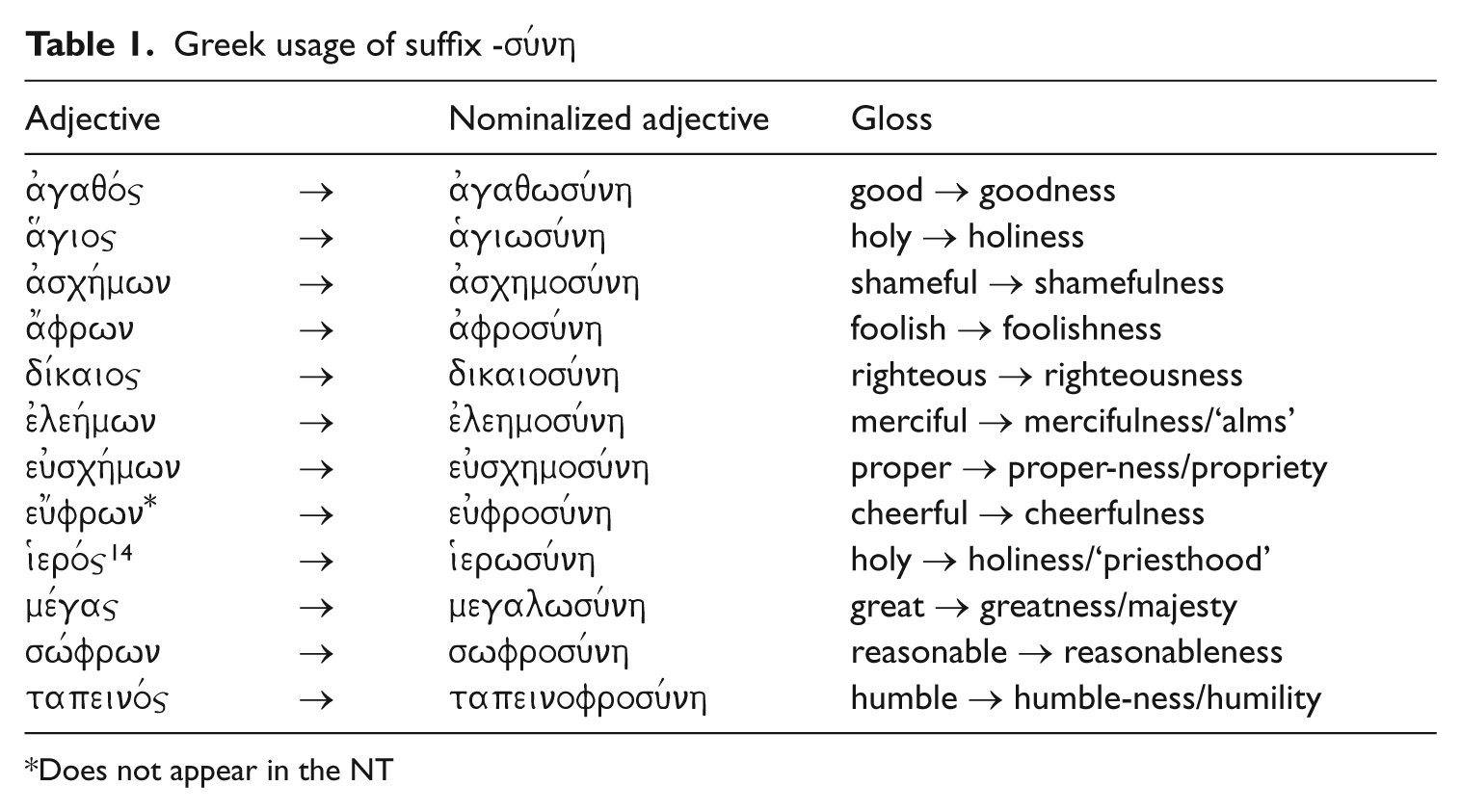
What, then, is the significance of the noun δɩκαɩοσύνη? If it is not the nominalization of verbal action, then what is it? δɩκαɩοσύνη belongs to a class of Greek nouns that derive from adjectives. The -συνη suffix in Greek corresponds roughly to the -ness suffix in English. As with the English -ness suffix, the Greek suffix -συνη attaches to adjectives to make them into nouns. The result is not the nominalization of verbal action, but the nominalization of an attribute or quality. The suffix -συνη functioned in a similar way in Koine Greek. 11 The -συνη suffix is appended to adjectives ending in -οϛ in order to make an adjectival quality or attribute into a noun. 12 Pierre Chantraine (1933: 211) says that nouns ending in -συνη tend to indicate the qualities or defects of a person’s character—one’s talents, abilities, or feelings. 13 There are twelve such -συνη nouns in the New Testament, and all but one of them (ταπɛɩνοφροσύνη) are also used in the LXX.
What all of these examples have in common is that the -συνη suffix nominalizes the quality or attribute signified by the adjective and that none of them denotes verbal action. 15 When Käsemann and his followers argue that δɩκαɩοσύνη would have been heard as denoting ‘saving action’, they are actually making a claim that would have been counter-intuitive to Paul’s original audience. Because this suffix was productive in the Koine period, Paul’s hearers would have heard nouns ending in -συνη in much the same way that English speakers hear nouns ending in -ness. Such nouns were heard as the nominalization of an attribute or quality, not of verbal action.
I can imagine some objections that one might have to what I have been arguing thus far. After all, Käsemann’s subjective genitive interpretation derives not so much from a linguistic observation as from a theological one. 16 Käsemann and his followers have been careful to observe how δɩκαɩοσύνη translates the Hebrew terms קךצ and הקךצ both in the Old Testament 17 and in second temple Judaism, where God’s righteousness is a virtual synonym for his saving activity. Thus Stuhlmacher (2001: 19) writes, ‘“God’s righteousness” in the Old Testament and early Judaism means, above all, the activity of the one God to create welfare and salvation in the creation, in the history of Israel, and in the situation of the (end-time) judgment.’ The objection goes, then, that the linguistic point is moot because the normal sense of δɩκαɩοσύνη has been swallowed up by its interface with Judaism (both in the OT and in second temple materials). Thus God’s δɩκαɩοσύνη must be defined as God’s activity in saving his people.
This objection is mitigated, however, by the fact that the actual phrase ‘righteousness of God’ never appears as such in all the Old Testament texts cited as parallels. In addition, we are lacking some of the linguistic signals that we would expect if such a definition for δɩκαɩοσύνη were really the case in the Old Testament. In his 1991 study in the journal Colloquium, Moore (1991: 63) says what those signals would be:
To establish beyond doubt that such activity is equivalent to Pauline usage, if [sic] would be necessary to show that in such cases the authors of Psalms and Isaiah were using δɩκαɩοσύνη simply as a substantivized form of the divine activity of δɩκαɩου̑ν in the sense that Paul uses that verb in ‘justificatory’ contexts. However, δɩκαɩου̑ν occurs infrequently in the Psalms and in Isaiah, and in the sense ‘vindicate, do justice for’, never in the sense of ‘“righting” the ungodly’ as in Rom 4:5. Consequently, such a link cannot be made.
I would add to Moore’s observation one other important point. The selection of δɩκαɩοσύνη on the part of the LXX translators is surely significant. It gives us a glimpse into how they were interpreting the Hebrew terms קךצ and הקךצ. If the LXX translators of Psalms and Isaiah had intended verbal action, then why did they not employ the noun δɩκαίωσɩϛ (which indicates nominalized action)? Should not their selection of δɩκαɩοσύνη (which every Greek reader would have heard as a nominalized attribute or quality) be taken as an early interpretation of the Hebrew texts—an interpretation that perhaps Paul himself adopted and that points us to righteousness conceived of as an attribute?
All of these observations must have an impact on how we read and understand the genitive θɛου̑ in the phrase righteousness of God. If what I have been arguing thus far is true, then we have to narrow the range of possible meanings for the genitive. We are not here dealing with verbal action (such as saving activity or even justifying activity), and thus we cannot interpret the phrase as either a subjective or an objective genitive.
I would argue that δɩκαɩοσύνη is related to the concept denoted by the verb δɩκαɩόω, but not in the way described by the Käsemann school. With that we turn to a closer examination of δɩκαɩοσύνη as a nominalized attribute.
The Righteousness of God as an Attribute
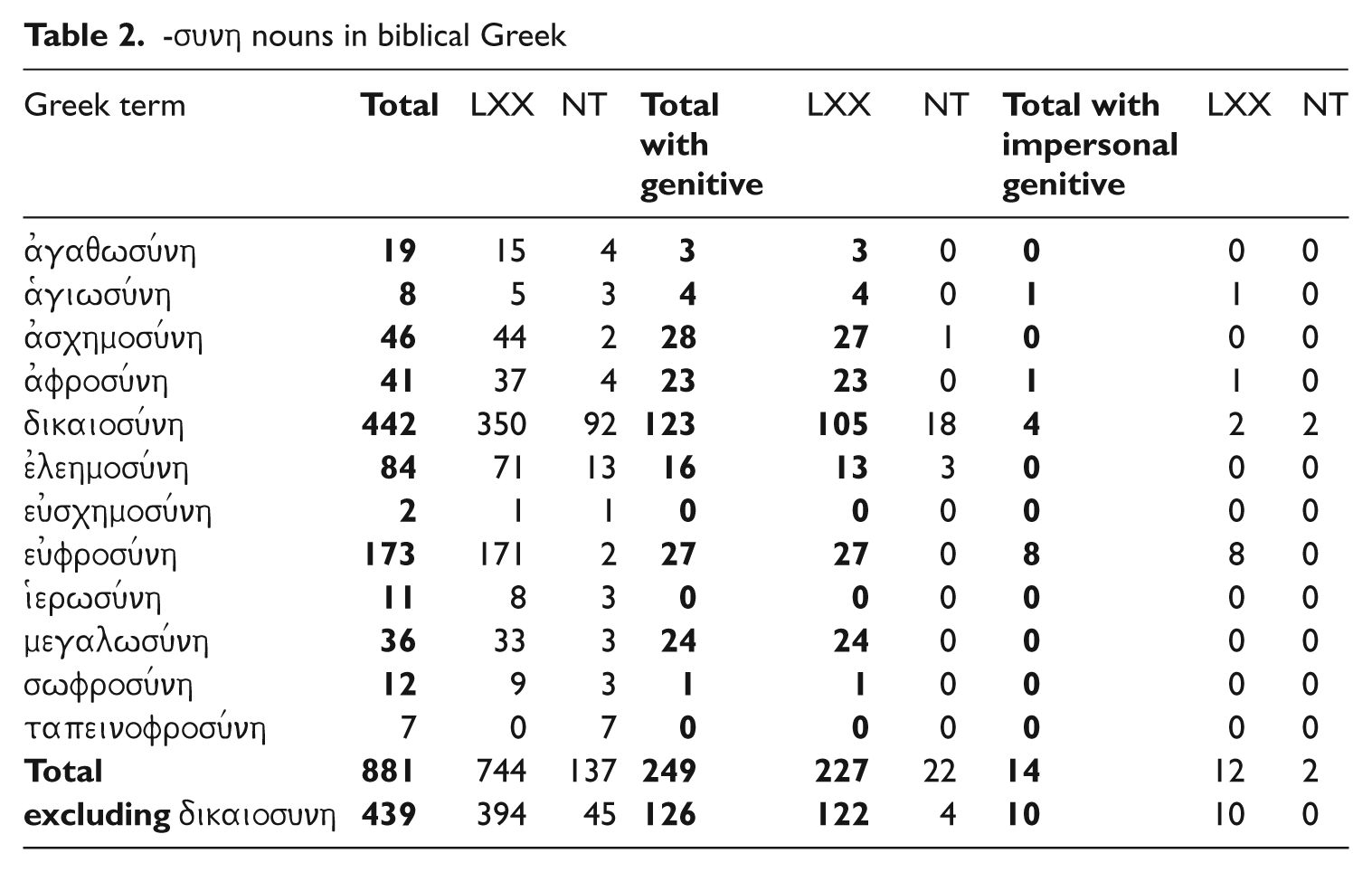
One might assume at this point that I have eliminated Käsemann’s interpretation altogether as a possibility. In fact, I have not. But before I can explain how this can be, we will need to take a look at how other -συνη nouns work in biblical Greek. Such a comparison will shed some light on our word δɩκαɩοσύνη. A computer search of all the -συνη nouns in biblical Greek has yielded the results in Table 2.
Greek usage of suffix -σύνη
Does not appear in the NT
-συνη nouns in biblical Greek
Exceptions to the pattern

The computer search reveals an interesting pattern when it comes to -συνη nouns and genitive adjuncts. As we noted earlier, there are 12 -συνη nouns that appear in biblical Greek. There are 881 occurrences of these 12 nouns across the whole terrain of biblical Greek. If we exclude δɩκαɩοσύνη, there are 439 occurrences. Of those 439 occurrences, 126 have a genitive modifier. Only 10 of the 126 have an impersonal genitive modifier. 18 All the rest have genitive modifiers that are personal. In the overwhelming number of instances of these -συνη nouns, a personal attribute is in view. My search results and complete listing of -συνη nouns with genitive modifiers are available online, 19 but here are some representative examples:
In light of the pattern seen among other -συνη nouns in biblical Greek, we are on firm ground in observing that both the original hearers of the LXX and that of Paul would have heard the nominalization of an attribute in the use of -συνη nouns such as δɩκαɩοσύνη.
We might also note an apparent exception to the pattern we have seen here. Two of the twelve -συνη nouns appear to denote not an attribute but something else.
So, for example, in Mt. 6.2, ἐλɛημοσύνη refers to alms, ‘When therefore you give alms [ἐλɛημοσύνην], do not sound a trumpet before you, as the hypocrites do.’ So also Heb. 7.12, ‘For when the priesthood [ὁɛρωσύνηϛ] is changed, of necessity there takes place a change of law also.’ The regular usage of these two nouns in this way would appear to undermine my thesis thus far since alms and priesthood are not nominalized adjectives. But appearances can be deceiving, and they are in this instance. In each of these texts there is a metonymical idiom in play. In the case of ἐλɛημοσύνη, the attribute of mercifulness stands metonymically for ‘alms’. In the case of ὁɛρωσύνη, holiness (or perhaps priestliness 20 ) stands metonymically for ‘priesthood’. So the root of both expressions is in fact an attribute, though the idiom substitutes a personal attribute for a related noun. 21
These observations about -συνη nouns in general are helpful as we consider how to interpret δɩκαɩοσύνη θɛου̑. The ‘righteousness of God’ could be standing metonymically for another noun that is closely related to it. So it may very well be that the Old Testament background for the term ‘righteousness’ does inform Paul’s use of the term and his readers’ understanding of it. For example, consider Ps. 97.2.
Whereas a follower of the Käsemann school might look at this verse and simply conclude that righteousness equals saving activity, I would argue for a more subtle link between these parallel lines. Righteousness here is an attribute of God that stands metonymically for God’s salvation. It is God’s righteous nature that motivates his salvific and redemptive acts. The presence of a metonym means that we do not have to pick between righteousness as an attribute and righteousness as saving activity. The former grounds and motivates the latter.
If Paul’s readers were informed by this understanding of righteousness, then Paul’s use of the term both in and out of the phrase righteousness of God becomes a little more intelligible. Let me sketch in brief how this would work out in the interpretation of Paul’s righteousness language in Rom. 1 and 3. In Rom. 1.17, Paul says that the righteousness of God is revealed in the gospel. If we take θɛου̑ as a simple possessive genitive, then Paul would be saying that God’s own attribute of righteousness is revealed in the gospel. Since Paul has already defined the ‘gospel’ by the narrative of events surrounding the life and work of Jesus (Rom. 1.1-4), then Paul would be saying that God’s righteousness is somehow revealed in Christ’s redemptive work in behalf of his people. Thus God’s righteousness is at its root an attribute of the divine nature, but it is also that which grounds and motivates the saving events that are narrated in the gospel of Jesus Christ. His righteousness is a metonym for his saving activity through Jesus. I think many commentators sense the connection I am talking about here, even if they do not identify the metonymical idiom as such. For instance, Joseph Fitzmyer (1993: 257) makes these comments on Rom. 1.17, ‘When dikaiosunē is called an attribute or quality, nothing static is implied; it is an aspect of God’s power, whence proceeds his acquitting and salvific activity in a forensic mode.’
The question remains as to how the gospel events reveal God’s attribute of righteousness. Paul answers this question most fully in Rom. 3.21-26. Paul refers to God’s righteousness four times in these verses: twice as δɩκαɩοσύνη θɛου̑ (vv. 21, 22) and twice as δɩκαɩοσύνη αὐτου̑ (vv. 25, 26). In all four cases I would argue that the root meaning of the two expressions is a personal attribute of God himself—as Moo (1996: 219) says it, ‘the integrity of God, his always acting in complete accordance with his own character’. In citing Moo, I would point out, however, that missing the presence of the metonym confuses his explanation of Paul’s meaning. Moo (1996: 219) argues that the references to ‘the righteousness of God’ in vv. 21 and 22 denote God’s ‘eschatological justifying activity’, but that the latter two references in vv. 25 and 26 refer to God’s ‘integrity’. In other words, the first two instances refer to verbal action while the latter two denote an attribute of the divine nature. But Moo here does not adequately justify making righteousness mean one thing in vv. 21 and 22 and something substantially different in vv. 25 and 26. I think in the end the switch can be justified on the grounds that the attribute in vv. 21 and 22 stands metonymically for God’s justifying action, while in vv. 25 and 26 the metonym is absent. This interpretation has the great advantage of allowing us to see consistency between vv. 21-22 and vv. 25-26. There is not an inexplicable disjunction (as Moo has it) between the meaning of δɩκαɩοσύνη in vv. 21-22 and its appearance in vv. 25-26. It denotes an attribute of God in each instance.
If this interpretation is correct, then v. 21 says that God’s righteousness (his justifying work through Christ) has been made manifest, having been foreshadowed in the Old Testament. In v. 22, this justifying work accrues to the sinner’s benefit through faith in Christ. In v. 24, Paul says that sinners are ‘justified’ (δɩκαɩόω) by grace through the redemptive work of Jesus. Verse 25 says that the price of redemption was nothing less than Christ himself bearing the wrath of God in place of sinners. Christ takes this wrath upon himself in order to demonstrate God’s ‘righteousness’ (his attribute of integrity). God’s integrity appeared to be in question since God had a long record of forgiving sinners their sins. How can a judge be righteous if he unilaterally acquits known law-breakers? Paul’s answer to this question is the cross of Jesus Christ. God demonstrates his ‘righteousness’ (his attribute of integrity) in the present time by exacting payment from his Son Jesus. Thus God proves that he is both ‘just’ and the one who ‘justifies’ sinners by faith. This last line confirms the interpretation advanced thus far. God is concerned to be seen as ‘just/righteous’. There is an attribute that he aims to put on display in the salvific events of the gospel, and that attribute is righteousness—the ground and the motive for his grace to sinners through Christ.
If δɩκαɩοσύνη is the nominalization of an attribute not an action, one other rendering of the genitive is also possible—the genitive of source or origin. In this case, the translation would be something like ‘righteousness from God’. The interpretation would be akin to the ‘objective genitive’ view associated with Luther, but only by implication. It would be a righteous status that comes from God as a gift and which (by implication) would avail before God at the judgment. Once again, this expanded meaning would not be indicated by the mere lexicographical data, but by an understanding of Paul’s larger theological framework.
Conclusion
The aim of this article has not been to establish definitively either the possessive or source genitive interpretations. That argument will have to wait for another essay. My purpose has simply been to narrow the field of possible interpretations so as to provide clarity in the ongoing debate. I have suggested an interpretation of God’s righteousness that relies heavily on the analysis of δɩκαɩοσύνη as the nominalization of an attribute. If this interpretation is correct, then we have to rule out of bounds any notion of δɩκαɩοσύνη θɛου̑ as a subjective or objective genitive. Once these two options are eliminated, the remaining possibilities for understanding the genitive are significantly narrowed. I have shown how Käsemann’s interpretation is still possible even when rendering the phrase as a simple possessive genitive—God’s own righteousness (though the genitive of source is still within the range of possible meanings). When interpreted as a possessive genitive, righteousness at its root is an attribute of the divine nature that can stand metonymically for God’s redemptive work through Christ. I have only sketched briefly how this might work out in Rom. 1.17 and 3.21-26, but I think the hypothesis has great explanatory power for Paul’s righteousness language elsewhere.
Footnotes
1.
Williams (1980: 241) identifies three main options: objective genitive, subjective genitive and genitive of origin. Eleven years later, Moore ( : 59, 64-65) argued that Williams’s range of possible meanings should be expanded to include the following: subjective genitive, genitive of origin/author, objective genitive, genitive of relationship, genitive of respect.
2.
This may be due to the way that verbal genitives are explicated in some of the grammars, e.g. Moulton 1963: 207: ‘For practical purposes perhaps the only real division among the genitives is that between subjective and objective.’ See also : §36: ‘Among the various usages into which grammarians have classified the immense variety of the genitive, the clearest and most useful are perhaps the two distinguished as “subjective” and “objective”.’
3.
Käsemann (1969: 174) writes, ‘The apostle describes God’s saving activity as righteousness.’ Käsemann also describes God’s righteousness as transformative, not as forensic. Thomas Schreiner (: 192-209) argues convincingly against Käsemann on this point.
4.
Fitzmyer (: 261) writes, ‘Luther was partly reacting against the idea of iustitia as a divine attribute, as medieval theologians had often taught, and partly against the idea that iustitia denoted God’s punitive activity. But in rejecting the Scholastic notion of attribute and preferring to interpret dikaiosunē theou in the Augustinian sense of a gift coming from God, Luther did away with two things. He not only rightly rejected the punitive idea of iustitia, but also the idea of iustitia as a divine attribute and, following Augustine, made of it a gift that God communicates to sinful human beings.’
5.
6.
7.
8.
Moulton-Howard (1929: 355, 373, 374) comments on the suffix -σɩϛ, which is termed a ‘nomen actionis’: ‘A very productive suffix from the I.E. period in the formation of primary verbal abstracts (nomina actionis) of the feminine gender’. Some words have -σɩϛ attached directly to the root or base. ‘This suffix was then attached to denominative verbal stems, especially when the existing noun from which the verb was derived did not convey the abstract verbal meaning’ (373). Moulton says the -σɩϛ suffix was used in nouns formed from verbs ending in -οω. Among the nouns listed in this group is δɩκαίωσɩϛ (373). Cf. Robertson 1934: 151; BDF 1961: §109 [4]. Translating δɩκαίωσɩϛ as ‘justification’ is appropriate, given that ‘justification’ is what grammarians call a nomen actionis (or verbal abstract) form of the verb justify. See : 355.
9.
Moore (: 64) makes the same linguistic point that I am making here, though he only applies it to the subjective genitive and he does not discuss the significance of noun suffixes in Greek: ‘It is clear that it is appropriate to apply this term only to nouns which function as substantivized verbs, i.e., cases in which “action” is expressed by means of a noun.’
10.
11.
12.
13.
Chantraine 1933: 211: ‘Pour le sens il apparaît que ce suffixe ne fournit pas n’importe quelle sorte d’abstraits, mais désigne surtout les qualités ou les defauts d’un individu, ses talents ou ses aptitudes, ses sentiments.’ The -σύνη suffix was still productive in the Koine period. See also BDF 1961: §110 [2]: ‘-σύνη is used to form a few qualitative abstracts’. Robertson (1934: 156) classifies -σύνη as a suffix ‘expressing quality’ and says that ‘with -σύνη several new words occur from adjectives in -οϛ with the lengthening of the preceding vowel.’ Cf. : II, 358.
14.
15.
In the instances of ἐλɛημοσύνη and ὁɛρωσύνη, the nominalized attribute becomes a metonym for something closely associated with it: mercifulness stands for alms and holiness stands for priesthood. Viewed this way, they are not exceptions. BDAG glosses ἐλɛημοσύνη with ‘exercise of benevolent goodwill, alms, charitable giving’, which might suggest a verbal idea inhering in the term itself. But the idiom is literally ‘to make/perform alms’ (ποɩɛɩ̑ν ἐλɛημοσύνην), and thus the verbal idea in the gloss most likely derives from ποɩɛɩ̑ν not ἐλɛημοσύνην. See BDAG, s.v. ἐλɛημοσύνη, 1. In earlier periods of Greek literature, there are examples of -συνη attaching to nouns that derive from verbs. But even in these instances, Buck and Petersen (: 289) note that the resulting idea is not verbal: ‘Semantically they are abstracts which, although of secondary origin, have a tendency to a dynamic meaning and so to approach the verbal abstracts in their uses, but without the verbal associations of the latter.’
16.
: 173 n. 4: ‘I, too, am bound to make a question of translation into a theological decision. At this point philology and the history of ideas prove broken reeds because, if we confine ourselves to the insights they provide, both solutions appear acceptable. The whole of the apostle’s theology has now to be subpoenaed in order to reach the correct translation of a single word and, conversely, the correct translation of this one word determines, as I see it, the whole of the apostle’s theology.’
17.
The phrase δɩκαɩοσύνη θɛου̑ never appears in the Old Testament. The ‘righteousness of the Lord’, however, appears twice: 1 Sam. 12.7 and Mic. 6.5. There are about 18 passages in which righteousness appears with a personal pronoun that has God as its antecedent: Pss. 22.31; 35.28; 40.10; 51.14; 69.27; 71.15, 16, 19, 24; 88.12; 98.2; 119.123; Mic. 6.5; Isa. 51.5, 6, 8; 46.13.
18.
2 Macc. 3.12; Wis. 12.23; Esth. 1.4; Isa. 24.8; 32.14; 35.7; Lam. 2.15; Ezek. 35.14. Nevertheless, in each one of these texts, the -συνη attribute is referring to a personal attribute or is used in the figure of speech known as personification.
19.
20.
As noted above, Howard (Moule-Howard 1929: 358) thinks ὁɛρωσύνη is from ὁɛρɛύϛ. Thus ὁɛρɛύϛ → ὁɛρωσύνη which would suggest the gloss priest → priestliness/priesthood.
21.
See David Crystal’s (2001: 216) definition of metonymy: ‘A figure of speech in which the name of an attribute of an entity is used in place of the entity itself.’ Note also Bussmann’s (: 305) description of the figure: ‘The replacement of an expression by a factually related term. The semantic connection is of a causal, spatial, or temporal nature and is therefore broader than synecdoche, but narrower than metaphor.’ The metonymical meaning of a term can become so well established that it becomes a part of its lexical meaning (as in the case of ἐλɛημοσύνη). It does not follow, however, that such nouns should be construed as a nomen actionis in relation to genitive adjuncts. This is especially the case with δɩκαɩοσύνη θɛου̑ and δɩκαɩοσύνη αὐτου̑ in which the metonymical meaning attaches to the phrase and not to the noun alone.