



Abstract
Recent analyses of the Gospel of Thomas by Mark Goodacre and Simon Gathercole make only a partial and, in several instances, unconvincing case for Thomas’s knowledge of the Synoptic Gospels. Other neglected data suggests that some portions of Thomas are substantially autonomous. This calls for a more complex understanding of the composition of Thomas, one that recognizes its construction as a ‘school text’ or ‘anthology’, drawing on multiple and parallel streams of the Jesus tradition.
Keywords
The Synoptic Problem, which had its origins in the late eighteenth century in the works of J.J. Griesbach, G.E. Lessing and J.G. Eichhorn, has traditionally been restricted to the investigation of the literary relationships among the first three canonical Gospels. 1 In recent years, however, there has been not only renewed attention to exploring solutions to the Synoptic Problem beyond the still-dominant Two Document hypothesis, 2 but additional quests for understanding the relationship of the Synoptics to John, 3 the Didache, 4 Longer (Secret) Gospel of Mark, 5 the Gospel of Peter 6 and the so-called Jewish Christian gospels. 7 One of the most hotly debated ‘Synoptic Problem’ issues has become the relation of the Gospel of Thomas to the Synoptic Gospels.
The enlarged ‘Synoptic Problem’ is consequential for historical reasons, for if Thomas and any of the other above-mentioned documents show no knowledge of, or dependence upon, the Synoptic Gospels, they might provide other windows onto the Jesus tradition. On this view, scholars such as John Dominic Crossan, Robert Funk and many others have utilized the Gospels of Thomas and Peter in their reconstructions of the historical Jesus and the early Jesus tradition. An independent Thomas played a critical role in the articulation of the model of ‘trajectories’ proposed forty years ago by James M. Robinson and Helmut Koester (1971), but also taken up by theologians like Edward Schillebeeckx, whose book on Christology was deeply influenced by the idea of multiple primitive Christological configurations (1979). This model does not award unique privilege to Jesus’ death as the core and centre of all Christian theologizing, but instead imagines multiple conceptual frameworks in which to conceive the significance of Jesus, including scenarios of apocalyptic rescue, Torah scholarship, thaumaturgy, sapiential instruction and the revelation of hidden wisdom.
If Thomas and the others are entirely dependent on, and hence posterior to, the Synoptic Gospels, the case for other independent lines of access to the early Jesus tradition disappears and the ‘trajectories’ model requires some adjustment. It is not that the conceptions of Jesus as the purveyor of special wisdom or as a heavenly revealer disappear entirely; there are still hints of Jesus-as-Sophia embedded in Matthew (Deutsch 1996) and the heavenly revealer is clearly present in the Gospel of John. But with a late and dependent Thomas, the ‘trajectories’ model would lose one of its earliest and pristine examples of Jesus as a wisdom figure, and the Jesus-as-revealer model could easily be dismissed as a later aberration rather than as one of the earliest generative soteriological models.
The debate is consequential for theological reasons as well. Goodacre is aware of the linkage between the question of Thomas’s status and American evangelical scholars, frightened of deep theological diversity at the earliest stages of the Jesus movement and wedded to the notion that only the documents that were canonized in the fourth century should be used for constructing the historical Jesus and the main lines of early Christian theologizing. 8 To his credit, Goodacre insists that he is not engaged in such theological identity politics, and this indeed seems to be the case. It is, nevertheless, important to keep in mind that the question of Thomas’s dependence or independence is not innocent of theological investment.
The two volumes under review, Goodacre’s Thomas and the Gospels: The Case for Thomas’s Familiarity with the Synoptics (2012) and Gathercole’s The Composition of the Gospel of Thomas: Original Language and Influences (2012), have both certain similarities and very substantial differences. Both argue that Thomas betrays knowledge of the Synoptics and cannot therefore be regarded as an early, autonomous witness to the Jesus tradition, at least as far as those sayings with Synoptic parallels are concerned. Both try to avoid the claim that Thomas is ‘dependent’ on the Synoptics in the way that Matthew, on the 2DH and the FH, is dependent on Mark, where one imagines Matthew copying significant chunks of Mark. Both build a good portion of their case on the similarities between the Oxyrhynchus fragments and the texts of Matthew and Luke, in order to forestall the objection that similarities with the Synoptics exist only at the level of the fourth-century Coptic text, where one might reasonably expect some harmonization with the better-known canonical Gospels. Both reject—rightly in my view—the older arguments for the independence of Thomas that appeal to supposed unidirectional ‘laws’ of development in the Jesus tradition, whereby shorter formulations are always prior to longer versions. Finally, both treat Thomas as a unified document, thus avoiding the possibility, raised by a number of scholars, that as a composite or layered document, Thomas might reflect Synoptic influence in some of its compositional moments but not in others.
Scribalism vs Secondary Orality
There are some important differences, however. For Goodacre, Thomas has ‘knowledge’ of the Synoptics, ostensibly on the analogy of debates about John’s knowledge of the Synoptics which does not thereby turn John into a ‘derivative’ gospel.
9
Nevertheless, as his book progresses, it is in fact about ‘dependence’, although Goodacre’s preferred term is that there is a ‘direct link’ between Thomas and Matthew and Luke.
10
In his summary of how Thomas worked, Goodacre adopts an essentially linear and scribal model: [T]he author is highly likely, on occasions, to have consulted the Synoptic Gospels directly. These will be occasions where the author has obtained a copy of Matthew or Luke, either his own or copies belonging to his church or community, and has looked up a passage in order to check the wording (p. 150).
In order, however, to account for the almost complete disagreement between Thomas and the Synoptics in the sequence of materials, he then suggests that Thomas sometimes accessed the Synoptics via memory, extracting sayings and juxtaposing them through his own associative preferences. The disagreements in sequence are also due to Thomas’s adoption of the genre of a sayings collection, which allowed Thomas to present sayings in whatever order he chose. Variations from the Synoptics in wording are a function of memory distortion and deliberate redaction (pp. 151-53).
Goodacre’s ‘scribal’ approach is related to another aspect of his argument. Anticipating the objection, ‘Yes, Thomas betrays knowledge of the Synoptics at a few places, but in other sayings is independent of the Synoptics’, Goodacre invokes what he called the plagiarist’s charter: ‘If twenty percent of a student’s essay shows clear signs of plagiarism, it would be no counterargument for the student to complain that the remaining eighty percent of the essay was his or her own work’ (p. 45).
The analogy fails. With undergraduate plagiarism, we have the ‘autograph’ (i.e., the student’s paper); we have access to the sources (a printed scholarly article or book or, more likely, Wikipedia); we know the chronological relationships between the paper and its sources (because we know that the paper was prepared shortly before the due date—probably the night before); and we know the vector of usage (i.e., how the source arrived in the paper). 11 In the case of early Christian material, we know none of this. We have neither the ‘autograph’ of Thomas (allegedly the secondary text) nor autographs of its supposed sources; we have at best third- or fourth-hand copies of each. We do not have a secure idea of the temporal relationships between Matthew and Luke, or between Thomas and the other two, and the common assumption that ‘canonical’ works must be chronologically prior to extracanonical works should be rejected as theologically freighted and historiographically fallacious. And we have no idea at all of the vector by which a source text reached its secondary users or of the compositional moments of Thomas or the Synoptics. 12 What we do know is that the earliest phase of transmission of early Christian documents was fluid, with plenty of cross-fertilization and cross-contamination such that modern text-critical methods always produce an eclectic reconstruction of the ‘initial text’ (not a putative Urtext) from multiple divergent witnesses. To use the analogy of physics, the earliest phase of the transmission of materials is not like electrons as determinate objects circling a nucleus in discrete, linear orbits, but clouds of probabilities. It is precisely our lack of knowledge of the autographs of the Synoptics and our lack of knowledge of transmissional and performative processes that leaves the Synoptic Problem as yet a problem, and which also leaves the tantalizing agreements between John and the Synoptics as less than compelling evidence of John’s ‘direct’ knowledge of the Synoptics and leaves the issue of Thomas’s sources as a problem. These unresolved problems probably mean that we need a more complex model of textual interactions to account for the present state of texts, rather than simply embracing the simple, linear Newtonian models currently available, a point to which I will return later.
Instead of thinking in linear and scribal terms, Gathercole routinely invokes the model of secondary orality 13 —the notion that Thomas, without having a direct literary dependence on the Synoptics, has been influenced by the re-oralization of Synoptic sayings. 14 For example, apropos of the ‘confession scene’ in Gos. Thom. 13.4-8, Gathercole argues, following Uro, that although there is ‘dependence’ on Matthew, Thomas is not a consequence of ‘a “scribal reworking” [of Matthew] but rather of “the influence of Matthew’s literary redaction on the oral tradition drawn upon by Thomas”’. 15 In the case of Luke, Gathercole doubts that Thomas knew Luke ‘as an evangelist’, but nonetheless betrays the ‘influence of Luke upon the memory behind Thomas’ (p. 220).
Goodacre objects strenuously to the appeal to ‘secondary orality’ along with his rejection of ‘primary orality’—that is, the notion that Thomas’s variations from the Synoptics point to the use of oral tradition independent of, and prior to, the Synoptics. He begins by faulting as ‘unidirectional’ Werner Kelber’s notion of secondary orality as the oralization of a written text—the passion narrative—that never had a primary oral expression. 16
It plays down the interaction between text and tradition, underestimating the role played by texts in the earliest period and overestimating the fixed nature of texts from Mark onward. The term ‘secondary’ orality here functions to emphasize that it is an orality that is derivative of the fixed text, with no link to the oral tradition from which the text was derived (Goodacre, 138).
His other objection to ‘secondary orality’ is that it effectively elevates a kind of primary orality to an importance it never had, and it detracts attention from the fact that texts were often composed and almost always mediated orally. In other words, we should be thinking about a kind of dynamic interaction between orality and literacy, between text and tradition, throughout the early period (Goodacre, 139).
These objections seem rather odd, since (a) the proponents of secondary orality agree that ‘texts were … almost always mediated orally’ and (b) in the case of Thomas, to emphasize the ‘interaction between text and tradition’, presumably in a multi-directional manner, in fact undermines Goodacre’s own thesis. Indeed, he needs to stress the ‘fixed nature’ of Matthew and Luke’s redaction of Mark and the unidirectionality of influence if Thomas’s alleged dependence on that redaction is to constitute an indication of Thomas’s secondary status.
In the end, both Goodacre and Gathercole seem intent on eliminating or minimizing the appeal to primary orality. Says Goodacre, ‘it seems that the oral tradition presupposes literacy and literate tradents’ (p. 142). 17 Gathercole makes, I think, the more nuanced point that the variations in wording between Thomas and the Synoptics that one potentially could ascribe to the vagaries of oral transmission 18 are equally typical of deliberate transformations of written sayings. 19 This implies that one cannot know a priori whether variation in wording is due to oral performance (either prior to, or following, textualization) or the literate manipulation of texts.
It seems to me that it matters little to the general conclusions of Goodacre and Gathercole whether Thomas knew Synoptic redaction via re-oralization of the Gospels of Matthew and Luke (Gathercole) or via direct copying, as Goodacre thinks. The result is the same. The only difference is that Goodacre needs Matthew and Luke to be physically accessible for Thomas to consult, even if only occasionally, while Gathercole only needs Matthew and Luke to be ‘in the air’ that Thomas breathes.
Genre and Sequence
Goodacre introduces the issue of the genre of Thomas. He begins with the dubious affirmation that ‘the argument [for an early date of Thomas] from the genre of Thomas requires appeal to the existence of the hypothetical Synoptic source Q … We do not have extant examples of the kind of gospel sayings collection that the genre argument requires’ (pp. 9-10). Indeed? This only recycles the specious argument of Austin Farrer, who made the same argument against the existence of Q (Farrer 1955), and repeated by disciples of Farrer ever since. The problem with the argument is that it ignores entirely the gnomological tradition, attested in Greek, Latin, Demotic, Coptic and other Near Eastern languages, many attested well before the Synoptics—and indeed Christian literature like the Sentences of Sextus and the Sayings of Apa Antonius—which is organized precisely around the serialization of wise sayings without a narrative framework. Collections of this sort are plentiful indeed. And it is precisely here that one suspects a theological argument intruding: that early Christians were insulated and isolated from their cultural environments and so surely would not, and did not, employ the didactic forms of their neighbours. But of course they did, as Thomas and Sextus illustrate. Irrespective of one’s judgments about Q and the Synoptic Problem, whatever Thomas’s relation to the Synoptics might be, and whatever the date of Thomas, Thomas is an extant sayings collection easily placed within the range of gnomological collections.
Goodacre seems to be aware of the problems with his argument and so turns to distancing Q from Thomas, pointing out (rightly) that whereas Q displays a slight tendency in the direction of narrative sequencing, 20 this is lacking in Thomas. But this kind of argument reifies one of the several developmental options of the genre of sayings collection and turns it into the criterion for genre membership. It relies ultimately on an outdated prescriptive theory of genre and ignores the fact that within the gnomological tradition there are multiple ways of organizing contents, from random miscellanies, to strong thematic organization, to proto-biographical presentations.
Traditionally, the lack of sequential agreement between Thomas and the Synoptics in the reproduction of sayings has been taken as an indication that Thomas did not know the Synoptic sequence. Goodacre turns this around: if Thomas is indeed a sayings collection which, by his stipulative definition of the genre, lacks a narrative sequence, then it is not surprising that Thomas does not agree with the Synoptic sequence, especially because Thomas might be ‘self-consciously enigmatic’ in nature (p. 17). This argument, in fact gets us nowhere. Thomas is intentionally enigmatic as the incipit indicates, 21 but it is not clear how the sequencing of individual sayings makes it so. 22 Moreover, to say that Thomas frames his sayings in an enigmatic fashion says nothing about whether Thomas knew or did not know the Synoptics. This kind of argument is not much different from the one that Goodacre himself tries to use to demonstrate Luke’s use of Matthew, which entails the dramatic re-ordering of Matthaean sayings, for no evident reason that can be found, or for reasons that turn out, on inspection, to be baseless. 23 How likely is it that Thomas has managed to completely disengage Synoptic sayings from their performative contexts in the Synoptics?
Gathercole has a different argument. First, against Wilson (1960–61: 38) he argues that the non-agreement in order would be telling only if there were a scribal relation between the two. ‘When the scribal mentality is abandoned, however, the objection ceases to have any force’ (p. 131). This, of course, also cuts against Goodacre’s argument, since he adopts a scribal model. Secondly, Gathercole (p. 131) also cites Tuckett (1998: 23-24) to the effect that ‘someone somewhere must have changed or created either the synoptic order or GTh’s order to produce the other (probably with a number of stages in between)’. In an article published earlier, however, Tuckett makes his position clear: The argument from the different order of Thomas is not a convincing defence of Thomas’s independence because of the ‘secondary nature of the Coptic text of Th’. That is, in at least one case the Coptic sequence differs from the Greek sequence (i.e., the ‘splitting the wood’ saying is found in P.Oxy. 1 in Greek—saying 30, but in saying 77 in Coptic) and there is one example of the use of catchwords in Coptic to link sayings (33.1, 2 linked by ⲘⲆⲆϪⲈ) (1988: 123-40). 24
The point is well taken, and indicates that one should not press the argument from order too far. There is, however, general agreement between the Greek fragments and the Coptic version apart from the dislocation of one sentence, σχίσον τὸ ξύλον κάγὼ ἐκεῖ εἰμι (P.Oxy. I 1.9-10//Gos. Thom. 77.2), suggesting that the sequence of Thomas, while admitting some variation, was also reasonably stable. 25 This being the case, the differences in sequence between Thomas and the Synoptics are still noteworthy.
Tuckett seems to believe that the lack of obvious sequence is a problem: [T]he claim that Th has no logical order of its own, and hence the order of Th must reflect the order of a source (which therefore cannot be the synoptic gospels), really only pushes the problem one stage further back. What are we to make of the equally formless source(s) which lie(s) behind Th? If the formlessness of Th is problematic, ascribing the order to a prior source merely transfers the problem. It does not solve it (Tuckett 1988: 140).
Yet an examination of the many instances of sayings collections that are extant shows that while some show signs of deliberate serialization, others seem rather random (Kloppenborg 1987: ch. 7). Hence, while Tuckett may be right that the ‘original’ sequence of Thomas is not securely known, and for that reason ‘arguments based on the order of the material in Th are thus not very convincing in defending the view that Th is independent of the synoptics’ (1988: 140), equally those who argue for Thomasine dependence on the Synoptics should explain how Thomas, using the Synoptics, came up with so random an order. Gathercole rather weakly pleads that Thomas is a ‘list’ in which ‘one would not expect order to be as important as it clearly is in a narrative’ (p. 132). This only pushes aside the problem of how to account for the massive re-ordering of sayings in Thomas that were ordered in the Synoptics.
Thomas and the Redaction of Matthew and Luke
The main argument offered by both Goodacre and Gathercole is not a new one, but it is perhaps put on a better footing than many previous attempts to argue for Thomas’s dependence on the Synoptics. The principle is a simple one: if Thomas betrays knowledge of the features of the Synoptics that can be identified as redactional, then Thomas must be subsequent to the Synoptics. 26
Earlier critics such as J.P. Meier based the case for the secondary nature of Thomas on similarities between Thomas and Matthew. Meier cited alleged parallels between Mt. 6.1-18//Gos. Thom. 6, 14; Mt. 13.47-50//Gos. Thom. 8; Mt. 13.44//Gos. Thom. 109; Mt. 13.44-46//Gos. Thom. 76; Mt. 18.20//Gos. Thom. 30; Mt. 10.16b//Gos. Thom. 39; Mt. 15.13//Gos. Thom. 40; Mt. 13.24-30//Gos. Thom. 57; Mt. 11.28-30//Gos. Thom. 90; and Mt. 7.6//Gos. Thom. 93, arguing that Mt. 15.13 and 13.24-30 are most likely redactional creations of Matthew (Meier 1991: 135). The obvious logical problem with this argument, however, is that each of these Matthaean texts is Sondergut and hence one cannot know whether Matthew is the creator of the text or whether Thomas reflects alternate formulations of sayings that also found their way into Matthew. 27
Meier added Gos. Thom. 33 (Q 12.3) and 34 (Q 6.39), both of which have Q parallels. Neither is decisive, however. In the case of Gos. Thom. 33, the IQP reconstructed Q with Matthew rather than Luke (Robinson, Hoffmann and Kloppenborg 2000: 292-93), which means that Thomas agrees with both Matthew and Q, not with an element of Matthaean redaction. In the case of Gos. Thom. 34 (not available in Greek), Thomas’s use of ⲤⲰⲔ ϨⲎⲦ⸗ suggests ἄγειν, προάγειν (Crum 327a) or ἕλκειν (Gos. Thom. 3//P.Oxy. IV 654.10) rather than Matthew and Luke’s ὁδηγεῖν. 28 Moreover, as Plisch points out, the proverbial uses of the image of blind leading the blind and of the dangers of falling into a βόθυνος are so widely attested that little can be concluded from Thomas’s use of this image (Plisch 2008: 103-104). Wisely, neither Goodacre nor Gathercole treats this saying as an example of the dependence of Thomas on the Synoptics. 29
Goodacre and Gathercole try to set the examination of Thomas on a more secure footing by focusing on instances where one can control for Synoptic redaction. Even here there are differences. Gathercole restricts himself to those Thomasine sayings that have both a Markan and either a Matthaean or Lukan parallel, so that one is able to isolate Matthaean/Lukan redaction of Mark and to determine whether Thomas betrays knowledge of this redaction. This avoids the impressionistic form-critical arguments that have sometimes been invoked in the past, according to which Thomas’s version is simpler, more direct, or less ‘developed’ than its Synoptic cousins, and therefore earlier. The consequence of the strictures that Gathercole imposes on himself is that only 20 sayings are the subject of intensive analysis: Gos. Thom. 4, 5, 9, 13, 14, 20, 22, 25, 31, 33, 35, 41, 44, 47, 65, 66, 71, 99, 100 and 104 (149-55).
This is certainly a defensible and cautious procedure, but it is implicitly faulted by Goodacre (who writes independently of Gathercole) on the grounds that double tradition pericopae such as Mt. 9.37-38//Lk. 10.2 and Mt. 8.20//Lk. 9.58, which display a high degree of similarity with, respectively, Gos. Thom. 73 and 86, might also indicate Thomasine dependence on one or other (or both) of the Synoptics (Goodacre, 43-44). For since there is little reason for denying that there exists a literary relationship between Matthew and Luke at these points—whether one presumes the 2DH and posits common dependence on Q, or the FH and posits Luke’s dependence on Matthew—it is reasonable to posit some sort of literary relationship between Thomas and the other two, especially where there is high-verbatim agreement between Thomas and the Synoptics. Of course, one might also observe that, for proponents of the 2DH, it would be impossible in such cases to distinguish between Thomas’s use of Q (or Q’s use of Thomas) and Thomas’s use of the Synoptics (or vice versa). For proponents of the FH (or 2GH) it would be impossible to determine whether Thomas depended on Matthew or on Luke, or whether the two ultimately depended on Thomas. 30 Moreover, since these sayings appear to have enjoyed a very stable transmission, it is also not impossible that the similarities reflect the overall stability in transmission, and hence are of little help when it comes to establishing directions of literary dependence.
It is impossible to give to all of the texts considered by Goodacre and Gathercole the attention that they deserve, and so a few examples in each of their categories will have to do.
Matthaean Redaction in Thomas
1. Goodacre’s search takes him to a variety of pericopae that have no Markan parallels. He notes, for example, the impressive agreements between P.Oxy. I 1.1-4 and Mt. 7.5//Lk. 6.42, the only difference between Luke and Thomas being the position in the sentence of ἐκβαλεῖν. 31 Likewise, there are close similarities between P.Oxy. IV 655.ii.20-23 and Mt. 10.16. But both are also proverbs with striking images—a κάρφος (speck) in one’s eye, and being prudent (φρόνιμοι) as snakes. As an examination of patristic literature shows, these images were cited in remarkably stable ways: the κάρφος saying is cited more than thirty times up to the time of Cyril of Alexandria, and the injunction to be as prudent as snakes appears dozens of times. 32 They glide so easily off the pens of these writers that it would be absurd to suppose that, each time, the writer had looked up Lk. 6.42 or Mt. 10.16. The point is twofold: first, that these data concern short pithy sayings that are known to have a stable transmission, and second, that they are sayings for which one cannot demonstrate that Thomas has taken over redactional features of the Synoptics. 33
2. Goodacre seems, however, to have made a strong case that Gos. Thom. 20 and 54 (and 114, all extant only in Coptic) use the distinctively Matthaean expression ⲦⲘ
First, the phrase ἡ βασιλεία τῶν οὐρανῶν occurs nowhere in the Greek fragments. At P.Oxy. IV 654.15-16, καὶ ἡ βασ[ιλεία τοῦ θεοῦ] | ἐντὸς ὑμῶν [ἐσ]τι κἀκτός is part of a restoration, where the Coptic simply has ⲦⲘ
What is noteworthy is that the Matthaean locution seems to have become a ‘meme’ in the third century, employed not only in the citation of Matthaean texts,
36
but also being imported into both non-Matthaean texts and other sayings.
37
Indeed, this same importation of the Matthaean formula has occurred in Hippolytus’s citation of the Naassene version of the Gospel of Thomas—μακαρίαν … φύσιν, ἤνπερ φασὶν ‹τὴν› ἐντὸς ἀνθρώπου βασιλείαν ‹τῶν› οὐρανῶν ζητουμένην, ‘a blessed nature, which [the Naasenes] say is the kingdom of the heavens to be sought within a person’ (Hippolytus, Ref. 5.7.20) and in the Manichaean Psalmbook, ⲦⲘ
Second, Gos. Thom. 20 (the Parable of the Mustard Seed) is, in other respects, more distant from Matthew (and Luke) insofar as it neither features an ἄνθρωπος sowing the seed nor does it make the extravagant claim that mustard becomes a δένδρον in which the birds shelter (κατασκνοῦν). Instead, the subject of the sentence is the seed (not the person) and the seed only becomes a great branch (ⲚⲞⲨⲚⲞⳜ
3. Gathercole makes the original argument that Gos. Thom. 13 betrays knowledge of Matthew’s Gospel by Thomas’s very mention of the disciple Matthew and his confession of Jesus as a ‘wise philosopher’ (pp. 167-77). Arguing that Matthew is otherwise an ‘undistinguished member of the apostolic college’ except as his putative role as an author of a gospel, Gathercole concludes that Gos. Thom. 13.3 not only knows of Matthew’s Gospel and the authority that it had gained, but thinks that Matthew’s confession is ‘clearly wrong’ and wishes to ‘debunk’ his gospel (pp. 169, 171).
Yet it is far from clear that Thomas wishes to characterize Matthew’s confession (or Peter’s confession of Jesus as a ‘righteous angel’) as wrong, any more than that the Fourth Gospel wants to dismiss Peter as ‘wrong’ in relation to the Beloved Disciple. 40 Nor is it at all compelling to believe that the confession of Peter in Mt. 16.16-19 has influenced Thomas’s confession in Gos. Thom. 13, since the two are completely different. In fact, had Thomas known Mt. 16.17 and the statement that Peter’s knowledge was not due to flesh and blood but rather to a revelation of the Father, one might have expected Thomas to have some version of this, now transferred to Thomas, especially given the attention that Thomas otherwise gives to contrasting the ‘flesh’ with the soul or body (Gos. Thom. 28; 29; 112) and to revelation (Gos. Thom. 6; 83; 108). The simple naming of Matthew by Thomas hardly indicates that he knows the Gospel of Matthew.
4. Goodacre makes the case that Gos. Thom. 57, the parable of the wheat and weeds, is a creation of Matthew and that Thomas’s use of the parable shows him to be dependent on Matthew (73-80, 110-111). Part of the argument rests on supposing that Mt. 13.24-30 is based on, or is a compensation for the omissions of, Mk. 4.26-29. And partly it rests on the observation that Thomas’s version fails to provide an antecedent for ‘he would not permit them’ (
Goodacre’s case is not strong, since his best argument depends on the conclusion that Mt. 13.24-30 is a Matthaean creation—hardly obvious and widely disputed. 42 Without that support, everything rests on the rather fragile supposition that one needs expressly to mention the owner’s slaves. Matthew clearly does, because his interpretation in 13.36-43 puts the angels in the role of those slaves, who refrain from separating the good seed from the darnel until the judgment. Thomas’s story, however, does not offer such an allegorical decoding of the parable, and it is perfectly intelligible without the slaves’ explicit question. After all, given what we know about agricultural management in the ancient world, landowners routinely engaged slaves or ἐργάται to work their properties, and hence a hearer would likely assume that the owner is speaking to slaves or workers without needing to have them expressly mentioned. There is nothing unintelligible or truncated about Thomas’s story.
5. In the case of Gos. Thom. 99, the agreement of Thomas with Matthew in the use of ‘the will of my father’ (τοῦ πατρός μου/ⲢⲆⲈⲒⲰⲧ) rather than Mark’s ‘God’ is scarcely significant, since Thomas’s ordinary term for the divine is ‘my father’ (and not Matthew’s ‘my father who is in the heavens’). Gathercole in fact takes Gos. Thom. 99 to be an instance of Luke’s influence on Thomas, since both Lk. 8.19-21 and Thomas lack Jesus’ question of Mt. 12.48b-49//Mk. 4.33b-34 and frames Jesus’ concluding declaration in the plural (οὗτοί ἐστιν/ⲚⲆⲈⲒ ⲚⲈ ⲚⲆⲤⲚⲎⲨ Ⲙ
6. Gathercole makes a fascinating case for an agreement of Thomas with Matthew’s redactional sequencing of the injunction against blasphemy (Mt. 12.31-32//Gos. Thom. 44) and the saying about trees and fruit (Mt. 12.33-34//Gos. Thom. 45) (2012: 182-83). There seems no doubt on the 2DH, at least, that Matthew has redactionally conflated the Markan saying on blasphemy with a similar saying from Q 12.10 and combined these with Q 6.45 (= Mt. 12.35) embellishing this further by repeating his characterization of his opponents as a ‘brood of vipers’—a phrase recycled from Q 3.7. Hence, on the face of the matter, it would seem that Thomas’s sequence betrays knowledge of Matthaean redaction.
The devil is in the detail, however. The first portion of Gos. Thom. 45 is parallel not to Mt. 12.34-35 but to Q/Lk. 6.44, the saying about the impossibility of gathering figs from thorns or grapes from thistles. Matthew used this part of Q 6.43-45 at Mt. 7.16b and split Q in order to use the first part at 7.16-20 and the second part at 12.34-35. Hence, if one supposes that Thomas knew Matthew, one must also suppose that he knew Luke’s (or Q’s) saying too, and recombined what Matthew had split. Moreover, Thomas’s oute is closer to Luke’s formulation of the saying than it is to Matthew’s ἤ (7.16b). However one construes the relationship between Thomas and Matthew, it is clearly more complicated than Gathercole allows.
7. Finally, Goodacre (pp. 70-71) and Gathercole (pp. 178-79), following Tuckett (1988: 143) draw attention to the use of ‘mouth’ in Gos. Thom. 14.5. Gathercole observes that Thomas’s use of the ‘what goes in’ saying is very different from that found in Mk 7 and Mt. 15, since Thomas uses it to justify the injunction to ‘eat what is set before you’ (Lk. 10.8b = Q?).
43
Thomas, however, agrees with Mt. 15.11 against Mk. 7.15 in using τὸ εἰσερχόμενον εἰς τὸ στόμα … τὸ ἐκπορευόμενον ἐκ τοῦ στόματος instead of Mark’s εἰσπορευόμενον εἰς αὐτὸν … τὰ ἐκ τοῦ ἀνθρώπου ἐκπορευόμενά (ⲠⲈⲧⲚⲆⲂⲰⲔ ⲄⲆⲢ’ ⲈϨⲞⲨⲚ Ϩ
Thomas indeed here seems to betray knowledge of Mt. 15.11. It must be said, however, that since the saying obviously contrasts kashruth practices with interior purity, the explicit mention by Matthew and Thomas of the mouth as the point of entry of impurities is hardly unexpected or idiosyncratic. This is all the more the case with Thomas, since, as noted above, he employs this in the context of an injunction to ‘eat what is set before you’.
Lukan Redaction in Thomas
1. A noteworthy case for Thomas’s knowledge of Luke comes from Gos. Thom. 31, where we have a Greek parallel in P.Oxy. I 1.10-15:
44
10 λέγει ’ Ιη(σοῦ)ς· οὐ- κ ἔστιν δεκτὸς προ- φήτης ἐν τῇ π(ατ)ρίδι αὐ- τ[ο]ῦ, οὐδὲ ἰατρὸς ποιεῖ θεραπείας εἰς τοὺς 15 γεινώσκοντας αὐτό(ν)
Since both Matthew and Mark use ἄτιμος, Thomas’s δεκτός / ϢⲎⲠ appears to reflect the Lukan redactional form of the saying, especially because this version of the saying is not cited very commonly elsewhere. 45
2. Goodacre finds another ‘missing middle’ in Gos. Thom. 63. As with Gos. Thom. 57, he argues that Lk. 12.15-21 is a Lukan creation and that Thomas, in copying the parable, has taken over Luke’s characteristic interior monologue but missed the Lukan character’s musings on his good fortune, ‘And I will say to my soul, “Soul, you have ample goods laid up for many years; relax, eat, drink, be merry”’ (12.19) (pp. 87-91, 111-12).
It should be clear that some of Lk. 12.15-21 is redactional. The paraenetic imperatives in v. 15 are clearly Lukan (Jeremias 1980: 215), and v. 21, which goes well beyond any plausible point of the parable, is also secondary.
46
Neither of these details, however, is represented in Thomas. On the other hand, it is far from clear that the bulk of the parable itself is a Lukan creation. As Skehan and Di Lella point out, the Hebrew version of Sir 11.18-19 invokes a scenario quite like Lk. 12.15-20: A person may become rich through a miser’s life, and this is his allotted reward. When he says, ‘I have found rest, now I will feast on my possessions’, he does not know how long it will be till he leaves them to others and dies (Skehan and Di Lella 1987: 236).
Of course it is still possible that Luke created the parable using a theme from Sirach. The text from Sirach, however, shows that the scenario of the parable is not distinctively or characteristically Lukan. As I noted in an earlier publication, a significant number of Synoptic critics regard the parable, at least 12.16b-20, as pre-Lukan. 47
As to Goodacre’s claim that Thomas betrays knowledge of Luke’s ‘interior monologue’, 48 it must be pointed out not only that both Mk. 12.1-9//Gos. Thom. 65 (admitted by Goodacre) and Q 12.42-46 (on the FH: Mt. 25.45-51) also use interior monologues. But this also is a routine feature of stories such as Aesop’s Fables. Luke is scarcely the inventor of this technique, nor does he hold a copyright on it. Its appearance in Thomas is not a sign of dependence on Luke.
The difference between Luke and Thomas, which Goodacre does not notice, is that Luke is worried about what the rich do with their wealth, using this as a story of the inappropriate use of wealth. For Thomas, by contrast, it is economic pursuit as such that is the problem, since this blinds one towards the truth. Luke’s focus is distinctively Lukan, since he also wants to enjoin the rich to give alms. Thomas’s focus is equally Thomasine, antagonistic to wealth and commerce as such. Thus, one might argue that Thomas has edited a story like Sir. 11.18-19 not in a way that betrays knowledge of Luke, but in a way that is entirely consistent with Thomas’s view of agricultural economics. Moreover, on the supposition that Thomas knew Luke, it is curious to say the least that he passed over the one Lukan sentence with which he agrees entirely: ‘The one who treasures up things is not rich towards God’ (Lk. 12.21).
Hence, it is far from clear that Gos. Thom. 63 betrays knowledge of Lukan redaction. It is only by assuming that Lk. 12.16-21 is a Lukan creation, and that interior monologue is a monopoly of Luke, that one can draw this conclusion.
3. Goodacre (pp. 97-108) devotes an entire chapter to Gos. Thom. 79, arguing that it is ‘so strikingly Lukan’, depending on Lk. 11.27-28 and 23.27-31. Thomas, rather gratuitously and unusually, has a woman from the crowd (Ϩ
The much stronger point is that Thomas’s phrase
Counterindications
Because of the approach taken by Goodacre and Gathercole, which treats Thomas as effectively unitary, it is logically required only to show that some of Thomas’s sayings betray knowledge of the Synoptics in order to be able to conclude, quite reasonably, that even those where the case is not as strong probably also rely on the Synoptics.
As soon as this assumption is problematized, the case becomes rather more complicated. A case for Thomas’s priority can be made for Gos. Thom. 9 and the Synoptic versions of the Parable of the Sower, for P.Oxy. IV 655 i.1-17 and its Synoptic parallel in Lk. 12.22-31, and above all in the Parable of the Tenants (Gos. Thom. 65; Mk. 12.1-12 and parallels). In these instances, it is difficult to imagine Thomas using the Synoptic Gospels and somehow arriving at a version of the saying that avoids all of the elements of Synoptic redaction and which appears more primitive than that of the Synoptics. Thomas was either a skilful redaction critic, able surgically to excise redactional elements (which would be incredible), or Thomas is autonomous.
Goodacre (pp. 60-63) cites P.Oxy. IV 655 i.1-17//Gos. Thom. 36 both to illustrate the undoubtedly correct observations that abbreviation as well as expansion is attested in the Synoptic tradition (since Gos. Thom. 36 is much shorter than the Oxyrhynchus fragment) and to illustrate the point that the Coptic version here is less like the Synoptics than the Oxyrhynchus fragment, and hence to challenge the notion that similarities between the Coptic version and the Synoptics are necessarily due to harmonization. Later he takes the Oxyrhynchus fragment to be an instance of a ‘missing middle’ (pp. 119-23), at least in regard to the Coptic version. Gathercole does not discuss the saying at all, presumably because it lacks a Markan parallel with which to establish Matthaean or Lukan redaction.
The Synoptic unit consists of an admonition not to care for food and clothing (Q 12.22-23), and it then invokes two illustrations, the ravens who do not plant or reap but nonetheless eat (12.24), and the lilies which do not toil or spin (12.27), further elaborating the latter with reference to Solomon’s clothing (12.28). Q (or Matthew on the FH) has complicated the admonition with a rhetorical question about adding to one’s height (12.25), which not only is not then illustrated by reference to an agricultural process, but also breaks the connection between the admonition on clothing (12.22) and its buttressing illustration in 12.27-28. P.Oxy. IV 655.i.1-17, by contrast, offers a more logical structure: it offers admonitions concerning eating, then clothing, illustrating this latter by reference to the lilies which neither card (ξαίνει) nor spin (νήθει), then a rhetorical question about having clothing. That question is answered with a second rhetorical question that returns to the issue of food: the one who can provide sustenance (and adds to one’s life-span [εἰλικία]) is the one who provides ‘clothing’ to the lilies (i.e., God). 50
In this case, not only does the Oxyrhynchus version of the saying cohere better as a rhetorical unit, but it allows us to see how Q elaborated the elements of the saying, creating an overloaded version in which Q 12.25-26, an original element of the unit, now seemed to interrupt the flow of the saying. To suppose that Greek Thomas derived his version of the saying from Matthew or Luke is to suppose that he rolled back the elaborations of the Synoptic version to arrive at a simpler, more original version. 51 Goodacre (p. 121) argues apropos of Thomas’s shorter Coptic version that, while it is not incoherent or somehow defective, the Synoptic version provides a fuller ‘logical progression from exhortation to poetic justification that, as usual, is better crafted and more rhetorically powerful than the Thomas version’. In fact, this observation cuts against his conclusion, since it is the Oxyrhynchus version that is the more carefully crafted and by his own principles should be the earliest.
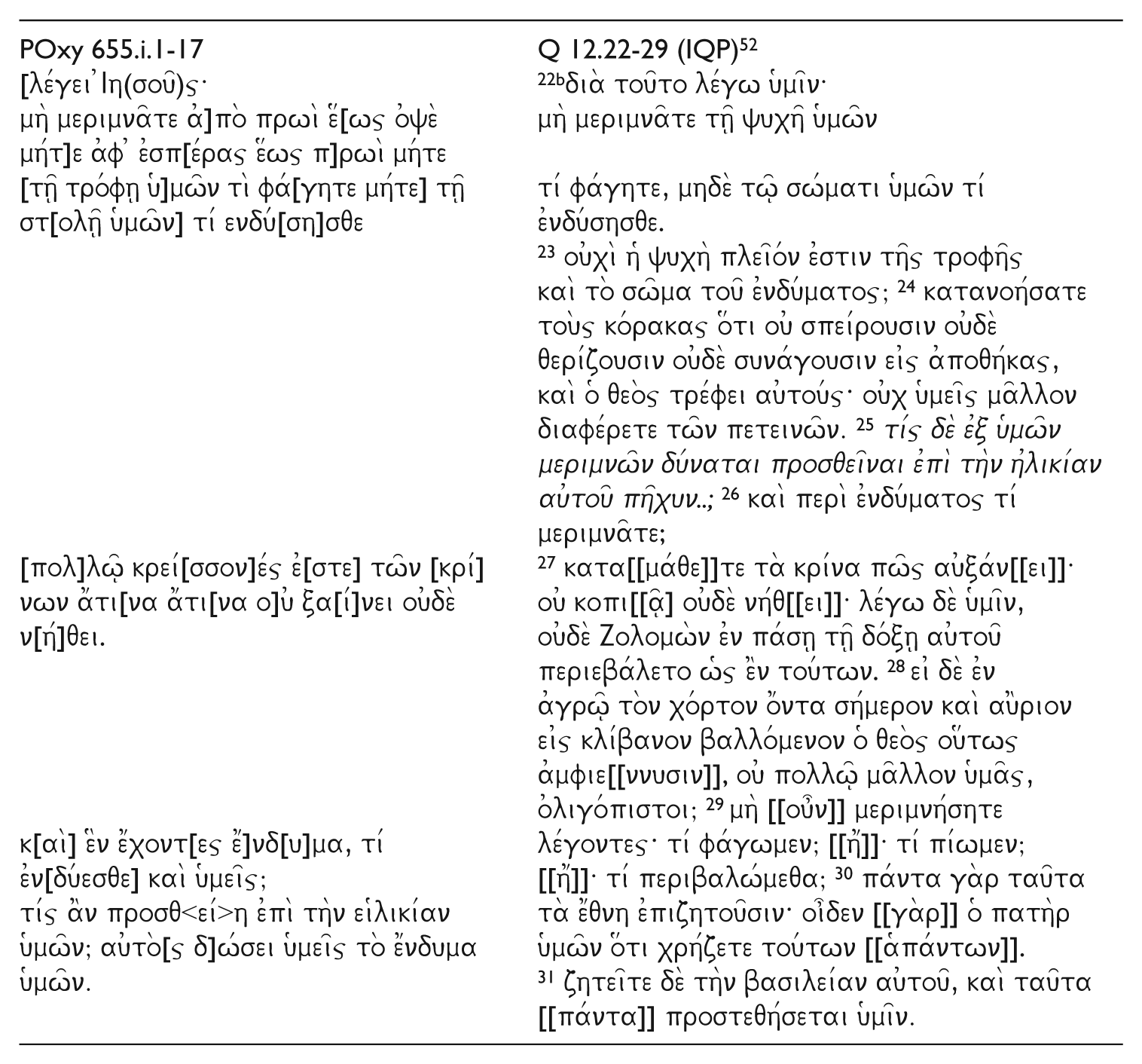
In this case it is far from clear that the Oxyrhynchus version depends on either Matthew or Luke (or Q). 52
A second example is Gos. Thom. 9, the parable of the Sower. Comparison with the Synoptic versions shows that Thomas lacks the overloaded descriptions (διὰ τὸ μὴ ἔχειν βάθος γῆς· καὶ ὅτε ἀνέτειλεν ὁ ἥλιος ἐκαυματίσθη), Markan elements taken over by Matthew. These overloadings are not the result of the vagaries of oral transmission, but are due to the fact that Mark’s interpretation of the parable (missing in Thomas) needs to stress the shallowness of certain kinds of belief (4.17 καὶ οὐκ ἔχουσιν ῥιζαν ἐν ἑαυτοῖς ἀλλὰ πρόσκαιροί εἰσιν) and the result, that ‘tribulation’ destroys shallow belief (εἶτα γενομένης θλίψεως ἢ διωγμοῦ διὰ τὸν λόγον εὐθὺς σκανδαλίζονται). 53 That is, Mark’s editorial interest lies in the additions he has made to vv. 5-6, which prepare for his interpretation in 4.13-20. Because Thomas lacks the Markan allegorical unpacking of the parable, there is no reason for him to have the overloading either.
Luke omitted this overloaded Markan phrase but substituted ‘because it did not have moisture’ for Mark’s ‘because it had no depth of soil’. Since Matthew took over Mark’s extra phrases, it is peculiar to imagine that Thomas, depending either on Mark or Matthew, would have eliminated, along with the allegorical unpacking of the parable, precisely what Mark added to the parable, and what Matthew took over. And Thomas also lacks the way in which Luke redacted Mark. So either Thomas was a fine redaction critic, able to discern the primary and secondary elements of Mark’s parable, or Thomas does not depend on Mark or its literary successors, but evidences another version of the story (yet another is available in 1 Clem. 24.5).
A third example is also a parable, Gos. Thom. 65, a showcase example of a Thomasine saying that has every appearance of being independent of its Synoptic parallels. As I have shown in detail elsewhere (2006), not only does Thomas lack the citation of Isa. 5.1, 7 which is prominent in Mark and Matthew and still vestigial in Luke’s ἐφύτευσεν, but Thomas also lacks an equivalent to Mk 12.5—by almost universal agreement, a Markan addition (summarized by Matthew in 21.36 and dropped by Luke). But even more importantly, while Thomas’s version reflects accurately the patterns of vineyard ownership in the first century
It should be underscored that I do not think that Thomas’s version of the Tenants is the source of Mark (contrary to what Gathercole [p. 186] suggests).
55
On the contrary, Thomas has his own interests in the parable, not least of which is vilifying the owner as a ‘usurer’ and underscoring the slave’s ignorance (ⲠⲈϪⲈ ⲠⲈϤϪⲞⲈⲒⲤ ϪⲈ ⲘⲈϢⲆⲔ
Gathercole continues: Many will find it hard to accept Kloppenborg’s proposal that (a) Thomas’s version reflects the earliest form of the parable without Isaiah, and (b) Mark inserts the Isaianic material into the introduction, and (c) Luke removes most of it again, leaving an introduction coincidentally similar to that of Thomas (p. 193).
He does not explain why ‘many’ will find this difficult. Cadoux, Jeremias, Hubaut, Klauck, Weder, Hengel, Via, Crossan, Hester, Frankemölle, Marcus, Schmeller, Weihs and others did not find the point that the Isaianic reference was secondary difficult or improbable at all. 57 Second, I did not argue that Mark inserted the allusion to Isa. 5 into the parable. After considering various possibilities, I sided with the majority who think that the Isaiah reference is pre-Markan (2006: 228). Gathercole could, no doubt, reply that this only puts the issue of the expansion of the parable to an earlier stage. On the other hand, the Septuagintal nature of the quotation and, in fact, its complete irrelevance to the rest of the narrative details of the parable—the fence, the vat and the tower play no role whatsoever in the story—suggest that it is an accretion at some stage and in Greek. Finally, Luke did not remove the allusion entirely, but retained, through an editorial inadvertence, the Isaianic reference to planting. The reason for Luke’s removal of the details of Mk 12.1 can be surmised: Luke’s more acutely honed rhetorical sensibilities and interest in conciseness 58 led him to omit detail that was plainly irrelevant to the telling of the story. But his retention of planted is a telltale sign that he was using Mark as his source. Such a sign is not present in Thomas. 59 But Luke’s version is not like Thomas’s, since Luke’s version still has the retaliation sequence, completely lacking in Thomas, and implicitly constructs the owner positively, rather than negatively, as in Thomas.
This leaves only Thomas’s ⲘⲈϢⲆⲔ (‘perhaps’) which agrees with Luke’s ἴσως, which Gathercole declares to be a ‘relatively unusual word’. Au contraire. A TLG search shows that it occurs more than 2500 times prior to the beginning of the second century, and is especially frequent in Platonic dialogues where Socrates introduces a belief that he wishes to refute. 60 This is not an unusual term at all, and precisely one that might be expected in this context, all the more so since, as I have noted, the erroneous nature of the owner’s belief is fundamental to Thomas’s story, but only incidental to Luke’s. Again, it would be different were it the case that ἴσως was incidental to Thomas’s narrative line but essential to Luke’s. For in that case we would have something like a smoking gun of Thomas’s use of Luke and his inadvertent absorption of a Lukan element that served no real purpose in Thomas. The reverse, in fact, is the case.
So we are left with the juxtaposition of the parable with Ps. 117.22(-23) in Mark (and Luke) and Thomas. Indeed, there is almost unanimity that Ps. 117.22-23 is a secondary addition to the parable, with the exception of Snodgrass and Lowe who try to rescue the reference for the original parable by positing a wordplay between ben and ’eben and thus must argue that the parable was originally performed in Hebrew rather than Aramaic. 61
The question remains whether it was Mark who connected the psalm with the parable, as some hold (Klauck, Hoffmann, Donahue) or is pre-Markan (Jeremias, Gundry, Mell). 62 It is critical to note that this debate is normally conducted without any attention to the Gospel of Thomas, and so it cannot be claimed that those favouring the former position are secretly advocating Thomas’s dependence on Mark or its successors, or contrariwise, that those who favour the former are clandestinely leaving room for a Thomas that is autonomous of the Synoptics. I, in fact, have favoured the latter position, that the connection of the parable with the psalm is not Mark’s work. The juxtaposition of Ps. 117.22-23 with the parable of the tenants provided Mark with the occasion to draw a strong connection between the two units so that in Markan redaction it functioned to vindicate the son who would otherwise have been left dead by the parable. This strategy was doubly appealing for Mark, since his parable already contained allusions to Isa. 5.2, 5, so that the equation of the owner with God logically required both the slaves and the sons to be interpreted as God’s envoys, and their rejection and deaths as acts that elicited divine vengeance and vindication (Kloppenborg 2006: 241).
Thus, contrary to Gathercole, I do have an explanation for the use of Ps. 117 both in the pre-Markan story and in Mark, and offer a reading of Thomas’s use of Ps. 117 that is consistent with Thomas in general.
Thomas assumes an entirely different tertium comparationis: the rejected stone is not the son of the parable but the pursuit of salvation, and the ‘rejecters’ are not the tenants but the usurer. It is difficult to imagine how Thomas, seeing the unequivocally clear Synoptic equations, could have arrived at his version except by a feat of interpretive perversity. Thomas would have had to reverse the Synoptics’ identification of the owner with God, delete the conclusion to the parable, which underscores the negative evaluation of the tenants, and detach the psalm quotation, which emphasizes the fact that human appraisal and divine perspective are at odds with each other (Kloppenborg 2006: 271).
Thus when Gathercole concludes that Kloppenborg ‘does not explain away the evidence for Mark → Luke → GTh’ (p. 194) (where he surely means not the ‘evidence’ but the data that might be accounted for on the scenario Mark → Luke → GTh), he does so by neglecting major features of the data outlined in The Tenants in the Vineyard on viticultural regularities, the summation of exegetical opinion offered in chs. 3–5, and the arguments that are assembled from the Synoptic and other data.
The Unity of Thomas
Both Goodacre and Gathercole need Thomas to be a unified composition, for if it is not, the road is open to argue that while some portions of Thomas reflect the editorial features of the Synoptics, other portions do not. Yet here too there are varying nuances between Goodacre and Gathercole.
Goodacre, if I understand him aright, is not averse to conceding that Thomas may be dependent on the Synoptics for only some of its material. 63 For since he is concerned with something like the final composition of Thomas, his point is only that, at the level of composition, Thomas knows the Synoptics.
In order for Thomas’s familiarity with the Synoptics to be established, one only requires knowledge of the Synoptics in certain places. It does not need to be a ‘consistent pattern’. And even if more primitive traditions are contained in Thomas, this is relevant only to the issue of Thomas’s knowledge of oral traditions, and is not directly relevant to the question of literary priority (Goodacre, 46).
This seems consistent with his ‘plagiarist’s charter’. In order to demonstrate the secondary nature of the final version of a document, all one needs to show is that some of its material is posterior to known, datable sources. One does not have to show that the document was cut from whole cloth or that it is a compositional unity.
The Gospel of Luke, for example, on both the FH and the 2DH, is ‘dependent’ on Markan redaction and editorial features, and is thus demonstrably post-Markan. But is that the end of the story? Luke had access to Q (on the 2DH) or Matthew (on the FH), which he interpolates into his Markan material. On most reckonings, much of this material is at least as early from a tradition-historical point of view as Mark, some of it earlier than Mark, and certainly independent of Mark. And Luke also has special material which most scholars (with notable exceptions like Michael Goulder) would suppose to be early, even authentic. The situation is not different with Matthew, whether one adopts the 2DH or the FH.
If the issue then is whether the composition of Thomas is post-Matthaean and post-Lukan, the presence of Matthaean and Lukan redaction—Matthew’s (?) ‘into the mouth’ and Luke’s δεκτός and ‘hear the word of the father and guard it’— would seem to indicate that the answer is that Thomas is post-Matthaean and Lukan. This, however, is not a surprise, except for those who date Thomas to sometime in the mid- to late-first century
Gathercole takes a different approach. Stressing the apparent lack of difference between the Greek fragments and the Coptic version, he doubts the conception of Thomas as a ‘rolling corpus’. 64 He notes varying theological perspectives in Thomas—often taken as a sign of composite construction—but avers that the eschatology of Thomas ‘is … not too difficult to fit together’ and seems to embrace the suggestion that Thomas’s alleged differing audiences might account for differing perspectives.
These are rather weak and grasping responses to the diverse contents of Thomas. But when he considers the several doublets in Thomas, he turns to the explanation that Thomas was only a moderately educated writer and hence that the doublets are due to his carelessness; or maybe they are deliberate (p. 165). This seems a rather desperate attempt to avoid the way in which doublets have been treated in the Synoptics, in Genesis, in Exodus, in the Deuteronomistic history, where doublets are routinely taken as evidence of the presence of multiple sources. This seems a prima facie case of changing analytic rules when they point in the wrong direction.
Ironically perhaps, Gathercole needs Thomas to be unitary more than Goodacre. Since for Goodacre, the focus of attention is on the final version of Thomas, he can tolerate bits of diverse materials in its compositional history. The issue for Goodacre is whether Thomas as a composition is anterior to the Synoptics, and he shows that our copies of Thomas—both Greek and Coptic—are not. For Gathercole, because he does not posit a direct literary relationship between Thomas and the Synoptics but instead suggests a relation of secondary orality, he seemingly cannot tolerate a composite Thomas, for in that case the road would be open to agree that some bits of Thomas reflect Synoptic redaction, but others do not, something he seems keen to reject.
The marked and dramatic difficulties that Thomas has posed for interpreters to arrive at a coherent and consistent editorial perspective, and the various seemingly incompatible positions it espouses, seem to suggest disunity rather than compositional unity. 65 And to invoke Gathercole against Gathercole: if Thomas indeed is a list in which order does not make much difference, it is also a list in which additions probably also do not make much difference. Examination of other collections such as the Life of Aesop give good evidence of such collections (or ‘lists’) being supplemented and sometimes abbreviated.
A New Model
So Thomas does reflect Synoptic elements—perhaps Matthew’s στόμα at Gos. Thom. 14.5, Luke’s δεκτός in P.Oxy. I 1.10-15, and Luke’s notion of ‘hearing the word and guarding it’ in Gos. Thom. 79. No doubt there are other elements that we might recognize as redactional. But it also includes signs of autonomous performances of Jesus’ sayings where Thomas is not only not dependent on the Synoptics—the parables of the Mustard Seed, the Sower and the Tenants and the saying on anxiety—but arguably represents versions of the sayings that can claim at least as much antiquity as Mark or Q’s versions. These elements are then juxtaposed in a manner that likely defies a simple means of disentangling them. What this calls for is not a reiteration of the linear and simplistic models of textual interaction that we have had since the works published fifty years ago which either pronounced Thomas to be an entirely secondary gospel from the mid-second century, without historical or theological merit, or exaggerated claims that it was the earliest gospel, from the 40s or 50s of the first century. Neither takes the textual data of Thomas seriously.
What we need are complex and sophisticated models which allow us to understand the complex data-sets with which we are presented in the Synoptics, Thomas, Jesus tradition in the Apostolic Fathers, and in other expressions of the Jesus tradition.
A possible way forward engages the work of John Whittaker (1989) on the transmission of philosophical texts. Whittaker challenged the common view, according to which fragments of philosophical texts transmitted in the form of quotations were unreliable, ‘since they are likely to be quoted from memory, or borrowed from someone else who was quoting from memory, or, even worse, quoted from memory from someone else who was quoting from memory’ (1989: 63). Variations in longer quotations were often dismissed as due either to the carelessness of the secondary author or the corruption of the text being cited.
In order to evaluate these dismissive claims, Whittaker examined a Middle-Platonic epitome, the Didaskalikos of Alcinous (first/second century We may conclude that such modifications were not considered improper, even where, in the case of alteration of the logical sequence, they might necessitate changes in the grammatical forms of words. Nor is the [modern] editor obliged to assume in such instances faulty memory or carelessness on the part of his author, nor, unless other circumstances so dictate, is he under any obligation to correct the indirect evidence in the light of its original, nor, even worse, the original in the light of the indirect evidence (1989: 74-75).
Whittaker’s investigations indicate that verbatim reproduction of sources was not a controlling virtue: Instead we must acknowledge that there is about the ancient manner of quotation something of the technique of theme and variation, as though one thought it constricting and impersonal, as well as boring, to repeat perpetually the same familiar words; as though it were expected of the epigone not that he deny himself by leaving well alone, but that he add to what he quotes the touch of his own or some commentating predecessor’s presumptive individuality, or at the very least assume a measure of studied carelessness … (1989: 94-95).
Whittaker’s remarks have been cited widely by members of our guild, usually in the context of evaluating the alleged citations of New Testament texts in the Apostolic Fathers and Justin, 67 and in order to challenge the view that patristic citations of these texts were careless or the result of faulty memory. 68 Gathercole adduces Whittaker to qualify DeConick’s point (2006: 21) that variations of Thomas from the Synoptics are due to the vagaries of oral transmission; Gathercole points out that they may also be due to intentional literary manipulation of written texts (p. 217).
It is important, however, to take note of Whittaker’s full argument, which is routinely ignored by those who cite him only on the topic of the manipulation of citations. Whittaker argues that there are instances where the variation from the primary source in the secondary materials is due not to the alterations of the secondary author, but point to now-lost school traditions. For example, Alcinous’s paraphrase of Timaeus 42e7–43a2 in Didaskalikos 171-72 agrees with Galen’s citation, and points to a ‘vanished tradition of commentary running parallel to the text of Plato but coinciding with that text only spasmodically’ (Whittaker 1989: 82). Plotinus, Origen and Gregory’s citations of Parmenides (130c6), ἃ … οἶον θρὶξ καὶ πηλὸς καὶ ῥύπος ‘things … such as hair and mud and dirt’, reverse the latter two terms and omit the first, again pointing to a commentary tradition current at Origen’s school. The citation of Timaeus 42e7–43a2 by Philo and Alcinous adds the phrase πρὸς ὡρισμένους χρόνους (Alcinous) or καθ’ ὡρισμένας περιόδους καιρῶν (Philo), terms absent from Plato (1989: 83). These variants, says Whittaker, ‘are likely to belong not to the textual tradition of Plato but to the tradition of commentary’ (1989: 94).
What Whittaker suggests, then, is that Platonic materials come to Alcinous both through the textual transmission of Platonic works and through a parallel commentary tradition that has elaborated, abbreviated and reframed Platonic sayings. Similar observations can be made of the use of Homeric texts by later authors: some of their citations may rely on the textual transmission of the epics, but others rest on the rich Homeric commentary tradition that was already well developed in the Common Era.
Applying Whittaker’s model to Thomas, we must make some adjustments. Citations of Plato and Homer in first- and second-century works derive, proximately or ultimately, from the texts of Plato and Homer. The situation with Thomas and the Synoptics is different, for we do not in fact know the relative temporal relation between Thomas and the Synoptics. So is the variation due to Thomas knowing the Synoptics and deliberately varying the wording for his own purposes? Or is it due to Thomas relying on traditions of Jesus’ sayings which—to use Whittaker’s words—‘[ran] parallel to the text of Plato but coincid[ed] with that text only spasmodically’ (1989: 82)? The fact that Thomas sometimes betrays knowledge of the redaction of the Synoptic authors, and at other times appears to know autonomous, even earlier, versions of sayings that also appear in the Synoptics, suggests that, like Alcinous, Thomas is the beneficiary of multiple sources of information.
Thomas as a School Document
There is every reason to think that Thomas, like Alcinous, was composed for a school setting. There are several indications of this. First, the incipit—‘whoever finds the hermeneia [of these sayings] will not taste death’—is a virtual advertisement of its setting in a context where study and reflection are practised. Likewise, saying 2 (P.Oxy. IV 659.5-9) maps a process of intellectual discovery, from seeking to finding, being troubled, being astonished, ruling and rest.
Secondly, key notions in Thomas are the themes of ‘labour’ and ‘toil’. As Cameron notes, the shepherd locates his lost sheep by ‘accomplishing his labour’ (
The privileging of labour recalls the popular chria, usually attributed to Isocrates and elaborated in the progymnasmata, that ‘education’s root is bitter [but] its fruit is sweet’.
73
Hermogenes’ elaboration exercise shows how this maxim was developed to valorize the toil (πόνοι) and hardship entailed in the process of learning: Then [elaborate] the rationale: ‘For the greatest things are wont to succeed through toil (ἐκ πόνων), and when successful bring pleasure’. Then by contrast, ‘Ordinary things need no toil and in the end give no pleasure, but things of importance are the opposite’. Then from a comparison, ‘For just as farmers need to reap fruits by working the soil (πονήσαντος περὶ τὴν γῆν), so also with speeches’. Then from an example, ‘Demosthenes, by shutting himself up at home and working hard (πολλὰ μοχθήσας), later reaped the fruit in the form of crowns and testimonials’. It is also possible to bring in a judgment; for example, Hesiod said [Opera et Dies 289], ‘The gods put sweat before virtue’, and another poet says, ‘The gods sell all good things to us for toils’ [= Epicharmus, frag. 287, ed. Kaibel] (Kennedy 2003: 77; Hock and O’Neil 1986: 176-77).
What is especially interesting in the use of these terms is not only that Hermogenes and, after him, Aphthonius stressed them in their respective elaborations of the chria of Isocrates, but that toil and labour became identity markers for schools. This is especially clear in the fourth century with Libanius, whose elaboration of the Isocrates chria is even longer than those of his predecessors. 74 As Paul Petit has shown, references to ‘toils’ (πόνοι) are particularly common in Libanius’s letters in connection with the characterization of his relationship with his own students. 75 Although toil and pain might be denigrated in elite circles, the toil of learning was valorized in schools, especially grammar and rhetorical schools.
The particulars of Thomas’s characterization of the process of scholastic learning—seeking, puzzlement, discovery—suggest similarities to what I have elsewhere called ‘sapiential research’ illustrated in Pythagoreanism (Kloppenborg 1987: 300-306). The Pythagorean symbola were formulated in a deliberately obscure fashion (μὴ γεύεσθαι μελανούρων, ‘do not eat the black-tail’) precisely in order to encourage ‘reading below the surface’. 76 What is socially formative here is the inculcation of a group ethos devoted collectively to the penetration of obscure sayings, where labour, puzzlement and insight become the markers of membership. Thomas displays the same interest in promoting ‘research’ into the sayings of Jesus, whether they appear to be transparent in their meaning or deliberately obscure. 77
Thirdly, Thomas itself takes the form of a gnomological anthology, collecting the sayings of Jesus for discussion and interpretation, just as a host of other wise sayings were collected for use in schools: the Kyriai doxai of Epicurus, the Chrysē ēpē of Pythagoras, the Sentences of Cleitarchus, the Golden Words of Democritus, and the later Byzantine gnomologia such as the Gnomologium Vaticanum. 78
Fourthly, while the collection itself is framed with the conceit that Thomas is the most insightful student of Jesus, indeed even achieving a standing on a par with Jesus (Gos. Thom. 13), Gos. Thom. 12 is clearly concerned with the issue of succession: the ‘best’ disciple of Jesus was clearly Thomas, but James was the institutional successor. Succession was a common topic in the history of the Academy, the Stoa, the Epicurean school and the Peripatetics. 79
Thomas and the Jesus Tradition
Just as Alcinous had access to a complex of sayings drawn directly from Plato and from the Platonic commentary tradition on Plato, Thomas seems to have drawn on the Synoptics (or at least was influenced by redactional elements in Matthew and Luke), but also knew of forms of sayings that lack the obvious editorial features of Matthew, Mark and Luke, and thus are likely independent forms. Moreover, it is widely recognized that Thomas also had access to sayings that appear quite independently in such early collections as the Gospel of the Egyptians and the Gospel of the Hebrews. 80
Given the data from the comparison of Thomas with the Synoptics and other non-canonical documents, we should perhaps imagine Thomas to have been composed like other school products, drawing on the ‘Jesus tradition’ in its variety of forms, either selecting versions of the sayings that were congenial to its interests—no doubt including those stressing ‘seeking and finding’, and androgyny—and adapting others in just the same way that we find commentators on Homer and Plato adapting their sources. This allowed for a complex interplay of tropes that we can conclude are drawn from Synoptic redaction such as ‘the kingdom of the heavens’ sayings taken from non-canonical gospels or traditions, sayings from the Synoptics themselves, and sayings that reflect pre-redactional versions of sayings that also appeared in the Synoptics. 81
Footnotes
1.
Throughout this paper I will use the following shorthands: 2DH for Two Document (Source) Hypothesis; FH for the Farrer (-Goulder) Hypothesis; 2GH for the ‘Two Gospel’ (neo-Griesbach) Hypothesis.
2.
See the collection of papers in Foster et al. 2011, and recent monographs and collections: Kloppenborg 2000; Black and Beck 2001; Stein 2001; Goodacre 2002; Neville 2002; Peabody, Cope and McNicol 2002; Burkett 2004; Goodacre and Perrin 2004; Derrenbacker 2005; Mournet 2005; Williams 2006; Burkett 2009; Fuchs 2009; MacDonald 2012;  .
.
3.
E.g., Labahn and Lang 2004; MacKay 2004; Siegert 2004; .
4.
E.g., Garrow 2004; Kloppenborg 2005; Tuckett 2005a, .
5.
E.g., Brown 2005, .
6.
E.g., Crossan 1998; Green 1987; Kirk 1994; Schonhoffer 2011; .
7.
E.g., Boismard 1966; Edwards 2002; .
8.
There is, of course, a linkage between the hypothesis of an independent Thomas and ‘progressive Christianity’ and neo-gnostics, but as far as I am aware there are no academic exponents of either contributing to the scientific debate about gospel origins.
9.
Goodacre, 7 even suggests that ‘knowledge of’ rather than ‘dependence upon’ might be appropriate on the FH’s view of Luke’s use of Matthew, although it would appear that he has no difficulty in supposing that Matthew is ‘dependent upon’ Mark.
10.
Goodacre, 32, 36, 38, 46, 48, 92 n. 33, 117, 131 (‘direct contact’).
11.
William Arnal points out to me (per litt.) that plagiarism involves a value judgment while source criticism does not. Moreover, in the case of student plagiarism, unacknowledged use of any source, direct or indirect, is an offence; in the case of Thomas no one disputes that Thomas (or Matthew or Luke) uses unacknowledged sources. The issue is which sources were used, and whether they were used directly or indirectly.
12.
13.
14.
Gathercole, 157-58, 177, 184, 198, 220-21, 224, 269. Gathercole seems at times hesitant to rely on this model exclusively: ‘“Secondary orality” may be one way to avoid the overly scribal models of Synoptic influence on Thomas which were made by some scholars especially in the 1960s and 1970s, as well as the correspondingly simplistic understanding of Thomas as tapping into a “pure orality” uncontaminated by any literary influence. It should be remembered, however, that secondary orality is no more than a hypothesis; it could be that the redactional features from Matthew and Luke are merely reminiscences in the mind of Thomas’s author or editor from having read the canonical Gospels or parts thereof in some form …’ (Gathercole, 224). Elsewhere, however, the model is adduced as the best explanation.
16.
: 196-220, where he stresses the contrast between ‘primary orality’ and the ‘passion narrative … largely built on texts and texts recycled into the oral medium, that is, secondary orality’ (197). Elsewhere, Kelber contrasts Q as an ‘oral genre’ with Mark’s written gospel as a ‘counterform’ to the oral gospel. ‘The resultant text [of Mark], as all texts, is fixed and in a sense dead, permanently open to visual inspection and the object of unceasing efforts at interpretation. If this text enters the world of hearers by being read aloud, it functions as secondary orality. But now the story narrated is one that was never heard in primary orality, for it comprises textually filtered and contrived language’ (217-18).
17.
18.
Koester 1983: 195; Patterson 1991: 37; 1993, passim; Dewey 2004; and especially : 21, who lists as the characteristics typical of oral transmission differences in length, the tenses and mood of verbs, and the substitutions of synonyms.
20.
22.
There are differing arrangements of the Pythogorean Symbolae with, e.g., μὴ γεύεσθαι μελανούρων, ‘Do not eat the blacktail’, appearing first in Plutarch’s list (De liberis educandis 12E), well down the list in Diogenes Laertius 8.19; and fifth in Iamblichus’s Protrepticus but with no indication that one sequence is more or less enigmatic than the others.
24.
Arnal (per litt.) points out that saying 77 in Coptic also has a catchword:
25.
Gathercole (163) seems to agree: ‘if Thomas is as permeable as some comment, why are no sayings added between the Greek fragments and the Coptic version?’
26.
The approach is already well worn, but with differing conclusions. See, for example, Sieber 1966, , and many more since.
27.
28.
Plisch (2008: 103) reconstructs the Greek as λέγει ’ Ιησοῦς· τυφλὸς ἐὰν προάγῃ τύφλόν, ἀμφότεροι πίπτουσιν εἰς βόθυνον. Patterson (1993: 34) also points out, against : 86-87), the substantial differences between the Sahidic version of Matthew and Coptic Thomas.
30.
Goodacre (44) attempts to make his case for a strong literary relationship between Thomas and the Synoptics in Gos. Thom. 86 by suggesting that φωλεός and κατασκήνωσις are ‘uncommon words’ (and hence, the coincidence in Thomas’s use of them suggests literary dependence). But they are not especially uncommon: φωλεός is attested more than 120 times prior to the 2nd century
31.
: 224) urges that the Oxyrhynchus fragments are not to be taken as necessarily better witnesses to the original Gospel of Thomas and wonders whether they contain examples of textual assimilation: ‘But might not [the possibility of textual assimilation] also apply to cases (quite rare) of very close verbal agreement in the Greek fragments? For instance, the phenomenon of close verbal agreement between Thomas 26 = P.Oxy. 1.1-4 and Lk. 6:42 is the exception rather than the rule. Yet this is used by Goodacre as his parade example to show that there is a prima facie case for accepting the theory of some sort of dependence—between probably the original Thomas and the Synoptics’.
32.
E.g., Origen, In Prov. (PG 13:20); Physiologus 9.3, 14; 11.1; 16.17; 24.2, 39; Gregory of Nyssa, De Virginitate 17.2; Epiphanius, Haer. 60.4, 11; Athanasius, Oratio III contra Arianos 18.5; Basil, Regula morales (PG 31:797); Didymus the Blind, In Gen. (SC 233, p. 93).
33.
Goodacre (35-37) also considers P.Oxy. IV 654.15-16 || Lk. 17.20-21, which does not have strong verbal similarities, and P.Oxy. IV 654.23-26 || Mt. 19.30, which has a Markan parallel, but where one cannot made a strong case for Matthaean redaction. Both are proverbial.
34.
Sayings 57, 76, 96, 97, 98, 99, 113.
35.
A suggestion of Arnal (per litt.).
36.
E.g., Justin, Dial. 51.2 (Mt. 4.17); 51.3 (Mt. 11.12); 76.4; 120.6; 140.4 (Mt. 8.11); Clement, Strom 5.12.80 (Mt. 13.33); 5.12.80 (Mt. 13.11); 6.11.95 (Mt. 13.47); Paed. 1.5.12 (Mt. 19.14); 1.5.16 (Mt. 18.4); Quis dives 31.3 (Mt. 11.11); Protrep. 9.89 (Mt. 4.17).
37.
E.g., in other scriptural citations such as those found in Irenaeus, Adv. Haer. 1.1.16 (conflating Lk. 9:62 with Matthew’s formula) and Clement, Protrep. 10.99.4, or in other sayings, e.g., Epistulae de virginitate 1.2.2; Clement, Quis dives 3.1; 17.1; Acta Pauli. (ed. C. Schmidt and W. Schubart, Acta Pauli. Glückstadt: Augustin, 1936) frag. 8; Irenaeus, Adv. Haer. 5, frag. 9.
39.
See Crossan 1973b: 256-57; Carlston 1975: 158; : I, 325.
40.
42.
E.g., Jeremias 1972: 81-85; Davies et al. 1988–97: II, 409-11; Roloff 2005: 47-53; : 405-16.
43.
45.
The Lukan version of the saying is cited only by Origen, Comm. in Ioh. 13.55 §375. The Matthaean/Markan versions are more frequently cited in patristic literature.
46.
Thus, Kloppenborg 1987: 222; Bovon 1996: 258: ‘A mon avis, le v. 21 est secondaire. Il est né d’une exigence, celle pour la parabole de recevoir une morale’. : 1067) notes that Luke has used θησαυρός in Q/Lk. 12.34 as the basis for his composition of 12.21.
48.
See Sellew 1992. : 544-46) also argues that the presence of the interior monologue in Thomas is a fingerprint of Lukan redaction, although he concedes that similar monologues are found in non-Lukan parables. His main argument is that Lk. 12.13-15 is a Lukan creation and therefore its presence in Gos. Thom. 72 is a sign of Thomas’s dependence on Luke.
49.
Above, p. 15.
50.
This point is made by Robinson and Heil 2001: 13: ‘the question [about life-span] does not refer to an impotent human, but rather to a caring God, who can indeed add to the human’s stature (or: span of life), and from whom one can hence quite appropriately expect to receive clothing. It is no worldly, despairing distraction from the original focus on trust in God. Rather, it emphasizes precisely this trust!’ : 503) by contrast takes Q 12.25 to be a later addition to the cluster of sayings, in which case Thomas is at least posterior to the redaction of Q. But in this case, it seems more likely that it is Q who has expanded the cluster, which had the effect of ‘orphaning’ Q 12.25.
51.
Similarly, : 74: ‘Man wird allerdings diesbezüglich über die allgemeine Feststellung nicht hinauskommen, daß die stilistisch ausgeformten und sorgfältig verknüpften Einzelaussagen der Q-Version auf einen älteren Spruchkomplex mit sehr viel einfacher gestalteten Sprüchen zurückgehen müssen—und daß in P. Oxy. 655 die Form einer solchen Spruchkombination vorliegt …’
52.
I use the Q version exempli gratia. The Matthaean and Lukan versions agree strongly and hence the hypothetical Q version can be employed to make the point.
53.
Crossan 1973a: 40-41; similarly : 32-33, who thinks that 6a was in the original parable, but 6b was an addition.
54.
Gathercole, 133 asserts that uses ‘realism’ as a criterion for the ‘originality’ of Thomas’s version. This is incorrect. I do not argue that Thomas’s version is prior to Mark’s, since Thomas’s version clearly manifests some of its own allegorization, for example ‘labour’ as standing for intellectual inquiry. Rather, the argument concerns the impossibility of deriving Thomas’s realistic version of the parable from Mark’s patently unrealistic version, especially given the fact that Thomas is not especially interested in narrative realism. Moreover, the ideologies of ownership, absenteeism, honor and deadly force that are manifest in Thomas are much more easily reconcilable with any reasonable reconstruction of the life of Jesus than those manifest in Mark. This is decidedly not an argument from realism, brevity, or allegorical content, but from the fundamental values inchoate in the two forms of the parable.
55.
Also Gathercole, 208, 209.
56.
This is often ‘corrected’ to
59.
On the issue of the supposed agreement between Lk. 20.10b ἵνα … δώσουσιν αὐτῷ and Gos. Thom. 65 (ϢⲒⲚⲆ … : 359-583, and p. 258 n. 127) referring to multiple leases using either λαμβάνειν (for rent received) or διδόναι (for rent paid). The point was that such variation is not especially telling when both verbs are part of the stereotypical vocabulary of leasing. It would be different if Luke and Thomas agreed in using an unusual verb of leasing. They do not. These verbs are in fact the most commonly used.
60.
E.g., Apol. 28B Ισως ἂν οὖν εἴποι τις· «Εἶτ’ οὐκ αἰσχύνῃ, ὦ Σώκρατες, τοιοῦτον ἐπιτήδευμα ἐπιτηδεύσας ἐξ οὗ κινδυνεύεις νυνὶ ἀποθανεῖν;» ‘Perhaps someone might say, “O Socrates, don’t you feel ashamed at pursuing a way of life that runs the risk of death?”’
61.
Lowe 1982: 259; Snodgrass 1983: 63 and passim. This is answered effectively by : 689-90.
64.
Wilson 1960–61: 39; compare .
65.
66.
finding in respect to citations of Homer in Strabo, Longinus, Heraclitus’s Homeric Allegories and Plutarch mirror those of Whittaker: while there is general faithfulness to the source text, the citations display an array of modifications that conform the citation to the grammatical requirements of the secondary author, the omission of irrelevant or problematic details and the conflation of texts. He finds, however, few instances of additions.
67.
See Hill 2004: 68-69; : esp. 67 n. 13.
68.
69.
72.
Sevrin 1989: esp. 435-37 and see : 256.
75.
See : 25-26, who notes the use of πόνοι in Libanius’s comments on identifiable students: Andronicus (Ep. 61), the two sons of Antiochus (Ep. 1543: χρῶνται τοῖς περὶ τοὺς λόγους πόνοις ἐννοοῦντες), Euerthius (Ep. 1201: ἀναμνήσθητι πόνων τε ἐκείνων, οὓς ἐπόνησα περὶ σέ), Gerontius (Ep. 878), the sons of Julianus (Ep. 1261), Letoius (Ep. 1265), Maximus (Ep. 1003), Polybios (Ep. 1250), Priscus (Ep. 1099), Romanus (Ep. 1544: περὶ γὰρ δὴ τοὺς τοιούτους οὐκ ἂν τηνάλλως ἀναλωθείη πόνος) and Solon (Ep. 1244: Σόλων δὲ οὗτος ἐγένετο μὲν ἂν οὐ χείρων ἴσως ἐκείνου τοῖς αὐτοῖς πόνοις χρησάμενος).
76.
The Pythagorean symbolae are preserved in Plutarch, De liberis educandis 12D-F; Diogenes Laertius 8.17-20; Iamblichus, De vita Pythagorica 24 §108-109 and Iamblichus, Protrepticus 106-108. Iamblichus, De vita pythagorica 161: ‘He was accustomed to reveal manifold and complex truths to his pupils in a symbolic manner, by means of very short sayings’. Plutarch, De liberis educandis 12E takes the prohibition of the black-tail as referring to spending too much time with persons of evil character.
77.
Goodacre (181-84) argues that the Synoptic-like sayings are present in Thomas in order to legitimate the more obscure sayings. Were this the case, one might expect the Synoptic-like sayings to be incorporated more or less unchanged. But such is not the case: they too have been manipulated, as the examples above concerning ‘toil’ and ‘labour’ indicate. All of the sayings, whether seemingly banal or obscure, are in the ‘hermeneutic of research’ framed as though they contained a deeper meaning.
78.
For details, see Kloppenborg 1987: 337-40; .
79.
80.
Gos. Thom. 2 = GHeb 4a, b (Clement, Strom. 2.9.45.5; 5.14.96); Gos. Thom. 15, cf. GEgy 1; Gos. Thom. 22 = GEgy (Clement, Strom. 3.13.93; 2 Clem. 12.2); Gos. Thom. 37 = GEgy (Clement, Strom. 3.13.92; Acts of Thomas 14; Dial. Sav. 84-85); Gos. Thom. 82 = Origen, In Jer. hom. 3.3.104-105; Gos. Thom. 99 = GEbi 5 (Epiphanius, Haer. 30.14.5; 2 Clem. 9.11); Gos. Thom. 104 = GHeb (Jerome, Adv. Pelagianos 3.2). See the analysis of parallels to Thomas’s saying in .
81.
I am most grateful to Bill Arnal, Ian Brown and Ron Cameron for reading an earlier version of this paper, providing helpful comments and criticisms, and saving me from various errors.