




Abstract
Towards the end of Paul’s career, Acts narrates two riot scenes tied to the temples in Ephesus and Jerusalem, forming a synkrisis between the two cities and their temples. The similarities between the two scenes argue for temples as places of danger for Christians while protecting the Christian community from perceptions of anti-cultic teaching. The endings, however, are very different. In the first case, the correct response to the church is presented in Ephesus where the riot ends in a quick and orderly manner. In the second case, the incorrect response is presented in Jerusalem where the disorder spreads to the local government, forcing the Roman military to intervene.
Towards the end of his free career in Acts, Paul is the cause of two riots—one in Ephesus (19.23–20.1) and another in Jerusalem (21.27–23.22). Both of these riots stem from accusations that Paul has attacked the (central) temple of the city, and their quick succession invites the audience of Acts to read them in tandem. Although each scene has been well examined and similarities are occasionally noted, there is a general absence of material which reads the two in relation to each other. Darrell Bock is emblematic of this, noting similarities between the scenes but sparing just two sentences of comment on the similarities between them.
1
Likewise Christopher Mount summarizes the connection well: The author, however, has … set the message of Jesus proclaimed by Paul over against the religious and economic interests of the Greek cult. This foreshadows the conflict between the message of Paul and the interests of the Jerusalem cult. The author intends to differentiate Christianity as proclaimed by Paul from cultic allegiance to idols and temples (whether pagan or Jewish) (Mount 2002: 125).
Since Mount’s interests are only in the Ephesus material, he does not develop this further.
By placing scenes with a number of parallel elements so close together, often in matching sequential order, the author of Acts
2
creates a σύγκρισις, a comparison between Ephesus and Jerusalem through the chaos-inducing effects of their temples. The usefulness of the ancient rhetorical device of synkrisis (in Latin texts, comparatio) for the study of Luke and Acts has been widely recognized.
3
Many ancient rhetoricians commented on synkrisis, including the progymnasmata of Theon (first century
Perhaps under the influence of Plutarch, scholars tend to notice parallels between people instead of places or things. 6 These include John the Baptist and Jesus in the infancy narratives of Lk. 1–2 7 and the careers of Peter and Paul in Acts (Clark 2001: 35-54). Yet Acts also creates a synkrisis between Ephesus and Jerusalem, particularly in their reactions to Paul’s perceived teaching against the great temple of the Gentiles and the great temple of the Jews. Taken together, the scenes argue against temples as the dwelling-place of the divine. However, the close parallels in how the riots begin only serve to highlight the differences in how they end. Since Acts is written after the Temple of Yahweh has been destroyed by Rome yet while the Temple of Artemis still stands, at the political level Acts argues that reacting with violence toward Christianity in defense of one’s cult is chaotic and anti-Roman. 8 At the theological level Acts may argue that God allows even God’s own temple to be destroyed if defending it leads to violent rejection of Christ and his followers.
Before establishing and analyzing the synkrisis, it must be stressed that the temples of both cities are the issue. A reluctance to put the Jerusalem temple in the same category as a Gentile one is often implicit in the secondary literature, probably due to positive aspects of the earlier depiction of the temple in Luke and Acts. 9 Would Acts really compare the temple where Jesus is presented as an infant (Lk. 2.22-24) and where the early Jerusalem church preaches (Acts 2–5) with a Gentile temple, and in a way that the Gentile one seems to come out ahead? Acts does exactly that. Moreover, Acts prepares us for this argument in the Jerusalem temple scene that immediately precedes Paul’s: the stoning to death of Stephen.
Stephen argues with other diaspora Jews (from among other places Asia, 6.9) who bring forward false witnesses before the Sanhedrin to lay a twofold charge against him: that he does not cease to speak against this holy place (κατὰ τοῦ τόπου τοῦ ἁγίου [τούτου]) and against the law, and that he claims that Jesus will destroy this place (τὸν τόπον τοῦτον) and change the Mosaic customs (6.13-14). Both charges involve the temple. In Stephen’s lengthy defense, he makes two important points, neither of which directly answers the charges against him: he emphasizes the migratory nature of the people’s history, from Abraham and his family (7.2-16) to Moses and the exodus (7.17-45) until the time of David and Solomon when the tabernacle is replaced with a house/temple (7.46-47). It is at this point, when Solomon has built the temple (not explicitly with divine permission),
10
that Stephen makes his second point: ‘the Most High does not live in things made by human hands’ (οὐχ ὁ ὕψιστος ἐν χειροποιή — τοις κατοικεῖ, 7.48). Several verses earlier Stephen recalled the Golden Calf incident, noting that the people reveled ‘in the works of their hands’ (ἐν τοῖς ἔργοις τῶν χειρῶν αὐτῶν, 7.41) which anticipates how he soon describes the temple. Thus Stephen argues that the house that Solomon built is like the Calf that Aaron made: both are cases of idolatry.
11
Charles Giblin comments: Stephen does not attack the temple but attacks a state of mind according to which that building and institution, divorced from response to God’s guidance, stands as a pseudo-religious absolute. Equivalently, this attitude constitutes idolatry. Such an attitude may presage national calamity, as it did before the Exile (Giblin 1985: 111).
Furthermore, there is no indication that the implied author disagrees with Stephen.
After his defense fails, Stephen is executed. 12 Although several scenes take place in Jerusalem after this point, the temple plays no role until Paul joins the Nazirites there and immediately incites a riot. Stephen’s death severs obligations to the temple (whether the characters know this yet or not) so that the church may move following God’s will as Abraham and Moses do in his speech. If we take Stephen’s argument seriously that the temple is (or has become) idolatrous, there is nothing to prevent the comparison of Jerusalem with Ephesus through their temples. This is precisely the lens through which I will examine the synkrisis between the riots in the two cities.
A monograph by Andrew C. Clark (2001) gives a detailed examination of the use of synkrisis in Luke and Acts. Clark’s methodological discussion establishes six criteria for identifying synkriseis which will be helpful in establishing the one in question. Several of these criteria are inevitably subjective, and no one alone is sufficient to establish an intentional comparison. Rather, we are looking for patterns of evidence that would build up in the minds of the original audience of Acts. As we will see, the scenes are constructed in such a way that they point toward each other, even as the latter scene diverges from the former.
Establishing a synkrisis through Six Criteria
Content
Similarity in content, particularly with regard to the vocabulary chosen in these two scenes, is quite easy to establish. Clark advises that care be taken in using this criterion: one risks mistaking stylistic choices for theological ones, and coincidence for intent. Still, he argues that ‘similarity in language in terms of lexical repetitions or synonyms is an important criterion… Rare words are more likely to be significant’ (Clark 2001: 75).
The author’s choices in describing the riots are themselves distinctive and rare. In four cases, the cities are described as in ‘confusion’. This is described as σύγχυσις in 19.29 (only here in the NT) 13 and with the related verb συγχέω (to confuse) in 19.32 (in Ephesus), and twice in Jerusalem (21.27, 31). This verb is unique to Acts in the NT. ‘Confusion’ is noted just twice before the riots (2.6; 9.22) but is suddenly noted four times in two scenes, and no more from that point onwards. Later, the town clerk warns the Ephesians that they are in danger of being accused of ‘dissension’ (στάσις, 19.40), a word that will be applied to the Sanhedrin (23.7, 10). Like ‘confusion’, ‘dissension’ is rare. 14 The town clerk also warns the Ephesians that they will be unable to explain this ‘disorderly gathering’ or ‘conspiracy’ (συστροφή, 19.40). In Jerusalem where no one is able to calm the violence, a συστροφή is actually formed in order to kill Paul immediately following a hearing on the riot (23.12). The word is unique to these two cases in the NT. In the end, both disturbances are described as a ‘riot’ (θόρυβος) by the narrator (20.1; 21.34) and by Paul (24.18). These are likewise the only uses of θόρυβος in Acts. 15 The restriction of this vocabulary principally to these scenes is even more notable given the Lukan tradition’s fondness for lexical variety. 16
So in four cases Acts uses words that are rare, if not unique, to these scenes in order to describe the riots. That Acts uses τάραχος (‘disturbance’, 19.23) only in Ephesus may be significant (see below), but it also demonstrates that the author had access to a broader vocabulary than he actually uses. The connection between the scenes on this front is strengthened even further in a turn of phrase used to describe the disturbances. In Ephesus the confusion is characterized by the narrator: Some cried one thing and some another (ἄλλοι μὲν οὖν ἄλλο τι ἔκραζον, 19.32).
This phrase is closely echoed in Jerusalem: Some shouted one thing and some another (ἄλλοι δὲ ἄλλο τι ἐπεφώνουν, 21.34).
These parallel constructions occur only here in Acts (and Luke).
Other lexical connections between the two scenes are less notable individually, but are numerous enough to draw attention. 17 These include the repeated use of ‘temple’ (ἱερόν, 19.27; 21.27, 28, 29, 30; 22.17), related lexical forms (‘sacrilege’ [ἱερόσυλος], 19.37) and terminology (‘sanctuary’ [ναός, 19.24]; ‘temple guardian’ [νεωκόρος, 19.35]), the vocative addresses to ‘men’ (ἄνδρες, 19.25, 35; 21.28; 22.1; cf. 23.1, 6) and the offering of an apology in both scenes (19.33; 22.1). 18 With so many overlaps in lexical content between the scenes, it would seem appropriate to proceed with our hypothesis and examine the sequence of events.
Sequence
Similarities in the sequencing of these elements are a strong indicator of intentional patterning, but Clark warns that the absence of a strict sequential match does not negate a parallel (2001: 76). Although Clark points to historical considerations as a restriction on the sequencing of events, it is just as likely that literary factors such as source material or the need to maintain multiple connections at once might disrupt sequential patterns. 19 Differences in sequential order may also derive from a desire to introduce variatio into two similar scenes 20 or from the contrasts an author wishes to highlight through the synkrisis. In Table 1, 14 major elements shared by both scenes are presented in the order that they appear in Ephesus.
Sequential Parallels within the Riot Scenes in Ephesus and Jerusalem.
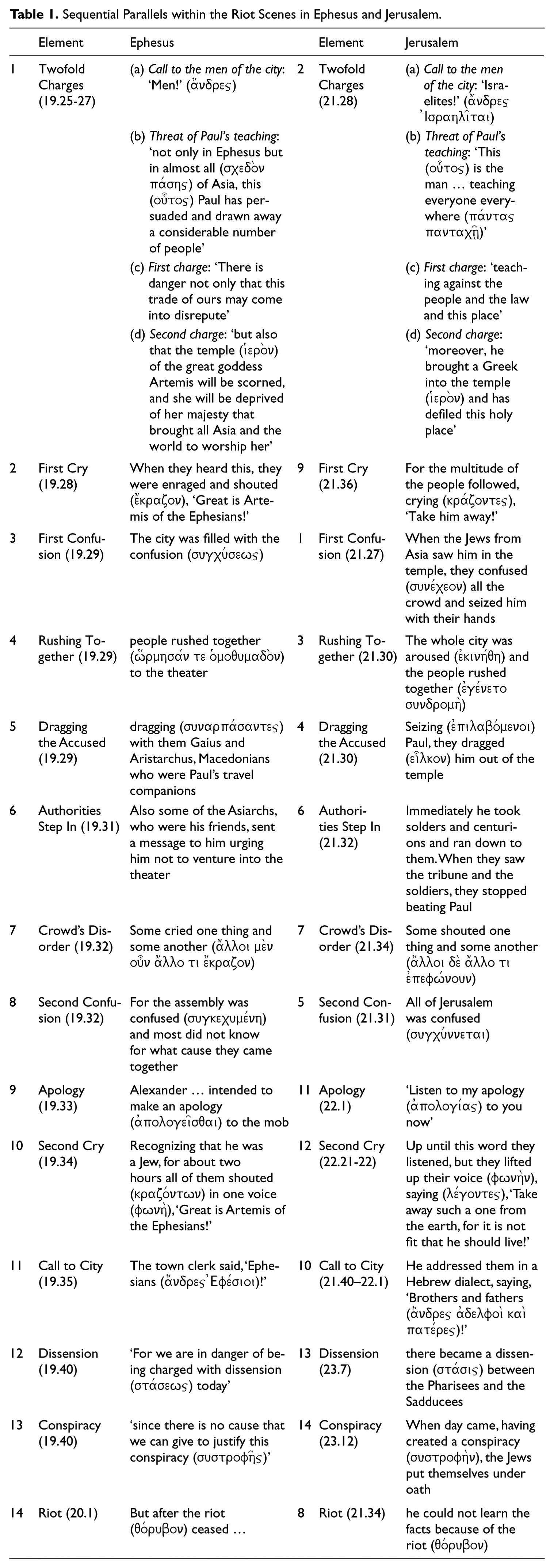
Looking at this set of parallels, there is a substantial alignment of elements as well as notable disruptions in the pattern. After a note of confusion (19.29; 21.27) there is a rushing together of a crowd (19.29; 21.30), a seizing of the accused (or in Ephesus, Paul’s companions as proxies, 19.29; cf. 21.30), a fortuitous intervention by authorities (the Asiarchs in Ephesus, 19.31; the Roman military in Jerusalem, 21.32), a description of the crowd’s disorder using a distinctive phrase (19.32; 21.34), an attempt at apology (19.33; 22.1), a second cry against the accused (19.34; 22.22), and mentions of dissension (19.40; 23.7) and conspiracy (19.40; 23.12). This accounts for 9 of the 14 elements. Other elements that are out of order are not wildly so: each scene begins with a twofold charge made against Paul (19.25-27; 21.28), although in Jerusalem this occurs after the mention of confusion.
Yet some elements are notably out of sequence. These include the cries of the crowd and the placement of the terms for ‘confusion’ and ‘riot’. These deviations are dealt with in more detail below. Here I will only note that the bulk of the matched elements are presented in the same order and the author does not move the remaining elements out of sequence haphazardly. The synkrisis created between these two scenes highlights similarities and differences in the reactions of the two cities to the threat presented by Paul’s teaching. These deviations in sequence align with the contrast.
Disruptions in the Text
Given that there are a high number of parallel elements, the majority of which are presented in a similar order, this criterion raises the question whether there are signs that they have been deliberately, even awkwardly, inserted into the text to create the parallels (Clark 2001: 77). At least one passage in the Ephesus riot has generated various conjectures on its role and placement in the narrative. 21 In 19.33-34a Acts introduces an Alexander, put forward by the Jews to offer a defense. Alexander fails to deliver his apology; instead the crowd shouts him down with cries of support for Artemis. He then disappears. What role does this interlude serve? In Jerusalem, Paul (the ambiguity of whose ethnic origins are continuously underlined) 22 offers a defense that fails as soon as he mentions his mission to the Gentiles, inspiring a second call for his life (22.21-22). Likewise in Ephesus, when Alexander attempts a defense (of Paul? of the Ephesian Jews?), as soon as the locals recognize that he is a Jew they raise up a second cry in support of Artemis. That is, the intrusion of Alexander and the Jews establishes Jewish–Gentile tension tied to a Gentile temple in a similar way that Gentile–Jewish tension tied to the Jewish temple fuels the riot in Jerusalem. Furthermore, this passage contributes to parallels between the scenes in both content and sequence even if its precise role remains somewhat unclear.
Literary Form
Here we are looking for formal similarities. However, in these long and rather complex scenes we do not have a form typical of the NT such as miracle stories or conversion narratives. Instead, we have riot scenes, specifically concerning Jewish–Gentile relations. As it is, riot scenes, often in theaters, are quite common in literature that is roughly contemporary with Acts. 23 Both Philo (Leg. ad Gaium 18 §120-26; 42 §335-36) and Josephus (Ant. 14.10.21 §244-46; 16.2.5 §58-60; 19.5.2 §284; War 7.3.2-4 §46-62; 7.5.2 §107-111) record riots in a way that is meant to support the rights of Jews in diaspora cities. The goal is to demonstrate that the Jews of Antioch, Alexandria, or wherever, are not responsible for the violence that takes place, and that their rights (particularly of exemption from taxes and sacrifices) must be enforced by the Roman authorities. Robert Stoops, Jr warns on the one hand that ‘No fixed narrative forms for reporting riots developed because no social context required the frequent repetition of such stories’ (Stoops 1989: 81). On the other hand, almost every element in the telling of the Ephesus riot in Acts has parallels in riot scenes in both the writings of Josephus and Philo, making it likely that Acts follows a set pattern in order to argue for the rights of Christians similar to those of the Jews (Stoops 1989: 81-89). These parallels include the charges against Paul for his attack on the temple, confusion, the dragging away of perceived foreigners, the friendliness of the Asiarchs (notably expanded by Stoops to include the protection of Roman officials), the attempted apology with the crowd shouting it down, and the accusations of dissension and conspiracy—all of which have parallels in the Jerusalem riot as well.
According to Stoops, the presentation of the Ephesus riot makes the point that Christians, as a sort of Jewish sect, enjoy the same rights (and exemptions) as Jews. Reading the scene with its twin in Jerusalem would strengthen his case, because Acts argues for the Jewish spiritual heritage of the Christians, while laying the blame for whatever divisions have arisen between the two sects at the feet of the other, non-Christian Jews. Paul never speaks against the temple and indeed has intense religious experiences while inside it, but the frenetic zealotry of the other Jews (as Acts portrays them) gets the best of them. They are responsible for the violence in Jerusalem against Paul (if historical); they are characterized by a violent fervor for their temple and city, a fervor that later reached its apex in the revolt against Rome.
Structure
It will also be useful to examine how these scenes fit into, and contribute to, the overall structure of Acts (Clark 2001: 76-77). Here we will focus on the role of the riot scenes in the larger narrative about Paul. After his conversion, Paul’s story alternates between visits to Jerusalem and his three Gentile missions. Ephesus is his final missionary city, the importance of which is underlined by the amount of narrative time devoted to Paul’s ministry in Ephesus (18.19–20.38) 24 and the amount of story time that Acts claims that Paul spent there (at least two years according to 19.10; but cf. 20.31). Paul’s farewell to the Ephesian elders is the final act of his third missionary journey, and his last visit to Jerusalem soon follows. As with Ephesus, Paul’s final stay in Jerusalem is textually his longest (21.17–23.31). 25 The last four chapters of Acts trace Paul’s movement out of Jerusalem to Rome, a move anticipated in Ephesus just before the riot (19.21) and in Jerusalem just after the riot as the Jewish authorities are still in an uproar (23.11). Structurally, riots form the climax of both Paul’s missionary journeys and his experiences in Jerusalem.
Several elements narrated in Ephesus prior to the riot tie the Ephesian material to Jerusalem. After Paul initially arrives in Ephesus, he briefly returns to Jerusalem (18.22). This may provide an excuse for Paul’s absence in the Apollos scene so that it is still Paul who founds the Ephesus church (Mount 2002: 112-13), but it also serves to interject Jerusalem into the Ephesus narrative, thus linking the two. Just before the riot the narrator says that Paul intends to return to Jerusalem (19.21). Later in Jerusalem, Jews from Asia—by which Ephesus is probably meant (cf. 21.29 and 20.4) 26 —accuse Paul of taking an Ephesian Gentile into the temple. The emphasis on Asia in both scenes (here and 19.26, 27, as well as the Asiarchs in 19.31) interconnects the scenes while perhaps recalling the Asians at Pentecost (2.9, signaling the church’s movement out of Jerusalem) and the Asians who argue with Stephen.
Paul’s farewell discourse to the Ephesian elders serves as a transition narrative. It is interesting that Paul displays no anxiety for the Ephesians as they return to their city, given the riot that has only just been narrated. 27 Instead, all of his anxiety points to Jerusalem: ‘I go, bound in the Spirit to Jerusalem, not knowing what will happen to me there’ (20.22). He even indicates that his life may be in danger (20.24), and his audience agrees (20.38). Likewise the disciples in Tyre warn him not to go to Jerusalem (21.4). In Caesarea, Agabus predicts that the Jews at Jerusalem will bind Paul, prompting those around Paul to beg him not to go. Instead he says that he is ready to be bound and even to die (21.10-13). So far Paul finds care and safety in the homes of his fellow Christians, even in Judea, while only a sense of doom surrounds Jerusalem.
Yet when Paul arrives in Jerusalem (21.17), he is received gladly by the church in the city. He is, however, encouraged to support four men in completing a vow in the temple (which includes shaving their heads) and to join them in purification (21.23-24). Prior to the Ephesus material, Paul is involved in a vow process where he shaves his own head (18.18). Luke Timothy Johnson (1992: 330) connects the two incidents by arguing that Paul initiates his vow in Cenchreae but finishes it here, in the temple. They have also been taken as two separate Nazirite vows, each meant to address concerns about Paul’s law-abidingness (cf. 18.13; 21.21) (Koet 1996; see also Horn 1997). Whatever the case, that a similar vow process precedes both riots creates an additional link on its own; if Johnson is correct that the passages are two steps in a single process, the connection would only be strengthened. Ironically, the process that is meant to prove to the ‘Jews who have believed’ that Paul does not forsake Moses or circumcision (21.20-21) will put him in the temple where he will be accused of teaching against ‘the people and the law and this place’ (21.28).
Theme
The theme of both of these scenes has to do with temples. In the time of the story world, each temple is a point of civic and national pride, entwined with other legal, economic and political concerns. There is no indication in the presentation of Paul in Acts that he would want to pose any threat to the temple in Jerusalem, in fact quite the contrary, but from the narrative perspective of Luke and Acts, Jesus and his church do exactly that. This is evident in the much-recognized argument formed by these texts that the negative response of Jerusalem to Jesus and his disciples makes the destruction of the temple inevitable. 28 Through this synkrisis, Acts argues that the temple (any temple) can no longer be the House of God. Acts even provides an alternative: the house-church.
As the riot scenes in Acts 19 and 21 are both tied to temples, it is important that the two cities should be readily identifiable with them. This is fairly certain in the case of Ephesus due to the extreme fame of the Temple of Artemis. The town clerk refers to Ephesus as νεωκόρος, which in the case of Ephesus is principally tied to the presence of the Temple of Artemis in numismatic and epigraphic evidence.
29
Herodotus (Hist. 1.26.1-2) claims that the dedication of the temple to Artemis saved the city from destruction by Croesus, who in fact contributed to the building.
30
Valerius Maximus (first century
Even though the Jerusalem temple did not enjoy the same fame as the Temple of Artemis, 32 the audience of Acts would be well informed about Jerusalem and the importance of its temple. If not, both Luke and Acts have already conditioned their audience to associate Jerusalem with the temple by the time that Paul arrives for his final visit. The temple is the setting for much of the action of the early Jerusalem church in Acts 2–7, including summary statements like 5.42: ‘And every day, in the temple and from house to house, they did not cease teaching and preaching Jesus as the Christ’ (cf. also 2.46). Yet Acts 21 is the first we have seen of it since Stephen was stoned for allegedly blaspheming the temple, a fact that should help us anticipate a violent reception.
The Temples of Artemis and of God
Now that we have established that a comparison is being made between these riots, it is time to look more closely at what both the similarities and differences tell us about the attitude that Acts displays toward the temples in Ephesus and Jerusalem. Historically the particular terms that Acts uses to describe the disturbance in Ephesus are important. Above it was noted that θόρυβος is used (20.1). In 19.23 the term is τάραχος. Later the town clerk uses ‘dissension’ (στάσις) and calls the mob in the theater a ‘conspiracy’ (συστροφή).
33
Paul Trebilco gives two historical parallels to the scene in Acts. The first is from a second-century Thus it comes about at times that the people are plunged into disorder (ταραχήν) and tumults (θορύβους) by the meeting and insolent action of the groups of bakers in the market-place, riots (στάσεων) for which they ought already to have been arrested and put on trial … When from this time forward any one of them shall be caught in the act of … starting any tumult (θορύβου) and riot (στάσεως), he will be arrested (Trebilco 1994: 339).
The description of a first-century
The economic dimensions should not be overstated, however, since they are mentioned very briefly.
34
Demetrius quickly notes the threats that Paul’s teaching poses to the goddess and her temple (19.26-27).
35
The riot itself is bracketed by the cry of the crowds, ‘Great is Artemis of the Ephesians!’ (19.28, 34).
36
The town clerk’s counter-argument is made in two parts, like the charges. The first is completely pious: the greatness of Artemis, whose image fell from Zeus (διοπετής, and is thus not made by human hands; cf. 19.26),
37
is unquestionable (19.35-36). The second is practical: these men have done nothing illegal; there are legal procedures for bringing charges against them if they had; and following this course of action puts them in danger of Roman enforcement of order (19.37-40). To the extent that the town clerk is successful in calming the crowd, it is based on an appeal to order and Ephesian confidence in their goddess. This latter element is well founded: the temple remained important into the third century
Turning to Jerusalem, the Asian Jews bring two charges against Paul as well. They complain that Paul teaches against this place and that Paul has brought a Gentile into the temple, defiling this holy place (21.28). The first claim closely echoes the first charge against Stephen (6.13), and Paul is seemingly in the temple to demonstrate that he does not teach against the people, the law, or the temple. Regarding the second, the narrator quickly explains how they are mistaken: Paul never took Trophimus into the temple (21.29). These diaspora Jews are just as wrong about Paul’s ‘attack’ on the temple as other Asian Jews were about Stephen. Their aims are the same: the crowds drag Paul out of the temple to safeguard its purity while seeking to kill an innocent man (21.30-31).
Paul offers a form of self-defense in which he recounts his personal history (22.1-21), including the story of his call. There are many oft-noted variations in the three versions of this story in Acts (cf. 9.3-19; 26.12-18), but for us the most important variation is that here—and only here—does Paul recount a separate vision that he had while praying in the temple (22.17-21). Although in the first narration (in Damascus) Jesus promises suffering to Paul (9.16), here—in the temple—Jesus simply tells Paul to leave quickly because the people will not accept his testimony (22.18). Paul protests that his credentials are impeccable since he approved of the death of Stephen (22.19-20, thus creating an explicit link to the last episode in the temple). Jesus responds by telling Paul to leave, and that he will send Paul to the Gentiles (22.21). In fact, Jesus’ entire message to Paul in the temple is characterized by three imperatives to leave, 38 as well as two futures that describe the program of Acts: they will not accept you, so I will send you to the Gentiles. 39
Yet here Paul is again in the temple, and he is in danger. There are two problems that Paul presents to the other Jews as Acts portrays them. The first is that Paul is drawing Jews away from their traditions. Yet the adherents of Ephesian Artemis are similarly threatened by Paul’s teaching. The second, related problem is that Paul is including Gentiles in Jewish traditions. This has been an issue even within the Jerusalem community of Jesus-followers (the ones, incidentally, still habitually tied to the temple), but it is especially the case here. In Paul’s self-defense before the crowds, he does his best (in a Hebrew dialect no less) 40 to present himself as a Jew devoted to the same God, praying in the same temple. Yet as soon as the Gentiles are mentioned, the crowd calls for his life. After he has been removed into Roman custody, 41 Paul has a vision of the Lord telling him that he must also testify in Rome (23.11); the conspiracy to kill Paul is noted in the next verse. Allowing Gentiles into one’s social circle or even the synagogue is one thing. A famous edict mounted in the temple threatening the lives of any Gentile who enters makes it clear: allowing Gentiles into the temple is quite another. These issues come to a head here, rather than in Thessalonica or Corinth, because this is the home of the temple.
It would be a mistake, however, to isolate this conflict as one with Jews alone, a mistake which is in part circumvented by the similar riot near the Ephesian temple. In both places Paul’s teaching threatens the reputation that they believe their temple deserves and the reaction is initially the same. One group is made up of Gentiles, the other of Jews. The similarity is the presence of the temple. The temple, whichever one we mean, is not the proper place of worship. It causes exclusion and defensiveness. Acts argues against both the great temple of the Jews and that of the Gentiles by presenting these two scenes almost back to back.
As we noticed, despite the numerous similarities between the two scenes, they end very differently from each other. While in Ephesus the local governing bodies end the riot before Roman authorities need to intervene, in Jerusalem the Roman authorities must intervene immediately. The accusers in Ephesus are simply dismissed. Those in Jerusalem conspire to kill Paul so that he must defend himself to Agrippa and two Roman governors, eventually appealing to Caesar. Why construct the scenes in this way? Arguing that the narrative simply reflects history is untenable in light of other traditions about Paul’s time in Ephesus and the fact that the author of Acts is indeed an author. He has created this synkrisis, which only highlights the divergent endings. One group submits to order and legal authority, allowing Paul to move on. This group’s temple still stands. The other group submits to chaos, trying to circumvent Roman authority and to execute illegally a Roman citizen. This behavior, taken as emblematic of Jerusalem, helps to explain why its temple has been destroyed.
Acts portrays the Ephesians as resolving this conflict without violence and finally without any real attack on Paul or on the church. Yet there are other works in the NT that some believe comment on this episode, namely Paul’s own references to the perils he faced in Ephesus in two letters written from that city: 1 and 2 Corinthians. 42 In 1 Cor. 15.30 Paul asks why ‘we are in danger’ (κινδυνεύομεν). Two verses later he claims that he fought with wild beasts at Ephesus (15.32). 43 It has also been conjectured that the dangers (κινδύνοις) that Paul describes in 2 Cor. 11.26 may partially refer to events in Ephesus (cf. 2 Cor. 1.8) (Foakes Jackson and Lake 1933: 245). It is curious that Acts uses this verb (κινδυνεύω) only in 19.27, 40 and that Paul uses it only to refer to events in Ephesus. Some take the wild beasts in 1 Cor. 15.30 to be metaphorical, 44 others interpret them in literal terms. 45 If the events in the theater did historically turn violent, it is that much more notable that Acts chooses to portray the event as ending so well. In that case, it would not be the only story in Acts that stops suddenly and well despite outside evidence of a more negative outcome (cf. Acts 8.24; 28.30-31). 46
After his defense in Jerusalem, Paul is brought before the Sanhedrin so that the Roman commander can determine what Paul is accused of. The language in this scene is important to note. In the theater, the town clerk, Asiarchs, silversmiths and crowds arrive at a certain peace and agreement. In the assembly of the Sanhedrin, Paul takes advantage of the internal strife of the group by claiming to be a Pharisee who is on trial for belief in the resurrection (a bit of a half-truth). This immediately causes dissension (23.7). The multitude is divided (ἐσχίσθη τὸ πλῆθος, 23.7), causing a great clamor (κραυγὴ μεγάλη, 23.9). In Ephesus, the town clerk warns that they are in danger of being accused of dissension, presumably to the Roman authorities. In Jerusalem, the dissension of the Sanhedrin is recognized as such by the Roman authority who is already involved (23.10). Because the commander takes Paul out, a ‘conspiracy’ is formed to kill him (23.12). Again, this is a word that the town clerk uses to characterize what is happening in Ephesus, and it is disbanded in the next verse. All the politically loaded language that was earlier applied to the riot in Ephesus is not only applied to the mobs that attack Paul in the temple but to the local ruling body in Jerusalem. Moreover, the Jerusalem authorities are not in danger of being accused of these disorderly acts—they are already guilty of them.
The quick involvement of the Roman commander also explains the relocation of certain elements. By 21.31, a report reaches the commander that Jerusalem is in confusion because its citizens are seeking to kill Paul. The shouting of the crowd confirms that the city is already in a riot (21.34-35). It is only now that Paul is in Roman custody that the call to kill him is given (αἶρε αὐτόν, 21.36). Earlier to Pilate (another Roman official), the chief priests had similarly called for Jesus’ life (αἶρε τοῦτον, Lk. 23.18). The synkrisis between the two riots is not the only parallel that Acts creates here, and this is one element that connects Paul’s trials back to that of Jesus (Clark 2001: 181). However, moving Jerusalem into a riot so much more quickly than Ephesus adds to the contrast established by the synkrisis between the two cities, helping to characterize Jerusalem as so devoted to its temple (but, in the view of Acts, not to its God as revealed in Jesus Christ) that its people try to circumvent Roman authority and kill those sent by God.
The attitude of Luke and Acts toward the Jerusalem temple is complex. Certainly there are positive elements in its portrayal of the temple in the early stages of the narrative, and it never depicts Paul as disrespectful of the temple. Yet the riot scene in Acts 21–22 is not the only anticipation of the temple’s destruction, especially if the Gospel of Luke is included. However, it is the last we see of the temple, and soon after, the last we see of Jerusalem. The cult’s participants feel that Paul’s message threatens ‘this holy place’, causing an irrational, bloodthirsty mob to emerge. The chief priests and the Sanhedrin should calm the crowd enough to investigate whether the temple has been defiled or whether Paul has spoken out against it, but they do not do so. They close the doors to protect the temple instead of protecting either Paul or the people: Thus, ironically enough, the Temple has become for Paul the place where his Jerusalem troubles begin. Luke adds the symbolic detail, that the gates of the Temple ‘were closed at once’. The Temple henceforth would have no meaning for the Christian church. Early Christians had in the beginning continued to worship there with Jerusalem Jews, but now the latter have turned against the ‘apostle of the Gentiles’, and the gates of the Temple have been closed against him (Fitzmyer 1998: 697).
Their devotion to the institution of the temple is misdirected. An informed reader knows the unhappy ending: the Temple of God is destroyed in a rebellion against Rome. 47
Conclusion
Where the Pharisees, and their rabbinic heirs after the temple’s destruction, tried to extend the purity of the temple into the home so that the house of each Jew approached the holiness of the House of God,
48
Christians, particularly as represented in Acts, began to replace the temple with the house-church as the space of God’s presence.
49
John Elliott, limiting his study to the Jerusalem temple in Acts, highlights ‘what appears to be a deliberate contrast drawn between temple and household’, and goes on to make a statement that is applicable to both the Jewish and Gentile readers of Acts: [I]n the Lukan economy of salvation, the temple system and the household represent opposed types of social institutions. Only one of them, the household, is capable of embodying socially and ideologically the structures, values, and goals of an inclusive gospel of universal salvation (Elliott 1991a: 212-13).
50
By concluding with violence stemming from both Gentile and Jewish temples, Acts avoids legitimizing Gentile temples in the process of moving away from a temple-based worship of God.
I will conclude with some reflections on how the synkrisis created in Acts 19 and 21–22 would read to the various potential audiences of Acts. We can consider these audiences in three categories that are neither exhaustive nor mutually exclusive: non-Jewish outsiders, non-Jewish converts and converts who are either Jewish or who are attracted to the Judaistic aspects of Christianity. It is not entirely unrealistic to imagine a non-Jewish outsider hearing part or all of Acts, including through public proclamations or an official investigating Christians. 51 The riot scenes defend Christian groups from accusations of sacrilegious or blasphemous attacks on temple establishments, shifting the blame away from the Christians and onto the defenders of the temples. Meanwhile, the Christian groups are presented as inclusive and obedient to authority while the non-Christian Jews are portrayed as exclusive and disrespectful of Roman power. Non-Christian Gentiles are presented as somewhere in the middle, perhaps in a position to make the transition either way. Acts appeals to the Jewish heritage of Christianity, a move that avoids accusations of novelty while perhaps acquiring some of the special rights of Jews for Christianity as a Jewish sect. Yet the narrative flow of Acts, including the final scenes in Jerusalem, distances Christianity from the exclusiveness and violent nationalism, tied to the temple, that were viewed as negative traits of Palestinian Judaism, especially after the Judean revolt. 52
Yet some Gentiles who heard the message of Christianity became Christians themselves. Religious participation in temple institutions would have been a long practiced habit to break. The proper boundary lines between the Christian community and non-Jewish temple practices are a major issue in 1 Cor. 8–10, which was written in Ephesus. The Ephesians were quite proud of their temple. To abandon it would be to endanger the city; it would also endanger one’s status in a city where political and business relationships were often mediated by the temple. Did the temptation to participate in feasts or civic cultic events exist at the time of Acts, as it did in Corinth when Paul wrote about the etiquette of eating idol meat? Would Ephesians and dwellers of other cities have reasoned similarly to the ‘strong’ in Corinth: these idols, including Artemis, are not gods, so what is the danger of benefiting from the temple? 53 Would new Christians who had grown up going to temples become wary of abstract ideas like the house-church or the presence of God in the assembly of believers, longing for something more tangible, a sacred place (not just a sacred space) where they could offer worship? Acts warns them against this by portraying temples as places of danger for Christians, while arguing for the church as a space of mutual economic and spiritual support. 54
The importance given to the temple in Luke and Acts suggests that the author(s), like many Jews and Jesus-followers, would have been greatly impacted by its destruction. Perhaps unsurprisingly, it was difficult for many Jews of various stripes completely to abandon a temple mentality even after there was no longer an actual temple. 55 John of Patmos, who is also connected to Ephesus (Rev. 2.1-7), longed for the arrival of a new Jerusalem, one not made by human hands and, notably, one without a temple (Rev. 21.22). Whatever role the temple may have played prior to Acts 7, both Stephen’s speech and his death establish that Jesus’ disciples cannot hope to find anything but violence in its precincts. Jesus tells Paul as much in Paul’s temple vision, a fact highlighted by the decision anachronistically to hold off telling this story until he is under siege for entering the temple. The church should not long for the return of the temple. The church itself is now God’s house, the place where God’s Spirit dwells.
Footnotes
1.
On the riot in Ephesus: ‘The scene also compares with 21:27-36, where Jews form the opposition’ ( : 608). On Jerusalem: ‘The mood of the scene is much like the riot in Ephesus in 19:21-40’ (Bock 2007: 653).
2.
The authors of Luke and Acts are often supposed to be one and the same. While this is possible, even likely, I make no assumption of this fact in what follows. Luke will be considered to the extent that Acts is in the Lukan tradition and models itself on Luke’s language and literary habits (if from a different author). I also take Acts to be written after the destruction of the Jerusalem temple in 70
3.
Clark (2001: 63-73) traces the history of synkriseis in Luke/Acts research, from Schneckenberger (d. 1848) up to his own study. For a more recent contribution, see .
4.
Cairns 2007: 75; Parsons 2004; and : 266-67.
5.
Quoted by Athenaeus (third century
6.
All of the parallels examined in Clark 2001 are between people or groups of people. This extends beyond Luke/Acts research, as Stanton 1992: 77-84 (John the Baptist and Jesus in Matthew) and (Paul and his opponents) illustrate.
7.
8.
It is no coincidence that every time a Roman official actually gets involved, he favors Paul (13.12; 18.12-17; 23.29; 25.25)—except for possibly Felix, who is portrayed as sycophantic and seeking bribes (24.26-27; see Wills 1991: 650-52). Pesch leans in this direction when he notes the importance to the ‘Apologie der Kirche’ in Acts of Paul’s success with a Roman official at the outset of his mission (13.12; see : II, 26).
9.
That the Jerusalem temple is part of Western (Jewish and Christian) religious heritage, while the Temple of Artemis is not, may also play a role. Furthermore, one needs to be careful not to contribute to anti-Semitic readings of Acts, a text which does not argue against Judaism or Jews as such, but against a particular way of worshiping God as no longer appropriate or desirable.
10.
In Acts 7.46-47, David asks if he may find a dwelling (σκήνωμα) for the House of Jacob (τῷ οἴκῳ ’Ιακώβ) and Solomon builds a house (οἰκοδόμησεν αὐτῷ οἶκον), but Acts/Stephen omits any story of God explicitly granting permission to either of them (cf. 2 Sam. 7.13; 2 Chron. 22.9-10).
11.
12.
The running scene beginning with Stephen’s seizure (6.12) and ending with his death (7.60) is textually the longest of the opening chapters in Jerusalem (Acts 1–7) and is in the climactic position, lending it a great deal of importance. See below nn. 24-25.
13.
In Codex Bezae the verb is used here instead (συνεχύθη), which would strengthen the parallel with Acts 21 in the double use of συγχέω.
14.
Acts describes the debate caused by Paul at the Council of Jerusalem by using στάσις (15.2), and Tertullus will blame the dissensions of the Jews, including the riot, on Paul (24.5). Mark claims that Barabbas was imprisoned for dissension (Mk 15.7), which Luke follows (Lk. 23.19, 25). These are Luke’s only uses of the term.
15.
Mark uses θόρυβος twice (Mk 5.38, the ‘commotion’ over the dead girl; and 14.2, the threat of riot if the chief priests arrest Jesus); in both cases Matthew follows Mark’s wording (Mt. 9.23; 26.5; cf. also 27.24, unique to Matthew) while Luke eliminates the mention of a riot in parallel passages (cf. Lk. 8.51; 22.2), so Luke–Acts—read as a two-volume work—uses the word only in reference to the riots in Ephesus and Jerusalem. Acts uses the related verb θορυβέω twice, once in the similar sense of ‘rioting’ started by Jews in Thessalonica (ἐθορύβουν, 17.5) and once when Paul advises his companions not to trouble themselves (θορυβεῖσθε, 20.10). Luke eliminates Mark’s use of this last form in Mk 5.39 (while Matthew does not), yet has Jesus (disapprovingly) tell Martha that she is ‘troubled’ (θορυβάζῃ, Lk. 10.41) in a scene unique to Luke.
16.
However, this variety is evident within the words used to describe the chaos within the scenes. Variatio in this smaller sense (avoiding the tedious repetition of words) was valued in ancient rhetoric (Aristotle, Rh. 1371a; Quintilian 10.2.1; Carm. 166-167 [fourth or fifth century ).
17.
See below on the sequencing of similar material for further connections. Note also the repeated mention of the ‘city’ in both scenes (19.29, 35; 21.29, 30, 39; 22.3), although this noun is used 37 other times in Acts, as well as the equally frequent mentions of a ‘crowd’ (19.26, 33, 35; 21.27, 34, 35), which is used only 16 other times in Acts.
18.
In 19.33 Alexander ‘was intending to make a defense (ἀπολογεῖσθαι)’, while in 22.1 Paul asks his countrymen to hear his defense (ἀπολογίας). The latter word is used by Festus in 25.16, which is the only other time Acts (or Luke) uses it. The former word is used in 24.10, 25.8 and 26.1, 2, 24 to describe the defenses that Paul offers to Felix, Festus and Agrippa and which were necessitated by the riot in Jerusalem. Luke chooses this word (against Mark and Matthew’s ‘speak’ [λαλέω]) in Lk. 12.11 (//Mk 13.11; Mt. 10.17) and the doublet in 21.14, both exhorting Jesus’ followers not to worry how to make a defense when they are brought before governing bodies because the Spirit/Jesus will tell them what to say. This may explain the uses in Acts 24–26 (e.g., see : 590-91). The connection between the apologies of Alexander and Paul is strengthened by the motioning of the hand that accompanies each attempt (κατασείσας τὴν χεῖρα, 19.33; κατέσεισεν τῇ χειρὶ, 21.40). Each of these is preceded by another mention of hands: in Ephesus, things made by hands are not gods (19.26), echoing 17.25, and in Jerusalem, they laid hands on Paul to seize him (21.27). This density of ‘hand’ language recalls the similar emphasis on hands in Stephen’s speech (7.25, 35, 41, 48, 50).
19.
The use of sources is a particular issue in Acts 19.23–20.1 (: 111-30). With the longer riot narrative in Acts 21.27–23.11, the author also maintains parallels with the deaths of Stephen and Jesus, so that we are not looking at a single-variable explanation for every element in a very complex set of scenes.
20.
: 35-36) draws attention to Lucian of Samosata (second century ce), Hist. Conscr. 51, who calls on the historian to arrange (διαθέσθαι) the order of events well. Marguerat relates this to the ability of Acts to vary a theme in the handling of narrative redundancy (for example, in the retelling of Paul’s call in Acts 9; 22; 26).
21.
Mount (2002: 124-25) notes several conjectures about the role of Alexander here, himself concluding that the episode is a vestige of a non-Pauline source, while : 86) rejects the appeal to sources, arguing that Alexander is inserted in order to draw attention to the issue of Jewish rights.
22.
First the Roman commander is surprised that Paul speaks Greek (21.37), not because he believes that Paul is Jewish but Egyptian; then the crowd is even more surprised that he can speak Aramaic (22.2). Despite Paul’s claims to be a Jew who has spent time in Jerusalem (22.3), he appears to be a Gentile to everyone else.
24.
This is a span of 89 verses from Paul’s first arrival in Ephesus to his farewell to the elders of Ephesus, although there are transitional verses (18.22-23, 27-28; 20.2-6, 13), an episode in Troas (20.7-12), and the farewell to the elders of Ephesus occurs in the nearby port of Miletus. Even without this material, 49 verses are devoted to events that take place in Ephesus.
25.
This constitutes 85 verses before Paul is removed to Caesarea by Roman soldiers. Although Paul does not spend two years in Jerusalem, he is detained in Caesarea for two years (24.27) as a direct result of the riot.
26.
Conzelmann 1987: 183; see also : 320-21.
27.
Although it has been some months of story time since the riot (cf. 20.3). The reference to wolves entering into the flock (20.29), paired with the warning that even among them some will lead disciples away (20.30), seems to refer to internal threats which are rather unlike the external threats of the mob in Acts 19.
28.
30.
31.
The image of Artemis Ephesia was featured on coinage from more than 50 Asia Minor communities (Worth 1999: 32). On these coins, Artemis is referred to as the leader, guide, founder, ancestral goddess and patron of Ephesus (: 215).
32.
However, see Strabo, Geo. 16.2.34, 37 and Josephus (Ag. Ap. 1.196-99, especially 2.79).
34.
Wills is somewhat reductionistic when he attributes the riot to ‘greed’ alone (1991: 649). The question of whether our Demetrius is the same as the neopoios Demetrius known from an inscription, dated 50–100 ce, is left open (see Conzelmann 1987: 165 and : 144-45), but would add to the religious dimension of his attack on Paul, (1) if this were the case and (2) if it were known to the audience of Acts. The identification is unnecessary as the religious dimension is already present without it.
35.
Larry Kreitzer situates this scene in the context of two silver coins minted in Ephesus to celebrate the marriage of Claudius and Agrippina. One side shows the couple, the other ‘Diana Ephesia’. These suggest a move towards the syncretism of the Imperial Cult with the cult of Artemis, creating a patriotic fervor. ‘One can almost imagine the Ephesians saying: “How dare this foreign Jew come here and criticize our sacred and holy temple of Artemis?”’ (: 66).
36.
The similar line in Xenophon, Eph. 1.11.5 is often cited in this context; cf. also the Acts of John (Arnold 1989: 22), which may know our text. C.L. Brinks goes further, arguing, ‘Luke’s account … cleverly and subtly compares Artemis with the God of the Christians and insinuates that even Artemis’s worshipers believed that the goddess faced a serious threat from a more powerful deity’ (Brinks 2009: 777). While this may be true, Brinks’s argument does not take into consideration the similar scene in Jerusalem and the quick resolution of the Ephesian riot when he concludes: ‘The Christians and Jews … are victims of the riot, dragged along with the crowd but not permitted to get a word in edgewise. In a competition of conduct, Artemis’s faithful are rebuked for being rowdy and disruptive, and the respectability of her city is cast into doubt’ (: 792). Nevertheless, Brinks draws much needed attention to the religious dimension of the conflict.
37.
38.
In 22.18 Paul is told ‘make haste’ (σπεῦσον) and ‘go away’ (ἔξελθε); the latter of these is strengthened by ‘quickly’ (ἐν τάχει), while in 22.21 Paul is simply told ‘go!’ (πορεύου).
39.
Cf. especially the conclusion in 28.25-28 where Paul says that the salvation of God is sent to the Gentiles after the Roman Jews fail to listen to him.
40.
There is the possibility that the crowd believes Paul to be another ‘Greek’ like Stephen who does not respect the temple (see above, n. 22).
41.
The vision occurs after Paul has been taken ‘into the barracks/camp’ (εἰς τὴν παρεμβολήν, 23.10). This phrase is repeated five other times in this context (21.34, 37; 22.24; 23.16, 32), creating an echo of Luke’s sole use of a verbal cognate when Jesus weeps over Jerusalem in Lk. 19.41-44, ‘your enemies will cast (παρεμβαλοῦσιν) a barricade around you’ (Lk. 19.43).
42.
For example, Witherington 1998: 586 and Barrett 2002: 299 (on 1 Cor. 15.32). See also Fitzmyer 1998: 140, 637 for discussion. Fitzmyer, however, denies that the events alluded to in 1–2 Corinthians bear any relation to the episode in Acts (: 655-56).
43.
The possible connection between Paul fighting with beasts (ἐθηριομάχησα) and Artemis, the lady of beasts (πότνια θηρῶν, Iliad 21.470) often goes unnoticed (Fitzmyer [1998: 657] points to this reference but does not develop it). This link has been recently examined in more detail by .
44.
Osborne 1966 argues that the beasts represent ‘Judaizers’ (we might say Jewish-Christians), against other suggestions that they represent imperial power or the mob in Acts, while argues rather that Paul, using the diatribe, simply indicates evil men.
45.
Maurice Carrez (1985: 777) and : 68) take this position. If this is the case, Acts avoids any indication of the fact.
46.
There is also the hypothesis (: 123-27) that Acts has modified a local story about an uprising against (non-Christian) Jews by inserting a few references to Paul. If this is the case, Acts still chooses this story into which to insert Paul, with the Ephesians obeying the rule of law, while at the same time building parallels with the even more chaotic scene in Jerusalem.
47.
The temple’s (and Jerusalem’s) capture and/or destruction by various Romans is perhaps the most well-known fact about it; see Livy, Per. 102; Valerius Flaccus (first century ce), Arg. 1.13-14; Tacitus, Hist. 2.4; Josephus, War 1.8; Appian, Syr. Lib. 50.252; Suetonius, Div. Tit. 5.2; Philostratus (third century ce), Vita Ap. 6.29; Cassius Dio (third century ce), Hist. Rom. 66.4-7.
48.
49.
There has been much work on the house-church in Acts in recent decades, including Blue 1994, Matson 1996 and . See also the related phenomenon in the Qumran writings, where the community is described as a ‘holy house’ where sacrifices are no longer burnt offerings but the ‘offerings of the lips’ (cf. 1QS 9.3-6).
50.
See also Elliott 1991b. As : 218) points out, the Jerusalem temple is called the ‘House of God’ four times in Luke but only once at the end of Stephen’s speech in Acts 7.47-50 and never thereafter; nor is the temple portrayed positively after Stephen’s death.
51.
Cf. Pliny the Younger’s letter to Trajan (Ep. 10.96), in which he complains that people are deserting the temples because of Christian influence; his investigation and concerns (exaggerated or not) provide an appropriate, roughly contemporary, example.
52.
I am thinking particularly of the anti-Jewish history of Tacitus (Hist. 2.4-6; 5.1-13), or the similarly anti-Jewish claims of Apion (Ag. Ap. 2.121).
53.
John of Patmos similarly complains of Christians in nearby Pergamum (Rev. 2.14) and Thyatira (Rev. 2.20) eating food sacrificed to idols, implying some sort of proximity to temple practices.
54.
Within the immediate material, cf. 19.19; 20.33-35; 21.23-24. The desire to portray the church as economically supportive may provide another reason for Acts to avoid mentioning Paul’s collection for the church in Jerusalem (if the author was aware of it); the necessity of this donation might imply that the economic model of Acts is unsuccessful.