



Abstract
From what would John’s immersions purify? Considering texts from the Synoptics, Josephus, and 1QS on purification, sin, and forgiveness, various options are outlined and disentangled with the help of conceptual metaphor theory, especially conceptual blending, and the theory of ritual form. Although John’s immersion was a ritual innovation, broadening ritual purification to include the removal of offensive acts and a change of behaviour by a physical water ritual, a conceptual blending analysis speaks strongly against immersion as a substitute for sacrifice and questions any confusion in relation to the priestly purity system. The theory of ritual form suggests an infrequent and high-arousal Special Agent ritual. Features reminiscent of pre-Hasmonean practices (river and ‘wilderness’ rather than miqveh), gave John’s rite a sense of genuineness and divine agency, making it attractive and emotionally satisfying. The eschatological setting of general purification in view of a divine encounter further contributed to the ritual’s success.
Introduction
Despite a fair number of texts mentioning John the Baptiser, we know less about him than we probably think. Our ‘primary’ sources from the late first century and early second century CE are basically the Synoptic narratives, a few comments in the Gospel of John, and a few passages in Acts, referring to the Baptiser or his disciples. 1 The number of references to John the Baptiser, especially throughout the Gospels, attest to his enduring importance and influence. Early Christ-believers had to relate to the memory of him, position themselves in relation to the remnants of John’s movement, and somehow accommodate him within their worldview. 2
In addition to the New Testament passages, there is a passage about John the Baptiser from Josephus’s Antiquities 18.116–19, and another from Life 2.10–12, about a somewhat similar figure, Bannus, which are relevant for our understanding of Josephus’s ideological tendency and his view of John. 3 They attest to one Jewish understanding of John within a particular context. A passage from 1QS III, 4–9, explicating a declaration that the unrepentant cannot enter the covenant, has often been appealed to in the discussion, due to the way it combines discourse about atonement from sin and purification from impurities, and in particular because of a similarity to Antiquities 18 in the way the two texts envisage right behaviour to precede the water ritual. 4
But the amount of certain information we can cull from this relative wealth of material is scant. Early Christian texts present John as a forerunner of Jesus, an Elijah figure, 5 and align his immersions with Christian baptism, as understood towards the end of the first century CE. 6 He is made into a subservient figure rather than an independent agent, in his own right. And Josephus has his own bias, recommending himself by association with the hardy and ascetic Bannus, whose similarity with both the Markan and the Josephan Baptiser is undeniable (Life 2.10–12). 7 Josephus’s portrait of John may also carry some apologetic undertones against early Christian interpretations. 8
Over twenty years ago, I discussed John the Baptiser as part of my dissertation on Jesus and purity halakah. I asked about John’s immersions as a purification ritual, whether it was a repeated ritual, and whether John administered it himself. And I asked about John’s immersions within the larger ritual context: “How did John’s baptism relate to repentance, forgiveness, bodily purification and the temple cult?” (Kazen 2010 [originally 2002]: 232) These issues are still debated and there is little consensus. The literature is extensive, and I make no attempts to cover all issues discussed in relation to the Baptiser, nor is it possible within the scope of this article to provide a substantial history of research. My focus is solely on the ritual aspects of John’s immersions, what they were supposed to purify from, and how they would have been experienced and understood, given the historical context.
Many have affirmed John’s immersion as a purification ritual (Flusser 1987), but the question remains why the Baptiser should administer a separate water-rite, to effect a type of ritual purification that could otherwise be taken care of by regular immersions in a miqveh (Kazen 2010 [originally 2002]: 234). 9 My suggestion then was that we must at least ascribe to John’s ritual some additional function in order to explain it. I pointed to the linking of repentance and baptism in almost all sources, the eschatological perspective, and Josephus’s tendency. I described the effect of John’s ritual as an “anticipatory forgiveness” in view of an eschatological restoration. I did not see John’s immersions as initiatory and I cautioned against understanding them as a substitute to sacrifice: “this extraordinary form of covenant renewal does not necessarily contradict the ordinary means of obtaining forgiveness under normal circumstances.” (Kazen 2010 [originally 2002]: 235–38, quotation from 238). However, I concluded that John’s ritual immersion of the body concerned inner impurity only (Kazen 2010 [originally 2002]: 238–39, 245, 248). 10
The distinction between ‘inner’ and ‘outer’ for categorising different types of impurity had been employed by scholars previously. For example, Barbara Thiering applied ‘inner’ and ‘outer’ for analysing 1QS III, 6–9, suggesting that this text attests to two types of initiatory purification rituals, one for inner sin and the other for outer sin (Thiering 1980). This is simply too speculative, with little foothold in the text. 11 Others have seen John’s baptism as an outer ritual symbol of an inner purification from sin. 12 Jonathan Klawans thinks that John’s ritual practice concretised water metaphors for washing away sin (cf. Isa. 1:16; Ps. 51:9) (Klawans 2000: 143), while Joel Marcus recently suggested a broadening of the object of purification to impurity in general, including impurity from sin and receiving eternal life (Marcus 2018: 29, 74–78). Joan Taylor objects and argues that bodily immersion is used neither in Qumran, nor by John the Baptiser, for purification from inner defilement. IQS always maintains a distinction between purification of the heart (metaphor) and the body (‘actual’): ‘metaphor and actuality … seem never to have been confused in any Jewish rite of ablution’ (Taylor 1997: 78–80, 88–93, quotation from 90). Similarly, John’s water rite was not symbolic, but purified the body from ritual impurity (Taylor 1997: 318). Ben Snyder (2019) has recently presented further arguments for viewing John’s immersions against the background of ritual purification.
While the contrast between ‘inner’ and ‘outer’ impurity and purification has roots in biblical as well as extra-biblical texts, it is insufficient and too blunt a tool for disentangling the details and meaning of John’s baptism, especially when metaphorical and rhetorical aspects are taken seriously into account. In the present article I will revisit the issue. I want to examine the evidence for John’s immersion rite being a purification ritual, in relation to the same available sources I and others have used, but with the help of conceptual metaphor theory and the theory of ritual form. I will argue that it was in fact understood as a purification ritual but from a general state of impurity in view of the divine encounter at the expected judgment, that it required a change of social and ethical behaviour, and that it was closely associated with the removal of objectionable behaviour (trespasses), that is, the forgiveness of sins. Applying blending theory (Coulson and Oakley 2000; Fauconnier and Turner 2002), I will try to explain how the focus on a change of objectionable behaviour can be intrinsically associated with purification from an objectionable state of impurity. Based on the theory of ritual form (McCauley and Lawson 2002), I will argue that the success of John’s immersion suggests that it was distinct enough to be understood as a ritual innovation in relation to immersion in a miqveh, and that it at least had traits of a Special Agent ritual, in a context which generally lacked such rituals (Ketola 2007: 95–114; Biró 2013: 120–43; Uro 2016: 71–98). 13 In conclusion, I will suggest that the Baptiser could have built on pre-Hasmonean, popular tradition, before the development of the miqveh (Zangenberg 2013; Regev 2010; Adler 2011; 2018; Fatkin 2019), and on a broader understanding of purity than the ‘levitical’ system. 14
Immersion as a purification rite
According to all sources, and according to his epithet, too, John practised and promoted a rite of immersion. 15 When practised beyond the need for physical washing, immersion was known in the ancient world as a purification ritual. Says Ben Snyder: ‘since baptism is nowhere explained in the NT, the socio-historical context becomes more important than what the NT says about the rite for determining its origin’ (Snyder 2019: 8). Hence the background to John’s immersions must first and foremost be sought in practices of ritual purification (cf. Jn 3:22–26). We find no competing alternative interpretation until early Christian baptism evolves, a mutation of sorts which nevertheless incorporates purificatory aspects in its baptismal theology (1 Cor. 6.11; Acts 22.16; 1 Pet. 3.21). 16
Any analysis of John’s rite of immersion which is not anachronistic must thus begin by considering it as a ritual of purification (Taylor 1997). The immediate question, however, is: purification from what? Hardly from physical dirt; for that no ritual is needed. There are basically three possibilities (cf. Klawans 2000: 140; Snyder 2019: 154–55, 185, 274), which do not necessarily exclude each other. 17
The first is purification from ritual impurities, of the type outlined in the priestly strata of the Pentateuch, and at the time dealt with by immersion in a miqveh and by the sprinkling of niddah water. These include impurities originating with genital discharges, skin disease, and the human corpse (Lev. 14, 15; Num. 19; corpse impurity was purified by a combination of immersions and sprinkling). 18 They also include carcass-eating (Lev. 17.15–16). Depending on our interpretation of the expression ‘he shall wash his clothes and be impure until the evening’, and more importantly, actual practice among the populace at the time, they most probably also include childbirth (Lev. 12), menstruation (Lev. 15), and mere contact with animal carcasses (Lev. 11; immersion is explicitly prescribed in some of these cases for priests, cf. Lev. 22.5). 19
The obvious question is why John’s immersions would have been sought for impurities that were contracted regularly and needed repeated purifications. What could the Baptiser’s rite of immersion have added which regular purifications in a miqveh would not take care of? What would a special baptismal rite do, and why would it be attractive, for such a setting?
Admittedly, the miqveh was a fairly recent innovation, probably evolving in the Hasmonean period in a process of establishing and consolidating Jewish identity and standardising Jewish ritual practice. 20 Before this, immersion in natural waters was probably much more common, although immersion may not have been as frequent. Both the frequency and the setting are interesting from the perspective of ritual form theory, to which we will return later.
Although John’s immersion in natural water may have appealed by harking back to a more pristine setting for purification in water, it seems unlikely that the need for purification from these impurities only would have triggered a ritual innovation like John’s.
The second possibility is purification from non-ritual, rhetorical impurities. With this I refer to what is often called ‘moral’ impurity, a concept that I also use now and then but am slightly uncomfortable with for reasons that I have repeatedly discussed elsewhere. 21 As many scholars have pointed out and elaborated on, there is an array of socially, ethically, and cultically objectionable behaviours for which impurity language is being employed, and for which the remedy is phrased in terms of purification (most importantly Klawans 2000). This is of course metaphorical language for rhetorical purposes, just as ritual impurity is a predominantly metaphorical concept, too—only material dirt and faeces are literal impurities (Kazen 2014; 2017)—consequently they do not require ritual purification. Whether we can talk of second-level metaphors in this case is a moot question. In any case, we have several examples of objectionable and transgressive behaviours outside of the priestly system, being conceived of as impurities in Jewish texts from the Second Temple period, such as murder, adultery, and idolatry. Their purification may at times be conceptualised with water imagery, but not performed by a literal water ritual. 22
The exception is often thought to be Qumran, followed by John and the early Christ followers, who supposedly merged concepts of ritual impurity and immoral behaviour. 23 For the early Christ followers, eventually yes. But I am not convinced about Qumran as will soon be clear. 24 What, then, about John and his rite? Did he employ ritual immersion in water for non-ritual, rhetorical impurities? Did he wash away objectionable social and ethical behaviour by literal water? Josephus says no, the purificatory water rite concerned the body (ἁγνείᾳ τοῦ σώματος), while the transgressions were taken care of in advance of immersion, by righteous behaviour (Ant. 18.117). 25 The emphasis he seemingly places on the order of events suggests there is an issue, but with whom or what? Although Mark (with Luke) speaks of a baptism of repentance unto forgiveness of sins (βάπτισμα μετανοίας εἰς ἄϕεσιν ἁμαρτιῶν), confessing transgressions seems to be associated with the rite in all three Synoptics, and Luke especially emphasises that there is no way to escape the coming wrath, that is, the judgment which John’s immersion was supposed to protect from, unless there is a radical change of social and ethical behaviour. 26 This is quite in line with Josephus’s characterisation of the Baptiser preaching virtue (ἀρετή) and justice (δικαιοσύνη), and fits the point of 1QS III well: immersion does not properly purify one who refuses to obey, unless there is a change of mind, unless transgressions are atoned by a spirit of uprightness (יושר) and humility (ענוה), and unless there is compliance with the divine laws. Only under such circumstances are purification rites in water effective (1QS III, 4–9). 27
But if the removal of objectionable behaviours, the repentance and forgiveness of sins, is viewed as only a preamble to a rite of bodily purification, then we are thrust back to the first alternative, which cannot explain John’s ritual innovation and its attraction. Neither the washings envisaged by Josephus—especially those of Bannus—nor the water rites of 1QS were singular or infrequent responses to special events. 28 They were ordinary and frequently repeated. To explain the force of John’s special rite, it must have been occasioned by a particular context, provided something extra, or both. And all sources agree that somehow the issue of objectionable behaviour and its removal is involved. 29 So the suggestion that John’s immersion was somehow thought to remove non-ritual impurities, i.e., transgressions conceptualised rhetorically as dirt, is fully possible. If so, his immersion was a mutation of sorts, a ritual innovation (Uro 2016: 71–76, 80–85). And just as immersion would not effect ritual purity unless the source of impurity had been removed, so it would not effect forgiveness of sins, unless transgressive behaviour was removed. Still, this suggestion does not suffice as an explanation by itself. There were other means of atonement, removal, settling accounts, and receiving forgiveness: prayer, fasting, repentance, charity, and for certain transgressions specific sacrifices.
The third possibility is to view John’s rite of immersion in the light of a general urge for purity and holiness, and especially associated with divine encounters. We must then think of purity and impurity in a broader sense than in the priestly ritual system of Leviticus and Numbers, with its required purifications, as they were practised in everyday life, especially with the help of immersions in miqva’ot. Ben Snyder has recently emphasised divine encounter as an important occasion for purification of a general sort, as in Exod. 19.10, 22. 30
Here we must rely also on narrative material and realise that popular practices relate not only to those parts of Torah and tradition that are thought of as ‘legal codes’, but to cultural tradition as a whole. What other uses of ritual washing do we have evidence for, outside of purification of the specific impurities of the standard priestly system (cf. Lawrence 2006)? Did people immerse for unspecific impurities? What about immersion before meals, in Qumran as well as by other non-priestly expansionists (cf. the Pharisee in Lk. 11.38)? Was this to purify from any specific impurities or some kind of general purification—as a safety measure, perhaps turning into a principle? And what about handwashing, which is slightly different? Are we on the wrong track when we try to figure out exactly which impurities handwashing was supposed to protect from and what precise views on chains of contamination such a practice assumes or requires (cf. Kazen 2013: 162–76; cf. also Kazen 2016)? What about the ‘morning bathers’ (t.Yad. 2.9)? 31 Did they have seminal emissions every night—poor guys—or does this practice reflect an ambition for a high degree of general purity during prayer? Did some people immerse before synagogue prayer towards the end of the Second Temple period? In the last case, supporting archaeological evidence is ambiguous and very uncertain (Adler 2008a). 32 But immersion before food processing (harvesting, oil pressing, etc) is suggested both by miqva’ot adjacent to industrial installations and by textual evidence (Snyder 2019: 193, with numerous references; Adler 2008b).
And what about the ‘extra’ immersion before a temple visit that seems to have become standard practice? 33 It has been far too common to include this among the arguments for purity being temple-centred, but as John Poirier (2003), and recently Ben Snyder (2019) have argued, this is a false conclusion from the evidence. Purity was a general concern and in fact a command, which applied regardless of the temple, but of course became not less, but even more, important in view of a divine encounter (Snyder 2019; Kazen 2021: 277–302). To this we could perhaps also add an observation from the Day of Atonement (Lev. 16), when the priest is required to bathe at the transition from the profane sphere to the holy, and vice versa.
Seeing John’s immersion as a ritual of transition, and in particular as a purification rite to achieve a high level of general, unspecified purity in view of a divine encounter, makes sense in the context. Although Josephus shows little understanding of the eschatological perspective (Meier 1994: 60–61 and notes; Grabbe 2000: 188–81), the Synoptic Gospels associate the Baptiser’s activity with an expectation of the ‘coming one’, originally not Jesus, but God coming in judgment, as is suggested not least by the Q material. 34 The judgment setting is further underscored by the Lukan exposition. As some have pointed out, it is not the eschatological setting as such that creates the need for a special general purification, but the divine encounter, the expected transition from the life of the ordinary, to the holy sphere of God. Eschatological fervour creates special expectations, but it is the expected encounter with the divine that necessitates special purification. 35
To summarise: John’s rite of immersion must be understood as a purification ritual, but not primarily from those specific impurities that are regulated by the priestly laws of Lev. 11–15 and Num. 19 and easily dealt with in an ordinary miqveh. It must be understood as a mutation of sorts, a physical water purification ritual for removing objectionable and non-ritual behaviour (transgression, sins), conceptualised and rhetorically expressed as impurities. The close association of forgiveness of sins with immersion in water cannot be denied, but since there were other means available for the removal of transgression, this is not in itself a sufficient explanation for the attraction of John’s rite. We also need to understand John’s type of immersion as purification from impurity in a general and unspecified sense, in view of an imminent encounter with God at the impending judgment. The eschatological setting makes such purification urgent, and the unspecified conceptualisation of impurity would allow for the inclusion of a variety of human behaviours considered objectionable to God. The combination would amount to a ritual innovation and the pre-Hasmonean setting and performance—river rather than miqveh—could explain part of the pull. We will now examine this hypothesis with the help of metaphor theory and ritual theory.
Blending without confusing
Conceptual metaphor theory (Lakoff and Johnson 1980; 1999) is useful for understanding how other things than physical dirt are conceptualised as dirt. The approach explains how a concept carries notions from its source domain over to a target domain to which it does not intrinsically belong. Thereby it provides more nuances to the discussion of ritual versus ‘moral’ impurity, and to what extent the latter category is metaphorical or not. 36
Literal impurity belongs to the source domain of dirt, but when the concept is used in various target domains where it is not originally at home, it provides these domains with notions from the source domain that influence our feelings and understanding within the target domain (figures based on Lakoff and Johnson 1980).

Mapping dirt onto people.

Mapping dirt onto animals.
By mapping the notion of impurity onto unsavoury things or people or animals, feelings and appraisals belonging to the domain of physical dirt are brought along and adhere to the target domains (as in the priestly laws of Lev. 11–15). 37 This is emotionally and rhetorically effective and works just as well with ritual impurities as with so-called ‘moral’ impurities, that is, objectionable behaviours (such as worship of foreign gods, child sacrifice, murder: 2 Kgs 21; Jer. 44; Ezek. 16; 23; 36; relations to foreign women: Ezra 9–10; same-sex intercourse: Lev. 18.22). 38

Mapping dirt onto actions.
In all of these target domains, dirt or impurity is conceptualised metaphorically, at some level, whether we speak of impure ‘swarming’ animals, pigs, genital discharge, adultery, murder, or idol worship. Various ‘types’ or ‘categories’ of impurity result from ‘thinking with’ or ‘experiencing with’ physical dirt in other domains. Whether we speak of ritual impurity or impure behaviour, it is all about conceptual metaphor. This does not mean that the priestly system of ritual impurity and ritual purification needs to be confused with other conceptualisations of impurity. But it may trigger ritual innovations.
In the case of John’s immersion, we might be further helped by conceptual blending theory (Coulson and Oakley 2000; Sweetser 2000: 305–33; Fauconnier and Turner 2002). The blending of various input spaces produces a blended space, in which some, but not all characteristics from the input spaces are combined. The blending process is not haphazard but requires that the input spaces have certain traits or characteristics in common, which we call a generic space. In some blends, one input space serves as source domain for the other input, the target domain, which provides the topic. In other blends, several input spaces contribute equally to an emerging novel domain.
Each use of purity language for what is considered objectionable or offensive can be thought of as a conceptual blend in one or more steps. The immersion of people with skin disease after quarantine, isolation, and healing, may serve as an example.
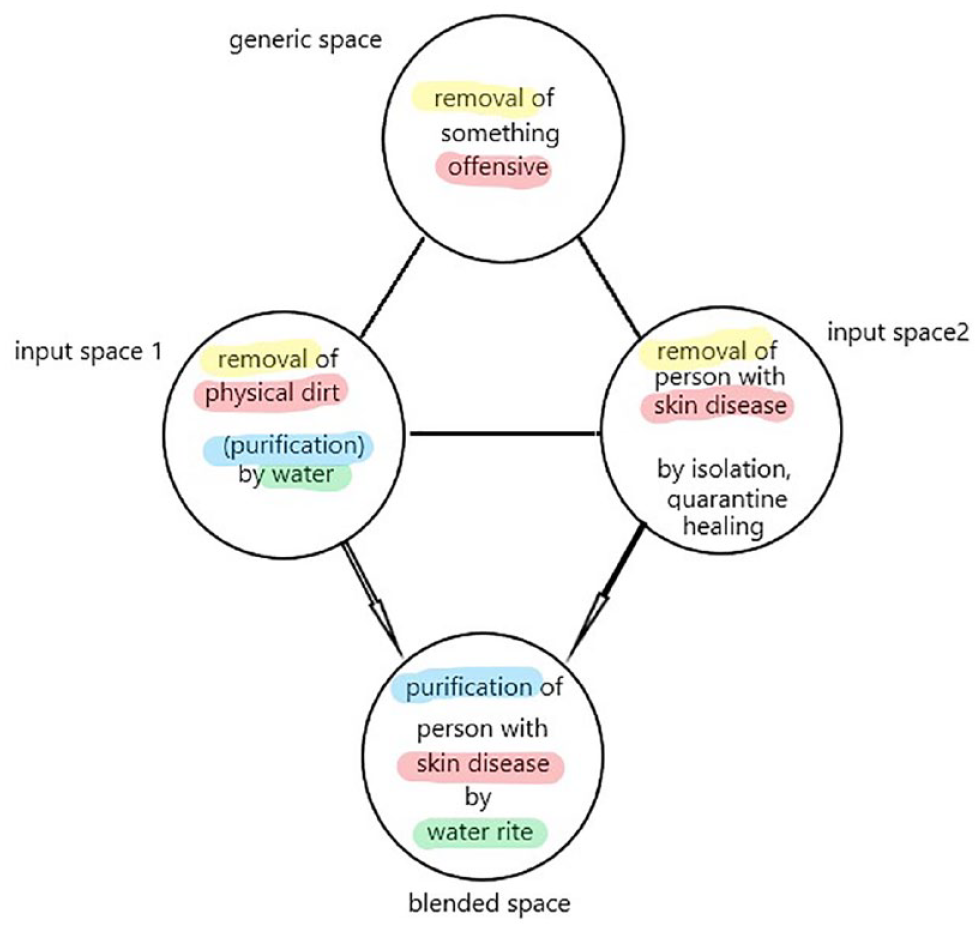
Skin disease as example blend.
Washing off skin disease is perhaps not intuitive, especially not after symptoms have gone away, but the wish to remove something experienced as offensive is common to seeing physical dirt and dealing with skin disease. It is this generic space that facilitates the blending of the input spaces. As dirt is removed by water, so is skin disease in the conceptual blend, although the idea may seem weird. Water purification rites for various purposes may be explained as such blends, as well as the rhetorical use of the concept of purification by water in discourses about repentance from social and ethical transgressions and change of offensive behaviour (see Kazen 2014; 2017 for concrete examples).
In the following figure, we find a number of input spaces which themselves result from prior blends, and which scholars have suggested as (partial) explanations for John’s immersions. When these are combined in a megablend we see the relevance for our interpretation of the Baptiser’s irregular rite of immersion.
As indicated by the generic space, all the input spaces have in common that they concern the removal of something offensive. All input spaces, except one (sacrifice), conceptualise this removal by washing with water, that is, as a form of purification. This means that removal by water is also part of the generic space for the first four input spaces, but not for the fifth, and we must ask ourselves how well the fifth input space fits the scheme. We will return to this shortly.
The blending of the first four input spaces confirms the view that at the core, John’s immersion was conceived of as a purification ritual. As water purifies from dirt, it was used in various ways to purify from ritual impurities. It was not, however, as far as we know, previously used directly to remove offensive behaviour, even though water or washing rhetoric was frequently employed for conceptualising the removal of, or purification from, transgression (Ps. 51 is the prime example; cf. Jer. 4.14; Ezek. 36.16–32). Physical or literal water seems only to have been used for washing off dirt and for dealing with ritual impurities according to the priestly system. Washing away transgression was a mental, emotional, and rhetorical manoeuvre, a conceptual metaphor, but not a physical practice.
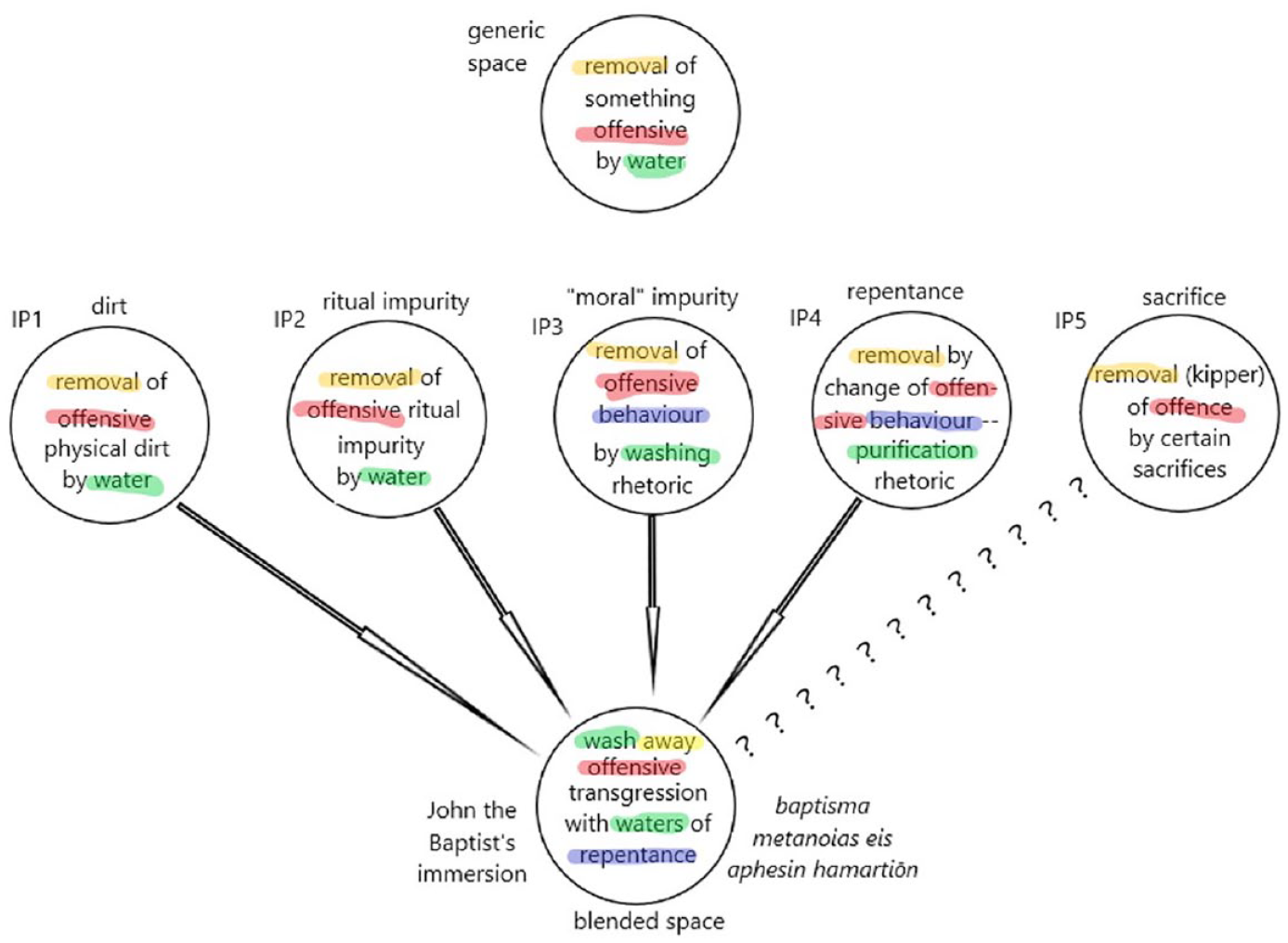
Megablend of John’s immersions.
Purification rhetoric, with or without explicit references to washing and water, is also part and parcel of the repentance discourse that evolves during the Second Temple period (Lambert 2016). Water metaphors are employed not only to conceptualise the removal of the offence caused by transgression, but also the change of mind and behaviour that came to be closely associated with the removal of such offence. 39
The offence we speak of in the blended space is offence against the holy, the divine sphere, God, who dislikes dirt, the ‘un-whole’, honour infringements, and disloyal behaviour to the same degree. For clearing the record and removing certain types of offences, the priestly system also provides sacrifices that effect removal (כִּפֶּר), mainly the חַטָּאת and אָשָׁם offerings (Lev. 4–5). In removing offences, these sacrifices partly serve a similar function to water purification rites. And just as rhetorical metaphors of purification, including water purification, are used in Second Temple period repentance discourse, so sacrificial metaphors are similarly employed rhetorically in contemporary texts, for example in penitential prayer and for reformed behaviour. 40
What is lacking, however, is the clear association between sacrifice, input space 5 in the figure above, and water. Input space 5 shares only one part of the generic space with the other input spaces, but not the decisive element: water. From the perspective of conceptual blending theory, there is no basis for suggesting that the domain of sacrifice provided essential input for John’s innovative water ritual. Sacrificial input is not necessary for explaining the association of John’s immersion with the removal of transgression (forgiveness of sins) or change of behaviour (repentance). The other input spaces (1–4) are quite sufficient for this.
An analysis of the blending process thus supports other arguments against seeing John’s immersion ritual as a substitute for the temple sacrifices (pace Webb 1991: 203–5, 211–12). There are no good arguments for such a view; they are only residues of theologically biased interpretations. Not even the early Christ-believers seem to have viewed their baptism as a substitute for the sacrificial cult. Christ’s death was, in due time, understood along such lines, as supersessionist interpretations gained ground, but this development takes us far beyond John the Baptiser. 41
We are left, then, with immersion as a rite of purification from offensive behaviour, conceptualised as purification from ritual and social offence in a broad sense, into a change of behaviour, conceptualised as repentance and righteous action. What is new is that purification in water was not only understood as a rhetorical metaphor, but physical immersion in water was actually employed by John to purify behaviour. In this regard, the Baptiser’s rite goes beyond previous practices and must be seen as a ritual innovation. Our blending analysis thus supports the second of our three possible interpretations discussed above. It also partly explains the attraction of John’s ritual, especially in an eschatological setting, with expectations of God’s imminent coming for judgment, but for further evidence, we will turn to the theory of ritual form (cf. Uro 2016: 71–98).
Ritual form: Agency, frequency, and pageantry
The theory of ritual form, developed by Thomas Lawson and Robert McCauley, begins by considering ritual as action. We think of rituals and experience them as we think of and experience actions in general. The cognitive apparatus for representing ritual form is the same as for representing any other action, which means there must be representation of agency. When human beings suppose that gods act in rituals, we think analogously to how humans act—and all acts, including rituals, involve an agent that does something with an instrument on or to a patient. This is what McCauley and Lawson call the Action Representation System. The question is where in this structure superhuman or divine agency comes in: does the god primarily act through the ritual agent (Special Agent ritual), in the action by means of an instrument (Special Instrument ritual), or in or through the patient (Special Patient ritual) (McCauley and Lawson 2002: 1–37)?
The theory suggests that Special Agent rituals are more permanent: they cannot be substituted, they are non-repeatable or at least less frequent, they involve more sensory pageantry (high arousal), and they are more exciting. Special Instrument and Special Patient rituals on the other hand can be substituted, they are frequently repeated, they involve less sensory pageantry (low arousal), and hence they run the risk of becoming boring (McCauley and Lawson 2002: 38–56).
Leaving some of the intricacies and less confirmed details of ritual form theory aside, the basic observation that oft-repeated rituals are often quotidian and easily produce a tedium effect, while rare rites can be lavishly performed, seems confirmed by research as well as by general experience. It is not that this must always be the case, but too frequent high arousal rituals may produce a sensory overload and too infrequent low arousal rituals may be forgotten. A balanced system needs both infrequent high-sensory Special Agent rituals and frequent low-sensory Special Instrument or Special Patient rituals. The theory predicts that an unbalanced system, lacking Special Agent rituals, will easily produce splinter groups (McCauley and Lawson 2002: 94–113, 157–212).
In the case of John’s immersion, where does the superhuman agent enter the Action Representation System? To put it simply, is God understood to be ritually connected primarily with the Baptiser, acting through him (Agent), is God most directly connected to the ritual in the act of immersion in water (Instrument), or is God mainly connected to the person who is immersed (Patient)? Which of the positions in the action-representation system, represented by the three circles in figure 6 below, has ‘the most direct connection with the gods’ (McCauley and Lawson 2002: 26)? Is it the immerser who effects a decisive change that the miqveh could not do for the repentants (Special Agent ritual)? Is it the act of immersion and the medium of water that does the trick (Special Instrument ritual)? Or is divine intervention mainly focused on the transformation of the person being immersed (Special Patient ritual)? The latter could in fact be argued for early Christian baptism, with its focus on the spirit entering and inhabiting the baptisand, but what about John’s ritual? At which point is the divine entrance into the system most obvious and direct? This is not always evident and the official, theological, or halakic answer may not necessarily equal that of popular perception (Biró 2013: 134, 138, 142).

(adapted from McCauley and Lawson 2002: 27).
Several scholars have pointed out that from the perspective of ritual form theory, neither Second Temple Judaism, nor rabbinic Judaism, seem to offer any clear examples of Special Agent rituals. Even circumcision, says Kimmo Ketola, was something people did to honour the covenant rather than something priests did on behalf of God (Ketola 2007: 99, 102 note 5). And Tamás Biró demonstrates the problems involved in analysing rituals from the perspective of rabbinic Judaism, most of which seem to be Special Instrument rituals, only that the focus is more on the formal characteristics of the instruments than on their relation to the superhuman agent (Biró 2013: 139–40).
Ketola thinks Second Temple Judaism was a balanced system with regard to types—it included low-frequency rituals with high sensory pageantry as well as high-frequency rituals with low sensory pageantry (that is, infrequent exciting rituals and frequent boring rituals)—but not with regard to forms (Ketola 2007: 103). Sacrifices were offered daily in Jerusalem, but even not-so-frequent high sensory rituals like festivals and special sacrifices were Special Patient rituals—human beings (agents) doing something by certain means (instruments) for God (‘patient’). And while daily sacrifices involve quite some sensory pageantry, much more so than prayer and other oft-repeated rituals, when they become everyday fare, they may contribute to a deflated system (Ketola 2007; McCauley and Lawson 2002: 207–10). Moreover, with high-sensory rituals restricted to the Jerusalem temple they were not immediately available to most Jews.
All of this suggests a situation in which splinter groups could easily emerge, providing available rituals with high-sensory pageantry, intuitively sensed by ordinary people as Special Agent rituals. Some of the ritual innovations in Qumran may be understood in this way (Biró 2013: 141; Ketola 2007: 106–11; cf. Jokiranta 2007: 286–89; 2013: 155–62), 42 as well as John’s immersion rite and Jesus’ healing activity (Uro 2016: 71–127). The latter, in particular, exemplifies a Special Agent ritual, in which the divine power intervenes directly through the person of the healer (Ketola 2007: 106–11; Uro 2016: 98, 99–127).
If it is to be fitted into the system, according to the theory of ritual form, immersion in a miqveh is a Special Instrument ritual. People immerse themselves, not as representatives of the divine, and they perform the rite to render themselves pure. The focus is on the means and details of purification, the miqveh, the water, the procedure (Biró 2013: 137–41). This is the place in the Action Representation System where the supernatural agent, God, enters the ritual. One could perhaps argue that since people do this in response to a divine command, we might interpret purification analogously to the presenting of a sacrifice before God, i.e., as presenting one’s body as pure before the divine power. But in any case, there is no place for a Special Agent in the common immersion ritual.
This is where the theory of ritual form can assist our thinking. In contrast to repeated immersions in a miqveh, likely to trigger little excitement because of their frequency, everyday character, and relative lack of sensory pageantry (with a reservation for the feeling of water against one’s skin), John’s ritual innovation probably appealed to the crowds by less frequency (perhaps a singular event), higher sensory pageantry (natural water in the wilderness), and at least in popular understanding, aspects of a Special Agent ritual, meaning that God was understood to be ritually connected not just to the water medium, but to the person of John, intervening or acting on those who immersed through his agency. This does not fully settle, but nevertheless weighs in on the argument regarding the Baptiser’s agency in the ritual. Based on the theory of ritual form, I find it likely that John actively immersed people and that most of them intuitively understood him as a Special Agent in a ritual which otherwise lacked one. This is a ritual innovation.
The alternative, that John immersed himself and only encouraged others to do the like in his presence, is possible, but less likely, based on the theory of ritual form. 43 But considering the eschatological context and the way in which immersion was associated with God’s coming and conceptualised as purification from ritual and social offense into changed behaviour, we could perhaps think of this as also displaying some aspects of a Special Patient ritual. The superhuman agent, God, could then be understood as being ritually connected also with the purified body of the immersed person, who thereby became prepared for the divine encounter at the coming judgment. This would also be a ritual innovation of sorts. 44 In any case, the theory of ritual form adds to the explanation of why John’s immersions became so attractive and supports the third of our three possible interpretations discussed above, according to which his rite aimed at achieving a high level of general, unspecified purity in view of a divine encounter. It is likely that the experience of divine action through the Baptiser as a Special Agent, and perhaps also of divine connection with, and influence on, the body and behaviour of the baptisand, displaying Special Patient aspects, added to the Special Instrument character of ritual immersion and contributed to the attraction and sense of efficacy of John’s rite.
One of the questions we previously asked was what the Baptiser added to the common ritual of immersion in a miqveh that could explain its popularity and the interpretations we trace in the sources? The theory of ritual form suggests an understanding of divine agency in immersion beyond the Special Instrument slot, providing immersion with aspects of a Special Agent ritual, and perhaps also Special Patient aspects. Special Patient aspects are, however, not necessary for explaining the ritual’s function in view of God’s coming judgment. The setting suggested by most of the sources as well as by the historical context is quite sufficient.
Conclusion
I have suggested that the immersion rite offered by John the Baptiser was a purification ritual by definition, but a ritual innovation compared to immersion for ritual impurities in a miqveh. The sources unanimously associate it with the removal of offensive behaviour, including a change of mind and action. The sources also portray John as a charismatic, prophetic figure, which fits the focus on social and ethical behaviour. Conceptual blending theory supports this by suggesting how a broadened understanding of purification could evolve, to include the removal of offensive acts and a change of behaviour by physical water, but it does not support immersion as a substitute for sacrifice, and it explains how transgression could be conceptualised as something that one could purify from, without causing any confusion in relation to the priestly system of ritual impurities and their purifications.
The theory of ritual form confirms this picture by suggesting a high-arousal Special Agent ritual, much less frequent, and involving more sensory pageantry, than immersion in an ordinary miqveh. John’s immersion may possibly be construed as a Special Patient ritual as well, but critics of ritual form theory highlight the frequent disjunction between official and dogmatic theory on the one hand and popular experience and conceptualisation on the other, and it is very likely that ordinary people experienced John’s ritual basically as a Special Agent ritual. Although it is theoretically possible to argue that John did not himself immerse people, it is easier to explain the attraction of his ritual innovation if he did take an active part in people’s immersion. Judaism at the time of John the Baptiser had few, if any, Special Agent rituals, which made such innovations by reform movements and charismatic figures like John the Baptiser, Jesus, and according to some interpretations the Qumran movement, attractive.
Popular attraction also goes well together with the observation that the miqveh was a relatively recent innovation, promoted by the Hasmoneans and the religious elite, and that John’s exchange of the miqveh for the wilderness and the river, could have been understood as a return to pre-Hasmonean practice, hence more genuine or pristine, and experienced as more emotionally satisfactory. In sum, all of this suggests a popular, less ‘priestly’, and less controlled ritual, based on a broader understanding of purity and purification than what we encounter in ‘official’ religion.
Finally, the eschatological setting, with its expectations of God’s coming in judgment, provides a context within which John’s ritual innovation gains relevance, becomes attractive, and was successful: a mutation of ritual immersion to include purification also from transgression, for which it had since long been a rhetorical metaphor; a Special Agent, administering an infrequent rite, providing it with an enhanced feeling of supernatural agency; and natural water in a wilderness setting, contributing to a heightened arousal and a sense of genuineness.
Footnotes
Acknowledgements
I am grateful to the anonymous JSNT reviewers whose comments have helped me improve my arguments.
1.
Gospel references are numerous and their contents and function cannot be discussed here (Lk. 1.5–25, 57–80; Mk 1.2–11 // Mt. 3.1–17 // Lk. 3.1–22; 3.10–14; Mk 1.14 // Mt. 4.12; Mk 2.18–20 // Mt. 9.14–15 // Lk. 5.33–35; Mt. 11.2–19 // Lk. 7.18–35 // cf. Gos. Thom. 46; Mk 6.14–29 // Mt. 14.1–12 // Lk. 9.7–9; 3.19–20; Mk 8.27–28 // Mt. 16.13–14// Lk. 9.18–19; Mk 9.11–13 // Mt. 17.10–13; Lk. 16.16 // Mt. 11.14; Mk 11.27–33 // Mt. 21.23–27 // Lk. 20.1–8; Jn 1.6–8, 15, 19–28, 29–34, 35–44; 3.22–30; 4.1–2; 5.33–36; 10.40–42). In Acts we find a few references as well (Acts 1.5, 22; 10.37; 11.16; 13.24–25; 18.24–28; 19.1–7). In the letters, there are no references to John. There are hardly any ‘primary’ references to the Baptiser in sources apart from these and other references seem to be dependent on them. The reference to a discussion between Jesus and his family regarding his need to be baptised, which Jerome seems to ascribe to the Gospel of the Nazarenes (fragment 2, Jerome Pelag. 3.2), is definitely secondary. In Josephus’s citations of the Ebionite gospel, nothing about the Baptiser seems to go beyond the Synoptic details (Pan. 30.13) (unless the mention of Aaron is taken as further emphasis on John’s priestly heritage). The shining of a light at Jesus’ baptism in fragment 3 has no bearing on the picture of John and his baptism. This also applies to the elaboration on the descent of the Spirit in the Gospel of the Hebrews (fragment 2; Jerome, Comm. Isa. IV on Isa. 11.2), which is mythological/christological. John the Baptiser’s testimony to the inhabitants of Hades in the Acts of Pilate (4th century?) within the Gospel of Nicodemus is entirely mythological, as are Gnostic references to the Baptiser (i.e., Pistis Sophia 7). The link between the Baptiser and Simon in the Pseudo-Clementines (3rd century) is completely legendary (H II). These texts elaborate on earlier sources and contribute nothing to our understanding of the historical Baptiser. See  -1992.
2.
For examples of comparative analyses and discussions of the Baptiser in the gospels, see Wink 1968; Tilly 1994; Rohmer and Vouga 2020. has emphasised the degree to which all sources construe the figure of John from a theological perspective. Although I basically agree, I still find it worthwhile to ask historical questions to go behind the ‘Christian John’, being fully aware that all ancient sources are permeated by ideology.
3.
Ascesis and self-control, rather than eschatological fervour, are virtues for Josephus. Hence his Baptiser is not an apocalyptic figure and his portrait of Bannus as an ascetic fits his tendency to describe Jewish groups and movements in Hellenistic terms. Scholars frequently acknowledge Josephus’s Hellenising tendencies (for one example among many, see Elledge 2017:175–198 on Josephus’s portrayal of resurrection and immortality) and his reticence towards militant eschatology for cultural and political reasons (cf. Maier 1994: 118–19; ).
4.
See further below and note 27.
5.
The understanding of ‘Elijah’ as forerunner to the Messiah is a specifically Christian idea, although among the Gospels it is only in Matthew that John is explicitly identified with Elijah (Mt. 11.14). In earlier Jewish tradition, an eschatological Elijah figure prepares the people for the coming of God, not of the Messiah (cf. Mal. 4.4–6; Syr. 48.1, 10; 4Q558; cf. 4Q521 2 iii; 11Q13; Zimmermann 1998: 413–15). Jewish associations between Elijah and the Messiah in rabbinic texts are later. See Faierstein 1981, for arguments and references. Cf. also .
6.
Both John’s immersions and Christian baptism are associated with forgiveness, even though Matthew’s understanding of John’s immersions on this point can be debated. It is possible that Matthew’s omission of the Markan εἰς ἄϕεσιν ἁμαρτιῶν has less to do with reserving forgiveness to Jesus’ death, as is often suggested, than with the fact that forgiveness in Matthew was understood as a result of being part of the covenant through continuous participation in the life of a community in which forgiveness was ritualised and practised. For discussion and arguments, see .
7.
According to Josephus, both Bannus and John performed their immersions for purity/consecration/observance (ἁγνεία) (Life 2.11; Ant. 18.117). Like the Markan Baptiser, Bannus had nature provide clothing and food. It is quite obvious that the function of Josephus’s description of Bannus is to portray himself as preparing for his civic and political career by first undergoing a period of strict asceticism.
8.
The explicit comment in Josephus about John’s baptism not being for the forgiveness of sins is much debated, as it most probably reveals an apologetic agenda: μὴ ἐπί τινων ἁμαρτάδων παραιτήσει χρωμένων, ἀλλ᾽ ἐϕ᾽ ἁγνείᾳ τοῦ σώματος, ἅτε δὴ καὶ τῆς ψυχῆς δικαιοσύνῃ προεκκεκαθαρμένης. Cf. : 225–37, especially note 21.
9.
For sake of convenience, the term miqveh, is anachronistically used in this article for the stepped (and usually plastered) pools, almost certainly used for ritual immersion. Cf. Adler 2014: 67–76; .
11.
Cf. Webb’s criticism (1991: 149–50). See also (originally 2002): 239–43.
13.
Ketola and Biró argue that Judaism of both the Second Temple and the rabbinic period more or less lacked Special Agent rituals. Uro sees John’s immersion definitely as a Special Agent ritual and a ritual innovation.
14.
I wish to acknowledge the inspiration I received from Ben Snyder’s recent dissertation (2019; forthcoming from Mohr Siebeck), to visit this complex of questions anew. He has reminded me of many of my previous questions, clarified quite a few, and introduced several new ones. I am indebted to his work. Needless to say, I am also indebted to all those who have written extensively on the Baptiser and his immersions, e.g., Webb 1991; Taylor 1997; Murphy 2003; .
15.
Whether John immersed people himself or whether they self-immersed under his supervision is debated. I will return to this issue later.
17.
My suggestions on the following pages can be compared to Klawans, who likewise suggests three possibilities: his first suggestion is the same as mine; the second is similar, but with the important difference that I do not think that the metaphorical and rhetorical use of impurity language in Qumran, or elsewhere, meant that they merged or confused transgressional behaviour with ritual impurity as outlined in the priestly system (cf. Himmelfarb 2001). My third alternative is akin to one of Snyder’s points. Cf. : 31–32, 186–87.
18.
For a discussion of purification from such impurities of the body, see for example Kazen 2013: 143–76; for a brief and comparative overview, see : 225–31.
19.
For the opinion that the phrase יטמא עד-הערב always implies immersion, see Milgrom 1991: 667; : 116–20. One of Harrington’s arguments is based on a comparison between Lev. 11.40; 17.15; and 22.6.
20.
Or, more precisely, the new immersion practices originally emerge from Hellenistic bathing practices, but distance themselves from them and become identity markers by involving special miqva’ot. Cf. Adler 2018; : 50–86.
21.
I basically understand impurity as a metaphorical and rhetorical concept at some level, except when referring to literal dirt (which does not require ritual purification), and I am hesitant at creating ever new ‘categories’ of impurity for various metaphorical usages. ‘Moral’ impurity is nevertheless a practical expression for speaking of transgressions conceptualised as defiling. See Kazen 2014; .
22.
The most conspicuous example is perhaps Psalm 51. Cf. Klawans 2000: 26–31 and for more examples.
23.
The argument for a merging of impurity and sin was outlined by Klawans (2000: 67–91) and has been followed by numerous scholars—but questioned by others. Cf. Himmelfarb 2001 and for further discussion and references. It should perhaps be pointed out that the blending I will suggest in the following section is not the same as an indiscriminate merging of ritual and ‘moral’ impurity, but rather an analytical tool for understanding the conceptual process and rhetorical use of purity language in ritual and ‘moral’ discourse alike.
24.
See especially note 27 below.
25.
οὕτω γὰρ δὴ καὶ τὴν βάπτισιν ἀποδεκτὴν αὐτῷ ϕανεῖσθαι μὴ ἐπί τινων ἁμαρτάδων παραιτήσει χρωμένων, ἀλλ᾽ ἐϕ᾽ ἁγνείᾳ τοῦ σώματος, ἅτε δὴ καὶ τῆς ψυχῆς δικαιοσύνῃ προεκκεκαθαρμένης (In this way, it seemed to him, was baptism acceptable: they should not use it to obtain forgiveness for the sins they had committed, but as a purification of the body, inasmuch as their soul had already been cleansed beforehand by righteousness). Note especially Josephus’s rather Greek distinction between soul (ψύχη) and body (σῶμα): after the soul had been purified by righteousness, the body could be purified by water.
26.
Considering the Synoptic emphasis on change and righteous behaviour, the idea of a strong contrast with Josephus’s description may be questioned. There is nevertheless a denial of an insincere use of immersion, together with an emphasis on the order of events in Josephus, which suggests that he is positioning himself against another viewpoint.
27.
There is an important difference, however, compared to 1QS III, at least in my reading of lines 8–9: ובענות נפשו לכול חוקי אל יטהר בשרו להזות במי נדה ולהתקדש במי דוכי (And by the compliance of his ‘soul’ with all the laws of God his flesh is purified, so as to [= so that he can] be sprinkled with niddah water and be made holy with the waters of repentance). The basar is made pure by the person’s (nefesh) obedience. Only then can ritual purification take place. Impurity and purification language is being used all through the section for offensive behaviour, but this metaphorical conceptualisation and rhetorical use does not necessarily mean that it is merged with the priestly purity system, so as to purify transgressions by literal water rites. See also my earlier discussion in (originally 2002): 239–43.
28.
Nor were they initiatory. Many scholars have pointed out that even though immersions were naturally part of initiation rituals in Qumran, this was not because immersion was in itself initiatory. Cf. Newton 1985: 26–30; Yarbro Collins 1989: 31; : 35–41.
29.
The Synoptics by their emphasis on repentance, the Gospel of John by associating the Baptiser’s immersion of Jesus with Jesus taking away transgression (sin), and Josephus, who, while denying a certain connection between immersion and forgiveness, strongly affirms that right behaviour is somehow closely associated with purification by immersion.
30.
31.
Cf. also the hemerobaptists, mentioned by Hegesippus (Eusebius, Hist. eccl. 4.22.7) and the Pseudo-Clementines (Homilies 2.23). The latter counts John the Baptiser to this group. Cf. the Babylonian Talmud (b.Ber. 22a). However, the epithet seems to better fit Josephus’s description of Bannus. Cf. : 94–95.
32.
Adler is today hesitant to draw conclusions from miqva’ot adjacent to synagogues (personal communication).
33.
It seems that immersion was required for visiting the court of the Israelites, even for one who had immersed earlier on the same day. See Kazen 2010 (originally 2002): 254–55, for a discussion based on the ancient evidence (m.Kel. 1.8; m.Yoma 3.3; y.Yoma 3.3; cf. Marmorstein 1914; t.Neg. 8.9; Josephus War 5.227; Ag. Apion 2.104; cf. : 332–35).
34.
The issue has been debated for decades, but when it is realised that we lack sufficient historical evidence for a contemporary belief in Elijah as a forerunner of the Messiah, the arguments for John as originally understood as a forerunner of God in judgment prove quite convincing. See for example Hughes 1972: 191–218. For the influence of the ‘coming of God’ tradition in New Testament Parousia texts, see : 1–19.
35.
36.
For a more elaborate discussion of the use of conceptual metaphor and blending theory in the area of purity, see Kazen 2014; .
37.
The association with literal dirt, of course, does not explain all distinctions between pure and impure in the priestly laws. We are here referring to the basic cognitive process through which language from one domain is mapped onto another domain; in this case ‘dirt’ language is mapped onto categories of objectionable human beings, animals, and behaviour. As for the detailed developments of purity halakah, there are numerous other factors involved. For a much more detailed explanation and discussion, see Kazen 2014; 2017; .
38.
Same-sex intercourse is admittedly not explicitly defined as ‘impure’ here, but is surrounded by other impure behaviours and called ‘abominable’ (תּוֹעֵבָה), which is a disgust term, belonging to the domain of impurity (cf. Kazen 2011: 71–94; 2014; ).
39.
Isa. 1.16–17 could serve as precedence. Cf. the penitential character of 4Q414, 4Q512, and 4Q274 1 I.1–4 (Baumgarten 1990; 1999; ). Even though 1QS I, 1 - III, 12 does not suggest initiation by immersion, repentance is associated with water metaphors.
40.
Cf. the ‘offering of the lips’ in 1QS IX, 4–5.
41.
There is a long (and dubious) tradition, from Ernst Lohmeyer (1932: 145–151) and onwards, of interpreting John’s immersions as indicating critique against the Temple and its sacrificial system, presenting baptism as a substitute means of obtaining forgiveness, in opposition to the Jewish sacrificial cult. Lohmeyer goes as far as to talk of ‘die Verdrängung der jüdischen Religion und die Stiftung einer neuen, der Taufreligion’ (: 148).
42.
43.
That John did not necessarily dip or dunk people by his own agency is frequently discussed, with reference to the narrative descriptions, to linguistic arguments, and to the ways in which purifications by water were performed historically, as well as to the ‘reception’ of John’s immersion in early Christian traditions (evidence from texts as well as from the physical construction of baptisteries). Cf. Taylor 1997: 49–58; : 259–63. The precise manner in which John acted is not decisive for my argument, however, but his agency as it was experienced by people coming to him for immersion.
44.
The theory of ritual form in fact suggests that in a ritual’s full structural description, the divine agent may be experienced as entering the action representation system at several levels, so that the entry with the fewest enabling rituals is understood as the initial one, while other entries may follow. In practice, this means that in our case, the Special Instrument ritual of purification in water has mutated into a Special Agent ritual through the immediacy of John’s agency, while at the same time, the medium of water and the change of mind and behaviour in the baptisand may be associated with the agency of the divine agent further down the chain, so to speak. Hence it is fully conceivable with a ritual like John’s being experienced primarily as a Special Agent ritual, but with additional aspects of a Special Instrument and Special Patient ritual. I have chosen, however, not to elaborate further on these intricacies of the theory.