



Abstract
This study responds to the central question: ‘What do you see as the tasks, methods, and aims of New Testament studies, given the demands and priorities of the context in which you work?’ From a decolonizing perspective, biblical scholarship’s crucial role is fostering interdisciplinary approaches to help address 21st-century challenges set within the communal see-judge-act-evaluate-celebrate/ritualize framework. As a test case, this study characterizes Mary, her maternal health, and the perils of pregnancy in Luke 1–2 from a decolonizing angle within the context of the teenage pregnancy crisis in the Philippines. This decolonizing and interdisciplinary approach involves utilizing a synergy of contextual biblical hermeneutics in interpreting Luke 1–2 as an attempt to ensure that New Testament studies remain a relevant source of inspiration for actionable responses to promote teenage maternal health.
Keywords
The central question to which this essay responds, and offers an illustrative case-study, concerns the purpose of our discipline: ‘What do you see as the tasks, methods, and aims of New Testament studies, given the demands and priorities of the context in which you work?’
As a response, I will begin by describing my context. My biblical training as a Filipina Catholic lay woman who finished her studies at the Faculty of Theology and Religious Studies in KU Leuven has allowed me to teach in two settings. At the Department of Theology and Religious Education at De La Salle University in Manila, I teach a course called ‘Encountering the Word in the World’ for undergraduates, and courses focused on biblical methods and biblical theology for graduate students of Applied Theology. 1 They are primarily locals but with some second-generation Filipinos from abroad and some from other Asian countries. At the Faculty of Theology and Religious Studies in KU Leuven, I co-teach a core course, Contextual Hermeneutical Approaches to the Bible, to a very international group of masters students focusing on various theological disciplines, including biblical studies. In both settings, the majority are Christians and Catholics, while others come from another religious tradition or a non-religious background.
Considering this central question from the perspective of decolonization invites one to embark on ‘recovering a communal way of interpretation that brings together readers from both western and non-western contexts, relating empire in Scripture to the contemporary global situation and challenging the tendency to isolate biblical studies as a secular, academic discipline’ (Lim 2019: 193; cf. Banazak and Reyes Ceja 2008). Thus, I encourage my students to include their context as interpreters while engaging the biblical text as revelatory using combinations of hermeneutical approaches and methods. I challenge my students to participate in knowledge creation and dissemination in the academic, ecclesial, and larger societal settings. The contextual issues that they articulate provoke questions and demand an action-response inspired by the Christian faith, particularly from the biblical tradition. Conversely, some who tend to be more text-centred find ways in which the Bible can be relevant to concrete issues. I also include scholarly materials from different genders and international scholars using different kinds of hermeneutical methods to widen their horizons and skills that inspire action-response amidst their challenging contexts. Thus, biblical scholarship contributes dynamically and vitally to interdisciplinary approaches to respond to the intersecting challenges of the 21st century. This involves using, exploring, adapting, and promoting a synergy of hermeneutical methods applied to the biblical text. Consequently, New Testament studies will continue to be a reliable and relevant source of inspiration for relevant action-response.
In an earlier publication, I argued that a meaningful biblical scholarship in the Philippines collaborates with the larger theological process within Filipino Catholics’ lived religion particularly among those in the lowland (see Ibita 2018). I shared the pastoral spiral suggested by the Federation of Asian Bishops Conference (FABC).
Figure 1 updates the illustration in the previous article (see Ibita 2018: 194) to demonstrate the FABC pastoral spiral’s overlap with the well-known SEE-JUDGE-ACT method begun by Cardinal Joseph Cardijn and two further steps as improvements. Cardijn developed it in the context of post-World War 1, poverty-stricken Belgium from the early to mid–20th century as he worked with the young labourers who would be known later as the international group of Jeunes Ouvrières Chrétiennes (JOC) or the Young Christian Workers (see Sands 2018: 2–4). Although a white, European priest started this process, its social justice and participatory orientation made this spiral a dialogical way of theologizing that engages both theory and practice and has been very helpful in liberationist and contextual theologizing in Latin America, Asia and Africa (Pilario 2016; Sands 2018: 4–9). The step SEE covers the multi-sensory awareness of a particularly challenging reality and the sharing of experiences noted in the FABC document. It uses the five senses, experiences, and data from one context. JUDGE encompasses a two-fold process, namely the analysis of causes and the theological analysis or reflection in faith, followed by decision-making based on these analyses. Finally, ACT covers the planning of action-response and carrying it out. While Cardijn’s spiral is a triptych, Latin American practitioners have seen the need for two more steps: CELEBRATE and EVALUATE (see Talavera 2020). In working with my sister, Ma. Maricel Ibita, an Old Testament scholar, while we were doing an interdisciplinary, interuniversity, international and intersectoral action research with urban poor women during the pandemic (2020–2022), we saw the need to flip these last two steps to make it more suited to the Filipino context while the COVID–19 pandemic was raging (see Ibita and Ibita 2023). For us, the need to EVALUATE must immediately follow the ACT step to assess the success or not of the actions taken and the consequent new reality. While we affirm the Latin American Christians’ decision to include the step to CELEBRATE, to recognize even the small victories, we also saw the need to articulate the step to RITUALIZE to deal with inadequate, delayed, or unforeseen harmful results of the actions, such as the need to lament before starting a new spiral (see Ibita and Ibita 2023: 182, 192–95). These steps decolonize theologizing and biblical interpretation.
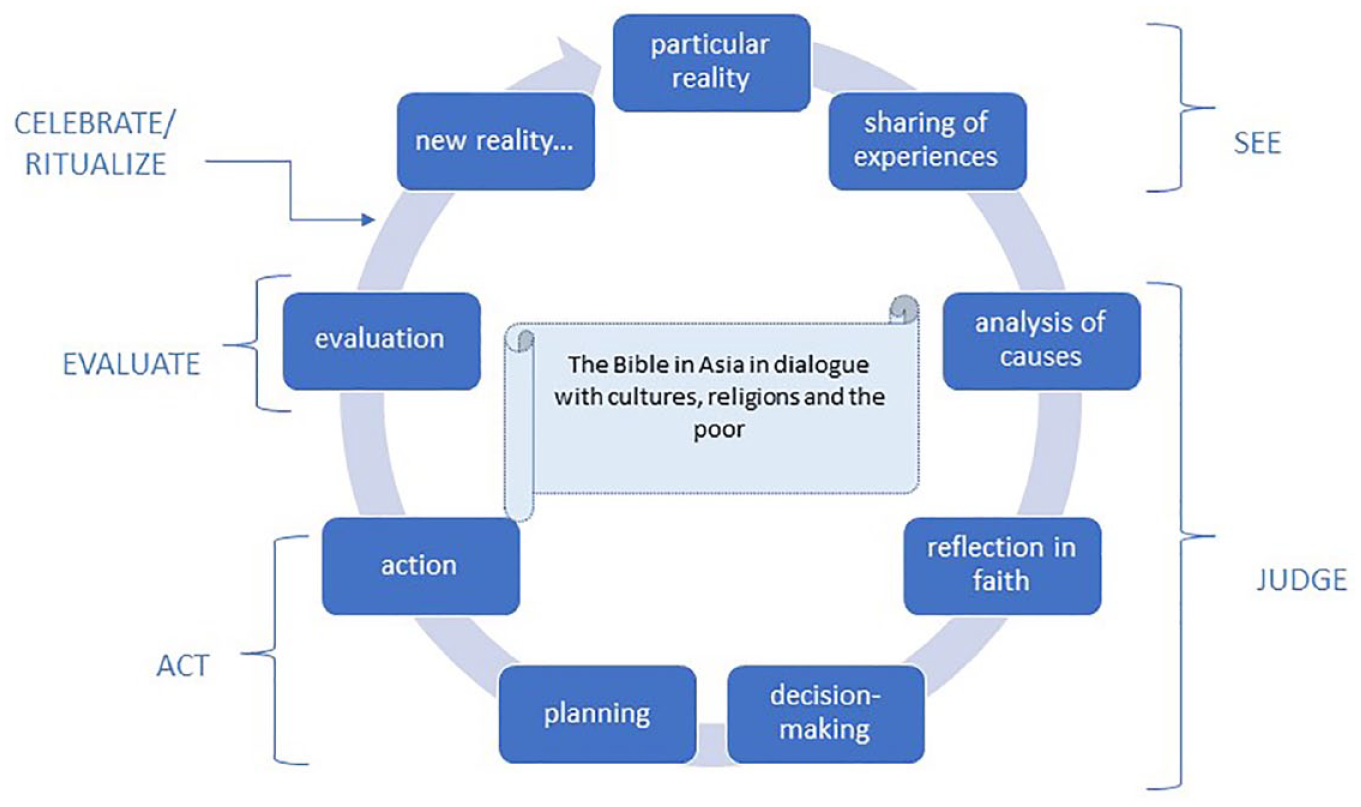
Updated Pastoral Spiral.
These five steps will serve as the basic structure for this essay. Generally, theologians think that biblical scholars can only help in the JUDGE step, which consists of the theological and non-theological analyses of the problem and the principles that can help in solving the issue. From a Catholic perspective, the theological analysis includes the biblical tradition and the applicable documents from the Catholic heritage, especially Catholic social thought, from which the problem is understood and on which the theological inspiration for the concrete solutions are based. The ACT part tends to include only the practical responses to the problem at hand. However, as a biblical scholar who observes the need for more adequate and contextual hermeneutics, I hold that there are instances in which the biblical contribution is also needed in the rest of the pastoral spiral steps, as I will show below, focusing on the perils of teen pregnancy, accompanied by the story of Mary in the Lukan infancy narrative.
See
The first step is to see, to identify, the issue that presents itself as a challenge. On June 30, 2019, teenage pregnancy was declared a national emergency in the Philippines through Executive Order 141 (see Duterte 2021). This law is based on the 2018 data from Civil Registration and Vital Statistics System of the Philippine Statistics Authority, which recorded 183,967 live births among 10–19 years old girls or 504 live births/day. This declined a little in 2019 to 180,916 live births or 495 live births/day. In 2023, there is a further decline, but the Philippines is still the second highest in Asia, in terms of the number of teenage pregnancies among those 19 years old and below (56%), following Laos (64%) (see Dela Peña 2023).
Judge
The second step is a multi-faceted analysis of the problem. A more comprehensive analysis below will consider the five aspects of teenage pregnancy from non-theological perspectives.
Pregnancy and Age
Considering Philippine teenage pregnancy and age, in September 2020 the Population Commission reported that ‘pregnancies among children aged 10 to 14 years old went up to 2,200 in 2018, more than double the 1,000 in 2007’ (Salaverria 2020). Moreover, while pregnancies among 15–19-year olds have shown some decrease, a Department of Health-Cordillera tracking (for one region within the Philippines) shows a rise among 10–14-year-olds, with 20 in 2020, 21 in 2021, but 31 in 2022 (see Malingan 2023).
Pregnancy and Consent
In explaining the high rate of teenage pregnancies in the Philippines recently, government officials and advocates tie it to the inadequate access to health and family planning services during the COVID–19 quarantines (Bello 2021). About 40% of Filipinos do not have adequate access to sex education, and 30% get theirs via social media, which can be inaccurate, inappropriate, and misleading (see Dela Peña 2023). However, teenage pregnancy is not only linked to consensual relationships. ‘Others raised gender-based violence issues—such as child sexual abuse and rape—as the roots of these early pregnancies’(Bello 2021). Executive Order 141 remarked that a United Nations Policy Brief in 2020 showed that only 3% of the pregnancies are fathered by men of the same age group as the mother and that the rest might have resulted from coercion and unequal power relations (see Duterte 2021). The longest global lockdown in the Philippines exposed many young girls to onsite and online sexual violence and exploitation in exchange for money due to the harsh economic situation of the pandemic lockdowns without recourse to help. They were trapped, living with the perpetrators, often their own family members. The Commission on Population and Development Population Officer III Job David Manalang shared data on the National Health and Development Survey and cited the 2021 Civil Registry of Vital Statistics finding that ‘there were actually men who are in their 60s, 70s, and 80s who impregnated teenage mothers’ (see Malingan 2023). Likewise, one can recall critically the sexual abuses done in the name of ‘god’ or as ‘son of God’ of cult leaders like Apollo Quiboloy (see Gomez and Espina-Varona 2021). In this case, there is a need to ensure that teaching about the story of Mary’s yes also includes teaching on how to say no to what is not life-giving, especially to those who claim to be gods but sexually abuse women and girls.
Pregnancy and Mobility
For contemporary pregnant Filipino women, specifically teenage mothers, the difficulty brought about by the pandemic also included a lack of access to safe delivery in both home and hospital birth due to the limits of lockdown, a problem that was already present in pre-pandemic times, but that worsened during the lockdowns (see Dela Peña 2022).
Pregnancy and Maternal Health
Philippine health officials and advocates have underlined that teenage pregnancy is primarily a health issue since it increases the risk of maternal mortality and preterm deliveries. It is also an education and social issue ‘that often results in poor lifelong social and economic outcomes for both the adolescent mother and her child’ and the next generation (Dela Peña 2023). Moreover, it is an issue of human rights violation and power disparity, particularly in the cases of sexual exploitation and rape.
Based on the United Nations Population Fund and the Philippines Population Institute reports, Ann Regala, UNFPA Philippines Communications and Media Officer, claims that given the exhaustion of the national and local health systems due to COVID–19, ‘attention, and resources for women’s health might have been diverted’ (Regala 2020). Moreover, ‘Pregnant women’s utilization of facilities for ante-natal check-ups and delivery is declining because of service disruption, difficulty in commuting, and fear of contracting COVID–19. Similarly, their access to modern contraception has also been facing challenges’ (Regala 2020).
Pregnancy and Delivery
The Population Commission noted the increase in maternal and neonatal deaths in the last few years under the pandemic, indicating difficulties in accessing appropriate, high quality, and timely maternal and neonatal care services in health facilities, especially in the first 1,000 days of their babies’ lives. They suspect that these deaths are due to inadequacies in home births, underlining the ‘challenge to improve our local health system for emergency obstetric and newborn care,’ which was affected gravely by the COVID–19 crisis (Dela Peña 2022).
From the Philippine Context to a Decolonizing New Testament Interpretation
The JUDGE step also consists of the theological analysis using the Bible and Catholic social thought. Here I shall focus mainly on the biblical contribution and task. Given the challenges of the 21st century, biblical scholars play a vital role in providing interdisciplinary insights into biblical passages that can inspire people to respond concretely. Their responsibility includes adapting and promoting a synergy of contextual hermeneutical methods to ensure that New Testament studies remain inspirational and relevant in finding solutions in the context in which they work.
Considering the Philippine teenage pregnancy problem, contextual approaches to biblical interpretation combine easily with storytelling and characterization. Their synergy allows both ordinary readers and biblical exegetes to read the biblical text closely by focusing on the words and deeds of actors and their interrelationship and the information gathered from the narrator. As an example, I will explore the characterization of Mary in Luke 1–2 and enrich this with intersecting insights from contextual biblical hermeneutics such as liberationist, feminist, and womanist hermeneutics (by highlighting the plight of poor women) and incorporating empire-critical studies and postcolonial hermeneutics by noting the impact of the Roman empire as evident in the storytelling. Mary’s presence is prominent in the Filipino faith tradition, mostly inherited from the Spanish and American missionary influence. It can be seen through praying the rosary, devotional prayers to Mary, singing Marian songs, and the para-liturgical playlet that shows Mary and Joseph’s trip to Jerusalem, the panunuluyan. This paper attempts a decolonizing characterization of Mary as a young, poor woman in her pregnancy and childbirth journey within the intersections of the difficulties of gestation, travel, and the generally oppressive conditions within the Roman-occupied province of Judea governed by Herod (Lk. 1.5) (Målqvist 2015; Dasen 2011; Parkin 2011), Mary gives voice to the traces of perils of pregnancy in the unfolding Lukan plot. I will present them through the five considerations about teenage pregnancy mentioned earlier.
Pregnancy and Age
Luke uses the Greek παρθένος twice in describing Mary in 1:27. Gordon J. Wenham’s word study on the Hebrew בְּתוּלָה and the Greek παρθένος suggests that the translation should be ‘a girl of marrying age’ or a female ‘teenager’, which became more restricted to mean ‘virgin’ only later in the Christian era (Wenham 1972).
Research on the age of marriage under the Roman empire shows that girls/young women had to be at least 12 years old, 14 years for boys, assuming the bride’s, the groom’s, and their fathers’ consent to the marriage (Dasen 2011: 296; Dixon 2011: 247). Rabbinical documents show that for Palestinian Jews in the late second temple period, the typical marrying age was around twelve or thirteen up to late teens for girls and late twenties to early thirties for men (Kulp 2007: e47; Schremer 2003; Satlow 2018; Parkin 2011). The same studies note that for Babylonian Jews, the boys got married in their late teens to girls who may not even have reached puberty. Does the Lukan story’s setting in Galilee allow the implied and real readers then and now to imagine that Mary was somewhere between 12 years old and her late teens when she got pregnant? What does this mean for our presuppositions considering her body’s maturity for childbearing with its accompanying changes and dangers?
Pregnancy and Consent
For some feminist scholars, the Annunciation story depicts a strong woman in Mary, reflecting the call narrative of prophets who initially resisted but afterward accepted God’s command, like Moses and Isaiah (see Reid and Matthews 2021: 14–22). However, recent critical thoughts on Lk. 1.26–38 include the issue of sexualization or sexual violence and consent. While Wenham says that παρθένος should be rendered ‘a girl of marrying age’ or a female ‘teenager,’ Michael Pope observes that Luke thrice sexualized Mary in describing her as a virgin twice (παρθένος, 1.28) and as being betrothed to Joseph (ἐμνηστευμένην, 1.27; Pope 2018: 703). Moreover, for Pope, the language used by Gabriel in his unbidden visit to the city of Nazareth to an unaccompanied young woman is intrusive and recalls the sexual language and violence sanctioned in Dt. 22.23–24 (Pope 2018: 703). Even Mary’s question in 1.34 focuses on her sexuality. Mary’s readiness for pregnancy dominates the characterization in 1.26–38.
The combination of the news of Mary becoming pregnant even as an engaged woman (Lk. 1.29–33), her initial resistance through questioning and articulation of her virginity (1.34), and her eventual consent (1.37), has been critiqued as an example of sexual violence due to power imbalance. That the Lord/master (κύριος, 1.30, 37) was with her from the start (1.28) and that there is nothing impossible with God do not give enough possibility for withholding consent. Mary’s character is not even explicitly asked for her consent. Instead, she is told about the impending pregnancy.
Moreover, Mary’s affirmative response and self-identification as a δούλη, a female slave, underline her lack of freedom, for a female slave cannot deny her master (Pope 2018: 708). Barbara Reid and Shelly Matthews consider δούλη κυρίου (1.38) to be ‘highly problematic’, not because of Mary’s lineage to the other biblical servants of God but due to slavery’s major problem of denigrating human dignity and the master’s right to the slaves’ labour and bodies (Reid and Matthews 2021: 31). For womanist reading or black women’s feminist interpretation, the traditional translation ‘servant’ instead of ‘slave’ minimizes the language and horror of slavery (see Lettsome 2021: 11; Martin 1990: 45). For Mats Målqvist, it shows how Mary submits to patriarchal authority and consequently agrees to an otherwise unwanted pregnancy (Målqvist 2015: 2). However, can these interpretations be entertained if Lk. 1.46 describes Mary as rejoicing? Here we see that the biblical text is ambivalent. One may interpret Mary’s consent as influenced by choosing to agree with a deity described as the Most High and Lord God (1.32), more powerful than the Roman gods, including the deified emperor, who has done great things for her and her people (1.46–55). However, a feminist reading can also critique the internalized, embodied violence in which women supposedly ought to be thankful for what was sexually done to them for the benefit of many (1.30–37). While this is a New Testament passage, the disturbing issue of consent and women’s bodies in biblical stories has been explored in the Hebrew Bible where some of these stories have been considered as texts of terror (Trible 1984) or texts after terror (Graybill 2021).
Pregnancy and Mobility
After the annunciation, Mary travels in haste to the Judean hill country to visit her old and pregnant cousin, Elizabeth. Roman roads, primarily built for military purposes, serve all other purposes of travel and mobility (see Cohen 2015: 192). While traveling and hospitality are prominent in Luke’s narrative, as seen later in Jesus’s journey narrative and his stories of travel, research on first-century mobility underlines the need to journey in groups for more security against robbers, brigands, and physical attack (as Lk. 10.30 demonstrates). Getzel Cohen notes that while there was an increase in travel to Jerusalem in the Persian period, pilgrimage to Jerusalem was promoted later during the Hasmonean era and during Herod the Great’s reign (Cohen 2015: 195). Security and safety were a concern, particularly in desert travel, as evidenced by inscriptions of gratitude for safe journeys, specifically of caravans (Cohen 2015: 195–97). Travellers ride on camels or donkeys or in wagons, or travel on foot, and bring their food and drink along the way (Cohen 2015: 212–13). Cohen’s comparison of accounts from ancient travellers suggests they cover about 20 miles or 32 kilometres per day, subject to the terrain, weather, animals, and the travellers’ condition (Cohen 2015: 210). Mary’s roundtrip journey to a hill country to visit Elizabeth covered more than one hundred kilometres each way in the beginning of her first and second trimesters (Lk. 1.39–56). Traveling during the first trimester was a delicate period in pregnancy in antiquity (and even today). Målqvist understands this journey as Mary’s way of coping with the physical, mental, and social stress of the first trimester of the pregnancy and even the possible social pressure of abortion given the extraordinary gestational context despite her uneventful journey (see Lk. 1.56) back to Nazareth (Målqvist 2015: 2).
Through a postcolonial lens, we also see the overarching authority and power of the Roman Empire over colonial subjects as actors. The subaltern characters, like Mary and Joseph, must follow the command to participate in the census despite Mary’s delicate situation in her third trimester. She was forced to travel even if it must have been so much more difficult for her mobility, comfort, and safety. The third trimester journey from Nazareth to Bethlehem was even more perilous than the usual travel. In Lk. 2.1–7, Mary faced dangers ahead even if she was with Joseph, given the possibility of delivering outside the comfort and safety of their home, a place preferred for safe delivery in antiquity (Dasen 2011: 296).
Pregnancy and Maternal Health
Pregnancy not only brings about bodily changes in Mary but also carries with it the stigma and dangers of a pregnancy out of wedlock with the accompanying punishment of being stoned (cf. Mt. 1.19, Målqvist 2015: 2). Another challenge relates to Mary’s physical and mental health due to the demand of pregnancy within the socio-economic setting of Roman Galilee. Douglas Oakman describes it as beset by ‘exploitative urbanism, powerful redistributive central institutions like the Roman state and Jewish temple, concentration of land holdings in the hands of a few, rising debt, and disrupted horizontal relations in society’ (Oakman 1986: 211). Given the fragmentary evidence of the socio-economic context of Roman Galilee, Reid and Matthews hold that Mary and Joseph might have been poor but not necessarily destitute since they could travel to Jerusalem (Reid and Matthews 2021: 23). Nevertheless, the socio-economic and political context under Roman-occupied Palestine added to the dangers posed to maternal health. From an intersecting liberationist and feminist perspective, Mary was fully aware of the socio-economic, political stressors (Lk. 1.51, 52, 54), even if she rejoiced (1.46–47). Mary recognizes her lowly status (1.48). Physically, she is not unfamiliar with the reality of hunger (1.53), a severe issue for the nutrition of pregnant women and the growing foetus. In her study of Greek and Roman pregnancy in antiquity, Véronique Dasen speaks of many rituals and votive offerings that express the desire for safe pregnancy and delivery, which reflect the potentially fatal threats to both mother and child (Dasen 2011: 296; Parkin 2011: 282).
Pregnancy and Delivery
The primary source about birth and delivery in antiquity was the second-century CE handbook for midwives’ training written by Soranos, a Greek physician from Ephesus (Soranus 1956). It includes a discussion of who are fit to be midwives, the female sex organs, menstruation, conception, care for pregnant woman, the procedure and the child delivery process, difficult labour, neonatal care and gynaecological problems. Home delivery is considered safer, given the availability of midwives, experienced women, and female helpers, as well as the available tools for the delivery like the birthing chair (Dasen 2011: 296). However, with the help of material evidence, Dasen’s studies also highlight fatal dangers. ‘The birthing process is usually only alluded to, as in scenes of divine births or on monuments of women who died in childbirth’ (Dasen 2011: 296; cf. Neils and Oakley 2003: 185–87). Moreover, neonatal death was high in the first week, so many children were named only after this time (Dasen 2011: 293).
Luke situates Mary’s delivery and Jesus’s birth within the events of the colonizing power of the Roman empire, citing the census as the immediate context (Lk. 2.1–7 ). Despite being in the third trimester, Mary needed to travel from Nazareth with Joseph, whose Davidic roots go back to Bethlehem. Luke describes the scene in 2.6–7. Without precluding the religious symbols, Målqvist considers the material description of Mary’s delivery as presenting the potential perils of maternal and neonatal deaths due to the physical strain of the arduous trip and the search for an inn, the poor birth preparations since they were not in the safety of their homes and were journeying, with no skilled attendant nor help at birth mentioned, and potentially poor hygiene at delivery since she had to lay him in a manger, as 2.7 describes.
The preceding discussion shows both the various dangers that teenage mothers endure in the contemporary Philippines and also parallels with the perils that Mary faced as a young pregnant Jewish woman in first century CE. But how can these insights help in combatting and preventing Filipina teenage pregnancy and supporting those who do become pregnant?
Act
As biblical scholars, the insights gained from the JUDGE step can be instrumental and inspirational in addressing the Philippine teenage pregnancy crisis. By utilizing storytelling and drawing insights from Mary’s character in Luke 1–2, we dialogue with catechists, religious educators, theologians, secondary school teachers, health practitioners, and other stakeholders especially the parents and the teenagers themselves. This approach aligns with our commitment to promote the United Nations Sustainable Development Goal 3: Good Health and Well-Being particularly in addressing the issue of Filipina teenage pregnancy. In this capacity-building dialogue, soliciting the input from teenage Filipinas in an age-appropriate manner is important since they tend to be embarrassed in discussing sexual matters. Within a dialogical context, here are some possible actions:
1) Converse in a safe space with the stakeholders, especially the adolescents, regarding the issue of consent and sex education. Here, a critical discussion between Mary’s yes and the capacity-building for teenage girls to say no is imperative.
2) Attend to signs of physical-psychological-emotional-spiritual abuse (often in a context of poverty). Mary’s song (1:47–55) is a form of saying no to what is not life-giving, especially in teenage pregnancy and prevention, such as the physical, psycho-emotional, spiritual needs of teens and in mitigating and ending the continuity of the cycle of poverty that teenage parents suffer due to early pregnancy. Developing their courage to say no to abusers who misuse religion and the Bible is vital.
3) Explore and provide structural support, advocacy, and referral when needed, just like Mary and Elizabeth who mutually helped each other. For adolescent Filipinas, this kind of help is necessary, and religion/theology teachers or parish workers can be the first line of support.
4) Maximize the use of accessible social media platforms and artificial intelligence to present reliable information and provide links to emergency help organizations. On November 26, 2023, the Quezon City government along with the Swiss non-profit organization, Spring ACT, launched Sophia, a chatbot that can help victims of domestic violence while preserving confidentiality (Legaspi 2023).
Evaluate
This step assesses the success of the individual and communal actions taken in the ACT step. Evaluative criteria like the following might be helpful: when participants express additional knowledge about consent and sex education from the discussion of their context vis-à-vis Mary and her pregnancy in Luke 1–2; exhibit a heightened alert for signs of physical-psychological-emotional-spiritual abuse (and awareness of the impact of poverty); articulate a refreshed/new knowledge about relevant structural support, advocacy, and referral; and demonstrate facility in using social media or AI for information and emergency support .
Celebrate and/or Ritualize
When the evaluation shows that the actions are successful, Luke 1–2 can be used as a basis for celebration like praying the rosary traditionally or contextually, encouraging reflective conscientization during Marian feasts, cosplaying or wearing of Marian costume in relevant occasions such as the Panunuluyan (the Filipino theatrical presentation of Luke 1–2, especially 2.1–7, at Christmas time), as well as singing Advent or Christmas carols and other celebratory songs.
However, for inadequate, delayed, or unacceptable/difficult results the same texts and prayers can be used as part of ritualization. The RITUALIZE step will need the additional insight from trauma biblical hermeneutics (see, for example, McIntosh 2020; Herman 1997) and other biblical passages, such as the texts of terror and after terror mentioned above, that can provide the participants with an avenue to express their varied emotions, such as lamentation, anger, frustration, self-pity, strong resolve for justice, courage, and hope amidst the difficulties. For instance, a Magnificat-like litany written or illustrated by girls/young mothers provides opportunities for self-expression. Creative prayer that highlights Mary’s strength and the reliability of a God who saves young and pregnant women may be helpful.
Conclusions
I hope that this paper contributes to the ongoing discussion about decolonizing the tasks, methods, and aims of New Testament studies through this illustration of how biblical interpretation can function fruitfully in the Philippine context in an interdisciplinary and intersectional way. I demonstrated that biblical interpretation could contribute to the communal and larger process of the SEE-JUDGE-ACT-EVALUATE-CELEBRATE/RITUALIZE pastoral spiral. The initial SEE step is vital in starting the decolonizing process since it situates the need for biblical interpretation within the different challenging contexts faced by 21st-century interpreters, such as the issue of teenage pregnancy. Biblical interpretation has a significant role in the rest of the steps of the spiral. The synergy of using different methods like narrative, liberationist, feminist/womanist, empire-critical, and postcolonial biblical hermeneutics critically enrich the inspirational, intersectional, and interdisciplinary insights into the character of Mary. Learning about her intersecting struggles as a young, poor, pregnant woman living under the Roman occupation, who needs to overcome the challenges posed by age, consent, mobility, maternal health, and delivery, invites a dialogue with the stakeholders of today’s teenage pregnancy crisis. The insights from this kind of dialogue can inspire communal concrete action-response to address contemporary contextual challenges like teen pregnancy in line with the goals of UNSDGs such as Goal 3 on maternal and child health and well-being. Hopefully, a decolonizing use of combined contextual biblical hermeneutics like this attempt can help in making New Testament studies remain a critical and pertinent source of inspiration for addressing other 21st-century challenges.
