



Abstract
Data from two bilingual Basque–Spanish children are analysed with respect to the grammatical domain of clitic drop, involving the interface between pragmatics and syntax. Basque Spanish allows for clitic drop in referential contexts, an option that does not exist in standard Spanish. The data suggest that the early high rate of clitic drop is most probably due to two factors: first, cross-linguistic influence from Basque because Basque lacks clitics – and hence the complement position is either occupied by a DP or pro – and both children studied in the present article drop more clitics in Spanish than the monolinguals reported in the literature (Fujino & Sano, 2002); and second, because children seem to have a notion of topic that equals information recoverability.
Introduction
This article examines the acquisition of the third person object clitics and clitic drop by bilingual Basque–Spanish children in Basque Spanish, a variety of Spanish which differs from standard Spanish in many respects, crucially in the use of third person clitics.
According to López (2003), who has analysed dislocations in Catalan, clitics are topics. Scholars agree on the crucial issue that the sentence topic and the discourse topic are two different concepts that have to be kept apart. But there is no consensus on the concept of topic. While some scholars argue that topics are elements that have been introduced in the preceding discourse, others argue that the topic is what the sentence is about (Zubizarreta, 1998). Yet other scholars contend that the topic is what the speaker assumes that the hearer knows. Casielles-Suárez (1997) contends that clitic left dislocations are used to reintroduce a topic in the current discourse.
Clitics are syntactically determined in standard Spanish while their use and clitic drop in referential contexts is a primarily pragmatic phenomenon in Basque Spanish. Clitics are not compulsory in any context in Basque Spanish and, hence, a wide range of intra- and interindividual variation exists in adult Basque Spanish. We assume that speakers drop clitics according to the principle of information recoverability, which turns out to be different for each speaker, as we will show later. The existing studies on clitics in this variety focus on syntactic and pragmatic properties. Hence, one of the issues that is addressed in this article is parental and caretaker language, which constitutes the input the children are exposed to. One parent and two caretakers will be investigated in order to determine their speaker profile as regards clitic use. If significant discrepancies in clitic use are observed, we will compare clitic use in adult Basque with clitic use in child Basque in order to assess the impact of bilingualism on clitic acquisition. Since Basque Spanish allows for clitic drop in all contexts, the only way to test whether bilingualism affects the path of acquisition is to investigate parental input. Second, children’s clitic use will be studied along the lines discussed in the theoretical framework, taking into account that clitics must be dropped in some contexts.
The article is organized as follows: to start with, we provide a brief literature review on acquisition of clitics in standard Spanish and in other Romance languages. We then deal with the main grammatical features of third person clitics in order to conduct the present study. In the third section we outline the theoretical framework adopted in the article, and a methodology follows. Data presentation and a concise discussion close the article.
Acquisition of clitics: The issue of cross-linguistic influence
Children acquiring languages which have clitics omit third person clitics at the very beginning of acquisition regardless of whether the children are monolingual or bilingual. With respect to object drop, 1 Hulk and Müller (2000) make the observation that object drop is highly language specific. According to their study, monolingual children acquiring Germanic languages drop objects twice as often as those monolinguals acquiring Romance languages; the reason being that German is a topic-drop language. Interestingly, clitics are massively dropped in early stages of language development (French and Italian) (Hulk & Müller, 2000) and even more often by bilinguals (Müller, Crysmann, & Kaiser, 1996) than by monolinguals. French is a non-topic-drop language and, therefore, clitic drop in child language is target deviant. Müller et al. in an agreement approach to clitics showed that a bilingual French–German child studied by them dropped direct object clitics in French until the age of 3;0. This age coincides with the acquisition of the functional category C in Ivar. Müller et al. claim that clitic drop in French is licensed in early child grammar until the age of 3;0 because PRO is adjoined to IP by the children and, hence, this empty category can identify the gap in object position. As soon as C is implemented, clitic drop disappears, because the adjunct position is properly governed by C and PRO cannot be governed. Hence, the child converges with adult grammar by implementing clitics to his grammar which are morphological devices strong enough to identify pro in object position. Based on the work of Müller et al., Müller and Hulk (2001, p. 9) conclude that ‘licensing of dropped constituents via discourse is a universal (pragmatic) strategy during early stages of language acquisition’. Müller and Hulk’s claim is based on figures, ignoring by and large the contexts in which clitics are dropped. The only mention to context is provided in Müller et al. (1996, p. 48), where the authors point out that there is evidence for the fact that PRO in child French is a topic much the same way as in Chinese (Huang, 1984). However, the authors merely provide four examples with no figures and, more importantly, nothing is said about the remaining cases of either clitic drop or overt clitics for part of which a topic-hood can be assumed. This issue has also been raised by Allen (2001), who correctly observes that in order to study the syntax–pragmatics interface, contexts systematically have to be taken into account. Therefore, contexts are analysed in the present study.
A recent paper on acquisition of clitics and strong pronouns by monolingual Italian and French as well as bilingual German–Italian and German–French children by Schmitz and Müller (2008) has shown a stable pattern of acquisition by monolinguals and bilinguals: strong subject and object pronouns as well as subject clitics are acquired first, subject, object and reflexive clitics follow. In a different study by Jackson-Maldonado, Maldonado, and Thal (1998) reflexive and middle clitics in Mexican Spanish were analysed, but we ignore this study here since it is not directly related to our purposes. The authors argue that the internal and external architecture as proposed by Raposo (1998) and by Cardinaletti and Starke (1999) can account for the observed pattern. Concretely, Schmitz and Müller (2008) contend that children first obey the primacy of pronoun principle and thereafter minimize α as suggested by Cardinaletti and Starke. In sum, all children opt to use the minimal structure at some point in development.
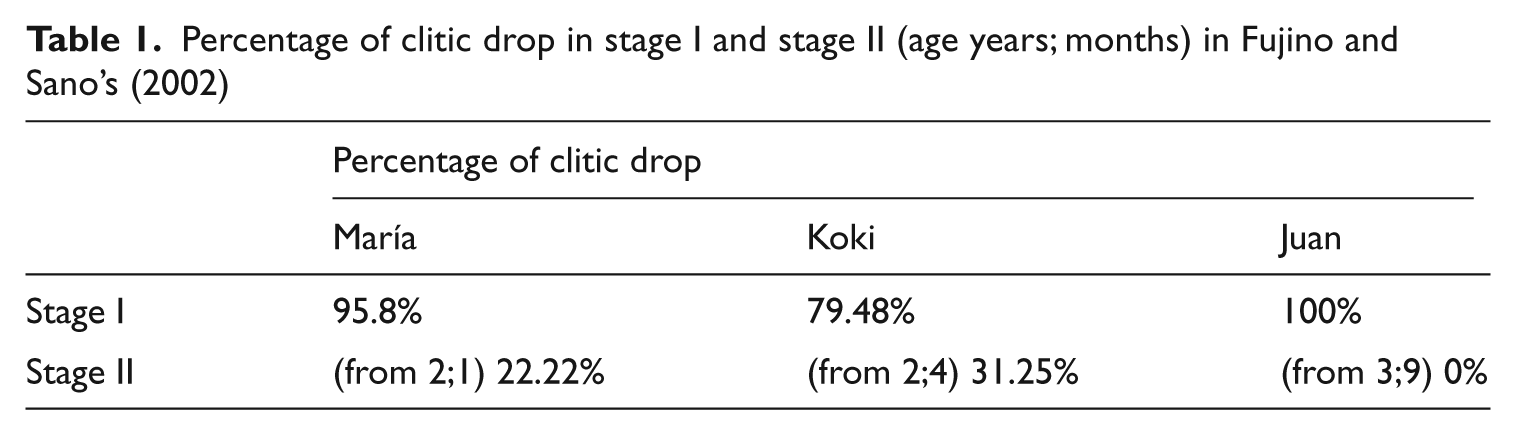
As regards clitic drop in Spanish, a recent paper by Fujino and Sano (2002), who studied three monolingual Spanish children, shows that the subjects they studied omit clitics in compulsory contexts very frequently at an early stage (see Table 1). The rate of omission drops dramatically in the second stage with increasing convergence with the target language. The distribution of stages in Fujino and Sano’s study was made according to Müller et al.’s (1996) proposal that the implementation of CP and the decrease of clitic drop are causally linked. Hence, Fujino and Sano determined the start of stage II by determining the first use of wh-phrases, imperatives and embedded clauses.
Percentage of clitic drop in stage I and stage II (age years; months) in Fujino and Sano’s (2002)
In an experimental study using the Elicited Imitation Task with 71 monolingual Spanish-speaking children from Argentina aged between 3;0 and 6;4, Eisenchlas (2003) was able to show that the youngest participants aged between 3 and 4 made 65% of the omission errors. The clitic omission error rate amounted to 16% overall. This study is not at all comparable to the present one, but it shows that children as old as 3 and beyond this age still have difficulties in repeating clitics.
Research to date has been able to show that language acquisition in bilinguals is not any different from language acquisition in monolinguals in most grammatical domains, therefore no evidence of qualitative differences between the two types of acquisition (Kupisch, 2008; Meisel, 2004, p. 94ff.) has been found. Moreover, it is well known that the target-deviant structures bilinguals use are not specific to them, but that monolinguals happen to use the same type of target-deviant forms in early stages. An issue that is still on the agenda of any study dealing with bilingualism is how an individual copes with the burden of acquiring two languages simultaneously, especially in domains which are believed to be hard to learn. In their seminal paper, Volterra and Taeschner (1978) proposed that bilingual children go through three stages in which they start with one lexicon and one grammar, past another stage where they can differentiate lexica but not grammars, achieving a grammar differentiation at a later stage. Subsequent literature over the past two decades has been able to disprove Volterra and Taeschner’s fusion proposal. To name but a few, Meisel (1989, 1990, 2004), Müller (1993), Ezeizabarrena (1996), Tracy (1995) and Larrañaga (2000) have examined different syntactic domains in bilinguals, coming to the conclusion that children use two grammars from the outset of syntax acquisition. The syntactic domains that have been studied so far seem to suggest that syntax acquisition is almost error free, even in those language combinations in which maximal syntactic differences are present. Children acquiring an OV and a VO language hardly ever make word order mistakes. Nevertheless, Platzack (2001) points out that the C-domain is a problematic area even for those children acquiring one language since it entails the interface between syntax and pragmatics.
In this respect, in recent years research in bilingualism has started to look at the original issue raised by Volterra and Taeschner (1978) from another perspective. In this sense, we adhere to the statement that ‘bilingual children separate their grammars from very early on, but that acquiring two languages simultaneously is not exactly the same as acquiring each language separately’ (Hulk & Müller, 2000, p. 227ff.). Hence, one of the issues concerns the question of whether there is cross-linguistic influence in bilingual first language acquisition or not. Paradis and Genesee (1996) claim that cross-linguistic influence is likely to occur provided that some external circumstances are met. That is to say, if one language is more dominant than the other, cross-linguistic influence resulting in acceleration, transfer or delay may arise, a claim that Paradis and Genesee could not confirm in their data. Hulk and Müller (2000, p. 229) discard dominance as a potential cause of cross-linguistic influence on theoretical grounds. They claim that, if mean length of utterance (MLU) mirrors language dominance, cross-linguistic influence should not occur ‘in reverse directions’, in other words only the more dominant language is likely to influence the weaker one. Kupisch (2008) shows that the weaker language can influence the stronger one. A bilingual German–French child studied by her was weaker in French than in German, but determiner use in German appeared much earlier than in the monolingual peers. Her claim is that it is the exposure to the weaker language (French) that determines the acceleration in determiner use in German. Therefore, Paradis and Genesee’s hypothesis of dominance does not predict cross-linguistic influence correctly. If we look at our own data, MLU values for Basque and Spanish are comparable in both children (see Figures 1 and 2), so that neither language seems to be more dominant than the other. Therefore, Paradis and Genesee’s hypothesis cannot be tested and we therefore ignore the issue of dominance for the remainder of the article. Hulk and Müller (2000, p. 228ff.) have proposed an alternative explanation for cross-linguistic influence, namely that influence must be due to language internal reasons provided that the following two conditions are met:
Cross-linguistic influence occurs at the interface between two modules of grammar, and more particularly at the interface between pragmatics and syntax in the so-called C-domain, since this is an area which has been claimed to create problems in L1 acquisition as well.
Syntactic cross-linguistic influence occurs only if language A has a syntactic construction which may seem to allow more than one syntactic analysis and, at the same time, language B contains evidence for one of these two possible analyses. In other words, there has to be a certain overlap of the two systems at the surface level.
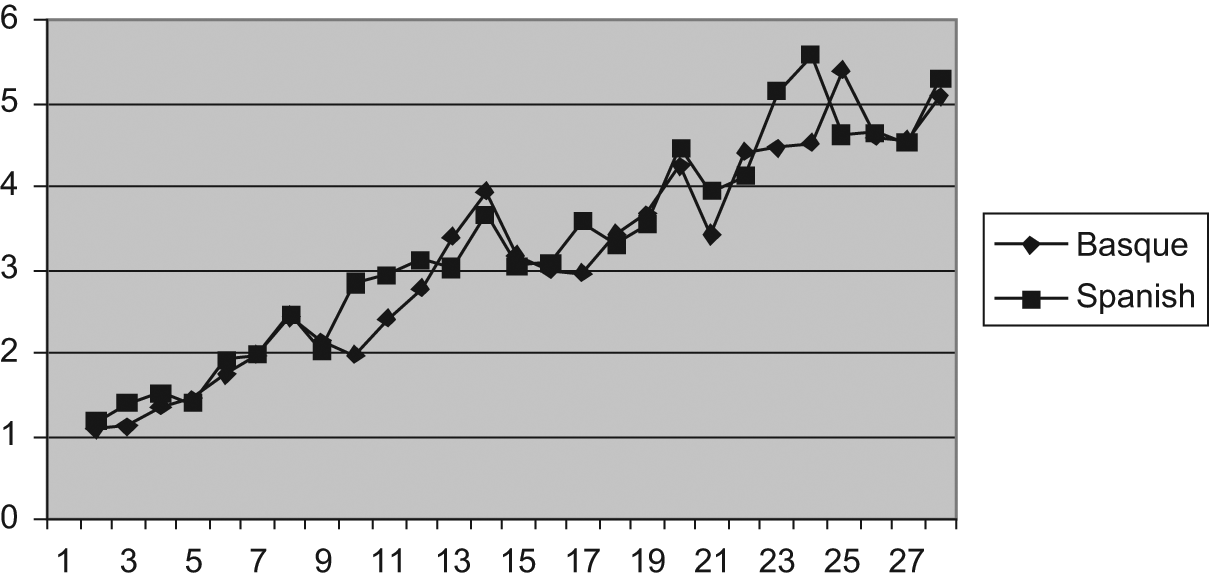
MLU (Mikel)
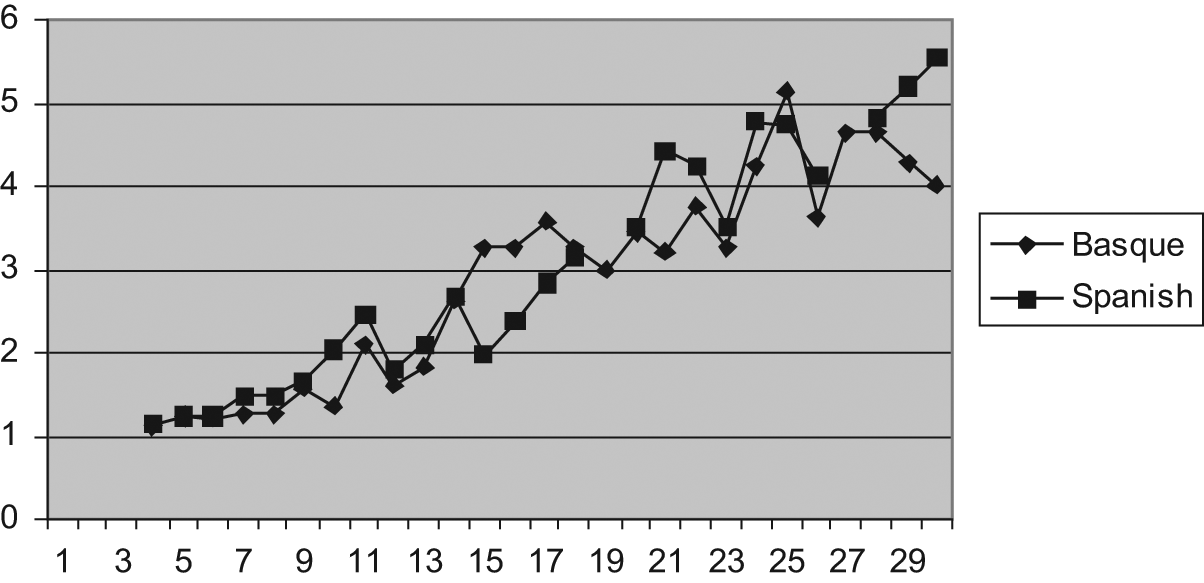
MLU in morphemes (Peru)
With regard to interfaces, it goes without saying that syntax and pragmatics interact in various grammatical domains, but Hulk and Müller claim that cross-linguistic influence can only manifest itself if the C-domain is involved. The reason alluded to by the authors is that the C-domain is believed to be the link between the syntax and the discourse domain (see Rizzi, 1997). Our case study fulfils Hulk and Müller’s conditions since the C-domain is involved and Basque has positive evidence for null objects, as we observe in the next section, and we know from their study that bilingual children drop more clitics than the monolingual peers.
The studies that have been reviewed in this section have not researched clitic acquisition with regard to the pragmatics in any systematic way. Furthermore, all studies have ignored the role parental input plays. The present study addresses these two important points.
Clitics in Spanish and Basque Spanish
Standard Spanish is a subject-drop language. Basque is also a pro-drop language with one crucial difference. The verb encodes the subject, direct object as well as indirect object. Hence, all constituents can be dropped, and the gaps are filled with the corresponding pros. However, Basque has third person pronouns neither for the subject nor for both objects (i.e., direct and indirect objects). 2 If a third person has to be referred to explicitly, demonstratives have to be used. Basque has no clitics but has pro for all three constituents. As a result of the rich verb morphology, both Basque and Spanish have strong subject and object pronouns which can appear in any surface position.
Having presented some general information about pronouns in both languages, we now address some issues concerning clitic distribution in standard Spanish (1–10), continuing with Basque Spanish. We finally claim that third person clitics in Basque Spanish are not the spell-out of agreement, contrary to Ezeizabarrena (1996) and Landa and Franco (1992).
First of all let us look at the paradigm of third person clitics in standard and Basque Spanish, which distinguish gender and number (Table 2).
Clitics in standard Spanish and Basque Spanish
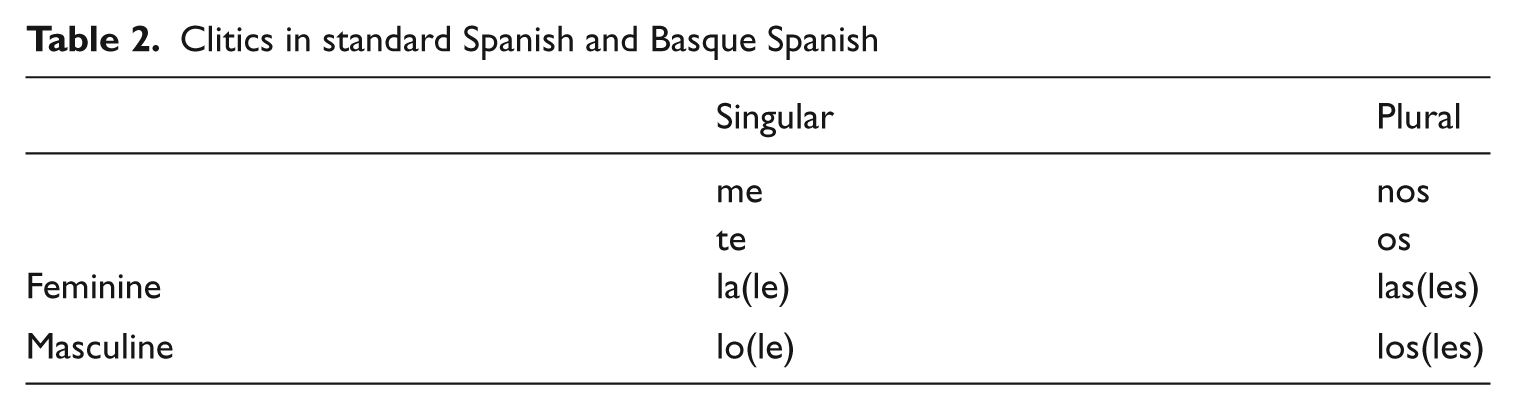
The forms in parentheses refer to the forms that may alternatively be used in Basque Spanish since this variety is a leísta variety, which entails that dative clitics may substitute accusative ones if the referent is animate.
First and second person clitics are mandatory, whereas third person clitics are not. An ordinary utterance consisting of subject-topic and object-focus in the form of a determiner phrase (DP) does not require a clitic in the third person (1). Third person object clitics are triggered in instances of clitic left dislocation 3 (2a) or extraposition of a [+definite] direct object (2b) as well as in instances where the [+definite] DP-object has been left out (2c) (Campos, 1986) and, thus, have a specific reading (Suñer, 1988; Uriagereka, 1995). Contexts in which the object DP is contrastive (example (3)) or neutral (1) disallow a coreferent object clitic:
(1) El decano no quiso recibir a los estudiantes. The dean not wanted to see to the students ‘The dean did not want to see the students.’ (2) a. A los estudiantesi no ( To the studentsi No-Neg themi-3ps-clitic wanted to see the dean ‘The dean did not want to see the students.’ (2) b. No ( No-Neg themi-3ps-clitic wanted to see the dean, to the students ‘The dean did not want to see the students.’ (2) c. No se No-neg. se-3ps clitic it-3ps-clitic pro has done to Juan. ‘I have not done it to Juan.’ (3) La casai ha comprado ei The house has bought ‘(He/she) bought the house.’
As regards direct object wh-questions, these disallow a coreferent direct object clitic (4) because the trace of wh is an operator, whereas in all other wh-questions they are compulsory if the object DP is missing (5):
(4) *¿Qué lo has comprado? What it did buy ‘What did you buy?’ (5) ¿Cuándo lo has comprado? When it did buy? ‘When did you buy it?’
However, clitics may be dropped with a small class of verbs like saber ‘to know’, 4 such as in (6), in some imperative constructions (8) or when the object remains implicit (7). The last differs substantially from other instances of clitic drop in generic contexts (9) because (7) allows to infer from the context that Pedro is eating something, although it might not be known to the speaker what he is eating:
(6) No sé. Pro No-neg. know e ‘I do not know it.’ (7) Pedro está cenando. Pedro is having supper e ‘Pedro is having supper.’ (8) Toma e, aquí tienes el dinero. ‘Take (it), here is the money.’
When a bare DP is dropped, no clitic is needed as in (9):
(9) ¿Compraste pasteles? Sí, sí compré. Bought-2sg cakes Yes, yes bought-1ps ‘Did you buy cakes?’ ‘*Yes, I bought.’
The structural status of clitics in Romance languages (Kayne, 1991, 1994) has been a matter of much debate over the three last decades. Clitics can appear in proclitic position with the inflected verb or in enclitic position with a non-inflected verb in infinitive or gerund. Due to the diverging syntactic distribution of strong and clitic pronouns, the traditional analysis of clitics as ‘object pronouns’ has been abandoned by most generative researchers who currently argue that they have affix-like status. In this vein, some authors (Ezeizabarrena, 1996) have claimed that direct and indirect object clitics in Spanish are the realization of object-Agr mainly because (first and second person) clitics are mandatory. Indeed, this property very much resembles subject agreement, which makes an agreement analysis of clitics plausible, but first and second person clitics are not the focus of the present article. The distributional properties of third person object clitics in standard Spanish differ considerably from those of first and second person clitics, as has been shown earlier. Notably, clitics are disallowed in contexts of wh/focus-movement which do not qualify them as agreement markers. The issue of clitic-doubling in clitic left dislocations and extrapositions is, however, problematic if we claim that clitics are not the spell-out of agreement (Franco, 1993). If we analyse those clitic left dislocations and extrapositions as being outside the sentence domain (IP) (Rivero, 1980; Rizzi, 1997), there is no case nor theta violation for standard Spanish.
The clitic-less structures that have been discussed above as well as clitic left dislocation are also found in Basque Spanish. However, referential third person clitics specified as [–animate] can be dropped in Basque Spanish (Landa & Franco, 1992) in the majority of contexts (as illustrated in (11a)). Landa and Franco show that referential object clitics in Basque Spanish can be dropped if they refer to a sentence or to a direct object with ditransitive verbs. Landa and Franco also contend that the omission can occur in anaphoric contexts, in subordinate clauses and in coordinate clauses. From the perspective of the present empirical study, we wish to add some more condition properties of clitic drop in Basque Spanish.
To start with, clitic drop is not usual in written Basque Spanish. A descriptive observation of our adult data reveals the following pattern of use. Clitics are dropped if the referent of the clitic has been previously mentioned or the speaker uses a temporal adverbial that contains new information (see (10a)). Clitics can also be dropped in contexts where an imperative is involved and a previous mention to the referent is not required (10c) because its reference is recoverable from the context. In the latter case, the referent of the clitic can be introduced by ostension. Let us insist upon one fact, clitics in Basque Spanish can be dropped but need not be (10b). Hence, there seems to be some degree of free variation between overt and covert clitics in some contexts in Basque Spanish.
As regards the syntactic analysis of clitics in Basque Spanish, Landa and Franco claim that clitics are the spell-out of agreement that license missing objects. The third person singular object agreement marker has the following morphemes: ø/lo/la, whereby ø stands for zero-clitic. Landa and Franco claim that a zero-clitic must exist because Basque Spanish licenses parasitic gaps. There are a number of problems with this account. On the one hand, agreement is realized as an overt clitic and as a zero-clitic for the third person singular. As Landa and Franco (1990) put it, their approach nicely explains why clitics in clitic-doubling structures are required with [+animate] referents and are disallowed with [–animate] referents. They seem to suggest that the choice between the zero-clitic and the covert clitic is subject to complementary distribution. Very surprisingly, they state in the following line that ‘there is variation within the language, this being a typical feature of agreement relations’. We do not believe that agreement relations allow for variation in the light of the distribution described above. Note further that the choice of allomorphs or allophones can either be constrained by complementary distribution or free variation, but not both simultaneously.
Another criticism concerns the fact that a wide range of variation is found among speakers and within one and the same speaker as to whether or not clitics are realized as illustrated by (10a, b), which are both possible in one and the same individual. Third person clitics in Basque Spanish are compulsory in some contexts, disallowed in others and subject to choice in most. If the speaker has the choice of use of the zero-clitic or the overt one, this distribution disqualifies an agreement approach. Moreover, some contexts seem to be more prone to omission than others. Nevertheless, we do not know of any studies that have investigated the frequency of omission of clitics as well as their contexts in spoken Basque Spanish. A further issue that Landa and Franco do not explore is the pragmatic rules that constrain the use or omission of the clitic when there is choice. We believe, however, that clitic omission is governed by pragmatic rules that need to be investigated in the future (10) in more detail. For the purposes of the present study, we assume that speakers drop clitics if they believe that the information encoded by the clitic can be recovered via the linguistic context. Hence, we do not favour an analysis of third person clitics as agreement for the variety of Spanish under investigation in this article for the reasons outlined above:
(10) a. S. Antes he cogido pro Before have caught pro B. Lehenago hartu dut Before take Aux (E1ps/A3ps) ‘(I) took (it) before’ (10) b. S.Ya Already it-3ps-clitic pro have caught pro B. Hartu dut Take Aux (E1ps/A3ps) ‘(I) took (it)’ (10) c. S. ¡Dame! Give (it) me B. Eman Take ‘Give it to me!’
In summary, clitic drop in referential contexts is governed by syntactic and pragmatic/semantic rules in standard Spanish since clitic drop is not optional. In contrast, clitic drop in Basque Spanish is a merely pragmatic phenomenon. It is up to the speaker whether he/she uses a clitic pronoun or not, with the only exception of direct object wh-phrases and [–definite] as well as bare generic DPs. Time and location adverbials or if the referent has been mentioned in the previous discourse favour clitic drop. As regards its syntactic status, we conclude that third person clitics are not affixes in the variety studied.
Internal and external architecture of clitics
As regards the internal architecture of clitics, Raposo (1998) has put forward a very interesting proposal. Raposo has made the observation that third person object clitics in Portuguese, unlike other Romance languages, can be omitted provided that their referent has been introduced in the previous discourse. Moreover, he shows that clitics and zero pronominals alternate in most contexts and more specifically in coordination structures, where the clitic can be left out in the second conjunct. Furthermore, overt and covert clitics also alternate in short answers to total questions. As far as determiners are concerned, Raposo demonstrates that determinerless nouns alternate with nouns preceded by determiners in generic contexts with verbs of affective attitude such as love, hate, prefer. Hence, languages that have null determiners should show the mentioned regularities both in the clitic and the determiner domain. Raposo’s approach is crucial for the present article since Basque Spanish shows some of the properties postulated for Portuguese in the clitic domain. Basque, on the contrary, has neither zero determiners nor clitics, as predicted by Raposo’s approach. Based on these observations, Raposo proposes that clitics are determiners and must be represented in the DP, where the pronoun is located in the head position and the complement hosts the pronominal pro.
Cardinaletti and Starke (1999) (henceforth C&S) have put forward an interesting approach that explains why speakers opt to use different types of pronouns. They propose to abandon the bipartition of the word class of pronouns and classify the group in three different classes: strong pronouns, weak pronouns and clitics. The properties that C&S judge crucial for this classification concern the issue of referentiality (range), prosodic reduction (word stress and reduction phenomena), their status as XP or X°, their distribution (possibility of coordination) and their morphology, which are summarized in Table 3.
Properties of pronouns adapted from Cardinaletti and Starke (1999, p. 176)
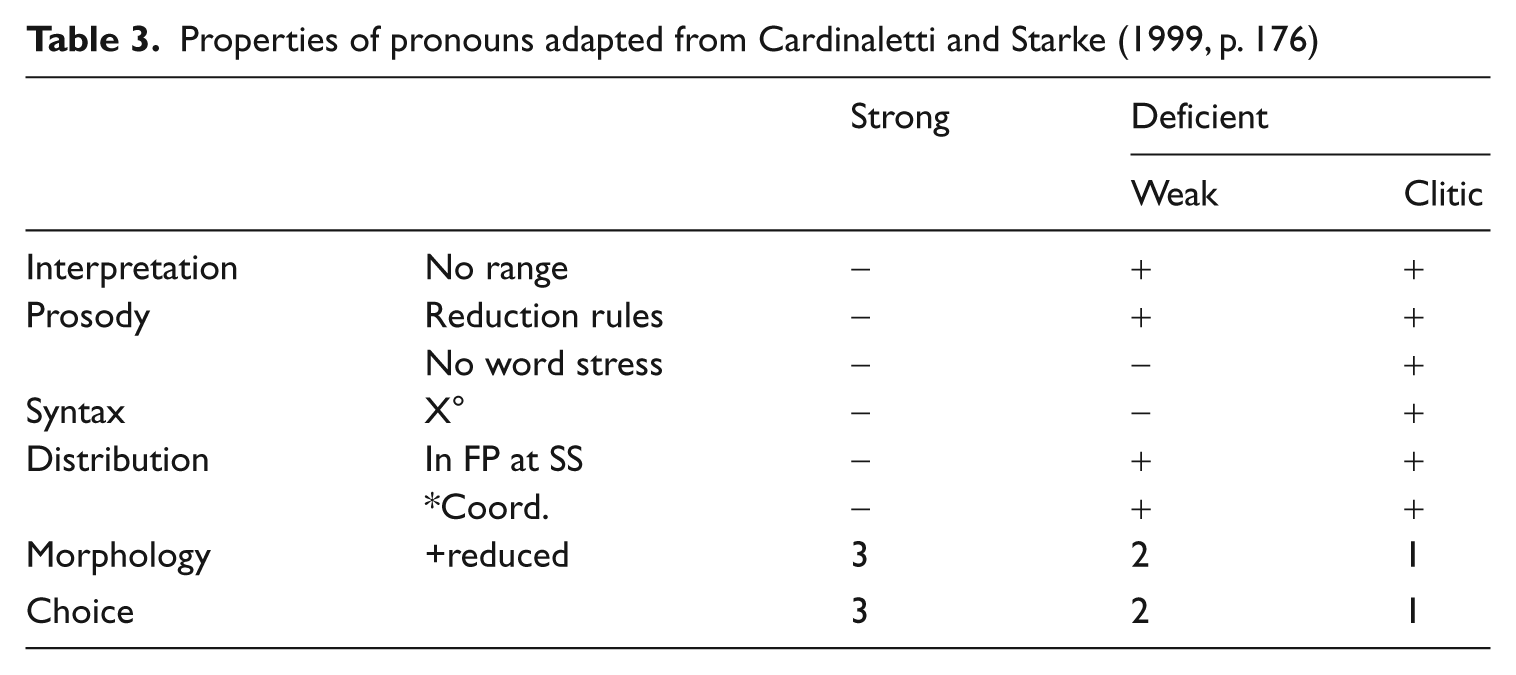
Applied to Basque and Spanish, this means that strong pronouns such as yo, tú, ni-nik, zu-zuk, 5 can be moved around in the clause, refer independently to [+animate] referents and are phonologically prominent. Very deficient pronouns such as clitics in Spanish cannot refer on their own, refer to [+animate] as well as to [–animate] referents and are phonologically weak. The important issue C&S raise is how to implement these properties in a syntactic framework. In order to do so, they develop the concept of structural deficiency that can be referred to as γ. Something is deficient if it lacks structure or a set of functional heads (as shown in (11)):
(11) γ = lacking a set of functional heads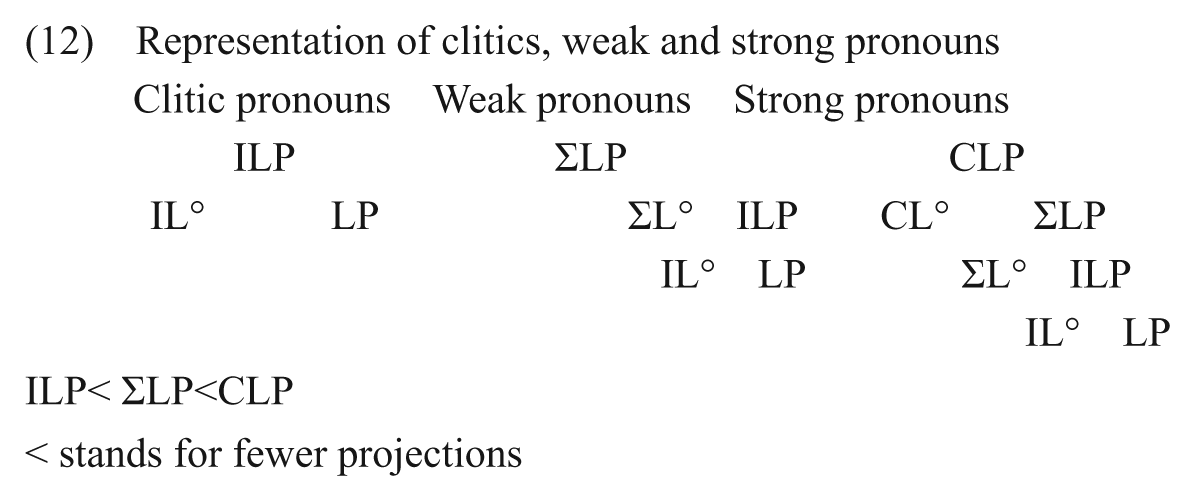
L stands for any lexical category. Properties that are subsumed under the title of Φ-features are represented in the I-projection. The ΣL-projection hosts prosodic information, and finally issues related to reference, such as range, are located in CP. Full pronouns have the full range of syntactic projections, whereas two layers are missing in the case of clitics, i.e., they are structurally deficient. The fact that clitics lack the Σ-layer explains why clitics do not receive lexical stress and undergo phonological reduction rules. Clitics also lack the CP-layer which hosts referential properties. The latter is the reason why clitics cannot refer on their own. But when and why are clitics used? C&S explain the licensing conditions for clitic appearance by postulating a principle of recoverability and making use of the principle of economy which accounts for the choice between pronouns. If any of the three pronouns can be chosen, what rules the choice between them? The underlying assumption here is that pronouns are inserted in the tree at some point in derivation. Clitics are generated by derivation, that is, by erasing structure by means of erase α. Not surprisingly, structure cannot be erased at random. The principle minimize α, which is an economy principle that applies to every domain, constrains how much structure can be erased (Chomsky, 1995 among others). This principle entails ‘up to crash’. That is to say, structure can be erased as long as the resulting new structure is still grammatical in the given context. But what happens if the minimal structure, clitic, is generated? Where does the clitic get its reference from? C&S propose that erased information must be recoverable. In other words, deficiency, i.e., the missing structure, must be compensated by other means, either syntactically or pragmatically.
If information must be recovered, let us discuss its constraints. We will assume with Raposo that clitics are Ds that project a DP which hosts a pro in complement position. This DP lacks higher projections and, hence, must get its reference by other means. According to C&S clitics must enter in a local relationship with Agr-OP and hence they must move from their base position under V to SpecAgrOP, which nicely explains proclisis. But does this explain how clitics get their reference? Since they lack higher projections, they cannot refer on their own. We argue that clitics must get their reference externally, either by virtue of a syntactic relationship of the sort TopP or via discourse. In the first case, the referent introduced in the TopP (CLLD) would enter in a syntactic relationship to the clitic or the pro if the clitic is dropped and in the second case the clitic would not need a syntactic link to get its reference, but only a discourse link very much in line with Huang (1984). The latter possibility has been claimed to be a universal strategy used by children in early stages by Müller and Hulk.
Raposo’s and C&S’s proposals are not mutually exclusive, but complement one another, as Schmitz and Müller (2008) point out. Raposo’s proposal that clitics are DPs is perfectly compatible with C&S’s analysis.
Clitics:
Are DPs where the clitic occupies the head position.
Have a complement position occupied by pro.
Lack higher projections.
Move like heads although they have DP status and have a topic reading.
If the clitic is dropped, pro remains in the complement position and hence establishes a discourse link.
Predictions and research questions
Let us now look at the predictions that the theoretical approach outlined in the previous section makes. As C&S have themselves pointed out, the syntactic representation of strong pronouns very much resembles the syntactic representation of a full phrase, where the highest projection CP hosts range, polarity is represented above which, in turn, hosts the inflectional properties. C&S’s approach predicts a degree of free variation between both types of pronominals. The choice between them is ruled by the principle of information recoverability. The issue that arises now is how children cope with the free variation between both pronominals. If children master the pragmatic principles that rule the use of clitics and zero pronominals from very early on, one would expect a more or less steady clitic drop rate over time. If, on the contrary, children have to learn in which situations clitics are dropped, the prediction is that clitic drop will decrease over time. If the latter holds true, Landa and Franco’s approach to clitics of agreement would be disconfirmed. It goes without saying that children will never reach a 100% use of third person clitics because the target language allows referential clitic drop anyway. Furthermore, we study the input the children are exposed to in more detail in order to investigate whether the children studied use clitics differently. Finally, and since both children are bilingual, we need to test the impact of bilingualism in the acquisition of clitics in the conditions set up by Müller and Hulk (2001).
Hence, the hypotheses to be tested are summarized in what follows;
Methodology
Participants
Our study is based on two male bilingual children acquiring Basque and Spanish from birth who have been recorded fortnightly for about 4 years starting at the age of around 1;9.00 (years; months. days). However, the data analysed in this article cover the period of 1;7.14 and to 3;6.14 for Mikel and 1;11.00–3;11.17 for Peru. Both children have been raised bilingually from birth in the Basque Country (Spain), following the one person–one language strategy (Ronjat, 1913). The corpus consists of fortnightly video recordings in naturalistic settings. 6
At the beginning of the study, the parents acted as interaction partners. Later, an unknown interviewer (A) was introduced in the case of Mikel but she inevitably became more familiar to him as the recordings progressed. The bilingual child Mikel has a bilingual Basque–Spanish mother and a monolingual Spanish father (V). Moreover, he has an older sister. He speaks Basque to his mother and his sister and Spanish to his father.
Peru’s father is bilingual Spanish–Basque and his mother is a native speaker of Spanish and an L2 Basque with a fairly good competence in Basque. Peru has a daytime childcarer (Marga) with whom he speaks Spanish exclusively. Family language with the parents is Basque. Parents from both children volunteered their children for this study.
The children’s ages and MLUs (morphemes) are illustrated in Figures 1 and 2. Both Mikel and Peru have longitudinal data spanning around 2 years.
According to the MLU figures three observations can be made:
Both children develop similarly in terms of MLU in both languages.
Basque and Spanish score similarly as regards absolute figures along the period studied.
MLU values show a steady increase over time. However, there are considerable drops at different points in time by both children that do not affect the whole picture in any significant way.
Coding and analysis
All recordings were transcribed by an experienced transcriber and checked by a second one in order to increase reliability. The Basque transcriptions were made at the University of the Basque Country and the Spanish ones at the University of Hamburg. All the transcripts were coded by the first author, who is a native bilingual of both Basque and Spanish language.
Results 7
Let us now turn to referential third person clitics and clitic drop, which are analysed according to four developmental stages; shorter developmental intervals as in Fujino and Sano have been selected for two reasons: longer time span studied and larger corpus than the one of Fujino and Sano. However, the first stage continues until the acquisition of INFL. The second one from INFL to C. Comp is acquired at around 2;3–2;5. CP is acquired at 2;3 (Barreña, 1994) by Mikel and 2;5 (Larrañaga, 2000) by Peru. A single post-CP stage in the vein of Fujino and Sano would be too long (around 1.5 years). Therefore and according to Larrañaga (2000), a stage called Top (Topic) has been included since she made the observation that new structures involving clitic left dislocation and topicalizations appear at around the age of 3. Despite the fact that we include four stages, our results can be easily compared to those of Fujino and Sano and Müller et al. (1996), 8 because they divided their stages in a pre-Comp and a post-Comp stage. Hence, the stages remain as follows from the beginning of the recordings to INFL (stage I), INFL to COMP (stage II), COMP to Top (stage III) and Top until the end of the study (stage IV).
An overview of overt DPs and clitics as well as clitic drop is provided in Figure 3a. 9 The figure shows that DPs in object position are used from the first stage onwards by both children, 1;8 in M and 2;0 in P according to Larrañaga (2000); that is some months before the acquisition of I. Overt clitics appear some months later than DPs in both children, towards the end of the IP period. Both children clearly show a clear preference for DPs to refer to objects at all times. Clitic drop is high at the beginning and does not show a clear pattern in absolute figures over time. Mikel shows an inverted U-shaped development, while clitic drop increases over time in absolute numbers by Peru. Clitic drop in implicit and [-specific] contexts remains constant over time in both children. Due to the fact that the development of clitic drop is rather surprising, let us look at the percentages in Figure 3b.

Overview of realized DPs, overt clitics, clitic drop in implicit and [-specific] contexts and referential clitic drop (tokens)
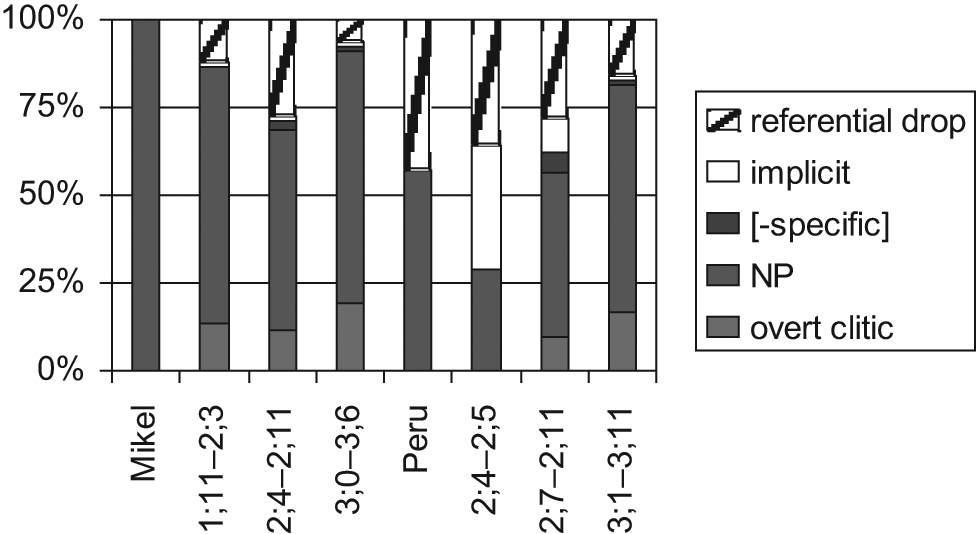
Overview of facts in percentages. Realized DPs (DP), referential drop (clitic drop), implicit (object), [-specific] object and overt clitics
The picture changes completely if we look at percentages. If we abstract from the first stages by M and P (except P 2;4–2;5), where data are scanty, both children use DPs in more than 50% of the contexts at all times and this percentage increases over time. Overt clitics are used in fewer than 20% of the cases in the first stages overall but their use increases as the children become older. Clitic drop is, on the contrary, high in the first stages and decreases towards the end of the present study.
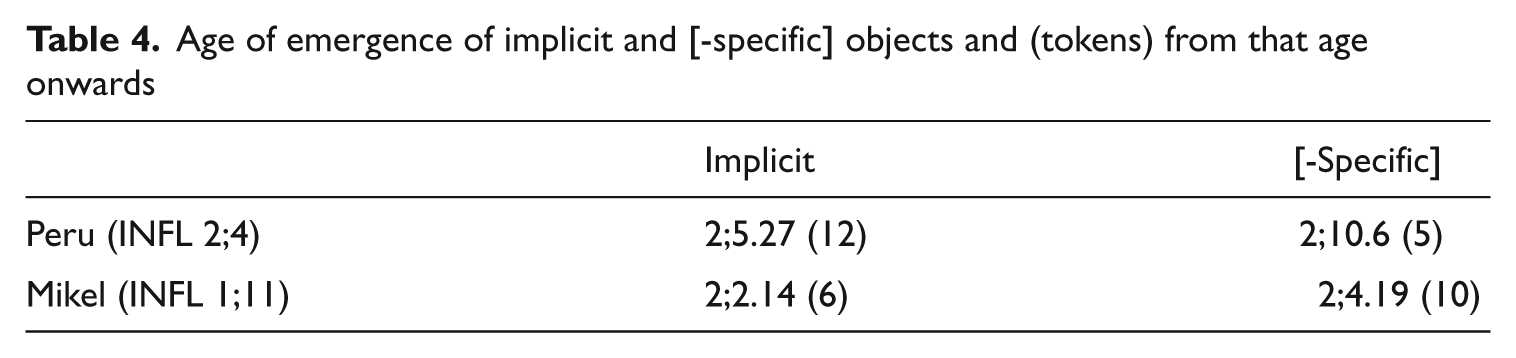
Figure 3b shows that third person overt clitics are missing in both children in the very first stage where INFL has not yet been acquired. Overt clitics emerge after the acquisition of INFL in M and after the acquisition of C in P. In P’s case, however, the age of acquisition of I and C is only one month apart by P. But it is not until the age of around 3 that clitics are used massively by both children. It also reveals that non-referential ([-specific], implicit) clitic drop appears after the acquisition of INFL in both children, and this type of clitic drop remains constant and is not very frequent at any subsequent stage (Table 4). Table 4 shows the total amount of contexts in which the children use target-like clitic drop. In both cases, the children start using target-like clitic drop after the acquisition of INFL. Furthermore, there are no misuses of this type of clitic drop. More importantly, the use of overt clitics and clitic drop in non-referential contexts seems to be causally linked as they emerge at the same age.
Age of emergence of implicit and [-specific] objects and (tokens) from that age onwards
As regards the referential contexts, two differing patterns seem to emerge at first sight. Whereas referential clitic drop almost disappears after the age of 3 in Mikel, this seems to increase in absolute numbers in the case of Peru. However, if referential clitic drop and overt clitics (Figure 4) are compared a different picture emerges.

Referential drop and overt clitics
Figure 4 shows percentages as well as absolute numbers and reveals that both children go through the same developmental stages; referential clitic drop still represents the majority in Stage III, whereas it falls sharply in Stage IV: in the case of Mikel from 66.6% to 24.67% and in the case of Peru from 83.33% to 49.1%, although the latter is not representative since only 3 overt clitics were used in stage III. In conclusion, this means that in the case of Peru, clitics in referential contexts are dropped in 50% of the cases at the very last stage bordering the age of 4.
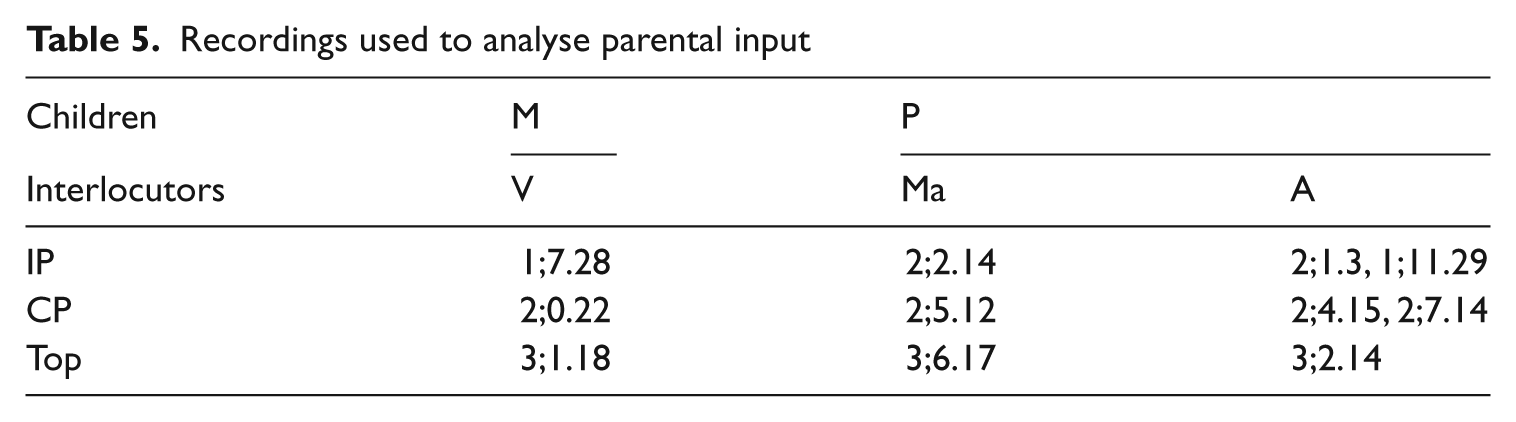
One of the issues that are under discussion in this article is whether parental input plays a role in the use patterns that have been observed. Hence, we analyse a subset of recordings to study parental (caretaker) language in order to have a tertius comparationis. We expect to find significant differences as regards clitic use. M is exposed to his father’s (V) Spanish. M’s father, a monolingual Spanish speaker, was the interlocutor in all three recordings with M. In P’s case, interlocutors varied over the period studied. The interlocutor A, a female bilingual Basque–Spanish speaker, was present in most of the recordings. P’s day carer, Marga, was the interlocutor in a few recordings. Hence it was not very easy to classify recordings according to the tripartition IP-CP-Top. Recordings prior or around IP and CP are labelled IP and CP, recordings around or after the age of acquisition of Top are labelled Top. In V’s and Marga’s case, only one recording per stage has been analysed (Table 5). In A’s case, there are two recordings in the two first stages and only one in the last. The target was to collect around 120 utterances that contained overt clitics and target-deviant clitic drop altogether.
Recordings used to analyse parental input
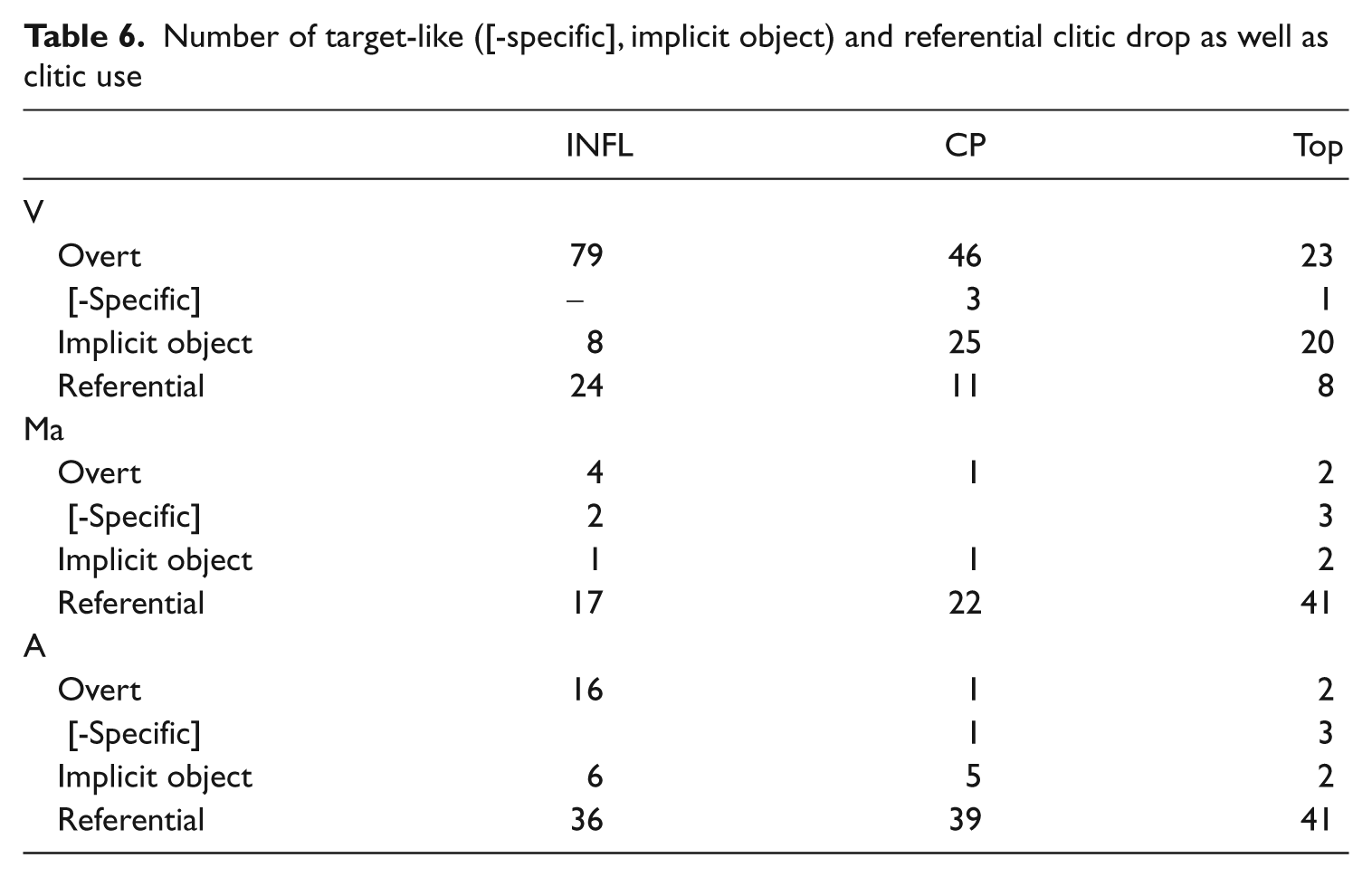
All utterances containing instances of clitics or clitic drop will be discussed here. [-Specific] objects are used from the beginning of the study by all interlocutors (Table 6), implicit objects are used by V at the beginning and by P’s interlocutors at subsequent stages. Comparing the clitic drop rates at all stages, two interesting observations can be made. First, and as expected, clitic drop is a speaker-specific issue, that is, we have different speakers’ profiles in this respect, a fact that has been reported in the theoretical literature (Franco & Landa, 1992). While V hardly ever drops clitics (M 22.66%), A drops clitics on average in more than 85% of the cases. M is between V and A as regards clitic drop with 69.3% of omissions (see Figure 5).
Number of target-like ([-specific], implicit object) and referential clitic drop as well as clitic use
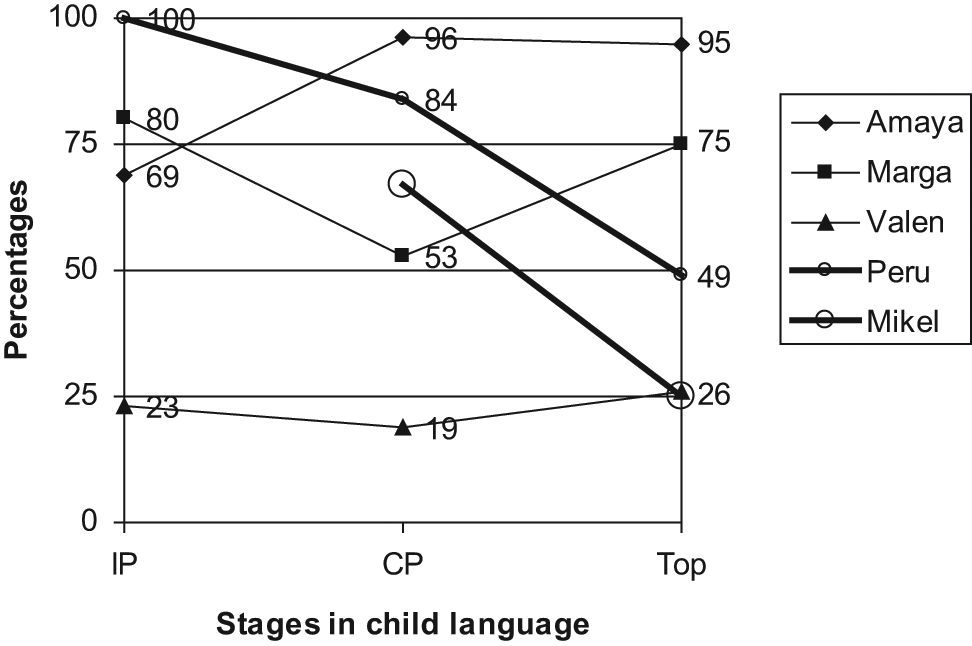
Overt clitics and clitic-drop (target-like ([-specific], implicit) and referential drop in Spanish
Second, and looking at the path of acquisition of the children, P drops clitics in all contexts at the beginning of the study and clitic drop steadily decreases over time until it reaches a threshold of 50 after the Top stage. In M’s case, no contexts in this first stage can be found. Similarly, clitic drop decreases over time and reaches 26% at stage IV. Hence input does not explain the path of acquisition, because both children are exposed to totally different frequencies of clitic drop and both drop clitics in fewer cases at the end of the study than at the beginning thereof. If input influenced the path of acquisition, one would expect M to converge with the target grammar earlier than P, because his father hardly ever drops referential third person clitics. But the data show that both children require 2 years to grasp the rules that govern clitic use in the variety they are acquiring. What input can explain is the end point of acquisition. M drops around 23% third person clitics in the Top stage as does his father, while P drops around 20% fewer clitics than his day carer. The fact that it took the children around 2 years of their life to converge with adult grammar shows that this phenomenon is a primarily pragmatic phenomenon. But how can this acquisition pattern be accounted for? Note that Müller et al. (1996) proposed that the acquisition of C triggered the acquisition of clitics and clitic drop disappears after its acquisition, because C could properly govern the gap under V. The present data show that clitic drop does not decrease dramatically with the acquisition of C (wh and COMP) but with the acquisition of Top, a category that was conflated in the CP prior to Rizzi’s split-CP hypothesis. And as expected, clitic drop does not disappear fully due to the fact that the variety the children are exposed to allows for clitic drop.
Discussion
Our data covering a period of 2 years show that both children drop clitics massively at the beginning of the study, which is not surprising. Clitic drop becomes less frequent over time and reaches a baseline converging with adult use at the end stage. Let us now turn to the hypotheses addressed in this article.
In order to discuss Hypothesis 1 let us look at previous research with monolinguals (María, Koki, Juan) by Fujino and Sano (2002) and our two bilingual children P and M (see Figure 6).

Percentage of clitic drop in M and P as well as María, Koki and Juan
The data clearly show that all children, monolingual Spanish and Basque–Spanish bilingual, omit compulsory clitics massively in a very early stage. By the end of the second stage the rate of referential clitic omissions drops dramatically in monolingual Spanish children. The data of Juan are not very conclusive since he only has a few examples in both stages (6 clitic omissions in stage 1 and 2 realized clitics in stage 2, which amounts to 100% and 0% respectively). Apart from this exception, the data display the same pattern as our own. Nevertheless, two important differences must be mentioned; first, stage 2 ends at ages 2;5 (María), 2;9 (Koki) and 3;9 (Juan) respectively. We will ignore Juan for the scarcity of his data. Recall that Mikel has been analysed until the age of 3;6 and Peru until 3;11, on average almost one year longer than Fujino and Sano’s children. Our pre-CP ended at age 2;3 for M and 2;5 for P, whereby both children still dropped more than 66% and 80% of the compulsory clitics respectively. The dramatic decrease on referential clitic drop occurs after age 3 in the Basque–Spanish bilingual children. In contrast to this, Fujino and Sano’s subjects dropped fewer than 31% of the clitics in compulsory contexts at stage II where the subjects were a year younger than our own subjects. Summarizing, our bilingual children drop the clitics more often than do the monolinguals studied by Fujino and Sano throughout the whole period studied, but as expected clitic drop becomes less frequent towards the end of the study in both cases. Since convergence to the variety exposed to took around 2 years, it can be concluded that bilingual Basque–Spanish children encounter difficulties implementing the pragmatic phenomena at stake very much in line with Müller and Hulk (2001). Hence, we need to address two issues, i.e., why the rate of clitic drop is so high at the beginning of the study and why it decreases differently in the two groups over time. As to the first issue, it has been shown that children drop clitics in most contexts in which the referents have not been introduced in early language. This comes as no surprise since Müller and Hulk contend that identification via discourse is a universal strategy regardless of whether the children are monolingual or bilingual. In the course of language acquisition, all children revise this hypothesis and start using more clitics. The monolingual children studied by Fujino and Sano reach native-like competence very soon, which demonstrates two issues: first, that third person clitics in standard Spanish could, in the last instance, qualify as agreement markers if we only looked at child data; and second, clitic drop is not determined by pragmatic constraints in standard Spanish. And since bilingual children drop clitics in all contexts at the beginning of the study, one is inclined to believe that children at first assume that all information encoded by the clitic is recoverable for the interlocutor at all times very much in line with C&S. Both bilingual children erase as much structure as possible at the beginning. And not only that, they erase the clitic itself in a post-lexical stage, because the pro in complement position of the D-head as suggested by Raposo identifies the referent via Agr. If we did not assume with Raposo that the clitic is a full projection with a pro in the complement position, it would be hard to explain why children drop clitics at all because the derivation in line with C&S would crash. The children assume at the outset of language acquisition that pro identifies the referent which is known to the speaker at the time of discourse. It is only later that they discover that clitics are not always elided and start using them increasingly until they converge with the target variety. We believe that the children studied clearly show that the concept topic is a difficult concept to deal with in the studied variety. As to the second issue, what children have to learn is that clitics can be dropped only if their information can be recovered. The data show that they implement the rules their input imposes step by step in a post-CP stage, which are different in quantitative terms for each of the children because they are exposed to different varieties in this respect. In sum, children who are exposed to Standard Spanish converge with the target grammar far earlier than children who are exposed to Basque Spanish. These results clearly show that children need more time to implement grammatical phenomena that are constrained by pragmatic principles than those that are determined by syntactic principles. To sum up, these data show that clitics in Basque Spanish are not agreement markers. If they were, one should expect a rapid convergence with the target grammar.
The issue that needs to be discussed is whether the dramatic decrease in clitic drop at some point is due to the acquisition of the category Top in the variety they are exposed to or only reveals that the child is acquiring the pragmatic rules governing clitic use in Basque Spanish. In order to research this issue, parental input will be investigated. Note that, due to the large interindividual variation, no general discourse rules for clitic drop have been stated as of today for Basque Spanish. We were able to identify some factors which favour clitic drop, but these are mere trends. This topic is on the agenda for further research.
In response to Hypothesis 2, the literature has reported that parental input may influence child language. Paradis and Navarro (2003) have studied the role of parental input by two monolingual Spanish children and one English–Spanish bilingual child in the acquisition of subject pronouns. Their study could not, however, find any conclusive evidence of the kind that parental input predetermines children’s output, partly due to the small set of data. Let us now turn to our own data.
It can definitely be stated for the present study that parental input does not influence the path of acquisition as far as clitic drop is concerned in any significant manner. First, parents or interlocutors have individual profiles that do not change over time. M’s father hardly ever drops third person clitics (around 23%). M, however, drops clitics in more than 60% of the cases at the CP stage. And more importantly, it takes M almost 2 years to converge with the grammar he is exposed to. The same goes for P. He massively drops clitics in the first stage. And second, in P’s case, one could argue that this is due to the input he is exposed to. A, who is P’s interlocutor in the recordings, shows extremely high clitic drop rates and her profile remains constant over time. However, P is not exposed to A’s Spanish on an everyday basis and P’s clitic use profile remains unchanged in A’s presence. Marga acts as P’s interlocutor as well, but with another profile. Peru does not tune his language either to A’s input nor to Marga’s input in the course of the recordings. This clearly shows that the child is not able to switch his speech on the spot to the pragmatic rules that constrain clitic drop in the interlocutor’s language. On the contrary, child clitic drop seems to follow its own rules and not the rules of the interlocutor present in a given recording. However, it is not possible to know the role of other interlocutors’ language on child language development.
In line with the framework adopted here, we claim that the internal and external architecture of the clitics accounts for the emergence of clitics as well as of clitic drop. This property accounts for the early use of DPs since both children refer to new information by using DPs very early. Hence, the D position is available for determiners and clitics very early. The data, however, show that DPs are used far earlier than clitics. But why are clitics implemented in children’s grammar later than Ds if clitics are Ds? The different use profiles show that each speaker seems to have a different concept of what topic is, which makes the acquisition task even more difficult. Let us now discuss whether the acquisition of one category within the C-domain explains the acquisition pattern. If we were to assume with Müller et al. (1996) that the children adjoin PRO to INFL prior to the acquisition of C, one would expect the number of realized clitics to increase dramatically after C has been acquired, which has proved to be wrong. In Rizzi’s (1997) split CP theory, the CP includes at least FocP and TopP, which were conflated in earlier approaches to CP. Children’s clitic use becomes target like only after the acquisition of TopP. Larrañaga (2000) determines the age of acquisition of Top according to two criteria: clitic left dislocation and preverbal subjects of unaccusative verbs. It does not seem to be coincidental that the age at which CLLD is acquired coincides with the age at which clitic use becomes target like. The target-like use of structures with CLLD shows that children have a certain notion of topic, that is to say, ‘introduced in the previous discourse’. Does the acquisition of Top offer a good explanation for the persistence of clitic drop? It is customary to assume that when projections are implemented, structures associated with them emerge. In the present case, clitics and target-like clitic drop have been attested before Top has been acquired. Hence, neither the use of clitics nor the omission thereof can be accounted by the implementation of this functional projection. Instead, Cardinaletti and Starke’s (1999) approach contends that structure can be omitted if information is recoverable. This is the key to explain the present data. Children assume at the outset of clitic acquisition that all information is known to the interlocutor or at least can be recovered, hence they drop most clitics in monolingual (Fujino & Sano, 2002) as well as in bilingual speech, as the present data show. Step by step, they revise their hypothesis in this respect because they are exposed to a certain variety of Spanish that allows for clitic drop. Monolingual Spanish children exposed to the standard variety soon attain target-like competence because clitics are syntactically determined in standard Spanish. Children exposed to the Basque Spanish variety need more than one year longer to reach the target, because they have to figure out the principle of recoverability which is subject to diverging constraints in each of the cases studied. And more importantly, clitic drop does not disappear because the target variety allows for it.
What we don’t know is whether children apply the same notion of topic to all instances where they use clitics after the acquisition of TopP, partly because we lack rigorous methodologies to test this issue. We do not know either if the children use any notion of topic as introduced information before TopP has been acquired. Furthermore, if clitics are dropped, it is obvious that the dropped entity is a topic, but what constrains clitic drop in child language? The latter is a different issue from what constrains clitic drop in adult language.
With regard to the long time children require to converge with the target grammar (Hypothesis 3), we have claimed that it is due to the fact that clitic use is a pragmatically constrained issue, but it is out of the question that bilingualism plays an important role. The data show that the children studied in this article are exposed to two very divergent varieties as regards clitic use, and nevertheless they follow the same pattern of acquisition, i.e., high clitic drop at the outset of acquisition, steady decrease of clitic drop over a period of 2 years and convergence simultaneously with the acquisition of the category TopP. If input were influencing children’s output, one would expect different patterns of acquisition, which is not the case. Recall that Basque is a clitic-less threefold pro-drop language and objects are dropped in most contexts. Bilingual children acquiring Basque Spanish receive positive evidence from their Basque input that objects are dropped. This fact reinforces them in the hypothesis for Basque Spanish that this strategy is valid in their learning variety. Step by step they revise this hypothesis and start using more and more clitics. Although it is not conclusive because we have studied only one bilingual adult speaker, the fact that this speaker drops clitics in far more contexts than the two monolingual speakers supports the observation that Basque influences clitic use in Basque Spanish.
Conclusions
Clitic drop is a very individual choice in adult language as the input data studied here have shown. It must be extremely difficult for children acquiring Basque Spanish to discover the pragmatic rules governing clitic use. The data show that both children use DPs from the outset of the study but clitics appear some months later, but why do children need so long to acquire them? The answer is that clitics are topics, as López (2003) points out, and children seem to assume that discourse topics are recoverable for the hearer at all times, at least at the outset of their acquisition. It is only later that they realize that clitics are not recoverable in all contexts creating confusion at times and they start using them in a target-like way. The fact that Basque is an object-drop language causes convergence delay.
An important point we need to make is that the small sample we have studied (two bilingual children) may not be sufficient to determine whether or not they are outside the typical monolingual children. Therefore, our interpretations and conclusions concerning cross-linguistic influence are necessarily cautious. Another important point to be made is that no rigorous methodology exists to investigate hearer’s intentions and knowledge and, therefore, future research will have to elucidate all remaining questions. A further issue on the agenda is that a further study with a monolingual Basque Spanish child would shed light on the issue of how much of the clitic drop is due to the input.
Footnotes
This project has been supported by a grant of the German Scientific Council (Deutsche Forschungsgemeinschaft, DFG) awarded to the applicant of the bid, Prof. Dr. Dr.hc. J. M. Meisel.