



Abstract
Emerging pragmatic language skills involve social, cognitive and linguistic abilities, including children’s awareness of the conversational partner’s mental states. The present study investigated the relation between children’s theory of mind (ToM) and features of pragmatic language skills assessed through narrative discourse. One hundred and fifteen Spanish-speaking children attending preschool and first grade (57 girls, 58 boys) participated. Children completed a standardized measure of receptive language, narrated a wordless picture book and completed first- and second-order ToM tasks. ToM was significantly related to various pragmatic language features. Hierarchical regression analyses showed that second-order ToM scores were a significant predictor of pragmatic language skills. Findings suggest that children’s communicative competence in social contexts, to some extent, requires the development of higher-order social-cognitive reasoning.
Theory of mind (ToM) is a central aspect of children’s social-cognitive development concerned with the understanding of persons as psychological beings. It refers to the understanding that desires, emotions, beliefs, intentions and other internal states relate to a person’s behavior (Premack & Woodruff, 1978). There seems to be a consistent pattern in children’s ToM development, characterized by the acquisition of false-belief understanding at around four years of age (Wellman, Cross, & Watson, 2001). Nevertheless, significant changes in this developmental domain continue after five years of age. Some gains in ToM development observed in studies with older children include: (1) understanding of second-order false belief or embedded mental state concepts, such as beliefs about beliefs or beliefs about intention (e.g. John knows that Mary doesn’t know the teacher is arriving) (Perner & Wimmer, 1985; Sullivan, Zaitchik, & Tager-Flusberg, 1994); (2) awareness that knowledge about others’ internal states is interpretative in nature and may vary from person to person (interpretive ToM) (Chandler & Lalonde, 1996; Pillow, 1991); and (3) comprehension of non-literal speech, such as irony, jokes and metaphors (Mayes, Klin, & Cohen, 1994).
Extant research suggests a robust and possibly causal relation between language and ToM development (Astington & Jenkins, 1999). However, most studies with typically developing children have used standardized measures of general language ability and have overlooked other aspects of linguistic development such as pragmatic language skills. Pragmatic competence refers to the functional use of language in social contexts. It is a core element of social interaction that, to some extent, requires a well-developed ToM. Effective communicative exchanges require that the speaker is aware of the listener’s internal states, allowing the speaker to track the listener’s comprehension of the message, interest and affective tone. Therefore, it is likely that socio-cognitive skills have an important effect on certain aspects of effective communication, in particular, in situations where appropriate verbal responses depend on accurate mind-reading skills. To date, research findings regarding the contribution of ToM development to children’s communicative competence during and beyond the preschool years is somewhat inconclusive. The present study aims to fill this gap in the literature by examining the relation between children’s ToM and pragmatic development, as observed specifically in their narrative performance.
Theory of Mind and Language
The challenge in understanding the relation between language and ToM is due in part to the fact that the development of linguistic and ToM skills is highly interdependent, and occurs rapidly during the preschool years (Durkin, 1987). While some researchers view the role of language as a primary way of providing children with the information they need to develop a ToM (e.g. Gopnik & Wellman, 1994), others propose that language plays a more fundamental role in its development (e.g. Astington & Jenkins, 1999; de Villiers & de Villiers, 2000).
The relation between ToM and language has been demonstrated in studies with typically developing (e.g. Astington & Jenkins, 1999; Jenkins & Astington, 1996; Ruffman, Slade, & Crowe, 2002), deaf (e.g. deVilliers, 2005; Peterson & Siegal, 1995) and autistic children (e.g. deVilliers, 2005; Happé, 1995; Tager-Flusberg & Joseph, 2005; Ziatas, Durkin, & Pratt, 1998). In general, children’s performance in ToM tasks is correlated with standardized measures of general language skills. What remains unclear, however, is whether the semantic, the syntactic, the pragmatic aspects of language, or a combination of those, steer this association (Nixon, 2005; Ruffman, Slade, Rowlandson, Rumsey, & Garnham, 2003). For instance, the case has been made in favor of lexical semantics. Children generally acquire concepts of mental states in conversations with caregivers (Dunn, Bretherton, & Munn, 1987; Dunn, Brown, & Beardsall, 1991; Moore, Furrow, Chiasson, & Patriquin, 1994; Ruffman et al., 2002). Over time, the repeated use of references to mental states in varying contexts supports children’s comprehension of concepts about unobservable mental states (Moore et al., 1994; Nelson, 1996). In addition, various studies report significant correlations between children’s scores in semantic tests of receptive vocabulary and their performance in ToM tasks (e.g. Astington & Jenkins, 1999; Cutting & Dunn, 1999; Happé, 1995).
The role of syntax in ToM development also has been documented. Certain syntactic structures, specifically, the capacity to formulate embedded propositions (i.e. sentential complements) are required to communicate different points of view using mental terms, and appear to be necessary for the acquisition of ToM (de Villiers & Pyers, 2002; Nixon, 2005). Typically, mental state verbs (e.g. think) occur as the main verb in a complex sentence that has a subordinate clause as its grammatical object (i.e. the sentential complement). Children are able to comprehend sentential complements approximately one to two years after they begin to use mental state terms spontaneously. Mastery of this specific syntactic structure has been found to be a precursor of children’s successful performance in false-belief tasks (de Villiers, 1995; de Villiers & de Villiers, 2000; de Villiers & Pyers, 2002; Nixon, 2005). DeVilliers and colleagues argue that sentential complements have unique syntactic and semantic features which provide the means for representing false beliefs. Mental state verbs (e.g. think, believe) take this particular syntactic form, allowing the expression of embedded propositions under a main verb (e.g. Maxi thought that the chocolate was in the drawer). Most false-belief and second-order ToM tasks require that children understand mental states embedded in such syntactic constructions. In fact, longitudinal studies have shown that mastery of specific syntactic skills is associated with performance in false-belief tasks (Astington & Jenkins, 1999; de Villiers & Pyers, 2002). Also, it has been demonstrated through experimental designs that preschoolers who are trained on some aspects of syntax, specifically on the use of sentential complements, gain syntactic knowledge and improve their ToM skills significantly (Hale & Tager-Flusberg, 2003).
The third aspect of linguistic competence linked to children’s ToM is conversational pragmatics. Children’s partaking in conversations with adults, siblings and peers is critical to their developing understanding of mental states. The pragmatic aspects of language use, particularly conversational abilities, seem to be crucial for ToM development, and to some extent may be more relevant than syntactic knowledge and vocabulary size (Davies & Stone, 2003; Harris, 2005). Evidence from longitudinal investigations suggests that the frequency with which children engage in conversations about mental states predicts their comprehension about mental states (Moore et al., 1994), as well as their performance in ToM and affective perspective-taking tasks (Adrián, Clemente, & Villanueva, 2007; Hughes & Dunn, 1998; Ruffman et al., 2002). Hughes and Dunn (1998) have found that children who engaged in frequent references to mental state talk with their friends at 33 months of age showed greater false-belief understanding concurrently and one year later. In contrast, the reverse relation was not found to be significant. That is, initial performance in ToM tasks did not predict mental state talk a year later. Similarly, Ruffman and collaborators (2002) reported a causal link between mothers’ utterances and ToM understanding among three to four-year-old children. They found that maternal use of mental state utterances at early time points predicted later ToM understanding, even after controlling for children’s own use of mental state language, earlier ToM understanding, language ability, age, maternal education and other types of maternal utterances. Adrián and collaborators (2007) demonstrated that influence of maternal mental talk continues from infancy to, at least, the early school years. In their study, mothers’ early use of cognitive verbs as attempts to build up shared meaning with children in a picture-book reading task predicted children’s understanding of mental states concurrently and one year later, after controlling for covariates.
These findings from longitudinal investigations are consistent with reports substantiating the relation between the frequency of children’s conversations about internal states with parents and siblings and later psychological understanding, as measured by children’s performance in emotion recognition (Dunn et al., 1991; Taumoepeau & Ruffman, 2006), affective perspective-taking (Dunn & Brown, 1993) and false-belief tasks (Brown, Donelan-McCall, & Dunn, 1996; Dunn, Brown, Slomkowski, Tesla, & Youngblade, 1991; Howard, Mayeux, & Naigles, 2008; Hughes & Dunn, 1998). The significance of conversational skills to ToM development also has been corroborated in studies with deaf children who have limited or delayed exposure to conversations about mental states and frequently show difficulties with false-belief tasks (Davies & Stone, 2003; Peterson & Siegal, 2000; Peterson & Slaughter, 2006). These studies suggest that variations in children’s conversations with adult family members, siblings and peers contribute to individual differences in ToM development.
Since most studies have focused specifically on a single aspect of linguistic development, it is difficult to distinguish between the independent and interdependent contribution of semantics, syntax and pragmatics on the development of ToM. It is quite possible that correlations between ToM performance and language reflect shared variance among these aspects of linguistic development (Ruffman et al., 2003). In fact, Ruffman and collaborators (2003) examined relations between ToM, semantic and syntactic skills simultaneously, and found that ToM was related to general language ability rather than to one domain of language development in particular. Collectively, the evidence reviewed thus far supports the notion that language and ToM are strongly, and perhaps causally, related, as some linguistic skills seem to be necessary for the development of ToM (Astington & Jenkins, 1999; de Villiers & Pyers, 2002).
Notwithstanding, there is also evidence that ToM affects the development of linguistic skills. Findings from infant research suggest that children’s emerging socio-cognitive skills, such as joint attention and social referencing, have a significant influence on language acquisition (Franco & Gagliano, 2001; Mumme, Fernald, & Herrera, 1996; Tomasello, 1995). Presumably, this relation extends throughout the preschool years, particularly with respect to developmental pragmatics (Kyratzis & Marx, 2001). Pragmatic competence requires the use of both linguistic and extra-linguistic communication in context, such as the ability to attribute mental states to others, to manipulate complex representations of the communicative interaction, and to answer questions differentially depending on the type of question asked (Bara, Bosco, & Bucciarelli, 1999; de Villiers, 2004; Gallagher, 1993; Loukusa, Leinonen, & Ryder, 2007). To communicate effectively in a social context, one’s awareness of the beliefs, feelings and intentions of the conversational partner are essential. Breakdowns in communication may occur when the speaker fails to recognize non-verbal cues that are indicative of the interlocutor’s intention to participate in the conversation, desire to continue or terminate the interaction, and belief or disbelief about the content of the verbal message (de Villiers, 2004). Further, a well-developed ToM is necessary for understanding the use of metaphors, deception and irony expressed in the interlocutor’s communicative acts, and might be essential for children’s comprehension of humor (Bara et al., 1999; Norbury, 2005). Thus, pragmatic language skill and mental state understanding are likely to be reciprocally interconnected at different points throughout children’s development (Peterson & Siegal, 2000).
Theory of Mind and Narrative Skill
The analysis of children’s narrative performance offers a unique and ecologically valid way to study ToM, as it requires the integration of social-cognitive, semantic, syntactic, pragmatic and metacognitive knowledge (Charman & Shmueli-Goetz, 1998; Tager-Flusberg, 1995). From a structural perspective, children’s narrative development is observed in their increasing ability to integrate, in a logical and cohesive manner, the sequence of events, themes and individual motivations that form a story (Peterson & McCabe, 1991). In terms of pragmatics, children gradually improve their ability to initiate conversations, to respond appropriately to conversational partners and to acknowledge subtle turn-taking cues. These features of pragmatic language skill seem to require an appreciation of others’ mental states, and are suggestive of an implicit ToM.
Pragmatic skills and an appreciation of the role of mental states in predicting and explaining behavior are essential for narrating stories. The narrator needs to understand the communicative perspective of the audience (O’Neill, 1996; Yifat & Zadunaisky-Ehrlich, 2008), to identify the referents telling the listener which character he or she is referring to (O’Neill & Holmes, 2002; van Veen, Evers-Vermeul, Sanders, & van den Bergh, 2009; Wittek & Tomasello, 2005), to convey the mental states of the characters (Guajardo & Watson, 2002) and to express temporal or causal relationships between events (Peterson & McCabe, 1988; Vion & Colas, 2005). In other words, authentic narratives must include a landscape of action (the sequence of connected events) and the landscape of consciousness, or the meaning of the events in terms of participants’ internal states (Bruner, 1986).
Even though the association between narrative and ToM development has been addressed in the literature (Astington, 1990; Fox, 1991; Nelson, Henseler, & Plesa, 2000; Symons, Peterson, Slaughter, Roche, & Doyle, 2005), most of the studies in this area have focused on autistic children, who frequently have difficulties dealing with the pragmatic aspects of social communication, as well as with situations that require a well-developed ToM (Capps, Losh, & Thurber, 2000; Hadwin, Baron-Cohen, Howlin, & Hill, 1997; Tager-Flusberg, 1995; Tager-Flusberg & Sullivan, 1995). Only a few experimental studies have specifically investigated the direct effect of typically developing children’s narrative ability on ToM development. For instance, Guajardo and Watson (2002) tested the hypothesis that mental state concepts in storytelling could enhance children’s ToM understanding. They found that performance in false-belief and deception tasks improved significantly for preschoolers who were exposed to a school-based storytelling intervention, but not for children in a control group. In a similar study, Peskin and Astington (2004) investigated whether exposing four to five-year-old children to picture books rich in explicit metacognitive terms over a four-week intervention period improved production and comprehension of metacognitive vocabulary, as well as false-belief understanding. Children in both the control and experimental groups performed significantly better on the false-belief tasks after the intervention period, but children in the control group who were exposed to the same picture books stripped of metacognitive language improved significantly more than children in the experimental group. Exposing children to explicit metacognitive vocabulary did result in greater conceptual understanding of mental states. According to the authors, having to interpret implicit mental states from illustrations and text seemed to be more important than hearing numerous metacognitive terms. Taken together, these experimental studies, along with the longitudinal studies on family discourse described earlier, suggest that even if mental state concepts are not made explicit verbally, children’s participation in social discourse improves their narrative skills and promotes ToM understanding (Adrián et al., 2007; Guajardo & Watson, 2002; Howard et al., 2008; Peskin & Astington, 2004; Ruffman et al., 2002).
However, these studies do not offer a full picture of how ToM understanding might relate and help explain children’s pragmatic development through their narrative production. Pragmatic development involves a wide range of pragmatic types such as the capacity to (a) link events cohesively, (a) reference story characters, (c) convey their motivating states, (d) understand the communicative perspective of others, (e) adjust the speech registers or styles according to the social context and (f) organize utterances into cohesive messages depending on the genres of extended discourse in question, such as storytelling or dinner conversations (Babelot & Marcos, 1999; Baroni & Axia, 1989; de Villiers, 2004; Hickmann, Kail, & Roland, 1995; Kyratzis & Marx, 2001; O’Neill & Holmes, 2002; O’Neill, Pearce, & Pick, 2004; Yifat & Zadunaisky-Ehrlich, 2008).
These features of children’s developmental pragmatics can be evaluated through their narrative performance. For instance, children display their ability to take on the role of narrators through a range of strategies that capture and maintain the listener’s attention. These strategies include, for example, the use of repetitions and intensifiers that signal the importance of an event by drawing the listener’s attention to a specific behavior, or the simulation of characters’ voices with the use of literary devices such as reported speech and onomatopoeia in the narrative. Furthermore, children’s socio-cognitive reasoning is evident in the use of internal state terms to describe characters’ motives, to link characters’ psychological states to events in the story and to link story events cohesively.
Aiming to better understand the role of ToM on children’s developmental pragmatics, the present study examined the relation between various features of Spanish-speaking children’s pragmatic language skill, and their performance in ToM tasks. Specifically, it was hypothesized that children’s ToM development would be a significant predictor of pragmatic language skills observed in their narrative discourse.
Method
Participants
One-hundred and fifteen low-income Colombian children ranging from 4.8 to 8.8 years of age participated. Children were evenly divided by gender (57 girls, 58 boys) and by grade level (56 kindergarteners, 59 first graders). The average age for kindergarteners was 6.1 (SD = 0.32) and for first graders was 7.2 (SD = 0.61). Children were recruited from two schools of comparable socio-demographic composition in Bogotá (Colombia) and the adjacent urban districts. Inclusion criteria for the study were that children attended preschool or first grade, that Spanish was the only language spoken at home, and that children had no known linguistic or cognitive disabilities.
Measures and Procedures
The homeroom teacher sent out information letters and informed consent forms to parents/guardians of eligible children via children’s backpacks. Children who obtained parental permission completed a battery of ToM tasks, a standardized language test and a storytelling task. The order of the tasks was randomized across children to prevent systematic carry-over effects between the storytelling and ToM tasks. The research protocol was administered in individual sessions of about 20–30 minutes by a native Colombian Spanish-speaker, with short breaks between tasks taking into account children’s attention span and fatigue.
Theory of mind
First-order scaled theory of mind tasks
(Wellman & Liu, 2004). The first-order scaled theory of mind tasks is a scaled set of seven tasks that assesses children’s understanding of a person’s mental states, including desires, emotions and beliefs. The set of tasks was translated into Spanish, and back-translated. In some cases the wording of the vignettes was modified for cultural appropriateness. It has been shown that children perform similarly when ToM tasks are presented using real persons, videotaped persons, dolls, toys or story drawings (Wellman et al., 2001). Based on the socio economic and cultural background of this sample, picture-based administration of ToM tasks was preferred over administration with toy figurines. In order to pass each task, children had to answer correctly the target and the comprehension control questions.
Second-order scaled theory of mind tasks
Three vignettes that require the child to infer a character’s belief about another character’s belief were included: the Birthday Story (Sullivan et al., 1994), the Messy Room Story (Sullivan, Winner, & Hopfield, 1995) and the Faux Pas Story (Banerjee, 2000). These vignettes were also presented as story drawings. The wording of the vignettes was also modified for cultural appropriateness. In order to pass each task, children had to answer correctly the target and the comprehension control questions. The order of the vignettes was randomized across children.
General and pragmatic language skills
Test Verbal de Imágenes Peabody (TVIP)
(Dunn, Padilla, Lugo, & Dunn, 1986). The TVIP is the Spanish adaptation of the PPVT-R (Dunn & Dunn, 1981), a standardized measure of receptive vocabulary, often used in the literature as a measure of general language ability. It consists of 175 items of increasing difficulty, organized as plates with four black and white pictures each. Following standard administration instructions, children were asked to choose the picture that corresponded to the stimulus word from the four response options.
Storytelling task
The storytelling task is a narrative task extensively used in international multilingual/multicultural child language research and is a versatile strategy for the assessment of children’s pragmatic language skills. It consists of eliciting a narrative from the child with a stimulus wordless picture book titled Frog, Where Are You? (Mayer, 1969). The procedure unfolds in two steps. Firstly, the examiner shows the pages in the picture book to the child, allowing the child to get a sense of the plot line. Then, the examiner prompts the child to narrate the whole story from the beginning. The investigator minimizes verbal comments, and avoids prompts that might influence the child’s natural discourse (see Berman & Slobin, 1994; Tager-Flusberg, 1995). Children’s narrative production was audio taped in digital format.
Transcription and coding
Recordings of children’s narrative production were transcribed by a Colombian Spanish speaker using a standardized format, Codes for Analysis of Human Language (CHAT), available through the Child Language Exchange System (CHILDES; MacWhinney, 2000). Transcriptions were verified and segmented in clauses by the principal investigator.
Narratives were coded to assess children’s pragmatic skills, specifically their capacity to reference story characters, their awareness of the story characters’ subjectivity and explicit knowledge of the connection between characters’ internal states and their actions in the story (i.e. psychological causation), their capacity to link events cohesively with temporal or causal connectives, their strategies to adjust their speech register and ability to organize utterances into a coherent story (de Villiers, 2004; Hickmann et al., 1995; Kyratzis & Marx, 2001; O’Neill et al., 2004). Three coding schemes were used to meet this purpose (narrative evaluation, narrative cohesion and narrative coherence). Using the CLAN programs software, coding was conducted at the clause level for narrative evaluation features and cohesion, and at the narrative level for structural coherence. Based on 20% of the transcripts, inter-coder reliability was established for each coding category separately using Cohen’s kappa and percentage agreement where appropriate.
Evaluation coding
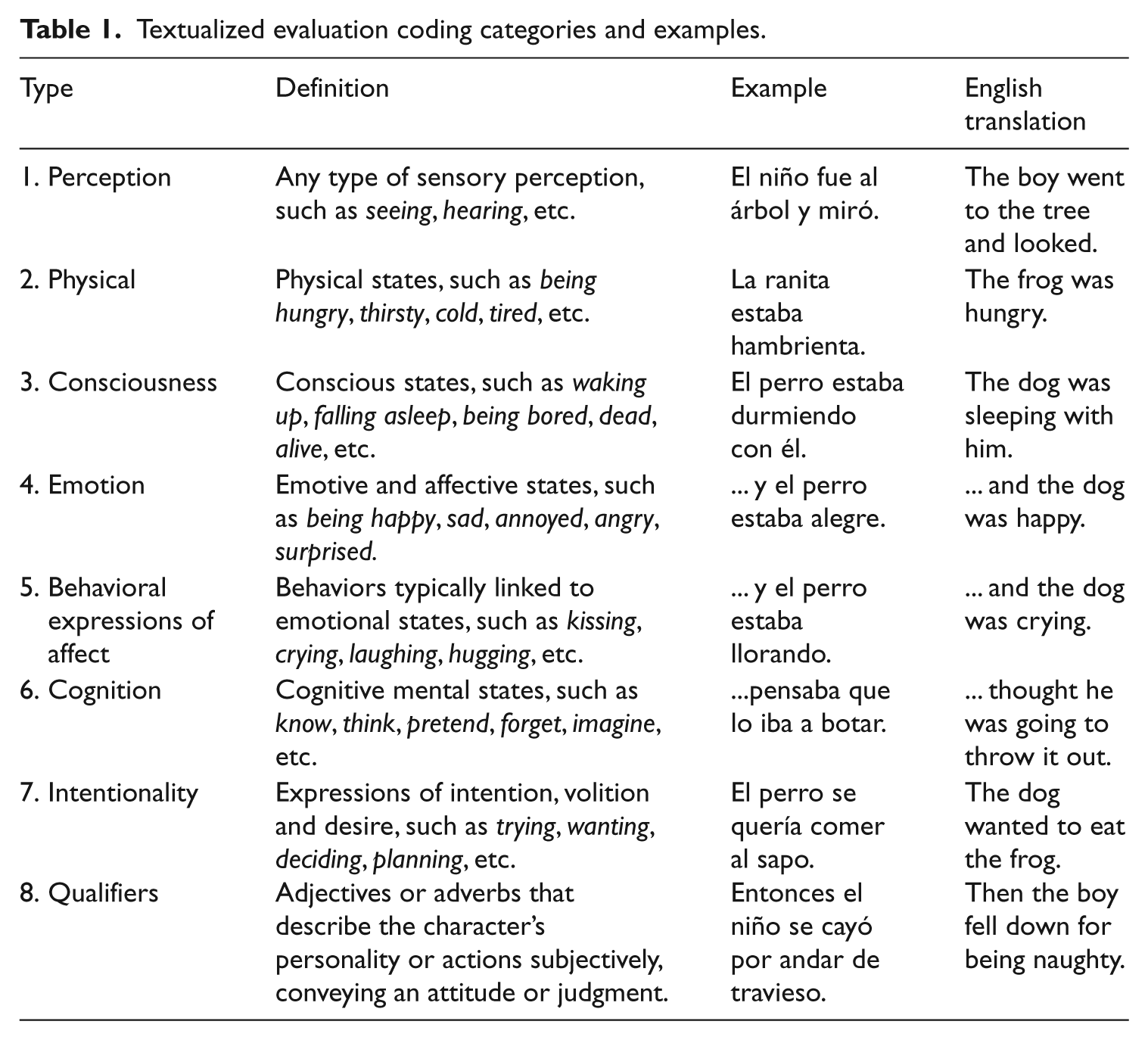
Narrative devices for textualized and performed evaluation were identified and coded at the clause level. Textualized evaluation consists of references to internal states that are indicative of children’s awareness of others’ minds and the characters’ subjectivity. Internal state references included metacognitive terms (think, know, wonder, etc.), terms indicating volition, desires and intentions (want, try, give up, etc.) and terms indicating emotions and other feeling states (sad, scared, cry, etc.). All references to internal states were coded according to the mutually exclusive categories presented in Table 1 (based on Dale, 1996; Dunn et al., 1987; Melzi & Fernández, 2004). Cohen’s k = 0.95.
Textualized evaluation coding categories and examples.
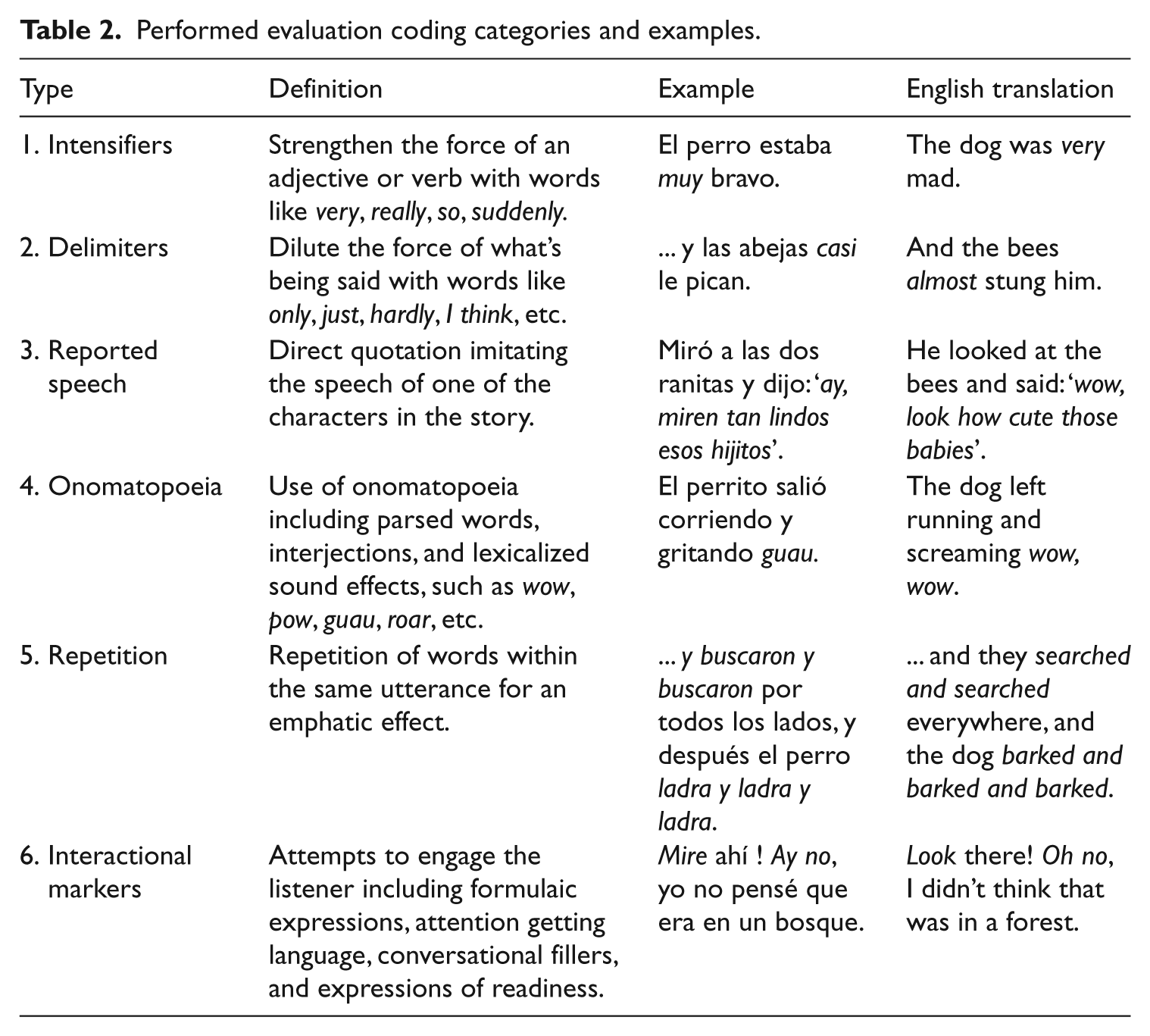
Performed evaluation, refers to the ‘acting out’ of the story through the use of literary devices that enrich the story for the audience (e.g. onomatopoeia, reported speech, intensifiers). These devices are indicative of children’s ability to take the perspective of narrators and show awareness of an audience. All performed evaluative devices were coded according to the categories presented in Table 2 (based on Fivush, Haden, & Adam, 1995; Tager-Flusberg, 1995; Uccelli, 2004). Cohen’s k = 0.85.
Performed evaluation coding categories and examples.
Cohesion coding
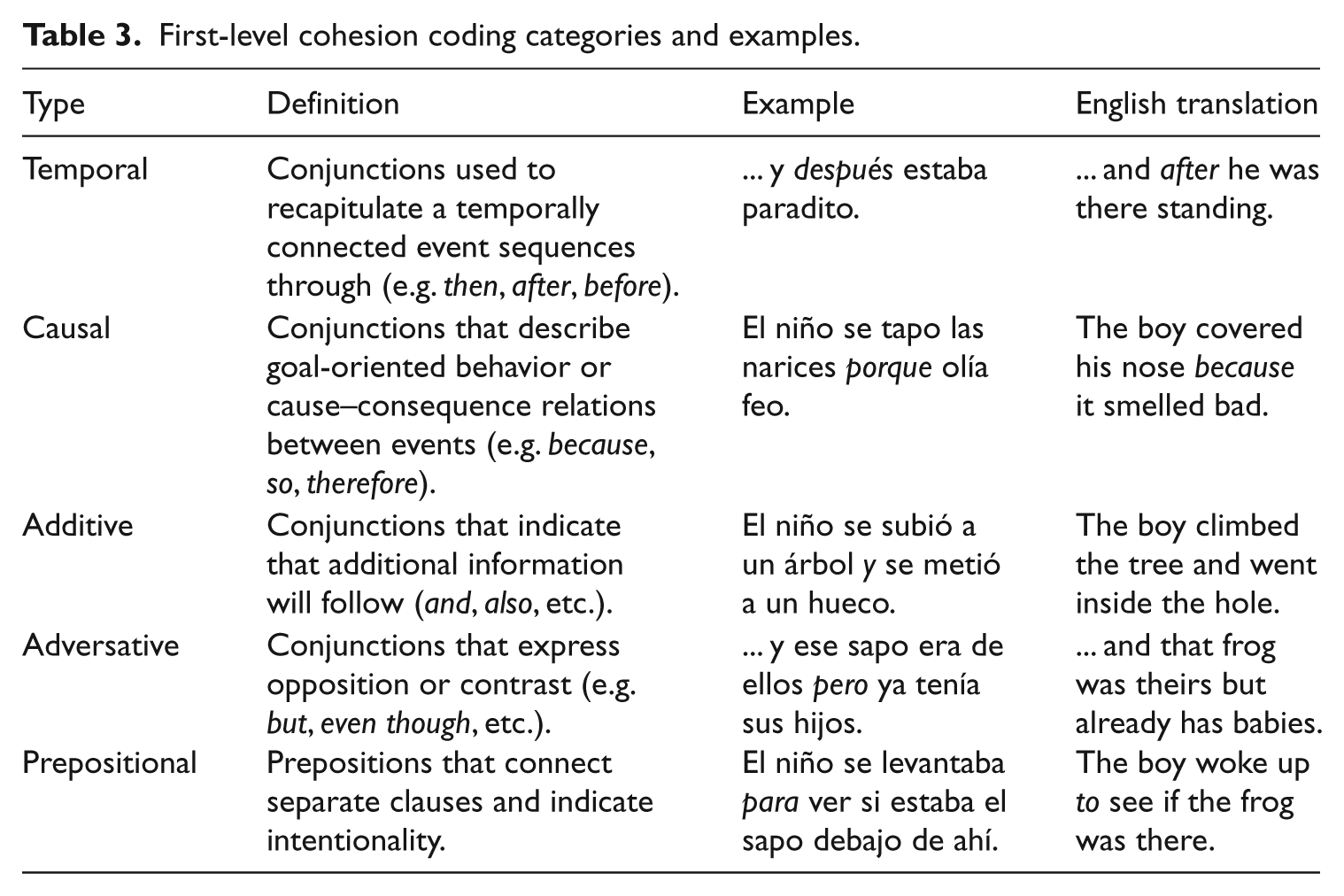
Cohesion coding assessed the explicit linguistic connectedness between events and characters’ motives. Cohesion is partly achieved through the use of connectives or conjunctions that join clauses in the narrative (Hickmann et al., 1995; O’Neill et al., 2004; Peterson & McCabe, 1988; Shapiro & Hudson, 1991; Vion & Colas, 2005). All clauses were coded for narrative cohesion at three levels. Coding was done for type, accuracy and function of cohesion devices. Table 3 presents the coding categories for the first-level cohesion scoring (based on Halliday & Hasan, 1976; Sebastián & Slobin, 1994; Trabasso & Nickels, 1992). Mean Cohen’s k coefficients ranged from 0.80 to 0.95.
First-level cohesion coding categories and examples.
The second level of cohesion coding addressed the accuracy in the use of connectives, and was defined as follows: (a) accurate, if the conjunction was correctly and specifically used to join adjacent clauses, and expressed the relation between clauses appropriately; and (b) inaccurate, if the conjunction was incorrectly used in linking adjacent clauses, used as filler or in hedging. The third level of cohesion coding referred to the inter-clausal function of the connectives. Only accurately used connectives were coded for inter-clausal function when they expressed psychological causation between connected clauses, and explained intention or motivation towards goal-directed actions according to the following mutually exclusive categories (Benson, 1997): (a) psychological causation, if the conjunction linked internal state references to previous or subsequent events or internal states in adjacent clauses; (b) other, if the conjunction expressed other type of explanation between clauses and did not include references to internal states.
Coherence coding
Coherence refers to event content and the overall conceptual organization of the narrative elements in a meaningful way. The sequence of events in a coherent narrative, following story grammar, consists of an overall goal and attempts to achieve a goal and an outcome. Prototypical structural requirements include: (a) opening, setting and orienting information; (b) initiating events; (c) motivating states or internal responses; (d) attempts to achieve a goal; (e) consequences; and (f) reactions to consequences and/or goal attainment (Benson, 1997; Berman, 1988; de Villiers, 2004; Shapiro & Hudson, 1991; Stein & Glenn, 1979; Trabasso & Nickels, 1992).
Event structure and goal-plan sequences were coded based on adaptations of Trabasso and Nickels’ (1992) and Berman’s (1988) coding schemes. The event structure of the picture storybook consisted of a single episode with a main event (i.e. a problem) and seven series of attempts to solve the problem, six failed and one successful. Within each plan of action there are minor events that lead to reactions that highlight the failure of the attempt, until resolution for the main event is achieved (inter-rater agreement = 0.92).
Scoring and Data Reduction
Theory of mind performance
The first-order ToM scores were calculated as the sum of binary scores (correct = 1; incorrect = 0) on each item (seven items) of the Theory of Mind Scale (Wellman & Liu, 2004). Similarly, the second-order ToM scores were calculated as the sum of binary scores (correct = 1; incorrect = 0) on the three second-order ToM vignettes (Banerjee, 2000; Sullivan et al., 1994, 1995). All children passed the comprehension control questions in ToM tasks.
Receptive language
The scores for children’s receptive language were obtained following TVIP standardization procedures (Dunn et al., 1986).
Linguistic production complexity
Scores were calculated from the number of utterances and clauses children produced in their narratives (a = 0.96). The total number of utterances is an indicator of sheer productive language. The number of clauses is an indicator of children’s productive language and linguistic complexity, as the combination of propositions within a single utterance to express an elaborate idea requires more complex syntactic constructions (Capps et al., 2000; Craig, Washington, & Thompson-Porter, 1998; Curenton, 2004).
Pragmatic language skills
Children’s scores for each dimension of pragmatic language skill (i.e. evaluation, cohesion and coherence) were obtained from the storytelling narrative task and standardized as t-scores. An aggregate score was calculated as the mean of the standardized scores, yielding an internal consistency coefficient a = 0.72.
Evaluation
Textualized and performed evaluation scores were computed from the frequency 1 of internal state references and performed evaluation devices children produced in their narratives.
Cohesion
Two cohesion scores were computed (i.e. cohesion-accurate and cohesion-psychological), based on the types of connectives children produced; whether or not connectives were used accurately, and whether or not connectives were used as explanations of psychological causation. A general cohesion score was calculated as the sum of accurately used connectives (i.e. additive, adversative, causal, temporal and prepositional), and a second score was calculated as the sum of accurately used connectives that expressed psychological causation specifically (a = 0.72).
Coherence
Narrative coherence scores consisted of the sum of the binary codes (presence/absence) identifying children’s organization of the narrative elements following story grammar (a = 0.69).
Results
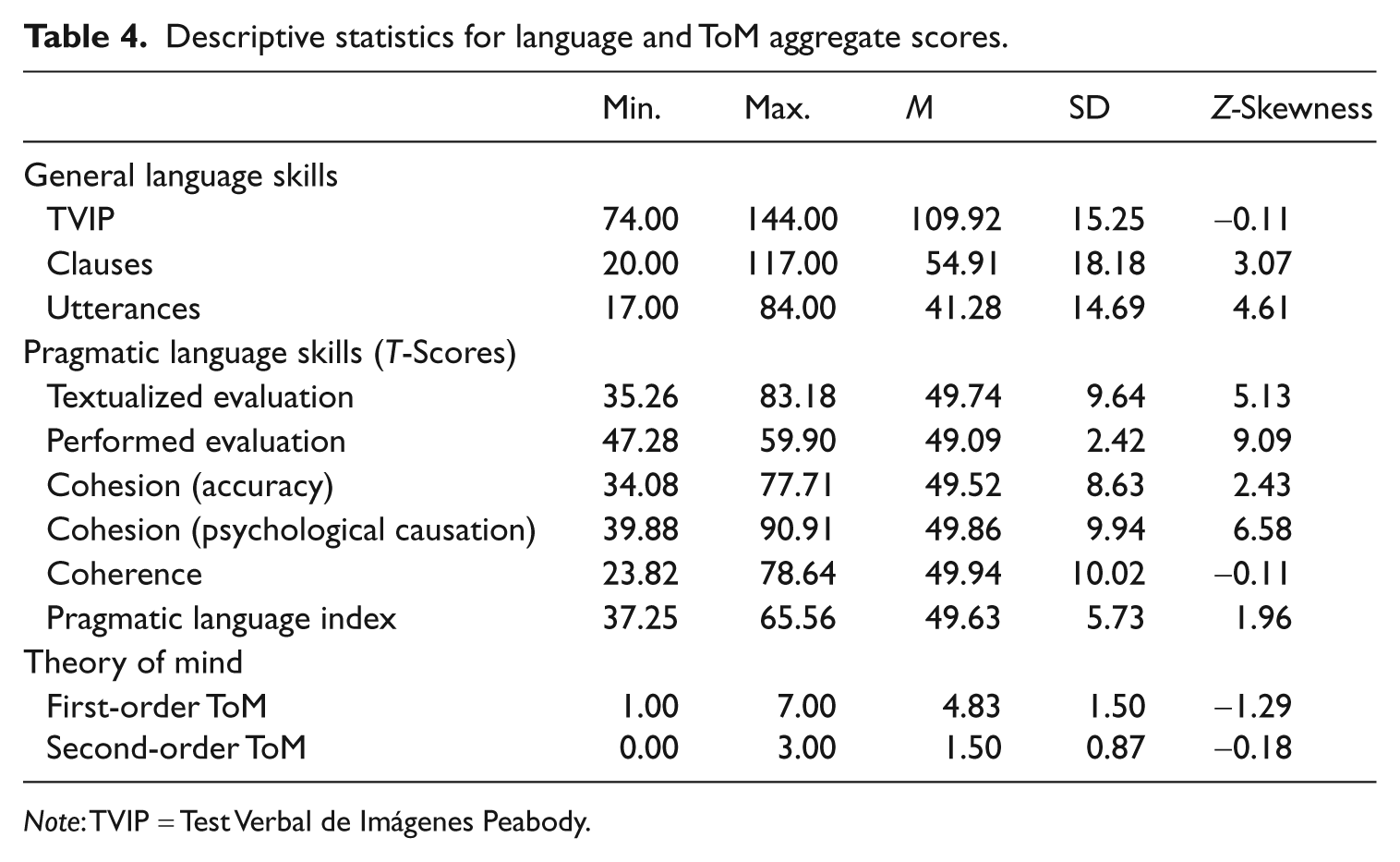
Results are organized into three sections. In the first section descriptive statistics for variables of interest are presented for the sample overall (See Table 4), and summarized by grade level and gender (See Table 5). The second section includes bivariate analysis between general language ability, ToM performance and pragmatic language skills. The third section presents a hierarchical linear regression model predicting children’s second-order ToM performance.
Descriptive statistics for language and ToM aggregate scores.
Note: TVIP = Test Verbal de Imágenes Peabody.
Means and standard deviations by grade level and gender.
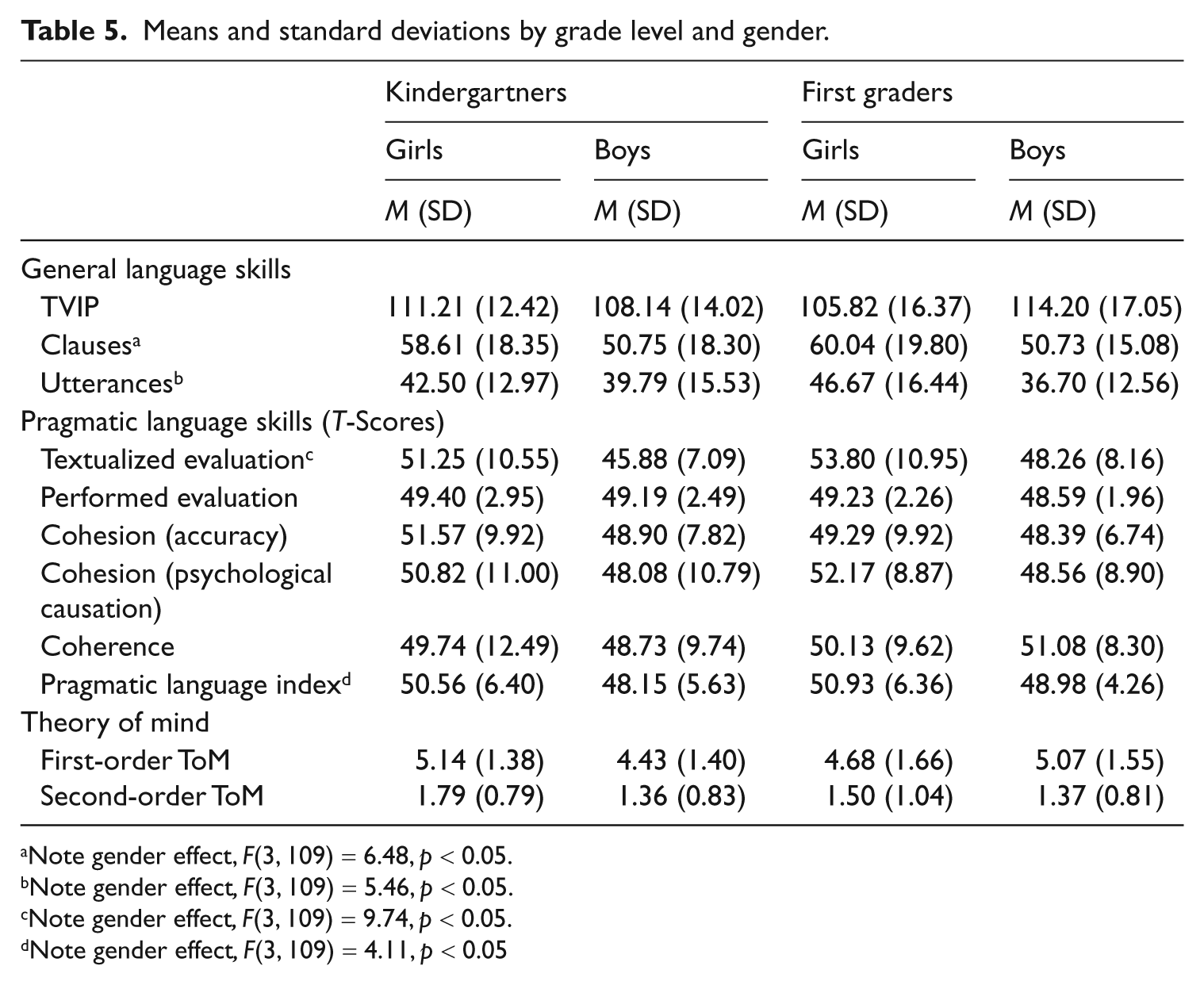
Note gender effect, F(3, 109) = 6.48, p < 0.05.
Note gender effect, F(3, 109) = 5.46, p < 0.05.
Note gender effect, F(3, 109) = 9.74, p < 0.05.
Note gender effect, F(3, 109) = 4.11, p < 0.05
Mean standardized TVIP scores were over a half a standard deviation above the normative mean. Scores were slightly higher for first graders (M = 110.15, SD =17.11) than for kindergartners (M = 109.68, SD = 13.21), although this difference was not statistically significant. In terms of children’s productive language, the mean number of clauses and utterances was 54.91 (SD = 18.18) and 41.28 (SD = 14.69), respectively. 2 As shown in Table 5, there was a significant gender main effect on both measures of productive language. Girls produced significantly longer and more complex narratives than boys did. However, kindergartners did not differ significantly from first graders on measures of general language ability.
Pragmatic Language Skills
Aggregate scores of pragmatic language ranged from 37.25 to 65.56 (M = 49.63, SD = 5.73). On average, children produced nine references to internal states, three performed-evaluation devices, 42 connectives and 12 elements of narrative coherence. The more frequently used types of internal state references were perception, intention and emotion terms. Reported speech was the most frequently performed evaluation device. Girls produced significantly more instances of internal state references than boys did (see Table 5); specifically, more terms denoting consciousness and emotion. The majority of cohesion devices that children used consisted of additive (70.86%) and temporal conjunctions (19.15%): 6.77% were prepositional, 2.45% were causal and only 0.76% were adversative conjunctions. In terms of accuracy, 95% of the connectives were used correctly. Of all accurately used connectives, only 4.63% denoted psychological causation linking internal state references with narrative events.
Children’s narrations were characterized by descriptions of goals, attempts to reach those goals, and outcomes based on the pictures. For the most part, these descriptions were interconnected and related to the central theme of the story. The majority of children included the main event of the story (i.e. the frog escaped from the jar), some attempts (i.e. climbing the rock to call the frog; looking behind the log to find it) and a series of salient events, such as the frog falling from the window, the squirrel biting the boy’s nose, the owl surprising the boy and the deer throwing the frog and the dog in the water. There were fewer explicit descriptions of consequences and reactions. There was no evidence of significant differences in pragmatic language skills between kindergartners and first graders.
Theory of Mind
The distribution of first-order ToM scores was negatively skewed 3 (M = 4.83, SD = 1.50, median = 5, mode = 6), with 59.1% of children obtaining scores of 5 points or above (maximum score of 7 points). This distribution suggests a ceiling effect on children’s performance in first-order ToM scores. Neither grade level, gender nor age was significantly related to children’s first-order ToM scores.
The pattern of results was somewhat different for children’s second-order performance. In the kindergarten group, the percentage of children with high second-order ToM scores (57.1%) was greater than the percentage of children with low scores, whereas in the first-grade group, the percentage of children with low second-order ToM scores (54.2%) was greater than the percentage of children with high scores. There was no evidence of a significant association between children’s second-order ToM performance, grade level or age. In terms of gender differences, 59.6% of girls versus 43.1% of boys fell in the high second-order ToM performance group. The Pearson Chi-Square test of independence approached significance, c2(1, N = 115) = 3.15, p = 0.076, suggesting that, compared to boys, girls tended to obtain higher scores on second-order ToM tasks. As expected given the level of difficulty, children performed better in first-order ToM tasks than in second-order ToM tasks. Average mean percent scores for first-order ToM were significantly higher (M = 69.07, SD = 21.48) than second-order ToM mean percent scores (M = 50.14, SD = 29.08; t(114) = 6.33, p < 0.001). 4
General Language Ability and Pragmatic Language Skills
General language ability (receptive and productive) and pragmatic language skills are related, but distinct, aspects of children’s linguistic development. Even though these skills refer to separate dimensions of linguistic development, they are conceptually related and acquired concurrently. As a consequence, it was expected that children’s receptive language, linguistic production and linguistic complexity scores would correlate with pragmatic language scores. As shown in Table 6, linguistic production was positively and significantly correlated with the total pragmatic language scores and with almost all the features of pragmatic language measured in this study, except coherence. The same pattern of correlation was true between linguistic complexity and pragmatic language skills. In contrast, receptive language scores were significantly correlated only with coherence.
Pearson product–moment correlation coefficients between general language ability and pragmatic language skills.

Note: TVIP = Test Verbal de Imágenes Peabody.
p < 0.05; ** p < 0.01; *** p < 0.001.
Overall, linguistic production and complexity scores were significantly related to scores on pragmatic skills. As shown in Table 6, linguistic production and complexity scores were significantly related to narrative evaluation and cohesion.
General, Pragmatic Language Ability and Theory of Mind
Bivariate correlations were computed for receptive language, linguistic production, linguistic complexity and first-order and second-order ToM scores. Pearson correlation coefficients revealed positive and significant correlations between receptive language and first-order ToM scores (r = 0.21, p < 0.05) and between receptive language and second-order ToM scores (r = 0.23, p < 0.05). No significant associations were found between children’s first-order ToM scores and pragmatic language skills. This may have been partly due to the restricted range and a ceiling effect in the distribution first-order ToM scores. Second-order ToM scores were significantly related to coherence scores (r = 0.23, p < 0.05), suggesting that children’s ability to narrate events in an interrelated and meaningful manner was associated with children’s second-order ToM abilities.
Regression Model for Pragmatic Language Skills
This section presents a hierarchical linear regression model that specifies the relative contribution of ToM performance and general language ability in explaining pragmatic language skills. The measures of linguistic production and linguistic complexity (i.e. number of clauses and utterances) were highly correlated (r = 0.95, p < 0.001). To prevent multicollinearity, only the number of clauses was included in the regression analyses as an index of linguistic production and complexity. 5
Predictor variables were entered in the regression model in three blocks: the first block included children’s gender, the second block included the linguistic production-complexity index and the third block included second-order ToM scores. As shown in Table 7, the model predicting children’s pragmatic language scores fit in three steps, F (3,109) = 29.57, p < 0.001, yielding an R2 of 45%. Children’s gender was a significant predictor of pragmatic language scores, Fchange (1, 111) = 4.11; p = 0.05. The linguistic production-complexity index made a significant contribution to the model over gender, Fchange (1, 110) = 67.42, p < 0.001, explaining an additional 37% of the variance in children’s pragmatic language skills. Second-order ToM scores improved the fit of the model, Fchange (1, 109) = 9.20, p < 0.001, explaining an additional 5% of the variance in children’s pragmatic language skills. The final model included the production-complexity index and second-order ToM scores as significant predictors, showing that socio-cognitive skills in fact contribute to children’s pragmatic skills.
Multivariate regression model predicting children’s pragmatic language skills (N = 114).
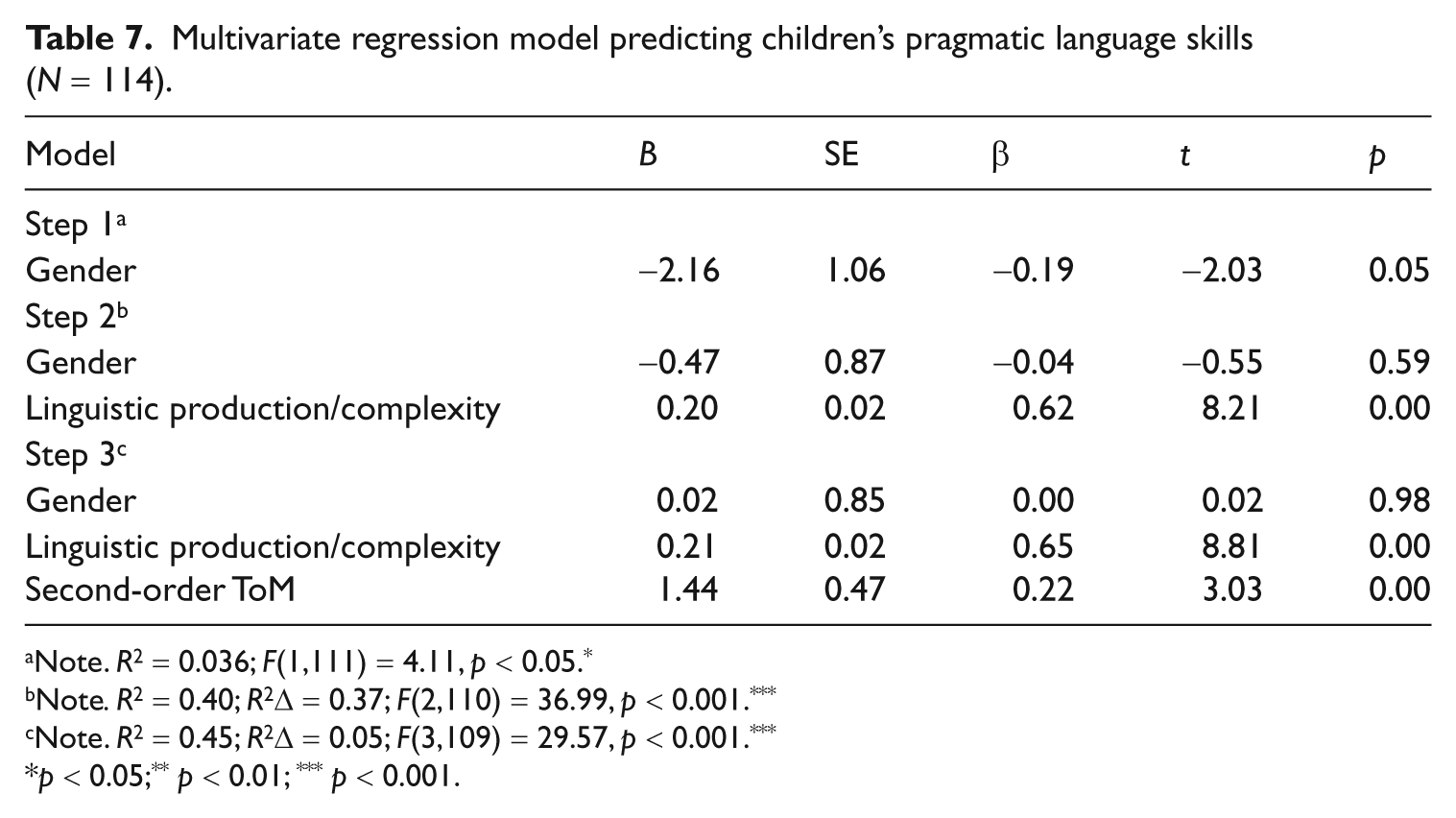
Note. R2 = 0.036; F(1,111) = 4.11, p < 0.05.*
Note. R2 = 0.40; R2Δ = 0.37; F(2,110) = 36.99, p < 0.001.***
Note. R2 = 0.45; R2Δ = 0.05; F(3,109) = 29.57, p < 0.001.***
p < 0.05;** p < 0.01; *** p < 0.001.
Discussion
The present study was motivated by inconclusive findings regarding the nature and direction of the relation between socio-cognitive skills and communicative competence at different points in development. Arguments in support of the relation between children’s ToM and pragmatic skills have been proposed in two directions. On the one hand, effective interpersonal communication requires the use of pragmatic knowledge to organize information and to recognize the interlocutor’s thoughts, beliefs, intentions and emotions (Astington, 2003). Thus, pragmatic language skills require a certain level of ToM understanding. On the other hand, certain pragmatic aspects of communicative exchanges during infancy and early preschool years, such as maternal use of internal state language in family conversations, have bearing on their ToM development (see de Rosnay & Hughes, 2006, for a review). In this sense, pragmatic development is also necessary for advancing ToM skills.
The present cross-sectional study examined the relation between various features of children’s pragmatic language skill, and their performance in ToM tasks. Specifically, it was hypothesized that children’s ToM development would be a significant predictor of pragmatic language skills as observed in their narrative discourse. Results from regression analysis in this investigation showed that second-order ToM scores were in fact a significant predictor of children’s pragmatic language skills. General language ability (i.e. linguistic production and complexity) and second-order ToM scores jointly explained 45% of the variance in children’s pragmatic competence. This evidence suggests that children’s semantic and syntactic abilities predict how effectively they are able to use language in social contexts (Hale & Tager-Flusberg, 2005). Further, it shows that the development of pragmatic competence during early childhood also requires socio-cognitive capacities, such as the comprehension of embedded mental state concepts (e.g. beliefs about beliefs, beliefs about intention).
A variety of methods have been used previously to study the development of pragmatic abilities in children, such as verbal production in natural (Blum-Kulka, Hamo, & Habib, 2010; Hoff, 2010; Kyratzis & Tarim, 2010) or experimental conditions (O’Neill et al., 2004), comprehension of pragmatic rules in a given social situation (Baroni & Axia, 1989) and conversational practices in group settings (Yifat & Zadunaisky-Ehrlich, 2008). Compared with spontaneous speech samples or conversational narratives, the study of pragmatic competence through storybook elicitation tasks offers some advantages. For instance, it affords the opportunity to score children’s skills in a more standardized fashion, and it constrains the range of appropriate utterances. Also, it limits elicitation prompts or natural linguistic input from family members, peers or others, which might influence children’s discourse or pragmatic performance during the task. These features of the narrative task, as well as three characteristics of the wordless picture book used in this study, were particularly suitable to explore the relation between ToM and pragmatic skills. Firstly, the pictures portrayed a variety of active characters trying to achieve a goal (e.g. the dog, the frog, the boy, etc.). Secondly, the sequence of scenes described temporal relation between events, which required the use of connectives or conjunctions to express temporal or causal relations. Finally, the images depicted motivating internal states of the characters in the story. These features of the stimulus book provided a strong pragmatic motivation for the expression of: (1) thematic coherence through the overall organization of the events; (2) linguistic cohesion of the discourse through the use of connectives; and (3) references to the characters’ subjectivity through the use of internal state language and evaluative devices (de Villiers, 2004).
Current findings showed that higher-order ToM skills are a good predictor of children’s capacities to narrate cohesive and coherent stories that convey the characters’ landscape of consciousness (Bruner, 1986). The evidence presented herein is in keeping with the notion that authentic narratives relate not only to the sequence of actions and events, but also to the motivating states and the meaning of the events for the characters. Further, it suggests that children’s abilities to make inferences about story character’s intentions and to communicate coherently about actions in relation to internal motivations, to some extent, depends on their higher-order mental state reasoning. In light of the present findings, it is reasonable to conclude that ToM facilitates the development of children’s pragmatic language skills, and that advances in these two domains are also aided by the development of semantic and syntactic linguistic abilities (Astington & Pelletier, 2005).
However, given the cross-sectional nature of this study, it is not possible to arrive at a definitive conclusion in terms of the direction of the relation between ToM and pragmatic competence. Further research is warranted to understand the dynamic and reciprocal relation between pragmatic language and ToM skills, which may change at different points in development (Hale & Tager-Flusberg, 2003). For instance, in a study with seven to nine-year-olds, Meins, Fernyhough, Johnson, and Lidstone (2006) found that second-order ToM performance was significantly related to children’s receptive verbal ability, but not to their use of internal state terms. The lack of an association between mental state discourse and ToM skills in older children might be indicative of the reciprocal and dynamic nature of this relation throughout the early school years.
Some interesting observations regarding the development of children’s ToM performance and narrative production are worth mentioning in light of extant literature. In this investigation, there were no significant differences in children’s ToM skills related to age or grade level. Most children obtained high scores in first-order ToM tasks. Previous research with English-speaking European American children suggests that by 5 years of age children succeed in a variety of first-order ToM challenges. By that age, most of them have gained a basic conceptual understanding of mental states and how these relate to people’s actions (Wellman & Liu, 2004). Given the average ages of children in the present study, the ceiling effect in children’s first-order ToM scores is not surprising. However, it is worth noting that success rates for first-order ToM tasks among five-year-olds in the present study were somewhat higher than previously reported success rates for similar tasks. Wellman and Liu, for instance, reported that 48% of the five-year-old children in their study were able to pass five first-order ToM tasks successfully. In comparison, 66.6% of the five-year-olds (5.0–5.11) in the present study succeeded in at least five first-order ToM tasks.
Research on second-order mental state understanding in typically developing children is rather limited compared to the body of literature on first-order ToM development. Seminal studies showed that many six- and seven-year-old children succeeded in second-order false-belief tasks (Perner & Wimmer, 1985). However, an age-related shift in children’s conceptual understanding of second-order or embedded mental states (e.g. She thinks that he thinks…) has not been thoroughly documented, as has been the case with first-order mental state reasoning. By and large, performance in second-order ToM tasks among children between the ages of 4 and 7 is variable (Coull, Leekam, & Bennett, 2006; Sullivan et al., 1994). This is partly due to the diverse information processing demands implicit in different task formats. Thus far, there is no clear consensus regarding the developmental trajectory of second-order ToM. However, it is generally accepted that children are capable of attributing second-order mental states around the age of 6, after the consolidation of first-order mental state reasoning. In the present study, children’s performance in second-order ToM tasks was similar, although somewhat higher, to performance rates previously reported in the literature. For example, Sullivan and collaborators (1995) reported success rates of 78% for five-year-olds, 67% for six-year-olds and 73% for seven-year-olds in the Messy Room second-order ToM task. Herein, success rates for children of the same age groups in this specific second-order ToM task were 88.9%, 60.3% and 63.3%, respectively.
The slightly higher success rates in five-year-old children’s ToM scores compared to those reported for European American children might be partly related to early childhood socialization patterns influenced by an orientation towards collectivism present Colombian cultural values. According to Geert Hofstede’s (2010) cultural dimensions, Colombia, like many Latin American countries, ranks low on individualism. Latin American societies are generally regarded as upholding values associated with an interdependent or communal cultural orientation, because they place strong emphasis on the affiliation and group cohesion. The general ideological orientation of a society represents the core ideas that define the socio-psychological reality of individuals, and how they perceive themselves as independent from or connected to others in varying degrees (Bakan, 1966; Markus & Kitayama, 1991). Communion or characteristics of interpersonal affiliation, warmth and responsiveness encourage the understanding of people’s inner world. Therefore, such cultural orientation might have a bearing on how children learn to represent others’ minds.
In terms of pragmatic language skills, there was a significant gender main effect in the frequency of references to internal states in the narrative, but not in the frequency of performed evaluation. This finding is consistent with previously reported gender differences in children’s evaluation, particularly in how they refer to emotion. In general, girls tend to include more references to emotion when narrating or discussing personal stories. Past research shows that children’s ability to discuss emotions spontaneously is related to the extent and the ways in which parents discuss emotions with them (Adams, Kuebli, Boyle, & Fivush, 1995; Denham, Zoller, & Couchoud, 1994; Dunn et al., 1991; Kuebli, Butler, & Fivush, 1995). For example, Dunn and collaborators (1987) showed that mothers tend to talk more about emotions with girls than they do with boys; therefore, by two years of age, girls are more likely than are boys to talk about emotions. Gender differences in the frequency of emotional references during children’s conversations with parents have also been observed across other ethnic and linguistic groups, including Mexican and Peruvian dyads (Flannagan & Perese, 1998; Melzi & Fernández, 2004). Thus, it is likely that the gender differences found in this study are due to socialization patterns in parent–child discourse.
Another crucial aspect of pragmatic language is the ability to communicate in an organized and coherent fashion, using connectives to join clauses in a meaningful way, and denoting temporal or causal relations among events. Research findings suggest that the sequence in which children acquire syntactic connectives might be fairly similar across English and Spanish. There is a common developmental pattern toward increasing coherence and cohesion in children’s storytelling (Berman & Slobin, 1994). Generally, additive conjunctions are acquired first, followed by terms that express temporal, causal or adversative relations (Bloom, Lahey, Hood, Lifter, & Fiess, 1988; Peterson & McCabe, 1988). Usually around the age of three, children are able to link clauses using ‘and’ (Peterson & McCabe, 1988). With increasing and more complex linguistic skills, children begin to include relative and subordinate clauses, and also start using temporal, adversative and causal conjunctions. Sebastián and Slobin (1994) studied the use of connectives in Spanish-speaking children and found that, as children grow older and begin to use more types of conjunctions, the proportion of clauses linked by ‘y’ (and) drops from 55% (at five years of age) to 49% (at nine years of age). In general, research suggests that, by the age of five, children can use a wider range of conjunctions in their everyday speech (Bloom et al., 1988; McCabe & Peterson, 1985). Still, there are noticeable improvements in the accuracy of temporal, adversative and causal conjunctions by the age of nine. For example, during the preschool years, Spanish-speaking children use temporal markers (e.g. después [after], entonces [so then]) to chain one event after the other, whereas school age children use them to indicate temporal relations (Sebastián & Slobin, 1994). Consistent with the literature, the most frequently used cohesion devices were additive and temporal conjunctions (Peterson & McCabe, 1988). Even though first graders are slightly older than kindergarteners, there were no significant differences in the use of adversative or causal conjunctions between them. It is possible that early exposure to literacy activities in the school context do not produce observable changes in children’s use of cohesion devices until later ages. This interpretation is consistent with Berman’s (1988) previous study showing that significant age differences in the use of some syntactic cohesion devices was evident only when looking across two groups of children of wide age ranges (3–5 and 7–11), but not within age groups.
In terms of narrative coherence, children’s scores did not differ significantly by grade level or gender. This finding is not consistent with other studies, which have documented developmental differences in children’s narrative coherence using the same storytelling task used this study (Frog Where are You?, Mayer, 1969). According to Berman (1988), most three to five-year-old children produce narratives based on isolated descriptions of pictures. From 5 to 12 years of age, there is a marked increase in children’s ability to organize elements sequentially following a central plot line. Trabasso and Nickels (1992) expanded further on Berman’s approach also using the frog story (Mayer, 1969). They proposed a hierarchical goal plan of action for the analysis of coherence, where the main goal is to get the frog back, the subordinate goal is to find the frog, and searching for the frog leads to a sequence of goals, attempts, failures and ultimately to the resolution of the story. According to Trabasso and Nickels (1992), the understanding of these narrative elements affords children with the capacity to tell a coherent story. They found significant developmental differences in children’s narrative coherence among three- and five-year-old children. Three-year-old children described states and outcomes based on the pictures, but those descriptions were not necessarily related to the central theme of the story. Four-year-old children included actions relevant to the central theme, but omitted goals and purposes. In contrast, five-year-olds included actions relevant to the central theme, goals and attempts to reach those goals. Only nine-year-old children in their study consistently produced coherent narrations according to a hierarchical goal plan of action (Trabasso & Nickels, 1992).
Overall, the narratives children produced resembled the pattern of narratives that five-year-old children produced in Trabasso and Nickels’ (1992) study. It seems that significant improvements in children’s narrative coherence occur between the ages of three and five, when children begin to relate short-goal plans of action linked to a central theme, and thereafter around the age of nine when they can narrate fully integrated hierarchical goal-based episodes (Trabasso & Nickels, 1992). Most children in the present study were between six and seven years of age. It is possible that the developmental trajectory in children’s narrative performance, particularly in terms of coherence, does not follow a linear pattern. While there is a salient leap in children’s improved ability to build more coherent stories by the end of the preschool years, this shift might be followed by a latent period where further improvements are not yet observable. It is likely that significant changes in narrative cohesion become evident again at later ages and, particularly, after a few more years of exposure to a variety of literacy-related school activities that afford children with richer knowledge construction of temporally and causally organized narratives (Shapiro & Hudson, 1991).
In summary, findings from this study highlight the importance of socio-cognitive abilities for children’s communicative competence beyond the preschool years, and contribute to existing literature on language and ToM development in three important ways. Firstly, this investigation expanded the range of linguistic skills typically assessed when looking at predictors of social-cognitive development. Secondly, it examined an important developmental period after age five, characterized by the significant increase in social demands children experience upon entering formal schooling. Thirdly, while most studies of ToM have included English-speaking children from the US, Canada and Great Britain, this study included a sample of children from a different cultural and linguistic background, characterized by interpersonal affiliation and responsiveness to others, thus affording an opportunity to explore whether such cultural orientation bears on how children learn to represent others’ minds.
Footnotes
Acknowledgements
This work was conducted at New York University’s Steinhardt School of Culture, Education, and Human Development as part of the doctoral dissertation. The final version of this manuscript was written at the Department of Psychology, Universidad de los Andes. Special thanks are due to Professor Gigliana Melzi for her feedback and support during the curse of the study, to the schools that granted access, and to the children and parents who participated in the research project.