



Abstract
Thirty infants at 1;1 and their mothers were videotaped while playing for 18 minutes. Experimental stimuli were presented in three communicative intent contexts – proto-declarative, proto-imperative, and ambiguous – to elicit infant communicative bids that did and did not contain gestures. Mothers’ responses were analyzed, and their verbal responses were further coded as object labels, action labels, internal state labels, and nonlabeling utterances. Results demonstrated differential responses to infants’ gestural and nongestural bids. Mothers responded more often and were more likely to provide a verbal response in all contexts when infants’ communicative bids included gestures. They were also more likely to provide an object label and less likely to provide nonlabeling utterances to gestural than nongestural bids in the proto-declarative and ambiguous contexts. The privileged responses following infants’ gestures may serve as a mechanism for vocabulary acquisition.
Keywords
Infants’ early communicative gestures, including pointing, reaching, and extending objects, are both precursors and predictors of early language acquisition (Acredolo & Goodwyn, 1988; Bates, Benigni, Bretherton, Camaioni, & Volterra, 1979; Brooks & Meltzoff, 2008; M. Carpenter, Nagell, & Tomasello, 1998). Moreover, these gestures have been proposed to play a facilitative role in promoting early language development (Brooks & Meltzoff, 2008; Goldin-Meadow, 2002, 2007; Goldin-Meadow, Goodrich, Sauer, & Iverson, 2007; Masur, 1982; Olson & Masur, 2011). For example, Goldin-Meadow (2002) proposed that infants’ gestures indirectly impact language learning by influencing a communicative partner. She theorized that infants’ gestures are more likely to elicit different and especially useful linguistic responses from adults than infant communicative behaviors without gestures. Her position is based on findings that teachers alter their instruction to school-age children based on the children’s gestures and these instructional adjustments result in improved learning of science and math concepts (Kelly & Church, 1998; Kelly et al., 2002; Singer & Goldin-Meadow, 2005). Goldin-Meadow (2002, 2007) suggested that a similar mechanism might link mothers’ responses to infants’ gestures with their language development, helping to explain why infants who gesture earlier and/or more frequently develop larger vocabularies (Acredolo & Goodwyn, 1988; Bates et al., 1979; Blake, Vitale, Osborne, & Olshansky, 2005; Brooks & Meltzoff, 2008; Camaioni, Castelli, Longobardi, & Volterra, 1991; M. Carpenter et al., 1998; Goldin-Meadow & Morford, 1985; Iverson & Goldin-Meadow, 2005; Masur, 1982; Rowe & Goldin-Meadow, 2009a, 2009b). If this is the case, mothers should respond differently to their infants’ communicative bids that contain gesture than to those without gestures. The current study is designed to test this hypothesis.
Offering maternal responsivity as a mediator of language acquisition is a reasonable assertion as mothers’ verbal responsiveness in general has been positively linked to language acquisition (Baumwell, Tamis-LeMonda, & Bornstein, 1997; Bornstein, Tamis-LeMonda, & Haynes, 1999; Filipi, 2009; Masur, Flynn, & Eichorst, 2005; Rollins, 2003; Tomasello & Farrar, 1986; Yoder & Warren, 1998). More specifically, we know that mothers respond to infants’ gestures with labeling utterances that should facilitate language acquisition (Goldin-Meadow et al., 2007; Marcos, 1991; Marcos, Ryckebusch, & Rabain-Jamin, 2003; Masur, 1982; Olson & Masur, 2011). For example, Olson and Masur (2011) found that mothers responded most often to infants’ pointing at 13 months with labels of the referenced objects or with internal state words labeling perception (e.g., What do you see?). Maternal responses to infants’ object extensions most often included internal state words that labeled desires (e.g., What do you want?). This is important because infants’ vocabularies at the beginning of the second year are largely made up of nouns, and perception or desire labels are often the first kinds of internal state words to enter children’s lexicons (Bretherton & Beeghly, 1982; Goldfield & Reznick, 1990; Nelson, 1973).
But these relations do not establish whether infants’ gestures were the key communicative behaviors that elicited these labels from mothers. Infants at 13 months also communicate by other means than gesture that might elicit the same kinds of maternal labels, such as vocalizing and looking at objects or their mothers (Bates et al., 1979; Crais, Douglas, & Campbell, 2004). In fact, mothers are highly verbally responsive to many infant behaviors, not just to gesture (Akhtar, Dunham, & Dunham, 1991; Masur & Olson, 2008; Tamis-LeMonda, Bornstein, & Baumwell, 2001). However, because Olson and Masur (2011) and other researchers did not compare mothers’ responses to infants’ gestures with their responses to other kinds of communicative bids, it is not known if mothers respond differently to infants’ gestures. Therefore, the present study compares mothers’ responses to infants’ communicative bids with and without gestures and examines whether their responses to gestural bids are especially facilitative of infants’ language development.
It is also possible that mothers’ responses to infant gestures are influenced by their perceptions and expectations of the infants’ communicative intents in differing situational contexts. Olson and Masur (2011) elicited gestures in three communicative contexts: proto-declarative or commenting, with objects presented at a distance and out of reach; proto-imperative or requesting, with attractive toys in reach and requiring adult assistance for operation; and ambiguous, with objects just out of reach to elicit either commenting or requesting. Because there was a strong relation between infants’ gesture type and context, Olson and Masur analyzed results by gesture type. However, it is clear that mothers’ production of labeling utterances not only varied by gesture type but also appeared to translate infants’ most likely communicative intent inherent in the context. Mothers provided object labels and internal state labels of perception (e.g., bear, see) after points, which occurred most often in the proto-declarative context. In contrast, they produced internal state labels of desire (e.g., want, need) most often after object extensions, which occurred only in the proto-imperative context. This kind of labeling linguistically mapped the infants’ inferred communicative intent to comment on an object or perceptual event or to express a desire for an object or action. Thus, mothers’ differential labeling could have been elicited by the strength of the communicative context rather than the presence of the gesture in the communicative bid. For this reason, it is important to consider and examine the communicative context as well as the type of communicative bid. The present study extends the findings of Olson and Masur (2011) by comparing mothers’ responses to gestures with their responses to nongestural communicative bids in the same communicative contexts.
The current study examines 13-month-old infants’ communicative bids elicited in three communicative contexts – proto-declarative or commenting, proto-imperative or requesting, and ambiguous – that do and do not contain gestures. We compare mothers’ responses to gestural and nongestural communicative bids to determine if gestural bids elicit different verbal responses than mothers provide when gesture is not present. If Goldin-Meadow (2002) is correct in her theoretical assertions, mothers should produce different and more linguistically rich verbal responses after communicative bids that contain gestures.
Method
Participants
Thirty infants, 14 boys and 16 girls, participated in the study with their mothers when they were 13 months (SD = .46). One dyad was Hispanic; 1 dyad was African American; 1 dyad was Asian American; and 27 dyads were Anglo-American. Mothers averaged 32 years of age (range = 19–46) and 29 of 30 reported living with the child’s father. Nine mothers had a high school diploma and 21 had college degrees (10) or higher (11). Twenty-five of the mothers worked outside the home, and 16 of the infants were only children. The native language of all dyads was English, and none had a family history of language or learning difficulties.
All infants had expressive vocabulary sizes of 65 or fewer words (M = 13.03; SD = 15.51; range 0–65) as measured by the McArthur–Bates Communicative Development Inventory: Words and Gesture (MCDI) or parent interview (Fenson, Marchman, Thal, Reznick, & Bates, 2007). Finally, all infants were reported to point on the MCDI or were observed to point, and none had any overt sign of developmental delay.
Procedure and stimuli
Infants and their mothers were videotaped as they interacted in a laboratory for 18 minutes, while experimenters observed from an adjacent room. Three pairs of target objects (i.e., communicative temptations) were presented at predetermined intervals to create three communicative context conditions – proto-declarative, proto-imperative, and ambiguous. During this communication sample, mothers were instructed to interact with their infants as they typically would using a toy set that included a ball, stacking blocks, a stuffed animal, plastic ducks and bears, a car, a feeding/cooking set, and a shape sorter. Mothers were instructed to ignore the communicative temptations unless their infants noticed them. They were then free to react.
Proto-declarative
Two animated toys were placed out of reach on a shelf as prompts to create proto-declarative communicative contexts. These stimuli were chosen because they have been shown to elicit infant communicative bids judged to be proto-declarative, including pointing and, sometimes, reaching (Blake, O’Rourke, & Borzellino, 1994; R. Carpenter, Mastergeorge, & Coggins, 1983; M. Carpenter et al., 1998; Franco & Butterworth, 1996; Liszkowski, Carpenter, Henning, Striano, & Tomasello, 2004). At the 6-minute mark in the play session, infants saw a remote control car move three times during a 30-second period (i.e., on for 3 seconds and off for 10 seconds). At the 8-minute mark, a toy bear in a darkened, inaccessible cabinet lit up and danced to soft music three times during a 30-second period (i.e., on for 3 seconds and off for 10 seconds).
Ambiguous
Two target objects, a bottle of bubbles and a ball placed on separate shelving units slightly out of reach, were chosen to create contexts where the communicative intent of infants’ gestures might be ambiguous to the mother (i.e., either proto-declarative or proto-imperative; Franco & Butterworth, 1996). They were each presented three times, at the 10-minute and the 12-minute mark of the play session respectively, by simultaneously activating remote control lights and music for 30 seconds (i.e., on for 3 seconds and off for 10 seconds).
Proto-imperative
To create proto-imperative contexts, mothers gave their infants two objects, a wind-up toy and a light-up toy in a container, that were hard for them to operate and open. Objects that require infants to get assistance have been shown to elicit early communicative bids from infants that are judged to be proto-imperative, such as extending the object to the parent (Blake et al., 1994; R. Carpenter et al., 1983; M. Carpenter et al., 1998; Harding & Golinkoff, 1979; Wetherby, Cain, Yonclas, & Walker, 1988; Yoder, McCathren, Warren, & Watson, 2001). The proto-imperative target objects were always presented three times each at the end of the play session so that the toy set was not present.
Coding infants’ communicative bids
Infants’ behaviors following and in response to the six target objects were examined and evaluated as communicative bids. In the proto-declarative and ambiguous contexts, infants’ behaviors were examined from the onset of stimulus presentation until 3 seconds after its offset. In the proto-imperative context, because infants often manipulated the toys for some time before making communicative bids, examination and coding began when the target object was placed near the child and discontinued after 30 seconds or when the child lost interest in the toy.
The following behaviors, singly or in any combination, were considered communicative bids and were coded. Following Goldin-Meadow et al. (2007) and Tomasello, Carpenter, and Liszkowski (2007), eye contact to the mother was not necessary for a gesture, or any other qualifying behavior, to be considered communicative.
Vocalizations, including conventional vocalizations (e.g., uh-oh!), word approximations (e.g., cah for car), and words; laughter, crying, fussing, and vegetative noises were excluded.
Looks to the object – correct looks to the target object.
Searching – looks around the room in an apparent effort to locate the sound or object.
Gaze to the mother – looks to the mother’s face.
Gestures: proto-declarative and/or proto-imperative gestures of pointing, open-handed reaching, and object extending/showing; the presence of any other gestural behavior was not included. Researchers also coded infant gestures to the proto-declarative and ambiguous target objects at any time during the play session:
Pointing included extensions of the index finger toward an object and excluded exploratory poking or manipulation. Open-handed reaching was defined as extensions of the arm with the hand open, excluding movements that were simply the first phase of grasping an object. Object extension/showing included movements of the arm in the direction of the mother while holding an object and included instances where the infants gave objects to mothers.
Researchers also coded all infant gestures that were directed toward the car, bear, ball, or bubbles at any time during the play session. Infants’ gestural bids that occurred during the stimulus presentation interval and outside the stimulus presentation interval were analyzed together.
Communicative bids were subsequently classified into the broad categories of gestural (i.e., including a gesture) or nongestural (i.e., not including a gesture) for comparative analyses. The proportions of gestural and nongestural bids accompanied by vocalizations were calculated using the numbers of bids of each type in each context as the denominators.
Inter-observer agreement for two coders on records of two boys and two girls, randomly chosen, in classifying infants’ reactions to the target stimuli as a gestural bid, a nongestural bid, or no response was 95% (kappa = .91). Inter-observer agreement for categorizing infant gestures by type (points, open-handed reaches, object extensions, other) was 97%; Cohen’s kappa = .95. Agreement in identifying the presence or absence of vocalization, looks to the object, searching, and gaze to mother ranged from 91% to 100%; kappas ranged from .81 to 1.00. Differences were resolved through discussion.
Coding mothers’ responses to infants’ gestural and nongestural communicative bids
After infants’ communicative bids toward the experimental stimuli were identified, coders examined mothers’ behaviors during the next 3 seconds (Henning & Striano, 2011). The first behavior (or set of behaviors) that mothers produced from the onset of each gestural or nongestural communicative bid until 3 seconds after the offset of each bid or the onset of a new behavior was considered the mother’s response. Responses to infants’ gestural and nongestural communicative bids met criteria for attention and contingency suggested by Masur (1987). To meet criteria for attention, mothers gave evidence of having seen or heard the communicative bid. To meet criteria for contingency, there was evidence that mothers’ behaviors were evoked by the communicative bid, rather than occurring spontaneously.
Maternal behaviors were coded into the following three broad categories for analyses:
None: no maternal response.
Nonverbal response: maternal responses that included any of the following behaviors but did not include words:
Vocalizations, including interjections (e.g., Oh!), conventional vocalizations (e.g., uh- oh!), and laughter. Looks to the target object. Gaze to the child – looks at the child’s face. Gestures – all pointing, open-handed reaching, and object extension/showing directed toward or involving the target objects, defined as listed above for infants. Other nonverbal responses – including smiling, hugging the child, etc.
Verbal response: maternal responses that included words.
The first utterance in mothers’ verbal responses was further coded for the presence of one or more of the following kinds of labels or as including only nonlabels:
Object labels – labels of the target objects (e.g., duck, bear, music, light).
Action labels – labels of specific relevant target actions (e.g., dance, go, wind, turn); nonspecific verbs (e.g., do) were excluded.
Internal state labels – labels of the infants’ or mothers’ internal states. These were further classified according to Slaughter, Peterson, and Carpenter (2008) as referencing perception (e.g., see), cognition (e.g., think), desire (e.g., want), or disposition (e.g., like).
Nonlabels – coded only if none of the previous categories was present. Nonlabels included references to secondary entities (e.g., shelf, container), nonspecific verbs (e.g., do), exclamations/interjections/minimal social acknowledgments (e.g., wow, thank you), and general all purpose statements that did not contain any reference to specific aspects of the stimuli or the infants’ internal state (e.g., what’s that?).
Mothers’ frequencies of each kind of broad response – none, nonverbal, verbal – to gestural and nongestural communicative bids were converted to proportions using the total numbers of bids of each type in each context as the denominators. Similar proportions were constructed for verbal responses to gestural and nongestural bids that were accompanied by vocalizations. Mothers’ frequencies of each kind of labeling response to gestural and nongestural bids were converted to proportions using the numbers of verbal responses to each type of bid in each context as the denominators.
Inter-rater agreement between two coders on responses by mothers of two boys and two girls for classifying mothers’ behaviors following infants’ communicative bids as verbal responses, nonverbal response, or none was 97%; Cohen’s kappa = .93. When coders agreed that mothers’ responses to infants’ communicative bids were verbal, inter-rater agreement for coding verbal responses was as follows: object labels and internal state labels = 98% (Cohen’s kappa = .96), action labels and nonlabels = 100% (Cohen’s kappa = 1). When discrepancies occurred, consensus was reached through discussion.
Analyses
For the repeated measures analyses of variance, missing scores for an individual in any context were replaced using the SPSS series means procedure. Mauchley’s test of sphericity was used to test for assumptions of homogeneity of covariances and degrees of freedom in F tests were adjusted by the Greenhouse–Geisser epsilon in the cases where assumptions were violated (Howell, 1987). The analyses of variance employed proportions because infants’ communicative rates varied, giving mothers differing opportunities to respond.
Results
Maternal responses to infants’ gestural versus nongestural communicative bids
All 30 infants produced communicative bids referencing the experimental objects (M = 16.4, SD = 5.7, range 4–32), with 29 of them producing both gestural (M = 7.9, SD = 5.5, range 1–24) and nongestural bids (M = 8.6, SD = 3.7, range 1–16). Furthermore, the three communicative contexts were almost equally successful in eliciting communicative bids, with infants producing an average of 6.2 bids in the proto-declarative, 6.1 bids in the ambiguous, and 4.1 bids in the proto-imperative context.
Mothers’ proportions of each of the three broad categories of response to their children’s gestural and nongestural bids in the different contexts were examined via a 3 (Context: proto-declarative, ambiguous, proto-imperative) × 2 (Bid: gestural, nongestural) × 3 (Response: none, nonverbal response, verbal response) repeated measures analysis of variance. Mothers’ overall response rates and verbal response rates did not vary significantly across contexts. Mothers’ had a strong propensity to respond to all communicative bids in all contexts (Ms ranged from 75% to 97%) and were most likely to respond verbally (Ms ranged from 62% to 93%), F(1.28, 37.24 [G–G adjusted]) = 182.46, p < .0001, η p 2 = .86.
However, the way mothers responded did vary by communicative bid, F(2, 58) = 14.73, p < .0001, η p 2 = .34. Follow-up ANOVAs examining differences between bids within each response category revealed that mothers produced no response less often (4% vs. 19%, F(1, 29) = 13.85, p = .001, η p 2 = .32) and provided verbal responses more often (87% vs. 67%, F(1, 29) = 23.88, p < .0001, η p 2 = .45) to infants’ gestural than nongestural communicative bids (see Table 1).
Mean proportions (and standard deviations) of maternal response rates by context and communicative bid.
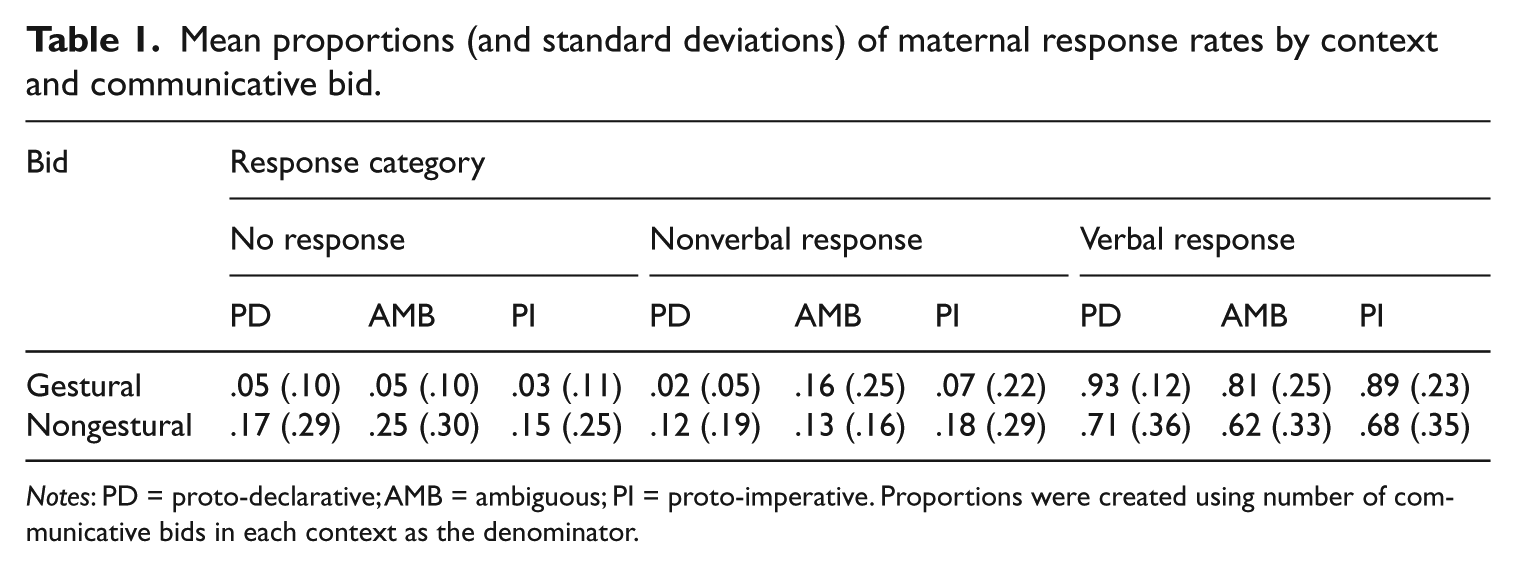
Notes: PD = proto-declarative; AMB = ambiguous; PI = proto-imperative. Proportions were created using number of communicative bids in each context as the denominator.
In order to make sure that the distinction mothers made in responding to gestural versus nongestural bids was not attributable to the extraneous factor of co-occurring vocalizations, we examined the proportions of both kinds of bids in each context that had an accompanying vocalization. A 3 (Context) × 2 (Bid) repeated measures ANOVA found a main effect for bid, F(1, 29) = 23.51, p < .0001, η p 2 = .45, and an interaction of bid and context, F(2, 58) = 20.41, p < .0001, η p 2 = .41. In fact, more gestural than nongestural bids were accompanied by vocalizations overall (Ms = 50% vs. 27%, respectively). That pattern characterized the proto-declarative and ambiguous contexts (Ms = 48% vs. 19% in the proto-declarative and 73% vs. 21% in the ambiguous context, respectively), but not the proto-imperative (Ms = 29% vs. 41%, respectively).
To ensure that the differential rates of maternal verbal responding to gestural versus nongestural bids described above had not been elicited by the presence of these accompanying vocalizations, we examined the proportions of gestural and nongestural bids with accompanying vocalization that received maternal verbal responses. A 3 (Context) × 2 (Bid) repeated measures ANOVA found a main effect for bid, F(1, 29) = 43.91, p < .0001, η p 2 = .60. Thus, even when only bids with vocalizations were considered, mothers were significantly more likely to provide verbal responses to gestural than to nongestural bids (Ms = 87% vs. 68%).
Characteristics of mothers’ verbal responses to infants’ gestural versus nongestural bids
The next set of analyses examined the kinds of verbal responses mothers provided to the infants’ gestural versus nongestural bids, in particular the extent to which their utterances contained object, action, and/or internal state labeling words. As a first step, we assessed the overall presence of labeling utterances in response to infants’ communicative bids by examining the proportions of total gestural and nongestural bids receiving a verbal response that included at least one labeling word. On average, infants’ gestural bids were nearly twice as likely to receive a maternal utterance containing a label as their nongestural bids. Mothers produced an utterance containing at least one labeling word after almost half of all gestural bids, but after only about a quarter of all nongestural bids (Ms = 47% vs. 27%, respectively), F(1, 29) = 11.54, p = .002, η p 2 = .28. Thus, infants’ gestural bids elicited not only more, but also linguistically richer maternal speech than their nongestural bids.
The next step involved examining the kinds of labeling utterances mothers produced to gestural and nongestural bids in the three contexts. For this more specific analysis, we controlled for the greater prevalence of verbal responses to gestural bids by examining the proportions of labels in mothers’ verbal responses to gestural and nongestural bids. It was designed to reveal whether both gesture and communicative intent context influenced maternal labeling even when only the bids that had received a verbal response were considered. The analysis assessed mothers’ differential provision of object, action, and internal state labels and their nonlabeling statements via a 3 (Context: proto-declarative, ambiguous, proto-imperative) × 2 (Bid: gestural, nongestural) × 4 (Verbal response: object, action, internal state, nonlabel) repeated measures ANOVA. In addition to overall differences in response types, F(2.05, 59.45 [G–G adjusted]) = 39.73, p < .0001, η p 2 = .58, and differences in response types across contexts, F(3.86, 112.04[G–G adjusted]) = 5.85, p = .0003, η p 2 = .17, the analysis revealed a three-way interaction, with the kinds of words mothers provided varying by both bid and communicative context, F(4.10, 118.76) = 6.30, p < .0001, η p 2 = .18 (see Table 2).
Mean proportions (and standard deviations) of verbal responses containing labels after infants’ gestural and nongestural communicative bids in three communicative intent contexts.

Note: Proportions were created using the number of each behavior that received a verbal response as the denominator.
To interpret this three-way interaction, follow-up bid by context analyses were conducted for each kind of verbal response. The analysis for object labels disclosed a main effect for context, F(2, 58) = 4.42, p < .02, η p 2 = .13, with more objects labels provided in the proto-declarative and ambiguous than the proto-imperative context. There was also an interaction between communicative bid and context, F(2, 58) = 12.79, p < .0001, η p 2 = .31. As Table 2 shows, mothers’ utterances included more object labels in response to gestural than to nongestural bids in the proto-declarative context and the ambiguous contexts, but more object labels to nongestural than gestural bids in the proto-imperative context.
The analysis for action labels found a significant main effect for context, F(1.44, 41.86 [G–G adjusted]) = 18.06, p = .0001, η p 2 = .38. As Table 2 shows, mothers’ verbal responses to infants’ gestural and nongestural bids rarely contained action labels in the proto-declarative or ambiguous contexts, but frequently did so in the proto-imperative context where the target objects required maternal operation.
The analysis for internal state labels revealed no significant differences in mothers’ overall provision of internal state terms by context or bid. However, further examination revealed that the kinds of internal state words mothers produced varied markedly by context and somewhat by bid (see Table 3). As Table 3 shows, in both the proto-declarative and ambiguous contexts, mothers provided perception labels more often than any other internal state labels. Friedman’s tests of differences among kinds of internal state labels approached significance for responses to gestural bids in the proto-declarative context (χr2(3) = 7.27, p = .06) and reached significance for responses to nongestural bids in the proto-declarative context (χr2(3) = 8.59, p = .035) and both gestural and nongestural bids in the ambiguous context (χr2(3) = 9.31, p = .02; χr2(3) = 14.8, p = .002). In contrast, in the proto-imperative context, following gestural bids mothers provided more volition labels than any other internal state label (χr2(3) = 26.3, p < .001). However, following nongestural bids in the proto-imperative context mothers were equally likely to provide a volition or perception label (40% respectively). Disposition and cognition labels were not common in any context.
Mean proportions (and standard deviations) of internal state labels after gestural and nongestural communicative bids in three contexts.

Note: Proportions were created using the number of each communicative bid type that received an internal state label as the denominator. Mothers could use more than one type of internal state label within the same responsive utterance.
The follow-up context by bid analysis for nonlabels revealed that mothers’ verbal responses varied significantly in their provision of nonlabeling utterances across contexts, F(2, 58) = 4.79, p = .01, η p 2 = .14, and in their inclusion of nonlabeling utterances to gestural versus nongestural bids in different contexts, F(2, 58) = 7.65, p = .001, η p 2 = .21. As Table 2 shows, in the proto-declarative and ambiguous contexts, maternal verbal responses were more likely to contain nonlabeling utterances following nongestural than gestural bids; in fact, the majority of their verbal responses to nongestural bids were nonlabeling. The reverse pattern held in the proto-imperative context.
Discussion
Infants who gesture earlier and/or more often develop larger vocabularies (Bates et al., 1979; Brooks & Meltzoff, 2008; M. Carpenter et al., 1998). One possible explanation that has been proposed for this predictive relation involves the responses infants receive from caregivers following their gestures (Brooks & Meltzoff, 2008; Goldin-Meadow, 2002; Olson & Masur, 2011). Mothers may produce responses following gestures that especially facilitate their infants’ linguistic development (Goldin-Meadow et al., 2007; Marcos, 1991; Masur, 1982; Olson & Masur, 2011). However, it is not known if mothers’ responses to infants’ early gestures are especially facilitative. If gestures elicit privileged input from mothers, then they should elicit different responses than nongestural communicative bids produced in the same communicative contexts. To begin to evaluate the likelihood of this proposal, the current study investigated whether mothers respond differently when their 13-month-old infants’ early communicative bids contain gestures than when they do not contain gestures. To ensure the comparability of the gestural and nongestural bids, we examined the infants’ gestural and nongestural communicative bids toward the same six experimental stimuli presented in three communicative intent contexts – proto-declarative or commenting, proto-imperative or requesting, and ambiguous. Mothers’ verbal and nonverbal response rates and their use of object, action, and internal state labels and nonlabeling utterances following these gestural and nongestural communicative bids were then examined.
As predicted, mothers responded differently to infants’ early communicative bids that contained gesture. Despite being highly responsive and highly verbally responsive to all communicative bids in all contexts, mothers responded more often and were more likely in all contexts to give a verbal response when infants’ communicative bids included gestures. Importantly, this differential response pattern remained even when only the communicative bids accompanied by vocalizations, especially likely to be noticed by mothers, were considered. Although bids with gestures were more likely also to include vocalizations, perhaps indicating more advanced communicative competence, mothers still favored gestural bids, responding more often (96% vs. 81%) and with more verbal responses (87% vs. 67%) to infants’ communicative bids that included gestures than to those without. Furthermore, the quality of mothers’ verbal responses was also greater when gesture was present. Overall, infants were nearly two times more likely to hear a maternal utterance that contained a word labeling an object, action, and/or internal state following a gestural than a nongestural bid. On average, almost half of infants’ gestural bids elicited these more linguistically substantive replies. These findings highlight the role infants’ gestures play in actively shaping their linguistic environments and represent the first empirical support for theoretical assertions that infants’ gestures, even more than their nongestural bids, indirectly impact language learning by influencing a communicative partner (Brooks & Meltzoff, 2008; Goldin-Meadow, 2002, 2007; Goldin-Meadow et al., 2007; Masur, 1982; Olson & Masur, 2011).
Why do infants’ gestures elicit different responses from mothers? Gesture may do at least two helpful things for mothers and infants. Most importantly, gesture may make infants’ early communicative bids more noticeable to caregivers. Many early intervention programs note the importance of helping caregivers notice infants’ early attempts to communicate and begin with instruction to watch for looking, gazing, gesturing, and vocalizing before teaching caregivers how to respond (Pepper & Weitzman, 2004). Even when only bids that included a vocalization were considered, mothers in the current study responded more often to communicative bids that included gestures in all communicative contexts suggesting that the gesture may have added saliency to the bid. Mothers not only noticed the gestural bids, they were more likely to respond verbally to bids including gesture than to bids that did not include gestures. Therefore, infants who gestured more elicited a greater amount of responsive verbal input from their caregivers. This is important because mothers’ rates of verbal responsivity have been positively linked to language outcomes (Baumwell et al., 1997; Bornstein et al., 1999; Rollins, 2003; Tomasello & Farrar, 1986; Yoder & Warren, 1998).
Second, gesture may help disambiguate young infants’ communicative intent. This was particularly salient in the proto-imperative context where mothers’ verbal responses were more likely to contain object labels or perceptual internal state labels after infants’ nongestural communicative bids than after bids that included gestures. Without gesture included in the communicative bids, mothers may have inferred that the child intended to comment rather than request and therefore provided an object or perceptual label, as they were likely to do following gestures in the proto-declarative context. But when infants included a gesture, almost always an object extension, mothers seemed to more easily infer that their infants were requesting. Instead of producing an object label or perceptual label, they then gave an action (e.g., open) or volition label (e.g., want) to better map their infants’ requests linguistically (Olson & Masur, 2011). Seventy-eight percent of the internal state labels mothers gave to gestures in the proto-imperative context were volition labels as opposed to 40% after nongestural communicative bids in the same context.
This linguistic mapping of internal state labels and action labels to proto-imperative gestures may also begin to explain why infants’ proto-imperative gestures are less strongly linked to early vocabulary sizes than their proto-declarative gestures (M. Carpenter et al., 1998). Mothers’ provision of internal state and action labels may not be as helpful at a time in development when infants’ early vocabularies are primarily made up of nouns (Goldfield & Reznick, 1990; Nelson, 1973). In contrast, however, it might help explain why infants’ early gestures are also related to their later production of internal state words and understanding of internal states (Dunn, Brown, Slomkowski, Tesla, & Youngblade, 1991; Meins et al., 2002; Sabbagh & Callanan, 1998; Taumoepeau & Ruffman, 2006, 2008).
Both context and bid type had an influence on mothers’ production of verbal responses containing object labels as well. Object labels were more prevalent in responsive utterances to bids in the proto-declarative context, and in the ambiguous context which evoked similar responses, than in the proto-imperative context. In addition, mothers provided more object labels to gestural than nongestural communicative bids in the proto-declarative and ambiguous contexts, even when only verbal responses were counted. This result extends those of Olson and Masur (2011), who found that mothers were more likely to provide object labels to infants’ proto-declarative gestures than to their proto-imperative gestures. However, because communicative context was held constant in the current study, we can now assert that it is also the presence of gesture in the communicative bid, not the communicative context alone that compels mothers to respond with such high rates of object labels. In contrast, mothers responded more often to infants’ nongestural than gestural communicative bids in the proto-declarative and ambiguous contexts with nonlabeling utterances that are less likely to facilitate vocabulary acquisition. This differential pattern of maternal responses results in a richer language experience for infants who gesture more in proto-declarative contexts and may go far toward explaining the strong association between proto-declarative gesturing and lexical acquisition (M. Carpenter et al., 1998). Significantly, more than other kinds of early communicative bids, infants’ commenting gestures at 13 months elicit more opportunities to hear object labels at the very time their noun vocabularies are rapidly expanding (Goldfield & Reznick, 1990; Nelson, 1973).
Even though vocabulary outcomes were not examined in the current study, it is reasonable to expect that mothers’ differential responses to infants’ gestural communicative bids will be related to their infants’ subsequent vocabularies. Other studies have found that mothers’ follow-in labeling, like the object labels they provided here in response to commenting gestures, have been positively related to infants’ lexical development (Baldwin & Markman, 1989; Bloom, Margulis, Tinker, & Fujita, 1996; M. Carpenter et al., 1998; Masur et al., 2005; Tomasello & Farrar, 1986). In addition, mothers’ use of internal state words predicts their infants’ internal state vocabularies (Dunn et al., 1991; Meins et al., 2002; Sabbagh & Callanan, 1998). Nevertheless, further studies need to be completed to test the relation between mothers’ responses to infants’ gestures early in the second year and infants’ later object and internal state vocabularies. It would also be worthwhile to include dyads with diverse linguistic and cultural backgrounds, as the current sample was largely Caucasian and middle class. Such relations would provide further support for the theoretical assertion that infants’ gestures indirectly impact language learning because communicative partners provide more responses that are helpful for language acquisition (Brooks & Meltzoff, 2008; Goldin-Meadow, 2002, 2007; Goldin-Meadow et al., 2007; Masur, 1982; Olson & Masur, 2011). We predict that mothers’ responses to infants’ gestures mediate the relation between infants’ gestures and their vocabulary. Our findings that mothers respond differently to their infants’ early gestural and nongestural communicative bids represents a first step toward testing this mediation model.
Footnotes
Acknowledgements
Portions of the results were presented at the International Conference on Infant Studies, Minneapolis, MN, June 2012. The authors thank Emily Block for assistance coding; Julie Bassetto, Jihee Hong, John Kinney, Carrie Lloyd, Leigh Mangun, Trish Schnell, and Brittney Wyatt for assistance collecting and managing data; and the participating children and mothers.
Funding
This research was supported by a Great Journeys Research Assistant Grant and Research and Artistry Grant to the first author from the Graduate School at Northern Illinois University. It was also supported by a PoP grant to both authors from the Center for the Interdisciplinary Study of Language and Literacy at NIU.