



Abstract
The ability of language-impaired children to maintain coherence by using discourse connectives has so far been assessed by quantitative measures. This study is a first attempt to scrutinize the quality of connective use in specific language impairment (SLI). The authors investigate whether Russian-speaking children reveal sensitivity to the subtle discourse-organizational distinctions between the quasi-synonymous connectives i ‘and’ and a ‘and/but’ in a narrative task. Study 1 compared connective use by 7-year-olds with and without SLI. The results demonstrate that connective frequencies do not differentiate between the two groups, but language-impaired children more often use connectives in a way that violates causal relations in the story. Study 2 assessed connective production by the same SLI participants 16 months later and also tested understanding of causal chains in a follow-up interview. The error rates remained high. These errors were not due to poor understanding of the story, since the language-impaired children answered the causal questions in the follow-up interview as well as their unimpaired peers did.
Keywords
Introduction
Individuals with specific language impairment (SLI) exhibit a deficit in language ability in the absence of any hearing, intellectual and emotional impairments or frank neurological damage. Research over the last two decades has contributed important insights into which areas of language are challenging for children with SLI acquiring different languages. The majority of studies so far have focused on the acquisition of noun and verb morphology (Anderson & Lockowitz, 2009; Bedore & Leonard, 2005; De Jong, 1999; Jacobson & Livert, 2010; Leonard & Dromi, 1994; Polite, 2011; Polite & Leonard, 2006; Roberts & Leonard, 1997) and more rarely morphology of other word classes (Bedore & Leonard, 2001; Leonard, Salameh, & Hansson, 2001; Marshall & Van der Lely, 2007; Orgassa, 2009; Ravid, Levie, & Avivi Ben-Zvi, 2003; Tribushinina & Dubinkina, 2012).
Although inflectional morphology appears to be a particularly vulnerable area in SLI (Bishop, 1994; Leonard, 1998), language-impaired individuals were also shown to have lexical deficits (see Leonard & Deevy, 2004 for a review) and difficulties with word semantics (Alt, Plante, & Creusere, 2004; Befi-Lopes, Silva, & Bento, 2010; Chaix, Barry, & Duvignau, 2012; McGregor & Appel, 2002; Nash & Donaldson, 2005; Sheng & McGregor, 2010). Research shows that word-finding problems in SLI may be caused by impoverished semantic representations. Children with SLI make more errors in picture-naming tasks, and their drawings of misnamed objects are often poorer than pictures of objects that they could correctly name, pointing at problems at the level of semantic representation (Befi-Lopes et al., 2010; McGregor & Appel, 2002). In the same vein, language-impaired children recognize fewer semantic features of novel objects or actions in fast-mapping experiments (Alt & Plante, 2006; Alt et al., 2004). Also semantic relations between words in the mental lexicon are vulnerable in SLI, as suggested, for example, by frequent semantic substitution errors (Chaix et al., 2012; McGregor, 1997; Rice & Bode, 1993; Tribushinina & Dubinkina, 2012) and fewer semantic associations produced in a word-association task compared to age-matched peers and also to younger vocabulary-matched peers (Sheng & McGregor, 2010).
Less attention in the SLI literature has been given to the acquisition of phenomena beyond the sentence level. Notice, however, that the ability to produce and to understand coherent discourse is crucial for adequate participation in the communication process. There is some indication that language-impaired children have difficulty producing coherent discourse, as evidenced, for instance, by poorer cohesion of their narratives (e.g. Gonsalez, Cáceres, Bento-Gaz, & Befi-Lopes, 2012; Liles, 1985a, 1985b; Norbury, Gemmel, & Paul, 2014; Tsai & Chang, 2008). However, studies addressing these issues are typically restricted to counting overall frequencies of cohesive markers. We know very little about which aspects of discourse coherence are particularly problematic in SLI and what the nature of the problems is. To fill this gap, the present article investigates how children with SLI maintain coherence in a narrative task and what problems they encounter as they go along.
Discourse coherence in the SLI context
The ability to produce and understand coherent discourse is a major milestone in a child’s life. Even in normal language development, the acquisition of coherence markers is a long process that continues far beyond age 4 when most morphosyntactic structures have already been acquired (Accorti Gamannossi & Pinto, 2014; Berman & Slobin, 1994; Mäkinen, Loukusa, Nieminen, Leinonen, & Kunnari, 2014; Peterson & McCabe, 1983).
Discourse can be coherent by virtue of repeated reference to the same entities. For example, the protagonist of Little Red Riding Hood can be referred to as Little Red Riding Hood, the girl and she throughout the story. This type of coherence is known as referential coherence (Ariel, 1990; Givón, 1992). Coherence can also be maintained by establishing logical relations (e.g. cause–consequence, list, contrast) between two or more discourse segments. This type of coherence is known as relational coherence (Sanders, Spooren, & Noordman, 1992). Notice that the term ‘coherence’ pertains to a mental representation of a text, rather than to linguistic markers of coherence relations. For example, relational coherence can be marked by discourse connectives such as and, but and because; in this case we speak of cohesion (Halliday & Hasan, 1976; Sanders & Pander Maat, 2006); but coherence relations between text segments can also be established in the absence of any explicit cohesive ties (Sanders & Spooren, 2007).
Studies addressing the acquisition of coherence in the SLI context have by and large focused on the quantitative distributions of five different types of cohesive ties identified by Halliday and Hasan (1976) – Reference, Ellipsis, Substitution, Conjunction, Lexical Cohesion – in the narratives produced by children with SLI and their typically developing (TD) peers. These studies demonstrate that language-impaired children produce narratives with fewer cohesive ties (Strong & Shaver, 1991) and with more incomplete and erroneous ties (Baltaxe & D’Angiola, 1992; Liles, 1985a, 1985b; Strong & Shaver, 1991). Another important finding reported in the literature is that not all types of cohesive devices identified by Halliday and Hasan (1976) are equally suitable for differentiating between children with and without SLI. More specifically, there is some evidence that only referential ties reliably differentiate between the two groups (Baltaxe & D’Angiola, 1992; Liles, 1985a, 1985b). It is, however, important to notice, that this conclusion was made on the basis of quantitative measures only (e.g. rates of pronoun use). The quality of cohesive ties in language-impaired populations is a largely under-researched area. For example, we know very little about the complexity and appropriateness of various cohesive ties in the speech of language-impaired children.
In this study, we investigate how children with SLI use discourse connectives (e.g. and, but), i.e. prototypical markers of relational coherence, and how connective use relates to referential coherence of children’s narratives. The acquisition of discourse connectives by TD children was shown to follow a path of increasing conceptual complexity (Evers-Vermeul & Sanders, 2009; Spooren & Sanders, 2008; Van Veen, Evers-Vermeul, Sanders, & Van den Bergh, 2009). For example, connectives denoting additive relations (e.g. and) are usually acquired before causal connectives (e.g. because); and positive connectives (e.g. and, when) are usually acquired before negative ones (e.g. but, although). At the outset of connective acquisition, children (over-)use additive connectives (mainly ‘and’) to express a whole range of relations, and as they grow older their connective inventories become more specific. For instance, older children acquire various causal connectives such as because, therefore and thus to express cause–consequence relations; this process is usually accompanied by a decrease in the frequency of less specific/complex connectives such as and (Berman & Slobin, 1994; Spooren & Sanders, 2008).
As far as the acquisition of discourse connectives by language-impaired children is concerned, investigations are scarce and the findings somewhat controversial. Gonsalez et al. (2012) report that Portuguese-speaking children with SLI (aged 7–10) produce fewer connectives than their TD peers, especially in the subordinating domain and especially in more complex narratives. In contrast, Gagarina (2012b) reports over-use of the additive connectives i ‘and’ and a ‘and/but’ by Russian-speaking 5-year-olds with SLI. Tsai and Chang (2008) show that Mandarin-speaking language-impaired children (aged 7–10) under-use temporal and causal connectives and over-rely on sequential connectives (‘and then’). Likewise, Befi-Lopes, Bento, and Perissinoto (2008) demonstrate that language-impaired children have difficulty expressing causal relations and compensate by ample use of additive connectives. Children with SLI were also shown to make more errors in connective use compared to their TD peers (Liles, 1985a, 1987; Purcell & Liles, 1992).
To recapitulate, prior research on the acquisition of (relational) coherence markers by language-impaired children has largely relied on quantitative measures (operationalized as token frequencies and proportions of errors). To the best of our knowledge, there are no studies investigating how individuals with SLI actually use discourse connectives in context. The quantitative data reviewed above seem to suggest that language-impaired children have particular difficulty using conceptually complex (temporal and causal) connectives and that they often use connectives inappropriately. But since these studies only report overall error rates, without analysing the errors, we do not know what kinds of errors these children make and how those relate to the conceptual complexity of the coherence relations involved. We trust that thorough semantic analyses of connective use in context we can provide useful insights into the discourse profile of language-impaired children and reveal whether (and if so, in what ways) their connective production is different from that of unimpaired individuals. To this end, the present study scrutinizes the use of two Russian additive connectives – i ‘and’ and a ‘and/but’ – in the narratives of children with and without SLI. These quasi-synonymous connectives reveal subtle semantic-pragmatic distinctions that are crucial for discourse organization and, therefore, provide a good testing ground for the hypothesis that the quality (rather than quantity) of connective use can be a good indicator of SLI.
The Russian connectives i and a
The conceptual space of additivity in Russian is divided between three connectives – the positive i ‘and’, the negative no ‘but’ and the semi-negative a ‘and/but’. The semantics of no ‘but’ is narrower than that of the English counterpart but; the use of no is confined to argumentative meanings such as denial of expectation and concession (e.g. The ring is beautiful, but too expensive). Therefore, no is acquired relatively late, whereas i ‘and’ and a ‘and/but’ emerge early and are very frequent in both child speech and parental input (Knjazev, 2007).
Despite their early emergence and high frequencies, the acquisition of i and a is not completed by age 6 (Tribushinina, Valcheva, & Gagarina, in press). The two connectives are quasi-synonymous; they reveal subtle semantic distinctions that are crucial from a discourse-organizational point of view. As shown in Table 1, there are only three types of use where the realms of i and a do not overlap: only i can be used for noun-phrase (NP) and verb-phrase (VP) coordination (A and B), and only a is used for correction (not A, but B). Both i and a can be used as part of sequential connectives (‘and then’), but a is more common in this function.
Semantic profiles of i and a.

In cases of clausal coordination (A does X, and A/B does Y), i and a may appear quite similar on the surface. However, semantic research shows that the two connectives have distinct discourse profiles (Jasinskaja & Zeevat, 2008; Kreidlin & Paducheva, 1974). I has an overall preference for topic maintenance, often realized as reference maintenance. When reference is switched after i, topic continuity should be maintained by establishing an obligatory causal link between the propositions of the two clauses (A does X, and=therefore B does Y). In contrast, a typically establishes an additive relation between two different topics and is therefore strongly associated with reference shift. Reference maintenance after a is only possible in cases of semantic contrast, often between temporal expressions (see Table 1).
In an eye-tracking study by means of the Visual World Paradigm, Mak, Tribushinina, and Andreiushina (2013) found that Russian-speaking adults are sensitive to these subtle semantic properties: they are more likely to switch gaze to a picture of a new referent after a than after i, even before they hear a second clause. In sum, even though additives are usually seen as the least complex type of connectives emerging early in child speech (Evers-Vermeul & Sanders, 2009), the Russian additives i and a have a quite complex semantic make-up based on interactions between reference and causality.
Hypotheses
Based on the intricate discourse profiles of i and a discussed above, it might be predicted that language-impaired children will have difficulty acquiring subtle semantic distinctions between the two connectives in the domain of clausal coordination where i and a overlap. This prediction is based on earlier findings demonstrating that language-impaired children have impoverished semantic representations of words and often make substitution errors by using inappropriate words instead of a semantically related target (see literature review above). Since there is no one-to-one mapping between type of referential development (maintenance or shift) and connective (i or a), children have to find out that the two connectives have underlying semantic preferences and that violating these preferences is only possible under specific constraints, such as an obligatory causal reading of i (in cases of shift) and contrast for a (in cases of maintenance).
It is also important to notice that if we only look at clausal coordination (and exclude cases of VP coordination), i is more often used for shift than a for maintenance, as shown by the results of the corpus study of adult speech reported in Mak et al. (2013). The reason is that temporal contrasts (facilitating the use of a for maintenance) are less ubiquitous than causal uses of i (requiring reference shift). Hence, it is likely that children will make more errors with i than with a because the distributions in the input are more ambiguous for the former connective.
Study 1
Method
Participants and data
Thirty-nine monolingual Russian children participated in this study – 19 children with SLI and 20 TD peers (see Table 2). The subjects with SLI were recruited through special schools for language disorders located in the Kemerovo area. The children had been independently diagnosed for SLI by a multidisciplinary committee consisting of a speech pathologist, a psychiatrist, a neurologist, a paediatrician and a clinical psychologist. The children were selected for participation in the present study if they met the following criteria:
Non-verbal IQ score of 26 or higher on the Amthauer’s Intelligence Structure Test (Amthauer, 1973) and a score of 11 or higher on the MEDIS test (Averina, Shcheblanova, & Zadorina, 1994); 1
No evidence of neurological impairment;
Normal hearing;
Absence of any other known disorder, such as autism;
No severe phonological disorder;
Lower-than-expected language performance, operationalized as at least two standard deviations below age-appropriate scores of receptive and expressive language on the Fotekova–Akhutina test. The mean age-appropriate scores are 160.9 on receptive language, 128.1 on expressive grammar and 105.4 on expressive vocabulary (Fotekova & Akhutina, 2002).
The participants.

The selected group of language-impaired children had a mean IQ score of 29.5 (SD = 3.3) on the Amthauer’s test and 14.7 (SD = 2.2) on the MEDIS test. Their mean language scores were 132.6 (SD = 14.2) on the receptive language part, 90.6 (SD = 23.5) on the expressive grammar part and 75.1 (SD = 8.9) on the expressive vocabulary part of the Fotekova–Akhutina test.
It was decided to use age-matched rather than language-matched TD controls. If younger TD children (matched for language age) were included as a comparison group, they would be less cognitively advanced compared to the SLI group and, therefore, less able to understand the causal links in the stories (Boudreau & Chapman, 2000). Twenty TD children were recruited in a regular school in the Kemerovo area. For privacy reasons, the investigators were not allowed to access (and use) the children’s records. Therefore, the teachers were asked to select the subjects following a set of criteria: normal IQ (within one standard deviation of the mean on IQ tests conducted for school enrolment), no severe visual or auditory problems (based on the yearly medical checks at school), average academic performance, normal sensory-motor, social-emotional and cognitive development, and age-appropriate language skills (as reported by teachers and parents). Informed consent was obtained from the parents of all participants.
Materials and procedure
In view of recent results by Colozzo and Whitely (2014) demonstrating that it is crucial to use more than one story for studying narrative ability, we used two picture stories to elicit children’s narratives – the Fox Story (Gülzow & Gagarina, 2007) and the Cat Story (Hickmann, 2003). The stories contained six pictures each and were also matched for the number of characters and grammatical gender of the nouns referring to the protagonists (fox, bird/crow and fish in the Fox Story; bird, cat and dog in the Cat Story). These two narratives have already been successfully used by earlier studies on the acquisition of referential and relational coherence (e.g. Gagarina, 2008, 2012a, 2012b; Tribushinina et al., in press). Both sets of pictures were simple black-and-white drawings, 12 × 12 cm (Fox Story) and 10 × 13 cm (Cat Story) in size.
The children were interviewed individually in a quiet room in their school by the second author of this paper. After a short warm-up talk about the child’s favourite stories, the investigator asked the child to tell the story in pictures. All pictures of the story were then placed on the table in front of the child. After the child looked through all the pictures and acknowledged to have understood the story, the experimenter put all the pictures away and afterwards placed only the first picture in front of the child and said, ‘Please, start telling the story’. When the child finished describing picture 1, the investigator placed picture 2 next to picture 1 so that the child could see two pictures at the same time. When the child was finished with picture 2, the investigator placed it on top of picture 1 and put picture 3 next to picture 2 on the table, etc. Both narratives were elicited in one session, the order was counterbalanced among participants.
The elicited narratives were audio-recorded and later transcribed in a CHAT format (MacWhinney, 2000) by the second author. The transcriptions were morphologically tagged by means of MORCOMM tools (Gagarina, Voeikova, & Gruzincev, 2003) and disambiguated by a trained research assistant.
Coding
Since the most intriguing differences between i ‘and’ and a ‘and/but’ are observed in the domain of clausal coordination, we have coded each instance of the connectives as ‘clausal coordinator’ (see examples (1)−(2)) and ‘other’ (see examples (3)−(6)).
(1) Žili-byli mama-ptička,
there.lived&ERR mother-bird
‘Once upon a time there was a mother-bird
(2) Lisa gonjaetsja,
fox chases
‘The fox is chasing (her),
(3) Potom ptica vzjala rybu
then bird took fish
‘Then the bird took the fish
(4) A sobaka
and/but dog
‘And the dog
(5)
‘And then the dog came and the cat did not have enough time to climb the tree.’
(6)
‘
Additionally, each instance of the connectives was coded as either correct or incorrect. For example, the use of i ‘and’ in (1) above was coded as ‘correct’ because here the connective is used to coordinate two clauses where reference in maintained. In contrast, the (bold-marked) use of i in (7) was coded as ‘incorrect’ because the use of i in the context of reference shift (from the cat to the mother-bird) forces the listener to adopt a causal interpretation that is not plausible in the story (the mother-bird brought food because the cat ran away from the dog). Only connective errors were coded. Other errors, such as the subject–verb agreement error and two case errors in (1), were not taken into account.
(7) A potom sobaka sdërnula košku s vetki, i koška pobežala ot sobaki.
and then dog pulled.off cat from branch and cat ran from dog
‘And then the dog pulled the cat from the tree, and the cat ran away from the dog.
Likewise, the use of a ‘and/but’ in (2) was coded as ‘correct’, because here it is used in its prototypical function – coordination of causally unrelated clauses with two different referents (fox and bird). As against this, a in (8) was coded as ‘incorrect’ because here it is used for reference maintenance without any (temporal or spatial) contrast. Notice that in (8) the child also makes a subject–verb agreement error (‘bird were’).
(8) Byli ptička,
were&ERR bird
‘There was a bird
Coding was performed by the first author. Thirty-five percent of the data (466 of 1344 instances), combined from both Study 1 and Study 2, were additionally coded by a trained research assistant. The inter-coder agreement was 94%. Disagreement was resolved by consensus.
Results
Narrative length
The mean narrative length measured in word tokens and utterances is presented by group in Table 3.
Mean narrative length by group (Study 1).
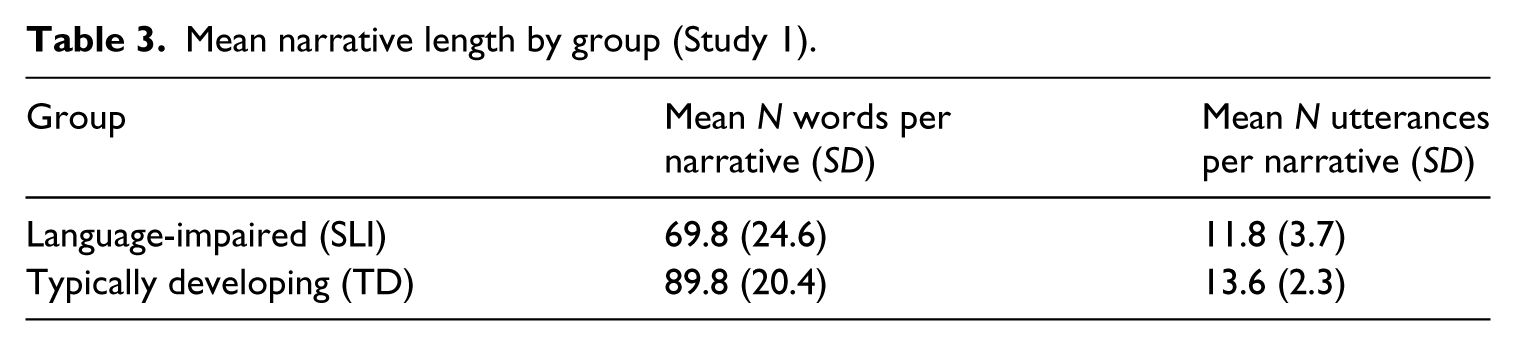
An independent-samples t-test revealed no significant difference between TD children and children with SLI in the mean number of utterances per narrative (p = .07), but the mean number of words per narrative was higher in the TD group, t (37) = 2.8, p = .009. Hence, children with and without language impairment produce a similar number of utterances per narrative, but the utterances of TD children are longer.
Connective frequencies
In order to take the volubility of the subjects into account, token frequencies of i ‘and’ and a ‘and/but’ were calculated per utterance (see Table 4).
Mean frequencies of i ‘and’ and a ‘and/but’ per utterance (Study 1).

A mixed 2 × 2 ANOVA with connective (i; a) as a within-subjects factor and group (SLI; TD) as a between-subjects factor showed no significant main effects of connective (p = .13) and group (p = .99). The connective by group interaction was not significant either (p = .15). Language-impaired children use i ‘and’ and a ‘and/but’ as often as their TD peers. So based on connective frequencies we cannot distinguish between individuals with and without language impairment.
Errors
In order to investigate whether 7-year-olds (with and without SLI) have mastered the intricate semantic profiles of i ‘and’ and a ‘and/but’, we compared the percentages of correct connective use by children with SLI and their TD peers (see Table 5). Since the children only made errors when the connectives were used for clausal coordination, the percentages were calculated relative to the total number of instances of clausal coordination rather than to the overall frequencies of the two connectives.
Mean percentages of correct uses of i ‘and’ and a ‘and/but’, SDs in parentheses (Study 1).

A mixed 2 × 2 ANOVA with connective (i; a) as a within-subjects factor and group (SLI; TD) as a between-subjects factor revealed a significant main effect of connective, F (1, 25) = 7.61, p = .01, η p 2 = .23. Children make more errors with i (M = 23%) than with a (M = 8%). There was also a significant main effect of group, F (1, 25) = 7.61, p = .01, η p 2 = .235. On average, children with SLI make more errors (M = 22%) than TD children (M = 8%). The connective by group interaction was not significant (p = .07). Post hoc t-tests (with alpha level adjusted to .025) revealed that there is no difference between the two groups in the error rate of a (p = .27), but children with SLI make significantly more errors with i, t (27) = 2.63, p = .01 (two-tailed).
There were large individual differences in the correctness of i, especially in the SLI group, as evidenced by the standard deviations in Table 5. Of the 15 language-impaired children who used i for clausal coordination, five children were 100% correct, three children were above 50% correct and seven children were at or below chance (including one child who had no correct uses at all).
A qualitative analysis of errors demonstrates that all incorrect uses of i ‘and’ involve reference shift in the absence of a plausible causal relationship between the two events. For example, in (9) the child switches reference from the cat to the bird; the use of i in this case imposes an obligatory causal reading of ‘therefore’. However, it is not the case (in the story) that the mother-bird flew away because the cat came. The mother-bird flew away to find some food for the nestlings and when she was gone the cat came to get the little birds.
(9) Potom prišla koška i xotela dostat’,
then came cat and wanted get
‘Then the cat came and wanted to get (them)
Incorrect uses of a ‘and/but’ were of two types. In 41% (SLI) and 39% (TD) of errors children used a for reference maintenance, as in (10). In these cases, i should have been used instead of a, since the latter is only felicitous in cases of reference maintenance where a contrast is realized by other elements such as temporal markers (e.g. today vs yesterday). A second group of inappropriate uses of a were cases of reference shift where a causal relationship evident in the story was not expressed (SLI 59%, TD 61%). For example, in the Fox Story the bird had a fish-bone in its mouth and the fox was doing its best to get it. At a certain moment, the bird dropped the fish-bone and the fox was very happy. There is a clear causal link between the act of losing the bone by the bird and the fox’s being happy. The use of a in (11) strongly suggests that these two events were not causally related; thus i ‘and’ would be more appropriate in this case.
(10) A zdes’ lisa pribežala.
and/but fox came
‘And/but here the fox came.
(11) Potom storož kinul rybu,
then guard dropped fish
‘Then (the) guard dropped (the) fish,
Discussion
We predicted that children with SLI would have more difficulty acquiring the discourse profile of the connective i ‘and’ compared to a ‘and/but’, since the latter is more straightforwardly associated with reference shift, whereas the former has a less transparent distribution. This prediction is borne out by the data: children in both groups made more errors with i than with a. Furthermore, language-impaired children did not differ from TD controls in the use of a, whereas the proportion of incorrect uses of i was higher in the SLI group. This result suggests that children with SLI differ from their TD peers not only in the use of reference, but also in the use of relational coherence devices (cf. Gagarina, 2012b). The subtle semantic differences between i and a, crucial from a discourse-organizational point of view, are challenging even for TD children, but more so for children with language impairment.
However, overall frequencies of the two connectives were comparable in the two groups, which suggests that we cannot differentiate between children with and without language impairment based on production rates of i ‘and’ and a ‘and/but’. This finding is consistent with the earlier results demonstrating that children with and without SLI do not differ from each other in overall frequencies of connective production (Baltaxe & D’Angiola, 1992; Liles, 1985a, 1985b). Hence, it is not sufficient to look only at token frequencies of coherence markers in research on SLI. It is crucial to scrutinize the actual use of discourse connectives in context. Our study has shown that the quality of connective use by language-impaired individuals is significantly lower than that of unimpaired peers. In particular, children with SLI have difficulty with causal meanings expressed by the connectives.
Study 2
A qualitative analysis of errors in Study 1 revealed that in most (erroneous) cases children either linguistically mark a causal relation (by using i) in scenes with no plausible causal relation from an adult point of view, or fail to express a causal link (by using a) that is evident in the story. Such errors may be either linguistic or conceptual in nature (Berman, 1995). It is possible that children understand the causal relations involved in the story, but sometimes fail to map them onto appropriate linguistic structures (mapping problem). Alternatively, it might be the case that children have mastered the semantics of i, but sometimes fail to establish/understand the correct causal relationship between the events (representation problem). We use the term ‘representation’ the way it is used in the literature on discourse coherence, i.e. with reference to conceptual links between discourse segments constructed in the mind of a speaker/listener (Sanders & Pander Maat, 2006).
The design of Study 1 does not allow us to disentangle these two factors (mapping vs representation). Therefore, we conducted a second study in order to rule out the possibility that errors in connective use are due to poor understanding of the story grammar rather than to impoverished connective semantics in SLI. A second goal of Study 2 was to trace the development of connective use over time. To this end, the same language-impaired subjects were tested approximately 16 months after the first session. This time each child was additionally offered several why-questions targeting their comprehension of the causal chains in the stories.
Since only language-impaired children with a normal intellect were selected to participate in this investigation, we predict that the subjects with SLI are able to understand the causal chains in the story, even if they express them inappropriately in their narratives (cf. Liles, 1985a, 1985b, 1987). Put differently, we expect that errors in connective production are not due to a representation problem. If our hypothesis is correct, we should find no correlation between the rate of causal errors in the narratives and the accuracy of answering the why-questions in the interview. It is also likely that the proportion of errors decreases with age.
In view of the earlier findings that the frequency of additive connectives tends to decrease as children grow older and learn more complex (e.g. causal, negative) connectives (Peterson & McCabe, 1987; Spooren & Sanders, 2008), we further hypothesize that overall frequencies of i ‘and’ and a ‘and/but’ should decrease between the two data points.
Method
Participants and data
The 19 language-impaired subjects from Study 1 were tested again approximately 16 months after the first session. The mean age of the children in Study 2 was 8;10 (age range: 8;01−9;04).
The control group were 20 TD children recruited from a regular school in Sochi. We used the same inclusion criteria as in Study 1. The control group was matched with the SLI group for sex (6 girls, 14 boys) and chronological age (mean age: 8;10, age range: 8;02–9;04).
Materials and procedure
In the first part of the session, the narratives were elicited by means of the materials and procedure described in Study 1. In the second part of the session, after telling the stories, the children were offered 19 why-questions about the causal links in the story (11 questions about the Cat Story and 8 questions about the Fox Story). The questions were selected on the basis of the errors made by the SLI subjects in the first session (e.g. Why was the fox happy?). All questions are presented in Appendix 1. For each question only the relevant picture was placed on the table in front of the child.
The elicited narratives and the responses to the why-questions were transcribed into CHAT and morphologically tagged by means of the MORCOMM tools.
Coding
As in Study 1, each occurrence of i ‘and’ and a ‘and/but’ was identified as an instance of ‘clausal coordinator’ or ‘other’. Each instance was also coded as either correct or incorrect.
The answers to the why-questions were coded as correct or incorrect. An answer was coded as ‘correct’ if the child provided a cause that was plausible in the context of the story and as ‘incorrect’ if the child provided a cause that was not compatible with the plot. For instance, for the question ‘Why did the bird fly away?’ answers such as ‘Because she wanted to bring food for the nestlings’ and ‘Because the nestlings were hungry’ were considered correct. Answers such as ‘Because she was afraid’ and ‘Because the cat came’ were counted as incorrect. In the picture it is clear that the bird is flying away to get food for the nestlings, unaware of the cat’s presence.
The coding was performed by the first author. Twenty percent of the answers were coded again by a trained research assistant. The agreement rate was 96%. Disagreement was resolved by consensus.
Results
Narrative length
The mean narrative length measured in word tokens and utterances is presented by group in Table 6.
Mean narrative length by group (Study 2).
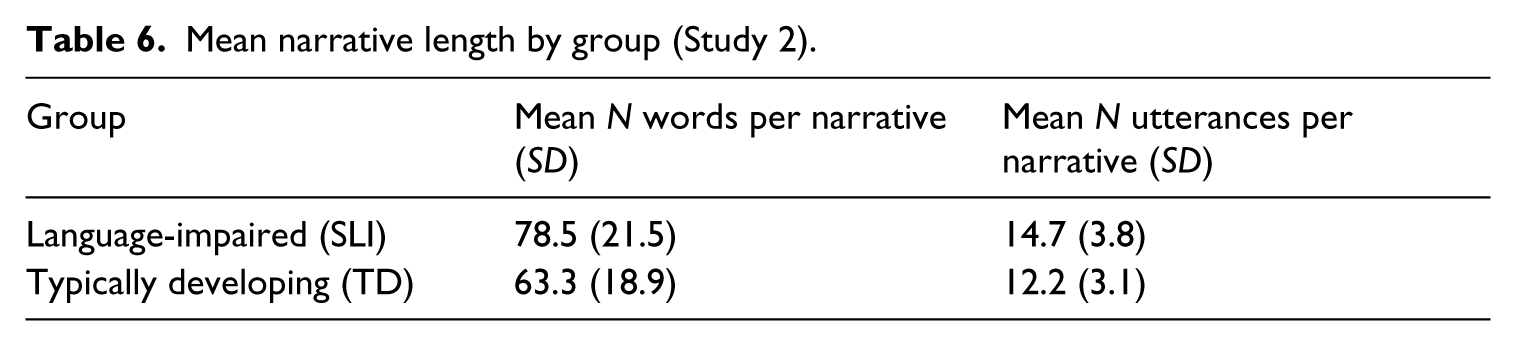
An independent-samples t-test revealed a significant difference between TD children and children with SLI in the mean number of utterances per narrative, t (37) = 2.4, p = .03. There was also a significant difference in the number of words per narrative, t (37) = 2.4, p = .02 (two-tailed). The language-impaired subjects produced longer narratives than their TD peers.
If we compare narrative length in the SLI group across the two data points, we see that the narratives produced by the language-impaired participants at Session 2, on average, contain more utterances, t (18) = 3.1, p = .003 (one-tailed), and more words, t(18) = 2.0, p = .03 (one-tailed). Thus, narrative length increased with age.
Connective frequencies
Overall token frequencies of i ‘and’ and a ‘and/but’ per utterance are presented by group in Table 7.
Mean frequencies of i ‘and’ and a ‘and/but’ per utterance (Study 2).

A mixed 2 × 2 ANOVA with connective (i; a) as a within-subjects factor and group (SLI; TD) as a between-subjects factor showed no significant main effects of connective (p = .71) and group (p = .27). But there was a significant connective by group interaction, F (1, 37) = 4.35, p = .04, η p 2 = .11. The TD children used more i ‘and’ and the children with SLI more a ‘and/but’.
A 2 × 2 repeated measures ANOVA with age (Session 1; Session 2) and connective (i; a) as within-subject factors revealed a significant main effect of age, F (1, 18) = 5.33, p = .03. The frequency of the additive connectives in the narratives of the language-impaired children decreased with age. The effect of connective (p = .51) and the connective by age interaction (p = .39) were not significant.
Errors
The mean percentages of correctly used i ‘and’ and a ‘and/but’ relative to all uses in clausal coordination are presented in Table 8.
Mean percentages of correct uses of i ‘and’ and a ‘and/but’, SD in parentheses (Study 2).

A mixed 2 × 2 ANOVA with connective (i; a) as a within-subjects factor and group (SLI; TD) as a between-subjects factor revealed no significant main effect of connective (p = .34). But there was a significant main effect of group, F (1, 28) = 6.6, p = .02, η p 2 = .19. On average, children with SLI made more errors (M = 19%) than TD children (M = 4%). The connective by group interaction was not significant (p = .06).
To assess change over the two data collection waves, we conducted a 2 × 2 repeated measures ANOVA with age (7; 8) and connective (i; a) as within-subject factors. The analysis revealed a significant main effect of connective, F (1,12) = 5.57, p = .04. The language-impaired children made more errors with i (M = 27%) than with a (M = 11%). The main effect of age (p = .24) and the connective by age interaction (p = .07) were not significant.
As evidenced by large standard deviations in Table 8, there is a lot of variability in the SLI group. For example, nine of the children used i in clausal coordination only correctly, four children performed between 60 and 90% correct, and four children scored at or below chance (including one using i only incorrectly). Similarly for a: six children were 100% correct, 11 children were between 60 and 90% correct, and one child performed at chance (50%).
Question–error correlations
As shown in Table 9, there were no significant correlations between correct connective use and correct responses to the why-questions in either of the groups. So errors in connective production do not seem to be related to understanding causal chains in the narratives. On average, the TD participants answered 95% of the why-questions correctly; in the SLI group 93% of the questions were answered correctly. Hence, both groups understood causal chains in the story. The difference between the two groups in the accuracy of responses was not significant (p = .6).
Correlations between percentages of correct connective use (in clausal coordination) and percentages of correct responses to the why-questions.
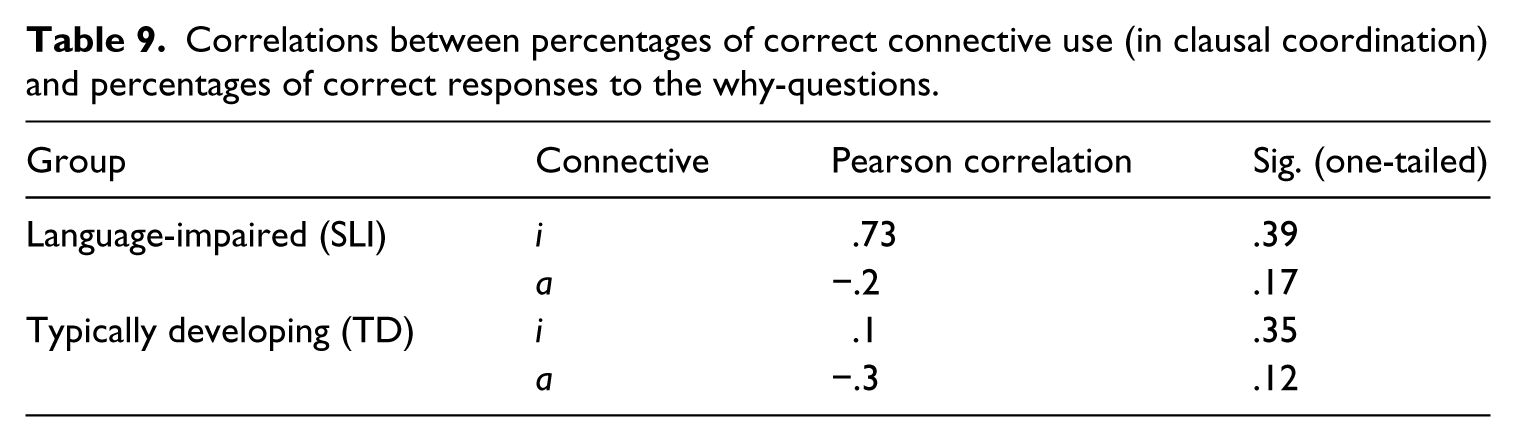
We further looked whether there were any errors in the narratives that pertained specifically to the causal links targeted by the why-questions in the follow-up interview. For example, for the error exemplified in (9) we would look at how this particular subject answered the question ‘Why did the bird fly away?’
In the SLI group there were 19 cases where the children made an error that was related to one of the questions in the interview, and 17 of those questions were answered correctly. In the TD group there were only eight errors that could be related to a follow-up question, and six of them were answered correctly. So errors in connective use do not seem to be (primarily) caused by poor understanding of the causal links in the story. The observed pattern is more consistent with the idea that children with SLI have trouble mapping their (correct) mental representations onto appropriate linguistic forms.
Discussion
A somewhat surprising finding is that the narratives of the SLI group were longer than those of the comparison group. At age 7, we did not find a difference between children with and without language impairment in the mean number of utterances per narrative, but the TD group, on average, used more words per narrative. However, 16 months later the children with SLI produced more utterances and more words per narrative than their TD peers. This finding might be explained by the observation that language-impaired children at a certain point arrive at the idea of how long a narrative is supposed to be and start inserting irrelevant material making the narration longer (Leonard, 1998; Miranda, McCabe, & Bliss, 1998). Greater narrative length in language-impaired populations has also been related to stronger dysfluency, including false-starts, repetitions and reformulations (Gagarina, 2012b).
The prediction that children would come to use additives less frequently as they grow older is confirmed by the data in this study. This tendency is probably related to the fact that children acquire more complex (causal, temporal and adversative) connectives as they grow older (Evers-Vermeul & Sanders, 2009; Sanders & Spooren, 2007). In addition, research shows that younger children rarely use markers of global plot-based connectivity; rather they maintain local connectivity by marking a shift from one picture to another, often by means of and. Berman and Slobin (1994, p. 176) call this type of and an ‘utterance-initial discourse filler, with no semantic or thematic motivation other than to indicate that “more is still to come”’. As children become more linguistically and cognitively advanced, they learn to maintain global connectivity and become less dependent on connectives such as and.
As far as the percentage of correct use is concerned, the figures in Tables 5 and 8 seem to suggest a positive development (fewer errors). However, the improvement over time proved not significant. This is probably due to large individual differences between children in the SLI group, as evidenced by the standard deviations across all tables. Large variance in clinical groups, also observed in Study 1, is a well-known phenomenon in research on language disorders (cf. Tribushinina, Gillis, & De Maeyer, 2013).
The examination of the children’s responses to the why-questions in a follow-up interview shows that there is no relation between causal errors in connective use and understanding causal chains in the story. In spite of high error rates, the language-impaired subjects answered almost all why-questions correctly, and there was no difference between children with and without SLI in the accuracy of answers. In other words, errors in the use of i ‘and’ and a ‘and/but’ are not due to problems with understanding the conceptual relations involved. Rather it is a problem of linguistically encoding the conceptual relations in the story. The discourse profiles of i and a are based on complex semantic interactions of reference and causality, and therefore take time to acquire. Recall that TD 8-year-olds, albeit scoring above 90% correct, are not completely target-like in the use of i and a either.
General discussion
Research on discourse coherence in SLI has so far relied mainly on global quantitative measures (e.g. Baltaxe & D’Angiola, 1992; Liles, 1985a, 1985b; Strong & Shaver, 1991). More specifically, studies targeting relational coherence in the narratives of language-impaired individuals have compared overall frequencies of connectives in the speech of children with and without SLI, sometimes distinguishing between additive, temporal and causal connectives. The findings were rather controversial: some studies report no differences between the groups in overall connective frequencies (Baltaxe & D’Angiola, 1992; Liles, 1985a, 1985b), whereas others found under-use of causal and temporal connectives and over-reliance on less complex additives in the narratives produced by children with language impairment (Befi-Lopes et al., 2008; Gagarina, 2012b; Tsai & Chang, 2008). Additionally, several papers report relatively high rates of erroneous connectives by children with SLI (e.g. Liles, 1985a, 1987; Purcell & Liles, 1992). However, these studies only mention proportions of errors without analysing how language-impaired children use specific connectives and what aspects of connective semantics are problematic in SLI.
The research reported in this article is a first attempt to explore semantic profiles of discourse connectives in the speech of language-impaired children compared to TD peers. Another important contribution of this study is that it targets connective properties at the interface of relational and referential coherence, thus studying these two important types of discourse coherence in tandem. We claim that a comprehensive semantic analysis may unveil informative differences between discourse profiles of children with and without SLI; these differences are commonly obscured by global counts blind to context and semantics. We have used the Russian additive connectives i ‘and’ and a ‘and/but’ as a testing ground for the hypothesis that children with SLI have problems mapping connectives onto relevant coherence relations. Although additive connectives are generally considered the least complex connective class (Evers-Vermeul & Sanders, 2009), Russian-speaking children have to find out that the quasi-synonymous conjunctions i and a have subtle semantic properties that lead to distinct discourse-organizational characteristics. I is strongly associated with reference maintenance, and must be interpreted causally if reference is shifted; a is a prototypical marker of double topics that can only be used for reference maintenance in contrastive contexts. The pervasiveness of causal relations in adult discourse facilitates the relatively frequent use of i for reference shift, which makes its semantic make-up even less transparent to a language learner (Mak et al., 2013).
Our analyses revealed that measuring frequency of use is not sufficient for differentiating between SLI and TD groups. If we only relied on frequencies, we would have to conclude that children with SLI use connectives in the same way as unimpaired individuals. In contrast, qualitative analyses of how children use specific connectives in context provide a window on what aspects of relational coherence are problematic in SLI.
As predicted, i ‘and’ is more demanding for children than a ‘and/but’, as indicated by higher errors rates across both groups of children. Errors with a did not differentiate between children with SLI and TD controls, whereas errors with i were significantly more frequent in the SLI group and their frequency did not decrease over the 16 months of the investigation period. Language-impaired children regularly use i for shifting reference in the absence of a plausible causal relationship, which is inappropriate in Russian. This result is perfectly explicable within the cumulative conceptual complexity approach to connective acquisition, claiming that causal relations are among the most complex coherence relations, which leads to a relatively late acquisition of causal connectives in typical language development (Evers-Vermeul & Sanders, 2009; Spooren & Sanders, 2008). The finding that children with SLI have trouble adequately expressing causal relations by means of i and a is also compatible with the observation that language-impaired individuals avoid using causal connectives and over-rely on less complex (additive and sequential) connectives for maintaining discourse coherence (Befi-Lopes et al., 2008; Gagarina, 2012b; Tsai & Chang, 2008). Thus, semantic analyses of connective use in children’s discourse are not only informative about differences between impaired and unimpaired populations, but also shed light on the quantitative patterns reported in the literature (e.g. over-use of additive connectives and under-use of causal connectives by language-impaired individuals).
There might be several reasons why children with SLI have difficulty expressing coherence relations. First, as explained in the Introduction, there is a growing body of evidence that SLI is not only a morphosyntactic deficit, children with SLI also have problems with semantic aspects of word learning, which has so far been demonstrated for content words such as nouns, verbs and adjectives (Alt et al., 2004; Befi-Lopes et al., 2010; Chaix et al., 2012; Gray, 2005; McGregor & Appel, 2002; Nash & Donaldson, 2005; Sheng & McGregor, 2010; Tribushinina & Dubinkina, 2012, inter alia). The current study extends these insights by showing that language-impaired children also have problems with the semantics of function words. Furthermore, there is recent evidence that children with SLI inefficiently integrate syntactic and semantic cues in sentence processing (Pizzioli & Schelstraete, 2013). Importantly, understanding subtle semantic differences between near-synonymous connectives and the ability to integrate semantic and syntactic information are essential to appropriate use of discourse connectives.
Second, it can be suggested that children with SLI have poorer understanding of story grammar compared to TD peers (Liles, 1985a; Norbury et al., 2014; Purcell & Liles, 1992). It is known, for example, that in non-linguistic tasks (e.g. reproducing a drawing) children with SLI often attend to local details and fail to see a coherent picture (Akshoomoff, Stiles, & Wulfeck, 2006). However, in this study we did not find any differences between children with and without SLI in understanding causal links between the events in the story. The language-impaired subjects were as good as their TD peers in answering the why-questions in a follow-up interview. So poorer understanding of causality has to be discarded as an explanation of the higher frequency of errors in connective use by children with SLI.
Third, even in cases where children with SLI do correctly represent the coherence relations involved, they can still fail to map those relations onto a relevant connective. We found no correlation between correct connective use and correct understanding of causal relations in the story. Remarkably, the children with SLI made errors in connective use even in the individual cases where they correctly answered the why-questions about the causal relation at issue. Thus, language-impaired children sometimes fail to map their correct mental representations onto corresponding linguistic structures. In the same vein, research by Liles (1985a, 1985b, 1987) and Liles, Duffy, Merritt, and Purcell (1995) shows that poor understanding of story grammar may be a predictor of erroneous cohesive ties, but good comprehension of story grammar in the SLI context is not sufficient for adequate coherence marking. In Liles’ words, ‘in spite of their good story knowledge, their ability to organize and sequence these ideas, as well as to mark the conjoined meanings as additive, temporal, causative, or adversative, is, at some level, independent from the understanding of the meanings themselves’ (Liles, 1985b, p. 420).
Although in view of the present findings and earlier research by Liles and associates it is plausible that the problem leading to inappropriate connective use is a linguistic rather than a conceptual one, we cannot completely exclude the possibility that two different representations were created by the child at the moment s/he was telling the story and at the moment s/he was answering the questions. In other words, correct answers to the causal questions during the interview do not completely guarantee correct mental representation of the coherence relation by the same child during the story-telling task, especially given the cognitive demands of a narrative task. Methodologically, it appears difficult to pinpoint mental representations of the causal links at the moment the child is producing a narrative.
Despite difficulties in mapping connectives onto appropriate (causal) meanings, the SLI subjects in this study did show improvement with age. Their narratives became longer and the overall frequencies of additive connectives decreased, which is usually taken as an indicator of a more proficient narrative ability (Peterson & McCabe, 1987).
To conclude, we would like to stress the importance of thorough semantic analyses in research on SLI. This study has shown that in cases where we cannot differentiate between SLI and TD children on the basis of frequencies alone, comprehensive semantic analyses might prove particularly informative. More research on semantic aspects of SLI is clearly warranted.
Footnotes
Appendix 1
Acknowledgements
We would like to thank all children, parents and teachers who have made this investigation possible. We are also grateful to the anonymous reviewers for their valuable comments.
Funding
This research was supported by a Marie Curie International Research Staff Exchange Scheme Fellowship within the 7th European Community Framework Programme (grant number 269173).