



Abstract
Young children regularly learn words from interactions with other speakers, though not all speakers are reliable informants. Interestingly, children will reverse to trusting a reliable speaker when a previously endorsed speaker proves unreliable. When later asked to identify the referent of a novel word, children who reverse trust are less willing to consider previously mislabeled objects. The current studies report two related findings. When later asked to identify the label of a novel object, children who reverse trust are less willing to consider previously misused words. When later asked to identify the referent of a novel word, children who reverse trust are less willing to endorse the testimony of the initially trusted but unreliable speaker – even when judged against a stranger. Overall, these findings suggest reversing trust has residual effects for elements involved in the original acquisition of misinformation (e.g. the mislabeled object, misused word, and originally trusted speaker), and these effects could undermine later word-learning efforts. Accounts of children who continue endorsing an unreliable speaker despite opposing testimony from a reliable speaker are also considered.
Keywords
Children actively explore their worlds in order to acquire lexical information. Interestingly, the primary sources of vocabulary words are speakers with whom children have interactions (Clark, 2010; Hoff, 2010). Often times, children fast map speakers’ novel words to objects quickly without particular mastery of words (Carey & Bartlett, 1978). Though efficient, fast mapping may cause children to learn inaccurate word–object mappings when speakers prove unreliable. This effect can be exacerbated by children’s word-learning constraints, including their mutual exclusivity bias in which children resist mapping two labels to a single object (Markman, 1990; Markman & Wachtel, 1988). Fortunately, when acquiring language, children judge reliable sources who have a history of accurately labeling objects as more trustworthy than unreliable sources who have a history of mislabeling objects (Koenig, Clément, & Harris, 2004; Koenig & Harris, 2005; Scofield & Behrend, 2008). Thus, children do not blindly accept all speakers’ testimony but instead can be selective about who they endorse when learning novel information (Clément, Koenig, & Harris, 2004; Harris, 2007).
Children prefer reliable over unreliable sources when learning words, so much so that they might expect reliable speakers to be more knowledgeable and prosocial than unreliable speakers (Brosseau-Liard & Birch, 2010). Specifically, Koenig et al. (2004) investigated whether children use the reliability of a speaker’s past testimony to determine whether they should endorse that speaker’s word–object mapping in the future. This study required young children to discriminate between two speakers in order to identify novel labels of unfamiliar objects. One speaker reliably labeled common objects prior to labeling unfamiliar objects with novel words, while the other speaker unreliably labeled common objects prior to labeling the same unfamiliar objects with contrasting novel words. Results indicated that children were able to both identify the reliable speaker and successfully label the novel objects with the reliable speaker’s words, again suggesting children differentiate between reliable and unreliable speakers and consider speakers’ past testimony in future word learning (see also Birch, Vauthier, & Bloom, 2008). In fact, reliable testimony can guide future word learning up to one week after initial exposure to speakers (Corriveau & Harris, 2009). Findings like these suggest children might believe a speaker’s reliability status is stable across time, supporting Harris’s broader observation that children construct cognitive profiles of the sources in their environments (Harris, 2007).
Interestingly, there are some cases in which children will endorse information produced by speakers who have proven unreliable in the past. For instance, in Robinson and Nurmsoo (2009), a group of children who heard a previously unreliable but ignorant speaker’s new, accurate testimony was more likely to endorse this testimony than a group of children who heard a previously unreliable but knowledgeable speaker’s new, accurate testimony. Findings suggest children are perhaps more likely to trust historically unreliable speakers when past unreliability can be easily explained and forgiven, for example when it is due to ignorance rather than dishonesty (see also Nurmsoo & Robinson, 2009). Although sometimes adaptive as seen in Robinson and Nurmsoo, trusting historically unreliable or ignorant speakers can lead to a variety of detrimental effects. For instance, children might experience diminished word learning when presented with ignorant speakers (Sabbagh & Baldwin, 2001). Children might also retain unreliable lexical information over time, as they have been found to struggle with identifying misinformation presented by ignorant speakers and therefore could be unaware of having learned information that requires modification (Sabbagh & Shafman, 2009). Fortunately, though, young children can use speakers’ histories of reliability to make informed decisions when deciding which speakers to trust for lexical information (Pasquini, Corriveau, Koenig, & Harris, 2007).
Given the potentially detrimental effects of learning lexical information from unreliable speakers, whether past unreliability is due to ignorance or not, young children are wise to trust reliable speakers. However, speakers’ histories of reliability may not always be known before the decision to trust a speaker is made. Scofield and Behrend (2008) investigated whether children would endorse an unknown speaker’s word–object mapping and, if so, what they would do if that speaker later proved unreliable. In this study, an unknown speaker labeled an unfamiliar object with a novel word. Children universally trusted this speaker and mapped the novel word to the object. However, this unknown speaker subsequently proved unreliable. A new, reliable speaker then used the same novel word to label a different unfamiliar object. Children were then presented with both unfamiliar objects. Nearly half switched or reversed from trusting the unknown speaker to trusting the reliable speaker and revised their word–object mapping, despite young word learners’ preference for consistency when labeling novel objects (Akhtar & Montague, 1999). Notably, ‘reversers’ maintained this revised mapping over time and even favored the reliable speaker’s future testimony, suggesting children’s reversal was not temporary. A critical finding, though, was that reversers later avoided the mislabeled object. That is, when deciding between the object the unreliable speaker previously mislabeled or a novel distracter object as the referent of a new novel word, most reversers selected the distracter. This is a surprising result as children seemingly ignored a viable, unlabeled object when determining the referent of a novel word.
Scofield and Behrend’s (2008) findings imply that a speaker’s history is not only used prospectively to guide future word learning, but it may also be used retrospectively to correct prior mislearning. However, another interesting implication is that correcting prior mislearning might not be a clean, ‘cut-and-paste’ lexical operation. This is because children who reversed trust appeared less willing to treat the previously mislabeled object neutrally, the same as any other unnamed object that might be a potentially viable referent for the word. Rather, children rejected the object outright. It is possible the object or referent is not the only casualty of prior mislearning. Study 1 asks whether children are similarly unwilling to treat a previously misused word neutrally, as a potentially viable label for another object. Further, Scofield and Behrend’s findings suggest children’s initial endorsement of a speaker does not necessarily reflect a permanent decision about that speaker’s trustworthiness for lexical information. Still, it remains unclear exactly how children view this originally endorsed but eventually unreliable speaker. Study 2 asks whether children who were previously misled view this speaker as less trustworthy than the reliable speaker or as completely untrustworthy when compared to any other speaker, perhaps even favoring the testimony of a stranger (see also Corriveau, Meints, & Harris, 2009). Both studies additionally consider how children who continue endorsing the original speaker (i.e. those who do not reverse trust) are affected by their prolonged trust in a now unreliable source of lexical information.
Study 1
Method
Participants
In Study 1, 108 four- and five-year-olds (M = 5;1; range = 4;0–5;11) from local preschools participated following parent consent and their own assent. Fifty-seven children were male, while 51 were female. Ninety-two children were White, 14 were Black, and 2 were of other racial backgrounds.
Procedure
Individual participants sat next to an experimenter at a small table near their classrooms and completed two testing sessions separated by a three-minute distracter task. The experimenter first told children, ‘You are going to meet my friend Blue/Purple. He/She is going to tell you the names of a few objects.’ During Session 1, children watched a two-minute animated video featuring two speakers, three familiar common objects (i.e. a ball, key, and cup), and one novel object for a total of four objects. While all four objects were in view, an unknown speaker pointed to and labeled the novel object with one of two novel words (i.e. ‘nem’ or ‘pax’). The four objects and unknown speaker disappeared, and the novel object reappeared alone on screen. The experimenter asked the participant for the name of the novel object (e.g. ‘Is this object a nem or pax?’) before it disappeared. The four objects reappeared, and the same unknown speaker pointed to and inaccurately labeled the three common objects (i.e. calling the ball a ‘key,’ key a ‘cup,’ and cup a ‘ball’) thus proving unreliable. The previously unknown, but now unreliable speaker disappeared.
A second speaker appeared on screen, pointed to, and labeled the same novel object with the other novel word (i.e. ‘nem’ or ‘pax’). This speaker then accurately labeled the three common objects thus proving reliable. The four objects and reliable speaker disappeared, and the novel object reappeared alone on screen. The experimenter again asked the participant for the name of the novel object (e.g. ‘Is this object a nem or pax?’). Note the unreliable speaker always appeared before the reliable speaker in Session 1. Scofield and Behrend (2008) found no effects of order of speakers’ testimonies. In their study, those children who first heard the reliable speaker’s testimony continued to endorse the reliable speaker even after subsequently hearing an unreliable speaker’s testimony. Furthermore, novel words and speaker sex were counterbalanced in Session 1. This session was designed to identify two groups of participants: ‘reversers,’ who initially trusted the unknown speaker but reversed to trusting the reliable speaker when the unknown speaker proved unreliable, and ‘non-reversers,’ who initially trusted the unknown speaker and continued trusting that speaker despite unreliable testimony.
Following a brief distracter task (i.e. piecing together a puzzle), all participants completed Session 2. This session was composed of three separate animated videos. Video 1 featured the original novel object, and children were asked for the object’s name (i.e. ‘Is this a nem, pax, or ziv?’). Thus, options included the reliable speaker’s word, the unreliable speaker’s word, and a distracter word. Video 2 featured a new novel object, and children were again asked for the object’s name using the same three novel words from Video 1. Presentation of novel words was counterbalanced in Video 1 and Video 2. Video 3 featured the unreliable speaker, the reliable speaker, and a final novel object. The speakers gave conflicting labels for the object (i.e. ‘fod’ and ‘tek’), and children were asked for the object’s name (i.e. ‘Is this a fod or tek?’). Novel words and speaker sex were counterbalanced in Video 3.
Results
In Session 1, 93% (100/108) of children initially endorsed the unknown speaker’s word when labeling the novel object, and a binomial test indicated this observed proportion was higher than the test proportion of .50, p < .001 (2-tailed). However, Session 1 also showed that 67% (67/100) of children who initially endorsed the unknown speaker (n = 100) reversed to trusting the reliable speaker when the unknown speaker proved unreliable. A McNemar test indicated this shift in endorsing speakers’ words was significant, χ2(1, n = 100) = 31.03, p < .001. Further, a binomial test indicated the observed proportion of .67 for eventually endorsing the reliable speaker was higher than the test proportion of .50, p < .01 (2-tailed). The remaining 33% (33/100) of children did not reverse trust but instead continued to endorse the unreliable speaker. These findings indicate a majority of children are willing to reverse their trust to a reliable speaker when an unknown speaker proves unreliable and subsequently revise their initial word–object mapping.
In Session 2, reversers (n = 67) and non-reversers (n = 33) were presented with the original novel object and a new novel object. The reliable and unreliable speakers were also revisited in Session 2, with each speaker using a new novel word to label a final novel object.
For the original novel object, 72% (48/67) of reversers used the reliable speaker’s word rather than the unreliable speaker’s word or distracter, and a binomial test indicated this observed proportion was higher than the test proportion of .33, p < .001 (1-tailed). In contrast, 64% (21/33) of non-reversers used the unreliable speaker’s word, and again a binomial test indicated this observed proportion was higher than the test proportion of .33, p < .001 (1-tailed). These findings suggest reversers continue trusting the reliable speaker, and non-reversers continue trusting the unreliable speaker. Additionally, reversers were no more likely to retain the reliable speaker’s word than non-reversers were to retain the unreliable speaker’s word, p > .05. See Table 1 for the sample’s rates of endorsing words when labeling the original novel object.
Frequencies of endorsing speakers’ words when labeling objects in Study 1.
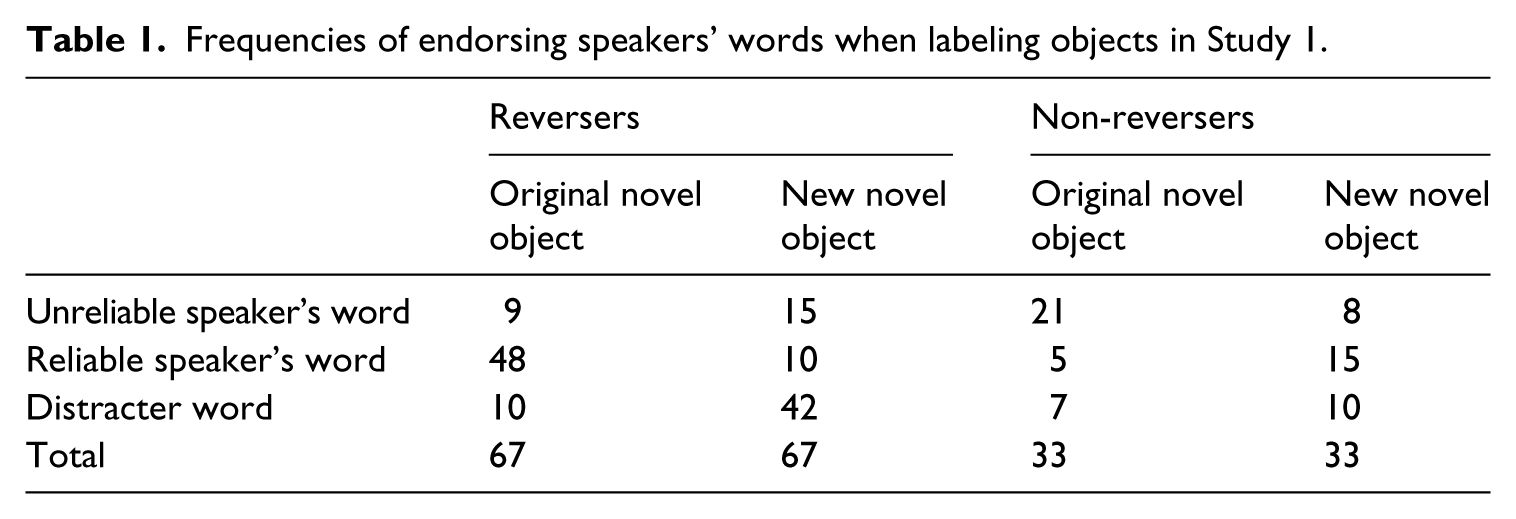
For the new novel object, 63% (42/67) of reversers used the distracter word rather than the reliable speaker’s word or unreliable speaker’s word, and a binomial test indicated this observed proportion was higher than the test proportion of .33, p < .001 (1-tailed). Perhaps a stricter test would be to analyze the preferences of only those reversers who continued to endorse the reliable speaker’s word after distraction (n = 48). For these children, 67% (32/48) preferred the distracter word when labeling the new novel object, again with this proportion higher than the test proportion of .33, p < .001 (1-tailed). Because reversers disregarded the unreliable speaker’s word in favor of the distracter, these findings indicate reversers may avoid remapping a previously inaccurate label.
In contrast, only 30% (10/33) of non-reversers used the distracter word rather than the reliable speaker’s word or unreliable speaker’s word, and a binomial test indicated this observed proportion was not different from the test proportion of .33, p > .05 (1-tailed). In fact, non-reversers did not show a clear preference for any of the three words, all ps > .05. Again, a stricter test would be to analyze the preferences of only those non-reversers who continued to endorse the unreliable speaker’s word after the distraction (n = 21). For these children, 33% (7/21) preferred the distracter word when labeling the new novel object, again with this proportion no different from the test proportion of .33, p > .05 (1-tailed). Thus, non-reversers showed no preference for the distracter over the reliable speaker’s word. See Table 1 for the entire sample’s rates of endorsing words when labeling the new novel object.
Finally, regarding which speaker children continued trusting, 64% (43/67) of reversers favored the previously reliable speaker to the unreliable speaker, and a binomial test indicated this observed proportion was higher than the test proportion of .50, p < .05 (2-tailed). Perhaps a stricter test would be to analyze the preferences of those reversers who continued to endorse the reliable speaker’s word after distraction (n = 48). For these children, 60% (29/48) favored the previously reliable speaker, but this proportion was not significantly different from the test proportion of .50, p > .05 (2-tailed). Unexpectedly, 70% (23/33) of non-reversers also favored the previously reliable speaker to the unreliable speaker, and a binomial test indicated this observed proportion was higher than the test proportion of .50, p < .05 (2-tailed). Again, a stricter test would be to analyze the preferences of those non-reversers who continued to endorse the unreliable speaker’s word after the distraction (n = 21). For these children, 81% (17/21) favored the previously reliable speaker, again with this proportion higher than the test proportion of .50,p < .01 (2-tailed). These findings indicate reversers continue to trust the reliable speaker but non-reversers do not continue to trust the unreliable speaker for lexical information. Oddly, non-reversers appeared to stop trusting the previously unreliable speaker despite having repeatedly endorsed that speaker’s testimony in Session 1.
Discussion
Study 1 replicated Scofield and Behrend (2008) in finding children willingly learn word–object mappings from speakers with whom they have no history, as a majority of children in this study trusted an unknown speaker’s testimony when learning a novel word. Study 1 further found many children will reverse to trusting a reliable speaker when this unknown speaker proves unreliable. Notably, this also means children will revise their initial word–object mappings, which perhaps demonstrates a level of metalinguistic awareness. That is, children not only judge speakers’ value as informants but also consider whether the speakers’ words are eligible to be mapped onto objects. Unfortunately, Study 1 cannot rule out the possibility that this trust reversal and revision was a recency effect in which children endorsed the reliable speaker because this speaker most recently presented lexical information. However, a recency effect seems unlikely, as Scofield and Behrend found no order effects using similar methodology.
Study 1 additionally found children who reversed trust (i.e. reversers) retained the reliable speaker’s word over time. Specifically, when re-presented with the original novel object, 72% of reversers continued to label it with the reliable speaker’s word despite having previously accepted two contrasting labels for the object. Previously mapping the unreliable speaker’s word to the original novel object did not appear to interfere with reversers’ ability to ultimately retain the reliable speaker’s word.
In contrast, Study 1 found children who did not reverse trust (i.e. non-reversers) retained the unreliable speaker’s word over time. Specifically, 64% of non-reversers continued to label the original novel object with the unreliable speaker’s word. Non-reversers appeared mostly unmoved by the unknown speaker’s unreliability and reliable speaker’s additional testimony. For non-reversers, this finding suggests trusting unknown speakers who become unreliable can result in long-term retention of misinformation or even long-term trust of unreliable speakers. It would certainly be problematic if children continued to accept unreliable lexical information simply as a result of having initially trusted a speaker with unknown history. However, it is also plausible that non-reversers made source-monitoring errors or experienced mutual exclusivity bias. For instance, non-reversers might understand the unreliable speaker is untrustworthy, but due to source monitoring errors do not permanently link the unreliable speaker to the speaker’s misinformation. They might also understand the unreliable speaker is untrustworthy, but resist considering a new label for the original novel object because they are biased to believe objects should only have single labels (Markman, 1990; Markman & Wachtel, 1988).
It should be noted that 31% (31/100) of the total sample did not show a consistent mapping for the original novel object. That is, some reversers failed to choose the reliable speaker’s word they endorsed prior to distraction, and some non-reversers failed to choose the unreliable speaker’s word they endorsed prior to distraction when labeling the original novel object. For these reversers, perhaps initially endorsing the unreliable speaker’s word proactively interfered with their ability to retain the reliable speaker’s word. For these non-reversers, perhaps hearing the reliable speaker’s testimony caused their confidence in the unreliable speaker’s word to decline, despite consistently mapping the unreliable speaker’s word to the original novel object initially.
Further, Study 1 found reversers avoided using the unreliable speaker’s word to label a new novel object. Specifically, when presented with a new novel object, 63% of reversers labeled it with the distracter word rather than the unreliable speaker’s word. Reversers’ overwhelming preference for the distracter word suggests they did not view the unreliable word neutrally, though it was no longer linked to a referent and thus a potentially viable label for the new object. One possibility is that reversers believed the unreliable speaker’s word was ineligible to be mapped to the new novel object because of its prior misuse and subsequently avoided it. Another possibility is that reversers simply assumed the novel object should be labeled with the novel word in a case of disambiguation (Merriman & Bowman, 1989; see also Kalashnikova, Mattock, & Monaghan, 2014). Since the reliable and unreliable speakers’ words were heard previously, the distracter word was the only remaining novel word and thus could have been the preferred label for the novel object. However, this possibility seems unlikely considering non-reversers did not make a similar assumption. Not only did non-reversers show no preference for the distracter word, they actually used the reliable speaker’s word more frequently (i.e. 45% of the time) than any other word when labeling the new novel object. Thus, despite avoiding it previously and in contrast to reversers, non-reversers assumed the reliable speaker’s word was still a potentially viable label for the new novel object.
A very different explanation from those stated previously could also be possible. Study 1 assumed that once reversers endorsed the reliable speaker, the unreliable speaker’s word–object mapping was replaced and thus this word was an acceptable label for a new novel object. A different possibility, though, is that reversers did not consider the unreliable speaker’s word an entirely inaccurate label for the original novel object. Children might have viewed speakers’ words as synonymous or different category-level labels (e.g. dish vs. cup) that could both apply to the original novel object. Thus, when children reversed trust away from the unreliable speaker, they might have simply demonstrated more confidence in the reliable speaker but not necessarily rejected the unreliable speaker’s word as an acceptable label for the original novel object. If this were the case, then reversers would have avoided labeling the new novel object with either the reliable or unreliable speakers’ words and instead favored the distracter like they did in this study. However, this possibility is unlikely given that reversers continued to reject the unreliable speaker later in Study 1.
Perhaps the most intriguing finding from Study 1 was that both reversers and non-reversers chose to endorse the reliable speaker when later learning new lexical information. Specifically, when re-presented with the reliable and unreliable speakers labeling a final novel object, 64% of reversers and 70% of non-reversers endorsed the reliable speaker’s word. Reversers’ preference for the reliable speaker is not particularly noteworthy, as they had already begun endorsing the reliable speaker previously. However, non-reversers’ preference for the reliable speaker is quite surprising, as non-reversers repeatedly rejected the reliable speaker in favor of the unreliable speaker previously. Non-reversers now seemed to consider the unreliable speaker untrustworthy, suggesting they experienced a delayed reversing of trust and revising of the initial word–object mapping. This was even true for non-reversers who continued to label the original novel object with the unreliable speaker’s word over time.
Together these findings suggest reversers accurately judged the reliable speaker as more trustworthy. Reversers then used this judgment to their advantage by correcting the inaccurate mapping they initially learned, retaining the reliable speaker’s word, and trusting the reliable speaker for future lexical information. Findings also suggest non-reversers may have accurately deemed the unreliable speaker as untrustworthy but failed to correct the inaccurate mapping they initially learned. This failure led non-reversers to retain the unreliable speaker’s word, even as they elected not to trust this speaker for future information. Thus, misinformation remained in non-reversers’ lexicons even after they correctly classified the source of the misinformation as unreliable. Perhaps non-reversers had more difficulty linking the source and the word, or perhaps they had difficulty disassociating or unmapping the unreliable word from its referent (e.g. because of word-learning constraints).
The Study 1 results that both reversers and non-reversers favored the reliable speaker for future lexical information sparked two follow-up questions. First, given that reversers switched to and continued trusting the reliable speaker, it was unclear if reversers might ever again consider the unreliable speaker a trustworthy source of new words. It was possible reversers viewed the unreliable speaker as potentially trustworthy, but with diminished confidence when compared to the reliable speaker. It was also possible reversers viewed the unreliable speaker as entirely untrustworthy and would even endorse the testimony of a stranger over that of the unreliable speaker. Second, given that non-reversers trusted the reliable speaker for future information, it was unclear why non-reversers initially failed to reverse trust when the unknown speaker proved unreliable. It was possible that being unreliable had no bearing on children’s decision to continue trusting the unreliable speaker, thus they had no reason to reverse trust. It was also possible non-reversers understood the speaker was untrustworthy but lacked the ability to correct the previously learned misinformation in their lexicons. Study 2 more closely examined these two questions.
Study 2
Method
Participants
In Study 2, 80 four- and five-year-olds (M = 4;10; range = 4;0–5;8) from local preschools participated following parent consent and their own assent. Forty children were male, while 40 were female. Forty-two children were White, 33 were Black, and 5 were of other racial backgrounds.
Procedure
Individual participants sat next to an experimenter at a small table near their classrooms and completed two testing sessions. Session 1 in Study 2 procedurally differed from Session 1 in Study 1 to more closely imitate Scofield and Behrend’s (2008) methodology.
During Session 1, children watched a two-minute animated video featuring two speakers, three familiar common objects (i.e. a ball, key, and cup), and two novel objects for a total of five objects. While all five objects were in view, an unknown speaker pointed to and labeled one of the novel objects with a novel word (i.e. ‘blurg’). The five objects and unknown speaker disappeared, and the two novel objects reappeared on screen. Children were asked to select the object that matched the novel word (e.g. ‘Which one is the blurg?’) before the objects disappeared. The five objects reappeared, and the unknown speaker pointed to and inaccurately labeled the three common objects (i.e. calling the ball a ‘key,’ key a ‘cup,’ and cup a ‘ball’) thus proving unreliable. The previously unknown, but now unreliable speaker disappeared.
A second speaker appeared on screen, pointed to, and labeled the other novel object with the same novel word (i.e. ‘blurg’). This speaker then accurately labeled the three common objects thus proving reliable. The five objects and reliable speaker disappeared, and the two novel objects reappeared on screen. Children were again asked to select the object that matched the novel word (e.g. ‘Which one is the blurg?’). Again, note the unreliable speaker always appeared before the reliable speaker in Session 1, as Scofield and Behrend (2008) found no order effects. Novel objects and speaker sex were counterbalanced in Session 1. Like Study 1, this session was designed to identify reversers and non-reversers.
All participants then completed Session 2, but reversers and non-reversers watched different videos. Reversers watched a video featuring the unreliable speaker, a stranger, and two novel objects. The unreliable speaker appeared on screen, pointed to, and labeled one of the two novel objects with a novel word (i.e. ‘pax’) before disappearing. The stranger then appeared on screen, pointed to, and labeled the other novel object with the same novel word (i.e. ‘pax’) before disappearing. Finally, the two novel objects appeared on screen, and children were asked to select the object that matched the novel word (e.g. ‘Which one is a pax?’).
Non-reversers watched a video featuring the unreliable speaker, the reliable speaker, and two novel objects. The unreliable speaker appeared on screen, pointed to, and labeled one of the two novel objects with a novel word (i.e. ‘nem’) before disappearing. The reliable speaker then appeared on screen, pointed to, and labeled the other novel object with the same novel word (i.e. ‘nem’) before disappearing. Finally, the two novel objects appeared on screen, and children were asked to select the object that matched the novel word (e.g. ‘Which one is a nem?’).
Results
In Session 1, 100% (80/80) of children initially endorsed the unknown speaker’s testimony when choosing the novel object, and a binomial test indicated this observed proportion was higher than the test proportion of .50, p < .001 (2-tailed). However, Session 1 also showed 53% (42/80) of children reversed to trusting the reliable speaker when the unknown speaker proved unreliable. A McNemar test indicated this shift in endorsing speakers was significant, χ2(1, n = 80) = 40.02, p < .001. Further, a binomial test indicated the observed proportion of .53 for eventually endorsing the reliable speaker was no different than the test proportion of .50, p > .05 (2-tailed). The remaining 47% (38/80) of children did not reverse trust but instead continued to endorse the unreliable speaker. Like Study 1, these findings indicate a slight majority of children are willing to reverse their trust to a reliable speaker when an unknown speaker proves unreliable and subsequently revise their initial word–object mapping, though they less often did so in this study.
In Session 2, reversers and non-reversers watched different videos. Reversers (n = 42) saw the unreliable speaker and a stranger use the same novel word to label contrasting novel objects. Non-reversers (n = 38) saw the unreliable speaker and reliable speaker use the same novel word to label contrasting novel objects.
Among reversers, 67% (28/42) avoided selecting the unreliable speaker’s object and instead selected the stranger’s object, and a binomial test indicated this observed proportion was higher than the test proportion of .50, p < .05 (2-tailed). These findings indicate young children may prefer to trust a stranger to a known yet unreliable speaker.
Among non-reversers, 66% (25/38) avoided selecting the unreliable speaker’s object and instead showed a preference for the reliable speaker’s object, and a binomial test indicated this observed proportion approached being significantly higher than the test proportion of .50, p = .07 (2-tailed). Interestingly, non-reversers in Session 2 were suddenly much less likely to endorse the unreliable speaker than they were in Session 1, and a McNemar test indicated this shift in endorsing speakers was significant, χ2(1, n = 38) = 23.04, p < .001. These findings indicate that non-reversers may start to doubt the trustworthiness of the unreliable speaker over time.
Discussion
Study 2 replicated both Study 1 and Scofield and Behrend (2008) in finding an overwhelming amount of children will trust an unknown speaker’s testimony when learning novel lexical information. Further, Study 2 again found many children will reverse to trusting a reliable speaker when this unknown speaker proves unreliable and thus revise their initial word–object mapping. Again, the latter is perhaps indicative of metalinguistic awareness as children judge whether speakers’ words are eligible to be mapped onto objects. However, Study 2 cannot rule out the possibility that this trust reversal and revision was a recency effect, though this idea seems less likely because Scofield and Behrend found no order effects.
Study 2 additionally found children who reversed trust from the unreliable to the reliable speaker (i.e. reversers) were later twice as likely to endorse a stranger over said unreliable speaker when learning new lexical information. Specifically, 67% of reversers trusted the stranger, while 33% of reversers trusted the unreliable speaker. This preference for the stranger might be due to the fact that children monitor speakers for inaccuracy and prefer endorsing neutral speakers like this stranger to previously unreliable speakers (see Corriveau et al., 2009). However, unlike in Corriveau et al. (2009), children in the current study initially endorsed this unreliable speaker when the speaker was unknown. Thus, the results newly suggest that having previously endorsed an unreliable speaker does not cause children to be more willing to trust this speaker in the future. Rather, children prefer a stranger to a previously trusted unreliable speaker. No matter the cause, demonstrating a strong preference for the stranger made it clear that reversers were inclined to judge the unreliable speaker as entirely untrustworthy for lexical information rather than simply less trustworthy than other speakers.
Lastly, Study 2 found that children who originally continued to endorse the unreliable speaker rather than reverse trust (i.e. non-reversers) eventually showed a preference for the reliable speaker over the unreliable speaker, though it only approached statistical significance. However, because 100% of non-reversers previously endorsed the unreliable speaker and only 34% continued to endorse the unreliable speaker, results indicated non-reversers were much less likely to trust the unreliable speaker than they were previously. This means that, in both Study 1 and Study 2, non-reversers’ trust in the unreliable speaker declined substantially over time despite hearing no additional inaccurate word–object mappings. Findings suggest non-reversers do not believe the unreliable speaker will continue to be trustworthy for future lexical information.
General discussion
When children learn novel words, they use their knowledge of speakers’ histories to make decisions about whether the sources might be trustworthy for future lexical information (Birch et al., 2008; Koenig et al., 2004). However, children do not always have the benefit of knowing the history of a speaker at the time when they encounter that source’s testimony. Yet, children appear perfectly willing to trust and endorse the word–object mapping of a speaker with whom they have no history (Scofield & Behrend, 2008). Of course, this can work to their advantage given how frequently young children encounter new speakers and lexical information. However, children’s willingness to trust an unknown speaker might also work to their disadvantage, especially in cases in which the source ultimately proves unreliable. The aim of the current studies was to better understand how children and their lexicons might be affected, if at all, by the realization that a trusted source had proven unreliable.
The results of the current studies suggest children can be diversely affected when they trust speakers who become unreliable, especially in terms of subsequent word learning. For children who stopped endorsing an unreliable speaker in favor of a reliable speaker (i.e. reversers), their decision to reverse trust was often advantageous. First, it served to correct past misinformation. Second, reversing trust potentially protected children from future word-learning errors by making them reluctant to trust a previously unreliable source. If the unreliable speaker’s history was any indication of future inaccuracy, it would be adaptive to trust a neutral informant like a stranger to a historically unreliable one. Recognizing that young children more regularly encounter reliable sources, it is likely wise for them to expect a new speaker will not make mistakes that could hinder their lexical development.
On the other hand, children’s decision to reverse trust could also prove disadvantageous for word learning. First, reversers often refused to consider the previously misused word as a potential label for a new object. It makes sense to judge the unreliable speaker as untrustworthy and avoid that speaker in the future, but reversers seemed to take this a step further and judged the misused word as untrustworthy and subsequently avoided it. By avoiding the previously misused word, reversers ignored a potentially viable label for the new object. Second, reversers later endorsed a stranger who could have also proven untrustworthy for new lexical information. That is, children’s avoiding the unreliable speaker and instead choosing to trust a stranger risked their learning additional misinformation. After all, trusting an unknown speaker caused the initial word-learning error. Thus, it seems children’s lexical development could be both positively and negatively affected after incidentally endorsing an unreliable speaker, even those children who later choose to reject this unreliable speaker in favor of a reliable one.
For children who continued to endorse an unreliable speaker despite hearing conflicting testimony from a reliable speaker (i.e. non-reversers), their decision to continue trusting the unreliable speaker was disadvantageous in terms of word learning. When re-presented with the original novel object in Study 1, a majority of non-reversers continued to label it incorrectly. Thus, the initial decision to favor the unreliable speaker ultimately resulted in inaccurate mappings that were often resistant to revision. However, many non-reversers in both studies elected not to endorse the unreliable speaker for future information and instead endorsed the reliable speaker. This pattern might suggest non-reversers are slower to change their minds or update their beliefs regarding sources of lexical information. Perhaps this reflects declining confidence in the unreliable speaker over time or a strong bias to trust initial testimony, even when later presented with subsequent reliable testimony (see Jaswal, Carrington Croft, Setia, & Cole, 2010).
Non-reversers in the current studies are not the first examples of children who are willing to trust historically unreliable speakers. Robinson and Nurmsoo (2009) found children are willing to endorse previously unreliable speakers’ new, accurate information when past unreliability is due to ignorance rather than dishonesty (see also Nurmsoo & Robinson, 2009). In these earlier studies, children adapted once presented with reliable information, but this was not the case in the current studies. Here, non-reversers initially continued trusting an unreliable speaker over a reliable speaker, though it is not clear why this happened. Perhaps non-reversers sincerely viewed the unreliable speaker as being trustworthy. However, if this were true, then non-reversers in the current studies had no reason to later stop trusting the unreliable speaker in favor of the reliable speaker. Alternatively, perhaps non-reversers failed to connect the unreliable speaker to the previous misinformation. If this were true, then witnessing the speaker become unreliable would have no bearing on any previously learned lexical information.
Further, explaining why non-reversers continued to endorse the unreliable speaker’s past testimony is complicated by their decision to discontinue trusting the unreliable speaker for future lexical information. Even though non-reversers continued to map the unreliable speaker’s word to the original novel object, there is a chance they did not view the unreliable speaker as trustworthy but instead were simply unable to unmap the word. That is, children may not have initially continued to favor the unreliable speaker as much as they continued to retain the initial word–object mapping. Once the word and referent were linked, it may have been particularly difficult for these children to sever that link in order to revise their mapping. Perhaps non-reversers experienced a stronger mutual exclusivity bias than reversers, rendering them unable to consider a new label for the original novel object (Markman, 1990; Markman & Wachtel, 1988).
An inability to unmap a label could occur in conjunction with an accurate judgment about the unreliable source. For example, non-reversers might encode the unreliable source provided unreliable testimony but be unable or unwilling to correct the word-learning error. Consequently, when asked for the label of the original object, a non-reverser would favor the unreliable label, yet when asked to trust a source to label a new object, a non-reverser would favor the reliable source. Alternatively, an inability to unmap a label could occur independently of an accurate judgment about the unreliable source. For example, non-reversers might encode the source was unreliable but not link the source to the unreliable testimony. The consequences of this alternate explanation would be identical to those of the previous explanation.
The latter explanation may indicate a simple source monitoring error. Previous research suggests preschool children may struggle with source monitoring to the extent that they not only forget the sources of their misinformation, but they experience source amnesia (see Drummey & Newcombe, 2002). A study by Sabbagh and Shafman (2009) supports this idea. When learning a word from an ignorant speaker, Sabbagh and Shafman found children were better at identifying who presented the misinformation than at identifying what was the misinformation. An important difference between the current studies and Sabbagh and Shafman was the order in which children encountered the speaker and misinformation. In the current studies, children learned the misinformation first and then learned of the speaker’s unreliability. In Sabbagh and Shafman, children learned of the speaker’s ignorance first and then learned the misinformation. Thus, children in Sabbagh and Shafman were able to avoid forming a mismapping, while children in the current studies were not. Nevertheless, children in both studies seemed to have independently represented the misinformation and source since in both cases children similarly encoded who presented the misinformation.
Future studies should probe individual differences between reversers and non-reversers on source monitoring tasks, as well as on lexical development and understanding of mental states in general, to better understand differences between these children. Future studies should also explore how often speakers prove to be unreliable informants by deliberately or accidentally misusing novel words in the presence of children. This research would be particularly important for determining the contexts in which children must correct prior word learning.
Conclusions
In all, the current studies in combination with Scofield and Behrend (2008) present a more complete picture of how children’s encounters with unreliable sources can affect their word learning. Scofield and Behrend found children were often unwilling to allow a mislabeled object serve as a referent for a new novel word. Similarly, Study 1 found children were unwilling to allow a misused word serve as a label for a new novel object. Study 2 found children were unwilling to trust an unreliable speaker for future lexical information, even when they had previously endorsed said speaker. Together these findings suggest children are generally skeptical of prior misinformation and its sources, and may be at least temporarily unwilling to absolve either in support of future word-learning efforts. This skepticism can work to children’s advantage by protecting them from future misinformation. However, avoiding mislabeled objects, misused words, and mistaken speakers can also undermine children’s word learning in contexts in which they prove viable.
Footnotes
Declaration of conflicting interests
The author(s) declared no potential conflicts of interest with respect to the research, authorship, and/or publication of this article.
Funding
The author(s) received no financial support for the research, authorship, and/or publication of this article.