



Abstract
Four-year-old (n = 20) and five-year-old (n = 22) bilingual children were tested twice in six months on Armenian (minority language) and English (majority language) picture identification and picture naming tasks to examine receptive and expressive vocabulary growth in both languages. Parental education, Armenian/English language exposure, and nonverbal cognitive ability were also measured as potential predictors of vocabulary. Children showed growth over time in all four vocabulary tasks. However, less growth was observed in Armenian expressive task than in others, which indicated a preference to use English. Armenian language exposure was the unique predictor of Armenian picture identification and picture naming, whereas English language exposure was the unique predictor of English picture identification.
Introduction
Bilingualism is an important socio-linguistic phenomenon. Many children are raised in environments where two different languages are used, either at home by different individuals, or one at home, usually a minority language, and the other at school, usually the majority language (Paradis, Genesee, & Crago, 2011). There is a growing number of bilingual children in North America (Hoff, Rumiche, Burridge, Ribot, & Welsh, 2014; Statistics Canada, 2010). These children need to learn their home language in addition to the official language to gain access to the social, educational, and vocational resources available in both language communities (Louis & Taylor, 2001). However, there is concern whether bilingual children are attaining the skills they need in the majority language for success at school (Hoff et al., 2014), especially with reports on their low performance in language skills, in particular in vocabulary (Duursma et al., 2007; Leseman, 2000; Oller & Eilers, 2002). This poses considerable problems especially at school, where language is used for reading and writing purposes (Kieffer, 2012).
An important aspect of language acquisition in bilinguals is vocabulary. Vocabulary plays a central role in language acquisition and literacy development (Conboy & Thal, 2006; Hammer, Lawrence, & Miccio, 2007). Vocabulary has been the subject of a very large number of studies in monolingual acquisition research, especially in preschool children (Bloom, 2000). The preschool years are marked by significant growth in different aspects of language, especially in vocabulary (Paul, 2001). However, very little is known about the typical course of vocabulary growth in bilingual preschoolers who learn English in the presence of their home language (McCardle & Hoff, 2006). To compensate for this lack of knowledge, often and unwillingly the information and norms available on typical monolingual vocabulary development are used in its place (Paradis et al., 2011). This may provide a skewed picture of vocabulary acquisition in bilinguals (Gathercole, Thomas, & Hughes, 2008) and poses practical problems in providing language services to bilingual children (Kohnert, Yim, Nett, Kan, & Duran, 2005). In addition to addressing the practical questions encountered in language assessment and intervention, bilingual studies can address many concerns encountered by families of bilingual children from minority-language communities. These families, sometimes misinformed by negative perspectives on bilingualism, may be concerned about possible adverse effects that maintaining their home language might have on their children’s success in learning the majority language (Barac & Bialystok, 2011). Nevertheless, by having a better understanding of typical vocabulary development in bilingual children, many of these concerns can be addressed in a more realistic manner. Furthermore, from a theoretical perspective, these studies can inform us of the capacities of children in learning two languages and the factors involved in this learning process.
The study of vocabulary acquisition in bilingual children is a challenging issue. The heterogeneity of the bilingual population as well as the multitude of factors related to vocabulary development pose specific challenges in this regard. Bilingual children from the same minority community experience different amounts of exposure in each of their two languages, a factor significantly related to vocabulary development (De Houwer, 2007; Parra, Hoff, & Core, 2011; Pearson, Fernandez, Lewedeg, & Oller, 1997; Scheele, Leseman, & Mayo, 2010; Thordardottir, 2011). These children also come from families with different socioeconomic status (SES), a factor closely associated with the quantity and quality of language input provided by mothers (Cote & Bornstein, 2014; Vanormelingen & Gillis, 2016). For example, children of parents with higher education (an index of SES) have shown higher rates of growth in English receptive and expressive vocabularies (Golberg, Paradis, & Crago, 2008; Hammer et al., 2012). In addition, internal factors, such as cognitive abilities (Hoff, 2005), are also significantly related to vocabulary development. A relationship between nonverbal cognitive abilities and vocabulary development is documented in monolinguals (Van der Schuit, Segers, Van Balkom, & Verhoeven, 2011) as well as bilinguals (Leseman, 2000).
Previous studies
Despite the need for information on vocabulary growth in young minority-language bilingual children in general, and in the minority–English bilingual children in particular, only few studies have focused on the latter population. While providing important objective data, these studies present some methodological limitations. In their study Rodriguez, Diaz, Duran, and Espinosa (1995) compared the vocabulary growth of a group of three- to four-year-old bilingual children (n = 30) attending Spanish–English full-day bilingual preschools in the United States (US) with that of Spanish-speaking children not attending preschool (n = 20). The Spanish and English receptive and expressive vocabularies were assessed using English standardized picture identification and naming tasks and their Spanish versions. The findings indicated a significant growth in Spanish and English receptive and expressive vocabularies in both groups and a higher rate of English expressive vocabulary growth in the preschool group. Both groups showed similar performance in Spanish receptive and expressive and English receptive vocabulary. However, no information was provided on the use of English at home, which could act as a source of variability in vocabulary performance between and within the two groups. Furthermore, the use of different measures for the two languages as well as for the receptive modalities of the two languages made it impossible to compare performance confidently across languages and modalities and their interactions. Receptive vocabulary in English was measured by the Peabody Picture Vocabulary Test–Revised (PPVT-R; Dunn & Dunn, 1981) and its Spanish version (TVIP; Dunn, Padilla, Lugo, & Dunn, 1986) was used for Spanish.
In a replication and follow-up of the participants in Rodriguez et al.’s (1995) study, Winsler, Diaz, Espinosa, and Rodriguez (1999) investigated the long-term effects of a bilingual preschool program on Spanish and English vocabulary development. The replication study provided the same results as the original study and the follow-up showed significant growth in English and Spanish receptive and expressive vocabularies for both groups. However, contrary to the original study, the follow-up study showed no significant differences between the two groups in their English expressive vocabulary or in their rate of growth in English. These findings were unexpected, as one would expect higher performance in English for children attending a bilingual preschool for the second year. These unexpected results might suggest the existence of other potential confounding variables such as English language exposure at home. However, as in Rodriguez et al.’s (1995) study, limited information on participant characteristics makes it difficult to determine factors related to vocabulary development.
Two other studies have investigated vocabulary growth in other minority–English language combinations. In their study on Hmong-speaking children, Kan and Kohnert (2005) investigated vocabulary performance in two age groups of bilingual preschoolers from low-income families in the US. Researcher-developed picture identification and naming tasks were used to measure Hmong and English receptive and expressive vocabularies. The tasks contained different items, but the same tasks were used in both languages, making it possible to make comparisons across languages but not modalities. Overall, the older group (n = 9, M age = 5;0 years) had higher vocabulary performance than the younger group (n = 10, M age = 3;11 years) and showed better performance in English compared to Hmong, whereas the younger group showed similar performance in the two languages. However, the report did not provide information on language exposure, which could possibly explain these differences. Although the study reported modality differences in Hmong, confident inferences cannot be made, because of the use of different sets of vocabulary items in receptive and expressive tasks with no information on whether they were equally difficult. In another study, Sheng, Lu, and Kan (2011) investigated bilingual vocabulary performance in two age groups of Mandarin–English bilinguals in the US. The two groups were comparable in maternal education, Mandarin exposure, Mandarin proficiency as rated by parents, and age of English language exposure. A researcher-developed vocabulary test was used to measure receptive and expressive vocabulary performances of the two age groups. It consisted of picture identification and naming tasks with different items for each task, but the same tasks were used for Mandarin and English. As in the previous study, inferences cannot be made on the comparisons involving modality, because there was no report on whether the two tasks were equivalent in difficulty. Nonetheless, the findings indicated a higher performance in English in the older group (n = 17, M age = 7;2 years) compared to the younger group (n = 18, M age = 4;4 years), but similar performance in Mandarin in the two groups. The study also examined language input and output in Mandarin and English, i.e., parental estimate of weekly hours that the child spent hearing or speaking each language at home, as predictors of vocabulary performance. Mandarin input (48.7%) and output (6.2%) both accounted for significant variance in Mandarin, but age was not a significant unique predictor. However, age (47.5%), which is considered as an index of cumulative language experience related to length of exposure, and English output (12.3%), but not English input, were the significant predictors of English. These findings suggested that different factors contributed to Mandarin and English vocabulary performance.
Although previous studies have provided important information on vocabulary growth in minority-language bilingual children, the nature of this growth is still far from clear. For instance, it is not yet known how the growth in the two modalities of the two languages compares or interacts, possibly because the vocabulary measures used were not always comparable across modalities and languages. In addition, except for the study by Sheng et al. (2011), the other studies did not address individual differences in vocabulary performance, especially in terms of language exposure at home, which could act as a predictor of vocabulary performance. Furthermore, the dissimilar use of the languages in the bilingual programs might have added another source of variability in vocabulary performance, which was not addressed in any of these studies.
The present study
The present study was designed to address some of the limitations of the previous studies while investigating vocabulary growth in a new group of minority-language children. The focus of this study was the cross-language and cross-modality vocabulary growth differences in Armenian–English bilingual children attending a unique balanced bilingual program. A researcher-developed parallel bilingual vocabulary measure was used, which consisted of picture identification and picture naming tasks in Armenian and English for assessing receptive and expressive vocabularies (Hovsepian, 2017). The language pair of interest in this study included the typologically different languages of English, the majority language, and Armenian, a minority language spoken in North America and elsewhere by the Armenian ethno-linguistic community. Armenians form one of the long-established minority communities in North America (Kaprielian-Churchill, 2005). It is assumed that Armenian children usually learn Armenian as their home language with possible exposure to English from early ages, through communicating with English-speaking neighbors, peers, or older siblings. The Armenian schools participating in this study offered Armenian–English balanced bilingual programs for Junior Kindergarten (JK) and Senior Kindergarten (SK) children with the provision of equal educational conditions for both languages with a half-day program in Armenian and a half-day in English taught by separate teachers. No information was collected on teacher demographics. During each language program, the teachers followed a formal, curriculum-based instruction, focused on developing reading and writing skills in Armenian and English. Therefore, in each language program the language of instruction as well as the content was focused on that language. This kind of balanced program has been shown to be beneficial for both minority- and majority-language development compared with an English-only monolingual program (Barnett, Yarosz, Thomas, Jung, & Blanco, 2007; Duran, Roseth, & Hoffman, 2010). The balanced nature of the bilingual program was verified using a systematic observation scheme following Eilers, Oller, and Cobo-Lewis (2002).
The Armenian language is the official language of the Republic of Armenia, geographically located between Asia and Europe. Armenian is also the ancestral language of Armenian diaspora from East to West, including the Middle East, Europe, and North America, with long-established ethno-linguistic minority communities in these regions. Armenian belongs to the Indo-European language family; however, it is an independent branch (Malmkjær, 2002). Armenian has a unique script or alphabet and two dialects, Western and Eastern, which share the same script. Both dialects are spoken in North America and elsewhere. The dialects use almost the same vocabulary, but have slight differences in grammar and pronunciation. Thus, they are mutually understood by speakers of each dialect (Andonian, 1966).
Although Armenian and English both belong to the same language family, they are typologically different. For example, the canonical word order in English is subject-verb-object (SVO), whereas in Armenian it is SOV. In addition, Armenian is morphologically an agglutinating language, where word ending affixation is used for expressing a wide range of grammatical meanings such as plural or past tense (Hagopian, 2005). Furthermore, nouns and pronouns in Armenian undergo declension, i.e., they take different case markers, which are affixed to their endings, to fulfill different syntactic functions (Sakayan, 2000). For example, to indicate the locative case in Armenian, the suffix um is added to the end of the nominative case of a noun. The declension system in Armenian is very extensive compared to many other languages, including English, where there are only a few cases of declension, such as the affix s, which reflects grammatical number, e.g., book/books. Finally, in terms of phonology, Armenian has six vowels and 31 consonants. The main difference between Armenian consonant sounds and those in many other languages, including English, is that Armenian has voiced aspirated plosives and affricates in addition to the voiced and voiceless pairs present in other languages. Studying this typologically different combination of minority–English languages may provide new insight into bilingual vocabulary development.
The present study, to my knowledge, is the first on Armenian–English bilingual vocabulary development, designed around the question of general developmental trends in vocabulary. Using a longitudinal design, Armenian and English receptive and expressive vocabulary performance was compared in two age groups of younger (four-year-old) and older (five-year-old) Armenian–English bilingual children across time, Time 1 (T1) and Time 2 (T2), with a six-month interval. Based on general developmental trends in vocabulary, higher performance was expected in the older group compared to the younger group, at T2 compared to T1, and in receptive vocabulary compared to expressive vocabulary. It was also predicted that performance on Armenian vocabulary would be higher than English vocabulary, but the rate of growth would be higher in English. The last two predictions were based on the assumption that the majority of participants would be from families with Armenian as the primary language spoken at home. However, upon entering the bilingual program with formal and considerable exposure to English, the children would show more rapid growth in English than Armenian.
As a secondary goal, the question of individual differences was addressed by examining the contribution of language exposure, parental education, and nonverbal cognitive abilities to Armenian and English receptive and expressive vocabularies. Based on previous literature it was predicted that these characteristics would separately predict vocabulary performance in Armenian and English. However, this study assessed the relative contributions of these multiple characteristics simultaneously.
Method
Participants
Forty-two bilingual kindergarteners from the Armenian–English bilingual schools in the Greater Toronto Area, Ontario, Canada participated in this study. Twenty children (40.0% male, M age = 51.6 months) were in JK and 22 (54.5% male, M age = 63.1 months) were in SK. At Time 2, the mean age of the children in the younger (JK) and older (SK) groups was 57.6 and 69.2 months, respectively. The children, speaking both Armenian and English, were from families where Armenian was spoken at home by at least one parent. No other inclusion or exclusion criteria were used. Parents reported no concern over the language development of the children. All the children passed a hearing test. The demographic information is presented in Table 1. Except for the Nonverbal IQ, the information was obtained using a researcher-developed parental questionnaire (see Appendix 1).
Means (M), standard deviations (SD), and ranges for participant characteristics in the younger and older age groups and results of test of significance.
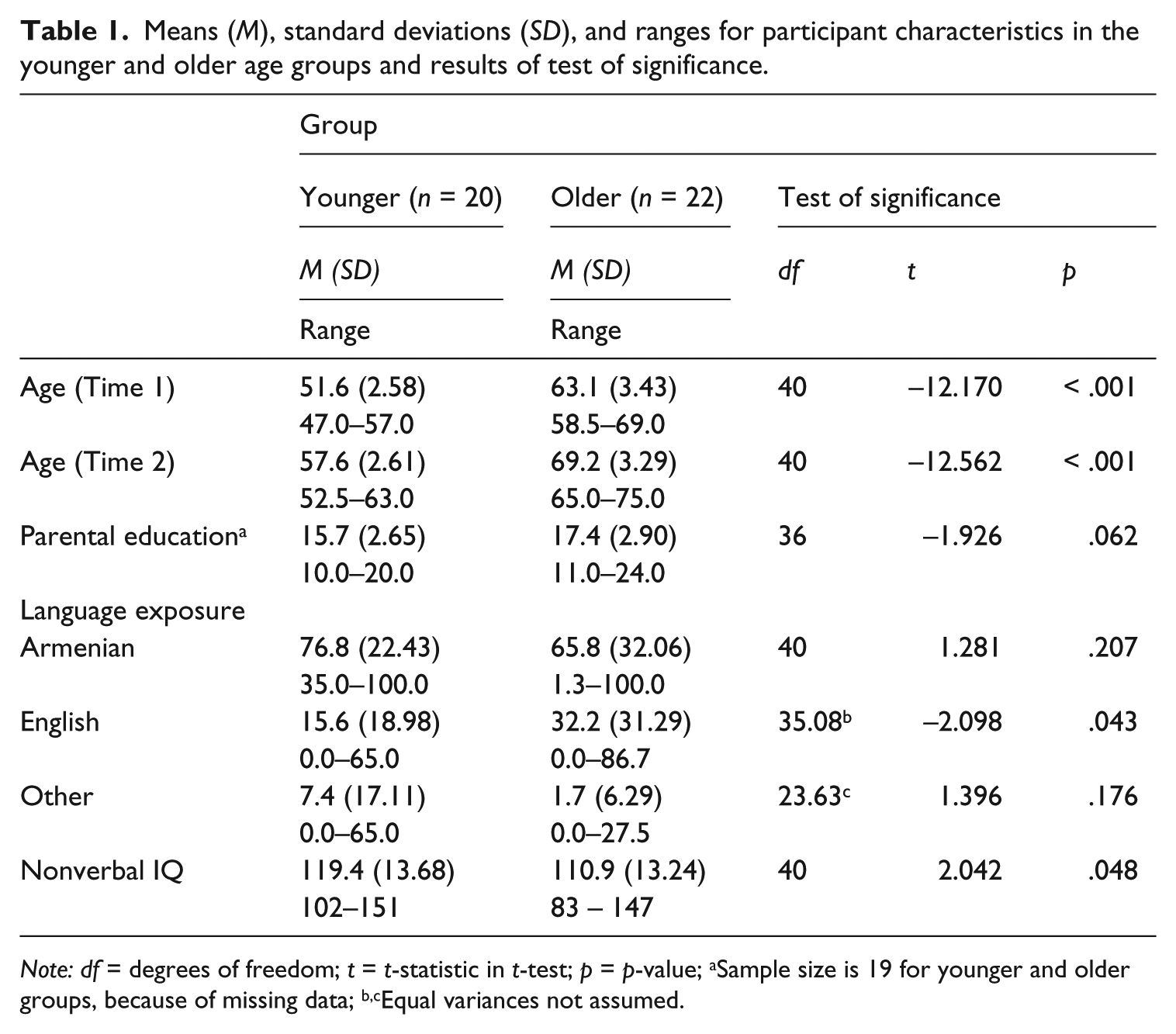
Note: df = degrees of freedom; t = t-statistic in t-test; p = p-value; aSample size is 19 for younger and older groups, because of missing data; b,cEqual variances not assumed.
Parental education was represented by mean years of education of both parents. As shown in Table 1, there was no significant difference between the two groups in parental education. Exposure in each language was represented by the mean percentage of use of that language at home by parents with the child and by child with parents and siblings. Three composite scores were used as a measure of language exposure at home in three language groups, i.e., Armenian, English, and other. These scores were obtained from five questions completed by parents on the parental questionnaire (see Appendix 1). For each language two separate means were obtained first, i.e., mean percentage of use of that language by parents with the child and mean percentage of use of that language by the child with parents and siblings. Then, the two means were averaged to obtain a composite score for exposure in that language. If there was missing information for a question, a mean of the values available was used instead. The decision to obtain the composite scores was based on the assumption that, for young children, parents are the main source of spoken language input at home, and likewise, parents and sisblings are the most constant individuals at home with whom the child interacts. In fact, the means representing the use of each language by parents with the child and by the child with parents and siblings showed high correlations for each language, ranging from .75 to .93. These high correlations justified the use of the two means in the composite score for each language. The questionnaire also provided two questions regarding use of languages by the child with grandparents and playmates, which were not included in the composite score, because of missing data or inapplicability of the questions to some participants.
While acknowledging the caveats that this simplistic approach in quantifying language exposure entails (see Carroll, 2015), the decision was founded on methodological as well as feasibility grounds. Ideally, to develop such a measure, observations should be made of the quality and quantity of the use of the target language by different individuals with the child and vice versa in different environments and conditions. Therefore, the procedure used in this study has taken a simplistic approach to quantifying language exposure without considering the quality. Furthermore, averaging the input and output does not intend to ignore the independent role of each one on different aspects of language development (e.g., Bohman, Bedore, Peña, Mendez-Perez, & Gillam, 2010; Sheng et al., 2011), in fact it has been inspired by the normal course of language development. From this perspective, language development does not occur because of input or output separately, but as an active interplay of both. Finally, to disentangle the intricate relationships between language development and exposure, consideration should also be given to other important factors including the status of the minority language and the social value associated with the two languages of the bilinguals (Armon-Lotem & Ohana, 2016; Thordardottir, 2011). As a case in point, Thordardottir has associated the comparable receptive vocabulary growth in the two languages of the bilinguals with the equal status of both languages. Furthermore, Armon-Lotem and Ohana have related balanced bilingualism to the comparatively high value and prestige associated with both languages of the bilinguals. However, considering the main purpose of this study, which was to replicate the general developmental trends in vocabulary in this population for the first time, as well as due to feasibility concerns, the approach taken in this study for measuring language exposure provided a practical way of getting the information needed in a timely manner.
Overall, the participants in both groups had higher exposure to Armenian than English at home; however, the older group, M (SD)% = 32.2 (31.29), compared to the younger, M (SD)% = 15.6 (18.98), had higher exposure to English, t(35.08) = −2.098, p = .043 (see Table 1). Finally, to provide a more comprehensive picture of the families participating in this study, further information on family characteristics is presented here. Armenian was reported as the first language of the family by 82.9% of fathers and 85.7% of mothers; whereas, 9.8% of fathers and 4.8% of mothers reported English, and 7.3% of fathers and 9.5% of mothers reported another language as their first language. There were 73.2% of families where both parents spoke Armenian as their first language. Furthermore, 11.9% of the children were born outside of Canada. In addition, based on reported age of onset (AoO) of language acquisition, 64.3% of the children can be considered as first-language speakers of Armenian with AoO of English ranging from 18 months and beyond, 7.1% as first-language speakers of English, and 28.6% as simultaneous bilinguals of Armenian–English or Armenian–other language with English as their third language. This information is not included in further analyses as it was beyond the scope of this study; however, it is an indication of the heterogeneity of the population of interest.
Measures
Vocabulary measure
An Armenian–English parallel bilingual vocabulary measure was developed and administered in this study (Hovsepian, 2017). The measure consisted of four parallel independent vocabulary lists (see Appendix 2), each with 55 items, arranged in order of difficulty based on age of acquisition (AoA) ratings, an estimate of the age at which the vocabulary items are acquired. The AoA ratings were obtained from 15 adult first-language speakers of Armenian and English, familiar with Armenian–English bilingual children’s language development. The participants were asked to rate a large initial pool of vocabulary items represented by black on white line drawing pictures (already used in published picture naming studies) on the age that they thought children speaking their language (Armenian or English) learned (understood or used) that item. The AoA ratings obtained thus were averaged across languages to obtain a mean AoA value for each item as a summary statistic. This procedure was supported by the significant correlations of the AoA ratings across the languages. These mean AoA ratings showed relatively high correlations with objective AoA values from Morrison, Chappell, and Ellis (1997), r (258) = .71, p < .01, suggesting the validity of the ratings. The summary statistic was then used to arrange the items in the four lists in ascending order of AoA values, an index of difficulty.
The four lists were then counterbalanced across four tasks, i.e., Armenian and English picture identification (PI) and picture naming (PN). Each child was tested on all four lists, one list in each of the four tasks. Children were assigned randomly to one of four different list–task combinations. No significant main effects or interactions involving list orders were observed, ruling out the possible effect of list order on task performance.
Nonverbal cognitive ability
The Brief IQ Screener from Leiter International Performance Scale–Revised (Roid & Miller, 1997) was used as a measure of nonverbal cognitive ability or IQ. The results, representing the standard score (M = 100, SD = 15), are presented in Table 1. The wide range of scores in the older group might account for the between-group difference. A supplementary analysis indicated that the possible outlier in the older group (IQ = 83) did not alter substantially the results of the main analyses.
Procedures
Each child was tested individually in a quiet room in the school by the author, a fluent speaker of Armenian and English. While acknowledging the constraints that the tester might have imposed on the performance of the children, it should be noted that the best practice would have been if two different speakers, one for each language, had tested the children. However, this was a limitation imposed by feasibility concerns. The language most often used by the child was used to greet the child and to provide test instructions. Each child was tested twice over a six-month interval, on two separate days in a week at each time. Following a fixed order, the Armenian tasks were administered on day 1 and the English tasks on day 2. In each language, the identification task was administered first followed by the naming task in that language. Other measures were administered on both days, following the vocabulary tasks. On each day, the whole session took about 30–45 minutes.
The visual stimuli for the vocabulary tasks were presented on a 14 inch Hewlett Packard Notebook display using the SuperLab Pro program (Cedrus, Version 2.0.4). The vocabulary items for the PN tasks were represented by single pictures; whereas for the PI tasks, each target item was presented with three foils (see Appendix 3 for sample pictures used in the tasks). The foils matched their target item on mean AoA value and no other criterion was used. The PI and PN task trials were presented in the centre of the display one at a time. During administration of the tasks, the laptop computer was positioned in front of the participant within his/her reach. The investigator and the participant were seated across the corner of the table with the investigator to the left.
Practice trials were presented for each task prior to the task trials. These trials were not part of the main task. During practice trials, the investigator used encouraging feedback as well as corrective feedback, if needed. No corrective feedback was used during task trials. Each correct response in either task was scored 1 and each incorrect response was scored 0. To obtain reliability, the audio-recorded responses from a randomly selected sample of 25% of the participants in Armenian and English PN tasks at T1 and T2 were re-scored independently by a second rater, an adult Armenian–English bilingual with no prior familiarity with the tasks. The results showed 99.6% and 96.3% agreement on the scoring of Armenian and English PN tasks, respectively.
Results
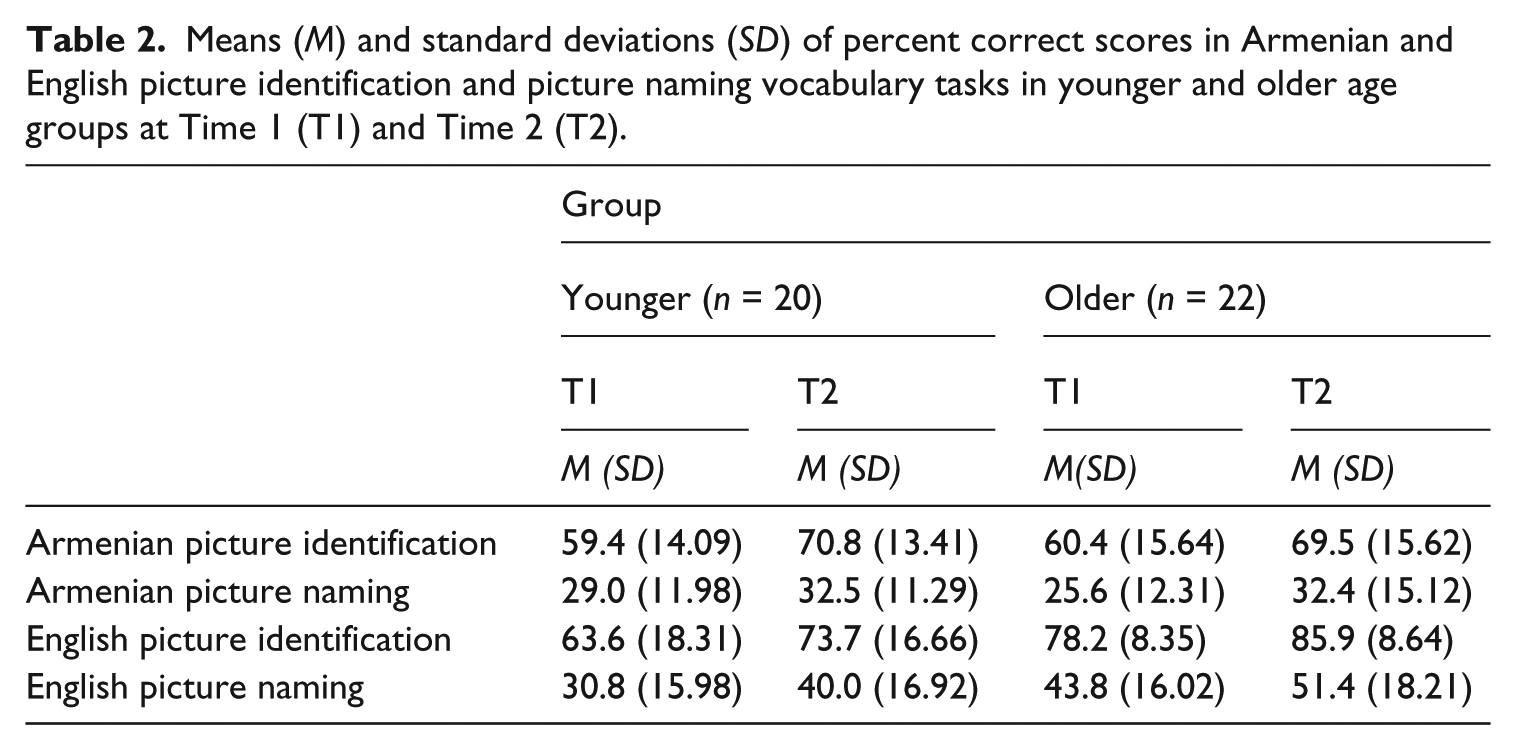
The analyses addressed the question of group as well as individual differences in vocabulary performance. Table 2 presents descriptive information on percent correct vocabulary scores in the four vocabulary tasks. As shown, the scores in all tasks increased between T1 and T2 in both groups.
Means (M) and standard deviations (SD) of percent correct scores in Armenian and English picture identification and picture naming vocabulary tasks in younger and older age groups at Time 1 (T1) and Time 2 (T2).
Group differences in bilingual vocabulary performance
Initially, mixed analysis of variance (ANOVA) was performed to examine the hypotheses regarding vocabulary growth differences. Group (younger, older) was the between-subjects variable and Time (T1, T2), Modality (PI, PN), and Language (Armenian, English) were the within-subjects variables. The results showed two significant interactions of Language by Modality by Time, F (1, 40) = 5.319, p = .026, η2 = .117; and Language by Group, F (1, 40) = 8.123, p = .007, η2 = .169. In addition, there were three significant main effects of Time, F (1, 40) = 109.730, p < .001, η2 = .733; Modality, F (1, 40) = 668.654, p < .001, η2 = .944; and Language, F (1, 40) = 20.677, p < .001, η2 = .341. The first two main effects, respectively, supported the hypotheses on higher performance at T2, M (SD)% = 57.0 (11.08), compared to T1, M (SD)% = 48.8 (10.05), and higher performance in PI, M (SD)% = 70.2 (10.40), compared to PN, M (SD)% = 35.7 (11.83). However, contrary to the language hypothesis, a higher performance was observed in English, M (SD)% = 58.4 (14.28), compared to Armenian, M (SD)% = 47.5 (12.25). The Language by Group interaction indicated different patterns of Armenian and English vocabulary performance in the two groups. The older group, M (SD)% = 64.8 (11.13), performed significantly better than the younger group, M (SD)% = 52.0 (14.57), in the English tasks, t(40) = −3.223, p = .003. However, there was no significant difference between the younger, M (SD)% = 47.9 (11.55), and older groups, M (SD)% = 47.0 (13.12), in the Armenian tasks, t(40) = .237, p = .814. These findings along with the information that the older group had higher English language exposure at home than the younger group (see Table 1) suggested that there might be a potential confound affecting task performance in the two languages.
Therefore, as a post-hoc analysis, mixed analysis of covariance (ANCOVA) was conducted with English language exposure as a covariate. The ANCOVA showed a significant four-way interaction of Language by Modality by Time by Group, F (1, 39) = 5.765, p = .021, η2 = .129, as illustrated in Figure 1. The panels depict the three-way interactions of Modality by Time by Group in Armenian and English. Post-hoc tests showed that the three-way interaction was significant in Armenian, F (1, 39) = 5.910, p = .020, η2 = .132, but not in English, F (1, 39) = .010, p = .923, η2 = .000. Furthermore, as depicted in the left panel, Armenian PI and PN showed different patterns of growth for younger and older groups. Additional post-hoc tests showed that the Modality by Time interaction was significant in the younger group, F (1, 18) = 7.246, p = .015, η2 = .287, but not in the older, F (1, 20) = 2.371, p = .139, η2 = .106. This indicated that the younger group showed less growth in the Armenian PN task than in Armenian PI. These, as well as the ANOVA findings, consistently showed different patterns of modality growth in Armenian and English. Overall, PN showed less growth than PI in Armenian, whereas growth in these two modalities was similar in English.

Significant four-way interaction of Language by Modality by Time by Group with lines representing adjusted mean percent correct scores in Armenian (left panel) and English (right panel) picture identification (PI) and picture naming (PN) tasks in younger (JK) and older (SK) groups.
Consistent with the original predictions, the ANCOVA showed three significant main effects of Group, F (1, 39) = 4.252, p = .046, η2 = .098, with a higher performance in the older group, M (SD)% = 56.3 (10.25), compared to the younger group, M (SD)% = 49.6 (10.28); Time, F (1, 39) = 56.051, p < .001, η2 = .590, indicating better performance at T2, M (SD)% = 57.0 (10.94), compared to T1, M (SD)% = 48.8 (9.70); and Modality, F (1, 39) = 366.866, p < .001, η2 = .904, indicating better performance in PI, M (SD)% = 70.2 (9.97), compared to PN, M (SD)% = 35.7 (11.81). Furthermore, the younger and older groups showed similar vocabulary performance in Armenian and English, F (1, 39) = .231, p = .633, η2 = .006, and the Language by Group interaction was no longer significant, F (1, 39) = 3.470, p = .070, η2 = .082. Finally, none of the analyses supported the hypothesized Language by Time interaction, F (1, 39) = .988, p = .326, η2 = .025.
Individual differences in bilingual vocabulary performance
To address the question of individual differences and the contribution of predictors on vocabulary tasks, four separate hierarchical multiple regression analyses were conducted with mean percent correct score in each task as the dependent variable and with environmental characteristics (parental education, language exposure at home) and nonverbal IQ as potential predictors. In these analyses, the order of forcing the predictors into regression was reversed to assess three models, the results of which are presented below after the correlations. Armenian PI correlated significantly with Armenian language exposure, r (38) = .59, p < .001, and parental education, r (38) = .33, p = .021, but not with nonverbal IQ, r (38) = .23, p = .078. Meanwhile, Armenian PN correlated significantly with Armenian language exposure, r (38) = .59, p < .001, and nonverbal IQ, r (38) = .36, p = .014, but not with parental education, r (38) = .21, p = .097. Furthermore, English PI correlated significantly with English language exposure, r (38) = .37, p = .010, and parental education, r (38) = .28, p = .045, but not with nonverbal IQ, r (38) = .20, p = .115. Finally, English PN correlated significantly with English language exposure, r (38) = .30, p = .033, but not with parental education, r (38) = .19, p = .126, or nonverbal IQ, r (38) = .22, p = .092.
Armenian picture identification
The first model indicated the significant contribution of the environmental predictors to Armenian PI, F (2, 37) = 13.414, p < .001, which accounted for 40% of variance, with Armenian language exposure at home, β = .570, p < .001, and parental education, β = .298, p = .025, as significant predictors. The second model indicated that nonverbal IQ did not contribute to variance in Armenian PI, F (1, 37) = 2.103, p = .156. The third model, which was also significant, F (3, 37) = 9.153, p < .001, indicated that the predictors together accounted for 40% of variance in Armenian PI. Armenian language exposure, β = .550, p < .001, and parental education, β = .290, p = .030, were both significant variables in this model. In addition, reversing the order of entry showed that, after the variance attributable to environmental predictors was taken into account, nonverbal IQ did not account for additional variance in Armenian PI, p = .380. Environmental predictors, however, accounted for an additional 34% of variance, p < .001, in Armenian PI, over and above the variance attributable to nonverbal IQ.
Armenian picture naming
The first model indicated the significant contribution of environmental predictors to Armenian PN, F (2, 37) = 10.778, p < .001, which accounted for 35% of variance, with Armenian language exposure at home, β = .580, p < .001, as the significant variable. The second model indicated the significant contribution of nonverbal IQ to Armenian PN, F (1, 37) = 5.183, p = .029. The third model, which was also significant, F (3, 37) = 8.913, p < .001, indicated that the predictors together accounted for 39% of variance in Armenian PN. Armenian language exposure, β = .537, p < .001, was the only significant variable in this model. In addition, reversing the order of entry showed that, after the variance attributable to environmental predictors was taken into account, nonverbal IQ accounted for an additional 4% of variance in Armenian PN, but this increment was not significant, p = .067. Environmental predictors, however, accounted for an additional 29% of variance, p =.001, in Armenian PN, over and above the variance attributable to nonverbal IQ.
English picture identification
The first model indicated the significant contribution of the environmental predictors to English PI, F (2, 37) = 4.376, p = .020, which accounted for 15% of variance, with English language exposure at home, β = .351, p = .027, as the significant predictor. The second model indicated that nonverbal IQ did not contribute to variance in English PI, F (1, 37) = 1.494, p = .229. The third model, which was also significant, F (3, 37) = 3.831, p = .018, indicated that the predictors together accounted for 19% of variance in English PI. English language exposure, β = .383, p = .015, was the only significant variable in this model. In addition, reversing the order of entry showed that, after the variance attributable to environmental predictors was taken into account, nonverbal IQ accounted for an additional 4% of variance in English PI, but this increment was not significant, p = .131. Environmental predictors, however, accounted for an additional 18% of variance, p = .014, in English PI, over and above the variance attributable to nonverbal IQ.
English picture naming
None of the three models examined showed a significant contribution to English PN. The first model indicated no significant contribution of environmental predictors to English PN, F (2, 37) = 2.317, p = .114. The second model indicated no significant contribution of nonverbal IQ to English PN, F (1, 37) = 1.831, p = .184. Finally, the third model was also nonsignificant, F (3, 37) = 2.459, p = .080.
Discussion
The present study concerned the question of comparative receptive and expressive vocabulary growth in the Armenian–English bilingual kindergarteners. It also examined the contribution of two separate categories of predictors on Armenian and English receptive and expressive vocabulary performance.
Modality growth differences
The findings indicated a modality growth difference in the minority but not in the majority language. Specifically, children showed similar growth over six months in all tasks except Armenian PN. Previous research has also provided supporting evidence for a modality growth difference in the minority language (Kan & Kohnert, 2005; Rodriguez et al., 1995; Sheng et al., 2011; Winsler et al., 1999). These findings, indicative of relatively less growth in the minority expressive modality, are referred to as the receptive–expressive gap (Gibson, Oller, Jarmulowicz, & Ethington, 2012). The finding in the current study might be related to the reported preference of bilingual children to speak in the majority language from the early years in kindergarten (Oller & Eilers, 2002), which is argued to be the result of longer immersion in environments with considerable exposure to the majority language as well as the influence of peers speaking the majority language at school (Luo & Wiseman, 2000), where the majority language has high value and is used for instruction (Orellana, 1994). Similarly, the children in this study might prefer to use the majority language at school, reducing the opportunity to practice using the minority language (Pearson et al., 1997), which may in turn explain the relatively slower development of its expressive modality (Hakuta & D’Andrea, 1992). Finally, according to the distributed characteristics of bilingual vocabulary knowledge (Oller & Pearson, 2002), it is possible that the children know words for some concepts in one language but not in the other. These speculative conclusions can be addressed in future studies.
The finding on the modality growth difference and its plausible explanations might be of concern, especially considering the bilingual environment of the children in this study. The balanced bilingual preschools were providing equal support for both languages and the children were receiving considerable minority exposure at home. Therefore, one would expect comparable growth in both languages in such an additive bilingual environment. However, if children in their early stages of entering the school environment are showing signs of preference towards majority language use, then more pronounced consequences might follow in the years to come with longer and more exposure to the majority language at school (Orellana, 1994; Wong Fillmore, 1991). Nonetheless, in the absence of longitudinal data on the same children followed over several years, it is speculative to draw further conclusions.
Although the children in the current study were presumably experiencing an additive bilingual environment with the potential to nurture comparable growth in both languages, other factors such as language status or value should also be taken into consideration, while judging about bilingual proficiency. Language status, majority vs. minority, has been shown to play a significant role in how bilingual children attain balanced bilingualism in their two languages (Armon-Lotem & Ohana, 2016; Thordardottir, 2011). In fact, the two languages of the participants in this study have a different status, one a minority language and the other a majority language, which is obviously associated with a higher prestige. While acknowledging the importance of language value, in the current study efforts were made to capture this variable and to examine its relationship with the vocabulary performance of the bilinguals. To this end, several questions in the parental questionnaire were developed to measure language values. Although this measure was not sensitive to variability among the respondents and yielded no statistically valid information, the descriptive information did provide invaluable insight into the high value associated with both languages from the perspective of families. Almost all the parents believed that sending their children to these schools would help them develop and keep their Armenian identity, learn about their culture and heritage, learn reading and writing in Armenian, and have Armenian friends.
Language exposure and patterns of vocabulary proficiency
The discrepancy between high minority language exposure at home and proficiency in the majority vocabulary is an important finding of this study. Given the long establishment of the Armenian community in Canada, it was expected that children from this community would show some English language abilities. In addition, it was assumed that the majority of participants in this study would be Armenian-proficient and representative of families with dominant use of Armenian as home. In fact, this latter assumption was supported by parental report indicating high exposure to Armenian at home, M (SD)% = 71.0 (28.12). However, despite high exposure to Armenian at home, most children were found to be more proficient in English (47.6%) or balanced in both languages (38.1%) (this proficiency categorization is based on an arbitrary cut-off point of a 10% difference between Armenian and English vocabulary performances). This finding, in line with previous studies, suggests that children in an English-dominant culture become proficient in English despite substantial exposure to a minority language at home (e.g., Duursma et al., 2007). Nonetheless, it should be emphasized that such findings should be discussed not only in terms of language exposure but also in the context of other interdependent socio-linguistic factors, at the individual, family, community, and broader societal levels (Potowski, 2013). For example, the minority status of Armenian and the social importance and prestige associated with English potentially play a role in the differential performance of the children in their two languages. To conclude, the findings discussed above further emphasize the importance of the home environment in minority-language maintenance (Boyce, Gillam, Innocenti, Cook, & Ortiz, 2013; De Houwer, 2007; Hakuta & D’Andrea, 1992; Luo & Wiseman, 2000). This emphasis becomes even more essential in the years past kindergarten, when the children will be experiencing an unbalanced bilingual program with extensive exposure to English at school. Therefore, families must concentrate on the establishment and consistent use of their language at home, if they want their children to become proficient in both languages.
The group difference in English language exposure, which had a significant impact on the main results, further emphasizes the significant role of language exposure in vocabulary performance. The older children showed an unexpected higher exposure to English at home. This difference might simply be a sampling error, but it might as well be a real one. Some demographic information provides a plausible explanation. The younger group included more recent immigrant families, 58.8% of the families of the children in the younger group compared to 30.0% of the families of the children in the older group. It is more likely that families with longer establishment in the majority community experience more contact with the majority culture and more interaction with English-speakers, which could in turn provide significant sources of English language exposure for their children. However, once the group difference in English language exposure at home was taken into consideration, a shift was observed in some findings. This shift in findings makes sense given the documented positive relationship between language exposure and vocabulary performance (e.g., Parra et al., 2011; Thordardottir, 2011). To conclude, these findings once again emphasize the importance of language exposure on vocabulary development.
Predictors of individual differences in receptive and expressive vocabulary performance
The use of two different groups of potential predictors of vocabulary performance made a unique contribution to the hardly studied Armenian–English combination of languages. It made it possible to examine the individual and combined contributions of the predictors on Armenian and English receptive and expressive vocabularies in Armenian–English bilingual children for the first time. Different patterns of results were obtained for the two languages. When considered separately, the environmental predictors predicted performance in Armenian PI, Armenian PN, and English PI tasks. The nonverbal IQ only predicted Armenian PN. However, when the predictors were considered jointly, Armenian language exposure contributed uniquely to Armenian PI and PN, but English language exposure made a unique contribution only to English PI.
One plausible explanation for the discrepancy in findings on the unique predictors of Armenian and English vocabulary might be related to some methodological limitations of the language exposure measure. The correlations between language exposure in each language and receptive and expressive vocabulary performance in that language indicate that the association between Armenian language exposure and Armenian PI (r = .54) and Armenian PN (r = .56) was stronger than the relationship between English language exposure and English PI (r = .41) and English PN (r = .35). This might indicate that the measure was more robust for the minority language than for the majority language. In fact, the language exposure measure was developed primarily based on the percentage of use of languages at home, while exposure from sources outside the home was not included. Therefore, the exclusion of the exposure received outside the home, which was probably more substantial in English, might render the English language exposure measure less accurate than the Armenian language exposure measure.
The language exposure measure served the purpose of this study well by capturing the amount of language exposure at home. It provided a relative measure of the percentages of use of each language at home by different individuals. However, the percentages did not provide information about the variability and nature of the use of languages by the individuals. There could be some systematic differences in the amount of talk addressed to children by different individuals. For example, equal percentages of use of a language by the two parents might not necessarily mean that both parents spent equal amounts of time interacting with the child. In addition, the context and quality of the languages used by each parent might also be different. Furthermore, language exposure should also be considered in the context of other variables, such as language value (Carroll, 2015), the status and prestige associated with each language (Armon-Lotem & Ohana, 2016; Thordardottir, 2011), and the practicality of use of each language given the language needs of all the family members. Finally, information on age of onset (AoO) of English and parent generation should also be included in any given language exposure measure to provide a more comprehensive picture of the language use of the population in question. However, in the current study, as discussed earlier, information on AoO was not included in the measure, because children showed a wide range of variability in AoO of English. The sample included not only second language learners of English, but also second language learners of Armenian as well as simultaneous bilinguals. Finally, even though the generation of parents/children or years in the majority community is a significant factor in the use of the minority language, it might be unrealistic to conclude that the same outcome can be observed in all minority communities. In fact, in the current study, there were families with parents born in Canada, who showed a considerable use of Armenian at home. A few families with both parents born in Canada were using over 80% Armenian at home. To conclude, there is an intricate interplay of different factors that should be taken into consideration while designing a comprehensive language exposure measure; however, this was not within the scope of the current study.
In conclusion, the present study made a significant contribution to the relatively small body of literature on minority–majority bilingual vocabulary acquisition in young children, in particular Armenian–English bilinguals. However, future longitudinal studies with a more comprehensive language exposure measure are needed to further deepen our understanding of vocabulary growth in bilingual children and the patterns of language use among siblings or peers and their effect on vocabulary performance.
Footnotes
Appendix 1
Appendix 2
All target items in the four lists (A, B, C, and D) in the order in which they appeared on the tasks.

| No. | List A | List B | List C | List D |
|---|---|---|---|---|
| 1 | cat | apple | dog | ball |
| 2 | nose | shoe | sun | door |
| 3 | table | book | cheese | chair |
| 4 | ear | rabbit | fish | horse |
| 5 | cow | balloon | duck | drinking |
| 6 | girl | flower | pencil | tree |
| 7 | eye | star | fork | bird |
| 8 | pig | bed | hat | snowman |
| 9 | sock | heart | butterfly | leaf |
| 10 | monkey | airplane | elephant | moon |
| 11 | bell | button | snake | bear |
| 12 | pants | candle | drum | square |
| 13 | stairs | swing | tomato | box |
| 14 | boat | grapes | flag | triangle |
| 15 | glasses | stool | bicycle | scissors |
| 16 | pear | church | key | knife |
| 17 | orange | strawberry | lion | bottle |
| 18 | squirrel | comb | donkey | ring |
| 19 | watch | pumpkin | belt | dress |
| 20 | fridge | clown | lemon | broom |
| 21 | king | nail (finger) | basket | wheel |
| 22 | spider | hammer | crown | giraffe |
| 23 | bow (ribbon) | goat | canoe | needle |
| 24 | paintbrush | sword | guitar | mountain |
| 25 | whistle | wall | witch | camel |
| 26 | coat | potato | owl | tiger |
| 27 | pepper | mushroom | smoke | lamp |
| 28 | necklace | couch | queen | nest |
| 29 | yawning | tent | chain | dentist |
| 30 | truck | whale | stove | peeling |
| 31 | fence | arrow | snail | drawer |
| 32 | deer | rock | gorilla | shoulder |
| 33 | vase | branch | onion | kettle |
| 34 | sewing | suitcase | bridge | walnut |
| 35 | saw | digging | iron | envelope |
| 36 | swan | violin | rocket | kangaroo |
| 37 | pan | antlers | pineapple | paw |
| 38 | porcupine | desk | castle | leopard |
| 39 | soldier | frame | lettuce | tie |
| 40 | rhinoceros | skeleton | brain | wrapping |
| 41 | faucet | merry-go-round | trumpet | pitcher |
| 42 | palm tree | nurse | statue | lobster |
| 43 | acorn | cage | well | ambulance |
| 44 | ostrich | thermometer | telescope | crab |
| 45 | trunk | globe | medal | skis |
| 46 | peacock | microphone | calculator | sawing |
| 47 | eagle | anchor | windmill | cactus |
| 48 | diamond | submarine | bow | flute |
| 49 | ashtray | volcano | cigarette | fountain |
| 50 | thimble | cannon | pillar | hoof |
| 51 | diving | dripping | blender | rectangle |
| 52 | oval | scorpion | terrified | tornado |
| 53 | pot | sled | flask | anvil |
| 54 | callipers | knight | island | tape |
| 55 | accordion | compass | nut | tambourine |
Appendix 3
Acknowledgements
This research is based on my PhD dissertation at the University of Toronto, Department of Speech-Language Pathology. I wish to thank cordially Dr. Carla J. Johnson. Without her admirable support, scholarly comments, and invaluable input, this work could not emerge in its current state. Special thanks are also due to Dr. Alice Eriks-Brophy and Dr. Esther Geva, for their expert contributions and support. My gratitude is also extended to the school personnel, parents, and children for their time and enthusiasm in participating in this study.
Declaration of Conflicting Interests
The author(s) declared no potential conflicts of interest with respect to the research, authorship, and/or publication of this article.
Funding
The author(s) received no financial support for the research, authorship, and/or publication of this article.