




Abstract
This study explores the developmental change of mother–child interactions in order to investigate which aspects of maternal behavior affect children’s speech production. To this end, the interactions between 79 German-speaking mothers and their two- or five-year-old children were observed at two time points (12 months apart) and in two interactive settings (joint picture book reading and joint play with toy blocks). Measures were obtained for the speech (mean length of utterance) of mothers and children and the pointing behavior and prosody of mothers. The results suggest that mothers adapt their behavior to the advancing abilities of their children. Moreover, mothers’ speech input was a significant predictor of children’s speech production later in life. Interestingly, speech production of younger children was explained by the relatively simpler speech of mothers during joint play, whereas speech production of older children was explained by the relatively more complex speech of mothers during joint picture book reading. Mothers’ nonverbal behavior, in contrast, did not predict children’s speech production. Taken together, this study provides compelling evidence for the changing role of mothers’ interactive behavior in supporting children’s language production during development.
Introduction
In their first years of life, children’s predominant interaction partners are their parents. It is therefore not surprising that the process of language acquisition has been shown to be influenced by caregivers’ behavior, especially mothers. Characteristics of caregivers’ behavior that have been suggested to play a role in language acquisition comprise, for instance, the quality of speech input, responsibility, contingency, engagement in the conversation, as well as the use of directives, recasts, gestures, and prosody (Hoff, 2006; Iverson, Capirci, Longobardi, & Caselli, 1999; Soderstrom, 2007). The present study investigated the language-facilitating role of three different verbal and nonverbal aspects of mothers’ interactive behavior, namely their speech input, indicated by their mean length of utterances, pointing, and prosody, indicated by the pitch variability within utterances. These aspects of maternal behavior represent main building blocks of verbal and nonverbal input for children’s speech development. Although each of them has been a subject of previous research, the present research is the first to examine them in a single study.
The role of speech input in children’s language development
The speech mothers use when addressing their children, known as child-directed speech (CDS), differs substantially from speech used to address adults, known as adult-directed speech (ADS). In particular, CDS is characterized by rather simple language, containing shorter and syntactically less complex utterances (Soderstrom, 2007). The impact of maternal speech input on child language development has been shown in several studies (e.g., Ambridge, Kidd, Rowland, & Theakston, 2015; Hoff, 2006; Huttenlocher, Haight, Bryk, Seltzer, & Lyons, 1991; Huttenlocher, Vasilyeva, Cymerman, & Levine, 2002; Huttenlocher, Waterfall, Vasilyeva, Vevea, & Hedges, 2010; Liu, 2014). The mechanism argued to be responsible for this impact is children’s sensitivity to the frequency of specific lexical or syntactic structures (Ambridge et al., 2015). Structures that are listened to more frequently can be stored more easily than structures that occur less frequently (Ambridge et al., 2015; Lieven, 2010). In principle, this mechanism may act at all ages. However, the cognitive readiness of children of different ages has to be taken into account. According to Vygotsky’s theory of the ‘zone of proximal development’, the acquisition of new knowledge depends on the potential next developmental stage of a child (Vygotsky, 1978). For language acquisition, this means that a child might have to have reached a certain period of language proficiency in order to learn more complex language structures. Even if children are suggested to be able to filter out input that is too complex (Hoff, 2006), caregivers might facilitate this process by adapting their speech to their children’s current or potentially next developmental stage. In line with this assumption, caregivers’ speech has, indeed, been shown to change, becoming more complex as children grow older and develop, at least after the age of approximately two years (Gleitman, Newport, & Gleitman, 1984; Huttenlocher, Vasilyeva, Waterfall, Vevea, & Hedges, 2007; Phillips, 1973; Rondal, 1980; Snow, 1972).
Mothers’ speech has not only been argued to differ as a function of age or developmental stage of children, but also as a function of the setting in which they address their children. Previous studies in this field mainly compared speech during joint picture book reading with speech in other play or ordinary situations and consistently showed that mothers produce longer and syntactically more complex utterances during shared picture book reading than in other situations such as playing or eating (Crain-Thoreson, Dahlin, & Powell, 2001; Hoff-Ginsberg, 1991; Rondal, 1980). However, so far, no studies have investigated if the impact of speech input differs as a question of the setting of interaction.
The role of pointing and prosody in children’s language development
Nonverbal means of caregiver communication such as pointing (Iverson et al., 1999; Pan, Rowe, Singer, & Snow, 2005; Tamis-LeMonda, Song, Leavell, Kahana-Kalman, & Yoshikawa, 2012) and prosody (Saint-Georges et al., 2013; Soderstrom, 2007; Soderstrom, Seidl, Nelson, & Jusczyk, 2003) have also been shown to influence children’s language development. However, the mechanisms guiding these impacts are different from the mechanisms responsible for the influence of speech input. Pointing is a social and intentional nonverbal form of communication that is suggested to facilitate language acquisition, such as the acquisition of first words, by directing children’s attention and supporting verbal speech input (Iverson, Longobardi, Spampinato, & Caselli, 2006; Kita, 2003; Rowe, 2000; Tomasello, Carpenter, & Liszkowski, 2007). Prosody in CDS (as compared to ADS) is mainly characterized by its high and variable pitch, but also by elongated vowels, longer pauses between utterances, a reduced speech rate, and greater prosodic repetition, at least in cultures for which CDS has been established (Cowie et al., 2001; Fernald, 1985; Fernald & Kuhl, 1987; Scherer, 1986; Segal & Newman, 2015; Soderstrom, 2007). It is assumed to act even earlier in development, when infants use prosodic units to segment words and other syntactic units from the speech stream (Gleitman, Gleitman, Landau, & Wanner, 1988; Gleitman & Wanner, 1982; Peters, 1983). Another language-facilitating function of prosody is the attraction of attention (Fernald, 1989), which, similar to pointing, supports children’s understanding of speech. Pointing and prosody have been shown to be especially important in early language acquisition, before the age of two years (Iverson et al., 1999; Pan et al., 2005; Saint-Georges et al., 2013; Soderstrom, 2007; Soderstrom et al., 2003; Tamis-LeMonda et al., 2012). Their role in later language acquisition is much less clear. As for the quality of speech input, previous research on the use of pointing and prosody during caregiver–child interaction suggests that caregivers adapt their nonverbal behavior to the age or developmental stage of their children. For pointing, previous studies reported an increase of maternal pointing until the age of two years (Murphy, 1978), and stagnation between two and three years of age (Rodrigo et al., 2006). For prosody, previous findings indicate a decrease in pitch and pitch variability as children grow older (Amano, Nakatani, & Kondo, 2006; Garnica, 1977; Liu, Tsao, & Kuhl, 2009; Warren-Leubecker & Bohannon, 1984). These findings suggest that caregivers’ efforts to direct children’s attention using pointing and/or prosody decline during child development.
The present study
The aim of the present study was to examine the impact of maternal speech input (indicated by the length of produced utterances), pointing (indicated by number of pointing/minute), and prosody (indicated by pitch variability) on children’s language development. We thereby focused on a developmental stage in which the roles of pointing and prosody have not been sufficiently established, that is, the period of syntactic development. For this purpose, we observed the interactions between German-speaking mothers and children. The children belonged either to a group of younger (two-year-old) or to a group of older (five-year-old) children. Whereas two-year-old children are just starting to acquire syntactic knowledge, five-year old children are already advanced language users that have acquired a large set of syntactic structures (Szagun, 1996). As all mother–child dyads were observed twice, approximately one year apart, it was possible to investigate effects of each of the assessed maternal behaviors longitudinally.
A further aim of the present study was to establish if the effects of the assessed verbal and nonverbal aspects of maternal interactive behavior differ as a function of child age and if the potential influence of speech input depends on the interactive setting in which the input was provided. For this purpose, two settings of interaction were compared: joint picture book reading, an activity characterized by especially complex maternal speech, and joint play, an activity usually characterized by comparably less complex maternal speech (Crain-Thoreson et al., 2001; Hoff-Ginsberg, 1991; Rondal, 1980). These settings were selected as they represent common and frequent activities shared by mothers and children. In contrast to previous studies that did not distinguish between textual and extra-textual language (Crain-Thoreson et al., 2001; Hoff-Ginsberg, 1991), we were interested in spontaneous speech only. Therefore, we provided mother–child dyads with picture books containing nearly no text, and we explicitly measured extra-textual language only.
We assumed that the roles of different means of caregiver communication change as children grow older and that mothers adapt their behavior to the changing needs and capabilities of their children. Based on the previous literature and these assumptions, the following hypotheses were formulated: The speech input provided by mothers becomes more complex as children grow older and is positively associated with the later speech production of younger as well as older children. Given that the speech input in a generally less complex speech setting (e.g., during joint play) might better fit the current/potentially next language stage of younger (two-year-old) children, it was expected that mothers’ speech during joint play predicts the language of younger children better than mothers’ speech during joint picture book reading. Older (five-year-old) children, on the other hand, were expected to benefit more from speech provided in a more complex speech setting (picture book reading) than from speech in a less complex setting.
In contrast to speech input, pointing was expected to remain stable throughout child development (Rodrigo et al., 2006), and prosody was expected to decrease and approximate the prosody in ADS. Furthermore, prosody and pointing were hypothesized to show only small associations with the later language production of the observed children.
Method
Participants
The original study sample consisted of 80 children (40 girls) and their mothers. Half the children (20 girls) belonged to a Younger Age Group of initially two-year-old children (mean age at T1 = 2;6, SD = .03). The other half belonged to an Older Age Group of initially five-year-old children (mean age at T1 = 5;5, SD = .03). One mother–child dyad of the Younger Age Group had to be excluded because the pre-determined exclusion criterion (values > 2 SD above the average in the same age group) was met for the speech input provided by the mother. Participants were observed at two time points, 12 months apart. The mean age of mothers at T1 was 32.63 years (SD = 4.42) in the Younger Age Group and 35.73 years (SD = 4.73) in the Older Age Group. All participants were native speakers of German, showed no signs of language or cognitive delay, and reported no chronic disease and no hearing problems.
In the Younger Age Group, 22 children had siblings. In the Older Age Group, 30 children had siblings. Having siblings or not had no significant impact on the measurements assessed in the present study, that is, on the speech of mothers and children and the pointing behavior and prosody of mothers (all p > .17).
At T1, all but one child attended nursery school or kindergarten. At T2, 12 children of the Older Age Group already attended school. The school and professional education of the mothers was high (85% highest secondary school education, 70% university degree), but did not differ between the two age groups (χ2 = .00, p = 1.0 and χ2 = .24, p = .81).
Design
Participants of both age groups (Younger Age Group of initially two-year-olds, and Older Age Group of initially five-year-olds) participated at two time points (T1 and T2), 12 months apart. This design allowed cross-sectional analyses (by comparing the two age groups) as well as longitudinal investigations (by comparing the same children at T1 and T2). The interactions between mothers and children were observed in two different settings, during joint picture book reading (Book Setting) and during joint play with toy blocks (Play Setting). In the Book Setting, the provided picture books contained (nearly) no text in order to assess spontaneous speech rather than reading. The order of both settings was pseudo-randomized, with the same proportion of boys and girls and the same mean age of children in each group. At each time point, measurements were obtained for the speech of children and mothers, for the pointing gestures produced by mothers, and for the prosody of mothers.
Mothers’ and children’s speech
Speech was transcribed and then analyzed in terms of syntactic structures. The assessed speech variables comprised the frequency of verbs, subject-first sentences, object-first sentences, and subordinate clauses as well as mean length of utterance in words (MLU-W). MLU-W was calculated by dividing the total number of words by the total number of utterances (Nice, 1925). A factor analysis including the assessed speech variables revealed that all of them loaded on one single factor, with factor loadings ranging between .70 and .93 for children and .52 and .89 for mothers. MLU-W emerged as the most representative single measure for this extracted factor, with a factor loading of .93 for children and .89 for mothers. Therefore, further analyses were based on MLU-W.
An utterance was defined as having a single intonational contour within a single conversational turn (Huttenlocher et al., 2010). Utterances were usually separated by pauses, although pausing to find a word could also occur within utterances. An utterance could contain a single word or one or more phrases or clauses. Following the CHAT transcription format of the Child Language Data Exchange System CHILDES (MacWhinney, 2000), whisper, non-speech (laughter, kisses), singing routines, direct repetitions, onomatopoeia, and utterances containing unintelligible speech or retracing were omitted from analysis. Reading was not analyzed.
Mothers’ pointing
Pointing was defined as extensions of a finger (typically the index finger) toward an object or event (Butterworth, Franco, McKenzie, Graupner, & Todd, 2002; Butterworth & Morissette, 1996; Leavens & Hopkins, 1998) and operationalized as the number of pointing gestures per minute. A pilot study on both settings revealed that mothers’ pointing was often ambiguous in the Play Setting. Therefore, pointing was assessed in the Book Setting only. Tracing a page of the picture book with the finger and fast consecutive pointing on the same event were counted as one pointing gesture. However, as soon as pointing gestures were interrupted by a withdrawal of the arm, they were counted separately.
Mothers’ prosody
Pitch and pitch variability are prosodic characteristics of speech that have been shown to be highly correlated (Scherer, 1986). We selected one of them, pitch variability, to represent prosody in the present study. Pitch variability is reflected in the standard deviation of pitch within utterances. It was assessed using Praat, Version 5.3.02 (Boersma & Weenink, 2011) and measured in two speech modes, in child-directed speech (CDS) and adult-directed speech (ADS). CDS was assessed during the mother–child interactions (i.e., Book and Play Setting) at both time points (T1 and T2). ADS was assessed in an interview at T1. During this interview, mothers answered questions on the picture book reading and play habits of their children while the child played in a neighboring room. The set of utterances to be analyzed was chosen randomly from the speech samples. Candidates for acoustic analysis were spontaneous natural and intelligible utterances containing at least one subject and one verb. Utterances containing questions, whisper, retracing, or background noise were excluded from analysis. In some cases, the number of utterances meeting these conditions was very limited, especially in the interviews with mothers. Therefore, the amount of analyzed utterances was set to 10 utterances in CDS (five in the Book Setting and five in the Play Setting) and five utterances in ADS. For further statistical analysis, the measure was averaged across utterances.
Material
The experimenter provided the material used for the interaction setting. It consisted of a colored picture book (Book Setting) and toy blocks and figures (Play Setting). To ensure age-appropriateness and avoid effects of recognition, different but comparable material was used in the two age groups and at the two time points of observation. As revealed by parental report, all mothers and children were familiar with picture books and toy blocks from home, but none of the children and mothers knew the exact material used in this study.
Picture books
The picture books used in the Book Setting were Schau mal an, was Paulchen kann [‘Look what Paulchen Can Do’] (Senner & Grimm, 2009) for two-year-old children, Gute Nacht Gorilla [‘Good Night, Gorilla’] (Rathmann, 2006) for three-year-old children, Lukas und der Wunschkäfer [‘Lukas and the Beetle that Fulfills Desires’] (Baumgart, 2011) for five-year-old children, and Le Petit Orge veut aller à l’école [‘Das kleine Monster möchte in die Schule gehen’ / ‘The Little Monster Wants to Go to School’] (Gaudrat & Parkins, 2007) for six-year-old children. To ensure spontaneous speech instead of reading, all text passages, except a few words that were helpful to understand the story of the picture book, were removed. The final picture book versions thus mainly consisted of pictures. The age-appropriateness of the picture books was tested in a pilot study.
Play material
The material in the Play Setting consisted of a Duplo© zoo for two-year-old children, a Duplo© animal clinic for three-year-old children, a Playmobil© farm for five-year-old children, and a Playmobil© animal clinic for six-year-old children. As with the picture books, the age-appropriateness of these toys was confirmed in a pilot study.
Procedure
During mother–child interaction, children and mothers stayed in a child-friendly equipped room of the lab. They were seated on a sofa. The play and picture book material was placed on a table in front of the sofa. Children and mothers were instructed to play as they would usually do at home, but to remain on the sofa and to play on the table.
The observation of the mother–child interaction started directly after a short warm-up game. During the target interaction, mothers and children were videotaped with an AXIS Q1755 video camera. To obtain an untreated speech recording for the prosodic analysis, the conversations were additionally recorded with a Sennheiser directional microphone ME 66. The microphone was connected to an M-Audio Micro Track II Digital-Recorder recording the speech at 16 bit, mono. Each setting was usually stopped after 10 minutes. However, in the rare case of lack of motivation of the child, a setting might have been stopped earlier. The mean duration of the Book Setting was 9.38 minutes (range 6.00–10.00). The mean duration of the Play Setting was 9.56 minutes (range 7.06–10.00). In the Book Setting, mothers and children were allowed to look at the picture book several times.
Coding, reliability, and statistical analysis
All conversations were transcribed using the software EUDICO Linguistic Annotator (ELAN) Version 4.7.0 (Sloetjes & Wittenburg, 2008). Transcription was done by trained coders. After initial transcription, each transcript was re-evaluated by a second coder. In case of discrepancy between the first and the second coder, both agreed on a solution. The tool used to calculate MLU-W was CLAN (Computerized Language Analysis) (MacWhinney, 2000). Pointing gestures were coded in ELAN. All coding sheets were double-checked by a second coder. Additionally, 20% of all coding sheets were coded by a third, independent coder. Kendall’s W was .62 (p < .01) for the number of pointing gestures in children and .70 (p < .01) for the number of pointing gestures in mothers. The correlation between both coders was .99 (p < .01) for the number of pointing gestures in children as well as in mothers. The data were analyzed in SPSS. ANOVAs and multiple linear regression analyses were calculated.
Results
The behavior of mothers and children as a function of child age and interactive setting
Age-related differences in MLU-W of children and mothers, pointing and pitch variability of mothers were assessed by calculating ANOVAs with AGE GROUP (Younger Age Group vs. Older Age Group) as between-subject factor and TIME POINT (T1 vs. T2) and SETTING (Book vs. Play) as within-subject factors. The results of these analyses are presented in the following. The descriptive statistics, namely means and standard deviations of each measurement, are displayed in Table 1.
Means (and standard deviations) of behavior assessed during mother–child interaction.
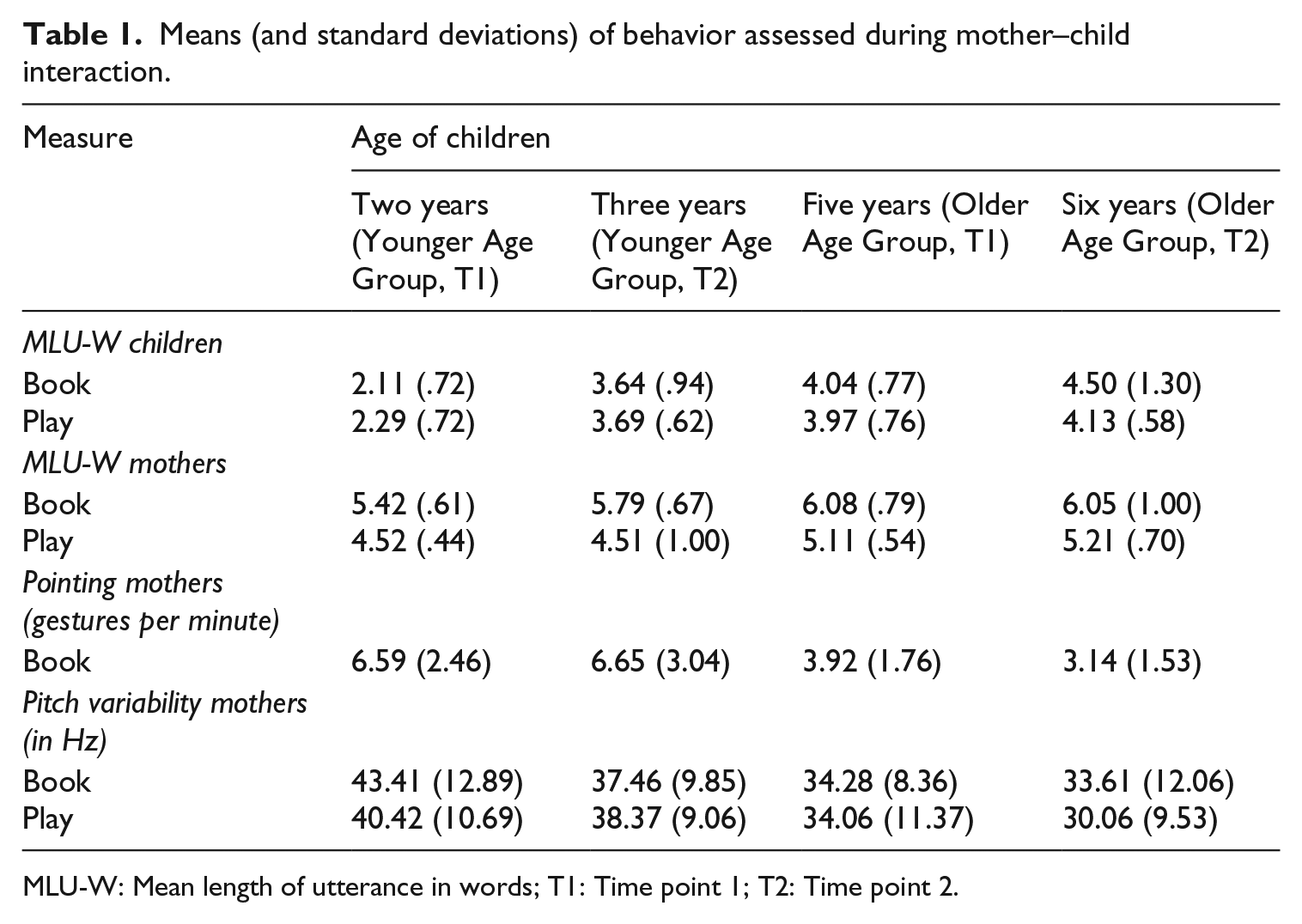
MLU-W: Mean length of utterance in words; T1: Time point 1; T2: Time point 2.
MLU-W of children
The utterances produced by children became longer as children grew older (see Figure 1). The analysis revealed a significant main effect of AGE GROUP, indicating that children’s utterances were longer in the Older Age Group than in the Younger Age Group, F(1,77) = 83.07, p < .01. A significant main effect of TIME POINT further showed an increase in children’s utterance length from T1 to T2, F(1,77) = 124.29, p < .01. As revealed by a significant interaction between AGE GROUP and TIME POINT, this increase from T1 to T2 was stronger in the Younger Age Group than in the Older Age Group, F(1,77) = 52.97, p < .01. There was no significant main effect of SETTING. However, a significant interaction between AGE GROUP and SETTING indicated that children in the Younger Age Group produced longer utterances in the Play Setting than in the Book Setting, whereas children in the Older Age Group produced longer utterances in the Book Setting than in the Play Setting, F(1,77) = 5.23, p < .05 (see Figure 1).

MLU-W of children in the Younger Age Group (two- and three-year-olds) and the Older Age Group (five- and six-year-olds), for the two time points and in the two interactive settings of picture book reading and play. ANOVA revealed significant main effects of AGE GROUP and TIME POINT and significant interactions between AGE GROUP and TIME POINT as well as between AGE GROUP and SETTING. Error bars indicate SD.
MLU-W of mothers
Mothers in the Older Age Group produced longer utterances than mothers in the Younger Age Group, indicated by a significant main effect of AGE GROUP, F(1,77) = 24.33, p < .01 (see Figure 2). However, there was no significant main effect of TIME POINT, indicating that the mean length of utterances produced by mothers did not change from T1 to T2. A significant main effect of SETTING indicated that mothers produced longer utterances in the Book Setting than in the Play Setting, F(1,77) = 188.42, p < .01 (see Figure 2).
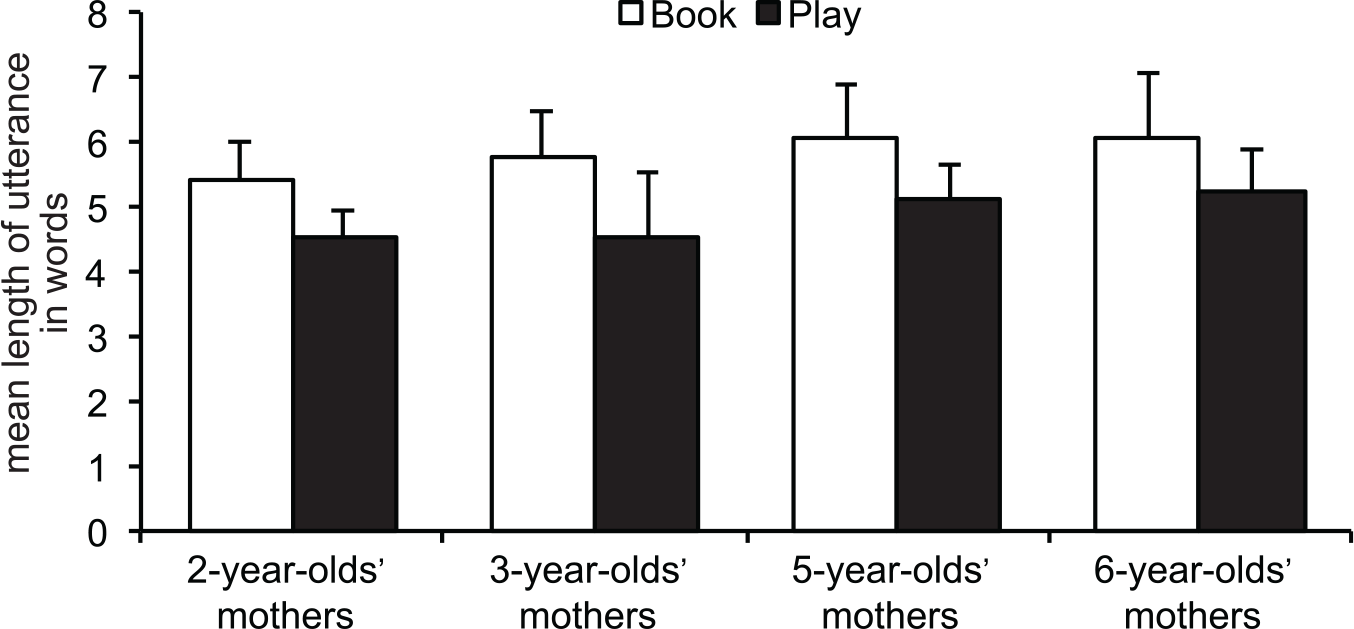
MLU-W of mothers in the Younger Age Group (two- and three-year-olds) and the Older Age Group (five- and six-year-olds), for the two time points and in the two interactive settings of picture book reading and play. ANOVA revealed significant main effects of AGE GROUP and SETTING. Error bars indicate SD.
Mothers’ pointing
A significant main effect of AGE GROUP showed that mothers in the Younger Age Group produced more pointing gestures than mothers in the Older Age Group, F(1,77) = 46.61, p < .01. However, there was no significant main effect of TIME POINT, indicating that mothers’ production of pointing gestures did not change from T1 to T2. No significant interaction was found.
Mothers’ prosody
The variability of mothers’ pitch decreased as children grew older. This was indicated by a significant main effect of TIME POINT, F(1,77) = 14.58, p < .01, as well as a significant main effect of AGE GROUP that remained significant after controlling for mothers’ ADS, F(1,77) = 15.49, p < .01. Analysis revealed no significant effect of SETTING. There were also no significant interactions.
In order to test for differences between mothers’ CDS and ADS, ANOVAs with repeated measurements including SPEECH MODE (CDS vs. ADS) as within-subject factor and pitch variability as dependent variable were calculated for mothers of two-, three-, five-, and six-year-old children separately. The effect of SPEECH MODE was significant in mothers of two-year-old children, F(1,38) = 37.91, p < .01, three-year-old children, F(1,38) = 23.41, p < .01, and five-year-old children, F(1,39) = 11.02, p < .01, indicating that mothers used a more variable pitch when interacting with two- to five-year-old children than when interacting with adults. For six-year-old children, however, the effect of SPEECH MODE was not significant, F(1,39) = 2.55, p = .12. During interaction with six-year-old children, the pitch variability within mothers’ utterances was thus comparable to the pitch variability during interaction with an adult.
Relations between the interactive behavior of mothers and the language production of children
To assess the relations between mothers’ behavior during mother–child interaction and the language development of their children, linear regression analyses with MLU-W, pointing, and pitch variability of mothers at T1 as regressors (predictors) and MLU-W of children at T2 as regressand (outcome) were calculated. Based on the assumptions that these relations might differ as a function of child age, the regression analyses were calculated separately for the Younger Age Group and the Older Age Group. Furthermore, to control for age differences within each age group, the exact age of children at T1 (in months) was added as additional regressor. Because mothers’ speech during joint picture book reading vs. joint play was expected to differ in predictive power, both MLU-W in the Book Setting (MLU-W-Book) and MLU-W in the Play Setting (MLU-W-Play) were included as potential predictors for later child speech. For pitch variability the average of both settings was entered as predictor.
Correlations between the predictor variables are displayed in Table 2. In the Younger Age Group, children’s exact age was significantly related to MLU-W-Play (r = .34, p < .05). MLU-W-Play and MLU-W-Book were significantly related in the Younger Age Group (r = .44, p < .01) as well as in the Older Age Group (r = .46, p < .01). The nonverbal means of communication, pointing and pitch variability, showed a significant relation in the Younger Age Group (r = .34, p < .05), but not in the Older Age Group.
Bivariate correlations between predictor variables at T1.

MLU-W: Mean length of utterance in words; T1: Time point 1; T2: Time point 2.
p < .05, ***p < .01.
The results of the regression analysis are summarized in Table 3. The standardized regression coefficients (β) indicate the strength of prediction effect for the regressors at T1 on children’s speech (MLU-W) at T2. In the Younger Age Group, MLU-W of children at T2 was significantly predicted by MLU-W-Play of mothers at T1 (β = .47, p < .01), whereas the other predictors showed no significant effects. In the Older Age Group, MLU-W-Book of mothers at T1 was a marginally significant predictor for children’s MLU-W at T2 (β = .33, p < .1). The other predictors did not show significant effects.
Multiple linear regression predicting T2 MLU-W in children.
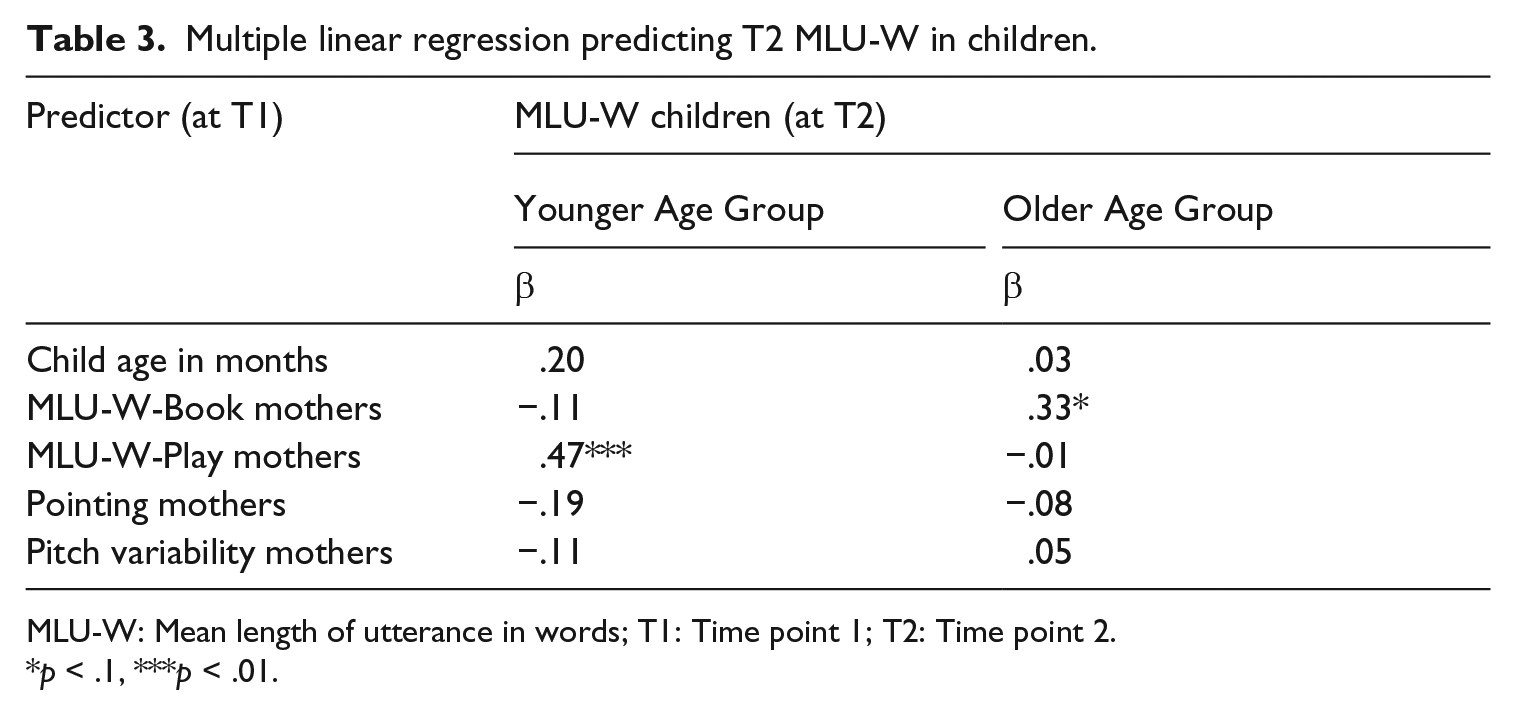
MLU-W: Mean length of utterance in words; T1: Time point 1; T2: Time point 2.
p < .1, ***p < .01.
Discussion
The aim of this study was to investigate the impact of verbal (speech input) and nonverbal (pointing and prosody) means of maternal communication on children’s later language production, with a special interest in how this impact might differ as a function of child age and interactive setting. For this purpose, we observed the verbal and nonverbal interactive behavior of two- and five-year-old German-speaking children and their mothers in two different settings (looking at a picture book and playing with toy blocks) and at two different time points. It is the first time that these different aspects of interaction have been investigated in a single study. The present study therefore provides detailed insight into the changing role and importance of key aspects of interaction in children’s language acquisition.
Verbal behavior of mothers
Mothers’ verbal behavior, indicated by the length of utterances they produced during interaction with their children, was expected to become more complex as children grow older and to show a positive association with later language production. These hypotheses could largely be confirmed. The utterances produced by mothers were longer during interaction with older (five- to six-year-old) as compared to younger (two- to three-year-old) children. Even if no significant longitudinal trends within the same age group could be found, we interpret this finding as an increase of maternal speech complexity as children grow older. This is in line with results from studies with English-speaking mothers (Gleitman et al., 1984; Huttenlocher et al., 2007; Rondal, 1980; Snow, 1972) and suggests that mothers adapt to the language capabilities of their growing children. The ability to process complex and long utterances increases with child age. For this reason, mothers might produce shorter utterances when interacting with younger as compared to older children.
The comparison between mothers’ speech during joint picture book reading and their speech during joint play revealed that mothers produce longer utterances during joint picture book reading than during joint play. This finding is in line with the hypothesis and confirms previous study results in English-speaking mothers (Crain-Thoreson et al., 2001; Hoff-Ginsberg, 1991; Rondal, 1980). A possible reason for this finding is that picture books encourage readers to tell a story, thus to produce speech. Playing with toy blocks, on the other hand, encourages players to build, play, and design, but not necessarily to talk. Another possible explanation for the observed differences is that (picture) books contain information parents want to explain to their children. Mothers might thus apply a more instructional and complex speech style during joint picture book reading than during joint play.
Most importantly, and in line with previous study results (Ambridge et al., 2015; Hoff, 2006; Huttenlocher et al., 1991, 2002, 2010; Lieven, 2010), the speech mothers provided during interaction with their children was shown to be significantly associated with children’s speech production one year later. Interestingly, even if maternal speech input during joint picture book reading and joint play were interrelated, their predictive power for later child language production differed between age groups. As expected, speech production of younger (three-year-old) children was best predicted by mothers’ relatively less complex speech during joint play, and the best predictor of speech production of older (six-year-old) children was the relatively more complex speech of their mothers during joint picture book reading. This result might be explained by Vygotsky’s theory of the ‘zone of proximal development’ (Vygotsky, 1978). According to this theory, the acquisition of new knowledge, in this case language, depends on the availability of instruction that corresponds to the potential next developmental stage of a child, a stage that is neither too simple nor too complex (Vygotsky, 1978). Five- to six-year-old children have already established a high proficiency in language and might therefore benefit from a more complex speech style, for instance the speech input provided when sharing a picture book with the mother. Two- to three-year-old children, on the other hand, are less proficient language users. The less complex speech provided during joint play might therefore better fit their next developmental stage and thus help them better to improve their language. Another possible explanation for the present finding is that the increased understanding of story grammar, that is, the structure of a story (Stein & Glenn, 1979), in older as compared to younger children might facilitate the understanding of picture books and therefore improve the benefit of speech provided during joint picture book reading. Younger children, in contrast, may benefit more from speech provided in situations in which knowledge of story grammar is not necessary, for example during joint play.
Interestingly, within each age group, the exact age of children was a weaker predictor of children’s speech production than the speech input provided by their mothers. This result provides further evidence that the acquisition of language, at least at higher stages of development, is not merely biologically determined, but rather influenced by the input (Vasilyeva, Waterfall, & Huttenlocher, 2008).
Nonverbal behavior of mothers
In contrast to mothers’ verbal communication, their nonverbal behavior, that is, their pointing as well as their prosody, was expected to remain stable or even decrease as children grow older. Furthermore, its impact on later language production was hypothesized to be limited and decrease with growing child age. These hypotheses could mainly be confirmed. As in English-speaking mothers (Rodrigo et al., 2006), the number of pointing gestures remained stable between age two and three years. However, mothers produced fewer pointing gestures during interaction with older (five- to six-year-old) as compared to younger (two- to three-year-old) children. This result may suggest that maternal pointing behavior changes between three and five years of age. Pitch variability within maternal utterances decreased as children grew older, a result that is in line with previous studies (Amano et al., 2006; Garnica, 1977; Liu et al., 2009; Warren-Leubecker & Bohannon, 1984).
The analysis of which aspects of maternal behavior predict children’s later language production revealed that mothers’ production of pointing gestures and the variability of their pitch were not significant predictors of children’s speech production, either for younger or for older children. Note that pointing and prosody in child-directed speech serve to reinforce a verbal message and attract children’s attention (Fernald & Kuhl, 1987; Kita, 2003; Tomasello et al., 2007) and have been shown to play a role in the language processing of very young children (Iverson et al., 1999; Pan et al., 2005; Soderstrom et al., 2003). So far, their role in later language acquisition has been less clear. The findings of the present study may suggest that both pointing and prosody play a less important role in the language production of children as old as two years. Furthermore, the findings indicate that mothers adapt their behavior appropriately, by using fewer pointing gestures and less exaggerated pitch variability when interacting with older vs. younger children.
The present study also revealed that maternal pointing and prosody are interrelated during interaction with two-year-old children, but not during interaction with five-year-old children. This finding underlines the assumption that both means of nonverbal behavior serve similar functions in earlier stages of child development, but diverge (possibly due to the decreasing importance of these functions) in later stages of development.
Mothers’ prosody in CDS vs. ADS
In addition to the comparison of prosody in interaction with children of different ages, the present design allowed a comparison of prosody in CDS with prosody in ADS. The results indicate that the speech addressed to two-, three-, and five-year-old children is characterized by higher pitch variability than speech addressed to adults, but that these differences between CDS and ADS disappear when interacting with six-year-old children. Previous studies already found pitch and/or pitch variability to be higher in speech addressed to five-year-old children than in speech addressed to adults (Liu et al., 2009; Warren-Leubecker & Bohannon, 1984). A study investigating the speech of Japanese mothers, however, reported no differences between speech addressed to five-year-old children vs. adults (Amano et al., 2006). Taken together, these findings suggest that the age period in which mothers shift from a more child-directed to a more adult-directed speech is rather broad (roughly between five and seven years) and that it varies as a function of language or culture. Here, we showed that German-speaking mothers start to shift from a more child-directed prosody to a more adult-directed prosody when a child is between five and six years old. Future research might show if this shift is associated with a declining interest of children in the prosodic characteristics of child-directed speech and if further factors (such as school entry) influence this process.
Children’s speech during mother–child interaction
The present study allowed an investigation of the speech of two- and five-year-old children in two different contexts (during joint picture book reading and during joint play with their mothers) and at two time points, one year apart. Not surprisingly, the results revealed that older children produce significantly longer utterances than younger children. More interestingly, children’s speech differed between settings. This finding contradicts previous study results (Crain-Thoreson et al., 2001; Hoff, 2010). Furthermore, the pattern of differences changed as a function of age group. Whereas younger (two- to three-year-old) children produced longer utterances when playing with toy blocks than when sharing a picture book with their mothers, older (five- to six-year-old) children produced longer utterances during joint picture book reading. There exist several alternative explanations for this finding, e.g., increased understanding of story grammar, the structure of a story (Stein & Glenn, 1979), or increased ability to produce narratives (Hudson & Shapiro, 1991; Mäkinen, Loukusa, Nieminen, Leinonen, & Kunnari, 2014) in older compared to younger children. Story grammar and narrative productivity might facilitate the interpretation of pictures in a picture book and enable (older) children to tell the story of the picture book by producing more complex and longer utterances than in other situations. Younger children, whose understanding of story grammar and production of narratives are limited, but who are already used to play, might show their speech potential in a play situation rather than during picture book reading. Another possible explanation is that the ability to use information provided by picture books (e.g., pictures, ready-made topics of conversation) as a key for the production of longer and more complex utterances might be better developed in older than in younger children.
Limitations
The present study has some limitations. A laboratory setting, as used here, represents a more objective way of collecting data than a home setting, but might reduce the authenticity of the situation and, therefore, limit the generalizability of the results to mothers’ and children’s behavior outside the study center. The generalizability might furthermore be reduced due to a relatively small sample size and a small number of participants from less educated families. Moreover, for the prosodic analysis only a restricted number of utterances per setting could be analyzed, limiting the power of the analysis. Future studies will show if the present results are supported by independent data sets.
In order to answer related research questions from different fields, we obtained a wide scope of variables covering verbal and nonverbal behavior. This broader scope included in a single study and their common analysis represents a strength of the study. At the same time, a shortcoming of this approach is that it might limit the specific details of some analyses. For instance, a more specific way of analyzing the interactive settings could be to differentiate between (and control for) several ways of playing or looking at picture books (e.g., role play vs. description of pictures or toy blocks). Future studies might investigate how different subjects of joint play or picture book reading might differ in their influence on child language development.
Conclusion
The results of the present study indicate that mothers adapt their verbal and nonverbal behavior to the changing capabilities of their growing children. At the same time, we could show that older (five- to six-year-old) children benefit from the relatively richer speech input provided during picture book reading. Younger (two- to three-year-old) children, in contrast, benefit from the relatively less complex speech provided during joint play. Taken together, the present study provides important insights into the changes in the interactive behavior of children and their mothers and underlines the changing importance of mothers’ verbal and nonverbal behavior in different contexts as predictors of child language development.
Footnotes
Acknowledgements
We thank Angela Friederici for her support to conduct this study.
Declaration of Conflicting Interests
The author(s) declared no potential conflicts of interest with respect to the research, authorship, and/or publication of this article.
Funding
The author(s) disclosed receipt of the following financial support for the research, authorship, and/or publication of this article: This work was supported by an ERC advanced grant (ERC-2010-AdG 269505).