



Abstract
Shared reading represents an established practice to foster preschool vocabulary development, particularly when coupled with explicit instruction in word meanings. However, a question remains as to whether explicit word definitions detract from story delivery and hence language learning. Accordingly, this study compared explicit versus story-focused, elaborative storytelling in a 2 × 2 pre–posttest randomized and counterbalanced mixed design with 63 preschoolers. Children were told two fairytales daily across three sessions in either explicit or elaborative conditions, whereby target words were accompanied with either an explicit (e.g., definition, question) or elaborative (e.g., gesture, metaphor, rhetorical question) word learning technique. Stories were either read aloud or freely told by experimenters. Both conditions resulted in similarly large gains in target vocabulary and performance on a story retelling. Some differential effects were found, with there being a larger difference between explained versus incidental words in the explicit condition. Furthermore, children in the elaborative condition were less restless during storytelling. The findings suggest that both elaborative as well as explicit approaches promote vocabulary growth and provide some evidence of differential effects for child behavior during storytelling.
Keywords
A widely recognized purpose of preschool and kindergarten education is to foster early language development, especially given discrepancies in language exposure in the home (Dickinson & McCabe, 2001; Hoff, 2013) and the large numbers of second language learners in school (Oller & Eilers, 2002; Pearson, Fernandez, Lewedeg, & Oller, 1997; Portocarrero, Burright, & Donovick, 2007). In preschool and kindergarten, sharing stories represents a common and widely used practice to foster vocabulary development (National Early Literacy Panel, 2008). Research indicates that simply reading stories out loud has effects on vocabulary (Penno, Wilkinson, & Moore, 2002; Sénéchal, 1997), but that these are greater when supplemented with explicit techniques (McBride-Chang, 2012), such as teaching word definitions (Mol & Bus, 2011) or comprehension questions (Blewitt, Rump, Shealy, & Cook, 2009).
One hallmark of previous approaches to fostering vocabulary development through reading is explicit techniques (e.g., explaining word definitions), with stories merely providing the means to lexical development. Possibly, a strong focus on explicit techniques for targeted words gives rise to the danger that stories – via overly formulaic and direct approaches – become relegated behind didactic techniques (Hyson, Hirsh-Pasek, & Rescorla, 1990), as opposed to serving as important educational activities in their own right. Indeed, stories have historically been valued as harbingers of not only vocabulary, but broader language, culture, and imaginative development (Reese, 2012, 2013). However, before a decision can be made as to whether methods that are more explicit should be preferred or abandoned in favor of potentially more interest-focused and elaborative storytelling techniques, a question arises as to the relative effectiveness of each approach measured against the current gold standard – namely lexical development. Therefore, in the current article we experimentally test the effects of a more explicit vocabulary-targeted instruction against a newly developed procedure we coin Elaborative Storytelling. This approach focuses on engaging children in the story and supporting vocabulary learning with non-explicit techniques that draw children’s attention to certain words and provide more contextual information.
Fostering vocabulary through shared reading
An old and natural form of promoting language is the sharing of stories, with most cultures having myths and sagas that were originally passed on orally through the generations (Reese, 2013; Ulich, Oberhuemer, & Reidelhuber, 1994). Sharing stories with children occurs in many different forms, from informal (e.g., spontaneous sharing of stories or memories) to more formal and structured formats such as intervention settings (Reese, Sparks, & Leyva, 2010).
The effect of specific techniques during shared book reading
Experimental, correlational, and longitudinal studies indicate that shared book reading is associated with gains in vocabulary development (Farrant & Zubrick, 2013; Mol & Bus, 2011). However, shared reading is itself a very heterogeneous construct, with the actual format and techniques employed differing across approaches and settings, giving rise to the question of which techniques and approaches are effective.
At a broad level, the term shared reading encompasses a class of activities involving the presence of a book, an adult or peer reading aloud, with or to children. Stories can be simply read or accompanied by additional techniques, such as: involving children in decoding text (Robbins & Ehri, 1994), providing instruction in unfamiliar words (Marulis & Neuman, 2010) via definitions, synonyms, and examples (Chlapana & Tafa, 2014; Damhuis, Segers, & Verhoeven, 2014), initiating interactions around word meanings (Crevecoeur, Coyne, & McCoach, 2013; Maynard, Pullen, & Coyne, 2010), and including pictures, gestures, mimicry, and role play (Collins, 2005; Penno et al., 2002). Studies have shown that vocabulary gains are higher when such instructional elements are added to interventions, compared to simply exposing children incidentally to unfamiliar vocabulary items (Coyne, McCoach, & Kapp, 2007; Elley, 1989; Maynard et al., 2010; Penno et al., 2002). Moreover, meta-analyses have examined differential effects of including such techniques on vocabulary outcomes, with these leading to higher vocabulary gains (Marulis & Neuman, 2010; National Reading Panel, 2000).
Explicit and implicit approaches
In their review of shared-reading techniques, Marulis and Neuman (2010) differentiated between explicit and implicit instruction, defining explicit approaches as those focusing directly on teaching vocabulary through definitions and examples. In contrast, implicit instruction involves exposing children to the words within the context of a story-reading activity, without deliberate teaching of target words. Generally, explicit or combined approaches are more effective than implicit approaches at fostering vocabulary growth (Marulis & Neuman, 2010; National Reading Panel, 2000). Although the distinction between implicit and explicit approaches is valuable (cf. Marulis & Neuman, 2010), a third approach might be to focus on making the story setting in and of itself inherently interesting, thereby retaining the focus on the story from implicit approaches but by providing some support for difficult word meanings. Indeed, two considerations speak for this capitalizing on children’s engagement in shared stories as a learning mechanism.
First, children seemingly acquire much of their lexicons in the absence of explicit word explanations. It is estimated that children have a vocabulary of around 10,000 words upon entering school (Diesendruck, 2007). Thus, given the comparatively small amount of time that adults can or do explain word meanings to children, it would seem that much preschool language development occurs through implicit acquisition (Biemiller & Slonim, 2001; Gampe, Liebal, & Tomasello, 2012). Second, one potential downside of explicit vocabulary instruction in the context of storytelling is whether this disrupts the flow of the story. In terms of working memory load, it is conceivable that interruptions to the story to define and discuss word definitions mean that children lose the thread of the story, effecting the overall story comprehension. Second, interrupting the story to provide explanations might sacrifice story delivery, making this less interesting for the children. Interestingly, research indicates that increasing imaginative content, perhaps via interest, might facilitate vocabulary acquisition (Weisberg et al., 2015) and that a generally more naturalistic style of interaction with children also fosters language growth (Reese, Leyva, Sparks, & Grolnick, 2010; Reese, Sparks, et al., 2010) and memory for discussed content (Reese & Newcombe, 2007).
Dialogic reading
An approach to shared book reading combining specific techniques into a single intervention approach is dialogic reading (e.g., McBride-Chang, 2012). Dialogic reading seeks to systematically increase the interactivity in shared reading, firstly by asking open questions and directing attention to content including discussing word meanings and at a later stage attempting to relate the stories to children’s lives thereby invoking narrative structures (Whitehurst et al., 1994). Accordingly, dialogic reading can be conceived of as a mixed approach, by virtue of including explicit components (e.g., ‘w’ questions), but also fostering interest in the story (through narrative). Adding dialogic components to reading interventions shows promise on measures of vocabulary (Mol, Bus, de Jong, & Smeets, 2008).
Story delivery
Arguably, one additional approach to increase the interactive nature of storytelling is to alter the story-delivery method (Suggate, Lenhard, Neudecker, & Schneider, 2013). When telling a story freely – without having to look into a book – the storyteller can make eye contact with the child as well as use more gestures to render storytelling livelier and more compelling, which might help the child to remain engaged (Myers, 1990).
Although effects of reading to children have been extensively studied, studies on free storytelling are largely missing (Isbell, Sobol, Lindauer, & Lowrance, 2004). In a study of a storytelling intervention, professional storytellers told fairytales in a classroom setting to children in underprivileged schools, which, according to the authors, had positive effects on vocabulary, narrative ability, as well as other outcomes (Wardetzky & Weigel, 2010). However, their study did not include a control group and findings were based on qualitative assessments. In an experimental study conducted on primary-school aged children, Suggate et al. (2013) found that second-grade children learned more words from freely told stories than from shared reading and in turn silent reading. However, the freely told condition resembled a read-aloud approach without explicit or elaborative techniques, and was conducted in a laboratory setting with schoolchildren. Therefore, little is known about the effectiveness of more elaborative storytelling in comparison to more explicit techniques for preschool children.
Current study: Elaborative storytelling
Previous work has found that kindergarten children’s vocabulary development can be boosted by including explicit techniques targeting specific lexical and story comprehension items during storytelling (Blewitt et al., 2009; Marulis & Neuman, 2010; Wasik, Bond, & Hindman, 2006). However, an alternative and possibly complementary approach is to foster children’s interest in the stories themselves instead of focusing directly on word definitions, by using inherently didactically engaging and child-centered techniques. We propose an approach called elaborative storytelling, in which an emphasis is placed on making the stories engaging for children in the hope that this facilitates vocabulary learning as well as understanding of the stories. At the same time, techniques supporting vocabulary learning provide contextual information drawing children’s attention to certain words. However, in contrast to dialogic reading, the supporting techniques are intended to be more subtle, not taking children’s attention too far away from from the story plot. Techniques in elaborative storytelling include naturally embedded rhetorical questions, elaborations, and synonyms, while excluding the explicit explanation and definition of word meanings. In the current study, this approach is contrasted to an explicit storytelling (e.g., Marulis & Neuman, 2010), which includes successful techniques at fostering vocabulary growth, namely through providing word meanings, explanations, examples, and questions on word meanings to foster vocabulary learning (Coyne et al., 2007; McKeown & Beck, 2014; Strasser, Larraín, & Lissi, 2013).
In addition to developing and experimentally testing the effects of an explicit versus an elaborative storytelling approach, we include two further features designed to increase the effectiveness of the conditions. First, following from a previous study (Suggate et al., 2013) we tested whether freely telling stories to the children has an additional advantage. Such a method might increase storyteller eye contact, engagement and thus lead to a story delivery that is better able to keep children’s attention and interest.
In a second novel feature, we also adopt fairytales as the content of the storytelling interventions, for three reasons. First, fairytales historically have cross-cultural appeal and contain a classical macro- and microstructure that may facilitate story comprehension (e.g., plots often entail common themes, such as enduring three trials before success; happy endings after encounters with danger). Second, previous work has suggested that an increased appeal to imagination in stories might facilitate vocabulary development (Weisberg et al., 2015) and reports indicate that fairytales are an appropriate and engaging medium (Wardetzky & Weigel, 2010). Third, at a pragmatic level, fairytales often contain an outdated language, thus providing a rich repertoire of non-familiar target words that still naturally relate to the language (e.g., in contrast to nonsense words).
Thus, to our knowledge, the current study represents a first attempt to experimentally examine the effects of an explicit versus an elaborative storytelling style, conducted across two delivery modalities (read vs. freely told) on language development and engagement in a small group read-aloud kindergarten setting. Using a randomized, pre–posttest mixed design, we expected (a) significant gains in target vocabulary in the explicit and the elaborative approaches, (b) consistent with Suggate et al. (2013), greater vocabulary gains with freely telling stories compared to reading aloud due to a more engaging delivery style, and (c) an effect of storytelling style and delivery on children’s behavior during storytelling. Specifically, we hypothesized that children in the elaborative condition and listening to a story being freely told would be more attentive and less disruptive and recall more of the stories in a retelling task.
Method
Participants
Five kindergartens in a city in the west of Germany took part in the study and distributed letters of participation to the children’s parents. The parents of 91 children provided written consent for participation in the study. Five children did not attend the story sessions due to sickness or family vacations. Nine children were missing at pretest, 13 at posttest, and one child was missing at both. Thus, the final sample consisted of 63 participants, of whom 50.8% were female. Mean age was 5;3 years (SD = 8 months) and ranged from 4;0 to 6;3 years. Information obtained from a parent demographics questionnaire showed that 41.3% of mothers and 44.4% of fathers had obtained a university degree, indicating a higher educational level than the German average. Of the parents, 25.6% were born in a country outside of Germany, which is representative for this region. For 71.4% the language spoken at home was German, for 28.6% another language or both German and another language.
Design
The experimental design was a mixed, repeated-measures 2 × 2 × 2 experimental design with storytelling style as between-subjects factor (explicit vs. elaborative). Within-subjects variables were time (pre vs. posttest) and story delivery (read aloud vs. freely told). Assignment of the two fairytales to the storytelling style and delivery conditions were randomized and counterbalanced. The experiment spanned one week per kindergarten, with pretest on Monday, story sessions on Tuesday, Wednesday, and Thursday, and posttest on Friday. After randomly assigning children to the explicit and the elaborative storytelling conditions, the two fairytales were presented, once read aloud and once freely told. Accordingly, each child heard both stories, one freely told and one read aloud, via either the explicit or elaborative storytelling style. Story and delivery order were balanced across conditions to prevent sequence effects. In total, children heard each story three times. For an overview of the experimental design, see Figure 1.
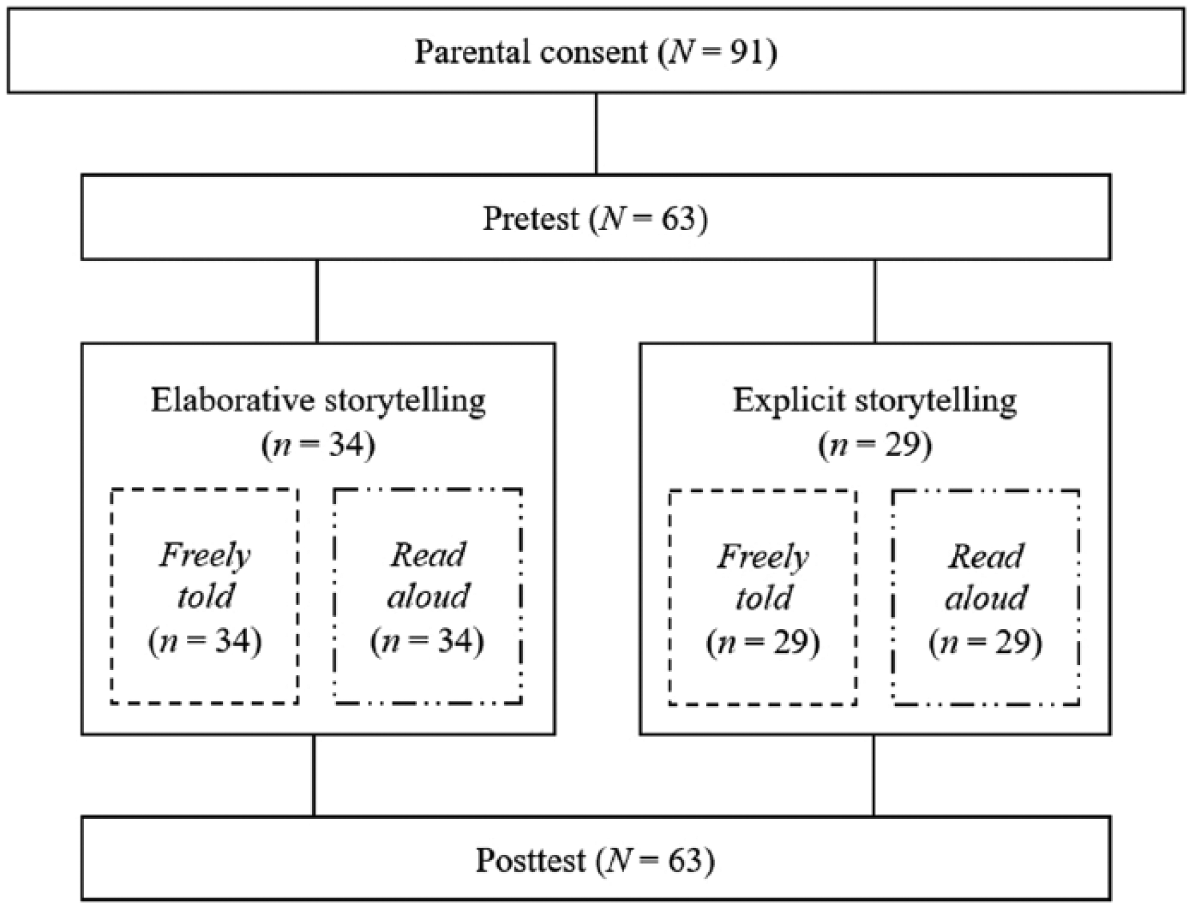
Overview of the mixed design with storytelling style as between- and story delivery as within-factor.
Measures
Receptive target vocabulary
The selection of target stimuli for the stories proceeded as follows. In a first step, words estimated to be unknown to the children by the first and third author were chosen from the stories and where no suitable words could be found because these were deemed to be too easy, words were replaced by a less known synonym. We ensured that target words appeared (a) not more than once in the story, (b) not in the other fairytale used in the study, (c) without explanation in the story, and (d) evenly throughout the stories. Next, the target words were checked for frequency of occurrence in children’s books using a lexical database of children’s literature childLex (Schroeder, Würzner, Heister, Geyken, & Kliegl, 2015) and words with a type frequency of more than 20 were not used as targets. The final list comprised 20 words – eight nouns, six adjectives, and six verbs – from each story, thus a total of 40 target words.
Additionally, 20 control words not appearing in the stories, matched on word type and frequency in childLex, were chosen from other stories in Grimm’s Fairy Tales (Grimm, Grimm, & Rölleke, 2003). To ensure equivalence of the target words from the two fairytales and control words, the three word lists were compared for type frequency, number of syllables, and bigram frequency, an indicator for how common a word sounds in the respective language (Rice & Robinson, 1975). A MANOVA showed no effect of word list on these three variables, p = .34.
An author-generated picture vocabulary test was used to measure children’s pretest and posttest receptive target and control word knowledge. The vocabulary test followed the structure of the Peabody Picture Vocabulary Test–4th edition (PPVT-4; Dunn & Dunn, 2007) – children were shown four pictures, one target picture and three distractors, and the experimenter orally presented the test item and the children pointed to the corresponding picture. Each picture appeared four times, once as target and three times as a distractor. Because the resulting test duration was too strenuous for some of the children, 17 participants (26.98%) were administered a shortened pretest containing only half of the target words. Pretest scores did not differ between those given the partial (M = 42.75%, SD = 14.12) and those given the full pretest (M = 42.28%, SD = 13.28), t(61) = .12, p = .90, therefore full-test estimates were calculated based on available pretest data for all participants. Accordingly, scores could range between zero and 40. The internal consistency of the vocabulary test across the entire response spectrum was estimated using Cronbach’s alphas as α = .70 for pretest and α = .80 for posttest.
Children’s story retelling
At posttest, children were asked to retell the stories to a hand puppet (see Reese, Sparks, & Suggate, 2011). To prompt the retelling, experimenters read the first sentence of the fairytale. If the child did not start telling the story, the experimenters then read the first half of the next sentence. After that the experimenters did not give any additional information regarding content, aside from encouraging the children to retell more by acting interested and asking questions not related to content. The retellings were recorded and transcribed.
In rating the retellings, stories were divided into memory units similarly to McKeown and Beck (2014). A memory unit was defined as a single piece of information that was provided in the story. For example, the sentence After the bandits had left, the girl saw the disaster was divided into two memory units, namely After the bandits had left and the girl saw the disaster. In total, this resulted in 78 and 64 memory units for the two stories, The Old Woman in the Forest and The Queen Bee, respectively. Children received points for memory units when they provided information representing the gist of the unit. Transcripts were rated and inter-rater reliability was calculated for 10 transcripts per story. Cohen’s kappas of .88 and .87 were reached for The Queen Bee and The Old Woman in the Forest, respectively, indicating substantial agreement (Landis & Koch, 1977).
General vocabulary
Children were assessed for their general receptive and expressive vocabulary using the German adaptation of the Wechsler Preschool and Primary Scale of Intelligence-III (WPPSI-III; Petermann, Ricken, Fritz, Schuck, & Preuß, 2014), a normed individual test for the assessment of cognitive abilities of children. The receptive vocabulary subtest consists of 31 target words of increasing difficulty, with a target picture and three distractor pictures and the test is discontinued after five consecutive incorrect or missing answers. Expressive vocabulary was tested with the subtest comprising 26 words of increasing difficulty. The child is presented with a picture and is asked to name the object. The discontinue criterion is reached after five consecutive incorrect or missing answers and the maximum score is 26 points.
In vivo observational ratings
Children’s behavior
Children’s behavior during the story sessions was rated on five-point Likert scales by the first and third author immediately after the sessions. Inter-rater reliability was calculated for 20% of the story sessions, indicated in brackets. Children’s behavior was rated for restlessness (ICC [intra-class correlation coefficient] = .85), attentiveness (ICC = .78), constructive interaction (ICC = .44), and disrupting the storytelling or reading (ICC = .38). Due to poor inter-rater agreement the latter two variables were not included in the analysis.
Storyteller’s behavior
The storytelling sessions were rated by the first and third author on a five-point Likert scale for storyteller behavior and fidelity of storytelling implementation. The behavioral variables included (a) how often gestures were used, (b) variation in storyteller’s voice regarding dynamics, intonation, and intensity, (c) how rapidly the storyteller or reader spoke, and (d) how much eye contact was made with the children. Inter-rater reliability was estimated as ICC = .96 for gesticulation, ICC = .69 for voice variation and ICC = .71 for rate of speaking, but poor for eye contact (ICC = .19), which was subsequently excluded from the analyses. For fidelity of implementation of the storytelling condition ratings tapped how well the storytelling accurately followed the original story, for which a good reliability was obtained (ICC = .83). The appearance of target words and the respective word explanations or elaborative techniques were counted later from audio recordings of the story sessions. From a total of 30 recordings of the storytelling sessions, two were missing due to technical problems. Length of the stories was also recorded.
Demographic questionnaire
Parents filled out a questionnaire assessing demographic variables including the country of birth for both parents and the child, years of residence in Germany, the parents’ highest level of education and occupation (ranging from 1 = no secondary school qualification to 5 = university degree), and languages spoken at home.
Materials
Stories
As outlined, the stories used for the intervention were selected from a compendium of 200 fairytales (Grimm et al., 2003). In selecting these, we had to consider several factors: Apart from being unfamiliar to the children, the fairytales had to be age-appropriate in content, style, and length, and provide enough vocabulary unknown to the children. Accordingly, the two stories The Old Woman in the Forest and The Queen Bee were selected, both of which follow a classic fairytale plot. The stories were 839 and 735 words long, and when read aloud, both lasted between 5 and 6 minutes. After making small adjustments to improve readability and language, the final versions of the stories were analyzed for readability (Björnsson, 1968) using an online tool (W. Lenhard & A. Lenhard, 2011). The readability indexes were nearly identical for both stories (40.06 vs. 40.59) and indicated suitability for children.
Procedure
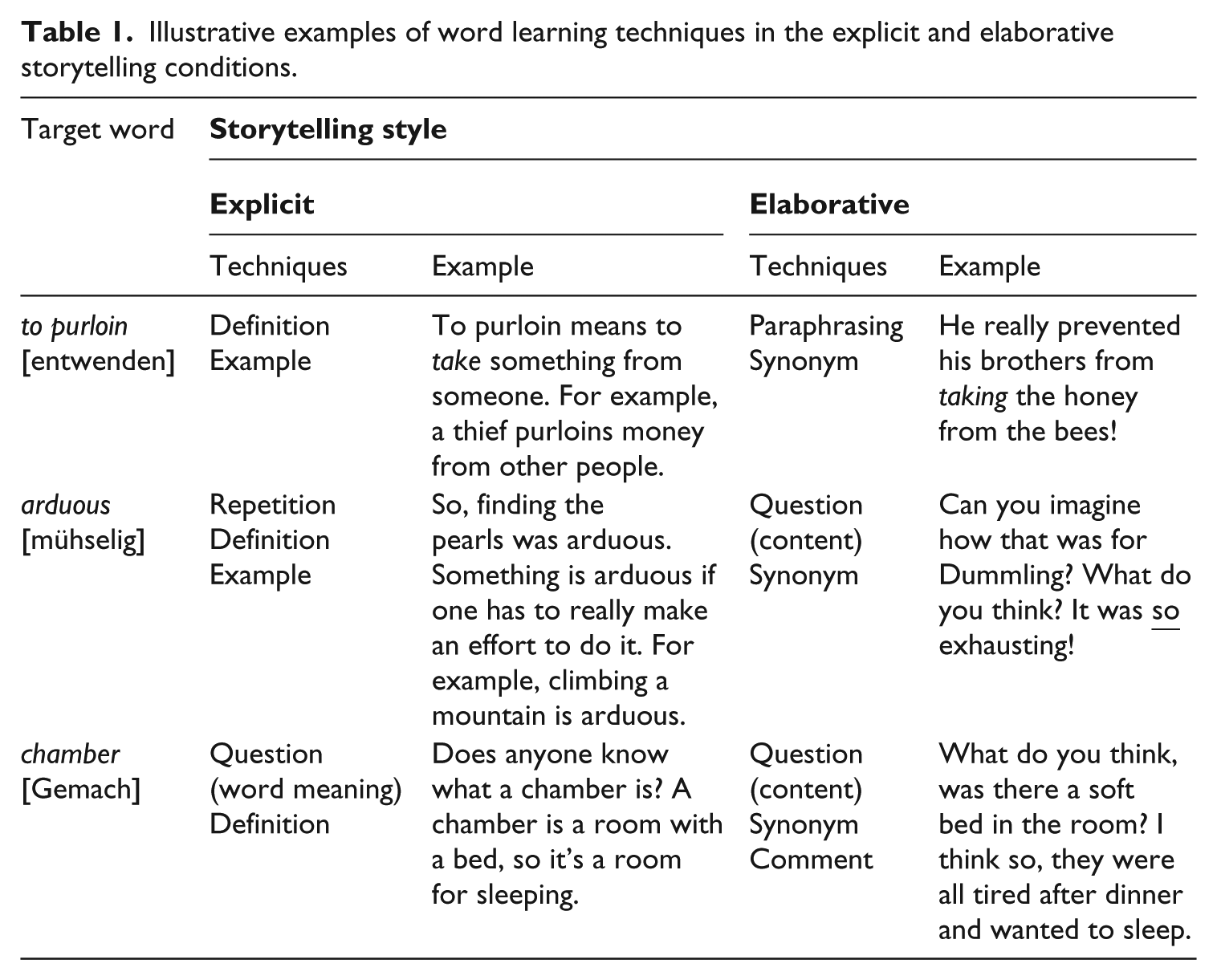
Two different storytelling styles, explicit and elaborative, were created using different techniques for either explicitly supporting learning of target words or elaborating the story around the target word (see Table 1 for illustrative examples). In each session, five new target words were accompanied with the corresponding explicit or elaborative storytelling techniques and five were never accompanied with a technique. Thus, across all sessions 10 of the 40 target words appeared incidentally (5 per story) because they were not presented with an explicit/elaborative technique and in total 30 target words (5 per story, twice per day, across 3 days) were accompanied by techniques supporting vocabulary learning (15 per story).
Illustrative examples of word learning techniques in the explicit and elaborative storytelling conditions.
Explicit condition
Consistent with explicit vocabulary instruction (Marulis & Neuman, 2010), in the explicit condition children were provided with prompts and information that directly related to word meanings. Target words were explained with definitions (e.g., ‘To flout means making fun of someone’, see Table 1) and examples (e.g., ‘Climbing a mountain for example is an adventure’). Furthermore, children were asked whether they knew the word (e.g., ‘Do you know what to wed means?’).
Elaborative condition
In the elaborative condition, learning of target words was supported with techniques designed to scaffold children’s awareness of what is semantically occurring around the target words by providing additional contextual information. Direct explanation of the explicit meaning of target words was excluded, thus maintaining the flow of the story. Furthermore, elaborative cues were placed in order to support children’s engagement in and appreciation for the story (see Table 1). Techniques included the use of synonyms (e.g., ‘Yes, they made fun of their poor little brother’; target word: to flout), elaborations (e.g., ‘The two brothers really wanted to stir up the anthill!’; target word: to churn up), closer descriptions (e.g., ‘The rings sparkled and glittered like stars’), rhetorical questions (e.g., ‘What might they have seen through the opening?’), and gestures accompanying target words (e.g., pretending to catch something in mid-air while saying the words to snatch). Children were also asked questions relating to the story (e.g., ‘What do you reckon, was it a big tree?’).
An effort was made to keep the two conditions similar in interactivity and to employ a similar number of techniques to prevent confounding storytelling style with interactivity. Since in the elaborative condition more knowledge of the story was required for answering questions, interactivity was progressively increased in both groups throughout the experiment, starting with few questions in the first session and with more questions in the third.
Story delivery
The fairytales were either read aloud from a book or freely told. For the read-aloud condition, the vocabulary supporting techniques were inserted into the text, which were then placed in a fairytale book in order to create an authentic read-aloud situation. For the freely told condition, storytellers memorized the fairytales and the vocabulary supporting techniques and delivered these without support of the written story.
Storyteller training
Storytellers were four education science students, who were trained in reading and freely telling the stories. The fairytales were given to the students a few weeks before the beginning of the study and then practiced with the first and third author in three sessions. Special attention was paid to target words, making sure that these appeared in the free storytelling and that they were pronounced clearly and comprehensibly. Storytellers were also trained to read and tell the stories in a natural yet captivating way, to keep children interested and attentive. The first and third authors also ensured that the storytellers told the stories in a similar way in order to keep storyteller effects to a minimum. In addition, storytellers conducting the elaborative condition were trained in using gestures depicting target words.
The explicit and elaborative groups were conducted by different storytellers in each kindergarten to avoid potential difficulties in switching from an elaborative to an explicit style. Storyteller effects were controlled for by balancing storytellers across conditions, such that halfway through the experiment, storytellers switched from one didactic style to the other. The project was approved by the human ethics committee of the University of Würzburg.
Results
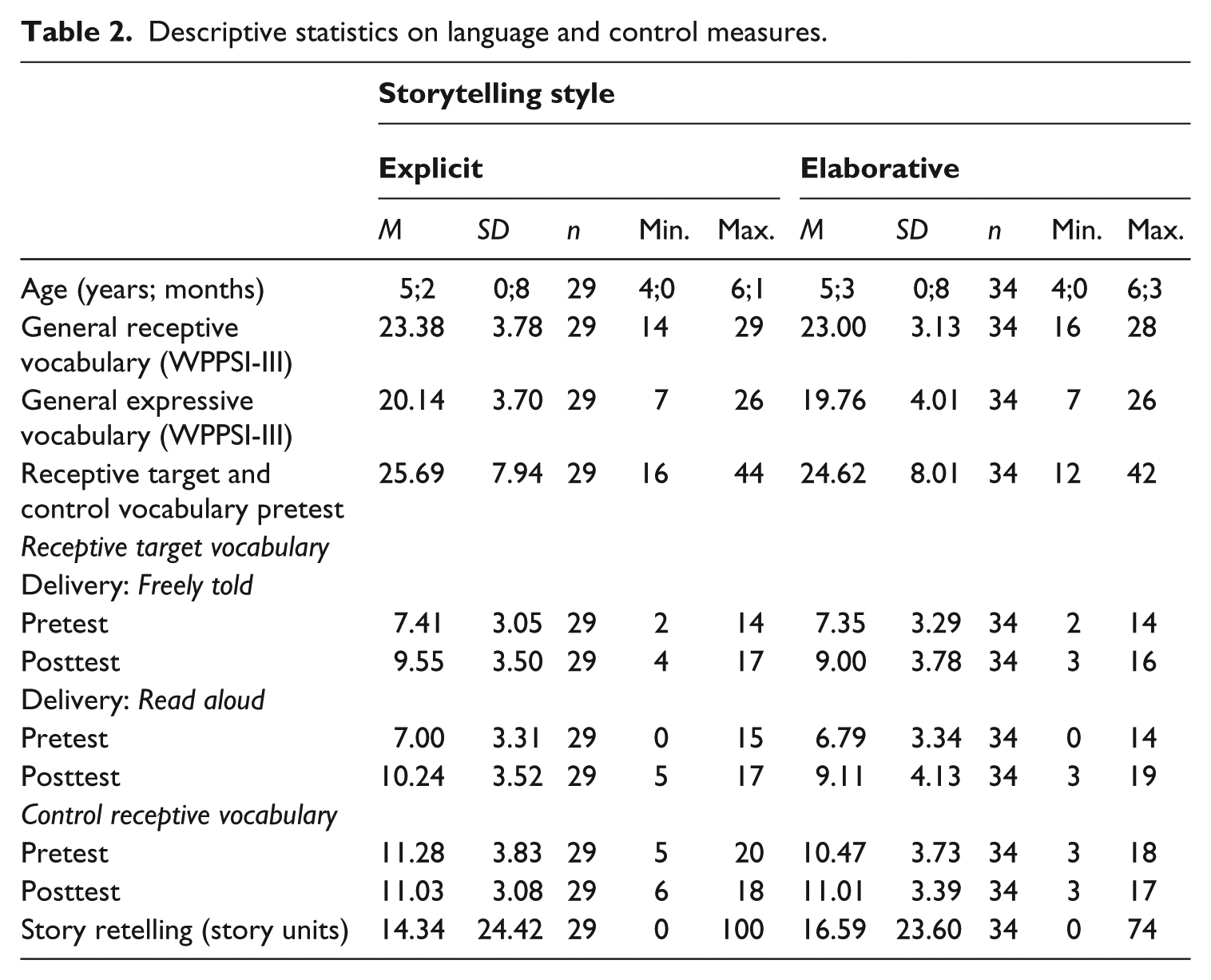
Descriptive statistics for the language variables as a function of group assignment to the explicit or the elaborative conditions were calculated and these appear in Table 2.
Descriptive statistics on language and control measures.
Internal validity of experimental conditions
Fidelity of implementation
Across all storytelling sessions, 99.7% (SD = 0.78) of target words and word explanations or techniques were delivered by storytellers. When stories were read aloud, all target words appeared. When stories were freely told, one target word each was missing in four sessions due to storyteller error, resulting in a total appearance of 99.3% (SD = 1.75). Regarding storyteller effects, a Kruskal–Wallis H test showed that there was no significant difference in target word appearance between storytellers, χ2 (3, 29) = 5.26, p = .11. Measured on a five-point Likert scale, freely told stories scored a mean of 4.35 (SD = 0.60) for following the original story, indicating close to full retelling fidelity.
Equivalence of experimental conditions
A MANOVA showed that there was no difference between explicit and elaborative condition in participant age, general receptive vocabulary, general expressive vocabulary, pretest overall vocabulary, or attendance at storytelling sessions, p = .90. Groups also did not differ on language spoken at home (German vs. other language & German), p = .34, gender, p = .71, or highest parental education, p = .10.
Storyteller behavior
The storytelling styles and delivery methods were analyzed for differences in storyteller behavior, namely voice variation, speaking rate, and the use of gestures. A MANOVA revealed that storytellers used more voice variation in the elaborative condition (M = 4.20, SD = 0.82) than in the explicit condition (M = 3.75, SD = 0.81), F (1, 53) = 4.45, p = .04, ηp2 = .08. Speaking rate was higher in the explicit condition (M = 3.52, SD = 0.55) than in the elaborative condition (M = 3.15, SD = 0.68), F (1, 55) = 5.14, p = .03, ηp2 = .09. Gestures were used more in the elaborative (M = 3.69, SD = 0.82) than in the explicit condition (M = 1.13, SD = 0.43), F (1, 55) = 220.90, p < .01, ηp2 = .80. Regarding delivery method, storytellers used more voice variation when stories were freely told (M = 4.24, SD = 0.69) than when they were read aloud (M = 3.68, SD = 0.88), F (1, 55) = 7.21, p = .01, ηp2 = .12. No difference between delivery methods was found for speaking rate, p = .23, or use of gestures, p = .40.
Effect of storytelling on language
Control words
To test the hypothesis that mere exposure to a list of words results in learning, a list of control words not appearing in the stories was tested at pre- and posttest. There was no significant gain from pre- to posttest, no difference between groups, and no significant interaction, ps > .25.
Target words
Target words were subjected to a repeated-measures ANOVA with time (pre vs. post) and delivery modality (freely told vs. read aloud) as within-factors and storytelling style (explicit vs. elaborative) as a between-factor (see Figure 2). There was a huge significant main effect of time, F (1, 61) = 72.34, p < .001, ηp2 = .54, with gains from pre- to posttest. No main effects were found for storytelling style, p = .50, or delivery modality, p = .89, and interaction effects were not significant, ps > .18.
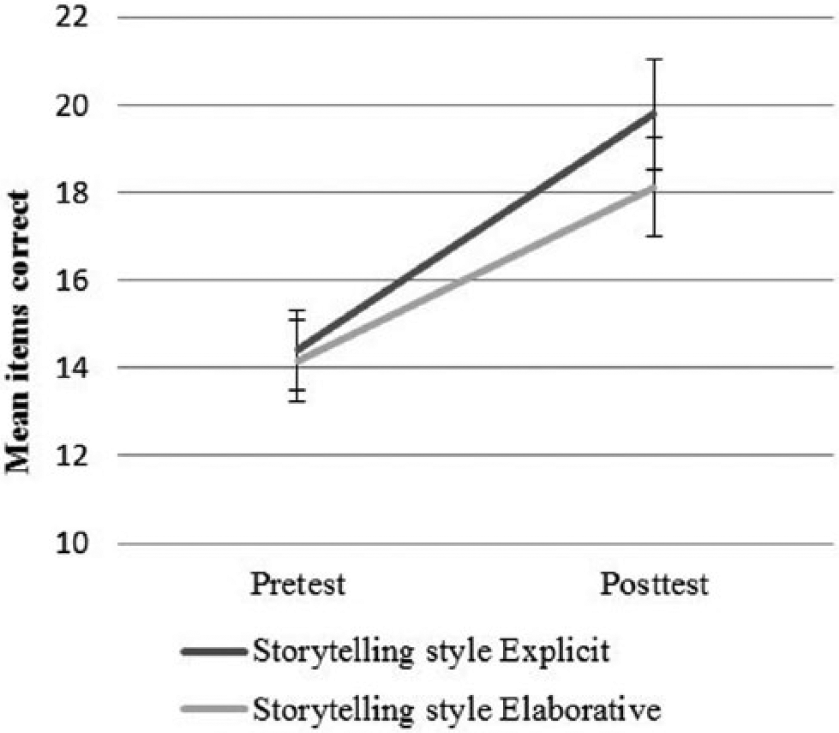
Mean items correct on receptive target vocabulary at pre- and posttest as a function of storytelling style. Error bars represent ± 1 SE.
Explained versus incidental words
Given that 75% of the words were accompanied by a technique to facilitate acquisition (either explicit or elaborative), we tested whether these words were more likely to be correct at posttest. The ratio of explained versus incidental words was 3:1, thus calculations were performed with percentages. Mean percentages at posttest were analyzed with a mixed ANOVA, with storytelling style (explicit vs. elaborative) as a between-subjects factor and explanation (explained vs. incidental) as a within-subjects factor (see Figure 3). There was a large main effect of explanation, F (1, 61) = 10.23, p = .002, ηp2 = .14, with explained words (M = 48.61%, SD = 18.29) scoring higher than unexplained words (M = 42.90%, SD = 18.31), and an interaction between storytelling style and explanation, F (1, 61) = 6.14, p = .02, ηp2 = .09. A simple main effects analysis showed that scores for explained words were 11% higher than incidental words in the explicit storytelling group, p < .001, while there was no difference between explained and incidental words in the elaborative storytelling group, p = .60. No main effect of storytelling style was found, F (1, 61) = .21, p = .65, ηp2 = .003.

Mean receptive target vocabulary correct (%) at posttest as a function of storytelling style. Error bars represent ± 1 SE.
Story retelling
Story unit scores were not normally distributed due to floor effects (48% zero scores). An exact Mann–Whitney U test showed that the ranks did not differ between the elaborative (Mdn = 4.5) and the explicit storytelling condition (Mdn = 2.0), U = 467, z = −0.37, p = .72, r = −.05. No difference was also found for story units between freely told (Mdn = 1.0) and read aloud (Mdn = 1.0) in an exact Wilcoxon signed rank test, z = −1.45, p = .08, r = −.13.
Effect of storytelling on child behavior
Children’s scores on the variables restlessness and attentiveness during storytelling were analyzed and subjected to a mixed ANOVA with storytelling style as between- and delivery modality as within-factor. A marginally significant, but descriptively large sized main effect of storytelling style was observed, F (1, 21) = 3.89, p = .06, ηp2 = .16, with children in the explicit conditions showing more restless behavior (M = 2.13, SD = 0.89) than in the elaborative conditions (M = 1.52, SD = 0.51). No main effect of delivery modality was found, F (1, 21), p = .33, ηp2 = .04. However, a descriptively very large and significant interaction of storytelling style and delivery modality emerged, F (1, 21) = 6.94, p = .02, ηp2 = .25. A simple effects analysis showed that this interaction resulted from the fact that in the explicit group more restlessness was observed when stories were read aloud (M = 2.38, SD = 0.93) than when they were freely told (M = 1.88, SD = 1.00), p = .02, whereas in the elaborative group there was no difference in restlessness between stories being read aloud (M = 1.41, SD = 0.49) or freely told (M = 1.64, SD = 0.64), p = .27. For attentiveness, no main effects or interactions were found, ps > .16.
Discussion
In the current experiment, we contrasted two approaches for fostering vocabulary development in preschool children in storytelling settings. The first established gold-standard approach involved explicit techniques providing definitions and explanations of difficult lexical items. Consistent with previous work (Marulis & Neuman, 2010), children exposed to this explicit storytelling condition experienced very large gains (ηp2 = .55) in target receptive vocabulary from pretest to posttest.
However, the novel feature of the current design was our pioneering of a different approach, in which children were not explicitly taught word definitions (Coyne et al., 2007; Elley, 1989; Maynard et al., 2010; Penno et al., 2002) but in which word learning was facilitated by adding contextual information and increasing children’s interest and engagement in the stories. Importantly, children were exposed to an identical number of words with accompanying techniques designed to facilitate the quality of the storytelling in both the elaborative and explicit conditions; these, however, varied appreciably in approach. As reported for the explicit condition, gains from pretest to posttest were also large and significant (ηp2 = .54). Thus, both the explicit and elaborative conditions resulted in large gains. Moreover, due to our inclusion of a list of control words selected to be similar to the words targeted in the stories – that showed no significant gains from pretest to posttest – we can rule out the unlikely possibility that gains were due to testing effects.
In terms of comparing the explicit and elaborative conditions, we found mixed evidence for the hypothesized differential effects. First, the elaborative and explicit groups resulted in nearly identical gains on target receptive vocabulary (main effect of storytelling style ηp2 = .01). This suggests that storytelling interventions employing elaborative techniques can be as effective as those employing explicit techniques. However, comparing target words appearing incidentally to target words accompanied by word-learning techniques at posttest, children in the explicit condition were more likely to acquire target words accompanied by an explicit technique than those incidentally presented. In the elaborative condition, no such difference was observed. Future research should continue to explore whether incidental learning of unexplained words differs for elaborative and explicit approaches and the mechanisms of how explicit and elaborative techniques relate to word learning.
Contrary to hypotheses, we did not find any significant advantage for the elaborative condition in terms of story memory. It should be noted that story memory was plagued with floor effects, and so these findings should be interpreted with caution. Considering children’s behavior, children in the elaborative condition did appear less restless during the storytelling. A medium effect size suggests that using an elaborative storytelling style could be beneficial for children’s behavior when listening to stories, although the marginal significance warrants more research with larger sample sizes. An intriguing finding was that reading stories aloud resulted in greater restlessness in the explicit but not the elaborative condition. A possible explanation is that due to the non-explicit, story-focused style in the elaborative condition, telling stories freely did not bring any additional benefit, whereas in the explicit condition, this seemed to keep children’s attention.
Corresponding differences between conditions were also found in storyteller behavior. Storytellers in the elaborative conditions used more voice variation than in the explicit condition, especially when stories were freely told. Storytellers in elaborative conditions also spoke more slowly than in the explicit conditions and used more gestures, the latter finding being expected since the use of gestures was planned in the elaborative condition. That, however, these delivery differences did not in turn lead to differences in vocabulary gains or story-retelling might be due to the short duration of this study, or a saturation effect, whereby delivery features only affect language learning to a certain point.
Interestingly, we found no effects of delivery modality on target-vocabulary gains. We had expected that freely telling the story would constitute an inherently more engaging delivery, thus bolstering vocabulary acquisition. The findings therefore did not replicate those of Suggate et al. (2013), who found that telling stories freely to primary school children resulted in marginally greater gains than a read-aloud condition. Four factors appear important in explaining these divergent findings.
One possible reason for the difference in findings was the age of the children. Perhaps in preschool children read aloud and free telling are similarly effective. Second, in the current study children were exposed to each story three times in contrast to only one exposure in Suggate et al. (2013), which might have reduced the added bonus of free storytelling. Third, the delivery modalities might have not been different enough to produce differential findings (see also Lenhart, Lenhard, Vaahtoranta, & Suggate, 2017). In order to ensure the comparability of conditions, storytellers learned the stories by heart and delivered them almost word for word, clearly constituting a different situation than when stories are told spontaneously and more variably. Fourth, it is possible that our storytelling style rendered story delivery redundant. Suggate et al. (2013) suggested that the inherently greater interactivity (eye contact, voice modulation) in the free-telling condition was responsible for the greater vocabulary gains. Accordingly, perhaps our experimental teasing apart of storytelling style in the elaborative and explicit conditions effectively captured the differences in interactivity inherent in Suggate et al. such that there was experimentally no added variance attributable to story delivery.
A further novel feature of our study warranting discussion is the use of fairytales as story material. Although sanitized Disney versions are an integral part of Anglo-American culture, traditional fairytales have a checkered history, with objections concerning old-fashioned language usage, gender stereotyping, and the often-grim endings. Casting aside socio-cultural considerations and restricting analysis to language development, we note that the complex and old-fashioned language did not appear to impede vocabulary development, with large effect sizes of a similar magnitude to those obtained in other work (Beck & McKeown, 2007; Marulis & Neuman, 2010) found here. Further, our experiences in the current study lend themselves to the conclusion that (well-chosen!) fairytales provide a rich source of language and content that constitutes inherently interesting and hence motivating language material for preschool children.
Although a clear strength of the current work is the experimental design, one key limitation is the short-term duration of the experiment. Therefore, longitudinal studies are necessary to investigate long-term effects and possible transfer effects to general vocabulary and thus examine the usefulness of elaborative storytelling as a language intervention. Second, we recruited a mixed sample containing a significant minority of children whose first language was not the study language. Future work should explicitly test whether the more direct methods of the explicit storytelling condition are particularly needed for lower levels of language proficiency or whether the elaborative techniques have a greater facilitatory effect on language development. One clear limitation is that testing did not include a measure of expressive target vocabulary, which might have delivered more differential results than a receptive measure. This should also be addressed by future research.
A challenge encountered in the current work was the difficulty in collecting measures of story memory. This was somewhat surprising, considering that a puppet was used to support production as in previous studies (Reese et al., 2011), yet constitutes a clear difficulty in studying expressive language with preschool children. A possible explanation for these difficulties is that children were not used to the task of retelling a story, or to doing this without the aid of pictures. The stories might also have been too long and complicated for children not used to this kind of task. These aspects should be considered when conducting future research. The techniques might also have emphasized vocabulary to the detriment of story comprehension, although this would be surprising given the attempt to avoid placing undue emphasis on vocabulary definitions in the elaborative condition.
A striking finding was the wide range of scores – while the majority of children were not able to reproduce anything from the stories, some children retold the stories almost word for word. This finding could point to shyness of many participants on one hand, and to underlying metacognitive abilities on the other hand. A further possible source for differences is storytellers’ behavior. Storytellers were encouraged to make eye-contact equally with all children, but although their overall implementation of eye-contact was investigated, we did not measure whether this occurred evenly across participants and hence lead to more engagement in some children. This could be investigated in future research.
The practical implementation of this approach also warrants discussion. We argue that the elaborative approach could present an alternative to established explicit techniques when parents or teachers want to engage children in stories and at the same time support vocabulary learning, albeit more research is required to confirm this. Although the elaborative storytelling is a new approach, it can be applied to shared reading situations with little effort by replacing explicit word teaching techniques with elaborative techniques suggested here. According to our findings, there seems to be no added advantage of free storytelling for vocabulary learning, although children seemed to benefit from free storytelling in the explicit condition in that they were less restless. Given that the stories were learned by heart in the present study, a question arises as to how a freer setting where the storyteller can rely on her/his own words and react more flexibly to the children would affect children’s attention, engagement, and word learning. Thus, although free storytelling seems not to be imperative for the effectiveness of the elaborative approach, it might be attractive for teachers or parents to use the elaborative style on well-known stories that can be told in their own words.
In summary, the current experiment adds to the existing literature on the effects of storytelling on vocabulary development and provides tentative experimental verification that a more elaborative approach emphasizing an inherently interesting storytelling style could be comparable to the gold-standard explicit approach – with possible benefits for child engagement during storytelling. More child engagement during storytelling could in turn have cumulative positive effects on vocabulary learning when employed over a longer period. However, more long-term work is needed to test this supposition.
Footnotes
Declaration of Conflicting Interests
The author(s) declared no potential conflicts of interest with respect to the research, authorship, and/or publication of this article.
Funding
The author(s) disclosed receipt of the following financial support for the research, authorship, and/or publication of this article: This work was supported by the German Research Council (Deutsche Forschungsgemeinschaft; DFG, grant number LE 2680/4-1).