




Abstract
This study reported the development and initial validation of the Survey of Parent/Provider Expectations and Knowledge (SPEAK), a self-administered questionnaire assessing expectations and knowledge about early childhood cognitive and language development. Development of the SPEAK was guided by the theory emphasizing the role of language input quality in young children’s language development. Items were refined through cognitive interviews (N = 29), expert consultations, and the first field test (N = 131). Rasch analysis following the second field test (N = 346) resulted in a 17-item SPEAK (α = .84); expert review confirmed its content validity. A third field test with low-income caregivers (N = 103) showed that higher SPEAK scores were correlated with higher education, receptive language ability, stronger endorsement of incremental mindset, and more language stimulation available to the child at home, supporting its concurrent validity. Findings provided preliminary evidence supporting the reliability and validity of the SPEAK to assess expectations and knowledge of early childhood cognitive and language development.
Keywords
Introduction
Research has documented substantial socioeconomic disparities in the language input children experience early in life (Hart & Risley, 1992; Hindman, Wasik, & Snell, 2016). Children living in poverty hear significantly fewer total words and fewer different words than their middle/high-class peers do during early childhood (Huttenlocher, Vasilyeva, Waterfall, Vevea, & Hedges, 2007). Such language input disparities contribute to differences in children’s vocabulary and language processing skills as early as the age of 18 months (Fernald, Marchman, & Weisleder, 2013). Despite the critical importance of language input on early childhood development, the field currently lacks a comprehensive tool that can reliably and validly assess the underlying knowledge, beliefs, and expectations presumed to influence adult input and behavior. Recognizing this gap, the Survey of Parent/Provider Expectations and Knowledge (SPEAK) was designed to assess adult knowledge and expectations about child cognitive development and language learning from birth through 5 years. To facilitate efficient survey administration, the SPEAK was designed as a quick, self-administered questionnaire to provide an overall estimate of expectations and knowledge.
Language disparities and importance of assessing knowledge
Compared with their more affluent peers, children in poverty are less likely to receive high-quality language exposure during the first four years of life (Huttenlocher et al., 2007). High-quality language environments (characterized by responsive parent–child interactions and/or parental supportive strategies for language learning) promote young children’s cognitive processing and vocabulary learning (Hindman et al., 2016). Language input disparities that young children experience in their home and childcare environments significantly contribute to differences in their cognitive and vocabulary development, and ultimately, to the educational and intellectual achievement gap (Roy & Chiat, 2013; Spencer, Clegg, & Stackhouse, 2012). Much work has been done to develop and implement parent-directed interventions in order to promote language skills and ultimately school readiness among low-income young children (Roberts & Kaiser, 2011). Enhancing the quality of home language environments through parent knowledge of child development is the basis of parent-directed home visiting interventions such as the Home Instruction for Parents of Preschool Youngsters (Palladino, 2015) and the Thirty Million Words Initiative (Suskind et al., 2015).
Longitudinal research with low-income families indicated that maternal knowledge of child development promoted maternal supportiveness of the child and in turn fostered child cognitive competence (Wacharasin, Barnard, & Spieker, 2003). Similarly, parent knowledge, mediated by parent literacy-oriented stimulation activities, contributed to toddlers’ emerging language competency (Zajicek-Farber, 2010). Through comparing families of varying socioeconomic status (SES), Rowe (2008) revealed that parent knowledge mediated the relation between SES and parent child-directed speech with toddlers, which predicted child vocabulary skills one year later. Parent knowledge also partially mediated the association between parent education and child language and pre-literacy skills (Rowe, Denmark, Harden, & Stapleton, 2016). In the studies reviewed above, parent knowledge of infant development has been assessed using the Knowledge of Infant Development Inventory (KIDI; MacPhee, 1981).
Other than language disparities at home, low-income children may also experience low quality of language exposure in non-home environments. Children under the age of 5 years spend a significant amount of time in the care of someone other than their parents (Landry et al., 2014). Disparities in language input have also been found in non-parental childcare arrangements (Laughlin, 2013). Low-income families tend to rely on informal childcare providers who usually have limited training or education (Fuller, Kagan, Caspary, & Gauthier, 2002), or low-quality center-based day care (National Institute of Child Health and Human Development [NICHD] Early Child Care Research Network, 2000). Children in these settings often have infrequent literacy-oriented activities and few give-and-take conversations with adults (Hindman et al., 2016). Efforts have been made to develop interventions that enhance the quality of childcare and early childhood education through building essential skills and knowledge for childcare providers and educators, for example, the Responsive Early Childhood Curriculum (Landry et al., 2014).
The expectations and knowledge of parents/providers are the building blocks supporting the theory of change for these language interventions. The key principle behind the theory of change is that increasing knowledge about child language development among parents/providers will lead to higher quality home/childcare language environments, which will in turn contribute to better cognitive and language outcomes for the children. Language input disparities consistently have a pronounced impact on child vocabulary development (Hoff, 2006); vocabulary learning is therefore the primary target as the measure of language development. The most proximal outcome of these parent-directed or provider-focused interventions is knowledge change. Thus, it is essential to have a reliable and valid measure of knowledge regarding early childhood cognitive and language development in order to evaluate the proximal effect of these early childhood interventions.
More importantly, the ability to assess the expectations and knowledge of expectant parents, first-time parents, or parents of very young children may enable practitioners and providers to educate these parents with further information and/or address common misconceptions regarding young children’s cognitive and language development. For example, a recent study found that first-time mothers were unsure of the rationale for using child-directed speech and sharing books with their infants even though they genuinely recognized the importance of early exposure to children’s acquisition of language and literacy skills (Whitmarsh, 2011).
Indeed, parents with more child-rearing experiences do not necessarily have more knowledge about optimal parenting strategies and/or child development (Morawska, Winter, & Sanders, 2009). For instance, using educational media to foster infant cognitive development is a common misconception for many parents (Zimmerman, Christakis, & Meltzoff, 2007b). Educating parents about child development and/or child-rearing may promote parenting self-efficacy among parents at different stages (Albarran & Reich, 2014; Winter, Morawska, & Sanders, 2012). Thus, a survey of parent expectations and knowledge of child cognitive and language development will help identify appropriate anticipatory guidelines and/or educational materials that address the needs of expectant, first-time, and/or experienced parents.
The present study reported the development and initial validation of a self-administered, criterion-referenced questionnaire assessing expectations and knowledge about early childhood cognitive and language development. The SPEAK can be used with parents at different stages, including first-time parents with no previous experience of child-rearing, expectant parents, parents of only children, and parents of later-born children. Rather than exclusively focusing on parents, this questionnaire can also be used with individuals providing care or services to typically developing young children and their families, including healthcare providers, childcare providers, social service providers, and early childhood educators.
Limitations of the existing measures/questionnaires
Educating parents and childcare providers about young children’s cognitive and language development is crucial to address the disparities in early language exposure and ultimately to narrow the achievement gap (Rowe et al., 2016). Importantly, having an effective measurement tool to assess parents’/providers’ expectations and knowledge specific to child cognitive and language development is essential for evaluating the efficacy of language interventions. Nevertheless, previous studies on parenting knowledge in early childhood have mainly examined parent understanding of young children’s overall development. The KIDI has been the most widely used measure of parent knowledge of infant development (Rowe et al., 2016; Zajicek-Farber, 2010). This inventory has been standardized based on college students, mothers, doctoral level psychologists, and pediatricians (MacPhee, 1981). It focuses on knowledge of parenting practices, developmental processes, health and safety guidelines, and norms and milestones regarding children’s growth from birth to 2 years of age. Even though 17 of 75 questions are devoted to child cognition or language development, the KIDI does not provide sufficient coverage of this crucial aspect of early childhood development. In particular, there is no avenue to generate a single score measuring parent expectations and knowledge of child cognitive and language development. Furthermore, the use of dichotomous (Agree/Disagree) response options, instead of Likert-like scales, makes it difficult to garner precise data on parent knowledge of child cognition and language development.
Given the limitations of the existing instrument, our previous work (Suskind et al., 2015) developed questions attempting to measure parent knowledge of young children’s cognitive ability, language acquisition, and math learning, as well as the impact of parent engagement and media use on child cognitive and language development. However, this set of questions was preliminary such that its psychometric properties had never been evaluated. The present study combined the original concepts with new items developed. To our knowledge, there is no validated measure to assess parents’/providers’ expectations and/or knowledge of young children’s cognitive development and language learning.
Theoretical base for the SPEAK
Development of the SPEAK was guided by the theory emphasizing the pivotal role of caregiver–child interactions and language input quality in young children’s vocabulary development and subsequent school readiness. Specifically, the SPEAK items were designed to capture expectations about the malleability of intelligence, understanding of the importance of early environments and experience, and perceptions about media exposure in cognitive and language learning among typically developing children.
Expectations about the malleability of intelligence
Caregivers are more likely to provide high-quality language environments when they perceive that their children’s cognitive and language abilities can be increased by their input (Moorman & Pomerantz, 2010; Pomerantz & Dong, 2006). Research showed that caregivers who perceived intelligence as static and resistant to change (entity mindset) displayed more unconstructive involvement in their children’s learning processes than mothers who perceived intelligence as malleable (incremental mindset; Moorman & Pomerantz, 2010). Caregivers with an entity mindset were likely to perceive their children as lacking competence in the face of challenge, and their children consistently had the poorest academic performance and motivation (Pomerantz & Dong, 2006). Thus, the expectations caregivers have about the malleability of intelligence contribute to the quality of the caregiver–child interactions as well as their involvement in children’s cognitive and language learning (Moorman & Pomerantz, 2010).
Understanding of the importance of early environments and experiences
An infant’s brain triples in size in the first two years of life (Knickmeyer et al., 2008). This rapid brain growth maximizes an infant’s capacity to learn new information and acquire language. The quality of early language environments plays a significant role in infant language acquisition during this critical window of early brain development (Hoff, 2013). Infants learn language most effectively when their caregivers intentionally ‘tune in’ to their communicative behaviors in a responsive and sensitive manner (Hamer, 2012). The reciprocal nature of social interactions and communications promotes infant cognitive development and learning of gestures, vocalizations, and language (Mermelshtine & Barnes, 2016; Rowe, 2008). Thus, the quality of early language environments is critical for cognitive development and vocabulary learning (Hindman et al., 2016). Specifically, caregiver–child attentional engagement at an early age has been shown to promote young children’s later vocabulary growth and language acquisition (Markus, Mundy, Morales, Delgado, & Yale, 2000; Morales et al., 2000). The ‘tuning in’ behaviors are associated with caregivers’ knowledge about child development (Donovan, Taylor, & Leavitt, 2007).
Conversational ‘turn-taking’ refers to continuous and non-simultaneous verbal exchanges in which young children and their caregivers provide prompt and contingent responses to one another’s preceding utterances (Bornstein, Putnick, Cote, Haynes, & Suwalsky, 2015). Caregivers’ responsiveness to and contingency with their young children’s verbal and exploratory initiatives have also been shown to significantly foster children’s advanced language skills (Tamis-LeMonda, Kuchirko, & Song, 2014) and promote caregiver–child conversational turns (Brassart & Schelstraete, 2015). Conversational turns with adult caregivers allow young children to practice and consolidate their newly acquired language skills and significantly promote their language development (Mendelsohn et al., 2010). Indeed, caregivers who better understand early childhood development are more likely to provide high-quality early language experiences for their young children (Vernon-Feagans et al., 2008).
Perceived impact of media exposure on young child cognitive and language development
The American Academy of Pediatrics (2001) recommends no screen time alone in the first two years of life and encourages parents to focus on social interactions with their infants to foster optimal child development. However, a substantially large portion of parents in the US are unaware of the recommendation (Zimmerman et al., 2007b). Many parents perceive media exposure (especially television programs or videos targeted for young children) as beneficial for infant cognitive development; they also consider media as a convenient, electronic babysitter (Vaala, 2014). Research shows that infants as young as 3 months old have regular media exposure (Zimmerman et al., 2007b).
Research also shows that young children before the age of 3 years can effectively learn vocabulary from media exposure only if the viewing is supported by social interaction with adults (Roseberry, Hirsh-Pasek, & Golinkoff, 2009). Television exposure without interaction with adults does not have educational or linguistic benefits for children at this early age (Mendelsohn et al., 2010). Importantly, a growing number of studies have indicated that television exposure is associated with reduced parent language input, parent–child interactions, and child participation in developmentally appropriate activities (Christakis et al., 2009). Both longitudinal and cross-sectional studies have also shown that daily television exposure during infancy has deleterious effects on children’s receptive and productive linguistic skills (Zimmerman & Christakis, 2005; Zimmerman, Christakis, & Meltzoff, 2007a). Media use is an essential component of our everyday lives. Thus, parent expectations and knowledge about media use directly shape the amount of media exposure young children receive and significantly contribute to their cognitive development and language skills.
Present study
In the present study, the process of developing and validating the SPEAK had three phases (see flowchart in Figure 1): (1) an initial item bank was developed and refined through an iterative process involving cognitive interviews, expert consultations, and field-testing; (2) reliability of the SPEAK items was field-tested; and (3) validity of the SPEAK items was evaluated through expert consultations and field testing. The Biological Sciences Division Institutional Review Board at the University of Chicago Medicine approved the present study. Statistical analyses were conducted in R version 3.3.0 (R Core Team, 2013) using the package ‘psych’ (Revelle, 2016) and the package ‘eRm’ (Mair & Hatzinger, 2007).
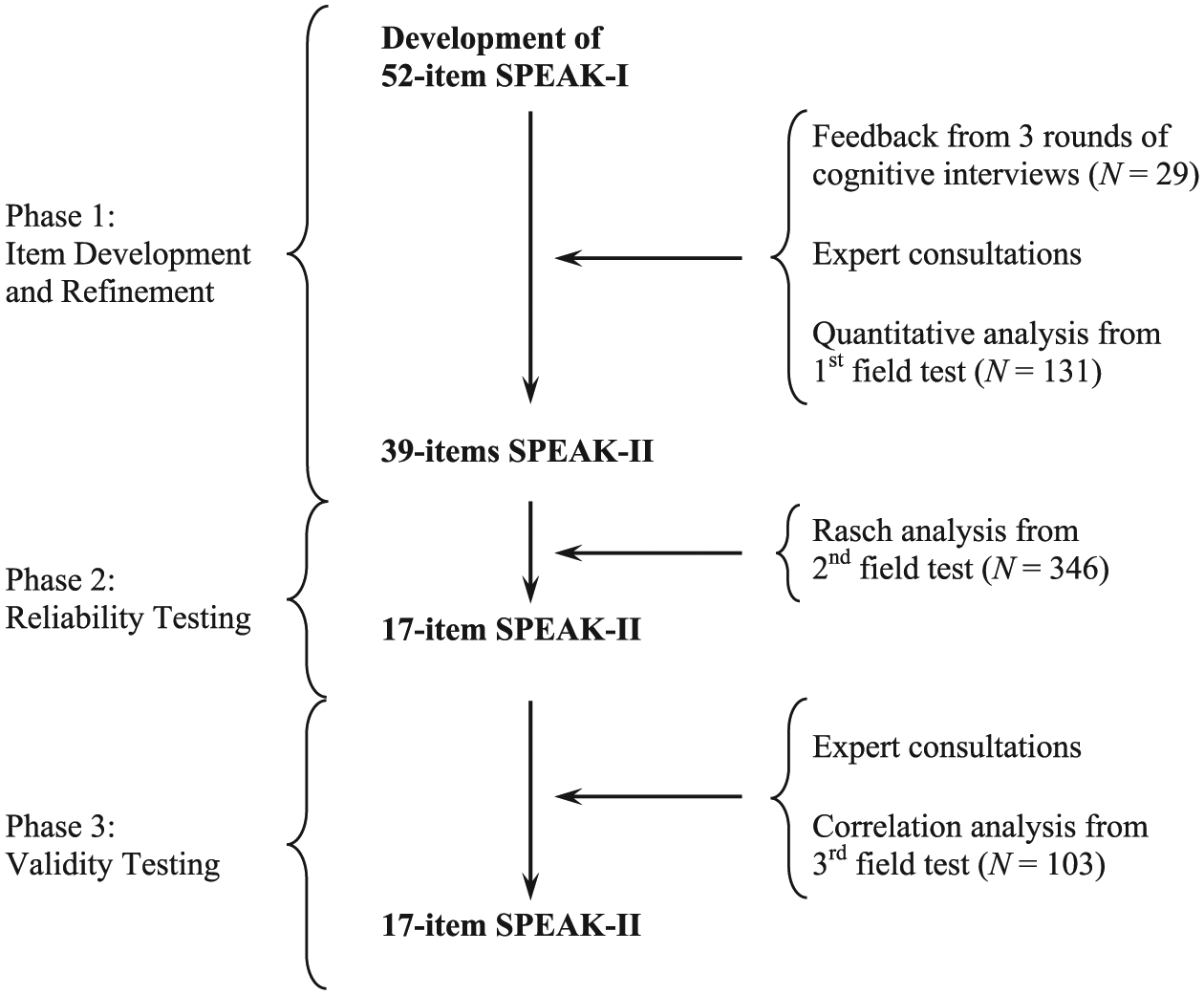
Flowchart on the SPEAK development, refinement, and psychometric testing.
Hypotheses
Concurrent validity of the SPEAK was tested in relation to five relevant, independent measures (education level, language ability, mindset about malleability of intelligence, parenting self-efficacy, and richness of the home language environment available to the child) in a sample of low-income caregivers in Phase 3. Five hypotheses were developed regarding these relations based on previous research. First, low-income caregivers with higher education levels were hypothesized to score higher on the SPEAK. Second, low-income caregivers with higher language ability were hypothesized to score higher on the SPEAK. Third, low-income caregivers with an incremental mindset were hypothesized to score higher on the SPEAK. Fourth, based on the argument that educating parents about child development may promote parenting self-efficacy, low-income caregivers who scored higher on the SPEAK were hypothesized to report higher parenting self-efficacy. Fifth, according to the theory of change, low-income caregivers who scored higher on the SPEAK were hypothesized to provide more enriched home language environments for their young children.
Phase 1: Item development and refinement
In Phase 1, three researchers in cognitive and language development, developmental psychology, and pediatrics developed an item bank to capture the expectations and knowledge that have been shown to relate to children’s cognitive and language development. Items were then refined through an iterative process involving three rounds of cognitive interviews, expert consultations, and the first field-testing (Appendix). During the process of testing items with cognitive interviews, techniques such as thinking aloud and verbal probing were applied to analyze how respondents interpret the item statements and process their responses to the items (Ryan, Gannon-Slater, & Culbertson, 2012).
Methods
Participants and procedure
In the three rounds of cognitive interviews, 29 participants were recruited from a public library, hospital, and survey lab in downtown Chicago to provide feedback on the SPEAK items. Each interview lasted approximately one hour; all items were probed with multiple participants. In the first field test, 131 participants were recruited from two survey labs in downtown Chicago to complete the SPEAK items. REDCap, a secure web application, was used for data collection and management (Harris et al., 2009). All participants provided consent and received $10/hour as compensation (see Table 1 for demographics).
Demographic characteristics of all samples.

Notes: Convenience sampling was used in cognitive interviews and field testings. Participants must be at least 18 years old and native English speakers. No participant was involved in more than one interview/testing. Participants in all interviews and the first and second testings did not have to be parents. Samples were recruited from multiple public places in diverse metropolitan areas and were heterogeneous in terms of age, education levels, and race/ethnicity.
In the second testing, 28.20% of the sample had one child, 41.20% had two, 17.60% had three, and 12.90% had four or more children. Almost three quarters (73.30%) were single and 15.20% were married. In terms of annual household income, 17.7% had less than $10,000, 11.90% had $10,000–$29,999, and 39.7% had over $75,000.
Statistical analyses
In addition to the three rounds of cognitive interviews, a panel of three experts in cognitive and language development commented on the instructions, order of the items, and response scales. Qualitative feedback from all interviews and expert consultations was incorporated when revising the SPEAK. Using data from the first field-testing, polyserial correlations were examined to assess the correlation between each item and the sum of all other items (Revelle, 2016). Overly low correlations might indicate the presence of unrelated items that compromise validity (Streiner & Norman, 2008). Items with correlations < .20 were discarded. Histograms of test scores were generated to explore heuristically whether the instrument showed acceptable variation in the scores.
Results
The item bank contained 52 items, designed to capture parent/caregiver: (a) attitudes toward ‘tuning in,’ ‘taking turns,’ and the role of early language exposure in promoting child language development; and (b) knowledge regarding children’s cognitive ability, language acquisition, and exposure to numbers and counting.
This first version of the SPEAK (SPEAK-I) was revised substantially based on the feedback from cognitive interviews, expert consultations as well as quantitative results. To address the feedback from expert consultations, wording of 2 items was revised to emphasize the importance of caregiver response to child gesture during toddlerhood and early exposure to shape and sizes. Survey instructions were edited to provide concise and straightforward directions. All items were rearranged in the order of developmental stages, starting from infancy to preschool to improve the flow of the questionnaire. To ensure consistent interpretations, terms referring to developmental stages were specified with appropriate age ranges (Appendix).
Quantitative analyses from the first field-testing revealed that 13 items had polyserial correlations < .20; these items were eliminated. A scale score was calculated based on the remaining 39 items; Cronbach’s alpha was .84 (Appendix). Out of 132 points, scores were high with relatively small standard deviation (M = 96.01, SD = 13.24; Figure 2(a)). Feedback from cognitive interviews indicated that many items were subtly agreeable such that participants would choose the correct responses, regardless of their true expectations and knowledge. The wording of 25 items was edited to eliminate leading statements, ambiguity, and redundancy; 14 items did not require any changes. With these changes implemented, the 52-item SPEAK-I was revised into the 39-item SPEAK-II.
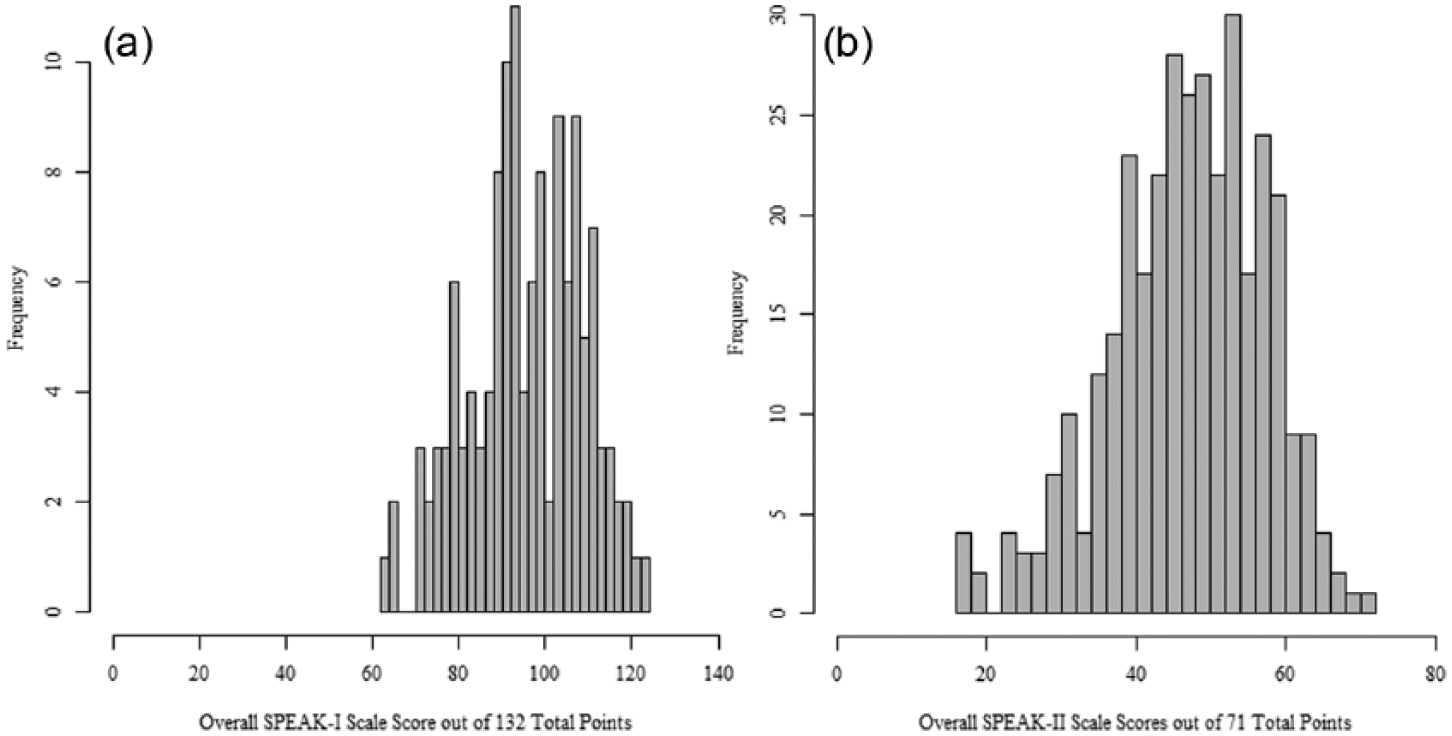
Histogram of the SPEAK scores. (a) Distribution of scores for the 52-item SPEAK-I at first field-testing; (b) Distribution of scores for the 17-item SPEAK-II at second field-testing.
Phase 2: Reliability testing
In Phase 2, the reliability of the 39-item SPEAK-II was tested in the second field-testing.
Methods
Participants and procedure
In Phase 2, 346 participants were recruited from two survey labs in downtown Chicago and one public charity event in New York City (see demographic characteristics in Table 1). Participants at the survey labs received $10/hour as compensation; participants at the event completed the survey voluntarily because providing cash incentive was not feasible onsite. All participants provided consent for their participation. Data were collected and managed using REDCap.
Statistical analysis
Responses to the 39 SPEAK-II items were modeled using a Rasch partial credit model (Masters, 1982). The Rasch model generates an overall estimate of the respondent expectations and knowledge of child cognitive and language development. The Rasch partial credit model is appropriate for the SPEAK because not all items share the same response scale and the same number of response options. Goodness-of-fit for items under the Rasch partial credit model was diagnosed according to the information-weighted mean square (infit MnSq) and the outlier-sensitive mean square (outfit MnSq) statistics. Both statistics compare the observed variance in the data against the theoretical variance under the model. MnSq statistics higher than 1.30 indicate excess variability in the data compared to the model (i.e., randomness in participant responses); MnSq statistics lower than 0.70 indicate highly predictable data structures (i.e., redundant response patterns). In either case, aberrant items should be removed. Items with polyserial correlations lower than .20 should also be removed as these items appear to be unrelated to each other, compromising validity. To ensure no biased item interpretations due to participant characteristics, residuals from the Rasch model were examined to assess differential item functioning (DIF) by age, gender, education, income, and whether the participant was a parent or not (Swaminathan & Rogers, 1990).
Results
Out of the 39 SPEAK-II items, 8 items were removed due to confusing wording and 14 items were removed due to poor fit statistics or low polyserial correlations. The remaining 17 items had acceptable item fits based on infit MnSq and oufit MnSq (Table 2), supporting the unity of these 17 items under the Rasch model. Specifically, 3 items were rated on a 6-point ordinal scale ranging from 0 (as an infant, 0–6 months) to 5 (in elementary school, 6 years and up) and 14 items were rated on a 5-point Likert scale ranging from 0 (strongly agree) to 4 (strongly disagree). A scale score was calculated for each participant using the same scoring approach of the SPEAK-I (Appendix). Reliability for the 17-item SPEAK-II was high with a Cronbach’s alpha of .82 and person-separation reliability of .84. The 17-item SPEAK-II had an overall Flesch Reading Ease score of 76.8 (ranging 0–100, with higher scores representing easier reading levels; Williamson & Martin, 2010), and typically read at a 6.7 Flesch–Kincaid Grade level (a readability test of the comprehension difficulty of a standard English passage, scored as the normative reading level for US school grades).
Results of the Rasch model for the 17 SPEAK-II items.
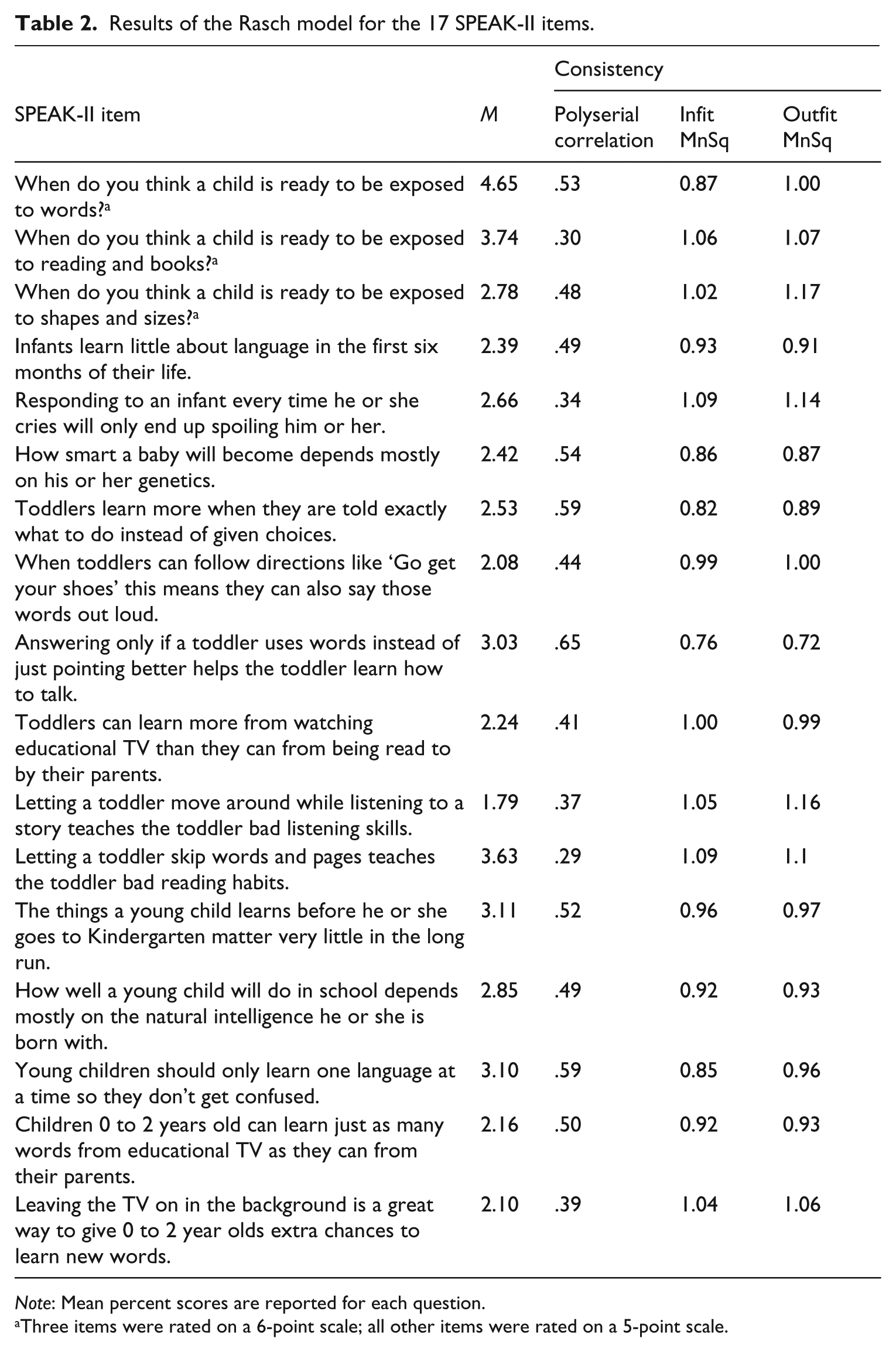
Note: Mean percent scores are reported for each question.
Three items were rated on a 6-point scale; all other items were rated on a 5-point scale.
The 17-item SPEAK-II was an improvement over the SPEAK-I in terms of the distribution of scores. Out of the 71 points, the mean score of the 17-item SPEAK-II was relatively close to the possible middle score, with a wide standard deviation relative to the overall score (M = 47.27, SD =10.33; Figure 2(b)). Residual analysis revealed no issues with differential item functioning (DIF). Analyzing the residuals from the Rasch model, there was no strong linear trend associated with respondent characteristics of age, gender, education, income, and parent status. Across all questions and all attributes, the distribution of DIF effects was small, M = 0.00 point, SD = 0.16, with no outliers above ±0.40 points.
Phase 3: Validity testing
In Phase 3, content validity of the 17-item SPEAK-II was evaluated through expert consultations and concurrent validity was examined in the third field-testing.
Methods
Participants and procedure
One hundred and thirty-nine participants were drawn from a study on language development with low-income caregivers of 13- to 16-month-old children in Chicago. They were recruited through postings at day-care centers, health clinics, local stores, public transportation, and community organizations serving low-income populations. Participants provided written consent for their participation.
Participants were given a Language Environment Analysis (LENA) device to complete on average 36 hours of audio recordings with their children during everyday activities at home. The LENA device generates hourly estimates of adult words spoken near the child (adult word count) and conversational turn-taking between the child and an adult (conversational turn count; see Suskind et al., 2015 for details). Participants then reported their demographic information and completed the SPEAK, the Theory of Intelligence (TOI; Dweck, 1999), the Peabody Picture Vocabulary Test-Parent (PPVT-Parent; Dunn & Dunn, 2015), and the Tool to Measure Parenting Self-Efficacy (TOPSE; Kendall & Bloomfield, 2005) during a home visit. They received $25 for completing the audio recording and $25 for filling out the surveys (see Table 1 for demographics).
Statistical analysis
Correlation analyses were conducted to examine whether the 17-item SPEAK-II scale score was significantly associated with education level (examined as a 7-level ordinal variable using polyserial correlation), receptive language ability (PPVT-Parent), theory of intelligence (TOI), parenting self-efficacy (TOPSE), and language stimulation available to the child at home (adult word count and conversational turn count based on LENA recordings) among low-income caregivers.
Results
Feedback from expert consultations and findings from the third field-testing both supported the validity of the 17-item SPEAK-II. All three experts indicated that the 17 SPEAK-II items appropriately measure the concepts regarding early childhood cognitive and language development, confirming the content validity of the SPEAK-II.
The 17-item SPEAK-II was examined in the third field-testing with low-income caregivers; Cronbach’s alpha for this sample was .84 and person-separation reliability was .85. Significant correlations with four relevant measures provided initial evidence supporting the concurrent validity of the 17-item SPEAK-II (Table 3). In support of the hypotheses, caregivers with higher education levels or language ability were likely to score higher on the SPEAK-II. A negative association between the SPEAK-II and the TOI indicated that caregivers with an incremental mindset were likely to have a higher SPEAK-II score. A higher SPEAK-II score was also associated with higher adult word count and conversational turn count.
Correlation between the 17-item SPEAK-II scale score and the five relevant measures.

p < .10, *p < .05, **p < .01, ***p < .001.
Low TOI scores indicate stronger endorsement with an incremental mindset, and vice versa.
Discussion
Behavioral intervention and public awareness campaign efforts have focused on promoting the importance of early cognitive and language development, and equipping parents and providers with tools to enrich their children’s early language environment. Nevertheless, there has been no instrument available to measure parent/provider expectations and knowledge about the significance of a quality home language environment and the role of social interactions in fostering young children’s cognitive development and language acquisition during early childhood. To address this limitation, the present study reported the development and initial validation of the SPEAK.
The 17-item SPEAK-II is a theoretically based self-administered questionnaire designed to assess expectations and knowledge of early childhood cognitive and language development. The SPEAK is a criterion-referenced questionnaire assessing evidence-based knowledge of young children’s cognitive development and language learning from birth to 5 years old. Each item targets information that pediatric professionals and developmental psychologists consider essential for caregivers, providers, and educators to know. This instrument measures knowledge against a research-informed criterion that minimizes subjectivity. In addition, the present findings indicated that the 17-item SPEAK-II efficiently differentiates caregivers with different levels of knowledge regarding early childhood cognitive and language development.
Previous research has shown that parents with higher education levels are more likely to possess knowledge about child development (Morawska et al., 2009; Rowe et al., 2016; Winter et al., 2012). Moreover, parents with higher language ability are more likely to provide richer and more complex language stimulation for their children (Vernon-Feagans et al., 2008). The present study revealed that low-income caregivers with higher education level or language ability scored higher on the SPEAK. Future studies should examine whether caregiver knowledge of early childhood cognitive and language development, as indicated by the SPEAK score, may be improved with intervention. Importantly, the highly significant positive association with language ability suggested that caregivers with higher SPEAK scores may have the potential to provide richer and more complex language stimulation for their children. Yet, this finding should be interpreted with caution as language abilities of caregivers was only assessed via receptive vocabulary in this study.
In support of the third hypothesis, caregivers with an incremental mindset had higher SPEAK scores, confirming that caregiver mindset about the malleability of intelligence was captured by the SPEAK as intended. Contrary to the fourth hypothesis, however, caregivers who scored higher on the SPEAK did not show a stronger sense of parenting self-efficacy. This lack of significant correlation might have explained the inconsistent findings in the literature (Morawska et al., 2009). Past research shows that ‘naively confident’ parents may feel very confident/efficacious in their parenting role, but they do not have adequate knowledge about child development and/or sufficient understanding of the complex nature of parenting (Morawska et al., 2009).
Nevertheless, low-income caregivers who had higher SPEAK scores provided a home environment with higher levels of language stimulation for their young children. Specifically, the adult word count and conversational turn count captured the naturalistic home language environments where language stimulation was not limited solely to the participant caregiver. Instead, the number of words spoken by adults around the child and the number of conversational turns the child took with adults at home were taken into account. The broader nature of the LENA estimates of home language environments might have been reflected in their significant yet moderate correlations with the caregiver SPEAK scores. These results were meaningful as caregivers with higher SPEAK scores were more likely to create enriched home language environments for their young children.
The 17-item SPEAK-II is a short and effective self-administered questionnaire, which can be easily implemented by researchers, practitioners, early childhood service providers, and/or educators to obtain an overall estimate of expectations and knowledge about young children’s cognitive development and language learning. The simple and straightforward scoring rubric of the SPEAK can be easily used in various settings where digital scoring may not be available. Using the 17-item SPEAK-II to measure parents’ or providers’ expectations and knowledge specific to child cognitive and language development will allow researchers to better understand the mechanisms linking knowledge to linguistic input available in the home, childcare, or early education environments, which in turn contributes to child language outcomes.
The 17-item SPEAK-II can also be applied as a measurement tool in the clinical setting for practitioners and healthcare providers to assess parents’ baseline understanding and address common misconceptions regarding young children’s cognitive and language development. In particular, the SPEAK items provide concrete and specific topics for practitioners and healthcare providers to educate or discuss with parents. Furthermore, information learned from the SPEAK will: (1) help identify the language intervention components that lead to changes in parents’ or providers’ expectations and knowledge versus behaviors, (2) fully evaluate the efficacy of the language interventions, and (3) facilitate improvement of language interventions.
Limitations and future directions
There are several limitations in the present study. Findings of the present study provided evidence supporting the reliability and validity of the 17-item SPEAK-II. Nonetheless, convenience sampling was used for the cognitive interviews and the first and second field tests, with limited demographic characteristics collected from participants. The psychometric analyses were also based on relatively small samples. Future studies should test this instrument using larger, more representative samples in order to add to the evidence base for the generalizability of its psychometric properties. The preliminary correlation findings provided initial evidence supporting the concurrent validity of the SPEAK. However, the significant correlations did not suggest causality as the present study was cross-sectional in design. In order to establish predictive validity, future intervention studies should examine the SPEAK in relation to the language input caregivers provide for their young children, as well as their children’s cognitive development and language outcomes using a longitudinal design. Finally, our ultimate goal is to validate the SPEAK as a research instrument as well as a clinical tool. Future research is needed to further examine the feasibility of using the 17-item SPEAK in a clinical setting. Nevertheless, the present study presents a significant step towards developing a measure of knowledge regarding early childhood cognitive and language development.
Footnotes
Appendix
Declaration of Conflicting Interests
The author(s) declared no potential conflicts of interest with respect to the research, authorship, and/or publication of this article.
Funding
The author(s) disclosed receipt of the following financial support for the research, authorship, and/or publication of this article: Research reported in this paper was supported by the PNC Foundation, the Hemera Foundation and the Successful Pathways from School to Work initiative, funded by the Hymen Milgrom Supporting Organization.