




Abstract
Children in Austria are exposed to a large amount of variation within the German language. Most children grow up with a local dialect, German standard language and ‘intermediate’ varieties summarized as ‘Umgangssprache’. Using an ABX design, this study analyses when Austrian children are able to discriminate native varieties of their L1 German (standard German vs local dialect). The results show children’s early ability to register differences and similarities on an across-speaker level when sentences are held constant (i.e. to discriminate translation equivalents in the two varieties) and a later, rather sudden emergence of more abstract categories of the varieties, which encompass different phonological and lexical variables and enable children to match sentences which also differ lexically. In sum, discrimination ability seems to be relatively stable and consistent at the age of 8/9. Other than age, the mother’s educational background, language variation at home and the immediate sociolinguistic setting (urban/rural) predict children’s discrimination performance.
Introduction
In sociolinguistics, Austria is typically referred to as an example of a standard-dialect-continuum situation, where a wide range of speech forms is spoken which can be conceptualized to range somewhere at or between the two poles of standard Austrian German and local base dialects. Many Austrians are capable of shifting and switching between speech forms but there is a large research gap as regards children’s acquisition of varietal competence in Austria or similar sociolinguistic settings. The ability to discriminate between L1-varieties is one of the (probably fundamental) aspects of the acquisition of sociolinguistic competence.
The developmental perspective: Discrimination abilities and awareness of variation in children
Children’s perception of dialect variation and their discrimination abilities have not yet been investigated extensively. In the studies to date, the early trajectory of discrimination abilities for L1-varieties does not seem to follow a straightforward route and may be subject to several influencing factors such as overall variability in the input.
Newborns with monolingual prenatal exposure already show an amazing ability to discriminate rhythmic classes of languages, i.e. they can distinguish between their mother’s language and another language, provided it is from a different rhythmic class (Christophe & Morton, 1998; Mehler et al., 1988; Nazzi, Bertoncini, & Mehler, 1998). Sensitivity to differences between languages within the same rhythmic class improves rapidly. From the age of approximately 3 to 8 months, monolingual (monodialectal) infants are able to discriminate their native language from other rhythmically close languages (Bosch & Sebastián-Gallés, 1997; Molnar, Gervain, & Carreiras, 2013; Nazzi, Jusczyk, & Johnson, 2000), and, importantly, they can discriminate their native accent from other L1 accents (Butler, Floccia, Goslin, & Panneton, 2011; Kitamura, Panneton, Notley, & Best, 2006; Phan & Houston, 2008). In contrast, infants are not able to distinguish two unfamiliar accents from each other (Butler et al., 2011), which led to the assumption that these early discrimination abilities rely on the ‘familiar’ vs ‘unfamiliar’ distinction.
Several research findings suggest that as infants grow older, ‘perceptual narrowing’, i.e. the decline of initial sensitivities in (language) perception when these sensitivities are no longer ‘necessary’ in the child’s immediate linguistic and social environment (Byers-Heinlein & Fennell, 2014), also affects their discrimination abilities for different accents of the L1. Discrimination abilities between children’s own and other regional accents have been shown to decrease from the age of approximately 6 to 8 months onwards (Kitamura, Panneton, Diehl, & Notley, 2006; Kitamura, Panneton, Notley, & Best, 2006) or at 11 months at the latest (Phan & Houston, 2008), which suggests that as infants accumulate input from their native language in different accents, they begin to normalize surface variability and learn to distinguish distinctive from non-distinctive variation in their speech community.
Findings as to the exact time-course of this development vary, however (see e.g. Butler et al., 2011), and it has been suggested by Kitamura, Panneton, Diehl, and Notley (2006) that the specific trajectory of infants’ discrimination abilities may correlate with the amount of input they receive in the different varieties, i.e. the overall amount of variability in L1 input the children get. More input from varieties different to their own seems to – at least temporarily – reduce infants’ sensitivity to cross-accent differences. Similar processes have been described for word learning, where high variability in the input appears to aid the formation of generalizable memory representations for words (Singh, 2008).
Following this narrowing process, (monolingual) children seem to undergo a phase in which they do not notice or attend to differences between regional varieties of their first language, and this phase may extend until after the fifth year of life (Edwards et al., 2014; Floccia, Butler, Girard, & Goslin, 2009; Girard, Floccia, & Goslin, 2008; Wagner, Clopper, & Pate, 2014). Girard et al. (2008) and Floccia et al. (2009) report that both 5-year-old English and French children could not distinguish their own and another regional accent on an above-chance level in a sentence categorization task, similar to Edwards et al. (2014), who worked with children speaking African American English. Wagner et al. (2014) arrive at similar results with 5- to 6-year-old English-speaking children from the US.
In contrast, a different experiment reported in Girard et al. (2008) shows that most 5-year-olds who were able to distinguish their home accent from a foreign accent could in fact also perceive the difference between different L1 accents in an AX discrimination task. Similarly, Beck (2014) established that 5- to 7-year-olds were able to match speakers based on regional accents (familiar vs unfamiliar) of American English. Jones, Yan, Wagner, and Clopper (2017) also demonstrated that some of their tested 4- to 5-year-olds could perceive regional dialect differences in grouping talkers from different dialect regions of the US. Indications that children of preschool age – at least under certain sociolinguistic conditions and in certain methodological settings – are indeed able to discriminate different accents/dialects of their L1 also come from preference studies (Cremona & Bates, 1977; Day, 1980; Kinzler & DeJesus, 2013; Rosenthal, 1977).
The adequate appraisal of existing research findings certainly needs to take into account the exact methodology and stimuli used in each of the studies. Some of the discrimination studies used an ABX design (Beck, 2014), others used a sentence categorization task with presented sentences having to be assigned to different speakers (Edwards et al., 2014; Floccia et al., 2009; Girard et al., 2008; Wagner et al., 2014). Still others employed an AX design (Experiment 4 in Girard et al., 2008) or free classification (Jones et al., 2017). These tasks place different demands on cognitive resources such as short-term memory and attention, with sentence categorization probably being the most demanding and AX tasks the least demanding in this respect. All of these studies worked with accents of English but depending on the linguistic distance between these accents, the degree of difficulty in discriminating between them might vary. The most important methodological difference seems to be whether the same or different lexical material was used for the stimuli in the different varieties and whether the stimuli in the different varieties were produced by the same or different talkers. Studies working with lexically identical stimuli establish a considerably earlier age at which children are able to discriminate languages or accents (Beck, 2014; Jones et al., 2017) than the others. Based on the results from Stockmal, Muljani, and Bond (1994) on foreign languages, we can hypothesize that discrimination should be simpler when tokens from the same speaker are to be matched, but among the studies discussed, only Edwards et al. (2014) used bidialectal talkers for recording the stimuli. In addition, it has to be kept in mind that all of these childhood studies worked with a cognitively far more demanding methodology than the infant studies and also on these grounds results are not fully comparable. Furthermore, there is a dearth of research in the age groups between infancy and childhood (especially ages 2 to 3). The precise nature of the posited ‘U-shaped’ behaviour in L1 discrimination abilities, specifically the age at which discrimination abilities ‘re-surface’, thus still needs to be identified.
While the above studies give some indications as to the development of discrimination between L1-varieties in monolingual (monodialectal) infants and children, data on bilingual or bidialectal children are scarce. Sensitivity to rhythmic class has been shown for infants with bilingual prenatal exposure (Byers-Heinlein, Burns, & Werker, 2010) and, while overall qualitatively different reactions to discrimination/preference tasks were found compared to monolingual infants, bilinguals with two rhythmically similar languages have been shown to be able to discriminate their first languages from each other and from other languages (Bosch & Sebastián-Gallés, 1997, 2003; Sebastián-Gallés & Bosch, 2001).
To our knowledge, there is only one study testing bilingual or bidialectal children above infant age and this happens to be the only study in the German-speaking area looking into children’s discrimination abilities between different regional varieties. Häcki Buhofer and Studer (1993) report that their first and second graders (i.e. 7- to 8-year-olds) were very adept at distinguishing most different Swiss German dialects from each other and from standard German. When asked whether lexically identical language samples were in the same or in a different variety, children in first grade (approx. 7 years old) could distinguish between their own dialect (Zurich German) and standard German at 90% accuracy and children in second grade (approx. 8 years old) scored 100% correct. It has to be stated that Switzerland is sociolinguistically different from (Bavarian-speaking) Austria since the two varieties of German in Switzerland are more clearly separated. The German-speaking part of Switzerland has frequently been referred to as a ‘medial diglossia’ (Kolde, 1981), i.e. among Swiss Germans, usually only Swiss German dialect is spoken, and standard German is the written variety. Crucially, no intermediate speech forms between dialect and the standard language seem to be in use in Switzerland.
To sum up, the existing studies point to the (gradual) (re-)emergence of perceptual and conceptual categories for different L1-varieties between the ages of approximately 5 and 7. The exact developmental trajectory may quite plausibly depend on the specific sociolinguistic circumstances, the linguistic distance between the varieties, and individual social and input factors the child is exposed to. Particularly, the amount and nature of variability may play an important role. More variability in the input may (temporarily) decelerate the emergence of discrimination ability because children at a certain point learn that their L1-varieties are semantically ‘equal’. Moreover, none of the studies above investigated the relationship between sociodemographic variables such as SES (socioeconomic status) and discrimination ability. In light of the well-attested relationship between socioeconomic status and language development on the one hand (e.g. Hart & Risley, 1995) and between language development and metalinguistic development on the other (e.g. Warren-Leubecker & Carter, 1988), it would seem warranted to consider this variable as well as variation in the input.
The present study will be one first attempt to systematically examine this interplay of factors.
The sociolinguistic perspective: Varieties of German in Austria
Austria is a German-speaking country which is frequently referred to as a prime instantiation of the so-called ‘standard-dialect continuum’ (Ammon, 2003; Scheutz, 1999; Wiesinger, 1992). The standard variety is Austrian standard German, but a majority of the population also speaks a local dialect, 1 which for all but the westernmost part of the country 2 is a Bavarian dialect variety. Irrespective of geographical and sociodemographic differences within Austria (Steinegger, 1998), dialect in Austria can still be said to be thriving: 78% of the participants in a comprehensive survey by Wiesinger, Patocka, and Steinegger (cited in Steinegger, 1998) consider themselves dialect speakers, and in a different survey by Ender and Kaiser (2009), 72% of Austrians from the Bavarian region reported having good or fairly good proficiency in both dialect and standard German. Dialect use is more frequent in the western parts of the country than in the eastern parts, and it correlates negatively with the number of inhabitants of the city/town/village somebody lives in (Steinegger, 1998, pp. 169, 201).
The main characteristic of a ‘standard-dialect continuum’, however, is the presence of several speech forms that lie somewhere between the two poles of the continuum. This intermediate range in German is typically called the ‘Umgangssprache’ – a somewhat fuzzy and difficult term, but a term that is equally present in expert and lay discourse about language in Austria. Only 5% of the Austrians in Steinegger’s (1998) survey state that their everyday speech is standard German, whereas 45.5% say they speak ‘Umgangssprache’ in everyday situations, and another 49.5% state that they speak dialect (Steinegger, 1998, p. 90). Situational language choice typically depends on the formality of the situation and on the (variety spoken by the) interlocutor (see also Ender & Kaiser, 2014; Wiesinger, 1992).
The following example (adapted from Wiesinger, 1992) serves to illustrate what forms the different language varieties in Austria may take (broad phonetic transcription):
Heute Abend kommt mein Bruder bald heim. (‘Tonight my brother is coming home early.’)
(Austrian) standard German (ASG): ‘hɔɪ̯tə ‘a:bənt khɔmt maɪ̯n ‘bʀu:dɐ balt haɪ̯m Umgangssprache (several possibilities): hɔɪ̯t ɑ:bmt khɔmt maɪ̯̃ ‘bʀu:dɐ bɑlt ha:m haɪ̯t ɔ:bmt khu:mt mãĩ ‘bʀuɐ̯dɐ bɔɪ̯t ha:m Bavarian base dialect variety (BD): haɪ̯̃t aʊ̯f dnɔxt khimt mãɪ̯̃ ‘bʀuɐ̯dɐ bɔɪ̯t hɔa̯m
As can be seen from the above examples, Bavarian base dialects and Austrian standard German are clearly linguistically distinct. There are differences between the varieties on all linguistic levels. Herrgen and Schmidt’s (1989) dialectality measurement, which measures string distances, gives some indication of this: in Ender and Kaiser (2014), the Bavarian dialect speaker reaches a d-value of slightly above 2.0. 3 Typical dialect features (as compared to standard German) in the example above include A-raising and L-vocalization (ASG balt → BD bɔɪ̯t), different diphthongs (ASG hɔɪ̯tə → BD haɪ̯̃t), n-elision with nasalization of the preceding vowel (ASG maɪ̯n → BD mãɪ̯̃) and diphthongization (ASG bʀu:dɐ → BD bʀuɐ̯dɐ). These are typical and highly frequent phonological features of Austrian-Bavarian dialect; there are further salient differences in the realm of vowels (/ai/ diphthongs) and monophthongs (different E-qualities) and less salient differences in consonants (lenition of voiceless plosives). Furthermore, there are typical morphological features in Bavarian German dialect, most notably the personal pronoun for 2nd person plural: /e:s/ (nom.), /ɛŋ/ oder /ɛŋk/ (dat./acc.) (instead of /i:ɐ/ <ihr> and /ɔɪ̯ç/ <euch> in ASG) and the resulting inflection morpheme for 2nd person plural with /-s/ or /-ts/ (e.g. /e:s hɔpts/ as opposed to /i:ɐ ha:pt/ in ASG). Dialect lexemes include BD /aʊ̯f dnɔxt/ <auf die Nacht>, literally ‘on the night’ (ASG /a:bənt/ ‘Abend’, literally ‘evening’) from the example above and many others in everyday language. 4
Despite the clear linguistic differences, all Austrians are able to understand (Austrian) standard German, which is the language of writing and taught at school as well as present in the media. Most Austrians can also be expected to understand Bavarian dialect as long as only systematic phonological variables are included and no rare dialect words. For those living in the eastern parts of the country and/or in larger cities, especially in Vienna, who are exposed to less dialect input, understanding utterances at the farther end of the dialect pole, however, may be challenging, though not unfeasible.
The different realizations of ‘Umgangssprache’ can be closer to the standard variety or closer to the base dialect, without belonging to either. ‘Umgangssprache’ is composed of a mix of standard and dialect features (which are subject to complex co-occurrence restrictions, see Felix & Kühl, 1982; Auer, 1986 for Bavarian speakers in Germany; Scheutz, 1985 for Bavarian speakers in Austria) 5 and of some intermediate variants (which might be intermediate in terms of phonetic salience or in terms of prestige) of words and/or phonemes (such as khu:mt or ɑ:bmt).
Both at home and in their kindergartens and schools, Austrian children can therefore be expected to be exposed to a mixture of highly variable varieties, which is influenced by factors such as location, number of non-German speakers and individual background and preferences of the parents, teachers and peers. In the survey conducted by Ender and Kaiser (2009), about half of the Bavarian-speaking participants (49%) reported they (would) use dialect with their children and a similar proportion (45%) indicated they (would) use ‘Umgangssprache’. Only a tiny 2% reported using standard German with their children. Still, the amount of standard German input must not be underestimated. Practically all children’s books, for example, are written in standard German and almost all children’s TV programmes are in the standard language, too. So it can safely be said that all Austrian children come into contact with the standard language receptively before entering school. Some further indications about mothers’ language use come from Lichtenegger’s (2015) study of mothers’ attitudes towards language varieties in Linz, Upper Austria. She found that generally, even though the standard form is associated with higher education, dialectal varieties are widely accepted speech forms without social stigma, with a minor qualification: mothers with high school diploma show a tendency to like dialect less and standard slightly more than mothers without high school diploma. Unfortunately, however, there are hardly any empirical data on actual language use in Austrian homes and Austrian educational institutions to date.
As far as language use in schools is concerned, we know from very few studies and many anecdotal reports that the exact composition of varieties in the classroom is a complex result of individual preferences and competencies of teachers, age of the students, location of the school and subject taught (Mannsberger, 2015). However, as one of the tasks of the educational system is to guide children to the so-called ‘Bildungssprache’ (‘language of education’, ‘CALP’; see Cummins, 2008), which is essentially linked to the standard variety, introducing children to the standard variety is anchored in the syllabus (Bundesministerium für Bildung, 2012; Charlotte-Bühler-Institut, 2009). Furthermore, the proportion of bilingual children (with migration background) is growing and typically higher in urban areas, which leads to a tendency for teachers to use more standard German in order to promote these children’s acquisition of the standard language (for kindergarten teachers, see Kroisenbrunner, 2014, pp. 97–104).
In several ways then, the sociolinguistic setting in which Austrian children acquire language is unlike that in the studies on discrimination abilities to date. First, linguistic variation between the standard language and Bavarian dialects is omnipresent in Austria. Most children will be confronted with different sociolinguistic varieties of German on an everyday basis. Second, the varieties children are exposed to do not form a clear-cut dichotomy but are positioned along a continuum and children may have contact with varying ranges of the continuum. And third, the language varieties in Austria are not invariably linked to specific social situations or speakers. Most Austrians – as we have seen – are able to speak both, standard German and a local dialect, and they use their linguistic repertoire flexibly (even though abilities vary). Individual language choice in a certain situation can therefore only ever be predicted probabilistically. To our knowledge, no study has yet dealt with the discrimination of varieties in such a complex sociolinguistic setting. Moreover, most of the children in our study are – again to different extents – bidialectal, a population which has hardly been studied on these questions so far. It remains to be seen how this setting affects children’s abilities to discriminate the different varieties they are surrounded by.
We aim to shed light on the following research questions:
What is the trajectory of children’s discrimination abilities between the local dialect and the standard language in the preschool and primary school years, i.e. in the age range from 3 to 10 years?
More specifically:
When are children able to generalize across speakers in discriminating between varieties?
When are children able to generalize across speakers AND sentences in discriminating between varieties?
And:
Which sociodemographic and/or input factors correlate with their discrimination abilities?
Judging from previous research (e.g. Butler et al., 2011; Byers-Heinlein & Fennell, 2014; Kitamura, Panneton, Diehl, & Notley, 2006), the fact that the children in our study are regularly surrounded by different varieties of German in everyday life might impact negatively on their discrimination abilities. In addition, dialect and standard language are not clearly socio-indexically distinct in the Austrian context, and their linguistic distinction is blurred by the fact that a large intermediate range of speech forms exists, where dialect and standard features mix (see above). In other words, the probabilistic information children get from the input is not categorically structured but ‘noisy’ (Byers-Heinlein & Fennell, 2014), which is known to make learning more difficult (e.g. Foulkes & Hay, 2015). Austrian children may therefore be expected to show full discrimination abilities later than children in previous studies in other sociolinguistic settings.
Furthermore, the discrimination of varieties can be hypothesized to be easiest for tokens of a lexically identical sentence (i.e. translation equivalents) by the same speaker (not tested here), followed by lexically identical sentences spoken by different speakers, and most difficult for different sentences spoken by different speakers, which requires the generalization of categories across speakers AND sentences (Stockmal et al., 1994). The latter two conditions will be tested in the following two experiments.
The present study will thus add to the currently modest amount of research on the discrimination of language varieties and will further our understanding of children’s acquisition of sociolinguistic variation and of language acquisition in general, also by taking into account important sociodemographic and input variables.
Experiment 1
Participants
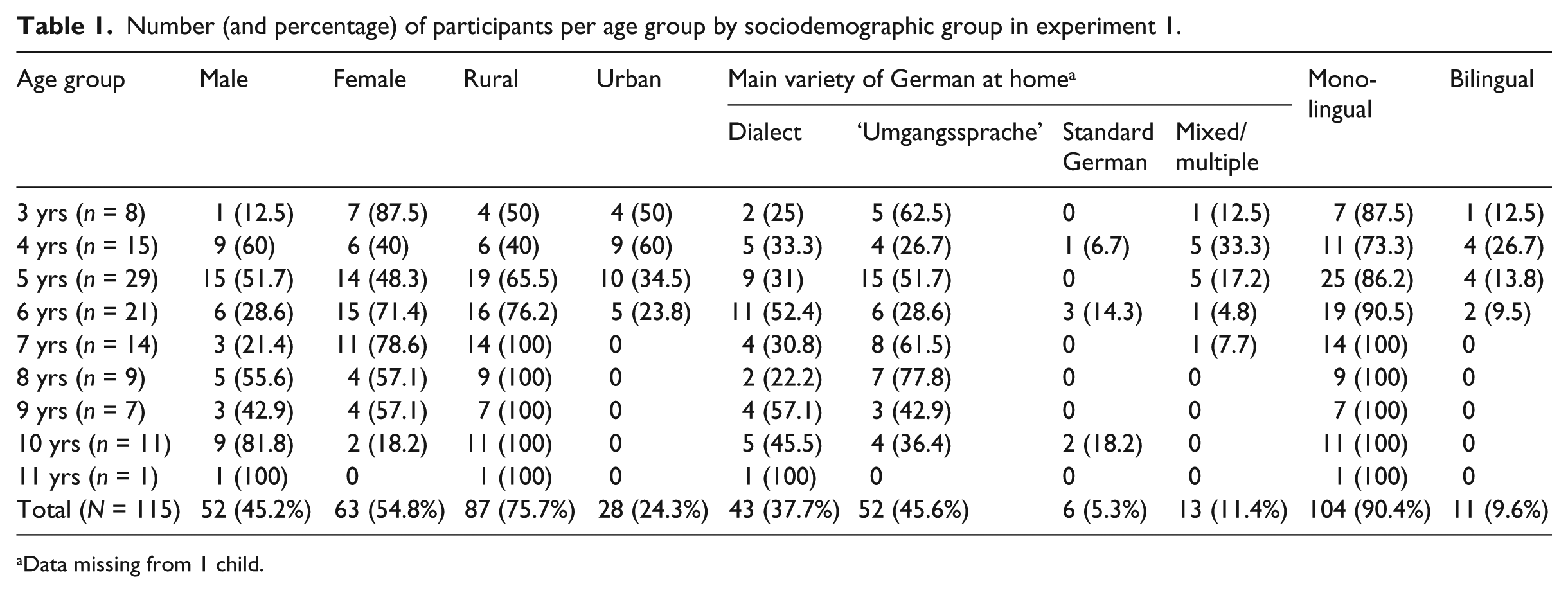
Data were collected in different kindergartens and primary schools in the provinces of Salzburg and Upper Austria in both rural and urban areas. In the following quantitative analyses, only the children with L1 German (mono- and simultaneous bilinguals) were included; we excluded children with German as L2 (i.e. sequential bilinguals, children coming from a different family language background). We analyse data from 115 children between the ages of 3;4 and 11;6 (mean age = 79 months, range: 40–138) for experiment 1, 14 of whom were from bilingual families speaking German and a second language. In terms of language variation at home, most of the children came from families where both dialect and a form of ‘Umgangssprache’ were spoken (see Table 1).
Number (and percentage) of participants per age group by sociodemographic group in experiment 1.
Data missing from 1 child.
The data from one child were excluded because of obvious problems fulfilling the task. Three participating children had been diagnosed with a speech or language disorder and were therefore excluded from the sample. Our final sample included one 11-year-old child, who was included in the calculations of the statistical models since age is operationalized as a continuous variable (in months) in these but was not included in the comparisons of age groups. Tables 1 and 2 list the sociodemographic details of our sample.
Number (and percentage) of participants per age group by mother’s level of education for experiment 1.

Data missing from 3 children.
Materials
To test children’s discrimination abilities, we used an ABX design (Beck, 2014) which included Austrian standard German and Bavarian dialect stimuli. The ABX design was chosen on several grounds. First, it offered the possibility to isolate discrimination abilities from socio-indexical knowledge, which was necessary in our sociolinguistic context as there is no categorical 1:1 mapping of (visible) speaker characteristics and language variety. Therefore, having children assign (pictures of) speakers to language samples would not have been a possibility in our case. Second, working-memory load in an ABX task is low as compared to other discrimination/matching tasks (though admittedly not zero), such as training studies where children have to learn ‘new’ categories of speakers and are then tested on them. Given that we work with very young children, we aimed at a task which would not put too heavy demands on (working) memory.
In a Microsoft PowerPoint presentation, children saw a drawing of a girl/boy (A) with a speech bubble and heard a sentence spoken in one of the varieties. Then a second girl/boy (B; same drawing but reverse colours) with a speech bubble appeared on the screen and children heard the same sentence spoken in the other variety (recording from the same speaker). A third picture was a photo of another girl/boy (X). In experiment 1, sentence X was lexically the same as sentences A and B, spoken in one of the two varieties. In each trial, sentences A and B were recordings from the same speaker, sentence X was spoken by a different speaker of the same gender (see Figure 1).
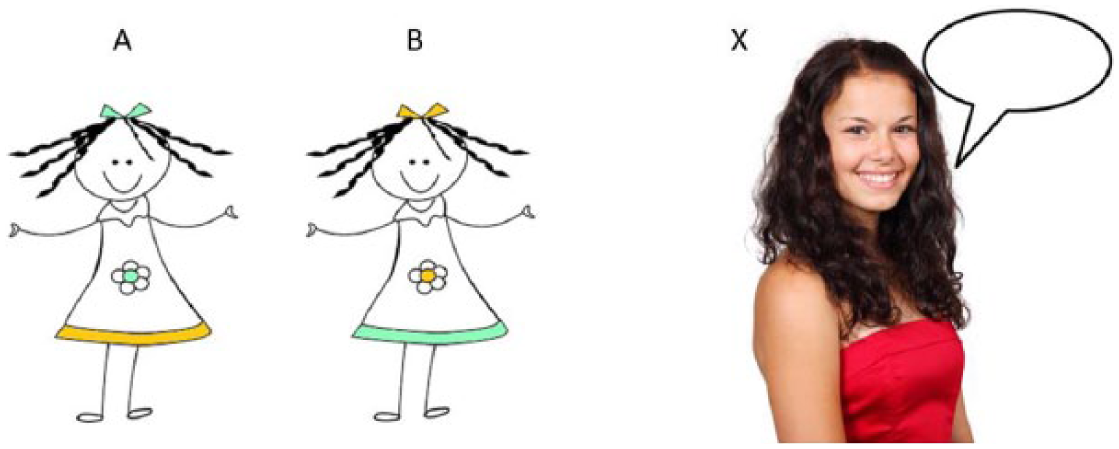
Example visuals for experiments: Does X speak like A or like B?
All stimuli were from bidialectal speakers fluent in both the local dialect and Austrian standard German. Speakers were from the same region as the children; i.e. two different sets of recordings were used, one from the Salzburg region and one from the central Upper Austrian region. All speakers were between 20 and 40 years old and were recorded in a quiet room using a Zoom H2n Audio Recorder and Audacity. The stimuli were balanced for intensity. There was one female and one male speaker for all the A/B sentences and four different speakers (three female, one male) for each of the X sentences but no trial was gender-mixed. The position of the drawings, the order of varieties within the trials and the colours in the drawings were counterbalanced across trials.
This design was meant to determine whether the child was able to recognize a variety across speakers for the same sentence. All sentences were grammatically simple sentences in the most frequent German word orders (finite verb in second position, subjects or adverbials before the finite verb) and no longer than 20 syllables. They only contained highly frequent words relevant to children’s experience so that even 3-year-olds could be expected to be familiar with the lexis in the stimuli. The stimuli contained almost exclusively phonological standard/dialect variables. Only highly frequent morphological variables (inflectional morphology and grammatical function words) such as the inflection forms of the verb sein (to be), typical pronouns and articles as well as the negation particle nicht were included.
Example trial 1
Die Marillen schmecken noch nicht gut, die sind ja total sauer.
‘The apricots do not taste good yet, they are completely sour.’ Phonetic realization in recording (broad transcription)ː A) Austrian standard German: diː ma‘ʀɪlən ‘ʃmɛkən nɔx nɪçt guːt diː sɪnt jaː to‘taːl ‘saʊ̯ɐ B) Bavarian dialect (Salzburg region)ː deː ma‘riːn ‘ʃmekan nuː neːt guɐ̯t deː haːn jɔː to‘taːl ‘saʊ̯ɐ X) like A) or B)
In this example, typical features of (mid-)Bavarian dialects are includedː A-raising as in jɔː instead of standard jaː, L-vocalization as in ma‘riːn instead of ma‘ʀɪlən, diphthongization as in guɐ̯t instead of standard German guːt. In addition, qualities of the E-vowels are distinct from standard German, and the typical short form deː (for the plural article die), the negation particle net and the dialect plural forms of the verb to be in the present tense (haːn) are used. In this respect, our stimuli are different from the stimuli in most other studies which only build on phonological differences between accents.
Example trial 2
Wir haben am Wochenende im Wald eine Heuschrecke gesehen!
‘We saw a grasshopper in the woods at the weekend.’ Phonetic realization in recording (broad transcription): A) Bavarian dialect (Salzburg region)ː miɐ̯ hɔːm am ‘voxŋɛnt aːn vɔe̯d aː ‘haɪ̯ʃrekŋ ksɛŋ B) Austrian standard Germanː viːɐ̯ haːbm am ‘vɔxənɛndə im valt ai̯nə ‘hɔy̯ʃʀɛkə gə’seːn X) like A) or B)
Example 2 includes instances of A-raising, L-vocalization (vɔe̯d for Wald), Bavarian E-vowels and articles as well as the Bavarian realization of certain <eu>-diphthongs (aɪ̯ as in haɪ̯ʃrekŋ for Heuschrecke).
Procedure
Prior to the experiment being conducted, consent forms were sent home to parents along with an extensive language background questionnaire. Only those children whose parents had signed and returned the consent forms participated in the study. The study received approval by the ethics committee of the University of Salzburg.
The questionnaire included questions on the parents’ language background and their level of education, and it screened for diagnosed language disorders or other health issues that may impact on language development (e.g. hearing problems). It also collected extensive information on the language input the child gets both at home and outside the home (based on parents’ reports). The parents could choose between filling in the written questionnaire and answering the questions on the phone; all of them chose the written version.
The study was conducted during kindergarten/school hours and the children were taken into separate rooms individually to complete the experiments. The child’s task was to decide whether X spoke similarly to A or to B. The children were given as long as needed to answer. If the child did not answer after about 10 to 15 seconds, he/she was asked if he/she wanted to hear the stimuli again (only necessary for some of the kindergarten children). This was done to minimize short-term memory effects. No child heard any trial more than twice. The computer was operated by the experimenter.
The experiment was introduced as a ‘game’ or a ‘riddle’ and children were given a warm-up trial to make sure they had understood the task without getting feedback on whether or not they had matched the right tokens. The warm-up trial was repeated if the experimenter felt that children had not yet fully understood the nature of the task.
Children were given ‘Okay’ as the only feedback on trials throughout the task.
The discrimination task lasted between 5 and 15 minutes (the older children were usually faster). The discrimination test was part of a larger test battery tapping into different aspects of children’s varietal competence (comprehension, production, attitudes/preferences). In addition, this test proved to be fairly demanding on the younger children’s cognitive resources. We thus had to limit the number of trials to four (similarly to Potter & Saffran, 2015).
Children’s answers (oral or pointing) were noted on paper by the experimenter. Additional audio-visual recordings enabled verification that the written records were accurate. Data were analysed in SPSS Statistics 24.
Results experiment 1
Since children had to decide whether speaker X sounds like speaker A or speaker B, they had a 50:50 chance of answering correctly by guessing. Children did four trials, which leads to a chance level of two successes.
On average, children scored 65.22% correct (standard deviation: 29.19; standard error of the mean: 2.72). This means that children overall succeeded in this task significantly above chance level, i.e. 50% (t(114) = 5.591, p < .001; r = .466).
As Figure 2 shows, discrimination rates increase from 3 years onwards through age 9, though not in a strictly linear sense. As early as the age of 5, the children in our sample are – on average – able to discriminate standard and dialect sentences on an above-chance level. Similarly, performance in the 6-year-old group exceeds chance level. And at age 8, children can solve this task at 80% accuracy.

Mean percentage of correct matches per age group for experiment 1; * = significantly above chance (3-year-olds: n = 8; 4-year-olds: n = 15; 5-year-olds: n = 29; 6-year-olds: n = 21; 7-year-olds: n = 14; 8-year-olds: n = 9; 9-year-olds: n = 7; 10-year-olds: n = 11).
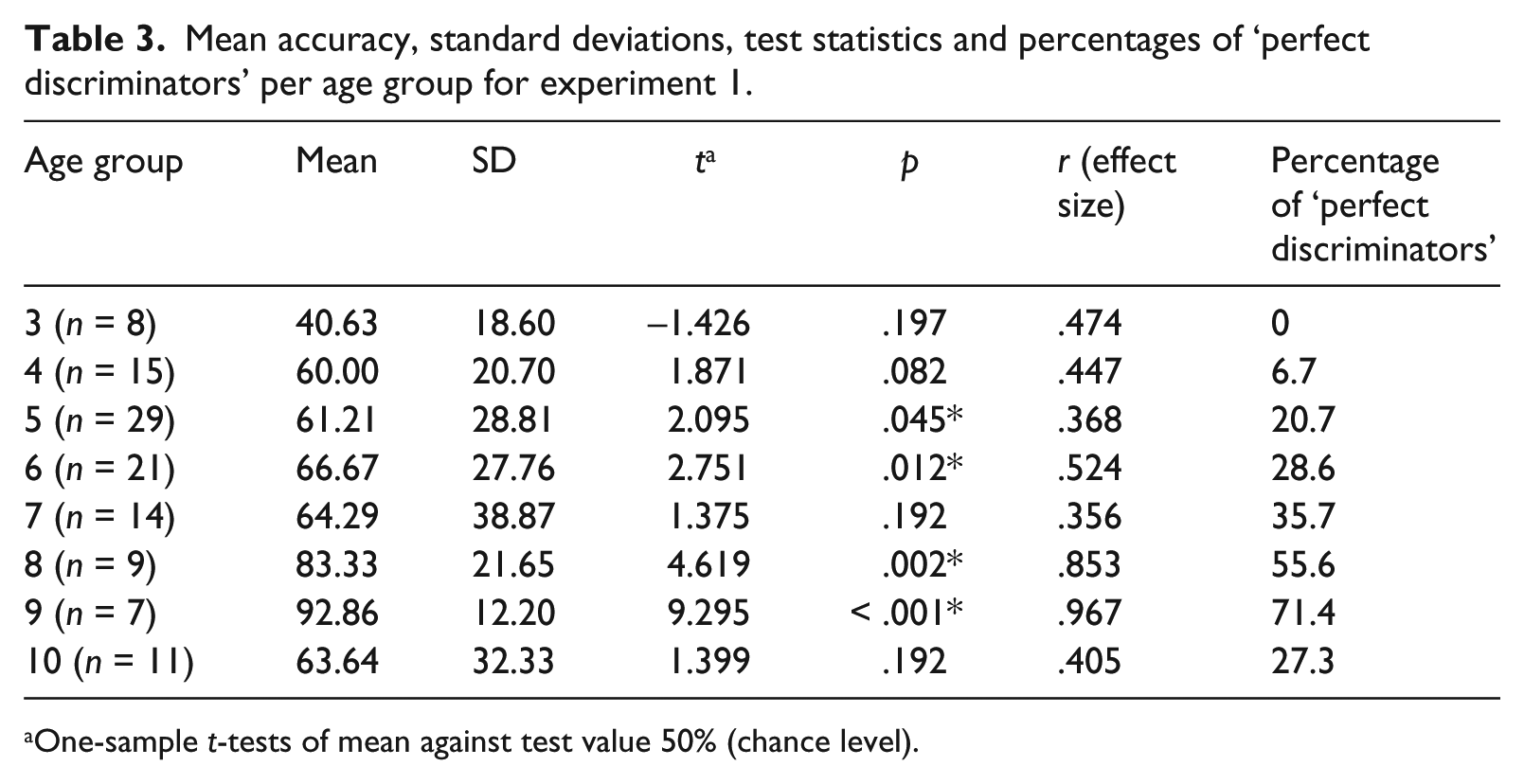
An overall steady increase in discrimination performance is corroborated by a look at the percentage of ‘perfect discriminators’ per age group, i.e. the percentage of children who got all trials correct, which can be gathered from Table 3.
Mean accuracy, standard deviations, test statistics and percentages of ‘perfect discriminators’ per age group for experiment 1.
One-sample t-tests of mean against test value 50% (chance level).
There are multiple explanations for the deviations from a linear change with age. The fact that the 7-year-old age group did not reach above-chance accuracy is due to its large variance in performance; the decline in the grand mean observed for the 7-year-olds is to be attributed to a small proportion (n = 3) of children in this age group performing very poorly (score 0). The difference between the 6- and 7-year-olds is not statistically significant, however, and the proportion of ‘perfect discriminators’ did not show a decline in the 7-year-olds at all (see Table 3). The 10-year-olds’ performance is surprisingly poor and we can only speculate on the reasons why. It may be due to being bored or underchallenged by the task.
In a one-way ANOVA the difference between mean performances by age group reaches significance (Welch’s F 6 (7, 106) = 7.061, p < .001, ω = .299). Table 4 gives the results of post-hoc pairwise comparisons (Games–Howell multiple comparison), indicating that the most important step in development happens between 6 and 9 years of age.
Pairwise comparisons of mean percentage of correct trials per age group for experiment 1.
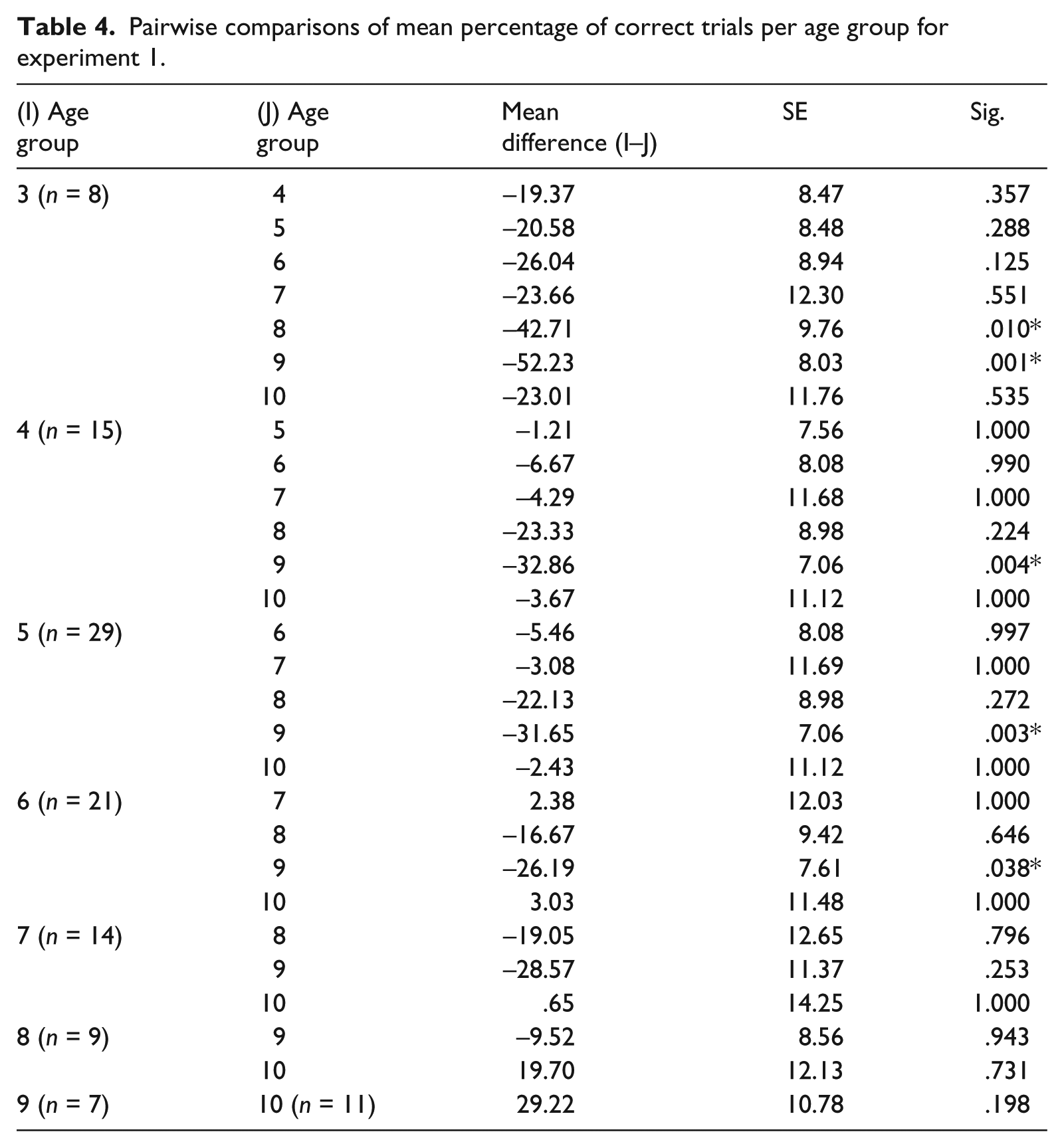
To summarize the age trajectory observed in experiment 1, we can state that there is a descriptively observable improvement between ages 3 and 6 and a statistically significant improvement in discrimination abilities between ages 6 and 9. As a group, children at the age of 5, 6, 8 and 9 perform above chance level, with 8-year-olds performing significantly better than 3-year-olds and 9-year-olds performing significantly better than 3- to 6-year-olds. The percentage of top scorers (reaching 100% accuracy) shows even clearer consistent improvement from age 3 through age 9.
In order to establish which subject variables correlate with individuals’ performance in matching the speech tokens, we calculated generalized linear models 7 with the proportion of correct matches as target variable and, as predictors, age (continuous variable), maternal education (ordinal, 3 levels), bilingualism (dichotomous), main variety of German at home (4 levels), location (rural/urban) and gender. These predictors were chosen on theoretical grounds, as they are known to be the most influential sociodemographic factors in first language acquisition (age, gender, maternal education as a proxy for SES) or as they include relevant information about the child’s language (variety) input (bilingualism, main variety at home, rural/urban location). Information about age, gender, maternal education and bilingualism was collected in an extensive parental questionnaire. Maternal education was coded as a three-level ordinal variable, ‘low’ level comprising mothers with an education level below high school diploma (i.e. apprenticeship or only obligatory schooling), ‘medium’ level comprising mothers who finished high school, and ‘high’ level comprising mothers with a university or college degree. The main variety of German spoken in the home was determined by aggregating the reported frequencies of use in the parental questionnaire. Parents had been asked to indicate the frequency of use from 0 (never) to 4 (very often) for each of the varieties of dialect, ‘Umgangssprache’ and standard German for each parent (or other caretaker) and the child’s siblings. The variety that reached the highest overall frequencies was identified as the ‘main variety’. If two (or three) varieties reached the same frequencies, the fourth category was applicable, i.e. ‘mixed/multiple’. All predictors were checked for collinearity before being entered into the model. The initial model was then reduced by excluding statistically redundant variables and comparing the model fit with the initial model by consulting the Akaike Information Criterion Corrected (AICC).
For experiment 1 (111 participants included in model 8 ), the model including age, maternal education and bilingualism as predictors proved to be that best fitting the data. See Table 5 for the data of the initial model and the final model.
Parameter estimates and model data for experiment 1.

Compares the fitted model against the intercept-only model.
Reference category: high.
Reference category: bilingual.
Reference category: mix.
Reference category: urban.
Reference category: female.
Reference category: high.
Reference category: bilingual.
Within this model, age, maternal education and bilingualism were statistically significant predictors. Gender, main variety spoken at home and location (rural/urban) did not turn out to be statistically significant variables in this experiment.
Children whose mothers graduated from high school (‘Matura’) or even finished university studies performed better than those children whose mothers did not finish high school, as shown in Figure 3.
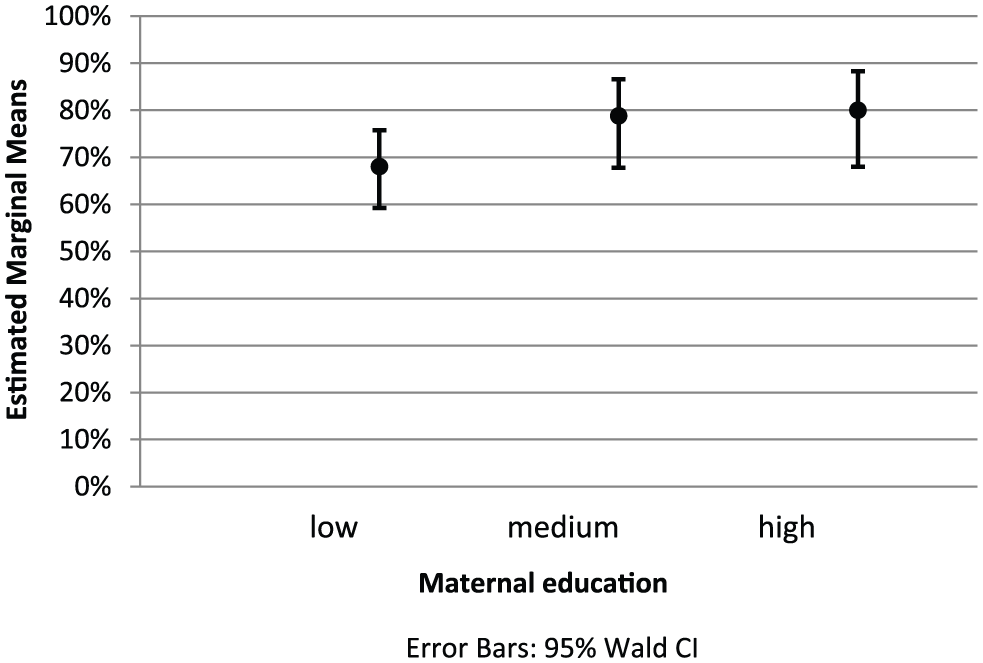
Estimated marginal mean percentage of correct responses from final generalized linear model for experiment 1 by maternal education. Covariate age fixed at 78.96 months.
Bilingualism proved to be another significant factor in this experiment. When we control for age and mother’s level of education, the bilingual participants performed better than the monolingual participants, which is reflected in the estimated marginal means (see Figure 4).
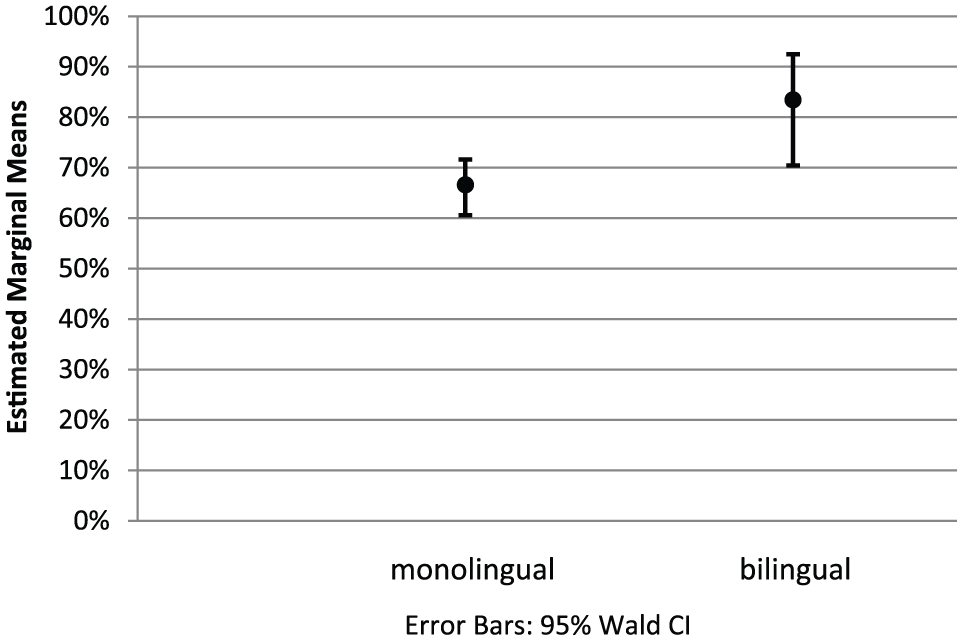
Estimated marginal mean percentage of correct responses from final generalized linear model for experiment 1 by mono-/bilingualism. Covariate age fixed at 78.96 months.
We will try to account for these findings in the general discussion section.
Experiment 2
Experiment 1 showed that as a group, children at the age of 5 years are able to recognize on an above-chance level the same Austrian German language variety across speakers for the same sentence. By and large, we could observe an increase in discrimination accuracy from that age onwards with a few exceptions discussed above. Experiment 1 targeted the capacity to generalize across speakers in discriminating between language varieties. Although this task utilized different talkers of the same variety, it may have been accomplished by low-level perceptual matching. In experiment 2, we were interested in whether children were able to also generalize across lexically different sentences. In this task, children were required to assign lexically different sentences spoken by different talkers to the same variety. We assume this can only be done by resorting to more abstract categories of language variety which subsume a wide range of lexical items and linguistic variables.
Participants
Data for experiment 2 were collected in different kindergartens and primary schools in the provinces of Salzburg and Upper Austria. In this experiment, 156 children between the ages of 5;0 and 11;6 (mean age = 99 months, range: 60–138) were tested, all of whom were speakers of L1 German (mono- or simultaneous bilinguals with another language); the data from three of these children were excluded due to obvious inattentiveness and/or problems understanding the task. This task had proven too complex for younger children in a pilot run and was therefore not conducted with 3- and 4-year-olds. None of the participating children had been diagnosed with a speech or language disorder according to their parents’ report in the questionnaire. Most of the children in this task spoke dialect and/or ‘Umgangssprache’ at home (see Table 6). Our final sample included two 11-year-old children, who were included in the calculations of the statistical models since age is operationalized as a continuous variable (in months) in these but were not included in the comparisons of age groups. Tables 6 and 7 give a breakdown of the sociodemographics of the sample.
Number (and percentage) of participants per age group and sociodemographic group for experiment 2.
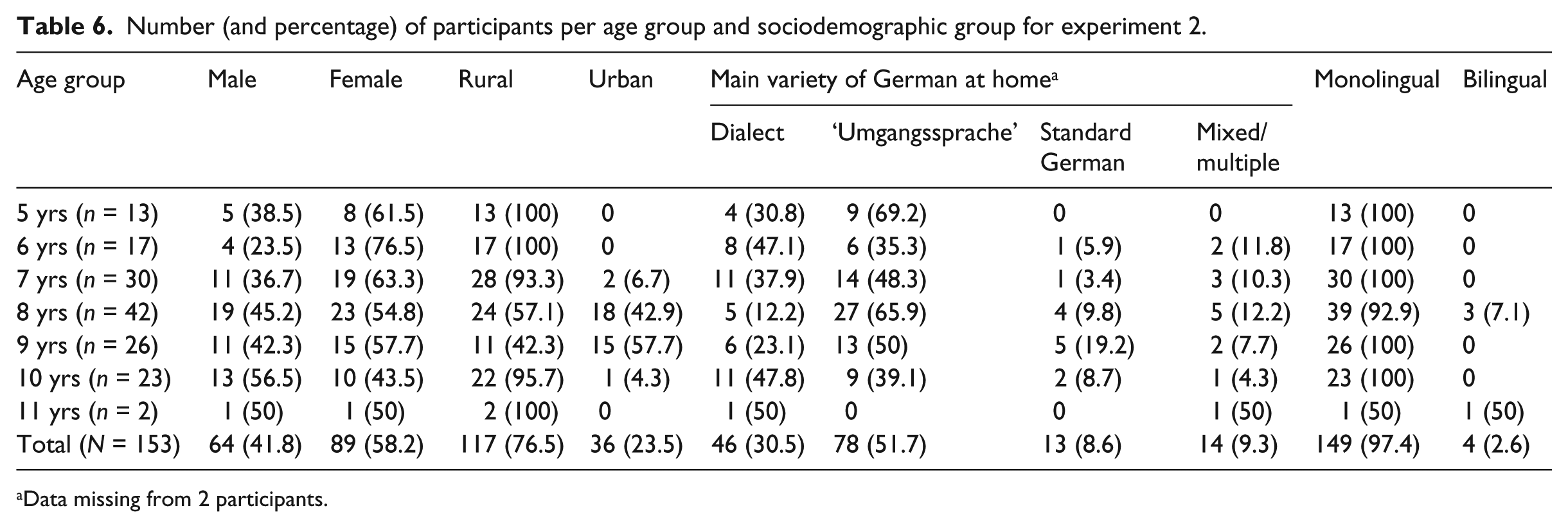
Data missing from 2 participants.
Number (and percentage) of participants per age group by mother’s level of education for experiment 2.
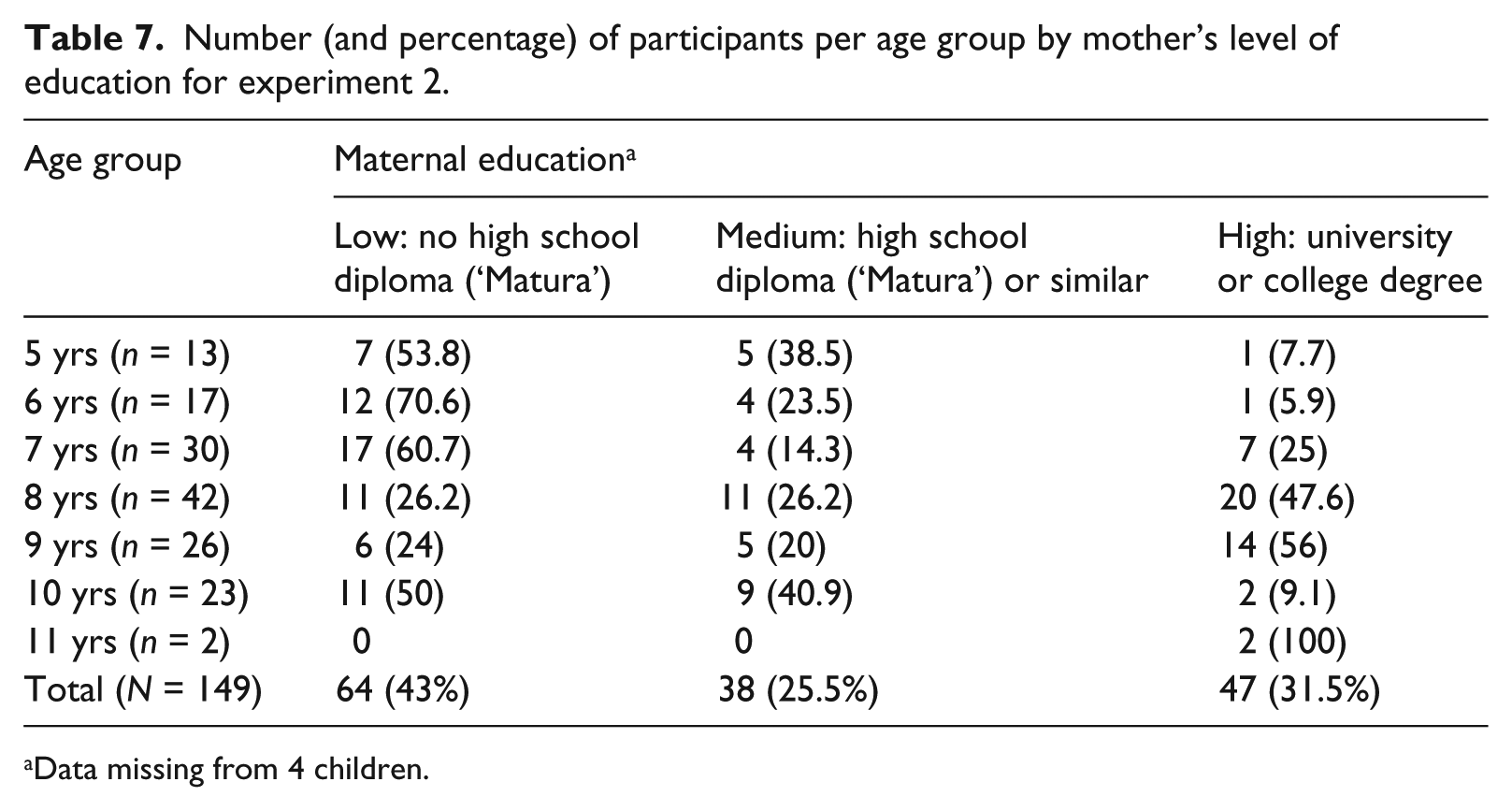
Data missing from 4 children.
Materials
The design and materials in experiment 2 were the same as in experiment 1, but crucially, this time sentence X was lexically different from sentences A and B. So, again sentences A and B were lexically the same sentences spoken by the same bidialectal speaker in different varieties (Austrian standard German and Bavarian dialect). Sentence X was a different sentence spoken by a different speaker in one of the varieties (Austrian standard German or Bavarian dialect). Sentence X typically included both phonological variables present in sentences A/B and new phonological variables.
Example trial 3 A) and B) Alle wollen im Turnsaal auf die Leiter klettern. ‘Everyone wants to climb the ladder in the gym hall.’ Phonetic realization in the recordings (broad transcription): A) BD: ‘ɔlɛ voe̯n im ‘d̥uɐ̯nsɔe̯ au̯f d̥ ‘lɔa̯tɐ ‘klɛtɐn. B) ASG: ‘alə ‘vɔlən im ‘tuɐ̯nsa:l au̯f di: ‘lai̯tɐ ‘klɛtɐn. X) Aber keiner will im Kindergarten mit den Stofftieren spielen. ‘But no-one wants to play with the plush toys in kindergarten.’ Phonetic realization in recording (broad transcription): X) BD: ‘ɔ:βɐ ‘khɔa̯nɐ vy: im ‘khindɐgɔɐ̯tn mite: ‘ʃtoftiɐ̯ʀə ʃb̥y:n (for comparison: ASG realization would be: ‘a:bɐ ‘khai̯nɐ vɪl ɪm ‘khɪndɐga:tn mɪt de:n ‘ʃtɔfthiɐ̯ʀən ‘ʃpi:lən)
Sentences A/B contain entirely different content words to sentence X, but both contain very clear and typical phonological dialect/standard markers, some of them even the same in A/B and X, respectively. For example, both A/B and X contain instances of L-vocalization (ASG vɔlən → BD voe̯n, ASG tuɐ̯nsa:l → BD d̥uɐ̯nsɔe̯; ASG vɪl → BD vy:, ASG ʃpi:ln → BD ʃb̥y:n), of the dialectal diphthong /ɔa̯/ (ASG lai̯tɐ → BD lɔa̯tɐ; ASG khai̯nɐ → BD khɔa̯nɐ) and of A-raising (ASG alə → BD ɔlɛ; ASG a:bɐ → BD ɔ:βɐ).
As in experiment 1, there was respectively one male and one female speaker who recorded all of the A/B sentences and different speakers for the X sentences and no gender-mixed trials were used.
Procedure
The younger children (5- to 7-year-olds) in this experiment were tested on four trials (3 female, 1 male), the older children were tested on seven trials (5 female, 2 male) in similar settings as in experiment 1. Again, there were different versions for the Salzburg and Upper Austria areas. For further information on materials and procedure, see experiment 1.
Results experiment 2
As in experiment 1, there was a 50:50 chance of randomly guessing the correct answer.
On average, children in experiment 2 scored 69.16% correct (standard deviation: 28.62; standard error of the mean: 2.31). This means that children overall succeeded in this task significantly above chance level, i.e. 50% (t(152) = 8.283, p < .001; r = .557). Note, however, that in this experiment the children were older than in experiment 1.
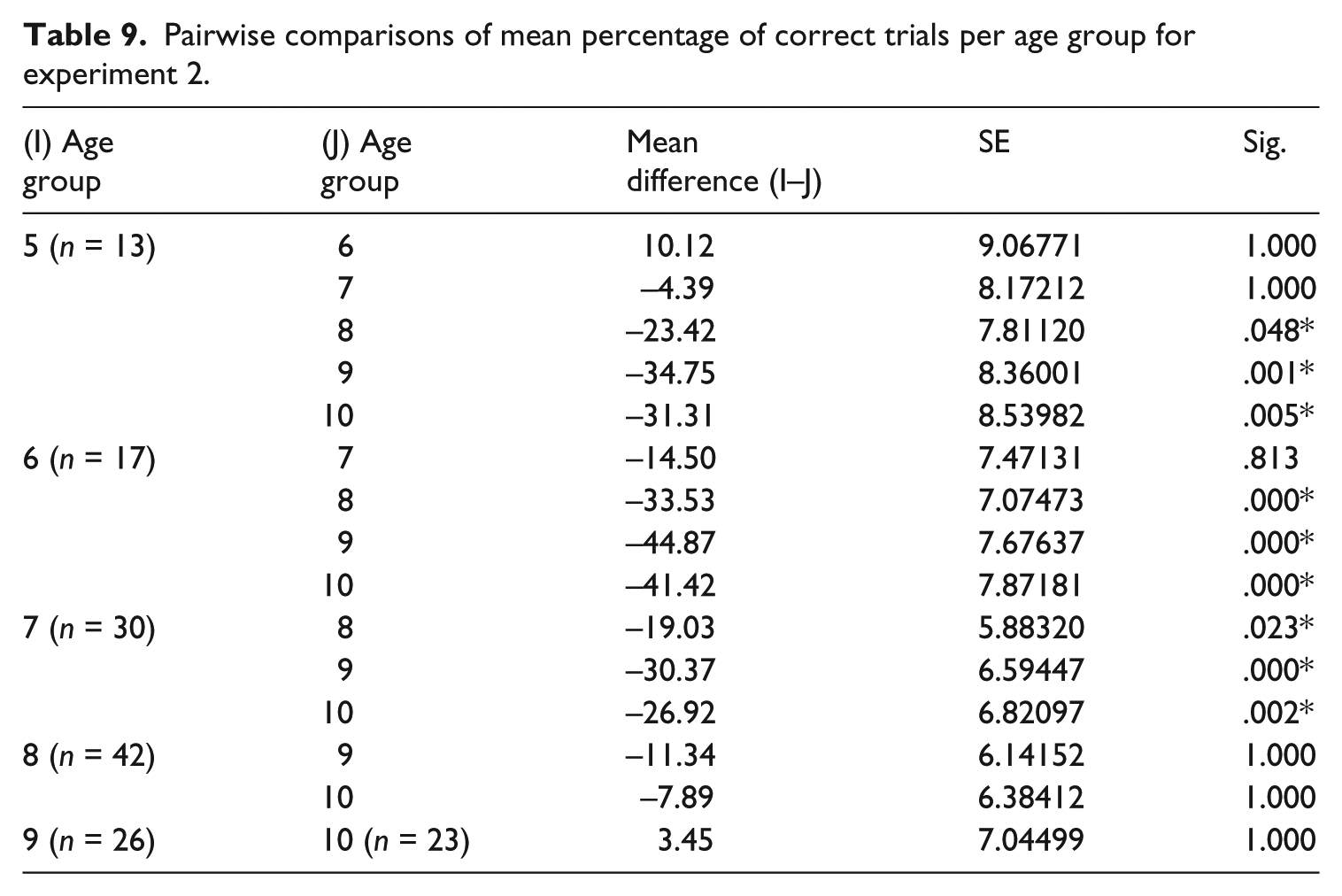
Figure 5 shows that the mean percentage of accuracy does not reach above-chance levels until the age of 8. It rises further in the 9-year-old group and decreases slightly in the 10-year-old group but these three age groups perform (collectively) clearly above chance. The exact figures can be gathered from Table 8. To complement the picture, Table 8 also gives the percentage of ‘perfect discriminators’, i.e. children in each age group who reached 100% accuracy (but note that the younger children had fewer trials). These figures largely mirror the development of mean accuracy across the age groups. In a one-way ANOVA, the differences of the mean between age groups reach significance (F(5) = 11.775, p < .001, η = .537). Post-hoc Bonferroni t-tests for multiple comparisons were administered, which revealed that the most important step in development sets in between ages 7 and 8 (see Table 9).
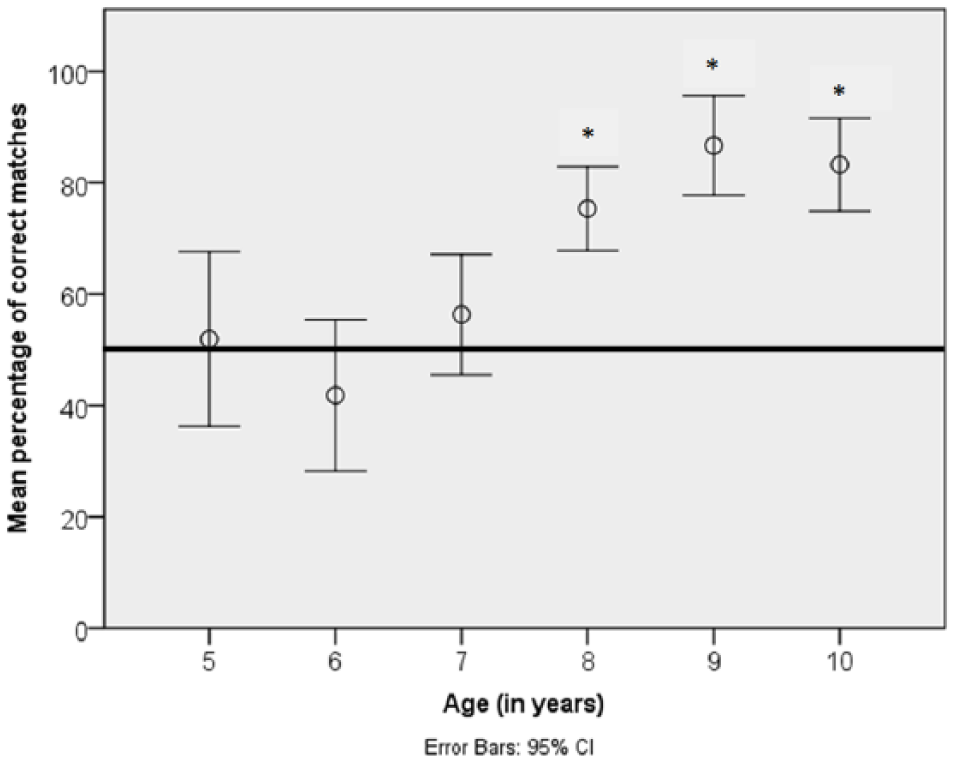
Mean percentage of correct matches per age group for experiment 2; * = significantly above chance (5-year-olds: n = 13; 6-year-olds: n = 17; 7-year-olds: n = 30; 8-year-olds: n = 42; 9-year-olds: 26; 10-year-olds: n = 23).
Mean accuracy, standard deviations, test statistics and percentages of ‘perfect’ discriminators per age group for experiment 2.
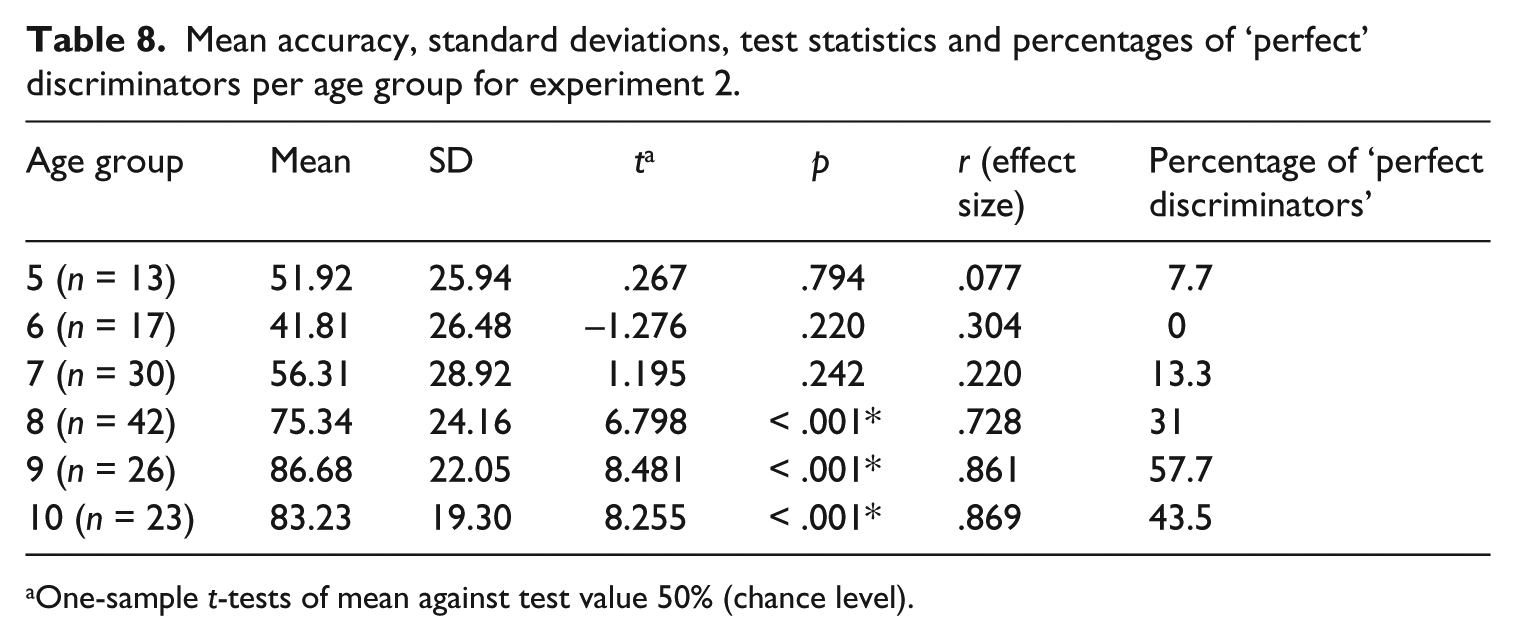
One-sample t-tests of mean against test value 50% (chance level).
Pairwise comparisons of mean percentage of correct trials per age group for experiment 2.
Similarly to experiment 1, we calculated a series of generalized linear models (146 participants included 9 ), starting with the proportion of correct matches as target variable and, as predictors, age (continuous variable), maternal education (ordinal, 3 levels), main variety of German at home (4 levels), location (rural/urban) and gender. Unfortunately, we could not include bilingualism as a variable since only four of the children were bilinguals. These children were excluded from the models.
In this sample, there was a considerable association between the location (rural or urban setting) and maternal level of education (we had a larger proportion of well-educated mothers in the cities) as well as location and age (we tested more older children in the cities) and location and main variety of German used at home (no primarily dialect-speaking homes in the cities).
After careful consideration of the collinearity diagnostics and checking the change in model statistics with and without the different predictors, we decided to keep all variables in the generalized linear model, keeping in mind the stratification of our sample when interpreting results.
The initial model was then reduced by excluding statistically redundant variables and comparing the model fit with the initial model by consulting the Akaike Information Criterion Corrected (AICC). The best fit for the data from experiment 2 was provided by the generalized linear model including age, mother’s level of education, location and main variety used at home. All of these factors were statistically significant. In Table 10 we have listed the parameter estimates for the initial and the best model for experiment 2.
Parameter estimates and model data for experiment 2.
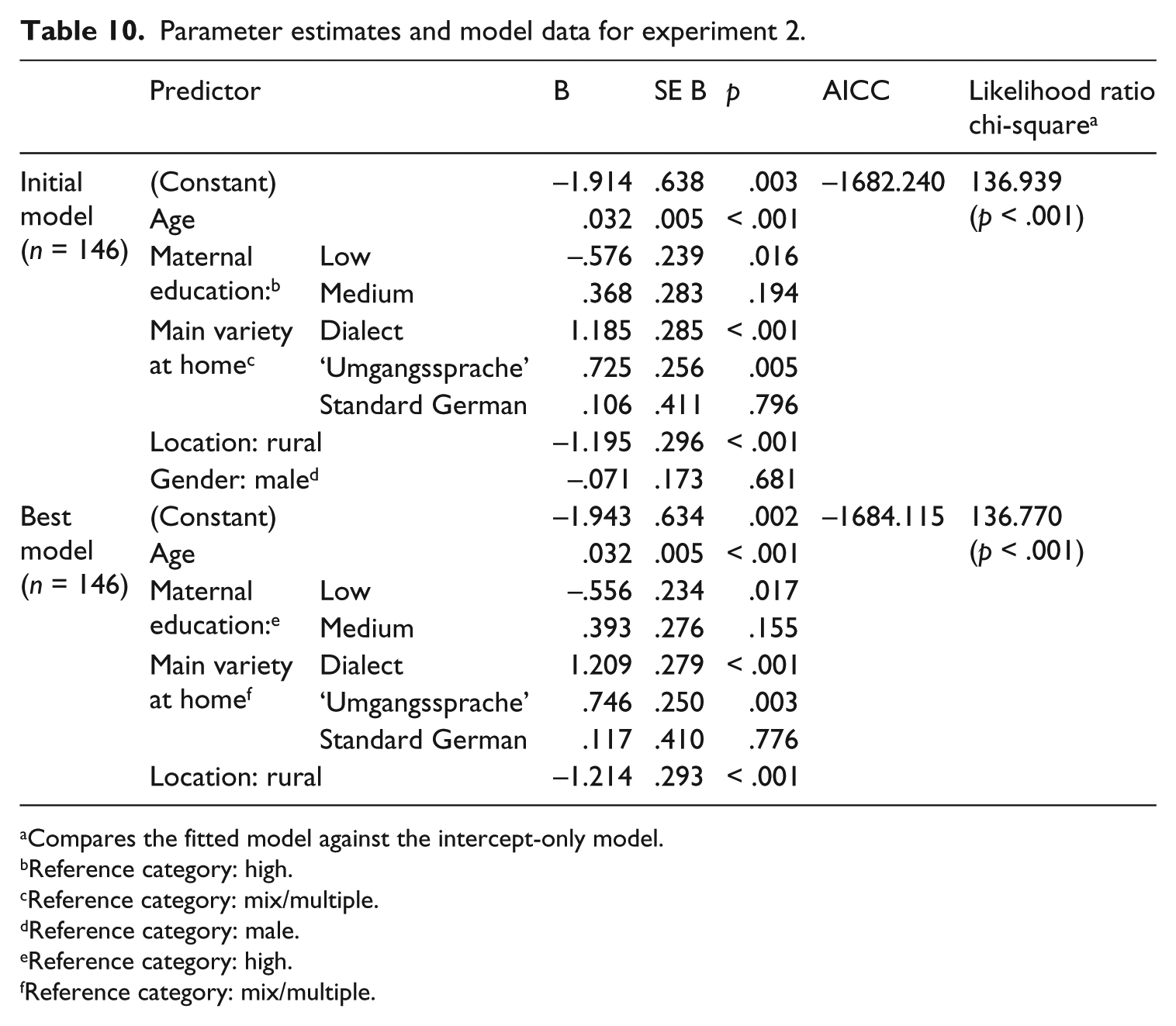
Compares the fitted model against the intercept-only model.
Reference category: high.
Reference category: mix/multiple.
Reference category: male.
Reference category: high.
Reference category: mix/multiple.
Maternal education proved to be a highly significant factor in children’s discrimination abilities, similarly to experiment 1. Children whose mothers graduated from high school (‘Matura’) or even finished university studies performed significantly better than those children whose mothers did not finish high school. This is shown in the estimated marginal means given in Figure 6. Estimated marginal mean percentage of correct responses from final generalized linear model for experiment 2 by maternal education. Covariate age fixed at 98.77 months.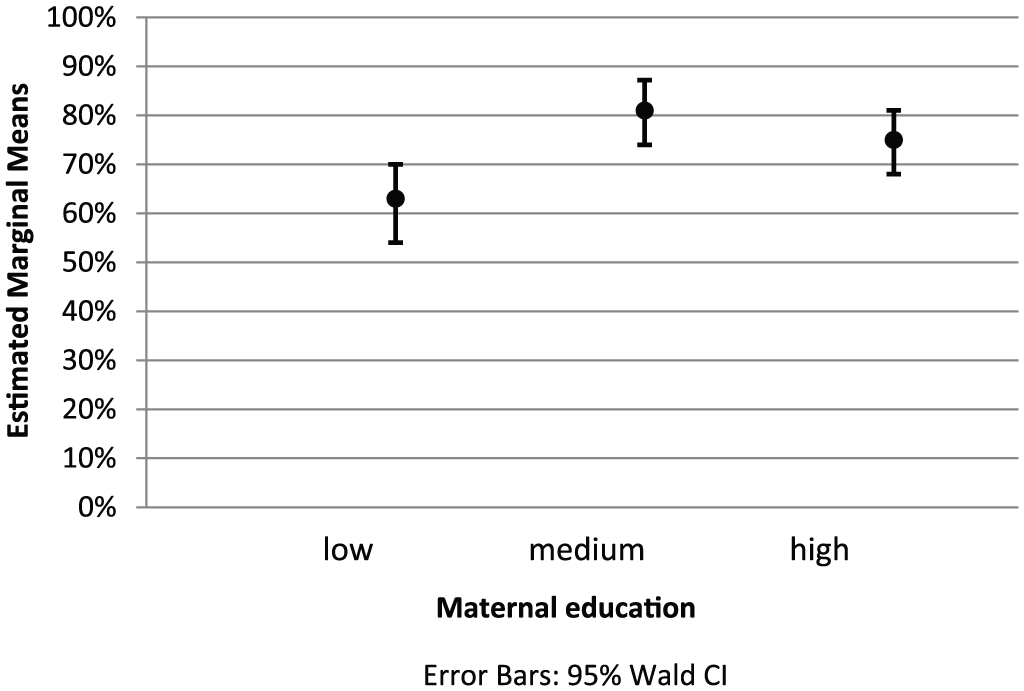
The setting of the kindergarten or school (rural or urban) also proved to be a significant factor in predicting the experimental outcome (see estimated marginal means in Figure 7). Estimated marginal means for experiment 2 by location of school (rural or urban setting). Covariate age fixed at 98.77 months.
In this experiment, the main variety spoken at home also proved to be a significant predictor of discrimination performance. A consultation of estimated marginal means for the categories of this variable (see Figure 8) suggests that children whose main input at home is the local dialect are at an advantage when it comes to discriminating between varieties of German surrounding them.
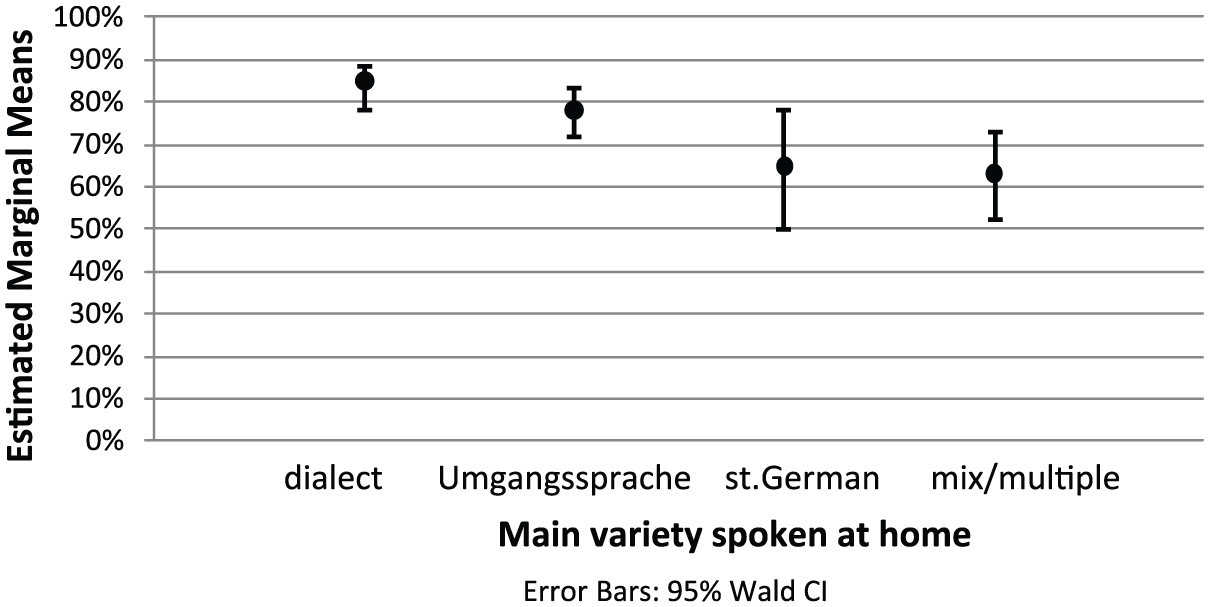
Estimated marginal means of proportion of correct responses in experiment 2 by main variety spoken at home. Covariate age fixed at 98.77 months.
Dialect speakers are predicted to perform better than any other group, with children receiving ‘Umgangssprache’ as their main home input doing moderately well and those children with standard German or a mix of varieties in the home performing most poorly. Note, however, that again there is a correlation between use of varieties in the home and location of the school (rural/urban). Since we do not have data from children from primarily dialect-speaking homes in the cities, we unfortunately cannot ascertain whether this effect would be the same for both urban and rural children.
General discussion
In two experiments, we investigated Austrian children’s abilities to discriminate between the varieties of Austrian standard German and Austrian (Bavarian) dialect. Using an ABX discrimination task, we showed that children in Austria can match the same sentences spoken in the same variety by different speakers from relatively early on, with our 5-year-old and 6-year-old subgroups performing above chance (experiment 1). Only at age 8, however, are they able to reliably match different sentences spoken in the same variety by different speakers (experiment 2). Analysing the results from different perspectives (means per age group, proportion of ‘perfect discriminators’ and compositions of age group), there seems to be a relatively gradual improvement in experiment 1 for low-level perceptual matching and a rather sudden emergence of the ability to discriminate varieties in experiment 2, which required children to resort to more generalized categories of language variety. In addition, this development is accompanied by effects of the mother’s level of education, present in both experiments. There are indications, moreover, that bilingualism and within-language variation in the input may impact on the development of discrimination abilities.
Age, schooling and metalinguistic awareness
Discrimination abilities clearly improve with age. However, there are considerable differences in the development of discrimination of different varieties for lexically/semantically identical and for lexically/semantically different sentences (i.e. between experiments 1 and 2). In all age groups where both experiments were administered, children fare better in experiment 1, the matching of the same sentence in the same variety (spoken by different talkers).
In experiment 1, we find a gradual age-related increase in accuracy from age 3 on, accelerated growth between ages 6 and 9 with its peak at age 9 and a (statistically not significant) decrease in 10-year-old children (analysing mean accuracy and proportions of ‘perfect discriminators’). This development generally confirms Jones et al.’s (2017) results, who found one peak of development of dialect classification in US children to occur between the ages of 7 and 8.
In our sample, the 5- and 6-year-olds were the youngest groups to collectively reach above-chance levels of accuracy (61.21% and 66.67%, respectively) and already one-fifth of the 5-year-olds and more than a quarter of the 6-year-olds scored 100% correct. The 7-year-olds show the widest range of performance but especially in the phase of transition from kindergarten to primary school heterogeneity is to be expected (Wildemann, 2015). Accounting for the somewhat unexpected worse performance by the 10-year-olds poses more difficulty. We can only speculate that the task was too simple for these children and they therefore lost concentration and interest – their doing better in experiment 2 might be a cue to this interpretation of the results.
We can conclude, then, that children on average have developed a certain level of discrimination ability by the age of 5/6. These results vaguely tie in with Beck’s results (2014) who established that 5- to 7-year-olds were able to match speakers based on regional accents of American English when the same words are used in the stimuli.
However, it is only at age 8 that the majority of children get all trials correct and that they score more than 80% on average, which points towards reliable and consistent discrimination abilities at that age. This backs up Häcki Buhofer and Studer’s (1993) results for Swiss German children. The children in their study – in a presumably simpler AX task and in a different, namely diglossic, sociolinguistic context – were even more consistent at a slightly earlier age. This hints at the possibility that the very complex sociolinguistic situation in Austria may indeed make learning the distinction between varieties more difficult because it is much more fuzzy than the rather clear-cut separation of varieties in Switzerland and thus offers rather ‘noisy input’ (Byers-Heinlein & Fennell, 2014; Foulkes & Hay, 2015).
In experiment 2 (different sentences), discrimination rates do not reach above-chance levels until the age of 8. Here the most remarkable increase can be observed between ages 7 and 8, from 56% to 75% of mean accuracy. At ages 9 and 10 children reach more than 80% accuracy on average. And in the 9-year-old group the majority of children manage to do all trials without error. While the comparison of mean accuracies across age groups in experiment 2 thus suggests a rather sudden rise in discrimination abilities between ages 7 and 8, the proportion of ‘perfect discriminators’ shows a more gradual and consistent increase. Furthermore, the different stratifications of the 7-year-old and 8-year-old age groups (different proportions of highly-educated mothers and urban schools) may contribute to the impression of a sudden improvement between these ages. Development may, in fact, be more gradual.
In comparison with experiment 1, these results suggest a protracted emergence of more abstract conceptual categories for the different varieties in question. A low-level perceptual match – albeit across speakers – is easier to make and therefore possible at a considerably earlier age than a match which has to be made on the basis of a purely abstract category of variety generalizing across speakers AND sentences (and therefore also across different linguistic variables). The difficulty of the latter for younger children has been shown previously by Edwards et al. (2014), Floccia et al. (2009), Girard et al. (2008) and Wagner et al. (2014) as well as by Stockmal et al. (1994).
In conclusion, Austrian children have established relatively stable abstract categories of the dialect and standard varieties they are hearing around them by age 9 on average, which is not to say that development is finished then. Taken together, the two experiments suggest that the most remarkable expansion of discrimination abilities takes place during the first years of primary school, i.e. coinciding with the acquisition of literacy skills. It has often been observed that the most considerable development in metalinguistic abilities occurs during this phase, leading to the hypothesis that metalinguistic awareness correlates with the acquisition of literacy (e.g. Bredel, 2013; Hakes, 1982; Warren-Leubecker & Carter, 1988, pp. 190–192; Wehr, 2001).
Maternal education (SES), language acquisition and metalinguistic awareness
Other than age, the mother’s level of education is the factor most clearly associated with children’s performance on the discrimination tasks (in both experiments). Children whose mothers graduated from high school or have a university/college degree fare better than those whose mothers did not finish high school. While all groups clearly improve with age, children from well-educated families have a significant advantage in the development of their discrimination abilities.
The association between maternal education/parental SES and language acquisition is anything but new. Parents with higher SES have been found to offer quantitatively and qualitatively richer input and foster communication with their children in many ways (e.g. Hart & Risley, 1995; Hoff, 2006 for a review). The direct relationship between SES and metalinguistic development has rarely been studied but at least one study has demonstrated SES to correlate with metalinguistic awareness and the pace at which it develops (Warren-Leubecker & Carter, 1988). Chaney’s (1994) analyses of the relationship between language development, metalinguistic awareness and SES-related factors in 3-year-olds revealed that in fact language development is the strongest predictor of metalinguistic awareness, suggesting that language development is a mediator of the relationship between SES and metalinguistic awareness. The specific contribution of language development – independent of age – to tasks which tap children’s experience with different language varieties still needs to be established, but Bent (2014) finds in her word recognition studies that in the group of 4- to 7-year-old children word recognition for native-accented words – but not for foreign-accented words – is linked to lexicon size even when controlling for age (Bent, 2014, p. 1351). It would therefore be significant progress to have reliable and valid tools for measuring language development/vocabulary knowledge both in standard German AND in the Bavarian dialects so as to be better able to get insight into the relationship between these and discrimination performance.
In addition to fostering language development in general, there may also be other ways in which well-educated mothers more directly help children develop discrimination abilities. There is an association in our data between maternal education and language use insofar as highly-educated mothers use more ‘Umgangssprache’ and standard German than less-educated mothers (confirming Lichtenegger’s [2015] observations on mothers’ attitudes). Note, however, that the variable ‘main variety at home’ (discussed below) does not point in the same direction: it is having a dialect-speaking home which correlates with better performance. There is also a moderate correlation between maternal education and the frequency of reading to their (kindergarten age) children in our data. But neither can reading explain the SES effect entirely since frequency of being read to does not predict discrimination performance in our data. It is therefore quite probably not one isolated behaviour but a combination of different measures exerted by highly-educated mothers, and/or other variables correlating therewith, which are conducive to their children’s better discrimination skills. For instance, the question could be whether mothers with higher education give more structured input in terms of language varieties and/or more guidance in terms of raising awareness to languages/varieties and their socio-indexical value and function in the Austrian context.
Bilingualism and metalinguistic awareness
Bilingualism could only be included as a predictor variable in experiment 1, in which it proved to be a significant factor. In view of the literature on bilinguals’ superior metalinguistic skills in certain areas (for review e.g. Bialystok, 2001), it is not necessarily surprising that bilingual children were better at discriminating dialect and standard German (when controlling for other variables).
Location and variability in the input
As we have pointed out, it is not entirely clear whether the variable ‘urban/rural location’ exerts an influence above and beyond the fact that there is a high proportion of well-educated mothers in the urban areas studied here. If it does, we can only speculate on the nature of the influence. Generally, exposure to the standard language and ‘Umgangssprache’ is expected to be higher in Austrian cities than in the country (Steinegger, 1998; Wiesinger, 1992). Perhaps the wider range of variation in cities encountered in everyday experience aids the development of metalinguistic awareness. Also there might be a much greater emphasis on speaking/teaching the standard variety in urban schools for different reasons (prestige, multilingual contexts and so forth), which may entail addressing issues of language variation more explicitly and more frequently and thus raising children’s awareness of the varieties.
Variability in the input at home
In experiment 2, the more difficult condition, the main variety spoken at home proved significant in predicting discrimination scores. Children from primarily dialect-speaking homes generally outperform children getting ‘Umgangssprache’ or standard German input and most considerably outperform those receiving ‘mixed’ input in the home. Having a mixture of varieties as the main input at home thus seems to be a (temporary) hindrance in developing discrimination skills between the varieties. Notably, at least one previous study (Kitamura, Panneton, Diehl, & Notley, 2006) has suggested that more variability in the input may increase ‘tolerance’ of variability and therefore decrease discrimination skills in children. It seems plausible, therefore, to assume that being presented with a constant mixture of varieties does not aid discrimination of these varieties. This mixing provides what Byers-Heinlein and Fennell (2014) (with respect to bilinguals) aptly call ‘noisy input’, which makes extracting patterns of co-occurrence and frequency especially difficult. Note, however, that it is not variation per se which poses a problem: all of the children have contact with different varieties of German. In the Austrian context, children who grow up in a clearly dialect-speaking home can be expected to receive much input in both the standard language (media, reading, kindergarten) and dialect, and, crucially, the varieties are typically quite consistently linked to certain situations and/or speakers. In contrast, children who primarily receive standard German input at home experience less language variation overall and children with ‘mixed’ and ‘Umgangssprache’ input at home may experience rather ‘opaque’ variability in this context. Ample systematic variability, then, may help children to develop different conceptual categories for different language varieties. In the sociolinguistic setting described above – including two closely-related varieties with many cognates and intermediate forms, which are not used consistently in specific social situations or by certain groups of speakers – hearing mixed varieties at home on top of everything might temporarily slow down the development of children’s discrimination skills. Notably, the two input variables (main variety at home and urban/rural location of school) only predict performance in experiment 2. The ability to discriminate varieties based on perceptual matching (although across speakers) may be less prone to input influences than the ability to develop all-encompassing representations of language varieties.
Conclusion
Studying for the first time the trajectory of children’s discrimination abilities in the complex sociolinguistic situation of Austria, we can conclude that increasingly abstract categories for different Austrian German varieties emerge in 3- to 10-year-old Austrian German-speaking children. Our study shows that basic perceptual abilities (recognizing the same sentence in the same variety spoken by different speakers) and first abilities to generalize across speakers develop earlier, with first performances above chance at age 5 in our sample. Abstract category formation including the ability to generalize across phonological and lexical variables, however, can be assumed to be developed by age 8/9. Considerable progress seems to be made between ages 7 and 8 and discrimination ability reaches its peak at age 9. Apart from the age factor, the ability to access speech varieties proved to be significantly associated with the mother’s level of education. For the emergence of abstract categories of varieties, the nature of language variation at home and the sociolinguistic surroundings (urban/rural location of school) also seem to be decisive insofar as substantial and at the same time structured variation in the input seems to accelerate the development of discrimination abilities. Future studies should aim to explore further the associations between discrimination abilities and variability in the input as well as the link to general language and metalinguistic development.
Footnotes
Acknowledgements
We wish to extend our gratitude to all the participating children, parents and teachers. The authors would also like to thank Anna Scheichl for her help in data collection and three anonymous reviewers as well as the associate editor and editor-in-chief for their valuable comments and helpful suggestions in revising this article.
Declaration of conflicting interests
The author(s) declared no potential conflicts of interest with respect to the research, authorship, and/or publication of this article.
Funding
The author(s) disclosed receipt of the following financial support for the research, authorship, and/or publication of this article: This research was supported by a grant from the Research Foundation of the University of Salzburg (Stiftungs- und Förderungsgesellschaft) and by the Hugo-Moser-Prize for German linguistics awarded to the first author.