




Abstract
This study aims to evaluate phonological competences and their correlations with lexical abilities in 2-year-old Italian-speaking children. Eighty-eight children (46 females) aged 25–32 months participated in the study. From the total sample, three subgroups of children with different lexical skills were extracted to identify phonological characteristics of low, typical and precocious talkers. The results provide a description of the children’s production in terms of consonant and correct consonant inventories; simplified and unintelligible words; and simplification processes. The percentage of unintelligible productions and the number of correct consonants show greater correlations with lexical competence. Children with low vocabulary differ significantly from the other two groups in the percentage of unintelligible words and in consonant inventories. Children with advanced vocabulary show significantly less simplification processes than the other two groups. In addition to describing phonological characteristics in a large sample of young Italian children, this study allows us to identify potential phonological markers of late linguistic development
Keywords
Few studies have analysed phonological development in languages other than English (Keren-Portnoy, Majorano, & Vihman, 2009). Nevertheless, as outlined by Saaristo-Helin, Kunnari, and Savinainen-Makkonen (2011) for Finnish, and by Kehoe, Chaplin, Mudry, and Friend (2015) for French, linguistic differences between languages can affect phonological development and its relations with lexical skills.
The Italian language, compared to English, has many differences that can influence the pattern of phonological simplification and language acquisition in children (Fasolo, Majorano, & D’Odorico, 2008). According to Bertinetto and Loporcaro (2005), Italian is a syllable-timed language and its syllable structure is relatively simple. It has a smaller variety of syllable types than stress-timed languages like English, and 60% of Italian syllable types are CV. While the English language has many vowel sounds associated with a variety of monosyllabic words (Onesti, 1974), the Italian language has only seven vowels, and the most common words have two or three syllables (Kehoe, 2011). Monosyllabic words are few, and they often have a grammatical function such as clitics that lean on neighbouring accented words (Maturi, 2006). Italian polysyllabic words are usually characterized by an unfooted weak syllable in the initial or final position. By contrast, in English many open class accented words are monosyllabic and in polysyllabic words also there is a predominance of strong initial syllables. The difference in rhythm between languages is, in the opinion of many authors, an undeniable fact, because different rhythms arise as a consequence of a series of phonological properties (see for example Nespor, Shukla, & Mehler, 2011). This fact acquires more importance because of the role of syllabic structure, accent position and rhythm in young children’s speech segmentation (Guasti, 2007). Moreover, correctness of production and types of simplification relate to the word accentual pattern of the ambient language. For example, at 2 years of age Italian children used fewer weak syllable deletions for trisyllabic words stressed on the first syllable compared to trisyllabic words with an initial weak syllable (Majorano & D’Odorico, 2011).
The phonological characteristics of Italian
The Italian phonetic inventory contains seven vowel sounds, /i e ɛ a o ɔ u/, and 23 consonants sounds: three pairs (voiceless and voiced) of occlusive or plosives (bilabial, dental and velar), /p b t d k g/, three nasals (bilabial, alveolar and palatal), /m n ɲ/, two pairs of affricates (dental and palatal), /ts dz ʧ ʤ/, five fricatives (one pair of labiodental, one pair of dental and one post-alveolar), /f v s z ʃ/, two laterals (alveolar and palatal), /l ʎ/, one alveolar vibrant or trill, /r/, and two semivowels (palatal and labial-velar), /j w/. Italian has 15 contrastive geminate consonants; the phonemes /ɲ ʎ ʃ ts dz/ are excluded from gemination, because they tend to have geminate-like duration. Also the fricative /z/ does not occur as geminate, due to its restricted distribution (Bertinetto & Loporcaro, 2005; Onesti, 1974).
As for Italian syllable structure and phonological constraints, generally the coda position of syllables is subject to severe constraints, as it normally consists of just one of the following consonants: /r l n s/, with some exceptions for loan-words (e.g. ritmo ‘rhythm’), most of which come from Greek. Moreover, words that end with a consonant are rare in the Italian native lexicon and usually consist of function words. The onset position is far less constrained, as it may contain any consonant (Bertinetto & Loporcaro, 2005); moreover, consonant clusters are quite frequent in the initial and medial position, although they are never present in the final position.
Phonological development in the language of Italian children
In relation to the development of phonological skills, Zmarich and Bonifacio (2005) described the phonetic inventories and syllable characteristics of 13 Italian children who were studied longitudinally from the age of 18 to 27 months. In their study, at the age of 18 months, the children produced occlusive and nasal consonants; at the age of 24 months, fricative sounds systematically appeared, and occlusive sounds were strengthened. Finally, at the age of 27 months, the typologies of syllables produced by children increased with the appearance of more complex sequences of syllables (CCV; CVC). At the age of 3, as indicated by Orsolini (2000), most children produce the complete consonant repertoire, although for some children, phonological development is not complete. In particular, some sounds, such as /r/, are not correctly pronounced yet, and more complex syllable structures are still absent.
A study focusing on phonological development in a sample of 30 Italian children aged from 36 to 42 months found that all of the children produced the unvoiced occlusives, the nasals /m/ and /n/ and the lateral alveolar /l/ (Zanobini, Viterbori, & Saraceno, 2012). More than 80% of the sample had at least 16 of the 23 consonants in their inventory and produced the voiced occlusives (except /g/), all the fricatives, the palatoalveolar affricate /ʧ/, the vibrant /r/ and the semiconsonants /j/ and /w/. A minority of the children produced the palatoalveolar affricate /ʤ/, the voiced occlusive /g/, the palatoalveolar sibilant /ʃ/, the lateral palatal /ʎ/, or the nasal /ɲ/. Finally, no child had the affricates /ts/ and /dz/ in his or her consonant inventory.
Considering a wider age range, Tresoldi et al. (2015) used a word repetition task in children aged 3;0 to 10;8 and found that all children in the sample were able to produce vowels correctly. For consonants, occlusives (except /g/), nasals (except /ɲ/), labiodentals fricatives and the lateral /l/ were already mastered by children aged 3;0 to 3;5. Affricates were mastered by the age of 4;5. The vibrant /r/ and the lateral /ʎ/ were acquired later, generally by the age of 6;0. In relation to simplification processes, Italian phonemes and clusters were generally distorted rather than omitted.
An in-depth analysis of phonological simplifications was provided by Bortolini (1995a), who describes the stages of phonological development for the Italian language in terms of types of phonological processes. She distinguishes between (a) processes that simplify the syllabic structure, mainly ‘selective deletions’ of sounds that are present in the adult version of the target (e.g. weak syllable deletion, diphthong reduction, cluster reduction), and (b) processes that simplify the phonological system, such as substitutions of a sound for a similar one or of a consonant that is difficult to pronounce with a more easily pronounced one (e.g. plausible phonological substitution in which only one of the three phonological features – manner of articulation, place of articulation, and voicing or devoicing – does not correspond to the adult target, such as /ʎ/ with /l/; stopping; r/l substitution). Cluster reduction and consonant or vowel deletion were found to be the most frequent structure simplifications in Italian children aged 36–42 months, whereas the use of /l/ instead of /r/ was the most frequent substitution (Zanobini et al., 2012).
Research indicates that early atypical phonological development predicts later language impairment in Italian children (Fasolo et al., 2008) and that some simplification processes, which are more common in late talkers, are associated with atypical or delayed morphosyntactic development in different languages (see Bortolini & Leonard, 2000, for Italian and English; Aguilar-Mediavilla, Sanz-Torrent, & Serra-Raventós, 2002, for Spanish). In light of these results, the study of the phonological characteristics of Italian children can have a significant impact in the field of diagnosis and intervention, as pointed out by Fletcher et al. (2004) for Cantonese and by Storkel (2004) for English.
Phonological and lexical development
In a review article concerning the interactions between lexical and phonological development from infancy to age 4;0, Stoel-Gammon (2011) examines studies belonging to two different perspectives: child-centred studies, which emphasize the active role played by the child, and studies that focus on the effects of the phonological and lexical characteristics of the adult language. In fact, early lexical development is influenced by both the child’s productive phonology and the phonological form of the adult words. In addition, as children’s vocabulary grows, they improve their segmental representation of lexical items. The result is that phonological and lexical development are interdependent and tend to be commensurate, both in precocious and late talkers and at different age levels in the preschool years.
Initially, research on the interaction between phonological and lexical development was mainly focused on very early stages of language acquisition and showed that at this stage, children tend to produce words composed of sounds already present in their babbling (Stoel-Gammon & Cooper, 1984); young children are more likely to imitate words that contain sounds ‘in’ rather than ‘out’ of their own production repertoire, displaying lexical selection and avoidance on this basis (Schwartz & Leonard, 1982). Recently, Zamuner and Thiessen (2018) advised a cautious interpretation of these results. The authors claim that other phonological and lexical factors, such as phonotactic probability, word length and the amount of phonemes a word shares with other words in the lexicon (neighbourhood density), can influence early lexical production. Sosa and Stoel-Gammon (2012) thoroughly explored the nature of this relationship by analysing the role of different lexical variables (word frequency, neighbourhood density and age of acquisition) and phonological variables (phonotactic probability and average consonant age of acquisition) in young children’s production of known words. The lexical factors were all found to influence the production variability of words and/or proximity of the children’s production to the adult’s target, whereas phonotactic probability did not affect variability or proximity. The authors concluded that, when producing real words, children between the ages of 2;0 and 2;5 appear to rely more on the whole word lexical representation than on categorical phonological representation: phonological representations become more segmental as the lexicon grows.
In a longitudinal study of Italian toddlers, Majorano, Vihman, and DePaolis (2014) investigated the relationship between children’s emerging articulatory abilities and their capacity to process speech input and found that an earlier start on consistent practice with consonants correlated with earlier production of first words. However, this early advantage did not lead to a more rapid lexical development at 18 months.
Analysing studies on vocabulary acquisition in the second year of life, Curtin and Zamuner (2014) suggested that the relationship between emerging lexicon and the sound system is dynamic and that sensitivity to the phonological properties of the words can vary across different tasks. On the one hand, word sound properties influence lexical acquisition, while on the other, children use words stored in their developing lexicon to process new information. Similarly, Storkel and Morrisette (2002) showed that there is also a reciprocal link between phonological and lexical development in older children. Some lexical properties, such as word frequency, facilitate the acquisition of new sounds in children with both precocious and delayed language development. However, the phonological characteristics of words and the overall phonetic inventory influence the learning of new words in preschool and school-aged children.
To summarize, the existing literature highlights the existence of bi-directional links between phonological and lexical development. However, further enquiry involving a broader array of languages and a wider range of ages is needed to address unanswered questions about the nature of this link and how it changes during children’s development (Stoel-Gammon, 2011).
Phonological abilities in children with different lexical skills
Phonological development and its relations with other aspects of language skills has not yet been comprehensively described in children after the first phases of lexical and grammatical development and before the age of 3, at least in Italian. It has been widely acknowledged that the third year of life constitutes a critical period for identifying late-talking children (Bello et al., 2014). This identification is usually based on lexical and morphosyntactic indexes, but late talkers are usually behind in several phonological measures. As a consequence, distinguishing the phonological characteristics of language in children with different lexical skills is a useful goal (Kehoe et al., 2015).
Smith, McGregor, and Demille (2006) analysed various phonological measures in lexically precocious 2-year-old children speaking English and compared their performance with that of typically developing children of the same age and of 30-month-old children with similar vocabulary and found significant correlations between lexicon size and some phonological measures. In particular, consonant inventory was significantly different between the two age-matched groups but not between the vocabulary-matched groups; in addition, all three groups of children showed similar accuracy levels (measured as a percentage of correct consonants) for initial- and medial-position consonants. For phonological processes, cluster reduction and gliding were the most common for all three groups, but cluster reductions were much more frequent in the 24-month-old children with an average lexicon than in the other two groups. Nevertheless, a considerable number of phonological processes did not differentiate the three groups. The authors concluded that their results support a link between lexical and phonological development, but this correlation does not involve all measured phonological abilities.
Kehoe et al. (2015) analysed the consonant inventory (overall and in different positions), the percentage of correct consonants and phonological processes in three groups of French 29-month-old children with different lexical skills. They found that some phonological abilities of late talkers (vocabulary size ⩽ the 15th percentile) were less well-developed than those of children with average-sized vocabularies (between 40th and 60th percentile), which in turn were less well-developed than those of children with advanced vocabularies (⩾ 90th percentile). Nevertheless, several phonological measures were not related to vocabulary size, in particular those concerning consonant inventory and cluster reduction in the syllable-final position.
In analysing the phonological abilities of 41 native Italian-speaking children with different levels of lexical ability in the first half of the third year, Zanobini and Viterbori (2009) found that some consonants were present in the phonetic inventory of most children, whereas the group with lower vocabulary size (below 25th percentile) produced the consonants /d/ /f/ /v/ and /s/ to a significantly lesser extent.
Orsolini, Sechi, Maronato, Bonvino, and Corcelli (2001) compared four groups of Italian children with different linguistic abilities: children with specific language impairment, typical children with low phonological performance, and two control groups (age and grammar controls). The clinical group differed from the other three groups due to a much stronger tendency to simplify consonant clusters, but was similar to the low phonological performance group in several other kinds of phonological processes, such as r/l substitution and the simplification of syllables ending with a liquid consonant through a geminate non-liquid consonant (e.g. [pot:a] instead of [porta] for door).
To the best of our knowledge, an analytical description of phonological skills and simplification processes in Italian children in the third year of life has never been undertaken; moreover, a comparison of phonological development in children with different levels of lexical skills could shed light on the characteristics of the link between phonology and lexical development in children learning Italian.
The first aim of the study is to explore several characteristics of phonological skills (consonant inventory, intelligibility and accuracy of children’s productions, frequency of different simplification processes) in a large sample of Italian children in their third year. The second aim is to describe similarities and differences between children with low, medium and high vocabulary size in order to identify phonological variables that constitute potential markers of late linguistic development (Fasolo et al., 2008). We hypothesize that children with low lexical skills differ from advanced children in all phonological measures. Nevertheless, given the generalized tendency to simplify language at this age, we hypothesize that children with advanced vocabulary tend to use simplification processes to a lesser extent compared to peers with low vocabulary or typical controls. As indicated by previous studies, many simplification processes are similar in both typical and low vocabulary children (Kehoe et al., 2015). A further prediction is that children with high vocabulary tend to avoid the immature simplification processes typical of the early stages of lexical development.
Method
Participants and procedure
One-hundred-and-two children aged 24–32 months (Mage = 28.43 months, SD = 1.97), who attended 16 daycare centres in the main town of a northern Italian region were recruited for this study. The following inclusion criteria were used: (a) no diagnosis of any neurological, psychiatric, or developmental disorders, (b) a developmental quotient higher than 85 on the Bayley Mental Scales, and (c) a sample of language with at least 30 different words on the phonological assessment of child language.
Of the 102 children initially recruited, 14 were excluded from the study for the following reasons: (a) suspected or confirmed development delay (n = 2), (b) a developmental quotient lower than 85 on the Bayley Mental Scale (n = 1), (c) a sample of spontaneous speech with fewer than 30 different words on the phonological assessment of child language (n = 3), or (d) unavailability at the time of the assessment because of prolonged illness or family transfers (n = 8). The final sample was composed of 88 children (46 females) aged 25–32 months (Mage = 28.44 months, SD = 1.71) with a developmental quotient ranging from 85 to 125 (M = 102.28, SD = 8.36).
Graduate students trained in developmental psychology administered the language and cognitive assessment individually in two 20–30 minute sessions at the daycare centre, and parents completed the Italian version of the MacArthur–Bates Communicative Development Inventories (CDI, Fenson et al., 1993).
The study was conducted in conformity with the ethical standards established by the Italian National Psychological Association for Research. The parents were informed about the study by the daycare teachers and by means of an informational letter, and written parental consent was asked for each child.
Assessment and measures
Cognitive level and language measures were assessed for each child using the following tasks:
Cognitive level
Bayley Mental Scales (BSID-III, Bayley, 2006). This study only administered the Cognitive Scale. The scale items include problem solving, a relational play task, object assembly, concept grouping and memory tasks.
Language development
The Italian version of the MacArthur Communicative Development Inventories (CDI, Fenson et al., 1993; Il Primo Vocabolario del Bambino, PVB, Caselli, Pasqualetti, & Stefanini, 2007), specifically the ‘Words and Sentences’ version suitable for children aged 18–36 months, was used to evaluate the children’s expressive vocabulary. To this end, we considered the Lexical Quotient (LQ), calculated as the proportion of lexical age (corresponding to the 50th percentile) to chronological age. In particular, we used this quotient in order to identify groups with different lexical abilities. Based on Kehoe et al. (2015), we extracted three subgroups of children with low lexical skills (LQ equal to or lower than 70, 10 children), typical lexical skills (LQ between 95 and 105, 17 children) and high lexical skills (LQ higher than 120, 7 children) from the general sample.
The Phonological Assessment of Child Language (Prove per la Valutazione Fonologica del Linguaggio Infantile, PFLI, Bortolini, 1995b) is a measure that evaluates the phonetic characteristics of a child’s language, the developmental level of phonological competence, and the phonetic and phonological similarities and differences between the child and adult language. This assessment may be used with all children aged 2–5 years, whether their language is normal or impaired. The test consists of a set of 90 pictures designed to obtain a spontaneous language sample. A total of 74 pictures show objects and events that the child must describe when encouraged by prompts, such as ‘Tell me what you can see in this picture.’ This study used only the first 32 pictures, which the author deemed sufficient for an initial assessment.
The variables considered were (a) total number of productions, consisting of the sum of unintelligible, simplified and correct words, (b) total number of intelligible words, consisting of the sum of simplified and correct words, (c) percentage of simplified words, (d) percentage of unintelligible productions, (e) number of consonants (consonant inventory), (f) number of correct consonants (inventory of consonants produced correctly at least three times, e.g. Smith et al., 2006), (g) system simplifications, (h) structural simplifications, (i) total phonological simplifications, and (l) percentage of system simplifications, structure simplifications and total phonological simplifications.
Phonological coding and analysis of language
The language assessment was performed individually for each child in a quiet room. The language production of each child was recorded using high-quality equipment (Sharp portable minidisk recorder MT190H with a Sony ECM-MS907 microphone). The researchers transcribed the language produced by the children immediately after it was recorded. All the recordings were transcribed by an experienced transcriber. Then, 30% of the total corpus was transcribed independently by two researchers. The agreement index ranged from 87% to 99%. For the remaining transcriptions, the first author reviewed all cases that the transcribers identified as ambiguous.
The following rules were adopted for the coding procedure:
All articles were counted as single words.
The expressions c’è (there is), c’era (there was), and c’ha (he/she/it has) were counted as single words.
Interjections (oh!, eh!, mm) and onomatopoeias were not counted in the child’s linguistic production.
Each production for which the adult counterpart could not be determined was counted but catalogued as unintelligible.
Productions with a consistent sound–meaning relationship and a phonological form clearly identifiable as based on an adult model were considered words (Keren-Portnoy et al., 2009).
Subsequently, we performed an independent analysis (which evaluates the phonetic skills of the child without reference to the adult target form) with the purpose of compiling the consonant inventory, i.e. the list of sounds classified by mode and place of articulation and position in the word. Sounds that appeared in at least three different words (types) in different positions, initial or median, were considered to be acquired. Phonemes that appeared only once or twice are considered among those occasionally present and were not considered for the purposes of this study. The index of agreement, calculated on 30% of the total corpus, was between 86% and 100%.
Finally, a relational analysis was performed that considered the correspondence between the words spoken by the child and the adult target, indicating the inventory of consonants produced correctly at least three times (e.g. Smith et al., 2006) and the type of error and the strategies used to simplify the adult form. To verify the accuracy of the classification, the simplification analysis was carried out by two independent judges on 30% of the total corpus. The index of agreement was between 85% and 96%. The doubtful cases of the whole corpus were discussed between the two examiners, and cases of disagreement were taken to a third judge to clarify the discrepancies (98% agreement).
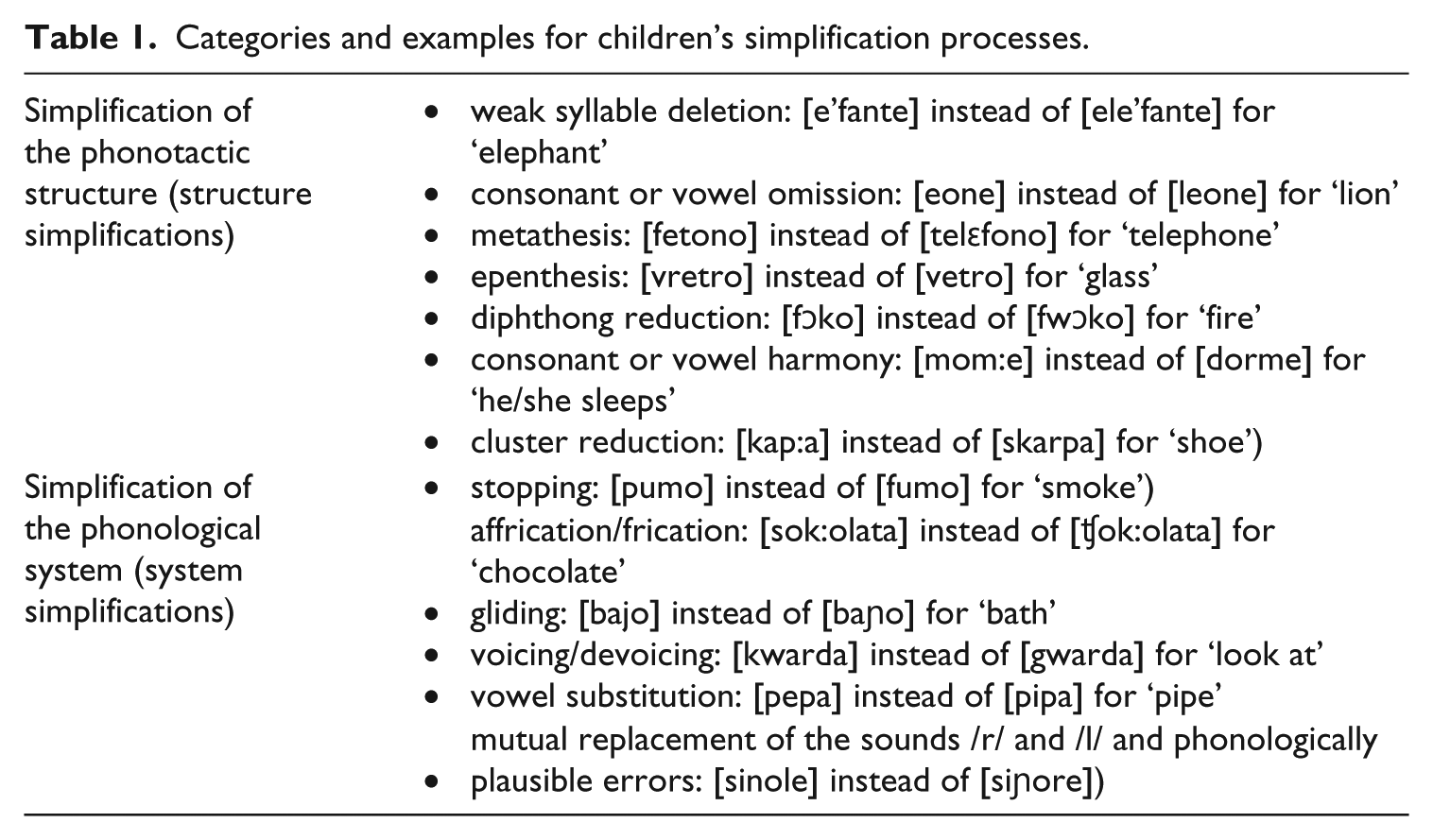
On the basis of the classifications presented in the PFLI test manual (Bortolini, 1995b), we assessed two categories of simplification processes consisting in processes that simplify the phonotactic structure or the phonological system (see examples in Table 1). For a detailed description of the phonological processes, refer to a previous publication (Zanobini et al., 2012).
Categories and examples for children’s simplification processes.
Results
Descriptive statistics for the phonological measures extracted from the PFLI and for the lexical quotient are shown in Table 2. The percentage of simplified words was calculated on the basis of the total number of intelligible words, and the percentage of unintelligible productions was calculated on the basis of the total number of productions. The mean number of consonants produced in the initial and medial positions were 10.9 (SD = 3.5) and 13.9 (SD = 4.8), respectively. The mean number of consonants produced independent of position was 16.8 (SD = 3.8). As expected, the mean number of correct consonants was reduced slightly (M = 15.9, SD = 4.0). The inventory of consonants produced correctly at least three times is indicative of a rudimentary ability to produce sounds accurately.
Descriptive statistics of the phonological measures extracted from the PFLI and of the lexical quotient of the CDI.
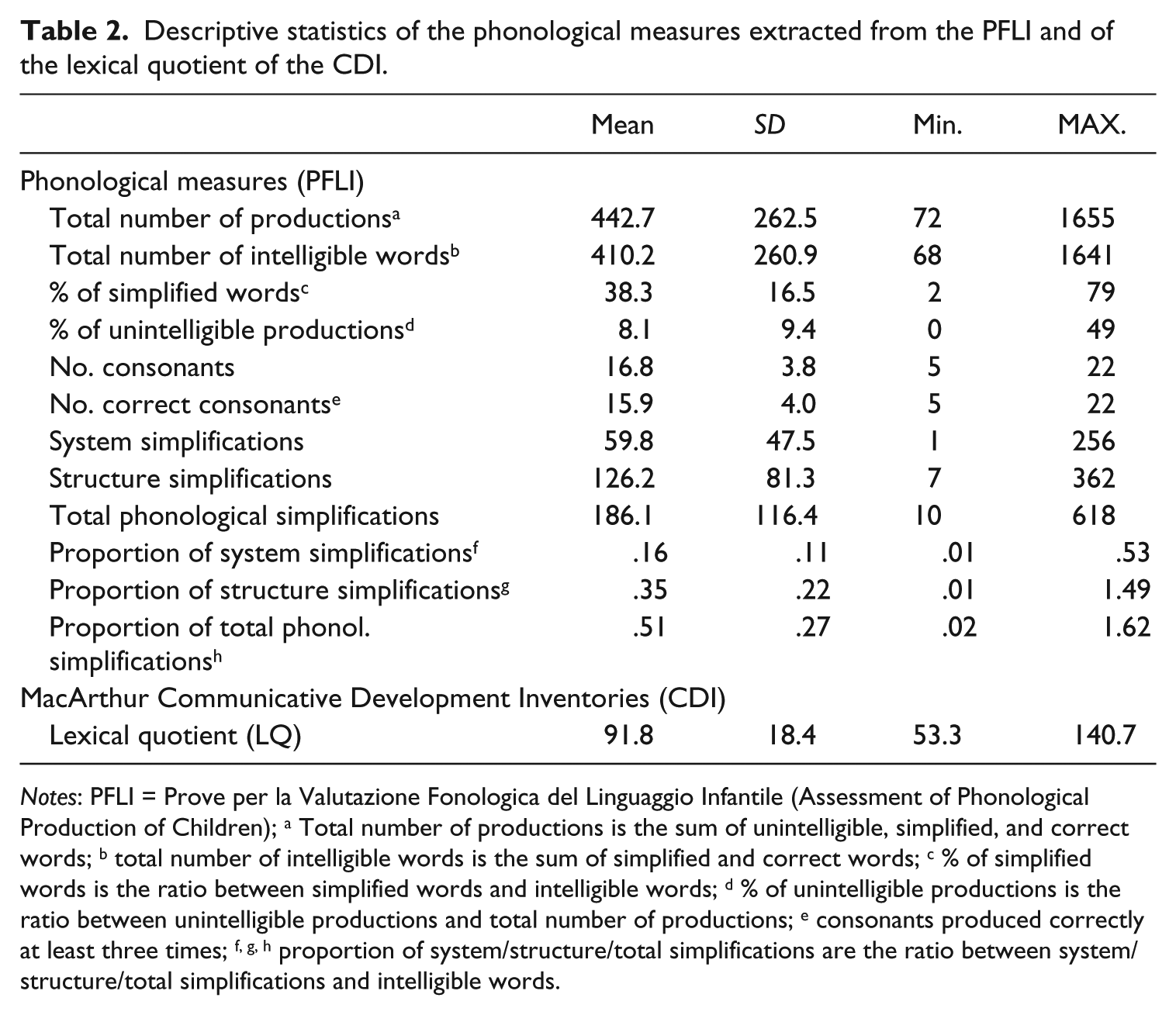
Notes: PFLI = Prove per la Valutazione Fonologica del Linguaggio Infantile (Assessment of Phonological Production of Children); a Total number of productions is the sum of unintelligible, simplified, and correct words; b total number of intelligible words is the sum of simplified and correct words; c % of simplified words is the ratio between simplified words and intelligible words; d % of unintelligible productions is the ratio between unintelligible productions and total number of productions; e consonants produced correctly at least three times; f, g, h proportion of system/structure/total simplifications are the ratio between system/structure/total simplifications and intelligible words.
In Table 3, we report the percentage of children in our sample who included each consonant in their own inventory and who produced it correctly with respect to the adult target at least three times. For the majority of consonants, as expected, the percentage of children who produced them correctly was lower. An exact McNemar’s test determined that there was a statistically significant difference in the percentage of the following consonants: /ʧ/ (p = .002), /ʤ/ (p = .031), /ʃ/ (p < .001) and /j/ (p = .007). For these consonants, a significant percentage of children able to produce the sound did not produce it correctly.
Percentage of children who produce each consonant (second column) and percentage of children who produce each consonant correctly at least three times (third column).

p < .05, McNemar’s test.
Table 4 shows the correlations between the phonological variables of the PFLI and the CDI lexical quotient. Although all the phonological measures except the percentage of structure simplifications are correlated with the lexical variable, correlations are generally moderate. The phonological variables that are most associated with lexical production are the percentage of unintelligible productions and the number of correct consonants.
Correlations between phonological measures extracted from the PFLI and the CDI lexical quotient.
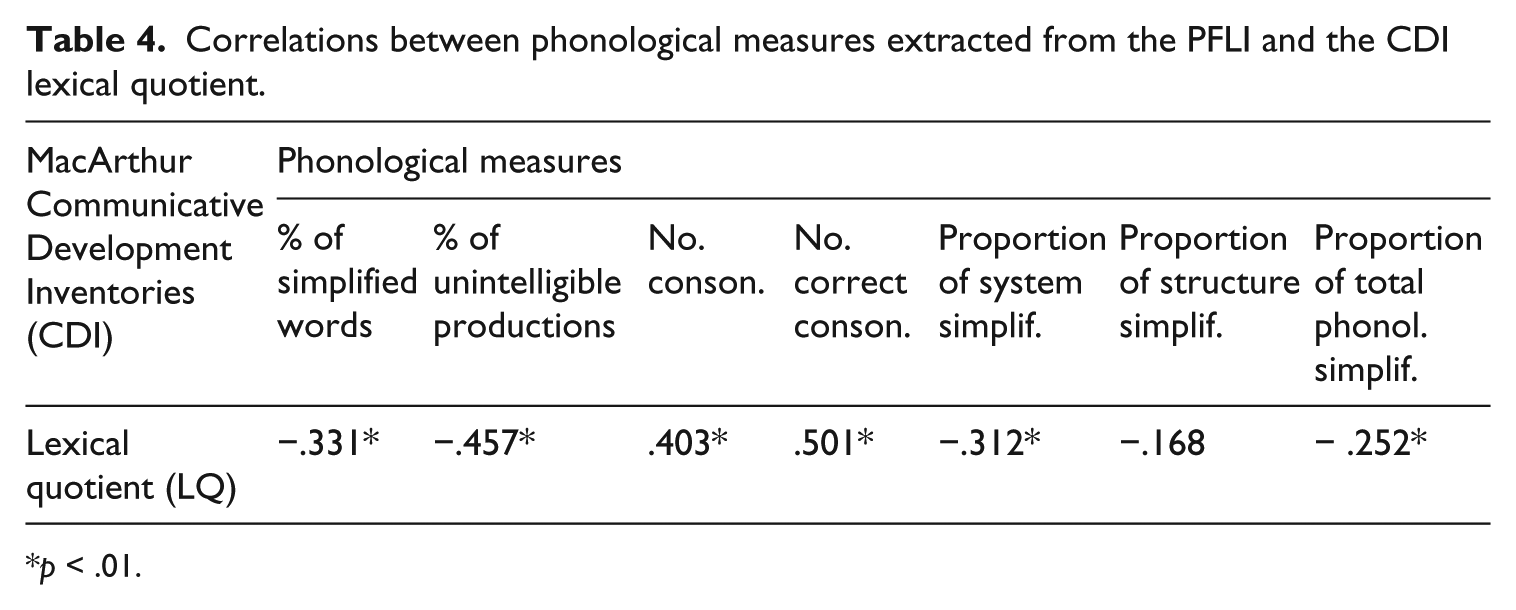
p < .01.
As expected, the correlation between the number of words recorded by mothers with the CDI and the total number of productions at PFLI is significant, though weak (r = .234; p = .029).
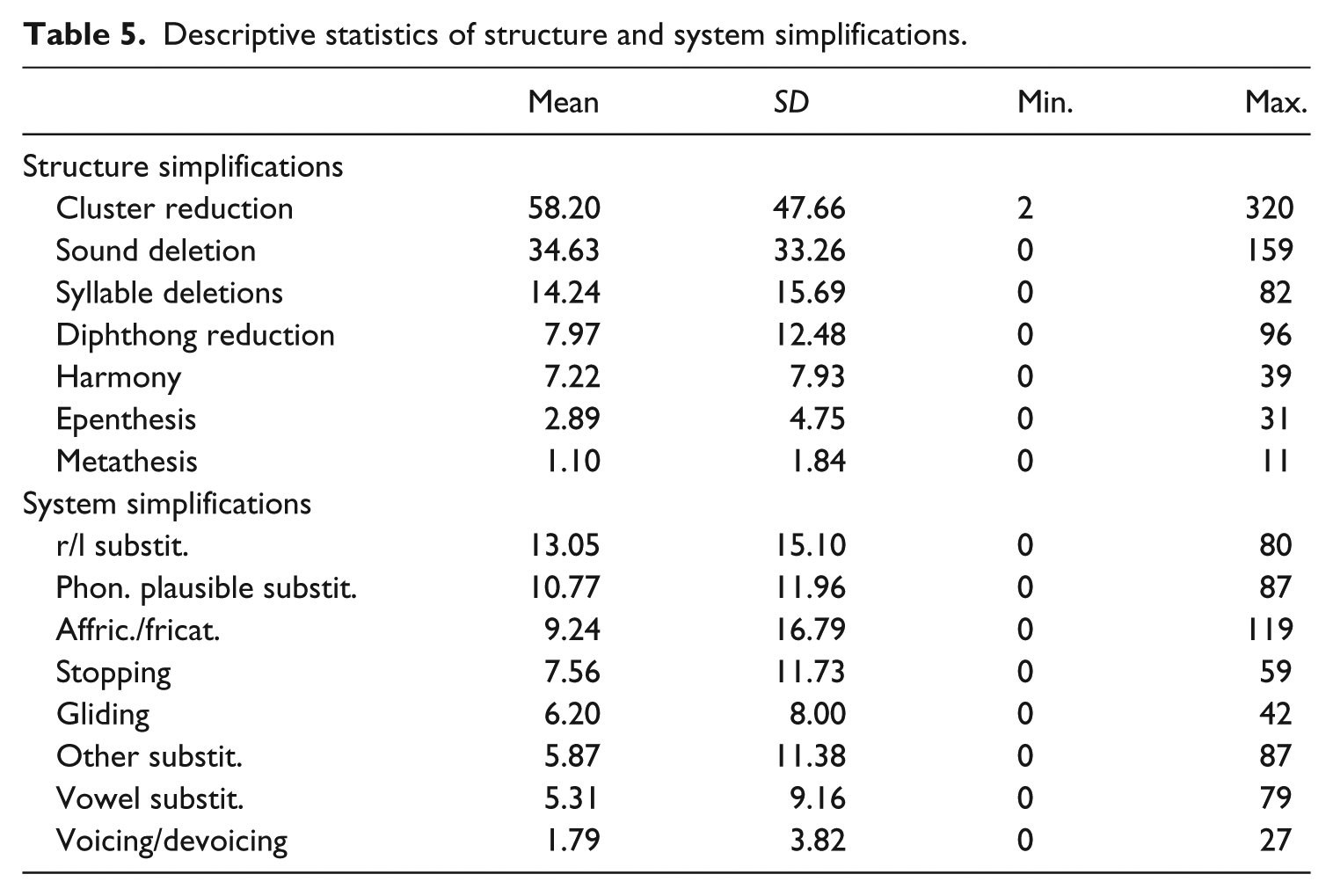
With respect to types of phonological processes, descriptive statistics for each category of system and structure simplifications are reported in Table 5. The most frequent structure simplifications (Table 5) in our sample were cluster and sound deletions, followed by syllable deletions; r/l and phonologically plausible substitutions were the most frequent system simplifications (Table 5).
Descriptive statistics of structure and system simplifications.
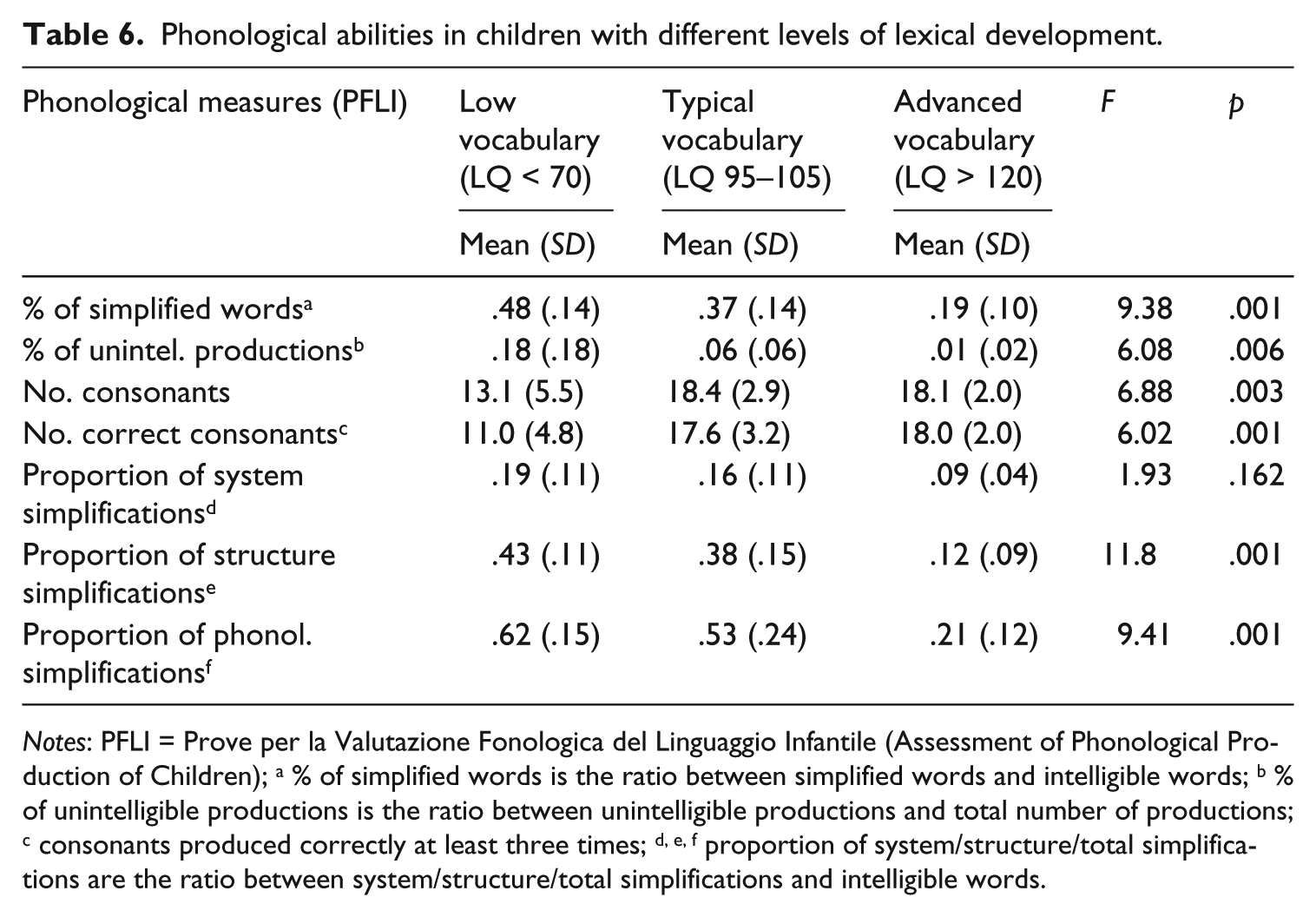
To assess the phonological characteristics of children with different lexical development, we extracted three subgroups of children from our sample that differed according to lexical quotient: low vocabulary (LQ < 70, n = 10), typical vocabulary (LQ ranging from 95 to 105, n = 17) and advanced vocabulary (LQ > 120, n = 7). As shown in Table 6, the three samples differed significantly in all phonological measures, except for system simplifications.
Phonological abilities in children with different levels of lexical development.
Notes: PFLI = Prove per la Valutazione Fonologica del Linguaggio Infantile (Assessment of Phonological Production of Children); a % of simplified words is the ratio between simplified words and intelligible words; b % of unintelligible productions is the ratio between unintelligible productions and total number of productions; c consonants produced correctly at least three times; d, e, f proportion of system/structure/total simplifications are the ratio between system/structure/total simplifications and intelligible words.
Post hoc comparisons, using the Bonferroni correction, revealed that children with a low vocabulary differed significantly from the other two groups in terms of the percentage of unintelligible words and in the number of both consonants and correct consonants at p < .05. They did not differ from the children with typical vocabulary in the percentage of structure simplifications and total phonological simplifications, but they differed significantly from the advanced vocabulary group (p < .05 for all comparisons). Conversely, children with advanced vocabulary showed, as expected, a significantly lower percentage of simplified words and consequently a lower percentage of structure and total phonological simplifications compared to the other groups (p < .05 for all comparisons).
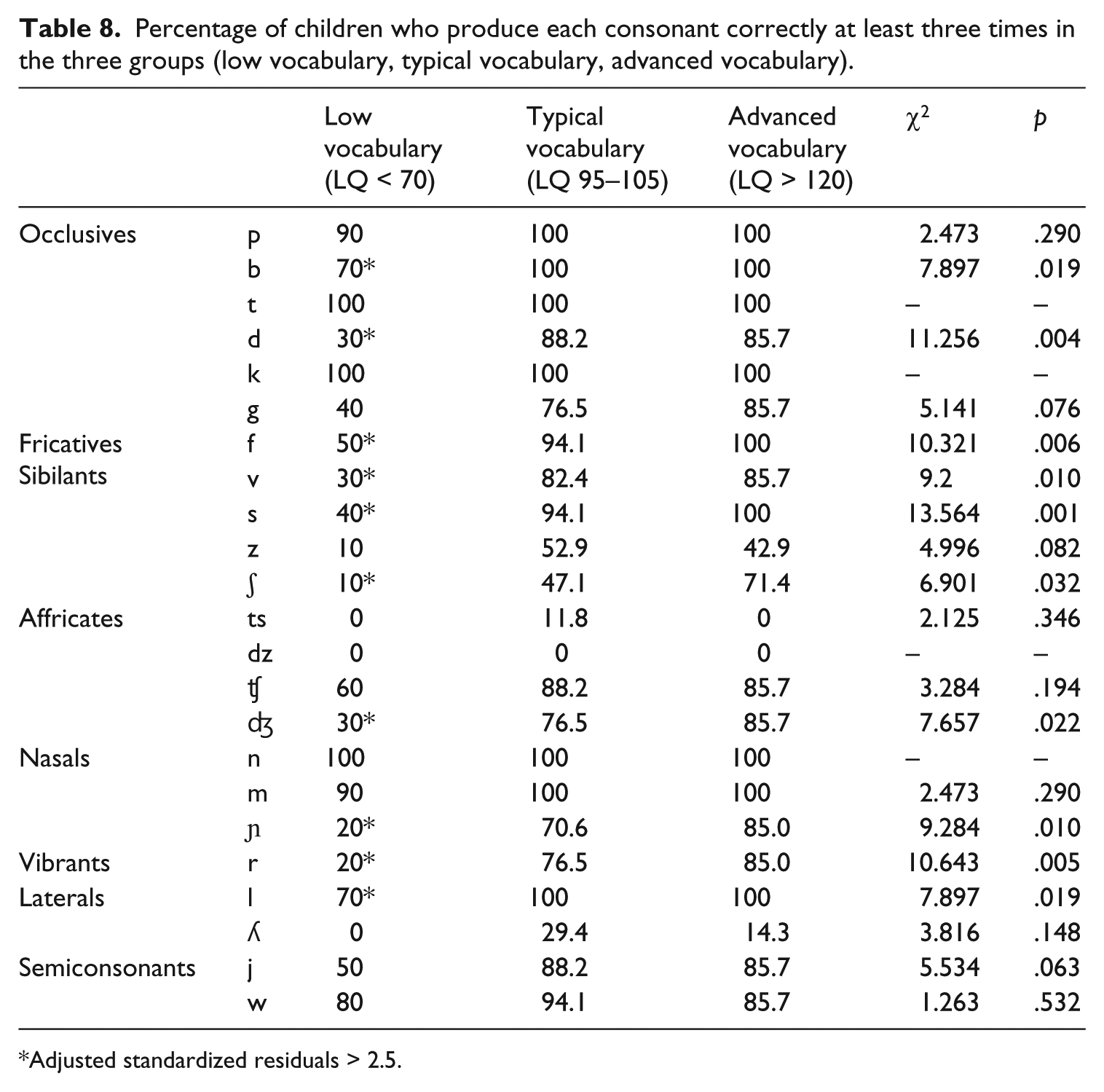
The chi-square test was used to determine whether the number of children who produced a given consonant differed between the three groups of children with low, typical and advanced vocabulary. Two separate analyses were performed for both consonants and correct consonants (Tables 7 and 8). When chi-squared statistics proved to be significant, adjusted standardized residuals were calculated to identify which cells contributed most to the significant chi-squared statistic. Cells in which the adjusted standardized residuals were ⩾ 2.5 were considered significant. The results indicate that some consonants were produced by most children irrespective of vocabulary size. These are the occlusives /p/, /t/, /k/, the nasals /m/, /n/ and the semiconsonant /w/. A statistically significant difference among the three groups of children was found in the production of the following consonants: /b/, /g/, /f/, /s/, /z/, /ʤ/, /r/. When considering the correct consonants (Table 8), the differences between the three groups of children become larger and extend to other consonants such as /d/, /l/, / ɲ/, /ʃ/, /v/. Inspection of adjusted standardized residuals indicates that children with low vocabulary were less likely to produce such phonemes compared to the other two groups of children.
Percentage of children who produce each consonant in the three groups (low vocabulary, typical vocabulary, advanced vocabulary).

Adjusted standardized residuals > 2.5.
Percentage of children who produce each consonant correctly at least three times in the three groups (low vocabulary, typical vocabulary, advanced vocabulary).
Adjusted standardized residuals > 2.5.
In sum, a significantly higher percentage of children with low vocabulary do not regularly produce some consonants (/b/, /g/, /f/, /s/, /z/, /ʤ/, /r/); the difference in consonant production of low vocabulary children compared to the other two groups becomes more evident when considering the correct consonants. In particular, as regards consonants /d/, /l/, /ɲ/, /ʃ/, /v/, children with low vocabulary are as able as children with typical and advanced vocabulary to produce them, but are less likely to produce them correctly, in relation to the adult target. Conversely, as regards consonants /g/ and /z/, children with low vocabulary produce them less frequently than the other groups of children, but as correctly as they do.
A detailed analysis of types of phonological simplification processes indicates that, as regards structure simplifications, significant differences were found in the proportion of cluster reductions (F = 9.37; p = .001), sound deletions (F = 5.10; p = .012) and harmony (F = 4.72; p = .016) (Figure 1). Post hoc comparisons revealed that children with advanced vocabulary produced significantly fewer cluster reductions than the other two groups (p < .05 for all comparisons), which did not significantly differ from one another. Furthermore, children with advanced vocabulary produced fewer sound deletions and harmony compared to children with low vocabulary (p < .05 for all comparisons). As regards both sound deletions and harmony, children with typical vocabulary did not differ from either the advanced or the low vocabulary group.
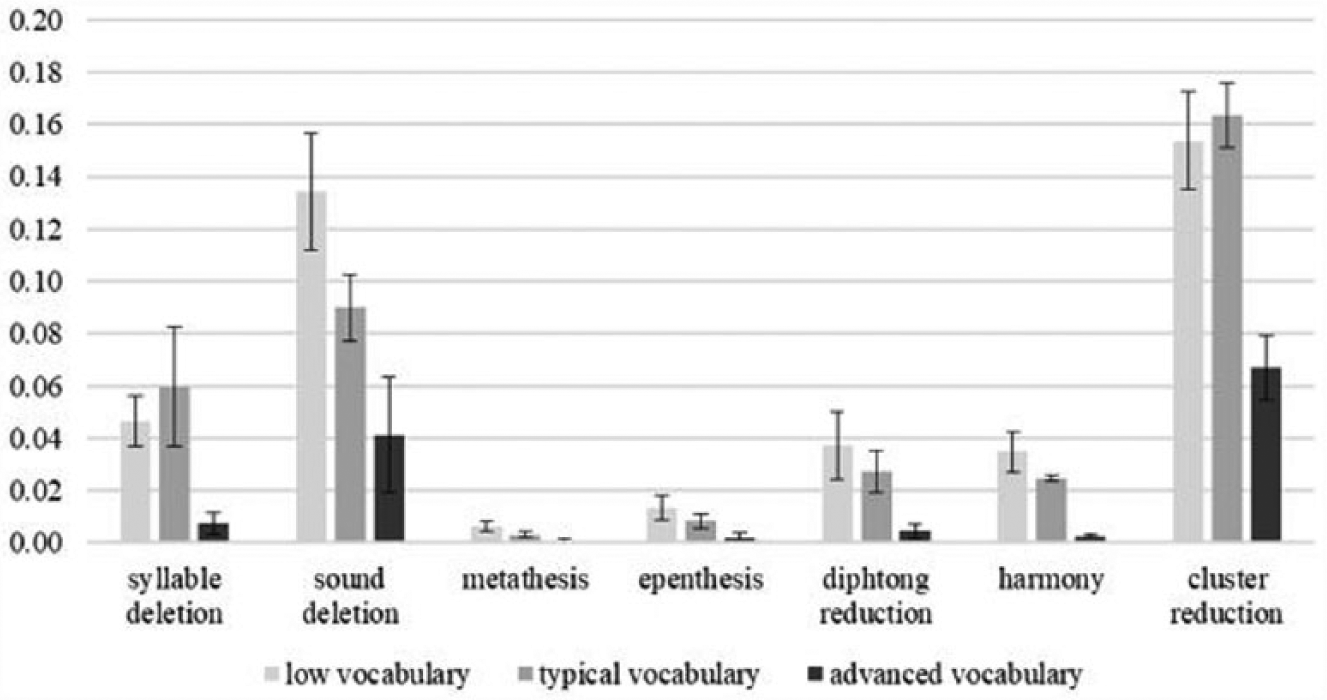
Structure simplifications as a proportion of the number of intelligible productions (and standard errors) in children with low, typical and advanced vocabulary.
As regards system simplifications (Figure 2), a significant difference among the three groups was found in the percentage of stopping (F = 6.11; p = .006). In particular, children with low vocabulary showed a significantly higher percentage of stopping compared to the other two groups (p < .05 for both comparisons). The other significant difference among the groups was related to vowel substitutions (F = 5.12; p = .0012), of which there were significantly fewer in children with advanced vocabulary compared to both other groups (p < .05 for both comparisons).
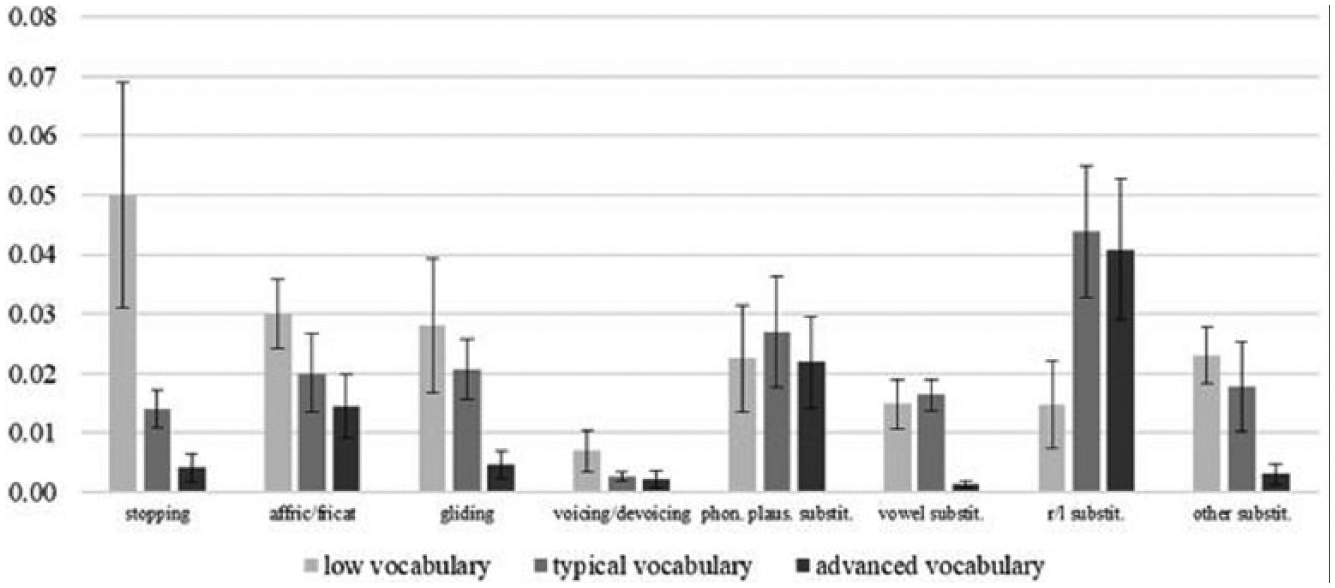
System simplifications as a proportion of the number of intelligible productions (and standard errors) in children with low, typical and advanced vocabulary.
Discussion
Phonological characteristics and phonological processes
The first aim of the study was to explore phonological abilities in a large sample of Italian children in their third year. To our knowledge, such a description did not exist for Italian-speaking children of this age especially in relation to the description of the phonological processes produced by children.
Considering the overall consonant inventory, our sample produced, on average, almost the same number of consonants as older Italian children in Zanobini et al.’s study (2012) and more sounds than 30-month-old children with average vocabularies in Smith et al.’s study (2006), thus showing a tendency of our sample to be on the whole more advanced than other samples. Nevertheless, comparison of consonant inventories among studies is not easy, both due to inter-linguistic differences (Saaristo-Helin et al., 2011) and possible methodological differences in data collection. In addition, at the very beginning of the third year, children tend to show considerable individual variation in the size of consonant inventories, but in subsequent months, individual differences seem to decrease, and at the end of their third year, the majority of children produce a large proportion of consonants in most native languages, although not always correctly (Orsolini, 2000). This fact could partially explain the similarity between the consonant inventory of our children and older children in other studies.
Considering the acquisition of single sounds, the results of our analysis are generally consistent with the literature. Stoel-Gammon (2011), for example, found that labial, alveolar and stop consonants, labial and alveolar nasals, glides and the fricatives /f/ and /s/ were present on average in 2-year-old children. Voiced fricatives and voiced affricates were found to be mastered later (Prather, Hedrick, & Kern, 1975). In particular, in Italian the sonorants are more difficult to produce since for voiced consonants vibration of the vocal folds has to precede release of the articulatory closure (Galluzzi, Bureca, Guariglia, & Romani, 2015; Zmarich & Bonifacio, 2005). Splitting the accuracy of consonant production into four levels on the basis of the percentage of correctness, Tresoldi et al. (2015) found that, among plosives and nasals, only /g/ and /ɲ/ were not yet mastered at the age of 3. Zanobini and Viterbori (2009) found that the alveolar affricate /ts/ and /dz/ and the lateral palatal /ʎ/ were difficult to pronounce for most children in their third year. Other consonants (/z/, /ʃ/, /r/) were difficult for a large percentage of the sample considered (almost 30%). These consonants tend to be produced later in typical phonological development in different languages (Bortolini, 1995a; McCune & Vihman, 2001; Tresoldi et al., 2015), possibly because of the manner of articulation, associated in most cases with a posterior pronunciation place (Bortolini, 1995a). Finally, Tresoldi et al. (2015) showed that /z/, /dz/, /ʃ/ and /r/ are distorted in the production of a lot of children until age 4;6, and the sound /ʎ/ tends to be frequently mispronounced by children in their sixth year. Moreover, most of these sounds are infrequent in Italian words and are probably rather uncommon in the adult input (Dietrich, Swingley, & Werker, 2007).
In relation to the inventory of consonants produced correctly at least three times, children in our sample were generally able to master the sounds already present in their inventory. Exceptions included consonants /ʧ/, /ʤ/, /ʃ/, /j/, where the difference between the two inventories was significant. These results are consistent with those of Tresoldi et al. (2015), who found that /ʧ/ and /ʤ/ were mastered after the fourth year and /ʃ/ after the fifth year. Finally, concerning the use of glides such as /j/, younger children frequently use them to simplify the production of more difficult sounds, such as /r/ or /ʎ/ (Fletcher, 1987).
In relation to the frequency of simplification processes, for Italian children aged 36–42 months, Zanobini et al. (2012) found that structure simplifications were more than twice as common as system simplifications, showing that, at a younger age, Italian children tend to simplify the syllable structure rather than substitute difficult sounds. Cluster reduction and consonant or vowel deletion were the most frequent structure simplifications, and the use of /l/ instead of /r/ was the most frequent substitution. In actual fact, the acquisition of consonant clusters constitutes a rather challenging task for children learning different languages (McLeod, van Doorn, & Reed, 2001). Two-year-old children begin to produce some consonant clusters correctly, but the complete acquisition of them is one of the longest lasting aspects of phonological acquisition and represents one of the most common difficulties in late-talking children. Moreover, in Italian, compared to English, consonant clusters are more common and consequently represent a specific challenge in the phonological development of young children.
Phonological abilities and vocabulary size
The second aim of our study was to explore the link between phonological and lexical development. An initial analysis of the correlations between phonological measures and vocabulary size shows the presence of moderate or low correlations for most phonological variables. The phonological measures showing the strongest associations with the lexical quotient of CDI were the proportion of unintelligible productions and the number of correct consonants. Simplification processes are less or not at all correlated with vocabulary size, possibly because phonological simplifications are common to all children at this age irrespective of their lexical abilities. As a whole, these results indicate that phonological and lexical development are interrelated and that the acquisition of the two processes proceeds in parallel for many aspects (Vihman, 2017), but also that other variables different from phonological accuracy are possibly involved in lexical acquisition (Smith et al., 2006; Zamuner & Thiessen, 2018). Some of these variables pertain to the lexical and phonological characteristics of the words, such as word length, neighbourhood density and phonotactic probability, some others likely refer to children’s cognitive processes, in particular executive function and phonological working memory which were found to be significant predictors of lexical acquisition (Cozzani, Zanobini, & Usai, 2016; Gathercole, Service, Hitch, Adams, & Martin, 1999; Michas & Henry, 1994). In addition, lexical development is strongly associated with both semantic development (Orsolini, Santese, Desimoni, Masciarelli, & Fanari, 2010) and quality and quantity of language input (Weisleder & Fernald, 2013).
Further information relative to the relationship between phonological and lexical acquisition can be extracted from our results by analysing the differences among the three groups of children with different vocabulary sizes. Among the variables considered, the consonant inventory, the number of consonants produced accurately at least three times and the level of intelligibility tended to distinguish low vocabulary children from both typical and precocious age-mates. Additionally, when considering phonological inventories, it emerges that a lower percentage of children belonging to the less competent group have the target consonants /b/, /g/, /f/, /s/, /z/, /ʤ/, /r/ in their inventory, while the other two groups perform significantly better. The same tendency is found for the differences in the inventory of correct consonants.
The results are mostly consistent with other studies comparing consonant production among children with different vocabulary sizes. Smith et al. (2006) found that 24-month-old children with average vocabulary differed significantly from precocious age-mates, whereas precocious 24-month-olds did not differ from average 30-month-old children in consonant inventory, in inventory of consonants produced accurately at least once, and in number of consonants produced with at least 75% accuracy. Kehoe et al. (2015) found that consonant inventory differentiated typically developing children from both precocious and late talkers. Finally, our results are consistent with the findings of studies considering consonant inventories and the level of intelligibility in late talkers as a risk factor for a persistent language delay. In relation to intelligibility, Orsolini (2000) reported that Italian children with a consistent language delay between 18 and 33 months of age produced a significantly smaller percentage of intelligible utterances than did children with typical language development of the same age and younger (12–18 months old). Similarly, Paul (1996) reported reduced intelligibility in English-speaking late talkers who were studied from ages 3 to 4 years and in older children with a history of persistent language delay.
As a whole, children with advanced vocabulary in our sample stand out for the correctness of their language, as shown by the low percentage of simplified words, while both low and typical vocabulary children in the age range considered tended to frequently simplify words and make many structure simplifications. In almost all the types of simplifications considered, even when differences were not significant, the distribution of phonological simplifications tend to decrease dramatically in children with advanced vocabulary. In particular, as expected, children with advanced vocabulary show almost no primitive simplification types such as assimilation and vowel substitution. Indeed, assimilations are considered as early phonological processes that are completely absent in older Italian children (Zanobini et al., 2012) and, similarly, vowels are consistently produced from a very precocious stage of development since they are easier to articulate than consonants (Galluzzi et al., 2015). Furthermore, children with advanced vocabulary use fewer cluster reductions than children in the other two groups, although, as previously outlined, this simplification is considered a very common one in older ages (McLeod et al., 2001).
The only substitution that shows an inverse tendency is that of /r/ with /l/ which is more frequent (though not significantly) in the group with advanced vocabulary. Among liquid consonants, the Italian /r/ is a rhotic sound, difficult to produce because the oral configuration and the strength of the air flow must be just right to cause the vibration (Galluzzi et al., 2015). This difficulty causes frequent substitutions with the easier liquid sound, even in older or more competent children (Tresoldi et al., 2015; Zanobini et al., 2012). Moreover, it is possible that less competent children tend to omit rather than substitute the sound /r/.
Finally, stopping errors seem to characterize the production of less competent children, whereas they are very weakly represented in the other two groups. A complete constriction of the vocal tract, such as that involved in the production of stop consonants, can be considered easier than a more limited closure such as that involved in the production of fricative and affricate consonants (Galluzzi et al., 2015). Stops, together with nasals, are the earliest true consonants to be produced by all children in different languages because of their natural perceptual salience (Fasolo et al., 2008; Vihman, 1996). Our results suggest that the wide prevalence of this simplification process in the third year could be considered a phonological indicator of low language ability.
Some limitations of the study have to be mentioned. First, our results are correlational and do not permit drawing inferences about the nature and the direction of the links between phonological and lexical acquisition. If phonological categories also emerge from the lexicon, the sound properties of a child’s lexicon in addition to the overall vocabulary size could help to further elucidate the relationship between the emerging sound system and lexical development (Curtin & Zamuner, 2014). As stated by Vihman (2017, p. 19), ‘there is no real clash of sounds before words versus words before sounds: the learning of sounds and words necessarily proceeds in parallel’.
Moreover, in order to better highlight the phonological characteristics of the production of children with different lexical skills, only the children showing markedly low, typical or advanced vocabulary were chosen. In this way, the samples compared were quite limited in size, thus many differences were not statistically significant. Further research should focus on the longitudinal relationships between early phonological skills and subsequent language outcomes and should deepen the study of the role of cognitive factors in phonological development, in order to answer some partially open questions. Does the phonological competence of Italian children in their third year predict subsequent lexical skills? Which phonological variables may constitute a risk factor for future language development? Which kinds of phonological simplifications can help to identify children who will show a persistent language delay? Do cognitive aspects such as attentional patterns and effortful control influence phonological development?
Footnotes
Funding
The authors received no financial support for the research, authorship, and/or publication of this article.