




Abstract
This article investigates the word order preferences of Tagalog-speaking adults and five- and seven-year-old children. The participants were asked to complete sentences to describe pictures depicting actions between two animate entities. Adults preferred agent-initial constructions in the patient voice but not in the agent voice, while the children produced mainly agent-initial constructions regardless of voice. This agent-initial preference, despite the lack of a close link between the agent and the subject in Tagalog, shows that this word order preference is not merely syntactically-driven (subject-initial preference). Additionally, the children’s agent-initial preference in the agent voice, contrary to the adults’ lack of preference, shows that children do not respect the subject-last principle of ordering Tagalog full noun phrases. These results suggest that language-specific optional features like a subject-last principle take longer to be acquired.
Introduction
A critical task in language acquisition is learning the specific word order regularities of the ambient language. Children acquiring languages like English must learn that the position of an argument in a sentence is crucial for determining who the agent and the patient of an action denoted by the verb are. For example, to express that a girl named Mary is kicking a boy named John, they should code Mary as the subject and therefore, at the initial position of the sentence, and John as the object, which comes after the verb.
It is claimed that children generally acquire the language’s canonical forms before the non-canonical patterns, with canonical referring to structures which speakers produce with minimal assumptions regarding the listener’s background knowledge (Slobin, 1982; Slobin & Bever, 1982). Studies on spontaneous speech have shown that children prefer a subject-initial word order in both fixed (Brown, 1973 for English; Slobin & Bever, 1982 for Italian) and relatively more flexible word order languages (Lee, 2010 for Mandarin; Slobin & Bever, 1982 for Serbo-Croatian and Turkish; Tanaka & Shirai, 2012 for Japanese). The same preference was found in production experiments wherein children had to describe pictures (Hakuta, 1982 for Japanese), videos (Cannizzaro, 2012 for Dutch and English), or act-outs (Angiolillo & Goldin-Meadow, 1982 for English; Cannizzaro, 2012 for Dutch and English).
In most of these studied languages, the canonical order is subject-initial, and the agent usually corresponds to the subject (Dryer, 2013), which means that the subject-initial order is also agent-initial (agent-before-patient). This order reflects both the grammatical relational hierarchy (the subject is the highest grammatical relation; Johnson, 1977) and the thematic role hierarchy (the agent is the highest thematic role; Fillmore, 1968; Siewierska, 1993). The subject-initial preference is considered to have such great importance in word ordering patterns that Greenberg (1963) proposed it as Universal #1: ‘In declarative sentences with nominal subject and object, the dominant order is almost always one in which the subject precedes the object’ (p. 61). Another – maybe not independent – ordering principle relates to the thematic roles of the argument with the agent preferably occurring before the patient. This order is considered to result from a universal principle that the thematically independent role (agent) tends to precede and/or c-command the role that is thematically dependent (patient) (Primus, 2006). A patient is thematically dependent on the agent, because there would be no patient if there were no agent acting on it in the first place. Primus (2003) proposed that this thematic dependency may be derived from the dependency of an effect to a cause. Others have claimed that an agent-initial preference reflects, in an iconic manner, how an agent initiates a causal event which affects the patient (Cohn & Paczynski, 2013; Kemmerer, 2012).
In languages with a subject-initial/agent-initial canonical order, children do not face a conflict on which argument should occur first – it is the subject which is also usually the agent, except for the passive voice. Therefore, in these languages, it cannot easily be disentangled whether the choice of the word order is driven by a subject-initial preference or by an agent-initial preference. After all, Jackendoff and Wittenberg (2014) have proposed that already at the two-word stage, children have a preference for an agent-initial order in utterances containing only nouns – an agent and a patient. They claim that this is a direct mapping from thematic roles to linear position without the need to resort to grammatical relations, which means that children prefer an agent to appear before a patient, even when the former is not a subject.
In this article, we investigate children’s acquisition of word order patterns in Tagalog – a language wherein the first noun phrase position is not confounded with the subject position, and the agent is not closely linked to the subject. These properties lead to the question of which word order Tagalog-learning children would prefer – subject-initial or agent-initial. Studying the acquisition of Tagalog can thus show whether children’s word order preference is syntactically-driven, i.e., subject-initial, or semantically-driven (determined by thematic roles), i.e., agent-initial.
Tagalog voice-marking and word order
Tagalog, a Malayo-Polynesian Austronesian language with over 23 million speakers, is one of the major Philippine languages (Simons & Fennig, 2018). Many aspects of its grammar remain controversial. Some scholars claim that Tagalog is a nominative-accusative language (Rackowski & Richards, 2005), while others argue that it is ergative-absolutive (Aldridge, 2012; Schachter & Reid, 2008). In this article, we follow Foley (1998), Himmelmann (2005a), and Riesberg (2014), who categorize Tagalog as a symmetrical voice language, which means that the language has multiple basic transitive constructions, which are considered symmetrical because the verb bears a specific marker in all of the voice alternations. Furthermore, there is no demotion of an argument to an oblique sentence element across the voice alternations, which is different from the active–passive alternation in other languages like English or German (Riesberg & Primus, 2015).
Tagalog’s basic sentence structure includes the predicate and the so-called ang-phrase, which is the sentence subject (Guilfoyle, Hung, & Travis, 1992; Kroeger, 1993a; see Schachter, 2015 for an alternative view). Other arguments as well as adjuncts are preceded by the morphological marker ng, which can signify a common noun object, a possessor, or also an adjectival modifier (Schachter & Otanes, 1972), or by the morphological marker sa, which is a locative preposition (Himmelmann, 2005b). According to Himmelmann (2005b, 2015), ng marks non-subject agents, and non-subject non-human patients which are preferably but not obligatorily indefinite; while sa marks non-subject human and definite patients.
In the Tagalog voice-marking system, a morphological marker on the verb assigns the thematic role of the ang-phrase or the subject (Himmelmann, 2005b). 1 In the agent voice (AV), the verbal infix –um– (see Latrouite, 2001 for a discussion on affix choice) indicates that the ang-phrase is the agent, see example (1). In contrast, in the patient voice (PV), the verbal infix –in– denotes that the ang-phrase is the patient, see example (2). Hence, the roles of agent and patient are reversed with only a change in the voice-marking on the verb. The thematic role assignments are not affected by the order of the arguments such that there is no change in meaning between examples (1) and (3) in agent voice and between examples (2) and (4) in patient voice.




The choice of voice seems to be affected by several factors. Definiteness is one of them (Himmelmann, 2005b): ang-phrases are always interpreted as definite, therefore patient voice is used in sentences with definite patients. A written corpus study by Cooreman, Fox, and Givón (1984), and a picture description task by Tanaka et al. (2015), provide empirical evidence that the patient voice is generally preferred when a patient is present. However, Tanaka and colleagues (2014) also showed that when the patient is indefinite and inanimate, the patient voice preference is weakened.
Another feature of Tagalog is its relatively free word order. The canonical order is verb-initial, but the order of the arguments is not fixed (Schachter, 2015). An ang-phrase-verb-ng-phrase 3 order (from here on referred to as ang-verb-ng) is also grammatical, but it is considered more formal and is usually found in writing (Schachter & Otanes, 1972). The basic orders of arguments and grammatical functions are still matters of controversy. There are claims that the canonical order is verb-ng-ang (Billings, 2005), verb-ang-ng (Aldridge, 2002), agent-initial (Buenaventura-Naylor, 1975; Manueli, 2010; Schachter, 2015), or verb-ng-ang for the patient voice and both verb-ng-ang and verb-ang-ng for the agent voice (Guilfoyle et al., 1992; Kroeger, 1993b).
In verb-initial sentences with a pronominal argument, the pronoun occurs immediately after the verb (Billings, 2005). Pronouns have corresponding ang-argument, ng-argument, and sa-argument forms (e.g., siya, niya, kaniya, respectively for the third-person singular; Himmelmann, 2005b). Concerning sentences with non-pronominal arguments, Kroeger (1993b) proposed three principles which determine the preferred order of full noun phrases. First, the agent tends to precede the other arguments (which we will call the agent-first principle). 4 Second, the ang-phrase tends to be the last phrase (subject-last principle). Third, heavier noun phrases (longer constituents) follow lighter noun phrases (shorter constituents). The first and third principles are commonly observed across languages but the second seems to go against the widely observed subject-initial preference.
There have been a few experimental studies that shed light on speakers’ preferences of ordering non-pronominal arguments in Tagalog. Manueli (2010) manipulated the voice-marking of the verb kain ‘eat,’ and the order of the arguments fish and cat, and asked native adult speakers of Tagalog to rate the grammaticality of the sentences, such as Kumakain ng isda si Muning (‘Muning (cat) is eating fish’). All 11 participants judged the agent voice patient-initial and patient voice agent-initial orders (verb-ng-ang) as grammatical, while three participants judged the agent voice agent-initial and patient voice patient-initial (verb-ang-ng) as less grammatical. More recently, Hsieh (2016) used more verbs in a task wherein participants read aloud a sentence, and then rated its naturalness. 5 The results showed that patient voice agent-initial (verb-ng-ang) was judged as the most natural, followed by both orders in the agent voice. Patient voice patient-initial (verb-ang-ng) was judged as the least natural. Similar to Manueli’s results, in the patient voice, ratings for the agent-initial condition (verb-ng-ang) were statistically higher (more grammatical) than the ratings for the patient-initial condition (verb-ang-ng). In contrast, in the agent voice, the ratings for the two orders were not statistically different from each other, unlike the patient-initial (verb-ng-ang) preference in Manueli’s study.
Using eye-tracking and a picture description task, Sauppe, Norcliffe, Konopka, Van Valin, and Levinson (2013) showed that adult speakers preferred to produce patient voice agent-initial sentences (verb-ng-ang, 62%), followed by agent voice patient-initial (verb-ng-ang, 30%). The speakers produced only a few agent voice agent-initial (verb-ang-ng, 5%), and patient voice patient-initial (verb-ang-ng, 2%) sentences. Tanaka (2016) also used a picture description task but manipulated animacy and definiteness as well. The adult participants’ preferences showed the same trend as the preferences shown in Sauppe et al.’s study, but there was a smaller difference between the frequency of agent voice patient-initial (verb-ng-ang, 15%) and agent voice agent-initial (verb-ang-ng, 8%) productions.
The studies reported so far all indicate that patient voice agent-initial (verb-ng-ang) is the overall most preferred construction for adult speakers of Tagalog. The production data further suggest that in the agent voice, subject-final (i.e., agent-final) constructions are preferred compared to agent-initial/subject-initial constructions. This finding is in line with the majority of proposals on Tagalog’s basic word order and supports the assumption that adults’ preferences are driven by an agent-first but also by a subject-last principle. The patient voice agent-initial (verb-ng-ang) structure obeys both of these principles, which could explain the overall preference for these constructions. The results for the agent voice suggest a slight dominance of the subject-last principle over the agent-first principle, as the participants preferred patient-initial sentences in this voice (subject-last utterances). This pattern could indicate that for Tagalog-speaking adults, grammatical principles of word order dominate principles that consider the thematic roles of the arguments. However, such a conclusion is premature based on the present data. In both production experiments, agent voice constructions were produced less, so there were fewer data points to compare. Moreover, Sauppe et al. (2013) did not control for the animacy of the themes in their stimuli. In Tanaka’s (2016) study, there was no agent voice production from stimuli with animate patients (N. Tanaka, personal communication, 15 February 2017). As studies have shown that animacy has an effect on word order choice and grammatical role assignment (Branigan, Pickering, & Tanaka, 2008; Ferreira, 1994; Prat-Sala, Shillcock, & Sorace, 2000), animacy should be controlled for in an experiment in order to dissociate the subject-initial from an agent-initial preference.
Acquisition of Tagalog word order
Empirical studies on the acquisition of Tagalog word order are scarce. One of the earliest studies that looked at the interaction of voice and word order in Tagalog acquisition was done by Segalowitz and Galang in 1978. They found that Tagalog-speaking children (mean ages: 3;6, 5;6, 7;4) correctly interpreted verb-ng-ang sentences in the patient voice (agent-initial) but not in the agent voice (patient-initial). This asymmetry was not observed in their production experiment, which showed no difference in children’s accuracy in using the agent voice and the patient voice. However, their study does not inform on children’s word order preference because they provided the initial argument in order to check for voice mastery.
Focusing more on word order preference, Bautista’s (1983) picture description task showed that children (ages: 2;2–4;6) had a preference for the agent-initial order (88%) compared to the patient-initial order (12%). In a longitudinal study of spontaneous speech samples of six children (ages: 1;2–4;11), Marzan (2013) reported that verb-agent-patient constructions were one of the most used constructions in the data set. However, voice was not considered in Marzan’s study, and Bautista did not report the interaction of word order and voice, so it cannot be determined based on these data whether the agent-initial preference is dependent on voice.
More recently, Tanaka (2016) gave children (mean age: 5;5) the same picture description task as in her production experiment with adults described above. According to her results, children – like adults – mostly produced patient voice agent-initial (verb-ng-ang) constructions. However, in contrast to the adults, children preferred agent-initial utterances for the agent voice (verb-ang-ng) as well. There were also a few patient voice patient-initial (verb-ang-ng) constructions, but unlike the adults in her study, the children did not produce agent voice patient-initial (verb-ng-ang) constructions.
The results from the reported studies on word order in Tagalog suggest differences between word order preferences of children and adults: Unlike adults who show an agent-initial preference only in the patient voice (verb-ng-ang), children also seem to prefer agent-initial sentences in the agent voice (verb-ang-ng). This finding suggests that children’s choice of word order is driven more by the agent-first principle than the grammatical functions of the arguments. Thus, the word order preference exhibited by children seems to follow a different underlying strategy compared to adult speakers of their language. However, the data based on Tagalog-learning children are still too scarce to draw such a strong conclusion. First, due to the general preference of patient voice in children, as well as adults, the number of utterances in agent voice was very limited in the previous production studies. Furthermore, Tanaka (2016) did not consider a potential effect of animacy on word order as both sentences with and without animacy contrast of the arguments were included in her task but not analyzed separately. Since animacy has been shown to interact with children’s word order preferences in other languages (Cannizzaro, 2012), we further investigated word order preferences in Tagalog using an experimental design that held animacy constant and provided conditions in which a higher number of agent voice productions could be elicited.
Current study
In this study, we examined Tagalog-learning children’s word order preferences to determine whether an agent-first principle is stronger in guiding their word order preferences than a word order that is based on the grammatical function of the argument, as data from adult Tagalog speakers suggest. We directly manipulated the voice-marking of the verbs in a sentence completion task to experimentally test and compare Tagalog-speaking adults’ and children’s word order preferences in agent and patient voice. Providing a voice-marked verb allowed us to investigate word order preferences in a highly controlled fashion and to elicit the same number of productions for the agent voice and the patient voice. We also held animacy constant to control for the possible bias to code an animate argument before an inanimate argument. Furthermore, in order to see when children reach adult-like behaviour, we included adult participants and two groups of children that differed in age: five-year-olds as in the study by Tanaka (2016) and an older group of seven-year-old children.
Experiment 1: Word order preferences of adults
In Experiment 1, we gave adult native speakers a sentence completion task to determine their word order preferences in both the agent and patient voice. Based on Kroeger’s (1993b) proposed agent-first and subject-last principles of ordering full noun phrases in Tagalog, the adults are expected to show an agent-initial preference in the patient voice (verb-ng-ang), but no such preference in the agent voice. However, if adults’ word order preference is more strongly guided by the subject-last than the agent-first principle, we would expect more patient-initial than agent-initial orderings in the agent voice.
Method
Participants
Twenty native Tagalog speakers (mean age: 19 years, age range: 18–24 years, males: 10) from a university in Manila participated in this study. They were all raised in Metro Manila, which was a selection criterion because there are different Tagalog dialects in other Philippine provinces. No participant reported a history of language delay, or a psychiatric or neurologic disorder. Informed consent was obtained. Participation was absolutely voluntary without any monetary compensation. Ethical approval was obtained from the University of Potsdam.
Materials
Sixteen transitive verbs (hila ‘pull,’ silip ‘peek at,’ sipa ‘kick,’ huli ‘capture,’ palo ‘hit,’ pasan ‘give a piggyback ride,’ kagat ‘bite,’ tira ‘hit,’ sagip ‘rescue,’ gamot ‘cure,’ pili ‘choose,’ tawag ‘call,’ salo ‘catch,’ karga ‘carry,’ baril ‘shoot,’ and habol ‘chase’) were selected so that either of two animate entities could act as the agent or the patient. We chose animals as doers and receivers of the actions to make the task more interesting for children, and because animals are usually in children’s vocabulary. We assigned each verb to an animal pair from a pool of eight animals. Each verb was depicted in two pictures, such that the agent animal on the first picture was the patient animal on the second (see Figure 1 for an example of such a picture pair), resulting in a total of 32 pictures. The pictures were created by a professional artist. All of these images were digital, colored, and with a resolution of 1650 × 1276 pixels. We also counterbalanced the side on which the agent and patient appeared in the picture.

Picture pair for the verb hila ‘pull.’
Each verb was used in both voices leading to a total of 32 verb forms. For example, the verb hila ‘pull’ was humihila in the agent voice and hinihila in the patient voice condition. All verbs were inflected for the imperfective aspect, which is the easiest aspect for children to understand (Galang, 1982).
To produce the stimulus materials, verb-initial sentences containing the voice-inflected verbs were recorded by a female native Tagalog speaker in an audio recording booth using the Audacity(R) 2.1.0 program (Audacity Team, 2015). The verbs were then cut from the wav files. Each sound file contained one inflected verb, had no silence, and was about 800 ms long.
Each of the 32 pictures was combined to each audio-recorded verb form resulting in 64 verb–picture combinations. Each verb–picture combination was assigned to four different lists, following a Latin square design. Each list contained eight verbs in the agent voice and eight verbs in the patient voice with each lexical verb being used only once. Moreover, each participant was assigned to only one list. The experiment was presented using DMDX Version 5 (Forster & Forster, 2014), in a pseudo-randomized order, such that the same experimental condition was not presented more than three times consecutively.
Procedure
The participants were tested individually in a quiet university room. The experimenter (first author) sat next to each participant, and presented the experiment on a 13-inch laptop which was about 50 centimeters away from the participant. The responses were recorded using a video or audio recorder.
First, the experimenter presented single pictures of the animals that would appear in the main experiment, as well as the actions mentioned in the stimuli sentences (the pictures showed the actions between two boys instead of between two different animals like in the main experiment). The pictures were presented four at a time, and the participants were asked to point to the picture of the concept that was labeled by the experimenter. This task was administered to ensure consistency with Experiment 2, in which children were tested. Next, the sentence completion task was conducted. The participants were informed that they would first see a picture, and then hear a word through the headphones. Their task was to complete the sentence which starts with this voice-marked verb, in order to describe the scene depicted in the picture. They were instructed not to repeat the verb, and only mention the arguments. Each picture was presented in full screen for 2500 ms before the audio-recorded verb was played. The picture remained on the screen and the audio was replayed after every 10 seconds as long as no response was provided.
Four practice items were presented before the actual experiment. Feedback was given, but was limited to reminders that the given word (the verb) should be in the beginning of the sentence, and that the event in the picture should be completely described. During the actual experiment, no feedback was given. The participants were offered a chance to have a break halfway through the experiment.
Data analysis
The video and audio recordings of the testing sessions were transcribed by a native Tagalog speaker. The independent variable was voice-marking (agent voice, patient voice), and the depicted agent’s position in the sentence was treated as dependent variable. The statistical analysis software R version 3.2.5 (R Core Team, 2016) was used for computations. Chance performance was analyzed using logistic mixed models, specifically the R function glmer (family = binomial) of the lme4 package version 1.1-12 (Bates, Mächler, Bolker, & Walker, 2015). The model included the fixed effect of voice, and the random effect of voice by subject and by item.
Single-argument productions (3%) 6 and trials wherein participants produced verbs which were different from the presented stimuli were not included in the analysis. Items including the verb pasan ‘give a piggyback ride’ (6%) were removed from all subsequent analysis due to an unexpected thematic role assignment by several participants. For example, for a picture of a chicken giving a mouse a piggyback ride, we expected that in the agent voice the ang marker would be used for the chicken as it is the agent of the action. However, 6 out of the 20 adult participants used ang for the mouse, and the preposition sa instead for the chicken which turned it into a locative, which means that the mouse is the agent, doing the action of riding the chicken. We also excluded a case of another incorrect verb interpretation, i.e., use of karga ‘carry’ to mean talon ‘jump onto’ (0.3%). A total of 10% of the data points were excluded. In addition, there were instances of a mismatch between the noun-markings and the action in the picture (1%): reversals of the markers ang and ng, and use of the ang marker for both arguments. However, these were still included in the chance-level testing. The results do not differ when these instances are excluded. To summarize, we analyzed 141 data points in the agent voice and 150 data points in the patient voice.
Results
The mean percentage of agent-initial productions and 95% confidence intervals are presented in Figure 2. In the agent voice, 50% of productions were agent-initial; while 98% of patient voice productions were agent-initial. We analyzed whether adults’ production of agent-initial constructions exceeded chance-level, i.e., 50% as the agent could occur only before or after the patient. The logistic mixed model showed that the amount of agent-initial constructions was not different from chance in the agent voice (Estimate = 0.50, SE = 0.59, z = 0.004, p > .99), but above chance in the patient voice condition (Estimate = 1.00, SE = 2.37, z = 2.67, p = .008).
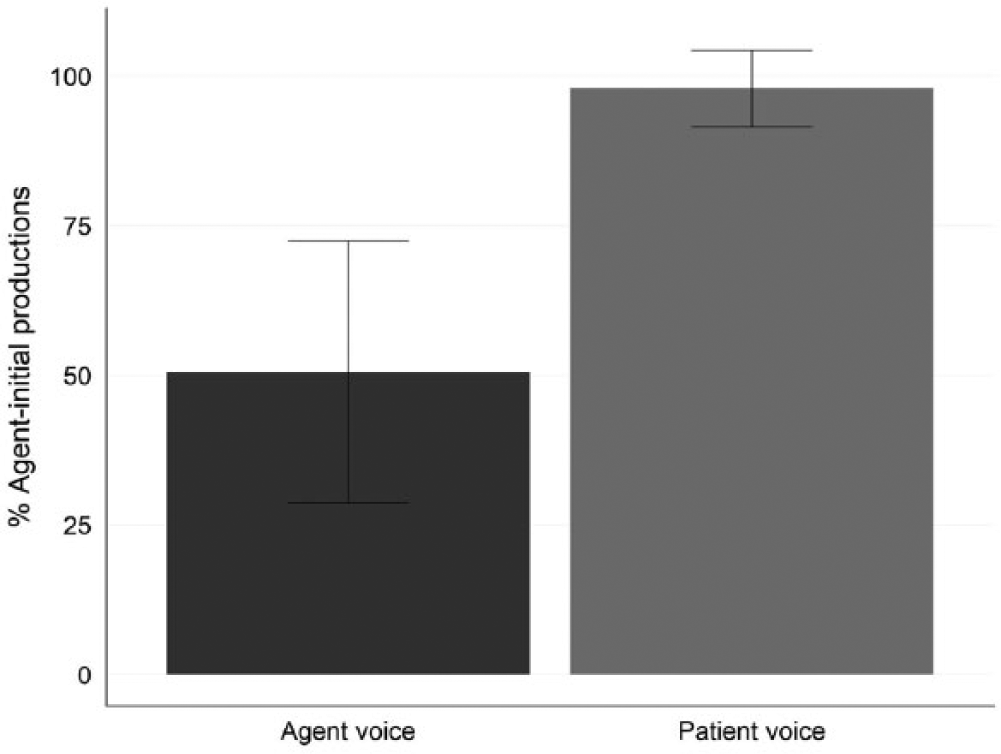
Mean percentage of agent-initial productions in Experiment 1 with between-participant 95% confidence intervals per voice condition.
We performed an item-analysis in the agent voice productions of the adults, and considering 70% as the minimum for showing a preference, we found that they showed an agent-initial preference in four verbs (silip ‘peek at,’ tawag ‘call,’ baril ‘shoot,’ and habol ‘chase’), a patient-initial preference in three verbs (huli ‘catch,’ tira ‘hit,’ and pili ‘choose’), and no preference in the remaining eight verbs. 7 A subject-analysis showed that six adults had an agent-initial preference, six a patient-initial preference, and eight had no word order preference. These results show that the chance-level word order preference was not specific to a preferred word order in particular items or subjects. Instead, these findings reveal that adults do not have a word order preference in the agent voice.
Discussion
Adults showed an agent-initial preference in the patient voice (verb-ng-ang), but no preference for one of the orders in the agent voice, showing that voice affects word order preferences in Tagalog speakers. The agent-initial preference in the patient voice is in line with findings from previous studies on Tagalog, which utilized other methods, such as grammaticality judgment and free picture description tasks (Hsieh, 2016; Manueli, 2010; Sauppe et al., 2013; Tanaka, 2016).
The lack of a clear preference in the agent voice, which is in line with Hsieh’s (2016) findings, provides empirical support for Kroeger’s (1993b) claim regarding the ordering of non-pronominal arguments. As mentioned in the introduction, Kroeger claims that the order of full noun phrases in Tagalog is guided not only by an agent-first principle but also by a subject-last principle. In the agent voice, these two principles are in competition with each other as an agent-initial construction (verb-ang-ng) satisfies only the agent-first principle, but violates the subject-last principle; while a patient-initial construction (verb-ng-ang) satisfies only the subject-last but not the agent-first principle. This competition could explain why no preferred word order could be found in this condition. In contrast, in the patient voice, both principles are satisfied in an agent-initial construction (verb-ng-ang), but violated in a patient-initial construction (verb-ang-ng), which may lead to a high and homogeneous preference for the agent-initial and simultaneously subject-last order in this condition.
However, the results do not fully conform to Sauppe et al.’s (2013) and Tanaka’s (2016) findings, which seemed to show that adult native speakers put more weight on the subject-last principle compared to the agent-first principle. In contrast, in the current experiment, no principle seems to outweigh the other as no statistically significant preference for one or the other order was found in our results for the agent voice. As already mentioned, our study did not elicit productions with animacy contrasts between the arguments, so differences in the results between our study and those of Sauppe et al. and Tanaka could be due to the fact that they did not control for this factor. Since animacy has been shown to affect both word order and grammatical functions (Branigan et al., 2008; Ferreira, 1994; Prat-Sala et al., 2000), the use of animate patients in the current study and mostly inanimate patients in the previous studies makes it difficult for the results to be compared with each other.
Experiment 2: Word order preferences of children
In Experiment 2, five- and seven-year-old Tagalog-speaking children were tested with the same experimental design and the same material as the Tagalog-speaking adults in Experiment 1. We wanted to know whether Tagalog-speaking children have a general agent-initial bias, similar to children learning other languages; or if they show this preference only in the patient voice, similar to the adults in Experiment 1.
Method
Participants
In total, 65 typically-developing children from Metro Manila, Philippines, participated in the study. There were 34 five-year-old and 31 seven-year-old participants. All of the children had Tagalog as their native and dominant language. Most of them were also exposed to English, while a few had exposure to other Philippine languages like Cebuano (4), Bikol (2), Ilonggo (2), Waray (1), and Ilokano (1). The five-year-old children (mean: 5;9, range: 5;4–5;11, males: 11) were kindergarten students from two public elementary schools, while the seven-year-olds (mean: 7;8, range: 7;3–7;11, males: 20) were Grade 2 students from the same schools. Informed consent was obtained from the children’s parents. No history of language delay was reported for any of the children.
Materials
The materials were identical to those used in Experiment 1.
Procedure
The procedure was similar to that of Experiment 1, with a few additional instructions for the children. Whenever a participant had made a mistake during the pre-experiment phase where they had to identify the animals and actions used in the experiment, they were reminded to look at all of the pictures again, and to listen more carefully. They were then asked to identify all the items on the screen again. The practice session for the actual experiment was started only when the participant had succeeded in identifying all the animals and actions.
There were four practice items. During this phase, feedback was given, but was limited to reminders that the given word (the verb) was the beginning of the sentence, that the word should not be changed, and that the event in the picture should be completely described. No corrections were given when the participants used morphological markers on the nouns which did not match the event depicted in the picture. During the actual experiment, no feedback was given except when the participants changed the inflection of the verb (most of the children repeated the verb to start their sentence). These incorrectly repeated items were presented again, by waiting for the 10-second programmed time for the verb prompt to be replayed. In addition, to motivate the children to finish the task, the experiment was presented as a game, in which they had to help a boy reach the finish line in a race.
Data analysis
Data analysis followed Experiment 1, with the addition of age group (five-year-olds, seven-year-olds) as an independent variable. The correctness of the morphological markers on the noun phrases, and the specific errors made (morphological marker reversals, or the use of at ‘and’ to conjoin the two noun phrases, and of ang or ng for both noun phrases) were also noted. Self-corrections were considered as correct only when the children produced single-argument constructions on the first try (twice in the five-year-olds, four times in the seven-year-old group). The trials in which the participants changed the voice-marking on the verb were not included. The item pasan ‘give a piggyback ride’ was also excluded from subsequent analyses because of the same reason as in Experiment 1.
Aside from the pasan items, 9% of the remaining data points were excluded for the following reasons: single-argument productions (4% from the five-year-olds, 2% from the seven-year-olds), 8 incorrect interpretation of the verb (0.9% from the five-year-olds, 0.4% from the seven-year-olds), conjoined noun phrase productions (0.5% from the five-year-olds, 0.7% from the seven-year-olds), not following the instructions (0.5% from the five-year-olds, 0.1% from the seven-year-olds), and skipped trials (0.1% from the five-year-olds, and 0.2% from the seven-year-olds).
In addition, in 14% of the data, there was a mismatch between the noun-markers and the action in the picture (8% from the five-year-olds, 6% from the seven-year-olds). For example, given an agent voice-inflected verb, a participant marked pig with ang when the agent in the picture was the cow, and thus, should have had the ang marker. However, these were still included in the model, as we were mostly interested in the order of mention of the agent of the action depicted in the picture. So in the example, as the cow was mentioned first, regardless of the noun-marker, this utterance was judged as agent-initial (see Appendix 1 for the results of the analyses when nouns with mismatched markers were excluded). The breakdown of the errors is discussed in a separate section. The number of analyzed data points per condition is shown in Table 1.
Number of analyzed data points per condition in Experiment 2.

Results
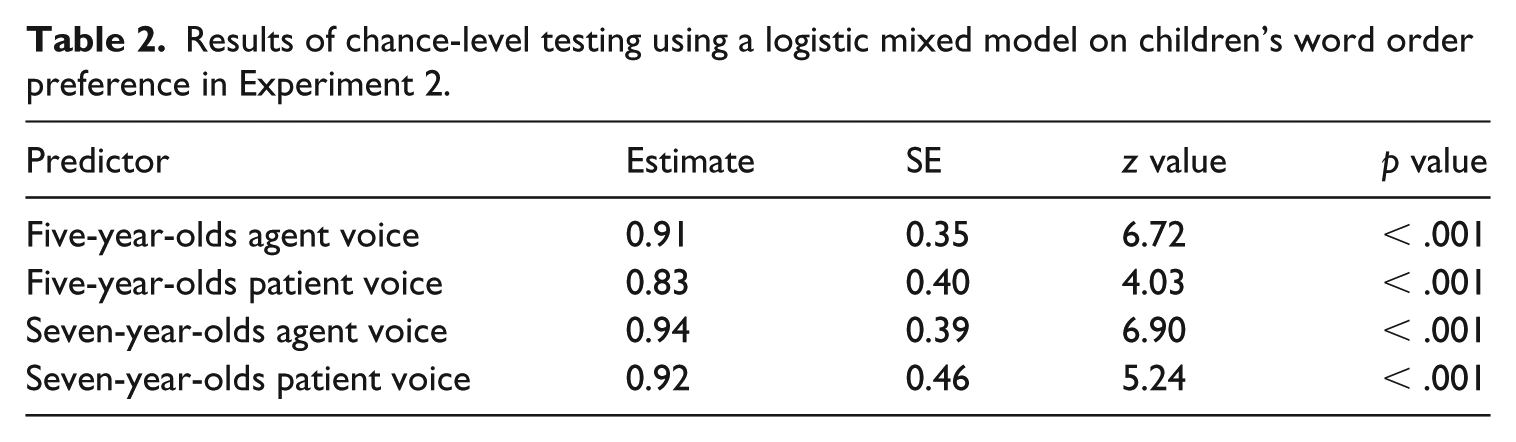
The mean percentage of agent-initial productions and 95% confidence intervals are presented in Figure 3. In the five-year-olds, agent-initial productions comprised 87% of agent voice productions, and 74% of patient voice productions. In the seven-year-olds, agent-initial order was observed in 90% of agent voice productions, and 82% of patient voice productions. We analyzed whether five- and seven-year-olds produced more agent-initial constructions in each voice condition compared to chance. The logistic mixed model showed that both age groups more often used an agent-initial construction than expected by chance in both voice-marking conditions (for details, see Table 2). Performing a subject-analysis showed that only one of the seven-year-olds showed a patient-initial preference in the agent voice condition, while the remaining 30 showed an agent-initial preference. The seven-year-olds also showed an agent-initial preference in all of the items.

Mean percentage of agent-initial productions in Experiment 2 with between participant 95% confidence intervals per voice condition within each age group.
Results of chance-level testing using a logistic mixed model on children’s word order preference in Experiment 2.
As noun-marking errors provide insight on the children’s mastery of the Tagalog voice-marking system and their preferred voice-marking on the verb, we also analyzed the accuracy in marking the nouns with ang and ng (see Figure 4). Accurate means that both nouns were marked correctly in relation to the voice-marking on the verb, such that the sentence interpretation matches the action depicted in the picture. We fitted a mixed-effects logistic model to determine the effects of voice, age, and their interaction on the accuracy in marking the nouns with ang and ng. The results show a main effect of voice (see Table 3 for a summary), such that the children were more accurate in marking the nouns given a patient voice-inflected verb compared to an agent voice-inflected verb.
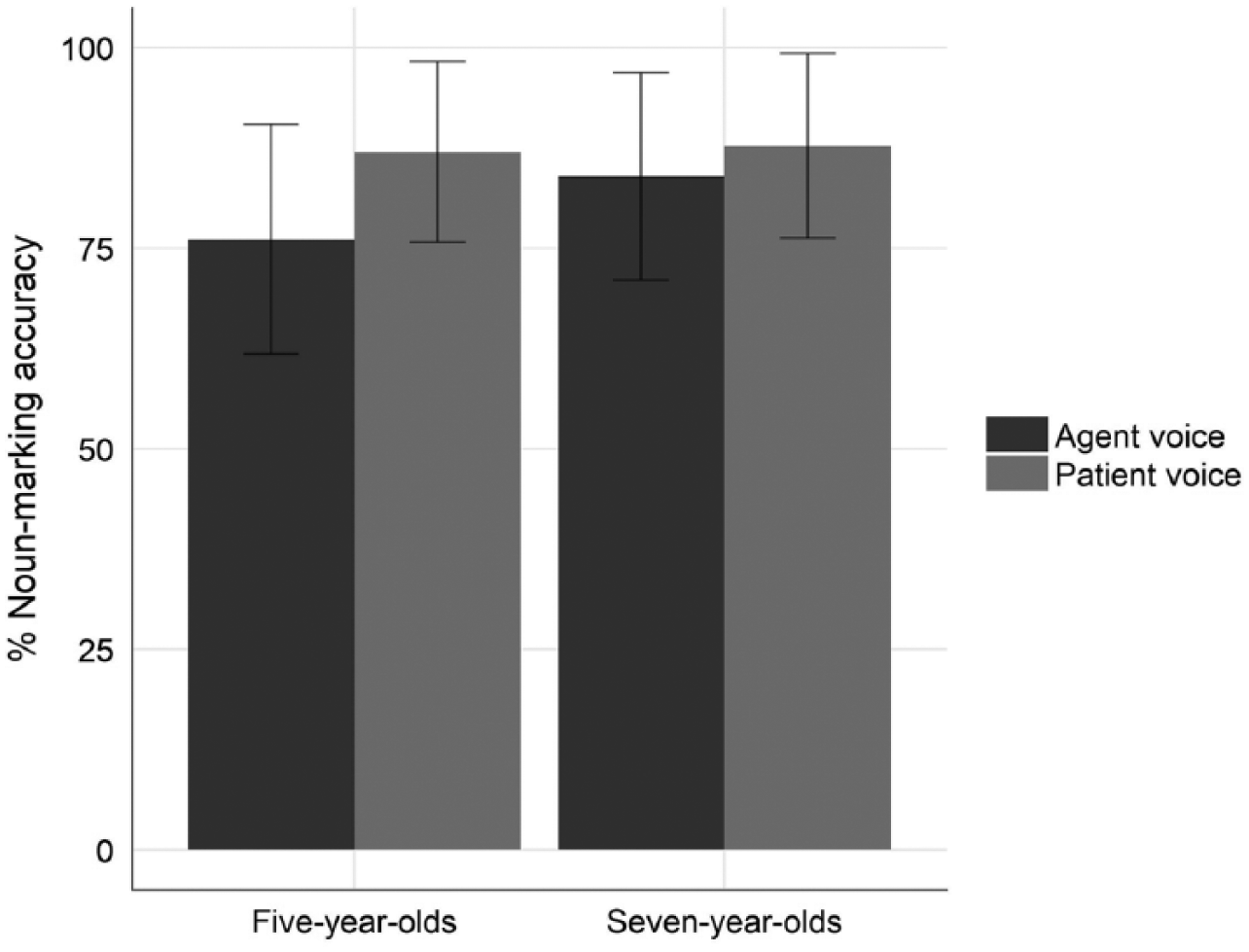
Mean percentage noun-marking accuracy in Experiment 2 with between-participant 95% confidence intervals per voice condition within each age group.
Summary of the fixed effects of voice, age, and their interaction on children’s noun-marking accuracy in Experiment 2 (N = 890; log-likelihood = −327.5).

The five-year-olds produced 17% of the nouns with a wrong marking while the seven-year-olds made only 14% of such errors. In the five-year-old group, 66% of the errors occurred in the agent voice, while this was the case for 52% of the errors in the seven-year-olds. For both five- and seven-year-olds, more than half of the errors were reversals of ang and ng (see Figure 5 for a breakdown of the errors per age and voice-marking). The remaining errors consisted of the use of ang for both arguments or ng for both arguments, and of dropping a noun-marker in one of the arguments.

Percentage distribution of noun-marking error within each voice condition (AV: agent voice, PV: patient voice) within each age group in Experiment 2.
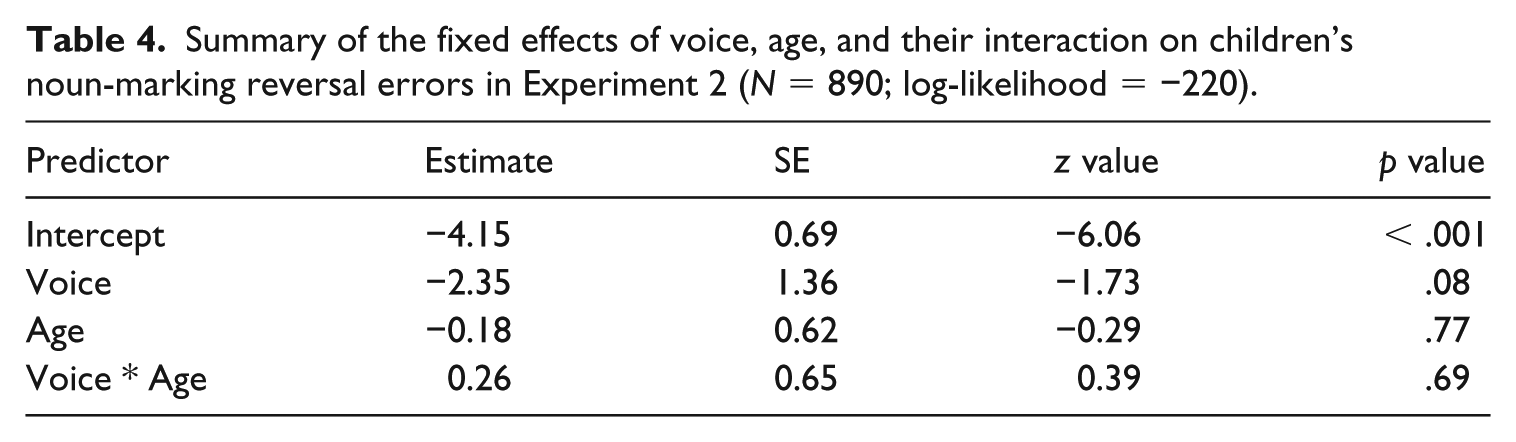
We also further analyzed the reversals of ang and ng. We fitted a mixed-effects logistic model to determine the effects of age, voice, and the interaction of the two, on the number of reversal errors. The results showed no significant main effects of age, voice, nor the interaction of the two (see Table 4 for a summary of the results).
Summary of the fixed effects of voice, age, and their interaction on children’s noun-marking reversal errors in Experiment 2 (N = 890; log-likelihood = −220).
Out of the 34 five-year-olds, 30 repeated the verb before completing the sentence, while 25 out of the 31 seven-year-olds did so. The five-year-olds incorrectly repeated the verb in 7% of the total number of experimental trials, and the seven-year-olds in 8% of the trials. For the five-year-olds, 79% of these incorrect repetitions involved a change of an agent voice-inflected verb to a patient voice-inflected verb, 14% of changes from patient voice to agent voice, and 7% of instances of use of other verbs aside from the one provided which was sagip ‘rescue.’ For the seven-year-olds, 90% of the incorrect repetitions involved a change from agent voice to patient voice, 3% a change from patient voice to agent voice, and 7% the use of another patient voice-inflected verb for sagip ‘rescue.’
Discussion
Five- and seven-year-old children showed a preference for agent-initial constructions in both the agent voice (verb-ang-ng) and the patient voice (verb-ng-ang). The same preference was shown by the five-year-old Tagalog-speaking children in Tanaka’s (2016) free picture description experiment. Moreover, these results are in line with findings of an early agent-initial preference in other languages (Angiolillo & Goldin-Meadow, 1982; Brown, 1973 for English; Cannizzaro, 2012 for Dutch and English; Lee, 2010 for Mandarin; Slobin & Bever, 1982 for Italian, Serbo-Croatian, and Turkish; Tanaka & Shirai, 2012 for Japanese). The current results also support Jackendoff and Wittenberg’s (2014) proposal that children prefer a word order that places the agent before the patient.
More importantly, these findings support the claim that this word order preference results from a direct mapping of thematic roles and linear argument order, without regard for grammatical categories like subject and object, and their preferred positions. In Tagalog, an agent-initial order is the same as a subject-initial order only in the agent voice. However, in the current experiment, an agent-initial preference was also found in the patient voice, which has a subject-final order. As the first noun phrase position in Tagalog is not confounded with the subject position, and the agent is not a preferred subject, the results show that children’s word order preference is semantically-driven, and not merely brought about by the preferred order of grammatical functions (i.e., subject-initial). The current findings support claims that the agent-initial preference is due to more general and not exclusively linguistic reasons such as the agent’s higher ranking in the thematic hierarchy (Siewierska, 1993), and thematic independence (Primus, 2006).
The results further revealed that children used the appropriate noun-markings in both the agent and the patient voice in more than 75% of their productions. However, they still made noun-marking errors, such as the use of ang instead of ng or vice versa, or not using a noun-marker at all, which may indicate that they have not yet fully mastered the voice-marking system of Tagalog. However, we attribute these errors to the design of the experiment. Children might have anticipated a particular voice-marked verb upon seeing the action in the picture, and could not overwrite this when they heard another voice-marking instead. The errors in noun-marking and the exchange of the voice-marker on the verb provide insight on this anticipation or voice preference. For both groups of children, there were more noun-marking errors in the agent voice than in the patient voice, and the incorrect repetitions of the voice-marking of the verbs were mostly changes of the agent voice inflection to the patient voice compared to the reverse. These findings implicate a general patient voice preference, which has also been previously found in a less restricted picture description task for children as well as adults (Tanaka, 2016; Tanaka et al., 2015).
General discussion
This study investigated the word order preferences of Tagalog-speaking adults and children. The results of Experiment 1 showed that adults preferred agent-initial constructions in the patient voice (verb-ng-ang), but they had no word order preference in the agent voice, supporting previous research on word order preferences in Tagalog (Hsieh, 2016). The results are also in line with Kroeger’s (1993b) proposed principles guiding the ordering of non-pronominal arguments in Tagalog: agent-first and subject-last.
In Experiment 2, the findings revealed that five- and seven-year-old children preferred agent-initial constructions not only in the patient voice (verb-ng-ang), but also in the agent voice (verb-ang-ng) – a pattern different from the one shown by the adults. The children’s data are consistent with Tanaka’s (2016) findings, supporting the claim that children exhibit this universal tendency of an agent-initial preference early on (Jackendoff & Wittenberg, 2014). The results do not show a subject-initial preference, but an agent-initial preference by the children instead. Primus (2006) proposed that an agent-initial preference is due to a universal principle that the thematically independent role (agent) tends to precede and/or c-command the role that is thematically dependent (patient). Our data from Tagalog-speaking children support this assumption and show that this preference is quite stable in children even if their language does not provide unique support for this ordering.
The results also imply that adults’ word order preferences are affected by the voice-marking on the verb. Adults showed a preference for agent-initial orderings only in the patient voice, but not in the agent voice. This result suggests that Tagalog has a preferred word order only in the patient voice, which could be characterized as agent-initial and subject-final. If children first acquire the language’s canonical forms (Slobin, 1982; Slobin & Bever, 1982), Tagalog-speaking children would first acquire the patient voice agent-initial order. The results of the current study support this claim. As regards the children’s agent-initial preference in the agent voice, it could be the case that they have derived this pattern from the preferred order for the patient voice. After all, the patient voice is also more frequently used compared to the agent voice in constructions with two arguments. When we analyzed a child-directed speech sample taken by Marzan (2013) from daily family interactions of one Tagalog-speaking child (from the age of 3;0 to 4;11), 83% of constructions with voice-inflected verbs and two arguments were in the patient voice, and only 17% were in the agent voice. The patient voice constructions were also 90% agent-initial. The results of the current study imply that children overgeneralize this preferred order for the patient voice to the agent voice.
It could be argued that children have the same word order preference for the two voices, only because they could not distinguish and make use of the verb-markers for the agent and for the patient voice. However, children’s correct use of the noun-markers in both voices in the current experiment actually shows that they know that the agent voice infix on the verb marks the ang-phrase as the agent of the action while the patient voice infix on the verb marks the ang-phrase as the patient. Their preference for an agent-initial construction for both voices also shows that they are aware of the differences between the two voices, since agent-initial is verb-ang-ng in the agent voice, but verb-ng-ang in the patient voice.
Children’s agent-initial preference in the agent voice shows that they rely more strongly on the agent-first principle than on the subject-last principle for ordering non-pronominal arguments in Tagalog. It could be that children are aware of the two principles, but give priority to the agent-first principle compared to the subject-last principle. Another possibility is that even seven-year-old Tagalog-speaking children follow only the more universal agent-first principle, but have not yet acquired the more language-specific subject-last principle. This inference suggests that the acquisition of some language-specific features may go beyond the age of seven years.
The lower priority or the late acquisition of the subject-last principle may also be due to the low frequency of utterances with two full noun phrases which is typical of spontaneous speech in general (Du Bois, 1987). If most utterances contain a pronoun, the subject-last principle may not be well-attested in the language input that children receive, given the more constrained order of pronouns in Tagalog. Given verb-initial sentences, pronouns are expected to appear immediately after the verb irrespective of their grammatical function (Billings, 2005). In fact, in the same child-directed speech sample from Marzan (2013), we found that only 3% of the utterances with a voice-inflected transitive verb had two non-pronominal arguments. Among these utterances, only one had a subject-last order. The rest of the utterances with two arguments contained pronouns. In 97% of sentences with one pronoun and one full noun phrase, the pronoun referred to the agent. Therefore, it could be that Tagalog-speaking children hear very few non-pronominal constructions with a subject-last order.
Children may prefer agents in the initial position, even in the agent voice, because they overgeneralize the stricter order of pronouns in their input. As shown by Matthews, Lieven, Theakston, and Tomasello (2005), children may learn word order from distributionally regular items like pronouns. Since agents are usually given information in discourse (Du Bois, 2003), and pronouns are used to represent given information (Weber & Müller, 2004), agents tend to be coded as pronouns (Bowerman, 1978). There is even evidence that pronouns tend to be used for agents rather than for patients (Angiolillo & Goldin-Meadow, 1982). Since pronouns occupy the position immediately after the verb in canonical Tagalog sentences (Billings, 2005), agent-initial constructions are probably more frequent in the input if pronouns are typically referring to agents. In the same child-directed speech sample from Marzan (2013) as described above, 86% of the two-argument utterances which contained at least one pronominal argument had an agent-initial order. In addition, all of the agent voice utterances with pronouns were actually agent-initial. We can say that children may have overgeneralized the dominant agent-initial order of sentences with pronouns in the input to sentences with non-pronominal arguments like in the current experiment.
Overall, the results showed that children were aware of the flexibility of word order in Tagalog, since they preferred verb-ang-ng in the agent voice but verb-ng-ang in the patient voice. However, at age seven, they still did not show adult-like distribution of productions in the agent voice. Concerning the children’s ability to use voice-marking per se, there were more instances of incorrect repetitions of the verbs from the agent voice to the patient voice, compared to the opposite direction. Moreover, both groups of children made more errors in marking the nouns in the agent voice compared to the patient voice. These results imply a patient voice preference which is in line with findings from adult corpus data (Cooreman et al., 1984) and previous production experiments (Sauppe et al., 2013; Tanaka, 2016; Tanaka et al., 2015). These findings show that with respect to the distribution of the agent and patient voice, even five-year-old children are more adult-like than with respect to word order properties. It could be that the complex interplay of verbal and nominal markings and word order in Tagalog makes the system more difficult for children to acquire.
It is then of interest to test older children to see when they start showing adult-like distributions. In addition, cross-linguistic comprehension studies show that children start correctly interpreting non-canonical word orders (e.g., use of morphological markers instead of a first-noun-phrase-as-agent strategy) as early as around two years of age in Turkish (Slobin & Bever, 1982), and between the age of five and seven in German (Dittmar, Abbot-Smith, Lieven, & Tomasello, 2008). Given the strong preference for agent-initial productions in Tagalog even at the age of seven, it would be interesting to see whether this preference is also found in comprehension.
In conclusion, even at the age of seven, Tagalog-speaking children are still tuning into the word order preferences of their language. A lot remains to be explored in the acquisition of word order, and investigations using understudied languages can broaden our understanding of this phenomenon.
Footnotes
Appendix 1
Acknowledgements
We would like to thank Ivan Bondoc, Nozomi Tanaka, Sebastian Sauppe, Jocelyn Marzan, Irina Sekerina, Roelien Bastiaanse, and colleagues from the University of Potsdam’s BabyLab, especially Tom Fritzsche and Nenad Jovanovic, for their helpful comments. We are also grateful to all those who participated in the study.
Funding
This research was supported by a PhD fellowship from the European Union’s Erasmus Mundus Joint Doctoral Programme (EMJD) to Rowena Garcia (2015-1603/001-001-EMJD [Framework Partnership Agreement 2012–2025]).
