



Abstract
Book retelling has been frequently used as an indicator of children’s reading proficiency. However, how children’s performance varies across retelling narrative and expository texts and whether that has different implications for reading proficiency remains understudied. The present study examined 85 high-poverty second- and third-graders’ retelling of narrative and expository books. A parallel coding scheme was developed to evaluate children’s performance on retelling fluency, content, and language complexity. Children’s retelling performance was compared across text types and analyzed in relation to reading proficiency. Findings revealed similarities and differences in retelling across text types, with narrative retelling containing a higher proportion of content-matched T-units, whereas expository retelling contained a higher proportion of inference generation and more complex syntactic structures. Moreover, indicators of reading proficiency were found to vary across text types. Findings highlight the distinct cognitive and linguistic demands posed by reading narrative and expository texts and provide implications for effective instruction and assessment.
Introduction
Approximately 64% of U.S. fourth-grade students scored below the expected proficiency level in reading comprehension, among which 79% were from low socioeconomic backgrounds (NAEP, 2015). Reading comprehension is a complex cognitive process involving the dynamic interaction between the reader, the text, and the reading activity embedded in larger sociocultural contexts (Kintsch & Van Dijk, 1978; Snow, 2002). The complexity of components involved in an individual’s reading proficiency results in the difficulty of identifying specific challenges students encounter in order to provide targeted instruction. Thus, researchers and practitioners are actively seeking efficient, malleable, and formative approaches to evaluate children’s reading proficiency, other than the traditional standardized reading comprehension assessments, e.g., Iowa Test of Basic Skills (ITBS).
Retelling has emerged as a promising approach to assessing reading proficiency due to its efficiency, reliance on active reconstruction of text, equivalency of format across text types, and formative evaluation of reading skills (Kucer, 2011; Reed & Vaughn, 2012; Shapiro, Fritschmann, Thomas, Hughes, & McDougal, 2014). In retelling tasks, children typically are asked to orally retell in their own words the key points of materials they have just read. Research has yielded interesting findings regarding the associations between children’s retelling performance and reading proficiency, but a review of the literature reveals a few areas worthy of further exploration. First, the majority of retelling studies focus on a single text type, either narrative (Shapiro et al., 2014; Spencer & Slocum, 2010) or expository (Moss, 1997, 2004), with minimal understanding of how retelling is performed across text types. Among the few cross-text-type retelling studies available (e.g., Best, Floyd, & Mcnamara, 2008; Kucer, 2011; Nippold, Hesketh, Duthie, & Mansfield, 2005), mixed findings were reported due to inconsistency in measurement approaches. Second, a number of studies used only fluency-based measures of retelling (i.e., how many words are retold in a set amount of time), but the association between retelling fluency and reading proficiency was found to diminish as children grow older (Good, Kaminski, Smith, Laimon, & Dill, 2003; Roberts, Good, & Corcoran, 2005; Shapiro et al., 2014). More research is needed to investigate the associations between other retelling-based measures and children’s reading proficiency.
The present study extends previous studies by applying a parallel coding scheme that analyzes high-poverty second- and third-graders’ retelling performance on both narrative and expository texts. Besides retelling fluency, the coding scheme also captures retelling content and language complexity. Narrative and expository texts were chosen as the target text types due to their prevalence in developmental literacy research and school assessments (Berman & Nir-Sagiv, 2007; Grabe, 2002; Paltridge, 2001; Qin & Uccelli, 2016). This study has two specific aims. First, it examines whether children demonstrate different performance (i.e., fluency, content, and language complexity) when retelling narrative and expository books. Second, it examines to what extent different retelling performance measures are associated with children’s reading proficiency and whether the relationships vary by text type.
Literature review
Understanding reading proficiency: the role of language in retelling
Our understanding of reading proficiency is largely influenced by well-known psychological models of reading, such as the simple view of reading (Gough & Tunmer, 1986) and the reading systems framework (Perfetti & Stafura, 2014). Both models agree on the critical role played by language knowledge in reading proficiency through its influence on both word recognition skills and meaning-making skills (Galloway, Qin, Uccelli, & Barr, under review). However, in quantitative research that explores the associations between language knowledge and reading proficiency, language knowledge is typically measured as receptive language skills using a series of discrete language tasks that tap on different linguistic levels (i.e., lexicon, morphology, syntax) (Geva & Farnia, 2012; W. A. Hoover & Gough, 1990; Kieffer & Lesaux, 2008) or as a global and underspecified construct, mostly measured through listening comprehension tests. Instruments that measure only one type of receptive language skill (e.g., lexicon) may fail to identify those students whose reading difficulty rests largely at another linguistic level (e.g., syntax). Similarly, instruments of overall comprehension are problematic in that they do not transparently capture specific cognitive processes (Cutting & Scarborough, 2006; Spooner, Baddeley, & Gathercole, 2004; Uccelli, Galloway, Barr, Meneses, & Dobbs, 2015). We argue in this article that retelling could be used as an alternative approach to measuring children’s language knowledge relevant to proficient reading. Different from an exclusive focus on receptive language skills (e.g., recognizing words, unpacking complex sentences, comprehending content), the retelling measures in the present study focus on expressive language skills in retelling. To successfully retell a text, children must deploy various language knowledge to comprehend information in the texts, recall them accurately and reorganize them in a meaningful way in the language output. Thus, we hypothesize that children’s expressive language skills, manifested as fluency, content and complexity in retelling, could capture the language knowledge relevant to successful reading comprehension.
Different approaches to measuring retelling
Researchers have adopted various instruments to measure children’s retelling performance, with no uniform scoring/coding procedure (Nilsson, 2008; Reed & Vaughn, 2012). The commonly adopted approaches are generally categorized into three types: retelling fluency, content, and language complexity. Retell fluency, introduced by Good et al. (2003) and Roberts et al. (2005), involves a count of the total number of words that children produce within a designated period when asked to retell passages they have read. It is hypothesized that a greater number of words retold during a designated period of time indicates a higher level of reading proficiency. A number of studies exploring the predictive validity of retell fluency to reading proficiency, however, yielded non-significant associations with reading comprehension outcomes, especially at elementary school levels (Marcotte & Hintze, 2009; Pressley, Hilden, & Shankland, 2005; Riedel, 2007).
Recognizing the unsatisfactory measure of retell fluency, researchers sought to examine other approaches to better capturing retelling performance. One approach focuses on retelling content, which analyzes how well children recall information that matches the content of the source texts. There are three types of studies under this approach. The first type relied on the numerical counts or proportion of predetermined idea units (e.g., Best et al., 2008; Capotosto & Kim, 2016; Curran, Kintsch, & Hedberg, 1996; Maria, 1990; Richgels, McGee, Lomax, & Sheard, 1987). The second type used the story grammar model (Stein & Glenn, 1979) to analyze the structural pattern of retelling. This method first classifies story texts into a particular category of information and then analyzes how well children organize their retelling to match the original story structure (e.g., Gambrell, Koskinen, & Kapinus, 1991; Hedberg & Stoel-Gammon, 1986; Schneider & Dubé, 2005). The third type examines retold content units that do not match those in the text (e.g., substitution, addition, summary, conflict) (Kucer, 2011).
The other approach examines the complexity of lexical and grammatical features in retelling. For example, Scott and Windsor (2000) evaluate to what extent 10 general language performance measures (e.g., productivity, lexical diversity, grammatical complexity) in oral and written summaries differentiated school-age children with language learning disabilities from their peers in oral and written retelling.
While researchers have identified an unsatisfactory association between retell fluency and reading proficiency, no study so far has specifically modeled the relationship between retell content/language complexity and reading proficiency. Moreover, no study to date has simultaneously applied measures of fluency, content, and language complexity to the same retelling data, and thereby, the relative importance of these expressive language skills in explaining variability in reading proficiency remains unknown.
Comparing narrative versus expository retelling
Narrative and expository texts are hypothesized to pose distinct linguistic and cognitive demands during the retelling process. The different structural organizations of narrative and expository texts are believed to have a significant influence on children’s retelling performance (Reed & Vaughn, 2012). Specifically, narratives typically contain six elements organized in a well-defined structure, e.g., abstract, orientation, complication, evaluation, result, and coda (Labov & Waletzky, 1997). In narrative retelling, children could rely on a temporal order and linkage between settings, characters, and plots. For instance, children need to understand casual linkages between events to comprehend the motivation for certain actions. On the other hand, expository discourse is normally organized into statements that allow readers to follow text flow through logic and causality (Bruner, 1990; Qin & Uccelli, 2018). In retelling expository texts, children are supposed to rely more on the logical linkage between ideas and propositions. Of the 54 retelling studies reviewed by Reed and Vaughn (2012) along with the empirical studies we have reviewed so far, only a small number of studies explicitly compared children’s performance in retelling both narrative and expository texts, and these yielded mixed findings. For example, some researchers found that third- and fourth-grade children could recall more information from narrative than expository texts (Best et al., 2008; Romero, Paris, & Brem, 2005). Others found that proficient readers were able to generate more inferences when retelling expository texts compared to narratives (Bridge & Tierney, 1981) or provide spontaneous summaries or substitution of texts instead of literal repetition (Kucer, 2011). Additionally, Scott and Windsor (2000) found, compared to narrative retelling, expository retelling contained fewer words per minute of retelling but grammatically more complex (e.g., higher number of words per T-unit). The mixed findings regarding children’s narrative and expository retelling performance shed light on the need to adopt a multi-dimensional approach – i.e., for fluency, content, and language complexity – to evaluate children’s retelling performance across these two specific text types.
The present study
The present study integrates a number of retelling measures that were widely used in previous research into a parallel coding scheme. Far from testing the validity of these measures, the study has a modest goal of revealing the strengths and weaknesses in high-poverty children’s narrative and expository retelling performance from a multi-dimensional view. Moreover, by explicitly modeling the relationship between these retelling measures and children’s reading proficiency, as measured by a traditional standardized English proficiency test (ITBS), and by examining the variation of such relationship by text type, we hope to identify relevant areas where parents and teachers could provide targeted scaffolding for retelling different text types. The following two sets of research questions guide the study:
Research Question 1: How does second- and third-grade children’s retelling of narrative and expository books differ in retelling fluency, content, and language complexity?
Research Question 2(a): After controlling for oral reading fluency and children’s demographic characteristics, how are retelling fluency, content, and language complexity associated with children’s reading proficiency (measured by the ITBS reading score)? (b): Does the relationship between retelling performance measures and reading proficiency vary by text type?
Methods
Research context and participants
Children participating in the current study were involved in a larger randomized-controlled trial of a summer reading intervention program conducted in high-poverty public elementary schools in North Carolina (Kim et al., 2016). As part of this intervention, participating children received packages of books that were matched to their reading levels and interests during the summer. In the present study, 85 children were randomly selected to participate in a home visit, where the retelling activity was conducted. The sample consisted of 44 second-graders and 41 third-graders and was relatively balanced by gender in both grades (see Table 1). Approximately 80% of the sample were eligible for free or reduced-price lunch, and 20% were identified as English language learners. African American and Latino/a children comprised the majority of the sample.
Demographic characteristics for children in the sample (N = 85).
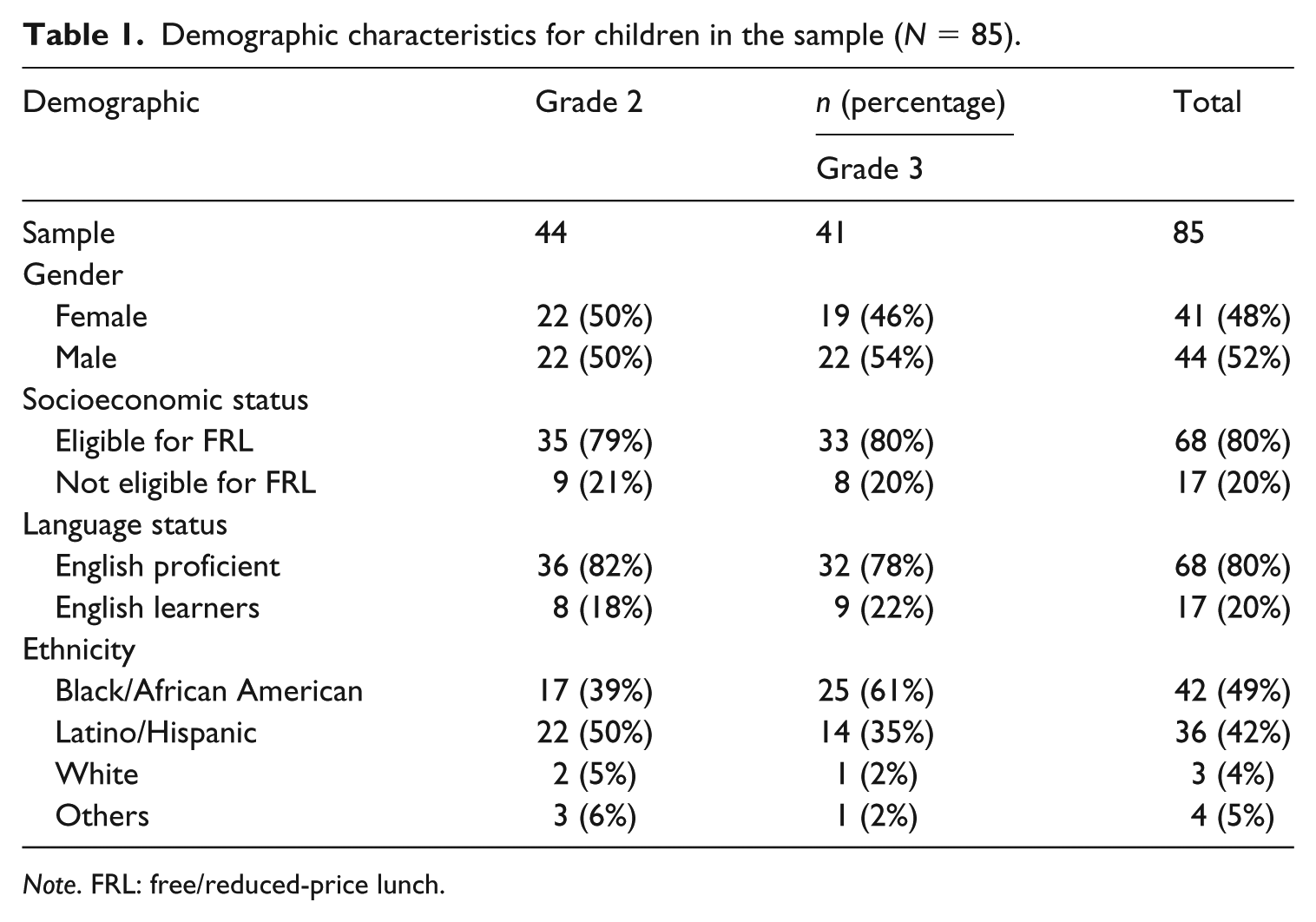
Note. FRL: free/reduced-price lunch.
Home visit procedures
Teams of two researchers visited the participating families for approximately 50 minutes. During the home visit, researchers completed multiple activities, including obtaining parent/child consent and conducting an open-ended parent interview as well as an interactive reading and book retelling activity. All activities with children were conducted in English. As one of the activities, interviewers invited the children to show them two books in English they read over the summer, one narrative book and one expository book. Then, the interviewers prompted the children to retell one of the books in their own language without looking at the texts. To minimize the effects of prompting, interviewers restricted their instructions to brief questions and statements such as, ‘Can you tell me what the book is about?’ ‘tell me more, please,’ and ‘anything else?’ Each child received up to three prompts before the end of the designated time. Then, the interviewer repeated the activity for the second book. The retelling activity lasted for 15 minutes, with an approximately equal amount of time distributed between the two books. To control for order effects, half of the sample was asked to retell the narrative book before the expository book, while the other half followed the reversed order (the Appendix contains a full list of books self-selected by children). In designing the retelling activity, we chose to use children’s self-selected books because we believe such an activity provides insight into naturalistic conversations between parents and children or between teachers and children in a classroom. All books were matched to children’s reading levels and interests at the beginning of the intervention.
Retelling texts transcription and segmentation
The home visits were audiotaped by the interviewers. Recordings were first transcribed by a third-party company into plain text. Then, the first five minutes of the retelling activity was entered in the standard Code for Human Analysis of Transcripts (CHAT) format following the conventions provided in MacWhinney (2000). Transcripts were then segmented into clauses and T-units. A clause is defined as ‘a unit that contains a unified predicate, … [i.e.,] a predicate that expresses a single situation (activity, event, state). Predicates include finite and nonfinite verbs, as well as predicate adjectives’ (Berman & Slobin, 1994, p. 660). T-units are defined as thematic units of complete and autonomous meaning, corresponding to a main clause plus all the subordinate clauses embedded in it (Hunt, 1983). Three graduate students were trained to segment the transcriptions and tested for inter-rater reliability using 20% of the data. The inter-rater reliability reached k = .91 for T-unit segmentation and k = .94 for clause segmentation.
Research measures
Reading proficiency: Iowa Test of Basic Skills (ITBS)
Children were administered the ITBS as a standardized measure of reading proficiency. Level 9, Form C was administered in fall 2014 (the semester following the home visit in summer). The ITBS is a reliable assessment with reported KR-20 coefficients above .93 and equivalent form estimates of .86 or higher (H. Hoover et al., 2003).
Oral reading fluency: DIBELS Oral Reading Fluency (DORF)
DORF is standardized, individually administered test of accuracy and fluency using passages calibrated for each grade level (α = .94) (Good, Kaminski, Smith, & Bratten, in press; Kennedy, Cummings, Bauer Schaper, & Stoolmiller, 2015). Performance is measured by having participants read a passage aloud for 1 minute. Words omitted, substituted, and hesitations of more than 3 seconds are scored as errors. The number of correct words per minute is the oral reading fluency score.
Retelling performance
Building on previous research (Capotosto & Kim, 2016; Good, Simmons, & Kame’enui, 2001; Kucer, 2011; Maria, 1990; Scott & Windsor, 2000), we generated a parallel coding scheme to assess children’s retelling performance across narrative and expository books for the following dimensions:
Retelling fluency
Retell fluency counts the total number of words in children’s retelling of books during the first 5 minutes of the retelling activity (Good et al., 2003; Roberts et al., 2005).
Retelling content
Each T-unit in the retelling was coded for whether the author’s meaning had been maintained, summarized, expanded, commented on, or changed in the children’s retelling. As shown in Table 2, the coding scheme consisted of eight categories. The T-unit was coded as
Parallel coding scheme of content features in retellings (adapted from Kucer, 2011).

The rest of the codes were hypothesized to be ‘negative indicators’ in the retelling because the child retold either
Three graduate research assistants were trained to implement the coding scheme. We selected three narrative books (Dinosaurs Before Dark, Revenge of the McNasty Brothers, Sounder) and three expository books (Baby Birds, Grateful Fred, Life and Times of the Ant) as the ‘training books.’ Each book represented a particular difficulty level of the text type (selected based on the 10th, 50th, and 90th percentile of the Lexile scale. The Lexile scale is a framework designed to measure readability for books matched to targeted readers. The scale typically runs from 300 to above 2000, with scores below 300 marked as beginner reading [BR]; Stenner, Horabin, Smith, & Smith, 1998.) The Lexile scores for second- and third-graders typically run from 170 to 760 (Lexile Framework for Reading, 2018). The three coders read each training book and applied the coding scheme to the corresponding retelling transcripts. We compared the coded results across coders and discussed disagreements and resolutions. The procedure was repeated for all six books (accounting for approximately 15% of the data) until an inter-rater reliability of k = .93 was reached. Then, the coders coded the rest of the data independently.
Retelling language complexity
The language complexity in retelling was measured using three indices commonly adopted in children’s language research:
Lexical diversity (VocD): calculated based on the predicted decline of the type/token ratio as the text length increases (McKee, Malvern, & Richards, 2000);
Utterance length (MLTU): calculated by the average number of words per T-unit. A number of studies have documented consistent positive relationship between the MLTU measure and children’s language development (Malvern & Richards, 2002; Malvern, Richards, Chipere, & Durán, 2004; Morrow, 1985; Norris & Ortega, 2009; Wolfe-Quintero, Inagaki, & Kim, 1998); and
Clausal subordination (C/TU): measured by the number of clauses per T-unit. Mixed results have been reported regarding the relationship between C/TU and language proficiency (see review in Qin, 2018; Wolfe-Quintero et al., 1998).
Analytic plan
We first generated descriptive statistics for all retelling measures for narrative texts and for expository texts. Measures that showed strongly skewed distribution (i.e., with a large number of zeros) were recoded as a dummy variable to indicate presence or absence. To address the first research question, we conducted multi-level modeling using each of the retelling measures (e.g., retell fluency, proportion of matched T-units) as the outcome variable, text type as the within-subject covariate, and book Lexile scores as the control variable. In this analysis, multi-level linear models were used for continuous outcomes, whereas multi-level logit models were selected for binary outcomes. To address the second set of research questions, we first examined the correlation matrices among measures of retelling performance for each text type and ITBS reading comprehension score. Any retelling performance variables that did not reach an absolute correlation value of r = .10 with the ITBS score in either type of text, which represents the threshold for a ‘small’ effect (Cohen, 1988), were removed from further consideration. The remaining variables were checked for multi-collinearity to ensure that the final model consisted only of unique indices and that multi-collinear indices did not exaggerate the results of the regression analysis. Next, a series of multi-level regression models were built with ITBS score as the outcome variable, text type as the within-subject covariate, and students’ demographic information (i.e., grade, gender, and SES) and oral reading fluency as control variables. Measures of retelling performance were entered into the model one at a time to explore the unique variance they explained in the outcome. Finally, the interactions between retelling performance variables and text type were tested to see whether the associations vary by text type.
Results
RQ 1: Comparing narrative and expository retelling performance
Table 3 presents descriptive statistics of retelling fluency, content, and language complexity in children’s retelling of narrative and expository books, and a significance test of variation across text types after accounting for books’ Lexile scores. The descriptive statistics were reported by grade level, with third-graders demonstrating higher or equivalent values on most of the measures. On average, Lexile scores of narrative and expository books selected by children were not significantly different (β = −14.09, p = .22). Children’s narrative retelling in general contained a higher number of T-units compared to expository retelling (β = 3.57, p = .002). For retell fluency, children produced about 110 words in the first 5 minutes of their narrative retelling and approximately 99 words in their expository retelling. The difference was not significant (β = 17.34, p = .069). Two of the retelling content measures were shown to be statistically significant across text types, with narrative retelling containing a higher percent of matched T-units (β = .12, p = .001) and expository retelling containing a higher percent of addition (OddRatio = .15, p = .001). It is also worth noting that meta-textual comments showed minimal appearance in the sample, with more than 90% of zeros in types of retelling. This code was not analyzed further. Finally, comparing the language complexity in retelling, although there was no statistically significant difference in lexical diversity (β = .99, p = .854), expository retelling displayed significantly higher-level syntactic complexity, as indicated by both longer T-units (β = −1.69, p < .001) and more incidences of clausal subordination (β = −.13, p = .006). Post-hoc tests indicated that these findings did not differ by grade level.
Descriptive statistics of all retelling performance measures and comparison between narrative (N = 80) and expository (N = 69) book retellings, controlling for book difficulty levels.

p < .006.
Notes. Multi-level linear models were used for continuous outcome variables, whereas multi-level logit models were used for binary outcome variables (i.e., summary, addition, meta-textual). Given that we are investigating nine measures and therefore performing nine tests on the same dataset simultaneously, we employed the Bonferroni correction to avoid spurious positives. This sets the alpha value for each comparison to .05/9, or .006.
RQ 2: Examining the relationship between retelling measures and ITBS reading score
To address the second set of research questions, we started by examining the correlation matrices between the ITBS reading comprehension score and retelling performance measures for narrative retelling and expository retelling, respectively (see Table 4). Retelling measures that did not reach an absolute correlation value of r = .10 in either narrative or expository texts were removed from further consideration (i.e., ADD, SUM, C/TU). The remaining variables did not show a concern for multi-collinearity (with r > = .70), and thus all were kept as relevant variables for subsequent regression analysis.
Pairwise correlations among measures of narrative/expository retelling performance and ITBS reading comprehension.
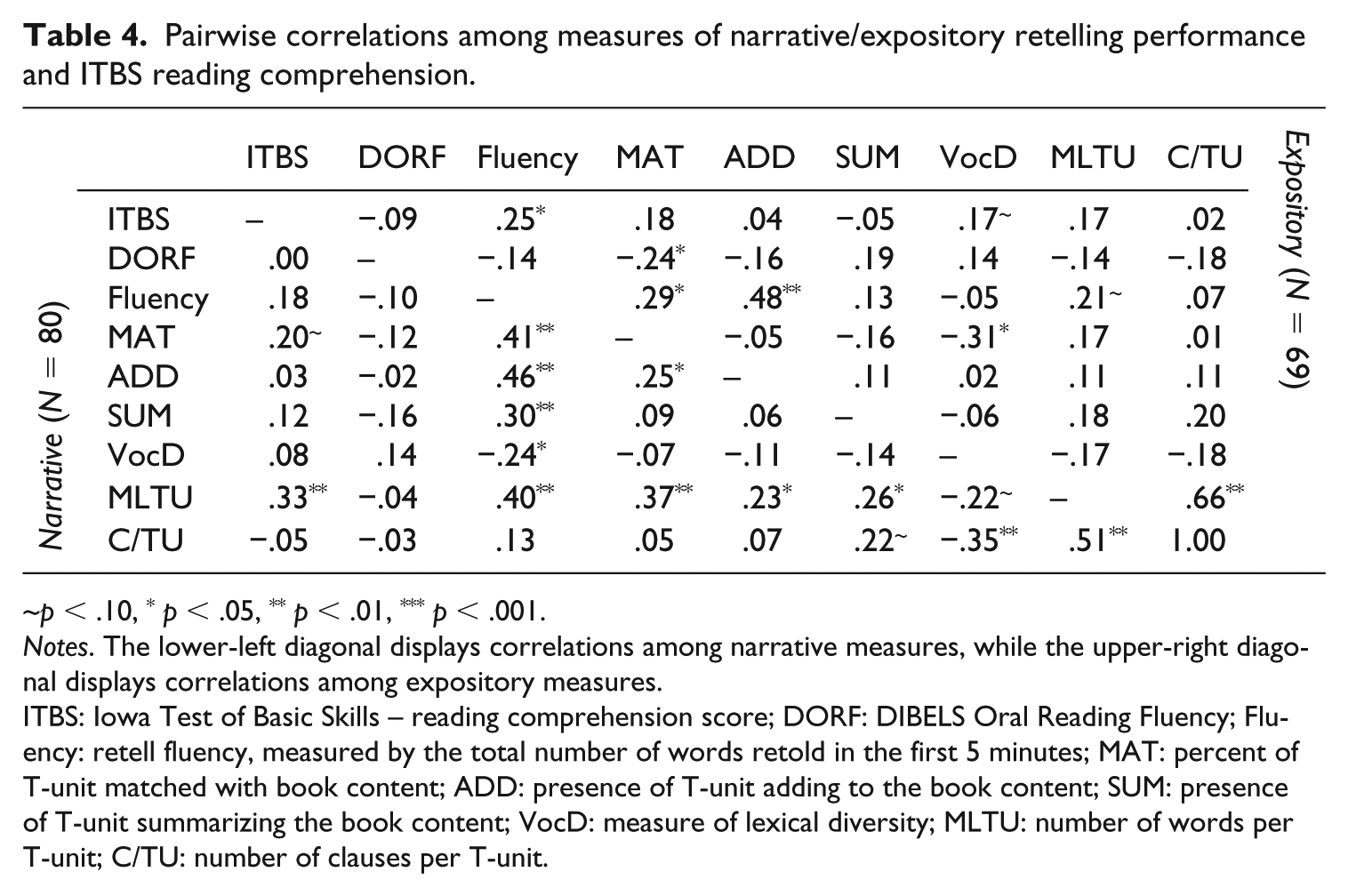
p < .10, * p < .05, ** p < .01, *** p < .001.
Notes. The lower-left diagonal displays correlations among narrative measures, while the upper-right diagonal displays correlations among expository measures.
ITBS: Iowa Test of Basic Skills – reading comprehension score; DORF: DIBELS Oral Reading Fluency; Fluency: retell fluency, measured by the total number of words retold in the first 5 minutes; MAT: percent of T-unit matched with book content; ADD: presence of T-unit adding to the book content; SUM: presence of T-unit summarizing the book content; VocD: measure of lexical diversity; MLTU: number of words per T-unit; C/TU: number of clauses per T-unit.
As retelling measures for two text types were nested within each individual child, we built a series of multi-level regression models, with a random intercept for individuals, to account for the within-child variation (Table 5). The baseline model showed that ITBS reading scores tended to be higher for third-graders, girls, and children who were not eligible for free or reduced-price lunch. Demographic variables that did not yield a significant relationship with the outcome variable, such as language status and ethnicity, were not kept in the baseline model for parsimony. Children’s oral reading fluency was significantly and negatively associated with ITBS reading score. In Model 2, retelling fluency, as measured by the number of words produced in the first 5 minutes of retelling, showed a significantly positive association with ITBS reading score (β = .17, p = .026). Another significant performance variable was found in Model 4, in which lexical diversity (VocD) explained unique variance in ITBS reading score above and beyond retelling fluency and matching content (β = .17, p = .020). In Model 6, utterance length, or MLTU, was also positively and significantly associated with ITBS score, holding other variables constant (β = .16, p = .043).
Taxonomy of fitted multi-level regression models describing the relationship between ITBS reading scores and narrative/expository retelling performance, controlling for children’s demographics and oral reading fluency.
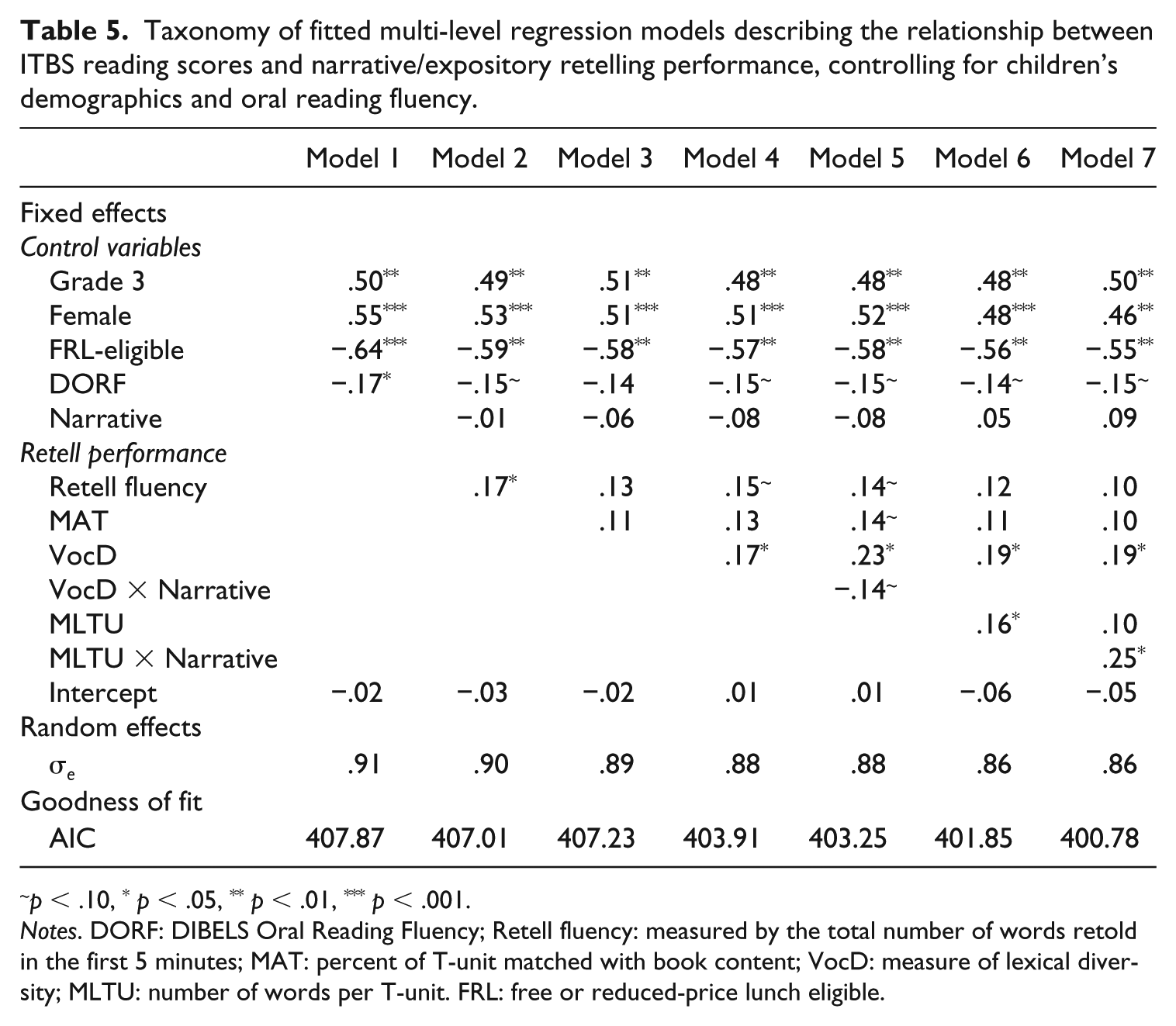
p < .10, * p < .05, ** p < .01, *** p < .001.
Notes. DORF: DIBELS Oral Reading Fluency; Retell fluency: measured by the total number of words retold in the first 5 minutes; MAT: percent of T-unit matched with book content; VocD: measure of lexical diversity; MLTU: number of words per T-unit. FRL: free or reduced-price lunch eligible.
Next the interactions between text type and each retelling measure were tested. Model 5 shows an emerging but non-significant interaction between VocD and text type, with the association between VocD and ITBS score potentially being stronger for expository retelling than narrative retelling (β = −.14, p = .084). Given that it did not reach the .05 level of significance, the interaction term was displayed for further exploration but not kept in the final model. In Model 7, a significant interaction (β = .25, p < .05) indicates that the relationship between MLTU and ITBS score is stronger in narrative retelling compared to expository retelling. Using the Akaike Information Criterion (AIC), a typical estimator of the relative quality of multi-level models, we selected Model 7 as our final model because it demonstrated the lowest AIC, i.e., an ideal trade-off between the goodness of fit and the simplicity of the model.
Discussion
The present study examined high-poverty second- and third-graders’ performance on retelling narrative and expository books. Children’s retelling fluency, content, and language complexity were first compared across text types and then analyzed in relation to their reading proficiency, as measured by the ITBS reading comprehension score. The study revealed some differences in children’s retelling performance across text types: i.e., a higher proportion of matched content in narrative retelling and more inference generation as well as syntactic complexity in expository retelling. The findings also demonstrate that retelling could be used as an alternative approach to measuring language knowledge that is relevant to children’s proficient reading. In addition to retell fluency, the traditional measure of retell performance, the study identified two additional language complexity indicators in retelling that explain unique variance in reading proficiency – i.e., lexical diversity (VocD) and utterance length (MLTU) – and that the association between utterance length and reading proficiency varied by text type.
Differences in narrative and expository retellings
Consistent with prior research (Best et al., 2008; Romero et al., 2005; Scott & Windsor, 2000), children’s narrative retelling, on average, contained a higher proportion of information that matched with the text content. Such a difference might be attributed to children’s relative familiarity with the narrative book structure as well as frequent participation in narrative story telling. An alternative explanation is that reproducing the expository discourse might be cognitively more challenging than retelling a narrative story (Berman & Verhoeven, 2002). For instance, researchers categorized the discourse structure of narrative and expository texts as dependency (one element is bound or linked to another element but is not part of it) versus constituency (one element is embedded, or a structural part of another) (Halliday, 1993; Ong, 1995). For example, in retelling narrative texts, children could rely on the temporal sequence or casual linkages between events to reconstruct the story structure (e.g., one night … ; something happened, and then …). In expository retelling, besides recalling a specific incidence, children also need to understand that the incidence was used by the author to illustrate or exemplify a main idea (e.g., The author believes that … for example). In other words, the narrative event (if used as an example) was sometimes ‘embedded’ in the expository structure. In expository retelling, if the child simply recalled incidences following temporal or casual linkages, he/she might miss important main ideas.
On the contrary, children’s expository retelling displays higher values on three measures, namely added content and syntactic complexity as measured by mean length of T-unit and clausal subordination. First, consistent with Kucer (2011), in expository retelling, children were more likely to produce information beyond the scope of the texts, such as making implicit inferences or connecting book content with personal experience. It could be anticipated that these additions would have been used to ‘fill the gaps’ when children could not remember or understand particular content in the expository books. Another possible explanation is that expository books might serve as an effective medium to stimulate children’s ‘de-contextualized talk,’ which is a critical factor influencing later literacy development (Rowe, 2012; Uccelli, Demir, Rowe, Goldin-Meadow, & Levine, 2018). Second, expository retelling contained more complex syntactic structures, namely longer T-units and more clausal subordination. This result is in line with previous studies comparing expository discourses/summaries versus narrative summaries or conversations in multiple age groups (Berman & Nir-Sagiv, 2007; Nippold et al., 2005; Qin, 2018; Qin & Uccelli, 2016; Scott & Windsor, 2000), supporting the view that complex reading tasks (expository reading/retelling) drive the use of more complex language.
Association between retelling language complexity and reading proficiency
Findings of the present study supported our argument that book retelling is a promising approach to measure reading proficiency. Researchers have argued that lower-level skills (e.g., decoding, commonly measured by oral reading fluency) are relevant to reading comprehension in the early years of schooling, but the effects tend to diminish as children enter upper-elementary levels (Roberts et al., 2005; Schatschneider et al., 2004; Uccelli et al., 2015; Uccelli, Galloway, & Qin, in press). Consistent with this view, the study first revealed a negative and significant association between the oral reading fluency measure (DORF) and ITBS reading scores, showing that oral reading fluency is no longer a reliable measure of reading proficiency as early as second grade.
In contrast, most of the retelling measures explored in the study showed positive associations with reading proficiency. Specifically, retell fluency is a positive indicator of reading proficiency across text types. Furthermore, language complexity (i.e., lexical diversity, utterance length) in retelling played a more important role in explaining variance in reading proficiency. The relationship between utterance length (MLTU) and reading proficiency was stronger in narrative retelling than expository retelling. Mean length of T-units (MLTU), rather than clauses per T-unit (C/TU), demonstrated a significant relationship between reading proficiency, a result that re-emphasizes the effectiveness of using MLTU to measure children’s language proficiency (Berman & Slobin, 1994; Nippold et al., 2005; Scott & Windsor, 2000). Longer utterances might reflect a myriad of syntactic factors, including but not limited to clausal subordination, coordination, phrasal modifiers, and evaluative markers. Based on a qualitative examination of the narrative retelling data, proficient readers are more likely to use complex and diverse syntactic structures to describe and evaluate the plots in the story. Below is an example of a proficient reader (ITBS = 260, the 95th percentile of the sample) retelling a narrative book, Clarice Bean, Don’t Look Now:
In this excerpt, the child used multiple conjunctions (e.g., so, because), dependent clauses (e.g., where her best friend was sitting, which was right beside) to provide details about the relationship between characters and making her own causal inferences of the character’s internal thinking. In addition, his/her use of hedges (e.g., maybe) and boosters (e.g., had to, actually, right) also enriched the evaluative stance of the retelling. The use of these advanced grammatical features contributed to extending the complexity of language. Therefore, the surface relationship between mean length of T-units and reading proficiency might actually reflect highly proficient readers’ skills in reconstructing narrative stories using well-connected, logical, and evaluative sentences.
Besides syntactic complexity, lexical diversity plays a significant role in explaining reading proficiency in both text types. The correlation appears to be slightly stronger in expository retelling, but since the interaction test did not reach the .05 significance level, the results should be cautiously interpreted. Below is an example of how a highly proficient reader (ITBS = 238, the 93rd percentile of the sample) used diverse vocabulary to retell an expository book, The Life and Times of the Ant:
They [the ants] have been around for maybe a
In this example, the child used a diverse repertoire of vocabulary related to the subject of the book, the ant. The association between lexical diversity and reading proficiency suggests a number of hypotheses to be explored in future research. One hypothesis is that more proficient readers might be able to acquire new words efficiently from the books they had read, so as to immediately apply them in book retelling. An alternative hypothesis is that more proficient readers might have more extensive vocabularies before reading the particular text and thus would have produced more lexically diverse retellings, regardless of how well they comprehended that text. It is beyond the scope of the present study to determine which hypothesis is more plausible. Future research might further explore this question, for example by measuring children’s vocabulary on related topics before and after the book reading.
Other retell performance measures, including retell fluency and proportion of matched content, demonstrated no significant association with reading proficiency. This result suggests that, compared to the traditional appreciation of ‘talking more’ or ‘getting it right,’ children’s ability to organize recounted information in a linguistically diverse, coherent, and sophisticated way could be a more reliable indicator of higher reading proficiency in general.
Limitations and implications
The results of the present study must be considered in light of several limitations. First, children in this study picked a book they had read, and they retold the content with minimal prompting from the interviewer. Although such an activity allows for self-selection of books and to some extent ensures the quality of the retelling (assuming children normally pick the books they like or at least the ones they have finished reading), the large number of books has no doubt created variability in the retelling performance. Although we have controlled for book difficulty levels in the analysis, further research is needed to determine whether retelling performance is affected by other book characteristics (e.g., topic, length, or presentations) (Schneider & Dubé, 2005). Researchers using a similar approach might also consider reducing the number of books by asking children to select from a smaller repertoire of books to read and then retell. Second, we did not account for the length of the time between book reading and the home visit when the retelling activity was conducted. Thus, it is unknown whether the retelling performance was influenced by children’s memory, depending on whether the book was read at an earlier or later time during the summer. Future research adopting a similar kind of activity might give children several minutes to quickly review the book before initiating the conversation, for example, by using pictures from the book. Third, inter-rater reliability for content coding was generated only based on six selected books from the large sample that represented different difficulty levels. What was not captured in this reliability test was the measurement error in how different coders identified authors’ meanings across various books. If the number of books could be reduced, as suggested above, future research might need to estimate separate inter-rater reliability for different books to strengthen the results.
Despite these limitations, this study has implications for both current practice and future research in reading instruction and assessment. First, we must acknowledge the critical role that different text types play in children’s retelling and reading performance. Understanding the different cognitive (e.g., matching, summarizing, making inferences) and linguistic demands (e.g., using diverse vocabulary and constructing complex sentences) of retelling narrative and expository texts might offer teachers new gateways to design instructional approaches to scaffold retelling activities, and more importantly, reading proficiency in a variety of text types. Additionally, this research shows an easy and accessible approach that teachers and parents could conduct with their students/children on a daily basis – talking about a book – which offers a convenient assessment of children’s reading proficiency. Finally, our finding that children’s ITBS reading scores were associated with certain language complexity measures in retelling narrative and expository books might offer teachers and parents some guidance in their strategies to scaffold and evaluate children’s retelling activity. For example, using diverse vocabulary and sophisticated syntactic structures to reconstruct information from texts sometimes might ‘tell’ more about one’s reading proficiency than simply being talkative or getting the content right in retelling.
Footnotes
Appendix
Children’s self-selected books for retelling.

| Book title | Lexile score | Number of retellings |
|---|---|---|
| Narrative books | ||
| The Adventures of Captain Underpants | 720 | 2 |
| Afternoon on the Amazon | 290 | 1 |
| The BFG | 720 | 2 |
| Beware the Snowman | 450 | 2 |
| The Blue Ghost | 440 | 1 |
| Bunnicula | 710 | 1 |
| Call it Courage | 830 | 1 |
| Cam Jansen and the Tennis Trophy Mystery | 360 | 1 |
| Cam Jansen: The Basketball Mystery | 420 | 2 |
| Clarice Bean, Don’t Look Now | 800 | 1 |
| Clementine’s Letter | 600 | 1 |
| Clocks and More Clocks | 440 | 2 |
| Curse of the Bologna Sandwich | 550 | 1 |
| Dinosaurs Before Dark | 240 | 2 |
| The Fairy-Tale Detectives | 840 | 1 |
| Fancy Nancy: Poison Ivy Expert | 320 | 1 |
| Forest of Secrets | 900 | 1 |
| Geronimo Stilton, Secret Agent | 490 | 1 |
| Gets His Man (Encyclopedia Brown) | 590 | 1 |
| The Great Kapok Tree | 670 | 1 |
| The Half-A-Moon Inn | 1010 | 1 |
| The Hero Revealed | 900 | 1 |
| I Survived The San Francisco Earthquake, 1906 | 610 | 2 |
| I Survived the Battle of Gettysburg | 660 | 1 |
| I Survived the Shark Attacks of 1916 | 610 | 3 |
| Invisible Stanley | 520 | 1 |
| Ivy and Bean | 510 | 1 |
| Ivy and Bean and the Ghost that Had to Go | 580 | 1 |
| Jamaica Tag-Along | 410 | 1 |
| Journey to the Volcano Palace | 420 | 1 |
| Junie B. Jones is a Beauty Shop Guy | 390 | 4 |
| Keena Ford and the Field Trip Mix-Up | 740 | 1 |
| The Lemonade War | 630 | 1 |
| The Magic School Bus Has a Heart | 280 | 1 |
| Maniac Magee | 820 | 1 |
| Mercy Watson Fights Crime | 390 | 2 |
| Miss Nelson Has a Field Day | 390 | 2 |
| Miss Nelson is Missing | 340 | 1 |
| More Stories Julian Tells | 430 | 1 |
| Mr. Putter & Tabby Catch the Cold | 230 | 1 |
| Mrs. Piggle Wiggle | 750 | 1 |
| My Best Friend is Invisible | 350 | 2 |
| Mysteries According to Humphrey | 590 | 1 |
| Mystery at Fort Thunderbolt | 820 | 1 |
| Nate the Great and the Monster Mess | 340 | 1 |
| Night of the Ninjas | 280 | 1 |
| Perilous Plot of Professor Poopypants | 640 | 1 |
| Poppleton Everyday | 250 | 1 |
| Ramona the Brave | 820 | 1 |
| Real Hoops | 630 | 1 |
| Revenge of the McNasty Brothers | 550 | 4 |
| Ribsy | 820 | 1 |
| Ruby Lu, Brave and True | 640 | 1 |
| The Soccer Shoe Clue | 430 | 1 |
| Sounder | 900 | 4 |
| Superfudge | 560 | 1 |
| Where the Mountain Meets the Moon | 820 | 1 |
| Young Cam Jansen and the Ice Skate Mystery | 210 | 1 |
| Expository books | ||
| Baby Birds | 240 | 3 |
| Basketball’s Greatest Players | 660 | 1 |
| Bessie Coleman: Daring to Fly | 510 | 1 |
| Big Tracks, Little Tracks: Following Animal Prints | 370 | 1 |
| Cars on Mars | 870 | 1 |
| Cowboys | 550 | 2 |
| Dinosaurs | 490 | 1 |
| Dollars and Sense | 770 | 1 |
| Extreme Machines | 850 | 1 |
| Grateful Fred | 590 | 2 |
| Hachiko: The True Story of a Loyal Dog | 830 | 1 |
| I Am Rosa Parks | 520 | 1 |
| I Wonder Why Horses Wear Shoes | 940 | 1 |
| Ice Wreck | 480 | 1 |
| If You Lived With the Cherokees | 800 | 1 |
| Let’s Go to the Bank | 300 | 1 |
| Life and Times of the Ant | 950 | 5 |
| The Mary Celeste: An Unsolved Mystery from History | 630 | 1 |
| Meet George Washington | 370 | 1 |
| Micro Monsters | 920 | 1 |
| My Muscles | 250 | 2 |
| An Octopus is Amazing | 730 | 1 |
| Oil Spill! | 630 | 1 |
| Pompei | 340 | 1 |
| Rocks, Sand, and Soil | 240 | 1 |
| Skeleton Inside You | 600 | 1 |
| Sky if Full of Stars | 570 | 1 |
| Sun, Moon, and Stars | 660 | 3 |
| Switch On, Switch Off | 460 | 1 |
| Volcano: The Eruption and Healing of Mount St. Helens | 830 | 1 |
| Volcanoes | 710 | 1 |
| Volcanoes: Mountains That Blow Their Tops | 310 | 1 |
| Vote! | 420 | 1 |
| Water Dance | 310 | 1 |
| We Beat the Street: How a Friendship Pact Led to Success | 860 | 1 |
| Weather | 740 | 1 |
| What Makes Day and Night | 230 | 1 |
| What Will the Weather Be? | 500 | 2 |
| What is the World Made Of? | 560 | 1 |
| Who Eats What?: Food Chains and Food Webs | 620 | 1 |
| Who Was Abraham Lincoln? | 720 | 2 |
| Who Was Harriet Tubman? | 650 | 1 |
| Who Was Walt Disney? | 720 | 1 |
| Why Do Cats Meow? | 590 | 1 |
| Why I Sneeze, Shiver, Hiccup, and Yawn | 480 | 3 |
| You Can’t Smell a Flower with Your Ear! | 390 | 1 |
| Your Skin and Mine | 560 | 2 |
Acknowledgements
We thank Bethany Mulimbi, Margaret Troyer, and Ziyun Deng for providing research assistance, and students and interviewers for participating in the study.
Funding
The study received funding from: the Wallace Foundation (Grant No. 20100222) and the US Department of Education Office of Innovation and Improvement I3 Grant (Grant No. U396B100195); however, the contents of this article do not represent the policies of the funding agencies.
