



Abstract
The purpose of this study was to examine early fast mapping abilities in late talkers (LT) and typically developing (TD) Spanish-speaking children by considering the effect of different variables on fast mapping (age, vocabulary level, grammatical category and number morphology). Thirty-eight Spanish-speaking children were assessed at three times (21 to 24 months at the beginning of the study). A group of LT was matched in age with a TD control group. They completed a fast mapping task with a disambiguation phase and an extension phase. Results show that vocabulary level and age interact with grammatical category and number morphology. TD children’s performance was significantly higher than LT children’s, but these differences decreased with age. Results suggest that the incorporation of new labels does not work automatically; some children may need repeated exposures to word–referent pairings. Longitudinal results suggest the importance of looking at the dynamics of lexical acquisition in addition to vocabulary size.
Keywords
As their language develops, children need to understand that words are arbitrary and stable symbols that refer to objects and events in the world around them. Most researchers agree that children initially incorporate words at a very slow rate, followed by a phase in which there is a sudden increase in the number of words produced. In this phase, children quickly associate new labels with their referents and do not need several presentations of word–referent pairs (Markman, 1991). This phenomenon, known in the literature as fast mapping, has been a subject of intense research over the last 20 years.
The basic procedure to test whether children fast map new labels onto referents has remained the same since the publication of the seminal paper by Carey and Bartlett (1978). At the beginning of the procedure, a series of objects or cards are shown, of which only one is unknown to the child. Participants are required to select the unknown object among known distractors when the experimenter produces an unknown lexical label (a nonword, such as a ‘blicket’). In a second phase, children are also expected to extend this label to other members of the same category, that is, to examples with some kind of variation (for example, color, size, or texture of the object). For this reason, after the initial phase of identification or disambiguation of the unknown item, there is usually an experimental phase of extension or generalization, in which a new element is presented with some kind of modification or superficial variation (Golinkoff, Jacquet, Hirsh-Pasek, & Nandakumar, 1996). The aim of this experimental phase is to test whether children are able to remember and identify this new label, even though they have not heard it many times.
Ever since Carey and Bartlett (1978) carried out this first experiment, a number of variables have been introduced in order to assess the process of word learning. This study analyzes the simultaneous influence of linguistic and developmental variables in early fast mapping of Spanish labels. Linguistic variables are examined through grammatical category (nouns and verbs) taking into account number morphology. Developmental changes are analyzed by longitudinally studying a sample of late talking and typically developing children.
Fast mapping of nouns and verbs
Differences between nouns and verbs in early word learning have been widely discussed (see for example Golinkoff et al., 1996; or Hirsh-Pasek & Golinkoff, 2006). Children are exposed to different kinds of labels associated to different referents in the world (objects, qualities, quantities, actions). Research on fast mapping has shown that children have more difficulties mapping labels for actions than for objects (Eyer et al., 2002; Sheng & McGregor, 2010). However, Maguire, Hirsh-Pasek, and Golinkoff (2006) point out that nouns are not easier than verbs per se. As they acknowledge, ‘the relevant distinction may not be between nouns and verbs per se but rather between concepts that are more or less abstract and relational’ (p. 7). Objects seem to be easier to label because their referents are usually perceptually available whereas actions are usually temporary referents. Moreover, differences between concrete nouns and verbs found in the literature might be the result of the interaction of several variables related to the word, such as frequency, familiarity or morphological variations. Regarding frequency, different experimental methodologies, as well as a series of simulations, have shown that children use their existing knowledge about other words during their first encounters with new labels (see Hidaka & Smith, 2011, for a review). For example, nouns are more frequent than verbs in English and in child directed speech (Hirsh-Pasek & Golinkoff, 2006), which may increase children’s knowledge about nouns. In fact, most words in children’s early vocabularies are concrete nouns (Samuelson & Smith, 1999). This could explain, at least partially, the advantage of concrete nouns during fast mapping tasks. Nevertheless, very few studies have analyzed differences between nouns and verbs simultaneously with other variables, especially in languages other than English.
Fast mapping and vocabulary level
Another variable that has been widely assessed is children’s vocabulary level (Kalashnikova, Mattock, & Monaghan, 2016). Previous studies have shown that familiarity with known words helps disambiguation of unknown words (given that there are less distractors). When children face a new word, there are many possible referents. Familiarity with known words may help by reducing the number of possible referents (Bion, Borovsky, & Fernald, 2013). Larger vocabularies are also associated with generalizations of names to other members of the same category (see Hidaka & Smith, 2011, for a review). For example, the number of object names in children’s productive vocabularies is related to the recognition of abstract objects previously presented in an experimental task (Smith, 2003). Knowledge about words and their referents helps children to pay attention to the relevant properties of each category, extracting those regularities that are needed to create lexical representations (Hockema & Smith, 2009). These results give rise to interesting questions such as: what happens when vocabulary levels are very low? Do children with lower levels of vocabulary experience difficulties matching new words with their referents? In order to explore these questions it is important to analyze fast mapping abilities in children with different levels of vocabulary. For example, Jackson, Leitao, and Claessen (2016) suggest that word learning difficulties in children with specific language impairment (SLI) appear during the earliest fast mapping stages. In support of this assertion, they found that children with SLI showed poorer fast mapping abilities compared to typically developing (TD) children of the same age. Indeed, most studies have shown that TD children perform better than children with SLI in fast mapping tasks. However, most of these studies have been carried out with four- to five-year-olds (Alt & Plante, 2006) and few studies have analyzed younger children with low vocabulary levels or late talkers (LT). Since late talking children are at risk of SLI (Bishop, Holt, Line, McDonald, & Watt, 2012), their fast mapping abilities could be a valuable indicator of evolution and prognosis.
Late talkers have been described in the literature as children presenting an early expressive delay but typical cognitive and motor development, and no genetic disorders (Rescorla & Schwartz, 1990). Traditionally, researchers and clinicians have identified these children because they produce fewer than 50 words and/or because they do not combine two words in one sentence by two years of age (Dale, Price, Bishop, & Plomin, 2003).
In one of the few studies on fast mapping abilities with late talkers, Jones (2003) found that late talking children showed more difficulties extending novel names by their shape, compared to their typically developing peer-participants aged two to four years old (see Ellis Weismer, Venker, Evans, & Moyle, 2013, for similar results with a sample of LT who are 30 months old). These results are interesting because late talking children usually do not show comprehension difficulties, and so they raise questions about relationships between comprehension and production. Late talking children also have more difficulties than their vocabulary matched counterparts recognizing abstract shape representations, even if they are able to produce the category name (Jones & Smith, 2005). This suggests that late talking children may have more basic perceptual problems than typically developing children, which has a cascading effect on their abilities during disambiguation and extension of new labels.
More recently, trying to explore the role that phonotactic probability plays in fast mapping, MacRoy-Higgins and Dalton (2015) not only pointed out that typically developing children showed an early advantage for fast mapping high phonotactic probability words, but also that late talking children required a greater number of exposures to the novel words to show the same advantage on the same items. That is, late talking children showed more difficulties disambiguating unknown labels compared to typically developing ones.
These results suggest that late talkers may have difficulties with both the initial process of disambiguation and later extension. In the present study we look at whether this is true from a developmental perspective, considering different ages. Literature has shown that a number of late talking children eventually reach average levels of vocabulary (Rescorla, Mirak, & Singh, 2000), especially if they do not show comprehension difficulties.
Most of these studies have been carried out with nouns, and not so many have compared different grammatical categories or taken into account other linguistic variables. This is important in order to know whether language delay is a general difficulty or it is related to specific kinds of word–referent pairings.
Fast mapping in Spanish
To date, most studies have been carried out in English, whereas little research has been conducted in other languages such as Spanish. The Spanish language is also interesting because of its morphological system, which is much richer in inflectional terms than English (Aguado-Orea & Pine, 2015). The Spanish inflectional system (especially for verbs) is more complex than the English system, including multiple cues.
Morphological variations are also interesting because not all morphemes are equally frequent in child directed speech. Plural morphemes are less frequent in the input. This is, in turn, reflected in children’s spontaneous production (Aguado-Orea & Pine, 2015). Frequency effects have been found at the level of lexical items and at the level of abstract linguistic categories. Generally speaking, those morphemes that are more frequent in child directed speech are generalized earlier than less frequent forms (Ambridge, Kidd, Rowland, & Theakston, 2015). Morphological frequency could be related to fast mapping abilities because (1) frequent forms increase familiarity and, therefore, (2) the likelihood that the child will detect regularities increases. In order to generalize categories and construct lexical representations, children need to extract regularities from the speech addressed to them (Hockema & Smith, 2009).
The analysis of morphological variations in Spanish may help us understand the role of linguistic variables in fast mapping abilities. Arias-Trejo, Cantrell, Smith, and Alva-Canto (2014) conducted two fast mapping experiments using the Intermodal Preferential Looking Paradigm (IPLP) with two-year-old Spanish-speaking children, testing the comprehension of plural noun morphology. Their results showed that Spanish-speaking children’s performance was better with plural morphemes than with singular ones, suggesting that children may benefit from morphological cues to fast map new labels with their referents.
However, in a previous study also conducted in Spanish, Bedore and Leonard (2000) designed a fast mapping task in which children had to identify labels that included singular and plural verbal morphemes as well as simple past morphemes. In this experiment, children had to identify the meaning of new verbs that were previously presented. In one condition, children had to identify the verbs that were previously presented using the same morpheme (i.e. presentation in singular, identification in singular). In the other condition, the verbs were presented using one morpheme (for example plural) and children were requested to identify it with another morpheme (for example singular). Results show that children’s performance was better in the no-variation condition. Moreover, children’s performance was similar in the identification of singular and plural verbal morphemes (i.e. children did not perform better with plural than with singular, as shown in Arias-Trejo et al., 2014). They interpreted these results as a lack of specific knowledge of verbal morphemes, so children do not benefit from morphological cues to fast map new action labels (that is, children do not use the information about the number of items included in number morphemes to identify the right referent). The authors state that children could identify the meaning of the new words without processing the meaning of the morphemes attached to them. The contrasting findings of these two studies suggests that the role of morphological variations is not so clear-cut, probably because it is not possible to analyze it without the grammatical category.
In order to increase our knowledge of how vocabularies grow during the second and the third years, specific research is needed that explores possible interactions of linguistic variables during the fast mapping process. Such research would clarify theoretical questions about the way new words are incorporated into children’s lexicons, and the way different variables interact at different ages (Carey, 2010; McMurray, Horst, & Samuelson, 2012).
Given that previous studies have found that fast mapping is difficult for late talking children and that fast mapping difficulties might be an indicator of language delay, it is important to investigate fast mapping abilities in Spanish-speaking late talkers. Even if previous research has shown fast mapping difficulties in late talking children, little is known about (a) the way in which these difficulties change over time, especially with two-year-olds, and (b) whether late talking children are sensitive to grammatical categories as their typically developing counterparts are.
The aim of the current study is twofold. First, we are interested in studying the effect of linguistic variables, grammatical category and number morphology, on Spanish children’s fast mapping abilities. Second, we are also interested in how the influence of these factors changes over development. This would be of a great help to better comprehend the relationship between vocabulary level and fast mapping abilities.
Our research questions are the following:
Q1. Do Spanish-speaking late talking children show more difficulties fast mapping new words onto their referents compared to their typically developing peers?
Q2. What is the relationship between fast mapping abilities and grammatical category (noun vs. verbs)?
Q3. What is the relationship between fast mapping abilities and number morphology in nouns and verbs?
Q4. Do fast mapping abilities change over time? If so, are changes related to vocabulary level, grammatical category and number morphology?
Our predictions are in line with previous research that has individually addressed the role of each variable. Therefore, we expect that late talking children will show more difficulties than their age-matched counterparts, both disambiguating new labels and extending them to other members of the same category. Disambiguation and extension scores will change depending on the type of word (grammatical category). Given that familiarity plays a role in vocabulary growth, we expect better performance with nouns than with verbs, and with singular than with plural forms. Nevertheless, linguistic variables may not work in absolute terms, since previous research suggests that children may not possess abstract representations of grammatical categories and morphemes. Thus, we expect that all children will show more difficulties disambiguating plural verbs, especially with lower levels of vocabulary and at the earlier stages of development. Differences between late talking and typically developing children will decrease with age.
In order to answer these questions a fast mapping task was designed following the design of Golinkoff et al. (1996) for verbs. The original task tested the ability of typically developing English-speaking children to fast map verbs. The design included four trials in which new action labels had to be identified and then generalized to other agents. In addition to verbs, our task also included nouns, and we presented both categories with singular and plural morphemes. We tested two-year-old late talking and typically developing children at three different ages.
Method
Participants
The participants were 38 children who were between 20 and 24 months at the beginning of the study. Initially, 146 parents were contacted from four different nurseries in Madrid. Families signed consent forms to participate in this study, which was approved by the Research Ethical Board of the Universidad Autónoma de Madrid (Spain), where this project was carried out.
They completed the Spanish version of the MacArthur–Bates Communicative Development Inventory (MCDI) (López-Ornat et al., 2005). Given that children were older than 15 months, we used MCDI-II. Therefore, our groups are based only in productive vocabulary. Following Fernald and Marchman (2012) and Paul (1991), those children who scored percentile 20th percentile or below were considered LT. All children who scored 20th percentile or below and whose parents were willing to participate were recruited (N = 15). Children who scored 20th percentile or above were considered TD. We recruited those children who were the same age as the late talking children and whose families were willing to participate in the longitudinal study. Twenty-three children matched these criteria. Table 1 shows mean ages and standard deviations. Although late talking children were, on average, two months younger than typically developing children, these differences did not reach significance (F(1,14) = 2.62; p = .114).
Mean ages and standard deviations of late talking group and typically developing group.
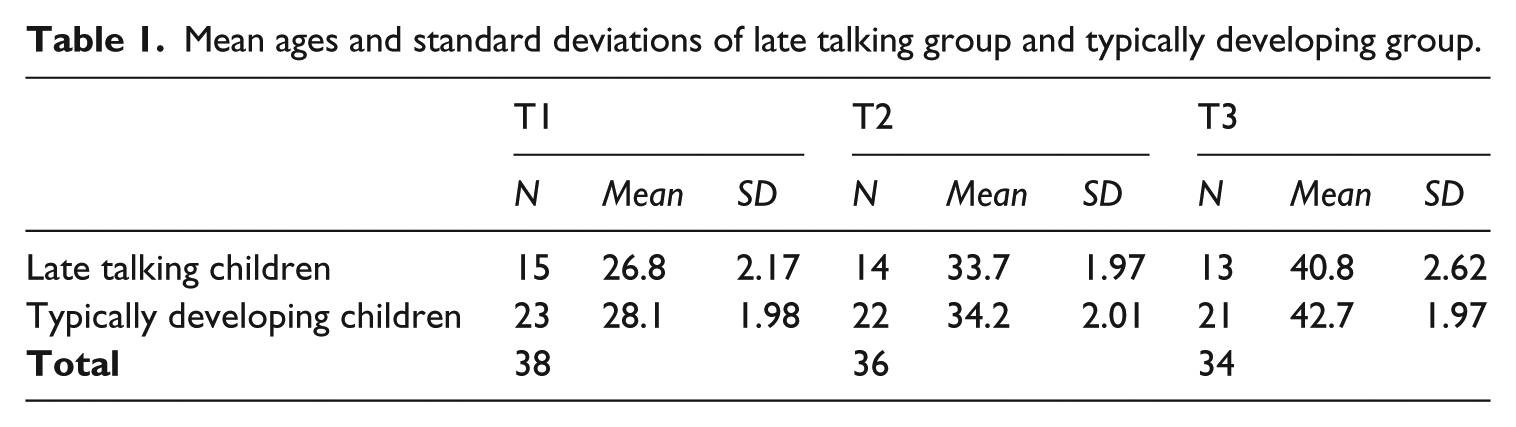
The 38 participants were followed for 14 months and were assessed at three different moments (T1, T2 and T3). There was a lapse of six months between T1 and T2 and eight months between T2 and T3. Because some families dropped out during the longitudinal study, sample size varies from time 1 to time 3. Table 1 also shows the sample distribution.
All participants were monolingual Spanish-speaking children. They had no history of hearing loss and no referral to speech or language therapy services.
Design
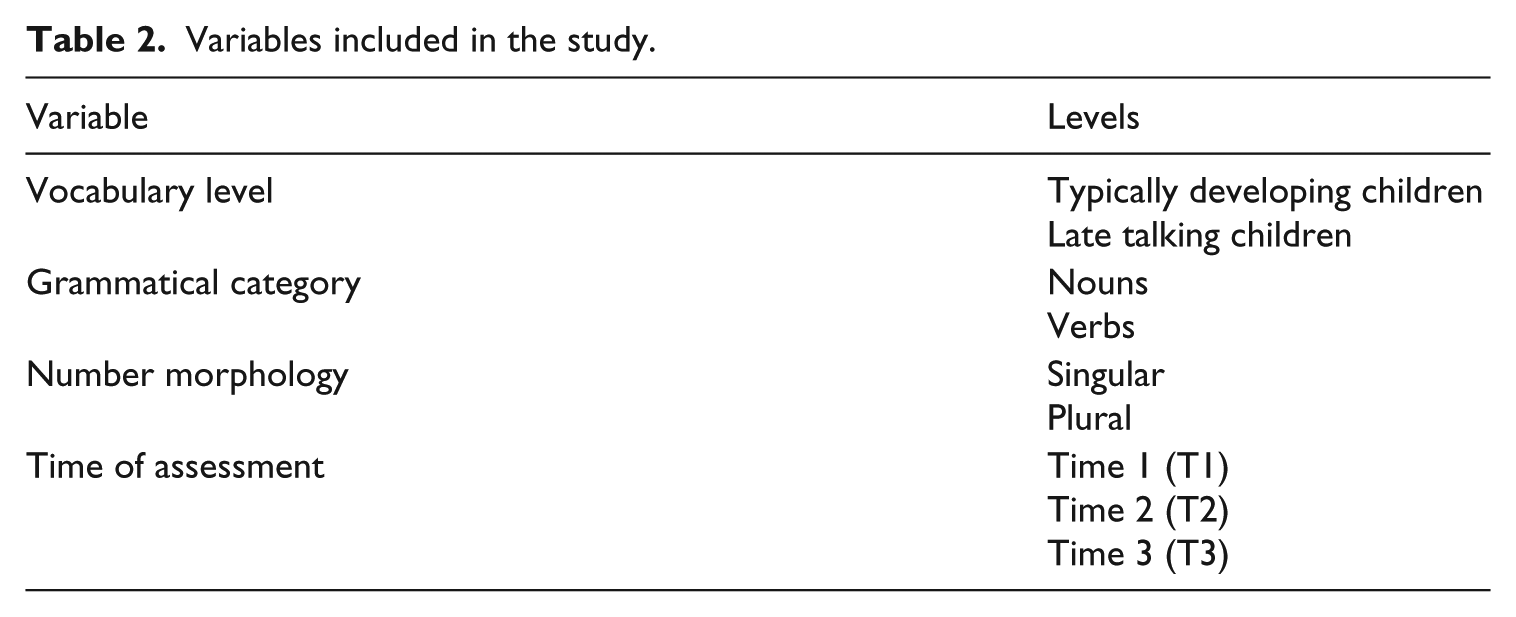
A between-subject design was used to measure the effects of the following variables on fast mapping abilities (see Table 2).
Variables included in the study.
Stimuli
Stimuli included auditory and visual items.
Auditory stimuli
Auditory stimuli included known and new labels (nonwords). Known labels were selected from the most frequent words in the Spanish version of the MCDI (López-Ornat et al., 2005) at age two. Most of these words are disyllabic. However, many frequent words in the Spanish version of the MCDI are also monosyllabic and trisyllabic. Thus, known items had one, two and three syllables. From known words, unknown labels (nonwords) were created using two main criteria: wordlikeness and number of syllables. Wordlikeness was based on the list of syllables of frequent words, so we created disyllabic items using syllables that were part of known words.
Both the words and the nonwords were presented in singular and plural forms. Appendices 1 and 2 include the words and the nonwords used in the experiment, which included half noun labels and half action labels.
Visual stimuli
Visual stimuli were represented in color pictures mounted on 10 cm × 7 cm cards. Each card presented one picture.
1. Objects labels (nouns). 1a. Known object labels (nouns): cards included one object image (for the task in singular) and two objects images (for the task in plural). 1b. Images that represented unknown object labels (nonwords) were unfamiliar objects for children (such as cufflinks). Another set of stimuli for the extension phase included the same target objects presented in another color.
Appendix 1 shows all the stimuli presented on each trial.
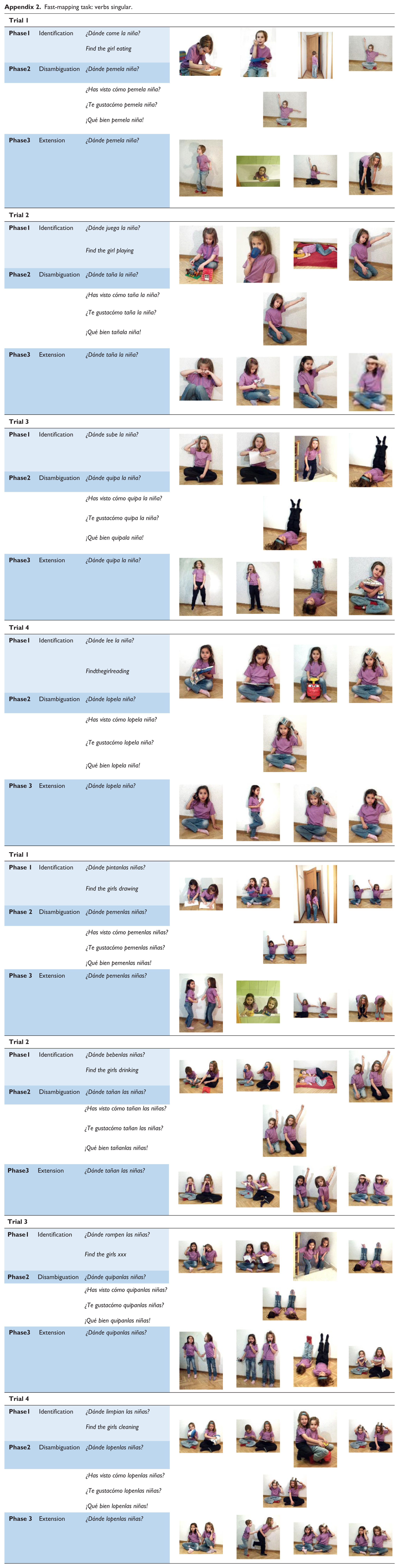
2. Action labels (verbs) 2a. Known action labels (verbs): cards included photographs of one child representing an action (for the task in singular) or two children representing the same action (for the task in plural). All of them were dressed in the same color t-shirt. 2b. In order to represent unknown action labels (nonwords), the children carried out different actions that lacked a specific known label (such as a girl raising one of her hands and pointing in another direction with the other hand). Following Golinkoff et al. (1996), another set of stimuli included the same target actions carried out by another agent, so it was possible to test the extension of unknown action labels to other members of the same category.
We acknowledge that static cards differ from dynamic actions presented in videos. There are two main reasons why we represented actions using photographs. First, given that objects were represented in cards, actions were also represented using cards. Second, while the referents of objects are perceptually available, the referents of actions are perceptually available only transiently (Maguire et al., 2006). Static cards better equate the perceptual availability of referents for actions and objects. Previous studies have used dynamic representation of actions in videos (Arias-Trejo et al., 2014; Bion et al., 2013; Snape & Krott, 2018). However, there is a considerable amount of research that has used static cards to represent actions and has found results comparable to those found when using videos (Bedore & Leonard, 2000; Golinkoff et al., 1996; Jonson & de Villiers, 2009).
To ensure that known objects and actions were identifiable, a sample of 15 adults and 15 five- to six-year-old girls were asked to identify all the known objects. Both, children and adults, identified known objects and actions as known, and labeled them with a single word. To ensure that unknown objects and actions were unknown, the same group of adults and children were asked to label the cards. In the case of objects, 10 out of 15 adults labeled all the unknown objects (old-slide, tin-opener, bottle-cap …), five hesitated with three objects. The 15 children did not label any of the objects with a single word (except ‘thing’). They reported that they did not know what those objects were. In the case of actions, all adults described them with periphrastic sentences. Eight out of 15 adult participants started their descriptions reporting their lack of knowledge about the action. Children answered the request to label with sentences like ‘I don’t know’ and ‘She’s like playing’.
Appendix 2 shows all the stimuli presented on each trial.
Procedure
The task comprised four trials, each with the following three phases, as shown in Appendices 1 and 2.
It could be that children did not respond after the first attempt, or it could be that they provided the wrong answer. These situations were coded as 0. However, given that it is impossible to determine whether children were not paying any attention, and given that parents self-repeat their own utterances (see, for example, Schwab & Lew-Williams, 2016, for a review), children were exposed to the word–referent pair up to three times. If the child did not respond or chose the wrong referent, the experimenter provided the right answer.
As shown in Appendix 1, in all cases, after the disambiguation phase, the experimenter showed the right answer separately three more times in sentences like ‘¿Has visto que fepo más bonito?’ ‘¿Te gusta el fepo?’ ‘Vamos a guardar el fepo’ (‘What a nice fepo!’, ‘Do you like the fepo?’ ‘Let’s put the fepo away’).
Therefore, children were exposed to each word–referent pair up to six times. As already stated, fast mapping is considered a quick word–referent matching after a ‘brief’ exposure (see Carey, 2010). Not all the studies reported specify the number of times that the new label is repeated. Since attention span varies greatly across young children, we considered one, two and three repetitions as brief exposures. Thus, before starting the next phase we made sure that all children were exposed to the mapping between the unfamiliar item and its referent, regardless of whether their performance was coded as right or wrong.
3.
There was a set of four trials for every grammatical category (singular nouns, plural nouns, singular verbs and plural verbs). The four trials of each category were presented together, one after the other. Thus, children were exposed to four trials of singular nouns, four trials of plural nouns, four trials of singular verbs and four trials of plural verbs. The order of presentation of each set of trials and the stimuli within each trial were counterbalanced across participants.
This procedure was exactly the same at T1, T2 and T3, therefore, at T3 children had already heard each label up to 12 times. There is evidence that children do not retain new labels after five minutes (Horst & Samuelson, 2008). Since there was a time lapse of six to eight months between each assessment, we considered that learning of the labels began anew at each assessment.
Coding
The ability to correctly identify the label the first time it was shown was codified as the right answer. Children scored 0 if they did not identify the picture depicting the word, and 1 if they identified it. Thus, for each test phase (disambiguation and extension) the highest possible score was 16 (four trials for four sets of stimuli: singular nouns, plural nouns, singular verbs, plural verbs).
Results
We report results for both test phases (disambiguation, extension), considering each research question separately. First we calculated the correlation between children’s accuracy scores in the disambiguation and extension phases. These analyses were carried out collapsing across vocabulary level. Results showed positive and significant correlation between the two phases at T1 (r(38) = .631, p < .001), T2 (r(36) = .555, p < .001) and T3 (r(34) = .696, p < .001).
In order to test the four research questions presented above, two ANOVAs (for disambiguation and extension phases) were carried out taking vocabulary level (typically developing vs. late talkers) as a between-subjects factor, and grammatical category (noun vs. verbs), number morpheme and time (T1, T2 and T3) (singular vs. plural) as within-subjects factors. Table 3 shows descriptive statistics for each time of assessment, during both disambiguation and extension phases.
Means and standard deviations of the children at each point in time and for each phase.
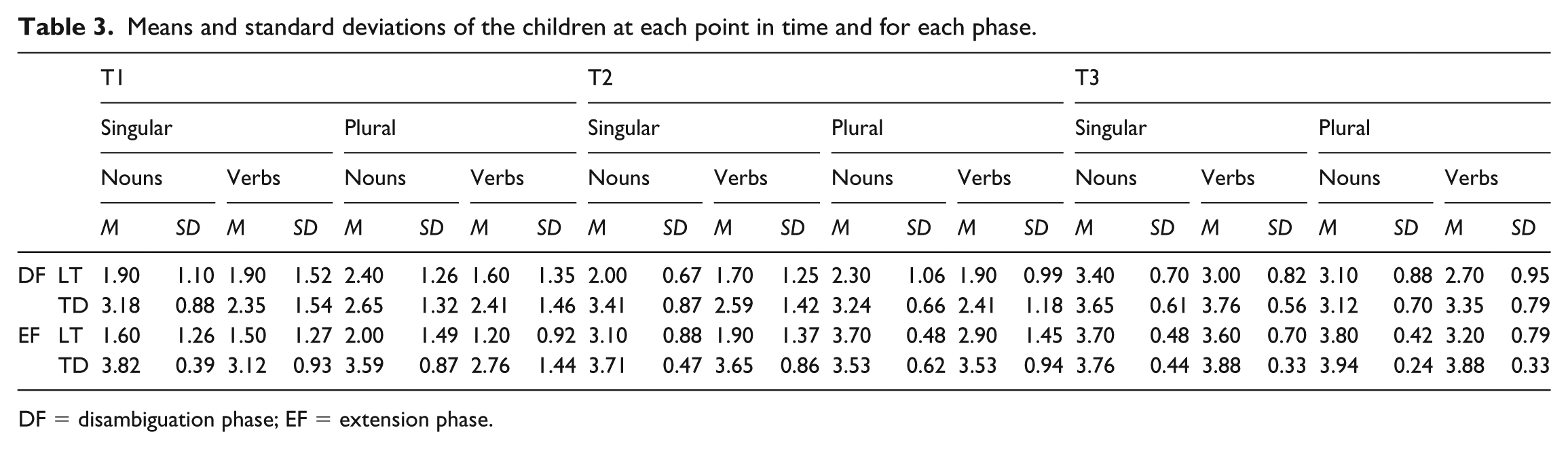
DF = disambiguation phase; EF = extension phase.
Disambiguation (test)
Q1. Do Spanish-speaking late talking children show more difficulties fast mapping new words onto their referents compared to their typically developing peers?
The main effect of vocabulary level is observed (F(1,25) = 14.35, p < .001, η = .476). Typically developing children performed better than late talking children (means 3.01 vs. 2.32). There is no significant interaction between vocabulary levels and any other variable.
Q2. What is the relationship between fast mapping abilities and grammatical category (nouns vs. verbs)?
The main effect of grammatical category is observed (F(1,25) = 18.72, p < .001, η = .428) such that nouns scored higher than action labels (means 2.86 vs. 2.47 respectively). This effect does not significantly interact with any other factor.
Q3. What is the relationship between fast mapping abilities and number morphology in nouns and verbs?
The main effect of number morphology does not reach significance (F(1,25) = 1.4, p = .30, η = .178) showing the same results for singular as for plural labels (2.73 vs. 2.59). There is no significant interaction with other variables.
Q4. Do fast mapping abilities change over time? If so, are changes related to vocabulary levels?
There is a significant main effect of time (F(1,25) = 17.65, p < .001, η = .414). Paired comparisons show that differences between T1 (mean 2.29) and T2 (mean 2.44) do not reach significance. However, differences between these times and T3 (mean 3.26) are significant (p = .001 in both cases). The effect of time is not significantly modulated by other variables.
Extension (test)
Q1. Do Spanish-speaking late talking children show more difficulties fast mapping new words onto their referents compared to their typically developing peers?
There is a main effect of vocabulary level (F(1,25) = 32.35, p < .001, η = .499). Typically developing children performed better than late talking children (means 3.60 vs. 2.68). There is a significant interaction between vocabulary level and morpheme (F(1,25) = 3.42, p < .05, η = .535). This interaction is modulated by time in a significant three-way interaction (F(1,25) = 4.9, p < .05, η = .567). The results show that late talking children perform better for plurals than for singulars (means 2.80 plurals vs. 2.50 singulars; p < .001). In T1 these differences do not reach significance (means 1.60 plurals vs. 1.55 singulars), although they do in T2 (means 3.30 plurals vs. 2.50 singulars; p = .001). In T3 late talking children perform better for singular than for plurals, although differences are not significant (means 3.50 plurals vs. 3.65 singulars). In contrast, typically developing children perform better on singulars than plurals at T1 (means 3.17 plurals vs. 3.47 singulars; p < .001) and T2 (means 3.52 plurals vs. 3.67 singulars; p = .007), but not in T3 (means 3.91 plurals vs. 3.82 singulars) (see Figure 1).
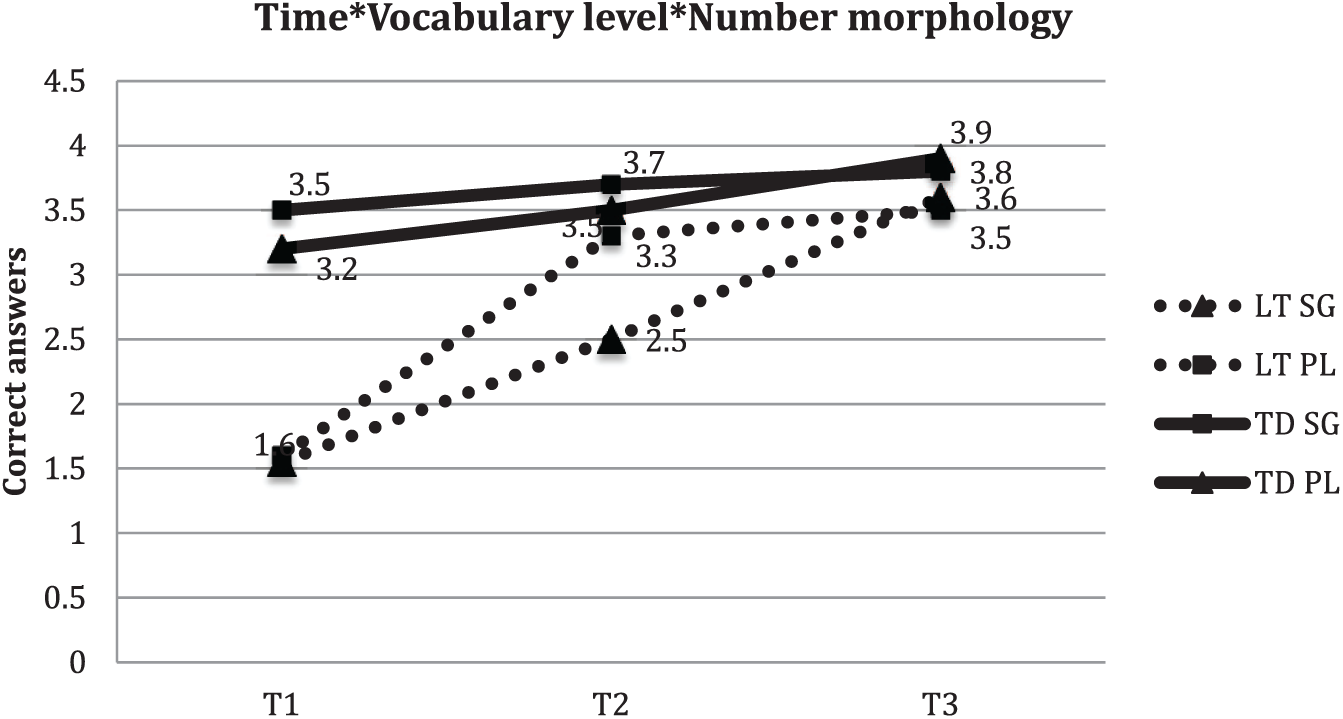
Three-way interaction between time, vocabulary level and morpheme.
In addition, a three-way interaction between vocabulary level, grammatical category and time reached significance (F(1,25) = 5.47, p = < .05, η = .612). For late talking children, performance with nouns is better than with verb forms at the three assessment times (p < .001). In the case of typically developing children, these differences are shown only at T1 (means 1.8 for nouns vs. 1.35 for verbs; p < .001), given that their performance at T2 and T3 is similar for nouns and verbs (see Figure 2).
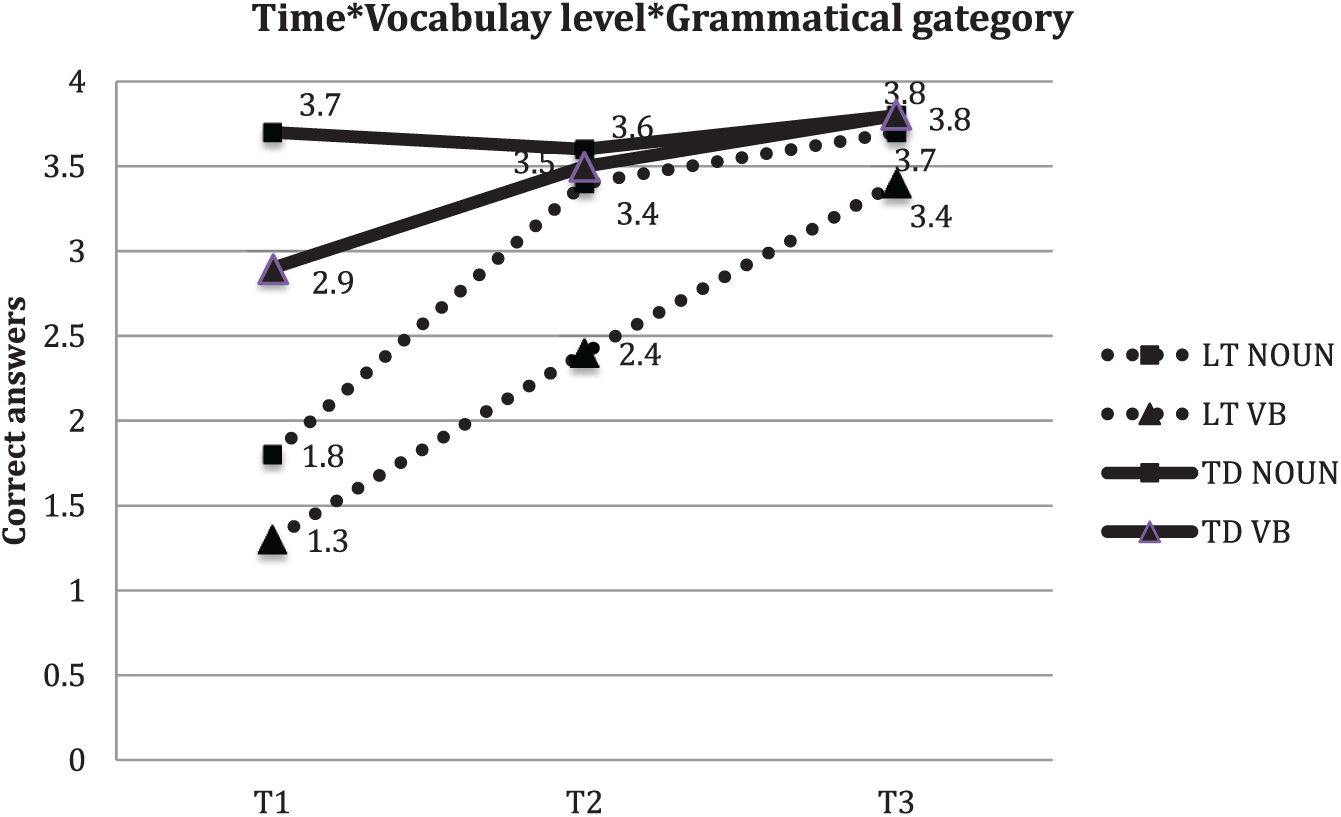
Three-way interaction between time, vocabulary level and grammatical category.
Q2. What is the relationship between fast mapping abilities and grammatical category (nouns vs. verbs)?
The main effect of grammatical category is observed (F(1,25) = 19.85, p < .001, η = .443) such that nouns scored higher than action labels (means 3.35 vs. 2.92 respectively). As previously mentioned, the three-way interaction between grammatical category, vocabulary level and time is significant.
Q.3. What is the relationship between fast mapping abilities and number morphology in nouns and verbs?
The main effect of morpheme does not reach significance (p = .01) and therefore shows the same results for singular as for plural labels. However, as already pointed out, there is a significant interaction between vocabulary level and morpheme, and a significant three-way interaction between vocabulary level, morpheme and time (see research question 1).
Q4. Do fast mapping abilities change over time?
There is a strong significant main effect of time (F(1,25) = 87.42, p < .001, η = .666) showing better performance in T3 (mean 3.7) than in T2 (mean 3.2), p < .001, and in T2 than in T1 (mean 2.4), p = .001. As reported above, there are two significant three-way interactions in which time is a factor: vocabulary level, morpheme and time; grammatical category, vocabulary level and time.
Discussion
The results of the present study show that monolingual Spanish-speaking late talking children have more difficulties disambiguating the referent of new labels than typically developing children. These results are similar to those found by Ellis Weismer et al. (2013) for English-speaking late talking children, and also to the ones found for children with specific language impairment (Alt & Plante, 2006; Gray, 2006; Gray & Brinkley, 2011). Moreover, our data also show that Spanish late talking children have more difficulties than typically developing children extending a new label to another referent after several repetitions of label–referent pairs (what we called the extension phase). Similar results were found by Jones (2003), who observed that English late talking children show more difficulties generalizing new learned labels compared to typically developing children. Thus, our results point out that there is a relationship between vocabulary levels and disambiguation and extension abilities. It could be that children with lower vocabulary levels present difficulties with these abilities. Moreover, difficulties in learning how to disambiguate and extend could lead to a slower vocabulary development.
Even if we consider our results at T3, when children’s performance was highest, we can still see a difference between the TD and late talking children. During disambiguation, children with higher levels of vocabulary (TD children) link the new word with the new referent nearly 95% of the time. However, children with lower levels of vocabulary are still only at 60% correct. Similarly, in the extension phase, TD children are at ceiling (more than 96% correct for nouns and verbs). Late talkers are at 93% for nouns, but still at only 70% correct for verbs. This is despite the fact that all participants heard the words between four and six times during the disambiguation phase (one to three repetitions and three more exposures to the right answer). These results suggest that late talking children may need more repetitions of word–referent pairs than typically developing children in order to start building lexical representations (MacRoy-Higgins & Dalton, 2015). However, further research is needed to confirm this hypothesis.
Regarding grammatical category, our results show differences between the disambiguation and the extension of object and action labels, as was previously found by Alt, Plante, and Creusere (2004) with English-speaking children. Object labels (concrete nouns) seem to be easier to identify than actions for both groups of children, both during the disambiguation and the extension phases. There was a three-way interaction of grammatical category with time of assessment and vocabulary level during the extension phase. At the beginning of the study, late talking children’s performance with verbs and nouns is worse than typically developing children. Nevertheless, these late talking children’s performance with nouns is not significantly worse than typically developing children. In contrast, verbs are still more difficult for late talking than for typically developing children at the end of the study, showing that differences between nouns and verbs remain for late talking children. Although these results were previously found for typically developing (see, for example, Hirsh-Pasek & Golinkoff, 2006) and late talking children (Alt et al., 2004), they were not attested in the Spanish. Moreover, these results add new data about the trajectories followed by these children, who may show different patterns than typically developing children.
Our results are in line with models that state that grammatical categories are not abstract representations stored in children’s lexicons (Hidaka & Smith, 2011; Hockema & Smith, 2009). Differences between objects and action labels are related to different variables, as well as the concepts they encode. In fact, we found differences between both categories, even though we used static images both for objects and actions, so the referents were perceptually available in both cases. This suggests that perceptual variables are not the only reason that learning differences for nouns and verbs exist. Other factors that may explain why some labels are more easily identified than others include morphology and frequency, and vocabulary level, which may explain why some labels are more easily identified than others (Maguire et al., 2006).
In this study we analyzed the interaction between grammatical category and morphology, considering that those forms that are more frequent in child directed speech should be easier to identify (Ambridge et al., 2015; Hockema & Smith, 2009). Therefore, we expected better performance with nouns than with verbs, better performance with singular than with plural forms and better performance with singular nouns than with plural verbs. We did found differences between nouns and verbs. However, regarding number morphology, no main effects were found, in either the disambiguation or extension phases. Moreover, we did not find an interaction between category and morphology, although both of them interact with time and vocabulary level. We found a three-way interaction between number morpheme, time of assessment and vocabulary level, for both groups of children, during the extension phase. This suggests that number morphology did not affect the incorporation of new labels during the first stages of word learning in a straightforward way. These results are similar to those found by Bedore and Leonard (2000), who suggested that children do not initially use morphological variations in order to identify new labels. If children’s knowledge of singular and plural morphemes was abstract, the identification of new labels in plural and singular should be equal. Of course, linguistic representations may not be the only reason why children have more difficulties identifying the referent of plural labels than with singular labels. Nevertheless, it is possible that part of these difficulties are because their knowledge about plural morphemes (which are less frequent both in child directed speech and children’s production) is not strong enough to be abstract (Ambridge et al., 2015).
Overall, late talking children’s performance was better on plural than singular forms when they had to extend a label, although this difference was only significant at T2. At T3 this group of children showed a slight advantage for singular, just as their typically developing counterparts do. Arias-Trejo et al. (2014) reported a similar advantage for plural nouns in young typically developing children. They suggest that children are using inflectional morphology in order to interpret the meaning of new words. In our case, late talking children’s scores with singular and plural forms are very low at T1 and T2, although their performance with plural forms is still higher. The fact that late talking children’s performance with plural forms is better than performance with singular ones does not mean that they are analyzing the information of plural morphemes to interpret the meaning of new action labels. It is possible that they are also using perceptual information, given that plural actions are represented twice, so they have more opportunities to see the same action. Further research should analyze whether these results are influenced by the number of items in the stimuli set, and should introduce perceptual variables that interact with morphological variables (for example, number of items that represent plurals, size of the items, allocation of the stimuli).
The results of this study provide support to the idea that the identification of new labels does not work in an all-or-none fashion (Carey, 2010; Hidaka & Smith, 2011). Moreover, fast mapping is the first step towards the construction of lexical representations. The identification of the referent of a new label is a complex process in which several variables are involved. Obviously, cognitive variables, such as short-term memory, may have a role (see, for example, Jackson et al., 2016). Nonetheless, our data suggest that grammatical category and morphological variations should be included in order to measure word learning skills, and that children’s identification and extension of nouns and verbs should be interpreted considering their age and vocabulary level.
Our longitudinal study not only shows that late talking children are delayed in comparison to typically developing children, but also that vocabulary level and disambiguation ‘work together through feedback loops in a mutually influential fashion’ (Bion et al., 2013, p. 49). Younger children with low vocabulary levels behave differently with new labels compared to children with larger vocabularies. The influence of each variable under study is not direct, and it depends on the interaction of vocabulary level with grammatical category, morphological information or time. As late talking children grow older (and their vocabularies increase), they show similar patterns but they score lower than their counterparts with typical development.
The findings in the present study show that the fast mapping task used is a useful method to examine late talking children’s word learning from a developmental point of view. Firstly, it allows us to analyze word learning beyond the quantification of the increase in vocabulary. Typical, standardized lexical measures focus on the number of labels stored in children’s lexicons, whereas the method used here focuses on incipient mechanisms involved in word learning. Secondly, differences between disambiguation and extension phases show that it is possible to analyze whether difficulties for children to increase their vocabularies are due to extension abilities. Thus, with this method it is also possible to test whether, once children have achieved the rapid association, they find it hard to understand that the new labels refer to a class of elements of the world (i.e. category), and not individual examples of the same. Positive and significant correlations between disambiguation and extension trials suggest that rapid association between new labels and their referents may help the construction of lexical categories. In our case, we found these correlations even if we provided children with the right answer when they failed to find it (all children were exposed to the word–referent pair separately three more times). Previous studies have also found correlations between the ability to disambiguate a new label and the ability to retain it (Bion et al., 2013). Moreover, this ability to retain the label in a short period of time is also related to vocabulary level.
Thirdly, the method of pointing out images of objects and/or actions also enables the insertion of morphological variations. It was possible to check whether some of the difficulties in the incorporation of new words into the lexicon were related to linguistic variables such as the grammatical category or the associated number morpheme. To date, not so many studies have analyzed fast mapping abilities in a richly inflected language as Spanish. Our results show that morphological variations, especially in verbs, have a complex role in the construction of vocabularies, and they should be taken into account in clinical assessments.
Finally, our longitudinal results show that the task is solved gradually. In fact, typically developing children reach ceiling effects only in T2 with nouns, whereas verbs do not reach ceiling effects until T3. Clinical implications may be derived from these results; the task could be a useful test of vocabulary learning. Given that this task is easy to administer (in terms of time and resources), future research could aim to adapt it for clinical purposes by both standardizing the items and/or measuring the number of repetitions that different groups of children need for the extension of each label.
Footnotes
Appendix
Fast-mapping task: verbs singular.
|
|
||||||
|
|
Identification |
¿Dónde come la niña?
Find the girl eating |
||||
|
|
Disambiguation | ¿Dónde pemela niña? | ||||
|
¿Has visto cómo pemela niña?
|
||||||
|
|
Extension | ¿Dónde pemela niña? | ||||
|
|
||||||
|
|
Identification |
¿Dónde juega la niña?
|
||||
|
|
Disambiguation | ¿Dónde taña la niña? | ||||
|
¿Has visto cómo taña la niña?
|
||||||
|
|
Extension | ¿Dónde taña la niña? | ||||
|
|
||||||
|
|
Identification | ¿Dónde sube la niña? | ||||
|
|
Disambiguation | ¿Dónde quipa la niña? | ||||
|
¿Has visto cómo quipa la niña?
|
||||||
|
|
Extension | ¿Dónde quipa la niña? | ||||
|
|
||||||
|
|
Identification |
¿Dónde lee la niña?
|
||||
|
|
Disambiguation | ¿Dónde lopela niña? | ||||
|
¿Has visto cómo lopela niña?
|
||||||
|
|
Extension | ¿Dónde lopela niña? | ||||
|
|
||||||
|
|
Identification |
¿Dónde pintanlas niñas?
|
||||
|
|
Disambiguation | ¿Dónde pemenlas niñas? | ||||
|
¿Has visto cómo pemenlas niñas?
|
||||||
|
|
Extension | ¿Dónde pemenlas niñas? | ||||
|
|
||||||
|
|
Identification |
¿Dónde bebenlas niñas?
|
||||
|
|
Disambiguation | ¿Dónde tañan las niñas? | ||||
|
¿Has visto cómo tañan las niñas?
|
||||||
|
|
Extension | ¿Dónde tañan las niñas? | ||||
|
|
||||||
|
|
Identification |
¿Dónde rompen las niñas?
|
||||
|
|
Disambiguation | ¿Dónde quipanlas niñas? | ||||
|
¿Has visto cómo quipanlas niñas?
|
||||||
|
|
Extension | ¿Dónde quipanlas niñas? | ||||
|
|
||||||
|
|
Identification |
¿Dónde limpian las niñas?
|
||||
|
|
Disambiguation | ¿Dónde lopenlas niñas? | ||||
|
¿Has visto cómo lopenlas niñas?
|
||||||
|
|
Extension | ¿Dónde lopenlas niñas? | ||||
Funding
The author(s) disclosed receipt of the following financial support for the research, authorship, and/or publication of this article: This research has been supported by the Ministerio de Economía y Competitividad with Grant Number ‘PSI2013-44250-P’ to Marta Casla, Miguel Lázaro, Sonia Mariscal, Eva Murillo, and Irene Rujas.