



Abstract
This cross-sectional study investigated the use of four verbal indices of social knowledge (personal pronouns, verb conjugations, people words and mental state language) and their concurrent relations in a sample of 287 Italian-speaking children between 18 and 36 months. Results showed that the production of all indices increased with age. Mental state language (MSL) was positively associated to the use of personal pronouns and verb conjugations, suggesting that the difficulty in the acquisition of person-marking devices is partly due to social constraints. Moreover, both second- and third-person pronouns and verb conjugations were related to the acquisition of MSL, above and beyond the effects due to age and vocabulary. First-person references had no unique relation to MSL, after considering second- and third-person references. Lastly, the use of people words showed bidirectional associations with MSL, suggesting that the frequency of this category might be considered as an early verbal indicator of children’s social knowledge.
Theory of mind (ToM) refers to the ability to appreciate the existence of one’s own and others’ mental states (e.g. intentions, emotions, desires) and use them to explain and predict behaviours (Baron-Cohen, Leslie, & Frith, 1985; Flavell, 2004; Longobardi, Spataro, & Rossi-Arnaud, 2016; Premack & Woodruff, 1978). Typically, ToM abilities have been examined in the laboratory via first- and second-order false belief tasks, which require children to make inferences about the behaviour of an agent based on that agent’s erroneous beliefs (Perner & Wimmer, 1985). An extensive body of research has shown that the probability of passing these tasks is about 50% at 44 months and becomes increasingly higher at later ages (Wellman, Cross, & Watson, 2001). However, younger children can signal access to their own and others’ mental states well before this age. In this respect, several authors have looked at the early development of mental state language (MSL), which can be defined as the mastery of linguistic expressions representing thoughts, emotions and beliefs (Bellagamba, Laghi, Lonigro, Pace, & Longobardi, 2014; Kristen, Sodian, Licata, Thoermer, & Poulin, 2012; Longobardi, Lonigro, & Laghi, 2016). MSL is acquired by young children in a predictable way, such that physiological (e.g. ‘hungry’), desire (e.g. ‘want’) and emotion (e.g. ‘happy’) terms are the earliest and most common psychological words to appear in the spontaneous speech of 2-year-old infants, whereas references to cognitive states, exemplified by the use of terms such as ‘think’ and ‘know’, are produced at later ages, by around age 3 (Bartsch & Wellman, 1995; Bretherton & Beeghly, 1982; Shatz, Wellman, & Silber, 1983). A consistent number of studies have reported direct links between children’s production of MSL and their concurrent or later ToM abilities (Brown, Donelan-McCall, & Dunn, 1996; Dunn, Brown, Slomkowski, Tesla, & Youngblade, 1991; Hughes & Dunn, 1998), suggesting that the use of a psychological lexicon can be considered as an early correlate of social understanding.
The above conclusion has been recently strengthened by Markova and Smolík (2014), who uncovered significant, positive associations between MSL and the way in which 2- to 3-year-old children used personal pronouns and verb conjugations to distinguish self from others. Pronouns are closed-class words that are mostly absent during the one-word stage and begin to appear in children’s language between 18 and 20 months of age (Bates, 1990). The difficulty in acquiring personal pronouns can be partly accounted for by their context-dependent nature. In fact, the referents of personal pronouns can easily shift, depending on the relationship between the speaker and the hearer (Bates, 1990). For example, a child knows that his/her mother will use the second-person form (‘you/your/yours’) when she is speaking to the child. However, the same child must understand that the same form can also be used by other people to refer to his/her mother during a conversation between adults. The fact that personal pronouns do not always refer to the same persons implies that, to understand and produce them, the child must have a rudimentary knowledge of the way in which different people can assume distinct roles in a given context, together with a basic comprehension of the speaker’s communicative intentions (Markova & Smolík, 2014).
For morphologically rich languages like Italian, a similar set of problems must be faced during the acquisition of verb morphology. For English-speaking children, the shifting roles of speakers and listeners do not constitute an important problem, because in that language there is just a contrast between the third-person singular form (‘He eats apples’) and every other form of a given verb (‘I/we/you/they eat apples’). In contrast, shifting person referents has an enormous impact on the structure of verbs in Italian (Bates, 1990). Take, for example, the common Italian verb ‘mangiare’ (‘to eat’). For the simple present tense, the same verb can take six distinct forms: ‘mangio’ (first person singular), ‘mangi’ (second person singular), ‘mangia’ (third person singular), ‘mangiamo’ (first person plural), ‘mangiate’ (second person plural) and ‘mangiano’ (third person plural). This state of affairs must be multiplied across the different parameters that affect verb conjugations in Italian: person, tense, number, aspect, mood, and occasionally gender (Leonard, Caselli, & Devescovi, 2002). Since Italian is a pro-drop language which allows the speaker to omit the subject of the sentence far more often than in English, the consequence of this high morphological variability is that Italian-speaking children must learn the system of verb conjugations as early as possible if they want to understand who did what to whom (Bates, 1990).
Besides the difficulties linked to their grammatical and referential properties, there is now converging evidence suggesting that the challenge in the acquisition of person-marking devices is partly of a social nature. In fact, in order to correctly use personal pronouns and verb conjugations, the children need (a) to recognize one’s own individuality, and (b) to think of others as independent beings with different psychological states (Lewis & Ramsay, 2004; Markova & Smolík, 2014; Ricard, Girouard, & Decarie, 1999). Along this way, an early study by Loveland (1984) reported that only 2-year-old children who demonstrated a full understanding of the fact that individuals’ spatial points of view could differ were able to use the pronouns ‘I’ and ‘you’ without errors. More recently, Brownell, Ramani, and Zerwas (2006) showed that, in children ranging from 19 to 27 months, joint attention skills and the frequency of language about self and others (which included the use of personal pronouns, action verbs and mental state words) were both positively associated to the ability to coordinate their behaviours with a peer. Finally, Chromá and Smolík (2017) found that the comprehension and production of nominal and pronominal references in children between 28 and 32 months of age was predicted by both linguistic and social measures – the latter being an aggregate of their performance in intention-understand, pretend-play and visual-perspective tasks.
If both the acquisition of person-marking devices (personal pronouns and verb conjugations) and the production of MSL require children’s access to their own and others’ mental states, then a significant relation between these two domains should be expected. Yet, only a few studies have empirically investigated this question. An indirect piece of evidence has been reported by Taumoepeau and Ruffman (2008), who found that children’s use of first-person pronouns at 24 months was positively and significantly associated to maternal MSL at 33 months. More recently, Markova and Smolík (2014) reported significant relations between person-marking devices and MSL in Czech-speaking children between 2 and 3 years of age. Specifically, these authors found that the use of both first- and second-person pronouns and verb conjugations was positively associated to the production of MSL referred to self and others. However, the following regression analyses indicated that command of second-person devices was a significant concurrent predictor of children’s MSL, whereas command of first-person devices had no unique relation with MSL and did not explain additional variance, over and above the variance accounted for by second-person devices. These findings were interpreted to be consistent with the proposal that the use of first-person references requires children to have a notion of their own mental states, whereas the use of second-person references requires them to have a model of the addressee’s mental states.
The present study was aimed at determining whether a similar asymmetry occurs in Italian. To further evaluate the relative importance of second-person pronouns and verb conjugations, we extended our evaluation to the first three singular person forms, since there is at least some evidence suggesting that the use of third-person pronouns and verb conjugations might reflect children’s ability to recognize what is shared and what is differentiated in the psychological orientations of self and others (Hobson, Lee, & Hobson, 2010). In agreement, Brandt, Buttelmann, Lieven, and Tomasello (2016) showed that the 4-year-old children’s comprehension of their own false beliefs was significantly related to their understanding of complement-clause constructions having a third-person subject (‘The cow thinks the sticker is in the red box’), whereas the comprehension of others’ false beliefs was related to their understanding of complement-clause constructions having both first- (‘I think the sticker is in the red box’) and third-person subjects. In addition to considering personal pronouns and verb conjugations, we also tracked the production of people words (i.e. words such as ‘mummy’, ‘daddy’, ‘grandpa’), since Longobardi, Spataro, Frigerio, and Rescorla (2016) found that the production of people words was a significant concurrent predictor of social competence in a sample of 268 preschoolers aged 18–35 months and suggested that this category might specifically tap the verbal aspects of social knowledge. On the basis of this assumption, we also expected the use of people words to show concurrent relations to MSL in the present study.
To summarize, the present cross-sectional study aimed at investigating the concurrent relations between four verbal indices of social knowledge (personal pronouns, verb conjugations, people words and MSL) in three groups of children ranging from 18 to 36 months of age, a period which is likely to be critical for the acquisition of lexical and grammatical skills. It should be noted that all measures were taken from the Italian adaptation of the MacArthur–Bates Communicative Development Inventory (MCDI) (Fenson et al., 1994). This choice aimed at ensuring that the parents’ adhesion to the study was as wide as possible, allowing us to obtain multiple indices of linguistic competence from a relatively large sample of children. Furthermore, previous studies have demonstrated that the MCDI can be usefully employed to track children’s production of internal state terms in the second year of life (Brooks & Meltzoff, 2015; Longobardi, Spataro, & Colonnesi, 2018; Meins, Fernyhough, Arnott, Leekam, & de Rosnay, 2013).
There were two primary aims: (1) to assess differences between the three age groups (18–23, 24–29 and 30–36 months) in the production of personal pronouns, verb conjugations, people words and MSL; and (2) to determine whether the asymmetry in the relation between person-marking devices and MSL reported by Markova and Smolík (2014) extended to Italian-speaking children, when considering first-, second- and third-person pronouns and verb conjugations.
Method
Participants
The sample consisted of 287 children (134 girls and 153 boys) recruited from kindergartens and paediatricians’ offices in the metropolitan area of Rome (Italy), whose mean age was 26.84 months (SD = 6.15). For the purposes of the present study, they were divided into three groups: 18–23 months (N = 70; M = 19.37), 24–29 months (N = 112; M = 25.11) and 30–36 months (N = 101; M = 34.13) – age information was missing for 4 children. All the families were monolingual Italian speakers and their socio-economic status was medium and medium-high, as based on parental education ‒ 41% of mothers and 31% of fathers had a postsecondary (university) degree. A total of 141 children (49%) were first-born, while the other 133 children were second- or later-born (this information was not reported for 13 children). No child had known or suspected sensory, intellectual, speech or language deficits, based on parents’ reports.
Measures
All measures were drawn from the Italian adaptation of the MacArthur–Bates Communicative Development Inventory (MCDI): Words and Sentences (Fenson et al., 1994) – Il Primo Vocabolario del Bambino: Parole e Frasi (Caselli & Casadio, 1995). This is a well-known and validated parent-report questionnaire which can be used to investigate the expressive language of children ranging in age from 8 to 36 months (Caselli & Casadio, 1995; Caselli, Casadio, & Bates, 1999). The word production checklist contains a total of 670 items, organized into 23 semantic categories covering nouns, verbs, adjectives, pronouns, prepositions and articles.
Mental state language
From the MCDI vocabulary checklist, we selected 47 mental state words spanning five different categories: 8 perceptual terms (e.g. ‘Guardare’: ‘to Watch’), 10 physiological terms (e.g. ‘Stanco’: ‘Tired’), 18 emotional terms (e.g. ‘Felice’: ‘Happy’), 3 volitional terms (e.g. ‘Volere’: ‘to Want’), 3 cognitive terms (e.g. ‘Conoscere’: ‘to Know’) and 5 moral terms (e.g. ‘Cattivo’: ‘Bad’). Mothers were asked to indicate which of the 47 mental state words were produced by their children: thus, possible scores ranged from 0 to 47.
These items were selected after careful comparison with similar checklists developed by Kristen et al. (2012), Bellagamba et al. (2014) and Taumoepeau and Ruffman (2008). Notably, the list used for the present research was considerably larger than that employed in previous studies which have similarly relied upon a subset of items selected from the MCDI to assess the early production of MSL (e.g. Brooks & Meltzoff, 2015; Longobardi et al., 2018; Meins et al., 2013).
Vocabulary
The size of expressive vocabulary was estimated as the total number of concrete nouns produced by children, among those listed in the MCDI (after excluding the 47 terms used to assess MSL). Thus, possible scores ranged from 0 to 334.
Pronouns
Like the English version, the Italian version of the MCDI includes a specific category of pronouns (23 items). From this category, we extracted three measures assessing the use of first-, second- and third-person singular pronouns. For each type of pronoun, parents were requested to indicate whether their children produced subject pronouns (‘Io’: ‘I’; ‘Tu’: ‘You’; ‘Lui’: ‘he’; ‘Lei’: ‘she’), object pronouns (‘Me/Mi’: ‘Me’; ‘Te/Ti’: ‘You’) and possessive pronouns (‘Mio/Mia’: ‘Mine’; ‘Tuo/Tua’: ‘Your’; ‘Suo/Sua’: ‘His/Her’). Thus, the maximum possible score for the three types of pronouns was always three.
Verb conjugations
The MCDI has a specific section assessing the use of grammar and, more specifically, the acquisition of verb conjugations. From this subsection, we extracted two measures reflecting the production of the first-, second- and third-person singular forms of three different regular verbs (‘Mangiare’: ‘to Eat’; ‘Bere’: ‘to Drink’; ‘Dormire’: ‘to Sleep’). For example, for the first-person singular forms, parents were requested to indicate whether their children produced the verbs ‘Mangio’ (‘I eat’), ‘Bevo’ (‘I drink’) and ‘Dormo’ (‘I sleep’). The maximum possible score was therefore three for all conjugations.
People words
The MCDI includes a category specifically assessing the production of 29 people words, such as ‘Zia/Zio’ (‘Aunt’), ‘Mamma’ (‘Mummy’), ‘Nonno’ (‘Grandpa’), etc. Hence, total scores ranged from 0 to 29.
Procedure
Parents were preliminarily asked their consent to participate in the study, generally described as a survey about the development of early communicative abilities. In a later meeting, each mother was given detailed instructions by trained research assistants, who explained in a very simple language the instrument’s goals and measures. At the end of this meeting, they received the Italian adaptation of the MCDI, under the recommendation to return it within the following week.
Results
Table 1 shows descriptive statistics of the measures used in the present study, both overall and separately for the three age groups. A preliminary examination indicated that all variables had a normal distribution (skewness ranged from −0.482 to 0.692). Thus, parametric analyses were used in all cases, with the critical α being set to 0.05. Note that the degrees of freedom could slightly change from analysis to analysis, due to different number of missing values.
Descriptive statistics for the measures used in the present study.

Note. ***p ⩽ 0.001; MSL: mental state language; PP1: first-person singular pronouns; PP2: second-person singular pronouns; PP3: third-person singular pronouns; VC1: first-person verb conjugations; VC2: second-person verb conjugations; VC3: third-person verb conjugations.
Age effects
Developmental differences between the three age groups were analysed via a series of one-way ANOVAs, considering Age (18–23, 24–29 and 30–36 months) as the between-subjects factor. As reported in Table 1, there were significant increases for all variables. Post-hoc comparisons with the Bonferroni adjustment showed that all the pairwise comparisons were significant (all ps < 0.029).
Correlations
Pearson’s correlations between all variables are reported in Table 2. As can be noted, MSL was positively and significantly correlated with the use of first-, second- and third-person pronouns, as well as with the use of first-, second- and third-person verb conjugations. Following Markova and Smolík (2014), we computed partial correlations to determine whether MSL continued to be associated to personal pronouns and verb conjugations after controlling for the effects of age. Not surprisingly, the resulting correlations continued to be significant, r(275) = 0.47, p < 0.001, r(275) = 0.62, p < 0.001 and r(275) = 0.48, p < 0.001 for first-, second- and third-person pronouns respectively, and r(275) = 0.57, p < 0.001, r(275) = 0.59, p < 0.001 and r(275) = 0.58, p < 0.001 for first-, second- and third-person verb conjugations respectively. As expected, the use of people words was significantly associated with MSL, even after removing the effects of age, r(275) = 0.65, p < 0.001.
Pearson’s correlations between all variables.

Note. All the correlations were significant (p < 0.01); MSL: mental state language; PP1: first-person singular pronouns; PP2: second-person singular pronouns; PP3: third-person singular pronouns; VC1: first-person verb conjugations; VC2: second-person verb conjugations; VC3: third-person verb conjugations.
Simultaneous regressions
To further assess the nature of the observed associations between personal pronouns, verb conjugations and MSL, a series of regression models were fitted to the data. It should be noted that, in the following sections, we will use the term ‘predictor’ to refer to concurrent (not predictive) relations between independent and dependent variables, without implying any direct causality.
Predicting person reference from MSL
To replicate the analyses performed by Markova and Smolík (2014), we first evaluated a series of simultaneous regression models in which the dependent variables were the number of first-, second- and third-person pronouns and verb conjugations produced by children. The concurrent predictors were age (here considered as a continuous variable measured in months), vocabulary and MSL. The results, illustrated in Table 3, were generally consistent with those reported by Markova and Smolík (2014, study 2), since the contribution of MSL reached the significance level in all cases – the only exception occurring for first-person pronouns. In addition, the analyses confirmed that MSL was a significant predictor of the production of people words, above and beyond the contribution of age and vocabulary.
Simultaneous regressions predicting person references (pronouns and verb conjugations) and people words from age, vocabulary and MSL.

Note. *p ⩽ 0.05; **p ⩽ 0.01; ***p ⩽ 0.001; MSL: mental state language; PP1: first-person singular pronouns; PP2: second-person singular pronouns; PP3: third-person singular pronouns; VC1: first-person verb conjugations; VC2: second-person verb conjugations; VC3: third-person verb conjugations.
Predicting MSL from personal pronouns and verb conjugations
As in the study by Markova and Smolík (2014), a second set of regression analyses were computed in which MSL served as the dependent variables, whereas first-, second- and third-person pronouns and verb conjugations were the predictors, together with age (again, considered as a continuous variable) and vocabulary. The results of these analyses are shown in Table 4. For both personal pronouns and verb conjugations, we found that the production of second- and third-person references (but not the production of first-person references) significantly predicted the development of MSL. Thus, we successfully replicated the finding that the use of first-person references showed no unique relation with MSL, after taking into account the simultaneous effects of second- and third-person references.
Simultaneous regressions predicting MSL from age, vocabulary, person references (pronouns and verb conjugations) and people words.
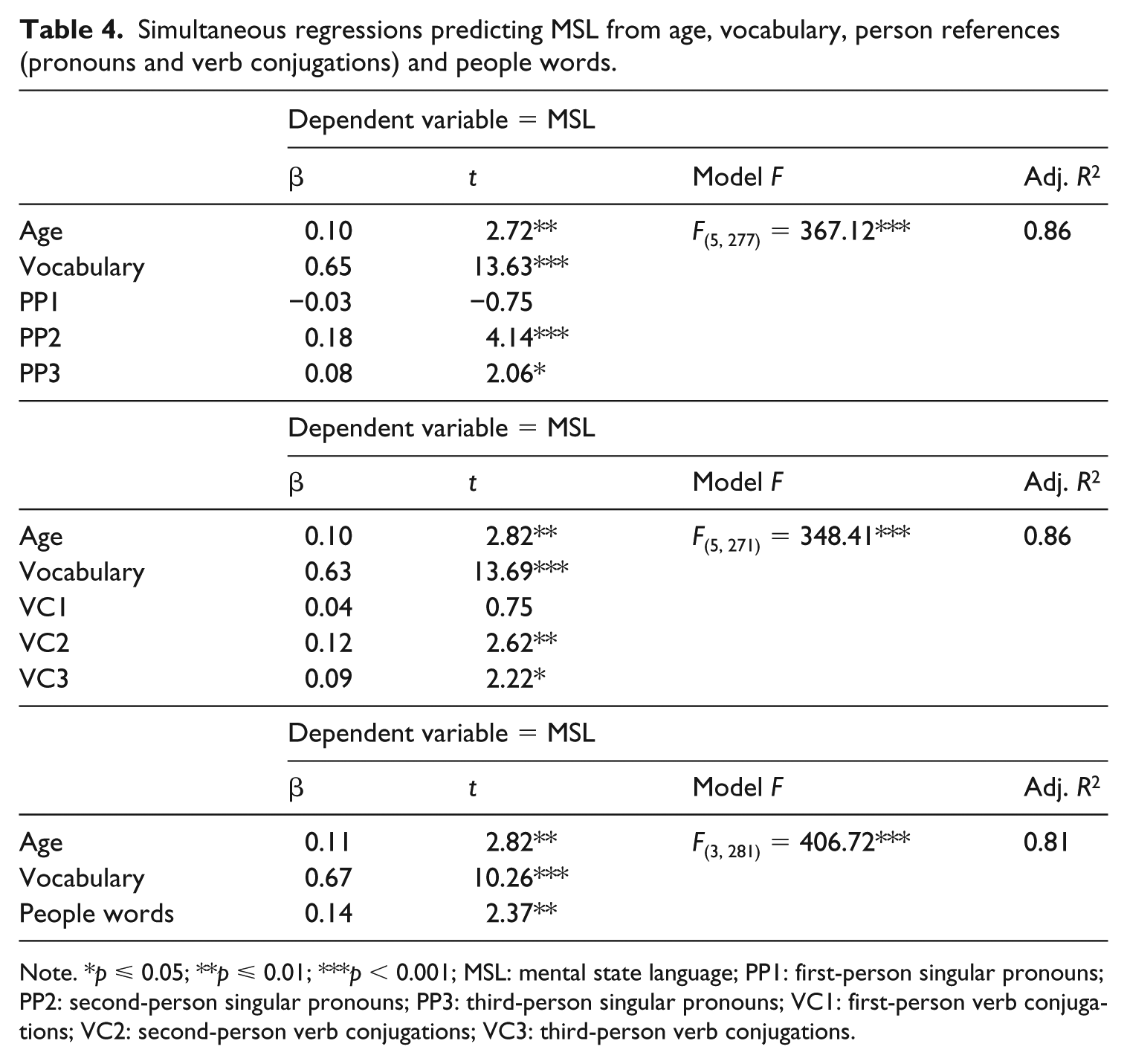
Note. *p ⩽ 0.05; **p ⩽ 0.01; ***p < 0.001; MSL: mental state language; PP1: first-person singular pronouns; PP2: second-person singular pronouns; PP3: third-person singular pronouns; VC1: first-person verb conjugations; VC2: second-person verb conjugations; VC3: third-person verb conjugations.
As expected, the production of people words significantly predicted the use of MSL, above and beyond the effects due to age and vocabulary – a result which reinforces the idea that this verbal measure taps the social aspects of language competence (Longobardi et al., 2016).
Discussion
The present cross-sectional study investigated the concurrent relations between four different indices of social knowledge (MSL, personal pronouns, verb conjugations and people words) in a relatively large sample of children between 18 and 36 months of age. Several interesting results were obtained. First, the production of all indices showed significant increases across age, suggesting that during this period the linguistic markers of children’s ability to distinguish between self and others and to understand that people have independent mental states undergo a rapid improvement. Second, MSL was positively associated to and predicted the use of both personal pronouns and verb conjugations, confirming that the difficulty in the acquisition of person-marking devices is partly due to social constraints. Third, both second- and third-person pronouns and verbs conjugations (but not first-person) predicted the acquisition of MSL, above and beyond the effects due to age and vocabulary. Fourth, people words showed bidirectional associations with MSL, further supporting the idea that the frequency of this category might be considered as an early verbal indicator of children’s social knowledge.
As concerns the development of MSL, our findings are generally consistent with those reported in many previous studies suggesting that genuine references to internal mental states begin to appear in children’s naturally occurring speech by about 2 years of age and increase substantially over the next few months (Bartsch & Wellman, 1995; Bretherton & Beeghly, 1982; Brown & Dunn, 1991; Shatz et al., 1983). In agreement, in our database, the percentage of children who did not produce mental state terms was relatively high in the 18–23 month group (31.4%) but decreased rapidly in the 24–29 month group (6.3%); in the 30–36 month group, all children produced at least 3 mental state terms and 50% of them produced between 36 and 47 terms. Similar observations can be done with respect to the developmental progression in the acquisition of personal pronouns. As stated above, these closed-class words are almost absent in the one-word stage, beginning to appear at about 18–20 months (Bates, 1990). In the current sample, the percentage of children who produced all three types of personal pronouns (subject, object and possessive) was low in the 18–23 month group (7% for the first-person, 4% for the second-person and 1% for the third-person), but increased substantially in the 30–36 month group (67% for the first-person, 54% for the second-person and 52% for the third-person). Interestingly, in the latter group, production of all verb conjugations was quite common, ranging from 72% for the third-person to 89% for the first-person. These rates are consistent with the idea that, in pro-drop languages like Italian, children must learn the system of verb inflections as early as possible if they want to understand the relations between speakers and referents (Bates, 1990).
The regression analyses showed that MSL predicted the use of both personal pronouns and verb conjugations. This result accords with a growing body of research indicating that the production of personal pronouns relates to the socio-cognitive development of children (Brownell et al., 2006; Lewis & Ramsay, 2004; Loveland, 1984). For example, Ricard et al. (1999) reported that competence at coordinating two visual perspectives paved the way for the full mastery of first- and second-person pronouns. Thus, the ability to differentiate between one’s own and others’ points of view represents an important precondition of pronoun use. Notably, the only exception to this pattern was that MSL did not predict the use of first-person pronouns. The weaker link between MSL and first-person pronouns provides empirical support to the idea that the use of first-person references may be more ambiguous than the use of second- and third-person references, because it does not necessarily refer to mental states (Brandt et al., 2016). In fact, previous research has clearly demonstrated that first-person complements are often employed by children as epistemic parentheticals, to alert the listener about the relative certainty of a proposition (i.e. phrases like ‘I think’ are often produced to signify ‘maybe’; Diessel & Tomasello, 2001).
Considering the opposite direction, our second set of regression analyses confirmed that both personal pronouns and verb conjugations significantly predicted the reported use of MSL, above and beyond the contribution of age and vocabulary. Critically, only second- and third-person references explained a significant portion of variance in the regression models predicting MSL, whereas first-person references had no independent role. Thus, for Italian-speaking children (like for Czech-speaking children: Markova & Smolík, 2014), the relation between first-person references and MSL was completely accounted for by the simultaneous use of second- and third-person references. On the one hand, this result confirms the hypothesis, advanced by Markova and Smolík (2014), that the production of second-person references (and, by extension, of third-person references) has a privileged association to the acquisition of MSL, because it requires children to have a model of the addressee’s mental states – in addition to the model of one’s own mental states required by the production of first-person references. On the other hand, this conclusion is consistent with the claim that the full comprehension of the referential meanings of first-, second- and third-person pronouns requires that they be recognized as being mutually exclusive (Girouard, Ricard, & Décarie, 1997). In this view, a complete understanding of first-person pronouns requires children to appreciate the fact that only first-person pronouns can be used to refer to the speaker, whereas second- and third-person pronouns cannot be used for the same purpose. Likewise, a complete understanding of second- and third-person pronouns requires children to acknowledge the fact that only second-person pronouns (but not first- and third-person pronouns) can be used to refer to the addressee and that only third-person pronouns (but not first- and second-person pronouns) can be used to refer to a non-addressee. Once the exclusive roles of all three pronouns have been understood, their comprehension and production will be largely simultaneous (Girouard et al., 1997).
Working from different perspectives, other authors have similarly argued that self- and other-awareness are closely linked because both involve a cognitive capacity for secondary representation (Asendorpf & Baudonnière, 1993). In this respect, Lewis and Ramsay (2004) reported that 15- to 21-month-old children showing self-recognition in a mirror exhibited a mixture of self- and other-directed pretend play, as opposed to the exclusively self-directed play exhibited by children showing no self-recognition. Importantly, the two groups also differed in the production of first-person pronouns (me, my, mine, I’m, I can’t, etc.), which was higher in self-recognizer than in non-self-recognizer children. This finding indicates that self-recognition marks the emergence of a broader ability of meta-representation which allows children to distinguish between self and others and, therefore, to master not only the use of first-person references, but also the use of second- and third-person references (Smiley, Chang, & Allhoff, 2011).
Besides first- and second-person references, the regression analyses also revealed a significant contribution of third-person references (both pronouns and verb conjugations) and people words to the prediction of MSL. Although the potential impact of third-person pronouns has been less widely investigated in the literature, evidence for a link with social engagement has been reported by Hobson et al. (2010), who found that children with autism were significantly less likely to use third-person pronouns or to show patterns of eye gaze reflecting communicative engagement with a third person. Regarding verb conjugations, to our knowledge, no study to date has specifically examined the potential associations between children’s production of third-person verbs and their performance in tasks requiring self- and other-awareness (e.g. pretend play, perspective taking tasks, imitation tasks) during the second and third years of life, although Brandt et al. (2016) found the performance of 4-year-old children in false-belief tasks to be significantly and positively related to their understanding of complement-clause constructions having third-person subjects. In this direction, it seems interesting to remark the fact that both the present and previous data indicate that Italian-speaking children show full command of third-person singular verbs in present tense quite early, likely because it represents the most neutral or unmarked form (Leonard et al., 2002; Pizzuto & Caselli, 1992). Leonard et al. (2002), for instance, reported that, for children between 29 and 37 months, the mean percentage of correct production of third-person singular forms in obligatory contexts was about 98% – as compared with only 85% for first-person singular forms. Furthermore, first-person singular forms were more likely to be replaced by third-person singular forms than the reverse. Thus, it appears that, at least in Italian, third-person singular verbs enjoy a special status which could be partly responsible for the present results.
Lastly, our data confirm previous evidence suggesting that the use of people words can specifically tap the verbal aspects of social knowledge (Longobardi et al., 2016). In agreement, Chromá and Smolík (2017) have recently reported that the production of nominal person references (i.e. nouns and person names like Annie, aunt, etc.) in children ranging from 28 to 32 months was significantly predicted by an aggregated socio-cognitive measure reflecting their performance in intention-understanding, pretend play and visual-perspective tasks. These authors concluded that nominal references required similar levels of social knowledge as pronominal references. More generally, both the present results and those illustrated by Chromá and Smolík (2017) suggest that the social aspect involved in the mastery of pronouns and verb conjugations is the very general fact that they refer to persons and require a clear differentiation between self and others.
In summary, the present study confirmed and extended previous research showing that MSL has bidirectional relations with the use of personal pronouns, verb conjugations and people words (Longobardi et al., 2016; Markova & Smolík, 2014). As is the case for most investigations, these conclusions should be evaluated against a number of limitations. The first limitation concerns the nature of the study, which was cross-sectional rather than longitudinal. This implies that we cannot draw strong conclusions about the causal relations linking person references to MSL. The second relevant limitation is that all the measures obtained in the present study, including the MSL estimates, were taken from the Italian version of the MCDI. Besides resulting in high levels of collinearity in the regression analyses, the use of parent-report measures has a series of methodological limitations that constrain the nature of the conclusions that can be reasonably drawn. As already noted by Dale, Bates, Reznick, and Morisset (1989) and Bates, Bretherton, and Snyder (1988), these instruments are mostly valuable for a rapid overall evaluation of child language for clinical or research purposes. However, they are considerably less adequate when specific structural and contextual factors can influence children’s language performance (Dale et al., 1989). To quote Bates et al. (1988): ‘parent report is more likely to reflect what the children knows, whereas free speech reflects those forms that she is more likely to use’ (see also Caselli et al., 1999). We have previously noted that personal pronouns are closed-class words that have a context-dependent nature (i.e. their referents can easily shift, depending on the relationship between the speaker and the hearer; Bates, 1990). As such, the analyses based on parent reports might be unable to provide accurate details about the use of first- and second-person references, and a full assessment of the way in which they are employed by children in day-to-day interactions might necessarily require more structured assessments. Among other things, this problem did not allow us to determine whether the MSL terms produced by our children referred to their own or to others’ mental states (Markova and Smolík, 2014), or whether the use of first-person pronouns was more ambiguous and less genuinely referred to mental states – as compared to the use of second- and third-person pronouns (Brandt et al., 2016). In addition, while there has been general agreement on the notion that parents have far more experience with their children than any other external observer and can therefore provide a more comprehensive picture of their expressive language, it is nonetheless true that the lack of specialized training and a natural pride can result in substantial bias (Dale et al., 1989). Given these problems, future studies should try to determine whether the present results replicate when using objective measures drawn from spontaneous-speech tasks (see Chromá & Smolík, 2017). Even with these considerations in mind, we believe that, by using a relatively large sample of participants and by focusing on the use of MSL and person-marking references, the present research provides useful evidence to understand the relations between multiple verbal indices of social understanding in a morphologically rich language like Italian.
