



Abstract
Closely related Swedish and German both mark information status of referents morphologically, though little is known about its acquisition. This study investigates character introductions in the narratives of 4- and 6-year-old Swedish–German bilinguals (N = 40) in both languages, elicited with MAIN Cat/Dog. We analyse effects of age group, language and animacy (human vs nonhuman characters) on the type of referring expression (indefinite NP and pronoun), as well as effects of language proficiency and exposure on the use of indefinite NPs for each language. We also explore which syntactic constructions indefinite NPs occur in. A significant difference was found between the two age groups, but not between languages. No effect was found of language skills or exposure. Four-year-olds used more pronouns and a lower proportion of indefinite NPs than 6-year-olds. Pronouns were more frequent for the human character than for nonhuman animate characters. Whilst animacy (humanness) promoted the use of pronouns, it did not affect the choice of morphological form for lexical NPs (indefinite/definite). The age groups differed in how indefinite NPs were used. Four-year-olds produced fewer narrative presentations (where a character is introduced as part of a typical story opening, e.g. Once upon a time there was
Introduction
When narrating a story for a listener who is unfamiliar with the plot and/or the story characters, it is important to introduce referents in a comprehensible and appropriate manner. Learning how to do this is not a simple task. The speaker needs to judge whether the referent is currently known to the listener (Ariel, 1990; Arnold, 2008; Gundel, 2010; Gundel et al., 1993) and adjust the referential form to the listener’s knowledge state.
In order to acquire the referential system of a language, children need to understand that certain forms, e.g. indefinite noun phrases (NPs), are used to refer to objects and persons that are new to the listener, whereas other forms, e.g. definite NPs and pronouns, are used for referents that have already been mentioned in the discourse (Gundel & Johnson, 2013). In addition to having developed sufficient Theory of Mind (ToM) skills (Astington & Pelletier, 2005; Tomasello, 2003), the child needs to have acquired the linguistic (lexical, syntactic and morphological) means to use the forms appropriately. Perspective-taking is thus not only a pragmatic ability, but also requires a certain level of language skills. There are indications that perspective-taking requires additional executive function skills, e.g. in order to be able to inhibit one’s own perspective (Serratrice & De Cat, 2020; see also the review in De Cat, 2015). The type of interaction or context influences how cognitively demanding it is to produce referring expressions. This level of cognitive load in turn influences the child’s performance (see the overview in Serratrice & Allen, 2015). Adequate reference in narrative discourse also requires relatively high processing capacities, including a well-developed capacity to update working memory (Whitely & Colozzo, 2013). In sum, learning how to introduce referents appropriately is clearly a complex process. 1 Additionally, in experimental tasks such as the picture-based narrative task used in the present study, the child needs to be able to carry out the given task, which requires both the linguistic means to tell the story and attentional resources (see the overview in De Cat, 2015). The task may be especially challenging for bilinguals, who need to develop the ability to introduce referents appropriately in both their languages. In this article, we analyse introductions of story characters in oral narratives elicited in both languages from 40 Swedish–German bilinguals aged 4 and 6, a hitherto understudied group. 2
This article proceeds as follows. In the next section, findings from earlier studies of referent introduction in mono- and bilingual children are summarized, and the Swedish and German referential systems are described. The third section states the aim, research questions, and predictions. The fourth section deals with the methodology and the fifth reports the results. The final section contains a discussion and conclusion.
Background
Referent introduction in monolingual children
A relatively large number of studies have investigated how monolingual children develop the ability to correctly introduce referents, i.e. first mentions of referents. Although many studies deal with English, a number of other languages have also been studied. However, little is known about Swedish-speaking children’s referent introductions and when they learn to introduce referents appropriately in narrative discourse; only one study of referent introductions in a larger group of Swedish monolingual children has been published (Lindgren, 2018b). 3
Findings from elicited narratives in monolinguals are not fully conclusive as to the age when children are able to introduce referents appropriately. Some studies report low proportions of so-called ego-centric definiteness errors, i.e. illicit use of pronouns and definite NPs, and predominant use of appropriate indefinite expressions to introduce a referent that is unknown to the listener already at age 2–4 (De Cat, 2013; Emslie & Stevenson, 1981). Other studies indicate that the ability to introduce characters appropriately develops much later and may not be fully developed until age 9 (e.g. Hickmann et al., 1996; Kail & Hickmann, 1992; Kail & Sanchez y Lopez, 1997; Serratrice, 2007; Warden, 1976), or is at least not acquired before age 7 (Karmiloff-Smith, 1981; Küntay, 2002; Schneider & Hayward, 2010; Wong & Johnston, 2004). These contradictory results may be linked to differences in methodology, for example whether there was shared visual attention between child and (adult) listener (Kail & Hickmann, 1992), and/or differences in stimulus material (Lindgren, 2018b). To give an example, in a study of 6-, 9- and 11-year-old French monolinguals, Kail and Hickmann (1992) compared the children’s performance when the experimenter could see the pictures and when the experimenter was blindfolded. They found that while the 6-year-olds produced both indefinite and definite NPs irrespective of condition, the 9-year-olds used more indefinite NPs to introduce story characters when the experimenter was blindfolded, and the 11-year-olds used indefinite NPs in both conditions.
Aspects such as plot complexity, number and types of characters, and how easily characters are distinguishable from each other have also been shown to affect the child’s ability to appropriately introduce referents (e.g. Aksu-Koç & Nicolopoulou, 2015; Colozzo & Whitely, 2014; De Cat, 2013; Hickmann et al., 1996; Kail & Hickmann, 1992; McGann & Schwartz, 1988; Wigglesworth, 1990; Wong & Johnston, 2004). To give an example, in a study of picture-based elicited narratives, children produced more indefinite NPs when they told a story with two main characters, compared to a story with one main and one secondary character (Aksu-Koç & Nicolopoulou, 2015). In a study of Spanish-speaking children, Kail and Sanchez y Lopez (1997) found that secondary characters were predominantly introduced with indefinites by all age groups, whereas main characters were not. Animacy, and more specifically humanness, is also a factor that influences children’s use of referring expressions (e.g. Kail & Hickmann, 1992; Lindgren & Vogels, 2018; see also the overview in Hickmann et al., 2015). Kail and Hickmann (1992) found that the children used more pronouns to introduce the boy than the other, nonhuman, characters in Frog Story narratives. In a recent study of anaphoric reference in Swedish monolingual children aged 4–6 using the same stimulus material as in the present study, Lindgren and Vogels (2018) found that animacy significantly influenced the children’s use of pronouns: more pronouns were used for human referents than for nonhuman animates and inanimate referents. The type of story character, including whether it is human or not, thus seems to influence which types of referring expressions children use to refer to them. However, this issue has not yet been investigated for Swedish-speaking children’s referent introductions.
There are also some indications that the age at which children are able to introduce characters appropriately may differ between languages (e.g. Aksu-Koç & Nicolopoulou, 2015 for English, Greek and Turkish; Hickmann et al., 1996 for Mandarin Chinese, English, French and German). However, it remains unclear exactly which effect language structure has on the development of the ability to introduce referents appropriately in narrative discourse.
In a recent study of 72 Swedish monolinguals aged 4;0–6;10, Lindgren (2018b) analysed character introductions in narratives elicited with Cat/Dog from the Multilingual Assessment Instrument for Narratives (MAIN; Gagarina et al., 2012, 2015), the same material as in the present study, and A2/B2 from the Edmonton Narrative Norms Instrument (ENNI; Schneider et al., 2005). Both stimulus materials contained the same number of story characters, but the children performed significantly better in narratives elicited with MAIN than with ENNI. Moreover, Lindgren (2018b) found significant age effects. When introducing story characters, Swedish 6-year-olds produced a higher percentage of fully appropriate indefinite NPs than 5-year-olds, who in turn performed better than 4-year-olds. In narratives elicited with MAIN Cat/Dog, the Swedish monolingual 6-year-olds (M = 6;5) introduced around 90% of the characters with (fully appropriate) indefinite NPs; the corresponding figure for the 4-year-olds (M = 4;5) was 40%.
Referent introduction in bilingual children
Compared to monolinguals, far fewer studies have been carried out on bilingual children’s referent introductions. Results are not fully conclusive as to when the ability to introduce characters appropriately develops in bilinguals and whether and how bilinguals differ from monolinguals. Few studies of referent introductions in bilinguals have investigated development with age. Moreover, little is known about reference in Swedish-speaking bilinguals. To our knowledge, the only earlier study is an unpublished MA thesis by Finnstedt (2013). Finnstedt analysed referent introduction and maintenance in narratives of 6- to 7-year-old Swedish–English bilinguals in both languages and in age-matched Swedish monolinguals. The narratives were elicited with the Baby Birds and Baby Goats from MAIN. The Swedish–English bilinguals performed similarly in their two languages, and Finnstedt found no difference between Swedish monolinguals and Swedish–English bilinguals, with 75–78% appropriate referent introductions for both groups. Finnstedt’s (2013) results suggest that bilingual children perform similarly to monolingual children in referent introduction. In a related vein, Serratrice (2007) found that Italian–English children aged 6;11–9;11 performed similarly to monolinguals in both languages for referent introduction, reintroduction and maintenance in Frog stories.
However, there are also a number of studies that show that bilinguals may develop differently from monolinguals in one or both languages with respect to referent introduction, or that they do not perform equally well in both languages (Álvarez, 2003; Chen & Lei, 2013; Chen & Pan, 2009; Jia & Paradis, 2015; Reichardt, 2014). For example, Chen and Lei (2013) found that 9-year-old Chinese–English bilinguals living in the US produced lower proportions of indefinite NPs to introduce characters in their English narratives than English monolinguals but performed comparably to monolinguals in Chinese. In contrast, Jia and Paradis (2015) found that Chinese–English bilinguals aged 6;9–10;10 growing up in Canada used fewer appropriate referring expressions than Chinese monolinguals when introducing characters and objects in narratives.
In a study of Russian–German bilinguals aged 4;0–6;11, Topaj (2010) found that the children only produced 35% indefinite NPs in German for what the author called ‘new referents’ (i.e. referent introduction). This is markedly lower than the 50% and 65% indefinites produced by German monolinguals (4- to 5-year-olds and 7-year-olds, respectively) in the study by Hickmann et al. (1996). Topaj’s results thus suggest that German–Russian bilinguals master the use of indefinite NPs later than German monolinguals do. Similar results were obtained in an unpublished study by Reichardt (2014), where 4- and 7-year-old Russian–German bilinguals only rarely used indefinite NPs to introduce characters in German, whilst 9-year-old bilinguals performed similarly to the German monolingual 7-year-olds in Hickmann et al. (1996).
Why do some studies find that bilingual children perform on a par with monolinguals concerning appropriate referent introduction in narratives, whilst other studies do not? One possible explanation is that bilinguals differ from monolinguals when the languages have different types of referential systems, such as English and Chinese (Chen & Lei, 2013; Chen & Pan, 2009; Jia & Paradis, 2015) or Russian and German (Reichardt, 2014; Topaj, 2010), but that bilinguals speaking languages with similar referential systems, e.g. English and Italian (Serratrice, 2007) or Swedish and English (Finnstedt, 2013), may perform similarly to monolingual age peers.
However, even when the languages have similar referential systems, bilinguals may show differential performance. In their study of 8- to 12-year-old German–Greek bilinguals, Andreou et al. (2015) found differences between bilinguals and Greek monolinguals in Greek, but not in German. In German, both bilinguals living in Germany and those living in Greece performed similarly to monolinguals. However, in Greek, bilinguals living in Germany produced substantially fewer indefinite NPs than bilinguals living in Greece and monolinguals. As the referential systems of Greek and German are similar, the authors point to the importance of input in explaining their findings: less exposure to a language may slow down the process of learning how to introduce characters appropriately (see also Jia & Paradis, 2015). However, it remains unclear in Andreou et al. (2015) why Greek was affected to a larger extent than German.
Taken together, the results from earlier studies indicate that bilinguals’ performance concerning referent introduction may be influenced by several factors in addition to age, such as the language combination, language skills and the amount of exposure to the two languages. Studying character introductions in Swedish–German children, who acquire two closely related languages with comparable (in)definiteness-marking systems, can provide further insights as to how language proficiency, language exposure and age affect the ability to introduce characters in narratives, while controlling for effects of the referential systems.
The Swedish and German referential systems
The systems for appropriate referent introduction in Swedish and German are similar. Both languages mark (in)definiteness morphologically, and there are clear discourse-pragmatic rules for the use of the different forms (e.g. Helbig & Buscha, 2001; Teleman et al., 1999, p. 269ff.). Swedish and German employ morphological forms to mark the information status of the referent (e.g. the Givenness Hierarchy: Gundel et al., 1993; see also Ariel, 1990; Givón, 1983). An overview of the German and Swedish forms of reference, with a comparison to English, is given in Table 1.
The Swedish and German referential systems compared to English (nominative case singular only).
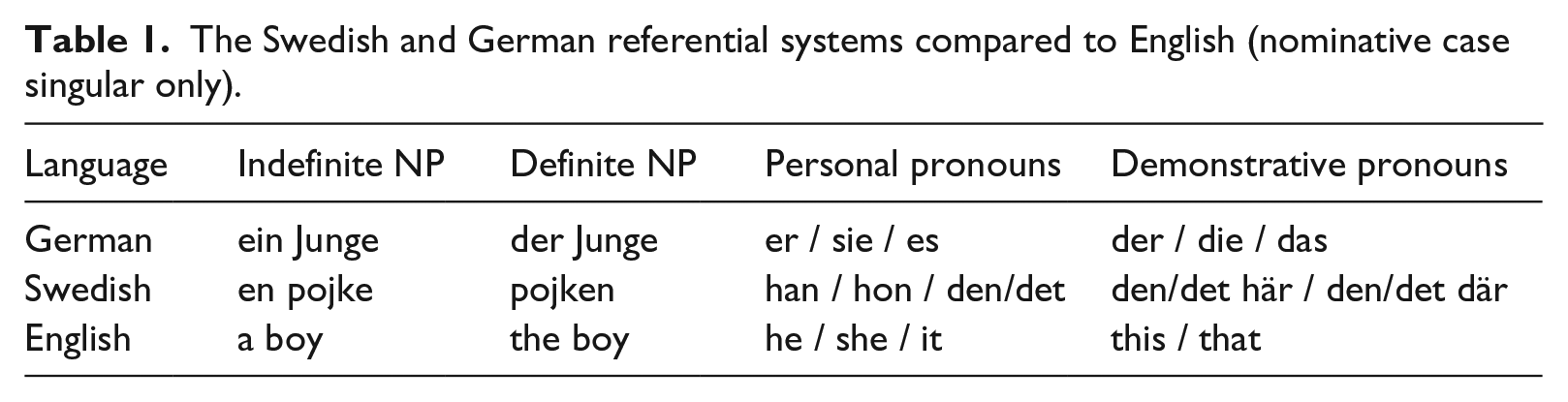
When there is no shared knowledge or joint visual attention between speaker and listener, an indefinite NP should be used to introduce a new referent appropriately in both Swedish and German (see Helbig & Buscha, 2001; Teleman et al., 1999, p. 169ff.). In both languages, just as in English, this is done with an indefinite article preceding the noun. In both languages, definite NPs give the listener enough lexical information to understand who the story is about, but signal that the referent is already known to the listener (Gundel et al., 1993). If a pronoun is used to introduce a character (e.g. Ger. er ‘he’), it will be next to impossible for the listener to know who the character is.
There are two main differences between Swedish and German concerning referential marking. First, the Swedish definiteness marker is a suffix, whereas the German one is a free-standing article. Second, German articles are inflected for both case (nominative, accusative, dative, genitive) and grammatical gender (masculine, feminine, neuter), whereas the Swedish articles only have grammatical gender inflections (common and neuter).
In Swedish, the definite suffixes are acquired earlier than the free-standing indefinite articles, but both types of markers are found in children’s spontaneous speech around or even before age 2 (Bohnacker, 1997, 2003, 2007; Kupisch et al., 2009). German (in)definiteness markers have been found to be acquired at a similar age as the Swedish ones or slightly later (age 2–3) (Clahsen et al., 1994; Eisenbeiss, 2000, 2002; Kupisch et al., 2009). Swedish–German bilinguals might therefore also be expected to acquire the morphological markers well before age 4. However, the fact that such markers are used by the child does not mean they are employed correctly to mark different information statuses in all contexts and discourse types. Whether Swedish–German bilinguals’ ability to use these markers correctly to introduce story characters is influenced only by age or also by language proficiency and exposure remains open and is investigated in the present study.
Pronouns and indefinite NPs, the least and most appropriate types of referring expressions for introducing new referents, form the extreme ends of the Givenness Hierarchy (Gundel et al., 1993) in both Swedish and German. This makes pronouns and indefinite NPs the most interesting types of referring expressions to analyse, and they will therefore be focused on in this article.
Syntactic constructions for referent introduction
In addition to the appropriateness of the morphological form (e.g. indefinite NPs should be used for first mentions), the type of syntactic constructions in which indefinite NPs occur to introduce story characters may affect how appropriately these NPs are as referent introductions. This topic has not been investigated in depth in children’s narratives; to our knowledge, there are no studies of larger groups of bilinguals.
In early (bilingual) language acquisition research, indefinite NPs in predicative constructions or labellings/namings (where the indefinite NP occurs in the predicative position of a copula construction) have been contrasted with indefinite NPs in argumentative constructions, where the indefinite NP is either the subject or the object of an (in)transitive clause (e.g. Kupisch, 2006, pp. 146–156; Serratrice, 2000). In (1) and (2), constructed examples of the predicative and argumentative construction are given (introduced referents in bold).
(1) That’s (2) a. b. The cat tries to catch
Serratrice (2000) found that the earliest indefinite NPs by Carlo, an Italian–English bilingual child, were all produced in predicative constructions. These were used mainly for labelling objects. Only later (age 2;3 for Italian, age 2;9 for English) did indefinite NPs start to appear in the argumentative position (Serratrice, 2000, p. 162). Similar results were obtained for the Italian–German and French–German children who were followed from age 1;6 to 3;0 in Kupisch (2006), as well as in Brown’s (1973) classic study of the English-speaking children Adam, Eve and Sarah: indefinite NPs appeared first in the naming function. These studies investigated all kinds of spontaneous speech by the children, and not the narrative genre specifically. When the first mention of a referent is made in the form of naming, this suggests that the child simply identifies the object as a member of a class, categorizing it according to type, rather than introducing it as part of a narrative sequence. Indeed, a number of researchers (e.g. Kupisch, 2006; Maratsos, 1976; Serratrice, 2000; Thomas, 1989) argue that indefinite NPs in the naming function are not referential at all. 4 Indefinite NPs in predicative constructions used for labelling/naming are thus seen as less appropriate than argumentative structures, and it can be questioned whether namings are true referent introductions. In addition to these studies of children’s spontaneous speech, early studies of children’s elicited productions (e.g. Karmiloff-Smith, 1979, p. 216; Warden, 1976) have also found labelling or naming to be the initial function of young children’s indefinite NPs.
The labelling construction has two subtypes: (i) a free-standing indefinite NP without any clause (‘NP only’), where predication functions via extra-linguistic means (typically via pointing, i.e. a deictic gesture) as in (3), and (ii) an indefinite NP inside a predicative clausal construction as in (4) and (5). 5 The predicative clausal construction consists of a deictic locative expression such as Swe. där/Ger. da ‘there’ or a deictic or expletive subject (Swe. det/Ger. es/das ‘it/that’), a form of the copula be (Swe. vara, Ger. sein), and an indefinite NP, as illustrated in (4) and (5), respectively.
(3) ‘A dog.’ (4) das ist ‘That is a cat.’ (5) där är det ‘There is EXPLETIVE a cat and a bush.’
In cases of ‘NP only’ (i), the predicative relationship is established via extra-linguistic means, such as a deictic gesture (pointing) towards the object. By contrast, in the predicative clausal construction (ii), there is a predicative relation between an overt deictic element (där/da ‘there’ or det/das ‘that’), which is referential, and the predicative NP, which is not (Kupisch, 2006, pp. 146–148). In the context of shared visual attention, gestures and/or linguistic deictic expressions thus establish a link to the referent. However, in contexts of non-shared visual attention, such as the story-telling task used in the current study, neither type of deixis is helpful for the listener. Even though the clausal predication is a more complex construction than an isolated indefinite NP, both have the same function, namely to point out or state the existence of the object, and may both be similarly infelicitous in a context of non-shared visual attention.
In an argumentative construction, the character is introduced either as the subject, as in (6), or as the object, as in (7), in any type of intransitive or transitive clause.
(6) dann kommt ‘Then a small boy comes.’ (7) katten fångar ‘The cat catches a butterfly.’
In addition to labellings and argumentative constructions, which are not genre-specific, there is also one type of presentational construction that is typical for the narrative genre. Cases of narrative presentation start with a typical narrative opening phrase, e.g. the Swedish and German equivalents of once upon a time, or a phrase with a similar function, such as one day. Examples of narrative presentations are given in (8) and (9). Such narrative presentations are appropriate genre-specific expressions.
(8) es war einmal it was once a cat ‘Once upon a time there was a cat.’ (9) det var en gång it was one time a dog ‘Once upon a time there was a dog.’
Introductions in the form of indefinite NPs can thus have different levels of ‘quality’: they can function purely as an identification of the referent, which may not even, strictly speaking, be a true referent introduction in a narrative context (Kupisch, 2006, p. 147), or they can be part of a conscious narration strategy. Investigations of children’s referent introductions should therefore look more closely at these qualitative differences in the use of indefinite NPs. The present study is the first to investigate the constructions used to introduce referents in Swedish-speaking children.
Aim, research questions and predictions
The aim of the present study is to investigate character introductions in Swedish–German bilinguals, a previously understudied group. The following research questions are asked:
Is there a difference between 4-year-old and 6-year-old Swedish–German bilinguals’ use of referring expressions for introducing story characters?
Do the children perform differently in their two languages?
Are there differences between different types of characters (human vs nonhuman animates)?
How does the children’s language exposure and proficiency influence their use of referring expressions in the two languages?
In which constructions are indefinite NPs used? Can different patterns with respect to the constructions used be observed for the age groups and/or for the two languages?
Based on the existing literature, we predict differences in the use of referring expressions for introducing characters between the age groups, similarly to what has been found for e.g. monolingual Swedish-speaking children (Lindgren, 2018b), but not between the languages, as the referential systems are comparable (Finnstedt, 2013; Serratrice, 2007), and that animacy (humanness) will influence the proportion of pronouns used to introduce characters (Kail & Hickmann, 1992; Lindgren & Vogels, 2018). We also expect the children’s language exposure and proficiency to influence their performance (Andreou et al., 2015; Jia & Paradis, 2015), and potentially more so for the minority language German, to which the children are exposed somewhat less (see below). Finally, we expect the use of different types of indefinite NP constructions to be linked to age, but not to language, as the languages have comparable syntactic constructions for referent introduction.
Method
Participants
Forty Swedish–German bilingual children participated in the study, divided into two groups with 20 participants each: a younger group (aged 4;0–5;3), hereafter 4-year-olds, and an older group (aged 5;8–6;11), hereafter 6-year-olds. Parents signed a consent form and filled in a detailed questionnaire, with questions about the child’s language development in both languages, family language use, and parents’ language competencies, education and occupation. Table 2 gives an overview of the two age groups.
Participants.
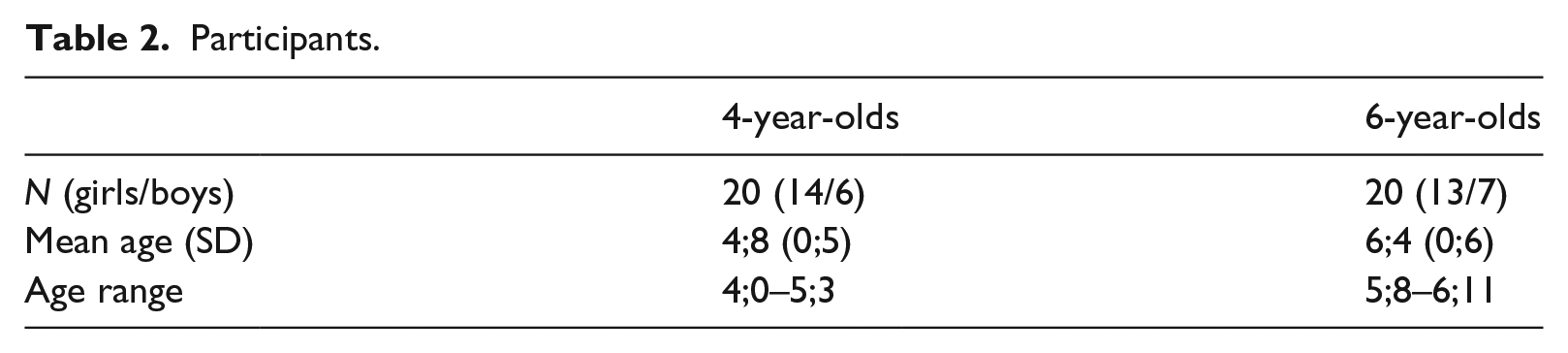
All children were growing up in Sweden, more specifically in the greater Stockholm area, and the majority (75%) had lived in Sweden since birth. They all came from mid to high SES backgrounds, which is typical for this population. No child had been diagnosed with language impairment. Close to half of the children (18/40) had two parents who were native German speakers, or in the case of two children, one German native speaker and one parent who was a native speaker of another language. The other children had one Swedish and one German native speaker parent. All children had received input in German continuously from birth. Most children (70%, 28 children) had been regularly exposed to Swedish before age 1;0. Only three children (7.5%), all 6-year-olds, had started receiving Swedish input after age 2;0.
According to the parental questionnaire, all children received regular input in both languages, and used both languages on a daily basis. Thirteen children (seven 4-year-olds, six 6-year-olds) attended a bilingual Swedish–German preschool or school; the others attended Swedish-medium (pre)schools. Parents were asked to indicate their child’s estimated relative daily input in the two languages on a scale ranging from 95% German/5% Swedish to 5% German/95% Swedish (answering the question ‘How often does your child hear the two languages in their daily life?’); parents could also write down additional comments concerning the input distribution. The parents of 24 children (60%, 13 4-year-olds, 11 6-year-olds) reported that the child received at least 40% daily input in each of the languages; 14 children (35%, seven 4-year-olds, seven 6-year-olds) received 80% or more daily input in Swedish. The remaining two children (and one child with 80% Swedish input) were also exposed to a third language. 6 No child was reported to receive above 60% daily input in German. The children were thus generally reported to receive more daily input in Swedish than in German.
The majority of the parents stated that the child could understand and speak both languages well or very well. Most parents (85%) rated their child’s Swedish language skills higher than or equal to his/her German; only six children (15%, four 4-year-olds, two 6-year-olds) were thought to have German as their stronger language. There are thus indications that the children have a somewhat higher proficiency in Swedish than in German.
Note that there are no differences between the 4-year-olds and the 6-year-olds in terms of these background factors. For more details about the participants, see Lindgren (2018a, Chapter 3).
Materials
Oral narratives were elicited with the picture sequences Cat and Dog from the Multilingual Assessment Instrument for Narratives (MAIN; Gagarina et al., 2012, 2015, 2019), a narrative instrument developed for children aged 4–10. Cat and Dog consist of six coloured pictures each. Both stories contain three characters: two animate, nonhuman characters, a cat/dog and a butterfly/mouse, and one human character, a boy, as shown in Figure 1. The stories thus require the same number of character introductions. In addition, they have identical episodic structures, making them comparable in all respects.
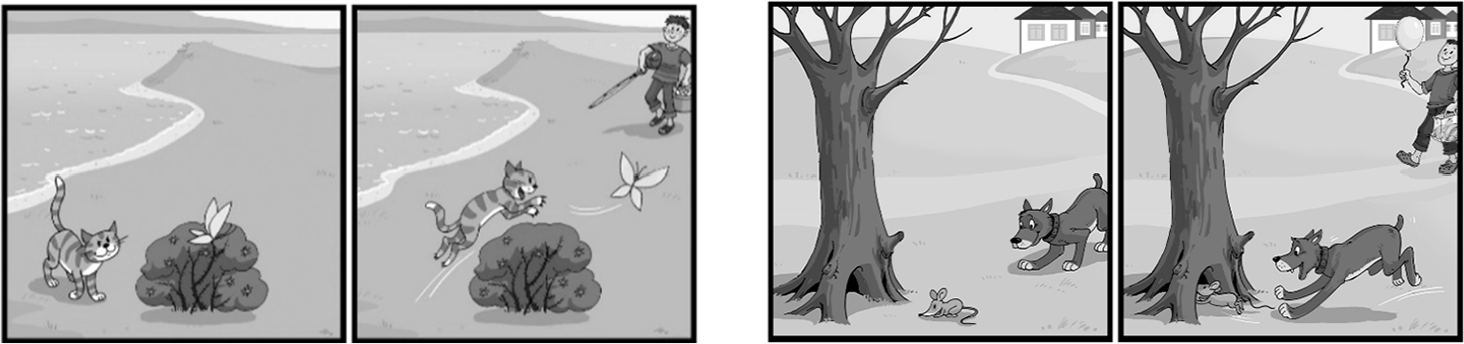
Small-scale black-and-white copies of pictures 1 and 2 from Cat (left) and Dog (right), Multilingual Assessment Instrument for Narratives.
As a (independent) measure of the children’s language proficiency, the Swedish and German versions of the Cross-linguistic Lexical Tasks (LITMUS-CLT, hereafter CLT; Haman et al., 2015) were administered. The CLTs have been developed for preschool children and are the only comparable vocabulary tasks that exist for Swedish and German. The CLT production parts consist of picture naming tasks in which the experimenter asks the child to name an object (‘What is this?’ for noun production) or action (‘What is she doing?’ for verb production). The maximum score in each language is 60 points.
Procedure
Each child was tested once in each language on different days with different native-speaker experimenters, who did not let on that they understood the other language. All children were tested in Swedish by the first author (a native speaker of Swedish) and in German by either the second or the last author (both native speakers of German). The average time between sessions was 8 days. In addition to MAIN Cat/Dog, each session contained two further narrative tasks as well as the vocabulary test CLT (for descriptions of the other narrative tasks, see Lindgren, 2018a, Chapter 3). The children told the Cat/Dog first (story generation [telling], not retelling). This narrative task was preceded by a short warm-up phase, in which the experimenter asked the child some general questions and/or chatted about everyday topics.
The order of the languages and the stories was counterbalanced. Half of the children were tested in Swedish first and the other half in German first. Half of the children told the Cat-story in Swedish and the Dog-story in German and vice versa. Tasks were administered in a quiet room at (pre)school, at home, or, in two cases, at the university (as requested by the parent). The CLTs were administered as paper-and-pencil tasks using the standardized procedure as described in Haman et al. (2015). When administering the narrative tasks, the procedure for MAIN as described in Gagarina et al. (2012) was followed closely. Child and experimenter sat facing each other across a table, on which three envelopes were placed, each containing the same story (unbeknownst to the child). The child was asked to choose one envelope, took out the story in the form of a fold-out strip, and looked at all the pictures. The pictures were then folded up so that only the first two were visible and the child was then prompted by the experimenter to tell the story (e.g. Swe. nu får du berätta sagan för mig ‘now you can tell me the story’). When the child had finished telling about the first pictures, the experimenter unfolded the next two pictures, and finally the last two. In some cases, the child held the pictures and did the unfolding by him-/herself. Crucially however, the pictures were not visible to the experimenter, who only gave minimal prompts (e.g. aa, mm, and then?) during the child’s narration and acted as if the stories were unknown to her. The setup was thus one of non-shared visual attention with a naïve listener; using pointing and other non-verbal cues to identify referents in the pictures was therefore not appropriate. The child received a sticker as a reward for completing the task, and a certificate after the second testing.
All sessions were video- and audio-recorded and the narratives were transcribed verbatim by the authors in CHAT-format (MacWhinney, 2000) and carefully checked. Transcriptions include relevant non-verbal information such as deictic gestures (pointing), which were generally captured well by the video recordings.
Coding and analysis
In each narrative, the first mention for each of the three characters was identified. This yielded 227 referring expressions that introduced story characters (see Table 3). These referring expressions were coded according to type (the morphological form of the NP, e.g. pronoun, indefinite or definite NP), age group (4-year-old or 6-year-old), story (Cat or Dog), language (Swedish or German), animacy (human vs nonhuman animate), test order (first or second) and construction (see below). The pronoun category consisted of personal pronouns and demonstrative pronouns. Whether the child’s referring expression was grammatically correct, e.g. with correct gender and, for German, case markings, did not influence the classification. Expressions not fully in the language of the testing (7 cases) were removed from the data. The first author coded the Swedish data, and the second author coded the German data. Coding was generally straightforward, and whenever a case was unclear, it was discussed by the first and second author until agreement was reached.
Number of introductions and percentage out of all possible introductions, MAIN Cat/Dog story characters, by language and age group.
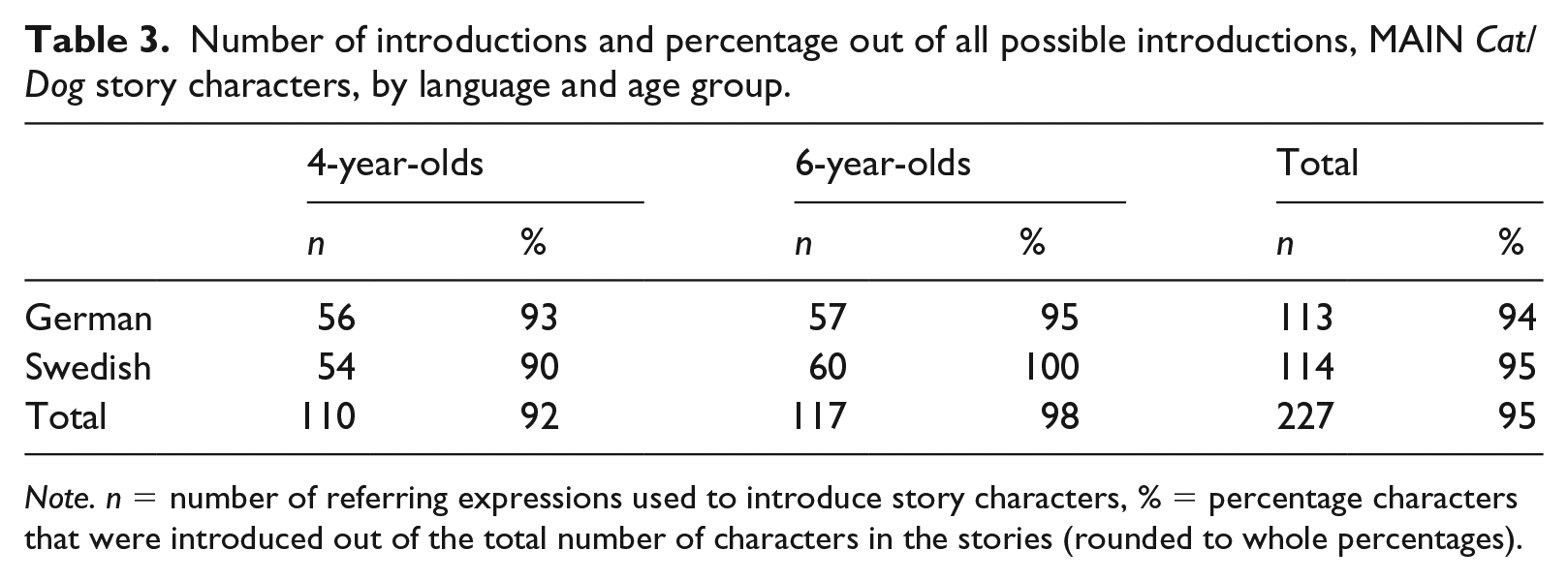
Note. n = number of referring expressions used to introduce story characters, % = percentage characters that were introduced out of the total number of characters in the stories (rounded to whole percentages).
We first analysed the distribution of different types of referring expressions in the two age groups for each language. Chi-square tests were used to compare proportions of different types of referring expressions for the two stories (Cat and Dog) and for expressions produced in the first vs the second session. This was done to ensure that it was equally difficult to introduce the characters in both stories, and that there was no training effect. In the first part of the analysis, two logit mixed effects models were run, one for pronouns vs lexical NPs, and one for indefinite NPs vs all other referring expressions. Age group, language and animacy were predictors in both models. Next, we investigated the effects of language proficiency and exposure on the children’s use of indefinite NPs in the two languages. Again, logit mixed effects models were run, one for German and one for Swedish, with, in addition to age group, the children’s proficiency and amount of exposure as predictors. For each language, language proficiency was operationalized as the child’s vocabulary production score (CLT, see ‘Materials’ above) and language exposure was operationalized as the child’s percentage of relative daily input in that language (as estimated by parents, see ‘Participants’ above, for more information about this variable). Language proficiency was a continuous variable on a scale from 0 to 60 (maximum score). Language exposure was a continuous variable on a scale of 0 to 100. Finally, we classified all indefinite NPs according to the type of construction in which the indefinite expressions were used, as argumentative construction (subject or object), labelling (NP only or predicative clausal construction), or narrative presentation (recall earlier discussion on Swedish and German referential systems). We then carried out two logit mixed effects models, one for labellings vs other indefinite expressions, and one for presentationals vs other indefinite expressions. All logit mixed effects models were run in R using the function glmer of the package lme4.
Results
Types of referring expressions
In this section, we first report the number and types of referring expressions that the Swedish–German bilinguals used to introduce the story characters and then analyse effects of age and language on the proportion of indefinite NPs used. Table 3 gives an overview of the total number of referring expressions used to introduce the story characters by the 4- and the 6-year-olds in German and Swedish, respectively.
As can be seen in Table 3, most characters (ca. 95%) were introduced by all children in both languages. The younger children introduced somewhat fewer characters than the older children, especially in the Swedish narratives.
Figure 2 shows the proportions of different types of referring expressions in the German and Swedish narratives for the 4-year-olds and 6-year-olds, respectively.
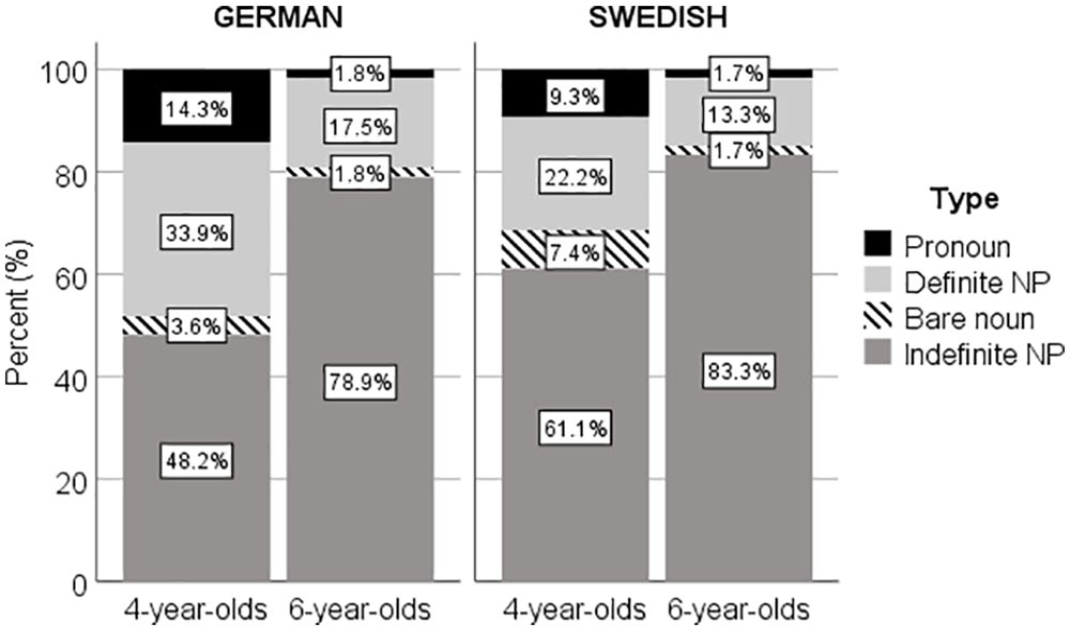
Proportions of different types of referring expressions used to introduce story characters, Swedish–German bilinguals by language and age group.
In both languages and for both age groups, the most frequently used type of referring expression to introduce story characters was an indefinite NP, followed by a definite NP. Bare nouns and pronouns were much less frequent, together making up around 16–17% of referring expressions in the 4-year-olds’ production. The 4-year-olds produced slightly more pronouns in the German narratives and somewhat more bare nouns in the Swedish narratives. For the 4-year-olds, the distribution of indefinite and definite NPs seemed somewhat different for the two languages. In their Swedish narratives, 61.1% of all referring expressions used to introduce the story characters were indefinites, and only 22.2% were definite NPs, thus showing a clear preference for indefinite expressions. By comparison, the proportions of these two categories in the German narratives of the 4-year-olds were more even, with 48.2% indefinite and 33.9% definite expressions. For the 6-year-olds, the distributions were very similar in the two languages. In both languages, most referring expressions used to introduce story characters were indefinites; 78.9% in German and 83.3% in Swedish. Definite NPs were relatively uncommon (17.5% in German and 13.3% in Swedish), compared to the younger group. The 6-year-olds’ use of pronouns and bare nouns was negligible in both languages.
To rule out potential confounds, we first controlled whether there was an effect of stimulus material and testing order. There were no significant differences in the children’s production of referring expressions between the Cat and the Dog story (χ2(3, N = 227) = 1.689, p = .639) nor between the first and the second session (χ2(3, N = 227) = 0.717, p = .869). It was thus equally difficult for the children to introduce characters irrespective of which story was told, and there was no training effect, indicating that the narrative task taps into a stable ability to introduce referents.
Second, we analysed the effect of age group, language, and animacy on the use of pronouns vs lexical NPs. Table 4 shows the summary of the final logit mixed effects model. 7
Summary of logit mixed effects model: pronouns vs lexical NPs.
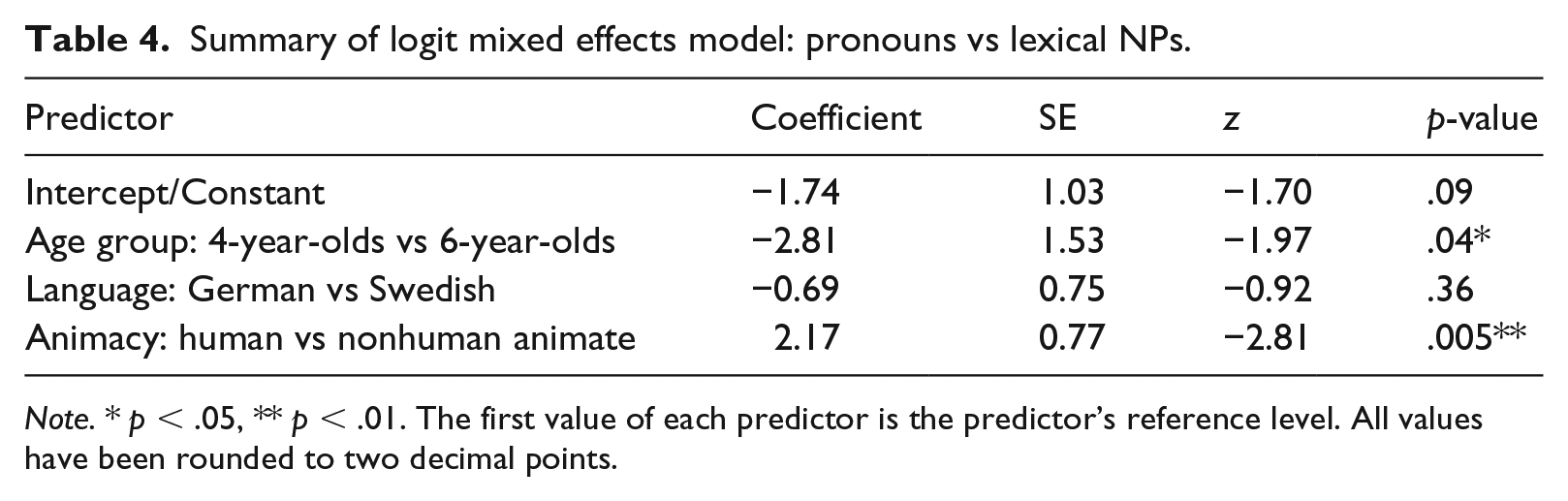
Note. * p < .05, ** p < .01. The first value of each predictor is the predictor’s reference level. All values have been rounded to two decimal points.
The logit mixed effects model in Table 4 showed significant main effects of both age group and animacy, but not of language. Pronouns were equally common in Swedish and German, 4-year-olds produced higher proportions of pronouns than 6-year-olds and pronouns were more commonly used to introduce the boy (13.2%) than the nonhuman characters (3.3%). Even though the 4-year-olds used pronouns more frequently than the 6-year-olds, it should be pointed out that pronoun percentages were generally low.
Next, we investigated the effects of age group, language, and animacy on the use of indefinite NPs. Table 5 shows a summary of the logit mixed effects model, which contains the predictors age group, language and animacy and the interaction age group × language.
Summary of logit mixed effects model: indefinite NPs vs all other referring expressions.
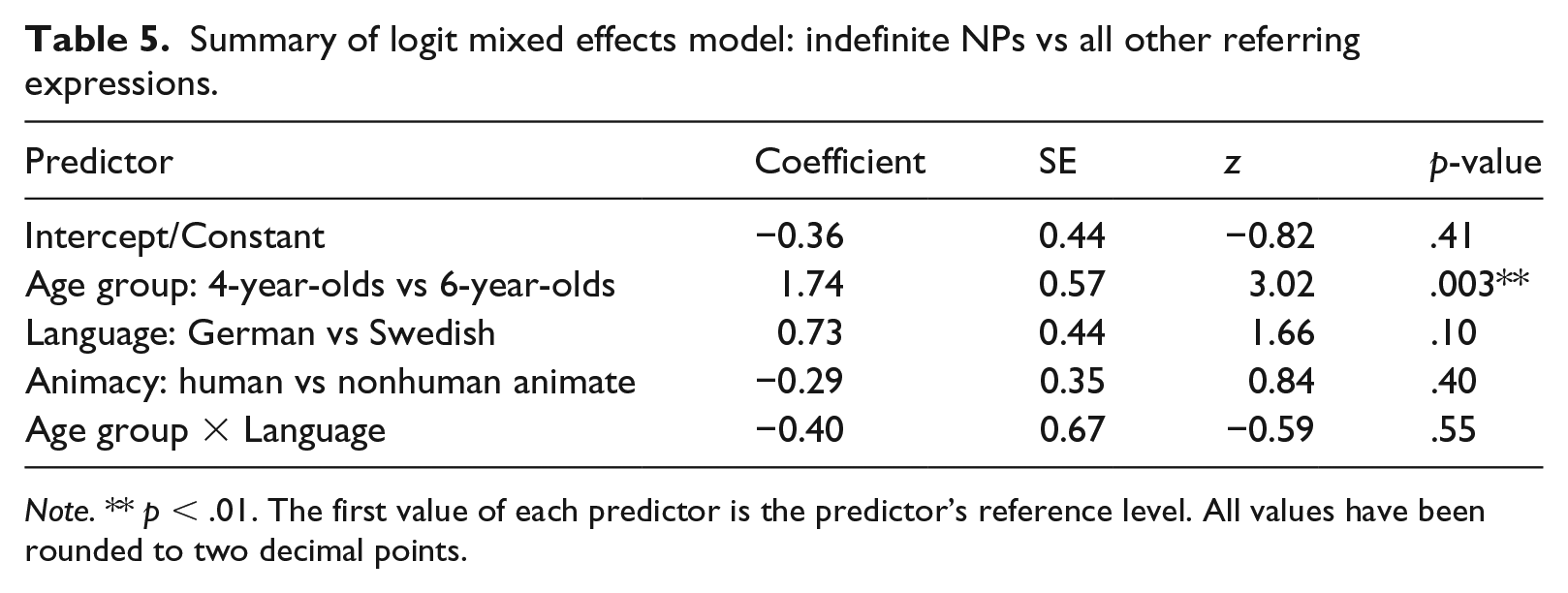
Note. ** p < .01. The first value of each predictor is the predictor’s reference level. All values have been rounded to two decimal points.
As seen in Table 5, there was a clear significant main effect of age group on the use of indefinite NPs to introduce story characters. The 4-year-olds produced fewer indefinite NPs than the 6-year-olds. However, there was no significant main effect of language and no interaction between age group and language. The children thus performed equally well when introducing story characters in both Swedish and German, in both age groups. The difference between the languages in the proportion of indefinite NPs seen for the 4-year-olds in Figure 2 was thus not significant. Additionally, there was no significant effect of animacy. It thus seems to be the case that the type of character (in terms of animacy, i.e. whether they are human or nonhuman animate) only influences pronoun use, but not the use of fully appropriate indefinite NPs.
Effects of language proficiency and exposure on the use of indefinite NPs
Next, we analysed the effects of language proficiency (CLT vocabulary production scores) and exposure (parental estimates of relative daily exposure) on the children’s production of indefinite NPs in the respective language, while controlling for age group. Tables 6 and 7 show the logit mixed model for Swedish and German, respectively. For neither language was there any effect of proficiency or exposure, but only a significant effect of age group.
Summary of logit mixed effects model: effects of language proficiency and exposure on indefinite NP vs other referring expression – Swedish.
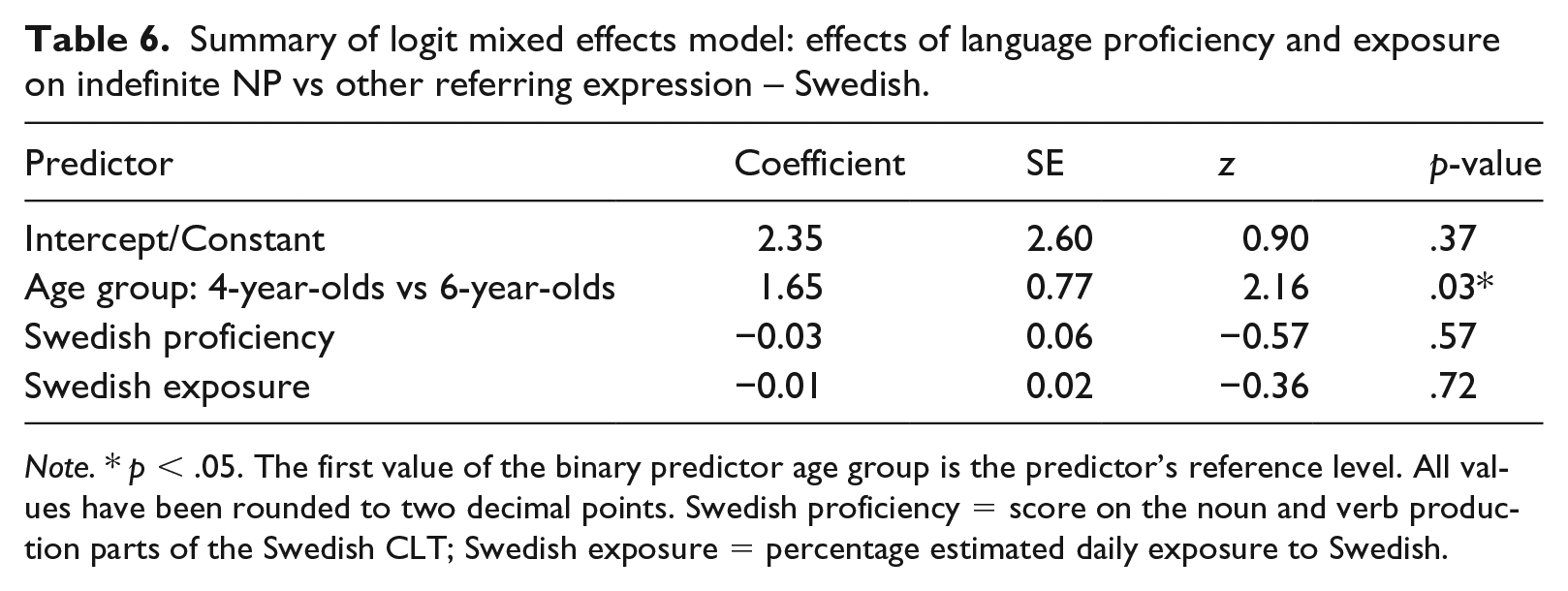
Note. * p < .05. The first value of the binary predictor age group is the predictor’s reference level. All values have been rounded to two decimal points. Swedish proficiency = score on the noun and verb production parts of the Swedish CLT; Swedish exposure = percentage estimated daily exposure to Swedish.
Summary of logit mixed effects model: effects of language proficiency and exposure on indefinite NP vs other referring expression – German.
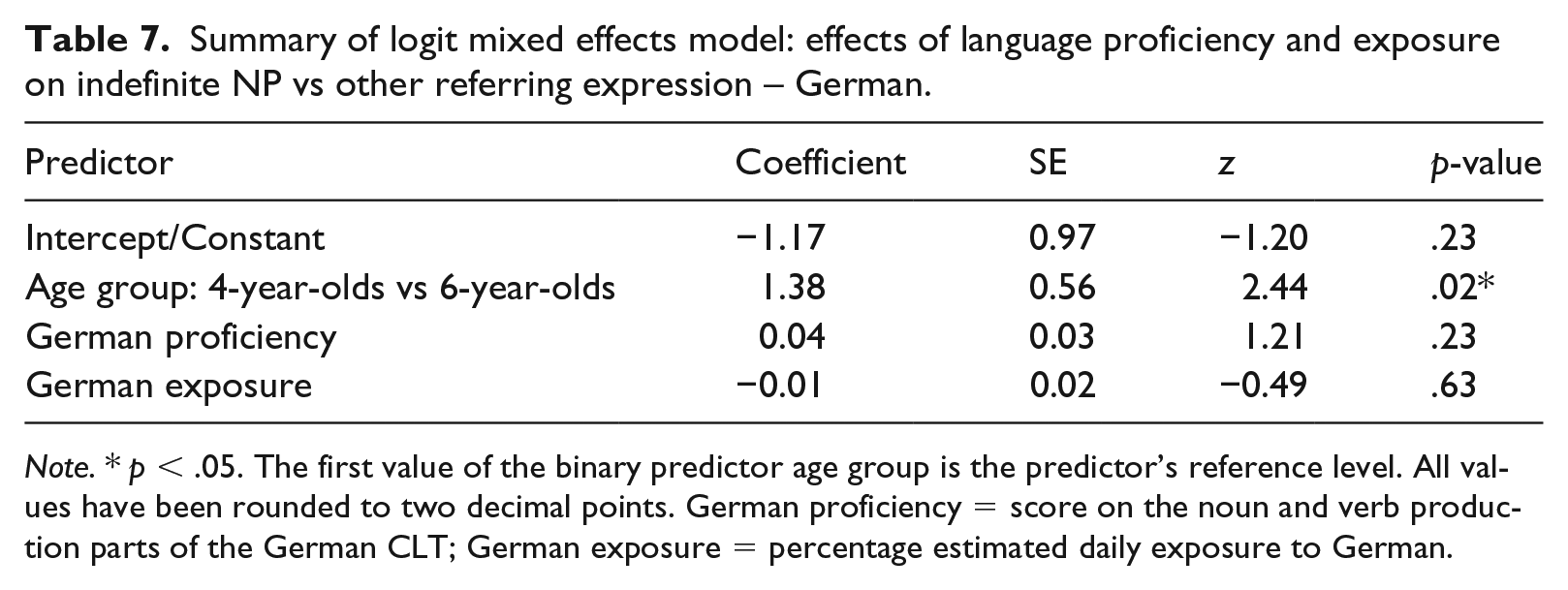
Note. * p < .05. The first value of the binary predictor age group is the predictor’s reference level. All values have been rounded to two decimal points. German proficiency = score on the noun and verb production parts of the German CLT; German exposure = percentage estimated daily exposure to German.
We also explored potential effects of other ways of measuring language exposure based on information from the parental questionnaire, such as whether the child was attending a Swedish-medium or a bilingual school, and whether the child had two native German parents or one Swedish native parent. Additionally, we recoded estimated daily exposure as a binary variable (at least 50% exposure to the target language vs less), and we also created a combined measure of exposure for each language (in the form of a scale between 0 and 3 with 1 point each given for at least 50% input in the language, for bilingual school attendance, and for the parents’ native language, so that for German, a zero score was given when the child received less than 50% German input, attended a Swedish-medium (pre)school and had only one native German parent, whilst 3 points were given to a child who had at least 50% estimated daily exposure to German, attended a bilingual (pre)school and had two native German parents). However, none of these measures of exposure had a significant effect on the children’s production of indefinite NPs either. Whether the exposure variables were included alone in the model or together with the language proficiency measure (CLT scores) did not matter.
Syntactic constructions used with indefinite NPs
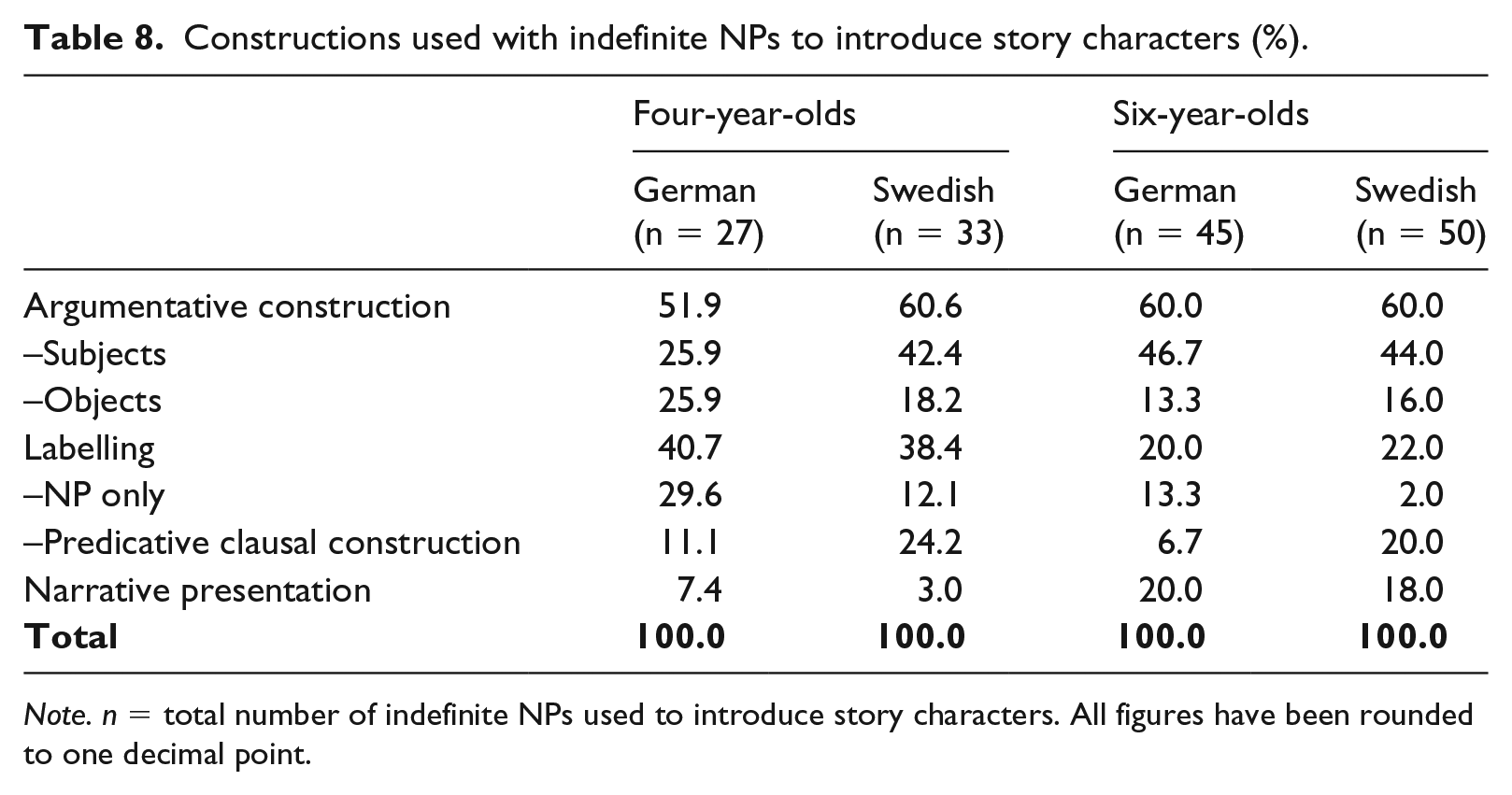
Not every indefinite NP used for referent introduction is equally appropriate (as discussed earlier). In this section, we take a closer look at the type of constructions in which indefinite NPs are used with first mentions of story characters. Table 8 shows the proportion of the different constructions.
Constructions used with indefinite NPs to introduce story characters (%).
Note. n = total number of indefinite NPs used to introduce story characters. All figures have been rounded to one decimal point.
As seen in Table 8, in both age groups and for both languages, when indefinite NPs were used to introduce characters, this occurred most commonly in argumentative constructions (as subjects or objects). In the 6-year-old group, labellings and narrative presentations were equally common, whereas the 4-year-olds rarely used narrative presentations, but frequently employed labelling constructions. Since the distribution across the three construction categories (argumentative, labelling, narrative presentation) was extremely similar for the two languages in both age groups, data from the two languages were collapsed in the analysis of age group and construction. The logit mixed effects model for labellings vs other types of indefinite expressions showed a border-line significant effect of age group (β = 1.25, SE = 0.69, z = 1.81, p = .07). For narrative presentation vs other types of indefinite expressions, the logit mixed effects model showed a significant effect of age group (β = 2.38, SE = 1.18, z = 2.02, p = .04); the 6-year-olds produced a significantly higher proportion of narrative presentations.
In the following, we zoom in on narrative presentations and labellings, as well as on individual children’s varying use of these constructions. Note that every child in the study introduced at least one story character with an indefinite NP when data from German and Swedish were combined. However, there was a difference between the age groups in the extent to which they did so: in the 4-year-old group, only four children (out of 20) used 5–6 indefinite NPs (out of a maximum of 6), whereas in the 6-year-old group, 12 children (out of 20) did so.
Concerning narrative presentation, the difference between the age groups was not only significant, but striking. Whereas this type of construction was used very rarely by the 4-year-olds (only 2 cases in German and 1 in Swedish), the older children introduced a character much more frequently in this manner. A full 20% of the 6-year-olds’ indefinite introductions in German and 18% in Swedish were narrative presentations. When looking at individual children, eight different 6-year-olds produced at least one indefinite NP as a narrative presentation in one of their languages, compared with only two 4-year-olds. One 4-year-old and five 6-year-olds used more than one narrative presentation. Due to its nature as a narrative opening sequence, this type of construction can only be used at the beginning of the narrative. It is thus unlikely, although not impossible, that all the characters in one narrative are introduced by such a construction. In our data, four cases were found in which a child introduced more than one character using narrative presentation in the same narrative. Interestingly, two of these come from the same child, one in each language, shown in (10) and (11). The children who produced such complex narrative presentations are all among the oldest participants in the study.
(10) es war einmal ‘Once upon a time, there was (11) det var en gång ‘Once upon a time, there was
The narrative presentation does not only introduce the character(s), but also sets the scene and indicates that what follows is a piece of narrative discourse (or more specifically, a fairytale). Narrative presentations are thus the most appropriate way to introduce (the first) character(s) in a narrative context. Using such a construction in the context of a narrative task indicates that the speaker is adapting their character introductions to the given genre.
By contrast, labellings are much less appropriate, as they simply name the referent. As shown in Table 8, in the 4-year-old group, labellings were about twice as common (ca. 40% of all indefinite character introductions) than in the 6-year-old group (ca. 20%), and this difference approached significance (p = .07). (Note that indefinite NPs were overall more frequently produced by the 6-year-olds, see Figure 2.) When looking at individual children, 13 4-year-olds used at least one labelling in one of their languages, compared with nine 6-year-olds. We did not see any common tendency for the children to exhibit the same behaviour in both languages with respect to the constructions they use with their indefinite NPs (though some individuals may do so); there was no significant correlation between the number of indefinite labellings produced in the two languages (r = .269, p = .136).
In each age group, one child performed differently than the others. One of the 4-year-olds (BiGer4-04) produced five indefinite labellings, and one 6-year-old (BiGer6-13) introduced all characters in both languages with indefinite labellings. None of the other 6-year-olds produced more than two such constructions, and only two other 4-year-olds produced three. Only three other children (two 6-year-olds, one 4-year-old) produced an indefinite labelling in both their languages. Since the labelling construction has a deictic or type-identifying function (as discussed earlier), productions on narrative tasks that contain many labellings may in fact not be narratives, but rather picture descriptions. For this reason, we took a closer look at the beginnings of the narrative productions of the two children who stood out. Remember that all children in the study are prompted by the experimenter to tell a story (as described in ‘Procedure’ above). In (12), the beginning of the Swedish narratives of child BiGer4-04 is shown. 8
(12) BiGer4-04, 4;11 – Dog, Swedish Exp: nu får du berätta sagan för mig ‘Now you can tell me the story.’ Child: (.) / trädet står kvar ‘(.) mouse / the tree remains.’ (Pictures 3–4 are unfolded) Child: (. . .) ett hus / (.) sig ‘(. . .) A house / (.)
As seen in (12), the child begins by labelling two inanimate objects (a tree, a house) and two story characters (a mouse, a dog) in the first two pictures with free-standing indefinite NPs, before continuing to tell the actions of the two characters. However, once the next two pictures are unfolded, the child goes back to naming what they contain, before telling what happened to the characters. This stretch of discourse, produced in the context of a narrative task, can be seen as a mixed genre, as it shows clear elements of both picture description and narrative. Importantly, the first mention of the referents (including both characters and inanimate objects) in the form of labellings makes this partly a picture description.
In (13), the beginning of the German narrative by the same child is shown. (The child does not wait for the experimenter to prompt him to start his story, but immediately starts talking.) While the two first characters are introduced with labellings, the child then switches to narrating the events instead of describing the pictures. The rest of the child’s production, including the introduction of the boy, is a narrative more than a picture description. This shows that the same child may use a similar strategy (or mixed discourse type) in both languages, but that the extent to which the resulting production is narrative-like or more of a picture description may vary between languages and/or time of testing.
(13) BiGer4-04, 4;11 – Cat, German Child: jagt den Schmetterling ‘
In (14) and (15), we see the beginnings of the Swedish and German narratives of another child that stands out with frequent labelling, the 6-year-old BiGer6-13. In Swedish (14), the child uses predicative clausal constructions to introduce all three characters (a dog, a mouse, a boy) as well as the inanimate objects in the surroundings of these characters (a tree, a path, three small houses), before proceeding to the narrative events. Although the first stretch of the discourse resembles a picture description, it also has a flair of ‘setting the stage’ for the coming events. Additionally, the introduction of the boy is in the form of a complex NP with a relative clause modifier (in which a balloon is introduced), which is more complex than just a simple indefinite NP. In German (15), the child uses free-standing indefinite NPs only (including for the inanimate objects), but tells about the events after being explicitly prompted by the experimenter. We do not know whether the child would have proceeded in this manner if she had not been prompted in this fashion, although the Swedish narrative suggests that the child is able to move from picture description to narrative without prompting.
(14) BiGer6-13, 6;2 – Dog, Swedish Exp: nu får du berätta sagan för mig ‘Now you can tell me the story.’ Child: ehm det är han fram till musen ‘Eh, it is forward to the mouse.’ (15) BiGer6-13, 6;2 – Cat, German Exp: was passiert denn da? ‘Well then, what happens there?’ Child: hm ‘Hm, Exp: und was passiert da mit denen? ‘And what happens there with them?’ Child: äh die Katze (.) versteckt sich hinter ein Busch / und dann hüpft sie rüber und dann (.) äh kommt ‘Eh, the cat (.) hides behind a bush / and then she jumps over it, and then (.) eh comes, he has a ball with him.’
Two 4-year-olds introduced all characters in their German narrative using indefinite NP labellings. (In Swedish, one of these children, BiGer4-09, did not use any indefinite NPs, while the other child, BiGer4-06, used three indefinite argumentative constructions.) In (16), the German narrative beginning of child BiGer4-06 is shown. The child uses the deictic marker da ‘there’ and names all the referents in the first two pictures, simultaneously pointing to them, despite the fact that the listener cannot see the pictures. 9 The child uses the same form for both story characters and inanimate objects (e.g. a balloon, a tree). Again, we see that, just as in (15), after repeated prompting by the experimenter, which explicitly directs the child towards the actions performed by the characters, the child moves on to tell the events in the pictures, instead of only labelling the objects.
(16) BiGer4-06, 4;5 – Dog, German Exp: und jetzt möchte ich, dass du mir die Geschichte erzählst, ja, weil ich hab die ja nicht gesehen ‘And now I would like you to tell me the story, yes, because I have not seen it’ Child: da war und noch zwei Häuser ‘There was more houses.’ (Child points to Pictures 1 and 2 throughout the utterances) Exp: mhm, und was passiert da? ‘Mm, and what happens there?’ Child: den Hund jagt die Maus ‘The dog chases the mouse.’
Another 4-year-old (BiGer4-09) also introduced all characters in the German narratives with labellings. In (17), the first part of her German narrative is shown. The child begins what is clearly a picture description, labelling all the characters first in picture 1 and then (the same characters) again in picture 2 (noch mal eine Katze und noch mal ein Bub und noch mal der Schmetterling ‘and again a cat and again a boy and again the butterfly’). The child does not connect the two pictures with each other, but rather names the characters in picture 2 as if they were new ones, as seen by the use of indefinite NPs also for these subsequent mentions. In fact, the child even names the boy a third time, again using an indefinite NP but with another noun (a human) as well as the deictic marker da ‘there’. Throughout the labelling of the characters, the child points to the pictures which are not visible to the listener. This first part is clearly not a piece of narrative discourse. However, again we see how the experimenter, using the narrative task’s standardized prompts, steers the child towards story telling.
(17) BiGer4-09, 4;10 – Cat, German Exp: und jetzt möchte ich, dass du mir die Geschichte erzählst ‘And now I would like you to tell me the story.’ Child: ähm noch mal ein Bub und noch mal der Schmetterling ‘Eh, butterfly.’ (Child points to Picture 1, then to Picture 2) Child: und da is(t) ein Mensch äh mit einer Angel und ein Ball und Fischen ‘And there is a human eh with a fishing rod and a ball and fish.’ Exp: mhm, gut und was passiert denn, was mach, was passiert denn? ‘Mhm, good, and what happens then, what do, well, what happens?’ Child: ah ich glaube, die Katze versucht, den Schmetterling zu fangen / ich glaube, der Mensch will, glaub ich, angeln ‘Ah, I think, the cat tries to catch the butterfly / I think, the human wants, I think, to fish.’
As the examples in (16) and (17) show, these two 4-year-olds are able to narrate events, but do so only after being prompted. Their spontaneous reaction to the narrative task is to describe the pictures, or more specifically, to name all the characters and objects present in the pictures accompanied by deictic gestures that are not visible to the listener.
What type of discourse have we seen in these examples? Picture descriptions? Narratives? It seems that in some cases, the answer lies in between. Some children name the main characters (and objects) before proceeding to narrate events, leading to a mixed genre that contains elements of both narrative and picture description, maybe being slightly closer to the former than the latter. However, other children, especially younger ones, continue to (repeatedly) name characters and objects until re-prompted towards the narrative genre by the adult listener. These narrative beginnings are in fact not narratives, but picture descriptions. In such cases, we also see the importance of the behaviour of the adult listener for the resulting discourse. In the context of a narrative task, such as the one from the MAIN used in the current study, the types of prompts given often direct the child towards the narrative genre.
What does this qualitative analysis tell us about the way indefinite NPs in labelling constructions are used? Are such expressions referential or merely type-denoting? The answer seems to be that they can be both. In some cases, we find that labelling of the characters (and objects) in the pictures, especially in the form of predicative clausal constructions, is used by the child to ‘set the scene’ before s/he, without prompting, starts to tell the story proper (as shown e.g. in (13) and (14)). Here, the labellings seem to be referential; the child is not only denoting the type of the characters, but actually introducing them, before telling about their actions. This is the case for example when the child introduces just one character with a labelling; the other characters are then introduced in argumentative constructions. However, in other cases when labellings are used, the child describes the pictures (as exemplified in e.g. (16) and (17)) and only narrates events when repeatedly prompted. In these cases, the indefinite ‘character introductions’ seem to be non-referential type-denoting; especially when they are accompanied by deictic gestures (pointing).
As has been shown in the examples above, labellings are often accompanied by deictic gestures (pointing) towards the named characters and objects, despite the fact that the listener cannot see the pictures. In fact, in almost a third (27.8%) of all labellings (for both languages and both age groups combined), such pointing was used by the child. In contrast, only one case of pointing (4.8%) was found with an indefinite NP in the narrative presentation construction. When looking at the age groups separately, an interesting difference appears. The 6-year-olds rarely used deictic gestures with indefinite NPs overall (8.4%), and in fact their use of pointing was not higher with labellings than with indefinite NPs in argumentative constructions. The 4-year-olds, on the other hand, used accompanying pointing gestures with almost half (47.8%) of their labellings, as compared to only 32.4% with their argumentative indefinite NPs.
Discussion and conclusion
The present study investigated character introductions in narratives by a younger group (aged 4;0–5;3), the ‘4-year-olds’, and an older group (aged 4;8–6;11), the ‘6-year-olds’, of Swedish–German bilinguals (N = 40). Narratives were elicited in both languages using the Cat/Dog story from MAIN (Gagarina et al., 2012, 2015). We focused on the type of referring expression used (indefinite NP, definite NP, pronoun) to introduce the story characters. Our research questions concerned differences between the age groups, languages, type of character (human vs nonhuman animates), effects of language proficiency (vocabulary knowledge) and language exposure (estimated daily input), and the types of constructions in which indefinite NPs were used to introduce story characters.
As expected, the results showed a significant difference between the two age groups, with the 6-year-olds using fewer pronouns and a higher proportion of indefinite NPs than the 4-year-olds. These results are similar to earlier studies showing development in the ability to introduce referents during the preschool period for other populations (e.g. Lindgren, 2018b; Schneider & Hayward, 2010). There was no difference in performance between the two languages, Swedish and German, a result that is in line with other studies investigating language combinations with the same type of referential system (Finnstedt, 2013 for Swedish–English bilinguals; Serratrice, 2007 for Italian–English bilinguals). In Swedish, the Swedish–German bilinguals performed similarly to the Swedish monolingual children in Lindgren (2018b), a study employing the same stimulus materials as the present study. In fact, the Swedish–German children were more accurate in their use of Swedish referring expressions at age 4 (61% compared with around 40% for Lindgren’s monolinguals), which may be linked to the fact that the bilinguals were slightly older (mean age 4;8 compared with 4;5 for the monolinguals). At age 6, the proportions of Swedish indefinite NPs were similarly high (83% for the bilinguals; 90% for Lindgren’s monolinguals). The present study thus supports the hypothesis that bilinguals perform similarly to monolinguals when the languages are similar with respect to their referential systems (Finnstedt, 2013; Serratrice, 2007).
Regarding the effect of type of character on the children’s character introductions, we found that animacy, or more specifically humanness, significantly influenced the use of pronouns. Even though pronouns were generally infrequent, pronouns were more commonly used for the human character, the boy, than for the nonhuman animate characters (cat/dog, butterfly/mouse). However, there was no effect of animacy (humanness) on the use of indefinite NPs, indicating that it only promotes the use of pronouns, but does not influence the morphological form of the lexical NPs used. In the current study, the use of pronouns to introduce the boy cannot be attributed to a thematic subject strategy, according to which pronouns are used by children mainly or only to refer to the human being who is the main character (e.g. Bamberg, 1986; Karmiloff-Smith, 1981), since in the MAIN Cat/Dog stories, the boy is not the main character that is more important than the animals. However, it may still be the case that the boy is more prominent (i.e. more highly accessible) for the children, and that this influences the use of pronouns. Results from a study of referent reintroduction and maintenance by Swedish monolinguals that employed the same stimulus materials as in the present study (Lindgren & Vogels, 2018) support this conclusion.
Contrary to our expectations, we found no significant effects of language proficiency (scores on the production parts of the vocabulary task CLT) and language exposure (estimated daily input) on the children’s production of indefinite NPs for character introduction, when controlling for age group (which was a significant predictor). Even performance in the minority language German, to which the children were generally less exposed, was not influenced by our measures of exposure or proficiency. Although the effects of language proficiency and exposure on children’s referring expressions have not been researched extensively, the results of the present study are in contrast to the few existing previous studies (e.g. Andreou et al., 2015; Jia & Paradis, 2015; Serratrice & De Cat, 2020). What might be the reasons for these results? First, for monolingual children, morphological indefinite markers have been found to be acquired early in both Swedish (around age 2) and German (age 2−3). Second, not only are the Swedish and German referential systems similar, but both languages also use indefinite articles that are similar in position (prenominal) and in form (en/ett for Swedish and ein(e) for German). This means that less input might be needed in each language in order to acquire these markers; 4-year-old Swedish–German bilinguals may thus be expected to already have acquired them. Earlier studies (e.g. Gathercole et al., 2013; Thordardottir, 2014) have also shown that the acquisition of morphosyntax may be less affected by amount of input than, for example, lexical skills (for an overview, see Unsworth, 2013). Although language exposure and/or skills might influence the (discourse-pragmatic) ability to use morphological indefinite marking appropriately, we did not find any such relationship for the bilinguals in the present study. Again, this could be linked to the cross-linguistic similarities in the discourse-pragmatic use of the referential systems concerning referent introduction. These participants might also have been ‘too advanced’ or ‘too balanced’ in their two languages to show effects of exposure or general language proficiency on referent introduction. The decisive factor for the children’s use of indefinite NPs instead seems to be age, which indicates general cognitive maturity.
Our final research question concerned the use of indefinite NPs for character introduction within different types of constructions. Three main types of constructions were found in the data: labellings (or namings), argumentative constructions (in which the character is introduced as subject or object), and narrative presentations (in which the character is introduced as part of a typical narrative beginning such as ‘once upon a time’). In both age groups, argumentative constructions were the most frequent. However, the 6-year-olds used significantly more narrative presentations and fewer labellings than the 4-year-olds. There was thus not only a difference between the age groups in the proportion of indefinite NPs used, but also in how these were used. This has rarely been studied. In addition to the quantitative analysis of the construction types, we took a closer look at the use of narrative presentations and labellings, with a focus on individual variation, and on the type of discourse produced by the children who used multiple labellings. This qualitative analysis suggests that indefinite NPs in labelling constructions can be both referential and type-denoting. In some cases, indefinite NPs in the form of labellings were used by the child to ‘set the scene’ before s/he started to tell the story proper. Such labellings seem to be referential as the child did not denote the type of the characters, but actually introduced the characters, before telling about their actions. In other cases, the child simply described the pictures with labellings for characters and objects and did not tell the story; here, the indefinite ‘character introductions’ rather seem to be non-referential type-denoting. In many cases, such labellings are accompanied by deictic gestures, i.e. the child points to the characters/objects in turn and names them, even though the listener cannot see them. These results show us that (a) not all indefinite NPs are equally appropriate character introductions in a narrative, as appropriateness also depends on the construction in which they are used, and (b) not all instances of the same construction are equally (in)appropriate. Purely quantitative analyses (e.g. percent indefinite lexical NPs as first mentions) may thus not give us the full picture of children’s developing referential skills in narratives. To capture the subtleties of how children present and introduce story characters, not only the form, but also the function of indefinite forms in context needs to be considered.
