



Abstract
Verbal working memory resources may impact syntax comprehension. Thirteen Italian children with cochlear implants (CIs) were assessed in relative clause (RC) comprehension, digit span and nonword repetition and compared to 13 chronological age peers (CA) and 13 younger controls (LA) with normal hearing (NH). The RC comprehension task tested subject relatives (SR), object relatives with preverbal (OR) and postverbal subjects (ORp) where number features were manipulated. Children with CIs show worse performance than controls in RC comprehension and nonword repetition. In the RC task, number features facilitated comprehension by children with NH, but not by children with CIs. The memory measure that predicted RC comprehension was digit span. In the LA group, backward digit span predicted comprehension of all RC types. Forward digit span predicted comprehension of ORs with number mismatch in the CA group, and comprehension of ORs with number mismatch and ORps in children with CIs. In these conditions, high memory resources are needed to exploit number features in theta-role assignment.
Keywords
Introduction
Profound sensorineural hearing loss strongly affects the natural development of oral languages. Children who are diagnosed as deaf or hard of hearing (DHH) struggle in developing age-appropriate oral language skills, because they have restricted access to spoken language in a time window in which exposure to linguistic input is fundamental for language acquisition (Hall et al., 2019). Children with profound hearing loss may receive cochlear implants (CIs) in order to access environmental and linguistic input. CIs are high-tech hearing devices that significantly improve vocabulary acquisition (Caselli et al., 2012; Young & Killen, 2002). In the morpho-syntactic domain, however, children with CIs still lag (far) behind age peers and younger children with normal hearing (NH) (Caselli et al., 2012; Geers et al., 2009; Guasti et al., 2014; Spencer et al., 2003; Volpato, 2010, 2012; Volpato & Adani, 2009; Volpato & Vernice, 2014; Young & Killen, 2002).
In addition to difficulties with grammar, children with CIs also show low scores on memory measures, such as nonword repetition (NWR) (testing phonological short-term memory [STM]) and/or digit span tasks (testing phonological/verbal STM and working memory [WM]) (Casserly & Pisoni, 2013; Conway et al., 2009; Dillon & Pisoni, 2006; Penke & Wimmer, 2018; Talli et al., 2018). Difficulties with memory tasks are claimed to be due to the presence of degraded input that affects short-term memory storage (Nittrouer et al., 2013; Talli et al., 2018). Limited memory resources also have an impact on developing grammar skills in children with CIs (Dillon et al., 2004; Harris et al., 2013; Penke & Wimmer, 2018; Pisoni & Geers, 2000; Talli et al., 2018; Volpato & Adani, 2009). Interestingly, NWR is a marker of developmental language disorder (DLD) and is a predictor of grammatical weaknesses in language impaired children (e.g. Delage & Frauenfelder, 2012; Dispaldro et al., 2013).
This study has two aims: to investigate the difficulties that Italian-speaking children with CIs have with the comprehension of relative clauses (RCs) and to investigate their performance in memory tasks. In particular, it focuses on feature (number) processing in RC comprehension in relation to memory processes.
In languages like Italian, NP dislocation is not the only crucial factor in complex sentence processing. In addition to movement, feature processing also plays an important role in RC comprehension. The morphological cues that an individual can exploit to interpret (object) RCs may vary cross-linguistically. In Greek, the role of morphological features (case and number) in relative clause interpretation by typically developing children (as well as by children with DLD) has been highlighted by Stavrakaki (2001) and Stavrakaki et al. (2015). For Greek-speaking typically developing children, case marking is the relevant feature: it is used more frequently than number marking for correct sentence interpretation (Stavrakaki et al., 2015). Further research addressing the role of morphological features proved that case features also significantly improve the level of syntactic comprehension of relative clauses in German-speaking typically developing children (Arosio et al., 2012). In Italian, individuals cannot rely on case marking for the interpretation of object relatives, and the manipulation of number features proved instead to be crucial for typically developing children in order to increase the correct assignment of thematic roles (Adani et al., 2010; Volpato, 2010, 2012). Given the important role of morphological features in RC comprehension, and especially the role played by number cues in Italian, it is of particular interest to investigate these properties in RC comprehension also in relation to memory skills (phonological STM [PSTM], verbal STM and WM). The question is whether the disambiguation through number features places a heavy load on the memory system in children with CIs.
Grammatical deficits in DHH children
An increasing number of studies show that hearing impairment has severe consequences on the development of oral language abilities. Individuals with hearing loss have difficulties especially with the acquisition of complex sentences, such as relative clauses, topicalized sentences and wh-questions across different languages (English: De Villiers et al., 1994; French: Tuller & Delage, 2014; German: Penke & Wimmer, 2018; Ruigendijk & Friedmann, 2017; Italian: Volpato, 2010, 2012; Volpato & Adani, 2009; Volpato & Vernice, 2014; Hebrew: Friedmann & Szterman, 2006, 2011; Palestinian-Arabic: Friedmann & Haddad-Hanna, 2014). These studies observed that sentences involving the movement of the object DP to the sentence-initial position are more difficult to comprehend, produce and repeat than those containing subject movement. Movement of the object to a non-canonical position involves a marked word order of constituents, in which the theme precedes the agent. In German RCs, agent and theme are also marked for case, but this cue does not help DHH children in theta-role assignment (Ruigendijk & Friedmann, 2017). The difficulties might be due to the computational complexity involved in the derivation of these sentences (Tuller & Delage, 2014) in order to process, for instance, the movement of a full NP (the object) across another NP (the subject) (Friedmann et al., 2009).
Friedmann and Szterman (2011) observed that movement is especially impaired in Hebrew-speaking DHH children when the object shares a subset of features (namely the lexical restriction, Friedmann et al., 2009) with the argument it crosses over. While the studies carried out by Friedmann and collaborators always investigated RC comprehension in heterogeneous groups of participants (either wearing hearing aids or CIs), Volpato and Adani (2009) and Volpato (2010, 2012) for the first time investigated the comprehension of complex syntax (RCs), and especially number feature processing in RCs, in a small, but homogeneous group of children fitted with CIs and similar clinical variables. In Volpato (2010, 2012), 13 Italian-speaking children with CIs were compared to 13 younger NH children matched on language skills (LA group). Right-branching subject relatives (SRs) and object relatives (with preverbal – ORs – and postverbal subjects – ORp) were created through the manipulation of number features on both DPs. This gave rise to conditions in which the two DPs had the same number features (match conditions, OR_M) or different number features (mismatch conditions, OR_MM and ORp). Compared to NH children, children with CIs were found to be less sensitive to number cues on the embedded verb in the interpretation of ORs with preverbal subjects. The poor performance of children with CIs can be explained by the problematic computation of weak unstressed elements (plural marking on verbs and nouns), which may hinder the correct theta-role assignment. Conversely, number agreement and number mismatch facilitate the correct interpretation of ORs by NH children. Along the lines of the proposal by Friedmann et al. (2009), the feature set associated to the DPs modulates the comprehension of RCs and explains the high accuracy rates in the mismatch conditions and the low accuracy rates in the match conditions. In Volpato (2012), the CI group was compared with the LA group. Children with CIs were never compared to NH age peers.
The first aim of this study is to further explore how the linguistic domains of syntax and morphology interact in complex sentence comprehension by children with CIs and NH children. This study contributes to the discussion on the RC comprehension and the role played by number feature processing by adding the further comparison between children with CIs and NH age peers. This makes it possible to understand how and to what extent the participants with CIs differ from different NH control groups. This is the first study to investigate, in addition to syntactic processes (NP dislocation), number agreement in match and mismatch conditions in the comprehension of right-branching relative clauses in Italian-speaking 8- to-10-year-old children. Previous research investigated number features in centre-embedded RCs (Adani et al., 2010). Given the fact that in Volpato (2012) children with CIs performed worse than younger LA matched controls, we expect that, overall, performance will also be worse than age-matched peers. Since CA children are older than LA children, we expect a greater performance gap between the CA group and children with CIs in the different sentence conditions. As for (CA) group analysis, we expect that disambiguation via number agreement only (ORp) is more problematic than disambiguation via preverbal position of the embedded subject (OR). In addition, the mismatch number condition is expected to be more accurate than the match condition. The combination of syntactic and morphological (number agreement) cues should drive the age-matched children into correct RC comprehension, replicating the results found for the LA group.
Memory deficits in DHH children
Several studies have investigated the performance of children with CIs in tests assessing memory resources, such as NWR and digit span tasks. Results do not always converge.
The NWR task assesses rapid phonological processing and measures phonological information stored in PSTM. The process necessary to repeat non-existing words is complex. A completely novel sound pattern is perceived without the possibility of relying on pragmatic or semantic knowledge and must be held and verbally rehearsed in immediate phonological memory. Finally, the perceived sound pattern is turned into an articulatory output. Some studies (e.g. Briscoe et al., 2001; Dillon et al., 2004; Talli et al., 2018) found that English and Greek DHH children had impaired PSTM. Different results were obtained for Italian (Guasti et al., 2014). Young children with CIs (4;2–6;10) did not differ from NH age peers in the repetition of nonwords. The lack of difference in their study as opposed to other cross-linguistic studies is claimed to be due to the phonological and prosodic characteristics of Italian, which make encoding, storing and rehearsal of new words relatively easy.
In contrast to NWR, the digit span task investigates memory resources for words (digits) that are already stored in the mental lexicon (Baddeley, 2003). Both forward digit span (FDS) and backward digit span (BDS) require verbal STM skills, while BDS requires, in addition, WM skills. Some studies found that children with CIs performed worse than NH children in both FDS and BDS tasks (e.g. Conway et al., 2009; Pisoni et al., 2011), and suggested that the resources allocated to digit perception increases the cognitive load of the task, taxing STM and WM. Conversely, other studies found that DHH children did not significantly differ from NH peers in digit recall (e.g. Briscoe et al., 2001).
Briscoe et al. (2001) suggested that the lower performance of DHH children in NWR (but not in the FDS task) is not due to a compromised memory capacity, but to the computational overload required to process novel sound sequences through a deficient auditory system. Other studies suggested that poor performance and low scores in these measures may depend on the quality of received input, which is partial and degraded, and does not favour appropriate phonological representation of spoken language in short-term memory (Nittrouer et al., 2013; Pisoni et al., 2011; Talli et al., 2018).
Starting from these findings, the second aim of this study is to investigate whether delayed access to the (quantitatively and qualitatively reduced) auditory input also affects the normal development of the memory system in Italian children with CIs. Cross-linguistically, children with CIs perform poorer than NH children in NWR and digit span tasks. Research on these aspects is scarce for Italian. As noted above, PSTM has only previously been assessed in young children with CIs (Guasti et al., 2014). Based on that study, we expect no difference between children with CIs and NH children. Therefore, although the linguistic input is degraded, the phonological and prosodic characteristics of Italian should nonetheless favour the development of appropriate PSTM skills. In the present study, however, children with CIs are older, and a difference in memory skills may have emerged with age.
To our knowledge, this is the first study investigating verbal STM and WM in Italian-speaking children with CIs and the first study to simultaneously assess FDS and BDS in addition to NWR. We keep the comparison between children with CIs and language-matched NH children (as in Volpato, 2012), in order to check whether, in addition to compromised RC comprehension, the access to reduced linguistic input also affects the development of the memory system.
The relation between memory resources and complex syntactic structures
Much research has investigated the role that NWR and digit span play in the development of linguistic skills in DHH individuals (Briscoe et al., 2001; Dillon et al., 2004; Guasti et al., 2014; Harris et al., 2013; Penke & Wimmer, 2018; Pisoni & Geers, 2000; Talli et al., 2018). In children with CIs, NWR was found to correlate with spoken word recognition, language comprehension, speech intelligibility, speech rate (Dillon et al., 2004) and receptive vocabulary (Talli et al., 2018). Digit span was found to predict speech intelligibility, speech perception, language comprehension and reading (Pisoni & Geers, 2000). Hence, the difficulty that DHH children have with complex sentences would be due to reduced memory resources rather than to syntactic deficits (Tuller & Delage, 2014).
Some studies have focused on the relation between memory skills and comprehension of specific complex constructions involving long-distance dependencies in DHH children (relative clauses: Volpato & Adani, 2009; wh-questions: Penke & Wimmer, 2018). For Italian children with CIs, the study by Volpato and Adani (2009) was the only one which addressed this issue and found a positive correlation between comprehension of ORps and BDS in eight children with CIs (6;9–9;3; mean age: 7;9), showing that the computation of agreement between the embedded verb and the postverbal subject places heavy load on the memory system and consequently on correct theta-role assignment. Conversely, Penke and Wimmer (2018), who investigated the relation between comprehension of who-questions and NWR in very young German children with hearing aids (ages 3–4), did not find any correlation between the two measures. The authors concluded that the lack of correlation did not imply that phonological short-term memory is independent from syntactic comprehension, given the fact that the who-questions tested were short constructions and memory skills were probably sufficient to support their comprehension. For this reason, research is necessary in order to investigate whether difficulties with comprehension of complex syntax are due to limited memory skills, to some (morpho)-syntactic deficit, or both.
This study tries to fill this gap by further investigating the relation between memory tasks (both NWR and digit span) and RC comprehension in children with CIs (as well as in NH controls). The assessment with both NWR and digit spans as possible predictors of RC comprehension enables us to investigate whether difficulties are attributed to PSTM, FDS (long string of words), or BDS (presence of long-distance dependencies and marked word orders). Based on previous research on children with CIs (Volpato & Adani, 2009), a positive relationship between RC comprehension and BDS is also expected in this study. The BDS task was found to correlate with RC comprehension in a study on typically developing children by Arosio et al. (2009). A similar relationship is expected in the NH children, especially in the youngest participants, for whom RC processing strategies may be driven by limitations of computational resources.
Methods
Participants
Three groups are included in this study: an experimental group and two control groups.
The experimental group is composed of 13 children with profound bilateral sensorineural hearing loss fitted with a cochlear implant (CI group). All participants were profoundly deaf since birth. At the time of data collection, they ranged in age from 7;9 to 10;8 (mean age: 9;2). Age of hearing aid fitting varied from 0;5 to 1;8. They received a CI between the age of 1;9 and 3;4. The duration of CI use varied from 4;5 to 8;6. All children had normal IQ. They were born to hearing parents and exposed to Italian. None of them had ever used Italian Sign Language. They came from different areas of Italy, although the majority were from Northern Italy. All children had been trained orally, and all of them received speech-language therapy two or three times per week. They did not show any associated disabilities. At the time of data collection, the participants with CIs were attending primary schools in mainstream classes. Clinical individual profiles of the children with CIs are shown in Table A1 in the Appendix.
The children with CIs were compared to 13 Italian-speaking children with NH of comparable linguistic age (LA group, age range: 5;0–7;9, mean age 6;7). Each child with CI was individually matched to a child with NH based on individual raw scores achieved in the TCGB (Test di Comprensione Grammaticale per Bambini, Chilosi & Cipriani, 2006), an Italian standardized test assessing children’s general morpho-syntactic abilities. Children matched on language were selected among those who had normal range scores in the TCGB (between the 25th and 75th percentile). No significant difference was found between the TCGB scores of the two groups (Mann–Whitney U = 74.5, p = .61). Hearing children were recruited in a kindergarten and two primary schools in a village near Venice.
The CI and LA groups include the same participants as Volpato (2012). In this study, children with CIs are also compared to 13 NH children ranging in age from 7;5 to 10;8 (mean age 9;0) matched on chronological age (CA group). Two children were slightly younger than the youngest child in the CI group. However, no significant difference was found between the age ranges of the two groups (Mann–Whitney U = 83, p = .94).
None of the children with NH had a language impairment or intellectual disability. All participants’ families were asked to sign a written consent in which the goals of the study were presented. This study received approval from the Doctoral Research Board in Language Sciences at Ca’ Foscari University of Venice.
Materials and procedure
Comprehension of relative clauses (Volpato, (2010) was examined via an experimental task. To assess memory skills, a standardized NWR task (Fabbro, 1999) and a standardized forward and backward digit span task (TEMA; Reynolds & Bigler, 1995) were used.
All tests were presented orally to all children. All participants were tested individually in two or more sessions, in a quiet room. Children with CIs were tested during their individual speech and language therapy sessions at the medical centres which they attended for their periodical follow-up, while children with NH were tested at their infant or primary schools.
The nonword repetition task
This task is included in the ‘Batteria della valutazione del linguaggio in bambini dai 4 ai 12 anni’ (Fabbro, 1999), a set of tests to assess linguistic abilities in children from 4 to 12 years. The test consisted of 15 one- to four-syllable nonwords (four monosyllabic nonwords, five disyllabic nonwords, five trisyllabic nonwords and one four-syllable nonword) presented in order of increasing length. All nonwords conformed to Italian phonotactic restrictions. One point was assigned for every nonword correctly repeated. Any nonword containing an error (both articulation errors and phonological processes such as consonant cluster reduction) was assigned a score of 0. For the NWR task, data are available only for the LA group, because it was not administered to all children in the CA group.
The forward and backward digit span tasks
These tasks are included in the standardized Test di Memoria e Apprendimento (TEMA, Test of Memory and Learning; Reynolds & Bigler, 1995). They require the immediate serial recall of sequences of digits (1–10) of increasing length. Stimuli are assembled into sequences ranging from 2 to 10 numbers for the forward digit span (FDS) and from 2 to 9 for the backward digit span (BDS), with two trials at each sequence length. They were read aloud by the experimenter at the rate of 1 second per item, and the participant was required to immediately repeat the digits in the same order as they were presented. For BDS, individuals were required to recall numbers in the reverse order. Testing stopped when children correctly repeated fewer than 4 digits in two consecutive trials. One point was assigned for each number recalled in the correct position. The higher the score, the better the performance. The TEMA manual makes it possible to convert raw scores into standard scores.
The relative clause comprehension task
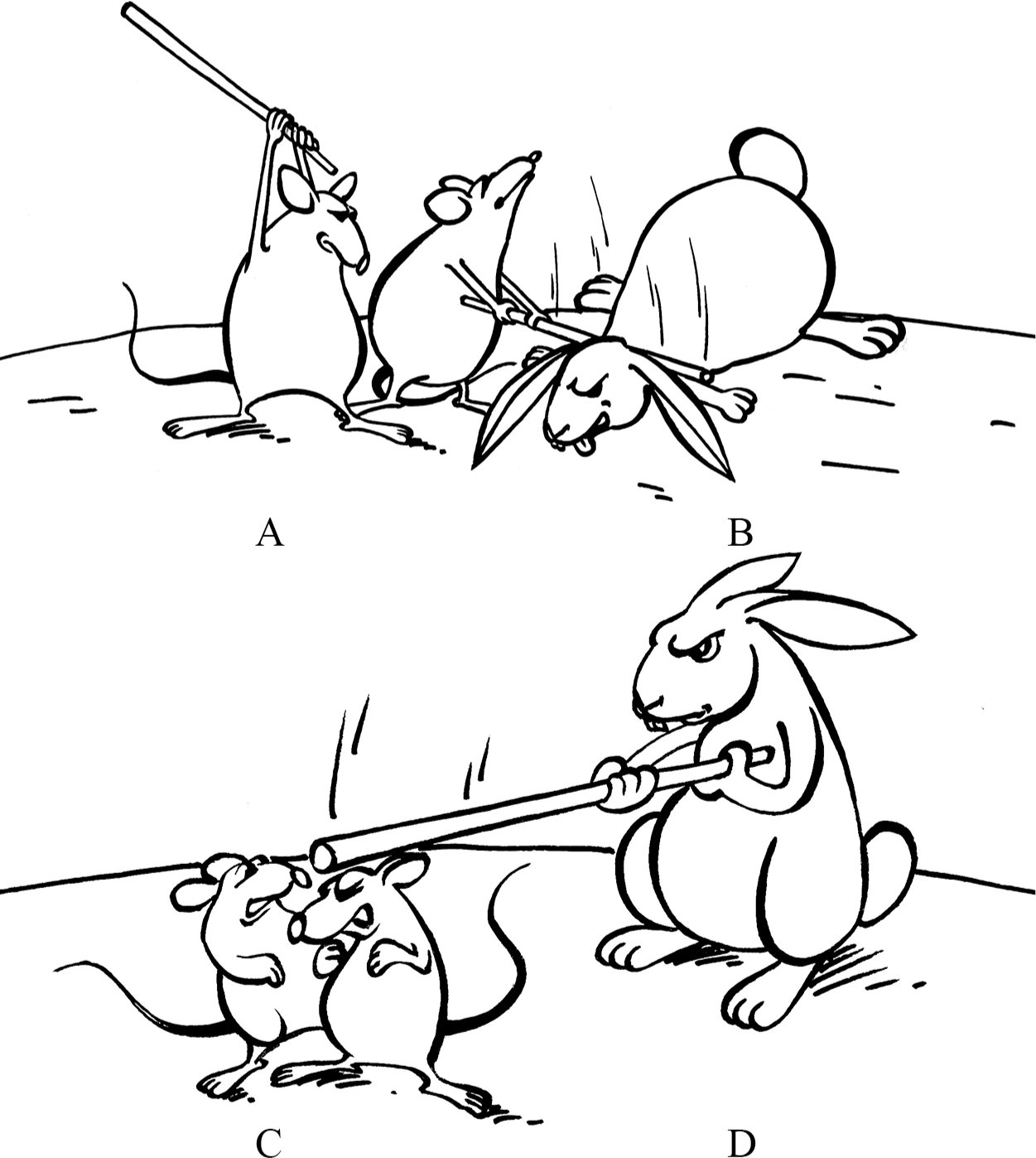
RC comprehension was assessed with a referent selection task designed by Volpato (2010). Following Friedmann and Novogrodsky (2004), each trial consisted of the presentation of a picture with two contrasting scenes (Figure 1). In the first scene, one or two characters perform a transitive action (e.g. two mice are hitting a rabbit ). In the second scene, the action is the same, but thematic roles are reversed (e.g. a rabbit is hitting two mice). With this paradigm, felicity conditions are satisfied by the presence of at least two instances for each DP head (Hamburger & Crain, 1982).
Experimental item.
After the experimenter had read the sentence, the child was asked to touch the correct referent out of four possible choices (A to D, see Figure 1). In this respect, this comprehension task is different from that of Friedmann and Novogrodsky (2004), in which participants were asked to select one of the two scenes rather than a single character out of the four present.
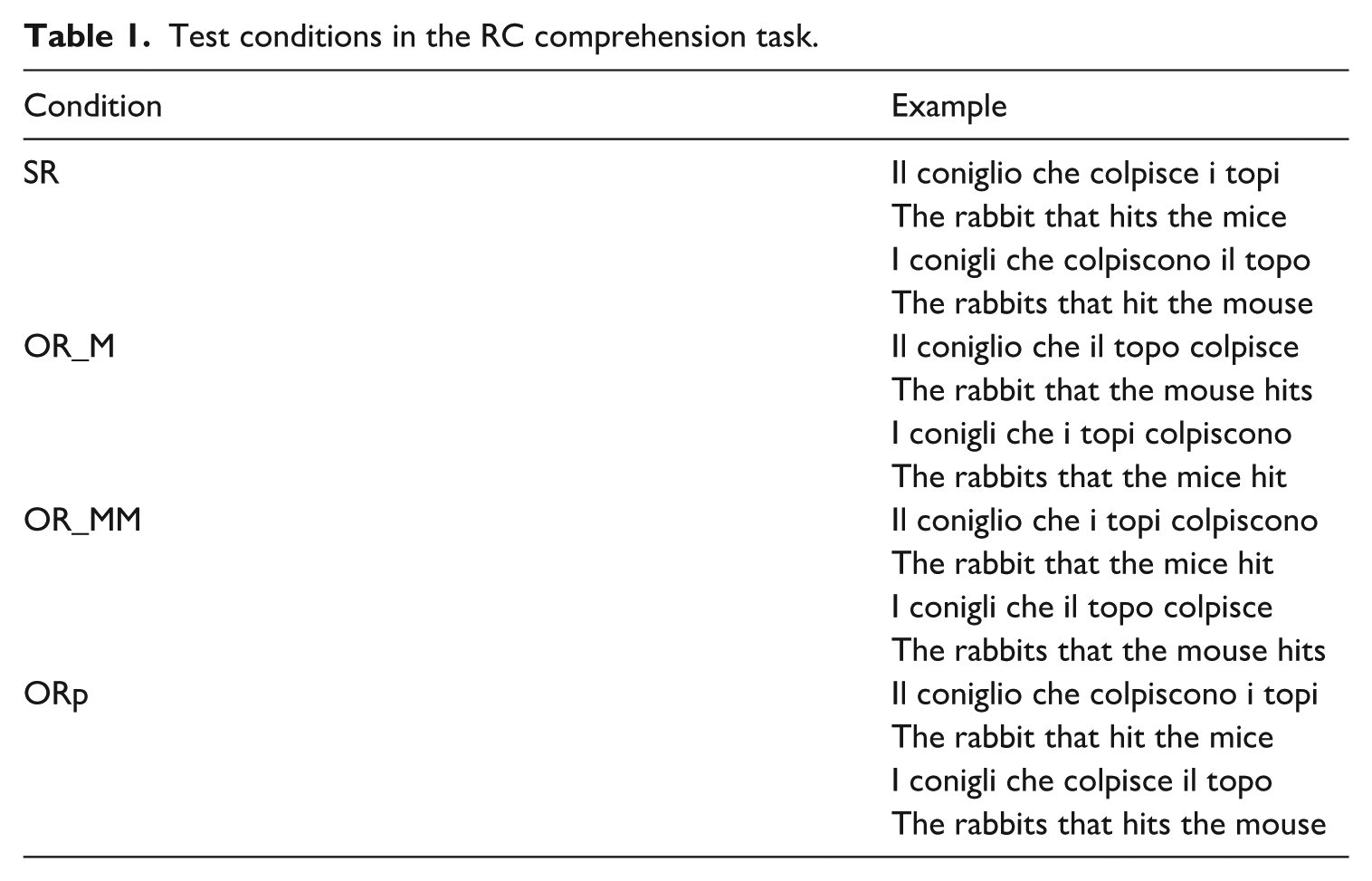
Only right-branching relative clauses were tested. The experimental sentences included 12 subject relatives (SR), 12 object relatives with preverbal subjects in which both DPs displayed the same number features (match condition, OR_M), 12 object relatives with preverbal subjects in which the two DPs displayed different number features (mismatch condition, OR_MM), and 12 object relatives with postverbal subjects and different number features (ORp). Table 1 shows all conditions.
Test conditions in the RC comprehension task.
Transitive reversible verbs that were compatible with both DPs were used for experimental items. Experimental sentences were interspersed with filler sentences. Fillers contained intransitive verbs or transitive verbs with animate subjects and inanimate objects. Filler sentences were interpretable without relying exclusively on syntactic cues.
A verb comprehension task preceded the administration of the experimental task to make sure that all participants were familiar with the verbs used. In addition, the nouns contained in each trial were introduced before reading the sentence in order to facilitate lexical retrieval and character recognition.
Results
This study yielded three sets of results: memory task results, RC comprehension results, and correlation analyses between memory tasks and RC comprehension.
In the memory tasks, Mann–Whitney tests were used for between-group comparisons (CI vs LA and CI vs CA) as sample sizes were small and the measurement scale for these data was interval. In the RC comprehension task, between-group and within-group analyses were carried out using generalized linear mixed effects logistic models (GLMEs), given the categorical (dichotomic) nature of the dependent variable (‘correct’ vs ‘incorrect’ response). Independent variables were group (CI vs LA, CA) and sentence type (SR, OR_M, OR_MM and ORp). Random effects were participants and items. The factors that provide a better fit to the data were investigated. In mixed logit models, in order to decide whether a predictor contributes significant information to the model, a model including the predictor is contrasted against a model without it using a χ2 test (Jaeger, 2008). GLMEs were also used to investigate the predictive value of phonological short-term memory (PSTM), verbal short-term memory (STM) and working memory (WM) in the comprehension of the different RC conditions. All analyses were carried out using R statistical software (R Development Core Team, 2018). Individual participant analyses were carried out to see how many children with CIs performed 1.5 SD below the mean performance of children with NH in the different tasks.
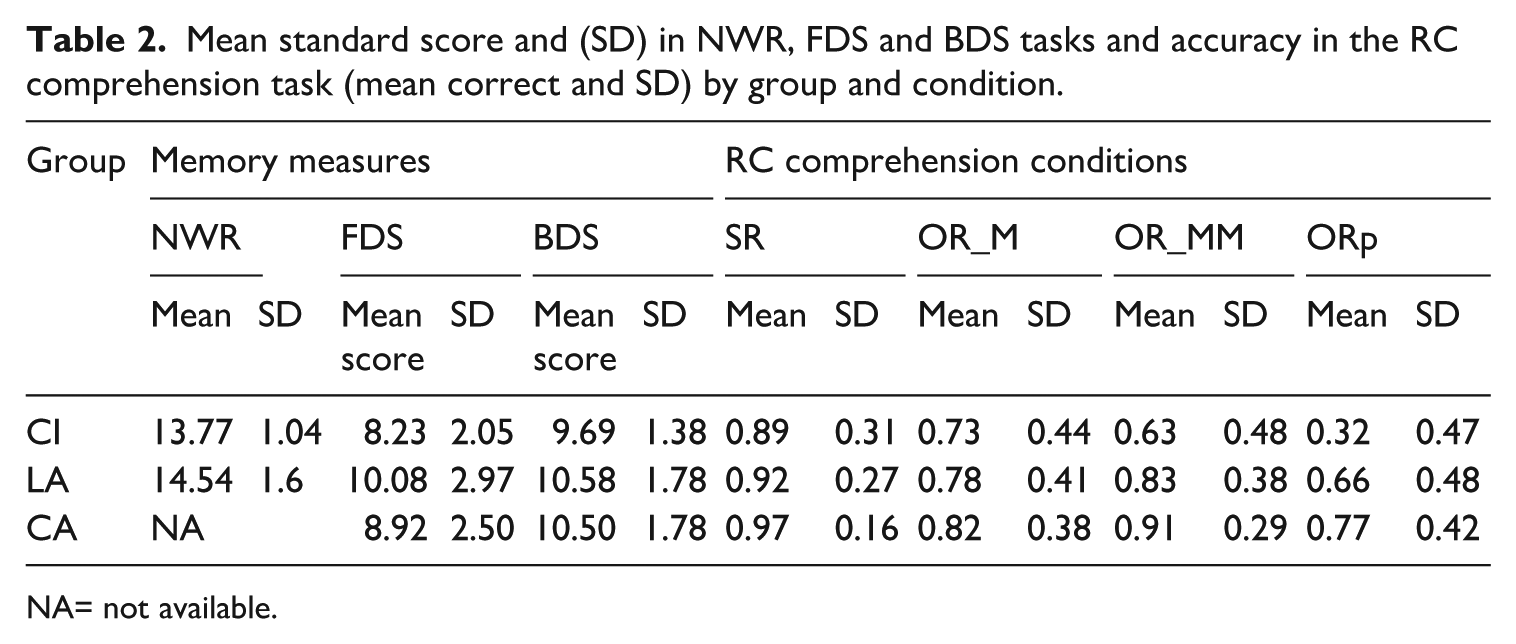
Table 2 summarizes the mean scores (and standard deviations) obtained in the NWR, FDS and BDS tasks and the proportion of correct answers (and SD) in the task assessing RC comprehension.
Mean standard score and (SD) in NWR, FDS and BDS tasks and accuracy in the RC comprehension task (mean correct and SD) by group and condition.
NA= not available.
Memory tasks
NWR was significantly less accurate in the CI group compared to the LA group (Mann–Whitney U = 43 p = .012).
In the FDS and BDS tasks, raw scores were converted into standard scores using the tables contained in the TEMA manual. Although the mean score of each subtest is lower in the CI group than in LA and CA groups, the Mann–Whitney test reveals no significant difference between the experimental group and each of the control groups in both verbal STM and WM skills (p > .05 for all comparisons). 1
The RC comprehension test
GLMEs were used to carry out between-group and within-group analyses in the RC comprehension task. Mean accuracy scores and standard deviations for all groups and for each sentence type are presented in Table 3. The CI group was first compared to the LA group and then to the CA group.
Estimated coefficients, standard errors (SE), Z-values and p-values for the group factor (CI vs LA and CI vs CA).

Between-group analysis
Table 3 summarizes estimated coefficients, standard errors, Z-values and associated p-values for the group factor (CI vs LA on the left and CI vs CA on the right) when both overall comprehension and comprehension in each sentence type are considered.
Comparing the CI and the LA groups, the variable group significantly contributed to the model fitting (χ2(1) = 4.86, p < .03). Overall, the LA group performed significantly better than the CI group. The analysis also considers the four sentence types separately. In SR and in OR_M, the variable group was not a significant predictor, and the two groups did not significantly differ from each other (χ2(1) = 0.92, p = .34 and χ2(1) = 1.71, p = .68, respectively). In OR_MM and ORp conditions, the variable group significantly predicted performance accuracy (χ2(1) = 4.74, p = .03 and χ2(1) = 8.60, p = .003, respectively). The LA group was significantly more accurate than the CI group.
Comparing the CI and the CA groups, the variable group significantly contributed to the model fitting (χ2(1) = 13.26, p < .001). Overall, the CA group performed significantly better than the CI group. When considering the four conditions separately, in SR and in OR_M, the variable group was not a significant predictor of performance (SR: χ2(1) = 2.88, p = .09; OR_M: χ2(1) = 0.64, p = .423): the two groups did not significantly differ from each other. In the OR_MM and ORp conditions, the variable group was a significant predictor (OR_MM: χ2(1) = 11.03, p < .001; ORp: χ2(1) = 14.80, p < .001). In both cases, the CA group performed significantly better than the CI group.
Within-group analysis: sentence type factor
Within each group, the variable sentence type was investigated in order to determine whether this variable was a significant predictor of performance and whether a specific type of sentence (SR, OR_M, OR_MM, ORp) was significantly more accurate than the others. Table 4 summarizes estimated coefficients, standard errors, Z-values and associated p-values for the sentence type factor within each group.
Estimated coefficients, standard errors (SE), Z-values and p-values for the sentence type factor within each group.
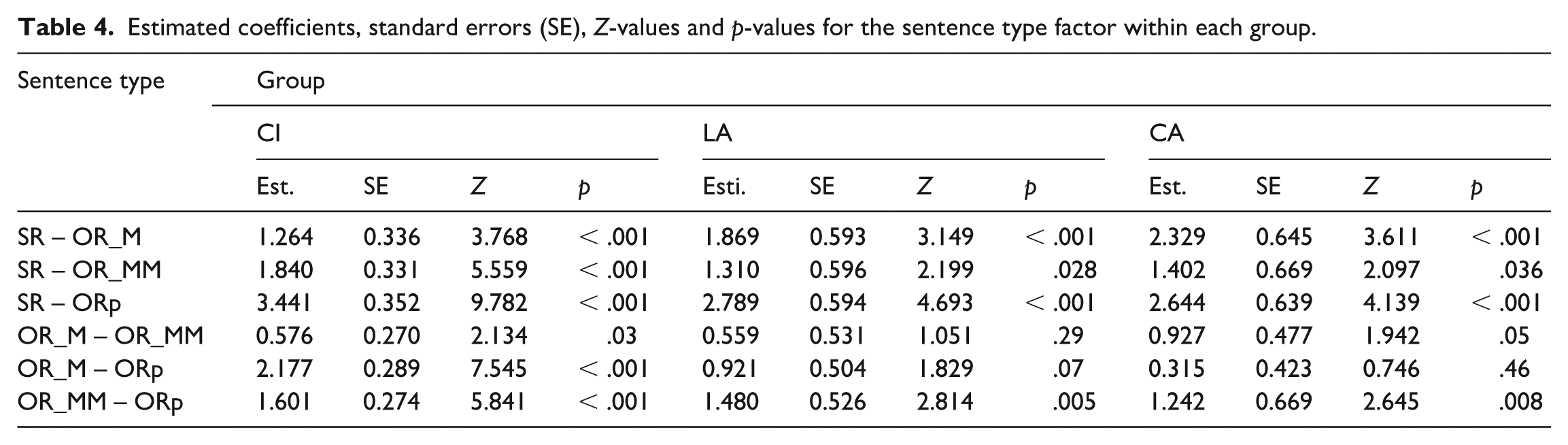
Within the CI group, the variable sentence type was a significant predictor of performance (χ2(3) = 70.3, p < .001). SR were significantly more accurate than OR_M, OR_MM and ORp. OR_M were significantly more accurate than OR_MM and ORp. OR_MM were significantly more accurate than ORp. In sum: SR > OR_M > OR_MM > ORp.
Within the LA group, the variable sentence type was a significant predictor of performance (χ2(3) = 22.17, p < .001). SR were significantly more accurate than OR_M, OR_MM and ORp. Although the percentage accuracy is higher in OR_MM than in OR_M, no significant difference was found between the two sentence types. The difference between OR_M and ORp was only marginally significant. OR_MM were instead significantly more accurate than ORp. In sum: SR > OR_M, OR_MM > ORp.
Within the CA group, the variable sentence type was a significant predictor of performance (χ2(3) = 23.17, p < .001). SR were significantly more accurate than OR_M, OR_MM and ORp. No significant difference was found between OR_M and ORp. Instead, OR_MM were significantly more accurate than OR_M and ORp. In sum: SR > OR_MM > OR_M, ORp.
Relationship between memory and relative clause comprehension
Further within-group analyses using GLME models aimed at identifying a possible relationship between verbal STM skills, WM skills, phonological STM skills, and accuracy in the RC comprehension task. The results of these analyses are reported in Table 5.
Relationship between relative clause accuracy and memory scores.

NWR = nonword repetition; FDS = forward digit span; BDS = backward digit span; NA = not available; Ns = not significant.
In the CI group, only verbal STM skills were significant predictors in the comprehension of OR_MM (χ2(1) = 3.94, p = .05) and ORp (χ2(1) = 5.03, p = .024); the increase of the STM span also corresponded to better performance in these sentence types. In all other cases, NWR, BDS and FDS were not significant predictors of RC comprehension.
In the LA group, BDS was found to be a significant predictor of performance in the comprehension of relative clauses. For every sentence type (SR, OR_M, OR_MM, ORp), accuracy significantly increases as the BDS increases. FDS and NWR were not significant predictors in the comprehension of any RC type.
In the CA group, only the FDS was a significant predictor and only in the comprehension of OR_MM (χ2(1) = 4.81, p = .028); the increase of the span also corresponds to better performance in this sentence type. For all other conditions, BDS and FDS were not significant predictors of RC comprehension. The relationship between RC accuracy and NWR was not investigated since the data on the NWR task were not available for some participants of the CA group.
Individual performance of the participants with CIs
We examined the individual performance of the children with CIs in the different tasks. Table 6 shows individual participant performance for children with CIs on the memory and repetition tasks (NWR, FDS and BDS) and the RC comprehension task (broken down by condition: SR, OR_M, OR_MM, ORp). On the left side of the table, the ‘X’ indicates performance scores 1.5 SD below the LA controls; on the right side of the table, the ‘X’ indicates performance scores 1.5 SD below the CA controls.
Children with CI who scored 1.5 SD below the mean of the LA group (on the left) and below the mean of the CA group (on the right).

NWR = nonword repetition; FDS = forward digit span; BDS = backward digit span.
In comparison with the LA group, three children with CIs scored below the mean of the LA group in memory tests (one in FDS, one in BDS and one in NWR), and three in some conditions of the RC comprehension task.
In comparison with the CA group, two additional children with CIs scored below the mean of the control group. One participant with CI scored below the mean of the CA group only in BDS. Six children with CIs failed in some conditions of the RC comprehension task. Only one participant who failed in the FDS also failed in the comprehension of object relatives with number manipulation of the two DPs.
Summary of results
In summary, children with CIs performed significantly worse than NH children in NWR, but not in the digit span tasks. In RC comprehension, they performed worse than both LA and CA groups, especially in OR_MM and ORp conditions. The regression analyses investigating the predictive value of memory in RC comprehension showed that only digit span was a predictor of performance. In the LA group, BDS was a significant predictor for all sentence conditions. In the CA group, FDS predicted comprehension of ORps. In children with CIs, FDS was a predictor of OR_MM and ORp conditions.
The individual performance analysis showed that eight children with CIs scored below the mean of control groups (6 below the mean of the LA group and 8 below the mean of the CA group). Some participants with CIs scored below the control groups only in memory measures, some others only in RC comprehension, and one scored below the (CA) control group both in memory measures (FDS) and object relative comprehension.
Discussion
This study addressed three main issues focusing on the group of children with CIs: the performance in a RC comprehension task, the performance in verbal STM, in WM and in PSTM tests, and the relationship between performance in RC comprehension and the three memory measures. In relative clauses in Italian, in addition to displacement of the NP into sentence initial position, syntactic cues (word order) and number feature manipulation may play an important role in the comprehension of (object) relative clauses.
In addition to the comparison with children matched on grammar (LA, age: 5;0–7;9), already reported and discussed in Volpato (2012), in this study the comparison with NH age peers is also presented (CA, age: 7;9–10;8). The comparison between the LA and CI groups highlighted a difference in performance between the two groups, the former performing significantly better than the latter. A significant difference was also expected in the comparison between the CA and CI groups. This was observed when examining overall performance. Given the higher percentages in the CA group in all sentence conditions, a significant difference would be expected for all of them. However, no significant difference was found in the SR and OR_M conditions. Despite delayed access to linguistic input, children with CIs showed age-appropriate language performance on the conditions in which only syntactic processes (NP movement to the left periphery) occurred.
Within-group analyses showed that comprehension accuracy was higher for SRs than for ORs in all groups. Following Friedmann et al. (2009), Volpato (2012) explained the difficulties with ORs appealing to locality effects arising when the object that moves across the subject shows a partial overlap of nominal features with that subject. What is also relevant for correct computation of ORs by NH children is number mismatch on the two DPs. Both LA and CA groups showed higher percentages under mismatch conditions than when the two DPs display the same number features (especially the group of younger ones). For the control participants, when syntactic processes are combined with number manipulation in object relatives, RC comprehension improves. The same important role of number features was highlighted for typically developing children by Adani et al. (2010), who tested the use of these cues in centre-embedded RCs. In our study, children with CIs showed the reverse pattern of children with NH: ORs with number mismatch were significantly more problematic than ORs with number match, suggesting that the problem is the computation of number features on the two DPs and/or the embedded verb. Number features and number marking on verbs may remain underspecified and not computed in DHH children (Chesi, 2006; Volpato, 2010, 2012). Correct assignment of thematic roles to sentence constituents may therefore become problematic. This phenomenon also predicts lower comprehension accuracy in ORp comprehension in children with CIs compared to LA and CA children. The failed or compromised interpretation of number features (along with the need to wait until the postverbal subject is uttered to comprehend the relative clause) can lead to incorrect theta-role assignment. In particular, some children with CIs are unable to exploit the morphological number information while processing complex syntactic structures, and therefore fail to perform correct theta-role assignment.
The second issue concerns the assessment of PSTM, verbal STM and WM in the experimental and the control groups using NWR and FDS and BDS tasks, respectively. In the NWR task, the CI group performed slightly worse than the LA group, although the magnitude of the difference is small, but significant. Unfortunately, the comparison with the CA group was not possible, because PSTM skills were not measured in all the participants of this group. The overall worse performance of the CI group as opposed to the LA group supports the hypothesis that children with CIs may have deficits in PSTM. Individual performance analyses showed that specifically one child was below the mean of the LA group in this memory measure. Poorer PSTM skills in children with CIs as opposed to children with NH were highlighted by several studies assessing memory resources through NWR tasks (Dillon & Pisoni, 2006; Penke & Wimmer, 2018; Talli et al., 2018; see Guasti et al., 2014, for contrasting findings). This suggests that phonological representations in children with CIs are not as robust as those of NH children.
In verbal STM and WM skills, no significant difference was observed between the CI group and the two groups of NH children. To our knowledge, this is the first study to compare children with CIs and NH children using digit span tasks in Italian. These findings are unexpected if they are compared with those of previous studies on other languages (Conway et al., 2009; Pisoni et al., 2011). However, although at group level no significant difference was observed between the experimental and the control groups, individual performance showed that two children were below the mean of both LA and CA groups. One child showed low WM skills, while the other showed low verbal STM skills. Further investigation is needed for Italian to clarify whether the different findings are due to cross-linguistic differences, to methodological issues, or to specific (clinical) characteristics of the participants involved in the different studies.
The third issue is the investigation of the relationship between RC comprehension and memory skills (verbal STM, WM and PSTM). The task assessing PSTM did not predict syntactic comprehension in any of the groups. Hence, the difficulties with the RC comprehension task cannot be attributed to poor PSTM. The lack of correlation between these two measures was also reported by Penke and Wimmer (2018) for younger German children (ages 3–4) fitted with conventional hearing aids. Other studies (e.g. Dillon et al., 2004), however, found a positive correlation between PSTM and different speech and language outcomes (spoken word recognition, language comprehension and speech production). Although the age groups in Dillon et al. (2004) and the current study are similar, different findings are likely due to the use of different tools to test language outcomes. Dillon et al. (2004) used general standardized tests. The current study, like Penke and Wimmer (2018), examined language performance on selected structures with experimental paradigms designed to tap into specific properties of language.
The only memory measure that was a significant predictor of RC comprehension, albeit to a different extent in each group, was digit recall. In the LA group, WM predicted performance under all sentence conditions. This result is probably due to the fact that all types of relative clauses are complex structures that rely on WM in comprehension. Even though SRs maintain an SVO word order, they nonetheless involve the computation of a chain between the position internal to the embedded relative clause and the position in the main sentence, namely the computation of an argument with respect to two verbs. In addition, they require that long strings of words be held in memory and processed. This is specially taxing for young children. In the CA group, the relationship between verbal STM and syntactic comprehension was only found with OR_MM. Mismatch number features were found to facilitate correct theta-role assignment; to do so, however, they place a heavy computational load on the memory system. In the CI group, verbal STM was a significant predictor of performance in comprehension of OR_MM and ORps, where high memory resources are needed to exploit number features to assign theta-roles correctly. The individual performance analysis highlighted that one participant showed difficulties in both OR_MM and ORps and STM. In ORps, memory resources are necessary to keep the verb and its morphological features in stand-by until the postverbal subject is encountered (Volpato & Adani, 2009). In Volpato and Adani (2009), a positive correlation was found between ORps and WM. However, importantly, the sample was different, but also the RC comprehension and the digit span tasks were not the same, and different measures may sometimes yield different results.
Conclusion
The results from this study show the following points. First, children with CIs performed significantly worse than both groups of NH controls in RC comprehension, especially ORs. The performance of children with CIs was better in the match condition, as opposed to NH children who showed higher scores in the mismatch condition. Second, children with CIs showed significantly poorer PSTM than the LA group; in the tasks measuring verbal STM and WM, they showed poorer performance than both NH groups, but differences are not significant. Third, for no group was a correlation found between NWR and comprehension of RCs, while digit span was a significant predictor of syntactic comprehension. These findings suggest that the weak PSTM of children with CIs may be related to the degraded signal of their hearing devices which affects phonological representations. However, the weak PSTM does not seem to be directly linked to their difficulties in RC comprehension. Verbal STM and WM were significant predictors of syntactic comprehension to a different extent in each group. For the LA group, WM appears to play a significant role in the computation of all types of relative clauses, while for the CA and the CI groups, verbal STM influences comprehension of OR_MM and ORps, respectively, i.e. the two conditions in which higher memory resources are required in order to exploit number features to assign theta-roles correctly.
In conclusion, memory skills play a more significant role in the computation of complex syntactic structure for younger children (LA group), probably because full maturation of these cognitive functions has still not occurred. These cognitive functions might not develop in children with CIs in the same way as the NH population, probably due to limited language exposure before implantation. This weakness in memory may be a reason for the non-optimal usage of morpho-syntactic cues such as number features.
Footnotes
Appendix
Clinical individual profiles of the participants with CI.

| ID | Age |
Age of HA |
Age of CI |
CI use |
HL |
HL with HA |
HL with CI |
|---|---|---|---|---|---|---|---|
| (Y;M) | (Y;M) | (Y;M) | (Y;M) | (dB) | (dB) | (dB) | |
| 1 | 10;8 | 0;9 | 2;2 | 8;6 | 90 | 85 | 30 |
| 2 | 7;11 | 1;2 | 1;11 | 6;0 | > 90 | 75 | 25 |
| 3 | 7;9 | 1;0 | 3;4 | 4;5 | > 90 | 85 | 30 |
| 4 | 9;6 | 1;6 | 2;4 | 7;2 | > 90 | 85 | 30 |
| 5 | 9;6 | 1;6 | 2;3 | 7;3 | > 90 | 55 | 30 |
| 6 | 9;6 | 1;6 | 2;4 | 7;2 | > 90 | 85 | 30 |
| 7 | 8;10 | 1;0 | 2;11 | 5;11 | 90 | 65 | 30 |
| 8 | 9;5 | 1;8 | 2;3 | 7;2 | > 90 | 85 | 30 |
| 9 | 9;9 | 0;9 | 2;8 | 7;1 | > 90 | 85 | 30 |
| 10 | 9;10 | 0;5 | 1;9 | 8;1 | > 90 | 85 | 30 |
| 11 | 9;3 | 0;10 | 1;9 | 7;6 | > 90 | 85 | 30 |
| 12 | 8;1 | 1;0 | 1;10 | 6;3 | > 90 | 85 | 25 |
| 13 | 8;2 | 1;4 | 2;3 | 5;11 | > 90 | 75 | 25 |
HL: hearing loss; HA: hearing aids; CI: cochlear implantation; Y: years; M: months; dB: decibel.
Acknowledgements
I thank the children of the ‘Centro Medico di Foniatria’ of Padua, the ‘Unità Operativa di Otorinolaringoiatria’ at the Hospital ‘Santa Maria del Carmine’ of Rovereto, Trento, and the ‘Centro IRCCS E. Medea Associazione “La Nostra Famiglia”’ of Conegliano, Treviso, their speech therapists and their parents, as well as the children at ‘Istituto Comprensivo “A. Gramsci”’ in Campalto, Venice, their teachers and their parents. Furthermore, I thank the editors, Prof. Chloe Marshall and Prof. Stavroula Stavrakaki, and two anonymous reviewers for their constructive comments, which were useful to improve the manuscript. I also thank Anna Cardinaletti and Giulia Bencini for their helpful comments and suggestions.
Funding
The author received no financial support for the research, authorship, and/or publication of this article.
