



Abstract
When taught a label for an object, and later asked whether that object or a novel object is the referent of a novel label, preschoolers favor the novel object. This article examines whether this so-called disambiguation effect may be undermined by an expectation to communicate about a discovery. This expectation may explain why 4-year-olds do not show the disambiguation effect if a sense modality shift occurs between training and test. In Study 1, 3- and 4-year-olds learned a label for a visible object, then examined two hidden objects manually and predicted which one they would be asked about. Only the older group predicted that they would be asked about the object that matched the visible object. Study 1 also included a test of the standard disambiguation effect, where both the training and test objects were visible. Both 3- and 4-year-olds showed a weaker disambiguation effect in this test when the matching object was unexpected rather than expected. In Study 2, both age groups predicted they would be asked about this object when it was unexpected. In Study 3, both age groups showed a stronger disambiguation effect when allowed to communicate about this object before deciding which object was the referent of a novel label. Metacognitive ability predicted the strength of this disambiguation effect even after controlling for age and inhibitory control. The article discusses various explanations for why only 4-year-olds abided by the pragmatics of discovery in the test of the cross-modal disambiguation effect, but both 3- and 4-year-olds abided by it in the test of the standard disambiguation effect.
Keywords
When uncertain of the referent of a novel label, even very young children adopt rational strategies for identifying it. For example, if taught a label for an object (e.g., zav), and then tested for whether they think this object or a novel object is the referent of a novel label (e.g., blicket), they favor the novel object (Diesendruck & Markson, 2001; Kalashnikova et al., 2016; Scofield & Behrend, 2007; Suanda & Namy, 2013). This result is one example of the so-called disambiguation effect (Merriman & Bowman, 1989), or tendency for children to map novel labels onto novel objects rather than objects that already have known labels. This effect has received considerable research attention because it may play an important role in children’s language comprehension and word learning.
According to two leading accounts, the effect results because children detect a mismatch between the label that they just learned for one of the objects and the novel label. According to the mutual exclusivity account (Markman & Wachtel, 1988; Merriman & Marazita, 1995), children tend to assume that two labels will not have exemplars in common. Therefore, they reject application of the novel word to the object that has the known label. According to the pragmatic contrast account (Clark, 1990; Diesendruck & Markson, 2001; Gathercole, 1989), children tend to assume that a speaker will adopt a cooperative way of referring to objects. Because it would be uncooperative to use a novel label to refer to something if there is already a known way of referring to it, they decide that the speaker must not be referring to the novel object.
Both mutual exclusivity and pragmatic contrast are considered default assumptions. Children are hypothesized to reject these assumptions in specific cases if they receive compelling evidence against them (Diesendruck & Markson, 2001; Merriman & Bowman, 1989). For example, Jaswal (2010, Study 2) found that 2-year-olds nearly always selected a familiar object rather than a novel object when the experimenter simultaneously looked at and pointed toward the familiar object when requesting the novel label’s referent. Likewise, in a study by Grassmann and Tomasello (2010), both 2- and 4-year-olds showed this same tendency when the experimenter pointed toward the familiar object while alternating gaze between the object and the child. Weaker pragmatic cues, such as looking at the familiar object without pointing at it or pointing at the familiar object while looking at the child, have been found to be less effective in blocking children’s tendency to map novel labels to novel objects (Graham et al., 2010; Grassmann & Tomasello, 2010; Jaswal, 2010; Jaswal & Hansen, 2006).
The goal of the current investigation was to examine whether another type of pragmatic cue can undermine young children’s disambiguation effect, namely, discovery of an object of mutual significance (Wall et al., 2015). We hypothesize that children expect to communicate about an object if it was important in a previous interaction and is encountered unexpectedly (Liebal et al., 2010). We will refer to this expectation as the pragmatics of discovery.
Our rationale for examining whether the pragmatics of discovery can undermine the disambiguation effect was to advance our understanding of both novel word mapping and pragmatic expectations in early childhood. As already noted, young children will decide that a novel label refers to a familiar rather than a novel object, contra the disambiguation effect, if the speaker’s pointing and gaze clearly indicate that the familiar object is the intended referent. However, there is little evidence that more conceptual pragmatic cues can have this effect, especially in younger children. For example, Haryu (1991) presented several trials in which Japanese children learned that a character who was experiencing a need state (e.g., hunger) wanted a novel-named object (e.g., ‘(the) heku’). They had to choose between a familiar object that would meet the character’s need (e.g., an apple) and a novel object that would not (e.g., a lipstick holder). Three-year-olds tended to select the novel object, but 5-year-olds tended to select the familiar object. Gollek and Doherty (2016) found a similar difference between 3- and 4-year-olds in a study of Austrian children and similar trends in two studies of 3- and 4-year-old Scottish children.
Gollek and Doherty (2016) proposed that unless a child understood that two labels can express different perspectives on the same object, they would be reluctant to satisfy the pragmatic cue by overriding their usual tendency to avoid mapping a novel label to an object with a known label. In support of this proposal, they found that in each of their studies, performance on tests of understanding of multiple perspective (e.g., understanding of false belief) predicted selection of the familiar object as the referent of the novel label, even after the effects of age and vocabulary size were statistically controlled.
We examined whether there is a similar age difference in the tendency for the discovery of an object of mutual significance to undermine the disambiguation effect. Very young children have shown a tendency to communicate about a discovery in situations in which doing so does not conflict with other cues or dispositions. For example, in one study (Liebal et al., 2010), 18-months-olds played with a set of toys with one experimenter and a different set of toys with a second experimenter. Later, one of the experimenters led them to a room where the infants saw a picture of each type of toy. The majority spontaneously pointed to the toy that had just been the focus of their play with the experimenter (see also Liebal et al., 2009; Saylor & Ganea, 2007).
The pragmatics of discovery may be so fundamental that it can undermine the disambiguation effect even in very young children. On the other hand, there is indirect evidence that this pragmatic cue does not acquire this power until children are at least 4 years old. This evidence comes from studies of the cross-modal disambiguation effect (Scofield et al., 2009, 2018; Wall et al., 2015). In this paradigm, children learn a label for a novel object that is presented in a single sense modality (either vision or touch), then encounter a copy of that object and a different object in the other sense modality, and must decide which is the referent of a second label. For example, they might examine a hidden object with their hands and hear it called a ‘zav.’ Next, they would be shown a pair of objects that includes an exact copy of the zav and asked, ‘Which one is a lerb?’ They show the cross-modal disambiguation effect if they select the one that is not a zav.
The circumstances in which preschool-age children have shown the cross-modal disambiguation effect are complex. The key findings come from studies in which the test of the second label (e.g., lerb) was not presented until children had demonstrated that they could recall the first label (e.g., zav) (see Table 1). In these studies, 3-year-olds showed the touch-to-vision version of the effect (i.e., when the first label was trained for a tactile object and the test of the second label involved a pair of visual objects) (Scofield et al., 2018), but not the vision-to-touch version of it (e.g., when the first label was trained for a visual object and the test of the second label involved a pair of tactile objects) (Wall et al., 2015). They did not show the vision-to-touch effect even when the test question was preceded by a match prompt. The prompt involved asking the children to indicate which tactile object matched the visual training object. Even though 3-year-olds responded correctly to this prompt, they did not avoid selecting this object when later asked whether it or the other tactile object was the referent of the second label. In contrast, 4-year-olds did not show either the touch-to-vision or vision-to-touch disambiguation effect unless they received the match prompt (Scofield et al., 2018; Wall et al., 2015).
Variation in the cross-modal disambiguation effect as a function of age, match prompt, and direction of sense modality change in previous studies.
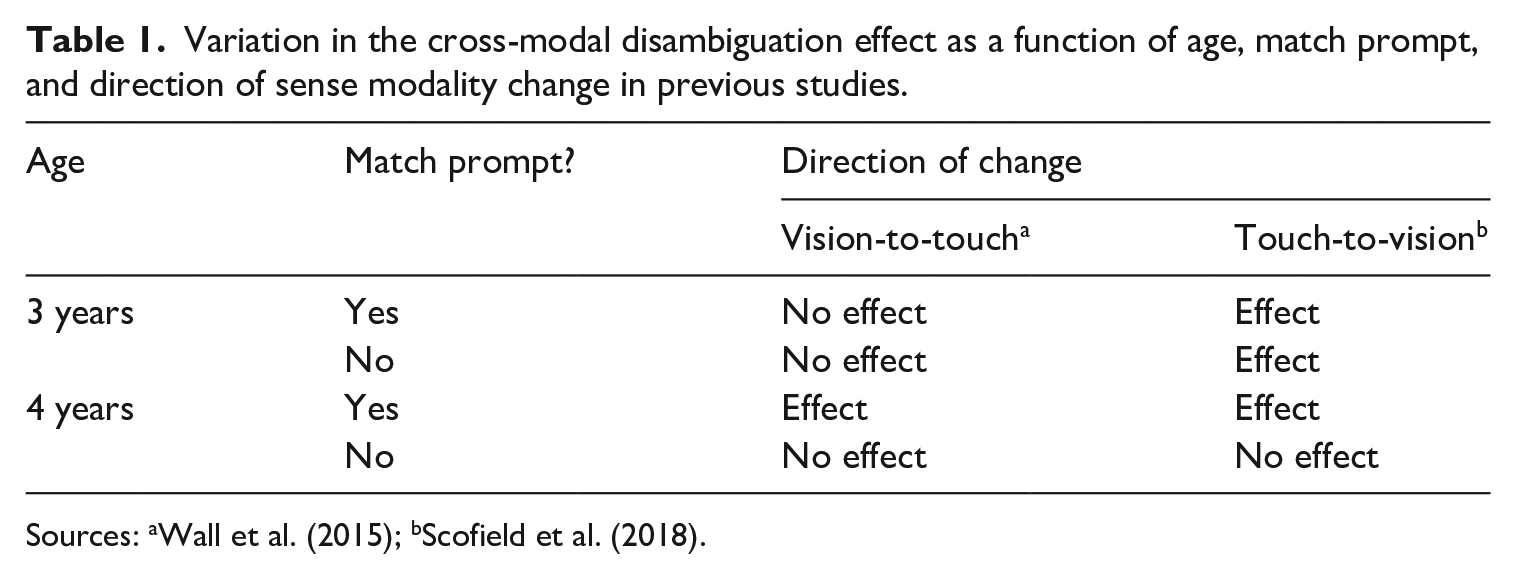
Sources: aWall et al. (2015); bScofield et al. (2018).
Scofield et al. (2018) offered two proposals to explain why the match prompt only affected 4-year-olds and why direction of modality change only affected 3-year-olds. First, they proposed that only 4-year-olds abided by the pragmatics of discovery. When these children discovered that one of the test objects matched the object that the adult had just trained them to label, they expected to communicate with the adult about this object. This expectation interfered with the children’s usual tendency to avoid mapping a second label to an object that already has a known label. It either directly overrode their assumption that a new label would not refer to the same thing as a known label or caused them to ‘mis-hear’ the adult’s request (i.e., believe that they had heard a request for the referent of the known label).
This proposal explains why the 4-year-olds did not show either the touch-to-vision or vision-to-touch effect when the adult’s request was not preceded by the match prompt. It also explains why when the request was preceded by the match prompt, 4-year-olds showed both versions of the effect. The match prompt allowed them to abide by the pragmatics of discovery by first communicating about the discovered object of mutual significance (the cross-modal match). Because they satisfied this expectation, it did not interfere with their comprehending the subsequent request involving the second label or conflict with their default assumption that this label would not refer to the same object as the known label.
Consistent with Scofield et al.’s (2018) proposal, 3-year-olds showed no evidence that they abided by the pragmatics of discovery. In the vision-to-touch test, they did not avoid label overlap even when the match prompt preceded the request for the second label’s referent (Wall et al., 2015). In the touch-to-vision test, they avoided label overlap; however, they avoided it even when a match prompt did not precede the request for the second label’s referent. Thus, this age group’s performance was affected by direction of modality change, but not by whether they received a match prompt.
Scofield et al.’s (2018) other proposal was that the test phase in the vision-to-touch procedure was more demanding than in the touch-to-vision procedure. Encoding a pair of hidden objects with one’s hands required more working memory resources than encoding a pair of visible objects with one’s eyes. Because 4-year-olds have greater working memory processing resources than 3-year-olds, only the younger group was adversely affected by the greater demands of the vision-to-touch test. Only in the touch-to-vision test did they have enough resources to retrieve the known label for the cross-modal match, note that this label did not match the novel label, and consequently, reject the cross-modal match. (Scofield et al. suggested that the key breakdown in the touch-to-vision test was failure to retrieve the known label for the cross-modal match; however, it is possible that the greater resource burden in this test caused breakdowns in one or more of the processes that are required for the disambiguation effect.) Four-year-olds had enough resources to carry out these processes even in the more demanding vision-to-touch test. This proposal explains why the cross-modal disambiguation effect was affected by the direction of sense modality change in the 3-year-olds, but not the 4-year-olds.
The current investigation addressed two limitations in previous research. First, the evidence for the impact of the pragmatics of discovery on the disambiguation effect is indirect. Because 4-year-olds showed the cross-modal disambiguation effect only if they received a match prompt (Scofield et al., 2018; Wall et al., 2015), we inferred that the prompt gave them an opportunity to satisfy a communication expectation that would have interfered with the effect. Studies 1 and 2 included a more direct test of children’s communication expectations. After an adult taught them a label for a novel object, she presented a copy of that object and another novel object and asked them questions about which object she was going to ask about.
The second limitation is that previous research has only examined the impact of the pragmatics of discovery on the cross-modal disambiguation effect. In Studies 1, 2, and 3, we examined its impact on the ‘standard’ disambiguation effect, in which every object is visible and no sensory modality shift occurs.
Finally, we addressed gaps in previous research concerning the relation between metacognitive ability and the disambiguation effect (see Henning & Merriman, 2019). Study 3 was the first study to examine this relation for a test of the standard disambiguation effect in which the pragmatics of discovery was relevant. It was also the first to examine whether the relation held even after controlling for individual differences in inhibitory control.
The Institutional Review Board (IRB) of Kent State University approved the ethics of the procedures followed in each of the reported studies. In each study, a child was only allowed to participate if a parent or guardian signed and returned the IRB-approved consent form and the child assented to the procedure.
Study 1
Three- and 4-year-olds performed two tasks. The first addressed Scofield et al.’s (2018) proposal that in the test of the cross-modal disambiguation effect, only the older group would expect to communicate about the test object that matches the training object. This task was a modified version of the vision-to-touch procedure of Wall et al. (2015, Study 1). Each trial began with an adult teaching a label for a visual object, then asking the children to examine two hidden objects with their hands. One object was identical to the visual object (i.e., the cross-modal match) and the other was novel. Next, rather than asking them to decide which object was the referent of a novel label, the adult gave the children a brief period to make comments and then asked them what they thought she was going to ask about the objects. If Scofield et al.’s proposal is correct, only the 4-year-olds should tend to report that they expected to be asked about the cross-modal match. Only this age group should tend to express an expectation consistent with the pragmatics of discovery.
The second task addressed whether the pragmatics of discovery could undermine the standard disambiguation effect. On each trial in this task, the adult taught a novel label for an object that the children inspected both visually and tactually. They then watched as the adult put this object in either a box at her feet (in the unexpected match condition) or a box on a nearby shelf (in the expected match condition). In both conditions, the adult then showed the children that the box from the shelf contained both an object that was identical to the training object and a novel object. She asked them to select the referent of a novel label (i.e., tested the disambiguation effect). Because children in the expected match condition had just seen the adult place the training object in the box, they should have expected to find this object when the box was opened. Because children in the unexpected match condition had just seen the adult place the training object in the box at her feet, they should not have expected to find an exact copy of it in the box from the shelf. If they reacted to this discovery by expecting to communicate about it, this reaction may interfere with their usual tendency to avoid selecting this object as the referent of a novel label. If so, the standard disambiguation effect should be weaker in the unexpected match condition than in the expected match condition.
Method
Participants
Fifty-two 3- and 4-year-olds participated. All were recruited from preschools in middle- to upper-class areas close to the university. Nearly every child was Caucasian and all were monolingual speakers of English. Each child received a sticker for participating.
For the test of the standard disambiguation effect, children were randomly assigned to two conditions. The unexpected match condition consisted of 18 3-year-olds (M = 43 months, range = 37–47 months; eight boys) and 18 4-year-olds (M = 54 months, range = 48–59 months; 12 boys). The expected match condition consisted of eight 3-year-olds (M = 42 months, range = 36–45 months; three boys) and eight 4-year-olds (M = 51 months, range = 48–54 months; four boys). Fewer children were assigned to this condition because previous studies that have used procedures like the ones used in this condition have obtained a ceiling-level disambiguation effect (e.g., Kalashnikova et al., 2016).
Materials
The materials used in the cross-modal expectations test were the same as one of the sets used by Wall et al. (2015) to test the cross-modal disambiguation effect. These included two copies of a novel object, a different novel object, and a white wooden box (see Figure 1). The box had a large opening on one side and two arm holes (3 inch diameter) cut into the opposite side. The arm holes had cotton sleeves attached to them.
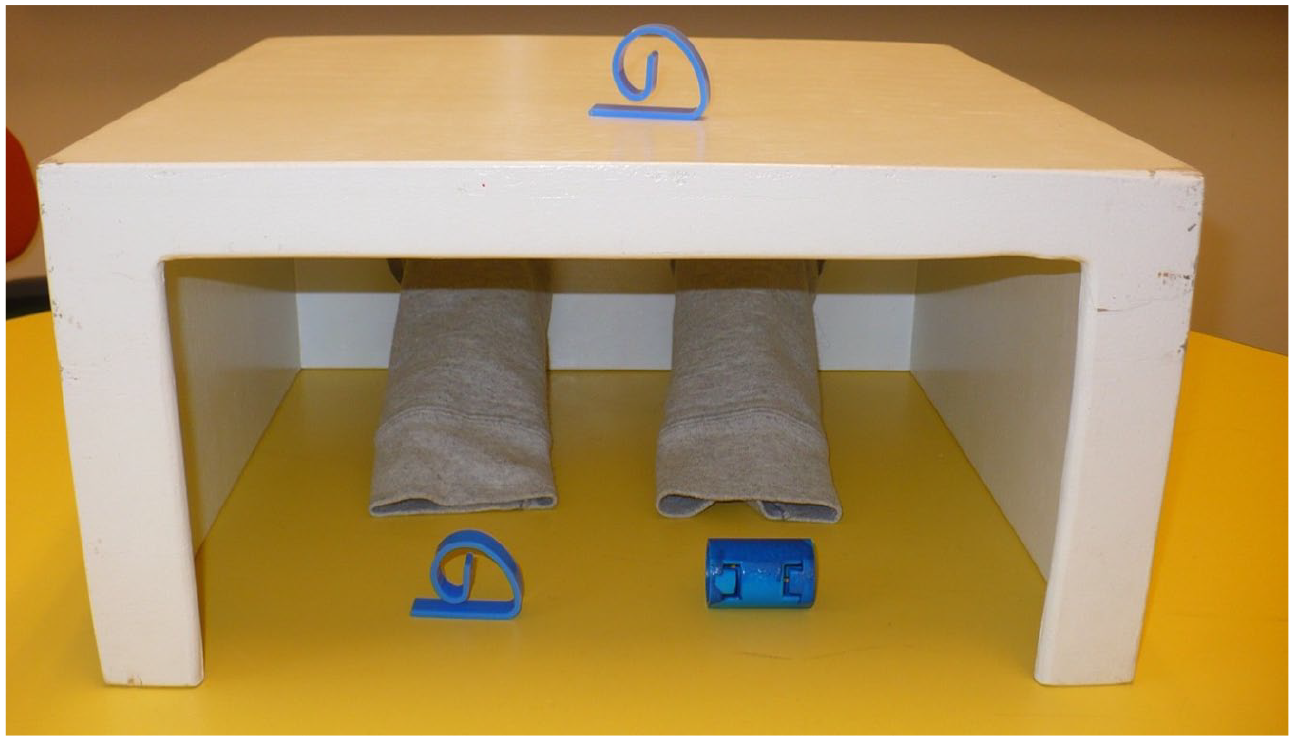
Box used in the cross-modal expectation task of Study 1.
The materials used in the standard disambiguation test included two other sets of novel objects from Wall et al. (2015). Each set consisted of two copies of the same object and a different object. Two opaque boxes (approximately 4 in × 3 in × 4 in) that differed in color (red vs. blue) were also used in this task. Each box had a removable top that made it possible to conceal a pair of the objects inside the box.
Five nonsense words (e.g., zav, mido, tigg, cobe, ferp) were used as either one of three trained labels or one of two novel labels. Each word was used on only one trial. The specific trial in which each word was used was counterbalanced.
Procedure
Children participated in a 10–15 minute session in a quiet room at their preschool. Each child received the cross-modal expectations test and the standard disambiguation test in counterbalanced order.
Cross-modal expectations test
The experimenter sat opposite the child at a small table and positioned the white box on the table so that the arm holes were facing the child. As a warm up, the child was asked to close his or her eyes while the experimenter placed a soft, foam ball inside the box. The child was then asked to place his or her arms through the arm holes, pick up the object, and answer three questions: ‘Is it hard or is it soft?’, ‘Is it big or is it small?’, and finally, ‘What is it?’ After answering the final question, the child was shown the ball for the first time.
Next, the child was told that they were going to play a game. The experimenter explained that she was going to show them an object and tell them the name for it. She also told them that they were not allowed to touch the object; they were only allowed to look at it. The experimenter showed the child one of the novel objects and labeled it three times (e.g., ‘This is a zav. It’s a zav. You’re looking at a zav.’). She asked the child to repeat the name out loud. To ensure that the child had learned the label for the object well enough to retrieve it later, a distractor task that lasted approximately 5 seconds followed. The object was removed from sight and the child was asked to state how many fingers the experimenter held up. The child did this for two finger displays. The experimenter then showed the child the object again and asked what it was called. If the child did not recall the label correctly, the experimenter labeled it herself and then repeated the whole procedure (beginning with ‘This is a . . .’) until the child successfully recalled the label. If the child did not recall the label after three training and test cycles, the experimenter taught the name one more time and then proceeded to the expectation assessment phase of the test.
The training object was placed on top of the box, and the child was instructed to close his or her eyes. The experimenter then placed two objects inside the box. One was identical to the still-visible training object (i.e., ‘the cross-modal match’) and the other was novel. The experimenter told the child to open his or her eyes, put his or her arms through the sleeves, and hold the objects that the experimenter placed in each hand. Children’s spontaneous comments about the objects were recorded. After 5 seconds, the experimenter asked a series of questions to assess the children’s expectations: (1) ‘I’m going to ask you a question about one of those things. What do you think I’m going to ask you?’ (2) ‘I’m going to ask you to pick one of these things. Which one do you think I’m going to ask you to pick?’ (3) ‘Can you give me one of those?’ For each question, the experimenter recorded children’s comments and any instances in which they used nonverbal cues to direct the experimenter to one of the objects (e.g., showing, pointing, redirecting gaze toward it).
Standard disambiguation test
The child completed two trials. At the beginning of each trial, the experimenter brought out a novel object from a box at her feet, showed it to the child, and labeled it three times (e.g., ‘This is a mido. Can you say mido? Let’s look at the mido’). Children were encouraged to hold and examine the object for approximately 5 seconds.
In the unexpected match condition, the experimenter made sure that the child watched as she put the training object back inside the box at her feet. She then directed the child’s attention to a red box on a shelf that was approximately 3 feet to the left of the table. The experimenter pointed toward the box, told the child that they were going to play with what was inside, and then retrieved the box placing it on the table between them. The experimenter removed the lid to reveal two objects inside: a copy of the training object (e.g., another mido) and a novel object. The experimenter then asked for the referent of a novel label (e.g., ‘Look! There’s a tigg in there! Can you give me the tigg?’). The child was encouraged to reach inside the box and hand one of the objects to the experimenter. After the child made his or her selection, the experimenter thanked the child, placed the objects back inside the box and returned it to its original location.
The second trial followed immediately. It was identical to the first trial except for the particular pair of novel objects, pair of novel labels (e.g., cobe, ferp), and box on the shelf. The experimenter took one of the objects out of the box at her feet, trained a label for it, returned it to the box, then asked the child to retrieve a blue box that was approximately 3 feet to the right of the table. After removing the lid to reveal that the box contained a copy of the training object and a novel object, the experimenter asked the child to select the referent of a novel label.
In the expected match condition, the procedure was the same except that after training the label, the experimenter did not place the training object back in the box at her feet. Rather, she directed the child’s attention to the red (or blue) box located to the left (or right) and said, ‘See that box? I’m going to put the mido in there.’ The experimenter walked over to the box, opened the lid, placed the object inside, then closed it again. As in the other condition, she then told the child that they were going to play with what was inside the box, placed it on the table, revealed the pair of objects inside, and asked the child to select the referent of a novel label.
Results
Cross-modal expectations test
Table 2 shows how many children mentioned or chose the training object (i.e., the cross-modal match) during various phases of the test. Before the first prompt, children’s spontaneous comments about either of the objects were scored. Only three 4-year-olds made such a comment. In each case, they made the comment while holding up the matching object to show it to the experimenter. (They themselves could not see either object during the entire test.) Their comments were: ‘I think this is a zav’; ‘I think one’s a zav’; and ‘Is this another zav?’ Very few children responded to the first prompt. Only one 3-year-old selected the matching object. She held it up and said, ‘The zav.’ Three held up the novel object. Their comments were: ‘What is this?’; ‘Hard or soft?’; and ‘A bowl.’ Five 4-year-olds held up the matching object and none held up the novel object. Their comments were: ‘The zav’ (three children); ‘This is the cobe’; and ‘That they’re the same.’ In response to each of the final two prompts, every child held up one of the objects. Some of these responses were accompanied by pronominal references (e.g., ‘This one.’). More 4-year-olds selected the matching object than selected the novel object in response to these prompts (19 vs. 7 for ‘Which . . . ask you to pick?’ χ2 (1) = 5.54, p = .019; 20 vs. 6 for ‘Can you give me one of those?’ χ2 (1) = 7.54, p = .008). In contrast, equal numbers of 3-year-olds (13) selected each object in response to each prompt.
Choices (or mentions) of the training object in the expectations test.

N = 26 per age group in each study.
A global score reflecting the tendency to choose/mention the matching object was created by giving children one point for each choice/mention they made of this object during the different phases/prompts of the test (max = 4 points). Four-year-olds tended to choose/mention this object more often than 3-year-olds (M = 1.81, SD = 1.13 and M = 1.04, SD = 1.00, respectively), t (50) = 2.60, p = .01, r = .35.
Standard disambiguation test
Every child in the expected match condition, regardless of age, selected the novel object rather than the training object as the referent of the novel label on both trials of the standard disambiguation test. That is, as predicted, when children saw the experimenter place the training object in the box, they showed a ceiling-level disambiguation effect.
Table 3 shows the number of children in the unexpected match condition who selected the novel object on 0, 1, or 2 trials. (There were no instances in which a child refused to respond on a trial.) Four-year-olds showed a significant disambiguation effect in that the number who selected the novel object on both trials (11) exceeded the number who never selected it (1), p = .003 by the binomial distribution. (M proportion novel object selections = .78, SD = .31.) Three-year-olds showed a similar tendency, with 9 selecting the novel object on both trials versus 4 never selecting it, although the trend was not significant, p = .133. (M = .64, SD = .41). The trends in the two age groups were not significantly different from each other, two-tailed Fischer exact p = .322.
Frequency of selection of the novel object in the standard disambiguation task of Study 1.

aN = 18 per age group. bN = 8 per age group.
If a one-tailed test is applied, even the disambiguation effect that the 4-year-olds showed in the unexpected match condition was significantly less than the ceiling-level disambiguation effect that this age group showed in the expected match condition. Seven of the 18 4-year-olds in the unexpected match condition selected the training object on at least one trial, whereas none of the eight in the expected match condition did so, one-tailed Fisher exact p = .048. Likewise, nine of the 18 3-year-olds in the unexpected match condition selected the training object on at least one trial, whereas none of the eight in the expected match condition did so, one-tailed Fisher exact p = .016. For this comparison in the entire sample (i.e., combining the two age groups), one-tailed Fisher exact p < .001.
Discussion
According to Scofield et al. (2018), when the test of the disambiguation effect involves a sense modality shift, 4-year-olds tend to abide by the pragmatics of discovery, but 3-year-olds do not. That is, when the older children discover that one of the test objects is a cross-modal match to the training object, they expect to communicate with the experimenter about it. Consistent with this proposal, when asked which of the two test objects they expected to be asked about, 4-year-olds tended to select the cross-modal match, whereas 3-year-olds showed no preference. This same age difference remained when the children were then asked to give the experimenter an object.
We also found that children’s tendency to abide by the pragmatics of discovery can disrupt the disambiguation effect even when no sense modality shift occurs. After learning a label for an object that was presented both visually and tactilely, children were asked to look in a box and decide which of the two objects inside – a novel object or the training object – was the referent of a novel label. Just before looking in the box, children had seen the training object either placed in the box or placed elsewhere. This manipulation affected both 3- and 4-year-olds. The children who had seen the training object placed in the box, and thus were not surprised to find it there, showed a ceiling-level disambiguation effect. The children who had seen the training object placed elsewhere, and thus should not have expected to find a copy in the box, showed a weaker disambiguation effect.
Whereas only 4-year-olds tend to abide by the pragmatics of discovery when the test objects are presented in a different sense modality than the training object, both 3- and 4-year-olds tended to abide by it when the test objects and the training object were both presented visually. Three-year-olds may only find a match between an object in a new setting and an object that had just been the focus of conversation to be noteworthy if they believe the two objects are identical.
If interference caused by the pragmatics of discovery explains why 3- and 4-year-olds had a weaker disambiguation effect in the unexpected match condition, then both age groups should show that they anticipate communicating about the matching object in this condition. To test this prediction, Study 2 used the same methods as in the cross-modal expectations test of the current study, but without the sense modality shift. Both training and test occurred in the visual modality. After learning a label for a visual novel object (which then remained in view), the children were directed to look in a box that contained another copy of that object and a novel object. They then received the same series of prompts as in the cross-modal expectations test.
Study 2
Participants
Twenty-six 3-year-olds (M = 42 months, range = 36–47 months; 14 boys) and 26 4-year-olds (M = 54 months, range = 49–59 months; 11 boys) participated. The children were recruited from the same populations as Study 1. (None had participated in that Study.) Nearly all were Caucasian and all were monolingual speakers of English. Each child received a sticker for participating.
Materials
The materials included the red box that had been used in the standard disambiguation test of Study 1 and the objects that had been used in the cross-modal expectations test of Study 1.
Procedure
The children participated in a 5 minute session in a quiet room at their preschool. The experimenter sat opposite the child at a small table and placed the red box between them. The box was closed so that the contents were not visible. The child was told that they would see an object, learn its name, and then be shown two things inside the box. The experimenter showed the child the training object, labeled it three times (i.e., ‘This is a zav. It’s a zav. You’re looking at a zav.’), then asked the child to repeat the name out loud. The experimenter then administered the same distractor task and label training procedure as in Study 1.
Once the child had succeeded in recalling the label for the training object, the object was placed on the table in full view of the child. The experimenter then opened the box, showing that it contained another copy of the training object and a novel object. She told the child to look inside, but not touch the objects. After 5 seconds (in which a few children made spontaneous comments), the experimenter asked the same series of questions as in the cross-modal expectation task in Study 1.
Results
Table 2 shows how many children chose/mentioned the training object after each prompt. As in Study 1, children received one point for each choice/mention of this object. Three-year-olds’ score (M = 1.85, SD = .97) did not differ from 4-year-olds’ score (M = 1.58, SD = 1.17), t (50) = .90, p = .37. The two age groups’ frequencies of choice/mention of the training object were quite similar for each prompt.
Three-year-olds’ expectation to communicate about the visual training object was stronger than this age group’s expectation to communicate about the training object in the cross-modal expectations test of Study 1 (M = 1.04, SD = 1.00), t (50) = 2.96, p < .01, r = .39. In response to the open-ended prompt (‘What . . . going to ask you?’), eight 3-year-olds indicated the training object in the current study, whereas only one did so in Study 1, two-tailed Fisher exact p = .024. In response to the directive prompts, more 3-year-olds in the current Study selected the training object than the novel object (18 vs. 8 for ‘Which . . . going to ask you to pick?’ χ2 (1) = 3.85, p = .050; 19 vs. 7 for ‘Can you give me one of those?’ χ2 (1) = 5.54, p = .019). In Study 1, in contrast, the same number of 3-year-olds selected the training object as selected the novel object (13 vs. 13 for both prompts).
Four-year-olds’ expectation to communicate about the training object in the current study was no different from this age group’s expectation to communicate about this object in the cross-modal expectations test of Study 1 (M = 1.81, SD = 1.13), t (50) = .72, p = .47. Four-year-olds’ frequency of choice/mention of the training object in the two studies was similar for each prompt. However, the number who selected this object in response to the two directive prompts in Study 1 (19 and 20 out of 26) exceeded chance, whereas the number who responded this way in the current study (16 and 17 out of 26) did not.
Discussion
The results provided support for the pragmatics-of-discovery explanation for the weakness of 3- and 4-year-olds’ standard disambiguation effect in the unexpected match condition of Study 1. In the current study, both age groups showed that they expected to communicate about the visual test object that was an unexpected identical copy of the visual object for which they had just learned a label.
In Study 1, 3-year-olds showed no evidence that they anticipated being asked about a tactile test object that was an unexpected match to a visual object for which they had just learned a label. Only 4-year-olds did. Three-year-olds may only find a match between an object in a new setting and an object that had just been the focus of conversation to be noteworthy if they perceive the two objects to be identical.
In Study 3, we tested an implication of the claim that 3- and 4-year-olds’ tendency to abide by the pragmatics of discovery weakens the standard disambiguation effect. We tested the hypothesis that both age groups would show a stronger effect if they received a match prompt before they were asked to select the referent of the novel label than if they did not receive a match prompt. We also examined whether metacognitive ability and inhibitory control were associated with the strength of the effect in this test.
Study 3
In the main task, an adult taught children a label for a visible novel object, then asked them to look in a box that contained an unexpected copy of this object and a novel object. As in Study 1, the adult asked them to pick the one that was the referent of a novel label. The main difference in procedure was that for children in the match prompt condition, this request was preceded by a request to identify the object in the box that was the same as the training object. Children in a control condition did not receive this additional request.
We hypothesized that allowing children to first identify the match would satisfy their expectation to communicate about this object. Consequently, this expectation would not be a source of interference when they later decided whether this object or the novel object was the referent of a novel label. In contrast, children in the control condition should experience such interference. We predicted that both 3- and 4-year-olds would benefit from the prompt because of the evidence from Studies 1 and 2 that both age groups anticipate being asked about the unexpected matching object in the standard disambiguation paradigm.
A second goal was to examine whether the disambiguation effect in the modified standard paradigm was associated with individual differences in metacognitive ability and inhibitory control. Awareness of lexical knowledge is a specific metacognitive ability that has been found to be associated with both the standard disambiguation effect (Merriman & Bowman, 1989; Merriman et al., 1993; Merriman & Schuster, 1991) and the cross-modal disambiguation effect (Wall et al., 2015). For example, those preschoolers who responded more accurately when asked whether they knew names for various objects tended to show a stronger cross-modal disambiguation effect, especially in the match prompt condition (Wall et al., 2015). Such results may reflect the tendency of these children to adopt a metacognitive representation of the disambiguation problem. That is, their tendency to select the novel object may be more robust because in addition to detecting the mismatch between the novel label and the label they know for the familiar object, they also note that the novel label and the novel object are both novel/unknown, whereas the familiar object is familiar/known (Henning & Merriman, 2019; Slocum & Merriman, 2018).
An alternative hypothesis is that the association between awareness of lexical knowledge and disambiguation is due to individual differences in inhibitory control. Children who have difficulty inhibiting ‘Yes’ responses to ‘Do you know?’ questions may also have difficulty inhibiting impulsive object selections in the disambiguation test. To our knowledge no study has evaluated this alternative hypothesis.
To assess awareness of lexical knowledge, children were asked, ‘Do you know the name for this?’ regarding various familiar and unfamiliar objects. Previous studies have found marked individual differences in preschoolers’ tendency to say ‘No,’ regarding the unfamiliar objects (Marazita & Merriman, 2004; Wall et al., 2015). To assess inhibitory control, children were administered the Kansas Reflection-Impulsivity Scale for Preschoolers (KRISP; Wright, 1971) and Whisper (Kochanska et al., 1996). In the KRISP, children are shown a drawing of an object (the target) and asked to pick the drawing that matches it. Because the foils are very similar to the target, children must delay selecting a drawing until after they have determined that its features match the features of the target completely. Carlson and Moses (2001) found KRISP to load with measures of inhibitory control that require delaying the execution of a prepotent response. In Whisper, children are shown familiar and unfamiliar cartoon characters and asked to whisper their names. Because they are typically excited to see the familiar characters, the response of whispering their names conflicts with their natural tendency to shout out their names. Carlson and Moses (2001) found this test to load with measures that require executing a novel response that conflicts with a prepotent response.
Method
Participants
Equal numbers of 3- and 4-year-old children (N = 26 per age group) participated. In each age group, half were randomly assigned to the match prompt condition (3-year-olds: M age = 42.9 months, SD = 3.1, range = 38–47 months, nine boys; 4-year-olds: M age = 54.6 months, SD = 3.8, range = 48–59 months, seven boys). The remaining children were assigned to the control condition (3-year-olds: M age = 41.8 months, SD = 2.9, range = 38–47 months, seven boys; 4-year-olds: M age = 54.2 months, SD = 4.0; range = 48–59 months, eight boys). The children were recruited from the same populations as in Study 1 and 2. (None had participated in those studies.) Nearly all were Caucasian and all were monolingual speakers of English.
Materials
Standard disambiguation test
The materials were like those used for this test in Study 1. More materials were required because the number of trials was increased from two to four to increase reliability. The materials included four sets of three unfamiliar objects (two of which are identical to each other), four small boxes (each a different color) and eight novel words (zav, tigg, cobe, hust, lide, ferp, beck, jeet). Two small backpacks were also used.
Kansas Reflection-Impulsivity Scale for Preschoolers (KRISP)
The standard version of this test (Wright, 1971) was used. Stimuli included 16 sets of black and white line drawings. Each set consisted of a target drawing and four to six choice drawings.
Whisper
Stimuli included 10 black and white pictures of cartoon characters. Six were likely to be highly familiar to a preschool-aged child (Elsa, Elmo, Sponge Bob, Spiderman, Scooby-Doo, and Mickey Mouse), and four were likely to be unfamiliar to them (Huckle, Fat Albert, Elmer, Petunia). Some of the familiar characters in the original test (Kochanska et al., 1996) (e.g., the Beast from Beauty and the Beast) were replaced with characters judged to be more familiar to the current cohort of preschoolers (e.g., Elsa from Frozen).
Object name knowledge judgment
Stimuli included 12 objects; six were common objects (flashlight, key, sock, toy car, fork, toothbrush) and six were uncommon objects for which preschoolers were unlikely to know names (plate hanger, tube squeezer, egg slicer, spouncer [a circular foam sponge attached to a wooden handle], latch hook, gel heel cushion).
Procedure
Children were tested in a quiet room in their preschools. In the first session, two experimenters took turns administering different trials of the standard disambiguation test. A day later, one of the experimenters administered the KRISP, Whisper, and Name Knowledge Judgment tests. The order of these three tests was counterbalanced over the sample. Each session lasted approximately 10 minutes. Children received a sticker at the end of each session.
Standard disambiguation test
The experimenters introduced themselves and engaged the child in a brief conversation. One experimenter then left the room. The other experimenter took a novel object out of her backpack and placed it on the table. She labeled it three times (e.g., ‘This is a cobe. Can you say cobe? Let’s play with the cobe’) and encouraged the child to play with it. She then said, ‘I’m going to put the cobe away’ and put it back in her backpack. The experimenter announced, ‘I brought some other things to play with. Hold on while I get them.’ She left the room for a few seconds, then returned with one of the colored boxes. She told the child that they were going to play with what was inside. The experimenter opened the box so the child could see that it contained a copy of the training object and a different novel object.
Procedure then varied by condition. In the control condition, the experimenter gazed in the box, then back at the child and said, ‘Look, there’s a hust. Can you give me the hust?’ In the match prompt condition, the experimenter also gazed in the box, then back at the child, but said, ‘Which one is the same as the one we just saw?’ After the child in this condition had pointed to an object, the experimenter said ‘Okay.’ She then gazed back in the box, then back at the child and said, ‘Look, there’s a hust. Can you give me the hust?’
In both conditions, after the child had selected the referent of hust, the experimenter said, ‘Okay,’ then put the object back in the box. She told the child that it was the other experimenter’s turn to play and left the room carrying the box. The other experimenter entered the room and administered the next trial. The experimenters alternated in this fashion until four trials had been administered. Each trial involved a different set of novel objects, a different pair of novel labels, and a different colored box.
KRISP
The standard instructions (Wright, 1971) were followed. On each trial, children were shown one of the 16 stimulus sheets. They were told to pick the drawing in the array of choices that matched the target drawing. If the child selected an incorrect drawing, the experimenter pointed out why that choice was incorrect, then asked the child to pick again. If a child made more than three errors on a trial, the experimenter pointed to the correct drawing and proceeded to the next trial. The first trial was considered practice. Performance was measured by the total number of errors the child made on the remaining trials.
Whisper
The instructions that Kochanska et al. (1996) used for this test were followed. Children were told they were going to play a whisper game. Before beginning, each child was asked to whisper his or her name and was reminded to whisper throughout the game. The experimenter, also in a whisper, explained that she was going to show the child pictures of cartoon characters, and that the child should whisper their names. On each trial, the experimenter presented one of the 10 characters and asked, ‘Do you know who this is?’ The child’s responses were recorded using the following coding scale: 0 = shout; 1 = normal or mixed voice; 2 = a whisper. Performance was measured by mean score on familiar character trials. Only characters that the child knew/named were included in his or her overall score.
Name knowledge judgment
Children were shown six familiar and six unfamiliar objects one at a time and asked, ‘Do you know the name for this?’ Children were instructed to only say ‘yes’ or ‘no’ and not name the object out loud. Before beginning, the experimenter provided a short demonstration with one of the familiar objects (a flashlight) and one of the unfamiliar objects (a plate hanger) to ensure each child understood the task. If a child identified an unfamiliar object as having a known name, he or she was prompted to name this object at the end of the task. If the child named the unfamiliar object correctly, or produced a plausible overextension, the trial was dropped from the computation of his or her overall accuracy (M = .43 trials; range = 0–3). Accuracy was computed by averaging the proportion of familiar objects judged correctly and the proportion of unfamiliar objects judged correctly.
Results
Standard disambiguation test
Children in the match prompt condition tended to respond correctly when asked to identify the test object that matched the training object (3-year-olds: M correct (out of 4) = 3.23, SD = 1.17; 4-year-olds: M = 3.85, SD = .38). The age difference was not significant, Welch t (14) = 1.81, p = .091.
Figure 2 shows how often children selected the novel object as the referent of the novel label (max = 4, chance = 2). A 2 (age) × 2 (condition) ANOVA of this variable yielded a significant effect of condition, F (1, 48) = 7.05, p = .011, r = .36. Neither age nor the two-way interaction was significant. As predicted, children in the match prompt condition selected the novel object (M = 3.35, SE = .21) more often than children in the control condition (M = 2.46, SE = .25). Frequency of novel object selection exceeded chance in the match prompt condition, t (25) = 6.00, p < .001, r = .77, but not in the control condition, t (25) = 1.81, p = .083, r = .34.

Mean frequency of novel object selections in the standard disambiguation test of Study 3.
KRISP
The data from two 4-year-olds were excluded from analysis because their error total was more than 3 standard deviations above the mean. Because the distribution of the remaining children’s error totals had a marked positive skew, z = 5.23, p < .001, a square-root-transformed score was analyzed. A 2 (age) × 2 (condition) ANOVA yielded a significant main effect of age, F (1, 46) = 7.13, p = .010, r = .37. Neither condition nor the two-way interaction was significant. As expected, 3-year-olds made more errors (M = 13.00, SD = 7.82) than 4-year-olds (M = 8.00, SD = 4.30).
Whisper
One 4-year-old failed to complete this test. A 2 (age) × 2 (condition) ANOVA of the remaining children’s scores yielded no significant effects, all p > .20. Mean score (max = 2) was 1.38 (SD = .73) for 3-year-olds and 1.62 (SD = .69) for 4-year-olds. (The correlation between score and age-in-months, r (49) = .27, p = .053, fell just below the significance criterion.)
Name knowledge judgment
One 4-year-old failed to complete this test. A 2 (age) × 2 (condition) ANOVA of judgment accuracy yielded a significant main effect of age, F (1, 47) = 5.99, p = .018, r = .34. Neither condition nor the two-way interaction was significant. Four-year-olds’ judgments (M = .87, SD = .18) were more accurate than 3-year-olds’ (M = .73, SD = .21).
Intercorrelations
For the correlational analyses, the transformed KRISP scores were reverse-coded so that higher scores reflected higher levels of inhibitory control. Results are summarized in Table 4. The two measures of inhibitory control, KRISP and Whisper, were moderately correlated, which is consistent with previous results (Carlson & Moses, 2001). As predicted, name knowledge judgment accuracy was associated with the disambiguation effect. This association remained significant even after controlling for age, partial r (47) = .41, p = .003.
Correlations between measures in Study 3.
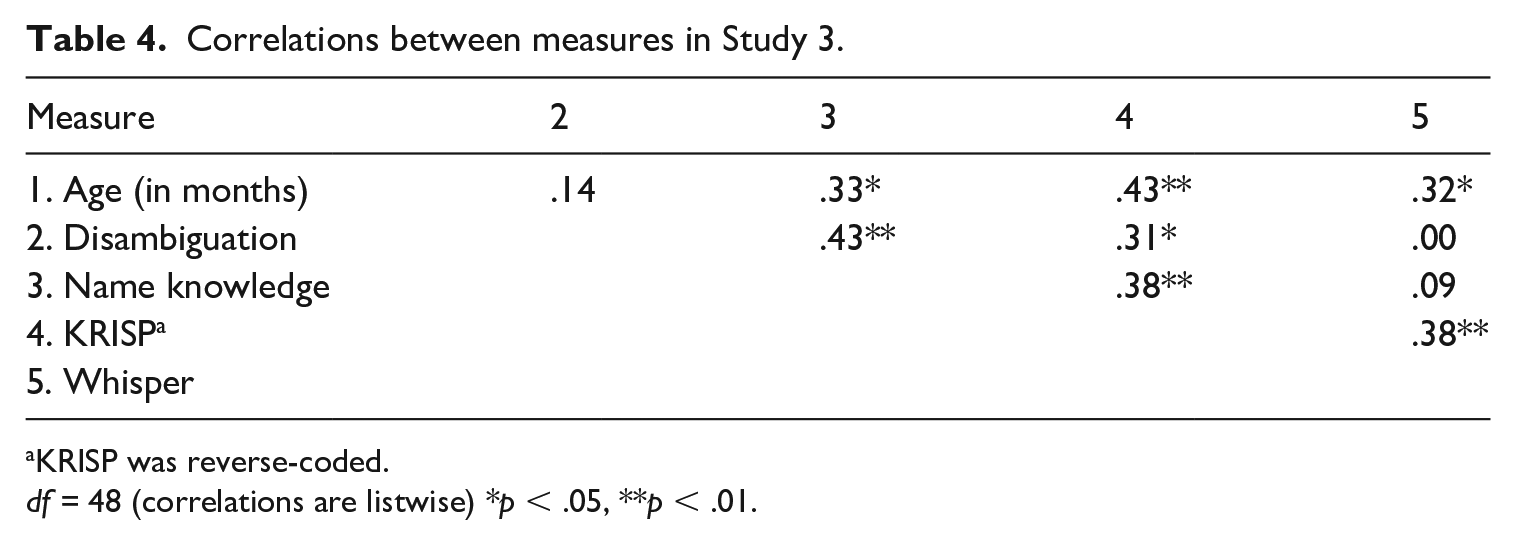
KRISP was reverse-coded.
df = 48 (correlations are listwise) *p < .05, **p < .01.
Regarding whether inhibitory control may account for this association, KRISP was associated with both name knowledge judgment accuracy and the disambiguation effect, but Whisper was not associated with either. After controlling for age, the two associations involving KRISP fell just below the criterion for significance, both partial r (47) = .28, p = .052. The correlation between name knowledge judgment and the disambiguation effect remained significant even after controlling for KRISP and age, partial r (46) = .36, p = .013. These findings support the hypothesis that the relation between name knowledge judgment and the disambiguation effect is independent of the association that these variables share with age and inhibitory control.
Hayes’ (2018) PROCESS program was used to examine whether KRISP might at least partially explain this relation. There was no evidence for partial mediation; the 95% CI for the index of mediation (.066, bootstrap SE = .055) included zero (bootstrap LL = –.020, bootstrap UL = .205). There was also no evidence that KRISP explained some of the variability in the disambiguation effect that was not explained by name knowledge judgment. KRISP and disambiguation were not significantly associated after controlling for name knowledge judgment, partial r (47) = .21, p = .14. Moreover, name knowledge judgment completely explained the relation between KRISP and the disambiguation effect, index of mediation = .137 (bootstrap SE = .076, 95% CI: .024, .327).
Finally, there was no evidence that the relations among these measures were different in the match prompt condition than in the control condition. In regression analyses using PROCESS (Hayes, 2018), condition was not a significant moderator of either the relation between name knowledge judgment and disambiguation, t (46) = .47, p = .64, or the relation between KRISP and disambiguation, t (46) = .58, p = .56.
Discussion
Three- and 4-year-olds who first identified the test object that matched the training object showed a stronger standard disambiguation effect than those who were not first asked to identify this match. This result provides further support for the conclusions of Study 1 and 2 that both age groups have a tendency to abide by the pragmatics of discovery, and that this tendency can oppose their usual tendency to select a novel object rather an object with a known label as the referent of a novel label. When children were asked to identify the matching object, they satisfied their expectation to communicate about it. Once satisfied, the expectation was no longer a potential source of interference with their usual tendency to select a novel object as the referent of a novel label.
A possible alternative explanation for why the match prompt strengthened the standard disambiguation effect is that responding to the prompt strengthened or consolidated children’s memory for the label they had been taught for the object. Although it is possible that the prompt had this effect, we think it is unlikely to completely explain the benefit of the prompt. First, in the expected match condition of the standard disambiguation task in Study 1, every 3- and 4-year-old showed the disambiguation effect. Previous studies that have used similar procedures have also obtained a ceiling-level disambiguation effect (e.g., Kalashnikova et al., 2016). If some children had difficulty remembering the label they had been taught for the training object, then the disambiguation effect in this condition would not have been at ceiling. Second, if label recall difficulty was the only cause of the weak disambiguation effect in the control condition of Study 3, it is surprising that no age difference was found in this condition. The 4-year-olds should have shown a stronger disambiguation effect than the 3-year-olds because 4-year-olds have better label recall skills than 3-year-olds (see Wall et al., 2015, Exp.1, for some evidence). Finally, the pragmatic expectation account, but not the label recall difficulty account, predicts the main finding of Study 2, which is that both 3- and 4-year-olds expected to be asked about the training object when they encountered it unexpectedly at test.
Consistent with previous findings (Merriman et al., 1993; Merriman & Schuster, 1991; Wall et al., 2015), individual differences in awareness of lexical knowledge were positively associated with the strength of the disambiguation effect even after controlling for age. There was also some evidence that individual differences in inhibitory control, as measured by the KRISP (Wright, 1971), were related to both the disambiguation effect and our measure of awareness of lexical knowledge (name knowledge judgment). However, the relation between the disambiguation effect and name knowledge judgment remained significant after controlling for both KRISP and age. These results are consistent with a metacognitive explanation rather than an inhibitory control explanation for why some preschoolers show a stronger disambiguation effect than others. According to the metacognitive explanation (Henning & Merriman, 2019; Slocum & Merriman, 2018), those children who are aware of their lexical knowledge tend to notice that the label and one of the objects in the disambiguation problem are both unknown, whereas the familiar object is known. This representation of the problem strengthens their tendency to select the novel object as the referent of the label.
General discussion
The current investigation addressed two limitations in past research on whether the pragmatics of discovery can undermine preschoolers’ tendency to avoid mapping novel labels to objects that have known labels. The first limitation was that the evidence that children abide by the pragmatics of discovery was indirect. Children’s communication expectations were not measured directly, but were inferred from the impact of a match prompt on their novel label mapping in a cross-modal paradigm (Scofield et al., 2018; Wall et al., 2015). The cross-modal expectations test of Study 1 provided direct evidence in support of the conclusions of past research. Specifically, in the vision-to-touch test 4-year-olds, but not 3-year-olds, showed that they anticipated being asked about the tactile test object that matched the visual training object. In Wall et al. (2015), a match prompt promoted the vision-to-touch disambiguation effect in 4-year-olds, but not in 3-year-olds.
The second limitation of past research was that it had only examined the impact of the pragmatics of discovery on the cross-modal disambiguation effect. The current investigation provided both direct and indirect evidence that it can undermine the standard disambiguation effect. Moreover, it provided this evidence for both 3- and 4-year-olds. In Study 2, when shown an object that unexpectedly matched a visual object they had just learned to label, both 3- and 4-year-olds anticipated being asked about this object rather than the novel object next to it. In Study 1, both age groups showed a weaker standard disambiguation effect when they did not expect to encounter the matching visual object in the test set than when they did expect to encounter it. In Study 3, a match prompt boosted both age groups’ later tendency to select the novel object over the unexpected matching object as the referent of a novel label. We had hypothesized that because answering the match prompt allowed them to satisfy their expectation to communicate about the matching object, the expectation would no longer interfere with their usual tendency to avoid mapping a novel label to an object that has a known label.
Some pragmatic cues, such as the direction of a speaker’s pointing and gaze, can counteract the disambiguation effect in children as young as 2 years (Grassmann & Tomasello, 2010; Jaswal, 2010). Other pragmatic cues, such as an object’s potential to satisfy a character’s expressed need, may only counteract the disambiguation effect in older preschoolers who have developed an understanding of multiple perspective (Gollek & Doherty, 2016). We found that an object’s status as a discovery of mutual interest could counteract the standard disambiguation effect in children as young as 3 years. Thus, although this pragmatic cue is more conceptual than pointing and gaze, children likely develop a tendency to abide by it before they develop an understanding of multiple perspective. It remains for future research to determine the earliest age at which the pragmatics of discovery can counteract children’s tendency to avoid mapping novel labels to objects that have known labels.
Three-year-olds tended to abide by the pragmatics of discovery in a test of the standard disambiguation effect, but not in tests of the cross-modal disambiguation effect. One possible explanation is that 3-year-olds spontaneously encode the matching test object as matching the training object in the standard test, but do not do so in the cross-modal test. Consequently, they only consider the matching object in the standard test to be a discovered object of mutual significance that they then expect to communicate about. One problem for this proposal is that 3-year-olds readily select the cross-modal match when asked to pick the test object that matches the training object (Scofield et al., 2018; Wall et al., 2015). However, even though they can select this match when asked, they may not spontaneously encode it as such. They may not notice that it is a match when engaged in deciding whether it or the novel object is the referent of the novel label. This explanation seems unlikely, however, because 3-year-olds show the cross-modal disambiguation effect in the touch-to-vision test (Scofield et al., 2018). Their success in this test implies that they spontaneously retrieve the label they learned for the tactile training object and apply it to the matching visual test object. If they execute these processes spontaneously during the test, it is likely that they also notice that the matching test object is a match.
A second possibility is that 3-year-olds notice that the cross-modal match is a match (i.e., another exemplar of the same category as the training object), but only expect to communicate about an object if they perceive it to be identical to an object of mutual significance. In the cross-modal situation, they can determine that the two objects match in shape and size, but do not know whether they also match in color, texture, and weight. By this explanation, only 4-year-olds consider the discovery of another object of the same size and shape as the training object to be noteworthy even if the two objects should happen to differ on other dimensions.
Future research could test this believed identity hypothesis in several ways. For example, in the touch-to-vision paradigm, after the pair of visual test objects is presented, the experimenter could ask 3-year-olds to say what color they think the tactile training object is and rate their confidence in this judgment (see Lyons & Ghetti, 2011, for evidence that this age group can be taught to judge their confidence). According to the hypothesis, very few 3-year-olds should be confident that the tactile object is the same color as its visual cross-modal match. Second, the hypothesis implies that any manipulation that increased 3-year-olds’ belief that the cross-modal match was identical to the training object should increase their tendency to select the cross-modal match rather than a novel object as the referent of a novel label. Finally, in the standard disambiguation paradigm, if the unexpected match were not identical to the original object, but was from the same category (e.g., differing only in color), the hypothesis implies that 3-year-olds should not expect to be asked about this object and thus, should not show a weakened disambiguation effect.
In Study 3, we found evidence for a relation between a specific metacognitive ability and the disambiguation effect. The children who showed greater awareness of their own lexical knowledge also showed a stronger tendency to map a novel label onto a novel object than onto an unexpected copy of an object for which they had just learned a label. Several previous studies have found a similar relation (see Henning & Merriman, 2019, for a summary). There were unique aspects to the current finding, however. First, there was no evidence that the relation was affected by whether children were asked to identify the copy before deciding which object was the referent of the novel label. Thus, the influence of awareness of lexical knowledge over novel label mapping may be independent of the influence of the pragmatics of discovery. Second, the relation between awareness of lexical knowledge and the disambiguation effect was evident even after controlling for individual differences in inhibitory control. These findings provide further support for the claim that the tendency to represent the elements of the disambiguation problem in metacognitive terms strengthens the tendency to solve it by mapping the novel label onto the novel object (Henning & Merriman, 2019; Slocum & Merriman, 2018).
In sum, the current investigation contributed valuable information regarding both pragmatic expectations and novel label mapping in early childhood. Even children as young as 3 years of age expect to communicate about a discovered object of mutual significance, and this expectation can affect the way that they resolve the ambiguous reference of a novel label. Both 3- and 4-year-olds expected to communicate about a visual object that a speaker had just taught them to label when they encountered this same visual object again unexpectedly. In addition, we found evidence for developmental change in this expectation. When children’s first encounter with the object was strictly visual and their second encounter was strictly tactile, only 4-year-olds showed the pragmatic expectation and its hypothesized impact on novel label mapping.
Footnotes
Acknowledgements
We appreciate the cooperation of the children from preschools in northeastern Ohio who participated in this research. We thank their parents and teachers too. We also thank Jason Scofield for his thoughtful critique of the article.
Funding
The author(s) received no financial support for the research, authorship, and/or publication of this article.
