



Abstract
This qualitative, exploratory research study is positioned within the field of Family Language Policy (FLP). Contextualised in bilingual Malta, where Maltese is the majority language, the study inquires into the effects of a plurilingual family language programme on the language ideologies within English-speaking Maltese families. The programme was followed by four such families over a four-week period, during which data were collected via the participants’ weekly entries into semi-structured family language journals. Upon the programme’s completion, a second set of data was collected via one-off, semi-structured, family focus group interviews, for the purpose of triangulation. The findings highlight interrelated issues across the macro, meso and micro levels of language ideology, contributing to existing research by postulating the potential of a family language programme to prompt ideological shifts in support of heritage-language engagement, transmission and maintenance.
Keywords
Introduction and background
The present study explores the participants’ reported use of a plurilingual family language programme (hereon simply referred to as the ‘programme’) that was custom-made for this research by the authors to facilitate Maltese-language engagement within English-speaking Maltese families facing ideological obstacles towards their bilingual aspirations. As explained below, the programme offers provocations for embedding the sociocultural (Vygotsky, 1987) usage of Maltese into everyday activities that parents and their young children often engage with collaboratively as part of their daily routines, thereby holding implications towards the fields of bilingual development and second-language learning.
Interrelated literature and discourses surrounding minority and heritage languages (Fishman, 2001) are also incorporated into this research, because Maltese is a minority language at the global level despite being the majority language at the local level, where it is additionally ‘minoritised’ within the Anglophone speech community (as illuminated shortly). However, for the sake of consistency, the authors refer to Maltese as the participants’ ‘heritage language’, since it fits well within the broad definition of the term as ‘the language a person regards as their native, home, or ancestral language’ (Richards & Schmidt, 2013, p. 259), which was also seen to offer a more nuanced focus on the affective dimension of their language engagement (Little, 2020a). Although the study took place within the Maltese context, its findings and related contribution to overcoming language shift (Fishman, 2001) have global ramifications within an era of language death and language revitalisation.
The inspiration for the programme primarily stems from the principal author’s navigation of her own family language policy (FLP), as a new mother raising her children within the speech community under study, within which she was born and raised by English-speaking Maltese parents, herself. Formosa’s positionality is also shaped by her experience of teaching children from similar backgrounds, which further sensitised her to the needs and realities of her speech community. Such positionality presents an inevitable bias; however, this was balanced by the second researcher, who has no personal affiliation with Malta or its speech communities.
These ‘speech communities’ refer to heterogeneous groups, comprising diverse personal, social, economic, demographic and linguistic factors. Even on the micro level, individual speakers may develop ‘multiple and often contradictory identities’ (Abdi, 2011, p. 165), so they cannot be rigidly categorised. Moreover, keeping in mind the fluidity of language usage in Malta (Vella, 2013), the authors’ reference to so-called ‘English-’ or ‘Maltese-speaking’ groups or individuals thus implies a predominant rather than exclusive usage of language and acknowledges their underlying heterogeneity.
Translanguaging – the usage of multiple languages within a given situation (Council of Europe [CoE], 2018) – is therefore common in Malta, particularly between its co-official languages of Maltese and English (Vella, 2013). This practice is embraced by the ‘plurilingual’ paradigm, which underpins a number of research disciplines (CoE, 2018), EU policy (Daryai-Hansen et al., 2015) and the present study. Plurilingualism rejects the idea that bi/multilingual language development and usage are concerned with distinct ‘monolingual competences’ (CoE, 2001, p. 134), and instead embraces the notion of a ‘single . . . repertoire’ (p. 134), or ‘system’ (Daryai-Hansen et al., 2015, p. 110), in which languages and cultures naturally ‘intertwine’ in response to sociocultural factors (CoE, 2001).
The family language programme was thus designed to support its users’ ability to embed their usage of Maltese within their existing language repertoires, rather than targeting its acquisition in isolation. As explained further on in the article, the programme explicitly incorporates English alongside Maltese, highlighting lexical similarities shared by the two languages and supporting the use of translanguaging between them. It was hoped that this would enable families to engage positively and confidently with the programme, and hence also with the Maltese language.
In congruence with this objective, the authors posed the following research question:
What are the affordances of a plurilingual family language programme in relation to family language ideologies, within the context of family language policy?
This question is approached through an FLP lens focused at the ‘micro’ (or individual) and ‘meso’ (or group-based) levels of society, in particular, while simultaneously capturing their sociopolitical interdependence at the ‘macro’ (or sociopolitical) level (Curdt-Christiansen, 2013a; Macalister & Mirvahedi, 2017). Positioning this study within the intricate realm of language policy thus necessitates contextualisation within the broader sociolinguistic field (Skerrett, 2016), which is outlined below.
The sociolinguistic context
Measuring 316 km2 with a population of 516,100 (National Statistics Office [NSO], 2021) and lying towards the centre of the Mediterranean Sea, Malta is characterised by societal and constitutional bilingualism (CoE, 2015; Vella, 2013). Maltese is the indigenous and sole national language, taking precedence over English – with which it shares official-language status – in local (Camilleri, 1996; Vella, 2013) and European political affairs (Camilleri Grima, 2018) at the macro level. A recent national survey about ‘the state of the Maltese language’ confirms earlier research findings regarding the strong position of Maltese at the meso level, where, out of a sample of 1025 adult Maltese residents, 97% identified their ‘first-language’ (L1) as Maltese, and only 2.9% identified theirs as English (National Council for the Maltese Language [NCML] et al., 2021a).
English is thus a minority language in the local context, but its speakers enjoy a position of power due to its global importance and the postcolonial implications of Britain’s rule over Malta between 1800 and 1964 (Bonello, 2022). It was during this period that the British established a formal national education system, into which ‘overtones of [their] influence’ (Bonello, 2022, p. 4) were consequently embedded, remaining so until today. In current educational policy and practice, English and Maltese are mutually recognised, with both being taught as subjects and used for instructional purposes throughout compulsory education (Ministry for Education and Employment [MEDE], 2012, 2014, 2016). O-Level pass marks in each language are required for the admittance of locals into Malta’s only public university, but English features more prominently in textbooks and examinations from primary up to university level (and particularly so in the latter). English is therefore strongly associated with education, privilege and social mobility, perpetuating historical stereotypes of English speakers as ‘snobs’ (or tal-pepé in Maltese), and of Maltese speakers as being ‘uneducated’ or ‘unsophisticated’ (Camilleri, 1996, p. 91).
This process of ‘othering’ means that English speakers may isolate themselves socially and demographically, often sending their children to private independent or Catholic church schools, which, respectively, use English predominantly and somewhat on par with Maltese (in contrast with state schools, where Maltese dominates; Vella, 2018). English speakers predominantly choose to reside in Malta’s Northern Harbour area (NSO, 2014), which is more aligned with their pro-Anglophone ideologies when compared to other regions. However, due to the country’s small size and the socioeconomic privilege of English speakers, pro-Anglophone sociolinguistic choices remain possible regardless of location of residence.
Globalisation, as the ‘motor of language shift’ (Fishman, 2001, p. 6), causes a further shift in favour of English-language usage (Camilleri Grima, 2018; Vella et al., 2018). In fact, as the Maltese-language survey (NCML et al., 2021a) reveals, a minimum of 6% of participating parents who do not speak English as an L1 nonetheless use it as either the predominant or ‘only’ language of communication with their child (NCML et al., 2021b). Singapore provides a noteworthy historical perspective on national language shift, where the number of English speakers increased sharply from 1.8% to 36% of the population between 1957 and 2020 (Mirvahedi & Cavallaro, 2020). Nonetheless, ‘bottom-up language planning’ (Skerrett, 2016, p. 107) offers some hope towards language maintenance through its ability to prompt ideological changes via the micro level, which is precisely the sort of opportunity that the family language programme aims to provide.
The family language programme
The programme’s objectives were targeted through the creation of its four components, which are outlined in Table 1, together with their respective plurilingual features. Somewhat akin to the Mentor-Apprentice model described by Purkarthofer (2020), a prerequisite to the use of the programme was that at least one participating adult per family had to be fluent – or at least proficient – in Maltese in order to take on the role of ‘Language Leader’ throughout the programme’s duration. However, no basic level of competence in Maltese was required of the other family members.
The programme’s components.
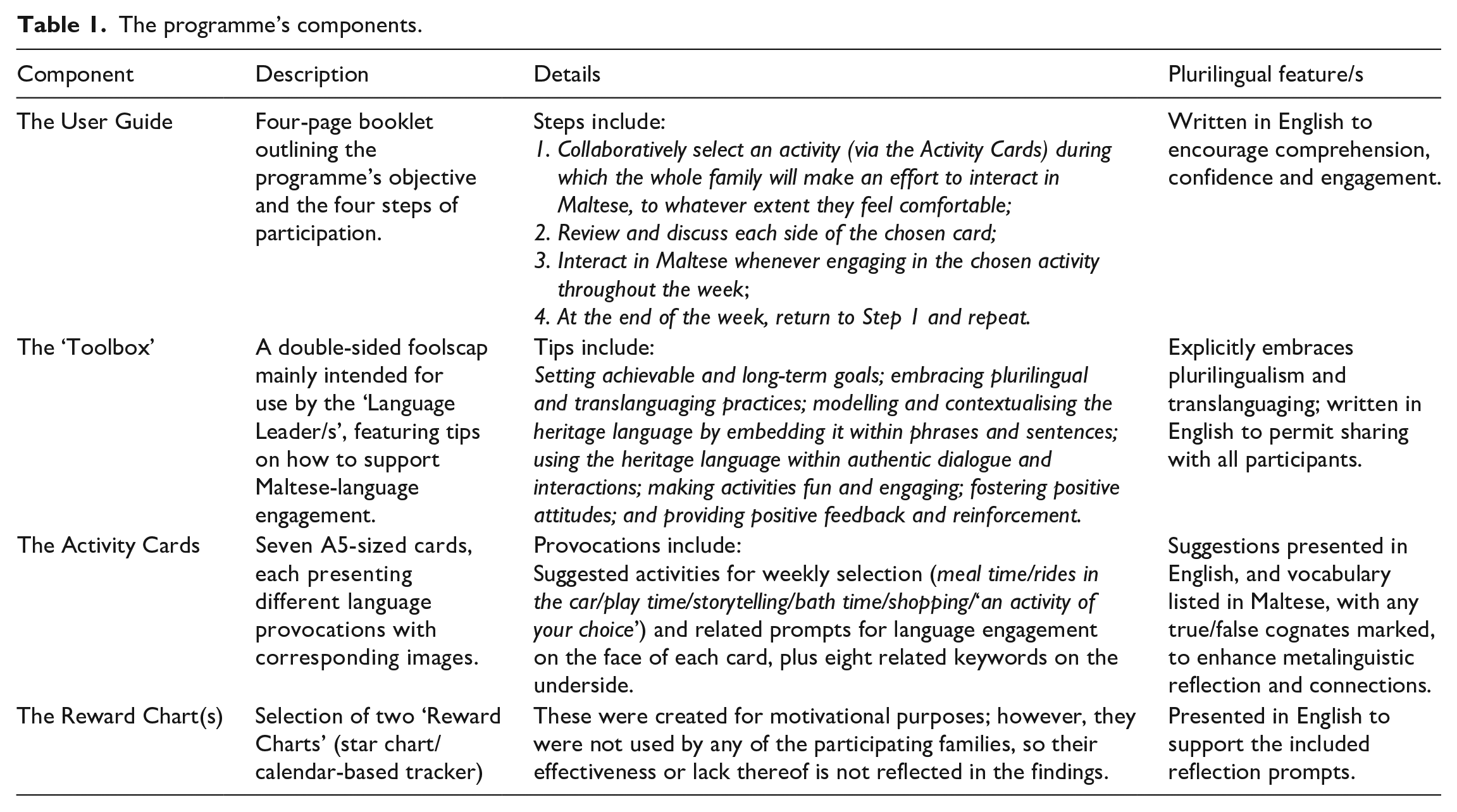
In keeping with the guiding sociocultural framework (Vygotsky, 1987), it is not the programme’s resources, but their pursued interactions, that are intended to serve as the medium for Maltese-language engagement. The research thus explores the relationships between these interactions and their underlying language ideologies (Abdi, 2011), via the sphere of FLP (King, 2016; Spolsky, 2012).
Literature review
FLP
FLP is not just an abstract policy but an embodied way of life that is ‘construct[ed] and enact[ed]’ (Curdt-Christiansen, 2013b, p. 281) through the bidirectional socialisation of parents and their children (Crump, 2017). The evolution of its study is comprehensively synthesised by both King (2016) and Smith-Christmas (2016), who outline its development from an emergent field of study in the early- to mid-twentieth century, to an established ‘framework’ (Smith-Christmas, 2016, p. 10) a century later. This ‘frame’ (King, 2016, p. 727) of inquiry enabled child language development in the family to be explored specifically via a focus on language policy (Smith-Christmas, 2016), leading to an interest in the three intertwined ‘components’ (Spolsky, 2004, p. 5) of FLP: namely family language ideologies, management and practices. Inquiries began to focus on the interrelated phenomenon (Armstrong, 2014) of ‘child language learning and use’ (King & Fogle, 2013, p. 172) vis-a-vis its connection to these three components and the ‘social and cultural context of family life’ (p. 172). An awareness of the fluidity in FLP consequently emerged, both in terms of its manifestation across the different components (Spolsky, 2012) and of its negotiation among family members (Armstrong, 2014).
A key consideration in current FLP research is the increasing diversity that characterises the field (King, 2016), since this is affecting identity development (King & Lanza, 2019) by impinging on the way in ‘which adults and children define themselves, their family roles, and family life’ (King, 2016, pp. 727, 728) through language. In doing so, families negotiate a variety of ‘societal and individual discourses’ (Macalister & Mirvahedi, 2017, p. 223), which collectively affect the speakers’ social positioning (Abdi, 2011) and broader FLP development (Macalister & Mirvahedi, 2017). Another pivotal contributor towards these issues is language ideology, which plays a significant role in language transmission and maintenance across a range of contexts (Abdi, 2011).
Family language ideology
A ‘language ideology’ is a ‘set’ (Armstrong, 2014, p. 573) of sociocultural perceptions and intentions (hereon ‘inclinations’) towards language (Curdt-Christiansen, 2013a) and language engagement (Moin et al., 2013; Pillai et al., 2014), thus incorporating language-related beliefs (Armstrong, 2014; Curdt-Christiansen, 2013a; Pillai et al., 2014), attitudes (Armstrong, 2014; Pillai et al., 2014), norms and values (Armstrong, 2014), and aims and expectations (Moin et al., 2013). These inclinations can be either ‘individual[ly]- or group-held’ (The Douglas Fir Group [DFG], 2016, p. 37), while interrelating across the three social levels (DFG, 2016) and their respective domains (Spolsky, 2019).
Within families, language ideologies also intersect with various sociolinguistic factors (Riches & Curdt-Christiansen, 2010), including the nature, role, and usage of language (Armstrong, 2014; DFG, 2016), cultural practices (Pillai et al., 2014), personal and social identity (DFG, 2016; Lanza, 2007; Pillai et al., 2014), access and agency (DFG, 2016; Smith-Christmas, 2022) and power (Armstrong, 2014), thereby rendering it a highly conflict-prone phenomenon (Armstrong, 2014; Curdt-Christiansen, 2016; Mirvahedi & Cavallaro, 2020).
The effects of ideological conflicts are particularly felt within the interrelated FLP component of ‘family language management’, through which family members ‘attempt to modify’ (Armstrong, 2014, p. 186) each other’s language ideologies and practices. This necessitates a sense of agency, which is most explicitly demonstrated by parents on account of their power within the family (Spolsky, 2009) and the sociolinguistic choices they make on their children’s behalf. However, despite their agency being less often articulated (Little & Little, 2021), children are actually key players within the family’s power dynamics, in which they either support or ‘undermine’ (Revis, 2019, p. 178) their parents’ attempts at language management (King & Fogle, 2013; Revis, 2019). Children achieve this through tactics such as ‘metalinguistic comments’, ‘medium requests’ (Revis, 2019, p. 188) ‘silent resistance strategies’ (p. 179; see also Curdt-Christiansen, 2013a), and even through language usage in imaginative play (Smith-Christmas, 2022). However, their agency is connected to their self-efficacy (Bandura, 1995; Little & Little, 2021), which interconnects with motivation.
Therefore, language ideologies – and their related inclinations – are neither ‘natural [n]or inevitable’ (Armstrong, 2014, p. 580), but actively constructed through a complex “linguistic ecology” (Bezcioglu-Goktolga, 2018, p. 185). The FLP field has thus evolved (Curdt-Christiansen, 2013a) from its initial leaning towards a naturalistic and merely intrapersonally oriented perspective of language acquisition to one which now incorporates a wider sociocultural understanding about families and their language policies (Curdt-Christiansen, 2013a; King & Fogle, 2013), as reflected in this study’s methodological considerations.
Methodology
The study follows a qualitative and social constructivist approach (Denzin & Lincoln, 2005), viewing knowledge as constructed through subjective experience (Creswell & Poth, 2018), that is embedded within and thus inherently interconnected with the wider sociocultural and historical context (Muller Mirza, 2016). This understanding supported an interpretivist approach (Creswell & Poth, 2018) that presents truth as interpretive rather than objective in nature. Credibility was thus addressed through triangulation, which allowed for the voices of each of the participating family members to be represented in this study (Little & Little, 2021).
Ethical considerations
This study was conducted with the understanding that ‘the crux’ (Soobrayan, 2003, p. 121) of ethical considerations actually lies in how ‘ethical decisions’ (p. 121) are approached throughout the entire research process. This approach was supported by the authors’ use of the flexible ‘methodological framework’ (Guest et al., 2012, p. 15) of applied thematic analysis (ATA), which was also particularly well-suited to the study’s exploratory nature. Ethical guidelines regarding consent and anonymisation were met in accordance with the British Educational Research Association (2018).
Data collection
Data collection occurred via ‘’between method’ triangulation’ (Wellington, 2015, p. 35) of semi-structured family language journals and audio-recorded family focus-group interviews, since both methods specifically correspond with the study’s constructivist, exploratory (Creswell & Poth, 2018) and FLP (Curdt-Christiansen, 2013a) underpinnings. Inspired by the diary-interview method (Wellington, 2015), family language journals were designed to prompt weekly activity-specific metalinguistic reflections via structured individual reflection sheets, which were also used to inform the development of the interviews that were conducted within two weeks of the families’ completion of the four-week programme. Since the interviews were expected to feature a significant element of translanguaging, they were conducted (and subsequently transcribed) by Formosa, as the only fluent Maltese speaker on the research team.
The interviews expanded on the insights that emerged through the journals, inquiring into the participants’ use of and views about the programme. Focus-group interviews were selected because of their advantages towards metacognitive reflections (Wellington, 2015), and were conducted by family in an attempt to alleviate the discomfort that children often feel within focus-group settings (Stewart & Shamdasani, 2015). To facilitate age-related challenges (Spyrou, 2011; Stewart & Shamdasani, 2015), the reflection sheets included in the journals and the elicitation strategies used during interviews were differentiated. With respect to literacy-related limitations, the children’s responses in the journals could be written verbatim by a parent and/or supported by drawings (for subsequent elicitation, rather than analysis).
Recruitment and sampling
The participants were recruited through local Facebook groups, via non-probability, purposive and criterion sampling (Wellington, 2015) that required volunteering families to include: Maltese children who speak to their parents predominantly in English (regardless of the parents’ L1); at least one parent who identifies as fluent/proficient in Maltese; and at least one six- to eight-year-old child who resists engaging with the Maltese language. In all, four out of 22 families were selected for participation after 12 had been turned away due to familiarity with the principal author or not meeting the eligibility criteria. Since all eligible families had been eager to participate in the study, the participants were drawn from the final pool by lot, in an attempt to enable an ethical selection process. A fifth family was subsequently drawn since one of the original families (pseudonymised as the ‘Sciberras’ family) opted out due to unavailability during the designated four-week period; however, the latter opted to run the two-week pilot instead, thus informing the refinement of the interview schedules and techniques.
The details of the final sample are provided in Table 2, with the names of the families’ respective ‘Language Leaders’ highlighted in bold font and those of the participants who dropped out of the study indicated by an asterisk. A related ‘pseudonymisation key’ is additionally provided beneath the table.
Sample demographics.

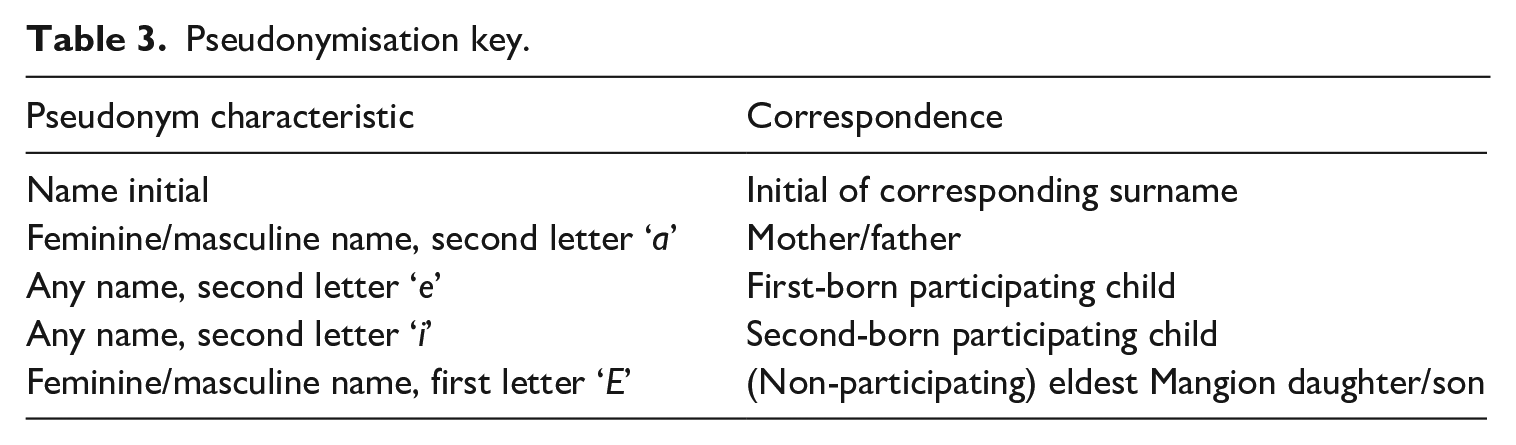
In order to better illuminate the interconnections within the findings, pseudonyms were allocated according to the key in Table 3.
Pseudonymisation key.
Data analysis
The complete data set generated from the four family language journals and four interviews comprised a total of 49 reflection sheets (21 submitted by parents and 28 by children) and 3.57 hours of audio recordings. To support the analysis of the journals, the handwritten responses were typed out verbatim into pseudonymised family specific tables that were created using MS Word. Within each table, each family member and question from the reflection sheets were respectively assigned a specific column and row to enable the comparison of responses across family members. The sequence of rows was repeated for each week of participation, thereby also demonstrating the progression of the participants’ reflections alongside their progression through the programme.
The interviews were transcribed onto a Word document and also pseudonymised, after which both sets of data were analysed in text-form, using the aforementioned ATA framework (Guest et al., 2012). In line with the study’s exploratory scope, the flexibility of ATA (Guest et al., 2012) permitted the use of a blend of ‘clean verbatim’ (Guest et al., 2013, p. 287) and ‘select summary’ (p. 287) methods of transcription, enabling the researchers to omit unrelated data that emerged on account of the high level of familiarity between the focus group members and to focus more specifically on ‘the phenomenon of interest’ (Onwuegbuzie et al., 2009, p. 4). To represent the participants’ language use as truthfully as possible, utterances made in Maltese were retained in the transcripts (written in underlined font) alongside corresponding translations to English (italicised in square brackets), the latter of which was used predominantly in both the interviews and journals.
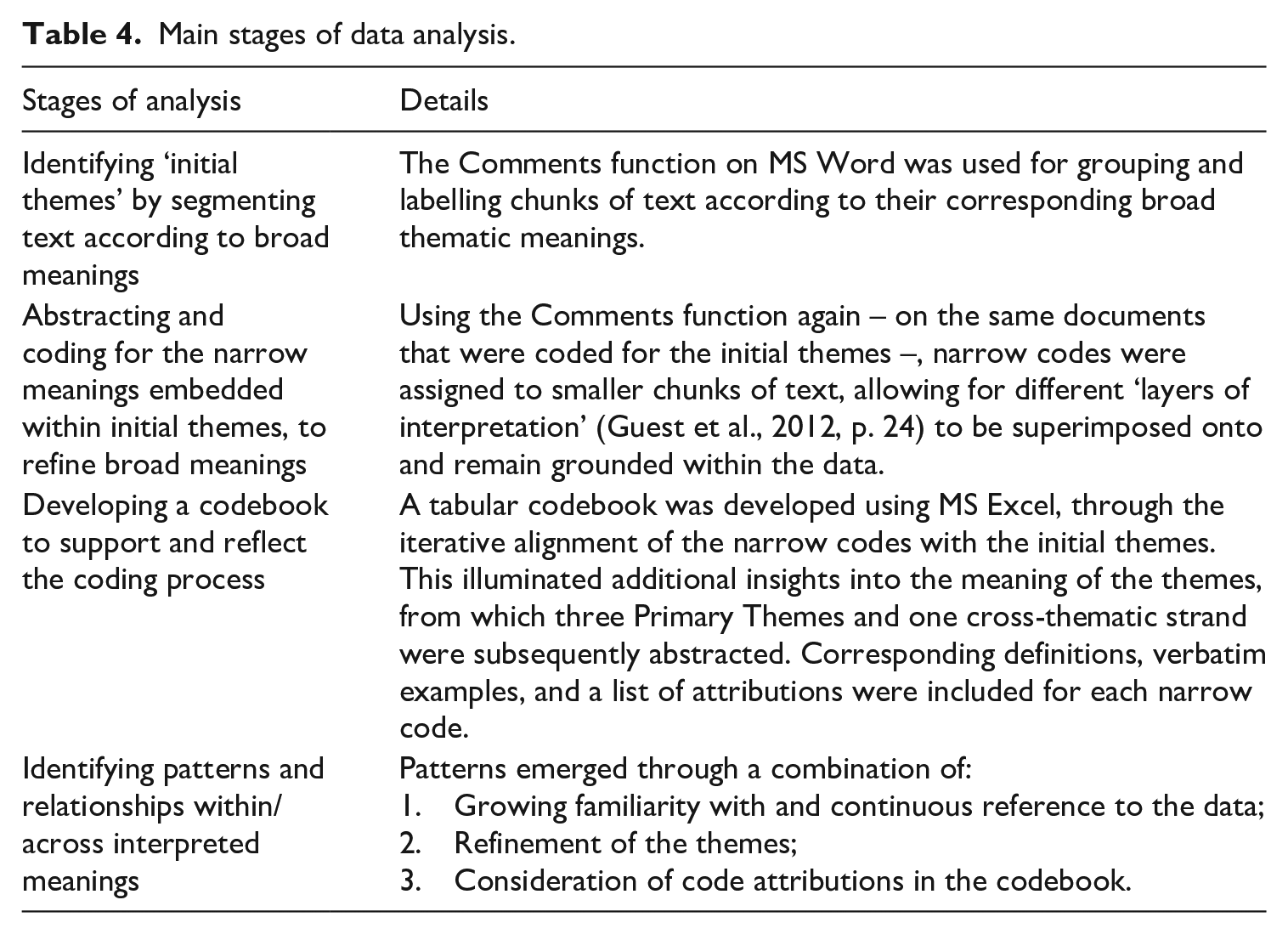
The main stages featured in this process of analysis are outlined in Table 4 (see Guest et al., 2012):
Main stages of data analysis.
The process of analysis continued into and culminated in the writing up of the findings (St Pierre, 2011), where close attention to the raw data persisted, in order to represent the participants’ intended meanings as truthfully as possible.
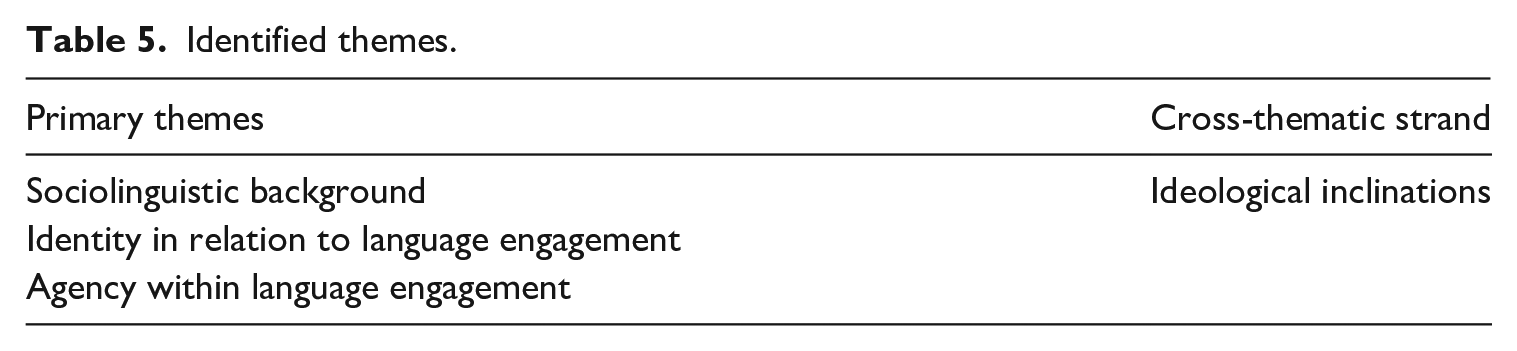
This process resulted in the emergence of the themes presented in Table 5, which are explored and discussed in the following section.
Identified themes.
Findings
Reflecting the multifaceted nature of language ideology, the analysis revealed the interweaving of the participants’ ideological inclinations (Curdt-Christiansen, 2013a; Moin et al., 2013; Pillai et al., 2014) with three key sociolinguistic factors (Riches & Curdt-Christiansen, 2010), namely, their sociolinguistic backgrounds, identities and agency. These additionally intertwined with other macro-, meso- and micro-level sociolinguistic factors (see Curdt-Christiansen, 2013a; DFG, 2016; Macalister & Mirvahedi, 2017; Skerrett, 2016), thereby revealing complex and dynamic ideological tapestries that differed from one family and participant to the next, as illustrated below.
Sociolinguistic background
Illustrating the group’s inherent heterogeneity (Abdi, 2011), the participants’ reports revealed a spectrum of pro-Anglophone to pro-Maltese sociolinguistic backgrounds. The Portelli family was seen to lie at the most pro-Anglophone end of the spectrum, with Paula explaining that her English-speaking ‘bubble’ was only ‘burst’ once she started post-secondary school, and Patrick highlighting that he only ‘started to use Maltese when [he] started working’. Paula explained that English remained their main language, used among both friends and family, thereby implying that Petra and Pia’s opportunities for Maltese-language engagement had been largely restricted to the school and wider community, until their participation in the programme.
The Grechs did not report that any Maltese-language engagement had occurred prior to their participation, either. This may have been influenced by the fact that two secondary caregivers within the family – the maternal grandmother and nanny – are non-Maltese nationals who communicate with the children exclusively in English. However, they reported that Gilbert is exposed to Maltese through his football training and that Gail uses it in communication with her clients. While the Grechs also happen to live in one of Malta’s most Maltese-speaking regions, they did not portray their locality or community as contributing factors towards their language engagement at any point during the data collection.
The Mangions appeared to be similarly positioned, since Martha explicitly described them as ‘an English-speaking family’, in which Malcolm reportedly ‘does not understand[ing] anything’ in Maltese due to his foreign nationality. 1 With both parents speaking English as an L1 and choosing to reside in Malta’s most English-speaking region, the family thus appeared to have strong pro-Anglophone inclinations. Nonetheless, two of Michael’s friends were referred to as ‘predominant Maltese-speakers’ by Martha, who also reported on his exposure to Maltese through football training. This revealed some pro-Maltese inclinations, which also featured in Martha’s reported occasional attempts at engaging her children in Maltese prior to their participation.
In the Borg family, Barbara also reported on only achieving Maltese-language fluency in early adulthood, thereby pointing towards a pro-Anglophone influence in her own upbringing and that of her children. However, Barry’s background appeared more balanced, since he was raised in a Maltese-speaking family while being educated at a private school, implying significant exposure to both pro-Maltese and pro-Anglophone ideologies. In fact, Barry reported on using both English and Maltese with his daughters prior to their participation, even if the latter was restricted to occasional story-time sessions or car drives. The whole family would reportedly also play games together in Maltese, thus indicating the presence of collective pro-bilingual inclinations, which were not identified in the backgrounds of any of the other participating families. Nonetheless, pro-Anglophone inclinations still prevailed in the Borg family, since English was reported as their main language of communication among both immediate and extended family members.
Identities related to language engagement
Since identity ‘hinges on an apparently paradoxical combination of sameness and difference’ (Lawler, 2008, p. 2), it is not only overtly expressed, but may also be implied through an individual’s Self–Other positionings (Marková, 2007). This theme thus emerged from the participants’ ‘associative’ as well as ‘othering’ positions (Abdi, 2011) in relation to language/language usage, revealing insights into the linguistic, social, and national facets of their developing identities.
In correspondence with their background, the Portellis’ pro-Anglophone linguistic and social identities were implied by Pia, who said, ‘English is our first language; and even with friends, family, and everyone [emphasis added], English is the main language’. However, the nature of language usage in Malta implies that there were bound to be people who the family interacted with in Maltese, as was indeed confirmed by Paula, in her subsequent reference to the members of their local community. Therefore, her use of the term ‘everyone’ was not actually all-inclusive, but appeared to be part of a strategy of ‘drawing boundaries and placing others outside those boundaries [in order to] establish . . . identities’ (Epstein, 1993, p. 18). Paula’s use of this strategy was actually identified a second time, during her aforementioned reference to their community; however, this time, her identity was asserted by placing her family outside of the figurative boundary line:
Occasionally I try to get the children to speak [Maltese]; to go out to buy the vegetables – so at least they get to speak to the locals in Maltese, and they have to speak in Maltese.
The locals [said sarcastically].
Yeah, what?
Why? Are we foreigners?
Ah,
This exchange was considered particularly noteworthy since it illustrates both a reflection and construction of identities (Bamberg et al., 2011). Indeed, by demonstrating an example of ‘displayed evaluative and epistemic orientations to ongoing talk’ (Bucholtz & Hall, 2005, p. 594), Patrick exposed Paula’s othering and revealed a pro-Maltese facet to his own linguistic identity.
By contrast, the Grech brothers expressed overt associative positions, which were made in reference to their national identities. When they were initially presented with the programme, George had remarked, ‘I do not need to learn Maltese because I am English’, revealing an overt pro-Anglophone national identity that was simultaneously an ‘implicature’ (Bucholtz & Hall, 2005, p. 594) of its simultaneous anti-Maltese facet. While unclear if this stance corresponded with his maternal grandmother’s heritage, his mother explained it on the basis of his concerns that the programme would feature the exclusive use of Maltese, which he reportedly overcame upon understanding that it would not. On the contrary, Gilbert demonstrated a contrasting pro-Maltese identity, when he stated in his journal entry, ‘I like doing [the activity in Maltese] because I’m Maltese’. However, he was unable to elaborate on this particular entry during the interview, during which he actually indicated contrasting pro-Anglophone and even anti-Maltese inclinations, as illustrated through the upcoming theme. This reflects the notion that an individual’s different identities may actually be conflicting (Abdi, 2011), while highlighting the importance of data triangulation in exploring children’s views.
No further intrapersonal conflicts regarding national identity were identified; however, opposing inclinations in terms of linguistic identity did emerge across the Mangion and Borg families. In the former, Martha expressed a pro-Anglophone linguistic identity on her family’s behalf, in stating, ‘Obviously, we are an English-speaking family’ – with the word ‘obviously’ suggesting a perceived sense of inevitability due to her family’s sociolinguistic background. On the contrary, in the latter, Barry, Becca and Bianca stood out for their distinctive use of Maltese during the interview, reflecting the fact that languages themselves can indeed ‘be indexically tied to identity categories’ (Bucholtz & Hall, 2005, p. 597). All the other participants only used Maltese for the purpose of contextualisation or insertion of discourse markers; howerver, Barry also did so in responding to a question that was put to him in English, while the girls additionally did so to enthusiastically call out examples of Maltese vocabulary that related to the different topics of discussion. Given the interview context and these participants’ sociolinguistic backgrounds, these contributions were seen to reflect linguistic choices, rather than necessity or habit, thus reflecting positive ‘identity position[s]’ (Bucholtz & Hall, 2005, p. 594) in relation to the heritage language.
Agency within language engagement
The complexity behind language ideology (Bezcioglu-Goktolga, 2018) was aptly revealed by the participants’ ‘agency’ – or ‘ability to make sense of the environment, initiate change, and make choices’ (Kuczynski, 2003, p. 9) – within their language engagements. While all of the participating parents reported on the programme’s ability to shift their families’ agency in reflection of increased pro-Maltese inclinations, the extent and nature of these shifts were actually found to vary considerably, thus illuminating related patterns and discrepancies.
In the Portelli family, despite Paula’s best intentions, her agency was seen to fluctuate based on external constraints – such as time restrictions, family issues or her children’s lack of fluency – which indeed were reported by all of the mothers in the sample. However, these were less of a concern for the fathers, thus indicating a possible ‘parental gap’ based on the responsibilities tied to gender/parenting roles (Okita, 2002). In fact, Patrick revealed that his intentions to ‘augment’ his daughter’s Maltese-language engagement were instead interrupted by internal factors; namely the combination of his own limited fluency, purist preoccupations and poor sense of self-efficacy in Maltese. Patrick was so committed to ‘giv[ing] a good answer or instruction’ and following the ‘rules’ of the Maltese language that he expressed concerns over the prospect of making mistakes in his daughters’ presence. However, believing that ‘if you show [children] you’re uncertain, they will be uncertain [too]’, he also reported on attempting to conceal any of his uncertainties or errors, thus inhibiting their potential role as valuable plurilingual learning opportunities.
Despite Patrick’s concerns and related efforts, it appeared that his inclinations may indeed have rubbed off onto Pia, who also seemed to avoid the possibility of erring in her family’s presence. This was revealed because she admitted to ‘sometimes talk[ing] to [her pet rabbit] and play[ing] in Maltese’, despite demonstrating anti-Maltese ‘silent resistance strategies’ (Revis, 2019, p. 179) and pro-Anglophone ‘medium requests’ (p. 188) during the family-based activities. Therefore, while play-based agency often demonstrates ideologies against heritage-language engagement (Smith-Christmas, 2022), this reflection indicates that it may also support it, at times. Nonetheless, in stark contrast with her sister, Petra reported that she ‘loved’ participating in the programme’s activities and ‘like[d] speaking Maltese’ so much that she would remind her parents to engage in the activities when they forgot to do so. This suggests a link between Petra’s agency in and sense of affect towards Maltese, while also revealing the first example of an agentive ‘sibling gap’ (see Kayam & Hirsch, 2014), which featured among all of the sibling pairs except for the Borg sisters.
In the Grech family, Gail indicated an oppositional sense of agency since she acknowledged that ‘the problem’ behind her sons’ lack of Maltese-language engagement prior to their participation was ‘more from [her] end’ than theirs. This appeared to interrelate with low self-efficacy levels, since she admitted to avoiding an engagement with certain activities during the programme due to her limited fluency. However, she nonetheless reported that the programme helped her to overcome this ‘problem’, since it had successfully ‘motivated’ her – as well as her non-participating husband – to use Maltese more often within the home.
Gail’s sons pointed towards the interconnection of both affect and efficacy with their agency, while highlighting a wide ‘sibling gap’ on that basis. Gilbert referred to the Maltese language during the interview as ‘poo’, qualifying the emotionally loaded metaphor by saying, ‘It’s boring – and I don’t understand [it]’. He additionally acknowledged losing his initial sense of pride in his participation ‘because [the programme] got harder, and then harder’, which Gail said was due to ‘new words being introduced’, which meant that he ‘needed a little bit more pushing’ during their participation. However, it appears that these issues may have been exacerbated by Gilbert’s evaluation of his elder brother’s progress in the heritage language, as indicated when Gail said, ‘Gilbert was not as happy with [playing ‘I Spy’ in Maltese], but that’s probably because George kept guessing/winning first’.
Indeed, George’s progress was so significant that he was able to recognise and reflect on it himself by saying, ‘I’m trying my best in Maltese . . . and the Maltese teacher said [that] I’ve been improving’, which she had allegedly picked up on soon after he began to follow the programme, despite being unaware of his participation. When considering that, just a few weeks prior to the onset of the research, this same teacher had reportedly commented that George did ‘not want to participate’, was ‘very shy’, and did ‘not want to get it wrong or try [during the Maltese lessons]’, this makes her observation all the more notable. George’s progress coincided with what Gail referred to as his new ‘mind frame’ about Maltese-language engagement, which she remarked had ‘[made] such a difference’ and made him feel so ‘positive towards the whole thing’, that he had even woken her up at six o’clock one morning, asking her to purchase a new Maltese book for him. These insights are thus strongly indicative of the programme’s initiation of shifts in George’s affect, self-efficacy and agency towards Maltese.
Among the Mangions, the children’s agency seemed highly influential since, notwithstanding her pro-Maltese inclinations, Martha reported that prompting her children to engage in Maltese sometimes felt ‘like a chore that [she] had to put on to them’. Illuminating her children’s role within the affect-agency link as well as the impact of external constraints, she additionally said,
I think [the outcomes depend on] the feedback that I get from the kids; if they are comfortable with it, I’ll try and keep on going, and if I find a barrier or it’s taking too much energy and time, then it’s obviously easier to switch [to English].
However, in reflection of the ‘sibling gap’, it appears that this affective resistance primarily came from Michael, who voiced strong sentiments against Maltese, in saying, ‘I hate [Maltese] . . . because I don’t like speaking [it]’. While he did not divulge further details about these feelings during the interview, his Week 1 journal entry had already stated that he ‘did not like speaking in Maltese because it is hard’. Therefore, when considering his prior exposure to Maltese through his peers, these insights were particularly indicative of how a low sense of self-efficacy in the heritage language can impede the development of positive affect and ideologies towards it (Little, 2020a). However, Melvin reflected the opposite side of this coin, in saying that he ‘felt better’ about using Maltese since starting the programme, because he noticed that it had helped him to ‘actually talk better’ in Maltese, which he reported on doing spontaneously with his English-speaking friends as well as with a cashier at a local grocery store, since starting the programme.
The sense of agency in the Borg family was seen to extend from the ideological balance identified across the parents’ backgrounds. On one hand, despite demonstrating pro-Maltese inclinations in referring to the local indications of language shift as ‘quite troubling’, Barbara also revealed pro-Anglophone naturalistic inclinations in stating, ‘I feel it’s important to just let [my daughters] express themselves [during affectively-loaded situations]; and if it’s easier in English, you know, so be it’. This points towards the complexity behind the affect-agency link, the conflicting nature of language ideology (Armstrong, 2014; Curdt-Christiansen, 2016; Mirvahedi & Cavallaro, 2020), and the ‘doubled-edged sword nature of language maintenance at the micro-level’ (Smith-Christmas, 2018, p. 149). On the other hand – possibly as a result of his pro-Maltese sociolinguistic background and identity – Barry reported on successfully directing his agency through his efforts to ‘move away from [translation]; to do
The combination of Barry and Barbara’s respective cognitively and affectively oriented approaches throughout their participation appeared to have supported their daughters’ development of pro-Maltese inclinations, since they were the only sibling pair across whom the ‘sibling gap’ did not feature any agentive, affectice, or efficacy-based discrepancies. In fact, the gap between them appeared to be purely proficiency-based, as indicated through Barry’s reports that Bianca had attempted to ‘learn quickly’ in order to ‘close the [proficiency] gap’ between herself and her sister, thus suggesting that their agency was also supported by a high sense of self-efficacy in Maltese. The girls additionally reported on involving their extended family in the programme’s activities and on engaging in the activities even in the absence of adult supervision, during which they appeared to reflect a balanced sensitivity to both cognitive and affective dimensions, as modelled by their parents. These insights support the claim that elder siblings may not only interrupt, but can also play an ‘important role . . . in encouraging the use of the heritage language at home’ (Yates & Terraschke, 2013, p. 119), while underscoring the interrelation between self-efficacy, agency and opportunities in language learning (Bandura, 1995).
Conclusion
The above findings support the notion of language ideology being a conflicting, complex and interconnected phenomenon (Abdi, 2011; Riches & Curdt-Christiansen, 2010; Spolsky, 2004, 2019), shedding light on related issues of intertwining discourses (Macalister & Mirvahedi, 2017), positionings (Abdi, 2011) and identities (King, 2016), while providing a glimpse into how this phenomenon manifests among English-speaking families in the Maltese context.
The respective families’ collaborative use of the family language programme caused a range of pro-Maltese shifts in their family language ideologies and wider FLPs (Spolsky, 2012), pointing towards the programme’s potential to prompt ‘excitement, identification with the home country . . . [and a] personal interest in the heritage language and heritage language-related activities, [which] bode well for heritage language development’ (Guardado, 2018, p. 165). The programme’s effects were even seen to extend into the domains of the peer-group, school and wider community, thus suggesting its ability to support the participants in reinforcing their FLPs by ‘reach[ing] for support outside the home for enacting their language decisions in the home’ (Macalister & Mirvahedi, 2017, p. 223).
However, the extent to which the programme enhanced the families’ Maltese-language engagement was seen to vary across the individual family members, in apparent correlation with their language ideologies. A ‘sibling gap’ was identified in relation to the children’s participation, which featured all four of the elder siblings demonstrating greater gains in Maltese-language proficiency than their younger siblings did and three of them additionally demonstrating comparatively greater gains in their agency, self-efficacy and/or affect towards Maltese. The authors tentatively suggest that gender may have been an additional factor within the ‘sibling gap’, since it was found to be wider across the participating pairs of brothers than it was across the sisters. While acknowledging the small number of participating fathers, the role of gender on an identified ‘parental gap’ is also postulated, thus indicating that there are plenty of opportunities for further research from this study. Indeed, further research into the ideological factors affecting the programme’s potential – and heritage language development, in general – is warranted, especially with respect to a wider variety of family contexts and types (King, 2016). The family language programme also holds potential to be explored and developed in other national as well as international contexts, in order to maximise its affordances in greater breadth and depth, perhaps even via social media and technology (Little, 2020b).
Follow-on studies may also seek to compensate for the study’s limitations, such as the authors’ role in the design of the family language programme, which may have impacted the collection and interpretation of data. The study is also inevitably limited by the small size and unique nature of the sociolinguistic context, speech community being researched, as well as the sample size and sample choice upon which the research is based. As in most qualitative research, the findings are therefore not deemed to be generalizable; however, in line with relativist ontology (Lincoln & Guba, 2013), the insights gained through this research are nonetheless considered to be significant. In fact, in light of twenty-first-century concerns regarding language death and language shift (Fishman, 2001), this study offers a vital contribution to the existing knowledge base regarding heritage language transmission and FLP, indeed offering a family centred approach to improving bilingual language ideologies and FLPs via ‘bottom-up language planning’ (Skerrett, 2016, p. 107), as it set out to do.
Footnotes
Acknowledgements
The authors thank Professor Antoinette Camilleri Grima (University of Malta) for her feedback and advice regarding the development of the Maltese family language programme.
Author contributions
Declaration of conflicting interests
The author(s) declared no potential conflicts of interest with respect to the research, authorship and/or publication of this article.
Funding
The author(s) received no financial support for the research, authorship and/or publication of this article.
Ethical approval
Ethical approval for this study was granted by the University of Sheffield’s School of Education.
