



Abstract
Children’s acquisition of directional verbs in sign languages has received a lot of attention, but less is known about the sociocultural process of using these verbs, especially in the context of emerging sign languages in diverse language ecologies. Directional verbs are a common grammatical phenomenon of many sign languages in which some verbs such as ‘to give’ and ‘to take’ can move in the direction of one or more of its arguments for indicating grammatical relations between agents and patients or recipients. I discuss the case study of one signing family who uses ‘making hands’, an emic term for the signing practices of deaf Chatino people and their families in the San Juan Quiahije municipality in Oaxaca, Mexico. The family in question consists of a first-generation adult signer and two second-generation child signers, aged 4;6 and 5;3. This article describes their usage of directional verbs for making explicit requests, asking questions, and talking about hypothetical events, including presenting or withholding gifts as part of the cultural understandings and practices of the allocations of goods. Ethnographic data reveals that the children’s production of verbs may be facilitated by directed input in the form of directives from a deaf adult signer, extensive peer play, and visual access to signed adult interactions. This case study offers insight about input and socialization for the children’s usage of directional verbs in an emerging sign language in a local Mesoamerican ecology.
Introduction
All over the world, children learn languages and how to use them appropriately in culturally diverse ecologies. These languages encompass the natural sign languages that originated and thrive in various communities of deaf people (Fenlon & Wilkinson, 2015). When deaf children learn a conventional sign language from their deaf signing caregivers, the timing of their acquisitional milestones generally parallels the timing of the same milestones of hearing children who learn a spoken language (Lillo-Martin & Henner, 2021). However, there are multiple pathways to signed language acquisition that are seldom observed in spoken language acquisition (Lillo-Martin & Henner, 2021; Singleton & Meier, 2021). Most deaf children are born to hearing, nonsigning caregivers and often experience language deprivation from the lack of exposure to language that they can access (Hall, 2017). Some children develop their own signs, commonly known as ‘homesigns’ in the literature, to communicate with their families (Goico & Horton, 2023).
Eventually, some children may learn a conventional sign language through early intervention programs or through enrollment in a signing school for the deaf. Other children may learn that language through peer interaction in social spaces, which often happens later in childhood or even adulthood. Then there are children who never get the opportunity to learn a conventional sign language, so they continue using their own signs with their families and other interlocutors for their entire lives. In a few cases, a new sign language emerges from unbroken, subsequent generations of deaf people in small-scale, rural communities such as the case study of Al-Sayyid Bedouin Sign Language (Kisch, 2012; Sandler et al., 2014) or subsequent cohorts of deaf children in an educational institution as documented for Nicaraguan Sign Language (Senghas & Coppola, 2001; Senghas et al., 2004). Various case studies of homesigns and emerging sign languages have generated much literature about the contribution of children’s language learning mechanisms to language emergence and evolution.
While there is substantial research about the cognitive processes of sign language acquisition in diverse language ecologies, by comparison, there is less research about the sociocultural processes, that is, how different types of social engagement can provide the context for language learning. This article reports a case study of two children’s acquisition of directional verbs in ‘making hands’, an emic term for an emerging, local sign language used by deaf people and their families in the San Juan Quiahije (SJQ) municipality, home to an indigenous Mesoamerican group, the Chatino people, in Oaxaca, Mexico. At the time of the study, the children are two second-generation child signers, Martha, a hearing girl aged 4;6 and Angelica, a deaf girl aged 5;3, who acquired their sign language from Regina, a first-generation deaf adult signer. I take an ethnographically grounded, languaging approach to investigating the sociocultural context of the children’s acquisition and use of directional verbs, a category of verbs commonly documented in many signed languages. The children learn how to use the verbs for making explicit requests, asking questions, and discussing hypothetical events through a combination of directive input from a deaf adult signer Regina, extensive signed peer play with each other, and visual access to signed interactions between adults. The sociocultural process of using verbs is situated in the context of a local Mesoamerican ecology of shared cultural understandings and practices of allocation of goods in relation to the development of linguistic and sociocultural competence in children.
Diversity and variation in language learning
Literature on cross-linguistic language acquisition and cross-cultural language socialization has shown that children acquire their native spoken languages and become competent speakers through multimodal input in various socially organized interactions with their caregivers, peers, and other interactants (de León, 1998; de León & García-Sánchez, 2021; Meek, 2019; Ochs & Schieffelin, 1994, 2011; Riley, 2011). Input is not exclusively limited to child-directed speech in face-to-face dyadic interactions between the child and their mother. Input also occurs through multiparty, multiage, and multimodal interactions in which children participate as targeted addressees or observant bystanders, overhearing language (see de León & García-Sánchez, 2021 for a review). Children are attuned to different types of input that are present in their language ecology based on how they are socialized to interact with other people.
The above literature implicitly privileges hearing children who have unconstrained access to auditory input, even in multimodal interactions, from their caregivers. This is not the case for sighted deaf children. The asymmetry of access to auditory input, especially incidental input, means that deaf children do not have the same access to it, even with technological assistance, as their hearing peers do. If deaf children learn to sign, they must rely on visual input from adult and peer signing models. What is known about deaf children’s sign language learning has been exclusively based on dyadic interactions with their deaf and hearing signing parents (Fieldsteel et al., 2020; Holzrichter & Meier, 2000; Meadow-Orlans et al., 2004; Pizer et al., 2011) and with their teachers in educational institutions for the deaf in Western societies (Graham & Tobin, 2019; Lieberman, 2015; Valente, 2019). The literature suggests that deaf children are socialized into visual practices of communication to become competent signers and these practices include culturally appropriate attention-getting and turn-taking strategies as well as physical and spatial orientation of one’s body for signed interactions; these processes tend to occur through dyadic interactions. Deaf children of deaf signing parents are early on socialized through these visual practices at home. However, deaf children of hearing parents are not generally socialized through these practices unless they enter a signing school for the deaf and learn the practices through explicit instruction (Graham & Tobin, 2019; Singleton & Morgan, 2006). These practices are considered key to engaging with signed interactions appropriately; mastering the practices signals communicative competence, that is, the ability to act appropriately and interact.
Not much is known about deaf children who live in communities where there is no educational institution for the deaf and there is no deaf of deaf signing families. In many Mesoamerican communities, hearing children tend to experience more input from adults by overhearing and overseeing multiparty interactions (Casillas et al., 2020; de León, 1998; de León & García-Sánchez, 2021). For deaf children, one possible outcome of this kind of language ecology is that they may receive less explicit instruction for visual practices of communication from their caregivers in dyadic contexts (Horton et al., 2023). Based on a cross-cultural study of communication in signing families in three Mesoamerican communities, Horton et al. (2023) propose that deaf and hearing children can be socialized through visual practices of communication through a combination of overseeing signed interactions between adults and explicit instruction from adults. This suggests that the local language ecology, including culturally appropriate and specific practices of spoken communication, shapes the socialization process of child signers into visual practices of communication. Other variables that shape the process are child-rearing ideologies about children and language development, deafness and sign language, and the distribution of the local sign language and deaf signing models (Horton et al., 2023).
In the SJQ municipality, many extended Chatino families generally encompass multiple generations within a family compound, so it is common to have many children and adults of various ages living together (H. Cruz, 2014). These living arrangements lead to frequent multiparty interactions in which children are present as addressees and/or observers (de León, 1998). Children’s social interactions with their peers are primarily organized with their siblings and other relatives, similar to what has been reported for Yucatec Mayan children (Gaskins, 2006). This trend continues as children start attending primary school and can play with other children outside of their kinship networks. As children transition to adolescence, they are socialized into more distinctly gendered roles and activities and may expand their social network to include other peers from school, but their families remain the center of their networks.
The signing community of SJQ
The SJQ municipality consists of two neighboring villages, San Juan Quiahije (hereafter, Quiahije) and Cieneguilla, located in a mountainous area in the Juquila district of southwestern Oaxaca (E. Cruz, 2017). The area is inhabited by the Chatino people, an indigenous Mesoamerican group. They speak SJQ Chatino as their first and dominant language, a variety of Eastern Chatino that belongs to the Zapotecan language family of the Otomanguean stock (E. Cruz, 2011, 2017; H. Cruz, 2014, 2017; E. Cruz & Woodbury, 2014a, 2014b). In Chatino, Quiahije is known as kchi A meaning ‘town’ or ‘village’ and Cieneguilla is known as nteʔ F meaning ‘valley’ or ‘flat land’. 1 The reported population of the whole municipality is 4203 (Instituto Nacional de Estadística y Geografía, 2020). This number includes 13 deaf people based on an informal count in December 2018: 4 adult men, 2 adult women, and 7 children (5 girls). Most deaf people share a biological kinship with at least one other deaf person as a sibling or as an extended family member (Hou, 2016).
Deaf Chatinos of the SJQ municipality are not familiar with lengua de señas mexicana (LSM) or Mexican Sign Language, the national sign language of deaf people in Mexico (Cruz Aldrete, 2008; Ramsey, 2012). Most deaf Chatino adults and some deaf children know one another and usually will chat in a chance encounter in the public but they do not intentionally seek out each other for company outside of their residences or kinship network. Their social lives are primarily organized around families, which is the norm in the SJQ municipality (Hou, 2016, 2020). Therefore, deaf people’s signing practices may be best characterized as a constellation of family sign language varieties from a language ecology perspective. 2 While deaf people do not have a proper name for their language, they all use the same sign to describe their signing. This sign can also be used to refer to the gesturing of hearing people. This suggests that deaf people do not always make lexical and conceptual distinctions between the academic categories of ‘gesture’ and ‘sign’, a sentiment also shared by hearing people (c.f. Kusters & Sahasrabudhe, 2018). Quiahije Chatino speakers also do not distinguish these terms. In an interview, a local community member asked a hearing mother how she communicated with her two deaf daughters, the mother replied: qne I yanq C ten E qo E , literally meaning ‘we make hands to talk to them’. This mother’s response is the source of ‘making hands’, which I use as a written shorthand to refer to the communicative practices of deaf people and their hearing interlocutors, though, in earlier works, I used ‘San Juan Quiahije Chatino Sign Language’ for documentation purposes in academic literature (Hou, 2016, 2020).
The case of one signing family
The focal family in this study consists of an extended family with two deaf people, Regina and Angelica. Regina is the eldest of four children and Angelica is the youngest; they are about 13 years apart. At the time of the study, everyone resided in the same family compound. Angelica lived in one section of the compound with her parents and brothers. Regina and her hearing daughter Martha, who is 10 months younger than Angelica, lived in another section of the compound with Regina’s parental aunt and uncle, Alberta and Alejo. The same aunt and uncle had no children of their own. The residents of both sections ate separately, but the proximity of these sections allowed Angelica and Martha to play together on a regular basis. As there were no other children in the family compound, the girls were each other’s primary playmates.
Regina is credited as the creator of the family’s signs from her perspective and her family’s perspective (Hou, 2020). The family has a strong metalinguistic understanding of the differences between Regina and the children. They recognize that Angelica, unlike Regina, had the advantage of being born into an environment with existing signing models. They also recognize that Martha, due to her close relationship with her deaf signing mother, understands her mother’s signing better than the other hearing family members. Martha thus had constant, intensive experience with sign language from birth. The girls’ noted signing proficiency, however, did not mean that Regina regarded them as appropriate conversational partners. She showed a clear preference for signing with other adults, including the author, over signing with children (Hou, 2020). When the girls entered adolescence, Regina started treating them as conversational partners more on par with other adults.
The signed interactions in Regina’s family heavily rely on various types of shared knowledge. The shared knowledge encompasses conventional linguistic knowledge, community-based knowledge, that is, background knowledge of community members, and discourse context (Omardeen et al., 2021). Such knowledge is key to understanding pointing constructions and directional verbs in ‘making hands’.
Pointing constructions and directional verbs
In ‘making hands’, pointing constructions are ubiquitous. Signers point to people for reference. In (1), Regina makes initial reference to both Martha and Angelica, telling a story to the interlocutor, who is the author of this article, about an accident that happened to Martha during a hide-and-seek game with Angelica. At that time of the conversation, Martha is present, but Angelica is not yet. The reference to the girls is boldfaced in the example. Regina refers to Martha by pointing to her across the room, as indicated by
(1)
`Hey, she (= Martha) got the wound on her forehead from falling, the child of the house (= Angelica) over there pushed her (= Martha) with her hands covering her face, she fell down’.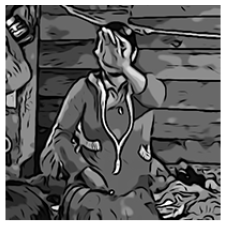
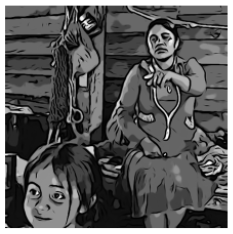

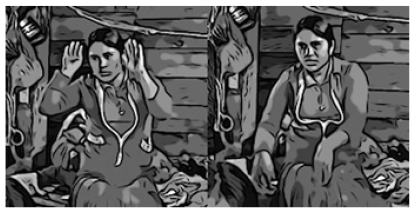
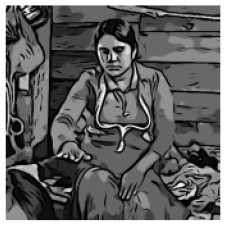
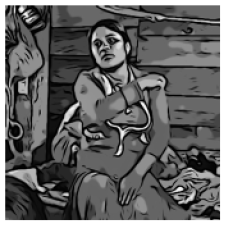
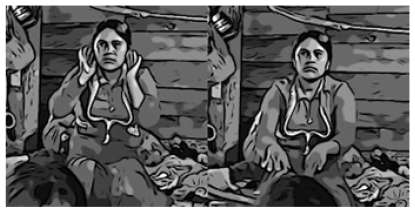
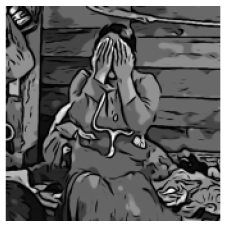
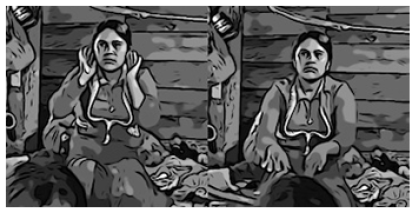
The above example shows the strategies for pointing to present and absent referents. If a referent is present in the physical environment at the time of the conversation, the signer points to the referent directly, usually with an extended index finger. If the referent is not present, the signer has a couple of strategies for marking initial displaced reference: (1) point to a spatial location of the local topography that is habitually associated with that referent, that is, their house where they eat and sleep; (2) point to a spatial location of the immediate environment that the referent recently occupied such as a chair that they were sitting in. The first strategy of displaced reference is more common; it has also been reported for some small-scale sign languages such as Yucatec Maya Sign Language and Providence Island Sign Language (de Vos, 2012; de Vos & Pfau, 2015; Le Guen, 2019; Omardeen et al., 2021) and also gesture systems of hearing people in different cultures (Haviland, 1993; Le Guen, 2011). As the real-world locations of houses are anchored in local topography, signers can point to any location, anywhere in principle. To disambiguate multiple possible referents associated with a residence, signers use a unique name sign or a sequence of signs, such as a generic noun and a height specifier, in conjunction with the point, for identifying the referent in question. The order of the point and the name sign or the descriptor are interchangeable.
‘Making hands’ uses real-world locations for directional verbs as well. ‘Directional verbs’ is a broad label for a category of some transitive and ditransitive verbs found in many sign languages (Rathmann & Mathur, 2002).
4
These verbs denote some transfer of a concrete or metaphorical object from a source argument to a goal argument; these arguments tend to be agent and patient or a recipient, respectively. A signer can produce a verb with their hand(s) by moving it toward a spatial location associated with a referent. The verb appears to be an iconic or transparent conceptualization of an action. A classic example is the verb
(2) The beginning and ending of 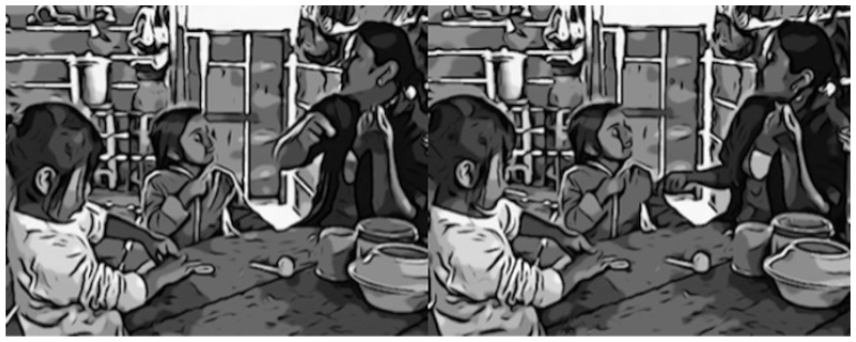
Many sign language researchers have used a production task known as the ‘Haifa Clips’ to investigate various grammatical aspects of different sign languages, including directional verbs, word order, and classifiers (Ergin et al., 2018; Kastner et al., 2014; Meir et al., 2017; Morgan, 2020; Sandler et al., 2005; Stoianov et al., 2022; a.o.). The task is designed to elicit descriptions of intransitive, transitive, and ditransitive actions portrayed by unfamiliar actors in 30 consecutive short video clips. One example of a clip is that a woman rolls a ball across the room to a girl. A signer is instructed to watch each video clip and describe it to their interlocutor, who in turn, must correctly identify the event by picking out one of the three pictures printed out on a paper. The signer must draw from different strategies, such as word order, to indicate the grammatical relations between the arguments. Importantly, the structure of the video clips makes it difficult for signers to base their descriptions on real-world locations of the referents which, as noted above, is the most common strategy employed by signers of ‘making hands’.
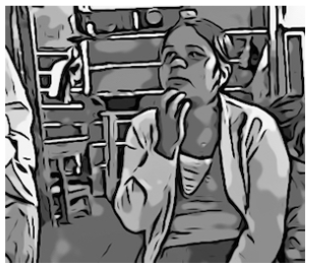
A trial with the Haifa Clips with Regina showed that she used a recurring word order strategy in which she referred to the agent first and the verb last. She rarely used the signing space for pointing to referents since they did not represent anyone from her community; therefore, her production of verbs did not incorporate any real-world locations. She occasionally pointed to a concrete object in the physical environment in tandem with a nominal sign. In (3), Regina describes a video of a child feeding a woman, though she perceived the woman as a man because of her short hair. She signed the agent (the child) first, the recipient (woman/man) next, and the verb last. The verb is a possible combination of two signs,
(3) ‘The child fed (lit. give food to) the man’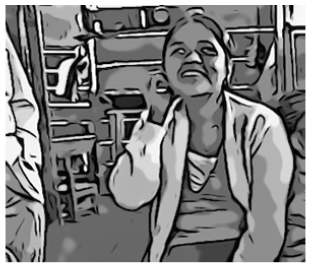

Regina’s responses from the production task seem to pattern with the documented responses of deaf signers who use small-scale sign languages. Many signers who have completed this task in other studies used word order to organize their responses, as Regina did, suggesting a potential cognitive bias for this strategy. Yet her responses do not fully represent the patterns of directional verbs in ‘making hands’ that the children are exposed to, because first, ‘making hands’ rely more on real-world locations of referents, and second, directional verbs are commonly used to talk about allocations of goods in the community.
Moreover, the production task was not appropriate to conduct with the children, owing to the unfamiliar contents and cognitive demands of the task. The data in the present study therefore focuses on the sociocultural context of the usage of directional verbs from spontaneous conversations in ‘making hands’ instead of children’s developmental production of the verbs. While there has been much scholarly attention to deaf children’s acquisition of these verbs in different signed languages (Lillo-Martin & Henner, 2021, pp. 402–403), the ongoing controversy over the linguistic status of directional verbs in older sign languages has led to differing opinions about how to best analyze children’s acquisition of directional verbs (Lillo-Martin & Meier, 2011). As ‘making hands’ is an emerging sign language, it is even more difficult to identify the ‘rules’ of directional verbs, so I focus more on the sociocultural context of the usage of verbs.
Method
Data collection and analysis
I spent one year conducting fieldwork with six different families in the SJQ municipality from June 2014 to June 2015. During that year, I visited Regina’s family every month at least once, usually staying for a whole day. I also made several follow-up trips to the municipality for a few weeks in 2018, 2019, and 2022, and slept at Regina’s house. All these visits allowed me to become more acquainted with the signing practices of the family and to accumulate some shared knowledge for following the interactions between me and the signers. The main participants filmed were Regina, Angelica (5;3), and Martha (4;6), with an occasional appearance of another family member such as Alberta, the aunt of Regina and Angelica. Because filming can be an invasive activity, especially for people who were not accustomed to cameras, the family consented to my filming certain interactions. Some of the filmed interactions occurred between me and Regina, due to her preference for adult conversational partners. Sometimes the girls were involved in the interactions as addressees or observers. Other filmed interactions focused on the interactions between the girls. These interactions were largely spontaneous and varied in length. I filmed a total of three hours’ worth of 11 spontaneous interactions that spanned nine months; these conversations are limited to the family’s residence. I also took ethnographic notes about my observations of the family’s interactions. For this study, I extracted one hour’s worth of language samples from the interactions; these samples contain the occurrence of directional verb constructions. Any sample that did not contain directional verb constructions is not included in the analysis here.
The language samples were transcribed and translated. To identify a directional verb, I took a few approaches. One, I looked at Regina’s responses in the Haifa Clips task to identify signs that functioned as verbs and match them with similar signs in the spontaneous language samples. Two, I read previous literature about cross-linguistic patterns in directional verbs in signed languages. There are some criteria for identifying whether a verb is directional (Mathur & Rathmann, 2010; Rathmann & Mathur, 2002). Directional verbs denote some transfer of a concrete or metaphorical object from a source argument to a goal argument; these arguments tend to be agent and patient or a recipient and are also animate. They exhibit a change in both or either path movement and palm orientation when they move toward a targeted location and give the reading of transitivity based on the argument structure of the verb. A classic example of a directional verb is
Once I identified a directional verb, I analyzed the utterance in which the verb occurred and the communicative context of the utterance. I first coded the identity of the signer who produced the utterance (Regina, Angelica, or Martha). Next, I coded the utterance for whether the signer directed it at an adult, a child, or both. Finally, I coded the utterance for its communicative function: making explicit requests, asking questions, and talking about actual or hypothetical events. These functions do not necessarily represent an exhaustive list of communicative functions for all utterances that contain directional verbs, but for the purpose of this study, I focused on the more common functions of child-directed utterances. The small sample of the child-directed utterances makes it challenging to generalize about more fine-grained functions.
Making an explicit request is a strategy of prompting an interlocutor to perform an action. An example would be Angelica requesting that I give her and Martha an orange. Asking a question is a strategy for requesting information, which includes clarifying one’s intentions about a situation. An example would be Martha asking Angelica if I intended to give Angelica something. Talking about an actual event is recalling a past event that happened, and talking about a hypothetical event is anticipating a future event. An example would be Regina’s recollection of how Angelica pushed Martha during a hide-and-seek game.
Results
A total of 122 candidate verb tokens were identified for directionality and were grouped into one of the following verbs:
Summary of directional verb tokens.

Included in the category of
Input directed at adults and children
Table 2 details the number of verb tokens that each signer directed at different types of targeted interactants. In principle, the token could be directed at a child, an adult, or more, that is multiple and mixed interactants, but all tokens were clearly directed at either the child or the adult. The current sample does not inform us whether the verbs were representative of a larger tendency for dyadic interactions among the signers at the time of the recordings. But what the sample does suggest is that the girls received some child-directed input, at least for verb tokens and the utterance in which the tokens occurred, from Regina and from each other. Moreover, some of the adult-directed input was available to the girls, though the recordings varied in whether the girls paid full attention to that kind of input and whether they oversaw (the visual equivalent of overhearing) the input from their peripheral vision.
Verb input directed at children and adults.

All the verb tokens were flagged for one of the following communicative functions: (1) making explicit requests, (2) asking questions, and (3) talking about actual or hypothetical events. Below, I provide representative examples for each function of a verb that was intentionally targeted at a child.
Making explicit requests: requesting food
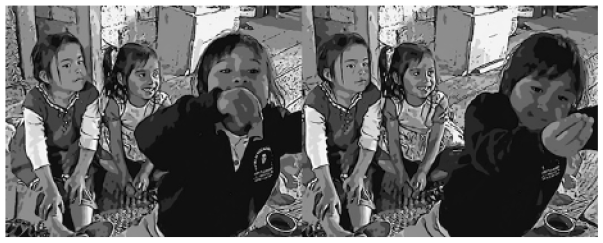
The family of Regina and Angelica believed that the children should make explicit requests in a culturally appropriate manner to obtain something that they desired from me, the author. The requests involved the production of the directional verb
(4) ‘You, she (=Martha), you give her (the orange).’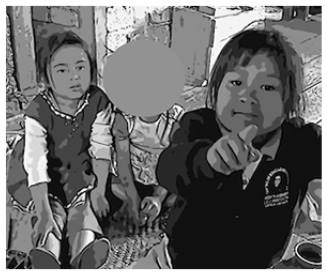

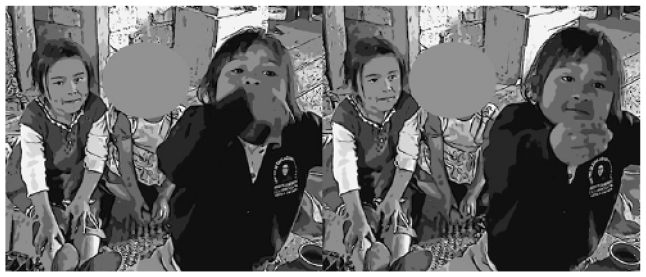 beginning and ending of
The verb form of
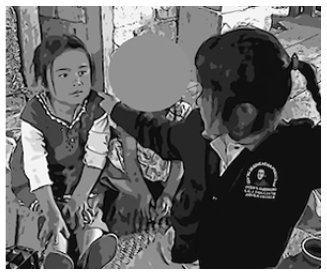
Regina was present at the time of the utterance, sitting at the table, and witnessed Angelica’s request. As soon as Angelica finished making her request, Regina waved to get her attention and subsequently demonstrated a different verb form,
(5)
beginning, middle, and ending of ‘You, you give, you give her (the orange).’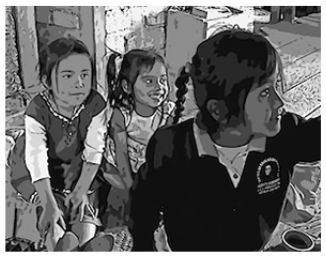 (Angelica looks at Regina)
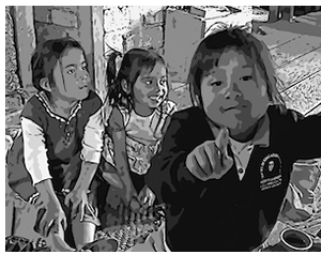
 beginning and ending of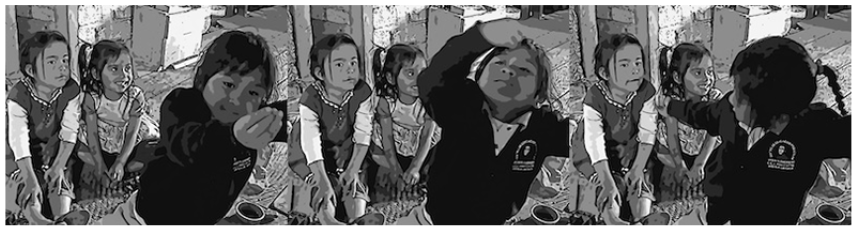
The above example contains a sequence of two verb forms of
Regina’s directive functioned as corrective feedback for Angelica to make an explicit request in a culturally appropriate manner, which entailed producing the appropriate verb form of
Asking questions: clarifying intentions about gifts
Signers employ directional verbs to ask questions, and that includes clarifying the intentions of one’s actions of giving gifts to other people. One day, I gifted Regina a bag of fruit that was intended to be distributed to the whole family. Alberta, Regina’s aunt, witnessed the gifting event and asked me if I was indeed giving them the fruit. She first pointed to me and then produced a sequence of
On another day, I was observing the girls playing in the kitchen. There was a bag of passion fruits on the floor. The fruit has been recently harvested from the family’s garden. I asked Martha for one, and she promptly gave it to me before she went back to playing. I was unsure about how to ‘open’ it without a knife, so I asked Angelica for assistance, to which she obliged. I handed her the fruit. Martha was paying attention to something else with her back to us and then turned around to see Angelica taking the fruit from my hand. As Angelica bit into the fruit, Martha tapped her on the arm and asked her with raised eyebrows, ‘Is she giving you the fruit to eat?’, as shown in (6). Her question was to clarify the intention of my action. Angelica turned her head in the direction of my face, as evidenced in the last film still, and pointed to me in response, thereby denying that I was giving the fruit to her for consumption and clarifying that she was breaking the fruit for my consumption.
(6)
‘Is she giving you (the fruit) for eating?’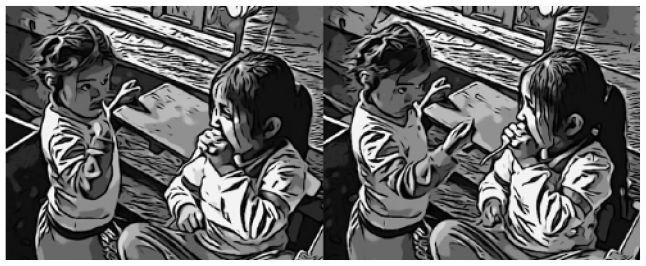 beginning and ending of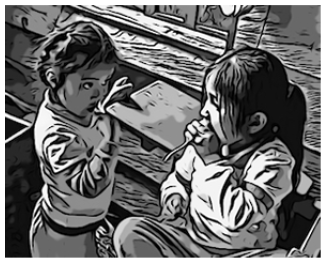
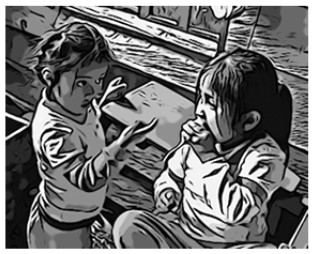
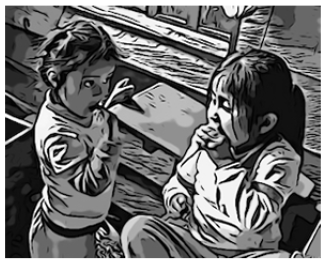
In this family, it was important to understand my intentions with regard to gifts, particularly given that I was not a ‘regular’ member of the local kinship network and did not fully participate in local customs that configured the reciprocity within and among families. Alberta’s and Martha’s production of
Talking about hypothetical events: presenting or withholding gifts
In ‘making hands’, signers, like everyone else, talk about actual and hypothetical events in their everyday lives. The directional verbs
(7) ‘Alejo is going to give it(=the brown puppy) to me, and Regina is going to give it(=the black puppy) to them (=the neighbor)’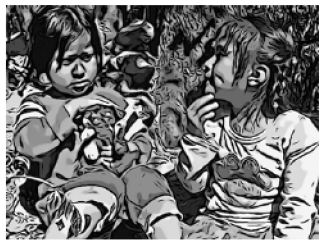
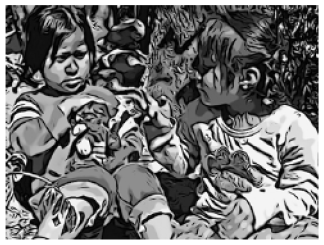
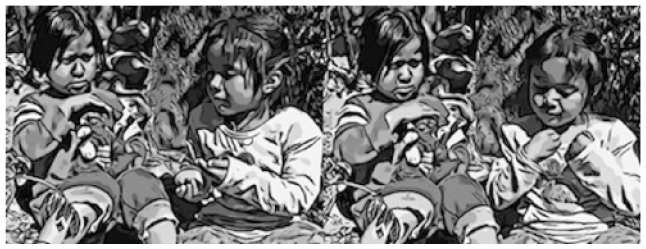 beginning and ending of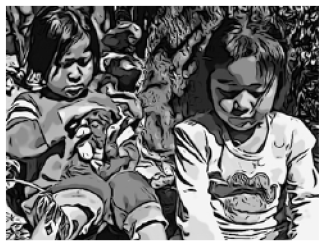
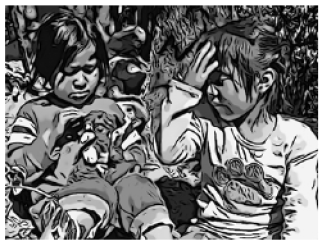
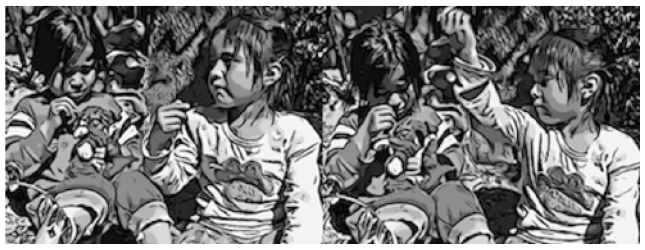 beginning and ending of
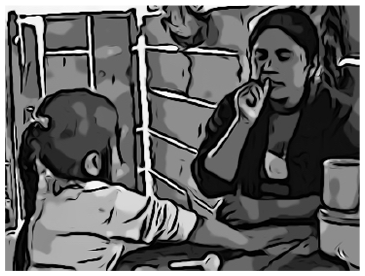
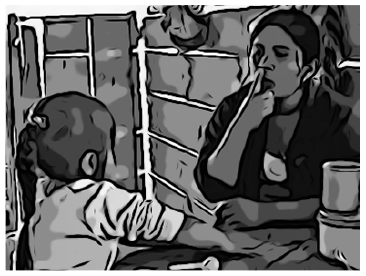
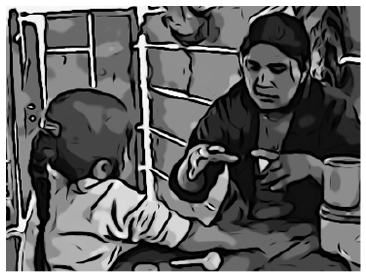
Another scene concerned the possibility of one taking away or withholding the gifts. In (8), Regina told Angelica that I was going to take away the lollipops, thereby potentially depriving the girl of her gift. The child-directed input consisted of Regina telling the girls whether they would receive a gift, which allowed Regina to assert herself as an authoritative expert on the girls’ future. One day, on the way to the family residence, I bought a bag of lollipops from a traveling vendor on the road and presented a few lollipops to the family. Angelica requested more lollipops, asking Regina, who replied that it was not her decision but my decision. Then Regina taunted Angelica, claiming that I was angry with the request and thus going to take home the rest of the lollipops without giving another lollipop.
(8) ‘She is angry about the lollipops [because you keep asking for more]. . . She’s going to take away the bag of lollipops, she’s not giving you a lollipop.’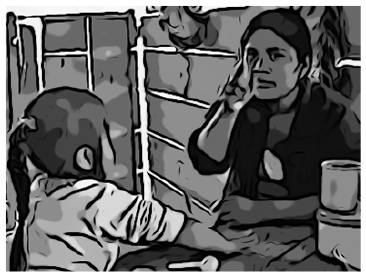
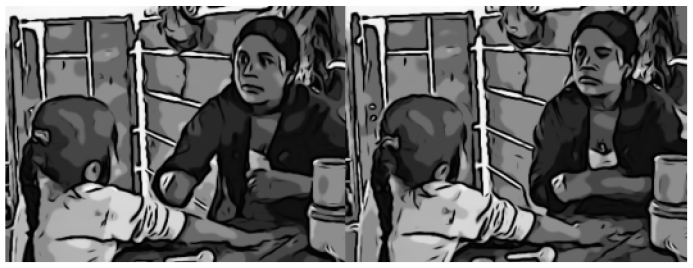 beginning and ending of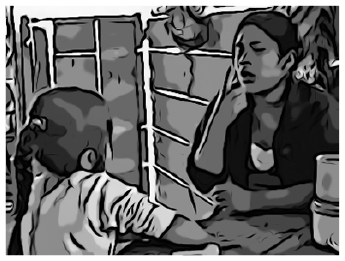
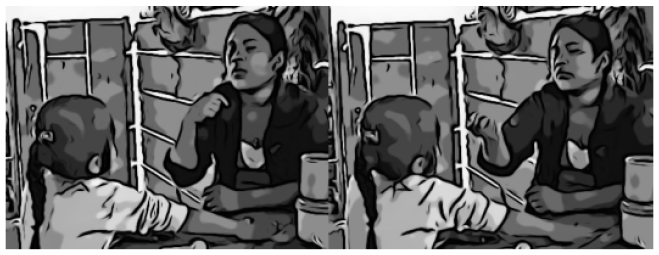 beginning and ending of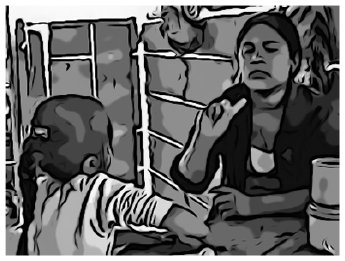
Regina’s taunting of her sister may be motivated by a moral imperative to socialize Angelica to not be greedy about asking for more lollipops from me or by a desire to ‘play’ with Angelica. In any case, the taunt worked well, perhaps rather too well – consequently, Angelica broke down in tears and did not make any explicit requests for another lollipop.
Discussion and conclusion
The goal of the present study was to take an ethnographically grounded approach to investigate the sociocultural context of children’s usage of directional verbs. The data shows the sociocultural context of the usage of directional verbs from a first-generation deaf adult signer and two second-generation child signers (one deaf and one hearing) in ‘making hands’. They use the verbs to make explicit requests for obtaining desired goods, to ask questions for clarification about one’s intentions, and to talk about hypothetical events. These communication functions are not limited to the children’s input but also occur in the adults’ input, which suggests that the children are learning about the cultural understandings and practices of allocating goods. The allocation of goods is part of larger cultural practices such as the celebration of marriage, compadrazgo (god-parenthood), and other rituals in the SJQ municipality (H. Cruz, 2014) as well as many other Mesoamerican communities.
The present study also addressed a gap in previous studies about children’s usage of directional verbs in different sign languages. These studies have focused more on the acquisition process of children’s errors and mastery in the production of verbs (Lillo-Martin & Henner, 2021, pp. 402–403), but these studies have not looked at how children use these verbs for different communicative functions and the connection of functions to larger cultural practices of the surrounding language ecology, and additionally, how the verbs how occur through child input and child-directed input from adult signers. In ‘making hands’, the children’s usage of directional verbs in ‘making hands’ may be facilitated by a mix of child-directed input in the form of directives from a deaf adult signer, extensive peer play, and visual access to signed adult interactions. This suggests that different types of input and interactions, not just child-directed input and dyadic interactions between a child and their mother, can contribute to children’s language learning and use.
There has been substantial research about the cognitive processes of sign language acquisition in diverse language ecologies but not as much research about the sociocultural processes, that is, how different types of social engagement, including input and interaction, provide the context for language learning. There is even less research about language learning in contexts where there are no educational institutions for the deaf available and no deaf of deaf signing families, and dyadic interactions are not necessarily the norm for children in general. In the case of ‘making hands’, the language ecology is further distinguished by a young sign language that emerged from two generations of deaf people in the SJQ municipality.
Such a scenario raises empirical questions about the processes of sign language acquisition and language socialization for deaf children in diverse language ecologies. There are numerous studies of sign language acquisition (Lillo-Martin & Henner, 2021) and a bit of research on sign language socialization (Erting & Kuntze, 2008), but these studies are primarily based on dyadic interactions between deaf children and their deaf signing parents, and deaf children of hearing parents in educational institutions for the deaf in Western societies. Less is known about deaf children of deaf signing parents and deaf children of hearing parents who use small-scale sign languages in rural, non-Western societies. Furthermore, there are no quantitative studies about signed input and even comparative, quantitative studies about child-directed input and overseen input; such studies have not been conducted due to theoretical and methodological challenges for capturing most or all of signed interactions on camera and distinguishing and counting signs in a stream of fluent signing. Future qualitative and ethnographic studies of sign language acquisition and socialization of different language ecologies can shed insight into different types of input that deaf children receive and the interactional configurations in which input occurs.
The case study of children’s development of directional verbs in making hands informs us about the sociocultural process of language learning in a language ecology in the context of a Mesoamerican (Chatino) ecology. The ecology is configured by shared cultural beliefs, understandings, and practices in relation to the development of linguistic and sociocultural competence in children, in which they are expected to learn how to use language appropriately through a combination of observation and child-directed input from other children and adults. As the children are learning a sign language here, they rely on vision for communicating with one another and for accessing visual input that occurs in directed and overseen input. Deaf adult caregivers engage in visual access for providing directed input to children about appropriate language use for communicative competence. More importantly, deaf and hearing signing children engage in peer play, which offers them the indispensable opportunity to use their language in a predominantly hearing and speaking world.
Footnotes
Acknowledgements
The author expresses her indebted gratitude to the people of the SJQ municipality for their hospitality and collaboration. She also thanks the guest editors Lourdes de León and Pedro Mateo Pedro, for the invitation to contribute to the special issue, Chloë Marshall for their support, and the two anonymous reviewers for their feedback. Finally, the author also thanks Laura Horton for her feedback on an earlier draft of the manuscript.
Author contribution
Funding
The author(s) disclosed receipt of the following financial support for the research, authorship, and/or publication of this article: The research presented here was supported by Endangered Languages Documentation Programme SG0186, the National Science Foundation Doctoral Dissertation Research Improvement under grant BCS-1348497, and the National Institute on Deafness and other Communication Disorders of the National Institutes of Health under award number F31DC1397202. The content is solely the responsibility of the author and does not necessarily represent the official views of the National Institutes of Health.
